International Journal of Evaluation and Research in Education (IJERE)
Vol. 14, No. 1, February 2025, pp. 229~239
ISSN: 2252-8822, DOI: 10.11591/ijere.v14i1.28342  229
Journal homepage: http://ijere.iaescore.com
Students’ metacognitive activities in contextual mathematical
problem solving
Yustinus Wangguway, Toto Nusantara, Sudirman, Susiswo
Department of Mathematics, Faculty of Mathematics and Natural Sciences, Universitas Negeri Malang, Malang, Indonesia
Article Info ABSTRACT
Article history:
Received Aug 15, 2023
Revised Aug 11, 2024
Accepted Sep 26, 2024
Metacognition is essential in supporting students’ academic success,
problem-solving abilities, and overall achievement. Therefore, this study
aimed to provide a detailed description of metacognitive activities of
students when engaging in contextual mathematical problem-solving. The
participants comprised 11th-grade students from SMA Negeri 3 Jayapura,
Papua Province, Indonesia. Descriptive and qualitative methods were
adopted, and the data were collected using various test instruments and
interview guidelines. Subsequently, the data were analyzed through the
phases of reduction, presentation, as well as conclusions, and triangulation
methods were used to ensure robustness and reliability. The results showed
that metacognitive awareness occurred when students considered previous
knowledge and experiences in solving contextual mathematical problem.
Metacognitive evaluation activities occurred when relevant methods and
steps were assessed, while metacognitive regulation manifested when
contemplating the actions required to solve problem. This showed that
students used various metacognitive activities, namely awareness,
evaluation, and regulation, to address contextual mathematical problem.
Keywords:
Contextual mathematical
Metacognitive
Metacognitive awareness
Metacognitive evaluation
Metacognitive regulation
This is an open access article under the CC BY-SA license.
Corresponding Author:
Toto Nusantara
Department of Mathematics, Faculty of Mathematics and Natural Sciences, Universitas Negeri Malang
Cakrawala street, No. 5, Sumbersari, Lowokwaru District, Malang City, East Java, Indonesia
Email: toto.nusantara.fmipa@um.ac.id
1. INTRODUCTION
Metacognition is essential in supporting students' academic success, problem-solving abilities, and
overall achievement. Studies have consistently shown that students with excellent metacognition tended to
use effective problem-solving strategies [1]–[3]. The awareness of this skill significantly enhanced
information processing within long-term memory, and also facilitated information, perception, and memory
[4]–[6]. A meta-analysis on metacognition indicated that when awareness occurred in an individual, it could
remain relatively unchanged throughout developmental stages and into elderly years [7]. Therefore, this
cognitive construction was strongly correlated to individual intelligence [6].
Several studies have confirmed the crucial role of metacognition in problem-solving skills and
general intelligence [7]. For instance, Berardi-Coletta et al. [8] found that people with higher metacognition
exhibited significantly better problem-solving strategies in training and task transfer compared to those with
lower abilities. Rickey and Stacey [9] also suggested that the enhancement of metacognition improved
problem-solving abilities. Cikrici and Odaci [10] described metacognition as a crucial component for
advanced mental performance and effective learning process.
Metacognition can be assessed in students during problem-solving processes using specific
indicators. Schraw and Dennison [11] developed metacognitive awareness inventory (MAI), which
 ISSN: 2252-8822
Int J Eval & Res Educ, Vol. 14, No. 1, February 2025: 229-239
230
comprised metacognitive components, namely declarative knowledge, procedural knowledge, conditional
knowledge, planning, information management strategies, monitoring understanding, debugging methods,
and learning evaluation. Wilson and Clarke [12] also formulated three metacognitive activities, namely
awareness, evaluation, and regulation, in solving mathematical problem.
Several improvements in mathematical education mainly focus on mathematical reasoning, problem-
solving skills, and their applicability in real-life situations. The use of real-life cases or contexts in mathematical
learning also aids students in comprehending abstract concepts by constructing their thoughts from familiar and
realistic situations [13]. Context is defined as a recognizable situation that captures students attention [14]. This
situation can either be imaginary or authentic, aiding students to recall the existing knowledge acquired through
experience, such as informal problem-solving procedures. It can also foster a meaningful learning process [13],
as appropriate learning context guides toward active thinking processes [15].
The use of contextual math problem is essential for enabling students to develop more complex
thinking patterns, as they engage both formal and informal mathematical knowledge. Furthermore, by solving
contextual mathematical problem, students are encouraged to unleash their full psychological potential,
specifically regarding cognitive processes [1]. The objective is to motivate students to understand the subject
matter [16], [17], as this enhances their metacognition in solving contextual problem [18], [19]. Problem-
solving is a complex process that includes several cognitive operations, such as gathering and selecting
information, heuristic, and metacognitive strategies [20]. Metacognition is an important strategy associated
with academic achievement and problem-solving ability since it comprises self-examination, cognitive
strategies, awareness, and thoughtful planning [21]. Metacognitive-based contextual learning effectively
enhances problem-solving and mathematical communication skills, making it a recommended method for
teaching mathematical [18].
An empirical study conducted at State Senior High School 3 Jayapura, Papua, Indonesia, suggested
that students had poor mathematical problem-solving skills. Furthermore, interviews with teachers showed that
students still struggled with daily exercises due to the complexity of understanding the narratives of questions.
This result was consistent with Tjalla and Putriyani [22], stating that students generally had poor metacognition
and frequently struggled with activities requiring metacognitive awareness, specifically, solving of
mathematical problem. Therefore, the current study aimed to develop an alternative method to help students
solve mathematical problem, using contextual math questions. The use of contextual questions could enhance
the motivation to solve problem and comprehend learning materials. Another objective was to improve students'
metacognition and environmental awareness. This was in line with Mumu and Tanujaya [23], showing that the
use of environmental math problem relevant to the context of students could improve metacognition and
awareness of environmental problem.
Several studies have described the importance of metacognitive awareness in learning mathematical,
specifically in mathematical proving [24], informal deductive thinking in geometric exercises [25], [26], literacy
[18], [27], [28], problem-solving [29]–[32], positioning and emotion in mathematical activities [10], [33], and
enhancing mathematical skills [34], [35]. While these investigations solely described metacognitive processes of
students and their relationships with mathematical problem-solving and thinking skills, the current study
focused on metacognitive activities in solving contextual mathematical problem. This area of study was relevant
as it represented the capacity of students to regulate information processing in their long-term memory. In
addition, this skill exhibits relative consistency throughout the developmental trajectory of an individual into
advanced age. This study analyzed and described metacognitive activities of high school students in solving
contextual mathematical problem. In addition, the indicator proposed by Wilson and Clarke [12], which
integrated the Polya problem-solving stages was adopted to evaluate students' metacognition.
2. METHOD
Descriptive and qualitative methods were specifically used in this study to effectively describe
students’ metacognitive activities in solving contextual mathematical problem. These methods were also used
due to the nature of the collected data, which primarily consisted of textual information in the form of
sentences [36]. A similar method had been used in some studies on metacognition [14], [37], [38]. The
participants comprised eleventh graders from State Senior High School 3 Jayapura, Indonesia. Contextual
mathematical problem-solving test was administered to 25 students in the first stage of participant selection,
while those who successfully completed the test and provided think-aloud responses were chosen in the
second stage. The three students who fulfilled these criteria were identified as PK, VP, and EDM. Other
studies with similar objective and sample size were [39]–[43].
Data collection was carried out using test instruments and think-aloud methods, as well as interview
guidelines, which were validated by mathematical expert at the State University of Malang. The validation
results showed that the instrument was suitable for achieving the study objectives. Interviews were conducted
Int J Eval & Res Educ ISSN: 2252-8822 
Students metacognitive activities in contextual mathematical problem solving (Yustinus Wangguway)
231
to clarify the results of the written test and capture metacognitive thoughts or processes of students. The
interviews were also carried out to confirm the results of the think-aloud process, which had been video
recorded. This method was adopted because not all metacognitive indicators were evident in the written
responses, and some thinking processes could not be adequately transcribed into an answer sheet. The
context of mathematical problem is shown in Figure 1.
Figure 1. Contextual mathematical exercise
The data analysis adhered to the model outlined by Miles et al. [44], and was conducted
interactively and continuously until data saturation was achieved. The analysis was completed through three
stages, namely data reduction, show, and verification or conclusion drawing. A triangulation method was
used to ensure data credibility and validity assessment. Source triangulation was specifically adopted,
wherein the reliability of information obtained from observations and interviews was compared and verified.
The analysis commenced with the distribution of tests to the participants, who were instructed to
engage in think-aloud process. The video recordings of participant metacognition in solving contextual math
problem, were subsequently analyzed. The think-aloud results and interviews from each participant were
analyzed based on the modified metacognitive indicators proposed by Wilson and Clarke [12]. Table 1
presents the description code for metacognitive activities in solving contextual mathematical problem.
Table 1. Description code for students’ metacognitive activities in solving contextual mathematical problem
Metacognitive
activities
Wilson and Clarke [12] Indicators Code
Metacognitive
awareness (AM)
Activities related to individual awareness
during problem-solving process using
specific content knowledge and the
knowledge about personal learning or
problem-solving strategies. This includes
what needs to be done, what has been done,
and what should be done in solving
problem.
1. Thinking about knowledge related to the
provided problem
2. Thinking about past experiences similar
to the provided problem
3. Thinking about the strategies to solve
problem
4. Thinking about the possible alternative
to solve problem
AM1
AM2
AM3
AM4
Metacognitive
evaluation (EM)
Activities related to individual judgments
about the processes, capacities, and
limitations of thinking when solving
problem. For example, judgments about the
effectiveness of thinking or strategy can be
formulated.
1. Thinking about the possible steps to
solve problem
2. Thinking and examining the steps of
solving mathematical problem
3. Thinking of the appropriate problem-
solving strategy
4. Thinking of the successful possibility to
solve problem
EM1
EM2
EM3
EM4
Metacognitive
regulation (RM)
Occurs when metacognition is used in
directing knowledge and thoughts.
1. Formulating the plan for solving
mathematical problem
2. Thinking of adopting a different
mathematical problem-solving strategy
3. Thinking about the next strategy to solve
mathematical problem
4. Thinking of adopting different strategies
to solve mathematical problem
RM1
RM2
RM3
RM4
3. RESULTS AND DISCUSSION
3.1. Results
The description of students’ metacognitive process in solving contextual mathematical problem is
presented in the following section. Three students identified as PK, VP, and EDM were extracted to describe
the students’ metacognitive activity process. The data on metacognitive activities were obtained using think-
aloud method, in conjunction with written answers and interview test results.
3.1.1. Metacognitive activities of the first participant (PK)
The results of the think-aloud session and written tests on contextual mathematical problem
suggested that PK exhibited metacognitive awareness in solving problem. Metacognitive process included
Beto and Boas went shopping at the Jayapura Mall, and were interested in the clothes brands A and B. Beto bought two brand A clothes
and three brand B clothes for IDR 900,000. Boas bought three brand A clothes and two brand B clothes for 850,000.
a. Without calculating the actual price, which brand is more expensive? Describe your reasons.
b. How much does one brand A shirt cost? How do you calculate it?
 ISSN: 2252-8822
Int J Eval & Res Educ, Vol. 14, No. 1, February 2025: 229-239
232
the identification of information from the provided problem (AM1), reflecting on past experiences (AM2),
and formulating a strategy to solve problem (AM3). In AM1, PK recorded essential information on
worksheet, showed an awareness of relevant information for solving contextual problem, and was capable of
communicating using mathematical symbols. During AM2, PK recalled prior experiences in solving similar
situations, and also formulated a strategy, particularly substitution and elimination methods for AM3.
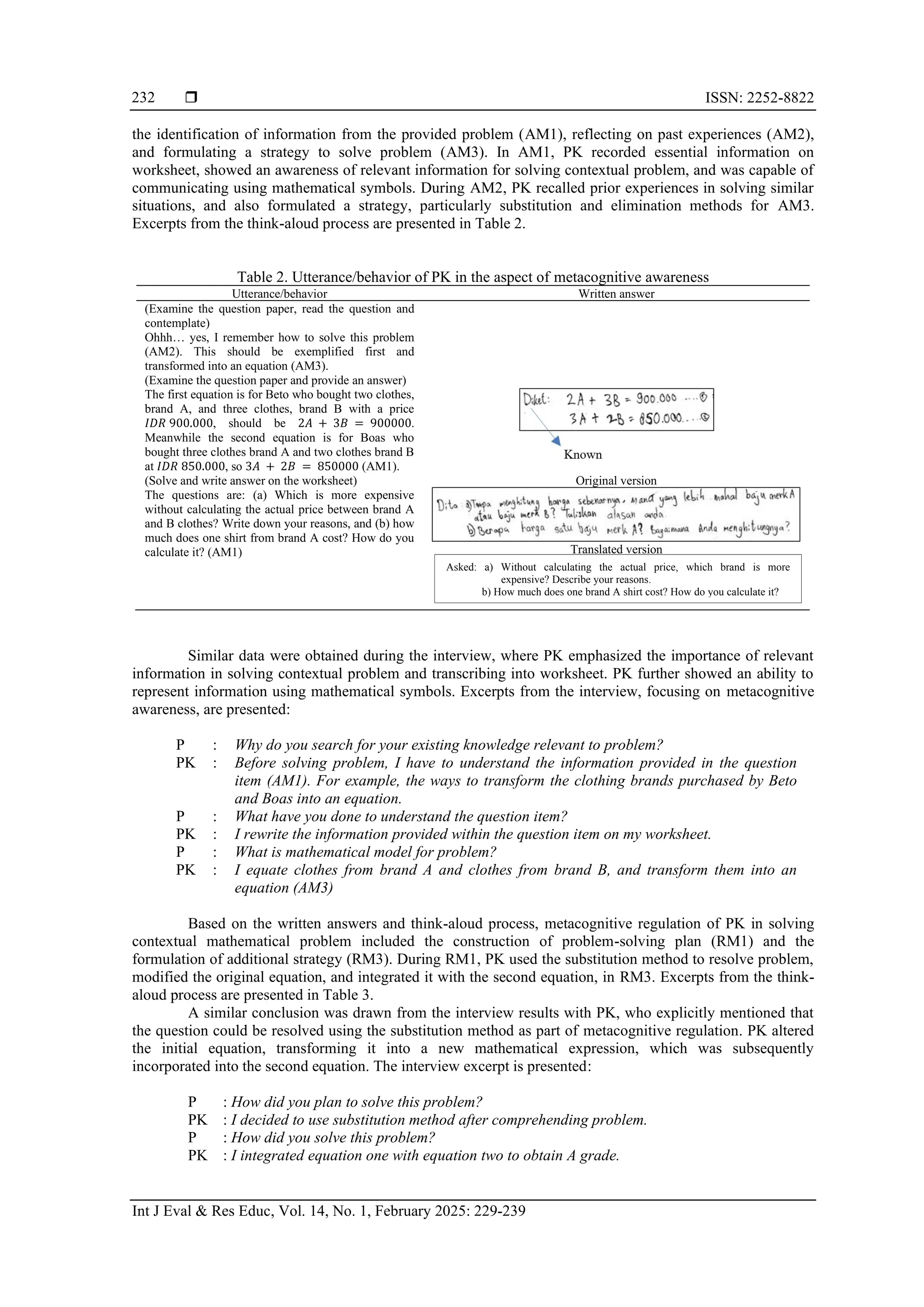
Excerpts from the think-aloud process are presented in Table 2.
Table 2. Utterance/behavior of PK in the aspect of metacognitive awareness
Utterance/behavior Written answer
(Examine the question paper, read the question and
contemplate)
Ohhh… yes, I remember how to solve this problem
(AM2). This should be exemplified first and
transformed into an equation (AM3).
(Examine the question paper and provide an answer)
The first equation is for Beto who bought two clothes,
brand A, and three clothes, brand B with a price
𝐼𝐷𝑅 900.000, should be 2𝐴 + 3𝐵 = 900000.
Meanwhile the second equation is for Boas who
bought three clothes brand A and two clothes brand B
at 𝐼𝐷𝑅 850.000, so 3𝐴 + 2𝐵 = 850000 (AM1).
(Solve and write answer on the worksheet)
The questions are: (a) Which is more expensive
without calculating the actual price between brand A
and B clothes? Write down your reasons, and (b) how
much does one shirt from brand A cost? How do you
calculate it? (AM1)
Original version
Translated version
Similar data were obtained during the interview, where PK emphasized the importance of relevant
information in solving contextual problem and transcribing into worksheet. PK further showed an ability to
represent information using mathematical symbols. Excerpts from the interview, focusing on metacognitive
awareness, are presented:
P : Why do you search for your existing knowledge relevant to problem?
PK : Before solving problem, I have to understand the information provided in the question
item (AM1). For example, the ways to transform the clothing brands purchased by Beto
and Boas into an equation.
P : What have you done to understand the question item?
PK : I rewrite the information provided within the question item on my worksheet.
P : What is mathematical model for problem?
PK : I equate clothes from brand A and clothes from brand B, and transform them into an
equation (AM3)
Based on the written answers and think-aloud process, metacognitive regulation of PK in solving
contextual mathematical problem included the construction of problem-solving plan (RM1) and the
formulation of additional strategy (RM3). During RM1, PK used the substitution method to resolve problem,
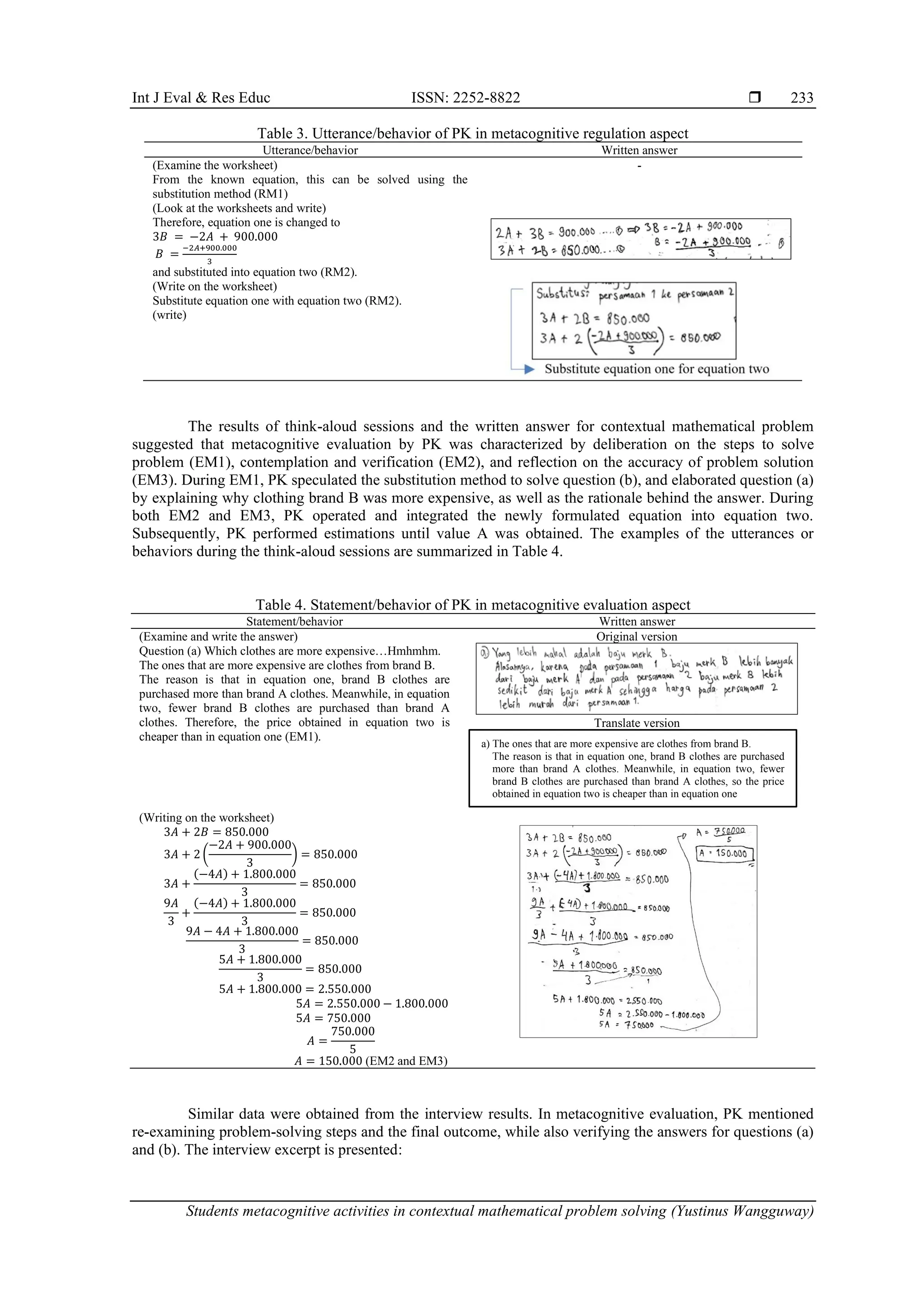
modified the original equation, and integrated it with the second equation, in RM3. Excerpts from the think-
aloud process are presented in Table 3.
A similar conclusion was drawn from the interview results with PK, who explicitly mentioned that
the question could be resolved using the substitution method as part of metacognitive regulation. PK altered
the initial equation, transforming it into a new mathematical expression, which was subsequently
incorporated into the second equation. The interview excerpt is presented:
P : How did you plan to solve this problem?
PK : I decided to use substitution method after comprehending problem.
P : How did you solve this problem?
PK : I integrated equation one with equation two to obtain A grade.
Asked: a) Without calculating the actual price, which brand is more
expensive? Describe your reasons.
b) How much does one brand A shirt cost? How do you calculate it?
Int J Eval & Res Educ ISSN: 2252-8822 
Students metacognitive activities in contextual mathematical problem solving (Yustinus Wangguway)
233
Table 3. Utterance/behavior of PK in metacognitive regulation aspect
Utterance/behavior Written answer
(Examine the worksheet)
From the known equation, this can be solved using the
substitution method (RM1)
-
(Look at the worksheets and write)
Therefore, equation one is changed to
3𝐵 = −2𝐴 + 900.000
𝐵 =
−2𝐴+900.000
3
and substituted into equation two (RM2).
(Write on the worksheet)
Substitute equation one with equation two (RM2).
(write)
The results of think-aloud sessions and the written answer for contextual mathematical problem
suggested that metacognitive evaluation by PK was characterized by deliberation on the steps to solve
problem (EM1), contemplation and verification (EM2), and reflection on the accuracy of problem solution
(EM3). During EM1, PK speculated the substitution method to solve question (b), and elaborated question (a)
by explaining why clothing brand B was more expensive, as well as the rationale behind the answer. During
both EM2 and EM3, PK operated and integrated the newly formulated equation into equation two.
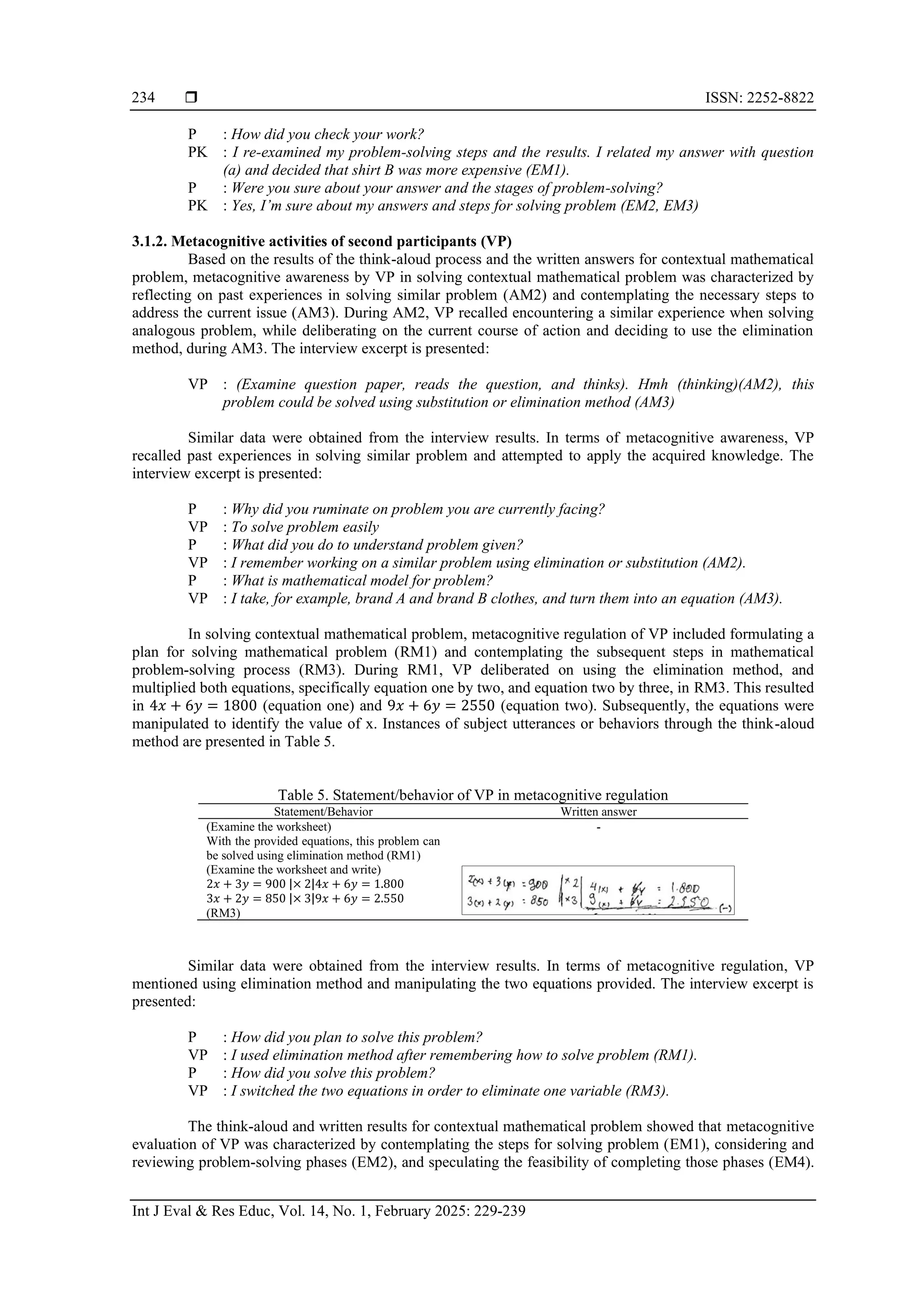
Subsequently, PK performed estimations until value A was obtained. The examples of the utterances or
behaviors during the think-aloud sessions are summarized in Table 4.
Table 4. Statement/behavior of PK in metacognitive evaluation aspect
Statement/behavior Written answer
(Examine and write the answer)
Question (a) Which clothes are more expensive…Hmhmhm.
The ones that are more expensive are clothes from brand B.
The reason is that in equation one, brand B clothes are
purchased more than brand A clothes. Meanwhile, in equation
two, fewer brand B clothes are purchased than brand A
clothes. Therefore, the price obtained in equation two is
cheaper than in equation one (EM1).
Original version
Translate version
(Writing on the worksheet)
3𝐴 + 2𝐵 = 850.000
3𝐴 + 2 (
−2𝐴 + 900.000
3
) = 850.000
3𝐴 +
(−4𝐴) + 1.800.000
3
= 850.000
9𝐴
3
+
(−4𝐴) + 1.800.000
3
= 850.000
9𝐴 − 4𝐴 + 1.800.000
3
= 850.000
5𝐴 + 1.800.000
3
= 850.000
5𝐴 + 1.800.000 = 2.550.000
5𝐴 = 2.550.000 − 1.800.000
5𝐴 = 750.000
𝐴 =
750.000
5
𝐴 = 150.000 (EM2 and EM3)
Similar data were obtained from the interview results. In metacognitive evaluation, PK mentioned
re-examining problem-solving steps and the final outcome, while also verifying the answers for questions (a)
and (b). The interview excerpt is presented:
a) The ones that are more expensive are clothes from brand B.
The reason is that in equation one, brand B clothes are purchased
more than brand A clothes. Meanwhile, in equation two, fewer
brand B clothes are purchased than brand A clothes, so the price
obtained in equation two is cheaper than in equation one
 ISSN: 2252-8822
Int J Eval & Res Educ, Vol. 14, No. 1, February 2025: 229-239
234
P : How did you check your work?
PK : I re-examined my problem-solving steps and the results. I related my answer with question
(a) and decided that shirt B was more expensive (EM1).
P : Were you sure about your answer and the stages of problem-solving?
PK : Yes, I’m sure about my answers and steps for solving problem (EM2, EM3)
3.1.2. Metacognitive activities of second participants (VP)
Based on the results of the think-aloud process and the written answers for contextual mathematical
problem, metacognitive awareness by VP in solving contextual mathematical problem was characterized by
reflecting on past experiences in solving similar problem (AM2) and contemplating the necessary steps to
address the current issue (AM3). During AM2, VP recalled encountering a similar experience when solving
analogous problem, while deliberating on the current course of action and deciding to use the elimination
method, during AM3. The interview excerpt is presented:
VP : (Examine question paper, reads the question, and thinks). Hmh (thinking)(AM2), this
problem could be solved using substitution or elimination method (AM3)
Similar data were obtained from the interview results. In terms of metacognitive awareness, VP
recalled past experiences in solving similar problem and attempted to apply the acquired knowledge. The
interview excerpt is presented:
P : Why did you ruminate on problem you are currently facing?
VP : To solve problem easily
P : What did you do to understand problem given?
VP : I remember working on a similar problem using elimination or substitution (AM2).
P : What is mathematical model for problem?
VP : I take, for example, brand A and brand B clothes, and turn them into an equation (AM3).
In solving contextual mathematical problem, metacognitive regulation of VP included formulating a
plan for solving mathematical problem (RM1) and contemplating the subsequent steps in mathematical
problem-solving process (RM3). During RM1, VP deliberated on using the elimination method, and
multiplied both equations, specifically equation one by two, and equation two by three, in RM3. This resulted
in 4𝑥 + 6𝑦 = 1800 (equation one) and 9𝑥 + 6𝑦 = 2550 (equation two). Subsequently, the equations were
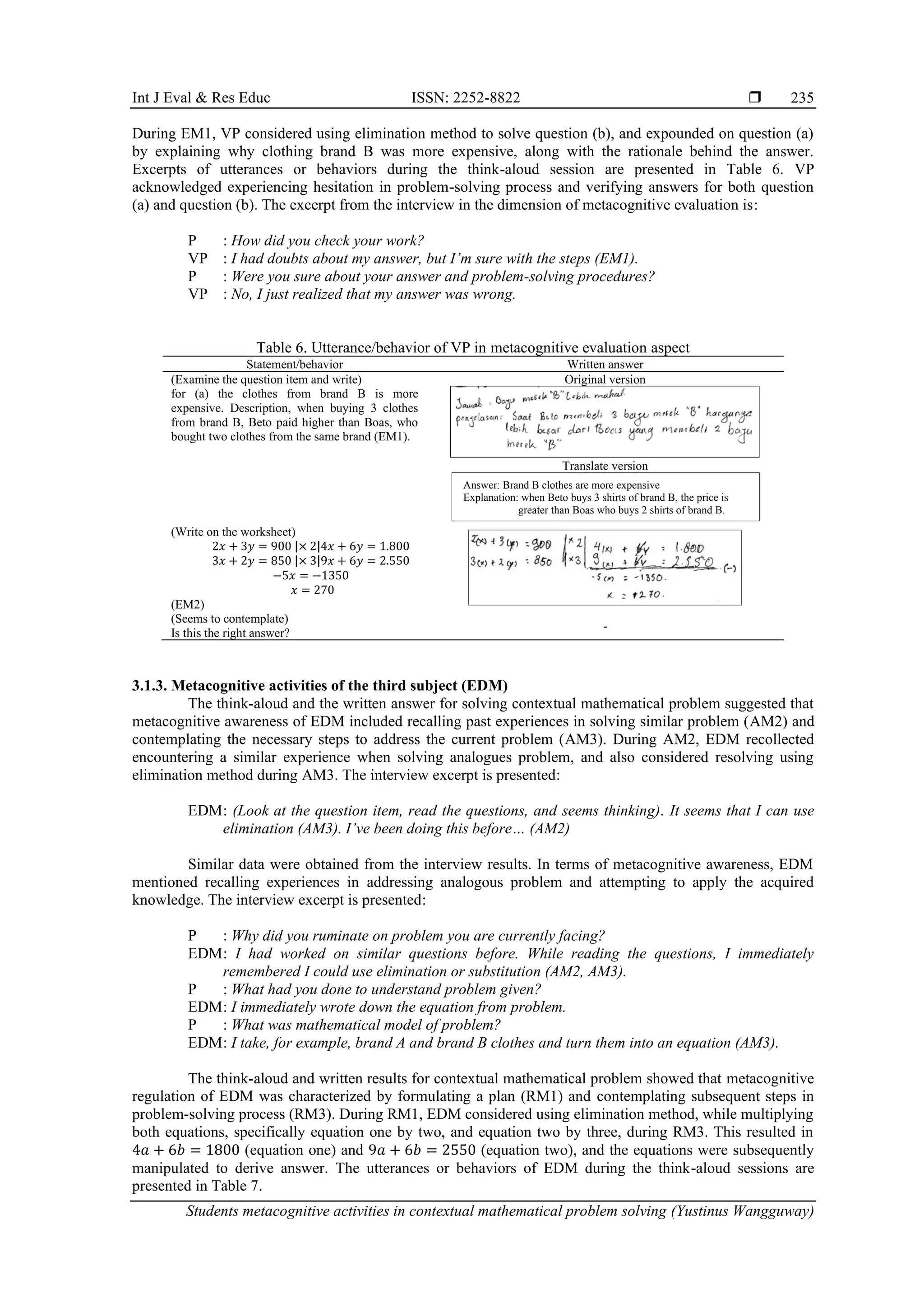
manipulated to identify the value of x. Instances of subject utterances or behaviors through the think-aloud
method are presented in Table 5.
Table 5. Statement/behavior of VP in metacognitive regulation
Statement/Behavior Written answer
(Examine the worksheet)
With the provided equations, this problem can
be solved using elimination method (RM1)
-
(Examine the worksheet and write)
2𝑥 + 3𝑦 = 900 |× 2|4𝑥 + 6𝑦 = 1.800
3𝑥 + 2𝑦 = 850 |× 3|9𝑥 + 6𝑦 = 2.550
(RM3)
Similar data were obtained from the interview results. In terms of metacognitive regulation, VP
mentioned using elimination method and manipulating the two equations provided. The interview excerpt is
presented:
P : How did you plan to solve this problem?
VP : I used elimination method after remembering how to solve problem (RM1).
P : How did you solve this problem?
VP : I switched the two equations in order to eliminate one variable (RM3).
The think-aloud and written results for contextual mathematical problem showed that metacognitive
evaluation of VP was characterized by contemplating the steps for solving problem (EM1), considering and
reviewing problem-solving phases (EM2), and speculating the feasibility of completing those phases (EM4).
Int J Eval & Res Educ ISSN: 2252-8822 
Students metacognitive activities in contextual mathematical problem solving (Yustinus Wangguway)
235
During EM1, VP considered using elimination method to solve question (b), and expounded on question (a)
by explaining why clothing brand B was more expensive, along with the rationale behind the answer.
Excerpts of utterances or behaviors during the think-aloud session are presented in Table 6. VP
acknowledged experiencing hesitation in problem-solving process and verifying answers for both question
(a) and question (b). The excerpt from the interview in the dimension of metacognitive evaluation is:
P : How did you check your work?
VP : I had doubts about my answer, but I’m sure with the steps (EM1).
P : Were you sure about your answer and problem-solving procedures?
VP : No, I just realized that my answer was wrong.
Table 6. Utterance/behavior of VP in metacognitive evaluation aspect
Statement/behavior Written answer
(Examine the question item and write)
for (a) the clothes from brand B is more
expensive. Description, when buying 3 clothes
from brand B, Beto paid higher than Boas, who
bought two clothes from the same brand (EM1).
Original version
Translate version
(Write on the worksheet)
2𝑥 + 3𝑦 = 900 |× 2|4𝑥 + 6𝑦 = 1.800
3𝑥 + 2𝑦 = 850 |× 3|9𝑥 + 6𝑦 = 2.550
−5𝑥 = −1350
𝑥 = 270
(EM2)
(Seems to contemplate)
Is this the right answer?
-
3.1.3. Metacognitive activities of the third subject (EDM)
The think-aloud and the written answer for solving contextual mathematical problem suggested that
metacognitive awareness of EDM included recalling past experiences in solving similar problem (AM2) and
contemplating the necessary steps to address the current problem (AM3). During AM2, EDM recollected
encountering a similar experience when solving analogues problem, and also considered resolving using
elimination method during AM3. The interview excerpt is presented:
EDM: (Look at the question item, read the questions, and seems thinking). It seems that I can use
elimination (AM3). I’ve been doing this before… (AM2)
Similar data were obtained from the interview results. In terms of metacognitive awareness, EDM
mentioned recalling experiences in addressing analogous problem and attempting to apply the acquired
knowledge. The interview excerpt is presented:
P : Why did you ruminate on problem you are currently facing?
EDM: I had worked on similar questions before. While reading the questions, I immediately
remembered I could use elimination or substitution (AM2, AM3).
P : What had you done to understand problem given?
EDM: I immediately wrote down the equation from problem.
P : What was mathematical model of problem?
EDM: I take, for example, brand A and brand B clothes and turn them into an equation (AM3).
The think-aloud and written results for contextual mathematical problem showed that metacognitive
regulation of EDM was characterized by formulating a plan (RM1) and contemplating subsequent steps in
problem-solving process (RM3). During RM1, EDM considered using elimination method, while multiplying
both equations, specifically equation one by two, and equation two by three, during RM3. This resulted in
4𝑎 + 6𝑏 = 1800 (equation one) and 9𝑎 + 6𝑏 = 2550 (equation two), and the equations were subsequently
manipulated to derive answer. The utterances or behaviors of EDM during the think-aloud sessions are
presented in Table 7.
Answer: Brand B clothes are more expensive
Explanation: when Beto buys 3 shirts of brand B, the price is
greater than Boas who buys 2 shirts of brand B.
 ISSN: 2252-8822
Int J Eval & Res Educ, Vol. 14, No. 1, February 2025: 229-239
236
Table 7. Utterance/ behavior of EDM in metacognitive regulation aspect
Utterance/behavior Written answer
(See worksheet)
The two provided equations allow the use of
elimination method, making it an easy task (RM1)
-
(Examine the worksheet and write)
2𝑎 + 3𝑏 = 900 |× 2|4𝑎 + 6𝑏 = 1.800
3𝑎 + 2𝑏 = 850 |× 3|9𝑎 + 6𝑏 = 2.550
(RM3)
Concordant data were obtained from the interview results, wherein EDM mentioned the potential
use of elimination method to solve problem, while manipulating both equations formed. The interview
excerpt is presented:
P : How did you plan to solve this problem?
EDM: I used the elimination method (RM1).
P : How did you complete the answer?
EDM: I substituted the two equations to eliminate one variable (RM3).
The think-aloud results and the written answers for contextual mathematical problem showed that
metacognitive evaluation by EDM was characterized by contemplating the steps to solve problem (EM1),
considering and reviewing the steps (EM2), and evaluating the validity of the solution (EM3). During EM1
stage, EDM deliberated on using elimination method to answer question (b), elaborated on question (a), and
explained that clothing brand B was more expensive. The interview excerpt is presented in Table 8. Similar
data were obtained from the interview results, wherein EDM expressed instances of uncertainty regarding the
provided answers and problem-solving stages, while verifying the answers for questions (a) and (b).
P : How did you check your work?
VP : I was confident in my work and had checked it (EM1).
P : Were you sure about your answer and the actions you took in solving problem?
VP : Yes (EM3)
Table 8. Statement/behavior of EDM in metacognitive evaluation aspect
Statement/behavior Written answer
(Examine and write)
I think it is brand B clothes because when Beto
bought 3 B clothes, he paid higher than Boas, who
bought 2 clothes from the same brand (EM1).
Original version
Translate version
(Write on the worksheet)
2𝑎 + 3𝑏 = 900 (× 2) → 4𝑎 + 6𝑏 = 1800
3𝑎 + 2𝑏 = 800 (× 3) → 9𝑎 + 6𝑏 = 2550
−5𝑎 = −750
𝑎 =
−750
−5
= 150
Therefore, cloth from brand A=IDR 150.000 (EM2)
3.2. Discussion
The analysis showed that all participants engaged in metacognitive activities, namely awareness,
evaluation, and regulation. metacognitive awareness occurred when students recognized that their prior
knowledge could assist in solving problem. This was in line with Wilson [12], stating that knowledge related
to problem constituted metacognitive awareness. Rofii et al. [25] also described the role of metacognitive
awareness during planning process to enhance knowledge and the effect on decision-making when selecting
or identifying alternative strategies. Furthermore, Arum et al. [29] identified components of metacognitive
awareness, including knowledge about cognition and cognitive regulation that impact the resolution of
mathematical problem among students.
I think it's shirt brand B, because when Beto buys 3 B shirts, he
gets a bigger total than Boas who buys 2 B shirts.
Int J Eval & Res Educ ISSN: 2252-8822 
Students metacognitive activities in contextual mathematical problem solving (Yustinus Wangguway)
237
The current study showed that metacognitive regulation occurred when the participants decided to
reconsider the steps repeatedly used before attempting different methods. Purnomo et al. [45] asserted that
the repeated checking of answers before reaching a conclusion was a characteristic of metacognitive
regulation activities. Metacognitive regulation refers to the mental activities used in managing cognitive
strategies in problem-solving [46]. This is specifically noted when participants alter problem-solving method,
while recording this alteration on the worksheet includes cognitive activities.
The results showed that metacognitive evaluation occurred when students judge their answers to be
correct after repeated checking. This was consistent with Magiera and Zawojewski [47], suggesting that
repetitive checks before making judgments reflected metacognitive evaluation. It can also occur when
judgements are made about the effectiveness of cognition or strategy used [5], [12].
Based on the explanation above, students engaged in metacognitive activities in the forms of
awareness, evaluation and regulation when solving contextual math problem. Metacognition plays an
important role in influencing the ability to solve problem, hence students who are aware of their
metacognition tend to use effective strategies [1], [9], [10], [12]. It is also related to the ability of students to
organize or evaluate thoughts, since they can control information processing [4], [5], [7]. The incorporation
of metacognitive activities into contextual mathematical problem solving can aid in identifying and rectifying
problem [29], [30], [33]. In addition, the integration of mathematical problem-solving with the environment
can enhance metacognition as well as the awareness of environmental issues [23]. Metacognitive-based
contextual learning typically improves problem-solving and mathematical communication skills, making it a
recommended method for teaching mathematical [18].
4. CONCLUSION
In conclusion, metacognitive activities experienced by participants in solving contextual
mathematical problem included metacognitive awareness, evaluation, and regulation. These three activities
occurred alternately with varying frequencies. The results showed that metacognitive process encouraged
students to engage more frequently in evaluating problem-solving processes. This indicated the importance of
training students to use metacognition when solving mathematical problem.
Following the conclusions, several recommendations were proposed to benefit educators and
educational practitioners. Firstly, the incorporation of metacognitive activities in problem-solving was crucial
as it instilled a habit of effectively engaging and managing knowledge. Secondly, students who were adept at
metacognition developed thinking patterns that were more critical, active, creative, and well-controlled when
encountering problem. Thirdly, the awareness of metacognition enhanced problem-solving skills. Fourthly,
the development or adaptation of mathematical problem into contextual forms was necessary to elevate both
mathematical problem-solving abilities and metacognition.
REFERENCES
[1] M. Anggo, Suhar, and Y. E. Y. Kansil, “Student’s Metacognitive Activities in Solving Mathematics Problems,” in Proceedings of
the 1st International Conference on Advanced Multidisciplinary Research (ICAMR 2018), 2019, vol. 227, pp. 16–20, doi:
10.2991/icamr-18.2019.5.
[2] Y. Wangguway, Slamin, Dafik, I. N. Maylisa, and S. Kurniawati, “The analysis of research-based learning implementation and its
affect to the students’ metacognition skill in solving a resolving domination number of a graph,” Journal of Physics: Conference
Series, vol. 1538, p. 012087, 2020, doi: 10.1088/1742-6596/1538/1/012087.
[3] K. Vorhölter, A. Krüger, and L. Wendt, “Metacognition in Mathematical Modeling – An Overview,” in Affect in Mathematical
Modeling, Advances in Mathematics Education, S. A. Chamberlin and B. Sriraman, Eds. Springer Nature Switzerland AG, 2019,
pp. 29–51, doi: 10.1007/978-3-030-04432-9_3.
[4] M. Hasselhorn and A. S. Labuhn, “Metacognition and Self-regulated Learning,” in Encyclopedia of Adolescence, B. B. Brown
and M. J. Prinstein, Eds. Elsevier Inc., 2011, pp. 223–230, doi: 10.1016/B978-0-12-373951-3.00026-0.
[5] D. Holton and D. Clarke, “Scaffolding and metacognition,” International Journal of Mathematical Education in Science and
Technology, vol. 37, no. 2, pp. 127–143, 2006, doi: 10.1080/00207390500285818.
[6] A. Tourva, G. Spanoudis, and A. Demetriou, “Cognitive correlates of developing intelligence: The contribution of working
memory, processing speed and attention,” Intelligence, vol. 54, pp. 136–146, 2016, doi: 10.1016/j.intell.2015.12.001.
[7] R. T. Ward and D. L. Butler, “An Investigation of Metacognitive Awareness and Academic Performance in College Freshmen,”
Education, vol. 139, no. 3, pp. 120–126, 2019.
[8] B. Berardi-Coletta, L. S. Buyer, R. L. Dominowski, and E. R. Rellinger, “Metacognition and Problem Solving: A Process-
Oriented Approach,” Journal of Experimental Psychology: Learning, Memory, and Cognition, vol. 21, no. 1, pp. 205–223, 1995,
doi: 10.1037/0278-7393.21.1.205.
[9] D. Rickey and A. M. Stacy, “The Role of Metacognition in Learning Chemistry,” Journal of Chemical Education, vol. 77, no. 7,
pp. 915–920, 2000, doi: 10.1021/ed077p915.
[10] Ö. Cikrikci and H. Odaci, “The Determinants of Life Satisfaction Among Adolescents: The Role of Metacognitive Awareness
and Self-Efficacy,” Social Indicators Research, vol. 125, pp. 977–990, 2016, doi: 10.1007/s11205-015-0861-5.
[11] G. Schraw and R. S. Dennison, “Assessing metacognitive awareness,” Contemporary Educational Psychology, vol. 19, no. 4,
pp. 460–475, 1994, doi: 10.1006/ceps.1994.1033.
 ISSN: 2252-8822
Int J Eval & Res Educ, Vol. 14, No. 1, February 2025: 229-239
238
[12] J. Wilson and D. Clarke, “Towards the modelling of mathematical metacognition,” Mathematics Education Research Journal,
vol. 16, no. 2, pp. 25–48, 2004, doi: 10.1007/BF03217394.
[13] D. D. Samo, Darhim, and B. Kartasasmita, “Developing Contextual Mathematical Thinking Learning Model to Enhance Higher-
Order Thinking Ability for Middle School Students,” International Education Studies, vol. 10, no. 12, pp. 17–29, 2017, doi:
10.5539/ies.v10n12p17.
[14] S. Alqurni, B. Usodo, and D. R. S. Saputro, “Students’ metacognition process in solving contextual problems based on gender,”
Journal of Physics: Conference Series, vol. 1567, p. 032005, 2020, doi: 10.1088/1742-6596/1567/3/032005.
[15] M. Achsin, Kartono, and H. Wibawanto, “Analysis of Problem Solving Capabilities in Problem Based Learning Contextual
Approaches Based on Metacognitive Awareness,” Unnes Journal of Mathematics Education Research, vol. 9, no. 2, pp. 147–155,
2020, [Online]. Available: https://journal.unnes.ac.id/sju/index.php/ujmer/article/view/32979.
[16] E. Surya, F. A. Putri, and Mukhtar, “Improving mathematical problem-solving ability and self-confidence of high school students
through contextual learning model,” Journal on Mathematics Education, vol. 8, no. 1, pp. 85–94, 2017, doi:
10.22342/jme.8.1.3324.85-94.
[17] W. Widjaja, “The use of contextual problems to support mathematical learning,” Journal on Mathematics Education, vol. 4,
no. 2, pp. 151–159, 2013, doi: 10.22342/jme.4.2.413.151-159.
[18] E. Ahdhianto, Marsigit, Haryanto, and N. N. Santi, “The effect of metacognitive-based contextual learning model on fifth-grade
students’ problem-solving and mathematical communication skills,” European Journal of Educational Research, vol. 9, no. 2,
pp. 753–764, 2020, doi: 10.12973/eu-jer.9.2.753.
[19] M. W. Alibali, S. A. Brown, and D. Menendez, “Understanding Strategy Change: Contextual, Individual, and Metacognitive
Factors,” in Advances in Child Development and Behavior, vol. 56, Elsevier Inc., 2019, doi: 10.1016/bs.acdb.2018.11.004
[20] Ç. Toraman, Ş. Orakcı, and O. Aktan, “Analysis of the Relationships between Mathematics Achievement, Reflective Thinking of
Problem Solving and Metacognitive Awareness,” International Journal of Progressive Education, vol. 16, no. 2, pp. 72–90,
2020, doi: 10.29329/ijpe.2020.241.6.
[21] R. M. Abdelrahman, “Metacognitive awareness and academic motivation and their impact on academic achievement of Ajman
University students,” Heliyon, vol. 6, no. 9, p. e04192, 2020, doi: 10.1016/j.heliyon.2020.e04192.
[22] A. Tjalla and M. F. Putriyani, “Mathematics Metacognitive Skills of Papua’s Students in Solving Mathematics Problems,” Asian
Social Science, vol. 14, no. 7, pp. 602–610, 2018, doi: 10.5539/ass.v14n7p14.
[23] J. Mumu and B. Tanujaya, “Analysis of metacognition ability in solving environmental mathematics problems,” Journal of
Physics: Conference Series, vol. 1613, p. 012034, 2020, doi: 10.1088/1742-6596/1613/1/012034.
[24] G. Yavuz, “The Relationship of Learning Approaches, Opinions about Mathematical Proof and Metacognitive Awareness,”
International Online Journal of Educational Sciences, vol. 11, no. 4, pp. 83–94, 2019, doi: 10.15345/iojes.2019.04.006.
[25] A. Rofii, S. Sunardi, and M. Irvan, “Characteristics of students’ metacognition process at informal deduction thinking level in
geometry problems,” International Journal on Emerging Mathematics Education, vol. 2, no. 1, 2018, doi:
10.12928/ijeme.v2i1.7684.
[26] D. Jagals and M. van der Walt, “Metacognitive awareness and visualisation in the imagination: The case of the invisible circles,”
Pythagoras, vol. 39, no. 1, pp. 1–10, 2018, doi: 10.4102/pythagoras.v39i1.396.
[27] O. O. Sumen and H. Calisici, “The relationships between preservice teachers’ mathematical literacy self efficacy beliefs,
metacognitive awareness and problem solving skills,” Participatory Educational Research, 2016, doi: 10.17275/per.16.spi.2.2.
[28] D. S. Ayunani, Mardiyana, and D. Indriati, “Analyzing mathematical connection skill in solving a contextual problem,” Journal
of Physics: Conference Series, vol. 1511, p. 012095, 2020, doi: 10.1088/1742-6596/1511/1/012095.
[29] R. P. Arum, D. B. Widjajanti, and H. Retnawati, “Metacognitive awareness: How it affects mathematical problem-solving
process,” Journal of Physics: Conference Series, vol. 1320, p. 012054, 2019, doi: 10.1088/1742-6596/1320/1/012054.
[30] I. D. Hastuti, T. Nusantara, and H. Susanto, “Constructive Metacognitive Activity Shift in Mathematical Problem Solving,”
Educational Research Review, vol. 11, no. 8, pp. 656–667, 2016. [Online]. Available: https://eric.ed.gov/?id=EJ1098254.
[31] F. E. Santoso, E. E. Napitupulu, and Z. Amry, “Metacognitive Level Analysis of High School Students in Mathematical Problem-
Solving Skill,” American Journal of Educational Research, vol. 7, no. 12, pp. 919–924, 2019, doi: 10.12691/education-7-12-4.
[32] N. M. Hassan and S. Rahman, “Problem solving skills, metacognitive awareness, and mathematics achievement: A mediation
model,” The New Educational Review, vol. 49, no. 3, pp. 201–212, 2017, doi: 10.15804/tner.2017.49.3.16.
[33] W. Daher, A. Anabousy, and R. Jabarin, “Metacognition, positioning and emotions in mathematical activities,” International
Journal of Research in Education and Science, vol. 4, no. 1, pp. 292–303, 2018, doi: 10.21890/ijres.383184.
[34] M. Salam, L. Misu, U. Rahim, N. Hindaryatiningsih, and A. R. A. Ghani, “Strategies of metacognition based on behavioural
learning to improve metacognition awareness and mathematics ability of students,” International Journal of Instruction, vol. 13,
no. 2, pp. 61–72, 2020, doi: 10.29333/iji.2020.1325a.
[35] L. Misu, I. K. Budayasa, A. Lukito, and R. Rosdiana, “Comparison of Metacognition Awareness of Mathematics and
Mathematics Education Students Based on the Ability of Mathematics,” International Journal of Trends in Mathematics
Education Research, vol. 2, no. 3, p. 124, 2019, doi: 10.33122/ijtmer.v2i3.118.
[36] J. W. Creswell, Research design: qualitative, quantitative, and mixed methods approaches, 4th ed. Pearson Education, Inc, 2014.
[37] Pathuddin and S. Bennu, “Metacognitive skills of students with high mathematical abilities in solving contextual problems,”
Journal of Physics: Conference Series, vol. 1832, no. 012048, 2021, doi: 10.1088/1742-6596/1832/1/012048.
[38] E. Erlin and A. Fitriani, “Profile metacognitive awareness of biology education students in microbiology course,” Journal of
Physics: Conference Series, vol. 1157, p. 022066, 2019, doi: 10.1088/1742-6596/1157/2/022066.
[39] A. Rozak, T. Nusantara, Subanji, and I. M. Sulandra, “Identification metacognitive failure based on the statistical reasoning
level,” International Journal of Science and Technology Research, vol. 9, no. 3, pp. 3801–3807, 2020.
[40] N. Huda, A. Sutawidjaja, Subanji, and S. Rahardjo, “Investigation of students’ metacognitive failures in mathematical problem
solving based on metacognitive behavior,” Journal of Physics: Conference Series, vol. 1157, p. 032102, 2019, doi: 10.1088/1742-
6596/1157/3/032102.
[41] N. Huda, A. Sutawidjaja, Subanji, and S. Rahardjo, “The errors of metacognitive evaluation on metacognitive failure of students
in mathematical problem solving,” Journal of Physics: Conference Series, vol. 1008, p. 012073, 2018, doi: 10.1088/1742-
6596/1008/1/012073.
[42] A. Rozak, Subanji, T. Nusantara, and I. M. Sulandra, “Identification Metacognitive Failure on Mathematics Problem Solving,”
Proceedings of the University of Muhammadiyah Malang’s 1st International Conference of Mathematics Education (INCOMED
2017), vol. 160, pp. 108–113, 2018, doi: 10.2991/incomed-17.2018.23.
Int J Eval & Res Educ ISSN: 2252-8822 
Students metacognitive activities in contextual mathematical problem solving (Yustinus Wangguway)
239
[43] N. Huda, Subanji, T. Nusantara, Susiswo, A. Sutawidjaja, and S. Rahardjo, “University students metacognitive failures in
mathematical proving investigated based on the framework of assimilation and accommodation,” Educational Research Review,
vol. 11, no. 12, pp. 1119–1128, 2016, doi: 10.5897/err2016.2721.
[44] M. B. Miles, A. M. Huberman, and J. Saldana, Qualitative Data Analysis: A Methods Sourcebook, 3rd ed. SAGE Publications,
Inc, 2014.
[45] D. Purnomo, T. Nusantara, S. Subanji, and S. Rahardjo, “The Characteristic of the Process of Students’ Metacognition in Solving
Calculus Problems,” International Education Studies, vol. 10, no. 5, pp. 13–25, 2017, doi: 10.5539/ies.v10n5p13.
[46] A. E. Jacobse and E. G. Harskamp, “Towards efficient measurement of metacognition in mathematical problem solving,”
Metacognition and Learning, vol. 7, pp. 133–149, 2012, doi: 10.1007/s11409-012-9088-x.
[47] M. T. Magiera and J. S. Zawojewski, “Characterizations of social-based and self-based contexts associated with students’
awareness, evaluation, and regulation of their thinking during small-group mathematical modeling,” Journal for Research in
Mathematics Education, vol. 42, no. 5, pp. 486–520, 2011, doi: 10.5951/jresematheduc.42.5.0486.
BIOGRAPHIES OF AUTHORS
Yustinus Wangguway is a Doctoral candidate in Mathematics Education,
Department of Mathematics, Faculty of Mathematics and Natural Sciences, Universitas
Negeri Malang, Indonesia. His research focuses on mathematics education, especially in the
process of thinking and metacognition. Areas of expertise in mathematics are combinatorics
and graphs. He can contact by at email yustinuswangguway@gmail.com or
yustinus.wangguway.2003119@students.um.ac.id.
Toto Nusantara is a professor and lecturer at the Department of Mathematics,
Faculty of Mathematics and Natural Sciences, Universitas Negeri Malang, Indonesia. He was
appointed as a lecturer at the university in 1991 and was promoted to Professor in 2008. His
research interests lie in the areas of applied and combinatorics. He can be contacted by email:
toto.nusantara.fmipa@um.ac.id.
Sudirman received his doctorate in mathematics education from the Universitas
Negeri Malang. He has more than 30 years of experience as a lecturer at the Universitas
Negeri Malang, where he currently serves as Associate Professor and Head of the Master and
Doctoral Study Program in Mathematics Education, Department of Mathematics, Faculty of
Mathematics and Natural Sciences, Universitas Negeri Malang, Indonesia. His research
interests lie in the area of mathematical thought processes. He can be contacted by email:
sudirman.fmipa@um.ac.id.
Susiswo is a professor and lecturer at the Department of Mathematics, Faculty of
Mathematics and Natural Sciences, Universitas Negeri Malang, Indonesia. He was appointed
as a lecturer at the university in 1990 and became a professor in 2023. His research interests
lie in the area of mathematical thinking processes. He can be contacted by email:
susiswo.fmipa@um.ac.id.

Students’ metacognitive activities in contextual mathematical problem solving

  • 1.
    International Journal ofEvaluation and Research in Education (IJERE) Vol. 14, No. 1, February 2025, pp. 229~239 ISSN: 2252-8822, DOI: 10.11591/ijere.v14i1.28342  229 Journal homepage: http://ijere.iaescore.com Students’ metacognitive activities in contextual mathematical problem solving Yustinus Wangguway, Toto Nusantara, Sudirman, Susiswo Department of Mathematics, Faculty of Mathematics and Natural Sciences, Universitas Negeri Malang, Malang, Indonesia Article Info ABSTRACT Article history: Received Aug 15, 2023 Revised Aug 11, 2024 Accepted Sep 26, 2024 Metacognition is essential in supporting students’ academic success, problem-solving abilities, and overall achievement. Therefore, this study aimed to provide a detailed description of metacognitive activities of students when engaging in contextual mathematical problem-solving. The participants comprised 11th-grade students from SMA Negeri 3 Jayapura, Papua Province, Indonesia. Descriptive and qualitative methods were adopted, and the data were collected using various test instruments and interview guidelines. Subsequently, the data were analyzed through the phases of reduction, presentation, as well as conclusions, and triangulation methods were used to ensure robustness and reliability. The results showed that metacognitive awareness occurred when students considered previous knowledge and experiences in solving contextual mathematical problem. Metacognitive evaluation activities occurred when relevant methods and steps were assessed, while metacognitive regulation manifested when contemplating the actions required to solve problem. This showed that students used various metacognitive activities, namely awareness, evaluation, and regulation, to address contextual mathematical problem. Keywords: Contextual mathematical Metacognitive Metacognitive awareness Metacognitive evaluation Metacognitive regulation This is an open access article under the CC BY-SA license. Corresponding Author: Toto Nusantara Department of Mathematics, Faculty of Mathematics and Natural Sciences, Universitas Negeri Malang Cakrawala street, No. 5, Sumbersari, Lowokwaru District, Malang City, East Java, Indonesia Email: toto.nusantara.fmipa@um.ac.id 1. INTRODUCTION Metacognition is essential in supporting students' academic success, problem-solving abilities, and overall achievement. Studies have consistently shown that students with excellent metacognition tended to use effective problem-solving strategies [1]–[3]. The awareness of this skill significantly enhanced information processing within long-term memory, and also facilitated information, perception, and memory [4]–[6]. A meta-analysis on metacognition indicated that when awareness occurred in an individual, it could remain relatively unchanged throughout developmental stages and into elderly years [7]. Therefore, this cognitive construction was strongly correlated to individual intelligence [6]. Several studies have confirmed the crucial role of metacognition in problem-solving skills and general intelligence [7]. For instance, Berardi-Coletta et al. [8] found that people with higher metacognition exhibited significantly better problem-solving strategies in training and task transfer compared to those with lower abilities. Rickey and Stacey [9] also suggested that the enhancement of metacognition improved problem-solving abilities. Cikrici and Odaci [10] described metacognition as a crucial component for advanced mental performance and effective learning process. Metacognition can be assessed in students during problem-solving processes using specific indicators. Schraw and Dennison [11] developed metacognitive awareness inventory (MAI), which
  • 2.
     ISSN: 2252-8822 IntJ Eval & Res Educ, Vol. 14, No. 1, February 2025: 229-239 230 comprised metacognitive components, namely declarative knowledge, procedural knowledge, conditional knowledge, planning, information management strategies, monitoring understanding, debugging methods, and learning evaluation. Wilson and Clarke [12] also formulated three metacognitive activities, namely awareness, evaluation, and regulation, in solving mathematical problem. Several improvements in mathematical education mainly focus on mathematical reasoning, problem- solving skills, and their applicability in real-life situations. The use of real-life cases or contexts in mathematical learning also aids students in comprehending abstract concepts by constructing their thoughts from familiar and realistic situations [13]. Context is defined as a recognizable situation that captures students attention [14]. This situation can either be imaginary or authentic, aiding students to recall the existing knowledge acquired through experience, such as informal problem-solving procedures. It can also foster a meaningful learning process [13], as appropriate learning context guides toward active thinking processes [15]. The use of contextual math problem is essential for enabling students to develop more complex thinking patterns, as they engage both formal and informal mathematical knowledge. Furthermore, by solving contextual mathematical problem, students are encouraged to unleash their full psychological potential, specifically regarding cognitive processes [1]. The objective is to motivate students to understand the subject matter [16], [17], as this enhances their metacognition in solving contextual problem [18], [19]. Problem- solving is a complex process that includes several cognitive operations, such as gathering and selecting information, heuristic, and metacognitive strategies [20]. Metacognition is an important strategy associated with academic achievement and problem-solving ability since it comprises self-examination, cognitive strategies, awareness, and thoughtful planning [21]. Metacognitive-based contextual learning effectively enhances problem-solving and mathematical communication skills, making it a recommended method for teaching mathematical [18]. An empirical study conducted at State Senior High School 3 Jayapura, Papua, Indonesia, suggested that students had poor mathematical problem-solving skills. Furthermore, interviews with teachers showed that students still struggled with daily exercises due to the complexity of understanding the narratives of questions. This result was consistent with Tjalla and Putriyani [22], stating that students generally had poor metacognition and frequently struggled with activities requiring metacognitive awareness, specifically, solving of mathematical problem. Therefore, the current study aimed to develop an alternative method to help students solve mathematical problem, using contextual math questions. The use of contextual questions could enhance the motivation to solve problem and comprehend learning materials. Another objective was to improve students' metacognition and environmental awareness. This was in line with Mumu and Tanujaya [23], showing that the use of environmental math problem relevant to the context of students could improve metacognition and awareness of environmental problem. Several studies have described the importance of metacognitive awareness in learning mathematical, specifically in mathematical proving [24], informal deductive thinking in geometric exercises [25], [26], literacy [18], [27], [28], problem-solving [29]–[32], positioning and emotion in mathematical activities [10], [33], and enhancing mathematical skills [34], [35]. While these investigations solely described metacognitive processes of students and their relationships with mathematical problem-solving and thinking skills, the current study focused on metacognitive activities in solving contextual mathematical problem. This area of study was relevant as it represented the capacity of students to regulate information processing in their long-term memory. In addition, this skill exhibits relative consistency throughout the developmental trajectory of an individual into advanced age. This study analyzed and described metacognitive activities of high school students in solving contextual mathematical problem. In addition, the indicator proposed by Wilson and Clarke [12], which integrated the Polya problem-solving stages was adopted to evaluate students' metacognition. 2. METHOD Descriptive and qualitative methods were specifically used in this study to effectively describe students’ metacognitive activities in solving contextual mathematical problem. These methods were also used due to the nature of the collected data, which primarily consisted of textual information in the form of sentences [36]. A similar method had been used in some studies on metacognition [14], [37], [38]. The participants comprised eleventh graders from State Senior High School 3 Jayapura, Indonesia. Contextual mathematical problem-solving test was administered to 25 students in the first stage of participant selection, while those who successfully completed the test and provided think-aloud responses were chosen in the second stage. The three students who fulfilled these criteria were identified as PK, VP, and EDM. Other studies with similar objective and sample size were [39]–[43]. Data collection was carried out using test instruments and think-aloud methods, as well as interview guidelines, which were validated by mathematical expert at the State University of Malang. The validation results showed that the instrument was suitable for achieving the study objectives. Interviews were conducted
  • 3.
    Int J Eval& Res Educ ISSN: 2252-8822  Students metacognitive activities in contextual mathematical problem solving (Yustinus Wangguway) 231 to clarify the results of the written test and capture metacognitive thoughts or processes of students. The interviews were also carried out to confirm the results of the think-aloud process, which had been video recorded. This method was adopted because not all metacognitive indicators were evident in the written responses, and some thinking processes could not be adequately transcribed into an answer sheet. The context of mathematical problem is shown in Figure 1. Figure 1. Contextual mathematical exercise The data analysis adhered to the model outlined by Miles et al. [44], and was conducted interactively and continuously until data saturation was achieved. The analysis was completed through three stages, namely data reduction, show, and verification or conclusion drawing. A triangulation method was used to ensure data credibility and validity assessment. Source triangulation was specifically adopted, wherein the reliability of information obtained from observations and interviews was compared and verified. The analysis commenced with the distribution of tests to the participants, who were instructed to engage in think-aloud process. The video recordings of participant metacognition in solving contextual math problem, were subsequently analyzed. The think-aloud results and interviews from each participant were analyzed based on the modified metacognitive indicators proposed by Wilson and Clarke [12]. Table 1 presents the description code for metacognitive activities in solving contextual mathematical problem. Table 1. Description code for students’ metacognitive activities in solving contextual mathematical problem Metacognitive activities Wilson and Clarke [12] Indicators Code Metacognitive awareness (AM) Activities related to individual awareness during problem-solving process using specific content knowledge and the knowledge about personal learning or problem-solving strategies. This includes what needs to be done, what has been done, and what should be done in solving problem. 1. Thinking about knowledge related to the provided problem 2. Thinking about past experiences similar to the provided problem 3. Thinking about the strategies to solve problem 4. Thinking about the possible alternative to solve problem AM1 AM2 AM3 AM4 Metacognitive evaluation (EM) Activities related to individual judgments about the processes, capacities, and limitations of thinking when solving problem. For example, judgments about the effectiveness of thinking or strategy can be formulated. 1. Thinking about the possible steps to solve problem 2. Thinking and examining the steps of solving mathematical problem 3. Thinking of the appropriate problem- solving strategy 4. Thinking of the successful possibility to solve problem EM1 EM2 EM3 EM4 Metacognitive regulation (RM) Occurs when metacognition is used in directing knowledge and thoughts. 1. Formulating the plan for solving mathematical problem 2. Thinking of adopting a different mathematical problem-solving strategy 3. Thinking about the next strategy to solve mathematical problem 4. Thinking of adopting different strategies to solve mathematical problem RM1 RM2 RM3 RM4 3. RESULTS AND DISCUSSION 3.1. Results The description of students’ metacognitive process in solving contextual mathematical problem is presented in the following section. Three students identified as PK, VP, and EDM were extracted to describe the students’ metacognitive activity process. The data on metacognitive activities were obtained using think- aloud method, in conjunction with written answers and interview test results. 3.1.1. Metacognitive activities of the first participant (PK) The results of the think-aloud session and written tests on contextual mathematical problem suggested that PK exhibited metacognitive awareness in solving problem. Metacognitive process included Beto and Boas went shopping at the Jayapura Mall, and were interested in the clothes brands A and B. Beto bought two brand A clothes and three brand B clothes for IDR 900,000. Boas bought three brand A clothes and two brand B clothes for 850,000. a. Without calculating the actual price, which brand is more expensive? Describe your reasons. b. How much does one brand A shirt cost? How do you calculate it?
  • 4.
     ISSN: 2252-8822 IntJ Eval & Res Educ, Vol. 14, No. 1, February 2025: 229-239 232 the identification of information from the provided problem (AM1), reflecting on past experiences (AM2), and formulating a strategy to solve problem (AM3). In AM1, PK recorded essential information on worksheet, showed an awareness of relevant information for solving contextual problem, and was capable of communicating using mathematical symbols. During AM2, PK recalled prior experiences in solving similar situations, and also formulated a strategy, particularly substitution and elimination methods for AM3. Excerpts from the think-aloud process are presented in Table 2. Table 2. Utterance/behavior of PK in the aspect of metacognitive awareness Utterance/behavior Written answer (Examine the question paper, read the question and contemplate) Ohhh… yes, I remember how to solve this problem (AM2). This should be exemplified first and transformed into an equation (AM3). (Examine the question paper and provide an answer) The first equation is for Beto who bought two clothes, brand A, and three clothes, brand B with a price 𝐼𝐷𝑅 900.000, should be 2𝐴 + 3𝐵 = 900000. Meanwhile the second equation is for Boas who bought three clothes brand A and two clothes brand B at 𝐼𝐷𝑅 850.000, so 3𝐴 + 2𝐵 = 850000 (AM1). (Solve and write answer on the worksheet) The questions are: (a) Which is more expensive without calculating the actual price between brand A and B clothes? Write down your reasons, and (b) how much does one shirt from brand A cost? How do you calculate it? (AM1) Original version Translated version Similar data were obtained during the interview, where PK emphasized the importance of relevant information in solving contextual problem and transcribing into worksheet. PK further showed an ability to represent information using mathematical symbols. Excerpts from the interview, focusing on metacognitive awareness, are presented: P : Why do you search for your existing knowledge relevant to problem? PK : Before solving problem, I have to understand the information provided in the question item (AM1). For example, the ways to transform the clothing brands purchased by Beto and Boas into an equation. P : What have you done to understand the question item? PK : I rewrite the information provided within the question item on my worksheet. P : What is mathematical model for problem? PK : I equate clothes from brand A and clothes from brand B, and transform them into an equation (AM3) Based on the written answers and think-aloud process, metacognitive regulation of PK in solving contextual mathematical problem included the construction of problem-solving plan (RM1) and the formulation of additional strategy (RM3). During RM1, PK used the substitution method to resolve problem, modified the original equation, and integrated it with the second equation, in RM3. Excerpts from the think- aloud process are presented in Table 3. A similar conclusion was drawn from the interview results with PK, who explicitly mentioned that the question could be resolved using the substitution method as part of metacognitive regulation. PK altered the initial equation, transforming it into a new mathematical expression, which was subsequently incorporated into the second equation. The interview excerpt is presented: P : How did you plan to solve this problem? PK : I decided to use substitution method after comprehending problem. P : How did you solve this problem? PK : I integrated equation one with equation two to obtain A grade. Asked: a) Without calculating the actual price, which brand is more expensive? Describe your reasons. b) How much does one brand A shirt cost? How do you calculate it?
  • 5.
    Int J Eval& Res Educ ISSN: 2252-8822  Students metacognitive activities in contextual mathematical problem solving (Yustinus Wangguway) 233 Table 3. Utterance/behavior of PK in metacognitive regulation aspect Utterance/behavior Written answer (Examine the worksheet) From the known equation, this can be solved using the substitution method (RM1) - (Look at the worksheets and write) Therefore, equation one is changed to 3𝐵 = −2𝐴 + 900.000 𝐵 = −2𝐴+900.000 3 and substituted into equation two (RM2). (Write on the worksheet) Substitute equation one with equation two (RM2). (write) The results of think-aloud sessions and the written answer for contextual mathematical problem suggested that metacognitive evaluation by PK was characterized by deliberation on the steps to solve problem (EM1), contemplation and verification (EM2), and reflection on the accuracy of problem solution (EM3). During EM1, PK speculated the substitution method to solve question (b), and elaborated question (a) by explaining why clothing brand B was more expensive, as well as the rationale behind the answer. During both EM2 and EM3, PK operated and integrated the newly formulated equation into equation two. Subsequently, PK performed estimations until value A was obtained. The examples of the utterances or behaviors during the think-aloud sessions are summarized in Table 4. Table 4. Statement/behavior of PK in metacognitive evaluation aspect Statement/behavior Written answer (Examine and write the answer) Question (a) Which clothes are more expensive…Hmhmhm. The ones that are more expensive are clothes from brand B. The reason is that in equation one, brand B clothes are purchased more than brand A clothes. Meanwhile, in equation two, fewer brand B clothes are purchased than brand A clothes. Therefore, the price obtained in equation two is cheaper than in equation one (EM1). Original version Translate version (Writing on the worksheet) 3𝐴 + 2𝐵 = 850.000 3𝐴 + 2 ( −2𝐴 + 900.000 3 ) = 850.000 3𝐴 + (−4𝐴) + 1.800.000 3 = 850.000 9𝐴 3 + (−4𝐴) + 1.800.000 3 = 850.000 9𝐴 − 4𝐴 + 1.800.000 3 = 850.000 5𝐴 + 1.800.000 3 = 850.000 5𝐴 + 1.800.000 = 2.550.000 5𝐴 = 2.550.000 − 1.800.000 5𝐴 = 750.000 𝐴 = 750.000 5 𝐴 = 150.000 (EM2 and EM3) Similar data were obtained from the interview results. In metacognitive evaluation, PK mentioned re-examining problem-solving steps and the final outcome, while also verifying the answers for questions (a) and (b). The interview excerpt is presented: a) The ones that are more expensive are clothes from brand B. The reason is that in equation one, brand B clothes are purchased more than brand A clothes. Meanwhile, in equation two, fewer brand B clothes are purchased than brand A clothes, so the price obtained in equation two is cheaper than in equation one
  • 6.
     ISSN: 2252-8822 IntJ Eval & Res Educ, Vol. 14, No. 1, February 2025: 229-239 234 P : How did you check your work? PK : I re-examined my problem-solving steps and the results. I related my answer with question (a) and decided that shirt B was more expensive (EM1). P : Were you sure about your answer and the stages of problem-solving? PK : Yes, I’m sure about my answers and steps for solving problem (EM2, EM3) 3.1.2. Metacognitive activities of second participants (VP) Based on the results of the think-aloud process and the written answers for contextual mathematical problem, metacognitive awareness by VP in solving contextual mathematical problem was characterized by reflecting on past experiences in solving similar problem (AM2) and contemplating the necessary steps to address the current issue (AM3). During AM2, VP recalled encountering a similar experience when solving analogous problem, while deliberating on the current course of action and deciding to use the elimination method, during AM3. The interview excerpt is presented: VP : (Examine question paper, reads the question, and thinks). Hmh (thinking)(AM2), this problem could be solved using substitution or elimination method (AM3) Similar data were obtained from the interview results. In terms of metacognitive awareness, VP recalled past experiences in solving similar problem and attempted to apply the acquired knowledge. The interview excerpt is presented: P : Why did you ruminate on problem you are currently facing? VP : To solve problem easily P : What did you do to understand problem given? VP : I remember working on a similar problem using elimination or substitution (AM2). P : What is mathematical model for problem? VP : I take, for example, brand A and brand B clothes, and turn them into an equation (AM3). In solving contextual mathematical problem, metacognitive regulation of VP included formulating a plan for solving mathematical problem (RM1) and contemplating the subsequent steps in mathematical problem-solving process (RM3). During RM1, VP deliberated on using the elimination method, and multiplied both equations, specifically equation one by two, and equation two by three, in RM3. This resulted in 4𝑥 + 6𝑦 = 1800 (equation one) and 9𝑥 + 6𝑦 = 2550 (equation two). Subsequently, the equations were manipulated to identify the value of x. Instances of subject utterances or behaviors through the think-aloud method are presented in Table 5. Table 5. Statement/behavior of VP in metacognitive regulation Statement/Behavior Written answer (Examine the worksheet) With the provided equations, this problem can be solved using elimination method (RM1) - (Examine the worksheet and write) 2𝑥 + 3𝑦 = 900 |× 2|4𝑥 + 6𝑦 = 1.800 3𝑥 + 2𝑦 = 850 |× 3|9𝑥 + 6𝑦 = 2.550 (RM3) Similar data were obtained from the interview results. In terms of metacognitive regulation, VP mentioned using elimination method and manipulating the two equations provided. The interview excerpt is presented: P : How did you plan to solve this problem? VP : I used elimination method after remembering how to solve problem (RM1). P : How did you solve this problem? VP : I switched the two equations in order to eliminate one variable (RM3). The think-aloud and written results for contextual mathematical problem showed that metacognitive evaluation of VP was characterized by contemplating the steps for solving problem (EM1), considering and reviewing problem-solving phases (EM2), and speculating the feasibility of completing those phases (EM4).
  • 7.
    Int J Eval& Res Educ ISSN: 2252-8822  Students metacognitive activities in contextual mathematical problem solving (Yustinus Wangguway) 235 During EM1, VP considered using elimination method to solve question (b), and expounded on question (a) by explaining why clothing brand B was more expensive, along with the rationale behind the answer. Excerpts of utterances or behaviors during the think-aloud session are presented in Table 6. VP acknowledged experiencing hesitation in problem-solving process and verifying answers for both question (a) and question (b). The excerpt from the interview in the dimension of metacognitive evaluation is: P : How did you check your work? VP : I had doubts about my answer, but I’m sure with the steps (EM1). P : Were you sure about your answer and problem-solving procedures? VP : No, I just realized that my answer was wrong. Table 6. Utterance/behavior of VP in metacognitive evaluation aspect Statement/behavior Written answer (Examine the question item and write) for (a) the clothes from brand B is more expensive. Description, when buying 3 clothes from brand B, Beto paid higher than Boas, who bought two clothes from the same brand (EM1). Original version Translate version (Write on the worksheet) 2𝑥 + 3𝑦 = 900 |× 2|4𝑥 + 6𝑦 = 1.800 3𝑥 + 2𝑦 = 850 |× 3|9𝑥 + 6𝑦 = 2.550 −5𝑥 = −1350 𝑥 = 270 (EM2) (Seems to contemplate) Is this the right answer? - 3.1.3. Metacognitive activities of the third subject (EDM) The think-aloud and the written answer for solving contextual mathematical problem suggested that metacognitive awareness of EDM included recalling past experiences in solving similar problem (AM2) and contemplating the necessary steps to address the current problem (AM3). During AM2, EDM recollected encountering a similar experience when solving analogues problem, and also considered resolving using elimination method during AM3. The interview excerpt is presented: EDM: (Look at the question item, read the questions, and seems thinking). It seems that I can use elimination (AM3). I’ve been doing this before… (AM2) Similar data were obtained from the interview results. In terms of metacognitive awareness, EDM mentioned recalling experiences in addressing analogous problem and attempting to apply the acquired knowledge. The interview excerpt is presented: P : Why did you ruminate on problem you are currently facing? EDM: I had worked on similar questions before. While reading the questions, I immediately remembered I could use elimination or substitution (AM2, AM3). P : What had you done to understand problem given? EDM: I immediately wrote down the equation from problem. P : What was mathematical model of problem? EDM: I take, for example, brand A and brand B clothes and turn them into an equation (AM3). The think-aloud and written results for contextual mathematical problem showed that metacognitive regulation of EDM was characterized by formulating a plan (RM1) and contemplating subsequent steps in problem-solving process (RM3). During RM1, EDM considered using elimination method, while multiplying both equations, specifically equation one by two, and equation two by three, during RM3. This resulted in 4𝑎 + 6𝑏 = 1800 (equation one) and 9𝑎 + 6𝑏 = 2550 (equation two), and the equations were subsequently manipulated to derive answer. The utterances or behaviors of EDM during the think-aloud sessions are presented in Table 7. Answer: Brand B clothes are more expensive Explanation: when Beto buys 3 shirts of brand B, the price is greater than Boas who buys 2 shirts of brand B.
  • 8.
     ISSN: 2252-8822 IntJ Eval & Res Educ, Vol. 14, No. 1, February 2025: 229-239 236 Table 7. Utterance/ behavior of EDM in metacognitive regulation aspect Utterance/behavior Written answer (See worksheet) The two provided equations allow the use of elimination method, making it an easy task (RM1) - (Examine the worksheet and write) 2𝑎 + 3𝑏 = 900 |× 2|4𝑎 + 6𝑏 = 1.800 3𝑎 + 2𝑏 = 850 |× 3|9𝑎 + 6𝑏 = 2.550 (RM3) Concordant data were obtained from the interview results, wherein EDM mentioned the potential use of elimination method to solve problem, while manipulating both equations formed. The interview excerpt is presented: P : How did you plan to solve this problem? EDM: I used the elimination method (RM1). P : How did you complete the answer? EDM: I substituted the two equations to eliminate one variable (RM3). The think-aloud results and the written answers for contextual mathematical problem showed that metacognitive evaluation by EDM was characterized by contemplating the steps to solve problem (EM1), considering and reviewing the steps (EM2), and evaluating the validity of the solution (EM3). During EM1 stage, EDM deliberated on using elimination method to answer question (b), elaborated on question (a), and explained that clothing brand B was more expensive. The interview excerpt is presented in Table 8. Similar data were obtained from the interview results, wherein EDM expressed instances of uncertainty regarding the provided answers and problem-solving stages, while verifying the answers for questions (a) and (b). P : How did you check your work? VP : I was confident in my work and had checked it (EM1). P : Were you sure about your answer and the actions you took in solving problem? VP : Yes (EM3) Table 8. Statement/behavior of EDM in metacognitive evaluation aspect Statement/behavior Written answer (Examine and write) I think it is brand B clothes because when Beto bought 3 B clothes, he paid higher than Boas, who bought 2 clothes from the same brand (EM1). Original version Translate version (Write on the worksheet) 2𝑎 + 3𝑏 = 900 (× 2) → 4𝑎 + 6𝑏 = 1800 3𝑎 + 2𝑏 = 800 (× 3) → 9𝑎 + 6𝑏 = 2550 −5𝑎 = −750 𝑎 = −750 −5 = 150 Therefore, cloth from brand A=IDR 150.000 (EM2) 3.2. Discussion The analysis showed that all participants engaged in metacognitive activities, namely awareness, evaluation, and regulation. metacognitive awareness occurred when students recognized that their prior knowledge could assist in solving problem. This was in line with Wilson [12], stating that knowledge related to problem constituted metacognitive awareness. Rofii et al. [25] also described the role of metacognitive awareness during planning process to enhance knowledge and the effect on decision-making when selecting or identifying alternative strategies. Furthermore, Arum et al. [29] identified components of metacognitive awareness, including knowledge about cognition and cognitive regulation that impact the resolution of mathematical problem among students. I think it's shirt brand B, because when Beto buys 3 B shirts, he gets a bigger total than Boas who buys 2 B shirts.
  • 9.
    Int J Eval& Res Educ ISSN: 2252-8822  Students metacognitive activities in contextual mathematical problem solving (Yustinus Wangguway) 237 The current study showed that metacognitive regulation occurred when the participants decided to reconsider the steps repeatedly used before attempting different methods. Purnomo et al. [45] asserted that the repeated checking of answers before reaching a conclusion was a characteristic of metacognitive regulation activities. Metacognitive regulation refers to the mental activities used in managing cognitive strategies in problem-solving [46]. This is specifically noted when participants alter problem-solving method, while recording this alteration on the worksheet includes cognitive activities. The results showed that metacognitive evaluation occurred when students judge their answers to be correct after repeated checking. This was consistent with Magiera and Zawojewski [47], suggesting that repetitive checks before making judgments reflected metacognitive evaluation. It can also occur when judgements are made about the effectiveness of cognition or strategy used [5], [12]. Based on the explanation above, students engaged in metacognitive activities in the forms of awareness, evaluation and regulation when solving contextual math problem. Metacognition plays an important role in influencing the ability to solve problem, hence students who are aware of their metacognition tend to use effective strategies [1], [9], [10], [12]. It is also related to the ability of students to organize or evaluate thoughts, since they can control information processing [4], [5], [7]. The incorporation of metacognitive activities into contextual mathematical problem solving can aid in identifying and rectifying problem [29], [30], [33]. In addition, the integration of mathematical problem-solving with the environment can enhance metacognition as well as the awareness of environmental issues [23]. Metacognitive-based contextual learning typically improves problem-solving and mathematical communication skills, making it a recommended method for teaching mathematical [18]. 4. CONCLUSION In conclusion, metacognitive activities experienced by participants in solving contextual mathematical problem included metacognitive awareness, evaluation, and regulation. These three activities occurred alternately with varying frequencies. The results showed that metacognitive process encouraged students to engage more frequently in evaluating problem-solving processes. This indicated the importance of training students to use metacognition when solving mathematical problem. Following the conclusions, several recommendations were proposed to benefit educators and educational practitioners. Firstly, the incorporation of metacognitive activities in problem-solving was crucial as it instilled a habit of effectively engaging and managing knowledge. Secondly, students who were adept at metacognition developed thinking patterns that were more critical, active, creative, and well-controlled when encountering problem. Thirdly, the awareness of metacognition enhanced problem-solving skills. Fourthly, the development or adaptation of mathematical problem into contextual forms was necessary to elevate both mathematical problem-solving abilities and metacognition. REFERENCES [1] M. Anggo, Suhar, and Y. E. Y. Kansil, “Student’s Metacognitive Activities in Solving Mathematics Problems,” in Proceedings of the 1st International Conference on Advanced Multidisciplinary Research (ICAMR 2018), 2019, vol. 227, pp. 16–20, doi: 10.2991/icamr-18.2019.5. [2] Y. Wangguway, Slamin, Dafik, I. N. Maylisa, and S. Kurniawati, “The analysis of research-based learning implementation and its affect to the students’ metacognition skill in solving a resolving domination number of a graph,” Journal of Physics: Conference Series, vol. 1538, p. 012087, 2020, doi: 10.1088/1742-6596/1538/1/012087. [3] K. Vorhölter, A. Krüger, and L. Wendt, “Metacognition in Mathematical Modeling – An Overview,” in Affect in Mathematical Modeling, Advances in Mathematics Education, S. A. Chamberlin and B. Sriraman, Eds. Springer Nature Switzerland AG, 2019, pp. 29–51, doi: 10.1007/978-3-030-04432-9_3. [4] M. Hasselhorn and A. S. Labuhn, “Metacognition and Self-regulated Learning,” in Encyclopedia of Adolescence, B. B. Brown and M. J. Prinstein, Eds. Elsevier Inc., 2011, pp. 223–230, doi: 10.1016/B978-0-12-373951-3.00026-0. [5] D. Holton and D. Clarke, “Scaffolding and metacognition,” International Journal of Mathematical Education in Science and Technology, vol. 37, no. 2, pp. 127–143, 2006, doi: 10.1080/00207390500285818. [6] A. Tourva, G. Spanoudis, and A. Demetriou, “Cognitive correlates of developing intelligence: The contribution of working memory, processing speed and attention,” Intelligence, vol. 54, pp. 136–146, 2016, doi: 10.1016/j.intell.2015.12.001. [7] R. T. Ward and D. L. Butler, “An Investigation of Metacognitive Awareness and Academic Performance in College Freshmen,” Education, vol. 139, no. 3, pp. 120–126, 2019. [8] B. Berardi-Coletta, L. S. Buyer, R. L. Dominowski, and E. R. Rellinger, “Metacognition and Problem Solving: A Process- Oriented Approach,” Journal of Experimental Psychology: Learning, Memory, and Cognition, vol. 21, no. 1, pp. 205–223, 1995, doi: 10.1037/0278-7393.21.1.205. [9] D. Rickey and A. M. Stacy, “The Role of Metacognition in Learning Chemistry,” Journal of Chemical Education, vol. 77, no. 7, pp. 915–920, 2000, doi: 10.1021/ed077p915. [10] Ö. Cikrikci and H. Odaci, “The Determinants of Life Satisfaction Among Adolescents: The Role of Metacognitive Awareness and Self-Efficacy,” Social Indicators Research, vol. 125, pp. 977–990, 2016, doi: 10.1007/s11205-015-0861-5. [11] G. Schraw and R. S. Dennison, “Assessing metacognitive awareness,” Contemporary Educational Psychology, vol. 19, no. 4, pp. 460–475, 1994, doi: 10.1006/ceps.1994.1033.
  • 10.
     ISSN: 2252-8822 IntJ Eval & Res Educ, Vol. 14, No. 1, February 2025: 229-239 238 [12] J. Wilson and D. Clarke, “Towards the modelling of mathematical metacognition,” Mathematics Education Research Journal, vol. 16, no. 2, pp. 25–48, 2004, doi: 10.1007/BF03217394. [13] D. D. Samo, Darhim, and B. Kartasasmita, “Developing Contextual Mathematical Thinking Learning Model to Enhance Higher- Order Thinking Ability for Middle School Students,” International Education Studies, vol. 10, no. 12, pp. 17–29, 2017, doi: 10.5539/ies.v10n12p17. [14] S. Alqurni, B. Usodo, and D. R. S. Saputro, “Students’ metacognition process in solving contextual problems based on gender,” Journal of Physics: Conference Series, vol. 1567, p. 032005, 2020, doi: 10.1088/1742-6596/1567/3/032005. [15] M. Achsin, Kartono, and H. Wibawanto, “Analysis of Problem Solving Capabilities in Problem Based Learning Contextual Approaches Based on Metacognitive Awareness,” Unnes Journal of Mathematics Education Research, vol. 9, no. 2, pp. 147–155, 2020, [Online]. Available: https://journal.unnes.ac.id/sju/index.php/ujmer/article/view/32979. [16] E. Surya, F. A. Putri, and Mukhtar, “Improving mathematical problem-solving ability and self-confidence of high school students through contextual learning model,” Journal on Mathematics Education, vol. 8, no. 1, pp. 85–94, 2017, doi: 10.22342/jme.8.1.3324.85-94. [17] W. Widjaja, “The use of contextual problems to support mathematical learning,” Journal on Mathematics Education, vol. 4, no. 2, pp. 151–159, 2013, doi: 10.22342/jme.4.2.413.151-159. [18] E. Ahdhianto, Marsigit, Haryanto, and N. N. Santi, “The effect of metacognitive-based contextual learning model on fifth-grade students’ problem-solving and mathematical communication skills,” European Journal of Educational Research, vol. 9, no. 2, pp. 753–764, 2020, doi: 10.12973/eu-jer.9.2.753. [19] M. W. Alibali, S. A. Brown, and D. Menendez, “Understanding Strategy Change: Contextual, Individual, and Metacognitive Factors,” in Advances in Child Development and Behavior, vol. 56, Elsevier Inc., 2019, doi: 10.1016/bs.acdb.2018.11.004 [20] Ç. Toraman, Ş. Orakcı, and O. Aktan, “Analysis of the Relationships between Mathematics Achievement, Reflective Thinking of Problem Solving and Metacognitive Awareness,” International Journal of Progressive Education, vol. 16, no. 2, pp. 72–90, 2020, doi: 10.29329/ijpe.2020.241.6. [21] R. M. Abdelrahman, “Metacognitive awareness and academic motivation and their impact on academic achievement of Ajman University students,” Heliyon, vol. 6, no. 9, p. e04192, 2020, doi: 10.1016/j.heliyon.2020.e04192. [22] A. Tjalla and M. F. Putriyani, “Mathematics Metacognitive Skills of Papua’s Students in Solving Mathematics Problems,” Asian Social Science, vol. 14, no. 7, pp. 602–610, 2018, doi: 10.5539/ass.v14n7p14. [23] J. Mumu and B. Tanujaya, “Analysis of metacognition ability in solving environmental mathematics problems,” Journal of Physics: Conference Series, vol. 1613, p. 012034, 2020, doi: 10.1088/1742-6596/1613/1/012034. [24] G. Yavuz, “The Relationship of Learning Approaches, Opinions about Mathematical Proof and Metacognitive Awareness,” International Online Journal of Educational Sciences, vol. 11, no. 4, pp. 83–94, 2019, doi: 10.15345/iojes.2019.04.006. [25] A. Rofii, S. Sunardi, and M. Irvan, “Characteristics of students’ metacognition process at informal deduction thinking level in geometry problems,” International Journal on Emerging Mathematics Education, vol. 2, no. 1, 2018, doi: 10.12928/ijeme.v2i1.7684. [26] D. Jagals and M. van der Walt, “Metacognitive awareness and visualisation in the imagination: The case of the invisible circles,” Pythagoras, vol. 39, no. 1, pp. 1–10, 2018, doi: 10.4102/pythagoras.v39i1.396. [27] O. O. Sumen and H. Calisici, “The relationships between preservice teachers’ mathematical literacy self efficacy beliefs, metacognitive awareness and problem solving skills,” Participatory Educational Research, 2016, doi: 10.17275/per.16.spi.2.2. [28] D. S. Ayunani, Mardiyana, and D. Indriati, “Analyzing mathematical connection skill in solving a contextual problem,” Journal of Physics: Conference Series, vol. 1511, p. 012095, 2020, doi: 10.1088/1742-6596/1511/1/012095. [29] R. P. Arum, D. B. Widjajanti, and H. Retnawati, “Metacognitive awareness: How it affects mathematical problem-solving process,” Journal of Physics: Conference Series, vol. 1320, p. 012054, 2019, doi: 10.1088/1742-6596/1320/1/012054. [30] I. D. Hastuti, T. Nusantara, and H. Susanto, “Constructive Metacognitive Activity Shift in Mathematical Problem Solving,” Educational Research Review, vol. 11, no. 8, pp. 656–667, 2016. [Online]. Available: https://eric.ed.gov/?id=EJ1098254. [31] F. E. Santoso, E. E. Napitupulu, and Z. Amry, “Metacognitive Level Analysis of High School Students in Mathematical Problem- Solving Skill,” American Journal of Educational Research, vol. 7, no. 12, pp. 919–924, 2019, doi: 10.12691/education-7-12-4. [32] N. M. Hassan and S. Rahman, “Problem solving skills, metacognitive awareness, and mathematics achievement: A mediation model,” The New Educational Review, vol. 49, no. 3, pp. 201–212, 2017, doi: 10.15804/tner.2017.49.3.16. [33] W. Daher, A. Anabousy, and R. Jabarin, “Metacognition, positioning and emotions in mathematical activities,” International Journal of Research in Education and Science, vol. 4, no. 1, pp. 292–303, 2018, doi: 10.21890/ijres.383184. [34] M. Salam, L. Misu, U. Rahim, N. Hindaryatiningsih, and A. R. A. Ghani, “Strategies of metacognition based on behavioural learning to improve metacognition awareness and mathematics ability of students,” International Journal of Instruction, vol. 13, no. 2, pp. 61–72, 2020, doi: 10.29333/iji.2020.1325a. [35] L. Misu, I. K. Budayasa, A. Lukito, and R. Rosdiana, “Comparison of Metacognition Awareness of Mathematics and Mathematics Education Students Based on the Ability of Mathematics,” International Journal of Trends in Mathematics Education Research, vol. 2, no. 3, p. 124, 2019, doi: 10.33122/ijtmer.v2i3.118. [36] J. W. Creswell, Research design: qualitative, quantitative, and mixed methods approaches, 4th ed. Pearson Education, Inc, 2014. [37] Pathuddin and S. Bennu, “Metacognitive skills of students with high mathematical abilities in solving contextual problems,” Journal of Physics: Conference Series, vol. 1832, no. 012048, 2021, doi: 10.1088/1742-6596/1832/1/012048. [38] E. Erlin and A. Fitriani, “Profile metacognitive awareness of biology education students in microbiology course,” Journal of Physics: Conference Series, vol. 1157, p. 022066, 2019, doi: 10.1088/1742-6596/1157/2/022066. [39] A. Rozak, T. Nusantara, Subanji, and I. M. Sulandra, “Identification metacognitive failure based on the statistical reasoning level,” International Journal of Science and Technology Research, vol. 9, no. 3, pp. 3801–3807, 2020. [40] N. Huda, A. Sutawidjaja, Subanji, and S. Rahardjo, “Investigation of students’ metacognitive failures in mathematical problem solving based on metacognitive behavior,” Journal of Physics: Conference Series, vol. 1157, p. 032102, 2019, doi: 10.1088/1742- 6596/1157/3/032102. [41] N. Huda, A. Sutawidjaja, Subanji, and S. Rahardjo, “The errors of metacognitive evaluation on metacognitive failure of students in mathematical problem solving,” Journal of Physics: Conference Series, vol. 1008, p. 012073, 2018, doi: 10.1088/1742- 6596/1008/1/012073. [42] A. Rozak, Subanji, T. Nusantara, and I. M. Sulandra, “Identification Metacognitive Failure on Mathematics Problem Solving,” Proceedings of the University of Muhammadiyah Malang’s 1st International Conference of Mathematics Education (INCOMED 2017), vol. 160, pp. 108–113, 2018, doi: 10.2991/incomed-17.2018.23.
  • 11.
    Int J Eval& Res Educ ISSN: 2252-8822  Students metacognitive activities in contextual mathematical problem solving (Yustinus Wangguway) 239 [43] N. Huda, Subanji, T. Nusantara, Susiswo, A. Sutawidjaja, and S. Rahardjo, “University students metacognitive failures in mathematical proving investigated based on the framework of assimilation and accommodation,” Educational Research Review, vol. 11, no. 12, pp. 1119–1128, 2016, doi: 10.5897/err2016.2721. [44] M. B. Miles, A. M. Huberman, and J. Saldana, Qualitative Data Analysis: A Methods Sourcebook, 3rd ed. SAGE Publications, Inc, 2014. [45] D. Purnomo, T. Nusantara, S. Subanji, and S. Rahardjo, “The Characteristic of the Process of Students’ Metacognition in Solving Calculus Problems,” International Education Studies, vol. 10, no. 5, pp. 13–25, 2017, doi: 10.5539/ies.v10n5p13. [46] A. E. Jacobse and E. G. Harskamp, “Towards efficient measurement of metacognition in mathematical problem solving,” Metacognition and Learning, vol. 7, pp. 133–149, 2012, doi: 10.1007/s11409-012-9088-x. [47] M. T. Magiera and J. S. Zawojewski, “Characterizations of social-based and self-based contexts associated with students’ awareness, evaluation, and regulation of their thinking during small-group mathematical modeling,” Journal for Research in Mathematics Education, vol. 42, no. 5, pp. 486–520, 2011, doi: 10.5951/jresematheduc.42.5.0486. BIOGRAPHIES OF AUTHORS Yustinus Wangguway is a Doctoral candidate in Mathematics Education, Department of Mathematics, Faculty of Mathematics and Natural Sciences, Universitas Negeri Malang, Indonesia. His research focuses on mathematics education, especially in the process of thinking and metacognition. Areas of expertise in mathematics are combinatorics and graphs. He can contact by at email yustinuswangguway@gmail.com or yustinus.wangguway.2003119@students.um.ac.id. Toto Nusantara is a professor and lecturer at the Department of Mathematics, Faculty of Mathematics and Natural Sciences, Universitas Negeri Malang, Indonesia. He was appointed as a lecturer at the university in 1991 and was promoted to Professor in 2008. His research interests lie in the areas of applied and combinatorics. He can be contacted by email: toto.nusantara.fmipa@um.ac.id. Sudirman received his doctorate in mathematics education from the Universitas Negeri Malang. He has more than 30 years of experience as a lecturer at the Universitas Negeri Malang, where he currently serves as Associate Professor and Head of the Master and Doctoral Study Program in Mathematics Education, Department of Mathematics, Faculty of Mathematics and Natural Sciences, Universitas Negeri Malang, Indonesia. His research interests lie in the area of mathematical thought processes. He can be contacted by email: sudirman.fmipa@um.ac.id. Susiswo is a professor and lecturer at the Department of Mathematics, Faculty of Mathematics and Natural Sciences, Universitas Negeri Malang, Indonesia. He was appointed as a lecturer at the university in 1990 and became a professor in 2023. His research interests lie in the area of mathematical thinking processes. He can be contacted by email: susiswo.fmipa@um.ac.id.