International Journal of Evaluation and Research in Education (IJERE)
Vol. 14, No. 2, April 2025, pp. 975~983
ISSN: 2252-8822, DOI: 10.11591/ijere.v14i2.31071  975
Journal homepage: http://ijere.iaescore.com
Unveiling the role of organizational commitment on job
satisfaction and job performance in Islamic education
Mohd Faiz Mohd Yaakob1
, Akhmad Habibi2,3
, Siti Hajar Halili4
, Hamdy Abdullah3
,
Lalu Nurul Yaqin5
, Turki Mesfer Alqahtani6
, Mohd Sofian Omar Fauzee7
1
Department of Educational Management, School of Education, Universiti Utara Malaysia, Sintok, Malaysia
2
Magister of Educational Technology, Graduate School, Universitas Jambi, Jambi, Indonesia
3
Faculty of Business and Management, Universiti Sultan Zainal Abidin, Kuala Terengganu, Malaysia
4
Department of Curriculum and Instructional Technology, Faculty of Education, Universiti Malaya, Kuala Lumpur, Malaysia
5
Faculty of Arts and Social Sciences, Universiti Brunei Darussalam, Bandar Seri Begawan, Brunei Darussalam
6
Department of Instructional Technology, e-Learning Center, Jazan University, Jazan, Saudi Arabia
7
Faculty of Education and Liberal Arts, INTI International University, Nilai, Malaysia
Article Info ABSTRACT
Article history:
Received May 5, 2024
Revised Nov 8, 2024
Accepted Nov 17, 2024
This study evaluates the influences of organizational commitment
components on job satisfaction and job performance among Islamic
boarding school (IBS) teachers. It also aimed to decide the mediating effect
of job satisfaction on the relationship between organizational commitment
and job performance. This comparative study compares the path coefficient
between exogenous and endogenous constructs based on respondents’
countries, Malaysia and Indonesia. Through a simple random sampling, the
data were gathered from 247 respondents. The analysis was conducted
through partial least square structural equation modeling (PLS-SEM)
approaches (measurement model, structural model, and multi-group
analysis). The measurement model informed that the obtained data was valid
and reliable. The structural model examination reports that normative and
continuance commitment strongly predict job satisfaction. Similarly,
continuance commitment and job satisfaction are significant predictors of
job performance. As a mediator, job satisfaction successfully mediates the
relationships between continuance commitment and job performance and
between normative commitment and job performance. No significant
differences emerge from the multi-group analysis results between IBS
teachers from Kedah (Malaysia) and Jambi (Indonesia), regarding all direct
paths between the constructs. This article provides knowledge contributions
from Indonesia and Malaysia, in the context of Islamic education.
Keywords:
Developing countries
Islamic boarding schools
Job performance
Job satisfaction
Organizational commitment
Sustainable development
education
This is an open access article under the CC BY-SA license.
Corresponding Author:
Akhmad Habibi
Magister of Educational Technology, Graduate School, Universitas Jambi
Mendalo- Ma Bulian st. KM 15 Muaro Jambi, Jambi, Indonesia
Email: akhmad.habibi@unja.ac.id
1. INTRODUCTION
Academics mostly agree on the significant influences of work outcomes regarding the concept of
organizational commitment. Three common components of organizational commitment are: i) affective
commitment, which refers to the emotional attachment of a worker to the organization; ii) normative
commitment, which emphasizes the importance of responsibility within the organization; and iii) continuous
commitment, described as the workers’ consciousness of the consequences arising from withdrawing from the
organization [1]. Organizational commitment is often elaborated with job satisfaction, a construct to
 ISSN: 2252-8822
Int J Eval & Res Educ, Vol. 14, No. 2, April 2025: 975-983
976
understand workers’ feelings about their job or working experience, reflecting a worker’s self-rating of the
positive or negative thoughts. Positive thoughts toward the job indicate workers’ job satisfaction. Prior studies
have revealed the influence of organizational commitment and job satisfaction on job performance, defined as
the quality and quantity achieved by workers after completing their tasks [2]–[5]. Some studies have also
evaluated job satisfaction, organizational commitment, and their correlation to job performance [1], [6], [7].
Affective commitment, which entails an emotional attachment to the organization, has been found to
positively influence job satisfaction. When employees feel a strong emotional bond with their organization,
they are more likely to report higher levels of job satisfaction, as their personal goals and values align with
those of the organization [6]. This emotional connection enhances their overall job performance, as they are
more motivated and engaged in their tasks [7]. Normative commitment, which emphasizes a sense of
obligation to remain with the organization, also plays a crucial role. Employees who feel a moral duty to stay
are likely to exhibit higher job satisfaction because they perceive their role within the organization as
important and necessary [8]. This sense of responsibility can lead to improved job performance, as these
employees strive to fulfill their perceived obligations and contribute positively to the organization [9].
Continuance commitment, which is based on the costs associated with leaving the organization, has a
different dynamic. While it might not directly enhance job satisfaction, continuance commitment can affect
job performance indirectly. Employees who recognize the costs of leaving (e.g., loss of benefits, lack of
alternative employment) may continue to perform their duties effectively to avoid the negative consequences
of departure [10]. However, high levels of continuance commitment without corresponding job satisfaction
might lead to minimal performance that just meets expectations rather than exceeding them. However,
literature focusing on those three constructs in education still needs to be improved. Limited empirical
research also informed the correlation, direct and indirect, between organizational commitment components,
job satisfaction, and job performance of teachers in an Islamic education context.
This study addresses the critical need to explore and compare the impact of organizational
commitment components on job satisfaction and job performance among teachers in Islamic boarding
schools (IBS) in Malaysia and Indonesia. Despite the cultural and religious similarities between the two
countries, differences in their educational systems and organizational contexts may lead to varying effects on
teacher commitment and performance. By examining and contrasting these contexts, the study aims to
contribute not only to the specific field of Islamic education but also to the broader understanding of
cross-cultural organizational behavior, which has been underexplored in the existing literature. Three
research questions were addressed: i) how is the role of organizational commitment components on job
satisfaction and performance?; ii) what is the mediating effect of job satisfaction on the relationship between
organizational commitment and job performance?; and iii) what are the differences regarding the direct path
coefficients based on the respondents’ locations of work, Malaysia and Indonesia?
Islamic boarding schools or “Sekolah Pondok” in Malaysia and “Pesantren” in Indonesia, have long
been established among the oldest educational institutions making significant contributions to education. In
general, Indonesia and Malaysia have almost the same aspects regarding Islamic education. Besides
similarities in geography and ethnicity, Malaysian and Indonesian Muslims share similar Islamic education
stories, starting some centuries ago [8]. IBS is defined as a group or community with institutional buildings,
mosques, and sports facilities [9]. Teachers in IBS are a key role in supporting the school’s existence as an
educational organization; their organizational commitment, job satisfaction, and performance [2], [10], [11].
Thus, this study focuses on the three variables. Continuance commitment, which is based on the costs
associated with leaving the organization, has a different dynamic. While it might not directly enhance job
satisfaction, it can affect job performance indirectly in the context of Indonesian and Malaysian IBS.
In this study, organizational commitment is defined as the identification with and loyalty to the IBS
and its goals. At the center of the management, it is the key factor for organizations, including Islamic
education, to retain quality teachers. Organizational commitment is described as a concept that allows a
quality worker to work better. It is also important that they have a good commitment to keep their job within
the organization [12]. Prior studies have examined the relationships between teachers’ organizational
commitment and job satisfaction and found a positive and significant relationship [2]–[5]. For example, in
research evaluating 601 teachers in Turkey, a moderate level of positive and significant correlation emerged
between organizational commitment and job satisfaction. Another study reported a significant relationship
between organizational commitment and job satisfaction among 84 English teachers in Iran [13].
Dhurup [14] asked 250 sports teachers in South Africa to fill in a survey measuring their organizational
commitments and job satisfaction and disclosed a significant and positive correlation between the two
variables. Indarti et al. [15] found no significant relationship between organizational commitments and job
performance. A strong connection between organizational commitment and job performance is also indicated
by a study conducted with nurses in Bosnia and Herzegovina as the respondents [6].
Int J Eval & Res Educ ISSN: 2252-8822 
Unveiling the role of organizational commitment on job satisfaction and … (Mohd Faiz Mohd Yaakob)
977
Job satisfaction in this study is defined as a combination of teachers’ positive or negative feelings
regarding their teaching profession in IBS, a positive feeling produced from assessing a teacher’s job
experience [16]. Meanwhile, job performance in the context of this study is described as the quality and
quantity accomplished by IBS teachers when they have already done the teaching tasks. Job satisfaction
includes some categories, namely salary, promotion, colleagues, and supervision [6]. Prior studies have
informed that job performance is significantly affected by job satisfaction [1], [6]. For instance, a significant
relationship between job satisfaction and job performance also emerged in a survey administered to nurses in
Bosnia and Herzegovina [6], [7].
The mediator, job satisfaction, is expected to significantly mediate the relationships between all
components of organizational commitments and job performance. A few studies have previously reported the
mediation power of job satisfaction in mediating various constructs [2], [6], [17]. In education, a positive
indirect correlation emerged between teachers’ teaching climate and sense of work engagement,
organizational commitment, and subjective well-being, mediated by teacher job satisfaction. A significant
indirect effect between components of organizational commitment and job performance was reported,
mediated by job satisfaction [6]. Besides computing the direct and indirect effects of organizational
commitments, job satisfaction, and job performance, this study also evaluated the roles of demographic
information (school locations) regarding the path coefficients of all direct relationships. Prior studies have
informed the roles of demographic characteristics related to organizational commitments, job satisfaction, or
job performance. For example, Anari [13], in the report of a survey involving 84 high school English
teachers, stated that a significant difference emerged regarding job satisfaction and organizational
commitments. To achieve the purposes of this study, 17 hypotheses were administered on the direct effect,
indirect effects, and differences between locations (Figure 1):
- H1: Affective commitment significantly affects job satisfaction.
- H2: Normative commitment significantly affects job satisfaction.
- H3: Continuance commitment significantly affects job satisfaction.
- H4: Affective commitment significantly determines job performance.
- H5: Normative commitment significantly determines job performance.
- H6: Continuance commitment significantly affects job performance.
- H7: Job satisfaction significantly affects job performance.
- H8: Job satisfaction plays a significant role in mediating the correlation between affective commitment
and job performance.
- H9: Job satisfaction plays a significant role in mediating correlation between normative commitment and
job performance.
- H10: Job satisfaction plays a significant role in mediating correlation between continuance commitment
and job performance.
- H11-H17: There are significant differences among all relationships based on the respondents’ country.
Figure 1. Proposed structural model of organizational commitment in affecting job satisfaction and job
performance
 ISSN: 2252-8822
Int J Eval & Res Educ, Vol. 14, No. 2, April 2025: 975-983
978
2. METHOD
Data were collected from 247 respondents who are IBS teachers from Indonesia and Malaysia. The
partial least squares structural equation modeling (PLS-SEM) procedures were applied in this study for the
data analysis. Measurement and structural model were two steps to test the hypotheses 1 to 1. Multi-group
analysis (MGA) was done to test differences among all relationships based on respondents’ area of teaching.
The statements were translated from English to Indonesian and Malay languages through back translation, a
method proposed by Behr [18]. Four parts of the questionnaire consist of demographic information,
organizational commitment, job satisfaction, and job performance. The organizational commitments consist
of affective, normative, and continuance commitment; 18 items of statements were used [19] with a 5-point
Likert scale that ranges from 1 (strongly disagree) to 5 (strongly agree). Job satisfaction (3 items) was
adapted from [20]; the items were also distributed with a 5-point Likert-type scale from 1 (mostly false) to 5
(mostly true). Job performance was scaled using three items [20], scaling from 1 (very poor) to 5 (very
good). Before the distribution of the pilot study, we sent the instrument to five experienced experts and
academics for setting and context investigation. The items were piloted to 50 Indonesian teachers to examine
their reliability [21]. All Cronbach’s alpha values exceed the recommended threshold of .70.
2.1. Sample size and data collection procedure
The target population of this study is in two states, Kedah in Malaysia and Jambi in Indonesia.
Despite the distinct locations of the target population, a similar concept of education is implemented in both
cities. Hence, the findings of the study might be generalized in the context of Islamic education. An online
survey was addressed through quota sampling. After two months, 300 responses were gained, with 247
responses being measurable, reflecting the rate of 82.33% clean responses. There are 160 respondents from
Jambi, while 87 teachers from Kedah filled out the survey. Male respondents are 111, while females are 134.
2.2. Analysis
This study employed PLS-SEM techniques for the data analysis [22]–[25]. In preventing common
method bias (CMB), respondents were informed and ensured that their personal identities remained
anonymous; the assurance of respondents’ anonymity would cause research participants to obtain less
apprehension in evaluating the responses. The computation of variance inflation factors (VIF) value was also
used to evaluate CMB. When VIF values are greater than 3, CMB affects the data. Therefore, the model is
ideally defined as free of CMB when the VIF value is lower than 3. All VIF values are less than 3, indicating
the current study model is free of CMB. Afterward, the data analysis was computed for the measurement,
structural model, and MGA.
3. RESULTS ANS DISCUSSION
The results of descriptive statistics exhibit the mean (x
̄ ) and standard deviation (SD) results. The
mean of bigger than 3.5 out of 5 informs that most respondents state their agreement on the questionnaire
statements. All SD values represent their closeness to each other, which can be referred to as the evenly
dispersed constructs, which suggest normal data. For the measurement model, initial output measures were
addressed in assessing the characteristics of the model, recognized by the constructs and items. All items
report a loading greater than .700, exceeding the cut-off value [26]. The results recommend that all items
have a contribution to the mutual constructs. Table 1 informs the value of Cronbach’s alpha that range from
.768 to .887; composite reliability (CR) shows satisfactory values from .839 to .93. The results are greater
than .700, suggesting the proposed model’s reliability and internal consistency. However, two items (ACom5
and ACom6) were eliminated since they have a loading of less than .50. To evaluate the convergent validity,
the average variance extraction (AVE) should exceed .50. All AVE values are higher than .500 (.569 to
.816), which is evidence that convergent validity is present within the model.
Heterotrait-Monotrait Ratio (HTMT) was computed for the discriminant validity [26], [27]. As an
estimation of correlation among factors, the value of HTMT is recommended to be less than 1. The HTMT
values informed in this study ranged from .242 to .790 as shown in Table 2. The values fall far below .90.
Therefore, the results indicate that all constructs stand alone to meet discriminant validity criteria. Further,
we assessed the model fitness for the measurement model [28] to understand the model fitness. The saturated
model and standardized root mean square residual (SRMR) at a 95% bootstrap quantile was reported [28].
The SRMR is the model fit criterion that can be addressed for the path modeling in PLS-SEM research.
Besides, we also computed the data to understand the dG and the dULS to quantify the discrepancy between
the two matrices. The dG and dULS valued .610 and 1.841, respectively, indicating a well-fitting model.
Additionally, the SRMR is .065 (<.08), referring to the fit model [29].
Int J Eval & Res Educ ISSN: 2252-8822 
Unveiling the role of organizational commitment on job satisfaction and … (Mohd Faiz Mohd Yaakob)
979
Table 1. Load, reliability, and convergent validity
Construct Item (load) Alpha CR AVE
Affective commitment ACom1 (.880; ACom2 (.713); ACom3 (.762); Acom4 (.644) .787 .839 .569
Continuance commitment CCom1 (.736); CCom2 (.807); CCom3 (.814); CCom 4 (.813);
CCom5 (.792); CCom6 (.806)
.884 .912 .632
Job performance JPerf1(.982); JPerf2 (.920); JPerf3 (.898) .887 .930 .816
Job satisfaction JSat1 (.785); JSat2 (.836); JSat3 ().857) .768 .866 .683
Normative commitment NCom1 (.780); NCom2 (.853); NCom3 (.847); NCom4 (.818);
NCom5 (.626); NCom6 (.790)
.878 .908 .623
Table 2. HTMT
1 2 3 4 Fit model Value
Continuance commitment .511 SRMR .085
Job performance .242 .589 dULS 1.841
Job satisfaction .362 .799 .696 dG .610
Normative commitment .524 .839 .551 .790
3.1. Structural model
The PLS-SEM in this study was mainly applied for testing the hypothetical establishment [30]. The
main goal of the PLS-SEM is to address indicators prediction through the expansion of the components.
When research predicts a key target construct, the PLS-SEM would fit into the study to gain path coefficient,
t-statistics, p-value, f2
, and R2
. We computed all direct and indirect paths through a bootstrapping process
with 5,000 subsamples [24], [31]. The computational results as shown in Table 3 and Figure 2 inform the
four direct relationships were positively significant; hence they support four hypotheses (H3, H5, H6, H7).
H3 is statistically significant, between normative commitment and job satisfaction, (β=.387, p<.001).
Besides, continuance commitment and job satisfaction (β=.383, p<.001) is also correlated, H5. The
significant relationship (H6) emerges between continuance commitment and job performance (β=.202,
p<.05). The last direct relationship between job satisfaction and job performance is also significant (β=.374,
p<.001); the positive association supports H7. Of the three indirect relationship hypotheses in this study, two
are supported. The relationship between continuance commitment and job performance is moderated by job
satisfaction (β=.143, p<.01). Similarly, the indirect relationship between normative commitment and job
performance is also statistically significant moderated by job satisfaction (β=.145, p<.01).
The explanatory power of a structural equation model is demonstrated by the explained variance
(R2
) value (Figure 2). Although many classifications were included for explained variance in the literature,
the value of R2
in this study were defined; .75 (substantial), .50 (moderate), and .25 (weak) [26]. As a result,
work satisfaction and work performance explained 50% and 38% of the variations, moderate. The Q2
test was
used to assess the predictive significance. It shows how effectively the model and its parameter reproduce
observed values; a measure of model fit. By blindfolding one case at a time, re-estimating the model
parameters using the remaining cases, and ultimately forecasting the missing case values based on the
remaining parameters, Smart PLS 3.3 was used to derive the value of Q2
. Positive Q2
endogenous variables
were regarded to have predictive value, while negative Q2
endogenous variables were considered to have no
predictive value. Figure 2 shows the R2
values, which are significantly above zero. As a result, the values of
Q2
suggested that they were predictive of work satisfaction and performance [26].
Table 3. Structural model
H Path β t value p value f2
Remarks
H1 Affective commitment ->Job satisfaction -.023 .416 .678 .001 Not supported
H2 Affective commitment ->Job performance -.024 .411 .681 .001 Not supported
H3 Normative commitment ->Job satisfaction .387 5.694 .000 .125 Supported
H4 Normative commitment ->Job performance .121 1.455 .146 .009 Not supported
H5 Continuance commitment ->Job satisfaction .383 5.158 .000 .123 Supported
H6 Continuance commitment ->Job performance .202 2.567 .010 .024 Supported
H7 Job satisfaction ->Job performance .374 4.729 .000 .112 Supported
H8 Affective commitment ->Job satisfaction ->Job performance -.009 .410 .682 - Not supported
H9 Continuance commitment ->Job satisfaction ->Job performance .143 3.444 .001 - Supported
H10 Normative commitment ->Job satisfaction ->Job performance .145 3.635 .000 - Supported
3.2. Moderating role of location
The moderating roles of location, Kedah in Malaysia, and Jambi in Indonesia were assessed for
H11, H12, H13, H14, H15, H16, and H17. The PLS-SEM results reveal that location of the IBS does not
significantly moderate the impact of all endogenous constructs on their exogenous constructs, respectively,
 ISSN: 2252-8822
Int J Eval & Res Educ, Vol. 14, No. 2, April 2025: 975-983
980
rejecting all hypotheses proposed in this study. For example, the p-value of the difference regarding the
relationship between affective commitment and job performance is .227 or p>.05, showing an insignificant
difference for H11. Another example is the difference between the predictive value of continuance
commitment and job satisfaction, which is also insignificant (β=-.011, p<.05), rejecting H13.
Figure 2. Final model
3.3. Discussion
This research explores the influences of organizational commitment components on work satisfaction
and work performance among teachers at IBS in Malaysia and Indonesia, considering the relevance of IBS
teachers’ performance for educational reasons. It also seeks to determine if job satisfaction moderates the link
between organizational commitment and work performance. The scale (24 items) for this survey study was
established by adapting previous findings [19], [20]. In purifying the scale, we first conducted a pilot study to
examine the reliability, followed by the assessment of the measurement model for the main data collection
analysis [21], [26]. The model was valid and reliable and can be utilized for further studies examining the
relationships among organizational commitment components on job satisfaction and job performance.
The results of the structural model assessment for the direct relationships indicate that normative
and continuance commitments influenced job satisfaction. Besides, continuance commitment significantly
predicts job performance. Job satisfaction had a strong effect on job performance. The study’s direct findings
are consistent with prior academic recommendations for alternative theories of work satisfaction and
organizational commitment [6], [7], [10]. This study seeks to address the gap in the literature by focusing on
work satisfaction and performance in Islamic education. For the indirect relationships, job satisfaction
mediates the relationship between affective commitment and job performance significantly. The variable also
plays an important role in mediating the correlational effect of normative commitment and job performance.
The findings on the mediating function of work satisfaction are similarly in line with earlier research [32].
Individual satisfaction may be achieved in three ways: contentment with compensation, promotions,
and coworkers [33]. The monthly remuneration of IBS teachers might be deemed modest. Educational
administrators at IBS need to improve teacher satisfaction with their professions by, for example, raising
monthly allowance and making promotions. It is critical for leaders to prioritize their personal ethical and
moral growth in addition to their professional development. Zembylas and Papanastasiou [34] argue that by
exhibiting compassion, justice, and the capacity to positively inspire their subordinates, leaders may have a
substantial impact on their workforce. Educational administrators should also pay greater attention to the
hiring process and educate future teachers to improve happiness with their coworkers. IBS may promote
involvement and empower its personnel to improve teacher job satisfaction [35], [36].
Int J Eval & Res Educ ISSN: 2252-8822 
Unveiling the role of organizational commitment on job satisfaction and … (Mohd Faiz Mohd Yaakob)
981
Besides the structural model, the current study also investigated the role of IBS location. The location
of the IBS does not substantially moderate the influence of the endogenous constructs on their exogenous
constructions, invalidating all hypotheses suggested in this study. Regarding Islamic education, Indonesia and
Malaysia are nearly identical in many ways [8], [37]. Aside from geographic and demographic commonalities,
Malaysian and Indonesian Muslims have comparable Islamic education histories that might trigger the
insignificant differences between both IBS teachers regarding the relationships between organizational
commitments, job performance, and satisfaction. As a result, while this strategy is useful in Islamic schools, it
may also be used to higher education. Administrators who use ways to improve lecturers' intrinsic work
motivation might affect future educational policy [36], [37].
4. CONCLUSION
The findings of this study reveal that in IBS in Jambi and Kedah, teacher job satisfaction has a
crucial role in mediating organizational commitment components and job performance. This research has
some drawbacks. The findings are based on a small sample size that can be extended in future research.
Studies with larger samples might provide a more significant results of the impact of organizational
commitment components on IBS teachers’ performance, which could be achieved through work satisfaction
as a mediator. Other methods, such as interviews and observation, are highly recommended. Finally, future
research should include aspects of identity, work satisfaction in organizational commitment components, and
the job performance link to address this gap. The study utilizes framework as model from PLS-SEM to test
the relationships between these constructs. Additionally, an MGA is conducted to compare the path
coefficients between the two countries, providing a nuanced understanding of how different organizational
and educational contexts may influence these relationships. The study's findings reveal that while both
Malaysia and Indonesia share cultural and religious similarities, their distinct educational systems result in
different impacts of organizational commitment on job satisfaction and job performance among teachers in
IBS. Specifically, normative and continuance commitments were found to significantly influence job
satisfaction in both contexts, with job satisfaction also emerging as a strong predictor of job performance.
However, the comparative analysis shows that these relationships manifest differently in the two countries,
highlighting the importance of considering contextual factors in organizational behavior research. This study
builds on previous research by applying a cross-cultural lens to the examination of these constructs, offering
new insights into the dynamics of teacher commitment and performance in Islamic educational settings.
REFERENCES
[1] B. R. Werang and A. A. G. Agung, “Teachers’ job satisfaction, organizational commitment, and performance in Indonesia: a
study from Merauke district,” International Journal of Development and Sustainability, vol. 6, no. 8, pp. 700–711, 2017.
[2] A. Shoshani and L. Eldor, “The informal learning of teachers: learning climate, job satisfaction and teachers’ and students’ motivation
and well-being,” International Journal of Educational Research, vol. 79, pp. 52–63, 2016, doi: 10.1016/j.ijer.2016.06.007.
[3] Y. Sayadi, “The effect of dimensions of transformational, transactional, and non-leadership on the job satisfaction and
organizational commitment of teachers in Iran,” Management in Education, vol. 30, no. 2, pp. 57–65, 2016, doi:
10.1177/0892020615625363.
[4] N. G. Torlak and C. Kuzey, “Leadership, job satisfaction and performance links in private education institutes of Pakistan,”
International Journal of Productivity and Performance Management, vol. 68, no. 2, pp. 276–295, 2019, doi: 10.1108/IJPPM-05-
2018-0182.
[5] M. L. C. Batugal, “Organizational culture, commitment and job satisfaction of faculty in private-sectarian higher education
institutions (HEIS),” World Journal of Education, vol. 9, no. 2, p. 123, 2019, doi: 10.5430/wje.v9n2p123.
[6] M. S. Dinc, C. Kuzey, and N. Steta, “Nurses’ job satisfaction as a mediator of the relationship between organizational
commitment components and job performance,” Journal of Workplace Behavioral Health, vol. 33, no. 2, pp. 75–95, 2018, doi:
10.1080/15555240.2018.1464930.
[7] L. Afshari, “Motivating toward organizational commitment: a cross-comparative perspective,” International Journal of Cross
Cultural Management, vol. 20, no. 2, pp. 141–157, 2020, doi: 10.1177/1470595820914643.
[8] A. Mas’ud, A. Z. Fuad, and A. Zaini, “Evolution and orientation of Islamic education in Indonesia and Malaysia,” Journal of
Indonesian Islam, vol. 13, no. 1, pp. 21–49, 2019, doi: 10.15642/JIIS.2019.13.1.21-49.
[9] A. Habibi et al., “Mapping instructional barriers during COVID-19 outbreak: Islamic education context,” Religions, vol. 12, no. 1,
p. 50, Jan. 2021, doi: 10.3390/rel12010050.
[10] D. Dou, G. Devos, and M. Valcke, “The relationships between school autonomy gap, principal leadership, teachers’ job
satisfaction and organizational commitment,” Educational Management Administration and Leadership, vol. 45, no. 6,
pp. 959–977, 2017, doi: 10.1177/1741143216653975.
[11] M. E. Önder, U. Akçil, and N. Cemaloğlu, “The relationship between teachers’ organizational commitment, job satisfaction and
whistleblowing,” Sustainability, vol. 11, no. 21, p. 5995, 2019, doi: 10.3390/su11215995.
[12] L. Stanley, C. Vandenberghe, R. Vandenberg, and K. Bentein, “Commitment profiles and employee turnover,” Journal of
Vocational Behavior, vol. 82, no. 3, pp. 176–187, Jun. 2013, doi: 10.1016/j.jvb.2013.01.011.
[13] N. N. Anari, “Teachers: emotional intelligence, job satisfaction, and organizational commitment,” Journal of Workplace
Learning, vol. 24, no. 4, pp. 256–269, May 2012, doi: 10.1108/13665621211223379.
 ISSN: 2252-8822
Int J Eval & Res Educ, Vol. 14, No. 2, April 2025: 975-983
982
[14] M. Dhurup, “South African amateur coaches’ perceptions of the relationship between employee fit dimensions, organisational
commitment and job satisfaction,” African Journal for Physical, Health Education, Recreation and Dance, vol. 25, no. 4,
pp. 455–471, 2020.
[15] S. Indarti, Solimun, A. A. R. Fernandes, and W. Hakim, “The effect of OCB in relationship between personality, organizational
commitment and job satisfaction on performance,” Journal of Management Development, vol. 36, no. 10, pp. 1283–1293, 2017,
doi: 10.1108/JMD-11-2016-0250.
[16] A. Eliyana, S. Ma’arif, and Muzakki, “Job satisfaction and organizational commitment effect in the transformational leadership
towards employee performance,” European Research on Management and Business Economics, vol. 25, no. 3, pp. 144–150,
2019, doi: 10.1016/j.iedeen.2019.05.001.
[17] W. Fu, F. He, and N. Zhang, “Antecedents of organizational commitment of insurance agents: job satisfaction, ethical behavior,
and ethical climate,” Journal of Global Business Insights, vol. 5, no. 2, pp. 134–149, 2020, doi: 10.5038/2640-6489.5.2.1135.
[18] D. Behr, “Assessing the use of back translation: the shortcomings of back translation as a quality testing method,” International
Journal of Social Research Methodology, vol. 20, no. 6, pp. 573–584, 2017, doi: 10.1080/13645579.2016.1252188.
[19] J. P. Meyer and N. J. Allen, “A three-component conceptualization of organizational commitment,” Human Resource
Management Review, vol. 1, no. 1, pp. 61–89, Mar. 1991, doi: 10.1016/1053-4822(91)90011-Z.
[20] F. Fu, W. Bolander, and E. Jones, “Managing the drivers of organizational commitment and salesperson effort: an application of
Meyer and Allen’s three-component model,” Journal of Marketing Theory and Practice, vol. 17, no. 4, pp. 335–350, 2009,
doi: 10.2753/MTP1069-6679170403.
[21] A. Habibi, F. D. Yusop, and R. A. Razak, “The dataset for validation of factors affecting pre-service teachers’ use of ICT during
teaching practices: Indonesian context,” Data in Brief, vol. 28, p. 104875, 2020, doi: 10.1016/j.dib.2019.104875.
[22] A. Habibi, A. Mukminin, and S. Sofyan, “Access to the digital technology of urban and suburban vocational schools,” Education
and Information Technologies, vol. 29, no. 4, pp. 4197–4222, 2024, doi: 10.1007/s10639-023-12006-x.
[23] A. Habibi, S. Sofyan, and A. Mukminin, “Factors affecting digital technology access in vocational education,” Scientific Reports,
vol. 13, no. 1, 2023, doi: 10.1038/s41598-023-32755-6.
[24] A. Habibi, Muhaimin, B. K. Danibao, Y. G. Wibowo, S. Wahyuni, and A. Octavia, “ChatGPT in higher education learning:
acceptance and use,” Computers and Education: Artificial Intelligence, vol. 5, 2 p. 100190, 023, doi: 10.1016/j.caeai.2023.100190.
[25] A. E. Legate, J. F. Hair, J. L. Chretien, and J. J. Risher, “PLS-SEM: prediction-oriented solutions for HRD researchers,” Human
Resource Development Quarterly, vol. 34, no. 1, pp. 91–109, 2023, doi: 10.1002/hrdq.21466.
[26] J. F. Hair, J. J. Risher, M. Sarstedt, and C. M. Ringle, “When to use and how to report the results of PLS-SEM,” European
Business Review, vol. 31, no. 1, pp. 2–24, Jan. 2019, doi: 10.1108/EBR-11-2018-0203.
[27] J. Henseler et al., “Common beliefs and reality about PLS: comments on Rönkkö and Evermann (2013),” Organizational
Research Methods, vol. 17, no. 2, pp. 182–209, 2014, doi: 10.1177/1094428114526928.
[28] J. Henseler, G. Hubona, and P. A. Ray, “Using PLS path modeling in new technology research: updated guidelines,” Industrial
Management and Data Systems, vol. 116, no. 1, pp. 2–20, 2016, doi: 10.1108/IMDS-09-2015-0382.
[29] T. K. Dijkstra and J. Henseler, “Consistent and asymptotically normal PLS estimators for linear structural equations,”
Computational Statistics and Data Analysis, vol. 81, pp. 10–23, 2015, doi: 10.1016/j.csda.2014.07.008.
[30] P. Guenther, M. Guenther, C. M. Ringle, G. Zaefarian, and S. Cartwright, “Improving PLS-SEM use for business marketing
research,” Industrial Marketing Management, vol. 111, pp. 127–142, May 2023, doi: 10.1016/j.indmarman.2023.03.010.
[31] J. F. Hair, G. T. M. Hult, C. M. Ringle, and M. Sarstedt, PLS-SEM book: a primer on PLS-SEM, 3rd ed. Thousand Oaks, CA:
SAGE Publications, Inc., 2022.
[32] R. C. Nabirye, K. C. Brown, E. R. Pryor, and E. H. Maples, “Occupational stress, job satisfaction and job performance among
hospital nurses in Kampala, Uganda,” Journal of Nursing Management, vol. 19, no. 6, pp. 760–768, 2011, doi: 10.1111/j.1365-
2834.2011.01240.x.
[33] A. A. M. Davidescu, S. A. Apostu, A. Paul, and I. Casuneanu, “Work flexibility, job satisfaction, and job performance among
Romanian employees-implications for sustainable human resource management,” Sustainability, vol. 12, no. 15, p. 6086, 2020,
doi: 10.3390/su12156086.
[34] M. Zembylas and E. G. Papanastasiou, “Modeling teacher empowerment: the role of job satisfaction,” Educational Research and
Evaluation, vol. 11, no. 5, pp. 433–459, 2005, doi: 10.1080/13803610500146152.
[35] C. Tang, W. Wider, K. W. Cheng, C. K. Chan, and L. Jiang, “Leadership style and employee performance in China’s fast moving
consumer goods industry,” Humanities and Social Sciences Letters, vol. 12, no. 1, pp. 77–87, 2024, doi: 10.18488/73.v12i1.3645.
[36] X. Zhao et al., “Triggering Chinese lecturers’ intrinsic work motivation by value-based leadership and growth mindset: generation
difference by using multigroup analysis,” PLoS ONE, vol. 19, no. 3 March, 2024, doi: 10.1371/journal.pone.0297791.
[37] A. F. A. Hamid, “Islamic education in Malaysia,” in International Handbooks of Religion and Education, vol 7. Springer, Cham,
2017, pp. 1–17. doi: 10.1007/978-3-319-53620-0_27-1.
BIOGRAPHIES OF AUTHORS
Mohd Faiz Mohd Yaakob is a Senior Lecturer (Educational Management and
Administration) in the School of Education, Universiti Utara Malaysia, Malaysia. His
research interests include educational policy, educational planning, educational law, school
culture, professional learning community, teachers’ competencies, Islamic administration,
teacher education, and professional development. He can be contacted at email:
mohd.faiz@uum.edu.my.
Int J Eval & Res Educ ISSN: 2252-8822 
Unveiling the role of organizational commitment on job satisfaction and … (Mohd Faiz Mohd Yaakob)
983
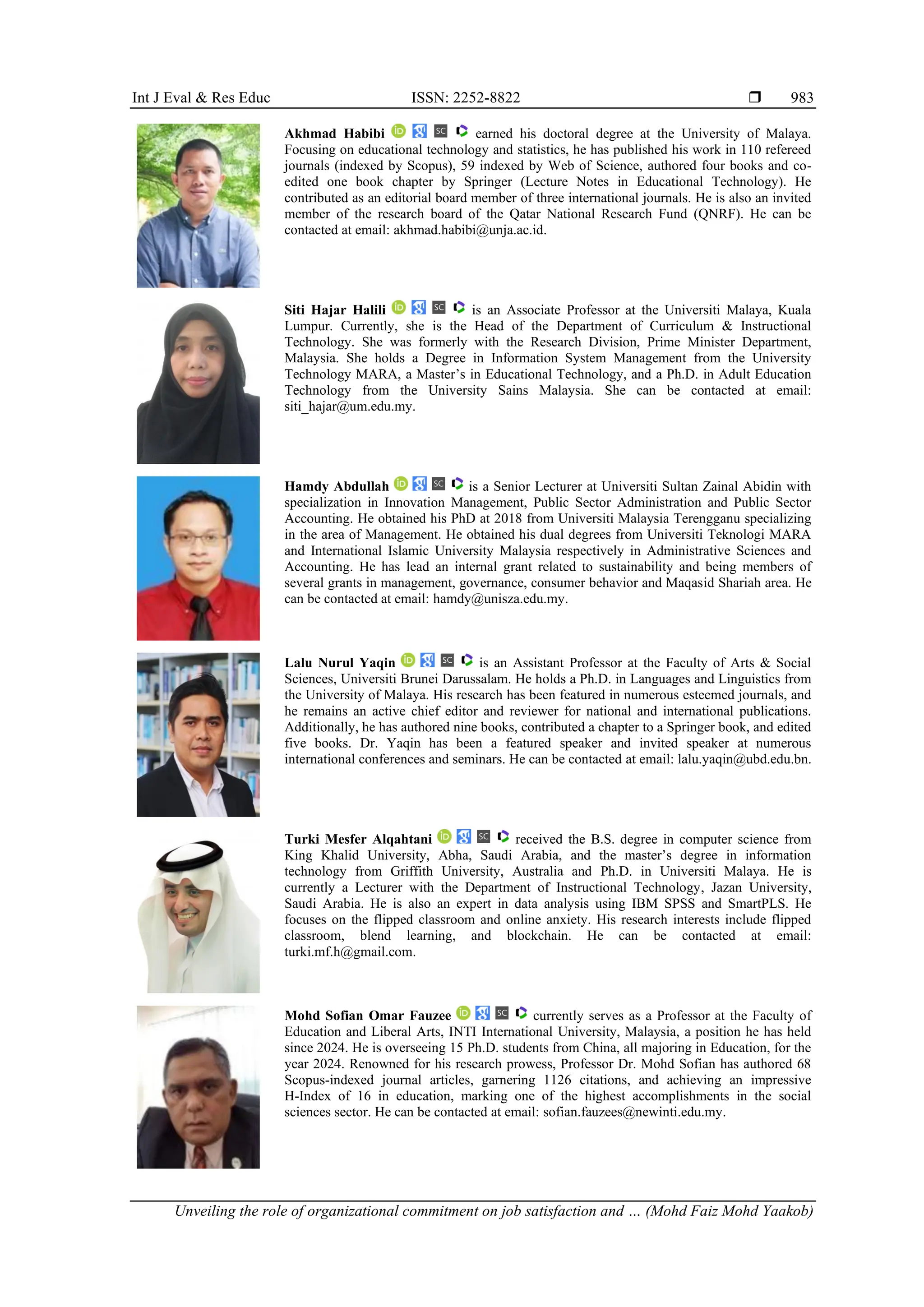
Akhmad Habibi earned his doctoral degree at the University of Malaya.
Focusing on educational technology and statistics, he has published his work in 110 refereed
journals (indexed by Scopus), 59 indexed by Web of Science, authored four books and co-
edited one book chapter by Springer (Lecture Notes in Educational Technology). He
contributed as an editorial board member of three international journals. He is also an invited
member of the research board of the Qatar National Research Fund (QNRF). He can be
contacted at email: akhmad.habibi@unja.ac.id.
Siti Hajar Halili is an Associate Professor at the Universiti Malaya, Kuala
Lumpur. Currently, she is the Head of the Department of Curriculum & Instructional
Technology. She was formerly with the Research Division, Prime Minister Department,
Malaysia. She holds a Degree in Information System Management from the University
Technology MARA, a Master’s in Educational Technology, and a Ph.D. in Adult Education
Technology from the University Sains Malaysia. She can be contacted at email:
siti_hajar@um.edu.my.
Hamdy Abdullah is a Senior Lecturer at Universiti Sultan Zainal Abidin with
specialization in Innovation Management, Public Sector Administration and Public Sector
Accounting. He obtained his PhD at 2018 from Universiti Malaysia Terengganu specializing
in the area of Management. He obtained his dual degrees from Universiti Teknologi MARA
and International Islamic University Malaysia respectively in Administrative Sciences and
Accounting. He has lead an internal grant related to sustainability and being members of
several grants in management, governance, consumer behavior and Maqasid Shariah area. He
can be contacted at email: hamdy@unisza.edu.my.
Lalu Nurul Yaqin is an Assistant Professor at the Faculty of Arts & Social
Sciences, Universiti Brunei Darussalam. He holds a Ph.D. in Languages and Linguistics from
the University of Malaya. His research has been featured in numerous esteemed journals, and
he remains an active chief editor and reviewer for national and international publications.
Additionally, he has authored nine books, contributed a chapter to a Springer book, and edited
five books. Dr. Yaqin has been a featured speaker and invited speaker at numerous
international conferences and seminars. He can be contacted at email: lalu.yaqin@ubd.edu.bn.
Turki Mesfer Alqahtani received the B.S. degree in computer science from
King Khalid University, Abha, Saudi Arabia, and the master’s degree in information
technology from Griffith University, Australia and Ph.D. in Universiti Malaya. He is
currently a Lecturer with the Department of Instructional Technology, Jazan University,
Saudi Arabia. He is also an expert in data analysis using IBM SPSS and SmartPLS. He
focuses on the flipped classroom and online anxiety. His research interests include flipped
classroom, blend learning, and blockchain. He can be contacted at email:
turki.mf.h@gmail.com.
Mohd Sofian Omar Fauzee currently serves as a Professor at the Faculty of
Education and Liberal Arts, INTI International University, Malaysia, a position he has held
since 2024. He is overseeing 15 Ph.D. students from China, all majoring in Education, for the
year 2024. Renowned for his research prowess, Professor Dr. Mohd Sofian has authored 68
Scopus-indexed journal articles, garnering 1126 citations, and achieving an impressive
H-Index of 16 in education, marking one of the highest accomplishments in the social
sciences sector. He can be contacted at email: sofian.fauzees@newinti.edu.my.

Unveiling the role of organizational commitment on job satisfaction and job performance in Islamic education

  • 1.
    International Journal ofEvaluation and Research in Education (IJERE) Vol. 14, No. 2, April 2025, pp. 975~983 ISSN: 2252-8822, DOI: 10.11591/ijere.v14i2.31071  975 Journal homepage: http://ijere.iaescore.com Unveiling the role of organizational commitment on job satisfaction and job performance in Islamic education Mohd Faiz Mohd Yaakob1 , Akhmad Habibi2,3 , Siti Hajar Halili4 , Hamdy Abdullah3 , Lalu Nurul Yaqin5 , Turki Mesfer Alqahtani6 , Mohd Sofian Omar Fauzee7 1 Department of Educational Management, School of Education, Universiti Utara Malaysia, Sintok, Malaysia 2 Magister of Educational Technology, Graduate School, Universitas Jambi, Jambi, Indonesia 3 Faculty of Business and Management, Universiti Sultan Zainal Abidin, Kuala Terengganu, Malaysia 4 Department of Curriculum and Instructional Technology, Faculty of Education, Universiti Malaya, Kuala Lumpur, Malaysia 5 Faculty of Arts and Social Sciences, Universiti Brunei Darussalam, Bandar Seri Begawan, Brunei Darussalam 6 Department of Instructional Technology, e-Learning Center, Jazan University, Jazan, Saudi Arabia 7 Faculty of Education and Liberal Arts, INTI International University, Nilai, Malaysia Article Info ABSTRACT Article history: Received May 5, 2024 Revised Nov 8, 2024 Accepted Nov 17, 2024 This study evaluates the influences of organizational commitment components on job satisfaction and job performance among Islamic boarding school (IBS) teachers. It also aimed to decide the mediating effect of job satisfaction on the relationship between organizational commitment and job performance. This comparative study compares the path coefficient between exogenous and endogenous constructs based on respondents’ countries, Malaysia and Indonesia. Through a simple random sampling, the data were gathered from 247 respondents. The analysis was conducted through partial least square structural equation modeling (PLS-SEM) approaches (measurement model, structural model, and multi-group analysis). The measurement model informed that the obtained data was valid and reliable. The structural model examination reports that normative and continuance commitment strongly predict job satisfaction. Similarly, continuance commitment and job satisfaction are significant predictors of job performance. As a mediator, job satisfaction successfully mediates the relationships between continuance commitment and job performance and between normative commitment and job performance. No significant differences emerge from the multi-group analysis results between IBS teachers from Kedah (Malaysia) and Jambi (Indonesia), regarding all direct paths between the constructs. This article provides knowledge contributions from Indonesia and Malaysia, in the context of Islamic education. Keywords: Developing countries Islamic boarding schools Job performance Job satisfaction Organizational commitment Sustainable development education This is an open access article under the CC BY-SA license. Corresponding Author: Akhmad Habibi Magister of Educational Technology, Graduate School, Universitas Jambi Mendalo- Ma Bulian st. KM 15 Muaro Jambi, Jambi, Indonesia Email: akhmad.habibi@unja.ac.id 1. INTRODUCTION Academics mostly agree on the significant influences of work outcomes regarding the concept of organizational commitment. Three common components of organizational commitment are: i) affective commitment, which refers to the emotional attachment of a worker to the organization; ii) normative commitment, which emphasizes the importance of responsibility within the organization; and iii) continuous commitment, described as the workers’ consciousness of the consequences arising from withdrawing from the organization [1]. Organizational commitment is often elaborated with job satisfaction, a construct to
  • 2.
     ISSN: 2252-8822 IntJ Eval & Res Educ, Vol. 14, No. 2, April 2025: 975-983 976 understand workers’ feelings about their job or working experience, reflecting a worker’s self-rating of the positive or negative thoughts. Positive thoughts toward the job indicate workers’ job satisfaction. Prior studies have revealed the influence of organizational commitment and job satisfaction on job performance, defined as the quality and quantity achieved by workers after completing their tasks [2]–[5]. Some studies have also evaluated job satisfaction, organizational commitment, and their correlation to job performance [1], [6], [7]. Affective commitment, which entails an emotional attachment to the organization, has been found to positively influence job satisfaction. When employees feel a strong emotional bond with their organization, they are more likely to report higher levels of job satisfaction, as their personal goals and values align with those of the organization [6]. This emotional connection enhances their overall job performance, as they are more motivated and engaged in their tasks [7]. Normative commitment, which emphasizes a sense of obligation to remain with the organization, also plays a crucial role. Employees who feel a moral duty to stay are likely to exhibit higher job satisfaction because they perceive their role within the organization as important and necessary [8]. This sense of responsibility can lead to improved job performance, as these employees strive to fulfill their perceived obligations and contribute positively to the organization [9]. Continuance commitment, which is based on the costs associated with leaving the organization, has a different dynamic. While it might not directly enhance job satisfaction, continuance commitment can affect job performance indirectly. Employees who recognize the costs of leaving (e.g., loss of benefits, lack of alternative employment) may continue to perform their duties effectively to avoid the negative consequences of departure [10]. However, high levels of continuance commitment without corresponding job satisfaction might lead to minimal performance that just meets expectations rather than exceeding them. However, literature focusing on those three constructs in education still needs to be improved. Limited empirical research also informed the correlation, direct and indirect, between organizational commitment components, job satisfaction, and job performance of teachers in an Islamic education context. This study addresses the critical need to explore and compare the impact of organizational commitment components on job satisfaction and job performance among teachers in Islamic boarding schools (IBS) in Malaysia and Indonesia. Despite the cultural and religious similarities between the two countries, differences in their educational systems and organizational contexts may lead to varying effects on teacher commitment and performance. By examining and contrasting these contexts, the study aims to contribute not only to the specific field of Islamic education but also to the broader understanding of cross-cultural organizational behavior, which has been underexplored in the existing literature. Three research questions were addressed: i) how is the role of organizational commitment components on job satisfaction and performance?; ii) what is the mediating effect of job satisfaction on the relationship between organizational commitment and job performance?; and iii) what are the differences regarding the direct path coefficients based on the respondents’ locations of work, Malaysia and Indonesia? Islamic boarding schools or “Sekolah Pondok” in Malaysia and “Pesantren” in Indonesia, have long been established among the oldest educational institutions making significant contributions to education. In general, Indonesia and Malaysia have almost the same aspects regarding Islamic education. Besides similarities in geography and ethnicity, Malaysian and Indonesian Muslims share similar Islamic education stories, starting some centuries ago [8]. IBS is defined as a group or community with institutional buildings, mosques, and sports facilities [9]. Teachers in IBS are a key role in supporting the school’s existence as an educational organization; their organizational commitment, job satisfaction, and performance [2], [10], [11]. Thus, this study focuses on the three variables. Continuance commitment, which is based on the costs associated with leaving the organization, has a different dynamic. While it might not directly enhance job satisfaction, it can affect job performance indirectly in the context of Indonesian and Malaysian IBS. In this study, organizational commitment is defined as the identification with and loyalty to the IBS and its goals. At the center of the management, it is the key factor for organizations, including Islamic education, to retain quality teachers. Organizational commitment is described as a concept that allows a quality worker to work better. It is also important that they have a good commitment to keep their job within the organization [12]. Prior studies have examined the relationships between teachers’ organizational commitment and job satisfaction and found a positive and significant relationship [2]–[5]. For example, in research evaluating 601 teachers in Turkey, a moderate level of positive and significant correlation emerged between organizational commitment and job satisfaction. Another study reported a significant relationship between organizational commitment and job satisfaction among 84 English teachers in Iran [13]. Dhurup [14] asked 250 sports teachers in South Africa to fill in a survey measuring their organizational commitments and job satisfaction and disclosed a significant and positive correlation between the two variables. Indarti et al. [15] found no significant relationship between organizational commitments and job performance. A strong connection between organizational commitment and job performance is also indicated by a study conducted with nurses in Bosnia and Herzegovina as the respondents [6].
  • 3.
    Int J Eval& Res Educ ISSN: 2252-8822  Unveiling the role of organizational commitment on job satisfaction and … (Mohd Faiz Mohd Yaakob) 977 Job satisfaction in this study is defined as a combination of teachers’ positive or negative feelings regarding their teaching profession in IBS, a positive feeling produced from assessing a teacher’s job experience [16]. Meanwhile, job performance in the context of this study is described as the quality and quantity accomplished by IBS teachers when they have already done the teaching tasks. Job satisfaction includes some categories, namely salary, promotion, colleagues, and supervision [6]. Prior studies have informed that job performance is significantly affected by job satisfaction [1], [6]. For instance, a significant relationship between job satisfaction and job performance also emerged in a survey administered to nurses in Bosnia and Herzegovina [6], [7]. The mediator, job satisfaction, is expected to significantly mediate the relationships between all components of organizational commitments and job performance. A few studies have previously reported the mediation power of job satisfaction in mediating various constructs [2], [6], [17]. In education, a positive indirect correlation emerged between teachers’ teaching climate and sense of work engagement, organizational commitment, and subjective well-being, mediated by teacher job satisfaction. A significant indirect effect between components of organizational commitment and job performance was reported, mediated by job satisfaction [6]. Besides computing the direct and indirect effects of organizational commitments, job satisfaction, and job performance, this study also evaluated the roles of demographic information (school locations) regarding the path coefficients of all direct relationships. Prior studies have informed the roles of demographic characteristics related to organizational commitments, job satisfaction, or job performance. For example, Anari [13], in the report of a survey involving 84 high school English teachers, stated that a significant difference emerged regarding job satisfaction and organizational commitments. To achieve the purposes of this study, 17 hypotheses were administered on the direct effect, indirect effects, and differences between locations (Figure 1): - H1: Affective commitment significantly affects job satisfaction. - H2: Normative commitment significantly affects job satisfaction. - H3: Continuance commitment significantly affects job satisfaction. - H4: Affective commitment significantly determines job performance. - H5: Normative commitment significantly determines job performance. - H6: Continuance commitment significantly affects job performance. - H7: Job satisfaction significantly affects job performance. - H8: Job satisfaction plays a significant role in mediating the correlation between affective commitment and job performance. - H9: Job satisfaction plays a significant role in mediating correlation between normative commitment and job performance. - H10: Job satisfaction plays a significant role in mediating correlation between continuance commitment and job performance. - H11-H17: There are significant differences among all relationships based on the respondents’ country. Figure 1. Proposed structural model of organizational commitment in affecting job satisfaction and job performance
  • 4.
     ISSN: 2252-8822 IntJ Eval & Res Educ, Vol. 14, No. 2, April 2025: 975-983 978 2. METHOD Data were collected from 247 respondents who are IBS teachers from Indonesia and Malaysia. The partial least squares structural equation modeling (PLS-SEM) procedures were applied in this study for the data analysis. Measurement and structural model were two steps to test the hypotheses 1 to 1. Multi-group analysis (MGA) was done to test differences among all relationships based on respondents’ area of teaching. The statements were translated from English to Indonesian and Malay languages through back translation, a method proposed by Behr [18]. Four parts of the questionnaire consist of demographic information, organizational commitment, job satisfaction, and job performance. The organizational commitments consist of affective, normative, and continuance commitment; 18 items of statements were used [19] with a 5-point Likert scale that ranges from 1 (strongly disagree) to 5 (strongly agree). Job satisfaction (3 items) was adapted from [20]; the items were also distributed with a 5-point Likert-type scale from 1 (mostly false) to 5 (mostly true). Job performance was scaled using three items [20], scaling from 1 (very poor) to 5 (very good). Before the distribution of the pilot study, we sent the instrument to five experienced experts and academics for setting and context investigation. The items were piloted to 50 Indonesian teachers to examine their reliability [21]. All Cronbach’s alpha values exceed the recommended threshold of .70. 2.1. Sample size and data collection procedure The target population of this study is in two states, Kedah in Malaysia and Jambi in Indonesia. Despite the distinct locations of the target population, a similar concept of education is implemented in both cities. Hence, the findings of the study might be generalized in the context of Islamic education. An online survey was addressed through quota sampling. After two months, 300 responses were gained, with 247 responses being measurable, reflecting the rate of 82.33% clean responses. There are 160 respondents from Jambi, while 87 teachers from Kedah filled out the survey. Male respondents are 111, while females are 134. 2.2. Analysis This study employed PLS-SEM techniques for the data analysis [22]–[25]. In preventing common method bias (CMB), respondents were informed and ensured that their personal identities remained anonymous; the assurance of respondents’ anonymity would cause research participants to obtain less apprehension in evaluating the responses. The computation of variance inflation factors (VIF) value was also used to evaluate CMB. When VIF values are greater than 3, CMB affects the data. Therefore, the model is ideally defined as free of CMB when the VIF value is lower than 3. All VIF values are less than 3, indicating the current study model is free of CMB. Afterward, the data analysis was computed for the measurement, structural model, and MGA. 3. RESULTS ANS DISCUSSION The results of descriptive statistics exhibit the mean (x ̄ ) and standard deviation (SD) results. The mean of bigger than 3.5 out of 5 informs that most respondents state their agreement on the questionnaire statements. All SD values represent their closeness to each other, which can be referred to as the evenly dispersed constructs, which suggest normal data. For the measurement model, initial output measures were addressed in assessing the characteristics of the model, recognized by the constructs and items. All items report a loading greater than .700, exceeding the cut-off value [26]. The results recommend that all items have a contribution to the mutual constructs. Table 1 informs the value of Cronbach’s alpha that range from .768 to .887; composite reliability (CR) shows satisfactory values from .839 to .93. The results are greater than .700, suggesting the proposed model’s reliability and internal consistency. However, two items (ACom5 and ACom6) were eliminated since they have a loading of less than .50. To evaluate the convergent validity, the average variance extraction (AVE) should exceed .50. All AVE values are higher than .500 (.569 to .816), which is evidence that convergent validity is present within the model. Heterotrait-Monotrait Ratio (HTMT) was computed for the discriminant validity [26], [27]. As an estimation of correlation among factors, the value of HTMT is recommended to be less than 1. The HTMT values informed in this study ranged from .242 to .790 as shown in Table 2. The values fall far below .90. Therefore, the results indicate that all constructs stand alone to meet discriminant validity criteria. Further, we assessed the model fitness for the measurement model [28] to understand the model fitness. The saturated model and standardized root mean square residual (SRMR) at a 95% bootstrap quantile was reported [28]. The SRMR is the model fit criterion that can be addressed for the path modeling in PLS-SEM research. Besides, we also computed the data to understand the dG and the dULS to quantify the discrepancy between the two matrices. The dG and dULS valued .610 and 1.841, respectively, indicating a well-fitting model. Additionally, the SRMR is .065 (<.08), referring to the fit model [29].
  • 5.
    Int J Eval& Res Educ ISSN: 2252-8822  Unveiling the role of organizational commitment on job satisfaction and … (Mohd Faiz Mohd Yaakob) 979 Table 1. Load, reliability, and convergent validity Construct Item (load) Alpha CR AVE Affective commitment ACom1 (.880; ACom2 (.713); ACom3 (.762); Acom4 (.644) .787 .839 .569 Continuance commitment CCom1 (.736); CCom2 (.807); CCom3 (.814); CCom 4 (.813); CCom5 (.792); CCom6 (.806) .884 .912 .632 Job performance JPerf1(.982); JPerf2 (.920); JPerf3 (.898) .887 .930 .816 Job satisfaction JSat1 (.785); JSat2 (.836); JSat3 ().857) .768 .866 .683 Normative commitment NCom1 (.780); NCom2 (.853); NCom3 (.847); NCom4 (.818); NCom5 (.626); NCom6 (.790) .878 .908 .623 Table 2. HTMT 1 2 3 4 Fit model Value Continuance commitment .511 SRMR .085 Job performance .242 .589 dULS 1.841 Job satisfaction .362 .799 .696 dG .610 Normative commitment .524 .839 .551 .790 3.1. Structural model The PLS-SEM in this study was mainly applied for testing the hypothetical establishment [30]. The main goal of the PLS-SEM is to address indicators prediction through the expansion of the components. When research predicts a key target construct, the PLS-SEM would fit into the study to gain path coefficient, t-statistics, p-value, f2 , and R2 . We computed all direct and indirect paths through a bootstrapping process with 5,000 subsamples [24], [31]. The computational results as shown in Table 3 and Figure 2 inform the four direct relationships were positively significant; hence they support four hypotheses (H3, H5, H6, H7). H3 is statistically significant, between normative commitment and job satisfaction, (β=.387, p<.001). Besides, continuance commitment and job satisfaction (β=.383, p<.001) is also correlated, H5. The significant relationship (H6) emerges between continuance commitment and job performance (β=.202, p<.05). The last direct relationship between job satisfaction and job performance is also significant (β=.374, p<.001); the positive association supports H7. Of the three indirect relationship hypotheses in this study, two are supported. The relationship between continuance commitment and job performance is moderated by job satisfaction (β=.143, p<.01). Similarly, the indirect relationship between normative commitment and job performance is also statistically significant moderated by job satisfaction (β=.145, p<.01). The explanatory power of a structural equation model is demonstrated by the explained variance (R2 ) value (Figure 2). Although many classifications were included for explained variance in the literature, the value of R2 in this study were defined; .75 (substantial), .50 (moderate), and .25 (weak) [26]. As a result, work satisfaction and work performance explained 50% and 38% of the variations, moderate. The Q2 test was used to assess the predictive significance. It shows how effectively the model and its parameter reproduce observed values; a measure of model fit. By blindfolding one case at a time, re-estimating the model parameters using the remaining cases, and ultimately forecasting the missing case values based on the remaining parameters, Smart PLS 3.3 was used to derive the value of Q2 . Positive Q2 endogenous variables were regarded to have predictive value, while negative Q2 endogenous variables were considered to have no predictive value. Figure 2 shows the R2 values, which are significantly above zero. As a result, the values of Q2 suggested that they were predictive of work satisfaction and performance [26]. Table 3. Structural model H Path β t value p value f2 Remarks H1 Affective commitment ->Job satisfaction -.023 .416 .678 .001 Not supported H2 Affective commitment ->Job performance -.024 .411 .681 .001 Not supported H3 Normative commitment ->Job satisfaction .387 5.694 .000 .125 Supported H4 Normative commitment ->Job performance .121 1.455 .146 .009 Not supported H5 Continuance commitment ->Job satisfaction .383 5.158 .000 .123 Supported H6 Continuance commitment ->Job performance .202 2.567 .010 .024 Supported H7 Job satisfaction ->Job performance .374 4.729 .000 .112 Supported H8 Affective commitment ->Job satisfaction ->Job performance -.009 .410 .682 - Not supported H9 Continuance commitment ->Job satisfaction ->Job performance .143 3.444 .001 - Supported H10 Normative commitment ->Job satisfaction ->Job performance .145 3.635 .000 - Supported 3.2. Moderating role of location The moderating roles of location, Kedah in Malaysia, and Jambi in Indonesia were assessed for H11, H12, H13, H14, H15, H16, and H17. The PLS-SEM results reveal that location of the IBS does not significantly moderate the impact of all endogenous constructs on their exogenous constructs, respectively,
  • 6.
     ISSN: 2252-8822 IntJ Eval & Res Educ, Vol. 14, No. 2, April 2025: 975-983 980 rejecting all hypotheses proposed in this study. For example, the p-value of the difference regarding the relationship between affective commitment and job performance is .227 or p>.05, showing an insignificant difference for H11. Another example is the difference between the predictive value of continuance commitment and job satisfaction, which is also insignificant (β=-.011, p<.05), rejecting H13. Figure 2. Final model 3.3. Discussion This research explores the influences of organizational commitment components on work satisfaction and work performance among teachers at IBS in Malaysia and Indonesia, considering the relevance of IBS teachers’ performance for educational reasons. It also seeks to determine if job satisfaction moderates the link between organizational commitment and work performance. The scale (24 items) for this survey study was established by adapting previous findings [19], [20]. In purifying the scale, we first conducted a pilot study to examine the reliability, followed by the assessment of the measurement model for the main data collection analysis [21], [26]. The model was valid and reliable and can be utilized for further studies examining the relationships among organizational commitment components on job satisfaction and job performance. The results of the structural model assessment for the direct relationships indicate that normative and continuance commitments influenced job satisfaction. Besides, continuance commitment significantly predicts job performance. Job satisfaction had a strong effect on job performance. The study’s direct findings are consistent with prior academic recommendations for alternative theories of work satisfaction and organizational commitment [6], [7], [10]. This study seeks to address the gap in the literature by focusing on work satisfaction and performance in Islamic education. For the indirect relationships, job satisfaction mediates the relationship between affective commitment and job performance significantly. The variable also plays an important role in mediating the correlational effect of normative commitment and job performance. The findings on the mediating function of work satisfaction are similarly in line with earlier research [32]. Individual satisfaction may be achieved in three ways: contentment with compensation, promotions, and coworkers [33]. The monthly remuneration of IBS teachers might be deemed modest. Educational administrators at IBS need to improve teacher satisfaction with their professions by, for example, raising monthly allowance and making promotions. It is critical for leaders to prioritize their personal ethical and moral growth in addition to their professional development. Zembylas and Papanastasiou [34] argue that by exhibiting compassion, justice, and the capacity to positively inspire their subordinates, leaders may have a substantial impact on their workforce. Educational administrators should also pay greater attention to the hiring process and educate future teachers to improve happiness with their coworkers. IBS may promote involvement and empower its personnel to improve teacher job satisfaction [35], [36].
  • 7.
    Int J Eval& Res Educ ISSN: 2252-8822  Unveiling the role of organizational commitment on job satisfaction and … (Mohd Faiz Mohd Yaakob) 981 Besides the structural model, the current study also investigated the role of IBS location. The location of the IBS does not substantially moderate the influence of the endogenous constructs on their exogenous constructions, invalidating all hypotheses suggested in this study. Regarding Islamic education, Indonesia and Malaysia are nearly identical in many ways [8], [37]. Aside from geographic and demographic commonalities, Malaysian and Indonesian Muslims have comparable Islamic education histories that might trigger the insignificant differences between both IBS teachers regarding the relationships between organizational commitments, job performance, and satisfaction. As a result, while this strategy is useful in Islamic schools, it may also be used to higher education. Administrators who use ways to improve lecturers' intrinsic work motivation might affect future educational policy [36], [37]. 4. CONCLUSION The findings of this study reveal that in IBS in Jambi and Kedah, teacher job satisfaction has a crucial role in mediating organizational commitment components and job performance. This research has some drawbacks. The findings are based on a small sample size that can be extended in future research. Studies with larger samples might provide a more significant results of the impact of organizational commitment components on IBS teachers’ performance, which could be achieved through work satisfaction as a mediator. Other methods, such as interviews and observation, are highly recommended. Finally, future research should include aspects of identity, work satisfaction in organizational commitment components, and the job performance link to address this gap. The study utilizes framework as model from PLS-SEM to test the relationships between these constructs. Additionally, an MGA is conducted to compare the path coefficients between the two countries, providing a nuanced understanding of how different organizational and educational contexts may influence these relationships. The study's findings reveal that while both Malaysia and Indonesia share cultural and religious similarities, their distinct educational systems result in different impacts of organizational commitment on job satisfaction and job performance among teachers in IBS. Specifically, normative and continuance commitments were found to significantly influence job satisfaction in both contexts, with job satisfaction also emerging as a strong predictor of job performance. However, the comparative analysis shows that these relationships manifest differently in the two countries, highlighting the importance of considering contextual factors in organizational behavior research. This study builds on previous research by applying a cross-cultural lens to the examination of these constructs, offering new insights into the dynamics of teacher commitment and performance in Islamic educational settings. REFERENCES [1] B. R. Werang and A. A. G. Agung, “Teachers’ job satisfaction, organizational commitment, and performance in Indonesia: a study from Merauke district,” International Journal of Development and Sustainability, vol. 6, no. 8, pp. 700–711, 2017. [2] A. Shoshani and L. Eldor, “The informal learning of teachers: learning climate, job satisfaction and teachers’ and students’ motivation and well-being,” International Journal of Educational Research, vol. 79, pp. 52–63, 2016, doi: 10.1016/j.ijer.2016.06.007. [3] Y. Sayadi, “The effect of dimensions of transformational, transactional, and non-leadership on the job satisfaction and organizational commitment of teachers in Iran,” Management in Education, vol. 30, no. 2, pp. 57–65, 2016, doi: 10.1177/0892020615625363. [4] N. G. Torlak and C. Kuzey, “Leadership, job satisfaction and performance links in private education institutes of Pakistan,” International Journal of Productivity and Performance Management, vol. 68, no. 2, pp. 276–295, 2019, doi: 10.1108/IJPPM-05- 2018-0182. [5] M. L. C. Batugal, “Organizational culture, commitment and job satisfaction of faculty in private-sectarian higher education institutions (HEIS),” World Journal of Education, vol. 9, no. 2, p. 123, 2019, doi: 10.5430/wje.v9n2p123. [6] M. S. Dinc, C. Kuzey, and N. Steta, “Nurses’ job satisfaction as a mediator of the relationship between organizational commitment components and job performance,” Journal of Workplace Behavioral Health, vol. 33, no. 2, pp. 75–95, 2018, doi: 10.1080/15555240.2018.1464930. [7] L. Afshari, “Motivating toward organizational commitment: a cross-comparative perspective,” International Journal of Cross Cultural Management, vol. 20, no. 2, pp. 141–157, 2020, doi: 10.1177/1470595820914643. [8] A. Mas’ud, A. Z. Fuad, and A. Zaini, “Evolution and orientation of Islamic education in Indonesia and Malaysia,” Journal of Indonesian Islam, vol. 13, no. 1, pp. 21–49, 2019, doi: 10.15642/JIIS.2019.13.1.21-49. [9] A. Habibi et al., “Mapping instructional barriers during COVID-19 outbreak: Islamic education context,” Religions, vol. 12, no. 1, p. 50, Jan. 2021, doi: 10.3390/rel12010050. [10] D. Dou, G. Devos, and M. Valcke, “The relationships between school autonomy gap, principal leadership, teachers’ job satisfaction and organizational commitment,” Educational Management Administration and Leadership, vol. 45, no. 6, pp. 959–977, 2017, doi: 10.1177/1741143216653975. [11] M. E. Önder, U. Akçil, and N. Cemaloğlu, “The relationship between teachers’ organizational commitment, job satisfaction and whistleblowing,” Sustainability, vol. 11, no. 21, p. 5995, 2019, doi: 10.3390/su11215995. [12] L. Stanley, C. Vandenberghe, R. Vandenberg, and K. Bentein, “Commitment profiles and employee turnover,” Journal of Vocational Behavior, vol. 82, no. 3, pp. 176–187, Jun. 2013, doi: 10.1016/j.jvb.2013.01.011. [13] N. N. Anari, “Teachers: emotional intelligence, job satisfaction, and organizational commitment,” Journal of Workplace Learning, vol. 24, no. 4, pp. 256–269, May 2012, doi: 10.1108/13665621211223379.
  • 8.
     ISSN: 2252-8822 IntJ Eval & Res Educ, Vol. 14, No. 2, April 2025: 975-983 982 [14] M. Dhurup, “South African amateur coaches’ perceptions of the relationship between employee fit dimensions, organisational commitment and job satisfaction,” African Journal for Physical, Health Education, Recreation and Dance, vol. 25, no. 4, pp. 455–471, 2020. [15] S. Indarti, Solimun, A. A. R. Fernandes, and W. Hakim, “The effect of OCB in relationship between personality, organizational commitment and job satisfaction on performance,” Journal of Management Development, vol. 36, no. 10, pp. 1283–1293, 2017, doi: 10.1108/JMD-11-2016-0250. [16] A. Eliyana, S. Ma’arif, and Muzakki, “Job satisfaction and organizational commitment effect in the transformational leadership towards employee performance,” European Research on Management and Business Economics, vol. 25, no. 3, pp. 144–150, 2019, doi: 10.1016/j.iedeen.2019.05.001. [17] W. Fu, F. He, and N. Zhang, “Antecedents of organizational commitment of insurance agents: job satisfaction, ethical behavior, and ethical climate,” Journal of Global Business Insights, vol. 5, no. 2, pp. 134–149, 2020, doi: 10.5038/2640-6489.5.2.1135. [18] D. Behr, “Assessing the use of back translation: the shortcomings of back translation as a quality testing method,” International Journal of Social Research Methodology, vol. 20, no. 6, pp. 573–584, 2017, doi: 10.1080/13645579.2016.1252188. [19] J. P. Meyer and N. J. Allen, “A three-component conceptualization of organizational commitment,” Human Resource Management Review, vol. 1, no. 1, pp. 61–89, Mar. 1991, doi: 10.1016/1053-4822(91)90011-Z. [20] F. Fu, W. Bolander, and E. Jones, “Managing the drivers of organizational commitment and salesperson effort: an application of Meyer and Allen’s three-component model,” Journal of Marketing Theory and Practice, vol. 17, no. 4, pp. 335–350, 2009, doi: 10.2753/MTP1069-6679170403. [21] A. Habibi, F. D. Yusop, and R. A. Razak, “The dataset for validation of factors affecting pre-service teachers’ use of ICT during teaching practices: Indonesian context,” Data in Brief, vol. 28, p. 104875, 2020, doi: 10.1016/j.dib.2019.104875. [22] A. Habibi, A. Mukminin, and S. Sofyan, “Access to the digital technology of urban and suburban vocational schools,” Education and Information Technologies, vol. 29, no. 4, pp. 4197–4222, 2024, doi: 10.1007/s10639-023-12006-x. [23] A. Habibi, S. Sofyan, and A. Mukminin, “Factors affecting digital technology access in vocational education,” Scientific Reports, vol. 13, no. 1, 2023, doi: 10.1038/s41598-023-32755-6. [24] A. Habibi, Muhaimin, B. K. Danibao, Y. G. Wibowo, S. Wahyuni, and A. Octavia, “ChatGPT in higher education learning: acceptance and use,” Computers and Education: Artificial Intelligence, vol. 5, 2 p. 100190, 023, doi: 10.1016/j.caeai.2023.100190. [25] A. E. Legate, J. F. Hair, J. L. Chretien, and J. J. Risher, “PLS-SEM: prediction-oriented solutions for HRD researchers,” Human Resource Development Quarterly, vol. 34, no. 1, pp. 91–109, 2023, doi: 10.1002/hrdq.21466. [26] J. F. Hair, J. J. Risher, M. Sarstedt, and C. M. Ringle, “When to use and how to report the results of PLS-SEM,” European Business Review, vol. 31, no. 1, pp. 2–24, Jan. 2019, doi: 10.1108/EBR-11-2018-0203. [27] J. Henseler et al., “Common beliefs and reality about PLS: comments on Rönkkö and Evermann (2013),” Organizational Research Methods, vol. 17, no. 2, pp. 182–209, 2014, doi: 10.1177/1094428114526928. [28] J. Henseler, G. Hubona, and P. A. Ray, “Using PLS path modeling in new technology research: updated guidelines,” Industrial Management and Data Systems, vol. 116, no. 1, pp. 2–20, 2016, doi: 10.1108/IMDS-09-2015-0382. [29] T. K. Dijkstra and J. Henseler, “Consistent and asymptotically normal PLS estimators for linear structural equations,” Computational Statistics and Data Analysis, vol. 81, pp. 10–23, 2015, doi: 10.1016/j.csda.2014.07.008. [30] P. Guenther, M. Guenther, C. M. Ringle, G. Zaefarian, and S. Cartwright, “Improving PLS-SEM use for business marketing research,” Industrial Marketing Management, vol. 111, pp. 127–142, May 2023, doi: 10.1016/j.indmarman.2023.03.010. [31] J. F. Hair, G. T. M. Hult, C. M. Ringle, and M. Sarstedt, PLS-SEM book: a primer on PLS-SEM, 3rd ed. Thousand Oaks, CA: SAGE Publications, Inc., 2022. [32] R. C. Nabirye, K. C. Brown, E. R. Pryor, and E. H. Maples, “Occupational stress, job satisfaction and job performance among hospital nurses in Kampala, Uganda,” Journal of Nursing Management, vol. 19, no. 6, pp. 760–768, 2011, doi: 10.1111/j.1365- 2834.2011.01240.x. [33] A. A. M. Davidescu, S. A. Apostu, A. Paul, and I. Casuneanu, “Work flexibility, job satisfaction, and job performance among Romanian employees-implications for sustainable human resource management,” Sustainability, vol. 12, no. 15, p. 6086, 2020, doi: 10.3390/su12156086. [34] M. Zembylas and E. G. Papanastasiou, “Modeling teacher empowerment: the role of job satisfaction,” Educational Research and Evaluation, vol. 11, no. 5, pp. 433–459, 2005, doi: 10.1080/13803610500146152. [35] C. Tang, W. Wider, K. W. Cheng, C. K. Chan, and L. Jiang, “Leadership style and employee performance in China’s fast moving consumer goods industry,” Humanities and Social Sciences Letters, vol. 12, no. 1, pp. 77–87, 2024, doi: 10.18488/73.v12i1.3645. [36] X. Zhao et al., “Triggering Chinese lecturers’ intrinsic work motivation by value-based leadership and growth mindset: generation difference by using multigroup analysis,” PLoS ONE, vol. 19, no. 3 March, 2024, doi: 10.1371/journal.pone.0297791. [37] A. F. A. Hamid, “Islamic education in Malaysia,” in International Handbooks of Religion and Education, vol 7. Springer, Cham, 2017, pp. 1–17. doi: 10.1007/978-3-319-53620-0_27-1. BIOGRAPHIES OF AUTHORS Mohd Faiz Mohd Yaakob is a Senior Lecturer (Educational Management and Administration) in the School of Education, Universiti Utara Malaysia, Malaysia. His research interests include educational policy, educational planning, educational law, school culture, professional learning community, teachers’ competencies, Islamic administration, teacher education, and professional development. He can be contacted at email: mohd.faiz@uum.edu.my.
  • 9.
    Int J Eval& Res Educ ISSN: 2252-8822  Unveiling the role of organizational commitment on job satisfaction and … (Mohd Faiz Mohd Yaakob) 983 Akhmad Habibi earned his doctoral degree at the University of Malaya. Focusing on educational technology and statistics, he has published his work in 110 refereed journals (indexed by Scopus), 59 indexed by Web of Science, authored four books and co- edited one book chapter by Springer (Lecture Notes in Educational Technology). He contributed as an editorial board member of three international journals. He is also an invited member of the research board of the Qatar National Research Fund (QNRF). He can be contacted at email: akhmad.habibi@unja.ac.id. Siti Hajar Halili is an Associate Professor at the Universiti Malaya, Kuala Lumpur. Currently, she is the Head of the Department of Curriculum & Instructional Technology. She was formerly with the Research Division, Prime Minister Department, Malaysia. She holds a Degree in Information System Management from the University Technology MARA, a Master’s in Educational Technology, and a Ph.D. in Adult Education Technology from the University Sains Malaysia. She can be contacted at email: siti_hajar@um.edu.my. Hamdy Abdullah is a Senior Lecturer at Universiti Sultan Zainal Abidin with specialization in Innovation Management, Public Sector Administration and Public Sector Accounting. He obtained his PhD at 2018 from Universiti Malaysia Terengganu specializing in the area of Management. He obtained his dual degrees from Universiti Teknologi MARA and International Islamic University Malaysia respectively in Administrative Sciences and Accounting. He has lead an internal grant related to sustainability and being members of several grants in management, governance, consumer behavior and Maqasid Shariah area. He can be contacted at email: hamdy@unisza.edu.my. Lalu Nurul Yaqin is an Assistant Professor at the Faculty of Arts & Social Sciences, Universiti Brunei Darussalam. He holds a Ph.D. in Languages and Linguistics from the University of Malaya. His research has been featured in numerous esteemed journals, and he remains an active chief editor and reviewer for national and international publications. Additionally, he has authored nine books, contributed a chapter to a Springer book, and edited five books. Dr. Yaqin has been a featured speaker and invited speaker at numerous international conferences and seminars. He can be contacted at email: lalu.yaqin@ubd.edu.bn. Turki Mesfer Alqahtani received the B.S. degree in computer science from King Khalid University, Abha, Saudi Arabia, and the master’s degree in information technology from Griffith University, Australia and Ph.D. in Universiti Malaya. He is currently a Lecturer with the Department of Instructional Technology, Jazan University, Saudi Arabia. He is also an expert in data analysis using IBM SPSS and SmartPLS. He focuses on the flipped classroom and online anxiety. His research interests include flipped classroom, blend learning, and blockchain. He can be contacted at email: turki.mf.h@gmail.com. Mohd Sofian Omar Fauzee currently serves as a Professor at the Faculty of Education and Liberal Arts, INTI International University, Malaysia, a position he has held since 2024. He is overseeing 15 Ph.D. students from China, all majoring in Education, for the year 2024. Renowned for his research prowess, Professor Dr. Mohd Sofian has authored 68 Scopus-indexed journal articles, garnering 1126 citations, and achieving an impressive H-Index of 16 in education, marking one of the highest accomplishments in the social sciences sector. He can be contacted at email: sofian.fauzees@newinti.edu.my.