Harnessing Student Power to Jet-Propel Your Community
Part II: Building on Basics
Community Affairs Committee
May 5, 2013: Leadership Day
60th Annual STC International Conference, Atlanta, GA
Bethany Bowles, Sally Henschel, Anna Lerew-Phillips, Dan Voss
Agenda
 Objective
 Approach
 Preview of What We Have to Offer
 Decision on Approach: One Session or Splinter Sessions
by Topic
 Execute Approach
 If “Splintered,” Reconvene
 Wrap-Up
 Distribution of Materials (Toolkit)
 Q&A’s, Discussion
Objective
Establish a nation-wide grid of student power …
… and re-energize STC!
Approach
 Be interactive
 Be flexible
 You tell us what you want
 And that’s where we go. 
Four Roads Diverged …
 Road 1: Face-to-face student mentoring programs pairing professionals
in geographic chapters with tech com students at nearby universities
 Forming a partnership with an existing student chapter
 Forming a new student chapter
 Partnering without a formal student chapter
 Road 2: Virtual student mentoring programs pairing professionals in
SIGs or remote geographic chapters with tech com students at
universities
 BoK-specific virtual mentoring partnerships pairing SMEs in the
Academic SIG and other SIGs with students working BoK-related
research/writing projects, centrally administered by the STC Office
using MentorBoard
 General virtual mentoring partnerships pairing STC professionals with
students, using MentorBoard
 Road 3: Leverage STC’s new alliance with Sigma Tau Delta, international
collegiate English Honor Society for English majors
 Road 4: Distribute, preview, and work with a comprehensive toolkit on
establishing and sustaining student mentoring programs (book and DVD)
Road 1: F2F Student Mentoring Programs:
Overview of Presentation
 Learning about successful mentoring programs pairing
STC geographic with student communities
 Becoming familiar with the benefits such programs
represent for students, professionals, the
communities, and the Society
 Learning the basic ingredients of a successful mentoring program and
receiving a “turnkey” package including guidelines, tools, and a
worksheet with which to initiate and administer a mentoring program
 Exploring the possibilities for forming mentoring programs pairing STC
professional and student communities
 Paving the way to “win-win-win” partnerships!
Detailed Presentation on How to Establish
and Sustain F2F Mentoring Programs
Road 1: F2F Mentoring Programs:
7 Key Steps and Checklist/Presentation
____ Find a student and professional to lead the program.
____ Review “turnkey “ source materials and adapt the guidelines,
promotionals, and administrative forms to meet your specific needs.
____ Recruit mentors and mentees.
____ Pair them based on information on their applications.
____ Hold an activity-based kickoff meeting to introduce the mentor/mentee pairs and
suggest activities and projects they may wish to pursue.
____ Have each M&M pair complete a mentor/mentee agreement form identifying objectives
and activities to fulfill those objectives, as well as scheduling for future mentoring sessions.
____Monitor the progress of the M&M pairs, encourage them to share experiences, and, if
necessary, to encourage them to meet or, occasionally, intervene to resolve issues.
Step-by-Step Worksheet/Checklist with a “Built-in” Turnkey
Toolkit: Everything You Need to Make this Happen!
Road 2: Virtual Student Mentoring:
Overview, Presentation 1
 How a successful trans-Atlantic virtual mentoring
partnership led to:
 A new student mentoring program pairing
the STC-France chapter with the University
of Paris
 A “two-way street” mentoring relationship that has become a long-
term professional and personal friendship
 The role of e-mail and social media in virtual mentoring
 How to teach an old “dinosaur” new tricks …
Detailed Presentation on Virtual Student Mentoring
Programs from 39th CPTSC Conference
Road 2: Virtual Student Mentoring:
Overview, Presentation 2
 BoK-specific … successful pilot program at
Appalachian State
 General … Academic SIG’s plans for a centralized
STC program for virtual professional-to-student
mentoring relationships beginning with the 2013-2014 academic year
 New MentorBoard program at STC Office is primed for action
 New program can provide oversight for unaffiliated “community-less”
STC student members-at-large, including Sigma Tau Delta recruits
Detailed Presentation on STC’s Emerging Virtual
Professional-to-Student Mentoring Programs
Road 3: STC/Sigma Tau Delta Alliance:
Overview, 2 Presentations
 About Sigma Tau Delta and its affiliates
 Background on STC/Sigma Tau Delta alliance
 STC outreach and presentations at Sigma Tau
Delta international conference in Portland, OR,
March 20-23, 2013
 Recruitment of new STC student members from Sigma Tau Delta
 Presentation on “Careers in Technical Communication for English
Majors”
 Presentation on “Student Mentoring Programs”
Full “Careers” and “Mentoring” Presentations for Visits
to ΣT∆ Chapters and College Tech Com Classes
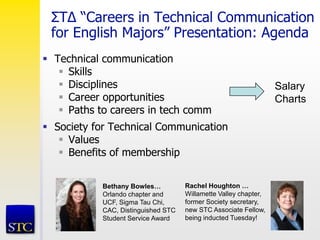
ΣT∆ “Careers in Technical Communication
for English Majors” Presentation: Agenda
 Technical communication
 Skills
 Disciplines
 Career opportunities
 Paths to careers in tech comm
 Society for Technical Communication
 Values
 Benefits of membership
Bethany Bowles…
Orlando chapter and
UCF, Sigma Tau Chi,
CAC, Distinguished STC
Student Service Award
Rachel Houghton …
Willamette Valley chapter,
former Society secretary,
new STC Associate Fellow,
being inducted Tuesday!
Salary
Charts
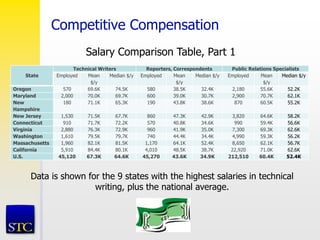
Competitive Compensation
State
Technical Writers Reporters, Correspondents Public Relations Specialists
Employed Mean
$/y
Median $/y Employed Mean
$/y
Median $/y Employed Mean
$/y
Median $/y
Oregon 570 69.6K 74.5K 580 38.5K 32.4K 2,180 55.6K 52.2K
Maryland 2,000 70.0K 69.7K 600 39.0K 30.7K 2,900 70.7K 62.1K
New
Hampshire
180 71.1K 65.3K 190 43.8K 38.6K 870 60.5K 55.2K
New Jersey 1,530 71.5K 67.7K 860 47.3K 42.9K 3,820 64.6K 58.2K
Connecticut 910 71.7K 72.2K 570 40.8K 34.6K 990 59.4K 56.6K
Virginia 2,880 76.3K 72.9K 960 41.9K 35.0K 7,300 69.3K 62.6K
Washington 1,610 79.5K 79.7K 740 44.4K 34.4K 4,990 59.3K 56.2K
Massachusetts 1,960 82.1K 81.5K 1,170 64.1K 52.4K 8,650 62.1K 56.7K
California 5,910 84.4K 80.1K 4,010 48.5K 38.7K 22,920 71.0K 62.6K
U.S. 45,120 67.3K 64.6K 45,270 43.6K 34.9K 212,510 60.4K 52.4K
Salary Comparison Table, Part 1
Data is shown for the 9 states with the highest salaries in technical
writing, plus the national average.
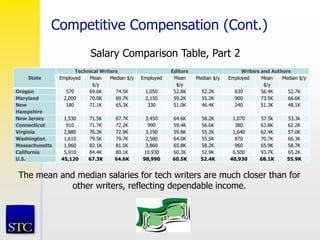
Competitive Compensation (Cont.)
State
Technical Writers Editors Writers and Authors
Employed Mean
$/y
Median $/y Employed Mean
$/y
Median $/y Employed Mean
$/y
Median $/y
Oregon 570 69.6K 74.5K 1,050 52.8K 52.2K 630 56.4K 52.7K
Maryland 2,000 70.0K 69.7K 2,150 59.2K 55.2K 900 73.5K 66.6K
New
Hampshire
180 71.1K 65.3K 330 51.0K 46.4K 240 51.3K 48.1K
New Jersey 1,530 71.5K 67.7K 3,450 64.6K 58.2K 1,070 57.5k 53.3k
Connecticut 910 71.7K 72.2K 990 59.4K 56.6K 380 63.8K 62.2K
Virginia 2,880 76.3K 72.9K 3,190 59.8K 55.2K 1,640 62.4K 57.0K
Washington 1,610 79.5K 79.7K 2,580 64.0K 55.5K 870 70.7K 66.3K
Massachusetts 1,960 82.1K 81.5K 3,860 65.8K 58.2K 960 65.9K 58.7K
California 5,910 84.4K 80.1K 10,930 60.3K 52.9K 6,500 93.7K 65.2K
U.S. 45,120 67.3K 64.6K 98,990 60.5K 52.4K 40,930 68.1K 55.9K
Salary Comparison Table, Part 2
The mean and median salaries for tech writers are much closer than for
other writers, reflecting dependable income.
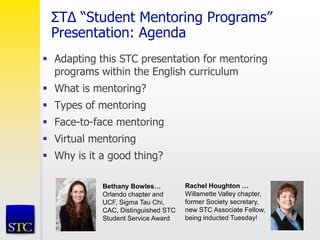
ΣT∆ “Student Mentoring Programs”
Presentation: Agenda
 Adapting this STC presentation for mentoring
programs within the English curriculum
 What is mentoring?
 Types of mentoring
 Face-to-face mentoring
 Virtual mentoring
 Why is it a good thing?
Bethany Bowles…
Orlando chapter and
UCF, Sigma Tau Chi,
CAC, Distinguished STC
Student Service Award
Rachel Houghton …
Willamette Valley chapter,
former Society secretary,
new STC Associate Fellow,
being inducted Tuesday!
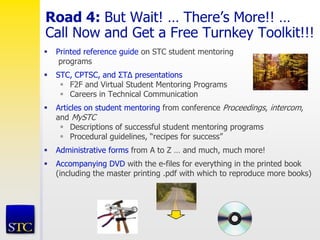
Road 4: But Wait! … There’s More!! …
Call Now and Get a Free Turnkey Toolkit!!!
 Printed reference guide on STC student mentoring
programs
 STC, CPTSC, and ΣT∆ presentations
 F2F and Virtual Student Mentoring Programs
 Careers in Technical Communication
 Articles on student mentoring from conference Proceedings, intercom,
and MySTC
 Descriptions of successful student mentoring programs
 Procedural guidelines, “recipes for success”
 Administrative forms from A to Z … and much, much more!
 Accompanying DVD with the e-files for everything in the printed book
(including the master printing .pdf with which to reproduce more books)
Decision Time …
 Stay together as a group and do a high-speed flip-
through of all these presentations and materials (a
glimpse down all 4 roads in the yellow wood …
OR
 … Split up into splinter groups (F2F, virtual, ΣT∆,
toolkit), each hiking down 1 road
deep into the forest
This is a Transition Slide … 
 Road 1: Face-to-face mentoring programs pairing professionals in
geographic chapters with tech com students in a nearby university:
partnering with a student chapter, establishing a student chapter, or
without establishing a student chapter*
 Road 2: Virtual mentoring programs using STC’s new MentorBoard
for pairing: BoK-specific and general mentoring relationships,
coordinated by the Academic SIG**
 Road 3: Sigma Tau Delta alliance: recruiting English majors as STC
student members: STC’s presentations to ΣT∆ on “Careers in TC” and
“Student Mentoring Programs”*
 Road 4: Toolkit (printed reference guide & accompanying DVD)*
* Complete presentations and materials available in printed reference guide & accompanying DVD.
** CPTSC presentation on virtual mentoring available in printed guide and DVD; Academic SIG
presentation on BoK pilot and plans for virtual mentoring in 2013-2014 will be available as
supplementary handouts at Leadership Day (BoK pilot at Appalachian State was still in progress
at press time for the toolkit)
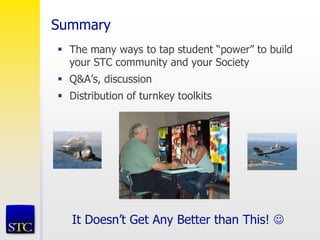
Summary
 The many ways to tap student “power” to build
your STC community and your Society
 Q&A’s, discussion
 Distribution of turnkey toolkits
It Doesn’t Get Any Better than This! 
 Dan Voss
 daniel.w.voss@lmco.com
 Bethany Bowles
 bethanybowles@gmail.com
 Sally Henschel
 sally.henschel@mwsu.edu
 Anna Lerew-Phillips
 anna.lerew-phillips@mwsu.edu
Thank you!

Student Outreach Part II

  • 1.
    Harnessing Student Powerto Jet-Propel Your Community Part II: Building on Basics Community Affairs Committee May 5, 2013: Leadership Day 60th Annual STC International Conference, Atlanta, GA Bethany Bowles, Sally Henschel, Anna Lerew-Phillips, Dan Voss
  • 2.
    Agenda  Objective  Approach Preview of What We Have to Offer  Decision on Approach: One Session or Splinter Sessions by Topic  Execute Approach  If “Splintered,” Reconvene  Wrap-Up  Distribution of Materials (Toolkit)  Q&A’s, Discussion
  • 3.
    Objective Establish a nation-widegrid of student power … … and re-energize STC!
  • 4.
    Approach  Be interactive Be flexible  You tell us what you want  And that’s where we go. 
  • 5.
    Four Roads Diverged…  Road 1: Face-to-face student mentoring programs pairing professionals in geographic chapters with tech com students at nearby universities  Forming a partnership with an existing student chapter  Forming a new student chapter  Partnering without a formal student chapter  Road 2: Virtual student mentoring programs pairing professionals in SIGs or remote geographic chapters with tech com students at universities  BoK-specific virtual mentoring partnerships pairing SMEs in the Academic SIG and other SIGs with students working BoK-related research/writing projects, centrally administered by the STC Office using MentorBoard  General virtual mentoring partnerships pairing STC professionals with students, using MentorBoard  Road 3: Leverage STC’s new alliance with Sigma Tau Delta, international collegiate English Honor Society for English majors  Road 4: Distribute, preview, and work with a comprehensive toolkit on establishing and sustaining student mentoring programs (book and DVD)
  • 6.
    Road 1: F2FStudent Mentoring Programs: Overview of Presentation  Learning about successful mentoring programs pairing STC geographic with student communities  Becoming familiar with the benefits such programs represent for students, professionals, the communities, and the Society  Learning the basic ingredients of a successful mentoring program and receiving a “turnkey” package including guidelines, tools, and a worksheet with which to initiate and administer a mentoring program  Exploring the possibilities for forming mentoring programs pairing STC professional and student communities  Paving the way to “win-win-win” partnerships! Detailed Presentation on How to Establish and Sustain F2F Mentoring Programs
  • 7.
    Road 1: F2FMentoring Programs: 7 Key Steps and Checklist/Presentation ____ Find a student and professional to lead the program. ____ Review “turnkey “ source materials and adapt the guidelines, promotionals, and administrative forms to meet your specific needs. ____ Recruit mentors and mentees. ____ Pair them based on information on their applications. ____ Hold an activity-based kickoff meeting to introduce the mentor/mentee pairs and suggest activities and projects they may wish to pursue. ____ Have each M&M pair complete a mentor/mentee agreement form identifying objectives and activities to fulfill those objectives, as well as scheduling for future mentoring sessions. ____Monitor the progress of the M&M pairs, encourage them to share experiences, and, if necessary, to encourage them to meet or, occasionally, intervene to resolve issues. Step-by-Step Worksheet/Checklist with a “Built-in” Turnkey Toolkit: Everything You Need to Make this Happen!
  • 8.
    Road 2: VirtualStudent Mentoring: Overview, Presentation 1  How a successful trans-Atlantic virtual mentoring partnership led to:  A new student mentoring program pairing the STC-France chapter with the University of Paris  A “two-way street” mentoring relationship that has become a long- term professional and personal friendship  The role of e-mail and social media in virtual mentoring  How to teach an old “dinosaur” new tricks … Detailed Presentation on Virtual Student Mentoring Programs from 39th CPTSC Conference
  • 9.
    Road 2: VirtualStudent Mentoring: Overview, Presentation 2  BoK-specific … successful pilot program at Appalachian State  General … Academic SIG’s plans for a centralized STC program for virtual professional-to-student mentoring relationships beginning with the 2013-2014 academic year  New MentorBoard program at STC Office is primed for action  New program can provide oversight for unaffiliated “community-less” STC student members-at-large, including Sigma Tau Delta recruits Detailed Presentation on STC’s Emerging Virtual Professional-to-Student Mentoring Programs
  • 10.
    Road 3: STC/SigmaTau Delta Alliance: Overview, 2 Presentations  About Sigma Tau Delta and its affiliates  Background on STC/Sigma Tau Delta alliance  STC outreach and presentations at Sigma Tau Delta international conference in Portland, OR, March 20-23, 2013  Recruitment of new STC student members from Sigma Tau Delta  Presentation on “Careers in Technical Communication for English Majors”  Presentation on “Student Mentoring Programs” Full “Careers” and “Mentoring” Presentations for Visits to ΣT∆ Chapters and College Tech Com Classes
  • 11.
    ΣT∆ “Careers inTechnical Communication for English Majors” Presentation: Agenda  Technical communication  Skills  Disciplines  Career opportunities  Paths to careers in tech comm  Society for Technical Communication  Values  Benefits of membership Bethany Bowles… Orlando chapter and UCF, Sigma Tau Chi, CAC, Distinguished STC Student Service Award Rachel Houghton … Willamette Valley chapter, former Society secretary, new STC Associate Fellow, being inducted Tuesday! Salary Charts
  • 12.
    Competitive Compensation State Technical WritersReporters, Correspondents Public Relations Specialists Employed Mean $/y Median $/y Employed Mean $/y Median $/y Employed Mean $/y Median $/y Oregon 570 69.6K 74.5K 580 38.5K 32.4K 2,180 55.6K 52.2K Maryland 2,000 70.0K 69.7K 600 39.0K 30.7K 2,900 70.7K 62.1K New Hampshire 180 71.1K 65.3K 190 43.8K 38.6K 870 60.5K 55.2K New Jersey 1,530 71.5K 67.7K 860 47.3K 42.9K 3,820 64.6K 58.2K Connecticut 910 71.7K 72.2K 570 40.8K 34.6K 990 59.4K 56.6K Virginia 2,880 76.3K 72.9K 960 41.9K 35.0K 7,300 69.3K 62.6K Washington 1,610 79.5K 79.7K 740 44.4K 34.4K 4,990 59.3K 56.2K Massachusetts 1,960 82.1K 81.5K 1,170 64.1K 52.4K 8,650 62.1K 56.7K California 5,910 84.4K 80.1K 4,010 48.5K 38.7K 22,920 71.0K 62.6K U.S. 45,120 67.3K 64.6K 45,270 43.6K 34.9K 212,510 60.4K 52.4K Salary Comparison Table, Part 1 Data is shown for the 9 states with the highest salaries in technical writing, plus the national average.
  • 13.
    Competitive Compensation (Cont.) State TechnicalWriters Editors Writers and Authors Employed Mean $/y Median $/y Employed Mean $/y Median $/y Employed Mean $/y Median $/y Oregon 570 69.6K 74.5K 1,050 52.8K 52.2K 630 56.4K 52.7K Maryland 2,000 70.0K 69.7K 2,150 59.2K 55.2K 900 73.5K 66.6K New Hampshire 180 71.1K 65.3K 330 51.0K 46.4K 240 51.3K 48.1K New Jersey 1,530 71.5K 67.7K 3,450 64.6K 58.2K 1,070 57.5k 53.3k Connecticut 910 71.7K 72.2K 990 59.4K 56.6K 380 63.8K 62.2K Virginia 2,880 76.3K 72.9K 3,190 59.8K 55.2K 1,640 62.4K 57.0K Washington 1,610 79.5K 79.7K 2,580 64.0K 55.5K 870 70.7K 66.3K Massachusetts 1,960 82.1K 81.5K 3,860 65.8K 58.2K 960 65.9K 58.7K California 5,910 84.4K 80.1K 10,930 60.3K 52.9K 6,500 93.7K 65.2K U.S. 45,120 67.3K 64.6K 98,990 60.5K 52.4K 40,930 68.1K 55.9K Salary Comparison Table, Part 2 The mean and median salaries for tech writers are much closer than for other writers, reflecting dependable income.
  • 14.
    ΣT∆ “Student MentoringPrograms” Presentation: Agenda  Adapting this STC presentation for mentoring programs within the English curriculum  What is mentoring?  Types of mentoring  Face-to-face mentoring  Virtual mentoring  Why is it a good thing? Bethany Bowles… Orlando chapter and UCF, Sigma Tau Chi, CAC, Distinguished STC Student Service Award Rachel Houghton … Willamette Valley chapter, former Society secretary, new STC Associate Fellow, being inducted Tuesday!
  • 15.
    Road 4: ButWait! … There’s More!! … Call Now and Get a Free Turnkey Toolkit!!!  Printed reference guide on STC student mentoring programs  STC, CPTSC, and ΣT∆ presentations  F2F and Virtual Student Mentoring Programs  Careers in Technical Communication  Articles on student mentoring from conference Proceedings, intercom, and MySTC  Descriptions of successful student mentoring programs  Procedural guidelines, “recipes for success”  Administrative forms from A to Z … and much, much more!  Accompanying DVD with the e-files for everything in the printed book (including the master printing .pdf with which to reproduce more books)
  • 16.
    Decision Time … Stay together as a group and do a high-speed flip- through of all these presentations and materials (a glimpse down all 4 roads in the yellow wood … OR  … Split up into splinter groups (F2F, virtual, ΣT∆, toolkit), each hiking down 1 road deep into the forest
  • 17.
    This is aTransition Slide …   Road 1: Face-to-face mentoring programs pairing professionals in geographic chapters with tech com students in a nearby university: partnering with a student chapter, establishing a student chapter, or without establishing a student chapter*  Road 2: Virtual mentoring programs using STC’s new MentorBoard for pairing: BoK-specific and general mentoring relationships, coordinated by the Academic SIG**  Road 3: Sigma Tau Delta alliance: recruiting English majors as STC student members: STC’s presentations to ΣT∆ on “Careers in TC” and “Student Mentoring Programs”*  Road 4: Toolkit (printed reference guide & accompanying DVD)* * Complete presentations and materials available in printed reference guide & accompanying DVD. ** CPTSC presentation on virtual mentoring available in printed guide and DVD; Academic SIG presentation on BoK pilot and plans for virtual mentoring in 2013-2014 will be available as supplementary handouts at Leadership Day (BoK pilot at Appalachian State was still in progress at press time for the toolkit)
  • 18.
    Summary  The manyways to tap student “power” to build your STC community and your Society  Q&A’s, discussion  Distribution of turnkey toolkits It Doesn’t Get Any Better than This! 
  • 19.
     Dan Voss daniel.w.voss@lmco.com  Bethany Bowles  bethanybowles@gmail.com  Sally Henschel  sally.henschel@mwsu.edu  Anna Lerew-Phillips  anna.lerew-phillips@mwsu.edu Thank you!

Editor's Notes

  • #4 DAN: Returning to the overall objective of Leadership Day, our focus this afternoon is going to be on formal student mentoring programs, both face-to-face and virtual. For those of you who are from communities fortunate enough to be “fully stocked” with officers and leaders, we encourage you to consider undertaking such programs—to the mutual benefit of your community and STC’s student members. For those of you whose communities are in a building mode, the information on formal student mentoring programs will also be useful in informal student outreach designed to recruit student members to strengthen your community. NEXT SLIDE
  • #5 SALLY: All in all, we’ll give you four roads to choose from, and we’ll take you anywhere you want to go.BETHANY [RECITING AS IN A POETRY READING]: “Four roads diverged in a yellow wood, and sorry I could not follow both …”DAN: I’m afraid Robert Frost is rolling in his grave, Bethany. BETHANY: So what’s wrong with a little “poetic license”?DAN: This is more like a “license to kill!”NEXT SLIDE
  • #7 BETHANY: This is what you’ll find if you choose Road 1. [ALLOW 10-15 SECONDS FOR AUDIENCE TO READ]NEXT SLIDE
  • #8 DAN: And if you take Road 1, we won’t just leave you in the middle of the forest … we’ll give you a map that leads you all the way to a successful mentoring program. [10-15 SECONDS TO READ]NEXT SLIDE
  • #9 DAN: Road 2 has another fork in it about a mile down the road. One side leads to a presentation on virtual mentoring that I gave at the 2011 conference of the Council for Programs in Technical and Scientific Communication, or CPTSC. If you want to go in that direction, I’ll be your tour guide. [5 SECONDS TO READ]NEXT SLIDE
  • #10 SALLY: The other side of Road 2 leads to STC’s initiative on virtual mentoring. I’ll cover the Academic SIG’s role in it.ANNA: And I’ll give you a look at the new MentorBoard program STC is bringing online to pair virtual mentors and mentees beginning with the 2013-14 academic year. [5 SECONDS TO READ]NEXT SLIDE
  • #11 BETHANY: Road 3 is about STC’s outreach to Sigma Tau Delta. If you want to pursue that path, I’ll be your tour guide. [5 SECONDS TO READ]NEXT SLIDE
  • #12 BETHANY: Here’s what Rachel Houghton and I covered in the “Careers” presentation in Portland [5 SECONDS TO READ]NEXT SLIDE
  • #13 BETHANY: This chart sparked avid interest in English majors, especially those who are about to graduate and face a very challenging job market with a degree that typically doesn’t lead to huge paychecks.NEXT SLIDE
  • #14 BETHANY: Here’s the second half of the salary chart. This presentation is in the book and on the CD, so if you are making a campus visit to speak to a tech com class, you may want to see if you can also arrange a presentation to a meeting of the Sigma Tau Delta chapter on campus while you’re there. This presentation is “plug-and-play” ready for such a visit.NEXT SLIDE
  • #15 BETHANY: Here’s what Rachel and I covered in the second Sigma Tau Delta presentation. This one is a update of the presentation Dan and I give on student mentoring programs, with some tailoring for the audience (English majors). It is also ready to go for a campus visit.NEXT SLIDE
  • #16 DAN: And Road 4 leads you into a rich forest of resources, providing you everything you need to establish and sustain a student mentoring program. [5 SECONDS TO READ]NEXT SLIDE
  • #17 DAN: So … four roads diverged … decision time! Shall we stay together or split up?
  • #19 [AFTER RECONVENING IF THERE WERE SPLINTER GROUPS]DAN: Well, we’ve come to the end of the road (or should I say “roads”)? Do you have any questions? Comments? Ideas?NEXT SLIDE