STUDENT
FULL
PONTENTIAL
Presented to Stakeholders of AMS and URA by
Stephen M. Lumati
Scholarship and Mentoring Program Manager
The Foundation For Tomorrow.
Workshop Objectives
• . Help teachers to explain the underlying factors to
Student Full Potential.
• 2. Teachers should be able to prepare tangible plans that
ensure all their students are achieving the intended
learning outcomes.
• 3. The School management teams to Review and or
make School Improvement plans which support
Teachers and Students to Improve performance
Guiding Principles
• Teachers should:
• Believe that all students can learn and achieve by taking
responsibility.
• Not ignore any learner.
• Not feel comfortable when students are not performing
well.
• On the other hand TFFT should collaborate with
Schools to Place and Support learners according to
their capabilities
• What constitutes Learning outcomes in School?
Teacher practices which govern student learning
contribute immensely to student learning.
All activities which the teacher carries with
learners( Planned, informaly planned Unplanned)
Schools should be organised based on what they
want their students to look like after school and not
what is common Practice in the community or
Region.
Learning Outcomes
What is not Common
1. Effective Teaching and Learning
2. Time management
3. Coaching and Mentoring
4. Parental involvement
5. Success for All
6. Accelerated learning Programmes
7. Staff Development
8. Psychological well being of students and teachers
9. School leadership
10. Others include school size and class size vis a vis the available resources,
retention of learners, sound school policies and school ethos
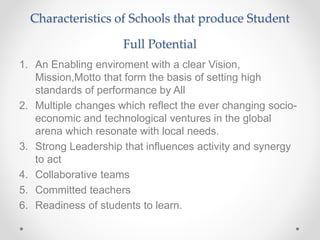
Characteristics of Schools that produce Student
Full Potential
1. An Enabling enviroment with a clear Vision,
Mission,Motto that form the basis of setting high
standards of performance by All
2. Multiple changes which reflect the ever changing socio-
economic and technological ventures in the global
arena which resonate with local needs.
3. Strong Leadership that influences activity and synergy
to act
4. Collaborative teams
5. Committed teachers
6. Readiness of students to learn.
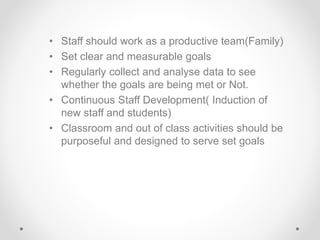
• Staff should work as a productive team(Family)
• Set clear and measurable goals
• Regularly collect and analyse data to see
whether the goals are being met or Not.
• Continuous Staff Development( Induction of
new staff and students)
• Classroom and out of class activities should be
purposeful and designed to serve set goals
What Opportunities are
Available for Schools
• Adoption Classroom management skills that have
School wide procedures.
• Create a Positive School Culture or family
• Have School goals and religiously collect and analyse
data about the set goals, activities, Outcomes and
Impacts
• Enhancing partnerships between teachers and Parents
to link with School communities
Involving Parents
• Communication and Education Aspirations
• Creating friendly learning environments through
consistent participation of Parents and families.
• Parents who are supportive and involved demonstrate
consistent Parenting skills, communicate with schools
effectively, volunteer time and resources at school and
help children learn at home and take an active role to
involve the school and the community in the education of
their children
How to involve Parents
Students Psychological well being
In summary:
1. Chilren need to feel safe
2. Have a sense of belonging, feel valued and respected
3. Be encouraged to raise their confidence and self efficasy
4. Encourage them to have autonomy and control over their lives
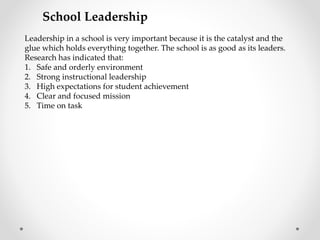
School Leadership
Leadership in a school is very important because it is the catalyst and the
glue which holds everything together. The school is as good as its leaders.
Research has indicated that:
1. Safe and orderly environment
2. Strong instructional leadership
3. High expectations for student achievement
4. Clear and focused mission
5. Time on task
THE END
THANK YOU

STUDENT FULL POTENTIAL

  • 1.
    STUDENT FULL PONTENTIAL Presented to Stakeholdersof AMS and URA by Stephen M. Lumati Scholarship and Mentoring Program Manager The Foundation For Tomorrow.
  • 2.
    Workshop Objectives • .Help teachers to explain the underlying factors to Student Full Potential. • 2. Teachers should be able to prepare tangible plans that ensure all their students are achieving the intended learning outcomes. • 3. The School management teams to Review and or make School Improvement plans which support Teachers and Students to Improve performance
  • 3.
    Guiding Principles • Teachersshould: • Believe that all students can learn and achieve by taking responsibility. • Not ignore any learner. • Not feel comfortable when students are not performing well. • On the other hand TFFT should collaborate with Schools to Place and Support learners according to their capabilities
  • 4.
    • What constitutesLearning outcomes in School? Teacher practices which govern student learning contribute immensely to student learning. All activities which the teacher carries with learners( Planned, informaly planned Unplanned) Schools should be organised based on what they want their students to look like after school and not what is common Practice in the community or Region. Learning Outcomes
  • 5.
    What is notCommon 1. Effective Teaching and Learning 2. Time management 3. Coaching and Mentoring 4. Parental involvement 5. Success for All 6. Accelerated learning Programmes 7. Staff Development 8. Psychological well being of students and teachers 9. School leadership 10. Others include school size and class size vis a vis the available resources, retention of learners, sound school policies and school ethos
  • 6.
    Characteristics of Schoolsthat produce Student Full Potential 1. An Enabling enviroment with a clear Vision, Mission,Motto that form the basis of setting high standards of performance by All 2. Multiple changes which reflect the ever changing socio- economic and technological ventures in the global arena which resonate with local needs. 3. Strong Leadership that influences activity and synergy to act 4. Collaborative teams 5. Committed teachers 6. Readiness of students to learn.
  • 7.
    • Staff shouldwork as a productive team(Family) • Set clear and measurable goals • Regularly collect and analyse data to see whether the goals are being met or Not. • Continuous Staff Development( Induction of new staff and students) • Classroom and out of class activities should be purposeful and designed to serve set goals
  • 8.
    What Opportunities are Availablefor Schools • Adoption Classroom management skills that have School wide procedures. • Create a Positive School Culture or family • Have School goals and religiously collect and analyse data about the set goals, activities, Outcomes and Impacts • Enhancing partnerships between teachers and Parents to link with School communities
  • 9.
    Involving Parents • Communicationand Education Aspirations • Creating friendly learning environments through consistent participation of Parents and families. • Parents who are supportive and involved demonstrate consistent Parenting skills, communicate with schools effectively, volunteer time and resources at school and help children learn at home and take an active role to involve the school and the community in the education of their children
  • 10.
  • 11.
    Students Psychological wellbeing In summary: 1. Chilren need to feel safe 2. Have a sense of belonging, feel valued and respected 3. Be encouraged to raise their confidence and self efficasy 4. Encourage them to have autonomy and control over their lives
  • 12.
    School Leadership Leadership ina school is very important because it is the catalyst and the glue which holds everything together. The school is as good as its leaders. Research has indicated that: 1. Safe and orderly environment 2. Strong instructional leadership 3. High expectations for student achievement 4. Clear and focused mission 5. Time on task
  • 13.