1
Student Book
LEVEL B1
Chapter 1: Present and Past perfect
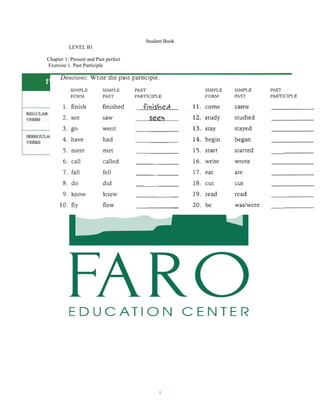
Exercise 1. Past Participle
2
Exercise 2. Forms of the present perfect
1 -
3.
Meanings of the Present perfect
3
4
Exercise 3. Present Perfect
1 - 4. Simple past VS Present perfect
5
Exercise 4. Simple VS Present perfect
6
Exercise 5. Simple past VS Present perfect
7
Exercise 6. Irregular verbs
8
Exercise 7. Irregular verbs
1 - 5. Using Since and For
9
10
Exercise 8. Since VS. For
Exercise 9. Sentences with since - clauses
11
1 - 6. Present Perfect Progressive
12
Exercise 10. Present Progressive VS. Present perfect progressive
13
1 - 7. Present perfect progressive VS. Present perfect
14
Exercise 11. Present Progressive VS. Present perfect progressive
15
16
1 - 8. Using ALREADY, YET, STILL, and Anymore
17
Exercise 12. Already, still, and anymore
18
19
Exercise 13. Already, still, and anymore
Exercise 14. Review of the verb tenses
20
21
22
Exercise 15. Error analysis
23
24
Exercise 16. Verb tense review
25
26
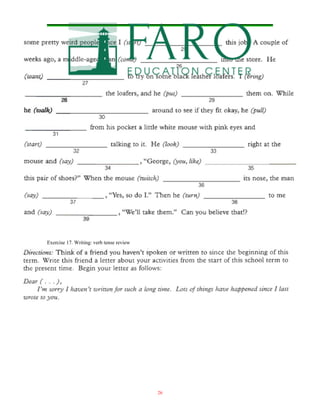
Exercise 17. Writing: verb tense review
27
1 - 9. Past perfect
28
Exercise 18. Past perfect
29
Exercise 19. Present perfect VS. Past perfect
30
Exercise 20. Looking at grammar
31
32
33
34
Student book
Level B1
Chapter 2: Modal verbs
2 - 1. The form of the modal verbs
35
2 - 2. Expressing ability: can and could
Exercise 1. Expressing past ability: could and could not
2 -
3.
36
Expressing possibility: May and Might
Expressing permission: May and Can
Exercise 2. Ability, possibility and and permission: can, may and might
37
38
2 - 4. Using could to express possibility
Exercise
3. Could
may and
probably
39
2 - 5. Polite questions : May I, could I and can I
2 - 6. Polite questions : would you, could you, will you and can you
Exercise 4. Polite questions: would , could , will, can you
40
41
2 - 7. Expressing advise: should and ought to
42
2 - 8. Expressing advice: Had better
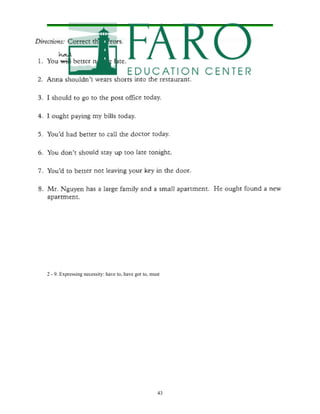
Exercise 5. Expressing advise: should , ought to and had better
43
2 - 9. Expressing necessity: have to, have got to, must
44
2 - 10. Expressing lack of necessity: do not have to
Expressing prohibition: must not
45
2 - 11. Making logical conclusions: must
Exercise 6. Making logical conclusions: must and must not
46
2 - 12. Giving instructions: Imperative sentences
47
Exercise 7. Imperative sentences
48
2 - 13. Making suggestions: Lets and why do not
Exercise 8. Making suggestions with lets and why do not we
49
50
2 - 14. Stating preferences: Prefer, like, ... Better , would rather
Exercise 9. Expressing references
51
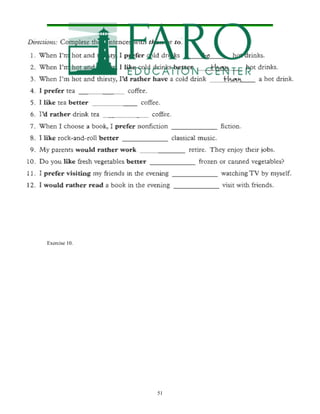
Exercise 10.
52
53
54
Exercise 11. Review auxiliary verbs
55
56
57
Student Book
58
LEVEL B1
Chapter 3. Phrasal verbs
59
Exercise 1. Identifying phrasal verbs
60
Exercise 2. Phrasal verbs: Separable VS. Non-separable
61
62
Exercise 3. Phrasal verbs
63
64
Exercise 4. Phrasal verbs
65
Exercise 5. Phrasal verbs
66
Exercise 6. Phrasal verbs
67
68
Exercise 7. Phrasal verbs
69
Phrasal verbs: intransitive
70
Exercise 8. Phrasal verbs
71
72
73
Exercise 9. Phrasal verbs
74
Phrasal verbs list
75
76
77
78
79
80
Student Book
LEVEL B1
Chapter 4. Count and non - count noun, articles
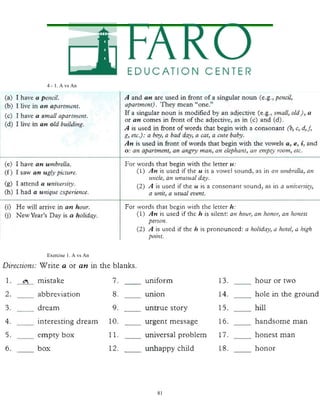
81
4 - 1. A vs An
Exercise 1. A vs An
82
Exercise 2. A vs An
4 - 2. Count and non - count nouns
Exercise 3. Count and non - count nouns
83
4 - 3. Non count nouns
84
Exercise 4. Count and non count nouns
85
4 - 4. More non count nouns
Exercise 5. Count and non count nouns
86
4 - 5. Using several, a lot of, many or much, and few or little
87
Exercise 6. Using several, a lot of, many or much
Exercise
88
7. How many and How much
89
Exercise 8. A few VS. A little
90
4 -6. Nouns that can be count or non count
Exercise 9. Nouns that can be count or non count
91
92
4 - 7. Using units of measure with non count nouns
Exercise 10. Units of measure with non count nouns
93
4 - 8.
Guidelines for
article usage
94
95
96
Exercise 11. The VS. A or an
97
Exercise 12. Using the for specific statement
98
99
Exercise 13. Summary: a VS. An 0 VS. the
100
101
Using The or 0 with names
102
Exercise 14. Using The or 0 with nouns
4 - 8. Capitalization
103
104
Exercise 15. Capitalization
105
Exercise 16. Error analysis
106
107
Student Book
108
LEVEL B1
Chapter 5. Preposition combinations
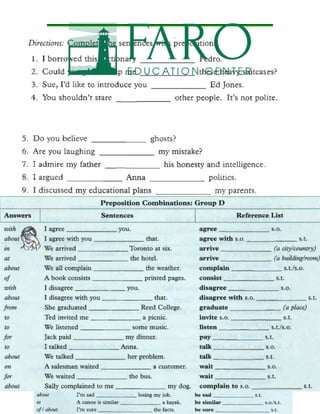
5 - 1. Preposition combinations
109
Exercise 1. Preposition
110
Exercise 2.
111
112
Exercise 3.
113
Exercise 4.
114
115
Exercise 5.
116
117
Exercise 6.
Reference list
118
119
120
Student Book
LEVEL B1
121
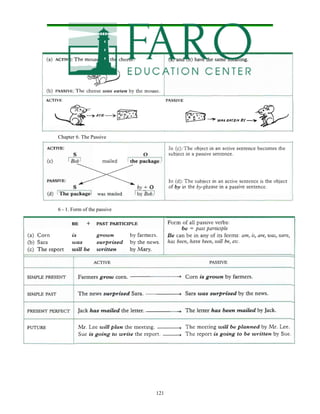
Chapter 6. The Passive
6 - 1. Form of the passive
122
Exercise 1. Active and Passive
Exercise 2. Form of passive
123
Exercise 3. Active VS. Passive
124
6 - 2. Using the By phrasal
125
Exercise 4. The By phrase
126
Exercise 5. Active VS. Passive
127
6 - 3. The passive forms of the present and past progressive
Exercise 6. Passive forms
128
129
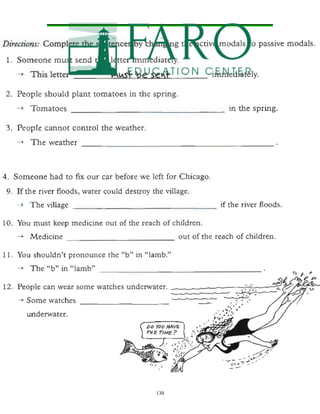
6 - 4. Passive modal auxiliaries
Exercise 7. Passive modals
130
131
Exercise 8. Active or Passive
132
6 - 3. Using past participles as adjective (stative passive)
133
Exercise 9. Stative passive
134
Exercise 10. Passive
135
6 - 4. Participle Adjectives
Exercise 11. Participle adjectives
136
137
Exercise 12. Participles adjectives
138
6 - 5. Get + adjective, Get + past participle
139
Exercise 13. Get + adjective / past participle
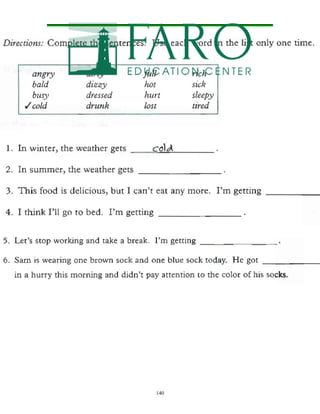
140
141
142
6 - 6. Used to VS. Be used to
Exercise 14. Used to VS. Be used to
143
Exercise 15. Used to VS. Be used to
144
6 - 7. Using be supposed to
Exercise 16. Be supposed to
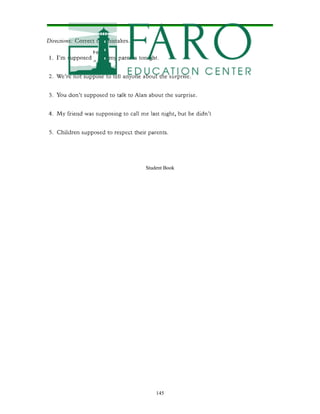
Exercise 17. Be supposed to
145
Student Book
146
LEVEL B1
Chapter 7. Reported speech
7 - 1.
When we tell people what someone has said in the past, we generally make the tense
'more in the past'.
• You look very nice. = I told him he looked very nice.
• He's working in Siberia now. = She told me he was working in Siberia now.
147
• Polly has bought a new car. = She said Polly had bought a new car.
• Jo can't come for the weekend. = She said Jo couldn't come for the weekend.
• Paul called and left a message. = He told me Paul had called and had left me a message.
• I'll give you a hand. = He said he would give me a hand.
Direct speech Reported speech
He said, "I live in Paris." He said he lived in Paris.
He said, "I am cooking dinner." He said he was cooking dinner.
He said, "I have visited London twice." He said he had visited London twice.
He said, "I went to New York last week." He said he had gone to New York the week before.
He said, "I had already eaten." He said he had already eaten.
He said, "I am going to find a new job." He said he was going to find a new job.
He said, "I will give Jack a call." He said he would give Jack a call.
Exercise 1.
1. John said, "I love this town."
John said
2. "Do you like soccer ?" He asked me.
He asked me
3. "I can't drive a lorry," he said.
He said
4. "Be nice to your brother," he said.
He asked me
5. "Don't be nasty," he said.
He urged me
148
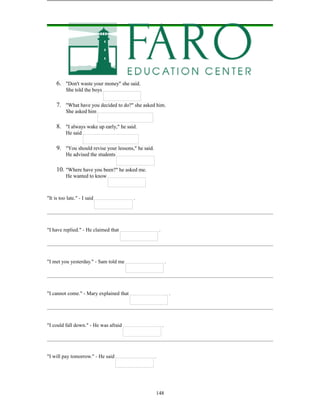
6. "Don't waste your money" she said.
She told the boys
7. "What have you decided to do?" she asked him.
She asked him
8. "I always wake up early," he said.
He said
9. "You should revise your lessons," he said.
He advised the students
10. "Where have you been?" he asked me.
He wanted to know
"It is too late." - I said .
"I have replied." - He claimed that .
"I met you yesterday." - Sam told me .
"I cannot come." - Mary explained that .
"I could fall down." - He was afraid .
"I will pay tomorrow." - He said .
149
"The Himalayas are the highest." - He knew that .
"I may lend you some money." - Bill promised .
"I have been watching a film." - He replied that .
"Claire must rest." - The doctor said .
"I have not done it today." - I explained that .
"If I was younger, I would accept it." - He thought that .
"I was with him last week." - Jill admitted that .
"You needn't change your shoes in our house." - She reminded me that .
"I am calling my mum." - She said .
150
"I will finish this picture tomorrow." - Diana supposed that .
"I would buy it." - She said .
"Greg used to be my friend." - He told us .

Student book b1