
Structuring Effective Buy-Sell Agreements 
The Absolutely Necessary, Highly Advisable, 
Very Useful, and Completely Dangerous 
Z. Christopher Mercer, ASA, CFA, ABAR 
www.linkedin.com/in/zchristophermercer 
www.buysellagreementsonline.com
2 
Pete and Sam 
Pete: “Sam, I just buried a small bomb in your yard. It isn’t large enough to kill you, your 
wife, or another member of your family, but it would certainly maim you or them if one 
of you stepped on it.” 
Sam: “Where is it?” 
Pete: “I’m not going to tell you where it is. But don’t worry. Chances are it is so well-hidden 
that no one will ever step on it.” 
Sam: “What do you mean, ‘chances are’? That’s a chance I can’t take! If it were just me it 
would be one thing, but you’re talking about hurting my wife and family!” 
Pete: “Like I said, don’t worry. Maybe no one will ever step on it. Maybe it will never 
explode.” 
Sam: “You must be crazy! I’ll bring in a bomb squad and dig up the entire yard to get rid of 
that it!” 
Pete: “Now Sam, you know I’m just kidding about the bomb. However, your buy-sell 
agreement might very well be a ticking time bomb and you just don’t know it. How 
about taking some time to talk about your buy-sell agreement – say, dinner tomorrow 
night?”
3 
What Is a Buy-Sell Agreement? 
» Agreements by and between the shareholders (or equity partners of 
whatever legal description) of a privately owned business and, perhaps, the 
business itself that establish the mechanism for the purchase of stock 
following the death (or other adverse changes) of one of the owners. In the 
case of corporate joint ventures, they also establish the value for break-ups 
or for circumstances calling for one corporate venture partner to buy out the 
other partner. 
» Buy-Sell Agreements… 
§ Require agreement at a point in time 
§ Relate to transactions that will or may occur at future points in time 
§ Define the conditions that “trigger” the buy-sell provisions 
§ Determine the price(s) at which specified future transactions will occur
4 
Session Objectives 
Part 1: Understand Buy-Sell Agreements and Their Hidden Problems 
» Understand formula, fixed price, and valuation process agreements 
» Understand the six defining elements that must be present in every valuation 
process agreement 
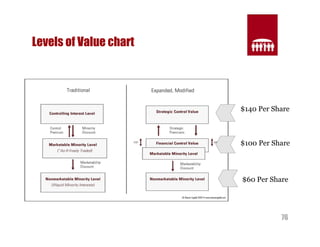
» Identify the process by which most problems can be averted for your or your 
client’s buy-sell agreement
5 
Session Objectives 
Part 1: Understand Buy-Sell Agreements and Their Hidden Problems 
» Understand formula, fixed price, and valuation process agreements 
» Understand the six defining elements that must be present in every valuation 
process agreement 
» Identify the process by which most problems can be averted for your or your 
client’s buy-sell agreement 
Part 2: Learn How to Review a Buy-Sell Agreement 
» Identify areas of concern in a buy-sell agreement 
» Complete a review process of a buy-sell agreement from business and 
valuation perspectives 
» Confidently communicate with your referral sources about buy-sell 
agreement issues
6 
Session Objectives 
Part 1: Understand Buy-Sell Agreements and Their Hidden Problems 
» Understand formula, fixed price, and valuation process agreements 
» Understand the six defining elements that must be present in every valuation 
process agreement 
» Identify the process by which most problems can be averted for your or your 
client’s buy-sell agreement 
Part 2: Learn How to Review a Buy-Sell Agreement 
» Identify areas of concern in a buy-sell agreement 
» Complete a review process of a buy-sell agreement from business and 
valuation perspectives 
» Confidently communicate with your referral sources about buy-sell 
agreement issues 
Part 3: Develop a Strategy to Help Your Clients and Increase Your Business
7 
Part 1 
Understand Buy-Sell Agreements 
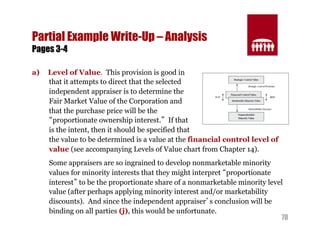
and Their Hidden Problems
8 
An Overview 
of Buy-Sell Agreements
9 
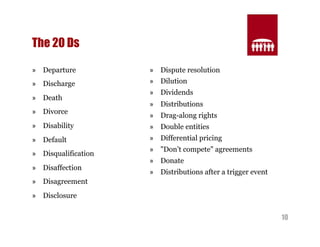
Potential “Trigger Events” 
Q Quits 
F is Fired 
R Retires 
D Disabled 
D Death 
D Divorce 
B Bankruptcy 
Others?
10 
The 20 Ds 
» Departure 
» Discharge 
» Death 
» Divorce 
» Disability 
» Default 
» Disqualification 
» Disaffection 
» Disagreement 
» Disclosure 
» Dispute resolution 
» Dilution 
» Dividends 
» Distributions 
» Drag-along rights 
» Double entities 
» Differential pricing 
» "Don’t compete" agreements 
» Donate 
» Distributions after a trigger event
11 
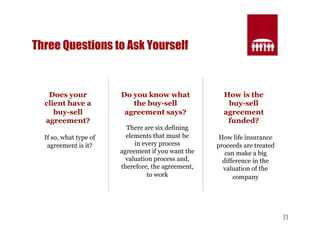
Three Questions to Ask Yourself 
Does your 
client have a 
buy-sell 
agreement? 
If so, what type of 
agreement is it? 
Do you know what 
the buy-sell 
agreement says? 
There are six defining 
elements that must be 
in every process 
agreement if you want the 
valuation process and, 
therefore, the agreement, 
to work 
How is the 
buy-sell 
agreement 
funded? 
How life insurance 
proceeds are treated 
can make a big 
difference in the 
valuation of the 
company
12 
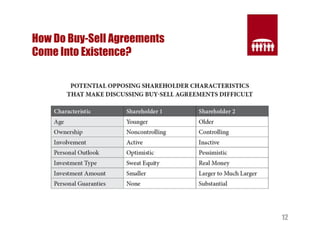
How Do Buy-Sell Agreements 
Come Into Existence?
13 
Get Agreement. Now. 
Just Do It.
14 
Types of Buy-Sell Agreements 
» Based on how price is determined 
§ Fixed-price agreements 
§ Formula agreements 
§ Process agreements
15 
Fixed-Price Agreements 
DESCRIPTION 
» You and the other owner(s) agreed on a price 
» That price of your agreement is likely years out of date 
» There are three possibilities regarding the price you set: 
§ The value today is lower, perhaps far lower, than the realistic value 
§ The value today is higher, perhaps far higher, than the realistic value 
§ The value is the same as it was back then 
» You haven’t agreed on a way to update the price
16 
A Real-Life Buy-Sell Agreement Marathon 
10 Years, Not 26.2 Miles 
» Sullivan v. Troser Management, Inc. 2013 NY Slip Op 01634 (4th Dept Mar. 15 2013) 
» A 10 year fight over an 18% interest in Troser Management, Inc. 
» Plaintiff was hired by Troser Mangement, Inc. (Troser) in 1986 with an agreement that he would 
be entitled to 18% of the equity of Troser if he stayed employed until 1991. He did. He did not 
actually receive the shares of Troser, but he apparently earned the legal right to such shares. 
» Perhaps there were negotiations between the parties following the plaintiff’s departure. We don’t 
know. However, the plaintiff filed a lawsuit in 2003 asking that his stock be issued and then 
bought. 
» There was a buy-sell agreement dating to 1986 – a fixed-price agreement. This agreement 
called for the owners to agree on the value each year and set such agreement forth in 
its Schedule A. The agreement further stated that, in the event that the shareholders did not 
update Schedule A for two years, then the agreement price would be adjusted up or down based 
on the change in Troser’s book value from the date of the last Schedule A to the time of the trigger 
event. 
» Schedule A was never finalized, so there was no base value from which to adjust.
17 
A Real-Life Buy-Sell Agreement Marathon 
10 Years, Not 26.2 Miles 
» You’ve got to figure that after ten years of litigation, including four appeals, likely the 
parties collectively have spent far more in legal fees than Sullivan’s shares are worth. On top of 
that, the litigants have yet to establish through their prodigious litigation efforts 
either (1) a methodology for establishing the value of Sullivan’s shares and (2) any 
certainty as to the exercise of Troser’s option to purchase Sullivan’s shares. 
» And to think, all of this could have been avoided had the parties prepared a simple 
schedule or certificate of value as contemplated by the 1986 buy-sell agreement. But 
do not view this omission as a freak occurrence. Rather, it is symptomatic of the myriad 
problems afflicting fixed-price buy-sell agreements.
18 
Fixed-Price Agreements 
REALITIES SELDOM DISCUSSED 
» If the value is unrealistically low, you are betting that the other guy 
will die first and you’ll get to buy at the low price 
» If the value is unrealistically high, you are betting that you'll be the 
one to leave the business so you and your family can benefit 
» The other guy(s) are making just the opposite bets 
» Why take a chance that you’ll be on the wrong end of that bet?
19 
Fixed-Price Agreements 
ADVANTAGES 
» Easy to understand, easy to negotiate – the first time only! 
» Inexpensive 
§ Easy for attorneys to draft 
§ No appraisers required
20 
Fixed-Price Agreements 
DISADVANTAGES 
» Fixed prices are seldom updated, even over periods of many years. 
Inequities are almost certainly a result of out-of-date fixed-price agreements 
» Easy to set an initial price, but may be difficult to reset as time passes and 
interests diverge 
» The longer period of time between updates to fixed-price agreements, the 
greater the potential for a divergence of the interests of the various parties 
» The normal procedure to address to this problem is a flawed process 
agreement 
» Betting that the other guy(s) will die first!
21 
Fixed-Price Agreements 
HOW TO “FIX” AN OUT-OF-DATE FIXED-PRICE 
AGREEMENT 
» Update it annually 
» So simple but rarely ever done
22 
Formula Agreements 
DESCRIPTION 
» You and the other owner(s) established a formula to calculate price 
» Chances are, no one has calculated it lately 
» Chances are, it can give an unreasonable result now 
» Combined with changes in the company and the industry: 
§ The formula price may be higher than a realistic value today 
§ The formula price may be lower than a realistic value today 
§ The formula price is realistic today 
» You haven’t agreed on ways to make necessary/appropriate adjustments
23 
Formula Agreements 
REALITIES SELDOM DISCUSSED 
» If the value is unrealistically low, you are betting that the other guy will die 
first and you’ll get to buy at the low price 
» If the value is unrealistically high, you are betting that you’ll be the one to 
leave the business so you and your family can benefit 
» The other guy(s) are making just the opposite bets 
» Why take a chance that you’ll be on the wrong end of that bet?
24 
Formula Agreements 
State a single formula to be applied to balance sheet and/or income statement 
metrics 
EXAMPLES 
» Multiple of EBITDA – (5 x EBITDA) 
§ Less debt? 
» Book Value 
§ “Shareholders’ equity per the audited financial statements at the end of the fiscal 
year immediately preceding the valuation date.” 
HOW TO “FIX” A FORMULA AGREEMENT 
» Every year, calculate the price based upon the formula
25 
The Terms of the Agreement
26 
Process Buy-Sell Agreements 
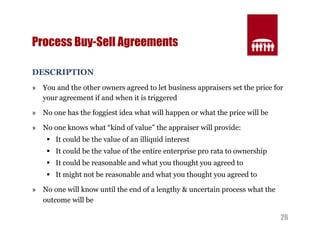
DESCRIPTION 
» You and the other owners agreed to let business appraisers set the price for 
your agreement if and when it is triggered 
» No one has the foggiest idea what will happen or what the price will be 
» No one knows what “kind of value” the appraiser will provide: 
§ It could be the value of an illiquid interest 
§ It could be the value of the entire enterprise pro rata to ownership 
§ It could be reasonable and what you thought you agreed to 
§ It might not be reasonable and what you thought you agreed to 
» No one will know until the end of a lengthy & uncertain process what the 
outcome will be
27 
Process Buy-Sell Agreements 
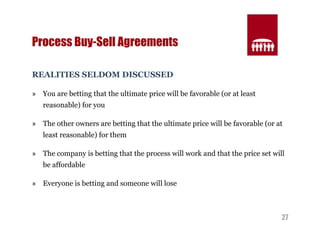
REALITIES SELDOM DISCUSSED 
» You are betting that the ultimate price will be favorable (or at least 
reasonable) for you 
» The other owners are betting that the ultimate price will be favorable (or at 
least reasonable) for them 
» The company is betting that the process will work and that the price set will 
be affordable 
» Everyone is betting and someone will lose
28 
Process Buy-Sell Agreements 
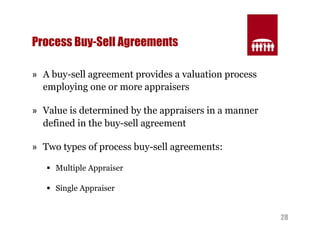
» A buy-sell agreement provides a valuation process 
employing one or more appraisers 
» Value is determined by the appraisers in a manner 
defined in the buy-sell agreement 
» Two types of process buy-sell agreements: 
§ Multiple Appraiser 
§ Single Appraiser
29 
Process Buy-Sell Agreements 
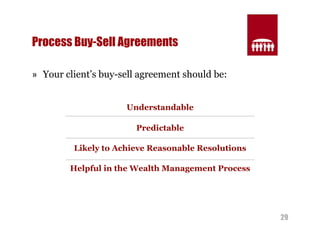
» Your client’s buy-sell agreement should be: 
Understandable 
Predictable 
Likely to Achieve Reasonable Resolutions 
Helpful in the Wealth Management Process
30 
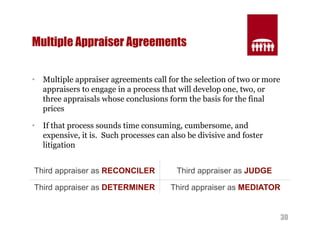
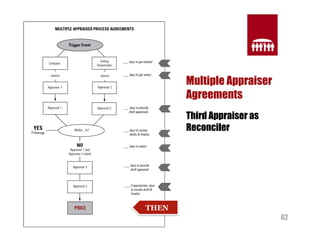
Multiple Appraiser Agreements 
• Multiple appraiser agreements call for the selection of two or more 
appraisers to engage in a process that will develop one, two, or 
three appraisals whose conclusions form the basis for the final 
prices 
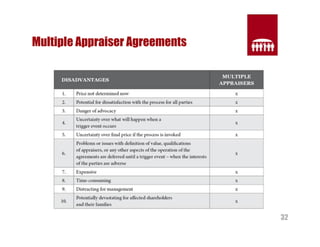
• If that process sounds time consuming, cumbersome, and 
expensive, it is. Such processes can also be divisive and foster 
litigation 
Third appraiser as RECONCILER Third appraiser as JUDGE 
Third appraiser as DETERMINER Third appraiser as MEDIATOR
31 
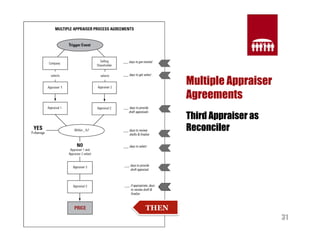
Multiple Appraiser 
Agreements 
Third Appraiser as 
Reconciler 
THEN
32 
Multiple Appraiser Agreements
33 
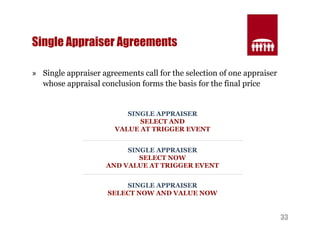
Single Appraiser Agreements 
» Single appraiser agreements call for the selection of one appraiser 
whose appraisal conclusion forms the basis for the final price 
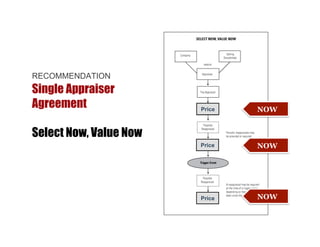
SINGLE APPRAISER 
SELECT AND 
VALUE AT TRIGGER EVENT 
SINGLE APPRAISER 
SELECT NOW 
AND VALUE AT TRIGGER EVENT 
SINGLE APPRAISER 
SELECT NOW AND VALUE NOW
34 
Key Recommendation 
Single Appraiser, 
Select Now and Value Now
35 
Single Appraiser, 
Select Now and Value Now 
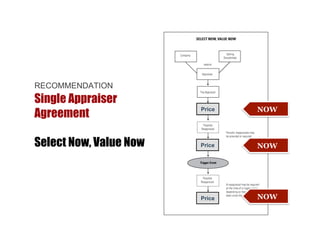
SELECT NOW 
» I have long recommended that parties creating buy-sell agreements name the 
appraiser at the time of agreement. This way, all parties have a voice and can sign off 
on the selection of the appraiser no matter how difficult the process of reaching 
agreement. 
VALUE NOW 
» Once selected, the chosen appraiser provides a baseline appraisal for purposes of the 
agreement. I suggest that the appraisal be rendered in draft form to all parties to the 
agreement, and that everyone has a reasonable period of time to provide comments 
for consideration before the report is finalized. 
VALUE EACH YEAR (OR TWO) THEREAFTER 
» Ideally, the selected appraiser will provide annual revaluations for buy-sell agreement 
purposes.
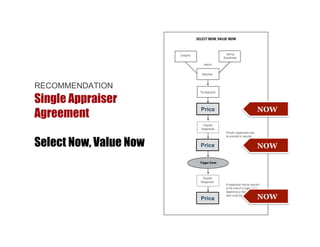
RECOMMENDATION 
Single Appraiser 
Agreement 
Select Now, Value Now 
Price 
Price 
Price 
NOW 
NOW 
NOW
37 
Single Appraiser, 
Select Now and Value Now 
ADVANTAGES 
» Selected appraiser viewed as independent 
» Appraiser’s valuation process is seen by all parties at the outset 
» Appraiser’s conclusion is known at outset and has established a baseline price for the 
agreement 
» Because process is observed at the outset, all parties know what will happen when 
trigger event occurs 
» Because the appraiser must interpret the “words on the pages” in conducting the 
initial appraisal, any issues regarding lack of clarity of valuation-defining terms will 
be resolved 
» Selected appraiser must maintain independence with respect to process and render 
future valuations consistent with terms of agreement and with prior reports
38 
Single Appraiser, 
Select Now and Value Now 
ADVANTAGES (CONTINUED) 
» Subsequent appraisals, either annually or at trigger events, should be less time-consuming 
and expensive than other alternatives 
» Parties should gain confidence in the process 
» Parties will always know the current value for the buy-sell agreement (helpful for 
planning all-around) 
» Appraisers’ knowledge of the company and its industry will grow over time, 
enhancing confidence for all parties with the process 
» Creates a means of maintaining pricing for other transactions, thereby enhancing “the 
market” for a company’s shares
39 
Multiple Appraiser vs. Single Appraiser, 
Select Now and Value Now
Do You Know What Your Client’s 
Buy-Sell Agreement Says? 
40
41 
Do You Know What Your 
Client’s Buy-Sell Agreement Says? 
» From a business perspective? 
» Departure 
» Discharge 
» Death 
» Divorce 
» Disability 
» Default 
» Disqualification 
» Disaffection 
» Disagreement 
» Disclosure 
» Dispute resolution 
» Dilution 
» Dividends 
» Distributions 
» Drag-along rights 
» Double entities 
» Differential pricing 
» "Don’t compete" agreements 
» Donate 
» Distributions after a trigger event 
» From a valuation perspective?
42 
The Six 
Defining 
Elements of 
Process 
Buy-Sell 
Agreements 
Standard of Value 
Level of Value 
The “As Of” Date 
Qualifications of Appraisers 
Appraisal Standards 
Funding Mechanism
43 
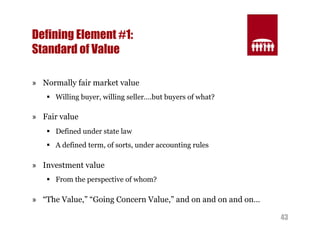
Defining Element #1: 
Standard of Value 
» Normally fair market value 
§ Willing buyer, willing seller….but buyers of what? 
» Fair value 
§ Defined under state law 
§ A defined term, of sorts, under accounting rules 
» Investment value 
§ From the perspective of whom? 
» “The Value,” “Going Concern Value,” and on and on and on…
44 
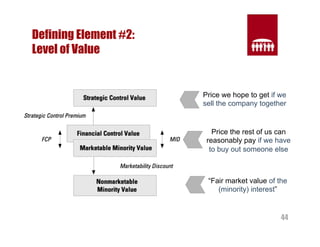
Defining Element #2: 
Level of Value 
Price we hope to get if we 
sell the company together 
Price the rest of us can 
reasonably pay if we have 
to buy out someone else 
“Fair market value of the 
(minority) interest”
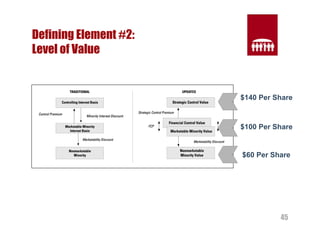
$140 Per Share 
$100 Per Share 
$60 Per Share 
45 
Defining Element #2: 
Level of Value
46 
Differences in 
Premiums and Discounts
47 
Defining Element #3: 
The “As Of” Date 
» There is no such thing as “The Value” 
§ Value is “as of” a specific point in time 
§ Is based on information known or reasonably knowable 
» The “as of” date can make a difference 
§ Date of marriage 
§ Date of separation 
§ Date of trial/divorce
48 
Defining Element #4: 
Qualifications of Appraisers 
INDIVIDUAL 
§ Education 
§ Valuation training 
§ Appraisal experience 
§ Industry experience 
§ Continuing education 
§ Publishing 
§ Credentials 
FIRM 
§ Size 
§ Longevity 
§ Specialization
49 
Defining Element #5: 
Appraisal Standards 
» Uniform Standards of Professional Appraisal Practice (USPAP) 
» ASA Business Valuation Standards 
§ Principles of Appraisal Practice and Code of Ethics 
» AICPA Statement on Standards for Valuation Services (SSVS) No. 1 
» Institute of Business Appraisers Business Valuation Standards and Rules of 
Professional Conduct 
» NACVA Professional Standards 
» CFA Institute Code of Ethics & Standards of Professional Conduct
50 
What If Your Appraiser Has 
No Standards?
51 
The Six 
Defining 
Elements of 
Process 
Buy-Sell 
Agreements 
Standard of Value 
Level of Value 
The “As Of” Date 
Qualifications of Appraisers 
Appraisal Standards 
Funding Mechanism
52 
How is Your Client’s 
Buy-Sell Agreement Funded?
53 
How Is Your Client’s 
Buy-Sell Agreement Funded? 
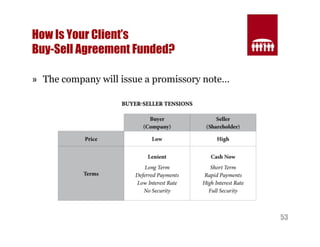
» The company will issue a promissory note…
54 
Potential Funding Sources 
» Life insurance 
» Cash 
§ Life insurance 
§ Corporate assets 
§ External borrowings 
§ “Sinking fund” 
» Selling shareholder notes 
» Combination of cash and shareholder notes 
» See “Basic Considerations Per Shareholder Notes” handout
55 
The Confrontation
56 
Funding the Buy-Sell Agreement 
» Life insurance typically purchased by company for corporate buy-sell 
agreements 
» Key question: Is life insurance intended as a: 
Funding Vehicle 
or 
Corporate Asset
57 
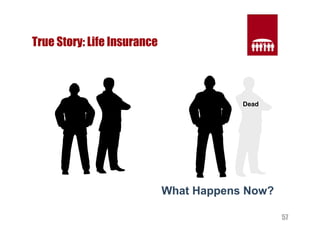
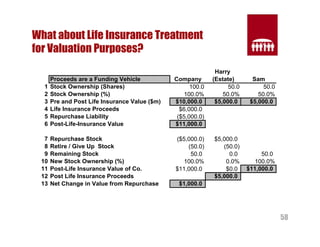
True Story: Life Insurance 
Dead 
What Happens Now?
58 
What about Life Insurance Treatment 
for Valuation Purposes? 
Harry 
Proceeds are a Funding Vehicle Company (Estate) Sam 
1 Stock Ownership (Shares) 100.0 50.0 50.0 
2 Stock Ownership (%) 100.0% 50.0% 50.0% 
3 Pre and Post Life Insurance Value ($m) $10,000.0 $5,000.0 $5,000.0 
4 Life Insurance Proceeds $6,000.0 
5 Repurchase Liability ($5,000.0) 
6 Post-Life-Insurance Value $11,000.0 
7 Repurchase Stock ($5,000.0) $5,000.0 
8 Retire / Give Up Stock (50.0) (50.0) 
9 Remaining Stock 50.0 0.0 50.0 
10 New Stock Ownership (%) 100.0% 0.0% 100.0% 
11 Post-Life Insurance Value of Co. $11,000.0 $0.0 $11,000.0 
12 Post Life Insurance Proceeds $5,000.0 
13 Net Change in Value from Repurchase $1,000.0
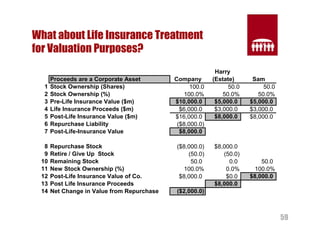
59 
What about Life Insurance Treatment 
for Valuation Purposes? 
Harry 
Proceeds are a Corporate Asset Company (Estate) Sam 
1 Stock Ownership (Shares) 100.0 50.0 50.0 
2 Stock Ownership (%) 100.0% 50.0% 50.0% 
3 Pre-Life Insurance Value ($m) $10,000.0 $5,000.0 $5,000.0 
4 Life Insurance Proceeds ($m) $6,000.0 $3,000.0 $3,000.0 
5 Post-Life Insurance Value ($m) $16,000.0 $8,000.0 $8,000.0 
6 Repurchase Liability ($8,000.0) 
7 Post-Life-Insurance Value $8,000.0 
8 Repurchase Stock ($8,000.0) $8,000.0 
9 Retire / Give Up Stock (50.0) (50.0) 
10 Remaining Stock 50.0 0.0 50.0 
11 New Stock Ownership (%) 100.0% 0.0% 100.0% 
12 Post-Life Insurance Value of Co. $8,000.0 $0.0 $8,000.0 
13 Post Life Insurance Proceeds $8,000.0 
14 Net Change in Value from Repurchase ($2,000.0)
60 
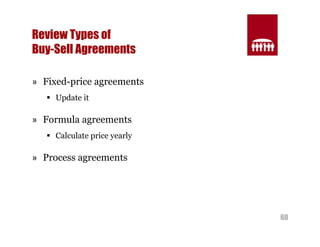
Review Types of 
Buy-Sell Agreements 
» Fixed-price agreements 
§ Update it 
» Formula agreements 
§ Calculate price yearly 
» Process agreements
61 
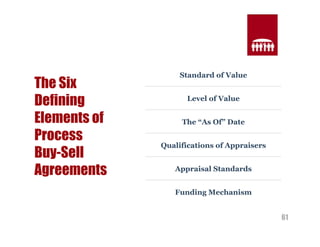
The Six 
Defining 
Elements of 
Process 
Buy-Sell 
Agreements 
Standard of Value 
Level of Value 
The “As Of” Date 
Qualifications of Appraisers 
Appraisal Standards 
Funding Mechanism
62 
Multiple Appraiser 
Agreements 
Third Appraiser as 
Reconciler 
THEN
RECOMMENDATION 
Single Appraiser 
Agreement 
Select Now, Value Now 
Price 
Price 
Price 
NOW 
NOW 
NOW
64 
Part 2 
Get Prepared to Help Your Clients
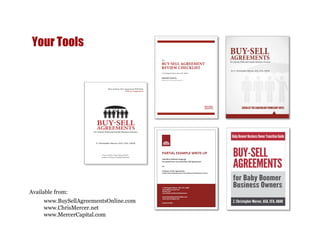
Your Tools
66 
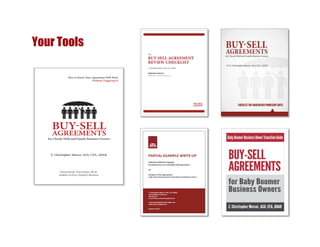
Step 1: Read & study the book 
» Read and study Buy-Sell Agreements for Closely Held and Family 
Business Owners and the companion Buy-Sell Audit Checklist 
§ Nothing gives more confidence than knowledge 
§ The book is all about common sense applied to common business 
situations 
§ Read and highlight, making notes from your own personal experience 
§ Read the book again 
§ By the time you have completed Step 1, you will know more about 
buy-sell agreements and how they work and don’t work than most 
professionals on the planet 
§ Don’t skip Step 1!
67 
Step 2: Read several buy-sell agreements 
» Pull several buy-sell agreements from your files 
» Practice reviewing buy-sell agreements from 
business and valuation perspectives 
» Use the Buy-Sell Agreement Review Checklist
68 
Step 3: Remember, you are not a lawyer 
» Make it clear when talking to clients and 
prospects that you are talking about buy-sell 
agreements from business and valuation 
perspectives - not from a legal perspective 
» You are not an attorney (unless you are …)
69 
Step 4: Reviewing an agreement 
» General issues 
§ Agreement status 
§ Type of agreement 
§ Parties to the agreement 
§ Right of first refusal 
§ Life insurance 
§ Status of stock after trigger event 
§ Binding or not? 
See Buy-Sell Agreement 
Review Checklist 
Page 1 
If you will go through the exercises discussed here 3-4 times with agreements from your files, 
you will gain confidence in your ability to offer the service for clients and prospects.
70 
Step 4: Reviewing an agreement 
» List the trigger events and what 
happens at each of them 
» Note what common trigger events 
are not included in the agreement (this is an area you 
can make suggestions for consideration) 
See Buy-Sell Agreement 
Review Checklist 
Page 3
See Buy-Sell Agreement 
Review Checklist 
71 
Step 4: Reviewing an agreement 
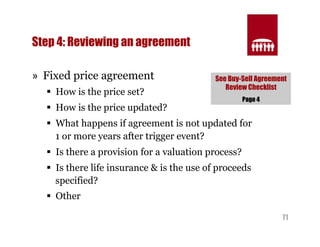
» Fixed price agreement 
§ How is the price set? 
§ How is the price updated? 
§ What happens if agreement is not updated for 
1 or more years after trigger event? 
§ Is there a provision for a valuation process? 
§ Is there life insurance & is the use of proceeds 
specified? 
§ Other 
Page 4
See Buy-Sell Agreement 
Review Checklist 
72 
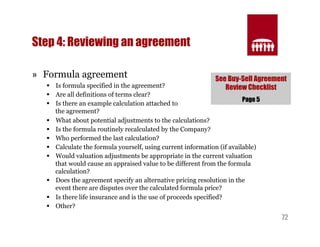
Step 4: Reviewing an agreement 
» Formula agreement 
§ Is formula specified in the agreement? 
§ Are all definitions of terms clear? 
§ Is there an example calculation attached to 
the agreement? 
§ What about potential adjustments to the calculations? 
§ Is the formula routinely recalculated by the Company? 
§ Who performed the last calculation? 
§ Calculate the formula yourself, using current information (if available) 
§ Would valuation adjustments be appropriate in the current valuation 
that would cause an appraised value to be different from the formula 
calculation? 
§ Does the agreement specify an alternative pricing resolution in the 
event there are disputes over the calculated formula price? 
§ Is there life insurance and is the use of proceeds specified? 
§ Other? 
Page 5
73 
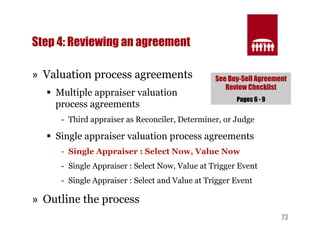
Step 4: Reviewing an agreement 
» Valuation process agreements 
§ Multiple appraiser valuation 
process agreements 
- Third appraiser as Reconciler, Determiner, or Judge 
§ Single appraiser valuation process agreements 
- Single Appraiser : Select Now, Value Now 
- Single Appraiser : Select Now, Value at Trigger Event 
- Single Appraiser : Select and Value at Trigger Event 
» Outline the process 
See Buy-Sell Agreement 
Review Checklist 
Pages 6 - 9
74 
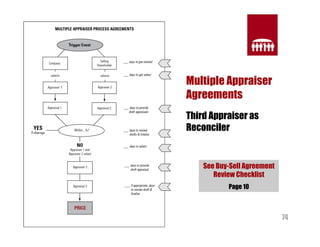
Multiple Appraiser 
Agreements 
Third Appraiser as 
Reconciler 
See Buy-Sell Agreement 
Review Checklist 
Page 10
See Buy-Sell Agreement 
Review Checklist 
75 
Step 4: Reviewing an agreement 
» Review the valuation sections for 
six factors that define the kind of 
value the appraiser(s) will determine 
§ What is the standard of value 
Page 7 
(fair market value, fair value, etc.)? 
- Is the standard defined precisely? If not, you might suggest a definition from 
Revenue Ruling 59-60 or the business valuation standards that you follow 
§ What is the level of value? 
- Is the value called for the value of the interest or the pro rata share of the 
value of the enterprise? 
- Is the language confusing regarding the use (or not) of valuation discounts 
and premiums? (If so, suggest referencing this book or another valuation 
text because it is often better to refer to a book than for attorneys to attempt 
to draft valuation language)
$140 Per Share 
76 
Levels of Value chart 
$100 Per Share 
$60 Per Share
77 
Partial Example Write-Up – Agreement 
Page 3 
A. Purchase Price. a) The purchase price paid will be the deceased 
Shareholder’s proportionate ownership interest in the Corporation multiplied 
by the Corporation’s b) Fair Market Value, as defined in Treasury Regulation 
§20.2031-1(b) of such shares of stock c) as of the Shareholder’s date of death. 
The Fair Market Value shall be d) determined by an independent appraiser 
e) with the cost of the appraisal being paid by the Corporation. f) In the event 
the deceased Shareholder’s personal representative and the Corporation are 
unable to agree as to such appraiser, g) such deceased Shareholder’s personal 
representative and the Corporation shall each select an appraiser, h) which 
appraisers shall agree upon a third independent appraiser, i) who shall then 
proceed to determine the Fair Market Value of such shares of stock. j) The 
value so determined shall be final and binding on the parties.
78 
Partial Example Write-Up – Analysis 
Pages 3-4 
a) Level of Value. This provision is good in 
that it attempts to direct that the selected 
independent appraiser is to determine the 
Fair Market Value of the Corporation and 
that the purchase price will be the 
“proportionate ownership interest.” If that 
is the intent, then it should be specified that 
the value to be determined is a value at the financial control level of 
value (see accompanying Levels of Value chart from Chapter 14). 
Some appraisers are so ingrained to develop nonmarketable minority 
values for minority interests that they might interpret “proportionate 
interest” to be the proportionate share of a nonmarketable minority level 
value (after perhaps applying minority interest and/or marketability 
discounts). And since the independent appraiser’s conclusion will be 
binding on all parties (j), this would be unfortunate.
79 
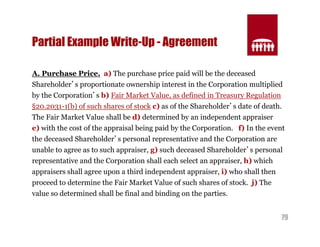
Partial Example Write-Up - Agreement 
A. Purchase Price. a) The purchase price paid will be the deceased 
Shareholder’s proportionate ownership interest in the Corporation multiplied 
by the Corporation’s b) Fair Market Value, as defined in Treasury Regulation 
§20.2031-1(b) of such shares of stock c) as of the Shareholder’s date of death. 
The Fair Market Value shall be d) determined by an independent appraiser 
e) with the cost of the appraisal being paid by the Corporation. f) In the event 
the deceased Shareholder’s personal representative and the Corporation are 
unable to agree as to such appraiser, g) such deceased Shareholder’s personal 
representative and the Corporation shall each select an appraiser, h) which 
appraisers shall agree upon a third independent appraiser, i) who shall then 
proceed to determine the Fair Market Value of such shares of stock. j) The 
value so determined shall be final and binding on the parties.
80 
Partial Example Write-Up – Analysis 
Pages 4-5 
b) Standard of Value. The agreement specifies that Fair Market Value is the required 
standard of value and further provides a citation to the definition of Fair Market Value as 
Treasury Regulation §20.2031-1(b), which is quoted in the Partial Example Write-Up 
(with emphasis added) 
Three reasons why reference to Section 2031-1(b) is not ideal 
1. The definition relates to the “valuation of property in general,” and not to the valuation of 
business interests 
2. The definition refers to other sections of the regulations for further discussion of the valuation of 
interests in businesses, which can cause confusion 
3. The discussion relates to “an item of property,” which could be misinterpreted as the block of 
stock itself rather than the proportionate share of the value of the enterprise, as indicated in the 
paragraph 
Reference to the ASA Business Valuation Standards [or your standards] could be 
preferable [or to other standards, as appropriate for the reviewing appraiser. This would 
also tend to ground the valuation in the context of relevant valuation standards 
Alternatively, the definition from Revenue Ruling 59-60 could be used 
Either of the definitions from the ASA Business Valuation Standards or Revenue Ruling 
59-60 is preferable to the reference to Section 2031-1(b) because of their focus on 
businesses and business interests
81 
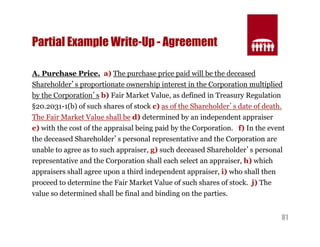
Partial Example Write-Up - Agreement 
A. Purchase Price. a) The purchase price paid will be the deceased 
Shareholder’s proportionate ownership interest in the Corporation multiplied 
by the Corporation’s b) Fair Market Value, as defined in Treasury Regulation 
§20.2031-1(b) of such shares of stock c) as of the Shareholder’s date of death. 
The Fair Market Value shall be d) determined by an independent appraiser 
e) with the cost of the appraisal being paid by the Corporation. f) In the event 
the deceased Shareholder’s personal representative and the Corporation are 
unable to agree as to such appraiser, g) such deceased Shareholder’s personal 
representative and the Corporation shall each select an appraiser, h) which 
appraisers shall agree upon a third independent appraiser, i) who shall then 
proceed to determine the Fair Market Value of such shares of stock. j) The 
value so determined shall be final and binding on the parties.
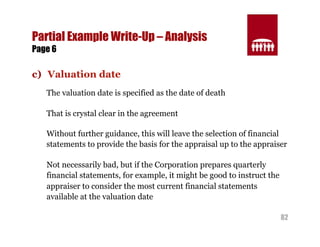
82 
Partial Example Write-Up – Analysis 
Page 6 
c) Valuation date 
The valuation date is specified as the date of death 
That is crystal clear in the agreement 
Without further guidance, this will leave the selection of financial 
statements to provide the basis for the appraisal up to the appraiser 
Not necessarily bad, but if the Corporation prepares quarterly 
financial statements, for example, it might be good to instruct the 
appraiser to consider the most current financial statements 
available at the valuation date
83 
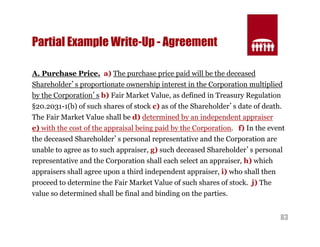
Partial Example Write-Up - Agreement 
A. Purchase Price. a) The purchase price paid will be the deceased 
Shareholder’s proportionate ownership interest in the Corporation multiplied 
by the Corporation’s b) Fair Market Value, as defined in Treasury Regulation 
§20.2031-1(b) of such shares of stock c) as of the Shareholder’s date of death. 
The Fair Market Value shall be d) determined by an independent appraiser 
e) with the cost of the appraisal being paid by the Corporation. f) In the event 
the deceased Shareholder’s personal representative and the Corporation are 
unable to agree as to such appraiser, g) such deceased Shareholder’s personal 
representative and the Corporation shall each select an appraiser, h) which 
appraisers shall agree upon a third independent appraiser, i) who shall then 
proceed to determine the Fair Market Value of such shares of stock. j) The 
value so determined shall be final and binding on the parties.
84 
Partial Example Write-Up – Analysis 
Page 6 
d) Qualifications of the appraiser/Standards to be followed. The 
Agreement calls for the parties to attempt to agree upon an “independent 
appraiser,” a term not defined in the agreement. Unfortunately, that tent is 
so open it doesn’t have doors. Absent specific criteria describing 
qualifications (experience, credentials, size of firm, etc.), any accountant, 
business broker or college professor could qualify. 
It is an excellent idea to provide a list of valuation credentials as minimum 
qualifications for the selection of an appraiser. I always recommend the 
ASA designations of the American Society of Appraisers. Members of the 
ASA are required to provide appraisals in accordance with the ASA Business 
Valuation Standards and the Uniform Standards of Professional Appraisal 
Practice (USPAP). This is important, because you definitely want your 
appraiser to provide a standards-compliant appraisal. [If your appraiser 
follows other standards, make sure those standards are cited in your write-ups 
of reviews of buy-sell agreements]
See Buy-Sell Agreement 
Review Checklist 
85 
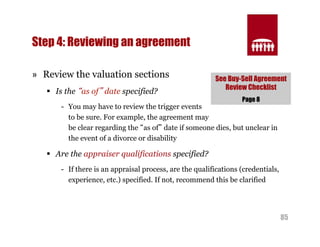
Step 4: Reviewing an agreement 
» Review the valuation sections 
§ Is the “as of” date specified? 
Page 8 
- You may have to review the trigger events 
to be sure. For example, the agreement may 
be clear regarding the “as of” date if someone dies, but unclear in 
the event of a divorce or disability 
§ Are the appraiser qualifications specified? 
- If there is an appraisal process, are the qualifications (credentials, 
experience, etc.) specified. If not, recommend this be clarified
See Buy-Sell Agreement 
Review Checklist 
86 
Step 4: Reviewing an agreement 
» Review the valuation sections 
§ Are the appraisal standards to be 
followed specified? 
- If not, recommend this be clarified 
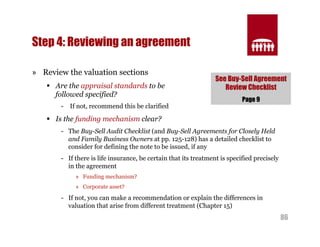
§ Is the funding mechanism clear? 
Page 9 
- The Buy-Sell Audit Checklist (and Buy-Sell Agreements for Closely Held 
and Family Business Owners at pp. 125-128) has a detailed checklist to 
consider for defining the note to be issued, if any 
- If there is life insurance, be certain that its treatment is specified precisely 
in the agreement 
» Funding mechanism? 
» Corporate asset? 
- If not, you can make a recommendation or explain the differences in 
valuation that arise from different treatment (Chapter 15)
87 
Partial Example Write-Up – Agreement 
Page 8 
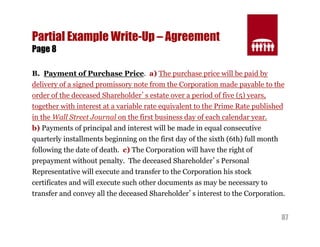
B. Payment of Purchase Price. a) The purchase price will be paid by 
delivery of a signed promissory note from the Corporation made payable to the 
order of the deceased Shareholder’s estate over a period of five (5) years, 
together with interest at a variable rate equivalent to the Prime Rate published 
in the Wall Street Journal on the first business day of each calendar year. 
b) Payments of principal and interest will be made in equal consecutive 
quarterly installments beginning on the first day of the sixth (6th) full month 
following the date of death. c) The Corporation will have the right of 
prepayment without penalty. The deceased Shareholder’s Personal 
Representative will execute and transfer to the Corporation his stock 
certificates and will execute such other documents as may be necessary to 
transfer and convey all the deceased Shareholder’s interest to the Corporation.
88 
Partial Example Write-Up – Analysis 
Page 8 
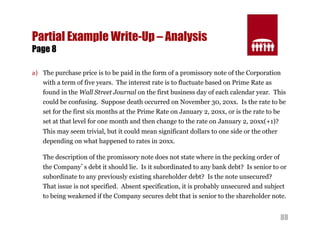
a) The purchase price is to be paid in the form of a promissory note of the Corporation 
with a term of five years. The interest rate is to fluctuate based on Prime Rate as 
found in the Wall Street Journal on the first business day of each calendar year. This 
could be confusing. Suppose death occurred on November 30, 20xx. Is the rate to be 
set for the first six months at the Prime Rate on January 2, 20xx, or is the rate to be 
set at that level for one month and then change to the rate on January 2, 20xx(+1)? 
This may seem trivial, but it could mean significant dollars to one side or the other 
depending on what happened to rates in 20xx. 
The description of the promissory note does not state where in the pecking order of 
the Company’s debt it should lie. Is it subordinated to any bank debt? Is senior to or 
subordinate to any previously existing shareholder debt? Is the note unsecured? 
That issue is not specified. Absent specification, it is probably unsecured and subject 
to being weakened if the Company secures debt that is senior to the shareholder note.
89 
Partial Example Write-Up – Agreement 
Page 9 
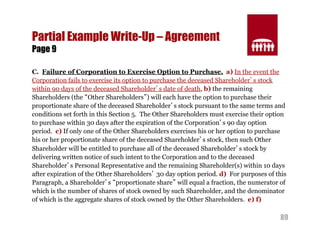
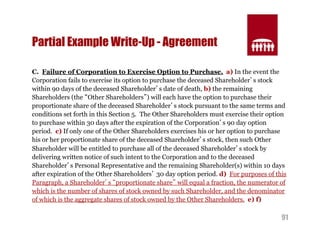
C. Failure of Corporation to Exercise Option to Purchase. a) In the event the 
Corporation fails to exercise its option to purchase the deceased Shareholder’s stock 
within 90 days of the deceased Shareholder’s date of death, b) the remaining 
Shareholders (the “Other Shareholders”) will each have the option to purchase their 
proportionate share of the deceased Shareholder’s stock pursuant to the same terms and 
conditions set forth in this Section 5. The Other Shareholders must exercise their option 
to purchase within 30 days after the expiration of the Corporation’s 90 day option 
period. c) If only one of the Other Shareholders exercises his or her option to purchase 
his or her proportionate share of the deceased Shareholder’s stock, then such Other 
Shareholder will be entitled to purchase all of the deceased Shareholder’s stock by 
delivering written notice of such intent to the Corporation and to the deceased 
Shareholder’s Personal Representative and the remaining Shareholder(s) within 10 days 
after expiration of the Other Shareholders’ 30 day option period. d) For purposes of this 
Paragraph, a Shareholder’s “proportionate share” will equal a fraction, the numerator of 
which is the number of shares of stock owned by such Shareholder, and the denominator 
of which is the aggregate shares of stock owned by the Other Shareholders. e) f)
90 
Partial Example Write-Up – Analysis 
Page 9 
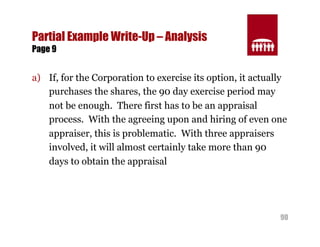
a) If, for the Corporation to exercise its option, it actually 
purchases the shares, the 90 day exercise period may 
not be enough. There first has to be an appraisal 
process. With the agreeing upon and hiring of even one 
appraiser, this is problematic. With three appraisers 
involved, it will almost certainly take more than 90 
days to obtain the appraisal
91 
Partial Example Write-Up - Agreement 
C. Failure of Corporation to Exercise Option to Purchase. a) In the event the 
Corporation fails to exercise its option to purchase the deceased Shareholder’s stock 
within 90 days of the deceased Shareholder’s date of death, b) the remaining 
Shareholders (the “Other Shareholders”) will each have the option to purchase their 
proportionate share of the deceased Shareholder’s stock pursuant to the same terms and 
conditions set forth in this Section 5. The Other Shareholders must exercise their option 
to purchase within 30 days after the expiration of the Corporation’s 90 day option 
period. c) If only one of the Other Shareholders exercises his or her option to purchase 
his or her proportionate share of the deceased Shareholder’s stock, then such Other 
Shareholder will be entitled to purchase all of the deceased Shareholder’s stock by 
delivering written notice of such intent to the Corporation and to the deceased 
Shareholder’s Personal Representative and the remaining Shareholder(s) within 10 days 
after expiration of the Other Shareholders’ 30 day option period. d) For purposes of this 
Paragraph, a Shareholder’s “proportionate share” will equal a fraction, the numerator of 
which is the number of shares of stock owned by such Shareholder, and the denominator 
of which is the aggregate shares of stock owned by the Other Shareholders. e) f)
92 
Partial Example Write-Up – Analysis 
Page 9 
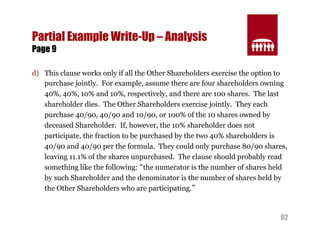
d) This clause works only if all the Other Shareholders exercise the option to 
purchase jointly. For example, assume there are four shareholders owning 
40%, 40%, 10% and 10%, respectively, and there are 100 shares. The last 
shareholder dies. The Other Shareholders exercise jointly. They each 
purchase 40/90, 40/90 and 10/90, or 100% of the 10 shares owned by 
deceased Shareholder. If, however, the 10% shareholder does not 
participate, the fraction to be purchased by the two 40% shareholders is 
40/90 and 40/90 per the formula. They could only purchase 80/90 shares, 
leaving 11.1% of the shares unpurchased. The clause should probably read 
something like the following: “the numerator is the number of shares held 
by such Shareholder and the denominator is the number of shares held by 
the Other Shareholders who are participating.”
93 
Part 3 
Formulate a Strategy to Help Your 
Clients and Increase Your 
Business
94 
Step 5: Consider using the book as a 
business development tool – Hand deliver 
» Obtain books for your clients and prospects 
» If your clients and prospects are local, hand-deliver as 
many books as possible 
§ Show each the book and prove your familiarity with the concepts 
you will be talking about 
§ Talk about your own experiences with buy-sell agreements 
§ In particular, it is helpful to talk about your experience in 
reviewing agreements from business and valuation perspectives
Step 6: Consider using the book as a 
business development tool – 
Conference call 
» If you can’t deliver personally, talk to them 
before you send the book and get agreement to 
have a conference call after they get it so you can 
introduce them to the concept 
95
96 
Step 7: Offer to review a buy-sell 
agreement 
» Offer to review one of your client’s agreements in 
complete confidence on a complimentary basis 
» If you follow the Buy-Sell Agreement Review Checklist 
and the information in the book, you will have a 
structure for reporting back to them 
» They may never take you up on the offer, but you will 
gain credibility in making it 
» If you take an agreement with you, do the review as 
quickly as possible, within a week or less, and get a 
written response to them that you can talk about
97 
Step 8: Single Appraiser : 
Select Now and Value Now 
» Make it clear in the conversations that you are 
glad to help in any way 
» If you are comfortable with it, leave them with 
the suggestion that the best pricing alternative 
for most buy-sell agreements is the “Single 
Appraiser, Select Now and Value Now” option 
from Chapter 17
RECOMMENDATION 
Single Appraiser 
Agreement 
Select Now, Value Now 
Price 
Price 
Price 
NOW 
NOW 
NOW
99 
Step 9: Leveraging content 
» Be sure your business card is attached to each book you 
give away 
» Print off the Buy-Sell Audit Checklist and provide a copy 
to each client or prospect with the book, with an 
attached business card 
§ The checklist is an additional resource that most find helpful
Step 10: A business development 
opportunity for your referral sources? 
» The resources provided today may be helpful for 
your referral sources in their own business 
development 
100 
§ Remember Zig Ziglar 
» Suggest that they consider talking to their clients 
with buy-sell agreements about reviewing their 
agreements in light of this new resource 
» Encourage them to be outbound on the topic 
§ The prospects for business coming to you increase
101 
Step 10a: Marketing via Kindle 
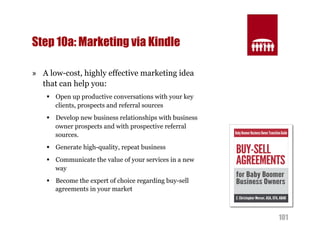
» A low-cost, highly effective marketing idea 
that can help you: 
§ Open up productive conversations with your key 
clients, prospects and referral sources 
§ Develop new business relationships with business 
owner prospects and with prospective referral 
sources. 
§ Generate high-quality, repeat business 
§ Communicate the value of your services in a new 
way 
§ Become the expert of choice regarding buy-sell 
agreements in your market
102 
Session Objectives 
Part 1: Understand Buy-Sell Agreements and Their Hidden Problems 
» Understand formula, fixed price, and valuation process agreements 
» Understand the six defining elements that must be present in every valuation 
process agreement 
» Identify the process by which most problems can be averted for your or your 
client’s buy-sell agreement 
Part 2: Learn How to Review a Buy-Sell Agreement 
» Identify areas of concern in a buy-sell agreement 
» Complete a review process of a buy-sell agreement from business and 
valuation perspectives 
» Confidently communicate with your referral sources about buy-sell 
agreement issues 
Part 3: Develop a Strategy to Help Your Clients and Increase Your Business
Your Tools 
Available from: 
www.BuySellAgreementsOnline.com 
www.ChrisMercer.net 
www.MercerCapital.com
104 
Questions? 
Z. Christopher Mercer, ASA, CFA, ABAR 
901.685.2120 
mercerc@mercercapital.com 
www.mercercapital.com 
www.chrismercer.net 
www.linkedin.com/li/zchristophermercer

Structuring Effective Buy-Sell Agreements

  • 1.
    Structuring Effective Buy-SellAgreements The Absolutely Necessary, Highly Advisable, Very Useful, and Completely Dangerous Z. Christopher Mercer, ASA, CFA, ABAR www.linkedin.com/in/zchristophermercer www.buysellagreementsonline.com
  • 2.
    2 Pete andSam Pete: “Sam, I just buried a small bomb in your yard. It isn’t large enough to kill you, your wife, or another member of your family, but it would certainly maim you or them if one of you stepped on it.” Sam: “Where is it?” Pete: “I’m not going to tell you where it is. But don’t worry. Chances are it is so well-hidden that no one will ever step on it.” Sam: “What do you mean, ‘chances are’? That’s a chance I can’t take! If it were just me it would be one thing, but you’re talking about hurting my wife and family!” Pete: “Like I said, don’t worry. Maybe no one will ever step on it. Maybe it will never explode.” Sam: “You must be crazy! I’ll bring in a bomb squad and dig up the entire yard to get rid of that it!” Pete: “Now Sam, you know I’m just kidding about the bomb. However, your buy-sell agreement might very well be a ticking time bomb and you just don’t know it. How about taking some time to talk about your buy-sell agreement – say, dinner tomorrow night?”
  • 3.
    3 What Isa Buy-Sell Agreement? » Agreements by and between the shareholders (or equity partners of whatever legal description) of a privately owned business and, perhaps, the business itself that establish the mechanism for the purchase of stock following the death (or other adverse changes) of one of the owners. In the case of corporate joint ventures, they also establish the value for break-ups or for circumstances calling for one corporate venture partner to buy out the other partner. » Buy-Sell Agreements… § Require agreement at a point in time § Relate to transactions that will or may occur at future points in time § Define the conditions that “trigger” the buy-sell provisions § Determine the price(s) at which specified future transactions will occur
  • 4.
    4 Session Objectives Part 1: Understand Buy-Sell Agreements and Their Hidden Problems » Understand formula, fixed price, and valuation process agreements » Understand the six defining elements that must be present in every valuation process agreement » Identify the process by which most problems can be averted for your or your client’s buy-sell agreement
  • 5.
    5 Session Objectives Part 1: Understand Buy-Sell Agreements and Their Hidden Problems » Understand formula, fixed price, and valuation process agreements » Understand the six defining elements that must be present in every valuation process agreement » Identify the process by which most problems can be averted for your or your client’s buy-sell agreement Part 2: Learn How to Review a Buy-Sell Agreement » Identify areas of concern in a buy-sell agreement » Complete a review process of a buy-sell agreement from business and valuation perspectives » Confidently communicate with your referral sources about buy-sell agreement issues
  • 6.
    6 Session Objectives Part 1: Understand Buy-Sell Agreements and Their Hidden Problems » Understand formula, fixed price, and valuation process agreements » Understand the six defining elements that must be present in every valuation process agreement » Identify the process by which most problems can be averted for your or your client’s buy-sell agreement Part 2: Learn How to Review a Buy-Sell Agreement » Identify areas of concern in a buy-sell agreement » Complete a review process of a buy-sell agreement from business and valuation perspectives » Confidently communicate with your referral sources about buy-sell agreement issues Part 3: Develop a Strategy to Help Your Clients and Increase Your Business
  • 7.
    7 Part 1 Understand Buy-Sell Agreements and Their Hidden Problems
  • 8.
    8 An Overview of Buy-Sell Agreements
  • 9.
    9 Potential “TriggerEvents” Q Quits F is Fired R Retires D Disabled D Death D Divorce B Bankruptcy Others?
  • 10.
    10 The 20Ds » Departure » Discharge » Death » Divorce » Disability » Default » Disqualification » Disaffection » Disagreement » Disclosure » Dispute resolution » Dilution » Dividends » Distributions » Drag-along rights » Double entities » Differential pricing » "Don’t compete" agreements » Donate » Distributions after a trigger event
  • 11.
    11 Three Questionsto Ask Yourself Does your client have a buy-sell agreement? If so, what type of agreement is it? Do you know what the buy-sell agreement says? There are six defining elements that must be in every process agreement if you want the valuation process and, therefore, the agreement, to work How is the buy-sell agreement funded? How life insurance proceeds are treated can make a big difference in the valuation of the company
  • 12.
    12 How DoBuy-Sell Agreements Come Into Existence?
  • 13.
    13 Get Agreement.Now. Just Do It.
  • 14.
    14 Types ofBuy-Sell Agreements » Based on how price is determined § Fixed-price agreements § Formula agreements § Process agreements
  • 15.
    15 Fixed-Price Agreements DESCRIPTION » You and the other owner(s) agreed on a price » That price of your agreement is likely years out of date » There are three possibilities regarding the price you set: § The value today is lower, perhaps far lower, than the realistic value § The value today is higher, perhaps far higher, than the realistic value § The value is the same as it was back then » You haven’t agreed on a way to update the price
  • 16.
    16 A Real-LifeBuy-Sell Agreement Marathon 10 Years, Not 26.2 Miles » Sullivan v. Troser Management, Inc. 2013 NY Slip Op 01634 (4th Dept Mar. 15 2013) » A 10 year fight over an 18% interest in Troser Management, Inc. » Plaintiff was hired by Troser Mangement, Inc. (Troser) in 1986 with an agreement that he would be entitled to 18% of the equity of Troser if he stayed employed until 1991. He did. He did not actually receive the shares of Troser, but he apparently earned the legal right to such shares. » Perhaps there were negotiations between the parties following the plaintiff’s departure. We don’t know. However, the plaintiff filed a lawsuit in 2003 asking that his stock be issued and then bought. » There was a buy-sell agreement dating to 1986 – a fixed-price agreement. This agreement called for the owners to agree on the value each year and set such agreement forth in its Schedule A. The agreement further stated that, in the event that the shareholders did not update Schedule A for two years, then the agreement price would be adjusted up or down based on the change in Troser’s book value from the date of the last Schedule A to the time of the trigger event. » Schedule A was never finalized, so there was no base value from which to adjust.
  • 17.
    17 A Real-LifeBuy-Sell Agreement Marathon 10 Years, Not 26.2 Miles » You’ve got to figure that after ten years of litigation, including four appeals, likely the parties collectively have spent far more in legal fees than Sullivan’s shares are worth. On top of that, the litigants have yet to establish through their prodigious litigation efforts either (1) a methodology for establishing the value of Sullivan’s shares and (2) any certainty as to the exercise of Troser’s option to purchase Sullivan’s shares. » And to think, all of this could have been avoided had the parties prepared a simple schedule or certificate of value as contemplated by the 1986 buy-sell agreement. But do not view this omission as a freak occurrence. Rather, it is symptomatic of the myriad problems afflicting fixed-price buy-sell agreements.
  • 18.
    18 Fixed-Price Agreements REALITIES SELDOM DISCUSSED » If the value is unrealistically low, you are betting that the other guy will die first and you’ll get to buy at the low price » If the value is unrealistically high, you are betting that you'll be the one to leave the business so you and your family can benefit » The other guy(s) are making just the opposite bets » Why take a chance that you’ll be on the wrong end of that bet?
  • 19.
    19 Fixed-Price Agreements ADVANTAGES » Easy to understand, easy to negotiate – the first time only! » Inexpensive § Easy for attorneys to draft § No appraisers required
  • 20.
    20 Fixed-Price Agreements DISADVANTAGES » Fixed prices are seldom updated, even over periods of many years. Inequities are almost certainly a result of out-of-date fixed-price agreements » Easy to set an initial price, but may be difficult to reset as time passes and interests diverge » The longer period of time between updates to fixed-price agreements, the greater the potential for a divergence of the interests of the various parties » The normal procedure to address to this problem is a flawed process agreement » Betting that the other guy(s) will die first!
  • 21.
    21 Fixed-Price Agreements HOW TO “FIX” AN OUT-OF-DATE FIXED-PRICE AGREEMENT » Update it annually » So simple but rarely ever done
  • 22.
    22 Formula Agreements DESCRIPTION » You and the other owner(s) established a formula to calculate price » Chances are, no one has calculated it lately » Chances are, it can give an unreasonable result now » Combined with changes in the company and the industry: § The formula price may be higher than a realistic value today § The formula price may be lower than a realistic value today § The formula price is realistic today » You haven’t agreed on ways to make necessary/appropriate adjustments
  • 23.
    23 Formula Agreements REALITIES SELDOM DISCUSSED » If the value is unrealistically low, you are betting that the other guy will die first and you’ll get to buy at the low price » If the value is unrealistically high, you are betting that you’ll be the one to leave the business so you and your family can benefit » The other guy(s) are making just the opposite bets » Why take a chance that you’ll be on the wrong end of that bet?
  • 24.
    24 Formula Agreements State a single formula to be applied to balance sheet and/or income statement metrics EXAMPLES » Multiple of EBITDA – (5 x EBITDA) § Less debt? » Book Value § “Shareholders’ equity per the audited financial statements at the end of the fiscal year immediately preceding the valuation date.” HOW TO “FIX” A FORMULA AGREEMENT » Every year, calculate the price based upon the formula
  • 25.
    25 The Termsof the Agreement
  • 26.
    26 Process Buy-SellAgreements DESCRIPTION » You and the other owners agreed to let business appraisers set the price for your agreement if and when it is triggered » No one has the foggiest idea what will happen or what the price will be » No one knows what “kind of value” the appraiser will provide: § It could be the value of an illiquid interest § It could be the value of the entire enterprise pro rata to ownership § It could be reasonable and what you thought you agreed to § It might not be reasonable and what you thought you agreed to » No one will know until the end of a lengthy & uncertain process what the outcome will be
  • 27.
    27 Process Buy-SellAgreements REALITIES SELDOM DISCUSSED » You are betting that the ultimate price will be favorable (or at least reasonable) for you » The other owners are betting that the ultimate price will be favorable (or at least reasonable) for them » The company is betting that the process will work and that the price set will be affordable » Everyone is betting and someone will lose
  • 28.
    28 Process Buy-SellAgreements » A buy-sell agreement provides a valuation process employing one or more appraisers » Value is determined by the appraisers in a manner defined in the buy-sell agreement » Two types of process buy-sell agreements: § Multiple Appraiser § Single Appraiser
  • 29.
    29 Process Buy-SellAgreements » Your client’s buy-sell agreement should be: Understandable Predictable Likely to Achieve Reasonable Resolutions Helpful in the Wealth Management Process
  • 30.
    30 Multiple AppraiserAgreements • Multiple appraiser agreements call for the selection of two or more appraisers to engage in a process that will develop one, two, or three appraisals whose conclusions form the basis for the final prices • If that process sounds time consuming, cumbersome, and expensive, it is. Such processes can also be divisive and foster litigation Third appraiser as RECONCILER Third appraiser as JUDGE Third appraiser as DETERMINER Third appraiser as MEDIATOR
  • 31.
    31 Multiple Appraiser Agreements Third Appraiser as Reconciler THEN
  • 32.
  • 33.
    33 Single AppraiserAgreements » Single appraiser agreements call for the selection of one appraiser whose appraisal conclusion forms the basis for the final price SINGLE APPRAISER SELECT AND VALUE AT TRIGGER EVENT SINGLE APPRAISER SELECT NOW AND VALUE AT TRIGGER EVENT SINGLE APPRAISER SELECT NOW AND VALUE NOW
  • 34.
    34 Key Recommendation Single Appraiser, Select Now and Value Now
  • 35.
    35 Single Appraiser, Select Now and Value Now SELECT NOW » I have long recommended that parties creating buy-sell agreements name the appraiser at the time of agreement. This way, all parties have a voice and can sign off on the selection of the appraiser no matter how difficult the process of reaching agreement. VALUE NOW » Once selected, the chosen appraiser provides a baseline appraisal for purposes of the agreement. I suggest that the appraisal be rendered in draft form to all parties to the agreement, and that everyone has a reasonable period of time to provide comments for consideration before the report is finalized. VALUE EACH YEAR (OR TWO) THEREAFTER » Ideally, the selected appraiser will provide annual revaluations for buy-sell agreement purposes.
  • 36.
    RECOMMENDATION Single Appraiser Agreement Select Now, Value Now Price Price Price NOW NOW NOW
  • 37.
    37 Single Appraiser, Select Now and Value Now ADVANTAGES » Selected appraiser viewed as independent » Appraiser’s valuation process is seen by all parties at the outset » Appraiser’s conclusion is known at outset and has established a baseline price for the agreement » Because process is observed at the outset, all parties know what will happen when trigger event occurs » Because the appraiser must interpret the “words on the pages” in conducting the initial appraisal, any issues regarding lack of clarity of valuation-defining terms will be resolved » Selected appraiser must maintain independence with respect to process and render future valuations consistent with terms of agreement and with prior reports
  • 38.
    38 Single Appraiser, Select Now and Value Now ADVANTAGES (CONTINUED) » Subsequent appraisals, either annually or at trigger events, should be less time-consuming and expensive than other alternatives » Parties should gain confidence in the process » Parties will always know the current value for the buy-sell agreement (helpful for planning all-around) » Appraisers’ knowledge of the company and its industry will grow over time, enhancing confidence for all parties with the process » Creates a means of maintaining pricing for other transactions, thereby enhancing “the market” for a company’s shares
  • 39.
    39 Multiple Appraiservs. Single Appraiser, Select Now and Value Now
  • 40.
    Do You KnowWhat Your Client’s Buy-Sell Agreement Says? 40
  • 41.
    41 Do YouKnow What Your Client’s Buy-Sell Agreement Says? » From a business perspective? » Departure » Discharge » Death » Divorce » Disability » Default » Disqualification » Disaffection » Disagreement » Disclosure » Dispute resolution » Dilution » Dividends » Distributions » Drag-along rights » Double entities » Differential pricing » "Don’t compete" agreements » Donate » Distributions after a trigger event » From a valuation perspective?
  • 42.
    42 The Six Defining Elements of Process Buy-Sell Agreements Standard of Value Level of Value The “As Of” Date Qualifications of Appraisers Appraisal Standards Funding Mechanism
  • 43.
    43 Defining Element#1: Standard of Value » Normally fair market value § Willing buyer, willing seller….but buyers of what? » Fair value § Defined under state law § A defined term, of sorts, under accounting rules » Investment value § From the perspective of whom? » “The Value,” “Going Concern Value,” and on and on and on…
  • 44.
    44 Defining Element#2: Level of Value Price we hope to get if we sell the company together Price the rest of us can reasonably pay if we have to buy out someone else “Fair market value of the (minority) interest”
  • 45.
    $140 Per Share $100 Per Share $60 Per Share 45 Defining Element #2: Level of Value
  • 46.
    46 Differences in Premiums and Discounts
  • 47.
    47 Defining Element#3: The “As Of” Date » There is no such thing as “The Value” § Value is “as of” a specific point in time § Is based on information known or reasonably knowable » The “as of” date can make a difference § Date of marriage § Date of separation § Date of trial/divorce
  • 48.
    48 Defining Element#4: Qualifications of Appraisers INDIVIDUAL § Education § Valuation training § Appraisal experience § Industry experience § Continuing education § Publishing § Credentials FIRM § Size § Longevity § Specialization
  • 49.
    49 Defining Element#5: Appraisal Standards » Uniform Standards of Professional Appraisal Practice (USPAP) » ASA Business Valuation Standards § Principles of Appraisal Practice and Code of Ethics » AICPA Statement on Standards for Valuation Services (SSVS) No. 1 » Institute of Business Appraisers Business Valuation Standards and Rules of Professional Conduct » NACVA Professional Standards » CFA Institute Code of Ethics & Standards of Professional Conduct
  • 50.
    50 What IfYour Appraiser Has No Standards?
  • 51.
    51 The Six Defining Elements of Process Buy-Sell Agreements Standard of Value Level of Value The “As Of” Date Qualifications of Appraisers Appraisal Standards Funding Mechanism
  • 52.
    52 How isYour Client’s Buy-Sell Agreement Funded?
  • 53.
    53 How IsYour Client’s Buy-Sell Agreement Funded? » The company will issue a promissory note…
  • 54.
    54 Potential FundingSources » Life insurance » Cash § Life insurance § Corporate assets § External borrowings § “Sinking fund” » Selling shareholder notes » Combination of cash and shareholder notes » See “Basic Considerations Per Shareholder Notes” handout
  • 55.
  • 56.
    56 Funding theBuy-Sell Agreement » Life insurance typically purchased by company for corporate buy-sell agreements » Key question: Is life insurance intended as a: Funding Vehicle or Corporate Asset
  • 57.
    57 True Story:Life Insurance Dead What Happens Now?
  • 58.
    58 What aboutLife Insurance Treatment for Valuation Purposes? Harry Proceeds are a Funding Vehicle Company (Estate) Sam 1 Stock Ownership (Shares) 100.0 50.0 50.0 2 Stock Ownership (%) 100.0% 50.0% 50.0% 3 Pre and Post Life Insurance Value ($m) $10,000.0 $5,000.0 $5,000.0 4 Life Insurance Proceeds $6,000.0 5 Repurchase Liability ($5,000.0) 6 Post-Life-Insurance Value $11,000.0 7 Repurchase Stock ($5,000.0) $5,000.0 8 Retire / Give Up Stock (50.0) (50.0) 9 Remaining Stock 50.0 0.0 50.0 10 New Stock Ownership (%) 100.0% 0.0% 100.0% 11 Post-Life Insurance Value of Co. $11,000.0 $0.0 $11,000.0 12 Post Life Insurance Proceeds $5,000.0 13 Net Change in Value from Repurchase $1,000.0
  • 59.
    59 What aboutLife Insurance Treatment for Valuation Purposes? Harry Proceeds are a Corporate Asset Company (Estate) Sam 1 Stock Ownership (Shares) 100.0 50.0 50.0 2 Stock Ownership (%) 100.0% 50.0% 50.0% 3 Pre-Life Insurance Value ($m) $10,000.0 $5,000.0 $5,000.0 4 Life Insurance Proceeds ($m) $6,000.0 $3,000.0 $3,000.0 5 Post-Life Insurance Value ($m) $16,000.0 $8,000.0 $8,000.0 6 Repurchase Liability ($8,000.0) 7 Post-Life-Insurance Value $8,000.0 8 Repurchase Stock ($8,000.0) $8,000.0 9 Retire / Give Up Stock (50.0) (50.0) 10 Remaining Stock 50.0 0.0 50.0 11 New Stock Ownership (%) 100.0% 0.0% 100.0% 12 Post-Life Insurance Value of Co. $8,000.0 $0.0 $8,000.0 13 Post Life Insurance Proceeds $8,000.0 14 Net Change in Value from Repurchase ($2,000.0)
  • 60.
    60 Review Typesof Buy-Sell Agreements » Fixed-price agreements § Update it » Formula agreements § Calculate price yearly » Process agreements
  • 61.
    61 The Six Defining Elements of Process Buy-Sell Agreements Standard of Value Level of Value The “As Of” Date Qualifications of Appraisers Appraisal Standards Funding Mechanism
  • 62.
    62 Multiple Appraiser Agreements Third Appraiser as Reconciler THEN
  • 63.
    RECOMMENDATION Single Appraiser Agreement Select Now, Value Now Price Price Price NOW NOW NOW
  • 64.
    64 Part 2 Get Prepared to Help Your Clients
  • 65.
  • 66.
    66 Step 1:Read & study the book » Read and study Buy-Sell Agreements for Closely Held and Family Business Owners and the companion Buy-Sell Audit Checklist § Nothing gives more confidence than knowledge § The book is all about common sense applied to common business situations § Read and highlight, making notes from your own personal experience § Read the book again § By the time you have completed Step 1, you will know more about buy-sell agreements and how they work and don’t work than most professionals on the planet § Don’t skip Step 1!
  • 67.
    67 Step 2:Read several buy-sell agreements » Pull several buy-sell agreements from your files » Practice reviewing buy-sell agreements from business and valuation perspectives » Use the Buy-Sell Agreement Review Checklist
  • 68.
    68 Step 3:Remember, you are not a lawyer » Make it clear when talking to clients and prospects that you are talking about buy-sell agreements from business and valuation perspectives - not from a legal perspective » You are not an attorney (unless you are …)
  • 69.
    69 Step 4:Reviewing an agreement » General issues § Agreement status § Type of agreement § Parties to the agreement § Right of first refusal § Life insurance § Status of stock after trigger event § Binding or not? See Buy-Sell Agreement Review Checklist Page 1 If you will go through the exercises discussed here 3-4 times with agreements from your files, you will gain confidence in your ability to offer the service for clients and prospects.
  • 70.
    70 Step 4:Reviewing an agreement » List the trigger events and what happens at each of them » Note what common trigger events are not included in the agreement (this is an area you can make suggestions for consideration) See Buy-Sell Agreement Review Checklist Page 3
  • 71.
    See Buy-Sell Agreement Review Checklist 71 Step 4: Reviewing an agreement » Fixed price agreement § How is the price set? § How is the price updated? § What happens if agreement is not updated for 1 or more years after trigger event? § Is there a provision for a valuation process? § Is there life insurance & is the use of proceeds specified? § Other Page 4
  • 72.
    See Buy-Sell Agreement Review Checklist 72 Step 4: Reviewing an agreement » Formula agreement § Is formula specified in the agreement? § Are all definitions of terms clear? § Is there an example calculation attached to the agreement? § What about potential adjustments to the calculations? § Is the formula routinely recalculated by the Company? § Who performed the last calculation? § Calculate the formula yourself, using current information (if available) § Would valuation adjustments be appropriate in the current valuation that would cause an appraised value to be different from the formula calculation? § Does the agreement specify an alternative pricing resolution in the event there are disputes over the calculated formula price? § Is there life insurance and is the use of proceeds specified? § Other? Page 5
  • 73.
    73 Step 4:Reviewing an agreement » Valuation process agreements § Multiple appraiser valuation process agreements - Third appraiser as Reconciler, Determiner, or Judge § Single appraiser valuation process agreements - Single Appraiser : Select Now, Value Now - Single Appraiser : Select Now, Value at Trigger Event - Single Appraiser : Select and Value at Trigger Event » Outline the process See Buy-Sell Agreement Review Checklist Pages 6 - 9
  • 74.
    74 Multiple Appraiser Agreements Third Appraiser as Reconciler See Buy-Sell Agreement Review Checklist Page 10
  • 75.
    See Buy-Sell Agreement Review Checklist 75 Step 4: Reviewing an agreement » Review the valuation sections for six factors that define the kind of value the appraiser(s) will determine § What is the standard of value Page 7 (fair market value, fair value, etc.)? - Is the standard defined precisely? If not, you might suggest a definition from Revenue Ruling 59-60 or the business valuation standards that you follow § What is the level of value? - Is the value called for the value of the interest or the pro rata share of the value of the enterprise? - Is the language confusing regarding the use (or not) of valuation discounts and premiums? (If so, suggest referencing this book or another valuation text because it is often better to refer to a book than for attorneys to attempt to draft valuation language)
  • 76.
    $140 Per Share 76 Levels of Value chart $100 Per Share $60 Per Share
  • 77.
    77 Partial ExampleWrite-Up – Agreement Page 3 A. Purchase Price. a) The purchase price paid will be the deceased Shareholder’s proportionate ownership interest in the Corporation multiplied by the Corporation’s b) Fair Market Value, as defined in Treasury Regulation §20.2031-1(b) of such shares of stock c) as of the Shareholder’s date of death. The Fair Market Value shall be d) determined by an independent appraiser e) with the cost of the appraisal being paid by the Corporation. f) In the event the deceased Shareholder’s personal representative and the Corporation are unable to agree as to such appraiser, g) such deceased Shareholder’s personal representative and the Corporation shall each select an appraiser, h) which appraisers shall agree upon a third independent appraiser, i) who shall then proceed to determine the Fair Market Value of such shares of stock. j) The value so determined shall be final and binding on the parties.
  • 78.
    78 Partial ExampleWrite-Up – Analysis Pages 3-4 a) Level of Value. This provision is good in that it attempts to direct that the selected independent appraiser is to determine the Fair Market Value of the Corporation and that the purchase price will be the “proportionate ownership interest.” If that is the intent, then it should be specified that the value to be determined is a value at the financial control level of value (see accompanying Levels of Value chart from Chapter 14). Some appraisers are so ingrained to develop nonmarketable minority values for minority interests that they might interpret “proportionate interest” to be the proportionate share of a nonmarketable minority level value (after perhaps applying minority interest and/or marketability discounts). And since the independent appraiser’s conclusion will be binding on all parties (j), this would be unfortunate.
  • 79.
    79 Partial ExampleWrite-Up - Agreement A. Purchase Price. a) The purchase price paid will be the deceased Shareholder’s proportionate ownership interest in the Corporation multiplied by the Corporation’s b) Fair Market Value, as defined in Treasury Regulation §20.2031-1(b) of such shares of stock c) as of the Shareholder’s date of death. The Fair Market Value shall be d) determined by an independent appraiser e) with the cost of the appraisal being paid by the Corporation. f) In the event the deceased Shareholder’s personal representative and the Corporation are unable to agree as to such appraiser, g) such deceased Shareholder’s personal representative and the Corporation shall each select an appraiser, h) which appraisers shall agree upon a third independent appraiser, i) who shall then proceed to determine the Fair Market Value of such shares of stock. j) The value so determined shall be final and binding on the parties.
  • 80.
    80 Partial ExampleWrite-Up – Analysis Pages 4-5 b) Standard of Value. The agreement specifies that Fair Market Value is the required standard of value and further provides a citation to the definition of Fair Market Value as Treasury Regulation §20.2031-1(b), which is quoted in the Partial Example Write-Up (with emphasis added) Three reasons why reference to Section 2031-1(b) is not ideal 1. The definition relates to the “valuation of property in general,” and not to the valuation of business interests 2. The definition refers to other sections of the regulations for further discussion of the valuation of interests in businesses, which can cause confusion 3. The discussion relates to “an item of property,” which could be misinterpreted as the block of stock itself rather than the proportionate share of the value of the enterprise, as indicated in the paragraph Reference to the ASA Business Valuation Standards [or your standards] could be preferable [or to other standards, as appropriate for the reviewing appraiser. This would also tend to ground the valuation in the context of relevant valuation standards Alternatively, the definition from Revenue Ruling 59-60 could be used Either of the definitions from the ASA Business Valuation Standards or Revenue Ruling 59-60 is preferable to the reference to Section 2031-1(b) because of their focus on businesses and business interests
  • 81.
    81 Partial ExampleWrite-Up - Agreement A. Purchase Price. a) The purchase price paid will be the deceased Shareholder’s proportionate ownership interest in the Corporation multiplied by the Corporation’s b) Fair Market Value, as defined in Treasury Regulation §20.2031-1(b) of such shares of stock c) as of the Shareholder’s date of death. The Fair Market Value shall be d) determined by an independent appraiser e) with the cost of the appraisal being paid by the Corporation. f) In the event the deceased Shareholder’s personal representative and the Corporation are unable to agree as to such appraiser, g) such deceased Shareholder’s personal representative and the Corporation shall each select an appraiser, h) which appraisers shall agree upon a third independent appraiser, i) who shall then proceed to determine the Fair Market Value of such shares of stock. j) The value so determined shall be final and binding on the parties.
  • 82.
    82 Partial ExampleWrite-Up – Analysis Page 6 c) Valuation date The valuation date is specified as the date of death That is crystal clear in the agreement Without further guidance, this will leave the selection of financial statements to provide the basis for the appraisal up to the appraiser Not necessarily bad, but if the Corporation prepares quarterly financial statements, for example, it might be good to instruct the appraiser to consider the most current financial statements available at the valuation date
  • 83.
    83 Partial ExampleWrite-Up - Agreement A. Purchase Price. a) The purchase price paid will be the deceased Shareholder’s proportionate ownership interest in the Corporation multiplied by the Corporation’s b) Fair Market Value, as defined in Treasury Regulation §20.2031-1(b) of such shares of stock c) as of the Shareholder’s date of death. The Fair Market Value shall be d) determined by an independent appraiser e) with the cost of the appraisal being paid by the Corporation. f) In the event the deceased Shareholder’s personal representative and the Corporation are unable to agree as to such appraiser, g) such deceased Shareholder’s personal representative and the Corporation shall each select an appraiser, h) which appraisers shall agree upon a third independent appraiser, i) who shall then proceed to determine the Fair Market Value of such shares of stock. j) The value so determined shall be final and binding on the parties.
  • 84.
    84 Partial ExampleWrite-Up – Analysis Page 6 d) Qualifications of the appraiser/Standards to be followed. The Agreement calls for the parties to attempt to agree upon an “independent appraiser,” a term not defined in the agreement. Unfortunately, that tent is so open it doesn’t have doors. Absent specific criteria describing qualifications (experience, credentials, size of firm, etc.), any accountant, business broker or college professor could qualify. It is an excellent idea to provide a list of valuation credentials as minimum qualifications for the selection of an appraiser. I always recommend the ASA designations of the American Society of Appraisers. Members of the ASA are required to provide appraisals in accordance with the ASA Business Valuation Standards and the Uniform Standards of Professional Appraisal Practice (USPAP). This is important, because you definitely want your appraiser to provide a standards-compliant appraisal. [If your appraiser follows other standards, make sure those standards are cited in your write-ups of reviews of buy-sell agreements]
  • 85.
    See Buy-Sell Agreement Review Checklist 85 Step 4: Reviewing an agreement » Review the valuation sections § Is the “as of” date specified? Page 8 - You may have to review the trigger events to be sure. For example, the agreement may be clear regarding the “as of” date if someone dies, but unclear in the event of a divorce or disability § Are the appraiser qualifications specified? - If there is an appraisal process, are the qualifications (credentials, experience, etc.) specified. If not, recommend this be clarified
  • 86.
    See Buy-Sell Agreement Review Checklist 86 Step 4: Reviewing an agreement » Review the valuation sections § Are the appraisal standards to be followed specified? - If not, recommend this be clarified § Is the funding mechanism clear? Page 9 - The Buy-Sell Audit Checklist (and Buy-Sell Agreements for Closely Held and Family Business Owners at pp. 125-128) has a detailed checklist to consider for defining the note to be issued, if any - If there is life insurance, be certain that its treatment is specified precisely in the agreement » Funding mechanism? » Corporate asset? - If not, you can make a recommendation or explain the differences in valuation that arise from different treatment (Chapter 15)
  • 87.
    87 Partial ExampleWrite-Up – Agreement Page 8 B. Payment of Purchase Price. a) The purchase price will be paid by delivery of a signed promissory note from the Corporation made payable to the order of the deceased Shareholder’s estate over a period of five (5) years, together with interest at a variable rate equivalent to the Prime Rate published in the Wall Street Journal on the first business day of each calendar year. b) Payments of principal and interest will be made in equal consecutive quarterly installments beginning on the first day of the sixth (6th) full month following the date of death. c) The Corporation will have the right of prepayment without penalty. The deceased Shareholder’s Personal Representative will execute and transfer to the Corporation his stock certificates and will execute such other documents as may be necessary to transfer and convey all the deceased Shareholder’s interest to the Corporation.
  • 88.
    88 Partial ExampleWrite-Up – Analysis Page 8 a) The purchase price is to be paid in the form of a promissory note of the Corporation with a term of five years. The interest rate is to fluctuate based on Prime Rate as found in the Wall Street Journal on the first business day of each calendar year. This could be confusing. Suppose death occurred on November 30, 20xx. Is the rate to be set for the first six months at the Prime Rate on January 2, 20xx, or is the rate to be set at that level for one month and then change to the rate on January 2, 20xx(+1)? This may seem trivial, but it could mean significant dollars to one side or the other depending on what happened to rates in 20xx. The description of the promissory note does not state where in the pecking order of the Company’s debt it should lie. Is it subordinated to any bank debt? Is senior to or subordinate to any previously existing shareholder debt? Is the note unsecured? That issue is not specified. Absent specification, it is probably unsecured and subject to being weakened if the Company secures debt that is senior to the shareholder note.
  • 89.
    89 Partial ExampleWrite-Up – Agreement Page 9 C. Failure of Corporation to Exercise Option to Purchase. a) In the event the Corporation fails to exercise its option to purchase the deceased Shareholder’s stock within 90 days of the deceased Shareholder’s date of death, b) the remaining Shareholders (the “Other Shareholders”) will each have the option to purchase their proportionate share of the deceased Shareholder’s stock pursuant to the same terms and conditions set forth in this Section 5. The Other Shareholders must exercise their option to purchase within 30 days after the expiration of the Corporation’s 90 day option period. c) If only one of the Other Shareholders exercises his or her option to purchase his or her proportionate share of the deceased Shareholder’s stock, then such Other Shareholder will be entitled to purchase all of the deceased Shareholder’s stock by delivering written notice of such intent to the Corporation and to the deceased Shareholder’s Personal Representative and the remaining Shareholder(s) within 10 days after expiration of the Other Shareholders’ 30 day option period. d) For purposes of this Paragraph, a Shareholder’s “proportionate share” will equal a fraction, the numerator of which is the number of shares of stock owned by such Shareholder, and the denominator of which is the aggregate shares of stock owned by the Other Shareholders. e) f)
  • 90.
    90 Partial ExampleWrite-Up – Analysis Page 9 a) If, for the Corporation to exercise its option, it actually purchases the shares, the 90 day exercise period may not be enough. There first has to be an appraisal process. With the agreeing upon and hiring of even one appraiser, this is problematic. With three appraisers involved, it will almost certainly take more than 90 days to obtain the appraisal
  • 91.
    91 Partial ExampleWrite-Up - Agreement C. Failure of Corporation to Exercise Option to Purchase. a) In the event the Corporation fails to exercise its option to purchase the deceased Shareholder’s stock within 90 days of the deceased Shareholder’s date of death, b) the remaining Shareholders (the “Other Shareholders”) will each have the option to purchase their proportionate share of the deceased Shareholder’s stock pursuant to the same terms and conditions set forth in this Section 5. The Other Shareholders must exercise their option to purchase within 30 days after the expiration of the Corporation’s 90 day option period. c) If only one of the Other Shareholders exercises his or her option to purchase his or her proportionate share of the deceased Shareholder’s stock, then such Other Shareholder will be entitled to purchase all of the deceased Shareholder’s stock by delivering written notice of such intent to the Corporation and to the deceased Shareholder’s Personal Representative and the remaining Shareholder(s) within 10 days after expiration of the Other Shareholders’ 30 day option period. d) For purposes of this Paragraph, a Shareholder’s “proportionate share” will equal a fraction, the numerator of which is the number of shares of stock owned by such Shareholder, and the denominator of which is the aggregate shares of stock owned by the Other Shareholders. e) f)
  • 92.
    92 Partial ExampleWrite-Up – Analysis Page 9 d) This clause works only if all the Other Shareholders exercise the option to purchase jointly. For example, assume there are four shareholders owning 40%, 40%, 10% and 10%, respectively, and there are 100 shares. The last shareholder dies. The Other Shareholders exercise jointly. They each purchase 40/90, 40/90 and 10/90, or 100% of the 10 shares owned by deceased Shareholder. If, however, the 10% shareholder does not participate, the fraction to be purchased by the two 40% shareholders is 40/90 and 40/90 per the formula. They could only purchase 80/90 shares, leaving 11.1% of the shares unpurchased. The clause should probably read something like the following: “the numerator is the number of shares held by such Shareholder and the denominator is the number of shares held by the Other Shareholders who are participating.”
  • 93.
    93 Part 3 Formulate a Strategy to Help Your Clients and Increase Your Business
  • 94.
    94 Step 5:Consider using the book as a business development tool – Hand deliver » Obtain books for your clients and prospects » If your clients and prospects are local, hand-deliver as many books as possible § Show each the book and prove your familiarity with the concepts you will be talking about § Talk about your own experiences with buy-sell agreements § In particular, it is helpful to talk about your experience in reviewing agreements from business and valuation perspectives
  • 95.
    Step 6: Considerusing the book as a business development tool – Conference call » If you can’t deliver personally, talk to them before you send the book and get agreement to have a conference call after they get it so you can introduce them to the concept 95
  • 96.
    96 Step 7:Offer to review a buy-sell agreement » Offer to review one of your client’s agreements in complete confidence on a complimentary basis » If you follow the Buy-Sell Agreement Review Checklist and the information in the book, you will have a structure for reporting back to them » They may never take you up on the offer, but you will gain credibility in making it » If you take an agreement with you, do the review as quickly as possible, within a week or less, and get a written response to them that you can talk about
  • 97.
    97 Step 8:Single Appraiser : Select Now and Value Now » Make it clear in the conversations that you are glad to help in any way » If you are comfortable with it, leave them with the suggestion that the best pricing alternative for most buy-sell agreements is the “Single Appraiser, Select Now and Value Now” option from Chapter 17
  • 98.
    RECOMMENDATION Single Appraiser Agreement Select Now, Value Now Price Price Price NOW NOW NOW
  • 99.
    99 Step 9:Leveraging content » Be sure your business card is attached to each book you give away » Print off the Buy-Sell Audit Checklist and provide a copy to each client or prospect with the book, with an attached business card § The checklist is an additional resource that most find helpful
  • 100.
    Step 10: Abusiness development opportunity for your referral sources? » The resources provided today may be helpful for your referral sources in their own business development 100 § Remember Zig Ziglar » Suggest that they consider talking to their clients with buy-sell agreements about reviewing their agreements in light of this new resource » Encourage them to be outbound on the topic § The prospects for business coming to you increase
  • 101.
    101 Step 10a:Marketing via Kindle » A low-cost, highly effective marketing idea that can help you: § Open up productive conversations with your key clients, prospects and referral sources § Develop new business relationships with business owner prospects and with prospective referral sources. § Generate high-quality, repeat business § Communicate the value of your services in a new way § Become the expert of choice regarding buy-sell agreements in your market
  • 102.
    102 Session Objectives Part 1: Understand Buy-Sell Agreements and Their Hidden Problems » Understand formula, fixed price, and valuation process agreements » Understand the six defining elements that must be present in every valuation process agreement » Identify the process by which most problems can be averted for your or your client’s buy-sell agreement Part 2: Learn How to Review a Buy-Sell Agreement » Identify areas of concern in a buy-sell agreement » Complete a review process of a buy-sell agreement from business and valuation perspectives » Confidently communicate with your referral sources about buy-sell agreement issues Part 3: Develop a Strategy to Help Your Clients and Increase Your Business
  • 103.
    Your Tools Availablefrom: www.BuySellAgreementsOnline.com www.ChrisMercer.net www.MercerCapital.com
  • 104.
    104 Questions? Z.Christopher Mercer, ASA, CFA, ABAR 901.685.2120 mercerc@mercercapital.com www.mercercapital.com www.chrismercer.net www.linkedin.com/li/zchristophermercer