Structured Data and Metadata Evaluation Methodology for 
Organizations Looking to Improve Image Findability on the Web 
School of Library and Information Studies 
LIS 5733 Taught by: Dr. Susan Burke 
Research Proposal Written by: Emily Kolvitz 
Research Setting: Primarily Geared Towards Online Ecommerce/Business Organizations, but methodology could 
easily translate to Galleries, Museums, Archives, Libraries (GLAMs) or any institution looking to evaluate their 
structured data and metadata practices on the world wide web in an effort to improve findability of product offerings, 
general information or services.
Introduction 
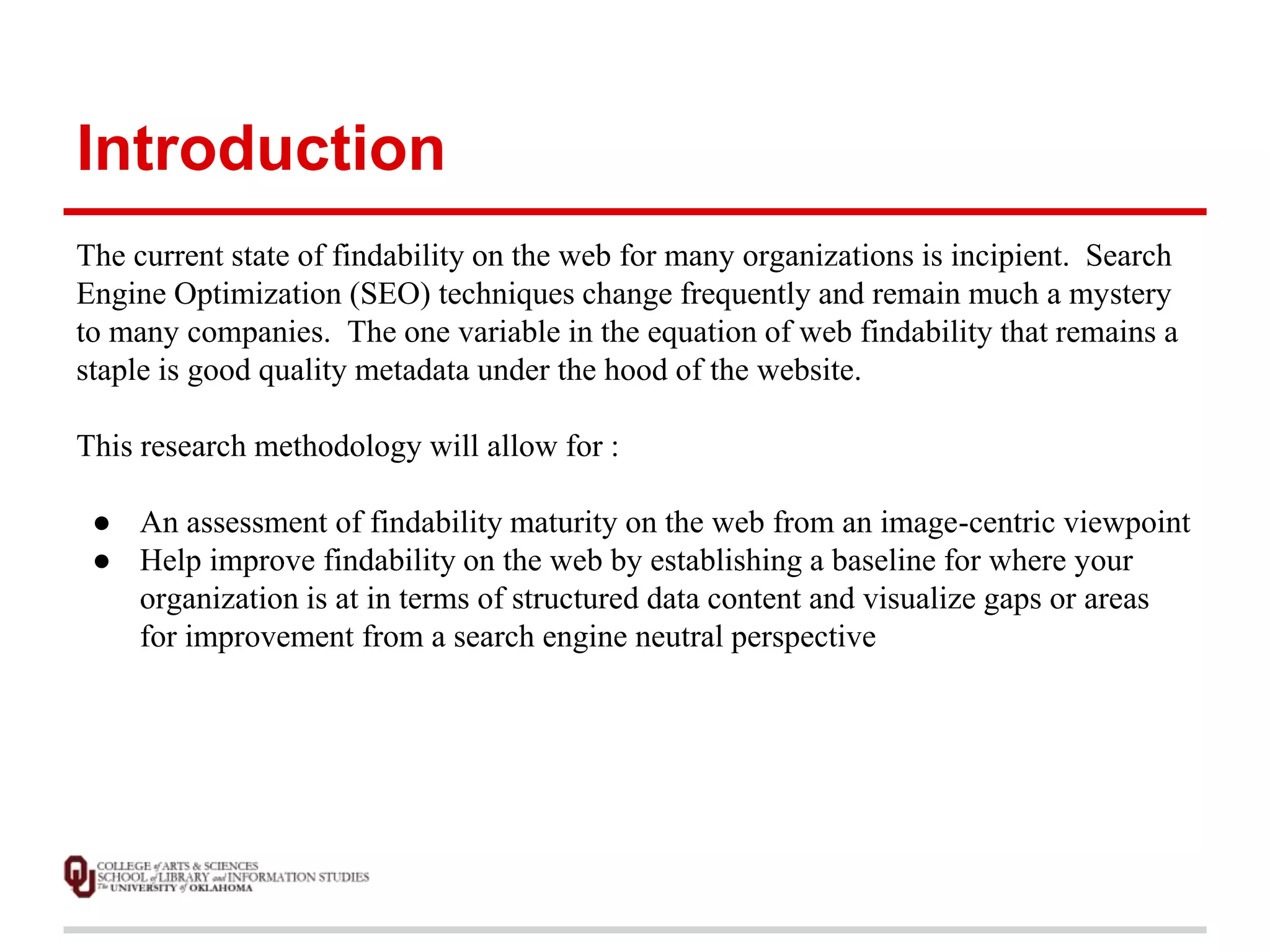
The current state of findability on the web for many organizations is incipient. Search 
Engine Optimization (SEO) techniques change frequently and remain much a mystery 
to many companies. The one variable in the equation of web findability that remains a 
staple is good quality metadata under the hood of the website. 
This research methodology will allow for : 
● An assessment of findability maturity on the web from an image-centric viewpoint 
● Help improve findability on the web by establishing a baseline for where your 
organization is at in terms of structured data content and visualize gaps or areas 
for improvement from a search engine neutral perspective
Introduction 
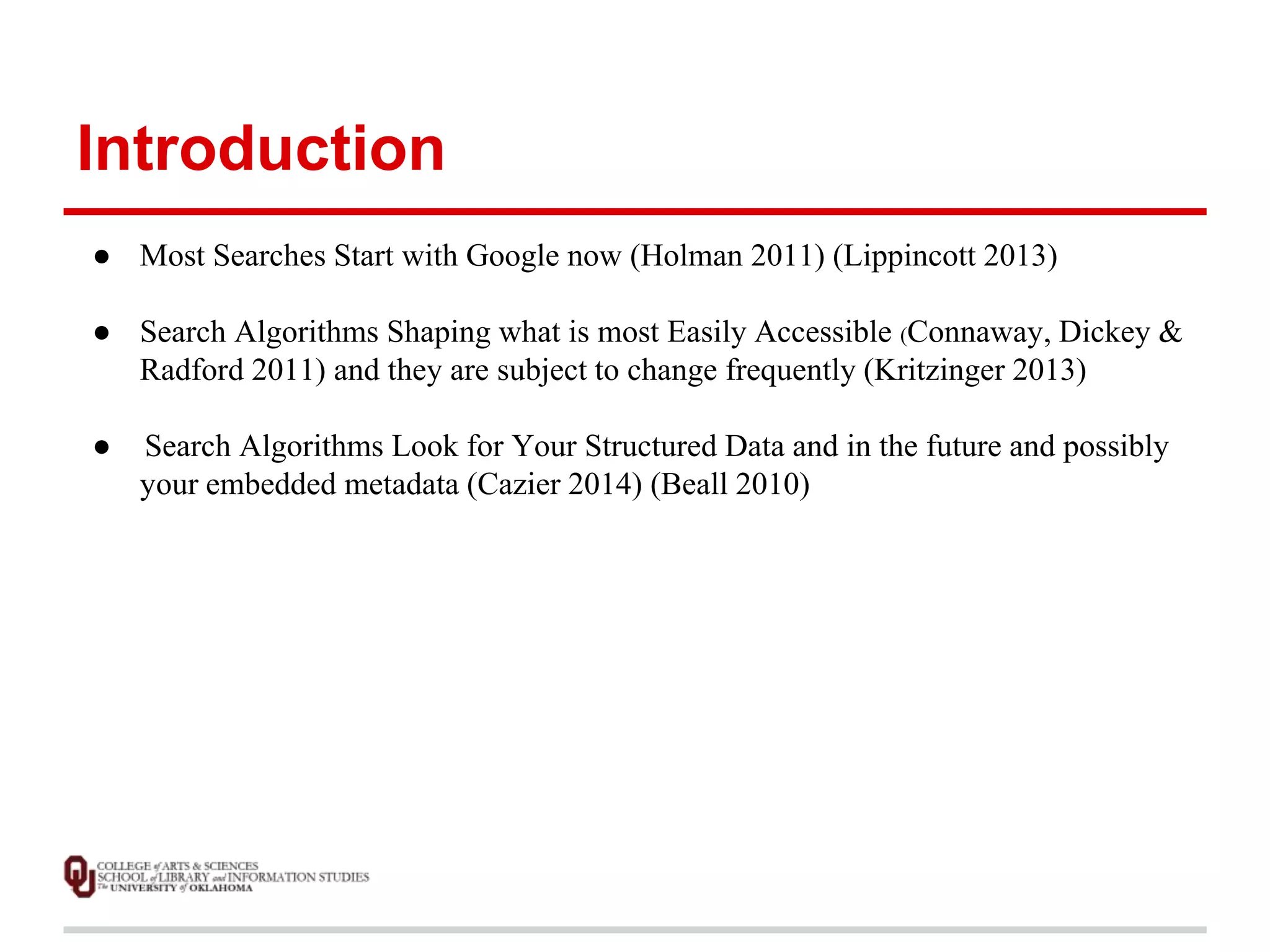
● Most Searches Start with Google now (Holman 2011) (Lippincott 2013) 
● Search Algorithms Shaping what is most Easily Accessible (Connaway, Dickey & 
Radford 2011) and they are subject to change frequently (Kritzinger 2013) 
● Search Algorithms Look for Your Structured Data and in the future and possibly 
your embedded metadata (Cazier 2014) (Beall 2010)
Literature Review 
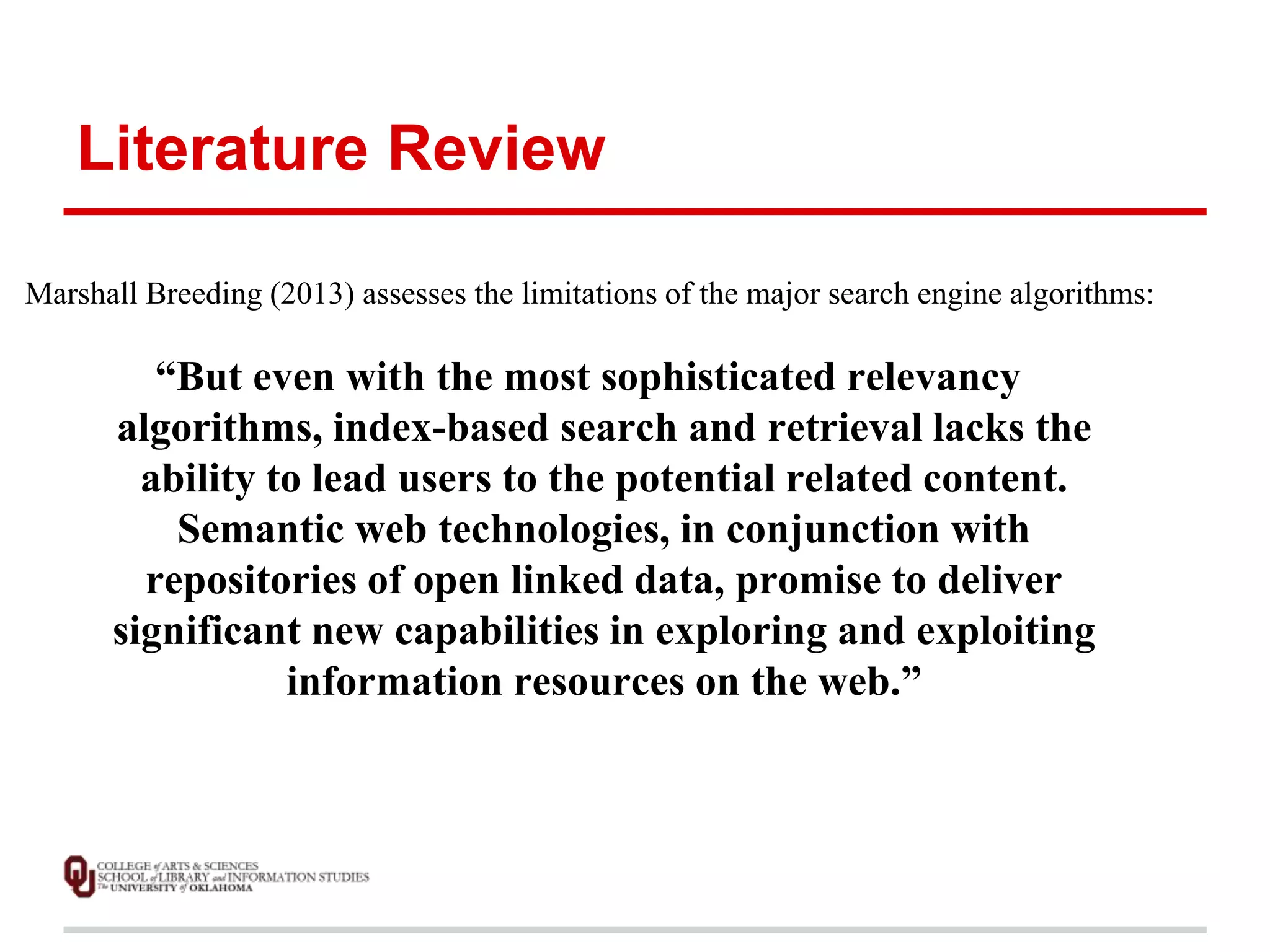
Marshall Breeding (2013) assesses the limitations of the major search engine algorithms: 
“But even with the most sophisticated relevancy 
algorithms, index-based search and retrieval lacks the 
ability to lead users to the potential related content. 
Semantic web technologies, in conjunction with 
repositories of open linked data, promise to deliver 
significant new capabilities in exploring and exploiting 
information resources on the web.”
Literature Review 
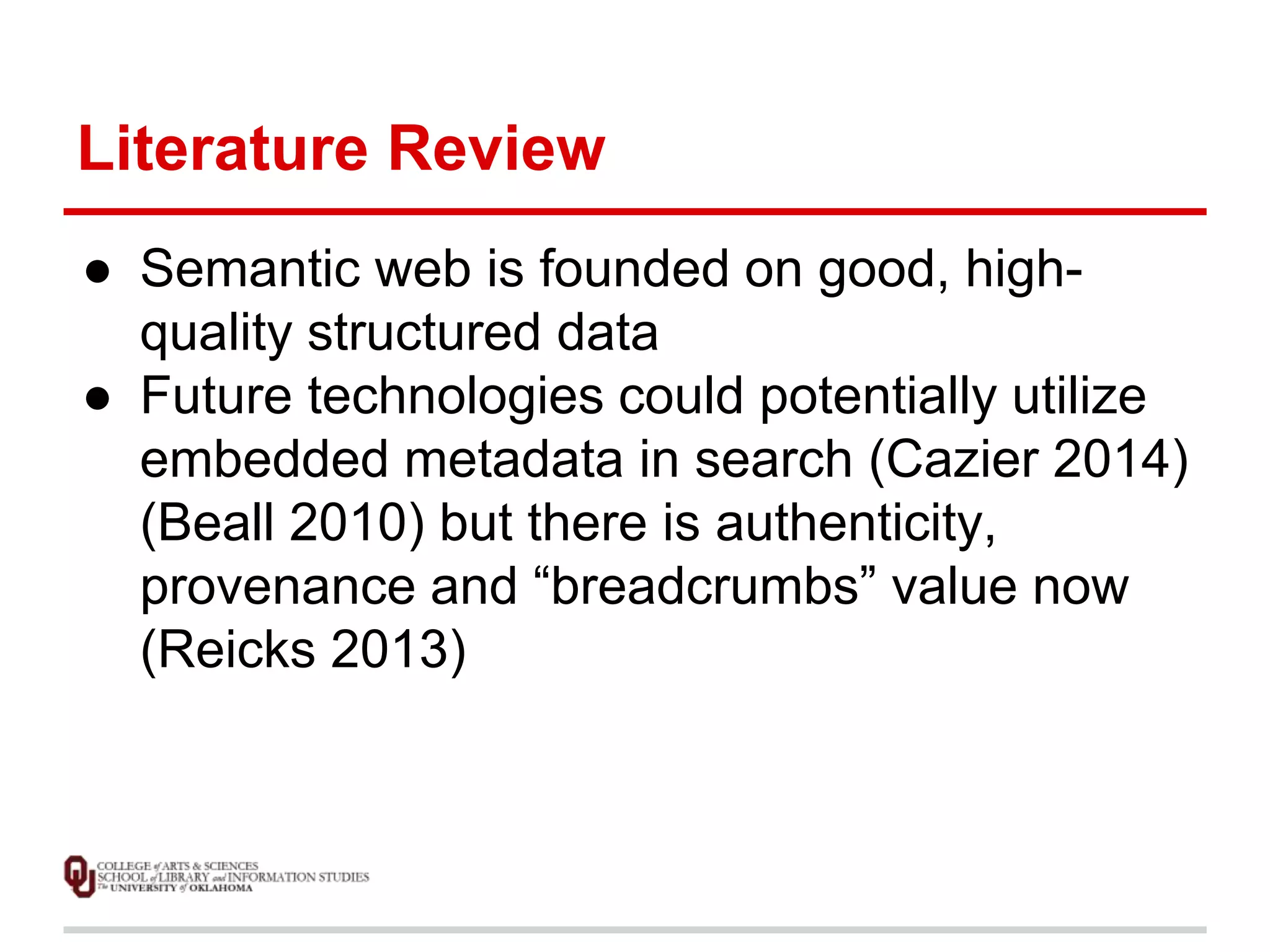
● Semantic web is founded on good, high-quality 
structured data 
● Future technologies could potentially utilize 
embedded metadata in search (Cazier 2014) 
(Beall 2010) but there is authenticity, 
provenance and “breadcrumbs” value now 
(Reicks 2013)
Literature Review 
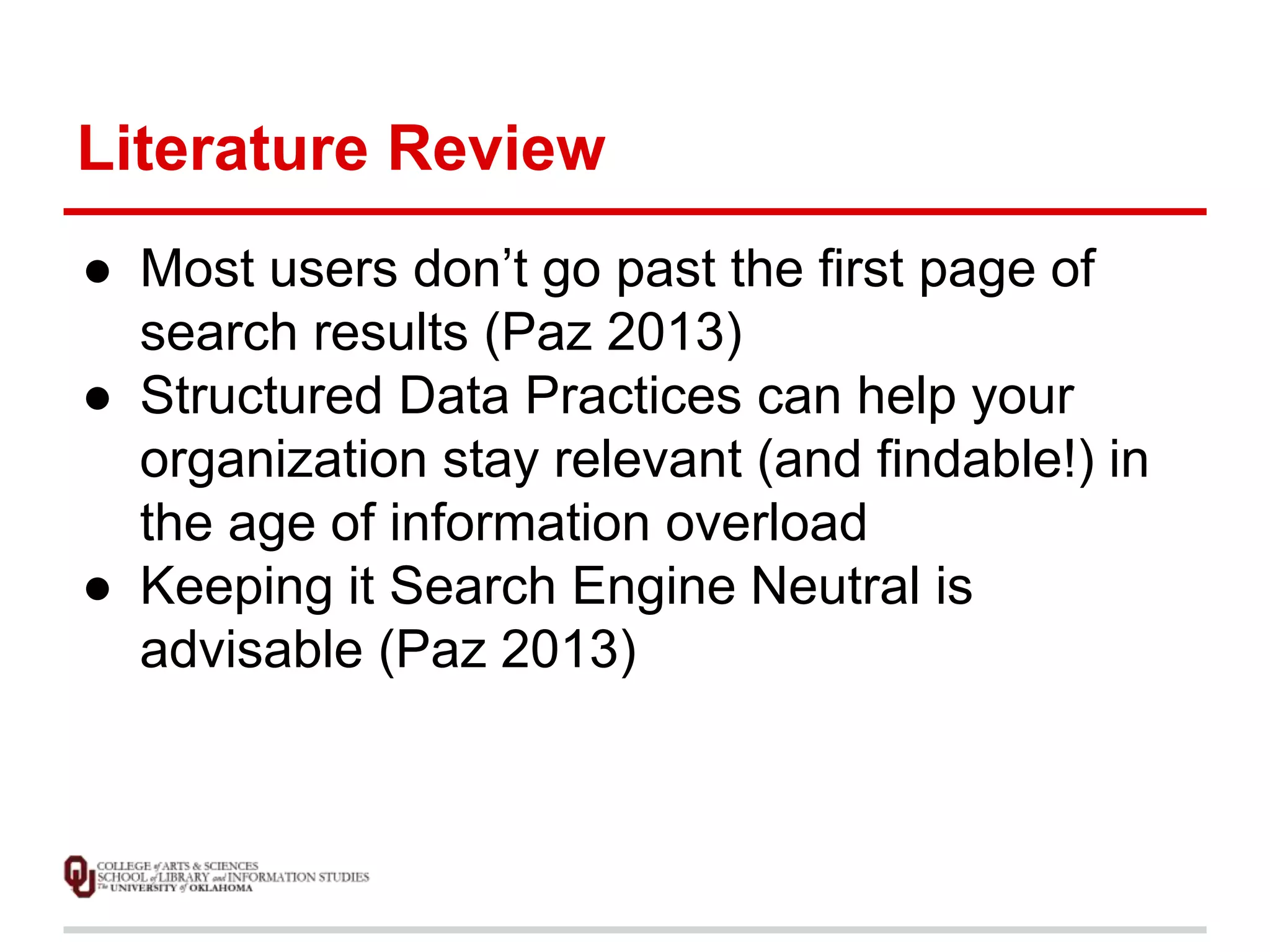
● Most users don’t go past the first page of 
search results (Paz 2013) 
● Structured Data Practices can help your 
organization stay relevant (and findable!) in 
the age of information overload 
● Keeping it Search Engine Neutral is 
advisable (Paz 2013)
Topic/Proposed Research 
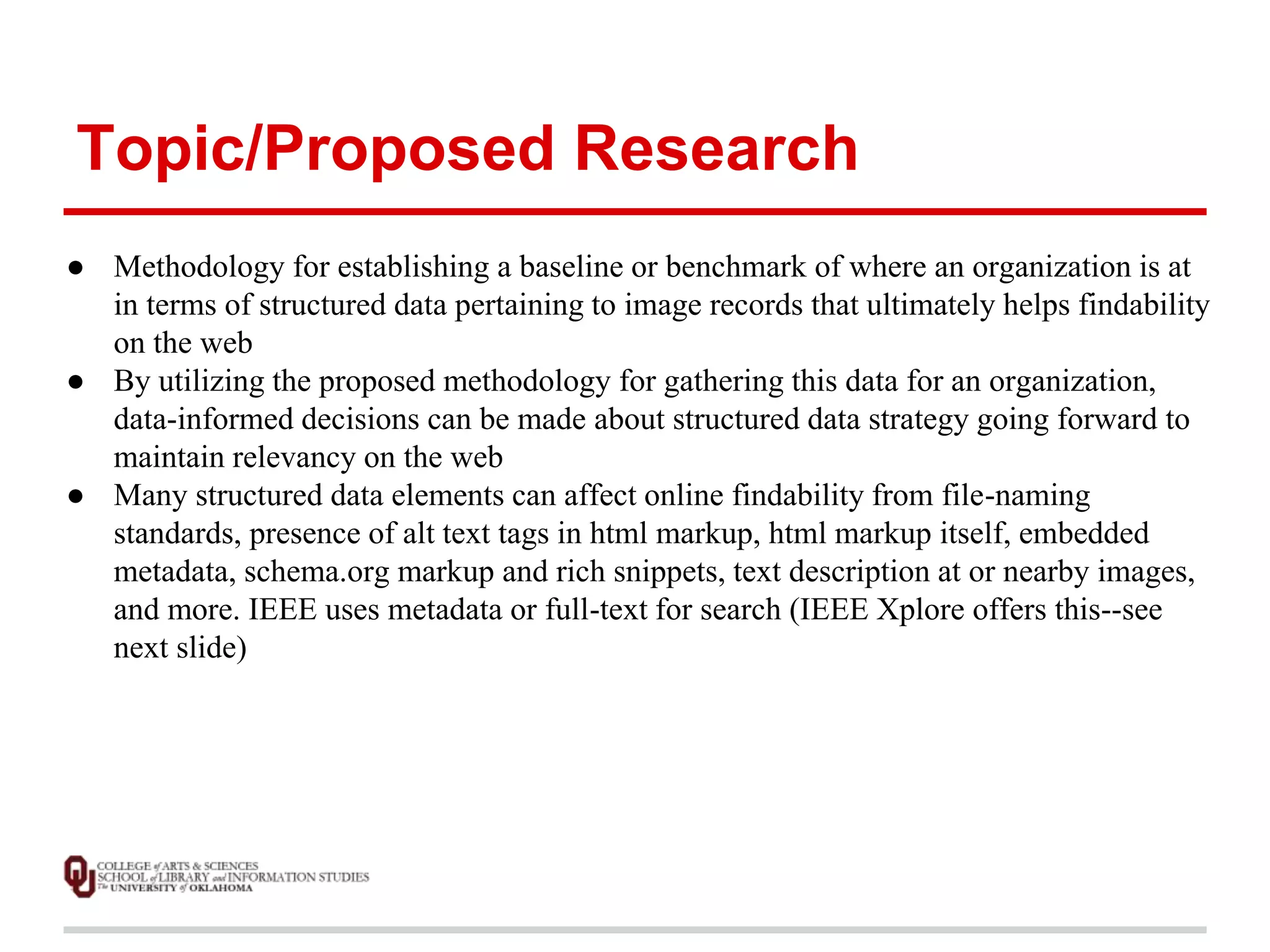
● Methodology for establishing a baseline or benchmark of where an organization is at 
in terms of structured data pertaining to image records that ultimately helps findability 
on the web 
● By utilizing the proposed methodology for gathering this data for an organization, 
data-informed decisions can be made about structured data strategy going forward to 
maintain relevancy on the web 
● Many structured data elements can affect online findability from file-naming 
standards, presence of alt text tags in html markup, html markup itself, embedded 
metadata, schema.org markup and rich snippets, text description at or nearby images, 
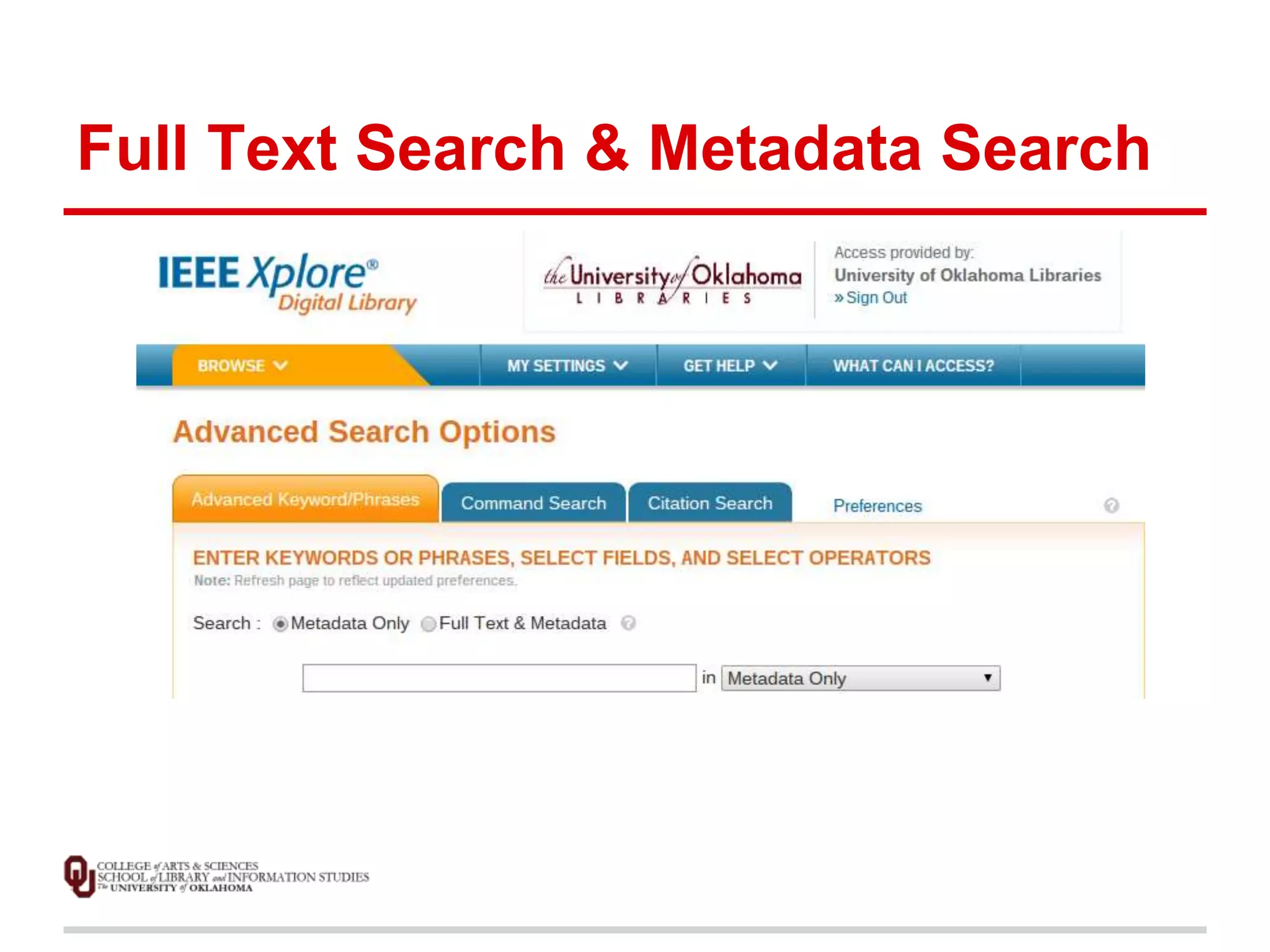
and more. IEEE uses metadata or full-text for search (IEEE Xplore offers this--see 
next slide)
Full Text Search & Metadata Search
Topic/Proposed Research 
● It is also noteworthy that there are additional factors that affect findability on 
the web that do not involve structured data, but this research focuses solely on 
structured data techniques within the control of individual organizations. 
● All of these structured data techniques pertaining to image records will be 
utilized in conjunction with the relevancy of onsite and offsite search results. 
● Image search and information retrieval is a more difficult area than text search 
and retrieval because accessibility to the image content is largely dependent on 
side-car text (or metadata if you will) that describes the aboutness and 
(hopefully) the context for the image record.
Questions 
Research Questions Addressed in this Study 
1. What methods of search are available on the organization’s online website? 
1. What is the file-naming structure for images on the website? 
1. What is the quality of search engine (onsite and offsite) results? 
1. What kinds of search results appear in Image Search when searching by the 
organization’s name and product description both with onsite search and offsite 
search?
Questions 
Research Questions Addressed in this Study 
5. What kinds of search results appear in Google Image Search when searching 
by images taken from the organization’s website? 
5. What kinds of search results come up when looking for specific products 
(measure of structured data) through onsite search and offsite search? 
5. What are the results when looking for specific products on the offsite search 
engine?
Questions 
Research Questions Addressed in this Study 
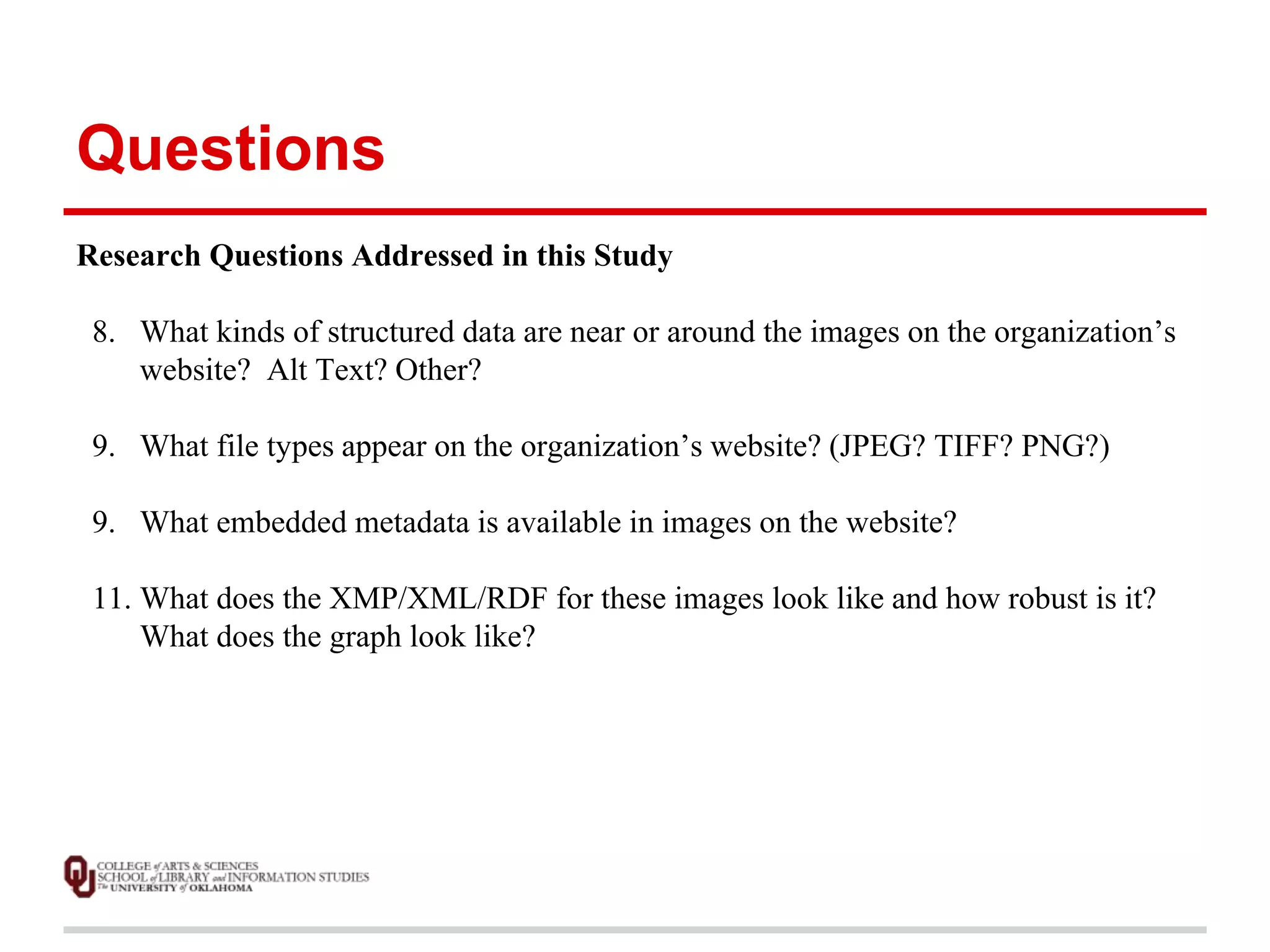
8. What kinds of structured data are near or around the images on the organization’s 
website? Alt Text? Other? 
9. What file types appear on the organization’s website? (JPEG? TIFF? PNG?) 
9. What embedded metadata is available in images on the website? 
11. What does the XMP/XML/RDF for these images look like and how robust is it? 
What does the graph look like?
Variables 
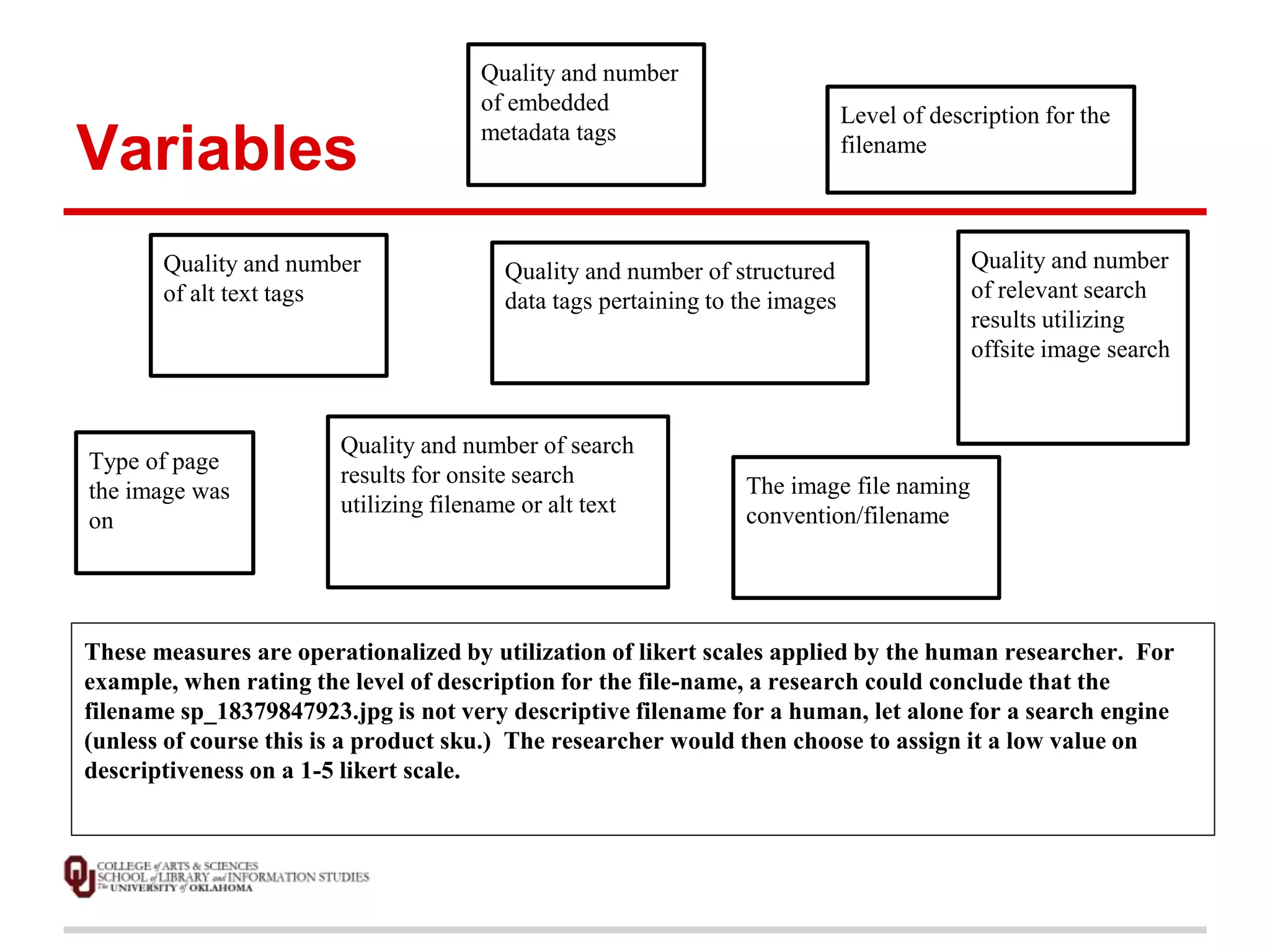
Quality and number 
of alt text tags 
Type of page 
the image was 
on 
Level of description for the 
filename 
Quality and number of structured 
data tags pertaining to the images 
The image file naming 
convention/filename 
Quality and number 
of embedded 
metadata tags 
Quality and number of search 
results for onsite search 
utilizing filename or alt text 
Quality and number 
of relevant search 
results utilizing 
offsite image search 
These measures are operationalized by utilization of likert scales applied by the human researcher. For 
example, when rating the level of description for the file-name, a research could conclude that the 
filename sp_18379847923.jpg is not very descriptive filename for a human, let alone for a search engine 
(unless of course this is a product sku.) The researcher would then choose to assign it a low value on 
descriptiveness on a 1-5 likert scale.
Data Collection Methods 
Participants 
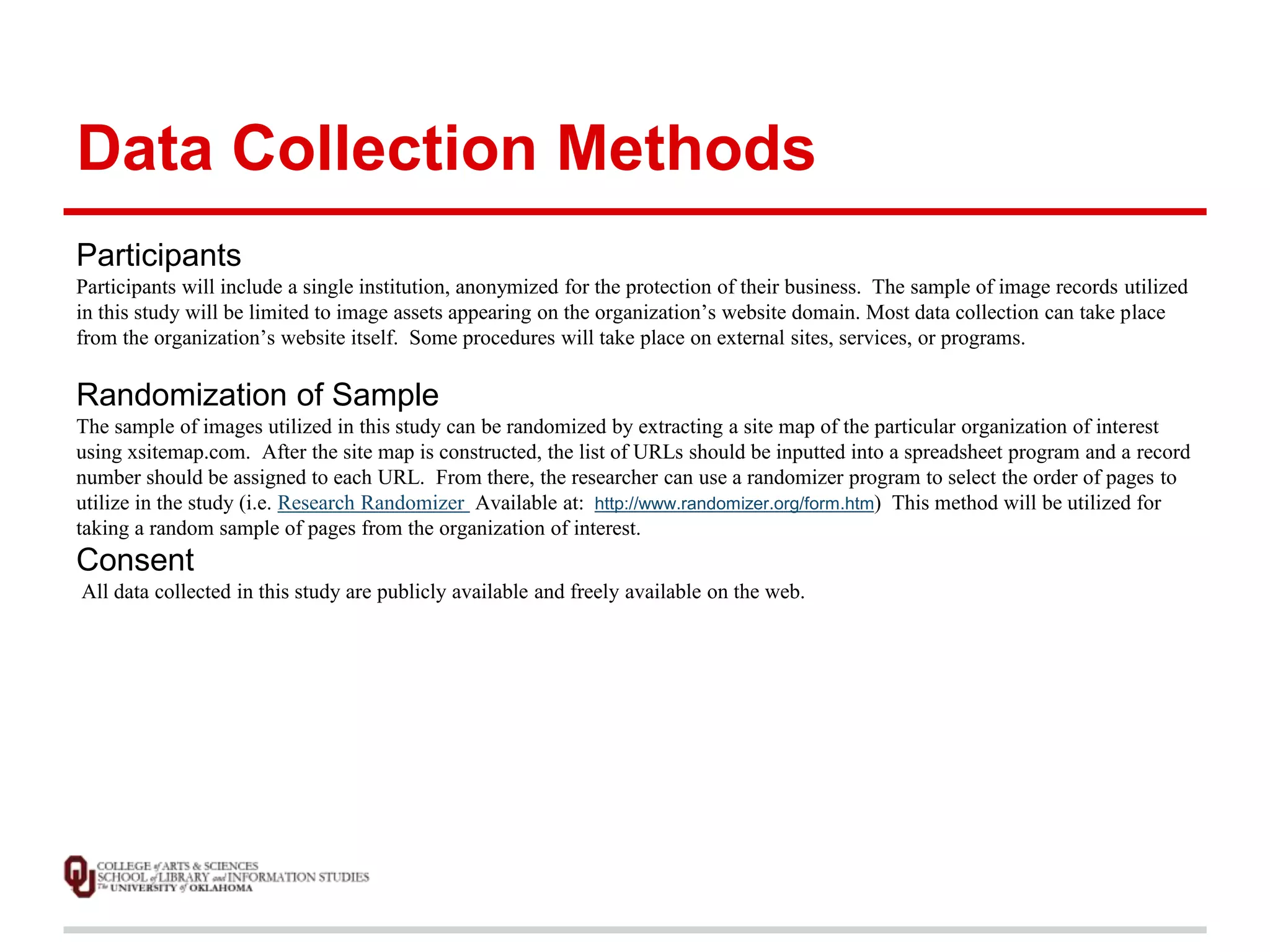
Participants will include a single institution, anonymized for the protection of their business. The sample of image records utilized 
in this study will be limited to image assets appearing on the organization’s website domain. Most data collection can take place 
from the organization’s website itself. Some procedures will take place on external sites, services, or programs. 
Randomization of Sample 
The sample of images utilized in this study can be randomized by extracting a site map of the particular organization of interest 
using xsitemap.com. After the site map is constructed, the list of URLs should be inputted into a spreadsheet program and a record 
number should be assigned to each URL. From there, the researcher can use a randomizer program to select the order of pages to 
utilize in the study (i.e. Research Randomizer Available at: http://www.randomizer.org/form.htm) This method will be utilized for 
taking a random sample of pages from the organization of interest. 
Consent 
All data collected in this study are publicly available and freely available on the web.
Data Collection Methods 
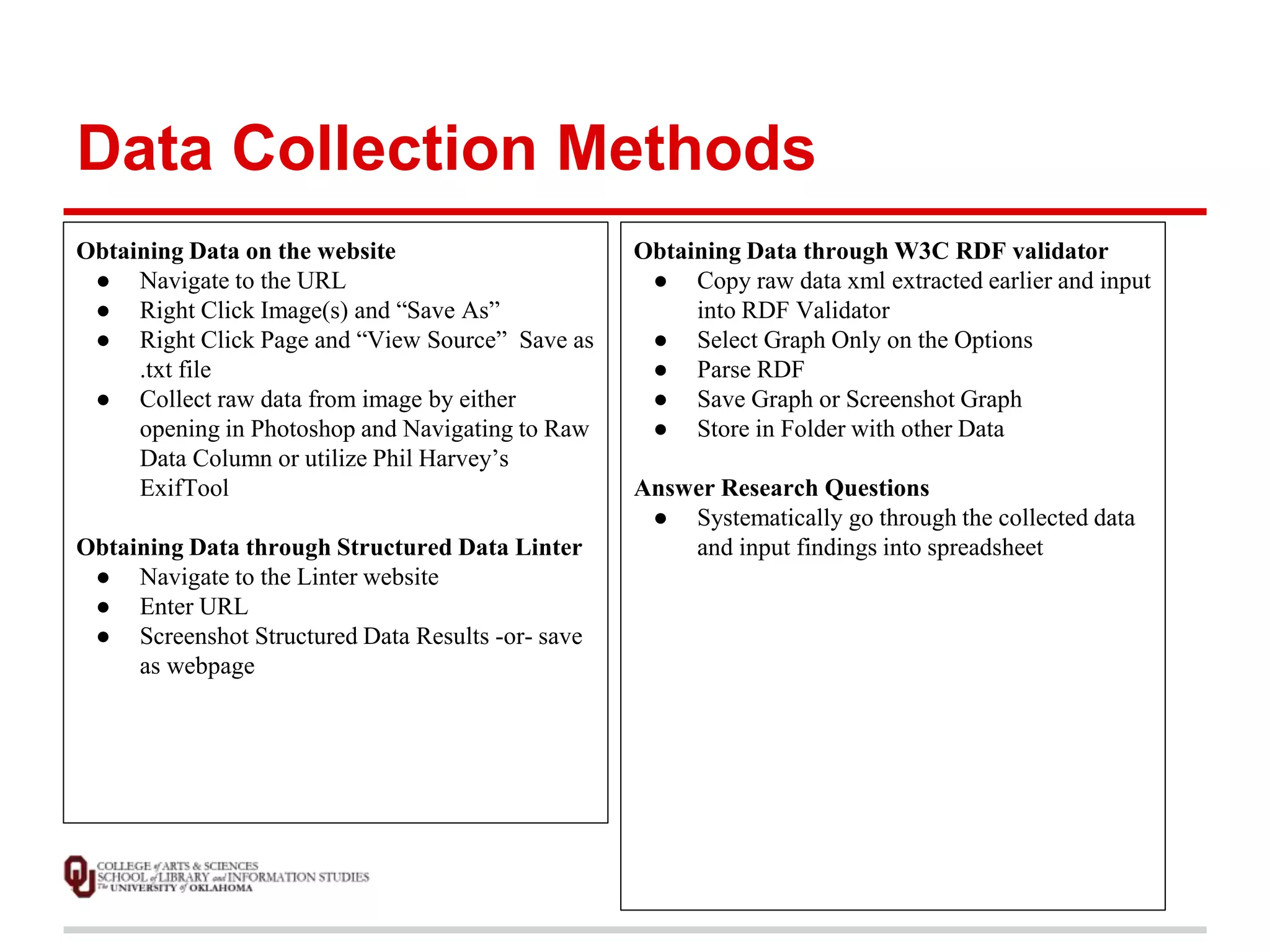
Obtaining Data on the website 
● Navigate to the URL 
● Right Click Image(s) and “Save As” 
● Right Click Page and “View Source” Save as 
.txt file 
● Collect raw data from image by either 
opening in Photoshop and Navigating to Raw 
Data Column or utilize Phil Harvey’s 
ExifTool 
Obtaining Data through Structured Data Linter 
● Navigate to the Linter website 
● Enter URL 
● Screenshot Structured Data Results -or- save 
as webpage 
Obtaining Data through W3C RDF validator 
● Copy raw data xml extracted earlier and input 
into RDF Validator 
● Select Graph Only on the Options 
● Parse RDF 
● Save Graph or Screenshot Graph 
● Store in Folder with other Data 
Answer Research Questions 
● Systematically go through the collected data 
and input findings into spreadsheet
Data Analysis Methods 
● Descriptive Statistics 
o Bell Curve - measures 
towards a central tendency 
using likert scale data 
Bell Curve Image By Vierge Marie 
(Own work) [Public domain], via 
Wikimedia Commons 
http://upload.wikimedia.org/wikipe 
dia/commons/f/f6/Gaussian_Filter 
.svg
Data Analysis Methods 
● Graphical Analysis 
(Charts and Graphs) 
● Summary Report 
● Discussion of Findings
Visualizing the Results 
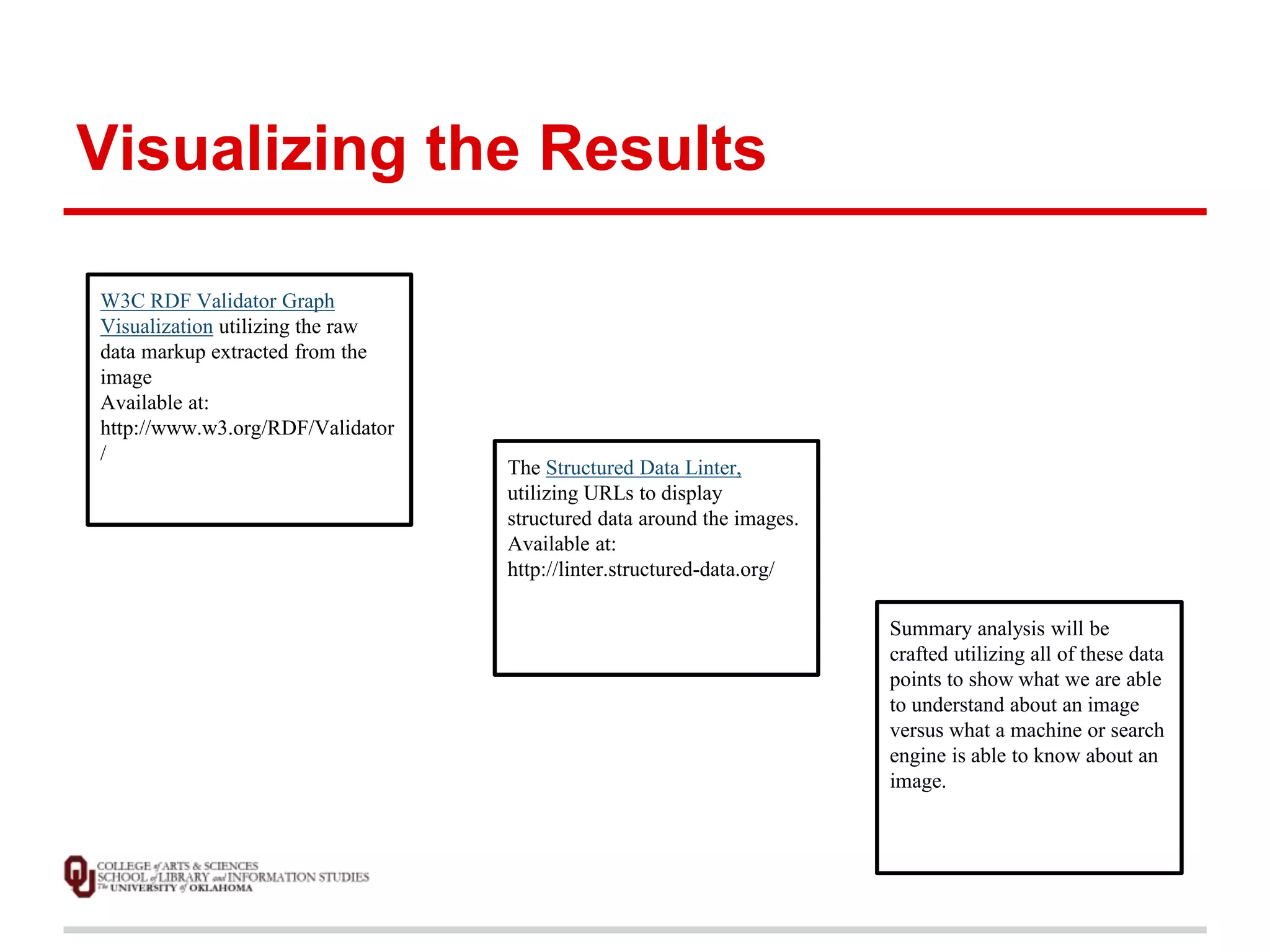
The Structured Data Linter, 
utilizing URLs to display 
structured data around the images. 
Available at: 
http://linter.structured-data.org/ 
Summary analysis will be 
crafted utilizing all of these data 
points to show what we are able 
to understand about an image 
versus what a machine or search 
engine is able to know about an 
image. 
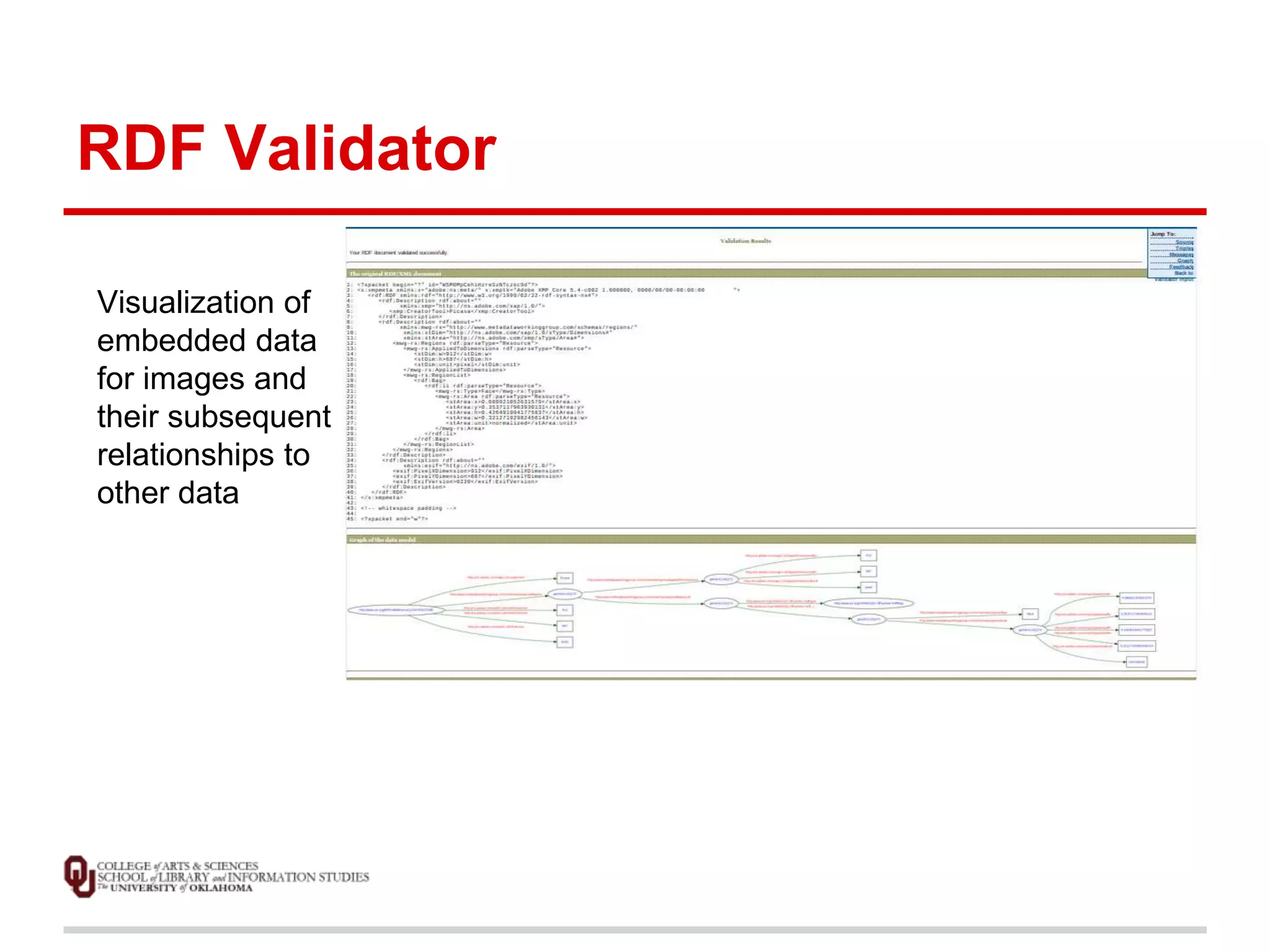
W3C RDF Validator Graph 
Visualization utilizing the raw 
data markup extracted from the 
image 
Available at: 
http://www.w3.org/RDF/Validator 
/
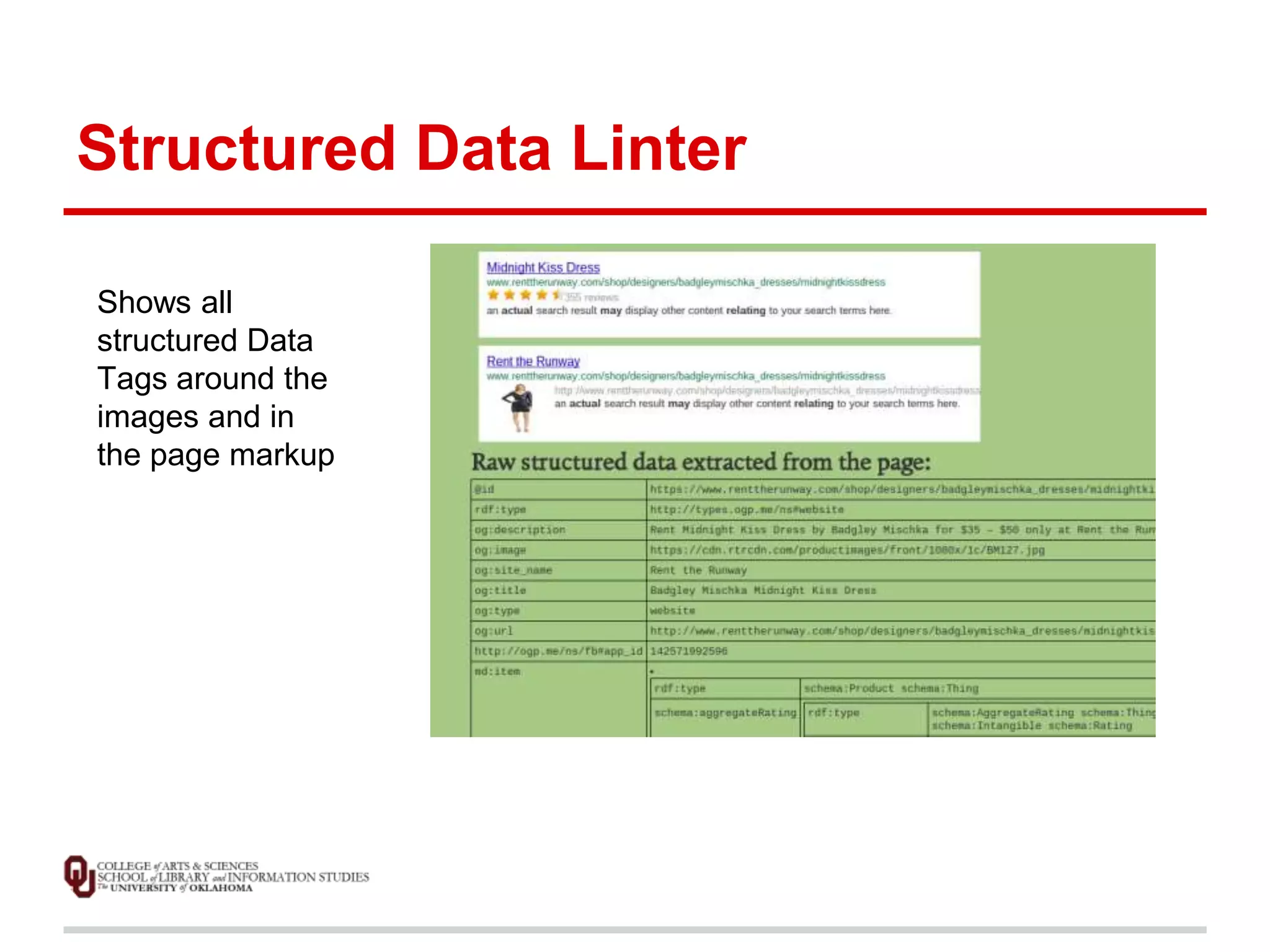
Structured Data Linter 
Shows all 
structured Data 
Tags around the 
images and in 
the page markup
RDF Validator 
Visualization of 
embedded data 
for images and 
their subsequent 
relationships to 
other data
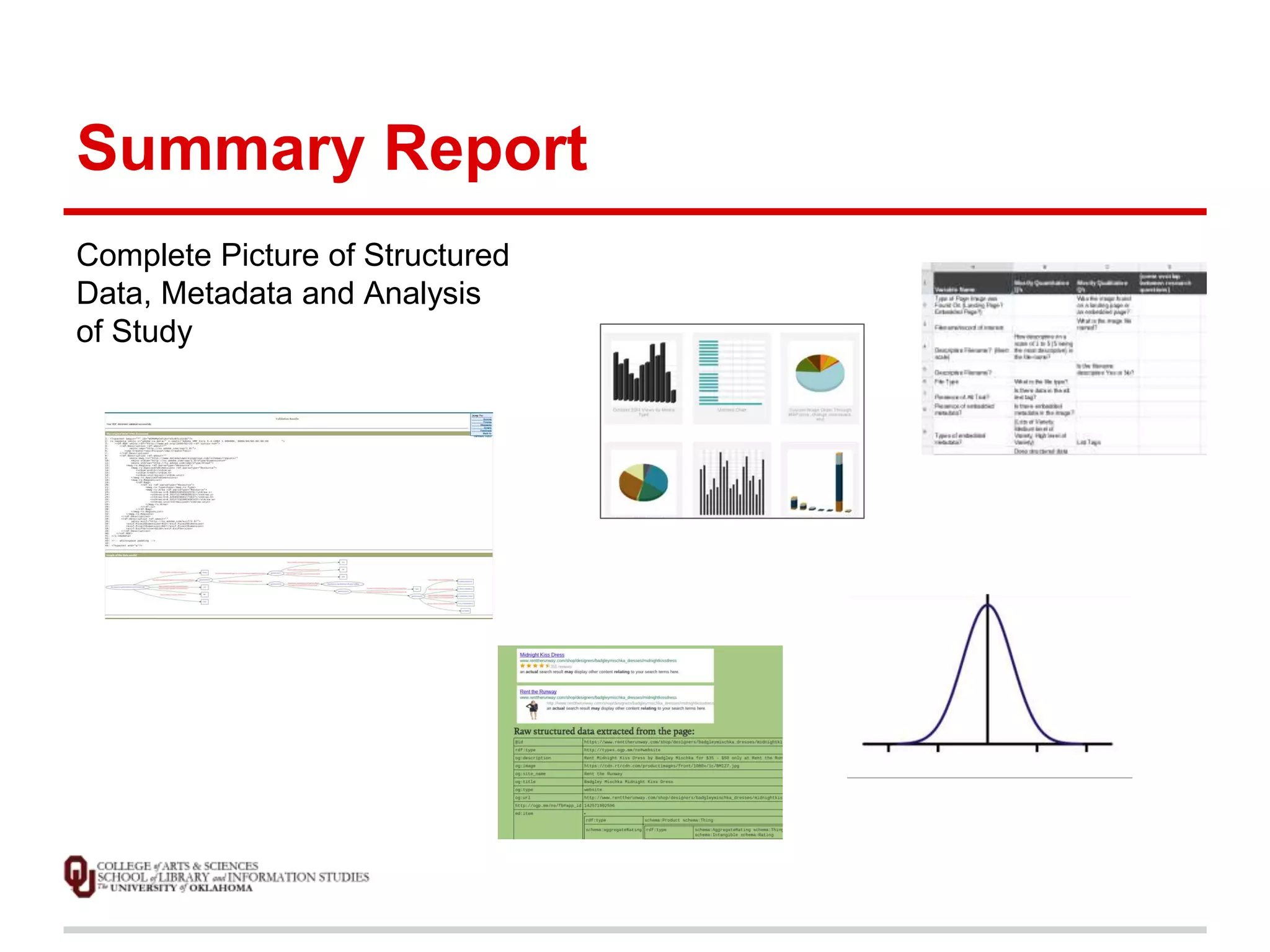
Summary Report 
Complete Picture of Structured 
Data, Metadata and Analysis 
of Study
Expected Outcomes 
The anticipated results of this project include a benchmark for where this specific 
organization is at in terms of structured data in the online environment and a 
methodology for other organizations looking to assess their structured data maturity in 
the digital space. These results will be used to create a roadmap for improving resource 
findability both on the web and within websites. Other organizations may also aspire to 
reuse this methodology for assessing their own current state of structured data. Future 
areas of research could include utilizing metadata/RDF-driven search engines in 
conjuncture with Vector Space Models to assess findability of image records on the 
web and within websites.
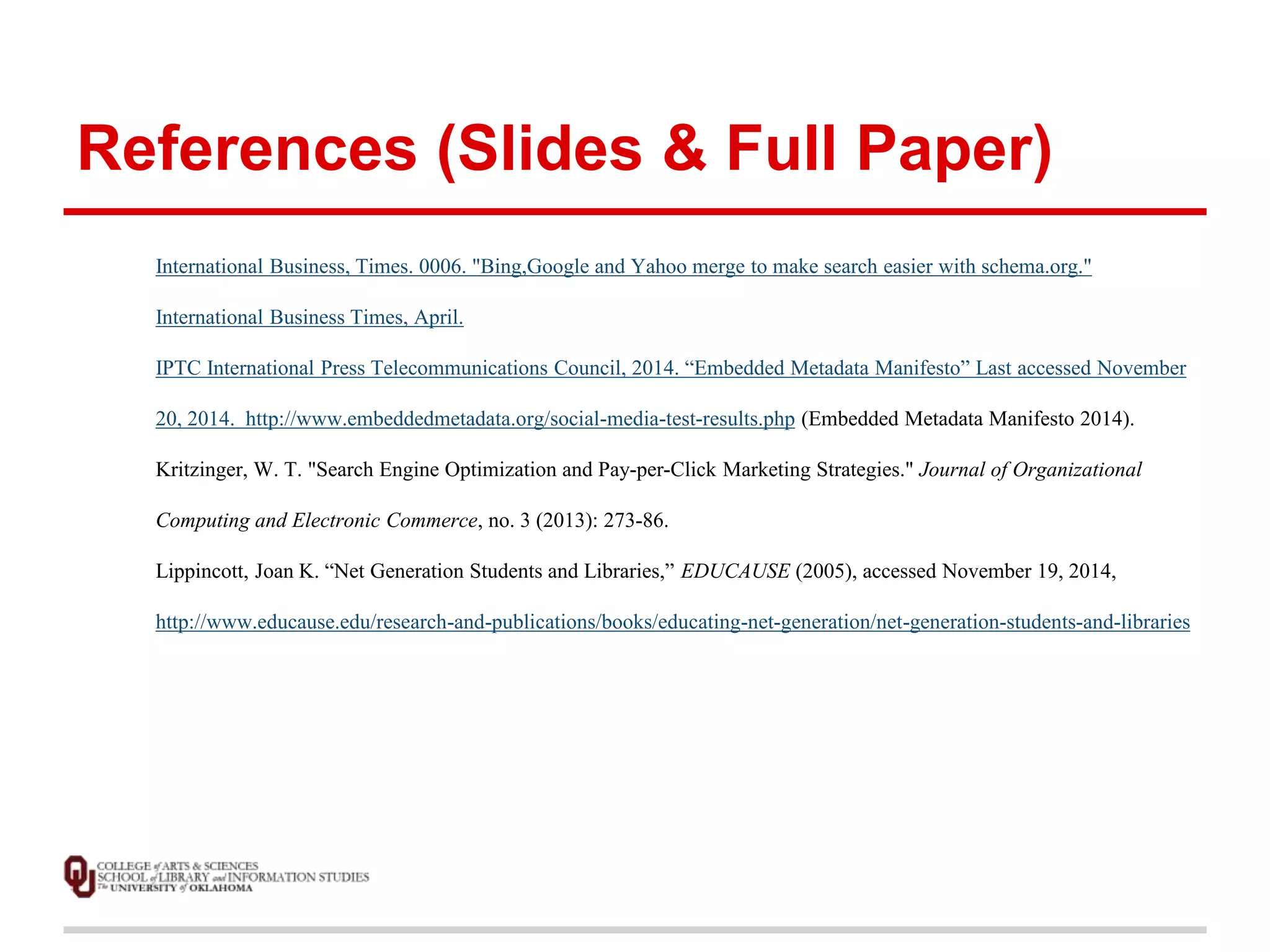
References (Slides & Full Paper) 
Algebraix Data, Corporation. 0005. "Algebraix Data Launches Industry’s First Cost-Effective Automated Implementation 
of Schema.org." Business Wire (English), 5. 
Beall, Jeffrey. 2010. "How Google Uses Metadata to Improve Search Results." Serials Librarian 59, no. 1: 40-53. 
Breeding, Marshall. 2013. "Linked Data: The Next Big Wave or Another Tech Fad?." Computers In Libraries 33, no. 3: 
20-22. 
Cafarella, M.J., Halevy, A.Y., Zhang, Y., Wang, D.Z., and Wu, E. Uncovering the relational Web. In Proceedings of the 
11th International Workshop on the Web and Databases (Vancouver, B.C., June 13, 2008). 
http://web.eecs.umich.edu/~michjc/papers/webtables_webdb08.pdf 
Connaway, Lynn Sillipigni, Timothy J. Dickey, and Marie L. Radford. 2011. "“If it is too inconvenient I'm not going after it:” 
Convenience as 
a critical factor in information-seeking behaviors." Library & Information Science Research (07408188) 33, no. 3: 179-190.
References (Slides & Full Paper) 
Cazier, Clay, 2014. PM Digital Marketing Blog “The Future of Exif Image Data” Last accessed November 20, 2014. 
http://www.pmdigital.com/blog/2014/04/future-exif-image-data/ 
Diagram Center: Digital Image and Graphic Resources for Accessible Materials , 2014. “Content Model” Last Accessed 
November 23, 2014. http://diagramcenter.org/standards-and-practices/content-model.html 
Google. 2014. “Image Publishing Guidelines” Last accessed November 21, 2014. 
https://support.google.com/webmasters/answer/114016?hl=en 
Holman, Lucy. 2011. "Millennial Students' Mental Models of Search: Implications for Academic Librarians and Database 
Developers." Journal Of Academic Librarianship 37, no. 1: 19-27
References (Slides & Full Paper) 
International Business, Times. 0006. "Bing,Google and Yahoo merge to make search easier with schema.org." 
International Business Times, April. 
IPTC International Press Telecommunications Council, 2014. “Embedded Metadata Manifesto” Last accessed November 
20, 2014. http://www.embeddedmetadata.org/social-media-test-results.php (Embedded Metadata Manifesto 2014). 
Kritzinger, W. T. "Search Engine Optimization and Pay-per-Click Marketing Strategies." Journal of Organizational 
Computing and Electronic Commerce, no. 3 (2013): 273-86. 
Lippincott, Joan K. “Net Generation Students and Libraries,” EDUCAUSE (2005), accessed November 19, 2014, 
http://www.educause.edu/research-and-publications/books/educating-net-generation/net-generation-students-and-libraries
References (Slides & Full Paper) 
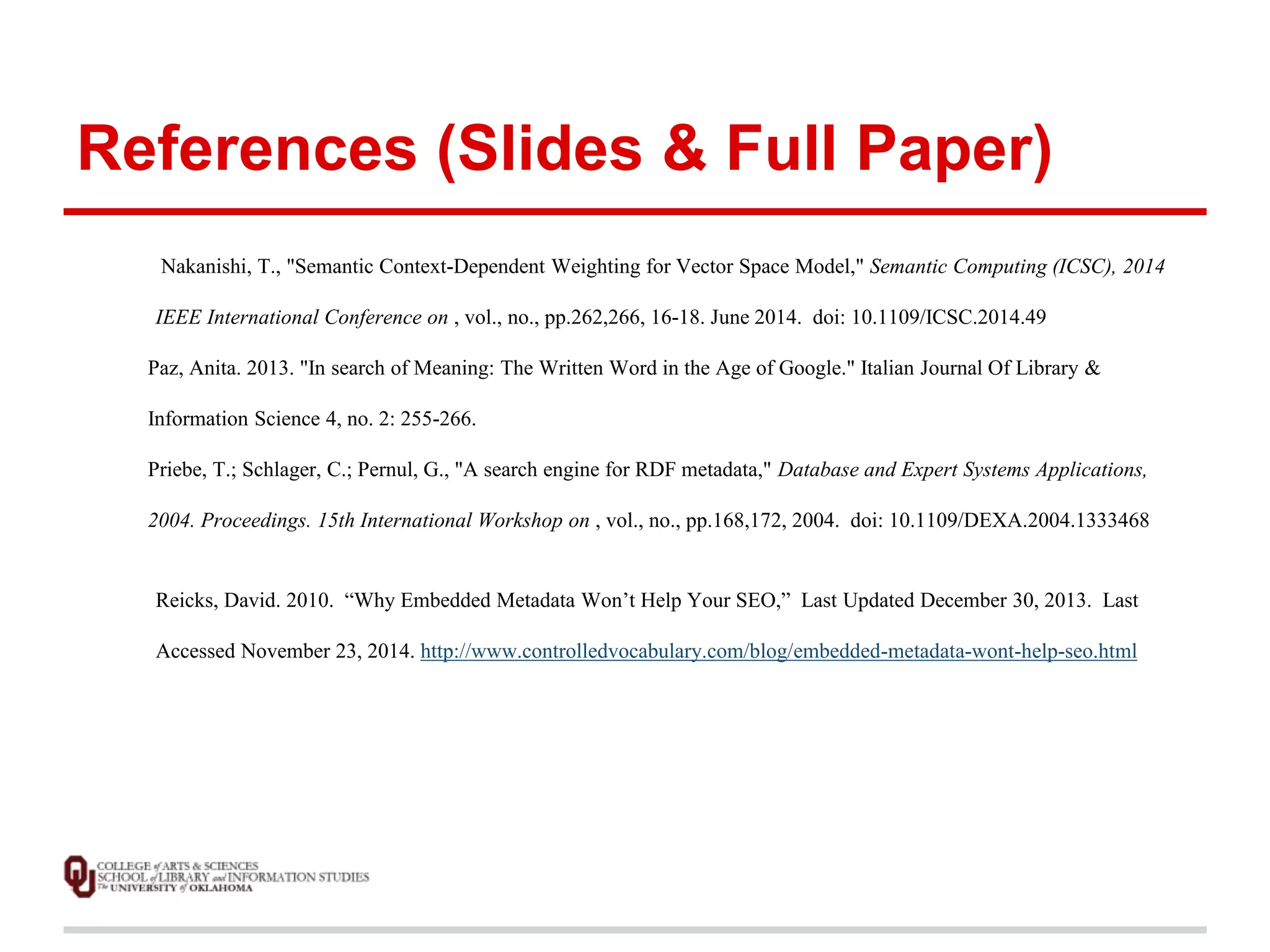
Nakanishi, T., "Semantic Context-Dependent Weighting for Vector Space Model," Semantic Computing (ICSC), 2014 
IEEE International Conference on , vol., no., pp.262,266, 16-18. June 2014. doi: 10.1109/ICSC.2014.49 
Paz, Anita. 2013. "In search of Meaning: The Written Word in the Age of Google." Italian Journal Of Library & 
Information Science 4, no. 2: 255-266. 
Priebe, T.; Schlager, C.; Pernul, G., "A search engine for RDF metadata," Database and Expert Systems Applications, 
2004. Proceedings. 15th International Workshop on , vol., no., pp.168,172, 2004. doi: 10.1109/DEXA.2004.1333468 
Reicks, David. 2010. “Why Embedded Metadata Won’t Help Your SEO,” Last Updated December 30, 2013. Last 
Accessed November 23, 2014. http://www.controlledvocabulary.com/blog/embedded-metadata-wont-help-seo.html

Structured data and metadata evaluation methodology for organizations looking to improve image findability on the web emily kolvitz_2014

  • 1.
    Structured Data andMetadata Evaluation Methodology for Organizations Looking to Improve Image Findability on the Web School of Library and Information Studies LIS 5733 Taught by: Dr. Susan Burke Research Proposal Written by: Emily Kolvitz Research Setting: Primarily Geared Towards Online Ecommerce/Business Organizations, but methodology could easily translate to Galleries, Museums, Archives, Libraries (GLAMs) or any institution looking to evaluate their structured data and metadata practices on the world wide web in an effort to improve findability of product offerings, general information or services.
  • 2.
    Introduction The currentstate of findability on the web for many organizations is incipient. Search Engine Optimization (SEO) techniques change frequently and remain much a mystery to many companies. The one variable in the equation of web findability that remains a staple is good quality metadata under the hood of the website. This research methodology will allow for : ● An assessment of findability maturity on the web from an image-centric viewpoint ● Help improve findability on the web by establishing a baseline for where your organization is at in terms of structured data content and visualize gaps or areas for improvement from a search engine neutral perspective
  • 3.
    Introduction ● MostSearches Start with Google now (Holman 2011) (Lippincott 2013) ● Search Algorithms Shaping what is most Easily Accessible (Connaway, Dickey & Radford 2011) and they are subject to change frequently (Kritzinger 2013) ● Search Algorithms Look for Your Structured Data and in the future and possibly your embedded metadata (Cazier 2014) (Beall 2010)
  • 4.
    Literature Review MarshallBreeding (2013) assesses the limitations of the major search engine algorithms: “But even with the most sophisticated relevancy algorithms, index-based search and retrieval lacks the ability to lead users to the potential related content. Semantic web technologies, in conjunction with repositories of open linked data, promise to deliver significant new capabilities in exploring and exploiting information resources on the web.”
  • 5.
    Literature Review ●Semantic web is founded on good, high-quality structured data ● Future technologies could potentially utilize embedded metadata in search (Cazier 2014) (Beall 2010) but there is authenticity, provenance and “breadcrumbs” value now (Reicks 2013)
  • 6.
    Literature Review ●Most users don’t go past the first page of search results (Paz 2013) ● Structured Data Practices can help your organization stay relevant (and findable!) in the age of information overload ● Keeping it Search Engine Neutral is advisable (Paz 2013)
  • 7.
    Topic/Proposed Research ●Methodology for establishing a baseline or benchmark of where an organization is at in terms of structured data pertaining to image records that ultimately helps findability on the web ● By utilizing the proposed methodology for gathering this data for an organization, data-informed decisions can be made about structured data strategy going forward to maintain relevancy on the web ● Many structured data elements can affect online findability from file-naming standards, presence of alt text tags in html markup, html markup itself, embedded metadata, schema.org markup and rich snippets, text description at or nearby images, and more. IEEE uses metadata or full-text for search (IEEE Xplore offers this--see next slide)
  • 8.
    Full Text Search& Metadata Search
  • 9.
    Topic/Proposed Research ●It is also noteworthy that there are additional factors that affect findability on the web that do not involve structured data, but this research focuses solely on structured data techniques within the control of individual organizations. ● All of these structured data techniques pertaining to image records will be utilized in conjunction with the relevancy of onsite and offsite search results. ● Image search and information retrieval is a more difficult area than text search and retrieval because accessibility to the image content is largely dependent on side-car text (or metadata if you will) that describes the aboutness and (hopefully) the context for the image record.
  • 10.
    Questions Research QuestionsAddressed in this Study 1. What methods of search are available on the organization’s online website? 1. What is the file-naming structure for images on the website? 1. What is the quality of search engine (onsite and offsite) results? 1. What kinds of search results appear in Image Search when searching by the organization’s name and product description both with onsite search and offsite search?
  • 11.
    Questions Research QuestionsAddressed in this Study 5. What kinds of search results appear in Google Image Search when searching by images taken from the organization’s website? 5. What kinds of search results come up when looking for specific products (measure of structured data) through onsite search and offsite search? 5. What are the results when looking for specific products on the offsite search engine?
  • 12.
    Questions Research QuestionsAddressed in this Study 8. What kinds of structured data are near or around the images on the organization’s website? Alt Text? Other? 9. What file types appear on the organization’s website? (JPEG? TIFF? PNG?) 9. What embedded metadata is available in images on the website? 11. What does the XMP/XML/RDF for these images look like and how robust is it? What does the graph look like?
  • 13.
    Variables Quality andnumber of alt text tags Type of page the image was on Level of description for the filename Quality and number of structured data tags pertaining to the images The image file naming convention/filename Quality and number of embedded metadata tags Quality and number of search results for onsite search utilizing filename or alt text Quality and number of relevant search results utilizing offsite image search These measures are operationalized by utilization of likert scales applied by the human researcher. For example, when rating the level of description for the file-name, a research could conclude that the filename sp_18379847923.jpg is not very descriptive filename for a human, let alone for a search engine (unless of course this is a product sku.) The researcher would then choose to assign it a low value on descriptiveness on a 1-5 likert scale.
  • 14.
    Data Collection Methods Participants Participants will include a single institution, anonymized for the protection of their business. The sample of image records utilized in this study will be limited to image assets appearing on the organization’s website domain. Most data collection can take place from the organization’s website itself. Some procedures will take place on external sites, services, or programs. Randomization of Sample The sample of images utilized in this study can be randomized by extracting a site map of the particular organization of interest using xsitemap.com. After the site map is constructed, the list of URLs should be inputted into a spreadsheet program and a record number should be assigned to each URL. From there, the researcher can use a randomizer program to select the order of pages to utilize in the study (i.e. Research Randomizer Available at: http://www.randomizer.org/form.htm) This method will be utilized for taking a random sample of pages from the organization of interest. Consent All data collected in this study are publicly available and freely available on the web.
  • 15.
    Data Collection Methods Obtaining Data on the website ● Navigate to the URL ● Right Click Image(s) and “Save As” ● Right Click Page and “View Source” Save as .txt file ● Collect raw data from image by either opening in Photoshop and Navigating to Raw Data Column or utilize Phil Harvey’s ExifTool Obtaining Data through Structured Data Linter ● Navigate to the Linter website ● Enter URL ● Screenshot Structured Data Results -or- save as webpage Obtaining Data through W3C RDF validator ● Copy raw data xml extracted earlier and input into RDF Validator ● Select Graph Only on the Options ● Parse RDF ● Save Graph or Screenshot Graph ● Store in Folder with other Data Answer Research Questions ● Systematically go through the collected data and input findings into spreadsheet
  • 16.
    Data Analysis Methods ● Descriptive Statistics o Bell Curve - measures towards a central tendency using likert scale data Bell Curve Image By Vierge Marie (Own work) [Public domain], via Wikimedia Commons http://upload.wikimedia.org/wikipe dia/commons/f/f6/Gaussian_Filter .svg
  • 17.
    Data Analysis Methods ● Graphical Analysis (Charts and Graphs) ● Summary Report ● Discussion of Findings
  • 18.
    Visualizing the Results The Structured Data Linter, utilizing URLs to display structured data around the images. Available at: http://linter.structured-data.org/ Summary analysis will be crafted utilizing all of these data points to show what we are able to understand about an image versus what a machine or search engine is able to know about an image. W3C RDF Validator Graph Visualization utilizing the raw data markup extracted from the image Available at: http://www.w3.org/RDF/Validator /
  • 19.
    Structured Data Linter Shows all structured Data Tags around the images and in the page markup
  • 20.
    RDF Validator Visualizationof embedded data for images and their subsequent relationships to other data
  • 21.
    Summary Report CompletePicture of Structured Data, Metadata and Analysis of Study
  • 22.
    Expected Outcomes Theanticipated results of this project include a benchmark for where this specific organization is at in terms of structured data in the online environment and a methodology for other organizations looking to assess their structured data maturity in the digital space. These results will be used to create a roadmap for improving resource findability both on the web and within websites. Other organizations may also aspire to reuse this methodology for assessing their own current state of structured data. Future areas of research could include utilizing metadata/RDF-driven search engines in conjuncture with Vector Space Models to assess findability of image records on the web and within websites.
  • 23.
    References (Slides &Full Paper) Algebraix Data, Corporation. 0005. "Algebraix Data Launches Industry’s First Cost-Effective Automated Implementation of Schema.org." Business Wire (English), 5. Beall, Jeffrey. 2010. "How Google Uses Metadata to Improve Search Results." Serials Librarian 59, no. 1: 40-53. Breeding, Marshall. 2013. "Linked Data: The Next Big Wave or Another Tech Fad?." Computers In Libraries 33, no. 3: 20-22. Cafarella, M.J., Halevy, A.Y., Zhang, Y., Wang, D.Z., and Wu, E. Uncovering the relational Web. In Proceedings of the 11th International Workshop on the Web and Databases (Vancouver, B.C., June 13, 2008). http://web.eecs.umich.edu/~michjc/papers/webtables_webdb08.pdf Connaway, Lynn Sillipigni, Timothy J. Dickey, and Marie L. Radford. 2011. "“If it is too inconvenient I'm not going after it:” Convenience as a critical factor in information-seeking behaviors." Library & Information Science Research (07408188) 33, no. 3: 179-190.
  • 24.
    References (Slides &Full Paper) Cazier, Clay, 2014. PM Digital Marketing Blog “The Future of Exif Image Data” Last accessed November 20, 2014. http://www.pmdigital.com/blog/2014/04/future-exif-image-data/ Diagram Center: Digital Image and Graphic Resources for Accessible Materials , 2014. “Content Model” Last Accessed November 23, 2014. http://diagramcenter.org/standards-and-practices/content-model.html Google. 2014. “Image Publishing Guidelines” Last accessed November 21, 2014. https://support.google.com/webmasters/answer/114016?hl=en Holman, Lucy. 2011. "Millennial Students' Mental Models of Search: Implications for Academic Librarians and Database Developers." Journal Of Academic Librarianship 37, no. 1: 19-27
  • 25.
    References (Slides &Full Paper) International Business, Times. 0006. "Bing,Google and Yahoo merge to make search easier with schema.org." International Business Times, April. IPTC International Press Telecommunications Council, 2014. “Embedded Metadata Manifesto” Last accessed November 20, 2014. http://www.embeddedmetadata.org/social-media-test-results.php (Embedded Metadata Manifesto 2014). Kritzinger, W. T. "Search Engine Optimization and Pay-per-Click Marketing Strategies." Journal of Organizational Computing and Electronic Commerce, no. 3 (2013): 273-86. Lippincott, Joan K. “Net Generation Students and Libraries,” EDUCAUSE (2005), accessed November 19, 2014, http://www.educause.edu/research-and-publications/books/educating-net-generation/net-generation-students-and-libraries
  • 26.
    References (Slides &Full Paper) Nakanishi, T., "Semantic Context-Dependent Weighting for Vector Space Model," Semantic Computing (ICSC), 2014 IEEE International Conference on , vol., no., pp.262,266, 16-18. June 2014. doi: 10.1109/ICSC.2014.49 Paz, Anita. 2013. "In search of Meaning: The Written Word in the Age of Google." Italian Journal Of Library & Information Science 4, no. 2: 255-266. Priebe, T.; Schlager, C.; Pernul, G., "A search engine for RDF metadata," Database and Expert Systems Applications, 2004. Proceedings. 15th International Workshop on , vol., no., pp.168,172, 2004. doi: 10.1109/DEXA.2004.1333468 Reicks, David. 2010. “Why Embedded Metadata Won’t Help Your SEO,” Last Updated December 30, 2013. Last Accessed November 23, 2014. http://www.controlledvocabulary.com/blog/embedded-metadata-wont-help-seo.html

Editor's Notes

  • #2 Full Paper Available. Please Contact Emily Kolvitz at kolvitz1@gmail.com
  • #3 Full Paper Available. Please Contact Emily Kolvitz at kolvitz1@gmail.com
  • #4 Full Paper Available. Please Contact Emily Kolvitz at kolvitz1@gmail.com
  • #5 Full Paper Available. Please Contact Emily Kolvitz at kolvitz1@gmail.com
  • #6 Full Paper Available. Please Contact Emily Kolvitz at kolvitz1@gmail.com
  • #7 Full Paper Available. Please Contact Emily Kolvitz at kolvitz1@gmail.com
  • #8 Full Paper Available. Please Contact Emily Kolvitz at kolvitz1@gmail.com
  • #9 Full Paper Available. Please Contact Emily Kolvitz at kolvitz1@gmail.com
  • #10 Full Paper Available. Please Contact Emily Kolvitz at kolvitz1@gmail.com
  • #11 Full Paper Available. Please Contact Emily Kolvitz at kolvitz1@gmail.com
  • #12 Full Paper Available. Please Contact Emily Kolvitz at kolvitz1@gmail.com
  • #13 Full Paper Available. Please Contact Emily Kolvitz at kolvitz1@gmail.com
  • #14 Full Paper Available. Please Contact Emily Kolvitz at kolvitz1@gmail.com
  • #15 Full Paper Available. Please Contact Emily Kolvitz at kolvitz1@gmail.com
  • #16 Full Paper Available. Please Contact Emily Kolvitz at kolvitz1@gmail.com
  • #17 Full Paper Available. Please Contact Emily Kolvitz at kolvitz1@gmail.com
  • #18 Full Paper Available. Please Contact Emily Kolvitz at kolvitz1@gmail.com
  • #19 Full Paper Available. Please Contact Emily Kolvitz at kolvitz1@gmail.com
  • #20 Full Paper Available. Please Contact Emily Kolvitz at kolvitz1@gmail.com
  • #21 Full Paper Available. Please Contact Emily Kolvitz at kolvitz1@gmail.com
  • #22 Full Paper Available. Please Contact Emily Kolvitz at kolvitz1@gmail.com
  • #23 Full Paper Available. Please Contact Emily Kolvitz at kolvitz1@gmail.com
  • #24 Full Paper Available. Please Contact Emily Kolvitz at kolvitz1@gmail.com
  • #25 Full Paper Available. Please Contact Emily Kolvitz at kolvitz1@gmail.com
  • #26 Full Paper Available. Please Contact Emily Kolvitz at kolvitz1@gmail.com
  • #27 Full Paper Available. Please Contact Emily Kolvitz at kolvitz1@gmail.com