Department of Physics
University of Education Lahore
(Multan Campus)
Introduction
Planet Profile
Layers of Earth
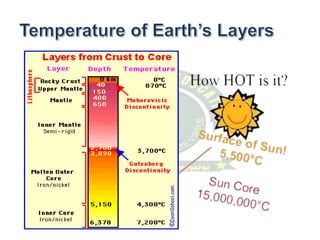
Temperature of Earth’s Layers
The Crust
The Mantle
The Core
Plate Tectonics
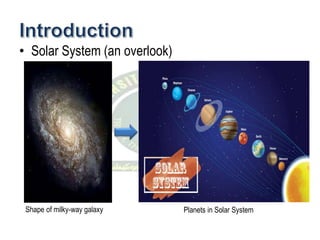
• Solar System (an overlook)
Shape of milky-way galaxy Planets in Solar System
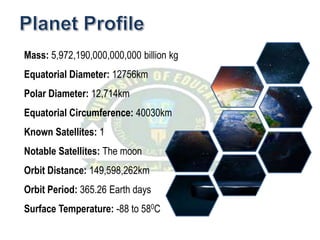
Mass: 5,972,190,000,000,000 billion kg
Equatorial Diameter: 12756km
Polar Diameter: 12,714km
Equatorial Circumference: 40030km
Known Satellites: 1
Notable Satellites: The moon
Orbit Distance: 149,598,262km
Orbit Period: 365.26 Earth days
Surface Temperature: -88 to 580C
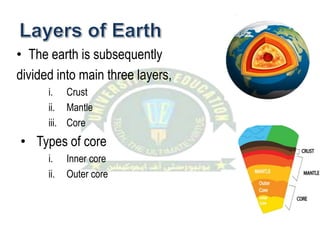
• The earth is subsequently
divided into main three layers,
i. Crust
ii. Mantle
iii. Core
• Types of core
i. Inner core
ii. Outer core
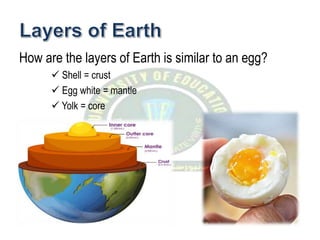
How are the layers of Earth is similar to an egg?
 Shell = crust
 Egg white = mantle
 Yolk = core
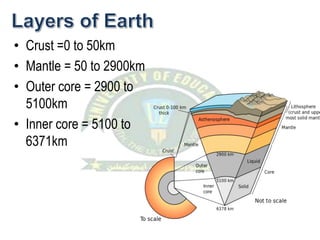
• Crust =0 to 50km
• Mantle = 50 to 2900km
• Outer core = 2900 to
5100km
• Inner core = 5100 to
6371km
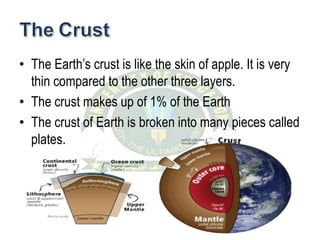
• The Earth’s crust is like the skin of apple. It is very
thin compared to the other three layers.
• The crust makes up of 1% of the Earth
• The crust of Earth is broken into many pieces called
plates.
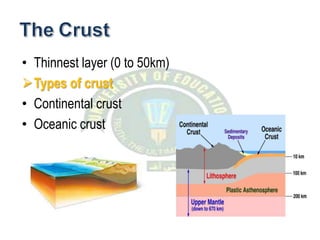
• Thinnest layer (0 to 50km)
Types of crust
• Continental crust
• Oceanic crust
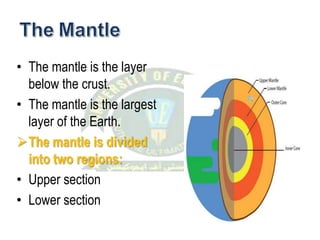
• The mantle is the layer
below the crust.
• The mantle is the largest
layer of the Earth.
The mantle is divided
into two regions:
• Upper section
• Lower section
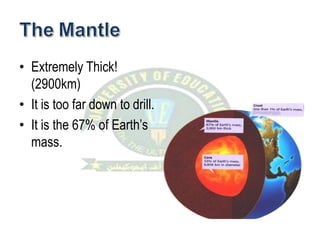
• Extremely Thick!
(2900km)
• It is too far down to drill.
• It is the 67% of Earth’s
mass.
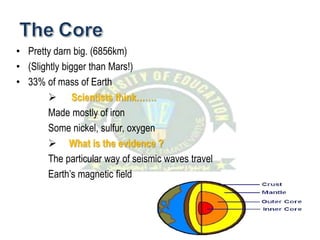
• Pretty darn big. (6856km)
• (Slightly bigger than Mars!)
• 33% of mass of Earth
 Scientists think…….
Made mostly of iron
Some nickel, sulfur, oxygen
 What is the evidence ?
The particular way of seismic waves travel
Earth’s magnetic field
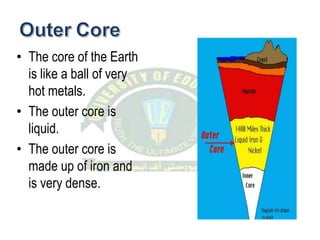
• The core of the Earth
is like a ball of very
hot metals.
• The outer core is
liquid.
• The outer core is
made up of iron and
is very dense.
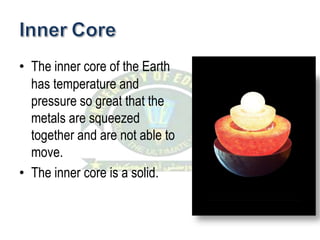
• The inner core of the Earth
has temperature and
pressure so great that the
metals are squeezed
together and are not able to
move.
• The inner core is a solid.
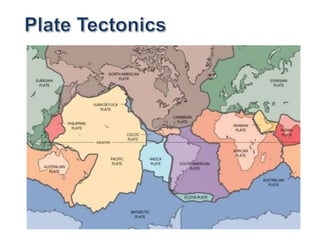
The Earth’s crust is divided into 12 major plates
which are moved in various directions.
This plate motion causes them to collide, pull apart,
or scrape against each other.
Each type of interaction causes a characteristic set
of Earth structure or “tectonic” features.
The word, tectonic, refers to the deformation of
crust as a consequence of plate interaction.
Structure of Earth PPT.pptx

Structure of Earth PPT.pptx

  • 1.
    Department of Physics Universityof Education Lahore (Multan Campus)
  • 2.
    Introduction Planet Profile Layers ofEarth Temperature of Earth’s Layers The Crust The Mantle The Core Plate Tectonics
  • 3.
    • Solar System(an overlook) Shape of milky-way galaxy Planets in Solar System
  • 4.
    Mass: 5,972,190,000,000,000 billionkg Equatorial Diameter: 12756km Polar Diameter: 12,714km Equatorial Circumference: 40030km Known Satellites: 1 Notable Satellites: The moon Orbit Distance: 149,598,262km Orbit Period: 365.26 Earth days Surface Temperature: -88 to 580C
  • 5.
    • The earthis subsequently divided into main three layers, i. Crust ii. Mantle iii. Core • Types of core i. Inner core ii. Outer core
  • 6.
    How are thelayers of Earth is similar to an egg?  Shell = crust  Egg white = mantle  Yolk = core
  • 7.
    • Crust =0to 50km • Mantle = 50 to 2900km • Outer core = 2900 to 5100km • Inner core = 5100 to 6371km
  • 9.
    • The Earth’scrust is like the skin of apple. It is very thin compared to the other three layers. • The crust makes up of 1% of the Earth • The crust of Earth is broken into many pieces called plates.
  • 10.
    • Thinnest layer(0 to 50km) Types of crust • Continental crust • Oceanic crust
  • 11.
    • The mantleis the layer below the crust. • The mantle is the largest layer of the Earth. The mantle is divided into two regions: • Upper section • Lower section
  • 12.
    • Extremely Thick! (2900km) •It is too far down to drill. • It is the 67% of Earth’s mass.
  • 13.
    • Pretty darnbig. (6856km) • (Slightly bigger than Mars!) • 33% of mass of Earth  Scientists think……. Made mostly of iron Some nickel, sulfur, oxygen  What is the evidence ? The particular way of seismic waves travel Earth’s magnetic field
  • 14.
    • The coreof the Earth is like a ball of very hot metals. • The outer core is liquid. • The outer core is made up of iron and is very dense.
  • 15.
    • The innercore of the Earth has temperature and pressure so great that the metals are squeezed together and are not able to move. • The inner core is a solid.
  • 16.
    The Earth’s crustis divided into 12 major plates which are moved in various directions. This plate motion causes them to collide, pull apart, or scrape against each other. Each type of interaction causes a characteristic set of Earth structure or “tectonic” features. The word, tectonic, refers to the deformation of crust as a consequence of plate interaction.