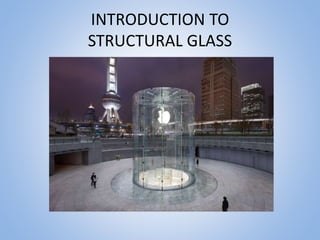
INTRODUCTION TO
STRUCTURAL GLASS
WHAT IS STRUCTURAL GLASS?
• GLASS… IS GLASS – SAND / SILICA, SODA, LIME ETC.
• STRUCTURAL GLASS
o GLASS CONSTRUCTION WHERE A PORTION OF
THE EXTERNAL LOADS ARE RESISTED BY THE
GLASS RATHER THAN A FRAME
• GLASS CAN FORM PRIMARY, SECONDARY AND
TIERTARY STRCUTURES
WINDOWS
FACADES
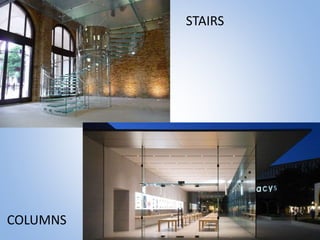
STAIRS
COLUMNS
STRUCTURAL GLASS COMPONENTS
• HOW DO YOU MAKE GLASS INTO A
STRUCTURE ?
1. TREAT THE GLASS TO MAKE IT STRONGER - HEAT
2. COMBINE MULTIPLE LAYERS OF GLASS – LAMINATION
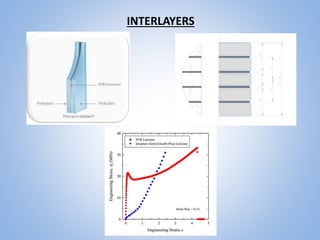
3. STICK THE LAYERS OF GLASS TOGETHER – INTERLAYERS
4. CONNECT PIECES OF GLASS TOGETHER – CONNECTORS &
ADHESIVES
5. COMBINE OR CONNECT GLASS STRUCTURES BACK TO
OTHER STRUCTURES
HEAT TREATING GLASS
FLOAT GLASS → HEAT STRENGTHENED → TOUGHENED
45 N/mm2 70 N/mm2 120 N/mm2
LAMINATING
STRENGTH AND SAFETY
INTERLAYERS
INTERLAYERS
CONNECTIONS - MECHANICAL
CONNECTIONS - INSERTS
CONNECTING - ADHESIVES
WHAT CAN YOU ACHIEVE WITH
STRUCTURAL GLASS?
Camino del Mar
LOAD BEARING INSULATED GLASS WALLS
LOAD BEARING GLASS FINS
2006 2011
2019
DESIGN CODES
• Australia – AS 1288 – 2006
• US – ASTM E1300-09
• Europe – EN 13474-3 (Draft only!)
• Reasonably similar in approach
• Define allowable stress, modification factors, duration
factors
• Some have calculations for effective thickness
• Simple stress calculations and design tables
• AS 1288 has simple fin buckling equations
KEY POINTS ON DESIGN
• Allowable stress design – what’s my allowable stress?
• Base allowable stress
• Material factors – Glass type
• Load Duration factors
KEY POINTS ON DESIGN
• Effective thickness – how thick is my glass?
• Glass thickness and ply
• Interlayer Properties
• Load Duration factors
• Length of element
• Calculate or use FE analysis?
KEY POINTS ON DESIGN
• Redundancy
• Glass does not yield, so when it fails.. It fails
• Design incorporates potential failure mechanisms
KEY POINTS ON DESIGN
• Redundancy
KEY POINTS ON DESIGN
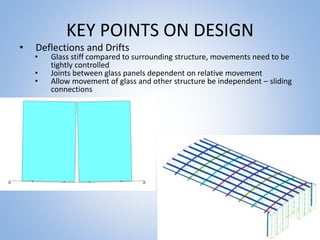
• Deflections and Drifts
• Glass stiff compared to surrounding structure, movements need to be
tightly controlled
• Joints between glass panels dependent on relative movement
• Allow movement of glass and other structure be independent – sliding
connections
ANALYSIS AND DESIGN METHODS
• Analysis – how complicated?
• 2D beam → 2D plate → 3D brick
3D BRICK ANALYSIS
ANALYSIS AND DESIGN METHODS
• Areas of concentrated stress need detailed analysis
• Fine mesh, material stiffness, bearings, allowing rotation
DESIGN LIMIT STATES
• Glass failure – overstressed
• Bending, bearings, stresses around holes
DESIGN LIMIT STATES
• Buckling
• Bow, wind load, axial load, displacement, PDelta
• Different glass properties under different loading
DESIGN LIMIT STATES
• Deflection limit – serviceability, weather seals
MODERN TECHNOLOGIES
CORNING® GORRILLA® GLASS
Corning developed Gorilla® Glass in response to a need for improved
screens on handheld devices
Touch screen technology → greater demands on screen quality:
• High strength
• Lightweight
• Scratch resistant
Structural Glass Presentation.pptx

Structural Glass Presentation.pptx

  • 1.
  • 2.
    WHAT IS STRUCTURALGLASS? • GLASS… IS GLASS – SAND / SILICA, SODA, LIME ETC. • STRUCTURAL GLASS o GLASS CONSTRUCTION WHERE A PORTION OF THE EXTERNAL LOADS ARE RESISTED BY THE GLASS RATHER THAN A FRAME • GLASS CAN FORM PRIMARY, SECONDARY AND TIERTARY STRCUTURES
  • 3.
  • 4.
  • 5.
    STRUCTURAL GLASS COMPONENTS •HOW DO YOU MAKE GLASS INTO A STRUCTURE ? 1. TREAT THE GLASS TO MAKE IT STRONGER - HEAT 2. COMBINE MULTIPLE LAYERS OF GLASS – LAMINATION 3. STICK THE LAYERS OF GLASS TOGETHER – INTERLAYERS 4. CONNECT PIECES OF GLASS TOGETHER – CONNECTORS & ADHESIVES 5. COMBINE OR CONNECT GLASS STRUCTURES BACK TO OTHER STRUCTURES
  • 6.
    HEAT TREATING GLASS FLOATGLASS → HEAT STRENGTHENED → TOUGHENED 45 N/mm2 70 N/mm2 120 N/mm2
  • 7.
  • 8.
  • 9.
  • 10.
  • 11.
  • 12.
  • 13.
    WHAT CAN YOUACHIEVE WITH STRUCTURAL GLASS?
  • 14.
  • 15.
  • 16.
  • 24.
  • 25.
  • 30.
    DESIGN CODES • Australia– AS 1288 – 2006 • US – ASTM E1300-09 • Europe – EN 13474-3 (Draft only!) • Reasonably similar in approach • Define allowable stress, modification factors, duration factors • Some have calculations for effective thickness • Simple stress calculations and design tables • AS 1288 has simple fin buckling equations
  • 31.
    KEY POINTS ONDESIGN • Allowable stress design – what’s my allowable stress? • Base allowable stress • Material factors – Glass type • Load Duration factors
  • 32.
    KEY POINTS ONDESIGN • Effective thickness – how thick is my glass? • Glass thickness and ply • Interlayer Properties • Load Duration factors • Length of element • Calculate or use FE analysis?
  • 33.
    KEY POINTS ONDESIGN • Redundancy • Glass does not yield, so when it fails.. It fails • Design incorporates potential failure mechanisms
  • 34.
    KEY POINTS ONDESIGN • Redundancy
  • 35.
    KEY POINTS ONDESIGN • Deflections and Drifts • Glass stiff compared to surrounding structure, movements need to be tightly controlled • Joints between glass panels dependent on relative movement • Allow movement of glass and other structure be independent – sliding connections
  • 36.
    ANALYSIS AND DESIGNMETHODS • Analysis – how complicated? • 2D beam → 2D plate → 3D brick
  • 37.
  • 38.
    ANALYSIS AND DESIGNMETHODS • Areas of concentrated stress need detailed analysis • Fine mesh, material stiffness, bearings, allowing rotation
  • 39.
    DESIGN LIMIT STATES •Glass failure – overstressed • Bending, bearings, stresses around holes
  • 40.
    DESIGN LIMIT STATES •Buckling • Bow, wind load, axial load, displacement, PDelta • Different glass properties under different loading
  • 41.
    DESIGN LIMIT STATES •Deflection limit – serviceability, weather seals
  • 42.
    MODERN TECHNOLOGIES CORNING® GORRILLA®GLASS Corning developed Gorilla® Glass in response to a need for improved screens on handheld devices Touch screen technology → greater demands on screen quality: • High strength • Lightweight • Scratch resistant