StreamSets and Spark:
Analytic Insights In Retail
Hari Shreedharan
Software Engineer
@harisr1234
hshreedharan@streamsets.com
Who am I?
● Software Engineer at Streamsets
○ Since March 2016
○ Work on:
■ Streamsets Data Collectector
■ Dataflow Performance Manager
● Software Engineer at Cloudera, Feb 2012 to March 2016
○ Worked on Apache Flume, PMC Chair
○ Worked on Apache Sqoop, Committer
○ Worked on Apache Spark, Contributor
● Software Engineer at Yahoo!, Jan 2010 to Feb 2012
○ Worked on Yahoo! Mail Metadata storage
● Author of O’Reilly’s “Using Flume”
StreamSets Data Collector
Open source software for
the rapid development and
reliable operation of complex
data flows.
➢ Efficiency
➢ Control
➢ Agility
➢ In-memory batches
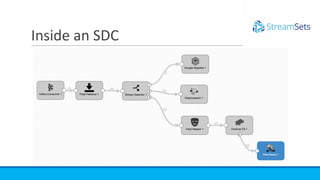
Inside an SDC
● Retail giant - hundreds of shoppers in each center at any time
● Lot of data available about each shopper:
○ Location
○ Existing user-profiles
○ Phone app data
● How to use this data to provide a personalized shopping experience for each of these
shoppers?
● Sensors around the center track:
○ WiFi
○ Bluetooth
○ In some cases, cell phone usage
Sensors and Data
for Personalized Shopping
● Partial WiFi handshake
○ Get unique id for each device
● Multiple sensors can be used to track an approximately accurate location
● Foot traffic pattern calculated using this information
● Unique user’s approximate time spent in individual stores and parts of the center can be
calculated and improved over recurring visits
● App provides additional information
● Specific promotions and updates can be sent to their devices (via app) on recurring visits
Sensors contd..
● Data pulled in from sensors via Streamsets Data Collector
● Various IoT origins:
○ CoAP
○ HTTP
○ TCP
○ UDP
○ WebSockets
○ MQTT
○ OPC-UA
● Add more nodes as required on (multi)cloud or on-prem or both (hybrid)
Getting the data from sensors
● SDC transparently converts several formats into SDC Record:
○ JSON
○ Avro
○ Byte[]
○ Delimited
○ Protobuf
○ Text
○ XML
○ Apache Log format
● Wow! That’s a lot of formats!
● Process SDC records and then write it out in any format, not necessarily the one you got
the data in!
● We also support ingesting Binary data
Formatting the data
● In-stream processing using processors
● Most processors are map operations on individual records
● Scripting processors process batches of records in python, groovy, javascript
● Spark Evaluators:
○ Perform arbitrary Spark operations on each batch of records
○ Each batch is an RDD[Record]
○ Stash batches or maintain state!
○ Perform reduces/shuffles.
○ Cluster mode pipelines
■ Each pipeline in the cluster generates an RDD batch
■ RDD can see all data coming in through the cluster
Processing the data
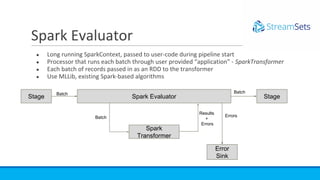
● Long running SparkContext, passed to user-code during pipeline start
● Processor that runs each batch through user provided “application” - SparkTransformer
● Each batch of records passed in as an RDD to the transformer
● Use MLLib, existing Spark-based algorithms
Spark Evaluator
Stage Spark Evaluator
Spark
Transformer
Batch
Results
+
Errors
Error
Sink
Errors
Stage
BatchBatch
● Transformer returns:
○ Result records that need to go to the next stage
○ Error records that can’t be processed
■ Written out to error stream
● Results are passed through to the rest of the pipeline
● Already available for CDH, MapR
Spark Evaluator
● In-stream processing useful for various real-time processing
○ Anomaly Detection
○ Sentiment Analysis
○ NLP
● Uses for retail giant:
○ Fraud Detection
○ Real time feedback/promotions
Using Spark Evaluator
SDC on Spark - Connectivity
Sources
● Kafka
Destinations
● HDFS
● HBase
● S3
● Kudu
● MapR DB
● Cassandra
● ElasticSearch
● Kafka
● MapR Streams
● Kinesis
● etc, etc, etc!
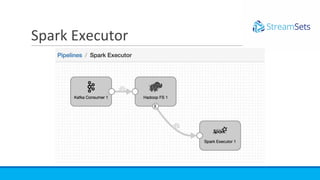
Spark Executor
● When an event is received, kick off a Spark application
● Ability to provide an application jar, and specific configuration
● Supports YARN and Databricks cloud support.
● YARN
○ Client and Cluster mode
○ Parameters can be based on the event data like file name
● Databricks Cloud
○ Define job beforehand
○ Jar or Notebook Job
○ Kick off the job on event
○ Parameters can be based on the event data like file name
Spark Executor
● Simplify operationalization of jobs on Databricks
● On File close on S3:
○ Kick of Databricks job
○ Object name passed in as a parameter
○ File data read in the Spark job
○ Can be a notebook job
■ Dbutils.widgets can be set by the executor to pass in parameters to notebooks
● Notebook integration can be used for easy experimentation:
○ Trial and error
○ Improvement of current job in real time
○ Change job between file closes
● Useful for model creation, classification algorithms and other batch jobs
Using Spark Executor
● Spark is excellent for in-stream and end of batch processing
● SDC makes in-stream processing with Spark easy
● SDC + Databricks cloud makes ingest followed by batch processing a
breeze!
● SDC + Notebooks makes it easy to incrementally improve applications and
experiment with parameters.
Conclusion
Questions?

Streamsets and spark in Retail

  • 1.
    StreamSets and Spark: AnalyticInsights In Retail Hari Shreedharan Software Engineer @harisr1234 hshreedharan@streamsets.com
  • 2.
    Who am I? ●Software Engineer at Streamsets ○ Since March 2016 ○ Work on: ■ Streamsets Data Collectector ■ Dataflow Performance Manager ● Software Engineer at Cloudera, Feb 2012 to March 2016 ○ Worked on Apache Flume, PMC Chair ○ Worked on Apache Sqoop, Committer ○ Worked on Apache Spark, Contributor ● Software Engineer at Yahoo!, Jan 2010 to Feb 2012 ○ Worked on Yahoo! Mail Metadata storage ● Author of O’Reilly’s “Using Flume”
  • 3.
    StreamSets Data Collector Opensource software for the rapid development and reliable operation of complex data flows. ➢ Efficiency ➢ Control ➢ Agility ➢ In-memory batches
  • 4.
  • 5.
    ● Retail giant- hundreds of shoppers in each center at any time ● Lot of data available about each shopper: ○ Location ○ Existing user-profiles ○ Phone app data ● How to use this data to provide a personalized shopping experience for each of these shoppers? ● Sensors around the center track: ○ WiFi ○ Bluetooth ○ In some cases, cell phone usage Sensors and Data for Personalized Shopping
  • 6.
    ● Partial WiFihandshake ○ Get unique id for each device ● Multiple sensors can be used to track an approximately accurate location ● Foot traffic pattern calculated using this information ● Unique user’s approximate time spent in individual stores and parts of the center can be calculated and improved over recurring visits ● App provides additional information ● Specific promotions and updates can be sent to their devices (via app) on recurring visits Sensors contd..
  • 7.
    ● Data pulledin from sensors via Streamsets Data Collector ● Various IoT origins: ○ CoAP ○ HTTP ○ TCP ○ UDP ○ WebSockets ○ MQTT ○ OPC-UA ● Add more nodes as required on (multi)cloud or on-prem or both (hybrid) Getting the data from sensors
  • 8.
    ● SDC transparentlyconverts several formats into SDC Record: ○ JSON ○ Avro ○ Byte[] ○ Delimited ○ Protobuf ○ Text ○ XML ○ Apache Log format ● Wow! That’s a lot of formats! ● Process SDC records and then write it out in any format, not necessarily the one you got the data in! ● We also support ingesting Binary data Formatting the data
  • 9.
    ● In-stream processingusing processors ● Most processors are map operations on individual records ● Scripting processors process batches of records in python, groovy, javascript ● Spark Evaluators: ○ Perform arbitrary Spark operations on each batch of records ○ Each batch is an RDD[Record] ○ Stash batches or maintain state! ○ Perform reduces/shuffles. ○ Cluster mode pipelines ■ Each pipeline in the cluster generates an RDD batch ■ RDD can see all data coming in through the cluster Processing the data
  • 10.
    ● Long runningSparkContext, passed to user-code during pipeline start ● Processor that runs each batch through user provided “application” - SparkTransformer ● Each batch of records passed in as an RDD to the transformer ● Use MLLib, existing Spark-based algorithms Spark Evaluator Stage Spark Evaluator Spark Transformer Batch Results + Errors Error Sink Errors Stage BatchBatch
  • 11.
    ● Transformer returns: ○Result records that need to go to the next stage ○ Error records that can’t be processed ■ Written out to error stream ● Results are passed through to the rest of the pipeline ● Already available for CDH, MapR Spark Evaluator
  • 12.
    ● In-stream processinguseful for various real-time processing ○ Anomaly Detection ○ Sentiment Analysis ○ NLP ● Uses for retail giant: ○ Fraud Detection ○ Real time feedback/promotions Using Spark Evaluator
  • 13.
    SDC on Spark- Connectivity Sources ● Kafka Destinations ● HDFS ● HBase ● S3 ● Kudu ● MapR DB ● Cassandra ● ElasticSearch ● Kafka ● MapR Streams ● Kinesis ● etc, etc, etc!
  • 14.
  • 15.
    ● When anevent is received, kick off a Spark application ● Ability to provide an application jar, and specific configuration ● Supports YARN and Databricks cloud support. ● YARN ○ Client and Cluster mode ○ Parameters can be based on the event data like file name ● Databricks Cloud ○ Define job beforehand ○ Jar or Notebook Job ○ Kick off the job on event ○ Parameters can be based on the event data like file name Spark Executor
  • 16.
    ● Simplify operationalizationof jobs on Databricks ● On File close on S3: ○ Kick of Databricks job ○ Object name passed in as a parameter ○ File data read in the Spark job ○ Can be a notebook job ■ Dbutils.widgets can be set by the executor to pass in parameters to notebooks ● Notebook integration can be used for easy experimentation: ○ Trial and error ○ Improvement of current job in real time ○ Change job between file closes ● Useful for model creation, classification algorithms and other batch jobs Using Spark Executor
  • 17.
    ● Spark isexcellent for in-stream and end of batch processing ● SDC makes in-stream processing with Spark easy ● SDC + Databricks cloud makes ingest followed by batch processing a breeze! ● SDC + Notebooks makes it easy to incrementally improve applications and experiment with parameters. Conclusion
  • 18.