Data driven
multi-channel management
Alison Waldron
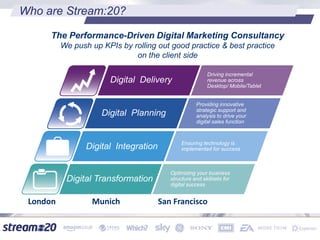
Who are Stream:20?
Digital Planning
Digital Transformation
Digital Integration
Digital Delivery
Optimizing your business
structure and skillsets for
digital success
Ensuring technology is
implemented for success
Providing innovative
strategic support and
analysis to drive your
digital sales function
Driving incremental
revenue across
Desktop/ Mobile/Tablet
The Performance-Driven Digital Marketing Consultancy
We push up KPIs by rolling out good practice & best practice
on the client side
London Munich San Francisco
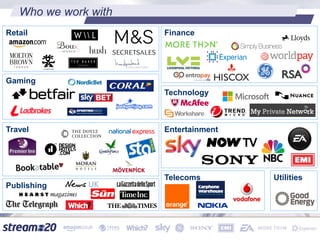
Who we work with
Retail Finance
Gaming
Telecoms
Travel Entertainment
Publishing
Technology
Utilities
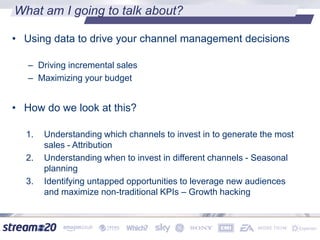
What am I going to talk about?
• Using data to drive your channel management decisions
– Driving incremental sales
– Maximizing your budget
• How do we look at this?
1. Understanding which channels to invest in to generate the most
sales - Attribution
2. Understanding when to invest in different channels - Seasonal
planning
3. Identifying untapped opportunities to leverage new audiences
and maximize non-traditional KPIs – Growth hacking
Channel management & attribution
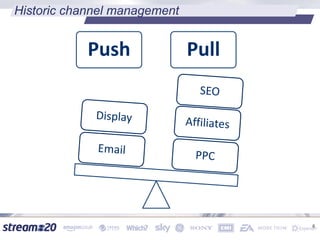
Push Pull
Historic channel management
6
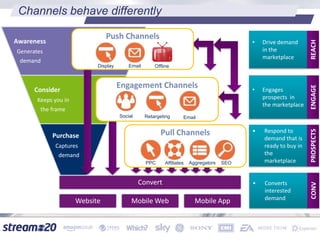
Awareness
Generates
demand
Consider
Keeps you in
the frame
Purchase
Captures
demand
Push Channels
Display Email Offline
Pull Channels
AffiliatesPPC SEOAggregators
Engagement Channels
Social Retargeting Email
• Converts
interested
demand
• Respond to
demand that is
ready to buy in
the
marketplace
• Drive demand
in the
marketplace
• Engages
prospects in
the marketplace
REACHENGAGEPROSPECTSCONV
Channels behave differently
Convert
Website Mobile Web Mobile App
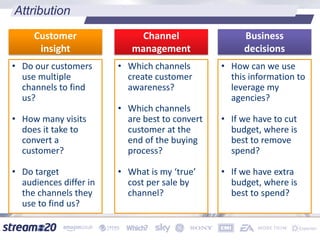
Attribution
Customer
insight
• Do our customers
use multiple
channels to find
us?
• How many visits
does it take to
convert a
customer?
• Do target
audiences differ in
the channels they
use to find us?
Channel
management
• Which channels
create customer
awareness?
• Which channels
are best to convert
customer at the
end of the buying
process?
• What is my ‘true’
cost per sale by
channel?
Business
decisions
• How can we use
this information to
leverage my
agencies?
• If we have to cut
budget, where is
best to remove
spend?
• If we have extra
budget, where is
best to spend?
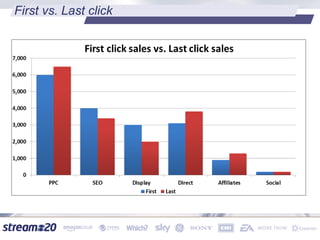
First vs. Last click
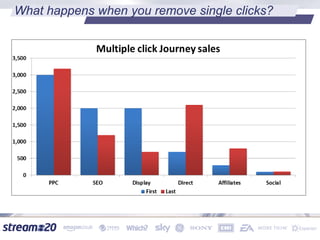
What happens when you remove single clicks?
Affiliate
Acquisition
Email
Display
Offline
Media
Attribution Multi-Channel management
PUSH
PULL
DEMAND
GENERATION
DEMAND
CONVERSION
PPC/SEO DirectRetargeting
Display
Conversion
Email
Brand
PPC/SEO
Generic
PPC / SEO
A typical customer journey
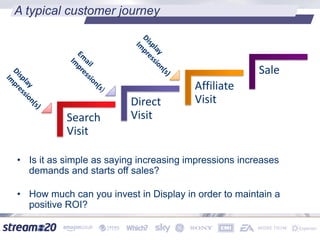
• Is it as simple as saying increasing impressions increases
demands and starts off sales?
• How much can you invest in Display in order to maintain a
positive ROI?
Search
Visit
Direct
Visit
Affiliate
Visit
Sale
Calculating Impact Accurately
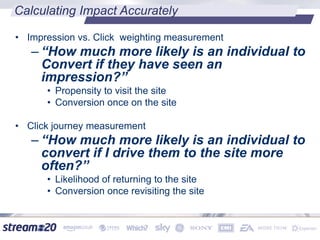
• Impression vs. Click weighting measurement
– “How much more likely is an individual to
Convert if they have seen an
impression?”
• Propensity to visit the site
• Conversion once on the site
• Click journey measurement
– “How much more likely is an individual to
convert if I drive them to the site more
often?”
• Likelihood of returning to the site
• Conversion once revisiting the site
Going further – simpler KPIs that
allow you to game attribution
Building a brand online
Then
Rich media formats
Expensive premium
placements
Display, video pre-rolls
Metrics replicating offline
Now
Content marketing
Seeding, social & mobile
placements ideal
Multitude of channels
Metrics leveraging online
relevance
In
practice
Awareness and brand are not
design heavy ads
Number and variations of
placements have increased
dramatically
The focus is now on the stage
a prospect is in their buying
journey, not the channel
All stages of the buying
journey are measurable
Macro Conversion Micro Conversion
New Metrics: Micro conversion
REGISTRATION
Goal KPI examples
Quality traffic to site / serving
appropriate content
CPA, CPC, CTR
Site performance / user journeys
Bounce Rate, Content Funnels,
Content Frequency
Clear calls to action / intuitive
discovery of new content /
behavioural targeting of stories
Sharing, Watch video, like, Signup,
ARPV (advertising)
Driving satisfaction & cohesive user
experience
Single log in / remembering
preferences / personalised content
/ community engagement
Provide a reason to be loyal (
loyalty scheme rewarding value)
Repeat Visit Rate, Multi-channel
behaviour, LTV
Create a environment where
customers are happy to become
advocates of the brand
Social Sharing, MGM Conversion
Post Visit
Multiple
return visits
and
engagement
1st Visit
Welcome, engage
and then transfer to
key revenue
generating content
areas
Acquisition
Browse
Micro Conversions
Satisfaction
Loyalty
Advocacy
Confirmed
sale
• Watching a video
on a site
• Sharing content
with a friend
• Posting an article
on your social
network
Use Case: Audience Segments
17
Unknown Group
Data Driven – Offsite
Brand Aware No Clear Desire
Brand Aware Thinking of Buying
Price / Product Aware
Order Dropouts
•Unknown – no known tags,
not meeting any other criteria
•Upper Segment Dropouts Able
to target externally
•All other site visits
•Number of Visits / Recency /
Time on Site / Brand Section
•Sales Section Visits
•Started Order Process – Not
completed order process1
2
3
4
5
6
Basic
Retargeting
Segmented
retargeting
Buying
Audiences
Audience Segments
No. Segment Content Display SEM Social Email
1
High CVR
Order Dropouts
2 Price / Product Aware
3
Brand Aware Thinking of
Buying
4
Brand Aware No Clear
Desire
5 Data Driven – Offsite
6 Unknown Group
Buying Funnel
Unidentified prospects
Fixed
RT
Criteo &
Analect
RT
GDN
RT
OMD (RTB)
RT
Sociomatic
Retargeting
PerformancePPC
Retargeting
OnsiteEmailCapture
Fixed
OnsiteEmail
Capture
Lookalike &
GDN
RTB
AwarenessPPC
Youtube
RT
Location
Targetin
g
Audience
Buys
List Rental
Customer
Reviews
Price
comparison
Expert
Reviews
UGC -
Video
Classic PR
Content
seeding
Seasonality rules the world
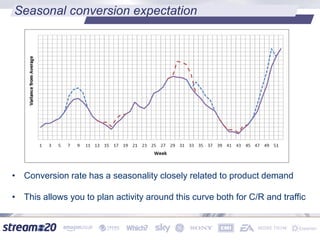
Seasonal conversion expectation
• Conversion rate has a seasonality closely related to product demand
• This allows you to plan activity around this curve both for C/R and traffic
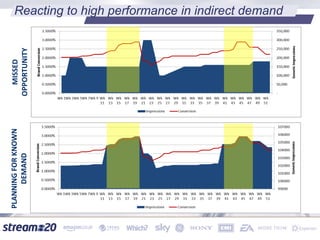
Reacting to high performance in indirect demandMISSED
OPPORTUNITY
PLANNINGFORKNOWN
DEMAND
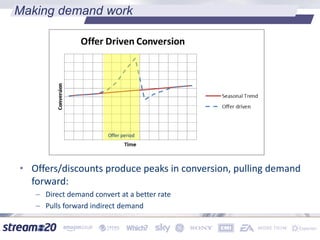
• Offers/discounts produce peaks in conversion, pulling demand
forward:
– Direct demand convert at a better rate
– Pulls forward indirect demand
Offer period
Making demand work
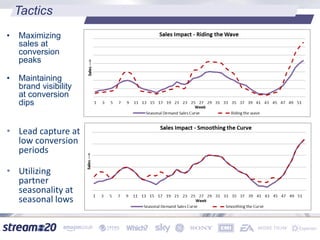
Tactics
• Maximizing
sales at
conversion
peaks
• Maintaining
brand visibility
at conversion
dips
• Lead capture at
low conversion
periods
• Utilizing
partner
seasonality at
seasonal lows
Using Growth Hacking Techniques
to improve performance
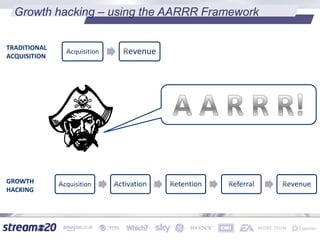
Growth hacking – using the AARRR Framework
cquisition evenueTRADITIONAL
ACQUISITION
cquisition ctivation etention eferral evenueGROWTH
HACKING
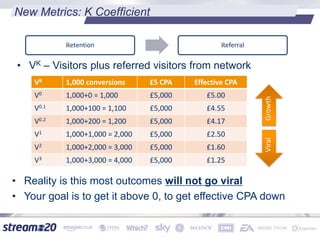
New Metrics: K Coefficient
• VK – Visitors plus referred visitors from network
VK 1,000 conversions £5 CPA Effective CPA
V0 1,000+0 = 1,000 £5,000 £5.00
V0.1 1,000+100 = 1,100 £5,000 £4.55
V0.2 1,000+200 = 1,200 £5,000 £4.17
V1 1,000+1,000 = 2,000 £5,000 £2.50
V2 1,000+2,000 = 3,000 £5,000 £1.60
V3 1,000+3,000 = 4,000 £5,000 £1.25
• Reality is this most outcomes will not go viral
• Your goal is to get it above 0, to get effective CPA down
ViralGrowth
etention eferral
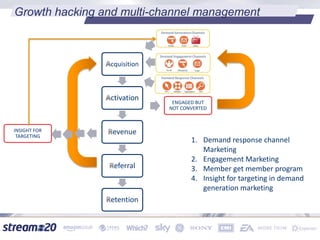
Growth hacking and multi-channel management
cquisition
ctivation
evenue
eferral
etention
ENGAGED BUT
NOT CONVERTED
INSIGHT FOR
TARGETING
1. Demand response channel
Marketing
2. Engagement Marketing
3. Member get member program
4. Insight for targeting in demand
generation marketing
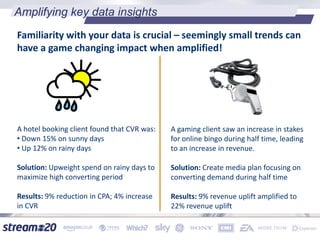
Amplifying key data insights
Familiarity with your data is crucial – seemingly small trends can
have a game changing impact when amplified!
A hotel booking client found that CVR was:
• Down 15% on sunny days
• Up 12% on rainy days
Solution: Upweight spend on rainy days to
maximize high converting period
Results: 9% reduction in CPA; 4% increase
in CVR
A gaming client saw an increase in stakes
for online bingo during half time, leading
to an increase in revenue.
Solution: Create media plan focusing on
converting demand during half time
Results: 9% revenue uplift amplified to
22% revenue uplift
Conclusions
• Understanding your seasonality and its effect on
conversion helps you maximize sales from existing
demand
• An accurate attribution model means you don’t just need
to rely on high cost Push marketing to drive demand
• Familiarity with your data is key – if you see something
that works, act fast!
Thank you
Alison.Waldron@Stream20.com

Data Driven Channel Management | San Francisco Digital Marketing Hub

  • 1.
  • 2.
    Who are Stream:20? DigitalPlanning Digital Transformation Digital Integration Digital Delivery Optimizing your business structure and skillsets for digital success Ensuring technology is implemented for success Providing innovative strategic support and analysis to drive your digital sales function Driving incremental revenue across Desktop/ Mobile/Tablet The Performance-Driven Digital Marketing Consultancy We push up KPIs by rolling out good practice & best practice on the client side London Munich San Francisco
  • 3.
    Who we workwith Retail Finance Gaming Telecoms Travel Entertainment Publishing Technology Utilities
  • 4.
    What am Igoing to talk about? • Using data to drive your channel management decisions – Driving incremental sales – Maximizing your budget • How do we look at this? 1. Understanding which channels to invest in to generate the most sales - Attribution 2. Understanding when to invest in different channels - Seasonal planning 3. Identifying untapped opportunities to leverage new audiences and maximize non-traditional KPIs – Growth hacking
  • 5.
  • 6.
  • 7.
    Awareness Generates demand Consider Keeps you in theframe Purchase Captures demand Push Channels Display Email Offline Pull Channels AffiliatesPPC SEOAggregators Engagement Channels Social Retargeting Email • Converts interested demand • Respond to demand that is ready to buy in the marketplace • Drive demand in the marketplace • Engages prospects in the marketplace REACHENGAGEPROSPECTSCONV Channels behave differently Convert Website Mobile Web Mobile App
  • 8.
    Attribution Customer insight • Do ourcustomers use multiple channels to find us? • How many visits does it take to convert a customer? • Do target audiences differ in the channels they use to find us? Channel management • Which channels create customer awareness? • Which channels are best to convert customer at the end of the buying process? • What is my ‘true’ cost per sale by channel? Business decisions • How can we use this information to leverage my agencies? • If we have to cut budget, where is best to remove spend? • If we have extra budget, where is best to spend?
  • 9.
  • 10.
    What happens whenyou remove single clicks?
  • 11.
  • 12.
    A typical customerjourney • Is it as simple as saying increasing impressions increases demands and starts off sales? • How much can you invest in Display in order to maintain a positive ROI? Search Visit Direct Visit Affiliate Visit Sale
  • 13.
    Calculating Impact Accurately •Impression vs. Click weighting measurement – “How much more likely is an individual to Convert if they have seen an impression?” • Propensity to visit the site • Conversion once on the site • Click journey measurement – “How much more likely is an individual to convert if I drive them to the site more often?” • Likelihood of returning to the site • Conversion once revisiting the site
  • 14.
    Going further –simpler KPIs that allow you to game attribution
  • 15.
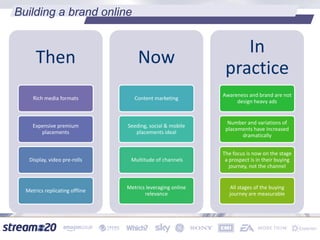
    Building a brandonline Then Rich media formats Expensive premium placements Display, video pre-rolls Metrics replicating offline Now Content marketing Seeding, social & mobile placements ideal Multitude of channels Metrics leveraging online relevance In practice Awareness and brand are not design heavy ads Number and variations of placements have increased dramatically The focus is now on the stage a prospect is in their buying journey, not the channel All stages of the buying journey are measurable
  • 16.
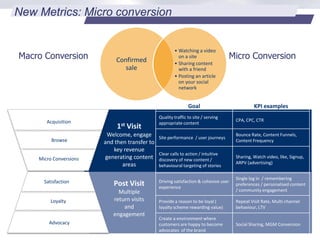
    Macro Conversion MicroConversion New Metrics: Micro conversion REGISTRATION Goal KPI examples Quality traffic to site / serving appropriate content CPA, CPC, CTR Site performance / user journeys Bounce Rate, Content Funnels, Content Frequency Clear calls to action / intuitive discovery of new content / behavioural targeting of stories Sharing, Watch video, like, Signup, ARPV (advertising) Driving satisfaction & cohesive user experience Single log in / remembering preferences / personalised content / community engagement Provide a reason to be loyal ( loyalty scheme rewarding value) Repeat Visit Rate, Multi-channel behaviour, LTV Create a environment where customers are happy to become advocates of the brand Social Sharing, MGM Conversion Post Visit Multiple return visits and engagement 1st Visit Welcome, engage and then transfer to key revenue generating content areas Acquisition Browse Micro Conversions Satisfaction Loyalty Advocacy Confirmed sale • Watching a video on a site • Sharing content with a friend • Posting an article on your social network
  • 17.
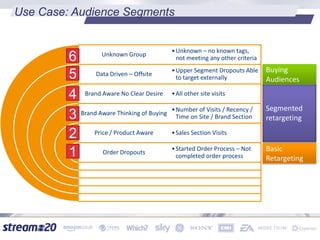
    Use Case: AudienceSegments 17 Unknown Group Data Driven – Offsite Brand Aware No Clear Desire Brand Aware Thinking of Buying Price / Product Aware Order Dropouts •Unknown – no known tags, not meeting any other criteria •Upper Segment Dropouts Able to target externally •All other site visits •Number of Visits / Recency / Time on Site / Brand Section •Sales Section Visits •Started Order Process – Not completed order process1 2 3 4 5 6 Basic Retargeting Segmented retargeting Buying Audiences
  • 18.
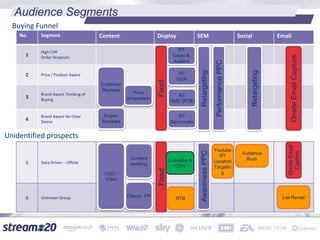
    Audience Segments No. SegmentContent Display SEM Social Email 1 High CVR Order Dropouts 2 Price / Product Aware 3 Brand Aware Thinking of Buying 4 Brand Aware No Clear Desire 5 Data Driven – Offsite 6 Unknown Group Buying Funnel Unidentified prospects Fixed RT Criteo & Analect RT GDN RT OMD (RTB) RT Sociomatic Retargeting PerformancePPC Retargeting OnsiteEmailCapture Fixed OnsiteEmail Capture Lookalike & GDN RTB AwarenessPPC Youtube RT Location Targetin g Audience Buys List Rental Customer Reviews Price comparison Expert Reviews UGC - Video Classic PR Content seeding
  • 19.
  • 20.
    Seasonal conversion expectation •Conversion rate has a seasonality closely related to product demand • This allows you to plan activity around this curve both for C/R and traffic
  • 21.
    Reacting to highperformance in indirect demandMISSED OPPORTUNITY PLANNINGFORKNOWN DEMAND
  • 22.
    • Offers/discounts producepeaks in conversion, pulling demand forward: – Direct demand convert at a better rate – Pulls forward indirect demand Offer period Making demand work
  • 23.
    Tactics • Maximizing sales at conversion peaks •Maintaining brand visibility at conversion dips • Lead capture at low conversion periods • Utilizing partner seasonality at seasonal lows
  • 24.
    Using Growth HackingTechniques to improve performance
  • 25.
    Growth hacking –using the AARRR Framework cquisition evenueTRADITIONAL ACQUISITION cquisition ctivation etention eferral evenueGROWTH HACKING
  • 26.
    New Metrics: KCoefficient • VK – Visitors plus referred visitors from network VK 1,000 conversions £5 CPA Effective CPA V0 1,000+0 = 1,000 £5,000 £5.00 V0.1 1,000+100 = 1,100 £5,000 £4.55 V0.2 1,000+200 = 1,200 £5,000 £4.17 V1 1,000+1,000 = 2,000 £5,000 £2.50 V2 1,000+2,000 = 3,000 £5,000 £1.60 V3 1,000+3,000 = 4,000 £5,000 £1.25 • Reality is this most outcomes will not go viral • Your goal is to get it above 0, to get effective CPA down ViralGrowth etention eferral
  • 27.
    Growth hacking andmulti-channel management cquisition ctivation evenue eferral etention ENGAGED BUT NOT CONVERTED INSIGHT FOR TARGETING 1. Demand response channel Marketing 2. Engagement Marketing 3. Member get member program 4. Insight for targeting in demand generation marketing
  • 28.
    Amplifying key datainsights Familiarity with your data is crucial – seemingly small trends can have a game changing impact when amplified! A hotel booking client found that CVR was: • Down 15% on sunny days • Up 12% on rainy days Solution: Upweight spend on rainy days to maximize high converting period Results: 9% reduction in CPA; 4% increase in CVR A gaming client saw an increase in stakes for online bingo during half time, leading to an increase in revenue. Solution: Create media plan focusing on converting demand during half time Results: 9% revenue uplift amplified to 22% revenue uplift
  • 29.
    Conclusions • Understanding yourseasonality and its effect on conversion helps you maximize sales from existing demand • An accurate attribution model means you don’t just need to rely on high cost Push marketing to drive demand • Familiarity with your data is key – if you see something that works, act fast!
  • 30.

Editor's Notes

  • #2 20 – 25 minutes If I can only do one thing, where should I start? Capturing data
  • #3 So who are Stream:20 and what do we do? Stream:20, are a digital marketing consultancy Why does this matter? We’re not an agency but work within our clients organisations, mostly onsite, focussing on generating incremental revenues This puts us in the enviable position of seeing first hand how many businesses approach their Channel management We work across 4 key areas, we: Sales delivery - Delivering Sales managing channels Sales planning - Help plan sales and manage cross-channel integrations Sales toolkits – Implementing reporting frameworks Sales organisation – Optimising business structure So why is this relevant, We have specialists in individual channels who work within their channel and how they can use data better but also focus on cross channel impact of these activities
  • #5 Change slide
  • #6 Now we’re getting as many sales as possible coming from our pull activity we return to the original problem – how to generate additional product demand and awareness What happens when you can’t get any more sales from your cheap pull channels?
  • #7 Historically a lot of you will have used this view of Channel management as a framework In short that your channel decisions are simply a balance between investing in Push channels (where you can access a new audience) and Pull channels (where they would convert an interested audience) Once you see Pull sales slowing down or dropping off you invest more in Push to increase demand And when costs increase you change their focus to Pull channels with a much lower CPA
  • #8 Getting a bit outdated
  • #9 To answer these questions we use “Attribution analysis” Now attribution doesn’t just mean what channel gets associated with what cost? Understanding the journeys to conversion and what this means about attributing sales gives much wider benefits This allows us to understand three key areas: Customer Insight …. Channel management ….. How to make key business decisions
  • #10 The first thing we do when we look at attribution is look at the two ends to the scale This means looking at where demand comes from by analysing where customer journeys start And looking at where they end – the last click before a sale This graph shows Channels along the bottom and Sales on the verical axis with the blue bars being first click sales and the red bar last click sales The difference between first and last click varies by channel but not necessarily enough to change how you optimise your marketing But, what if we want to generate incremental sales? If we assume that incremental sales will come from people undecided or who don’t know our product we can make the assumption they will take more than 1 visit to convert
  • #11 Taking out single click journeys we get a much wider difference between first click sales and last click sales. This implies that we need to take a closer look at spending more in Display and SEO to create demand, But importantly holding enough money back to convert sales through Affiliates PPC and Direct
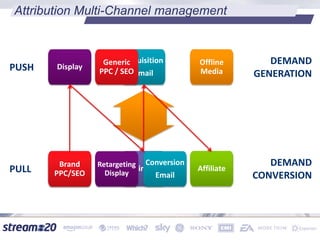
  • #12 So, is it just a question of investing in the channels you choose. No, because channels are no longer static Sales journeys might actually start off in PPC before crossing many channels on route to conversion And PPC is not just for conversion, Generic term search offers access to a new audience And Display starts to convert sales through the use of Retargeting as an “Engagement channel” Email is used to access new audiences and convert order drop outs In the end it is understanding the relationship between demand generating areas and demand converting areas with engagement opportunities linking these together
  • #13 Looking at a first click vs. last click model only takes you so far, what we need to do is to understand a full customer journey This view shows a typical customer journey and the steps to conversion that they take. You can see the “Introducing” channel at the beginning of the user journey - Search The next stage is an “influencing” Direct visit, acting to maintain interest in the product Before you have a “convertor” visit in Affiliates producing a sale However Clicks aren’t the only impactful metric that we need to consider Impressions can drive visits at each stage of this process This then leaves you with a few questions: Do I simply up-weight impression volumes in order to increase sales? How much can I spend on impressions before it effects my ROI?
  • #14 By using data to answer these questions means you can have an accurate model that delivers clear recommendations This means answering two key questions: Firstly, to understand the importance of impressions on sales How much more likely is an individual to convert if they have seen an impression? And Secondly, to understand the importance of the different stages on a click path How much more likely is a customer to convert if I drive them to the site more often? By using you’re data to answer these questions you can put in place a full fact based attribution model that will allow you to drive significant incremental sales cost effectively
  • #15 We’ve done loads of attribution projects for clients and what we’ve some to realize is that often the conclusions are the same. For those of you who maybe don’t have the time or the resources to carry out a full time attribution project, here are some quick takeaways.
  • #16 Let’s start from top of funnel / brand awareness Rich media formats -> to content marketing. It’s no longer about design heavy ads, it’s about getting content out there that propagates the brand. Expensive premium placements -> seeding, social & mobile placements – number and variation have increased dramatically and this might feel like it’s made more work for us but really we should stop thinking about them as ads and start thinking about them as data points. Similarly from the move to Display / video to a multitude of channels – it’s all about the data point, it’s about the state the prospect is in their buying journey rather than the channel And we’ve moved now to an environment where the expectation is that all stages of the buying journey are measurable – we don’t just have to focus on conversion to gauge performance.
  • #17 When it comes to micro conversion, different businesses will choose to measure this in different ways. It might not be just about defining engagement KPIs but also creating a framework that scores customers based on a range of interactions e.g. have they watched a video for more than one minute, have they browsed to these pages etc.
  • #21 Now what we see is that Conversion changes over time and that it has a seasonality. This graph shows Weeks along the bottom and conversion on the vertical axis. Each industry has a seasonal curve and each brand within it will have a slightly adjusted curve. To effect conversion we use a model built around “conversion rate expectation” We know what the expected BAU conversion will be throughout the year and it allows us to layer ontop Traffic volumes, pricing changes and product improvements to control this The key is to not just let this curve simply run your sales budget. Take control of it and use it to maximise sales
  • #22 Planning your marketing spend to take this seasonal conversion into account can deliver a big impact on your sales This graph shows conversion rate over time as with the previous slide (the red line) but alongside this is impressions bought, the blue area As you can see there are two clear peaks in Conversion rate with a limited amount of media being bought. This is a big missed opportunity By planning for known demand levels and bringing forward media spend we are able to maximise the volume of traffic at periods when this traffic delivers the most sales
  • #23 Pull channels are all about getting the most people possible across the line to become customers and the key driver to this is conversion This graph shows Conversion on the vertical axis, now conversion isn't an immovable beast. If you overlay an offer during this period, you effect conversion Conversion goes up during the offer period And then there’s a hangover, and if you’re smart you can minimise this hangover to boost overall conversion
  • #24 Utilising this conversion expectation methodology we can use two core tactics: Firstly, and rather cheesily, “Riding the wave”! What this means is Maximising investment at high converting periods to ensure you get the most sales from this traffic and increase your sales peaks The flip side of this is that you use up budget previously used to maintain brand visibility in tough seasonal periods and experience a decrease in brand awareness and increased sales dips The other tactic you can use is “Smoothing the curve” This is about removing the reliance on seasonality by spending in low periods to maintain a flat yearly sales line The truth is the tactics you need to use fall somewhere in between these two approaches You need to maximise pull sales during seasonal highs And use engagement and push tactics like “lead capture” and “brand display” to maintain product awareness at other times
  • #30 So, In conclusion, Understanding your seasonality and its effect on conversion helps you maximise sales from existing demand An accurate attribution model means you don’t just need to rely on high cost Push marketing to drive demand By utilising these two approaches you can allocate your budget over time and across channels to deliver the most sales And importantly, demonstrating this to your finance team can help you increase your marketing budget
  • #31 Thank you very much, Does anyone have any questions?