Strategy Planning and Executing with Future ScenariosImproving decision making and strategic paths to creating the futurePart 2 - A Process Framework1
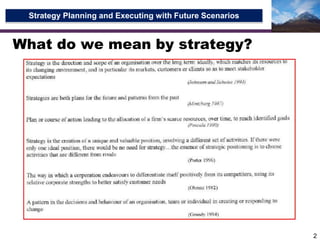
What do we mean by strategy?2
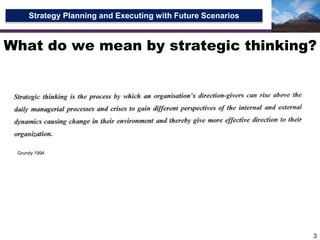
3What do we mean by strategic thinking?Grundy 1994
The traditional strategy process cycle...4“Most companies have an annual cycle of strategic planning reviews...”- however -“...strategies are rarely made in conference rooms but are more likely to be cooked up informally and often in real time.”McKinsey Quarterly – Tired of Strategic Planning?    Henry Mintzberg : The Rise and Fall of Strategic Planning
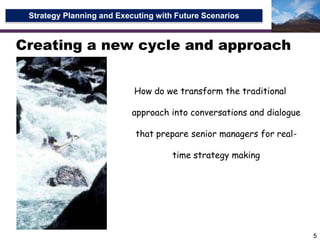
Creating a new cycle and approach5How do we transform the traditional approach into conversations and dialogue that prepare senior managers for real-time strategy making
6“The ability to learn faster than your competitors may be your only sustainable competitive advantage.”Arie de Geus
So what then is the purpose?The tools of conventional strategic analysis are still required– however – they have another purpose7“We do this so that we have prepared minds.”Extracted from “Creating Strategy in an unknowable Universe”. - Eric D. Beinhocker.  HBS Working Knowledge series
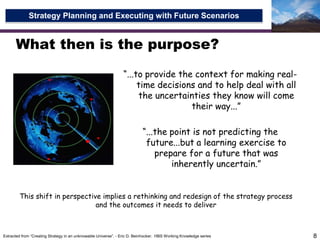
What then is the purpose?8“...to provide the context for making real-time decisions and to help deal with all the uncertainties they know will come their way...”“...the point is not predicting the future...but a learning exercise to prepare for a future that was inherently uncertain.”This shift in perspective implies a rethinking and redesign of the strategy process and the outcomes it needs to deliverExtracted from “Creating Strategy in an unknowable Universe”. - Eric D. Beinhocker.  HBS Working Knowledge series
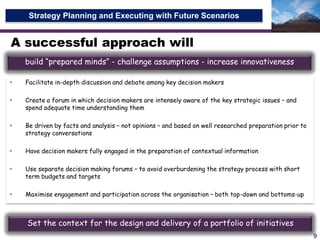
A successful approach willFacilitate in-depth discussion and debate among key decision makers
Create a forum in which decision makers are intensely aware of the key strategic issues – and spend adequate time understanding them
Be driven by facts and analysis – not opinions – and based on well researched preparation prior to strategy conversations
Have decision makers fully engaged in the preparation of contextual information
Use separate decision making forums – to avoid overburdening the strategy process with short term budgets and targets
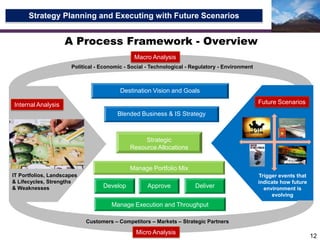
Maximise engagement and participation across the organisation – both top-down and bottoms-up9build “prepared minds” - challenge assumptions - increase innovativenessSet the context for the design and delivery of a portfolio of initiatives

Strategy and future scenarios part 2

  • 1.
    Strategy Planning andExecuting with Future ScenariosImproving decision making and strategic paths to creating the futurePart 2 - A Process Framework1
  • 2.
    What do wemean by strategy?2
  • 3.
    3What do wemean by strategic thinking?Grundy 1994
  • 4.
    The traditional strategyprocess cycle...4“Most companies have an annual cycle of strategic planning reviews...”- however -“...strategies are rarely made in conference rooms but are more likely to be cooked up informally and often in real time.”McKinsey Quarterly – Tired of Strategic Planning? Henry Mintzberg : The Rise and Fall of Strategic Planning
  • 5.
    Creating a newcycle and approach5How do we transform the traditional approach into conversations and dialogue that prepare senior managers for real-time strategy making
  • 6.
    6“The ability tolearn faster than your competitors may be your only sustainable competitive advantage.”Arie de Geus
  • 7.
    So what thenis the purpose?The tools of conventional strategic analysis are still required– however – they have another purpose7“We do this so that we have prepared minds.”Extracted from “Creating Strategy in an unknowable Universe”. - Eric D. Beinhocker. HBS Working Knowledge series
  • 8.
    What then isthe purpose?8“...to provide the context for making real-time decisions and to help deal with all the uncertainties they know will come their way...”“...the point is not predicting the future...but a learning exercise to prepare for a future that was inherently uncertain.”This shift in perspective implies a rethinking and redesign of the strategy process and the outcomes it needs to deliverExtracted from “Creating Strategy in an unknowable Universe”. - Eric D. Beinhocker. HBS Working Knowledge series
  • 9.
    A successful approachwillFacilitate in-depth discussion and debate among key decision makers
  • 10.
    Create a forumin which decision makers are intensely aware of the key strategic issues – and spend adequate time understanding them
  • 11.
    Be driven byfacts and analysis – not opinions – and based on well researched preparation prior to strategy conversations
  • 12.
    Have decision makersfully engaged in the preparation of contextual information
  • 13.
    Use separate decisionmaking forums – to avoid overburdening the strategy process with short term budgets and targets
  • 14.
    Maximise engagement andparticipation across the organisation – both top-down and bottoms-up9build “prepared minds” - challenge assumptions - increase innovativenessSet the context for the design and delivery of a portfolio of initiatives