A Presentation on
Subject-Strategic Management
INDIRA INSTITUTE OF MANAGEMENT, PUNE
MASTER OF BUSINESS ADMINISTRATION, SEMESTER – III
BATCH: 2021-2023
GROUP FINANCE20
Sr.No. Name Roll no.
1 Aarya Gangakhedkar FNB-01
2 Akshay Pendavale FNB-05
3 Aman Nashine FNB-07
4 Deepak Rajbhar FNB-11
5 Himanshu Patil FNB-15
INTRODUCTION
• TCS, a member of the TATA group, was established in 1968 and had its headquarters in Mumbai.
• TCS is a consulting, IT services, and business solutions organization. It has partnered with many large businesses
in the past 50 years across the world. It has established itself on a global scale.
• The company has its footprint in the Asia pacific, India, north America, Latin America, the united kingdom,
Europe, Africa, and the middle east.
• TCS has five primary verticals or business segments: retail and consumer business, banking, financial services &
insurance (BFSI), communication media and technology (CMT). Manufacturing and others like energy, healthcare,
and life sciences.
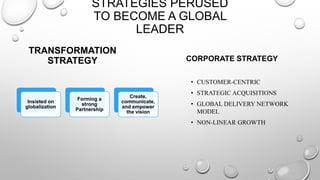
TRANSFORMATION
STRATEGY
Insisted on
globalization
Forming a
strong
Partnership
Create,
communicate,
and empower
the vision
STRATEGIES PERUSED
TO BECOME A GLOBAL
LEADER
CORPORATE STRATEGY
• CUSTOMER-CENTRIC
• STRATEGIC ACQUISITIONS
• GLOBAL DELIVERY NETWORK
MODEL
• NON-LINEAR GROWTH
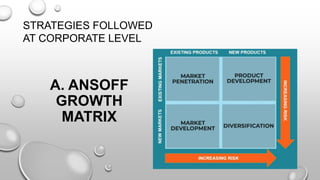
A. ANSOFF
GROWTH
MATRIX
STRATEGIES FOLLOWED
AT CORPORATE LEVEL
B. BLUE
OCEAN
STRATEG
Y
The "blue ocean" strategy refers to the idea of creating new
market space and moving into an uncontested market, rather
than competing in an existing market where competition is
intense.
• DIGITAL SOLUTIONS
• EMERGING MARKETS
• NICHE SOLUTIONS
• EMPLOYEE EMPOWERMENT
GENERIC STRATEGIES
• COST LEADERSHIP
• DIFFERENTIATION
• MARKET FOCUS
• GROWTH
AT BUSINESS LEVEL
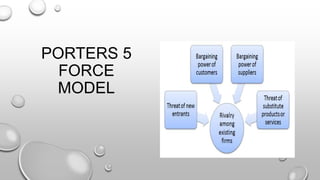
PORTERS 5
FORCE
MODEL
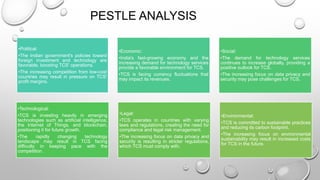
•Political:
•The Indian government's policies toward
foreign investment and technology are
favorable, boosting TCS' operations.
•The increasing competition from low-cost
countries may result in pressure on TCS'
profit margins.
•Economic:
•India's fast-growing economy and the
increasing demand for technology services
provide a favorable environment for TCS.
•TCS is facing currency fluctuations that
may impact its revenues.
•Social:
•The demand for technology services
continues to increase globally, providing a
positive outlook for TCS.
•The increasing focus on data privacy and
security may pose challenges for TCS.
•Technological:
•TCS is investing heavily in emerging
technologies such as artificial intelligence,
the Internet of Things, and blockchain,
positioning it for future growth.
•The rapidly changing technology
landscape may result in TCS facing
difficulty in keeping pace with the
competition.
•Legal:
•TCS operates in countries with varying
laws and regulations, creating the need for
compliance and legal risk management.
•The increasing focus on data privacy and
security is resulting in stricter regulations,
which TCS must comply with.
•Environmental:
•TCS is committed to sustainable practices
and reducing its carbon footprint.
•The increasing focus on environmental
sustainability may result in increased costs
for TCS in the future.
PESTLE ANALYSIS
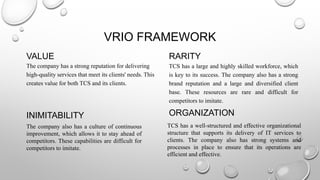
VRIO FRAMEWORK
VALUE
The company has a strong reputation for delivering
high-quality services that meet its clients' needs. This
creates value for both TCS and its clients.
RARITY
TCS has a large and highly skilled workforce, which
is key to its success. The company also has a strong
brand reputation and a large and diversified client
base. These resources are rare and difficult for
competitors to imitate.
INIMITABILITY
The company also has a culture of continuous
improvement, which allows it to stay ahead of
competitors. These capabilities are difficult for
competitors to imitate.
ORGANIZATION
TCS has a well-structured and effective organizational
structure that supports its delivery of IT services to
clients. The company also has strong systems and
processes in place to ensure that its operations are
efficient and effective.
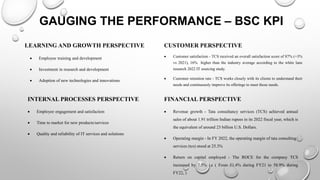
GAUGING THE PERFORMANCE – BSC KPI
FINANCIAL PERSPECTIVE
 Revenue growth - Tata consultancy services (TCS) achieved annual
sales of about 1.91 trillion Indian rupees in its 2022 fiscal year, which is
the equivalent of around 23 billion U.S. Dollars.
 Operating margin - In FY 2022, the operating margin of tata consulting
services (tcs) stood at 25.3%
 Return on capital employed - The ROCE for the company TCS
increased by 7.5% i.e ( From 51.4% during FY21 to 58.9% during
FY22, )
CUSTOMER PERSPECTIVE
 Customer satisfaction - TCS received an overall satisfaction score of 87% (+3%
vs 2021), 16% higher than the industry average according to the white lane
research 2022 IT sourcing study.
 Customer retention rate - TCS works closely with its clients to understand their
needs and continuously improve its offerings to meet those needs.
INTERNAL PROCESSES PERSPECTIVE
 Employee engagement and satisfaction
 Time to market for new products/services
 Quality and reliability of IT services and solutions
LEARNING AND GROWTH PERSPECTIVE
 Employee training and development
 Investment in research and development
 Adoption of new technologies and innovations
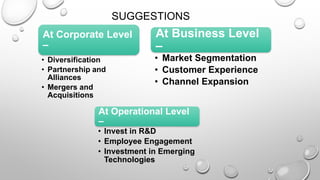
At Corporate Level
–
• Diversification
• Partnership and
Alliances
• Mergers and
Acquisitions
At Business Level
–
• Market Segmentation
• Customer Experience
• Channel Expansion
At Operational Level
–
• Invest in R&D
• Employee Engagement
• Investment in Emerging
Technologies
SUGGESTIONS
Strategic management Tea.pptx

Strategic management Tea.pptx

  • 1.
    A Presentation on Subject-StrategicManagement INDIRA INSTITUTE OF MANAGEMENT, PUNE MASTER OF BUSINESS ADMINISTRATION, SEMESTER – III BATCH: 2021-2023 GROUP FINANCE20 Sr.No. Name Roll no. 1 Aarya Gangakhedkar FNB-01 2 Akshay Pendavale FNB-05 3 Aman Nashine FNB-07 4 Deepak Rajbhar FNB-11 5 Himanshu Patil FNB-15
  • 2.
    INTRODUCTION • TCS, amember of the TATA group, was established in 1968 and had its headquarters in Mumbai. • TCS is a consulting, IT services, and business solutions organization. It has partnered with many large businesses in the past 50 years across the world. It has established itself on a global scale. • The company has its footprint in the Asia pacific, India, north America, Latin America, the united kingdom, Europe, Africa, and the middle east. • TCS has five primary verticals or business segments: retail and consumer business, banking, financial services & insurance (BFSI), communication media and technology (CMT). Manufacturing and others like energy, healthcare, and life sciences.
  • 3.
    TRANSFORMATION STRATEGY Insisted on globalization Forming a strong Partnership Create, communicate, andempower the vision STRATEGIES PERUSED TO BECOME A GLOBAL LEADER CORPORATE STRATEGY • CUSTOMER-CENTRIC • STRATEGIC ACQUISITIONS • GLOBAL DELIVERY NETWORK MODEL • NON-LINEAR GROWTH
  • 4.
  • 5.
    B. BLUE OCEAN STRATEG Y The "blueocean" strategy refers to the idea of creating new market space and moving into an uncontested market, rather than competing in an existing market where competition is intense. • DIGITAL SOLUTIONS • EMERGING MARKETS • NICHE SOLUTIONS • EMPLOYEE EMPOWERMENT
  • 6.
    GENERIC STRATEGIES • COSTLEADERSHIP • DIFFERENTIATION • MARKET FOCUS • GROWTH AT BUSINESS LEVEL
  • 7.
  • 8.
    •Political: •The Indian government'spolicies toward foreign investment and technology are favorable, boosting TCS' operations. •The increasing competition from low-cost countries may result in pressure on TCS' profit margins. •Economic: •India's fast-growing economy and the increasing demand for technology services provide a favorable environment for TCS. •TCS is facing currency fluctuations that may impact its revenues. •Social: •The demand for technology services continues to increase globally, providing a positive outlook for TCS. •The increasing focus on data privacy and security may pose challenges for TCS. •Technological: •TCS is investing heavily in emerging technologies such as artificial intelligence, the Internet of Things, and blockchain, positioning it for future growth. •The rapidly changing technology landscape may result in TCS facing difficulty in keeping pace with the competition. •Legal: •TCS operates in countries with varying laws and regulations, creating the need for compliance and legal risk management. •The increasing focus on data privacy and security is resulting in stricter regulations, which TCS must comply with. •Environmental: •TCS is committed to sustainable practices and reducing its carbon footprint. •The increasing focus on environmental sustainability may result in increased costs for TCS in the future. PESTLE ANALYSIS
  • 10.
    VRIO FRAMEWORK VALUE The companyhas a strong reputation for delivering high-quality services that meet its clients' needs. This creates value for both TCS and its clients. RARITY TCS has a large and highly skilled workforce, which is key to its success. The company also has a strong brand reputation and a large and diversified client base. These resources are rare and difficult for competitors to imitate. INIMITABILITY The company also has a culture of continuous improvement, which allows it to stay ahead of competitors. These capabilities are difficult for competitors to imitate. ORGANIZATION TCS has a well-structured and effective organizational structure that supports its delivery of IT services to clients. The company also has strong systems and processes in place to ensure that its operations are efficient and effective.
  • 11.
    GAUGING THE PERFORMANCE– BSC KPI FINANCIAL PERSPECTIVE  Revenue growth - Tata consultancy services (TCS) achieved annual sales of about 1.91 trillion Indian rupees in its 2022 fiscal year, which is the equivalent of around 23 billion U.S. Dollars.  Operating margin - In FY 2022, the operating margin of tata consulting services (tcs) stood at 25.3%  Return on capital employed - The ROCE for the company TCS increased by 7.5% i.e ( From 51.4% during FY21 to 58.9% during FY22, ) CUSTOMER PERSPECTIVE  Customer satisfaction - TCS received an overall satisfaction score of 87% (+3% vs 2021), 16% higher than the industry average according to the white lane research 2022 IT sourcing study.  Customer retention rate - TCS works closely with its clients to understand their needs and continuously improve its offerings to meet those needs. INTERNAL PROCESSES PERSPECTIVE  Employee engagement and satisfaction  Time to market for new products/services  Quality and reliability of IT services and solutions LEARNING AND GROWTH PERSPECTIVE  Employee training and development  Investment in research and development  Adoption of new technologies and innovations
  • 12.
    At Corporate Level – •Diversification • Partnership and Alliances • Mergers and Acquisitions At Business Level – • Market Segmentation • Customer Experience • Channel Expansion At Operational Level – • Invest in R&D • Employee Engagement • Investment in Emerging Technologies SUGGESTIONS