Strategy Development
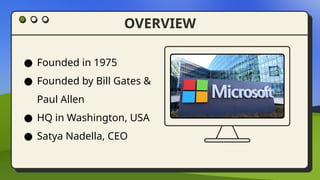
OVERVIEW
● Founded in 1975
● Founded by Bill Gates &
Paul Allen
● HQ in Washington, USA
● Satya Nadella, CEO
1. Which one generic
strategy best reflects
the business strategy
your company is
following?
Apply the concepts on strategy
development to analyze and explain the
rationale for your decision.
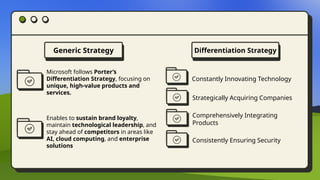
Constantly Innovating Technology
Microsoft follows Porter’s
Differentiation Strategy, focusing on
unique, high-value products and
services.
Generic Strategy Differentiation Strategy
Enables to sustain brand loyalty,
maintain technological leadership, and
stay ahead of competitors in areas like
AI, cloud computing, and enterprise
solutions
Strategically Acquiring Companies
Comprehensively Integrating
Products
Consistently Ensuring Security
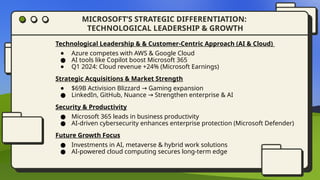
Technological Leadership & & Customer-Centric Approach (AI & Cloud)
● Azure competes with AWS & Google Cloud
● AI tools like Copilot boost Microsoft 365
● Q1 2024: Cloud revenue +24% (Microsoft Earnings)
Strategic Acquisitions & Market Strength
● $69B Activision Blizzard Gaming expansion
→
● LinkedIn, GitHub, Nuance Strengthen enterprise & AI
→
Security & Productivity
● Microsoft 365 leads in business productivity
● AI-driven cybersecurity enhances enterprise protection (Microsoft Defender)
Future Growth Focus
● Investments in AI, metaverse & hybrid work solutions
● AI-powered cloud computing secures long-term edge
MICROSOFT’S STRATEGIC DIFFERENTIATION:
TECHNOLOGICAL LEADERSHIP & GROWTH
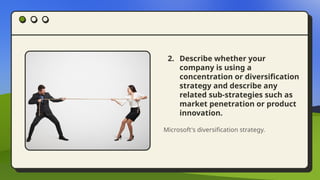
2. Describe whether your
company is using a
concentration or diversification
strategy and describe any
related sub-strategies such as
market penetration or product
innovation.
Microsoft's diversification strategy.
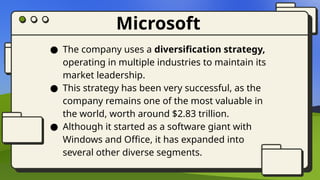
Microsoft
● The company uses a diversification strategy,
operating in multiple industries to maintain its
market leadership.
● This strategy has been very successful, as the
company remains one of the most valuable in
the world, worth around $2.83 trillion.
● Although it started as a software giant with
Windows and Office, it has expanded into
several other diverse segments.
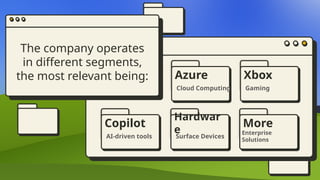
The company operates
in different segments,
the most relevant being: Azure
Cloud Computing
Hardwar
e
Surface Devices
Xbox
Gaming
More
Enterprise
Solutions
Copilot
AI-driven tools
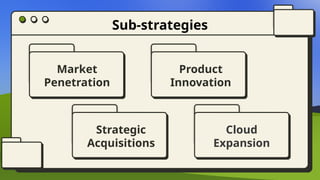
Market
Penetration
Sub-strategies
Product
Innovation
Strategic
Acquisitions
Cloud
Expansion
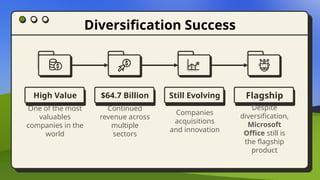
Still Evolving Flagship
High Value
Companies
acquisitions
and innovation
Diversification Success
One of the most
valuables
companies in the
world
Despite
diversification,
Microsoft
Office still is
the flagship
product
$64.7 Billion
Continued
revenue across
multiple
sectors
3. How have your company's
strategies evolved over
time?
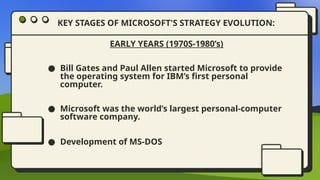
EARLY YEARS (1970S-1980’s)
● Bill Gates and Paul Allen started Microsoft to provide
the operating system for IBM’s first personal
computer.
● Microsoft was the world’s largest personal-computer
software company.
● Development of MS-DOS
KEY STAGES OF MICROSOFT'S STRATEGY EVOLUTION:
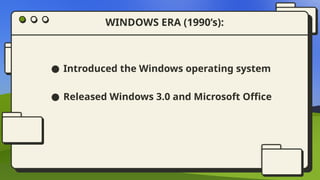
● Introduced the Windows operating system
● Released Windows 3.0 and Microsoft Office
WINDOWS ERA (1990’s):
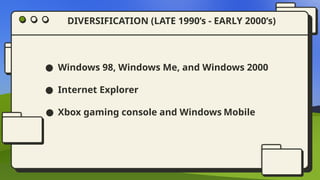
DIVERSIFICATION (LATE 1990’s - EARLY 2000’s)
● Windows 98, Windows Me, and Windows 2000
● Internet Explorer
● Xbox gaming console and Windows Mobile
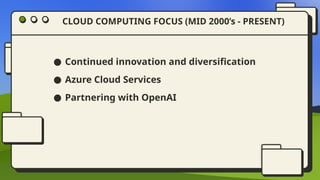
CLOUD COMPUTING FOCUS (MID 2000’s - PRESENT)
● Continued innovation and diversification
● Azure Cloud Services
● Partnering with OpenAI
CREDITS: This presentation template was created by Slidesgo,
including icons by Flaticon, and infographics & images by
Freepik
Do you have any questions?
Thanks!

STRATEGIC MANAGEMENT - A MICROSOFT COMPANY ANALYSIS

  • 1.
  • 2.
    OVERVIEW ● Founded in1975 ● Founded by Bill Gates & Paul Allen ● HQ in Washington, USA ● Satya Nadella, CEO
  • 3.
    1. Which onegeneric strategy best reflects the business strategy your company is following? Apply the concepts on strategy development to analyze and explain the rationale for your decision.
  • 4.
    Constantly Innovating Technology Microsoftfollows Porter’s Differentiation Strategy, focusing on unique, high-value products and services. Generic Strategy Differentiation Strategy Enables to sustain brand loyalty, maintain technological leadership, and stay ahead of competitors in areas like AI, cloud computing, and enterprise solutions Strategically Acquiring Companies Comprehensively Integrating Products Consistently Ensuring Security
  • 5.
    Technological Leadership && Customer-Centric Approach (AI & Cloud) ● Azure competes with AWS & Google Cloud ● AI tools like Copilot boost Microsoft 365 ● Q1 2024: Cloud revenue +24% (Microsoft Earnings) Strategic Acquisitions & Market Strength ● $69B Activision Blizzard Gaming expansion → ● LinkedIn, GitHub, Nuance Strengthen enterprise & AI → Security & Productivity ● Microsoft 365 leads in business productivity ● AI-driven cybersecurity enhances enterprise protection (Microsoft Defender) Future Growth Focus ● Investments in AI, metaverse & hybrid work solutions ● AI-powered cloud computing secures long-term edge MICROSOFT’S STRATEGIC DIFFERENTIATION: TECHNOLOGICAL LEADERSHIP & GROWTH
  • 6.
    2. Describe whetheryour company is using a concentration or diversification strategy and describe any related sub-strategies such as market penetration or product innovation. Microsoft's diversification strategy.
  • 7.
    Microsoft ● The companyuses a diversification strategy, operating in multiple industries to maintain its market leadership. ● This strategy has been very successful, as the company remains one of the most valuable in the world, worth around $2.83 trillion. ● Although it started as a software giant with Windows and Office, it has expanded into several other diverse segments.
  • 8.
    The company operates indifferent segments, the most relevant being: Azure Cloud Computing Hardwar e Surface Devices Xbox Gaming More Enterprise Solutions Copilot AI-driven tools
  • 9.
  • 10.
    Still Evolving Flagship HighValue Companies acquisitions and innovation Diversification Success One of the most valuables companies in the world Despite diversification, Microsoft Office still is the flagship product $64.7 Billion Continued revenue across multiple sectors
  • 11.
    3. How haveyour company's strategies evolved over time?
  • 12.
    EARLY YEARS (1970S-1980’s) ●Bill Gates and Paul Allen started Microsoft to provide the operating system for IBM’s first personal computer. ● Microsoft was the world’s largest personal-computer software company. ● Development of MS-DOS KEY STAGES OF MICROSOFT'S STRATEGY EVOLUTION:
  • 13.
    ● Introduced theWindows operating system ● Released Windows 3.0 and Microsoft Office WINDOWS ERA (1990’s):
  • 14.
    DIVERSIFICATION (LATE 1990’s- EARLY 2000’s) ● Windows 98, Windows Me, and Windows 2000 ● Internet Explorer ● Xbox gaming console and Windows Mobile
  • 15.
    CLOUD COMPUTING FOCUS(MID 2000’s - PRESENT) ● Continued innovation and diversification ● Azure Cloud Services ● Partnering with OpenAI
  • 16.
    CREDITS: This presentationtemplate was created by Slidesgo, including icons by Flaticon, and infographics & images by Freepik Do you have any questions? Thanks!