
Strategic Management                                      P.G.KATHIRAVAN


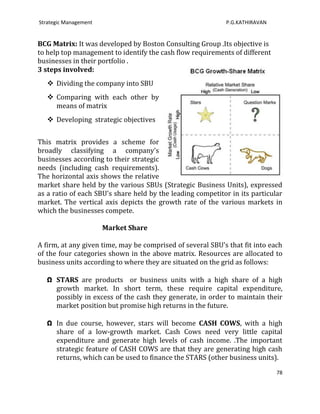
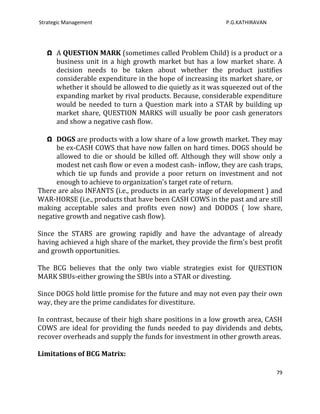
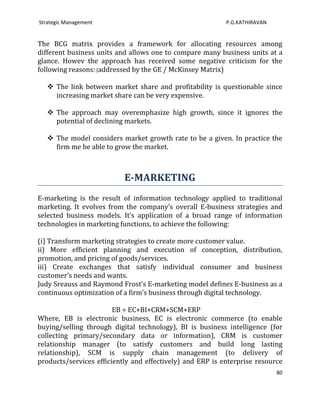
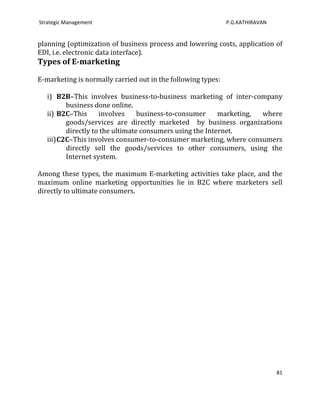
                       MANAGEMENT ACCOUNTING AND
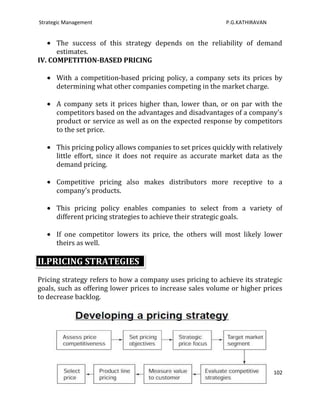
                       STRATEGIC MANAGEMENT – II MFC
                                                       - P.G.KATHIRAVAN


                               CONTENTS
UNIT I :     PLANNING ENVIRONMENT ECONOMICS                     01 – 30


UNIT II:     STRATEGIES                                         31 – 57


UNIT III:    MODEL BUILDING AND MODELS                          58 – 81


UNIT IV:     BASIC CONCEPTS OF MARKETING                        82 – 95


UNIT V:      CONTROL OR APPLICATION OF MANAGEMENT
             ACCOUNTING IN MARKETING                            96 - 125


             Semester Question paper- November 2011             126 -127
             Semester Question paper- November 2010             128- 128
             Answers to Semester Question paper 2010            129 – 132
             Semester Question paper- November 2009             133- 133
             Semester Question paper- November 2008             134 - 135
             Semester Question paper- November 2007                  78

                                                                            1
Strategic Management                                     P.G.KATHIRAVAN


MANAGEMENT ACCOUNTING AND STRATEGIC MANAGEMENT – II MFC


Unit I:


Prepared by
Prof.P.G.Kathiravan    M.com.,M.phil.,PGDCA.,MBA.,Ph.D


                                                                          2
Strategic Management                                        P.G.KATHIRAVAN


           FORECASTING TREND AND CHANGES
Forecasting: involves the analysis of revenues, costs and volumes for making
the projections into the future, based on the past trends and after considering
all the other factors, affecting profits and retums.


In many cases the environmental forecasting needs to make multiple
forecasts so that contingency goals and action plans can be developed.

A Forecast is a prediction of future events and their quantification for
planning purposes. It includes the assessment of environmental changes and
in this respect, forecasting assist in obtaining strategic fit.

Forecasting involves the estimation of the trend in future variables sales,
tastes or profit using both quantitative and judgment techniques whereas
extrapolation is a purely statistical exercise.

The strategic environment of the firm consists of economic, political, legal,
social and technologic factors, which influence the ability of the organization
to survive and make profits.

Examples of environmental variables with which a fit must be achieved
include the following:

      The changing tastes of the customers
      Developments in the market demand for a product
      The likely trend of interest and exchange rates.

Forecasting can be more than Just a numerical exercise on estimated trends .
Whilst trends in price, interest rates, market growth rates and margins will
involve numbers, other forecast does not:

      Value profiles are long range forecasts of consumers and social attitudes
      Geographical forecasts consider changes in national economic power
      and can alert the firm to new markets or potential competitive threats.

                                                                              3
Strategic Management                                         P.G.KATHIRAVAN


The important role which forecasting plays in strategic planning is therefore
to forewarn managers of possible changes in environmental factors. The long-
term nature of strategic change means that effective forecasting is necessary
to give the organization time to adopt and obtain a good fit with its
environment.

Fore casting Techniques / Models
Different forecasting models are used in taking management decisions.

Forecasting models happens to be important constituents of the category of
decision support system models. These are extremely helpful in transforming
user inputs into useful information. Planning for the future is the essence of
any business. Businesses need estimates of future values of business
variables. Commodities industry needs forecasts of supply, sale and demand
for production planning, sales. marketing and financial decisions.

Some businesses need forecasts of monetary variables eg., costs or price.
Financial insertions face the need to forecast volatility in stock prices.There
are macro economic factors that have to be predicted for policy-making
decisions in Governments.The list is endless and forecasting is a key 'decision-
making practice' in most organizations.

Forecasting models are needed to develop strategic plans for long range
perspectives. Forecasting models are of 4 types as lised below:

I. Qualitative Models

      a). Delphi model- Collects and analyses panel of expert opinions
      b). Historic data- Develop analogies to the past data. .
      c). Normal group technique-participative group process

II. Naive (Time Series) Quantitative Models

      a). Simple average- Averages past data to project the future based on
      that average.
      b). Exponential smoothing- Weighs differently earlier forecasts and
      the recent one to project the future.
                                                                               4
Strategic Management                                       P.G.KATHIRAVAN


III. Causal Quantitative Models:
      a). Regression analysis- defines functional relationships among
      variables as to whether it is linear or non-linear.
      b) Economic Modeling: offers an overall forecast for a variable like
      Gross Natioal Product (GNP).
IV.Combination of monetary & physical projections
      a. Marketing projections- Monetary by region, product and product
      group.
      b. Economic prejections- Monetary by region, industry and broad
      product group
      c. Historical projections- In units, monetary by product and product
      group.
      d. Demand forecast-In units by product and product group for
      operations management and monetary for sales and financial planning (
      a combinations of a, b, and c)

Various criteria used in selecting a a forecasting method:
Managers are often confronted with the problem of preparing forecasts for
which sourcing of data becomes a difficult problem and the decisions
regarding selection of the method of forecast with the available data.
Following are some of the factors that would influence the criteria for
selecting a forecasting method.
    Quantum of data : Maximum/ minimum , no. of observations, peaks and
     troughs, weightages, seasonal data etc.,
    Pattern of data: stationary, trend, seasonality, complexity, cyclic etc,
    Time horizon :short, medium and long.
    Preparation time : short, medium and long.
    Type of skills required: no sophistication, moderate sophistication or
     high sophistication.


                                                                            5
Strategic Management                                         P.G.KATHIRAVAN


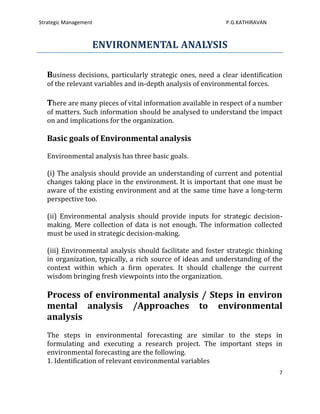
Types of forecasting:


                             Types of forecasting


   Economic forecast Social forecast Political forecast   Technological forecast


   1. Political Forecasting : When it is underteken to forecast the political
      changes.
   2. Economical Forecasting : When it is underteken to forecast the
      changes in the Economy.
   3. Social Forecasting : When it is underteken to forecast the Societal
      changes.
   4. Technological Forecasting : When it is underteken to forecast the
      technological changes.

Laws of Forecasting
   1. Forecasts are Always Wrong: No forecasting approach or model can
      predict the exact level of the future variable. Point estimates are almost
      always off by some amount.
   2. Forecasts for the near-term tend to be more accurate: Predicting
      tomorrow’s gas price will likely be more accurate than predicting gas
      price 6 weeks from now.
   3. Forecasts for groups of products or services tend to be more
      accurate: Predicting the demand for trucks will likely be more accurate
      than predicting for green trucks with a 6-disk CD player.
   4. Forecasts are no substitute for calculated values: When the actual
      demand is known, then this will be more accurate than a forecast. For
      example, A manufacturer produces widgets and his customer has placed
      a purchase order of 6000 widgets. That purchase order is an actual
      future value of widgets that the manufacturer needs to manufacture.
      That number can be used instead of a forecast using historical data.

                                                                               6
Strategic Management                                         P.G.KATHIRAVAN


                   ENVIRONMENTAL ANALYSIS

   Business decisions, particularly strategic ones, need a clear identification
   of the relevant variables and in-depth analysis of environmental forces.

   There are many pieces of vital information available in respect of a number
   of matters. Such information should be analysed to understand the impact
   on and implications for the organization.

   Basic goals of Environmental analysis

   Environmental analysis has three basic goals.

   (i) The analysis should provide an understanding of current and potential
   changes taking place in the environment. It is important that one must be
   aware of the existing environment and at the same time have a long-term
   perspective too.

   (ii) Environmental analysis should provide inputs for strategic decision-
   making. Mere collection of data is not enough. The information collected
   must be used in strategic decision-making.

   (iii) Environmental analysis should facilitate and foster strategic thinking
   in organization, typically, a rich source of ideas and understanding of the
   context within which a firm operates. It should challenge the current
   wisdom bringing fresh viewpoints into the organization.

   Process of environmental analysis / Steps in environ
   mental analysis /Approaches to environmental
   analysis
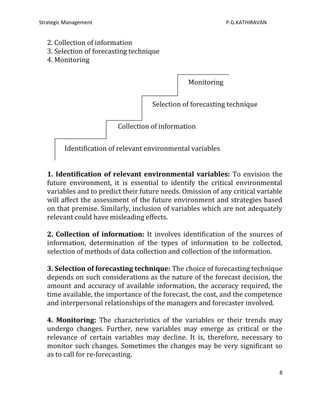
   The steps in environmental forecasting are similar to the steps in
   formulating and executing a research project. The important steps in
   environmental forecasting are the following.
   1. Identification of relevant environmental variables
                                                                              7
Strategic Management                                          P.G.KATHIRAVAN


   2. Collection of information
   3. Selection of forecasting technique
   4. Monitoring


                                                 Monitoring


                                     Selection of forecasting technique


                          Collection of information


         Identification of relevant environmental variables


   1. Identification of relevant environmental variables: To envision the
   future environment, it is essential to identify the critical environmental
   variables and to predict their future needs. Omission of any critical variable
   will affect the assessment of the future environment and strategies based
   on that premise. Similarly, inclusion of variables which are not adequately
   relevant could have misleading effects.

   2. Collection of information: It involves identification of the sources of
   information, determination of the types of information to be collected,
   selection of methods of data collection and collection of the information.

   3. Selection of forecasting technique: The choice of forecasting technique
   depends on such considerations as the nature of the forecast decision, the
   amount and accuracy of available information, the accuracy required, the
   time available, the importance of the forecast, the cost, and the competence
   and interpersonal relationships of the managers and forecaster involved.

   4. Monitoring: The characteristics of the variables or their trends may
   undergo changes. Further, new variables may emerge as critical or the
   relevance of certain variables may decline. It is, therefore, necessary to
   monitor such changes. Sometimes the changes may be very significant so
   as to call for re-forecasting.

                                                                                8
Strategic Management                                         P.G.KATHIRAVAN


   Importance or benefits of environmental analysis
      The following are the specific benefits of environmental study:

      a. It makes one aware of the environment – organization linkage.
      b. It helps an organization to identify the present and future threats and
         opportunities.
      c. It provides a very useful picture of the important factors which
         influence the business
      d. It helps to understand the transformation of the industry
         environment.
      e. It helps to identify the risks.
      f. It is a prerequisite for formulation of right strategies – corporate,
         business and functional strategies.
      g. It helps suitable modifications of the strategies as and when
         required.
      h. It keeps the managers informed, alert and often dynamic.
      i. It helps to develop action plans to deal with development of
         technological advancements.
      j. It helps to foresee the impact of socio-economic changes at the
         national and international levels on the firm’s stability.
      k. It helps to analysethe competitor’s strategies and formulation of
         effective counter measures,

   Factors affecting environmental analysis

      Availability of information
      Variables relevant
      Selection of forecasting techniques
      Co operation of the people


                                                                               9
Strategic Management                                        P.G.KATHIRAVAN


SOCIAL, POLITICAL, LEGAL AND TECHNOLOGICAL
                   IMPACTS
A scan of the external macro-environment in which the firm operates can be
expressed in terms of the following factors:

          Political (P)
          Economical (E)
          Social (S)
          Technological(T)

The acronym PEST for sometimes rearranged as ("STEP") is used to describe a
framework for the analysis of these macro environmental factors.

                       PEST Analysis or Types of forecasting

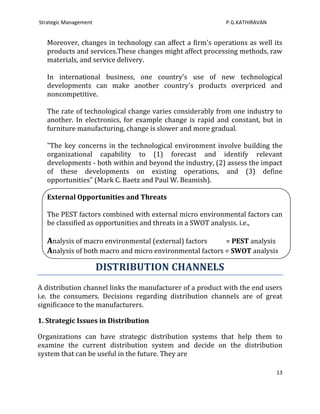
A PEST analysis into an overall environmental scan as shown in the following
diagram:
                                           All organizations are affected by
                                           four     macro      environmental
                                           forces: political-legal, economic,
                                           technological, and social. To
                                           know the impact in advance , a
                                           firm can make Political forecast,
                                           Economical      forecast,    Social
                                           forecast     and     technological
                                           forecast.

   I. Political

   The political sector of the environment presents actual and potential
   restriction on the way an organization operates. The most important
   government actions are: regulation, taxation, expenditure, takeover .The
   political environment might include such issues as monitoring government
   policy toward income tax, relative influence of unions, and policies
   concerning utilization of natural resources.

                                                                             10
Strategic Management                                         P.G.KATHIRAVAN


   Political activity may also have a significant impact on three additional
   governmental functions influencing a firm's external environment:

          Supplier function. Government decisions regarding creation and
          accessibility of private businesses to government-owned natural
          resources and national stockpiles of agricultural products will
          profoundly affect the viability of some firm's strategies.

          Customer function. Government demand for products and services
          can create, sustain, enhance, or eliminate many market
          opportunities.

          Competitor function. The government can operate as an almost
          unbeatable competitor in the marketplace, Therefore, knowledge of
          government strategies can help a firm to avoid unfavorable
          confrontation with government as a competitor.

II. Economical

   Economic forces refer to the nature and direction of the economy in which
   business operates. Economic factors have a tremendous impact on
   business firms.

   The general state of the economy (e.g., depression, recession, recovery, or
   prosperity), interest rate, stage of the economic cycle, balance of payments,
   monetary policy, fiscal policy, are key variables in corporate investment,
   employment, and pricing decisions.

   The impact of growth or decline in gross national product and increases or
   decreases in interest rates, inflation, and the value of the dollar are
   considered as prime examples of significant impact on business operations.

   To assess the local situation, an organization might seek information
   concerning the economic base and future of the region and the effects of
   this outlook on wage rates, disposable income, unemployment, and the
   transportation and commercial base. The state of world economy is most
   critical for organizations operating in such areas.

                                                                              11
Strategic Management                                           P.G.KATHIRAVAN


III.Social

   Social forces include traditions, values, societal trends, consumer
   psychology, and a society's expectations of business.

   The key concerns in the social environment are:ecology (e.g., global
   warming, pollution); demographics (e.g., population growth rates, aging
   work force in industrialized countries, high educational requirements);
   quality of life (e.g., education, safety, health care, standard of living); and
   noneconomic activities (e.g., charities).

   Moreover, social issues can quickly become political and even legal issues.

   Social forces are often most important because of their effect on people's
   behaviour. For an organization to survive, the product or service must be
   wanted, thus consumer behaviour is considered as a separate
   environmental behaviour.

   A society's expectations of business present other opportunities and
   constraints.

   Determining the exact impact of social forces on an organization is difficult
   at best. However, assessing the changing values, attitudes, and
   demographic characteristics of an organization's customers is an essential
   element in establishing organizational objectives.

   IV. Technological

   Technological forces influence organizations in several ways. A
   technological innovation can have a sudden and dramatic effect on the
   environment of a firm.

   First, technological developments can significantly alter the demand for an
   organization's or industry's products or services.

   Technological change can decimate existing businesses and even entire
   industries, since its shifts demand from one product to another.

                                                                                12
Strategic Management                                       P.G.KATHIRAVAN


   Moreover, changes in technology can affect a firm's operations as well its
   products and services.These changes might affect processing methods, raw
   materials, and service delivery.

   In international business, one country's use of new technological
   developments can make another country's products overpriced and
   noncompetitive.

   The rate of technological change varies considerably from one industry to
   another. In electronics, for example change is rapid and constant, but in
   furniture manufacturing, change is slower and more gradual.

   "The key concerns in the technological environment involve building the
   organizational capability to (1) forecast and identify relevant
   developments - both within and beyond the industry, (2) assess the impact
   of these developments on existing operations, and (3) define
   opportunities" (Mark C. Baetz and Paul W. Beamish).

   External Opportunities and Threats

   The PEST factors combined with external micro environmental factors can
   be classified as opportunities and threats in a SWOT analysis. i.e.,

   Analysis of macro environmental (external) factors     = PEST analysis
   Analysis of both macro and micro environmental factors = SWOT analysis

                       DISTRIBUTION CHANNELS
A distribution channel links the manufacturer of a product with the end users
i.e. the consumers. Decisions regarding distribution channels are of great
significance to the manufacturers.

1. Strategic Issues in Distribution

Organizations can have strategic distribution systems that help them to
examine the current distribution system and decide on the distribution
system that can be useful in the future. They are

                                                                            13
Strategic Management                                        P.G.KATHIRAVAN


    Issues Related to Marketing Decisions
    Product Issues
    Issues Related to Channel Relations

2. Steps involved in designing a distribution channel for an organization

In designing a distribution channel for an organization, there are mainly three
steps –

    identifying the functions to be performed by the distribution system,
    designing the channel, and
    Putting the structure into operation.

3. Types of Distribution Channels

There are different types of distribution channels depending on the number of
levels that exist between the producer and the consumer. The distribution
channel may be

    Reverse Channel of Distribution
    Flexible Distribution Channels

4. Considerations in Distribution Channels

In deciding on the kind of distribution strategy to be used, there are various
considerations to be kept in mind. They are:

    Middlemen Considerations: The middlemen should have the necessary
     financial capacity to carry out the task effectively.
    Customer Considerations: Customers should be able to get the products
     conveniently.
    Product Considerations: Product features to be considered include
     durability, toughness etc.
    Price Considerations: The price of the product also requires
     consideration in deciding the distribution strategies.


                                                                             14
Strategic Management                                           P.G.KATHIRAVAN


5. Distribution Intensity

Distribution intensity can be referred to in terms of the number of retail
stores carrying a product in a geographical location. It may be

    intensive distribution
    exclusive distribution
    selected distribution

   a) In intensive distribution, the manufacturer distributes the products
      through the maximum number of outlets.
   b) In exclusive distribution, the number of distribution channels will be
      very limited.
   c) In selected distribution, the number of retail outlets in a location will be
      greater than in the case of exclusive distribution and fewer than in the
      case of intensive distribution.

6. Conflict and Control in Distribution Channels

    Identifying Channel Conflict: Channel conflicts should be identified.
    Avoidance of a Channel Collapse: Channel collapse should be avoided.

7. Managing the Channel

    Distribution management is of strategic importance to any organization
     as distribution plays a crucial role in the success of the product in the
     market. Distribution management also helps to maximize profits.
    In managing the distribution channels, maintaining a mutually
     beneficial relationship between the manufacturer and distributor is
     necessary.

8. International Channels

    International distribution is gaining importance with the increase in the
     number of multinational companies.
    There are certain factors to be considered in international distribution.
     The distributors should be chosen carefully with a long-term focus. It is
     better to build a long-term relationship with the local distributors.
                                                                                15
Strategic Management                                         P.G.KATHIRAVAN


    They should be provided with all the necessary support in expanding
     their operations. The marketing strategy for the product should be
     controlled solely by the MNC.
    Information plays an important role in distribution and the MNC has to
     ensure that the local distributors provide them with the required
     information which will help them to increase sales and expand their
     business.

              COMPETITIVE FORCES (BY PORTER)

Introduction
The model of the Five Competitive Forces was developed by Michael E. Porter
in his book “Competitive Strategy: Techniques for Analyzing Industries and
Competitors’’ in 1980. Since that time it has become an important tool for
analyzing an organizations industry structure in strategic processes.

Porters’ model is based on the insight that a corporate strategy should meet
the opportunities and threats in the organizations external environment.
Especially, competitive strategy should base on and understanding of industry
structures and the way they change.

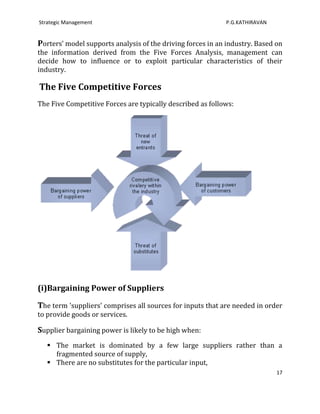
Porter has identified five competitive forces that shape every industry and
every market. They are:

      (i)     Bargaining Power of Suppliers
      (ii)    Bargaining Power of Customers
      (iii)   Threat of New Entrants
      (iv)    Threat of Substitutes
      (v)     Competitive Rivalry between Existing Players

These forces determine the intensity of competition and hence the
profitability and attractiveness of an industry.

The objective of corporate strategy should be to modify these competitive
forces in a way that improves the position of the organization.


                                                                              16
Strategic Management                                        P.G.KATHIRAVAN


Porters’ model supports analysis of the driving forces in an industry. Based on
the information derived from the Five Forces Analysis, management can
decide how to influence or to exploit particular characteristics of their
industry.

The Five Competitive Forces
The Five Competitive Forces are typically described as follows:


(i)Bargaining Power of Suppliers

The term 'suppliers' comprises all sources for inputs that are needed in order
to provide goods or services.

Supplier bargaining power is likely to be high when:
    The market is dominated by a few large suppliers rather than a
     fragmented source of supply,
    There are no substitutes for the particular input,
                                                                             17
Strategic Management                                        P.G.KATHIRAVAN


    The suppliers’ customers are fragmented, so their bargaining power is
     low,
    The switching costs from one supplier to another are high,
    There is the possibility of the supplier integrating forwards in order to
     obtain higher prices and margins. This threat is especially high when

              The buying industry has a higher profitability than the
               supplying industry,
              Forward integration provides economies of scale for the
               supplier,
              The buying industry hinders the supplying industry in their
               development (e.g. reluctance to accept new releases of
               products),
              The buying industry has low barriers to entry.
              In such situations, the buying industry often faces a high
               pressure on margins from their suppliers. The relationship to
               powerful suppliers can potentially reduce strategic options for
               the organization.

(ii)Bargaining Power of Customers

Similarly, the bargaining power of customers determines how much
customers can impose pressure on margins and volumes.

Customers bargaining power is likely to be high when
      They buy large volumes; there is a concentration of buyers,
      The supplying industry comprises a large number of small operators
      The supplying industry operates with high fixed costs,
      The product is undifferentiated and can be replaces by substitutes,
      Switching to an alternative product is relatively simple and is not
       related to high costs,
      Customers have low margins and are price-sensitive,
      Customers could produce the product themselves,
      The product is not of strategical importance for the customer,
      The customer knows about the production costs of the product
      There is the possibility for the customer integrating backwards.


                                                                             18
Strategic Management                                         P.G.KATHIRAVAN


(iii)Threat of New Entrants

The competition in an industry will be the higher; the easier it is for other
companies to enter this industry. In such a situation, new entrants could
change major determinants of the market environment (e.g. market shares,
prices, customer loyalty) at any time. There is always a latent pressure for
reaction and adjustment for existing players in this industry.

The threat of new entries will depend on the extent to which there are
barriers to entry. These are typically

    Economies of scale (minimum size requirements for profitable
     operations),
    High initial investments and fixed costs,
    Cost advantages of existing players due to experience curve effects of
     operation with fully depreciated assets,
    Brand loyalty of customers
    Protected intellectual property like patents, licenses etc,
    Scarcity of important resources, e.g. qualified expert staff
    Access to raw materials is controlled by existing players,
    Distribution channels are controlled by existing players,
    Existing players have close customer relations, e.g. from long-term
     service contracts,
    High switching costs for customers
    Legislation and government action

(iv)Threat of Substitutes

A threat from substitutes exists if there are alternative products with lower
prices of better performance parameters for the same purpose. They could
potentially attract a significant proportion of market volume and hence
reduce the potential sales volume for existing players. This category also
relates to complementary products.

Similarly to the threat of new entrants, the threat of substitutes is determined
by factors like

    Brand loyalty of customers,
                                                                              19
Strategic Management                                         P.G.KATHIRAVAN


      Close customer relationships,
      Switching costs for customers,
      The relative price for performance of substitutes,
      Current trends.

(v) Competitive Rivalry between Existing Players

This force describes the intensity of competition between existing players
(companies) in an industry.

High competitive pressure results in pressure on prices, margins, and hence,
on profitability for every single company in the industry.

Competition between existing players is likely to be high when
    There are many players of about the same size,
    Players have similar strategies
    There is not much differentiation between players and their products,
     hence, there is much price competition
    Low market growth rates (growth of a particular company is possible
     only at the expense of a competitor),
    Barriers for exit are high (e.g. expensive and highly specialized
     equipment).

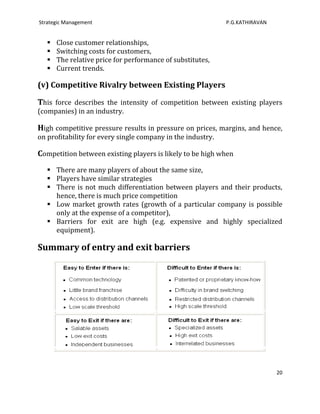
Summary of entry and exit barriers


                                                                              20
Strategic Management                                        P.G.KATHIRAVAN


                       GOVERNMENT POLICIES
The following are the (various) policies of the government enunciated in
various sectors of the economy.

                           Government Policies


Real sector   Fiscal policy External sector   Monetary      Financial sector
 Policies                    Policies         Policies         Policies

I) Real sector policies.

      a) Agriculture and allied activities:
            National Rain Fed Area Authority (NRAA) has been created in
            November 2006, to support up gradation and management of dry
            land and rain fed agriculture.
            The National Agricultural Insurance Scheme (NAIS) and the
            National Rural Employment Guarantee Scheme (NREGS) are two
            Important schemes Implemented recently.


      b) Manufacturing & Infrastructure policies
           Formulated Policies to upgrade the infrastructure facilities in the
           country.
           Following have been identified as areas which need growth in
           future.
           - Up gradation of human skills
           - Work on golden quadrilateral
           - Introduction of public-private partnership model.
           - Increase in the power production capacity.

              Government takes efforts to find alternatives to fuel.
              Wind energy is encouraged to reduce the utilization of coal
              reserves.


                                                                               21
Strategic Management                                         P.G.KATHIRAVAN


             Micro, small and medium enterprises development Act 2006 has
             been passed and micro, small and medium enterprises were
             defined.
                   Definition of micro enterprises : Investment in plant &
                   machinery does not exceed 25 Lakhs / 10 Lakhs in case of
                   Sector.

                       Definition of small enterprises : Investment in plant &
                       machinery does not exceed 25 Lakhs / 10        Lakhs 5
                       crores/2crores

                       Definition of medium enterprise: Investment in plant &
                       machinery does not exceed 25 Lakhs / 10 Lakhs 10
                       crores/5c

             To strengthen the drug regulatory system, and patent office , a
             new national pharmaceutical policy has been announced in 2006.
             Concept of SEZ (Special Economic zone) has been introduced.
             To regulate IT applications, security practices, and procedures
             relating to such applications, “The IT amendment bill 2006” was
             announced.

2) Fiscal Policy:

             Government realized the (importance) / necessity of reducing
             fiscal deficit by introducing fiscal corrections.
             The tax base is being broadened to include more and more new
             services in the tax net to encourage savings and increase
             disposable incomes.
             Personal taxation is being reduced.
             VAT was introduced to maintain price stability and increase
             earnings.

3) External Sector Policies:
             Foreign trade policy of 2004- 2009 was modified in 2007 for
             increasing the incentives provided for focused products and
             market.
                                                                              22
Strategic Management                                          P.G.KATHIRAVAN


             Recommendations of committee of fuller capital account
             convertibility were considered
             - To simplify and liberalise the external payments
             - To encourage foreign exchange market.
             Policy Initiatives undertaken by Govt., of India:
             - Increasing the overseas investment limits for joint ventures.
             - Increasing the overseas investment limits for wholly owned
                subsidiaries abroad by Indian companies.
             - Fixing higher portfolio Invt., limits for Indian companies /
                domestic mutual funds.
             - Fixing higher ceilings for invts by foreign institutional
                investors in government securities.
             - Enhancing repayment limits for external commercial
                borrowings.

      4) Monetary Policies:
             Through the monetary policy, Government tries to balance the
             growth of economy with containing inflationary pressures.
             RBI has taken its stance on the monetary policy to continue to
             reinforce the emphasis on price stability and financial stability by
             using (Reverse Repo and Repo rates). (The rate at which RBI
             lends money to commercial banks.)
             Rates of inflation are keenly monitored and interest rates are
             being modified whenever necessary.

      5) Financial sector policies:
             RBI have
             - Tightened provisioning norms and risks weights to ensure
                asset quality.
             - Strengthened the accounting and disclosure norms for greater
                transparency and discipline.
             Final guidelines for the implementations of the new capital
             adequacy frame work have been issued.
             RBI continues to take measures for
             - Protecting customer’s rights and
             - Enhancing the quality of customer’s service.

                                                                               23
Strategic Management                                      P.G.KATHIRAVAN


                       GOVERNMENT EXPENDITURE
      GDP = Money value of Goods and services produced by an economy
      during a year.
      Aggregate expenditure
      i)    Aggregate expenditure as a % of
            GDP in 2006- 07                     =        14.1 %
            (-) Aggregate expenditure as a % of
            GDP in 2007- 08                     =        13.8%
                                                         ________
                                    Reduction      =        0.3%
      This was done by reducing non – planned expenditures particularly
                Interest payments and
                Subsidies.

      Planned expenditure
      ii)  Planned expenditure to GDP ratio in 2006-07    =    20.9%
           Planned expenditure to GDP ratio in 2007-08    =    22.5%
                                                               _________
                                   Increase                      1.6%
           Planned expenditure was increased to support central plan
      Capital expenditure
           Capital expenditure as a % of GDP in 2006-07 =      1.8%
           Capital expenditure as a % of GDP in 2007-08 =      1.8%
           remain Unchanged

      Education expenditure
           Education expenditure as a
           Proportion to total exp. in 2006-07            =     3.7%
           Education expenditure as
           Proportion to total exp. in 2007-08            =     4.1%
                                                                _______
                             Increase                           0.4%.

      Health expenditure
           Health expenditure as a proportion to total
           Expenditure in 2006-07                    =          1.8%
           Health expenditure as a proportion to total

                                                                           24
Strategic Management                                      P.G.KATHIRAVAN


             Expenditure in 2007-08                 =           2.1%
                                                                _________
                                     Increase.                  0.3%
             The share of expenditure for
             agriculture and Rural department = same level at around 10%.


                                                                            25
Strategic Management                                         P.G.KATHIRAVAN


     PUBLIC AND PRIVATE SECTOR INVESTMENT
Public-Private Partnership (PPP or P3) involves a long-term contractual
agreement between a public sector authority and a private party.

PPP model is a concept of collective approach mooted by Government of India
involving government and private agencies / institutions in order to bridge
the deficit in infrastructure like railways, road transport and highways, ports,
civil aviation, power infrastructure considered to be vital for economic
growth.

According to the Viability Gap Funding (VGF) scheme and guidelines for the
India Infrastructure Development Fund, issued by the Ministry of Finance, GoI,
a public-private partnership occurs when government agencies share
resources and revenue with a non-government company.

These partnership arrangements are used to meet specific niche requirements
and are legally binding.

According to the Asian Development Bank, PPP is a range of possible
relationship between public entity and the private party in the context of
infrastructure and core services. This partnership is a mutually beneficial
long-term relationship between the public and private sectors, which are an
effective way to bridge gaps between demand and available resources, quality
and accessibility, and risk and benefit.

The concept of Public- Private Partnership (PPP) has been a comparatively
new one in our national economic development scenario. It has been observed
that the growth of infrastnucture has lagged behind and may assume serious
proportions impeding our economic growth. To overcome this, Govemment of
India has been actively pursuing PPP to bridge the gap in the infrastructure.

Under the overall guidance of the committee of infrastructure, headed by the
Prime Minister the PPP programme formulation and implementation are
being closely monitored by the relevant ministry/departments. An appraisal
mechanism has been given a mandate and guidelines for drawing up time-
frame for according approvals to proposals in a speedy manner.

                                                                              26
Strategic Management                                        P.G.KATHIRAVAN


PPP projects normally involve long term contracts between the Government
and the private parties detailing the rights and obligations of both the
contracting parties. Government has decided to develop standardized frame-
works, based on due diligence and agreements will follow international
practices. They will also create a framework with a right matrix of risk
allocation, obligations and returns.

Planning Commission has also issued Model Concession Agreement (MCA) for
ports, state highways and operation maintenance agreements for highways.To
promote PPP programmer all state governments and central ministries are
setting up PPP cell with a senior level officer as a nodal officer. Technical
assistance has been obtained from Asian Development Bank (ADD) including
hiring of consultants and training of personnel.

ROLE OF GOVERNMENT IN CONTROLLING INFLATION

Inflation: a general increase in prices and fall in the purchasing value of
           money.

Inflation can be controlled by
             1)    By checking on supply of money.
             2)    By reducing deficit financing
             3)    By increasing Agricultural production.
             4)    By increasing industrial production.
             5)    By enforcing national wage policy
             6)    By making proper use of fiscal policy
             7)    By distributing through fair price shops.
             8)    By checking black money.
             9)    By controlling over population.
             10) By using appropriate monetary policy.
             11) BY banning export of essential consumption goods.
             12) BY reducing administered prices.

1)     By checking on supply of money.
      To check rise in price, supply of money shouldn’t be allowed to expand,
      it should be freezed.
2)     By reducing deficit financing
                                                                             27
Strategic Management                                       P.G.KATHIRAVAN


      Deficit financing can be reduced
         by levying taxes on agriculture.
         by reducing unessential expenditure.
         by withdrawing of subsidies.

3)     By increasing Agricultural production.
      Inflation can be controlled by increasing agricultural production.
      Agricultural production can be increased

          o By using improved seeds.
          o By producing not only food grains but also oil seeds, pulses,
            sugarcanes& Jutes.
          o By using good quality fertilizers.
          o By providing better irrigation facilities.

4)    By increasing industrial production at low cost:
      The ways to increase industrial production at low costs are:
       In the short run => Fuller utilization of production
                              capacity in industrial units.
       In the long run =>
                                    By setting up of new industries
                                    By using domestic resources than
                                    imports.
                                    By developing small scale and cottage
                                    industries.
                                    By using modern technology.

5)     By enforcing national wage policy:
      Inflation can be controlled by enforcing national wage policy. This can
      be done
       By linking wages with productivity : more wages for more
         productivity and Less wages for less productivity
       By banning strikes and lock out through the co-operation of
         labourers.


6)    By making proper use of fiscal policy
                                                                            28
Strategic Management                                        P.G.KATHIRAVAN


      Both Central and State governments should make use of fiscal policy
      properly to control inflation.

           Role of state govt :    -By introducing unnecessary public exp.
                                    - By tapping new sources of revenue.
           Role of central govt    -By cutting down the non departmental
                                    Expenditure.
                                    -By encouraging savings and investments
                                    Savings, investments, productions, prices.

7)    By distributing through fair price shops.
      Hoarding of essential goods creates artificial demand and inflation. This
      can be controlled
                   By opening more fair price shops ( ration shops) at
                     village and in backward regions
                   By distributing the essential goods among the poor at
                     low price through fair price shops.


8)    By checking black money.
      Black money is one of the major reasons for inflation. Black money can
      be checked by applying the following two ways:

           Way1 :       Suggesting demonetization of the currency ( like
                         Germany)
           Way 2:       Giving long term bonds to the amount of black money
                         declared by the persons who possess.

9)    By controlling over population.
         Population is incasing day by day. The increasing population
           needs hue amount of essential goods. When the supply of
           essential goods is not equal to the demand, it increases the prices
           and creates inflation.
         In order to control the inflation, the population should be
           controlled.
         The growth in population can be controlled by making extensive
           publicity of family planning (welfare) program.
                                                                             29
Strategic Management                                             P.G.KATHIRAVAN


10)    By using appropriate monetary policy.
      Inflation can be controlled
                   -By reducing supply of money.
                   -By increasing rate of interest on savings.
                   -By contracting credit.

11)    By banning export of essential consumption goods.
      In order to control inflation, export of essential consumption goods
      like
                  onions
                  vegetables
                  cement
                  Sugar.
      Should be banned and they should be channelized for domestic
      consumption.

12) By increasing the growth of power and transport:
    By increasing the supply of electricity, coal and the other sources of
    power, industries will get appropriate raw material at the appropriate
    time.


                                                                                  30
Strategic Management                                     P.G.KATHIRAVAN


MANAGEMENT ACCOUNTING AND STRATEGIC MANAGEMENT


Unit II:


Prepared by
Prof.P.G.Kathiravan    M.com.,M.phil.,PGDCA.,MBA.,Ph.D


                           STRATEGY
                                                                          31
Strategic Management                                        P.G.KATHIRAVAN


A strategy can be thought of in either of two ways:
     as a pattern that emerges in a sequence of decisions over time, or
     as an organizational plan of action that is intended to move a company
       toward the achievement of its shorter - term goals and, ultimately, its
       fundamental purposes.

Strategy should be both deliberate and emergent, and firms should both adapt
to and enact their environments, with the situation determining which option
to choose.


FACTORS THAT SHAPE A COMPANY'S STRATEGIES
   Organizations do not exist in a vacuum. Many factors enter into the forming
   of a company's strategy. Each exists within a complex network of
   environmental forces.
   These forces, conditions, situations, events, and relationships over which
   the organization has little control are referred to collectively as the
   organization's environment.
   In general terms, environment can be broken down into three areas:
                                     Environment


   Macro environment       Operating environment      Internal environment

      I.     Macroenvironment,       or general  environment       (remote
             environment) - that is, economic, social, political and legal
             systems in the country;

      II.    Operating environment - that is, competitors, markets, customers,
             regulatory agencies, and stakeholders; and

      III.   Internal environment - that is, employees, managers, union, and
             board of directors.

                       STRATEGIC PLANNING

                                                                             32
Strategic Management                                          P.G.KATHIRAVAN


Strategic planning is about matching the strengths of a business to available
market opportunities.

Strategic planning means, defining clearly the objectives and assessing both
the internal and external situation to
      formulate strategy,
      implement the strategy,
      evaluate the progress and
      make adjustments as necessary to stay on track.

The major assumption in strategic planning is that an organization must be
responsive to a dynamic, changing environment.

The emphasis in strategic planning is on understanding how the environment
is changing and will change, and in developing organizational decisions which
are responsive to these changes.

In short, strategic planning is a disciplined effort to produce fundamental
decisions and actions that shape and guide
    What an organization is,
    What it does, and
    Why does it, with a focus on the future

Long range Planning :               It becomes the basis for the strategies to be
pursued to drive an organization towards its mission. It is a long-term view of
what an organization is planning to become in future, indicating the basic
thrust of the firm, including its products, business and markets. It focuses on
forecasting the future by using economic and technical tools.

Corporate Planning : From a company’s perspective, corporate planning
involves formulating long term business goals so that strategic planning of
an enterprise may be developed and acted upon. The corporate planning term
that was popular in the 1960s has since been referred to as strategic
management.

                       STRATEGIC MANAGEMENT
                                                                               33
Strategic Management                                         P.G.KATHIRAVAN


Strategic management can be defined as the art and science of formulating,
implementing and evaluating cross-functional decisions that enable an
organization to achieve its objectives.

Strategic Management is the means by which the management establishes
purpose and pursues the purpose through co-alignment of organizational
resources with environment, opportunities and constraints.

Strategic Management deals with decision making and actions which
determine an enterprise’s ability to excel , survive or due by making the best
use of a firm’s resources in a dynamic environment.

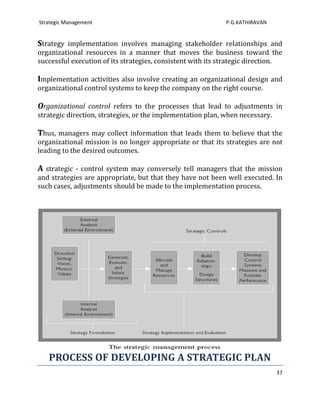
The Strategic Management Process
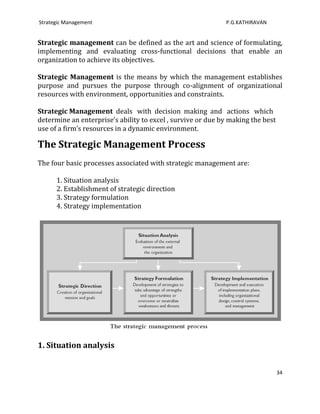
The four basic processes associated with strategic management are:

      1. Situation analysis
      2. Establishment of strategic direction
      3. Strategy formulation
      4. Strategy implementation


1. Situation analysis


                                                                                 34
Strategic Management                                          P.G.KATHIRAVAN


All of the stakeholders inside and outside of the firm, as well as the major
external forces, should be analyzed at both the domestic and international
levels.

The external environment includes groups, individuals, and forces outside of
the traditional boundaries of the organization that are significantly influenced
by or have a major impact on the organization.

External stakeholders, part of a company’s operating environment, include
competitors, customers, suppliers, financial intermediaries, local
communities, unions, activist groups, and local and national government
agencies and administrators.

The broad environment forms the context in which the company and its
operating environment exist, and includes socio-cultural, economic,
technological, political, and legal influences, both domestically and abroad.

One organization, acting independently, may have very little influence on the
forces in the broad environment; however, the forces in this environment can
have a tremendous impact on the organization.

The internal organization includes all of the stakeholders, resources,
knowledge, and processes that exist within the boundaries of the firm.

SWOT analysis is also “situation analysis “

2. Establishment of strategic direction

Strategic direction pertains to the longer - term goals and objectives of the
organization.

At a more fundamental level, strategic direction defines the purposes for
which a company exists and operates. This direction is often contained in
mission and vision statements.

An organization’s mission is its current purpose and scope of operation, while
its vision is a forward – looking statement of what it wants to be in the future.
                                                                               35
Strategic Management                                          P.G.KATHIRAVAN


Unlike shorter - term goals and strategies, mission and vision statements are
an enduring part of planning processes within the company. They are often
written in terms of what the organization will do for its key stakeholders.

3. Strategy formulation

Strategy formulation, the process of planning strategies, is often divided into
three levels: corporate, business, and functional i.e.,

   a) Corporate level strategy (“ where to compete, ” )
   b) Business level strategy or Competitive strategies (“ how to compete in
      those areas, ” )
   c) Functional- level strategies (“the functional details of how resources will
      be managed so that business - level strategies will be accomplished.”)

(a) Corporate level strategy is to define a company’s domain of activity
through selection of business areas in which the company will compete.

(b) Business level strategy formulation pertains to domain direction and
navigation, or how businesses should compete in the areas they have selected.
Sometimes business - level strategies are also referred to as competitive
strategies.

(c) Functional - level strategies contain the details of how functional
resource areas, such as marketing, operations, and finance, should be used to
implement business - level strategies and achieve competitive advantage.
Basically, functional - level strategies are for acquiring, developing, and
managing organizational resources.

4. Strategy Implementation

Strategy formulation results in a plan of action for the company and its
various levels, whereas strategy implementation represents a pattern of
decisions and actions that are intended to carry out the plan.


                                                                               36
Strategic Management                                         P.G.KATHIRAVAN


Strategy implementation involves managing stakeholder relationships and
organizational resources in a manner that moves the business toward the
successful execution of its strategies, consistent with its strategic direction.

Implementation activities also involve creating an organizational design and
organizational control systems to keep the company on the right course.

Organizational control refers to the processes that lead to adjustments in
strategic direction, strategies, or the implementation plan, when necessary.

Thus, managers may collect information that leads them to believe that the
organizational mission is no longer appropriate or that its strategies are not
leading to the desired outcomes.

A strategic - control system may conversely tell managers that the mission
and strategies are appropriate, but that they have not been well executed. In
such cases, adjustments should be made to the implementation process.


   PROCESS OF DEVELOPING A STRATEGIC PLAN
                                                                               37
Strategic Management                                         P.G.KATHIRAVAN


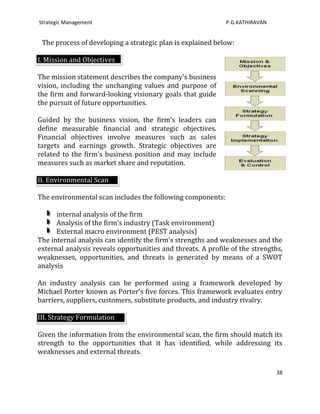
TThe process of developing a strategic plan is explained below:

I. Mission and Objectives

The mission statement describes the company's business
vision, including the unchanging values and purpose of
the firm and forward-looking visionary goals that guide
the pursuit of future opportunities.

Guided by the business vision, the firm's leaders can
define measurable financial and strategic objectives.
Financial objectives involve measures such as sales
targets and earnings growth. Strategic objectives are
related to the firm's business position and may include
measures such as market share and reputation.

II. Environmental Scan

The environmental scan includes the following components:

      internal analysis of the firm
      Analysis of the firm's industry (Task environment)
      External macro environment (PEST analysis)
The internal analysis can identify the firm's strengths and weaknesses and the
external analysis reveals opportunities and threats. A profile of the strengths,
weaknesses, opportunities, and threats is generated by means of a SWOT
analysis

An industry analysis can be performed using a framework developed by
Michael Porter known as Porter's five forces. This framework evaluates entry
barriers, suppliers, customers, substitute products, and industry rivalry.

III. Strategy Formulation

Given the information from the environmental scan, the firm should match its
strength to the opportunities that it has identified, while addressing its
weaknesses and external threats.

                                                                              38
Strategic Management                                        P.G.KATHIRAVAN


To attain superior profitability, the firm seeks to develop a competitive
advantage over its rivals. A competitive advantage can be based on cost or
differentiation. Michael Porter identified three industry-independent generic
strategies from which the firm can choose.

IV. Strategy implementation

The selected strategy is implemented by means of programs, budgets, and
procedures. Implementation involves organization of the firm's resources and
motivation of the staff to achieve objectives.

The way in which the strategy is implemented can have a significant impact
on whether it will be successful. In a large company, those who implement the
strategy likely will be different people from those who formulated it. For this
reason, care must be taken to communicate the strategy and the reasoning
behind it. Otherwise, the implementation might not succeed if the strategy is
misunderstood or if lower-level managers resist its implementation because
they do not understand why the particular strategy was selected.

V. Evaluation & Control

The implementation of the strategy must be monitored and adjustments made
as needed.Evaluation and control consists of the following steps:
1. Define parameters to be measured 2. Define target values for those
parameters 3. Perform measurements 4. Compare measured results to the
pre-defined standard 5. Make necessary changes .

                          SWOT ANALYSIS
The traditional process for developing strategy consists of analyzing the
internal and external environments of the company to arrive at organizational
strengths, weaknesses, opportunities, and threats (SWOT).

Analyzing the environment and the company can assist the company in all of
the other tasks of strategic management. For example, a firm’s managers
should formulate strategic direction and specific strategies based on

                                                                             39
Strategic Management                                         P.G.KATHIRAVAN


organizational strengths and weaknesses and in the context of the
opportunities and threats found in its environment.

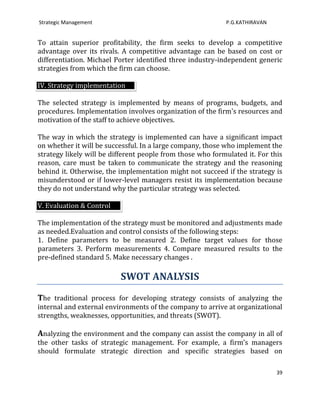
A scan of the internal and external environment is an important part of the
strategic planning process. Environmental factors internal to the firm usually
can be classified as strengths (S) or weaknesses (W), and those external to the
firm can be classified
as opportunities (O) or
threats (T). Such an
analysis      of      the
strategic environment
is referred to as a
SWOT analysis.

The SWOT analysis
provides information
that is helpful in
matching the firm's
resources and capabilities to the competitive environment in which it
operates. As such, it is instrumental in strategy formulation and selection. The
given diagram shows how a SWOT analysis fits into an environmental scan.

Thus , SWOT analysis is a tool, strategists use it to evaluate Strengths,
Weaknesses, Opportunities, and Threats.

    Strengths: A firm's strengths are its resources and capabilities that can
     be used as a basis for developing a competitive advantage. Examples of
     such strengths include:
           patents                                   exclusive access to high
           strong brand names                        grade natural resources
           good reputation among                     favorable access to
           customers                                 distribution networks
           cost advantages from
           proprietary know-how

    Weaknesses are resources and capabilities that a company does not
     possess, to the extent that their absence places the firm at a competitive
     disadvantage. The absence of certain strengths may be viewed as a
                                                                              40
Strategic Management                                        P.G.KATHIRAVAN


      weakness. For example, ear of the following may be considered
      weaknesses:

             Lack      of    patent                  high cost structure
             protection                              Lack of access to the
             a weak brand name                       best natural resources
             poor reputation among                   Lack of access to key
             customers                               distribution channels

      In some cases, a weakness may be the flip side of a strength. Take the
      case in which a firm has a large amount of manufacturing capacity.
      While this capacity may be considered a strength that competitors do
      not share, it also may be considered as weakness if the large investment
      in manufacturing capacity prevents the firm from reacting quickly to the
      changes in the strategic environment.

    Opportunities : The external environmental analysis may reveal
     certain new opportunities for pit and growth. Some examples of such
     opportunities include:
           an unfulfilled customer need
           arrival of newtechnologies
           Loosening of regulations
           Removal of International trade barriers

    Threats : Changes in the external environmental also may present
     threats to the firm. Some examples of such threats include:
           shifts in consumer tastes away from the firm's products
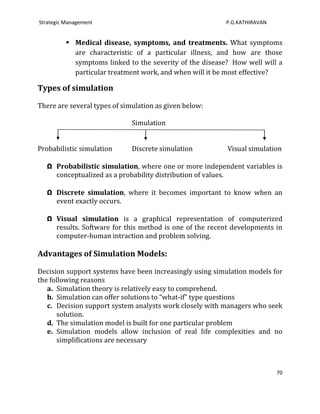
           emergence of substitute products
           new regulations
           increased trade barriers

Features of SWOT Analysis

   Ω Systematic analysis : SWOT analysis involves a systematic analysis of
     the internal strengths and weaknesses            of a firm (financial,
     technological, managerial) and of the external opportunities and threats


                                                                             41
Strategic Management                                       P.G.KATHIRAVAN


      in the firm's environment (changes in the markets, laws, technology and
      the actions of the competitors.)

   Ω Exposing the strengths and weaknesses : It is an internal appraisal of
     a firm. The purpose of SWOT analysis will be to expose the strengths
     and weaknesses of the firm.

   Ω Identifying profit-making opportunities and threats : An analysis of
     Opportunities and Threats is concerned with identifying profit-making
     opportunities in the business environment and for identifying threats-
     eg., falling demand, new competition, government legislation etc., It is
     thus an external appraisal, strengths and weaknesses analysis.

   Ω Basis for evaluation and identification: This will provide a basis for
     evaluating the extent to which the firm is likely to achieve its various
     objectives and for identifying new products and market opportunity.

   Ω Defining the strategic approach : SWOT Analysis will help in defining
     the strategic approach to be formulated that will fit in admirably with
     the environment.

   Ω Preventing the company from poor results : Identification of
     shortcomings in skills or resources could lead to a planned acquisition
     programme or staff recruitment and training. Thus SWOT analysis helps
     in highlighting areas within the company, which are strong and which
     might be exploited more fully and weaknesses, where some defensive
     planning might be required to prevent the company from poor results .


MAJOR OUTCOMES OF SWOT ANALYSIS:
   Ω Matching the company strengths to take advantage of the opportunities
     in the market place like say, converting a fast food stands into a full-
     fledged restaurant.
   Ω Converting threat or weakness into an advantage.
   Ω Eliminating the weaknesses that expose a company to external threats.
   Ω Exposure of shortcomings in the company's present skills and resources

                                                                            42
Strategic Management                                         P.G.KATHIRAVAN


   Ω Strengths, which the firm should seek to exploit.

SWOT Analysis thus assesses the firm's internal strengths and weaknesses in
relation to the opportunities and threats, offered by the environment.


THE SWOT MATRIX

A firm should not necessarily pursue the more lucrative opportunities. Rather,
it may have a better chance at developing a competitive advantage by
identifying a fit between the firm's strengths and upcoming opportunities. In
some cases, the firm can overcome a weakness in order to prepare itself to
pursue a compelling opportunity

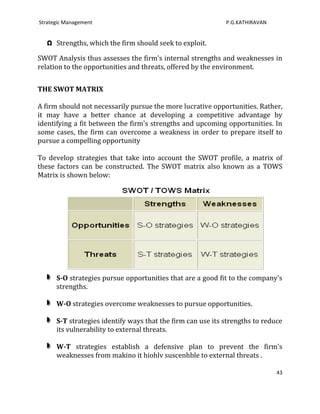
To develop strategies that take into account the SWOT profile, a matrix of
these factors can be constructed. The SWOT matrix also known as a TOWS
Matrix is shown below:


      S-O strategies pursue opportunities that are a good fit to the company's
      strengths.

      W-O strategies overcome weaknesses to pursue opportunities.

      S-T strategies identify ways that the firm can use its strengths to reduce
      its vulnerability to external threats.

      W-T strategies establish a defensive plan to prevent the firm's
      weaknesses from makino it hiohlv suscenhble to external threats .

                                                                              43
Strategic Management                                         P.G.KATHIRAVAN


    STRATEGIES FOR GROWTH THROUGH EXPANSION
             VERSUS DIVERSIFICATION

Growth strategy
Organizations pursing a grown strategy do not necessarily grow faster than
the economy as a whole but do grow faster than the markets in which their
products are sold; tend to have larger than average profit margins; attempt to
postpone or even eliminate the danger of price competition in their industry
regularly develop new products, new markets, new processes, and new uses
for old products and tend to adapt the outside world to themselves by
creating something or a demand for something that did not exist before.

Expansion strategy: It is followed when an organization aims at high
growth by substantially broadening the scope of one or more of its businesses
in terms of their respective customer group , customer functions. It is followed
to improve its overall performance.

Diversification strategy: It involves a simultaneous departure from
current business . Firms choose diversification when the growth objectives
are very high and it could not be achieved with in the existing product market
scope.

Classification of diversification
Various types are given below:

1. Concentric diversification :Concentric diversification is a growth strategy
that involves adding new products or services that are similar to the
organization’s present products or services

2. Vertical integration :Vertical integration is a growth strategy that involves
extending an organization’s present business in two possible directions.

      Forward integration moves the organization into distributing its own
      products or services.


                                                                              44
Strategic Management                                        P.G.KATHIRAVAN


      Backward integration moves it into supplying some or all of the
      products or services that are used in producing its present products or
      services.

3. Horizontal diversification : Horizontal diversification is a growth strategy
in which an organization buys one of its competitors.

4. Conglomerate diversification : Conglomerate diversification is a
growth strategy that involves adding new products or services that are
significantly different from the organization’s present products or services.


        ACQUISITION AND MERGER STRATEGIES
Mergers and acquisition are two frequently used methods for implementing
diversification strategies.

A merger takes place when two companies combine their operations,
creating, in effect, a third company.

An acquisition is a situation in which one company buys, and, controls,
another company.


DIFFERENCE BETWEEN MERGERS AND ACQUISITIONS
Though the two words mergers and acquisitions are often spoken in the same
breath and are also used in such a way as if they are synonymous, however,
there are certain differences between mergers and acquisitions.

                MERGER                              ACQUISITION

The case when two companies (often      The case when one company takes
of same size) decide to move forward    over another and establishes itself as
as a single new company instead of      the new owner of the business.
operating business separately.
The stocks of both the companies are    The buyer company “swallows” the
surrendered, while new stocks are       business of the target company, which
                                                                             45
Strategic Management                                         P.G.KATHIRAVAN


issued afresh.                          ceases to exist.

For example, Glaxo Wellcome and Dr. Reddy's Labs acquired Betapharm
SmithKline Beehcam ceased to exist through an agreement amounting
and merged to become a new $597 million.
company, known as Glaxo SmithKline.


A buyout agreement can also be known as a merger when both owners
mutually decide to combine their business in the best interest of their firms.
But when the agreement is hostile, or when the target firm is unwilling to be
bought, it is considered as an acquisition.

M&A DEALS IN INDIA.

Sectors like pharmaceuticals, IT, ITES, telecommunications, steel,
construction, etc, have proved their worth in the international scenario and
the rising participation of Indian firms in signing M&A deals has further
triggered the acquisition activities in India.

In spite of the massive downturn in 2009, the future of M&A deals in India
looks promising. Indian telecom major Bharti Airtel is all set to merge with its
South African counterpart MTN, with a deal worth USD 23 billion. According
to the agreement Bharti Airtel would obtain 49% of stake in MTN and the
South African telecom major would acquire 36% of stake in Bharti Airtel.

Classification of Mergers or Acquisitions
   a.   Horizontal Mergers or Acquisitions
   b.   Concentric Mergers or Acquisitions
   c.   Vertical Mergers or Acquisitions
   d.   Conglomerate Mergers or Acquisitions

a) Horizontal Mergers or Acquisitions are the combining of two or more
organizations that are direct competitors.

b) Concentric Mergers or Acquisitions are the combining of two or more
organizations that have similar products or services in terms of technology,
product line, distribution channels, or customer base.
                                                                              46
Strategic Management                                          P.G.KATHIRAVAN


c) Vertical Mergers or Acquisitions are the combining of two or more
organizations to extend an organization into either supplying products or
services required in producing its present products or services or into
distributing or selling its own products or services.

d) Conglomerate Mergers or Acquisitions involve the combining of two or
more organizations that are producing products or services that are
significantly different from each other.

Reasons for mergers and Acquisitions
The following are the reasons for mergers and acquisitions.

Major reason

    Getting the potential benefit that can accrue to the stockholders of both
      companies.

Other reasons
    Providing a better utilization of existing manufacturing facilities
    Selling in the same channels as existing channels to make the existing
     sales organization more productive.
    Getting the services of proven management team to strengthen or
     succeed the existing staff.
    Smoothing out cyclical/ seasonal trends in present products or services.
    Providing new volume to replace static or shrinking volume in present
     products or services.
    Providing new products or services and better margins of profit in order
     to supplement older products or services still selling in good demand
     but at increasingly competitive levels.
    Entering a new and growing field
    Securing or protecting sources of raw materials or components used in
     its manufacturing process ( vertical integration)
    Effective savings in income and excess profits taxes.
    Broadening the opportunities for using the managerial ability of the
     acquiring organization’s personnel or its resources.
    Providing an avenue for the selling of the organization’s stock.
    Providing resources for expanding the organization.
                                                                               47
Strategic Management                                        P.G.KATHIRAVAN


    Reducing tax obligations ( income tax, estate and inheritance taxes)
    Providing for management succession and the perpetuation or
     continuation of the business.

Merger and Acquisition Strategies
Merger and Acquisition Strategies are extremely important in order to derive
the maximum benefit out of a merger or acquisition deal.

It is quite difficult to decide on the strategies of merger and acquisition,
especially for those companies who are going to make a merger or acquisition
deal for the first time. In this case, they take lessons from the past mergers
and acquisitions that took place in the market between other companies and
proved to be successful.

Strategies for Successful Merger or Acquisition Deal
Through market survey and market analysis of different mergers and
acquisitions, it has been found out that there are some golden rules which can
be treated as the Strategies for Successful Merger or Acquisition Deal.

      Before entering in to any merger or acquisition deal, the target
      company's market performance and market position is required to be
      examined thoroughly so that the optimal target company can be chosen
      and the deal can be finalized at a right price.
      Identification of future market opportunities, recent market trends and
      customer's reaction to the company's products are also very important
      in order to assess the growth potential of the company.
      After finalizing the merger or acquisition deal, the integration process
      of the companies should be started in time. Before the closing of the
      deal, when the negotiation process is on, from that time, the
      management of both the companies requires to work on a proper
      integration strategy. This is to ensure that no potential problem crop up
      after the closing of the deal.
      If the company which intends to acquire the target firm plans
      restructuring of the target company, then this plan should be declared
      and implemented within the period of acquisition to avoid
      uncertainties.
                                                                             48
Strategic Management                                            P.G.KATHIRAVAN


       It is also very important to consider the working environment and
       culture of the workforce of the target company, at the time of drawing
       up Merger and Acquisition Strategies, so that the laborers of the target
       company do not feel left out and become demoralized.

Reasons for failure of mergers
   Ω   Overoptimistic appraisal
   Ω   Overbidding
   Ω   Overestimation of synergies
   Ω   Poor post acquisition integration

MERGER AND ACQUISITION STRATEGY PROCESS
The merger and acquisition strategies may differ from company to company
and also depend a lot on the policy of the respective organization. However,
merger and acquisition strategies have got some distinct process, based on
which, the strategies are devised. They are:

       1) Determining Business Plan Drivers

       2) Determining Acquisition Financing Constraints

       3) Developing Acquisition Candidate List

       4) Building Preliminary Valuation Models

       5) Rating/Ranking Acquisition Candidates

       6) Reviewing and Approving the Strategy

1) Determining Business Plan Drivers

       Merger and acquisition strategies are deduced from the strategic
       business plan of the organization. So, in merger and acquisition
       strategies, the first need is to find out the way to accelerate the strategic
       business plan through the M&A. The strategic business plan is to be
       transformed into a set of drivers, which merger and acquisition
       strategies would address.
                                                                                  49
Strategic Management                                         P.G.KATHIRAVAN


      While chalking out strategies, an organization needs to consider the
      points like

         the markets of its intended business,
         the market share that it is eyeing for in each market,
         the products and technologies that it would require,
         the geographic locations where it would operate its business in,
         the skills and resources that it would require,
         the financial targets and the risk amount etc.

2) Determining Acquisition Financing Constraints

      Now, the organization needs to find out if there are any financial
      constraints for supporting the acquisition.

      Funds for acquisitions may come through various ways like cash, debt,
      public and private equities, PIPEs, minority investments, earn outs etc.

      The organization needs to consider a few facts like
       the availability of untapped credit facilities,
       surplus cash, or untapped equity,
       the amount of new equity and new debt that it can raise etc.

      The organization also needs to calculate the amount of returns that it
      must achieve.

3) Developing Acquisition Candidate List

      Now the organization has to identify the specific companies (private
      and public) that it is eyeing for acquisition.

      It can identify those by market research, public stock research, referrals
      from board members, investment bankers, investors and attorneys, and
      even recommendations from its employees. It also needs to develop
      summary profile for every company.

4) Building Preliminary Valuation Models

                                                                                 50
Strategic Management                                         P.G.KATHIRAVAN


      This stage is to calculate the initial estimated acquisition cost, the
      estimated returns etc. Many organizations have their own formats for
      presenting preliminary valuation.

5) Rating/Ranking Acquisition Candidates

      The next step is rating or ranking the acquisition candidates according
      to their impact on business and feasibility of closing the deal. This
      process will help the organization in understanding the relative impacts
      of the acquisitions.

6) Reviewing and Approving the Strategy

      In this stage, merger and acquisition strategies are reviewed and
      approved. The organization needs to find out whether all the critical
      stakeholders like board members, investors etc. agree with it or not. If
      everyone gives their nods on the strategies, it can go ahead with the
      merger or acquisition.

                          JOINT VENTURES
Meaning

Joint ventures are equity arrangements between two or more independent
firms. They are usually temporary partnerships in which two or more
business entities (proprietorship, partnership, corporation, or other) join for
the purpose of conducting a specific project.

Joint ventures are used frequently in the construction business.

The joint venture is treated as a separate entity from the other business of the
partners, and it keeps a separate set of accounts.

When the project is completed, the joint venture is terminated, with all profits
distributed to its members (or loses covered by them).

Characteristics

                                                                              51
Strategic Management                                           P.G.KATHIRAVAN


    Two partners coming together to create a common undertaking
     contributing money, effort, knowledge, skill, or any other asset.
    The subject matter of a joint venture is interest in joint property.
    Right of management or mutual control of the enterprise.
    Presence of “adventure” to anticipate profit.
    Normal limitations to the objective of a single undertaking or ad hoc
     enterprise

Motives for joint venture:
      Lack of funds
      Learning experience
      Sharing risk and resources
      Regulating authorities are flexible in regard to joint ventures

STRATEGY OF JOINT VENTURE IN INDIA
Three basic strategies have been proposed for use in joint ventures. They are:

   1. Spider’s web
   2. Go together-split
   3. Successive integration
The spider’s web strategy : In ‘Spider Web Strategy', a small firm establishes
a series of joint ventures, so that it can survive and not absorbed by its large
competitors.

Go together- split is a strategy in which two or more organizations co
operate for an extended time and then separate. This strategy is particularly
appropriate on projects that have a definite life span, such as construction
projects.

Successive integration starts with a weak joint venture relationship between
the organizations, becomes stronger and results in a merger.

STRATEGY OF JOINT VENTURE IN ABROAD
A foreign company can commence operations in India by incorporating a
company under the Companies Act, 1956 through

                                                                                52
Strategic Management                                        P.G.KATHIRAVAN


      Joint Ventures; or
      Wholly Owned Subsidiaries

Joint venture with an Indian Partner
    Foreign Companies can set up their operations in India by forging
    strategic alliances with Indian partners.

    In Joint venture, the domestic company and a foreign company enter into
    50:50 agreement in which both of them take 50% of ownership stake and
    operating control is shared between team of managers drawn from both
    companies.

    It involves technology collaboration, so the company may lose control
    over its proprietory technology.

   Joint Venture may entail the following advantages for a foreign investor:
   a. Established distribution/ marketing set up of the Indian partner
   b. Available financial resource of the Indian partners
   c. Established contacts of the Indian partners which help smoothen the
      process of setting up of operations

Reasons for failure of joint venture

   a. The research and development for a new technology never materialized
   b. Preparation and planning for a joint venture might have been
      inadequate
   c. Conflicts in regard to the basic objectives of the joint venture cropping
      up after the formation.
   d. Revealing the secrecy of the partner
   e. Difficulties faced in sharing managerial control between the partners
      made into a dead lock.

                       MARKETING STRATEGY
Marketing strategy:

                                                                             53
Strategic Management                                         P.G.KATHIRAVAN


The marketing concept of building an organization around the profitable
satisfaction of customer needs has helped firms to achieve success in high-
growth, moderately competitive markets. However, to be successful in
markets in which economic growth has leveled and in which there exist many
competitors who follow the marketing concept, a well-developed marketing
strategy is required. Such a strategy considers a portfolio of products and
takes into account the anticipated moves of competitors in the market.

In short, marketing strategy means, the marketing logic by which the business
unit hopes to achieve its marketing objectives.

Process of Marketing Strategy:
      a) Scanning the marketing environment.
      b) Internal scanning- Process of assessing the firm’s strengths and
      weakness and identifying its core competencies and competitive
      advantages.
      c) Setting marketing objectives – to provide clear cut direction to the
      business regarding its future course of action.
      d) Formulating marketing strategy
      e) Developing the function plans – elaborating the marketing strategy
      into detailed plans and programmes.

Marketing strategy as a part of corporate strategy:
A marketing strategy for a company needs to be an integral part of a corporate
strategy, which is the umbrella. The business strategy of a company shapes
the marketing strategy, which has to be developed and implemented through
functional level strategy involving superior efficiency, quality, innovation and
customer responsiveness.


                                                                              54
Strategic Management                                        P.G.KATHIRAVAN


According to David Aakar, the marketing strategy involves laying down
strategic specifications as follows.

   1. Scope of the product market in which the company desires to compete
      has to be laid down.

   2. The level of investment required taking into consideration the timing,
      nature and phase of the market will have to be determined.

   3. Identifying the functional strategies required for implementation.

   4. The strategic assets like brand name, loyal customer base, talent
      inventories required for building sustainable competitive advantage
      will have to be built.

   5. In case of multiple businesses need for proper allocation of resources
      both financial and non financial becomes important.

   6. Synergy among the various market activities for the different
      businesses of the same company will have to be developed.


         RESOURCE ANALYSIS AND EVALUATION

Various resources of an organisation:
                                                                             55
Strategic Management                                             P.G.KATHIRAVAN


The following diagram shows the various sources of an organisation.


Evaluation of Resources
The resource - based view of the firm explains that an organization is a bundle
of resources, which means that the most important role of a manager is that of
acquiring,developing, managing, and discarding resources. According to this
view, firms can gain competitive advantage through possessing superior
resources. Superior resources are those that have value in the market, are
possessed by only a small number of firms,and are not easy to substitute.
Most of the resources that a firm can acquire or develop are directly linked to
an organization’s stakeholders, which are groups and individuals who can
signifi cantly affect or are signifi cantly affected by an organization’s activities.
A stakeholder approach depicts the complicated nature of the management
task.
Diversification of product mix, technology, customer base, capital structure
for further growth, as a defensive move or for improved resource utilization.


                                                                                  56
Strategic Management   P.G.KATHIRAVAN


                                        57
Strategic Management                                     P.G.KATHIRAVAN


MANAGEMENT ACCOUNTING AND STRATEGIC MANAGEMENT


Unit III:


Prepared by
Prof.P.G.Kathiravan    M.com.,M.phil.,PGDCA.,MBA.,Ph.D


                                                                          58
Strategic Management                                          P.G.KATHIRAVAN


 STRATEGIES IN THE DEVELOPMENT OF MODELS
Models are a group of tools, which help comprehension of problems and help
assist in taking decisions.
A typical modeling process starts with the identification of a problem and
analysis of the requirements of the situation.
This analysis will include the scope of the problem, internal or external forces
acting as part of the problem and the dynamics of the situation. While such an
analysis is attempted, the need to identify variables and their relationship is
very essential.
Whenever a model is built, assumptions are made. These assumptions usually
are untested beliefs or predictions and as such they will have to be tested for
their relevance to the model. As otherwise the results of the model may not be
realistic
                               Analysis


Static analysis                                               Dynamic analysis

Static analysis:
It means that all occurrences take place in a single interval whose duration
can be either short or long.
For example, “make or buy decisions “belong to static analysis.

Dynamic analysis:
It is applied to situations which are subject to change over a period.
A simple example would be a financial projection either of profitability or
funds over five year period. The input data such as investments, costs, prices
and quantities are likely to change from year to year.


The various models used are given below:
                                                                               59
Strategic Management                                       P.G.KATHIRAVAN


                         I. DELPHI MODEL
    This method, developed by the RAND Corporation in the 1950s,
     estimates the future based on experts’ evaluation.

    It asks an anonymous panel of experts to estimate individually the
     probability of certain events occurring in the future.

    After scoring or weighting their estimates, the panel members are given
     several chances to revise their answers, and receive feedback on the
     distribution of the panel’s evaluation.

    The goal of this technique is to have participants converge on future
     views by comparing their answers with those of others.

    Although this technique provides an opportunity to explore each
     expert’s perspective and opinions in depth, it has been criticized for
     problems such as peer pressure and the lack of dialectical conversations
     among decision-making participants

Delphi study proceeds
    A questionnaire designed by a monitor team is sent to a select group of
     experts.

    After the responses are summarized, the results are sent back to the
     respondents to re-evaluate their original answers, based upon the
     responses of the group.
   
    By incorporating a second and sometimes third round of
     questionnaires, the respondents have the opportunity to defend their
     original answers or change their position to agree with the majority of
     respondents.

    The Delphi technique, therefore, is a method of obtaining what could be
     considered an intuitive consensus of group expert opinions.

                                                                            60
Strategic Management                                           P.G.KATHIRAVAN


                       II. ECONOMETRIC MODEL
      Econometric Model is the model that studies the different economic
      variables and their inter-relationships and used for forecasting.

      Econometric modeling is one of the most sophisticated methods of
      forecasting. In general, econometric models attempt to mathematically
      model an entire economy

      Econometric model is designed as numerical interpretations of real
      world systems (e.g. national economies, ecologies, production systems)

      Most econometric models are based on numerous regression equations
      that attempt to describe the relationships between the different sectors
      of the economy.

      Here the analyst changes assumptions or estimations with in the model
      to generate varying outcomes.

      By varying the income variables in the model, the analyst examines this
      impact on whatever mobility variables the model contains, thus
      assessing their sensitivity to income changes.

      For example, in a dynamic population forecasting model, one might
      wish to assess the impact of changes in personal income on population
      mobility.

      In doing so the analyst is able to evaluate the model itself, as well as gain
      some understanding of contingency outcomes.

      A particular advantage of this technique is the ability to perform
      sensitivity analyses. Econometric modeling is very expensive and
      complex and is therefore, primarily used by very large organizations.

                                                                                 61
Strategic Management                                           P.G.KATHIRAVAN


            III. MATHEMATICAL PROGRAMMING
Mathematical programming (MP) refers to a class of analytical (algebraic)
methods that prescribe the best way to achieve a given objective while
complying with a set of constraints.

MP models determine the optimal allocation of economic resources among
competing alternatives within an operational system.

MP constitutes a pivotal(crucial or central importance) element in the study of
rational decision making.

The term programming as used here means systematic planning. Thus MP
stands for “planning a decision mathematically.”

MP provides a sound theoretical basis for properly understanding the broader
implications inherent to managerial decision making in general.

Certain MP models depict the consequences of alternative courses of action by
quantifying the opportunity costs of scarce system resources.

Managers are thus made aware of the value forgone by not making optimal
decisions.

MP offers a way to avoid the pitfalls associated with the satisficing criterion by
providing a comprehensive view of the decision problem that can assist
managers in attaining and sustaining a solid competitive advantage.

MP comprises a variety of paradigms (theoretical frameworks) tailored to
different kinds of problems. The most widely used variant is linear
programming (LP), a form of MP where the objective and all constraints are
expressed as linear functions.

Other variants include integer programming (IP), for problems requiring
integer solutions; nonlinear programming (NLP), where the objective
and/or one or more constraints are nonlinear functions; and goal
programming (GP), for problems with multiple objectives.

                                                                                62
Strategic Management                                        P.G.KATHIRAVAN


Advances in computer technology have brought MP to the forefront of the
managerial stage. Any personal computer with a full-featured spreadsheet
program, such as Excel or Lotus 1-2-3 is quite capable of solving sophisticated
constrained optimization problems.

STAGES OF FORMULATION, SOLUTION, AND IMPLEMENTATION OF
MATHEMATICAL PROGRAMMING

The various stages in the mathematical programming are given below:

             A. Formulating the model.
             B. Gathering the data.
             C. Obtaining an optimal solution.
             D. Applying sensitivity analysis.
             E. Testing and implementing the solution.

A) Formulating the Model

The first step to be taken in a practical application is the development of the
model. The following are elements that define the model structure:

   a) Selection of a Time Horizon / planning horizon/ cutoff date

    The time horizon indicates how long we have to look into the future to
     account for all the significant factors of the decision under study.

    It might cover ten to twenty years in a major capital-investment
     decision, one year in an aggregate production-planning problem, or just
     a few weeks in a detailed scheduling issue.

    Sometimes it is necessary to divide the time horizon into several time
     periods. This is done in order to identify the dynamic changes that take
     place throughout the time horizon.

    For example, in a production planning problem it is customary to divide
     the one-year time horizon into time periods of one month’s duration to
     reflect fluctuations in the demand pattern due to product seasonalities.

                                                                             63
Strategic Management                                     P.G.KATHIRAVAN


   b) Selection of Decision Variables and Parameters

    The next step in formulating the mathematical-programming model is
     to identify the decision variables, which are those factors under the
     control of the decision-maker, and the parameters, which are beyond
     the control of the decision-maker and are imposed by the external
     environment.

    If we are dealing with production planning models, some relevant
     decision variables might be the amount to be manufactured of each
     product at each time period, the amount of inventory to accumulate at
     each time period, and the allotment of man-hours of regular and
     overtime labor at each time period.

    The parameters represent those factors which affect the decision but
     are not controllable directly (such as prices, costs, demand, and so
     forth).

    In deterministic mathematical-programming models, all the parameters
     are assumed to take fixed, known values, where estimates are provided
     via point forecasts. The impact of this assumption can be tested by
     means of sensitivity analysis.

    Examples of some of the parameters associated with a production-
     planning problem are: product demands, finished product prices and
     costs, productivity of the manufacturing process, and manpower
     availability.

    The distinction made between parameters and decision variables is
     somewhat arbitrary and one could argue that, for a certain price, most
     parameters can be controlled to some degree by the decision-maker.

   c) Definition of the Constraints

    The constraint set reflects relationships among decision variables and
     parameters that are imposed by the characteristics of the problem
     under study (e.g., the nature of the production process, the resources

                                                                          64
Strategic Management                                          P.G.KATHIRAVAN


      available to the firm, and financial, marketing, economical, political, and
      institutional considerations).

    These relationships should be expressed in a precise, quantitative way.
     The nature of the constraints will, to a great extent, determine the
     computational difficulty of solving the model.

    It is quite common, in the initial representation of the problem, to
     overlook some vital constraints or to introduce some errors into the
     model description, which will lead to unacceptable solutions.

    However, the mathematical programming solution of the ill-defined
     model provides enough information to assist in the detection of these
     errors and their prompt correction. The problem has to be reformulated
     and a new cycle has to be initiated.

   d) Selection of the Objective Function

    Once the decision variables are established, it is possible to determine
     the objective function to be minimized or maximized, provided that a
     measure of performance (or effectiveness) has been established and can
     be associated with the values that the decision variables can assume.

    This measure of performance provides a selection criterion for
     evaluating the various courses of action that are available in the
     situation being investigated.

    Objective functions could become more relevant in some instances.
     Examples of alternative objectives are:
              Maximize total production, in units.
              Minimize production time.
              Maximize share of market for all or some products.
              Maximize total sales, in dollars or units.
              Minimize changes of production pattern.
              Minimize the use of a particular scarce (or expensive)
              commodity.


                                                                               65
Strategic Management                                          P.G.KATHIRAVAN


B) Gathering the Data

After defining the model, the data required to define the parameters of the
problem is collected.

The data involves the objective-function coefficients, the constraint
coefficients (also called the matrix coefficients) and the right hand side of the
mathematical-programming model.

This stage usually represents one of the most time-consuming and costly
efforts required by the mathematical-programming approach.

C) Obtaining an Optimal Solution

Lengthy calculations are required to obtain the optimal solution of a
mathematical-programming model.

A digital computer (with highly efficient codes to solve linear-programming
models) is invariably used in this stage of model implementation.

When dealing with large models, it is useful, in utilizing computer programs,
to input the required data automatically. These programs, often called matrix
generators, are designed to cover specific applications.

Similarly, computer programs often are written to translate the linear-
programming output, (usually too technical in nature) into meaningful
managerial reports ready to be used by middle and top managers.

D) Applying Sensitivity Analysis

One of the most useful characteristics of linear-programming codes is their
capability to perform sensitivity analysis on the optimal solutions obtained for
the problem originally formulated. These post optimum analyses are
important for several reasons:


                                                                               66
Strategic Management                                        P.G.KATHIRAVAN


   a) Data Uncertainty

    Much of the information that is used in formulating the linear program
     is uncertain.

    Future production capacities and product demand, product
     specifications and requirements, cost and profit data, among other
     information, usually are evaluated through projections and average
     patterns, which are far from being known with complete accuracy.

    Therefore, it is often significant to determine how sensitive the optimal
     solution is to changes in those quantities, and how the optimal solution
     varies when actual experience deviates from the values used in the
     original model.

   b) Dynamic Considerations

    Instead of getting merely a static solution to the problem, it is usually
     desirable to obtain at least some appreciation for a dynamic situation.

   c) Input Errors

    An inquiry is made to test how errors have been committed in the
     original formulation of the problem that may affect the optimal solution.

    It is sometimes necessary to evaluate the impact on the objective
     function of introducing new variables or new constraints into the
     problem.

    Good linear-programming codes provide several means of obtaining
     pertinent information about the impact of these changes with a
     minimum of extra computational work.

E) Testing and implementing the Solution

The solution should be tested fully to ensure that the model clearly represents
the real situation.

                                                                             67
Strategic Management                                        P.G.KATHIRAVAN


When testing is complete, the model can be implemented.

Implementation usually means solving the model with real data to arrive at a
decision or set of decisions.


                       SENSITIVITY ANALYSIS
    A sensitivity analysis guides an analyst through the varying impacts of
     the particular component or variable on the model or the plan or the
     budget
    Whenever the plan is formulated or a model constructed or a budget
     document is prepared, many assumptions underlie such activity. These
     activities are time bound and also involve time consuming exercises.
     They are prepared normally ahead of a particular deadline for
     implementation.
    So, it is possible that some of the key assumptions may undergo a
     change to near efflux of time. So, it is always prudent to quantify the
     impact of such assumptions or variables due to their deviations from
     the original quantifications.
    Sensitivity analysis is often attempted by varying one sensitive factor at
     a time, other factor remaining the same and quantifies the impact on the
     model or budget or plan.
    For instance, price and capacity utilization are two common factors that
     are taken for sensitivity analysis. If the price of the product were to go
     up, sales fall due to lowering demand. But how exactly the increments of
     price per unit affect the demand or the sale will be borne out in the
     sensitivity analysis.
    It becomes very important for the models as the variables can be many
     and interdependencies will have to be fully understood for a meaningful
     exercise. Towards this sensitivity analysis helps.


                                                                             68
Strategic Management                                         P.G.KATHIRAVAN


Characteristics of Sensitivity analysis
    Sensitivity analysis is performed on the optimal solutions obtained for
     the problem originally formulated by mathematical modeling.
    It is applied to analyse the sensitive factors like price and capacity
     utilization.
    It is applied to quantify the impact of assumptions.
      It identifies the varying impacts of the particular component or variable
       on the model

                       SIMULATION TECHNIQUES
A simulation model is a mathematical model that calculates the impact of
uncertain inputs and decisions. Such a model can be created by writing code
in a programming language, statements in a simulation modeling language, or
formulas in a Microsoft Excel spreadsheet
Modeler: Translates information about market dynamics (whether verbal or
otherwise) into mathematical representations that produce consistent with
what one would expect in the real world

Some examples of situations:
Modeling and simulation can be put to work in different type of situations.
Following are some examples:
           Industrial processes. How many machines, and what capabilities
            should they have to complete a manufacturing process in a given
            time?
           Service processes. How many employees should be allocated to
            serve the customers at peak hour, if the owner wishes to provide
            a service time that does not exceed one minute?
           Computer networks and the way people interact with them.
            The users and procedures associated with the overall business
            process in your organization can be tied in within the same model
            as the computers and computer networks in place.

                                                                              69
Strategic Management                                      P.G.KATHIRAVAN


           Medical disease, symptoms, and treatments. What symptoms
            are characteristic of a particular illness, and how are those
            symptoms linked to the severity of the disease? How well will a
            particular treatment work, and when will it be most effective?

Types of simulation

There are several types of simulation as given below:

                              Simulation


Probabilistic simulation      Discrete simulation         Visual simulation

   Ω Probabilistic simulation, where one or more independent variables is
     conceptualized as a probability distribution of values.

   Ω Discrete simulation, where it becomes important to know when an
     event exactly occurs.

   Ω Visual simulation is a graphical representation of computerized
     results. Software for this method is one of the recent developments in
     computer-human intraction and problem solving.

Advantages of Simulation Models:

Decision support systems have been increasingly using simulation models for
the following reasons
   a. Simulation theory is relatively easy to comprehend.
   b. Simulation can offer solutions to “what-if” type questions
   c. Decision support system analysts work closely with managers who seek
       solution.
   d. The simulation model is built for one particular problem
   e. Simulation models allow inclusion of real life complexities and no
       simplifications are necessary


                                                                           70
Strategic Management                                          P.G.KATHIRAVAN


Disadvantages of Simulation Models:

   a. An optimal or the best solution is not always guaranteed.
   b. Building simulation model is a slow and costly process.
   c. Solutions and inferences from a specific simulation model cannot be
      transferred for other problems.


             LIMITATIONS IN MODEL BUILDING
   The following are the limitations of model building.

   a) Data Uncertainty
   b) Input Errors
   c) Need of computers with codes
   d) Need of computer programmes
                         LIFE CYCLE MODEL
The profitability and sales of a product , in general, change over time. The
Product Life Cycle (PLC) is an attempt to recognize distinct stages in a
product's sales history. Just like human beings have different phases in his life
cycle, products too go through an. identical phase in its Product Life
Gycle(PLC).The product is first introduced in the market, Grows at a steady
rate , reaches a saturation point, then declines and finally dies out.


                                                                               71
Strategic Management                                           P.G.KATHIRAVAN


I. Introduction Phase: In this phase, the product just makes its maiden
appearance with an expectation of high profitability. At this stage, the firm has
a low growth rate and low market share. It would require more capital
investment to grow at rapid rate and for capturing a higher market share.

II. Growth Phase: At this stage, the firm starts growing. The product tries to
get itself entrenched and begin to grow. The sales start picking up as early
adopters enter the market and repeat purchases also start taking place.

III. Maturity Phase: This is the longest period in the life of the product. This is
the stage, when the sales volume will be its highest level. In this stage, the
sales reach their peak level and thereafter try to stabize.

IV. Decline: This is the stage, where the sales will start declining steeply and
slowly and the product would die out. In this stage, only those firms, which
have substantial resources or a larger market share, will remain in the market.
Strategy to be adopted at different stages of Product Life Cycle :


         PORTERS GENERIC STRATEGIC MODEL
Michael Porter was originally an engineer, then an economist before he
specialized in strategy.

Michael Porter has described a category scheme consisting of three general
types of strategies that are commonly used by businesses to achieve and
maintain competitive advantage.

These three generic strategies are defined along two dimensions: strategic
scope and strategic strength.


                                                                                 72
Strategic Management                                        P.G.KATHIRAVAN


Strategic scope is a demand-side dimension and looks at the size and
composition of the market the firm intends to target.

Strategic strength is a supply-side dimension and looks at the strength or core
competency of the firm.

In particular Porter identified two competencies that he felt were most
important: i) product differentiation and ii) product cost (efficiency).

He originally ranked each of the three dimensions (level of differentiation,
relative product cost, and scope of target market) as either low, medium, or
high, and placeed them in a three dimensional matrix. That is, the category
scheme was displayed as a 3 by 3 by 3 cube. But most of the 27 combinations
were not viable.


In his 1980 classic Competitive Strategy: Techniques for Analysing Industries
and Competitors, Porter simplifies the scheme by reducing it down to the three
best strategies. They are

   1. cost leadership,
   2. differentiation, and
   3. Market segmentation (or focus).

Market segmentation is narrow in scope while both cost leadership and
differentiation are relatively broad in market scope.
                                                                             73
Strategic Management                                              P.G.KATHIRAVAN


1. Cost Leadership Strategy (with high margins and low volumes)

This strategy involves the firm winning market share by appealing to cost-
conscious or price-sensitive customers.

This is achieved by having the lowest prices in the target market segment, or
at least the lowest price to value ratio (price compared to what customers
receive).

To succeed at offering the lowest price while still achieving profitability and a
high return on investment, the firm must be able to operate at a lower cost
than its rivals. There are three main ways to achieve this.

      Way 1: Achieving a high asset turnover by spreading fixed costs over a
      larger number of units of the product or service, resulting in a lower
      unit cost

      Way 2 : Achieving low direct and indirect operating costs by offering
      high volumes of standardized products, offering basic no-frills products
      and limiting customization and personalization of service.

      Way 3: control over the supply/procurement chain to ensure low costs.
      This could be achieved by bulk buying to enjoy quantity discounts,
      squeezing suppliers on price, instituting competitive bidding for
      contracts, working with vendors to keep inventories low using methods.

A cost leadership strategy may have the disadvantage of lower customer
loyalty, as price-sensitive customers will switch once a lower-priced
substitute is available. A reputation as a cost leader may also result in a
reputation for low quality, which may make it difficult for a firm to rebrand
itself or its products if it chooses to shift to a differentiation strategy in future.

2. Differentiation Strategy (with low margins and high volumes)

Differentiation is a viable strategy for earning above average returns in a
specific business by creating brand loyalty among the customers.

Brand loyalty is created by the creation of a product or services that is
perceived throughout its industry as unique.
                                                                                   74
Strategic Management                                        P.G.KATHIRAVAN


This specialty can be associated with design, brand image, technology,
features, dealers, network, or customers’ service.

The company or business unit may then charge a premium for its product.

Increased costs can usually be passed on to the buyers.

Buyers loyalty can also serve as an entry barrier-new firms must develop
their own distinctive competence to differentiate their products in some way
in order to compete successfully.

Examples of the successful use of a differentiation strategy are Hero Honda,
Asian Paints, HLL, Nike athletic shoes, Perstorp Bio Products, Apple Computer,
and Mercedes-Benz automobiles.

A differentiation strategy is appropriate where
              the target customer segment is not price-sensitive,
              the market is competitive or saturated,
              customers have very specific needs which are possibly under-
               served, and
              the firm has unique resources and capabilities which enable it
               to satisfy these needs in ways that are difficult to copy.
               (Including patents or other Intellectual Property (IP), unique
               technical expertise, talented personnel or innovative
               processes.)

Some research does suggest that a differentiation strategy is more likely to
generate higher profits than is a low cost strategy because differentiation
creates a better entry barrier.

Disadvantages of Differentiation strategies :
      higher prices will also likely result in lower sales volumes and lower
      asset turnovers.

3. Focus or Strategic Scope


                                                                             75
Strategic Management                                       P.G.KATHIRAVAN


It describes the scope over which the company should compete based on cost
leadership or differentiation.

The firm can choose to compete in the mass market with a broad scope, or in
a defined, focused market segment with a narrow scope. In either case, the
basis of competition will still be either cost leadership or differentiation.

In adopting a narrow focus, the company ideally focuses on a few target
markets (also called a segmentation strategy or niche strategy). These should
be distinct groups with specialized needs.

The choice of offering low prices or differentiated products/services should
depend on the needs of the selected segment and the resources and
capabilities of the firm.

A focused strategy should target market segments that are less vulnerable to
substitutes or where a competition is weakest to earn above-average return
on investment.

Examples of firm using a focus strategy include Southwest Airlines, which
provides short-haul point-to-point flights in contrast to the hub-and-spoke
model of mainstream carriers, and Family Dollar.

In adopting a broad focus scope, the principle is the same: the firm must
ascertain the needs and wants of the mass market, and compete either on
price (low cost) or differentiation (quality, brand and customization)
depending on its resources and capabilities.

Apple targets the mass market with its iPhone and iPod products, but
combines this broad scope with a differentiation strategy based on design,
branding and user experience that enables it to charge a price premium due to
the perceived unavailability of close substitutes.


                                                                            76
Strategic Management                                         P.G.KATHIRAVAN


Porter’s explanation is that firms with high market share were successful
because they pursued a cost leadership strategy and firms with low market
share were successful because they used market segmentation to focus on a
small but profitable market niche. Firms in the middle were less profitable
because they did not have a viable generic strategy.

Combining a market segmentation strategy with a product differentiation
strategy is an effective way of matching a firm’s product strategy (supply side)
to the characteristics of its target market segments (demand side).


                          BCG MATRIX
Boston Classification: The Boston Consulting Group (BCG) have developed a
matrix, based on empirical research, which analyses products and businesses
by market share and market growth.This growth/ share matrix for the
classification of products into cash cows, Dog, rising stars and question marks
is known as the Boston Classification.


                                                                              77
Strategic Management                                        P.G.KATHIRAVAN


BCG Matrix: It was developed by Boston Consulting Group .Its objective is
to help top management to identify the cash flow requirements of different
businesses in their portfolio .
3 steps involved:
    Dividing the company into SBU
    Comparing with each other by
     means of matrix
    Developing strategic objectives


This matrix provides a scheme for
broadly classifying a company's
businesses according to their strategic
needs (including cash requirements).
The horizontal axis shows the relative
market share held by the various SBUs (Strategic Business Units), expressed
as a ratio of each SBU's share held by the leading competitor in its particular
market. The vertical axis depicts the growth rate of the various markets in
which the businesses compete.

                       Market Share

A firm, at any given time, may be comprised of several SBU's that fit into each
of the four categories shown in the above matrix. Resources are allocated to
business units according to where they are situated on the grid as follows:

   Ω STARS are products or business units with a high share of a high
     growth market. In short term, these require capital expenditure,
     possibly in excess of the cash they generate, in order to maintain their
     market position but promise high returns in the future.

   Ω In due course, however, stars will become CASH COWS, with a high
     share of a low-growth market. Cash Cows need very little capital
     expenditure and generate high levels of cash income. .The important
     strategic feature of CASH COWS are that they are generating high cash
     returns, which can be used to finance the STARS (other business units).
                                                                             78
Strategic Management                                        P.G.KATHIRAVAN


   Ω A QUESTION MARK (sometimes called Problem Child) is a product or a
     business unit in a high growth market but has a low market share. A
     decision needs to be taken about whether the product justifies
     considerable expenditure in the hope of increasing its market share, or
     whether it should be allowed to die quietly as it was squeezed out of the
     expanding market by rival products. Because, considerable expenditure
     would be needed to turn a Question mark into a STAR by building up
     market share, QUESTION MARKS will usually be poor cash generators
     and show a negative cash flow.

  Ω DOGS are products with a low share of a low growth market. They may
      be ex-CASH COWS that have now fallen on hard times. DOGS should be
      allowed to die or should be killed off. Although they will show only a
      modest net cash flow or even a modest cash- inflow, they are cash traps,
      which tie up funds and provide a poor return on investment and not
      enough to achieve to organization's target rate of return.
There are also INFANTS (i.e., products in an early stage of development ) and
WAR-HORSE (i.e., products that have been CASH COWS in the past and are still
making acceptable sales and profits even now) and DODOS ( low share,
negative growth and negative cash flow).

Since the STARS are growing rapidly and have the advantage of already
having achieved a high share of the market, they provide the firm's best profit
and growth opportunities.

The BCG believes that the only two viable strategies exist for QUESTION
MARK SBUs-either growing the SBUs into a STAR or divesting.

Since DOGS hold little promise for the future and may not even pay their own
way, they are the prime candidates for divestiture.

In contrast, because of their high share positions in a low growth area, CASH
COWS are ideal for providing the funds needed to pay dividends and debts,
recover overheads and supply the funds for investment in other growth areas.

Limitations of BCG Matrix:

                                                                             79
Strategic Management                                       P.G.KATHIRAVAN


The BCG matrix provides a framework for allocating resources among
different business units and allows one to compare many business units at a
glance. Howev the approach has received some negative criticism for the
following reasons: (addressed by the GE / McKinsey Matrix)

    The link between market share and profitability is questionable since
     increasing market share can be very expensive.

    The approach may overemphasize high growth, since it ignores the
     potential of declining markets.

    The model considers market growth rate to be a given. In practice the
     firm me be able to grow the market.


                           E-MARKETING
E-marketing is the result of information technology applied to traditional
marketing. It evolves from the company’s overall E-business strategies and
selected business models. It’s application of a broad range of information
technologies in marketing functions, to achieve the following:

(i) Transform marketing strategies to create more customer value.
ii) More efficient planning and execution of conception, distribution,
promotion, and pricing of goods/services.
iii) Create exchanges that satisfy individual consumer and business
customer’s needs and wants.
Judy Sreauss and Raymond Frost’s E-marketing model defines E-business as a
continuous optimization of a firm’s business through digital technology.

                        EB = EC+BI+CRM+SCM+ERP
Where, EB is electronic business, EC is electronic commerce (to enable
buying/selling through digital technology), BI is business intelligence (for
collecting primary/secondary data or information), CRM is customer
relationship manager (to satisfy customers and build long lasting
relationship), SCM is supply chain management (to delivery of
products/services efficiently and effectively) and ERP is enterprise resource
                                                                            80
Strategic Management                                          P.G.KATHIRAVAN


planning (optimization of business process and lowering costs, application of
EDI, i.e. electronic data interface).
Types of E-marketing

E-marketing is normally carried out in the following types:

   i) B2B–This involves business-to-business marketing of inter-company
          business done online.
   ii) B2C–This      involves     business-to-consumer     marketing, where
          goods/services are directly marketed by business organizations
          directly to the ultimate consumers using the Internet.
   iii) C2C–This involves consumer-to-consumer marketing, where consumers
          directly sell the goods/services to other consumers, using the
          Internet system.

Among these types, the maximum E-marketing activities take place, and the
maximum online marketing opportunities lie in B2C where marketers sell
directly to ultimate consumers.


                                                                               81
Strategic Management               P.G.KATHIRAVAN


MANAGEMENT ACCOUNTING AND STRATEGIC MANAGEMENT


Unit IV:


Prepared by

                                                    82
Strategic Management                                       P.G.KATHIRAVAN


Prof.P.G.Kathiravan      M.com.,M.phil.,PGDCA.,MBA.,Ph.D

                PRODUCTION ORIENTATION Vs
                   MARKET ORIENTATION
I. Production Orientation:

A Production oriented business produces exciting and interesting products
and seeks to demand-supply for goods/services.

Firm focusing on a production orientation specializes in producing as much as
possible of a given product/servke. Thus this signifies a firm exploiting
economies of scale, until the minimum efficient scale is reached. It is an
approach to a business that centres its activities on producing goods most
efficiently and with cost effectiveness. Production Orientation approach may
be deployed when a high demand for a product/service exists,coupled with a
good certainty that consumer tastes do not rapidly alter. Thus, Production
Orientation is a management philosophy that emphasizes production
techniques and unit cost reduction rather than the needs and wants of the
market.

Simply stated, a Production Oriented business is said to be mainly concerned
with making as many units as possible. Here the business develops products
based on what it is good at making/ doing rather than what a customer wants.
By concentrating on producing maximum volumes, such a business aims to
maximize profitability, by exploiting the economies of scale.

II. Marketing Orientation

A Marketing Oriented approach means a business reacts to what its customer
wants . The decisions taken are based around information about customers
needs and wants.

The Marketing Orientation is perhaps the most common orientation that is
used in contemporary marketing. It involves a firm essentially basing its
marketing plans around the marketing concept and thus supplies products to
suit new consumer tastes. As an example, a firm would employ Market
                                                                            83
Strategic Management                                        P.G.KATHIRAVAN


Research to gauge consumer desires, use R&D to develop a product attuned to
the revealed information and then utilize promotion techniques to ensure
persons know the product exists. A Market Oriented company is one that
organizes its activities, products and services around the needs and
requirements of its customers.

Summing up

To sum up, Production Orientation for a Product to be put on to the market is
based on the concept that customers prefer products, which are available
freely and at low cost. Put this orientation has given way with customer
driven strategy coming to the fore. Thus the market orientation stems out of
the concept that the company should be more effective than the competitors
in creating, delivering and communicating superior customer value to the
target markets.

This change in the orientation has come about mainly due to the globalization
of the market and the liberalization of economies all over the world. This has
resulted in multiple options being available to the customer and other things
being equal, the customer now articulates his own option to create a new
proctuct, as he, has become “the boss”.

            Market Orientation                    Product Orientation
1.    Demand is known first and          Goods are produced first and demand
      goods are produced next            is created next.
2.    The firm has to act according to   There is no such need. It can follow
      the taste and preferences of       its own production plan.
      consumers.
3.    New products are rarely            New      products    are    frequently
      introduced, when customer          introduced and consumers are
      wants                              induced through advertisement to
                                         buy the products.
4.    Competition will be high as it s a Competition will be low as it is a new
      demanded product.                  product.
5.    More effectiveness is needed.      No such effectiveness is needed.
6.    “ Produce what you can sell”       “ Sell what you can produce”


                                                                             84
Strategic Management                                          P.G.KATHIRAVAN


                       MARKETING OBJECTIVES
The main objectives of marketing are as follows-
1.    Creation of demand : A business firm can sell goods and services only
      when there is customer willing to buy them. Marketing finds out the
      needs and preferences of customers. Then advertising, personal selling,
      sales promotion and other methods are used to create demand and
      persuade customer to buy.
2.    Customer satisfaction: Modern marketing is customer oriented. All
      marketing activities begin with and end with customers. The focus is on
      selling satisfaction rather than selling one particular product or service.
3.    Market share: Every business firm seeks to have a reasonable share of
      the total demand. In a competitive market, aggressive selling efforts are
      necessary to make products and services popular. Good quality goods
      are offered at reasonable prices to capture a large share in the market.
4.    Profitability and Growth: Marketing seeks to achieve long term goals
      of profitability and growth by satisfying the wants of customers. In
      order to survive and grow, a good business must create and satisfy
      customers. If the customers are not satisfied, business will fail to earn
      and survive. Therefore modern marketing begins and ends with
      customers.
5.    Goodwill: Marketing aims at building the reputation of the enterprise
      over a time. The enterprise attempts to earn a name for itself and build
      its position in the market by selling quality products at reasonable
      prices, and through efficient after sales services. An enterprise with
      good goodwill can easily survive in a competitive market so Goodwill is
      one of the important objectives of marketing which can never be
      neglected.
6.    Standard of Living: Modern marketing aims at improving the living
      standards of people by providing a wide variety of products and
      services. Marketing improves the standard of living of common man by


                                                                               85
Strategic Management                                           P.G.KATHIRAVAN


      supplying new and better quality products. Marketing benefits the
      society by creating employment opportunities.

                            MARKETING MIX
"Marketing Mix” refers to the apportionment of effort, the combination,
designing and integration of the elements of marketing into a programme or
mix which, on the basis of an appraisal of the market forces will best achieve
the objectives of an enterprise at a given time.

Kotler defines the marketing mix as the set of controllable variables and their
levels that the firm uses to influence the target market. Such variables are:

      Product                                     Price and
      Place /distribution                         Promotion.

Under the 4 P's obviously quality, features, opinions, style and sizes will be
important characteristics for the product. Packaging will be irrelevant.
The P - 'Place' may be important for service back-up while promotion will
depend on trade advertising ,technical publicity and reports, service back-up
and the personal selling.
The P-'Price' will again be important, although more in the context of value for
money. Discounts and allowances will be important.
In addition, for service-there are four more P's. They are;

       People
       Processes and
       Physical evidence.
A manufacturer of heavy commercial vehicles like say, Ashok Leyland or
Bharat Earth Movers produce for the industrial market. Here the purchase is
made by a professional buyer, who buys for use and not for personal
satisfaction.

Tatas Nano-do not claim to be the cheapest but they emphasis on quality,
reliability and long-term Credit terms may be important, although this may be
dealt with separately.
                                                                                86
Strategic Management                                           P.G.KATHIRAVAN


  DISTRIBUTION COSTS ANALYSIS AND CONTROL
Meaning of Distribution cost:

The term 'distribution' is widely used in relation to the whole operation of
getting goods into the hands of the consumer, and thus covers the two
functions of sales promotion and delivery. The expression 'distribution costs',
however, may be considered as relating only to delivery.

Distribution Cost:

             That portion of marketing cost is indicated by distribution cost,
             which is incurred for warehousing of the saleable products &
             products delivery to the customers.

             The cost of the process which begins with making the packed
             product available for dispatch and ends with making the
             reconditioned returned empty package available for re-uses.

A large part of the delivery charges are variable costs, the totals of these costs
closely following movements up or down in volume of deliveries.

Sales of 1,000 units at Rs. 10 each                                  10,000

Deduct:

Manufacturing Variable costs at Rs. 4 each Rs. 4,000
Distribution Variable costs at Re. 1 each Rs. 1,000
                                                                      5,000
Contribution at Rs. 5 each                                            5,000

Deduct:

Manufacturing Fixed Cost                    Rs. 2,000
Distribution Fixed Costs                      Rs. 200                  2,200
                                                                                87
Strategic Management                                          P.G.KATHIRAVAN


Balance                                                               2,800
Deduct:

Selling Cost                                                          1,000

Profit                                                                1,800

The major objectives of management are threefold. Management must (a)
produce and sell goods and services which are satisfactory to their customers;
(b) try to earn optimum profits and (c) try to ensure the company’s long-term
prosperity by building a strong management team, and by establishing the
best possible relation ships with customers. In considering how best to meet
these objectives, management will usually have to pay greater attention to
selling costs and distribution costs.

The relationship of distribution costs to levels of turnover is less complex. An
established business can tell within close limits what distribution costs will be
incurred in selling the usual -goods in the usual markets.

Controlling Distribution costs

For many businesses the biggest single cost of selling and distribution is that
on salaries and wages. This will include warehousemen, transport drivers,
salesmen and administrative and clerical staff. Here the primary task will be
to assess the proper number of employees required for each function, to
determine their remuneration, making allowance particularly in seasonal
trades for temporary staff and overtime.

                       MARKETING RESEARCH

Meaning : Marketing research is a systematic objective and exhaustive
          search for and study of the facts relevant to any problem in the
          field of marketing.


                                                                               88
Strategic Management                                         P.G.KATHIRAVAN


             It is systematic gathering, recording and analysing of data about
             problems relating to the marketing of goods and services under
             essentially non-recurring conditions.
             Marketing Research is systematic problem analysis, model
             building and fact finding for the purpose of important decision
             making and control in the marketing of goods and services.

             Marketing Research plays a very significant role in identifying the
             needs of customers and meeting them in best possible way.

             Marketing Research is essential for strategic market planning and
             decision making. It helps a firm in identifying what are the market
             opportunities and constraints, in developing and implementing
             market strategies, and in evaluating the effectiveness of
             marketing plans.

Features of Marketing Research

Salient Features or Characteristics of Marketing Research are as follows :-

1.Wide and Comprehensive Scope : Marketing research has a very
           widescope. It includes product research, packaging research,
           pricing research, market research, sales research, etc. It is used to
           solve marketing problems and to take marketing decisions. It is
           used to make marketing policies. It is also used to introduce new
           products in the market and to identify new markets. Marketing
           research is used to select channels of distribution, in advertising
           strategy, for sales promotion measures, etc.
2.Systematic and Scientific : Marketing research is conducted in a step-by-
           step manner. It is conducted in an orderly fashion. Therefore, it is
           systematic. Marketing research uses scientific methods. Thus, it is
           also scientific.
3.Science and Art : A Science collects knowledge (data) while an Art uses this
           knowledge for solving problems. Marketing research first collects
           data. It then uses this data for solving marketing problems.
           Therefore, it is both, a Science and an Art.


                                                                              89
Strategic Management                                          P.G.KATHIRAVAN


4.Collects and Analyses Data : Marketing research gathers data accurately
            and objectively. It first collects reliable data and then analyses it
            systematically and critically.
5.Continuous and Dynamic Process : The company faces marketing
            problems throughout the year. So, Marketing research is
            conducted continuously. It continuously collects up-to-date data
            for solving the marketing problems. Large companies have their
            own marketing research departments. They conduct Marketing
            research continuously throughout the year. Therefore, Marketing
            research is a continuous process. It is a dynamic process because
            it goes on changing. It does not remain static (the same). It uses
            new methods and techniques for collecting, recording and
            analysing the data.
6.Tool for Decision-Making : The marketing manager has to take many
            decisions. For this, he requires a lot of data. Marketing research
            provides correct and up-to-date data to the marketing manager.
            This helps him to take quick and correct decisions. Therefore,
            Marketing research is an important tool for decision-making.
7.Benefits Company and Consumers : Marketing research is useful to the
            company in many ways. It increases the sales and profits of the
            company. It helps the company to fight competition and boost its
            goodwill in the market. It reduces the marketing risks. In short,
            Marketing research brings success to the company. It also brings
            the company closer to the consumers. It gives convenience and
            satisfaction to the consumers.
8.Similar to Military Intelligence : Marketing research is a commercial
            intelligence-gathering activity. It works similar to military
            intelligence. Marketing intelligence first makes a systematic study
            and only then takes a business action. Marketing research collects
            reliable data about the consumers, the competitors, the market,
            etc. This data is then organised and used for planning, decision-
            making and problem solving. This data is also further used for
            introducing new products and services in the market.
9.Applied Research : Applied research is used for solving problems.
            Marketing research is used for solving marketing problems.
            Therefore, we can say that, Marketing research is also an applied
            research. It has a practical value because it is used for solving
            present and future problems.
                                                                               90
Strategic Management                                        P.G.KATHIRAVAN


10.Connected With Marketing Information Syatem (MIS) : Marketing
           research is a component of MIS. Marketing research and MIS are
           interrelated. Both are used to solve marketing problems and to
           take marketing decisions.
11.Reduces Gap between Producers and Consumers : Marketing research
           informs producers about the needs and wants of the consumers.
           The producers produce goods according to the needs and
           demands of the consumers. This brings satisfaction to the
           consumers and in return producers make good profits. So,
           Marketing research reduces the gap between the producers and
           the consumers.
12.Uses Different Methods : Marketing research uses three methods for
           collecting data, viz., Survey Method, Experiment Method and
           ObservationMethod. All three methods are scientific. The
           researcher has to use a suitable method for collecting a reliable
           data.
13.Has Few Limitations : Marketing research has few limitations too. It is not
           an exact science. So, it does not give accurate results. It provides
           suggestions and not solutions. It is also a costly and time-
           consuming process.
14.Accurate Data Collection and Critical Analysis : Marketing research
           gives much importance to accurate data collection and its critical
           analysis. Thus, in a Marketing research, the data must be first
           collected accurately. That is, collected data or gathered
           information must be accurate, reliable and relevant. Later, this
           information must be systematically and critically examined before
           making any decisions.

USES OF MARKETING RESEARCH

I.Uses to the Producers
       a.     To know about his product potential in the market vis-à-vis the
              total product;
       b.     New Products;
       c.     Various brands;
       d.     Pricing;
       e.     Market Structures and selection of product strategy, etc.

                                                                             91
Strategic Management                                            P.G.KATHIRAVAN


II .Uses to the Business and Government

Marketing Research helps businesses and government in focusing attention
on the complex nature of problems faced by them. For example:

      a.     Determination of Gross National Product; Price indices, and per
             capita income;
      b.     Expenditure levels and budgeting;
      c.     Agricultural Pricing;
      d.     The economic policies of Government; and
      e.     Operational and planning problems of business and industry.

III.Uses to theMarket Research Agencies

Marketing Research is being used extensively by professionals to help
conducting various studies in Marketing Research. Most prominent agencies
being:-

      a.     Linta India Ltd;
      b.     British Market Research Bureau (BMRB);
      c.     Hindustan Thompson Associate Ltd;
      d.     eSurveysPro.com;
      e.     MARG

IV. Managers :         Marketing Research is useful to the managers for taking
                       managerial decisions.

Evaluation of Marketing Research:
Evaluation is one type of applied research. It is made for assessing the
effectiveness of social and economic programmes implemented.
Types of evaluation:
a) Concurrent evaluation                      c) Terminal evaluation
b) Periodic evaluation
Criteria:
      i)     Different from basic research- knowledge for its own sake.
                                                                                 92
Strategic Management                                        P.G.KATHIRAVAN


     ii)   Difficult to measure.
     iii) Less control over research work.
     iv) Problems of reliability, validity
Operationalization and Research Method are common to evaluation.
                       MARKETING PLANNING
Marketing planning is a logical sequence and a series of activities leading to
the setting of marketing objectives and the formulation of plans for achieving
them. It is a management process.

Need for Marketing planning
The need for marketing planning is based on three issues:
    the mix of market types;
    the mix of margins and sales; and
    the managerial reasons for a marketing plan.

Components of a marketing plan

From the diagram, the main components of a marketing plan can be
summarised as:


                                                                             93
Strategic Management                                                P.G.KATHIRAVAN


Component of the plan                             Description

Mission statement       A meaningful statement of the purpose and direction of the
                        business

Corporate objectives    The overall business objectives that shape the marketing plan

Marketing audit         The way the information for marketing planning is organised.
                        Assesses the situation of marketing in the business – the
                        products, resources, distribution methods, market shares,
                        competitors etc

Market analysis         The markets the business is in (and targeting) – size , structure,
                        growth etc

SWOT analysis           An assessment of the firm’s current position, showing the
                        strengths & weaknesses (internal factors) and opportunities
                        and threats (external factors)

Marketing objectives    What the marketing function wants to achieve (consistent with
and strategies          corporate objectives) and how it intends to do it (e.g. Ansoff,
                        Porter)

Marketing budget        Usually a detailed budget for the next year and an outline
                        budget for the next 2-3 years

Action plan             The detailed implementation plan


There are two outputs from the process of marketing planning: the strategic
marketing plan; and the tactical marketing plan.

Strategic and tactical marketing planning.

A distinction can be made between strategic and tactical planning: strategy is
about doing the right things; tactics are about doing things in the right way.
Survival and success, it has been realised, can only come from patient and
meticulous planning and market preparation, especially as the environment is
much more competitive, complex, fast moving, and abrasive than it ever has
been. Now, more than ever there is a need for the use of both an effective
strategy and efficient tactics.

                                                                                        94
Strategic Management                                          P.G.KATHIRAVAN


  LINKAGE BETWEEN STRATEGIC PLANNING AND
            MARKETING STRATEGY
Strategic planning: It Establishes the hierarchy of strategic intent
      Creating and communicating                 Defining a business
      vision                                     Adopting a business mode
      Designing     a   mission                  Settingobjectives
      statement

Strategic planning is a broad process that can address the entire business, or a
portion of the business such as marketing. Marketing strategies derive from
strategic plans.


Marketing Strategy: It means the marketing logic by which the business
unit hopes to achieve its marketing objectives. Its processes are:
a) Scanning the marketing environment.
b) Internal scanning- assessing the firm’s strengths and weakness
c) Setting marketing objectives
d) Formulating marketing strategy
e) Developing the function plans – elaborating the marketing strategy into
detailed plans and programmes.
LINKAGE BETWEEN STRATEGIC PLANNING AND MARKETING STRATEGY

a) Forward Linkage: A marketing strategy for a company needs to be an
integral part of a corporate strategy . The business strategy of a company
shapes the marketing strategy, which has to be developed and implemented
through functional level strategy involving superior efficiency, quality,
innovation and customer responsiveness.


                                                                               95
Strategic Management                                     P.G.KATHIRAVAN


b) Backward Linkage: Data about tastes and preferences of customers are
collected through marketing activities and on the basis of collected data ,
strategies of business are planned.
MANAGEMENT ACCOUNTING AND STRATEGIC MANAGEMENT


UNIT         V:


Prepared by
                                                                          96
Strategic Management                                         P.G.KATHIRAVAN


Prof.P.G.Kathiravan       M.com.,M.phil.,PGDCA.,MBA.,Ph.D

 APPLICATION OF MANAGEMENT ACCOUNTING IN
                MARKETING
Marketing uses the following tools of Management Accounting to get better
results.
   1. Cost volume Profit Analysis
   2. Break even analysis
   3. Budgetary control
They are briefly explained below:
1.Cost-Volume-Profit Analysis
 Cost-Volume-Profit Analysis(CVP analysis) takes into consideration price,
sales, expenses incurred and determines the profitability of a product.


2. Break even analysis
Break even analysis - Using break even analysis a comapny analyses the sales,
expenses and profits to determine at what point the project it has invested
will start making profit.
The Break Even Calculation: The break even analysis involves identifying fixed
and variable costs and then using the product’s sell price to determine the
break even point. The calculation is


3.Budgetary Control:
It is a tool which is used to monitor and control the deviation from actual
( variance) by preparing budgets. When the actual is more than the planned ,
the variance is called Favourable. When the actual is less than the planned , it
is called Adverse.


                                                                              97
Strategic Management                                         P.G.KATHIRAVAN


Remedial action will be be taken asper the results of budgetary control to
overcome the variance.

                   MARKETING COST ANALYSIS
Marketing Cost: Cost which is incurred for the purpose of publicizing &
presenting the product of the undertaking to the customers at an acceptable
prices & suitably attractive forms, along with all relevant research work’s
costs, the securing of order, & usually, delivery of the goods to the customers
are represented by marketing cost.
Cost of after-sale service & /or processing of order, may also be included in
certain cases.
                              Marketing Cost


Selling Cost            Publicity Cost                 Distribution Cost


      Selling Cost: That portion of marketing cost is indicated by selling cost,
      which is incurred for the purpose of securing orders.
      Publicity Cost: That portion of marketing cost is indicated by publicity
      cost, which, as aids to the sale of goods or services, is incurred for the
      purpose of advertising & sales promotion.
      Distribution Cost: That portion of marketing cost is indicated by
      distribution cost, which is incurred for warehousing of the saleable
      products & products delivery to the customers.


Marketing Cost Analysis helps the business to identify costs in its marketing
mix. This analysis will determine ROI on each marketing activity, giving the
business an estimate of its efficiency in marketing activities.


Spending Smart in Marketing is the basic idea of Marketing Cost Analysis.
                                                                              98
Strategic Management                                          P.G.KATHIRAVAN


            PRICING POLICIES AND STRATEGIES
    Pricing policy refers how a company sets the prices of its products and
     services based on costs, value, demand, and competition.

    Pricing strategy refers to how a company uses pricing to achieve its
      strategic goals, such as offering lower prices to increase sales volume or
      higher prices to decrease backlog.

Pricing objectives
Pricing objectives are goals that a business hopes to achieve when deciding on
the cost of its products or services.

In order to be effective, the pricing process must be connected to the overall
marketing mix. A marketing mix is known as the 4 Ps: product, price,
place/distribution and promotion. All of the decisions made on the price
points, or costs of goods or services to buyers, has to fit in with the marketing
strategy or plan that relates to the value of the product — as well as
distribution and promotion expenses.

The company has to make a profit, or a profitable return on investment (ROI),
to stay in business, yet its pricing objectives must also be competitive to
attract customers.

One type of pricing objective is to create a "buzz" (continuous humming or
murmuring sound ). For example, supplying quality grain products at low
prices to help people during an economic recession gives the new consumers
a hard-to-resist reason for buying that particular brand over competitors'
offerings. This is known as a unique selling proposition (USP).

Other more common pricing objectives involve matching techniques.Price
matching objectives must be based on a strong knowledge of competitors'
pricing, as well as the cost and overhead to the company to ensure that a good
ROI will still be made.
                                                                               99
Strategic Management                                              P.G.KATHIRAVAN


I . PRICING POLICY
Pricing policy refers how a
company sets the prices of its
products and services based on
costs,  value,  demand,    and
competition

I. COST-BASED PRICING

      The     traditional pricing
      policy can be summarized
      by the formula:

                       Cost + Fixed profit percentage = Selling price.

      Cost-based pricing involves the determination of all fixed and variable
      costs associated with a product or service.

      After the total costs attributable to the product or service have been
      determined, managers add a desired profit margin to each unit such as a
      5 or 10 percent markup.

      The goal of the cost-oriented approach is to cover all costs incurred in
      producing or delivering products or services and to achieve a targeted
      level of profit.

      Managers study financial and accounting records to determine prices.

      It does not involve examining the market or considering the
      competition and other factors that might have an impact on pricing.

      One problem with the cost-plus strategy is that determining a unit's cost
      before its price is difficult in many industries because unit costs may
      vary depending on volume.

                                                                                   100
Strategic Management                                        P.G.KATHIRAVAN


II. VALUE-BASED PRICING

      The value of a product or service is derived from customer needs,
      preferences, expectations, and financial resources as well as from
      competitors' offerings.

      This approach calls for managers to query customers and research the
      market to determine how much they value a product or service.

      In addition, managers must compare their products or services with
      those of their competitors to identify their value advantages and
      disadvantages.

      It depends heavily on strong advertising, especially for new products or
      services, in order to communicate the value of products or services to
      customers and to motivate customers to pay more if necessary for the
      value provided by these products or services.


III. DEMAND-BASED PRICING

      Demand-oriented pricing focuses on the level of demand for a product
      or service, not on the cost of materials, labor, and so forth.

      According to this pricing policy, managers try to determine the amount
      of products or services they can sell at different prices.

      Using demand schedules, managers can figure out which production and
      sales levels would be the most profitable. To determine the most
      profitable production and sales levels, managers examine production
      and marketing costs estimates at different sales levels.

      The prices are determined by considering the cost estimates at different
      sales levels and expected revenues from sales volumes associated with
      projected prices.

                                                                             101
Strategic Management                                         P.G.KATHIRAVAN


      The success of this strategy depends on the reliability of demand
      estimates.
IV. COMPETITION-BASED PRICING

      With a competition-based pricing policy, a company sets its prices by
      determining what other companies competing in the market charge.

      A company sets it prices higher than, lower than, or on par with the
      competitors based on the advantages and disadvantages of a company's
      product or service as well as on the expected response by competitors
      to the set price.

      This pricing policy allows companies to set prices quickly with relatively
      little effort, since it does not require as accurate market data as the
      demand pricing.

      Competitive pricing also makes distributors more receptive to a
      company's products.

      This pricing policy enables companies to select from a variety of
      different pricing strategies to achieve their strategic goals.

      If one competitor lowers its price, the others will most likely lower
      theirs as well.

II.PRICING STRATEGIES
Pricing strategy refers to how a company uses pricing to achieve its strategic
goals, such as offering lower prices to increase sales volume or higher prices
to decrease backlog.


                                                                              102
Strategic Management                                         P.G.KATHIRAVAN


The following are the most common pricing strategies

1)    Pioneer pricing - setting the base price for a new product is a
      necessary part of formulating a marketing strategy. The base price is
      easily adjusted (in the absence of government price controls) and its
      establishment is one of the most fundamental decisions in the
      marketing mix. The base price can be set high to recover development
      costs quickly or to provide a reference point for developing discount
      prices to different market segments.

2)    Skimming Price. –setting the highest initial price that customers really
      desiring the product are willing to pay. A firm introducing a new or
      innovative product can use skimming pricing, prices are lowered in a
      series of steps. Demand tends to be inelastic in the introductory stage of
      the product life cycle (for example, the DVD player, mobile phones).

3)    Penetration Price. A penetration price is a price below the prices of
      competing brands and is designed to penetrate a market and produce a
      larger unit sales volume. When introducing a product, a marketer
      sometimes uses a penetration price to gain a large market share quickly.

4)    Prestige Pricing. In prestige pricing, prices are set at an artificially
      high level to provide a prestige or quality image. Prestige pricing is
      used especially when buyers associate a higher price with higher
      quality. Typical product categories in which selected products are
      prestige priced include perfumes, cars, alcoholic beverages, jewellery
      and electrical appliances.

5)    Psychological Pricing Psychological pricing encourages purchases
      based on emotional rather than rational responses. It is used most often
      at the retail level. Psychological pricing has limited use for industrial
      products.

6)    Odd-Even Pricing. By odd-even pricing – ending the price with certain
      numbers (odd or even) it is generally thought that marketers are trying
      to influence buyers’ perceptions of the price or the product.


                                                                              103
Strategic Management                                         P.G.KATHIRAVAN


7)    Price Lining Often a firm that is selling not just a single product but a
      line of products may price them at a number of different specific pricing
      points, which is called price lining. The basic assumption in price lining
      is that the demand is inelastic for various groups or sets of products. If
      the prices are attractive, customers will concentrate their purchases
      without responding to slight changes in price.

8)    Customary Pricing. In customary pricing, certain goods are priced
      primarily on the basis of tradition.

9)    Bundle Pricing A frequently used demand-oriented pricing practice is
      bundle pricing – the marketing of two or more products in a single
      “package” price.

10) Professional Pricing Professional pricing is used by people who have
    great skill or experience in a particular field or activity (medical
    services)

11) Promotional Pricing Price is an ingredient in the marketing mix, and it
    is often coordinated with promotion. The two variables sometimes are
    so interrelated that the pricing policy is promotion orientated.
    Examples of promotional pricing include price leaders, special-event
    pricing, and experience-curve pricing.

12) Cost-Plus Pricing. In cost-plus pricing, the seller’s costs are determined
    (usually during a project or after a project is completed) and then a
    specified amount or percentage of the cost is added to the seller’s cost to
    set the price.


STRATEGIES FOR NEW AND ESTABLISHED PRODUCTS

Product pricing strategies frequently depend on the stage a product or service
is in its life cycle; that is, new products often require different pricing
strategies than established products or mature products.


                                                                              104
Strategic Management                                        P.G.KATHIRAVAN


A. NEW PRODUCT PRICING STRATEGY.

Entrants often rely on pricing strategies that allow them to capture market
share quickly. When there are several competitors in a market, entrants
usually use lower pricing to change consumer spending habits and acquire
market share. To appeal to customers effectively, entrants generally
implement a simple or transparent pricing structure, which enables
customers to compare prices easily and understand that the entrants have
lower prices than established incumbent companies.

Complex pricing arrangements, however, prevent lower pricing from being a
successful strategy in that customers cannot readily compare prices with
hidden and contingent costs. The long-distance telephone market illustrates
this point; large corporations have lengthy telephone bills that include
numerous contingent costs, which depend on location, use, and service
features. Consequently, competitors in the corporate long-distance telephone
service market do not use lower pricing as the primary pricing strategy, as
they do in the consumer and small-business markets, where telephone billing
is much simpler.


B. ESTABLISHED PRODUCT PRICING STRATEGY.

Sometimes established companies need not adjust their prices at all in
response to entrants and their lower prices, because customers frequently are
willing to pay more for the products or services of an established company to
avoid perceived risks associated with switching products or services.

However, when established companies do not have this advantage, they must
implement other pricing strategies to preserve their market share and profits.
When entrants are involved, established companies sometimes attempt to
hide their actual prices by embedding them in complex prices. This tactic
makes it difficult for customers to compare prices, which is advantageous to
established companies competing with entrants that have lower prices. In
addition, established companies also may use a more complex pricing plan,
such as a two-part pricing tactic. This tactic especially benefits companies
with significant market power. Local telephone companies, for example, use
this strategy, charging both fixed and per-minute charges.
                                                                             105
Strategic Management                                        P.G.KATHIRAVAN


            BUDGETARY CONTROL IN MARKETING
Budget:

      A Budget is a financial plan of action normally covering a specific time
      period, say six months or one year.

      A budget will describe expected levels of expenditure and revenues of a
      business.

      Large businesses will prepare budgets on a departmental basis or in
      relation to business functions.

      A business will have an overall budget based upon the budgets of
      departments such as marketing, purchasing, personnel, and capital
      expenditure etc.

      All budgets should be objective driven.

Marketing budget
   Ω Marketing Budget is one of the 3 main functional budgets of business (
     the other two are : Production budget and Financial Budget) and each is
     dependent upon the objectives of the business.

   Ω In Marketing Budget, both revenues and costs are combined. Revenues
     from sales predicted and costs from operating the firms marketing
     strategy.

The Budgeting Process
Budgeting and monitoring of budgets is an ongoing procedure in large
businesses.
     i)     Setting of goals.
      ii)    Measurement of actual.

                                                                             106
Strategic Management                                           P.G.KATHIRAVAN


      iii)   Comparing the standard with the actual.
      iv)    Taking the difference or variance if any
      v)     Remedial action may be taken in future.
      vi)    Using the knowledge and experience for next budget


Benefits of Budgeting
The budgeting process has important benefits for a business. These benefits
include:

      Improves management control of the organisation. Managers know who
      is spending what, and why they are spending the money

      Improves financial control of the organisation. Part of the budgeting
      process is monitoring of expenditure and revenues. Any changes from
      (variances from) budgeted amounts need to be explained and reacted
      too.

      Allows managers to be aware of their responsibilities.

      Budgeting ensures, or should ensure, that limited resources are used
      where most effective to help achieve the firms objectives.

      Budgeting can motivate managers. When managers at all levels are
      involved in the budgeting process they will have a commitment to
      ensuring that budgets are met.

      Budgeting can improve communication systems within organisation
      both up and down the hierarchy .

Problems with Setting Budgets.
The budgeting process can cause problems. These include.


                                                                                107
Strategic Management                                         P.G.KATHIRAVAN


      Those excluded from the budgeting process, may not be committed to
      the budgets and may feel demotivated.

      If budgets are inflexible then changes in the market or other conditions
      may not be met by appropriate changes in the budget, e.g. if a
      competitor starts a major new advertising campaign, and the marketing
      budget does not allow for a response to this, sales are likely to be lost.

      Also an effective budget can only be based on good quality information.
      Many managers overstate their budgetary needs to protect their
      departments; this leads to lack of control and poor allocation of
      resources.

Budgetary Control.
The basis of budgetary control is variance analysis. A variance is any
unplanned change from the budgeted figure.

Variances can be Favourable (F) or Adverse (A). A favourable variance occurs
when expenditure is less than expected or revenues are higher than expected.
An adverse variance occurs when expenditures are higher than expected, or
revenues are lower than expected.

Budgets must be monitored for variances, so that they can be reacted to.
Because each budget has a budget holder (the person responsible for the
budget), then responsibility for variances can be traced to the right person,
and that person should be able to explain why the variance has occurred.

There can be valid reasons for variances, such as price increases of raw
materials, or increased sales.

Calculation of Variances.
Calculation of variances is relatively simple. The actual figure must be
compared with the budgeted figure and the difference shown as either
Favourable (F), or Adverse (A). These variances should then be totalled, to
gain an overall Favourable (F) or Adverse (A) figure.

                                                                              108
Strategic Management                                          P.G.KATHIRAVAN


                                           Budgeted       Actual      Variance

Sales Revenue                              1,63,000       179,000 16,000 (F)
Raw Materials                                73,000        81,000  8,000 (A)
Labour                                       41,000        43,000 2,000 (A)
Total Variance                                                     6,000 (F)

ESSENTIALS OF A SOUND BUDGETARY CONTROL:

1.    Budgeting, or the process of preparing the budget, should be the
      starting point for budgetary control.
2.    Budgets pertaining to each function to all the relevant sections with in
      the organization should be distributed
3.    Actual data pertaining to all budgeted activitiesshould be collected.
4.    Continuous comparison of actual performance with budgeted
      performance to be made.
5.    Analysis of variances in actual performance and budgetedperformance
      to be made.
6.    Initiation of corrective action to ensure that actual performance is in
      line with budgeted performance to be taken.
7.    Revision of budgeted to be done if it is felt that the budgets prepared are
      nolonger relevant on account of unforeseen developments.

EVALUATION AND CONTROL OF SALES ACTIVITIES
Sales activities are made for selling the product or for the purpose of securing
orders.

Sales activities include
   1. Advertising
   2. Sales Promotion.

                             ADVERTISING
      Advertising is within the scope of promotion which is one element in
      the marketing mix .

                                                                               109
Strategic Management                                        P.G.KATHIRAVAN


      Advertising is the art of influencing human action and awakening of a
      desire to possess products and services. It is a mass persuasion activity
      duly sponsored by the manufacturer, retailer, or dealer for whom the
      advertising is done.

Features of Advertising

Advertising has certain basic features. The important ones are:

i). Paid form: Advertising is always a paid form of communication and hence
commercial in nature..

ii). Non-personal presentation: Advertising is a non-personal in nature and
it is always directed to a mass audience rather than to any individual.
iii). Promoting and selling ideas, goods and services: The scope of
advertising is wide and it is designed to sell not only goods but services (
banking, insurance)and ideas also.

iv). Identified sponsor: Advertising always has an identified sponsor. In
other words, advertising discloses or identifies the source of the opinions and
ideas it presents.

v). Inform and persuade: Advertising usually informs the potential
consumer about products and services, their benefits and utilities. It also
persuades the consumers to purchase such products and services.

vi). Target oriented : This selection of a specific market is called target
market. Advertising becomes effective and result oriented when it is target
oriented. The waste in advertising can be minimized through such target
oriented advertising

Objectives / preposes of Advertising

The following are the basic objectives of advertising
      To give information
      To attract attention
      To create awareness
      To influence the buying behavior of consumers.
                                                                             110
Strategic Management                                       P.G.KATHIRAVAN


Advantages of Advertising
The advantages of advertising can be divided into two main groups. One
group denotes benefits to manufactures and other group denotes benefit to
consumers.

I. Benefits of Advertising to Manufacturers

             EnsuresLarge scale production and marketing
             Helps to Introduce new products
             Creates new demand
             Supports and supplements personal selling.
             Builds brand image
             Reduces cost of production.
             Helps to face competition
             Facilitates background for Sales
             Builds Goodwill

II. Benefits of Advertising to Consumers

             Gives information and guidance
             Acts as reminder
             Announces offers of producers
             Raises living
             Ensures effective product use
             Removes misunderstanding about certain products/ services.

Advertising Strategy
While undertaking advertising campaign or while organising an advertising
programme for products concerned company has to take certain decisions
and adjust the advertising activity accordingly. Such advertising decision-
making is a five-step process consisting of mission, money, message, media
and measurement. They are called Five Ms of Advertising . An advertiser has
to take decisions on these following 5 Ms:


                                                                            111
Strategic Management                                         P.G.KATHIRAVAN


1)    Mission : This refers to the purpose/objective behind advertising.
      They include sales promotion, information and guidance to consumers,
      developing brand loyalty, market goodwill, facing market competition
      effectively, making the products popular/successful and introduction of
      a new product. Decision in regard to mission is a basic one as other
      decisions are to be adjusted as per the mission or objective or purpose
      of advertising decided.

2)    Money : It means the budget allocation made by the company for
      advertising. Effectiveness of advertising, media used, coverage of
      advertising, etc. are related to the funds provided for advertising
      purpose. Advertising should be always within the limits of funds
      provided. Naturally, decisions on advertising package should be
      adjusted as per the budget allocation for advertising.

3)    Message : The message is given through written words, pictures,
      slogans and so on. The message is for the information, guidance and
      motivation of prospective buyers. Attractive and meaningful messages
      give positive results and the advertising becomes result-oriented.

4)    Media : The advertiser has to take decision about the media to be used
      for advertising purpose. Media differ as regards cost, coverage,
      effectiveness and so on. The selection of media depends on the budget
      provided, products to be advertised, and features of prospective buyers
      and so on. Wrong decision on media may make advertising ineffective

5)    Measure : Measure relates to the effectiveness of advertising. An
      advertiser has to measure the effectiveness of his advertisement
      programme/ campaign and take suitable decisions. Such testing
      facilitates introduction of suitable remedial measures, if required.

Selecting advertising media

Advertising media have their special features, merits, limitations and
suitability. An advertiser has to consider his advertising budget and select the
most appropriate advertising media and use them for advertising purpose.The
major steps in media selection are:
                                                                              112
Strategic Management                                        P.G.KATHIRAVAN


i.     Deciding on reach, frequency, and impact;
ii.    Choosing among major media types;
iii.   Selecting specific media vehicles;
iv.    Deciding on media timing

Evaluation of Advertising
The advertising program should evaluate both the communication effects and
the sales effects of advertising regularly.

Measuring the communication effects of an advertisement copy testing tells
whether the advertisement is communicating well.
Copy testing can be done before or after an advertisement is printed or
broadcast. Beforethe advertisement is placed, the advertiser can show it to
consumers, ask how they like it, and measure recall orattitude changes
resulting from it. After the advertisement is run, the advertiser can measure
how the advertisement affected consumer recall or product awareness,
knowledge, and preference.
The sales effects of advertising are often harder to measure than the
communication effects. Sales are affected by many factors besides advertising
such as product features, price, and availability.

Advertising agencies

Most large advertising agencies have the staff and resources to handle all
phases of an advertising campaign for their clients, from creating a marketing
plan to developing advertisement campaigns and preparing, placing, and
evaluating advertisements.
Agencies usually have four departments:
   a) Creative department, whichdevelops and produces advertisements;
   b) Media department, which selects media and places advertisements;
   c) Research department, which studies audience characteristics and
      wants; and
   d) Business department, which handles the agency's business activities.

Each account is supervised by an account executive, and people in each
department are usually assigned to work on one or more accounts.

                                                                             113
Strategic Management                                             P.G.KATHIRAVAN


                            SALES PROMOTION
      Sales promotion consists of short-term incentives to encourage the
      purchase or sale of a productor service.

      Sales promotions offer the customer extra value in return for purchases

      Advertising and personal selling offer reasons to buy a product or
      service, but sales promotion offers reasons to buy now.

      Sales promotions are usually used together with advertising or personal
      selling.

      Salespromotion plays an important role in the total promotion mix and
      it is viewed as an effective short-run sales tool.

Contributing factors to the rapid growth of sales promotion

Internal factor :  Product managers face greater pressures to increase their
                   current sales.
External factors : Thecompany faces more competition and competing brands
                   are less differentiated. Increasingly,competitors are using
                   sales promotion to help differentiate their offers.

                       Advertising efficiency has declined because of rising costs,
                       media clutter, and legal restraints.

                       Consumers have become more deal oriented and retailers
                       are demanding more deals from manufacturers.

Process of Sales Promotion:
The following are the steps involved in sales promotion.
      Defining the sales promotion objectives,
      Selecting the best tools,
      Designing the sales promotion program,
      Implementing the program, and
                                                                                  114
Strategic Management                                          P.G.KATHIRAVAN


       Evaluating the results.
                                                               Evaluating


                                                  Implementing the program

                                    Designing the sales promotion program


                           Selecting the best tools
       Defining the sales promotion objectives,

Objectives of Sales Promotion

   Ω   Increasing short-term sales
   Ω   building long-term market share.
   Ω   Getting retailers to carry new items and more inventories,
   Ω   Getting retailers to advertise the product
   Ω   Getting the retailers to buy ahead.
   Ω   Getting more sales force support for current or new products
   Ω   Getting sales people to sign up new accounts.

Sales Promotion Tools
The following tools can be used to accomplish sales promotion objectives.

                         sales promotion tools


Consumer promotion        trade promotion          business promotion
     tools                      tools                         tools

   a) Consumer Promotion Tools: The main consumer promotion tools
      include samples, coupons, cash refunds ( getting refund by sending
      proof of purchase), price packs ( rduction in regular price), premiums
      (goods offered either free or at low cost), advertising specialties (useful
                                                                               115
Strategic Management                                        P.G.KATHIRAVAN


      articles imprinted with an advertiser's name given as gifts to
      consumers), patronage rewards (awards offered for the regular use),
      point-of-purchase    displays (displays, signs, and posters)     and
      demonstrations, contests, sweepstakes (calls for consumers to submit
      their names for a drawing), and games.

   b) Trade promotion tools: These tools can persuade resellers to carry a
      brand, give it shelf space, promote it inadvertising, and push it to
      consumers. Manufacturers offer price-offs, allowances, buy-back
      guarantees, or free goods to retailers and wholesalers. Many of the tools
      used for consumer promotions (contests, premiums, displays ) can also
      be used as trade promotions. Manufacturers may give retailers free
      specialty advertising items that carry the company's name, such as pens,
      pencils, calendars,paperweights, matchbooks, memo pads, and
      yardsticks

   c) Business Promotion Tools : Business promotion includes many of the
      same tools used for consumer or trade promotions. In addition, there
      are two major business promotion tools (i) conventions and trade
      shows ( to reach many prospects not reached through sales forces ) and
      (ii) sales contests for sales people or dealers

Evaluation of Sales Promotion

1) Evaluation through Comparison:

      Manufacturers can use one of many evaluation methods.The most
      common method is to compare sales before, during, and after a
      promotion.

      Suppose a company has a 6 percent market share before the promotion,
      which jumps to 10 percent during the promotion, falls to 5 percent right
      after, and rises to 7 percent later on. The promotion seems to have
      attracted new triers and more buying from current customers.

      After the promotion, sales fell as consumers used up their inventories.
      The long-run rise to 7 percent means that the company gained some
      new users. If the brand's share had returned to the old level, then the
                                                                             116
Strategic Management                                         P.G.KATHIRAVAN


      promotion would have changed only the timing of demand rather than
      the total demand.

2).Evaluation through consumer research:

      Consumer research would also show the kinds of people who responded
      to the promotion and what they did after it ended.

3).Evaluation through surveys

      Surveys can provide information on how many consumers recall the
      promotion, what they thought of it, how many took advantage of it, and
      how it affected their buying.

4).Evaluation through experiments:

      Sales promotions also can be evaluated through experiments that vary
      factors such as incentive value, length, and distribution method.

Uses of Sales Promotion
Sales promotion tools are effective for the organizations in different aspects .
It
      Introduces new products
      Makins existing customers to buy more
      Attracst new customers
      Combats (to reduce or prevent) competition
      Maintains sales in off season
      Increases retail inventories
      Ties in advertising and personal selling
      Enhances personal selling efforts.


Limitations of sales promotion
Sales promotions have certain limitations as well .

      It cannot reverse declining sales trend
                                                                              117
Strategic Management                                          P.G.KATHIRAVAN


        It cannot overcome inferior product
        It may encourage competitive retaliation
        It may hurt profit.

Differences between Advertising and Sales Promotion:
                    ADVERTISING                  SALES PROMOTION
Offer        it offers reasons to buy a offers incentive to the consumers to
             product or service.        buy the product or service now
Time         Time-frame is long term    Time frame is short term.
frame
Primary      to create an enduring brand   To get sales quickly or to induce
objective    image.                        trial.
Type of      Indirect approach towards     Direct    approach    to   induce
approach     persuading customers to       consumers to buy a product or
             buy a product or service.     service immediately by temporarily
                                           changing the existing price-value
                                           relationship of the product or
                                           service

                       CONTRIBUTION ANALYSIS
The profit contribution involves taking the product’s sell price and deducting
variable costs (Contribution = Selling Price – Varibale Cost ). The profit
contribution is important because it determines the cumulative profit of each
additional unit sold. In essence, each unit’s profit contribution is added to the
previous contribution total, until the company reaches break even.
The profit contribution is an important part of the break even analysis.
Because, Companies use the analysis in order to define the conditions for
profit and Loss on a Product Line. Break even analysis will focus on a
product’s profit contribution, sometimes called its “unit contribution”.
Break even analysis - Using break even analysis a comapny analyses the sales,
expenses and profits to determine at what point the project it has invested
will start making profit.


                                                                               118
Strategic Management                                          P.G.KATHIRAVAN


The Break Even Calculation: The break even analysis involves identifying fixed
and variable costs and then using the product’s sell price to determine the
break even point. The calculation is


All companies must understand their product’s profit contribution. It helps to
distinguish those parameters that lead to profit and helps a company
determine whether a given product line has a long-term future.

                       PROFITABILITY ANALYSIS
An analysis of cost and revenue of the firm which determines whether or not
the firm is profiting is known as profitability analysis.
Profitability analysis leads to the firm discovering the areas where it is
profitable and where it is not.
Profitability analysis, helps to identify cost effective product mix, refine
pricing strategies to improve profits.
Cost-Volume-Profit Analysis(CVP analysis) takes into consideration price,
sales, expenses incurred and determines the profitability of a product.
It can help the firm decide where it can lower the cost and where it can
increase value.
The motive of a business is to earn profits and profitability analysis helps the
firm achieve the same aim.

Criteria of Profitability analysis
Profitability analysis mainly has a focus on three criteria
1)    Customer profitability analysis (CPA) – Which calculates revenue
      coming from customers less all costs
2)    Customer product profitability analysis – This equation helps calculate
      the profitability per product and per customer.
                                                                               119
Strategic Management                                          P.G.KATHIRAVAN


3)    Increasing company profitability – which increases the competitive
      advantage of a company
4)    Implementing TQM – which increases the total quality. Because,
      Profitability of the firm also depends on its ability to continuously
      improve its products and processes

                  PRODUCT RATIONALIZATION
Product line rationalization is a powerful technique to improve profits, free
valuable resources, and simplify operations and supply chains.
It does this by rationalizing existing product lines to eliminate or outsource
products and product variations that are problem prone, don’t "fit" into a
flexible environment, have low sales, have excessive overhead demands, are
not really appreciated by customers, have limited future potential, may really
be losing money.
Product line rationalization encourages companies to focus on their best
products by eliminating or outsourcing the marginal products. The resources
that were being wasted on the low-leverage products can then be focused on
growing the "cash cows."

Example:

All companies experience some Pareto effect, typically with 80% of profits or
sales coming from the best 20% of the products. If a company kept the 20% of
the product line that was making 80% of the profits, and dropped the other
80% of the product line, it would result in only a 20% drop in revenue.

However, dropping 80% of the worst products would eliminate 80% or more
of overhead and distribution costs . If overhead and distribution costs are half
of total cost (as is quite common), eliminating 80% of those costs will cut total
costs in half. If profits were originally 10%, dropping revenue by 20% and
cutting costs in half would result in over three times the profit.

The Rationalization Procedure

The actual procedure divides the product line in to four zones:
                                                                               120
Strategic Management                                           P.G.KATHIRAVAN


Zone I:      The least profitable products would be dropped.
Zone II:     Products that need to be in the catalog would be outsourced, thus
             simplifying the supply chain and manufacturing operations.
Zone III:    The cash-cows would remain and
Zone IV:     the balance would be improved with a better focus in product
             development, operations, and marketing. Because these products
             no longer need to subsidize the "losers," they can now sell for less.

The combination of better focus and lower overhead changes will soon
restore the "lost" revenue from the dropped products.

Benefits of Product Rationalization:
      Increases profits by avoiding the manufacture of products that have low
      profit

      Improves operational flexibility .

      Simplifies Supply Chain Management by eliminating the products with
      unusual parts and materials.

      Frees up valuable resources to improve operations and quality,

      Implements better product development practices.

      Improves quality

      Focuses on most profitable products. Focusing on the most profitable
      products can increase growth

      Protects most profitable products from "cherry picking" (launching a
      competitive attack on the most profitable products).


                                                                                121
Strategic Management                                         P.G.KATHIRAVAN


                       PRODUCT REVAMPING
Product Revamping means ‘giving a new and improved form, structure, or
appearance to an existing product ‘.

Small companies revamp their products all the time by means of new
packaging, different features and updated designs and functions.

Revamping is done to appeal to a new audience or to put an updated look on a
mature product. Major revamps should be done only when there is a
compelling reason for change that results in a tangible benefit for the
company.

Objectives of product Revamping:
Product Revamping may be done for the following reasons.

      to add or update benefits or features
      to demonstrate to consumers the company’s willingness to fix known
      problems.
      To eliminate a Poor Image about the product and reposition the product
      in the minds of consumers.
      to justify a higher price tag
      to appeal to the consumer’s cost-saving nature.


                       PRODUCT ELIMINATION
   Ω The decision of a business firm to phase out or to drop a weak product
     is called product elimination.
   Ω To maintain an effective product mix, a firm sometimes has to get rid of
     some products.
   Ω A weak product costs the firm financially. In addition, too much of a
     marketer's time and resources are spent trying to revive it. This, in turn,
     reduces the time and resources available for modifying other products
     or developing new ones.
                                                                              122
Strategic Management                                            P.G.KATHIRAVAN


     Ω When a weak product generates unfavorable images among customers,
       the negative ideas may rub off onto some of the firm's other products.
     Ω When a product reaches the stage where continued support can no
       longer be justified because its performance falls short of expectations, it
       is desirable to pull the product out.
Reasons for poor performance of a product are notorious and may be any of
the following:
        (1) Low profitability
        (2) Stagnant or declining sales volume or market share which would be
        too costly to build up
        (3) Risks of technological obsolescence
        (4) Entry into a mature or declining phase of the product life cycle
        (5) Poor fit with the company's strengths or declared mission.

Approaches availbale for Product Elimination:
Basically there are 3 approaches availbale for deleting a product. They are :
     1. Phase-out approach
     2. Run out Policy
     3. Immediate Drop decision.
1)      Phase-out approach : A phase-out approach lets the product decline
        without changing the marketing strategy. No attempt is made to give the
        product new life.
2)      Run out Policy : A runout policy exploits any strengths left in the
        product. By increasing marketing efforts in core markets or by
        eliminating some marketing expenditures such as advertising, the
        product may provide a sudden spurt of profits. This approach is often
        used for technologically obsolete products. Often the price is reduced to
        get a sales spurt before the product inventory is depleted.
3)      Immediate Drop decision: An immediate drop decision results in
        sudden termination of an unprofitable product. This strategy is
        appropriate when losses are too great to prolong the life of a product.

                                                                                 123
Strategic Management                                            P.G.KATHIRAVAN


Product-elimination strategy
The two alternatives in the product-elimination strategy are
     1. Line simplification and
     2. Total-line divestment.
1)      Line-simplification strategy refers to a situation where a product line
        is trimmed to a manageable size by pruning (reducing) the number and
        variety of products or services being offered. This is a defensive strategy
        which is adopted to keep the falling line stable. It is hoped that the
        simplification effort will help in restoring the health of the line. This
        strategy becomes especially relevant during times of rising costs and
        resource shortages.
        Benefits of Line simplification: It can lead to a variety of benefits:
        potential cost savings from longer production runs; reduced
        inventories; and a more forceful concentration of marketing, research
        and development (R & D), and other efforts behind a shorter list of
        products. A company with an extensive line could trim costs and add to
        revenues by cutting a specified percentage of the varieties being offered.
        A well-implemented program of product simplification can lead to both
        growth and profitability. It may, however, be done at the cost of market
        share.
2)      Divestment is a situation of reverse acquisition. It is the action or
        process of selling off subsidiary business interests or investments
        Divestment means negative growth in sales and assets, which runs
        counter to the business ethic of expansion.
        Divestment can improve the return on investment and growth rate both
        by ridding the company of units which are growing more slowly than
        the basic business and by providing cash for investment in faster-
        growing, higher-return operations.


                                                                                 124
Strategic Management                                          P.G.KATHIRAVAN


      EVALUATION OF RESEARCH INFORMATION
Evaluating sources of information is an important step in any research
activity. Because all research information are not valid, useful, or accurate. In
order to evaluate the research information, certain techniques are used.
The important one among these techniques is Bayes theorem.


                          BAYES' THEOREM
Bayes' Theorem is a theorem of probability theory originally stated by the
Reverend Thomas Bayes.
It can be seen as a way of understanding how the probability that a theory is
true is affected by a new piece of evidence.
It has been used in a wide variety of contexts, ranging from marine biology to
the development of "Bayesian" spam blockers for email systems.
The notation of the theorem and terminology involved are given below:


In this formula, T stands for a theory or hypothesis that we are interested in
testing, and E represents a new piece of evidence that seems to confirm or
disconfirm the theory.
P(T|E) represents the probability assigned to T after taking into account the
new piece of evidence, E. To calculate this we need, in addition to the prior
probability P(T), two further conditional probabilities indicating how
probable our piece of evidence is depending on whether our theory is or is not
true. We can represent these as P(E|T) and P(E|~T), where ~T is the negation
of T, i.e. the proposition that T is false.


                                                                               125
Strategic Management                                                      P.G.KATHIRAVAN


No.of Page(s): 1                                                   Exam .No. of
                                                                   the Candidates
                                                                                            S3PK3
                 THIAGARAJAR COLLEGE (AUTONOMOUS), MADURAI-9
                       M.F.C.Degreee Examinatin, NOVEMBAER 2011
                       III SEMESTER SUMMATIVE EXAMINATIONS
                                STRATEGIC MANAGEMENT
Time: 3 Hours.                                                     Maximum: 75 Marks

                                        SECTION- A                 ( 5 X 5 = 25 Marks)
Answer ALL questions

1.     a) Explain the concept of environment.
                                      (OR)
       b) What is private sector investments?

2.     a) What is corporate planning?
                                      (OR)
       b) What is profit growth strategy?

3.     a) Briefly describe Delphi model
                                    (OR)
       b) Explain simulation techniques.

4.     a) Write short note on pricing
                                  (OR)
       b) Comment on advertisement.

5.     a) Give an account of product line.
                                    (OR)
       b) What is Marketing Research information?

                                        SECTION – B                       ( 5 X 10 = 50 Marks)
Answer any FIVE questions.

6.     Explain social, political ,legal and technological impact of planning environment.
7.     Explain in detail “ SWOT” analysis
8.     Give the effect of life cycle in the business strategy.
9.     Discuss the various forms of merger and acquisition.
10.    Describe sensitivity analysis.
11.    Explain the frame work and management of marketing mix.
12.    Illustrate the pricing strategies followed in marketing.
13.    Determine the objectives and strategies of sales promotion.

                                                                                              126
Strategic Management                                                      P.G.KATHIRAVAN


No.of Page(s): 1                                                   Exam .No. of
                                                                   the Candidates
                                                                                         S3PK3
                 THIAGARAJAR COLLEGE (AUTONOMOUS), MADURAI-9
                       M.F.C. Degree Examination, NOVEMBER 2010
                       III SEMESTER SUMMATIVE EXAMINATIONS
                                STRATEGIC MANAGEMENT
Time: 3 Hours.                                                     Maximum: 75 Marks

                                       SECTION- A                  ( 5 X 5 = 25 Marks)
Answer ALL questions

1.     a) Describe Strategic Management
                                    (OR)
       b) What is public sector investment?

2.     a) Envisage: Business Policy.
                                     (OR)
       b) What is strategic Planning? .

3.     a) Enumerate Diversification Strategy.
                                    (OR)
       b) What is “ Expansion Strategy?”

4.     a) List out the limitations of model building.
                                       (OR)
       b) Describe BCG matrix.

5.     a) What is meant by sales promotion? Is it different from Advertisement?
                                    (OR)
       b) What is Marketing Research?

                                       SECTION – B                        ( 5 X 10 = 40 Marks)
Answer any FIVE questions.

6.     Explain the role of government in controlling inflation
7.     Point out the strategy of Joint venture
8.     Explain in detail “ SWOT” analysis
9.     Bring out the details of marketing strategy
10.    Briefly point out the strategies in the development of models.
11.    Give a detailed account of the basic objectives of marketing.
12.    How will you evaluate the marketing research?
13.    Explain the Budgetary control in marketing.

                                                                                           127
Strategic Management                                                         P.G.KATHIRAVAN


  MANAGEMENT ACCOUNTING AND STRATEGIC
         MANAGEMENT – II MFC
                         SCHEME OF VALUATION
                                      November 2010
----------------------------------------------------------------------------------------------------
                               Section A ( 5 x 5 =25 marks)
----------------------------------------------------------------------------------------------------

1) a) Strategic Management deals with decision making and actions
      which determine an enterprise’s ability to excel , survive or due by
      making the best use of a firm’s resources in a dynamic environment.

1) b) Public sector investment: Any investment in government
      securities i.e., bonds, assets, debentures, shares, it is called public sector
      investment ( purely safety, gilt-edged securities )


2)a) Business Policy : Strategic management is generally considered as
     the process of formulating, implementing and evaluating strategies for a
     organization, business policy is usually considered
           o as a academic field of study
           o as area of specialization
           o as specifically named course related to strategic management.

2)b) Strategic planning: Establishing the hierarchy of strategic intent
           a.   Creating and communicating vision
           b.   Designing a mission statement
           c.   Defining a business
           d.   Adopting a business mode
           e.   Setting objectives
----------------------------------------------------------------------------------------------------
                                                                                                 128
Strategic Management                                                         P.G.KATHIRAVAN


3)a) Diversification strategy: It involves a simultaneous departure from
     current business . Firms choose diversification when the growth
     objectives are very high and it could not be achieved with in the existing
     product market scope.

3)b) Expansion strategy: It is followed when an organization aims at
     high growth by substantially broadening the scope of one or more of its
     businesses in terms of their respective customer group , customer
     functions. It is followed to improve its overall performance.
----------------------------------------------------------------------------------------------------

4)a) Limitations of Model building: any five points ,five marks.

4)b) BCG Matrix: It was developed by Boston Consulting Group .Its
     objective is to help top management to identify the cash flow
     requirements of different businesses in their portfolio .
       3 steps:
           o Dividing the company into SBU
           o Comparing with each other by means of matrix
           o Developing strategic objectives
----------------------------------------------------------------------------------------------------

5)a) Sales promotion: It means marketing activities other than personal
     selling , advertising and publicity that stimulate consumer purchasing
     and dealer effectiveness such as display shows, expositions,
     demonstrations and various non-recurrent selling efforts not in the
     ordinary routine.


5)b) Marketing Research: Marketing research is a systematic objective
     and exhaustive search for and study of the facts relevant to any problem
     in the field of marketing.
       It is systematic gathering, recording and analysing of data about
       problems relating to the marketing of goods and services under
       essentially non-recurring conditions.

                                                                                                 129
Strategic Management                                                         P.G.KATHIRAVAN


----------------------------------------------------------------------------------------------------
----------------------------------------------------------------------------------------------------
                               Section B ( 5 x 10 =50 marks)
----------------------------------------------------------------------------------------------------

6)     Role of government in controlling inflation:
       Inflation – 2 marks,           Causes - 2 marks
       Preventive or controlling measures – 6 marks
       a) Limit the money supply
       b) Fixation of fair price
       c) Implements of various rules and laws to control money supply.


7)     Strategy of Joint venture:
       In Joint venture, the domestic company and a foreign company enter
       into 50:50 agreement in which both of them take 50% of ownership
       stake and operating control is shared between team of managers drawn
       from both companies.
       It involves technology collaboration, so the company may lose control
       over its proprietory technology.

8)     SWOT Analysis:
       It comes under situation analysis. SWOT means Strengths, Weakness,
       Opportunities and Threats. It results in identification of Competitive
       distinctive Competencies.
       Opportunities that are not exploited fully due to shortage of resources.
       An opportunity may not have any value, unless the firm has a capacity to
       exploit the opportunity.


                                                                                                 130
Strategic Management                                          P.G.KATHIRAVAN


9)    Marketing Strategy:
      It means the marketing logic by which the business unit hopes to
      achieve its marketing objectives.
      a) Scanning the marketing environment.
      b) Internal scanning- Process of assessing the firm’s strengths and
      weakness and identifying its core competencies and competitive
      advantages.
      c) Setting marketing objectives – to provide clear cut direction to the
      business regarding its future course of action.
      d) Formulating marketing strategy
      e) Developing the function plans – elaborating the marketing strategy
      into detailed plans and programmes.


10)   Strategies in the development of Models:
      Models – meaning (2 marks)
      a) Delphi Model
      b) Econometric model
      c) Mathematical programming, Budgeting and heuristic model
      d) BCG Matrix. - (Brief of all points, give 7 marks).


11)   Basic objectives of marketing:
      From economic point of view, marketing is that part of economics which
      deals with the creation of time, place and the possession utilities.
             Intelligent and Capable application of modern marketing policies.
             To develop the marketing field.

                                                                               131
Strategic Management                                         P.G.KATHIRAVAN


             To develop guiding policies and their implementation for a good
             result.
             To suggest solutions by studying the problems relating to
             marketing.
             To revive marketing functions
             To take appropriate actions in the course of action.


12)   Evaluation of Marketing Research:
      Evaluation is one type of applied research. It is made for assessing the
      effectiveness of social and economic programmes implemented.
      Types of evaluation:

      a) Concurrent evaluation

      b) Periodic evaluation

      c) Terminal evaluation

      Criteria:

      i)     Different from basic research- knowledge for its own sake.

      ii)    Difficult to measure.

      iii)   Less control over research work.

      iv) Problems of reliability, validity
      Operationalization and Research Method are common to evaluation.

13)   Budgetory control in marketing:
      i)     Setting of goals.
      ii)    Measurement of actual.
      iii)   Compare the standard with the actual.
      iv)    Take the difference or variance if any
      v)     Remedial action may be taken in future.


                                                                              132
Strategic Management                                                        P.G.KATHIRAVAN


No.of Page(s): 1                                                     Exam .No. of
                                                                     the Candidates
                                                                                           S3PK3
                 THIAGARAJAR COLLEGE (AUTONOMOUS), MADURAI-9
                       M.F.C. Degree Examination, NOVEMBER 2009
                       III SEMESTER SUMMATIVE EXAMINATIONS
                                STRATEGIC MANAGEMENT
Time: 3 Hours.                                                       Maximum: 75 Marks

                                     SECTION- A                      ( 5 X 5 = 25 Marks)
Answer ALL questions

1.     a) Enumerate the factors affecting environmental appraisal
                                     (OR)
       b) Explain the techniques of forecasting.

2.     a) Enlist the limitations of strategic management.
                                        (OR)
       b) Explain the different types of expansion strategies?.

3.     a) Briefly describe the Michael E.Porter’s Five force model.
                                      (OR)
       b) Explain the stages in the development of Kaizen-feian approach

4.     a) Evaluate the features of marketing planning.
                                       (OR)
       b) Explain in detail the limitations of marketing research.

5.     a) How can main goals in pricing be classified?
                                     (OR)
       b) Explain the features of advertising.

                                     SECTION – B                            ( 5 X 10 = 40 Marks)
Answer any FIVE questions.

6.     Describe the process of using environmental analysis.
7.     Discuss the role of strategic management.
8.     Critically evaluate the strategies followed by an MNC familiar to you.
9.     Explain the strategic management model.
10.    Discuss the marketing planning process.
11.    Explain in detail the objectives of marketing research.
12.    Dsecribe the essentials for a sound system of budgetary control.
13.    Discuss different kinds of sales promotion.

                                                                                             133
Strategic Management                                                       P.G.KATHIRAVAN


No.of Page(s): 1                                                    Exam .No. of
                                                                    the Candidates
                                                                                            S3PK3
                 THIAGARAJAR COLLEGE (AUTONOMOUS), MADURAI-9
                       M.F.C. Degree Examination, NOVEMBER 2008
                       III SEMESTER SUMMATIVE EXAMINATIONS
                                 STRATEGIC MANAGEMENT
Time: 3 Hours.                                                      Maximum: 60 Marks

                                      SECTION- A                    ( 5 X 4 = 20 Marks)
Answer ALL questions

1.     a) What aspects does environmental appraisal deal with?
                                    (OR)
       b) Explain the importance of Environmental change.

2.     a) Why the Diversification Strategies adopted?
                                     (OR)
       b) Point out the reasons for Merger.

3.     a) Describe the charecteristics of Sensitivity analysis.
                                      (OR)
       b) What are the factors influencing portflio strategy.

4.     a) Distinguish between product orientation and market orientation
                                      (OR)
       b) Describe the forces affecting the marketing mix.

5.     a) How does a pricing strategy differ from pricing policy?
                                     (OR)
       b) Evaluate the importance of management accounting in markting.

SECTION – B                                   ( 5 X 8 = 40 Marks)

Answer ALL questions.

6.     a) Discuss the socio-cultural environment to be studied in the process of planning
          environment economics.
                                      (OR)
       b) Analyse the role of Government in controlling inflation.

7.     a) How can a SWOT analysis help in shortlisting strategic alternatives?
                                  (OR)

                                                                                              134
Strategic Management                                                     P.G.KATHIRAVAN


      b) Highlight the role of planning system in strategy implementation.

8.    a) Describe the variuos cells discussed in BCG Matrix
                                     (OR)
      b) Evaluate the different model building and models.

9.    a) Describe briefly the different methods of marketing research. What factors determine
      the choice of a suitable method of marketing resarch?
                                     (OR)
      b) What do you mean by marketing strategy ? Explain the factors to be considered while
      formulating overall marketing strategy.

10.   a) “ Advertising is unethical as it tends to dominate the buyer in exercising his own
      judgement about product utility” – comment.
                                      (OR)
      b) Explain the scientific process of deceloping a new product. What are the reasons that
      contribute to the failure of a new product?

                                           ************


                                                                                            135

Strategic management

  • 1.
    Strategic Management P.G.KATHIRAVAN MANAGEMENT ACCOUNTING AND STRATEGIC MANAGEMENT – II MFC - P.G.KATHIRAVAN CONTENTS UNIT I : PLANNING ENVIRONMENT ECONOMICS 01 – 30 UNIT II: STRATEGIES 31 – 57 UNIT III: MODEL BUILDING AND MODELS 58 – 81 UNIT IV: BASIC CONCEPTS OF MARKETING 82 – 95 UNIT V: CONTROL OR APPLICATION OF MANAGEMENT ACCOUNTING IN MARKETING 96 - 125 Semester Question paper- November 2011 126 -127 Semester Question paper- November 2010 128- 128 Answers to Semester Question paper 2010 129 – 132 Semester Question paper- November 2009 133- 133 Semester Question paper- November 2008 134 - 135 Semester Question paper- November 2007 78 1
  • 2.
    Strategic Management P.G.KATHIRAVAN MANAGEMENT ACCOUNTING AND STRATEGIC MANAGEMENT – II MFC Unit I: Prepared by Prof.P.G.Kathiravan M.com.,M.phil.,PGDCA.,MBA.,Ph.D 2
  • 3.
    Strategic Management P.G.KATHIRAVAN FORECASTING TREND AND CHANGES Forecasting: involves the analysis of revenues, costs and volumes for making the projections into the future, based on the past trends and after considering all the other factors, affecting profits and retums. In many cases the environmental forecasting needs to make multiple forecasts so that contingency goals and action plans can be developed. A Forecast is a prediction of future events and their quantification for planning purposes. It includes the assessment of environmental changes and in this respect, forecasting assist in obtaining strategic fit. Forecasting involves the estimation of the trend in future variables sales, tastes or profit using both quantitative and judgment techniques whereas extrapolation is a purely statistical exercise. The strategic environment of the firm consists of economic, political, legal, social and technologic factors, which influence the ability of the organization to survive and make profits. Examples of environmental variables with which a fit must be achieved include the following: The changing tastes of the customers Developments in the market demand for a product The likely trend of interest and exchange rates. Forecasting can be more than Just a numerical exercise on estimated trends . Whilst trends in price, interest rates, market growth rates and margins will involve numbers, other forecast does not: Value profiles are long range forecasts of consumers and social attitudes Geographical forecasts consider changes in national economic power and can alert the firm to new markets or potential competitive threats. 3
  • 4.
    Strategic Management P.G.KATHIRAVAN The important role which forecasting plays in strategic planning is therefore to forewarn managers of possible changes in environmental factors. The long- term nature of strategic change means that effective forecasting is necessary to give the organization time to adopt and obtain a good fit with its environment. Fore casting Techniques / Models Different forecasting models are used in taking management decisions. Forecasting models happens to be important constituents of the category of decision support system models. These are extremely helpful in transforming user inputs into useful information. Planning for the future is the essence of any business. Businesses need estimates of future values of business variables. Commodities industry needs forecasts of supply, sale and demand for production planning, sales. marketing and financial decisions. Some businesses need forecasts of monetary variables eg., costs or price. Financial insertions face the need to forecast volatility in stock prices.There are macro economic factors that have to be predicted for policy-making decisions in Governments.The list is endless and forecasting is a key 'decision- making practice' in most organizations. Forecasting models are needed to develop strategic plans for long range perspectives. Forecasting models are of 4 types as lised below: I. Qualitative Models a). Delphi model- Collects and analyses panel of expert opinions b). Historic data- Develop analogies to the past data. . c). Normal group technique-participative group process II. Naive (Time Series) Quantitative Models a). Simple average- Averages past data to project the future based on that average. b). Exponential smoothing- Weighs differently earlier forecasts and the recent one to project the future. 4
  • 5.
    Strategic Management P.G.KATHIRAVAN III. Causal Quantitative Models: a). Regression analysis- defines functional relationships among variables as to whether it is linear or non-linear. b) Economic Modeling: offers an overall forecast for a variable like Gross Natioal Product (GNP). IV.Combination of monetary & physical projections a. Marketing projections- Monetary by region, product and product group. b. Economic prejections- Monetary by region, industry and broad product group c. Historical projections- In units, monetary by product and product group. d. Demand forecast-In units by product and product group for operations management and monetary for sales and financial planning ( a combinations of a, b, and c) Various criteria used in selecting a a forecasting method: Managers are often confronted with the problem of preparing forecasts for which sourcing of data becomes a difficult problem and the decisions regarding selection of the method of forecast with the available data. Following are some of the factors that would influence the criteria for selecting a forecasting method.  Quantum of data : Maximum/ minimum , no. of observations, peaks and troughs, weightages, seasonal data etc.,  Pattern of data: stationary, trend, seasonality, complexity, cyclic etc,  Time horizon :short, medium and long.  Preparation time : short, medium and long.  Type of skills required: no sophistication, moderate sophistication or high sophistication. 5
  • 6.
    Strategic Management P.G.KATHIRAVAN Types of forecasting: Types of forecasting Economic forecast Social forecast Political forecast Technological forecast 1. Political Forecasting : When it is underteken to forecast the political changes. 2. Economical Forecasting : When it is underteken to forecast the changes in the Economy. 3. Social Forecasting : When it is underteken to forecast the Societal changes. 4. Technological Forecasting : When it is underteken to forecast the technological changes. Laws of Forecasting 1. Forecasts are Always Wrong: No forecasting approach or model can predict the exact level of the future variable. Point estimates are almost always off by some amount. 2. Forecasts for the near-term tend to be more accurate: Predicting tomorrow’s gas price will likely be more accurate than predicting gas price 6 weeks from now. 3. Forecasts for groups of products or services tend to be more accurate: Predicting the demand for trucks will likely be more accurate than predicting for green trucks with a 6-disk CD player. 4. Forecasts are no substitute for calculated values: When the actual demand is known, then this will be more accurate than a forecast. For example, A manufacturer produces widgets and his customer has placed a purchase order of 6000 widgets. That purchase order is an actual future value of widgets that the manufacturer needs to manufacture. That number can be used instead of a forecast using historical data. 6
  • 7.
    Strategic Management P.G.KATHIRAVAN ENVIRONMENTAL ANALYSIS Business decisions, particularly strategic ones, need a clear identification of the relevant variables and in-depth analysis of environmental forces. There are many pieces of vital information available in respect of a number of matters. Such information should be analysed to understand the impact on and implications for the organization. Basic goals of Environmental analysis Environmental analysis has three basic goals. (i) The analysis should provide an understanding of current and potential changes taking place in the environment. It is important that one must be aware of the existing environment and at the same time have a long-term perspective too. (ii) Environmental analysis should provide inputs for strategic decision- making. Mere collection of data is not enough. The information collected must be used in strategic decision-making. (iii) Environmental analysis should facilitate and foster strategic thinking in organization, typically, a rich source of ideas and understanding of the context within which a firm operates. It should challenge the current wisdom bringing fresh viewpoints into the organization. Process of environmental analysis / Steps in environ mental analysis /Approaches to environmental analysis The steps in environmental forecasting are similar to the steps in formulating and executing a research project. The important steps in environmental forecasting are the following. 1. Identification of relevant environmental variables 7
  • 8.
    Strategic Management P.G.KATHIRAVAN 2. Collection of information 3. Selection of forecasting technique 4. Monitoring Monitoring Selection of forecasting technique Collection of information Identification of relevant environmental variables 1. Identification of relevant environmental variables: To envision the future environment, it is essential to identify the critical environmental variables and to predict their future needs. Omission of any critical variable will affect the assessment of the future environment and strategies based on that premise. Similarly, inclusion of variables which are not adequately relevant could have misleading effects. 2. Collection of information: It involves identification of the sources of information, determination of the types of information to be collected, selection of methods of data collection and collection of the information. 3. Selection of forecasting technique: The choice of forecasting technique depends on such considerations as the nature of the forecast decision, the amount and accuracy of available information, the accuracy required, the time available, the importance of the forecast, the cost, and the competence and interpersonal relationships of the managers and forecaster involved. 4. Monitoring: The characteristics of the variables or their trends may undergo changes. Further, new variables may emerge as critical or the relevance of certain variables may decline. It is, therefore, necessary to monitor such changes. Sometimes the changes may be very significant so as to call for re-forecasting. 8
  • 9.
    Strategic Management P.G.KATHIRAVAN Importance or benefits of environmental analysis The following are the specific benefits of environmental study: a. It makes one aware of the environment – organization linkage. b. It helps an organization to identify the present and future threats and opportunities. c. It provides a very useful picture of the important factors which influence the business d. It helps to understand the transformation of the industry environment. e. It helps to identify the risks. f. It is a prerequisite for formulation of right strategies – corporate, business and functional strategies. g. It helps suitable modifications of the strategies as and when required. h. It keeps the managers informed, alert and often dynamic. i. It helps to develop action plans to deal with development of technological advancements. j. It helps to foresee the impact of socio-economic changes at the national and international levels on the firm’s stability. k. It helps to analysethe competitor’s strategies and formulation of effective counter measures, Factors affecting environmental analysis Availability of information Variables relevant Selection of forecasting techniques Co operation of the people 9
  • 10.
    Strategic Management P.G.KATHIRAVAN SOCIAL, POLITICAL, LEGAL AND TECHNOLOGICAL IMPACTS A scan of the external macro-environment in which the firm operates can be expressed in terms of the following factors: Political (P) Economical (E) Social (S) Technological(T) The acronym PEST for sometimes rearranged as ("STEP") is used to describe a framework for the analysis of these macro environmental factors. PEST Analysis or Types of forecasting A PEST analysis into an overall environmental scan as shown in the following diagram: All organizations are affected by four macro environmental forces: political-legal, economic, technological, and social. To know the impact in advance , a firm can make Political forecast, Economical forecast, Social forecast and technological forecast. I. Political The political sector of the environment presents actual and potential restriction on the way an organization operates. The most important government actions are: regulation, taxation, expenditure, takeover .The political environment might include such issues as monitoring government policy toward income tax, relative influence of unions, and policies concerning utilization of natural resources. 10
  • 11.
    Strategic Management P.G.KATHIRAVAN Political activity may also have a significant impact on three additional governmental functions influencing a firm's external environment: Supplier function. Government decisions regarding creation and accessibility of private businesses to government-owned natural resources and national stockpiles of agricultural products will profoundly affect the viability of some firm's strategies. Customer function. Government demand for products and services can create, sustain, enhance, or eliminate many market opportunities. Competitor function. The government can operate as an almost unbeatable competitor in the marketplace, Therefore, knowledge of government strategies can help a firm to avoid unfavorable confrontation with government as a competitor. II. Economical Economic forces refer to the nature and direction of the economy in which business operates. Economic factors have a tremendous impact on business firms. The general state of the economy (e.g., depression, recession, recovery, or prosperity), interest rate, stage of the economic cycle, balance of payments, monetary policy, fiscal policy, are key variables in corporate investment, employment, and pricing decisions. The impact of growth or decline in gross national product and increases or decreases in interest rates, inflation, and the value of the dollar are considered as prime examples of significant impact on business operations. To assess the local situation, an organization might seek information concerning the economic base and future of the region and the effects of this outlook on wage rates, disposable income, unemployment, and the transportation and commercial base. The state of world economy is most critical for organizations operating in such areas. 11
  • 12.
    Strategic Management P.G.KATHIRAVAN III.Social Social forces include traditions, values, societal trends, consumer psychology, and a society's expectations of business. The key concerns in the social environment are:ecology (e.g., global warming, pollution); demographics (e.g., population growth rates, aging work force in industrialized countries, high educational requirements); quality of life (e.g., education, safety, health care, standard of living); and noneconomic activities (e.g., charities). Moreover, social issues can quickly become political and even legal issues. Social forces are often most important because of their effect on people's behaviour. For an organization to survive, the product or service must be wanted, thus consumer behaviour is considered as a separate environmental behaviour. A society's expectations of business present other opportunities and constraints. Determining the exact impact of social forces on an organization is difficult at best. However, assessing the changing values, attitudes, and demographic characteristics of an organization's customers is an essential element in establishing organizational objectives. IV. Technological Technological forces influence organizations in several ways. A technological innovation can have a sudden and dramatic effect on the environment of a firm. First, technological developments can significantly alter the demand for an organization's or industry's products or services. Technological change can decimate existing businesses and even entire industries, since its shifts demand from one product to another. 12
  • 13.
    Strategic Management P.G.KATHIRAVAN Moreover, changes in technology can affect a firm's operations as well its products and services.These changes might affect processing methods, raw materials, and service delivery. In international business, one country's use of new technological developments can make another country's products overpriced and noncompetitive. The rate of technological change varies considerably from one industry to another. In electronics, for example change is rapid and constant, but in furniture manufacturing, change is slower and more gradual. "The key concerns in the technological environment involve building the organizational capability to (1) forecast and identify relevant developments - both within and beyond the industry, (2) assess the impact of these developments on existing operations, and (3) define opportunities" (Mark C. Baetz and Paul W. Beamish). External Opportunities and Threats The PEST factors combined with external micro environmental factors can be classified as opportunities and threats in a SWOT analysis. i.e., Analysis of macro environmental (external) factors = PEST analysis Analysis of both macro and micro environmental factors = SWOT analysis DISTRIBUTION CHANNELS A distribution channel links the manufacturer of a product with the end users i.e. the consumers. Decisions regarding distribution channels are of great significance to the manufacturers. 1. Strategic Issues in Distribution Organizations can have strategic distribution systems that help them to examine the current distribution system and decide on the distribution system that can be useful in the future. They are 13
  • 14.
    Strategic Management P.G.KATHIRAVAN  Issues Related to Marketing Decisions  Product Issues  Issues Related to Channel Relations 2. Steps involved in designing a distribution channel for an organization In designing a distribution channel for an organization, there are mainly three steps –  identifying the functions to be performed by the distribution system,  designing the channel, and  Putting the structure into operation. 3. Types of Distribution Channels There are different types of distribution channels depending on the number of levels that exist between the producer and the consumer. The distribution channel may be  Reverse Channel of Distribution  Flexible Distribution Channels 4. Considerations in Distribution Channels In deciding on the kind of distribution strategy to be used, there are various considerations to be kept in mind. They are:  Middlemen Considerations: The middlemen should have the necessary financial capacity to carry out the task effectively.  Customer Considerations: Customers should be able to get the products conveniently.  Product Considerations: Product features to be considered include durability, toughness etc.  Price Considerations: The price of the product also requires consideration in deciding the distribution strategies. 14
  • 15.
    Strategic Management P.G.KATHIRAVAN 5. Distribution Intensity Distribution intensity can be referred to in terms of the number of retail stores carrying a product in a geographical location. It may be  intensive distribution  exclusive distribution  selected distribution a) In intensive distribution, the manufacturer distributes the products through the maximum number of outlets. b) In exclusive distribution, the number of distribution channels will be very limited. c) In selected distribution, the number of retail outlets in a location will be greater than in the case of exclusive distribution and fewer than in the case of intensive distribution. 6. Conflict and Control in Distribution Channels  Identifying Channel Conflict: Channel conflicts should be identified.  Avoidance of a Channel Collapse: Channel collapse should be avoided. 7. Managing the Channel  Distribution management is of strategic importance to any organization as distribution plays a crucial role in the success of the product in the market. Distribution management also helps to maximize profits.  In managing the distribution channels, maintaining a mutually beneficial relationship between the manufacturer and distributor is necessary. 8. International Channels  International distribution is gaining importance with the increase in the number of multinational companies.  There are certain factors to be considered in international distribution. The distributors should be chosen carefully with a long-term focus. It is better to build a long-term relationship with the local distributors. 15
  • 16.
    Strategic Management P.G.KATHIRAVAN  They should be provided with all the necessary support in expanding their operations. The marketing strategy for the product should be controlled solely by the MNC.  Information plays an important role in distribution and the MNC has to ensure that the local distributors provide them with the required information which will help them to increase sales and expand their business. COMPETITIVE FORCES (BY PORTER) Introduction The model of the Five Competitive Forces was developed by Michael E. Porter in his book “Competitive Strategy: Techniques for Analyzing Industries and Competitors’’ in 1980. Since that time it has become an important tool for analyzing an organizations industry structure in strategic processes. Porters’ model is based on the insight that a corporate strategy should meet the opportunities and threats in the organizations external environment. Especially, competitive strategy should base on and understanding of industry structures and the way they change. Porter has identified five competitive forces that shape every industry and every market. They are: (i) Bargaining Power of Suppliers (ii) Bargaining Power of Customers (iii) Threat of New Entrants (iv) Threat of Substitutes (v) Competitive Rivalry between Existing Players These forces determine the intensity of competition and hence the profitability and attractiveness of an industry. The objective of corporate strategy should be to modify these competitive forces in a way that improves the position of the organization. 16
  • 17.
    Strategic Management P.G.KATHIRAVAN Porters’ model supports analysis of the driving forces in an industry. Based on the information derived from the Five Forces Analysis, management can decide how to influence or to exploit particular characteristics of their industry. The Five Competitive Forces The Five Competitive Forces are typically described as follows: (i)Bargaining Power of Suppliers The term 'suppliers' comprises all sources for inputs that are needed in order to provide goods or services. Supplier bargaining power is likely to be high when:  The market is dominated by a few large suppliers rather than a fragmented source of supply,  There are no substitutes for the particular input, 17
  • 18.
    Strategic Management P.G.KATHIRAVAN  The suppliers’ customers are fragmented, so their bargaining power is low,  The switching costs from one supplier to another are high,  There is the possibility of the supplier integrating forwards in order to obtain higher prices and margins. This threat is especially high when  The buying industry has a higher profitability than the supplying industry,  Forward integration provides economies of scale for the supplier,  The buying industry hinders the supplying industry in their development (e.g. reluctance to accept new releases of products),  The buying industry has low barriers to entry.  In such situations, the buying industry often faces a high pressure on margins from their suppliers. The relationship to powerful suppliers can potentially reduce strategic options for the organization. (ii)Bargaining Power of Customers Similarly, the bargaining power of customers determines how much customers can impose pressure on margins and volumes. Customers bargaining power is likely to be high when  They buy large volumes; there is a concentration of buyers,  The supplying industry comprises a large number of small operators  The supplying industry operates with high fixed costs,  The product is undifferentiated and can be replaces by substitutes,  Switching to an alternative product is relatively simple and is not related to high costs,  Customers have low margins and are price-sensitive,  Customers could produce the product themselves,  The product is not of strategical importance for the customer,  The customer knows about the production costs of the product  There is the possibility for the customer integrating backwards. 18
  • 19.
    Strategic Management P.G.KATHIRAVAN (iii)Threat of New Entrants The competition in an industry will be the higher; the easier it is for other companies to enter this industry. In such a situation, new entrants could change major determinants of the market environment (e.g. market shares, prices, customer loyalty) at any time. There is always a latent pressure for reaction and adjustment for existing players in this industry. The threat of new entries will depend on the extent to which there are barriers to entry. These are typically  Economies of scale (minimum size requirements for profitable operations),  High initial investments and fixed costs,  Cost advantages of existing players due to experience curve effects of operation with fully depreciated assets,  Brand loyalty of customers  Protected intellectual property like patents, licenses etc,  Scarcity of important resources, e.g. qualified expert staff  Access to raw materials is controlled by existing players,  Distribution channels are controlled by existing players,  Existing players have close customer relations, e.g. from long-term service contracts,  High switching costs for customers  Legislation and government action (iv)Threat of Substitutes A threat from substitutes exists if there are alternative products with lower prices of better performance parameters for the same purpose. They could potentially attract a significant proportion of market volume and hence reduce the potential sales volume for existing players. This category also relates to complementary products. Similarly to the threat of new entrants, the threat of substitutes is determined by factors like  Brand loyalty of customers, 19
  • 20.
    Strategic Management P.G.KATHIRAVAN  Close customer relationships,  Switching costs for customers,  The relative price for performance of substitutes,  Current trends. (v) Competitive Rivalry between Existing Players This force describes the intensity of competition between existing players (companies) in an industry. High competitive pressure results in pressure on prices, margins, and hence, on profitability for every single company in the industry. Competition between existing players is likely to be high when  There are many players of about the same size,  Players have similar strategies  There is not much differentiation between players and their products, hence, there is much price competition  Low market growth rates (growth of a particular company is possible only at the expense of a competitor),  Barriers for exit are high (e.g. expensive and highly specialized equipment). Summary of entry and exit barriers 20
  • 21.
    Strategic Management P.G.KATHIRAVAN GOVERNMENT POLICIES The following are the (various) policies of the government enunciated in various sectors of the economy. Government Policies Real sector Fiscal policy External sector Monetary Financial sector Policies Policies Policies Policies I) Real sector policies. a) Agriculture and allied activities: National Rain Fed Area Authority (NRAA) has been created in November 2006, to support up gradation and management of dry land and rain fed agriculture. The National Agricultural Insurance Scheme (NAIS) and the National Rural Employment Guarantee Scheme (NREGS) are two Important schemes Implemented recently. b) Manufacturing & Infrastructure policies Formulated Policies to upgrade the infrastructure facilities in the country. Following have been identified as areas which need growth in future. - Up gradation of human skills - Work on golden quadrilateral - Introduction of public-private partnership model. - Increase in the power production capacity. Government takes efforts to find alternatives to fuel. Wind energy is encouraged to reduce the utilization of coal reserves. 21
  • 22.
    Strategic Management P.G.KATHIRAVAN Micro, small and medium enterprises development Act 2006 has been passed and micro, small and medium enterprises were defined. Definition of micro enterprises : Investment in plant & machinery does not exceed 25 Lakhs / 10 Lakhs in case of Sector. Definition of small enterprises : Investment in plant & machinery does not exceed 25 Lakhs / 10 Lakhs 5 crores/2crores Definition of medium enterprise: Investment in plant & machinery does not exceed 25 Lakhs / 10 Lakhs 10 crores/5c To strengthen the drug regulatory system, and patent office , a new national pharmaceutical policy has been announced in 2006. Concept of SEZ (Special Economic zone) has been introduced. To regulate IT applications, security practices, and procedures relating to such applications, “The IT amendment bill 2006” was announced. 2) Fiscal Policy: Government realized the (importance) / necessity of reducing fiscal deficit by introducing fiscal corrections. The tax base is being broadened to include more and more new services in the tax net to encourage savings and increase disposable incomes. Personal taxation is being reduced. VAT was introduced to maintain price stability and increase earnings. 3) External Sector Policies: Foreign trade policy of 2004- 2009 was modified in 2007 for increasing the incentives provided for focused products and market. 22
  • 23.
    Strategic Management P.G.KATHIRAVAN Recommendations of committee of fuller capital account convertibility were considered - To simplify and liberalise the external payments - To encourage foreign exchange market. Policy Initiatives undertaken by Govt., of India: - Increasing the overseas investment limits for joint ventures. - Increasing the overseas investment limits for wholly owned subsidiaries abroad by Indian companies. - Fixing higher portfolio Invt., limits for Indian companies / domestic mutual funds. - Fixing higher ceilings for invts by foreign institutional investors in government securities. - Enhancing repayment limits for external commercial borrowings. 4) Monetary Policies: Through the monetary policy, Government tries to balance the growth of economy with containing inflationary pressures. RBI has taken its stance on the monetary policy to continue to reinforce the emphasis on price stability and financial stability by using (Reverse Repo and Repo rates). (The rate at which RBI lends money to commercial banks.) Rates of inflation are keenly monitored and interest rates are being modified whenever necessary. 5) Financial sector policies: RBI have - Tightened provisioning norms and risks weights to ensure asset quality. - Strengthened the accounting and disclosure norms for greater transparency and discipline. Final guidelines for the implementations of the new capital adequacy frame work have been issued. RBI continues to take measures for - Protecting customer’s rights and - Enhancing the quality of customer’s service. 23
  • 24.
    Strategic Management P.G.KATHIRAVAN GOVERNMENT EXPENDITURE GDP = Money value of Goods and services produced by an economy during a year. Aggregate expenditure i) Aggregate expenditure as a % of GDP in 2006- 07 = 14.1 % (-) Aggregate expenditure as a % of GDP in 2007- 08 = 13.8% ________ Reduction = 0.3% This was done by reducing non – planned expenditures particularly Interest payments and Subsidies. Planned expenditure ii) Planned expenditure to GDP ratio in 2006-07 = 20.9% Planned expenditure to GDP ratio in 2007-08 = 22.5% _________ Increase 1.6% Planned expenditure was increased to support central plan Capital expenditure Capital expenditure as a % of GDP in 2006-07 = 1.8% Capital expenditure as a % of GDP in 2007-08 = 1.8% remain Unchanged Education expenditure Education expenditure as a Proportion to total exp. in 2006-07 = 3.7% Education expenditure as Proportion to total exp. in 2007-08 = 4.1% _______ Increase 0.4%. Health expenditure Health expenditure as a proportion to total Expenditure in 2006-07 = 1.8% Health expenditure as a proportion to total 24
  • 25.
    Strategic Management P.G.KATHIRAVAN Expenditure in 2007-08 = 2.1% _________ Increase. 0.3% The share of expenditure for agriculture and Rural department = same level at around 10%. 25
  • 26.
    Strategic Management P.G.KATHIRAVAN PUBLIC AND PRIVATE SECTOR INVESTMENT Public-Private Partnership (PPP or P3) involves a long-term contractual agreement between a public sector authority and a private party. PPP model is a concept of collective approach mooted by Government of India involving government and private agencies / institutions in order to bridge the deficit in infrastructure like railways, road transport and highways, ports, civil aviation, power infrastructure considered to be vital for economic growth. According to the Viability Gap Funding (VGF) scheme and guidelines for the India Infrastructure Development Fund, issued by the Ministry of Finance, GoI, a public-private partnership occurs when government agencies share resources and revenue with a non-government company. These partnership arrangements are used to meet specific niche requirements and are legally binding. According to the Asian Development Bank, PPP is a range of possible relationship between public entity and the private party in the context of infrastructure and core services. This partnership is a mutually beneficial long-term relationship between the public and private sectors, which are an effective way to bridge gaps between demand and available resources, quality and accessibility, and risk and benefit. The concept of Public- Private Partnership (PPP) has been a comparatively new one in our national economic development scenario. It has been observed that the growth of infrastnucture has lagged behind and may assume serious proportions impeding our economic growth. To overcome this, Govemment of India has been actively pursuing PPP to bridge the gap in the infrastructure. Under the overall guidance of the committee of infrastructure, headed by the Prime Minister the PPP programme formulation and implementation are being closely monitored by the relevant ministry/departments. An appraisal mechanism has been given a mandate and guidelines for drawing up time- frame for according approvals to proposals in a speedy manner. 26
  • 27.
    Strategic Management P.G.KATHIRAVAN PPP projects normally involve long term contracts between the Government and the private parties detailing the rights and obligations of both the contracting parties. Government has decided to develop standardized frame- works, based on due diligence and agreements will follow international practices. They will also create a framework with a right matrix of risk allocation, obligations and returns. Planning Commission has also issued Model Concession Agreement (MCA) for ports, state highways and operation maintenance agreements for highways.To promote PPP programmer all state governments and central ministries are setting up PPP cell with a senior level officer as a nodal officer. Technical assistance has been obtained from Asian Development Bank (ADD) including hiring of consultants and training of personnel. ROLE OF GOVERNMENT IN CONTROLLING INFLATION Inflation: a general increase in prices and fall in the purchasing value of money. Inflation can be controlled by 1) By checking on supply of money. 2) By reducing deficit financing 3) By increasing Agricultural production. 4) By increasing industrial production. 5) By enforcing national wage policy 6) By making proper use of fiscal policy 7) By distributing through fair price shops. 8) By checking black money. 9) By controlling over population. 10) By using appropriate monetary policy. 11) BY banning export of essential consumption goods. 12) BY reducing administered prices. 1) By checking on supply of money. To check rise in price, supply of money shouldn’t be allowed to expand, it should be freezed. 2) By reducing deficit financing 27
  • 28.
    Strategic Management P.G.KATHIRAVAN Deficit financing can be reduced  by levying taxes on agriculture.  by reducing unessential expenditure.  by withdrawing of subsidies. 3) By increasing Agricultural production. Inflation can be controlled by increasing agricultural production. Agricultural production can be increased o By using improved seeds. o By producing not only food grains but also oil seeds, pulses, sugarcanes& Jutes. o By using good quality fertilizers. o By providing better irrigation facilities. 4) By increasing industrial production at low cost: The ways to increase industrial production at low costs are:  In the short run => Fuller utilization of production capacity in industrial units.  In the long run => By setting up of new industries By using domestic resources than imports. By developing small scale and cottage industries. By using modern technology. 5) By enforcing national wage policy: Inflation can be controlled by enforcing national wage policy. This can be done  By linking wages with productivity : more wages for more productivity and Less wages for less productivity  By banning strikes and lock out through the co-operation of labourers. 6) By making proper use of fiscal policy 28
  • 29.
    Strategic Management P.G.KATHIRAVAN Both Central and State governments should make use of fiscal policy properly to control inflation.  Role of state govt : -By introducing unnecessary public exp. - By tapping new sources of revenue.  Role of central govt -By cutting down the non departmental Expenditure. -By encouraging savings and investments Savings, investments, productions, prices. 7) By distributing through fair price shops. Hoarding of essential goods creates artificial demand and inflation. This can be controlled  By opening more fair price shops ( ration shops) at village and in backward regions  By distributing the essential goods among the poor at low price through fair price shops. 8) By checking black money. Black money is one of the major reasons for inflation. Black money can be checked by applying the following two ways:  Way1 : Suggesting demonetization of the currency ( like Germany)  Way 2: Giving long term bonds to the amount of black money declared by the persons who possess. 9) By controlling over population.  Population is incasing day by day. The increasing population needs hue amount of essential goods. When the supply of essential goods is not equal to the demand, it increases the prices and creates inflation.  In order to control the inflation, the population should be controlled.  The growth in population can be controlled by making extensive publicity of family planning (welfare) program. 29
  • 30.
    Strategic Management P.G.KATHIRAVAN 10) By using appropriate monetary policy. Inflation can be controlled -By reducing supply of money. -By increasing rate of interest on savings. -By contracting credit. 11) By banning export of essential consumption goods. In order to control inflation, export of essential consumption goods like  onions  vegetables  cement  Sugar. Should be banned and they should be channelized for domestic consumption. 12) By increasing the growth of power and transport: By increasing the supply of electricity, coal and the other sources of power, industries will get appropriate raw material at the appropriate time. 30
  • 31.
    Strategic Management P.G.KATHIRAVAN MANAGEMENT ACCOUNTING AND STRATEGIC MANAGEMENT Unit II: Prepared by Prof.P.G.Kathiravan M.com.,M.phil.,PGDCA.,MBA.,Ph.D STRATEGY 31
  • 32.
    Strategic Management P.G.KATHIRAVAN A strategy can be thought of in either of two ways:  as a pattern that emerges in a sequence of decisions over time, or  as an organizational plan of action that is intended to move a company toward the achievement of its shorter - term goals and, ultimately, its fundamental purposes. Strategy should be both deliberate and emergent, and firms should both adapt to and enact their environments, with the situation determining which option to choose. FACTORS THAT SHAPE A COMPANY'S STRATEGIES Organizations do not exist in a vacuum. Many factors enter into the forming of a company's strategy. Each exists within a complex network of environmental forces. These forces, conditions, situations, events, and relationships over which the organization has little control are referred to collectively as the organization's environment. In general terms, environment can be broken down into three areas: Environment Macro environment Operating environment Internal environment I. Macroenvironment, or general environment (remote environment) - that is, economic, social, political and legal systems in the country; II. Operating environment - that is, competitors, markets, customers, regulatory agencies, and stakeholders; and III. Internal environment - that is, employees, managers, union, and board of directors. STRATEGIC PLANNING 32
  • 33.
    Strategic Management P.G.KATHIRAVAN Strategic planning is about matching the strengths of a business to available market opportunities. Strategic planning means, defining clearly the objectives and assessing both the internal and external situation to  formulate strategy,  implement the strategy,  evaluate the progress and  make adjustments as necessary to stay on track. The major assumption in strategic planning is that an organization must be responsive to a dynamic, changing environment. The emphasis in strategic planning is on understanding how the environment is changing and will change, and in developing organizational decisions which are responsive to these changes. In short, strategic planning is a disciplined effort to produce fundamental decisions and actions that shape and guide  What an organization is,  What it does, and  Why does it, with a focus on the future Long range Planning : It becomes the basis for the strategies to be pursued to drive an organization towards its mission. It is a long-term view of what an organization is planning to become in future, indicating the basic thrust of the firm, including its products, business and markets. It focuses on forecasting the future by using economic and technical tools. Corporate Planning : From a company’s perspective, corporate planning involves formulating long term business goals so that strategic planning of an enterprise may be developed and acted upon. The corporate planning term that was popular in the 1960s has since been referred to as strategic management. STRATEGIC MANAGEMENT 33
  • 34.
    Strategic Management P.G.KATHIRAVAN Strategic management can be defined as the art and science of formulating, implementing and evaluating cross-functional decisions that enable an organization to achieve its objectives. Strategic Management is the means by which the management establishes purpose and pursues the purpose through co-alignment of organizational resources with environment, opportunities and constraints. Strategic Management deals with decision making and actions which determine an enterprise’s ability to excel , survive or due by making the best use of a firm’s resources in a dynamic environment. The Strategic Management Process The four basic processes associated with strategic management are: 1. Situation analysis 2. Establishment of strategic direction 3. Strategy formulation 4. Strategy implementation 1. Situation analysis 34
  • 35.
    Strategic Management P.G.KATHIRAVAN All of the stakeholders inside and outside of the firm, as well as the major external forces, should be analyzed at both the domestic and international levels. The external environment includes groups, individuals, and forces outside of the traditional boundaries of the organization that are significantly influenced by or have a major impact on the organization. External stakeholders, part of a company’s operating environment, include competitors, customers, suppliers, financial intermediaries, local communities, unions, activist groups, and local and national government agencies and administrators. The broad environment forms the context in which the company and its operating environment exist, and includes socio-cultural, economic, technological, political, and legal influences, both domestically and abroad. One organization, acting independently, may have very little influence on the forces in the broad environment; however, the forces in this environment can have a tremendous impact on the organization. The internal organization includes all of the stakeholders, resources, knowledge, and processes that exist within the boundaries of the firm. SWOT analysis is also “situation analysis “ 2. Establishment of strategic direction Strategic direction pertains to the longer - term goals and objectives of the organization. At a more fundamental level, strategic direction defines the purposes for which a company exists and operates. This direction is often contained in mission and vision statements. An organization’s mission is its current purpose and scope of operation, while its vision is a forward – looking statement of what it wants to be in the future. 35
  • 36.
    Strategic Management P.G.KATHIRAVAN Unlike shorter - term goals and strategies, mission and vision statements are an enduring part of planning processes within the company. They are often written in terms of what the organization will do for its key stakeholders. 3. Strategy formulation Strategy formulation, the process of planning strategies, is often divided into three levels: corporate, business, and functional i.e., a) Corporate level strategy (“ where to compete, ” ) b) Business level strategy or Competitive strategies (“ how to compete in those areas, ” ) c) Functional- level strategies (“the functional details of how resources will be managed so that business - level strategies will be accomplished.”) (a) Corporate level strategy is to define a company’s domain of activity through selection of business areas in which the company will compete. (b) Business level strategy formulation pertains to domain direction and navigation, or how businesses should compete in the areas they have selected. Sometimes business - level strategies are also referred to as competitive strategies. (c) Functional - level strategies contain the details of how functional resource areas, such as marketing, operations, and finance, should be used to implement business - level strategies and achieve competitive advantage. Basically, functional - level strategies are for acquiring, developing, and managing organizational resources. 4. Strategy Implementation Strategy formulation results in a plan of action for the company and its various levels, whereas strategy implementation represents a pattern of decisions and actions that are intended to carry out the plan. 36
  • 37.
    Strategic Management P.G.KATHIRAVAN Strategy implementation involves managing stakeholder relationships and organizational resources in a manner that moves the business toward the successful execution of its strategies, consistent with its strategic direction. Implementation activities also involve creating an organizational design and organizational control systems to keep the company on the right course. Organizational control refers to the processes that lead to adjustments in strategic direction, strategies, or the implementation plan, when necessary. Thus, managers may collect information that leads them to believe that the organizational mission is no longer appropriate or that its strategies are not leading to the desired outcomes. A strategic - control system may conversely tell managers that the mission and strategies are appropriate, but that they have not been well executed. In such cases, adjustments should be made to the implementation process. PROCESS OF DEVELOPING A STRATEGIC PLAN 37
  • 38.
    Strategic Management P.G.KATHIRAVAN TThe process of developing a strategic plan is explained below: I. Mission and Objectives The mission statement describes the company's business vision, including the unchanging values and purpose of the firm and forward-looking visionary goals that guide the pursuit of future opportunities. Guided by the business vision, the firm's leaders can define measurable financial and strategic objectives. Financial objectives involve measures such as sales targets and earnings growth. Strategic objectives are related to the firm's business position and may include measures such as market share and reputation. II. Environmental Scan The environmental scan includes the following components: internal analysis of the firm Analysis of the firm's industry (Task environment) External macro environment (PEST analysis) The internal analysis can identify the firm's strengths and weaknesses and the external analysis reveals opportunities and threats. A profile of the strengths, weaknesses, opportunities, and threats is generated by means of a SWOT analysis An industry analysis can be performed using a framework developed by Michael Porter known as Porter's five forces. This framework evaluates entry barriers, suppliers, customers, substitute products, and industry rivalry. III. Strategy Formulation Given the information from the environmental scan, the firm should match its strength to the opportunities that it has identified, while addressing its weaknesses and external threats. 38
  • 39.
    Strategic Management P.G.KATHIRAVAN To attain superior profitability, the firm seeks to develop a competitive advantage over its rivals. A competitive advantage can be based on cost or differentiation. Michael Porter identified three industry-independent generic strategies from which the firm can choose. IV. Strategy implementation The selected strategy is implemented by means of programs, budgets, and procedures. Implementation involves organization of the firm's resources and motivation of the staff to achieve objectives. The way in which the strategy is implemented can have a significant impact on whether it will be successful. In a large company, those who implement the strategy likely will be different people from those who formulated it. For this reason, care must be taken to communicate the strategy and the reasoning behind it. Otherwise, the implementation might not succeed if the strategy is misunderstood or if lower-level managers resist its implementation because they do not understand why the particular strategy was selected. V. Evaluation & Control The implementation of the strategy must be monitored and adjustments made as needed.Evaluation and control consists of the following steps: 1. Define parameters to be measured 2. Define target values for those parameters 3. Perform measurements 4. Compare measured results to the pre-defined standard 5. Make necessary changes . SWOT ANALYSIS The traditional process for developing strategy consists of analyzing the internal and external environments of the company to arrive at organizational strengths, weaknesses, opportunities, and threats (SWOT). Analyzing the environment and the company can assist the company in all of the other tasks of strategic management. For example, a firm’s managers should formulate strategic direction and specific strategies based on 39
  • 40.
    Strategic Management P.G.KATHIRAVAN organizational strengths and weaknesses and in the context of the opportunities and threats found in its environment. A scan of the internal and external environment is an important part of the strategic planning process. Environmental factors internal to the firm usually can be classified as strengths (S) or weaknesses (W), and those external to the firm can be classified as opportunities (O) or threats (T). Such an analysis of the strategic environment is referred to as a SWOT analysis. The SWOT analysis provides information that is helpful in matching the firm's resources and capabilities to the competitive environment in which it operates. As such, it is instrumental in strategy formulation and selection. The given diagram shows how a SWOT analysis fits into an environmental scan. Thus , SWOT analysis is a tool, strategists use it to evaluate Strengths, Weaknesses, Opportunities, and Threats.  Strengths: A firm's strengths are its resources and capabilities that can be used as a basis for developing a competitive advantage. Examples of such strengths include: patents exclusive access to high strong brand names grade natural resources good reputation among favorable access to customers distribution networks cost advantages from proprietary know-how  Weaknesses are resources and capabilities that a company does not possess, to the extent that their absence places the firm at a competitive disadvantage. The absence of certain strengths may be viewed as a 40
  • 41.
    Strategic Management P.G.KATHIRAVAN weakness. For example, ear of the following may be considered weaknesses: Lack of patent high cost structure protection Lack of access to the a weak brand name best natural resources poor reputation among Lack of access to key customers distribution channels In some cases, a weakness may be the flip side of a strength. Take the case in which a firm has a large amount of manufacturing capacity. While this capacity may be considered a strength that competitors do not share, it also may be considered as weakness if the large investment in manufacturing capacity prevents the firm from reacting quickly to the changes in the strategic environment.  Opportunities : The external environmental analysis may reveal certain new opportunities for pit and growth. Some examples of such opportunities include: an unfulfilled customer need arrival of newtechnologies Loosening of regulations Removal of International trade barriers  Threats : Changes in the external environmental also may present threats to the firm. Some examples of such threats include: shifts in consumer tastes away from the firm's products emergence of substitute products new regulations increased trade barriers Features of SWOT Analysis Ω Systematic analysis : SWOT analysis involves a systematic analysis of the internal strengths and weaknesses of a firm (financial, technological, managerial) and of the external opportunities and threats 41
  • 42.
    Strategic Management P.G.KATHIRAVAN in the firm's environment (changes in the markets, laws, technology and the actions of the competitors.) Ω Exposing the strengths and weaknesses : It is an internal appraisal of a firm. The purpose of SWOT analysis will be to expose the strengths and weaknesses of the firm. Ω Identifying profit-making opportunities and threats : An analysis of Opportunities and Threats is concerned with identifying profit-making opportunities in the business environment and for identifying threats- eg., falling demand, new competition, government legislation etc., It is thus an external appraisal, strengths and weaknesses analysis. Ω Basis for evaluation and identification: This will provide a basis for evaluating the extent to which the firm is likely to achieve its various objectives and for identifying new products and market opportunity. Ω Defining the strategic approach : SWOT Analysis will help in defining the strategic approach to be formulated that will fit in admirably with the environment. Ω Preventing the company from poor results : Identification of shortcomings in skills or resources could lead to a planned acquisition programme or staff recruitment and training. Thus SWOT analysis helps in highlighting areas within the company, which are strong and which might be exploited more fully and weaknesses, where some defensive planning might be required to prevent the company from poor results . MAJOR OUTCOMES OF SWOT ANALYSIS: Ω Matching the company strengths to take advantage of the opportunities in the market place like say, converting a fast food stands into a full- fledged restaurant. Ω Converting threat or weakness into an advantage. Ω Eliminating the weaknesses that expose a company to external threats. Ω Exposure of shortcomings in the company's present skills and resources 42
  • 43.
    Strategic Management P.G.KATHIRAVAN Ω Strengths, which the firm should seek to exploit. SWOT Analysis thus assesses the firm's internal strengths and weaknesses in relation to the opportunities and threats, offered by the environment. THE SWOT MATRIX A firm should not necessarily pursue the more lucrative opportunities. Rather, it may have a better chance at developing a competitive advantage by identifying a fit between the firm's strengths and upcoming opportunities. In some cases, the firm can overcome a weakness in order to prepare itself to pursue a compelling opportunity To develop strategies that take into account the SWOT profile, a matrix of these factors can be constructed. The SWOT matrix also known as a TOWS Matrix is shown below: S-O strategies pursue opportunities that are a good fit to the company's strengths. W-O strategies overcome weaknesses to pursue opportunities. S-T strategies identify ways that the firm can use its strengths to reduce its vulnerability to external threats. W-T strategies establish a defensive plan to prevent the firm's weaknesses from makino it hiohlv suscenhble to external threats . 43
  • 44.
    Strategic Management P.G.KATHIRAVAN STRATEGIES FOR GROWTH THROUGH EXPANSION VERSUS DIVERSIFICATION Growth strategy Organizations pursing a grown strategy do not necessarily grow faster than the economy as a whole but do grow faster than the markets in which their products are sold; tend to have larger than average profit margins; attempt to postpone or even eliminate the danger of price competition in their industry regularly develop new products, new markets, new processes, and new uses for old products and tend to adapt the outside world to themselves by creating something or a demand for something that did not exist before. Expansion strategy: It is followed when an organization aims at high growth by substantially broadening the scope of one or more of its businesses in terms of their respective customer group , customer functions. It is followed to improve its overall performance. Diversification strategy: It involves a simultaneous departure from current business . Firms choose diversification when the growth objectives are very high and it could not be achieved with in the existing product market scope. Classification of diversification Various types are given below: 1. Concentric diversification :Concentric diversification is a growth strategy that involves adding new products or services that are similar to the organization’s present products or services 2. Vertical integration :Vertical integration is a growth strategy that involves extending an organization’s present business in two possible directions. Forward integration moves the organization into distributing its own products or services. 44
  • 45.
    Strategic Management P.G.KATHIRAVAN Backward integration moves it into supplying some or all of the products or services that are used in producing its present products or services. 3. Horizontal diversification : Horizontal diversification is a growth strategy in which an organization buys one of its competitors. 4. Conglomerate diversification : Conglomerate diversification is a growth strategy that involves adding new products or services that are significantly different from the organization’s present products or services. ACQUISITION AND MERGER STRATEGIES Mergers and acquisition are two frequently used methods for implementing diversification strategies. A merger takes place when two companies combine their operations, creating, in effect, a third company. An acquisition is a situation in which one company buys, and, controls, another company. DIFFERENCE BETWEEN MERGERS AND ACQUISITIONS Though the two words mergers and acquisitions are often spoken in the same breath and are also used in such a way as if they are synonymous, however, there are certain differences between mergers and acquisitions. MERGER ACQUISITION The case when two companies (often The case when one company takes of same size) decide to move forward over another and establishes itself as as a single new company instead of the new owner of the business. operating business separately. The stocks of both the companies are The buyer company “swallows” the surrendered, while new stocks are business of the target company, which 45
  • 46.
    Strategic Management P.G.KATHIRAVAN issued afresh. ceases to exist. For example, Glaxo Wellcome and Dr. Reddy's Labs acquired Betapharm SmithKline Beehcam ceased to exist through an agreement amounting and merged to become a new $597 million. company, known as Glaxo SmithKline. A buyout agreement can also be known as a merger when both owners mutually decide to combine their business in the best interest of their firms. But when the agreement is hostile, or when the target firm is unwilling to be bought, it is considered as an acquisition. M&A DEALS IN INDIA. Sectors like pharmaceuticals, IT, ITES, telecommunications, steel, construction, etc, have proved their worth in the international scenario and the rising participation of Indian firms in signing M&A deals has further triggered the acquisition activities in India. In spite of the massive downturn in 2009, the future of M&A deals in India looks promising. Indian telecom major Bharti Airtel is all set to merge with its South African counterpart MTN, with a deal worth USD 23 billion. According to the agreement Bharti Airtel would obtain 49% of stake in MTN and the South African telecom major would acquire 36% of stake in Bharti Airtel. Classification of Mergers or Acquisitions a. Horizontal Mergers or Acquisitions b. Concentric Mergers or Acquisitions c. Vertical Mergers or Acquisitions d. Conglomerate Mergers or Acquisitions a) Horizontal Mergers or Acquisitions are the combining of two or more organizations that are direct competitors. b) Concentric Mergers or Acquisitions are the combining of two or more organizations that have similar products or services in terms of technology, product line, distribution channels, or customer base. 46
  • 47.
    Strategic Management P.G.KATHIRAVAN c) Vertical Mergers or Acquisitions are the combining of two or more organizations to extend an organization into either supplying products or services required in producing its present products or services or into distributing or selling its own products or services. d) Conglomerate Mergers or Acquisitions involve the combining of two or more organizations that are producing products or services that are significantly different from each other. Reasons for mergers and Acquisitions The following are the reasons for mergers and acquisitions. Major reason  Getting the potential benefit that can accrue to the stockholders of both companies. Other reasons  Providing a better utilization of existing manufacturing facilities  Selling in the same channels as existing channels to make the existing sales organization more productive.  Getting the services of proven management team to strengthen or succeed the existing staff.  Smoothing out cyclical/ seasonal trends in present products or services.  Providing new volume to replace static or shrinking volume in present products or services.  Providing new products or services and better margins of profit in order to supplement older products or services still selling in good demand but at increasingly competitive levels.  Entering a new and growing field  Securing or protecting sources of raw materials or components used in its manufacturing process ( vertical integration)  Effective savings in income and excess profits taxes.  Broadening the opportunities for using the managerial ability of the acquiring organization’s personnel or its resources.  Providing an avenue for the selling of the organization’s stock.  Providing resources for expanding the organization. 47
  • 48.
    Strategic Management P.G.KATHIRAVAN  Reducing tax obligations ( income tax, estate and inheritance taxes)  Providing for management succession and the perpetuation or continuation of the business. Merger and Acquisition Strategies Merger and Acquisition Strategies are extremely important in order to derive the maximum benefit out of a merger or acquisition deal. It is quite difficult to decide on the strategies of merger and acquisition, especially for those companies who are going to make a merger or acquisition deal for the first time. In this case, they take lessons from the past mergers and acquisitions that took place in the market between other companies and proved to be successful. Strategies for Successful Merger or Acquisition Deal Through market survey and market analysis of different mergers and acquisitions, it has been found out that there are some golden rules which can be treated as the Strategies for Successful Merger or Acquisition Deal. Before entering in to any merger or acquisition deal, the target company's market performance and market position is required to be examined thoroughly so that the optimal target company can be chosen and the deal can be finalized at a right price. Identification of future market opportunities, recent market trends and customer's reaction to the company's products are also very important in order to assess the growth potential of the company. After finalizing the merger or acquisition deal, the integration process of the companies should be started in time. Before the closing of the deal, when the negotiation process is on, from that time, the management of both the companies requires to work on a proper integration strategy. This is to ensure that no potential problem crop up after the closing of the deal. If the company which intends to acquire the target firm plans restructuring of the target company, then this plan should be declared and implemented within the period of acquisition to avoid uncertainties. 48
  • 49.
    Strategic Management P.G.KATHIRAVAN It is also very important to consider the working environment and culture of the workforce of the target company, at the time of drawing up Merger and Acquisition Strategies, so that the laborers of the target company do not feel left out and become demoralized. Reasons for failure of mergers Ω Overoptimistic appraisal Ω Overbidding Ω Overestimation of synergies Ω Poor post acquisition integration MERGER AND ACQUISITION STRATEGY PROCESS The merger and acquisition strategies may differ from company to company and also depend a lot on the policy of the respective organization. However, merger and acquisition strategies have got some distinct process, based on which, the strategies are devised. They are: 1) Determining Business Plan Drivers 2) Determining Acquisition Financing Constraints 3) Developing Acquisition Candidate List 4) Building Preliminary Valuation Models 5) Rating/Ranking Acquisition Candidates 6) Reviewing and Approving the Strategy 1) Determining Business Plan Drivers Merger and acquisition strategies are deduced from the strategic business plan of the organization. So, in merger and acquisition strategies, the first need is to find out the way to accelerate the strategic business plan through the M&A. The strategic business plan is to be transformed into a set of drivers, which merger and acquisition strategies would address. 49
  • 50.
    Strategic Management P.G.KATHIRAVAN While chalking out strategies, an organization needs to consider the points like  the markets of its intended business,  the market share that it is eyeing for in each market,  the products and technologies that it would require,  the geographic locations where it would operate its business in,  the skills and resources that it would require,  the financial targets and the risk amount etc. 2) Determining Acquisition Financing Constraints Now, the organization needs to find out if there are any financial constraints for supporting the acquisition. Funds for acquisitions may come through various ways like cash, debt, public and private equities, PIPEs, minority investments, earn outs etc. The organization needs to consider a few facts like  the availability of untapped credit facilities,  surplus cash, or untapped equity,  the amount of new equity and new debt that it can raise etc. The organization also needs to calculate the amount of returns that it must achieve. 3) Developing Acquisition Candidate List Now the organization has to identify the specific companies (private and public) that it is eyeing for acquisition. It can identify those by market research, public stock research, referrals from board members, investment bankers, investors and attorneys, and even recommendations from its employees. It also needs to develop summary profile for every company. 4) Building Preliminary Valuation Models 50
  • 51.
    Strategic Management P.G.KATHIRAVAN This stage is to calculate the initial estimated acquisition cost, the estimated returns etc. Many organizations have their own formats for presenting preliminary valuation. 5) Rating/Ranking Acquisition Candidates The next step is rating or ranking the acquisition candidates according to their impact on business and feasibility of closing the deal. This process will help the organization in understanding the relative impacts of the acquisitions. 6) Reviewing and Approving the Strategy In this stage, merger and acquisition strategies are reviewed and approved. The organization needs to find out whether all the critical stakeholders like board members, investors etc. agree with it or not. If everyone gives their nods on the strategies, it can go ahead with the merger or acquisition. JOINT VENTURES Meaning Joint ventures are equity arrangements between two or more independent firms. They are usually temporary partnerships in which two or more business entities (proprietorship, partnership, corporation, or other) join for the purpose of conducting a specific project. Joint ventures are used frequently in the construction business. The joint venture is treated as a separate entity from the other business of the partners, and it keeps a separate set of accounts. When the project is completed, the joint venture is terminated, with all profits distributed to its members (or loses covered by them). Characteristics 51
  • 52.
    Strategic Management P.G.KATHIRAVAN  Two partners coming together to create a common undertaking contributing money, effort, knowledge, skill, or any other asset.  The subject matter of a joint venture is interest in joint property.  Right of management or mutual control of the enterprise.  Presence of “adventure” to anticipate profit.  Normal limitations to the objective of a single undertaking or ad hoc enterprise Motives for joint venture:  Lack of funds  Learning experience  Sharing risk and resources  Regulating authorities are flexible in regard to joint ventures STRATEGY OF JOINT VENTURE IN INDIA Three basic strategies have been proposed for use in joint ventures. They are: 1. Spider’s web 2. Go together-split 3. Successive integration The spider’s web strategy : In ‘Spider Web Strategy', a small firm establishes a series of joint ventures, so that it can survive and not absorbed by its large competitors. Go together- split is a strategy in which two or more organizations co operate for an extended time and then separate. This strategy is particularly appropriate on projects that have a definite life span, such as construction projects. Successive integration starts with a weak joint venture relationship between the organizations, becomes stronger and results in a merger. STRATEGY OF JOINT VENTURE IN ABROAD A foreign company can commence operations in India by incorporating a company under the Companies Act, 1956 through 52
  • 53.
    Strategic Management P.G.KATHIRAVAN Joint Ventures; or Wholly Owned Subsidiaries Joint venture with an Indian Partner Foreign Companies can set up their operations in India by forging strategic alliances with Indian partners. In Joint venture, the domestic company and a foreign company enter into 50:50 agreement in which both of them take 50% of ownership stake and operating control is shared between team of managers drawn from both companies. It involves technology collaboration, so the company may lose control over its proprietory technology. Joint Venture may entail the following advantages for a foreign investor: a. Established distribution/ marketing set up of the Indian partner b. Available financial resource of the Indian partners c. Established contacts of the Indian partners which help smoothen the process of setting up of operations Reasons for failure of joint venture a. The research and development for a new technology never materialized b. Preparation and planning for a joint venture might have been inadequate c. Conflicts in regard to the basic objectives of the joint venture cropping up after the formation. d. Revealing the secrecy of the partner e. Difficulties faced in sharing managerial control between the partners made into a dead lock. MARKETING STRATEGY Marketing strategy: 53
  • 54.
    Strategic Management P.G.KATHIRAVAN The marketing concept of building an organization around the profitable satisfaction of customer needs has helped firms to achieve success in high- growth, moderately competitive markets. However, to be successful in markets in which economic growth has leveled and in which there exist many competitors who follow the marketing concept, a well-developed marketing strategy is required. Such a strategy considers a portfolio of products and takes into account the anticipated moves of competitors in the market. In short, marketing strategy means, the marketing logic by which the business unit hopes to achieve its marketing objectives. Process of Marketing Strategy: a) Scanning the marketing environment. b) Internal scanning- Process of assessing the firm’s strengths and weakness and identifying its core competencies and competitive advantages. c) Setting marketing objectives – to provide clear cut direction to the business regarding its future course of action. d) Formulating marketing strategy e) Developing the function plans – elaborating the marketing strategy into detailed plans and programmes. Marketing strategy as a part of corporate strategy: A marketing strategy for a company needs to be an integral part of a corporate strategy, which is the umbrella. The business strategy of a company shapes the marketing strategy, which has to be developed and implemented through functional level strategy involving superior efficiency, quality, innovation and customer responsiveness. 54
  • 55.
    Strategic Management P.G.KATHIRAVAN According to David Aakar, the marketing strategy involves laying down strategic specifications as follows. 1. Scope of the product market in which the company desires to compete has to be laid down. 2. The level of investment required taking into consideration the timing, nature and phase of the market will have to be determined. 3. Identifying the functional strategies required for implementation. 4. The strategic assets like brand name, loyal customer base, talent inventories required for building sustainable competitive advantage will have to be built. 5. In case of multiple businesses need for proper allocation of resources both financial and non financial becomes important. 6. Synergy among the various market activities for the different businesses of the same company will have to be developed. RESOURCE ANALYSIS AND EVALUATION Various resources of an organisation: 55
  • 56.
    Strategic Management P.G.KATHIRAVAN The following diagram shows the various sources of an organisation. Evaluation of Resources The resource - based view of the firm explains that an organization is a bundle of resources, which means that the most important role of a manager is that of acquiring,developing, managing, and discarding resources. According to this view, firms can gain competitive advantage through possessing superior resources. Superior resources are those that have value in the market, are possessed by only a small number of firms,and are not easy to substitute. Most of the resources that a firm can acquire or develop are directly linked to an organization’s stakeholders, which are groups and individuals who can signifi cantly affect or are signifi cantly affected by an organization’s activities. A stakeholder approach depicts the complicated nature of the management task. Diversification of product mix, technology, customer base, capital structure for further growth, as a defensive move or for improved resource utilization. 56
  • 57.
    Strategic Management P.G.KATHIRAVAN 57
  • 58.
    Strategic Management P.G.KATHIRAVAN MANAGEMENT ACCOUNTING AND STRATEGIC MANAGEMENT Unit III: Prepared by Prof.P.G.Kathiravan M.com.,M.phil.,PGDCA.,MBA.,Ph.D 58
  • 59.
    Strategic Management P.G.KATHIRAVAN STRATEGIES IN THE DEVELOPMENT OF MODELS Models are a group of tools, which help comprehension of problems and help assist in taking decisions. A typical modeling process starts with the identification of a problem and analysis of the requirements of the situation. This analysis will include the scope of the problem, internal or external forces acting as part of the problem and the dynamics of the situation. While such an analysis is attempted, the need to identify variables and their relationship is very essential. Whenever a model is built, assumptions are made. These assumptions usually are untested beliefs or predictions and as such they will have to be tested for their relevance to the model. As otherwise the results of the model may not be realistic Analysis Static analysis Dynamic analysis Static analysis: It means that all occurrences take place in a single interval whose duration can be either short or long. For example, “make or buy decisions “belong to static analysis. Dynamic analysis: It is applied to situations which are subject to change over a period. A simple example would be a financial projection either of profitability or funds over five year period. The input data such as investments, costs, prices and quantities are likely to change from year to year. The various models used are given below: 59
  • 60.
    Strategic Management P.G.KATHIRAVAN I. DELPHI MODEL  This method, developed by the RAND Corporation in the 1950s, estimates the future based on experts’ evaluation.  It asks an anonymous panel of experts to estimate individually the probability of certain events occurring in the future.  After scoring or weighting their estimates, the panel members are given several chances to revise their answers, and receive feedback on the distribution of the panel’s evaluation.  The goal of this technique is to have participants converge on future views by comparing their answers with those of others.  Although this technique provides an opportunity to explore each expert’s perspective and opinions in depth, it has been criticized for problems such as peer pressure and the lack of dialectical conversations among decision-making participants Delphi study proceeds  A questionnaire designed by a monitor team is sent to a select group of experts.  After the responses are summarized, the results are sent back to the respondents to re-evaluate their original answers, based upon the responses of the group.   By incorporating a second and sometimes third round of questionnaires, the respondents have the opportunity to defend their original answers or change their position to agree with the majority of respondents.  The Delphi technique, therefore, is a method of obtaining what could be considered an intuitive consensus of group expert opinions. 60
  • 61.
    Strategic Management P.G.KATHIRAVAN II. ECONOMETRIC MODEL Econometric Model is the model that studies the different economic variables and their inter-relationships and used for forecasting. Econometric modeling is one of the most sophisticated methods of forecasting. In general, econometric models attempt to mathematically model an entire economy Econometric model is designed as numerical interpretations of real world systems (e.g. national economies, ecologies, production systems) Most econometric models are based on numerous regression equations that attempt to describe the relationships between the different sectors of the economy. Here the analyst changes assumptions or estimations with in the model to generate varying outcomes. By varying the income variables in the model, the analyst examines this impact on whatever mobility variables the model contains, thus assessing their sensitivity to income changes. For example, in a dynamic population forecasting model, one might wish to assess the impact of changes in personal income on population mobility. In doing so the analyst is able to evaluate the model itself, as well as gain some understanding of contingency outcomes. A particular advantage of this technique is the ability to perform sensitivity analyses. Econometric modeling is very expensive and complex and is therefore, primarily used by very large organizations. 61
  • 62.
    Strategic Management P.G.KATHIRAVAN III. MATHEMATICAL PROGRAMMING Mathematical programming (MP) refers to a class of analytical (algebraic) methods that prescribe the best way to achieve a given objective while complying with a set of constraints. MP models determine the optimal allocation of economic resources among competing alternatives within an operational system. MP constitutes a pivotal(crucial or central importance) element in the study of rational decision making. The term programming as used here means systematic planning. Thus MP stands for “planning a decision mathematically.” MP provides a sound theoretical basis for properly understanding the broader implications inherent to managerial decision making in general. Certain MP models depict the consequences of alternative courses of action by quantifying the opportunity costs of scarce system resources. Managers are thus made aware of the value forgone by not making optimal decisions. MP offers a way to avoid the pitfalls associated with the satisficing criterion by providing a comprehensive view of the decision problem that can assist managers in attaining and sustaining a solid competitive advantage. MP comprises a variety of paradigms (theoretical frameworks) tailored to different kinds of problems. The most widely used variant is linear programming (LP), a form of MP where the objective and all constraints are expressed as linear functions. Other variants include integer programming (IP), for problems requiring integer solutions; nonlinear programming (NLP), where the objective and/or one or more constraints are nonlinear functions; and goal programming (GP), for problems with multiple objectives. 62
  • 63.
    Strategic Management P.G.KATHIRAVAN Advances in computer technology have brought MP to the forefront of the managerial stage. Any personal computer with a full-featured spreadsheet program, such as Excel or Lotus 1-2-3 is quite capable of solving sophisticated constrained optimization problems. STAGES OF FORMULATION, SOLUTION, AND IMPLEMENTATION OF MATHEMATICAL PROGRAMMING The various stages in the mathematical programming are given below: A. Formulating the model. B. Gathering the data. C. Obtaining an optimal solution. D. Applying sensitivity analysis. E. Testing and implementing the solution. A) Formulating the Model The first step to be taken in a practical application is the development of the model. The following are elements that define the model structure: a) Selection of a Time Horizon / planning horizon/ cutoff date  The time horizon indicates how long we have to look into the future to account for all the significant factors of the decision under study.  It might cover ten to twenty years in a major capital-investment decision, one year in an aggregate production-planning problem, or just a few weeks in a detailed scheduling issue.  Sometimes it is necessary to divide the time horizon into several time periods. This is done in order to identify the dynamic changes that take place throughout the time horizon.  For example, in a production planning problem it is customary to divide the one-year time horizon into time periods of one month’s duration to reflect fluctuations in the demand pattern due to product seasonalities. 63
  • 64.
    Strategic Management P.G.KATHIRAVAN b) Selection of Decision Variables and Parameters  The next step in formulating the mathematical-programming model is to identify the decision variables, which are those factors under the control of the decision-maker, and the parameters, which are beyond the control of the decision-maker and are imposed by the external environment.  If we are dealing with production planning models, some relevant decision variables might be the amount to be manufactured of each product at each time period, the amount of inventory to accumulate at each time period, and the allotment of man-hours of regular and overtime labor at each time period.  The parameters represent those factors which affect the decision but are not controllable directly (such as prices, costs, demand, and so forth).  In deterministic mathematical-programming models, all the parameters are assumed to take fixed, known values, where estimates are provided via point forecasts. The impact of this assumption can be tested by means of sensitivity analysis.  Examples of some of the parameters associated with a production- planning problem are: product demands, finished product prices and costs, productivity of the manufacturing process, and manpower availability.  The distinction made between parameters and decision variables is somewhat arbitrary and one could argue that, for a certain price, most parameters can be controlled to some degree by the decision-maker. c) Definition of the Constraints  The constraint set reflects relationships among decision variables and parameters that are imposed by the characteristics of the problem under study (e.g., the nature of the production process, the resources 64
  • 65.
    Strategic Management P.G.KATHIRAVAN available to the firm, and financial, marketing, economical, political, and institutional considerations).  These relationships should be expressed in a precise, quantitative way. The nature of the constraints will, to a great extent, determine the computational difficulty of solving the model.  It is quite common, in the initial representation of the problem, to overlook some vital constraints or to introduce some errors into the model description, which will lead to unacceptable solutions.  However, the mathematical programming solution of the ill-defined model provides enough information to assist in the detection of these errors and their prompt correction. The problem has to be reformulated and a new cycle has to be initiated. d) Selection of the Objective Function  Once the decision variables are established, it is possible to determine the objective function to be minimized or maximized, provided that a measure of performance (or effectiveness) has been established and can be associated with the values that the decision variables can assume.  This measure of performance provides a selection criterion for evaluating the various courses of action that are available in the situation being investigated.  Objective functions could become more relevant in some instances. Examples of alternative objectives are: Maximize total production, in units. Minimize production time. Maximize share of market for all or some products. Maximize total sales, in dollars or units. Minimize changes of production pattern. Minimize the use of a particular scarce (or expensive) commodity. 65
  • 66.
    Strategic Management P.G.KATHIRAVAN B) Gathering the Data After defining the model, the data required to define the parameters of the problem is collected. The data involves the objective-function coefficients, the constraint coefficients (also called the matrix coefficients) and the right hand side of the mathematical-programming model. This stage usually represents one of the most time-consuming and costly efforts required by the mathematical-programming approach. C) Obtaining an Optimal Solution Lengthy calculations are required to obtain the optimal solution of a mathematical-programming model. A digital computer (with highly efficient codes to solve linear-programming models) is invariably used in this stage of model implementation. When dealing with large models, it is useful, in utilizing computer programs, to input the required data automatically. These programs, often called matrix generators, are designed to cover specific applications. Similarly, computer programs often are written to translate the linear- programming output, (usually too technical in nature) into meaningful managerial reports ready to be used by middle and top managers. D) Applying Sensitivity Analysis One of the most useful characteristics of linear-programming codes is their capability to perform sensitivity analysis on the optimal solutions obtained for the problem originally formulated. These post optimum analyses are important for several reasons: 66
  • 67.
    Strategic Management P.G.KATHIRAVAN a) Data Uncertainty  Much of the information that is used in formulating the linear program is uncertain.  Future production capacities and product demand, product specifications and requirements, cost and profit data, among other information, usually are evaluated through projections and average patterns, which are far from being known with complete accuracy.  Therefore, it is often significant to determine how sensitive the optimal solution is to changes in those quantities, and how the optimal solution varies when actual experience deviates from the values used in the original model. b) Dynamic Considerations  Instead of getting merely a static solution to the problem, it is usually desirable to obtain at least some appreciation for a dynamic situation. c) Input Errors  An inquiry is made to test how errors have been committed in the original formulation of the problem that may affect the optimal solution.  It is sometimes necessary to evaluate the impact on the objective function of introducing new variables or new constraints into the problem.  Good linear-programming codes provide several means of obtaining pertinent information about the impact of these changes with a minimum of extra computational work. E) Testing and implementing the Solution The solution should be tested fully to ensure that the model clearly represents the real situation. 67
  • 68.
    Strategic Management P.G.KATHIRAVAN When testing is complete, the model can be implemented. Implementation usually means solving the model with real data to arrive at a decision or set of decisions. SENSITIVITY ANALYSIS  A sensitivity analysis guides an analyst through the varying impacts of the particular component or variable on the model or the plan or the budget  Whenever the plan is formulated or a model constructed or a budget document is prepared, many assumptions underlie such activity. These activities are time bound and also involve time consuming exercises. They are prepared normally ahead of a particular deadline for implementation.  So, it is possible that some of the key assumptions may undergo a change to near efflux of time. So, it is always prudent to quantify the impact of such assumptions or variables due to their deviations from the original quantifications.  Sensitivity analysis is often attempted by varying one sensitive factor at a time, other factor remaining the same and quantifies the impact on the model or budget or plan.  For instance, price and capacity utilization are two common factors that are taken for sensitivity analysis. If the price of the product were to go up, sales fall due to lowering demand. But how exactly the increments of price per unit affect the demand or the sale will be borne out in the sensitivity analysis.  It becomes very important for the models as the variables can be many and interdependencies will have to be fully understood for a meaningful exercise. Towards this sensitivity analysis helps. 68
  • 69.
    Strategic Management P.G.KATHIRAVAN Characteristics of Sensitivity analysis  Sensitivity analysis is performed on the optimal solutions obtained for the problem originally formulated by mathematical modeling.  It is applied to analyse the sensitive factors like price and capacity utilization.  It is applied to quantify the impact of assumptions.  It identifies the varying impacts of the particular component or variable on the model SIMULATION TECHNIQUES A simulation model is a mathematical model that calculates the impact of uncertain inputs and decisions. Such a model can be created by writing code in a programming language, statements in a simulation modeling language, or formulas in a Microsoft Excel spreadsheet Modeler: Translates information about market dynamics (whether verbal or otherwise) into mathematical representations that produce consistent with what one would expect in the real world Some examples of situations: Modeling and simulation can be put to work in different type of situations. Following are some examples:  Industrial processes. How many machines, and what capabilities should they have to complete a manufacturing process in a given time?  Service processes. How many employees should be allocated to serve the customers at peak hour, if the owner wishes to provide a service time that does not exceed one minute?  Computer networks and the way people interact with them. The users and procedures associated with the overall business process in your organization can be tied in within the same model as the computers and computer networks in place. 69
  • 70.
    Strategic Management P.G.KATHIRAVAN  Medical disease, symptoms, and treatments. What symptoms are characteristic of a particular illness, and how are those symptoms linked to the severity of the disease? How well will a particular treatment work, and when will it be most effective? Types of simulation There are several types of simulation as given below: Simulation Probabilistic simulation Discrete simulation Visual simulation Ω Probabilistic simulation, where one or more independent variables is conceptualized as a probability distribution of values. Ω Discrete simulation, where it becomes important to know when an event exactly occurs. Ω Visual simulation is a graphical representation of computerized results. Software for this method is one of the recent developments in computer-human intraction and problem solving. Advantages of Simulation Models: Decision support systems have been increasingly using simulation models for the following reasons a. Simulation theory is relatively easy to comprehend. b. Simulation can offer solutions to “what-if” type questions c. Decision support system analysts work closely with managers who seek solution. d. The simulation model is built for one particular problem e. Simulation models allow inclusion of real life complexities and no simplifications are necessary 70
  • 71.
    Strategic Management P.G.KATHIRAVAN Disadvantages of Simulation Models: a. An optimal or the best solution is not always guaranteed. b. Building simulation model is a slow and costly process. c. Solutions and inferences from a specific simulation model cannot be transferred for other problems. LIMITATIONS IN MODEL BUILDING The following are the limitations of model building. a) Data Uncertainty b) Input Errors c) Need of computers with codes d) Need of computer programmes LIFE CYCLE MODEL The profitability and sales of a product , in general, change over time. The Product Life Cycle (PLC) is an attempt to recognize distinct stages in a product's sales history. Just like human beings have different phases in his life cycle, products too go through an. identical phase in its Product Life Gycle(PLC).The product is first introduced in the market, Grows at a steady rate , reaches a saturation point, then declines and finally dies out. 71
  • 72.
    Strategic Management P.G.KATHIRAVAN I. Introduction Phase: In this phase, the product just makes its maiden appearance with an expectation of high profitability. At this stage, the firm has a low growth rate and low market share. It would require more capital investment to grow at rapid rate and for capturing a higher market share. II. Growth Phase: At this stage, the firm starts growing. The product tries to get itself entrenched and begin to grow. The sales start picking up as early adopters enter the market and repeat purchases also start taking place. III. Maturity Phase: This is the longest period in the life of the product. This is the stage, when the sales volume will be its highest level. In this stage, the sales reach their peak level and thereafter try to stabize. IV. Decline: This is the stage, where the sales will start declining steeply and slowly and the product would die out. In this stage, only those firms, which have substantial resources or a larger market share, will remain in the market. Strategy to be adopted at different stages of Product Life Cycle : PORTERS GENERIC STRATEGIC MODEL Michael Porter was originally an engineer, then an economist before he specialized in strategy. Michael Porter has described a category scheme consisting of three general types of strategies that are commonly used by businesses to achieve and maintain competitive advantage. These three generic strategies are defined along two dimensions: strategic scope and strategic strength. 72
  • 73.
    Strategic Management P.G.KATHIRAVAN Strategic scope is a demand-side dimension and looks at the size and composition of the market the firm intends to target. Strategic strength is a supply-side dimension and looks at the strength or core competency of the firm. In particular Porter identified two competencies that he felt were most important: i) product differentiation and ii) product cost (efficiency). He originally ranked each of the three dimensions (level of differentiation, relative product cost, and scope of target market) as either low, medium, or high, and placeed them in a three dimensional matrix. That is, the category scheme was displayed as a 3 by 3 by 3 cube. But most of the 27 combinations were not viable. In his 1980 classic Competitive Strategy: Techniques for Analysing Industries and Competitors, Porter simplifies the scheme by reducing it down to the three best strategies. They are 1. cost leadership, 2. differentiation, and 3. Market segmentation (or focus). Market segmentation is narrow in scope while both cost leadership and differentiation are relatively broad in market scope. 73
  • 74.
    Strategic Management P.G.KATHIRAVAN 1. Cost Leadership Strategy (with high margins and low volumes) This strategy involves the firm winning market share by appealing to cost- conscious or price-sensitive customers. This is achieved by having the lowest prices in the target market segment, or at least the lowest price to value ratio (price compared to what customers receive). To succeed at offering the lowest price while still achieving profitability and a high return on investment, the firm must be able to operate at a lower cost than its rivals. There are three main ways to achieve this. Way 1: Achieving a high asset turnover by spreading fixed costs over a larger number of units of the product or service, resulting in a lower unit cost Way 2 : Achieving low direct and indirect operating costs by offering high volumes of standardized products, offering basic no-frills products and limiting customization and personalization of service. Way 3: control over the supply/procurement chain to ensure low costs. This could be achieved by bulk buying to enjoy quantity discounts, squeezing suppliers on price, instituting competitive bidding for contracts, working with vendors to keep inventories low using methods. A cost leadership strategy may have the disadvantage of lower customer loyalty, as price-sensitive customers will switch once a lower-priced substitute is available. A reputation as a cost leader may also result in a reputation for low quality, which may make it difficult for a firm to rebrand itself or its products if it chooses to shift to a differentiation strategy in future. 2. Differentiation Strategy (with low margins and high volumes) Differentiation is a viable strategy for earning above average returns in a specific business by creating brand loyalty among the customers. Brand loyalty is created by the creation of a product or services that is perceived throughout its industry as unique. 74
  • 75.
    Strategic Management P.G.KATHIRAVAN This specialty can be associated with design, brand image, technology, features, dealers, network, or customers’ service. The company or business unit may then charge a premium for its product. Increased costs can usually be passed on to the buyers. Buyers loyalty can also serve as an entry barrier-new firms must develop their own distinctive competence to differentiate their products in some way in order to compete successfully. Examples of the successful use of a differentiation strategy are Hero Honda, Asian Paints, HLL, Nike athletic shoes, Perstorp Bio Products, Apple Computer, and Mercedes-Benz automobiles. A differentiation strategy is appropriate where  the target customer segment is not price-sensitive,  the market is competitive or saturated,  customers have very specific needs which are possibly under- served, and  the firm has unique resources and capabilities which enable it to satisfy these needs in ways that are difficult to copy. (Including patents or other Intellectual Property (IP), unique technical expertise, talented personnel or innovative processes.) Some research does suggest that a differentiation strategy is more likely to generate higher profits than is a low cost strategy because differentiation creates a better entry barrier. Disadvantages of Differentiation strategies : higher prices will also likely result in lower sales volumes and lower asset turnovers. 3. Focus or Strategic Scope 75
  • 76.
    Strategic Management P.G.KATHIRAVAN It describes the scope over which the company should compete based on cost leadership or differentiation. The firm can choose to compete in the mass market with a broad scope, or in a defined, focused market segment with a narrow scope. In either case, the basis of competition will still be either cost leadership or differentiation. In adopting a narrow focus, the company ideally focuses on a few target markets (also called a segmentation strategy or niche strategy). These should be distinct groups with specialized needs. The choice of offering low prices or differentiated products/services should depend on the needs of the selected segment and the resources and capabilities of the firm. A focused strategy should target market segments that are less vulnerable to substitutes or where a competition is weakest to earn above-average return on investment. Examples of firm using a focus strategy include Southwest Airlines, which provides short-haul point-to-point flights in contrast to the hub-and-spoke model of mainstream carriers, and Family Dollar. In adopting a broad focus scope, the principle is the same: the firm must ascertain the needs and wants of the mass market, and compete either on price (low cost) or differentiation (quality, brand and customization) depending on its resources and capabilities. Apple targets the mass market with its iPhone and iPod products, but combines this broad scope with a differentiation strategy based on design, branding and user experience that enables it to charge a price premium due to the perceived unavailability of close substitutes. 76
  • 77.
    Strategic Management P.G.KATHIRAVAN Porter’s explanation is that firms with high market share were successful because they pursued a cost leadership strategy and firms with low market share were successful because they used market segmentation to focus on a small but profitable market niche. Firms in the middle were less profitable because they did not have a viable generic strategy. Combining a market segmentation strategy with a product differentiation strategy is an effective way of matching a firm’s product strategy (supply side) to the characteristics of its target market segments (demand side). BCG MATRIX Boston Classification: The Boston Consulting Group (BCG) have developed a matrix, based on empirical research, which analyses products and businesses by market share and market growth.This growth/ share matrix for the classification of products into cash cows, Dog, rising stars and question marks is known as the Boston Classification. 77
  • 78.
    Strategic Management P.G.KATHIRAVAN BCG Matrix: It was developed by Boston Consulting Group .Its objective is to help top management to identify the cash flow requirements of different businesses in their portfolio . 3 steps involved:  Dividing the company into SBU  Comparing with each other by means of matrix  Developing strategic objectives This matrix provides a scheme for broadly classifying a company's businesses according to their strategic needs (including cash requirements). The horizontal axis shows the relative market share held by the various SBUs (Strategic Business Units), expressed as a ratio of each SBU's share held by the leading competitor in its particular market. The vertical axis depicts the growth rate of the various markets in which the businesses compete. Market Share A firm, at any given time, may be comprised of several SBU's that fit into each of the four categories shown in the above matrix. Resources are allocated to business units according to where they are situated on the grid as follows: Ω STARS are products or business units with a high share of a high growth market. In short term, these require capital expenditure, possibly in excess of the cash they generate, in order to maintain their market position but promise high returns in the future. Ω In due course, however, stars will become CASH COWS, with a high share of a low-growth market. Cash Cows need very little capital expenditure and generate high levels of cash income. .The important strategic feature of CASH COWS are that they are generating high cash returns, which can be used to finance the STARS (other business units). 78
  • 79.
    Strategic Management P.G.KATHIRAVAN Ω A QUESTION MARK (sometimes called Problem Child) is a product or a business unit in a high growth market but has a low market share. A decision needs to be taken about whether the product justifies considerable expenditure in the hope of increasing its market share, or whether it should be allowed to die quietly as it was squeezed out of the expanding market by rival products. Because, considerable expenditure would be needed to turn a Question mark into a STAR by building up market share, QUESTION MARKS will usually be poor cash generators and show a negative cash flow. Ω DOGS are products with a low share of a low growth market. They may be ex-CASH COWS that have now fallen on hard times. DOGS should be allowed to die or should be killed off. Although they will show only a modest net cash flow or even a modest cash- inflow, they are cash traps, which tie up funds and provide a poor return on investment and not enough to achieve to organization's target rate of return. There are also INFANTS (i.e., products in an early stage of development ) and WAR-HORSE (i.e., products that have been CASH COWS in the past and are still making acceptable sales and profits even now) and DODOS ( low share, negative growth and negative cash flow). Since the STARS are growing rapidly and have the advantage of already having achieved a high share of the market, they provide the firm's best profit and growth opportunities. The BCG believes that the only two viable strategies exist for QUESTION MARK SBUs-either growing the SBUs into a STAR or divesting. Since DOGS hold little promise for the future and may not even pay their own way, they are the prime candidates for divestiture. In contrast, because of their high share positions in a low growth area, CASH COWS are ideal for providing the funds needed to pay dividends and debts, recover overheads and supply the funds for investment in other growth areas. Limitations of BCG Matrix: 79
  • 80.
    Strategic Management P.G.KATHIRAVAN The BCG matrix provides a framework for allocating resources among different business units and allows one to compare many business units at a glance. Howev the approach has received some negative criticism for the following reasons: (addressed by the GE / McKinsey Matrix)  The link between market share and profitability is questionable since increasing market share can be very expensive.  The approach may overemphasize high growth, since it ignores the potential of declining markets.  The model considers market growth rate to be a given. In practice the firm me be able to grow the market. E-MARKETING E-marketing is the result of information technology applied to traditional marketing. It evolves from the company’s overall E-business strategies and selected business models. It’s application of a broad range of information technologies in marketing functions, to achieve the following: (i) Transform marketing strategies to create more customer value. ii) More efficient planning and execution of conception, distribution, promotion, and pricing of goods/services. iii) Create exchanges that satisfy individual consumer and business customer’s needs and wants. Judy Sreauss and Raymond Frost’s E-marketing model defines E-business as a continuous optimization of a firm’s business through digital technology. EB = EC+BI+CRM+SCM+ERP Where, EB is electronic business, EC is electronic commerce (to enable buying/selling through digital technology), BI is business intelligence (for collecting primary/secondary data or information), CRM is customer relationship manager (to satisfy customers and build long lasting relationship), SCM is supply chain management (to delivery of products/services efficiently and effectively) and ERP is enterprise resource 80
  • 81.
    Strategic Management P.G.KATHIRAVAN planning (optimization of business process and lowering costs, application of EDI, i.e. electronic data interface). Types of E-marketing E-marketing is normally carried out in the following types: i) B2B–This involves business-to-business marketing of inter-company business done online. ii) B2C–This involves business-to-consumer marketing, where goods/services are directly marketed by business organizations directly to the ultimate consumers using the Internet. iii) C2C–This involves consumer-to-consumer marketing, where consumers directly sell the goods/services to other consumers, using the Internet system. Among these types, the maximum E-marketing activities take place, and the maximum online marketing opportunities lie in B2C where marketers sell directly to ultimate consumers. 81
  • 82.
    Strategic Management P.G.KATHIRAVAN MANAGEMENT ACCOUNTING AND STRATEGIC MANAGEMENT Unit IV: Prepared by 82
  • 83.
    Strategic Management P.G.KATHIRAVAN Prof.P.G.Kathiravan M.com.,M.phil.,PGDCA.,MBA.,Ph.D PRODUCTION ORIENTATION Vs MARKET ORIENTATION I. Production Orientation: A Production oriented business produces exciting and interesting products and seeks to demand-supply for goods/services. Firm focusing on a production orientation specializes in producing as much as possible of a given product/servke. Thus this signifies a firm exploiting economies of scale, until the minimum efficient scale is reached. It is an approach to a business that centres its activities on producing goods most efficiently and with cost effectiveness. Production Orientation approach may be deployed when a high demand for a product/service exists,coupled with a good certainty that consumer tastes do not rapidly alter. Thus, Production Orientation is a management philosophy that emphasizes production techniques and unit cost reduction rather than the needs and wants of the market. Simply stated, a Production Oriented business is said to be mainly concerned with making as many units as possible. Here the business develops products based on what it is good at making/ doing rather than what a customer wants. By concentrating on producing maximum volumes, such a business aims to maximize profitability, by exploiting the economies of scale. II. Marketing Orientation A Marketing Oriented approach means a business reacts to what its customer wants . The decisions taken are based around information about customers needs and wants. The Marketing Orientation is perhaps the most common orientation that is used in contemporary marketing. It involves a firm essentially basing its marketing plans around the marketing concept and thus supplies products to suit new consumer tastes. As an example, a firm would employ Market 83
  • 84.
    Strategic Management P.G.KATHIRAVAN Research to gauge consumer desires, use R&D to develop a product attuned to the revealed information and then utilize promotion techniques to ensure persons know the product exists. A Market Oriented company is one that organizes its activities, products and services around the needs and requirements of its customers. Summing up To sum up, Production Orientation for a Product to be put on to the market is based on the concept that customers prefer products, which are available freely and at low cost. Put this orientation has given way with customer driven strategy coming to the fore. Thus the market orientation stems out of the concept that the company should be more effective than the competitors in creating, delivering and communicating superior customer value to the target markets. This change in the orientation has come about mainly due to the globalization of the market and the liberalization of economies all over the world. This has resulted in multiple options being available to the customer and other things being equal, the customer now articulates his own option to create a new proctuct, as he, has become “the boss”. Market Orientation Product Orientation 1. Demand is known first and Goods are produced first and demand goods are produced next is created next. 2. The firm has to act according to There is no such need. It can follow the taste and preferences of its own production plan. consumers. 3. New products are rarely New products are frequently introduced, when customer introduced and consumers are wants induced through advertisement to buy the products. 4. Competition will be high as it s a Competition will be low as it is a new demanded product. product. 5. More effectiveness is needed. No such effectiveness is needed. 6. “ Produce what you can sell” “ Sell what you can produce” 84
  • 85.
    Strategic Management P.G.KATHIRAVAN MARKETING OBJECTIVES The main objectives of marketing are as follows- 1. Creation of demand : A business firm can sell goods and services only when there is customer willing to buy them. Marketing finds out the needs and preferences of customers. Then advertising, personal selling, sales promotion and other methods are used to create demand and persuade customer to buy. 2. Customer satisfaction: Modern marketing is customer oriented. All marketing activities begin with and end with customers. The focus is on selling satisfaction rather than selling one particular product or service. 3. Market share: Every business firm seeks to have a reasonable share of the total demand. In a competitive market, aggressive selling efforts are necessary to make products and services popular. Good quality goods are offered at reasonable prices to capture a large share in the market. 4. Profitability and Growth: Marketing seeks to achieve long term goals of profitability and growth by satisfying the wants of customers. In order to survive and grow, a good business must create and satisfy customers. If the customers are not satisfied, business will fail to earn and survive. Therefore modern marketing begins and ends with customers. 5. Goodwill: Marketing aims at building the reputation of the enterprise over a time. The enterprise attempts to earn a name for itself and build its position in the market by selling quality products at reasonable prices, and through efficient after sales services. An enterprise with good goodwill can easily survive in a competitive market so Goodwill is one of the important objectives of marketing which can never be neglected. 6. Standard of Living: Modern marketing aims at improving the living standards of people by providing a wide variety of products and services. Marketing improves the standard of living of common man by 85
  • 86.
    Strategic Management P.G.KATHIRAVAN supplying new and better quality products. Marketing benefits the society by creating employment opportunities. MARKETING MIX "Marketing Mix” refers to the apportionment of effort, the combination, designing and integration of the elements of marketing into a programme or mix which, on the basis of an appraisal of the market forces will best achieve the objectives of an enterprise at a given time. Kotler defines the marketing mix as the set of controllable variables and their levels that the firm uses to influence the target market. Such variables are: Product Price and Place /distribution Promotion. Under the 4 P's obviously quality, features, opinions, style and sizes will be important characteristics for the product. Packaging will be irrelevant. The P - 'Place' may be important for service back-up while promotion will depend on trade advertising ,technical publicity and reports, service back-up and the personal selling. The P-'Price' will again be important, although more in the context of value for money. Discounts and allowances will be important. In addition, for service-there are four more P's. They are; People Processes and Physical evidence. A manufacturer of heavy commercial vehicles like say, Ashok Leyland or Bharat Earth Movers produce for the industrial market. Here the purchase is made by a professional buyer, who buys for use and not for personal satisfaction. Tatas Nano-do not claim to be the cheapest but they emphasis on quality, reliability and long-term Credit terms may be important, although this may be dealt with separately. 86
  • 87.
    Strategic Management P.G.KATHIRAVAN DISTRIBUTION COSTS ANALYSIS AND CONTROL Meaning of Distribution cost: The term 'distribution' is widely used in relation to the whole operation of getting goods into the hands of the consumer, and thus covers the two functions of sales promotion and delivery. The expression 'distribution costs', however, may be considered as relating only to delivery. Distribution Cost: That portion of marketing cost is indicated by distribution cost, which is incurred for warehousing of the saleable products & products delivery to the customers. The cost of the process which begins with making the packed product available for dispatch and ends with making the reconditioned returned empty package available for re-uses. A large part of the delivery charges are variable costs, the totals of these costs closely following movements up or down in volume of deliveries. Sales of 1,000 units at Rs. 10 each 10,000 Deduct: Manufacturing Variable costs at Rs. 4 each Rs. 4,000 Distribution Variable costs at Re. 1 each Rs. 1,000 5,000 Contribution at Rs. 5 each 5,000 Deduct: Manufacturing Fixed Cost Rs. 2,000 Distribution Fixed Costs Rs. 200 2,200 87
  • 88.
    Strategic Management P.G.KATHIRAVAN Balance 2,800 Deduct: Selling Cost 1,000 Profit 1,800 The major objectives of management are threefold. Management must (a) produce and sell goods and services which are satisfactory to their customers; (b) try to earn optimum profits and (c) try to ensure the company’s long-term prosperity by building a strong management team, and by establishing the best possible relation ships with customers. In considering how best to meet these objectives, management will usually have to pay greater attention to selling costs and distribution costs. The relationship of distribution costs to levels of turnover is less complex. An established business can tell within close limits what distribution costs will be incurred in selling the usual -goods in the usual markets. Controlling Distribution costs For many businesses the biggest single cost of selling and distribution is that on salaries and wages. This will include warehousemen, transport drivers, salesmen and administrative and clerical staff. Here the primary task will be to assess the proper number of employees required for each function, to determine their remuneration, making allowance particularly in seasonal trades for temporary staff and overtime. MARKETING RESEARCH Meaning : Marketing research is a systematic objective and exhaustive search for and study of the facts relevant to any problem in the field of marketing. 88
  • 89.
    Strategic Management P.G.KATHIRAVAN It is systematic gathering, recording and analysing of data about problems relating to the marketing of goods and services under essentially non-recurring conditions. Marketing Research is systematic problem analysis, model building and fact finding for the purpose of important decision making and control in the marketing of goods and services. Marketing Research plays a very significant role in identifying the needs of customers and meeting them in best possible way. Marketing Research is essential for strategic market planning and decision making. It helps a firm in identifying what are the market opportunities and constraints, in developing and implementing market strategies, and in evaluating the effectiveness of marketing plans. Features of Marketing Research Salient Features or Characteristics of Marketing Research are as follows :- 1.Wide and Comprehensive Scope : Marketing research has a very widescope. It includes product research, packaging research, pricing research, market research, sales research, etc. It is used to solve marketing problems and to take marketing decisions. It is used to make marketing policies. It is also used to introduce new products in the market and to identify new markets. Marketing research is used to select channels of distribution, in advertising strategy, for sales promotion measures, etc. 2.Systematic and Scientific : Marketing research is conducted in a step-by- step manner. It is conducted in an orderly fashion. Therefore, it is systematic. Marketing research uses scientific methods. Thus, it is also scientific. 3.Science and Art : A Science collects knowledge (data) while an Art uses this knowledge for solving problems. Marketing research first collects data. It then uses this data for solving marketing problems. Therefore, it is both, a Science and an Art. 89
  • 90.
    Strategic Management P.G.KATHIRAVAN 4.Collects and Analyses Data : Marketing research gathers data accurately and objectively. It first collects reliable data and then analyses it systematically and critically. 5.Continuous and Dynamic Process : The company faces marketing problems throughout the year. So, Marketing research is conducted continuously. It continuously collects up-to-date data for solving the marketing problems. Large companies have their own marketing research departments. They conduct Marketing research continuously throughout the year. Therefore, Marketing research is a continuous process. It is a dynamic process because it goes on changing. It does not remain static (the same). It uses new methods and techniques for collecting, recording and analysing the data. 6.Tool for Decision-Making : The marketing manager has to take many decisions. For this, he requires a lot of data. Marketing research provides correct and up-to-date data to the marketing manager. This helps him to take quick and correct decisions. Therefore, Marketing research is an important tool for decision-making. 7.Benefits Company and Consumers : Marketing research is useful to the company in many ways. It increases the sales and profits of the company. It helps the company to fight competition and boost its goodwill in the market. It reduces the marketing risks. In short, Marketing research brings success to the company. It also brings the company closer to the consumers. It gives convenience and satisfaction to the consumers. 8.Similar to Military Intelligence : Marketing research is a commercial intelligence-gathering activity. It works similar to military intelligence. Marketing intelligence first makes a systematic study and only then takes a business action. Marketing research collects reliable data about the consumers, the competitors, the market, etc. This data is then organised and used for planning, decision- making and problem solving. This data is also further used for introducing new products and services in the market. 9.Applied Research : Applied research is used for solving problems. Marketing research is used for solving marketing problems. Therefore, we can say that, Marketing research is also an applied research. It has a practical value because it is used for solving present and future problems. 90
  • 91.
    Strategic Management P.G.KATHIRAVAN 10.Connected With Marketing Information Syatem (MIS) : Marketing research is a component of MIS. Marketing research and MIS are interrelated. Both are used to solve marketing problems and to take marketing decisions. 11.Reduces Gap between Producers and Consumers : Marketing research informs producers about the needs and wants of the consumers. The producers produce goods according to the needs and demands of the consumers. This brings satisfaction to the consumers and in return producers make good profits. So, Marketing research reduces the gap between the producers and the consumers. 12.Uses Different Methods : Marketing research uses three methods for collecting data, viz., Survey Method, Experiment Method and ObservationMethod. All three methods are scientific. The researcher has to use a suitable method for collecting a reliable data. 13.Has Few Limitations : Marketing research has few limitations too. It is not an exact science. So, it does not give accurate results. It provides suggestions and not solutions. It is also a costly and time- consuming process. 14.Accurate Data Collection and Critical Analysis : Marketing research gives much importance to accurate data collection and its critical analysis. Thus, in a Marketing research, the data must be first collected accurately. That is, collected data or gathered information must be accurate, reliable and relevant. Later, this information must be systematically and critically examined before making any decisions. USES OF MARKETING RESEARCH I.Uses to the Producers a. To know about his product potential in the market vis-à-vis the total product; b. New Products; c. Various brands; d. Pricing; e. Market Structures and selection of product strategy, etc. 91
  • 92.
    Strategic Management P.G.KATHIRAVAN II .Uses to the Business and Government Marketing Research helps businesses and government in focusing attention on the complex nature of problems faced by them. For example: a. Determination of Gross National Product; Price indices, and per capita income; b. Expenditure levels and budgeting; c. Agricultural Pricing; d. The economic policies of Government; and e. Operational and planning problems of business and industry. III.Uses to theMarket Research Agencies Marketing Research is being used extensively by professionals to help conducting various studies in Marketing Research. Most prominent agencies being:- a. Linta India Ltd; b. British Market Research Bureau (BMRB); c. Hindustan Thompson Associate Ltd; d. eSurveysPro.com; e. MARG IV. Managers : Marketing Research is useful to the managers for taking managerial decisions. Evaluation of Marketing Research: Evaluation is one type of applied research. It is made for assessing the effectiveness of social and economic programmes implemented. Types of evaluation: a) Concurrent evaluation c) Terminal evaluation b) Periodic evaluation Criteria: i) Different from basic research- knowledge for its own sake. 92
  • 93.
    Strategic Management P.G.KATHIRAVAN ii) Difficult to measure. iii) Less control over research work. iv) Problems of reliability, validity Operationalization and Research Method are common to evaluation. MARKETING PLANNING Marketing planning is a logical sequence and a series of activities leading to the setting of marketing objectives and the formulation of plans for achieving them. It is a management process. Need for Marketing planning The need for marketing planning is based on three issues:  the mix of market types;  the mix of margins and sales; and  the managerial reasons for a marketing plan. Components of a marketing plan From the diagram, the main components of a marketing plan can be summarised as: 93
  • 94.
    Strategic Management P.G.KATHIRAVAN Component of the plan Description Mission statement A meaningful statement of the purpose and direction of the business Corporate objectives The overall business objectives that shape the marketing plan Marketing audit The way the information for marketing planning is organised. Assesses the situation of marketing in the business – the products, resources, distribution methods, market shares, competitors etc Market analysis The markets the business is in (and targeting) – size , structure, growth etc SWOT analysis An assessment of the firm’s current position, showing the strengths & weaknesses (internal factors) and opportunities and threats (external factors) Marketing objectives What the marketing function wants to achieve (consistent with and strategies corporate objectives) and how it intends to do it (e.g. Ansoff, Porter) Marketing budget Usually a detailed budget for the next year and an outline budget for the next 2-3 years Action plan The detailed implementation plan There are two outputs from the process of marketing planning: the strategic marketing plan; and the tactical marketing plan. Strategic and tactical marketing planning. A distinction can be made between strategic and tactical planning: strategy is about doing the right things; tactics are about doing things in the right way. Survival and success, it has been realised, can only come from patient and meticulous planning and market preparation, especially as the environment is much more competitive, complex, fast moving, and abrasive than it ever has been. Now, more than ever there is a need for the use of both an effective strategy and efficient tactics. 94
  • 95.
    Strategic Management P.G.KATHIRAVAN LINKAGE BETWEEN STRATEGIC PLANNING AND MARKETING STRATEGY Strategic planning: It Establishes the hierarchy of strategic intent Creating and communicating Defining a business vision Adopting a business mode Designing a mission Settingobjectives statement Strategic planning is a broad process that can address the entire business, or a portion of the business such as marketing. Marketing strategies derive from strategic plans. Marketing Strategy: It means the marketing logic by which the business unit hopes to achieve its marketing objectives. Its processes are: a) Scanning the marketing environment. b) Internal scanning- assessing the firm’s strengths and weakness c) Setting marketing objectives d) Formulating marketing strategy e) Developing the function plans – elaborating the marketing strategy into detailed plans and programmes. LINKAGE BETWEEN STRATEGIC PLANNING AND MARKETING STRATEGY a) Forward Linkage: A marketing strategy for a company needs to be an integral part of a corporate strategy . The business strategy of a company shapes the marketing strategy, which has to be developed and implemented through functional level strategy involving superior efficiency, quality, innovation and customer responsiveness. 95
  • 96.
    Strategic Management P.G.KATHIRAVAN b) Backward Linkage: Data about tastes and preferences of customers are collected through marketing activities and on the basis of collected data , strategies of business are planned. MANAGEMENT ACCOUNTING AND STRATEGIC MANAGEMENT UNIT V: Prepared by 96
  • 97.
    Strategic Management P.G.KATHIRAVAN Prof.P.G.Kathiravan M.com.,M.phil.,PGDCA.,MBA.,Ph.D APPLICATION OF MANAGEMENT ACCOUNTING IN MARKETING Marketing uses the following tools of Management Accounting to get better results. 1. Cost volume Profit Analysis 2. Break even analysis 3. Budgetary control They are briefly explained below: 1.Cost-Volume-Profit Analysis Cost-Volume-Profit Analysis(CVP analysis) takes into consideration price, sales, expenses incurred and determines the profitability of a product. 2. Break even analysis Break even analysis - Using break even analysis a comapny analyses the sales, expenses and profits to determine at what point the project it has invested will start making profit. The Break Even Calculation: The break even analysis involves identifying fixed and variable costs and then using the product’s sell price to determine the break even point. The calculation is 3.Budgetary Control: It is a tool which is used to monitor and control the deviation from actual ( variance) by preparing budgets. When the actual is more than the planned , the variance is called Favourable. When the actual is less than the planned , it is called Adverse. 97
  • 98.
    Strategic Management P.G.KATHIRAVAN Remedial action will be be taken asper the results of budgetary control to overcome the variance. MARKETING COST ANALYSIS Marketing Cost: Cost which is incurred for the purpose of publicizing & presenting the product of the undertaking to the customers at an acceptable prices & suitably attractive forms, along with all relevant research work’s costs, the securing of order, & usually, delivery of the goods to the customers are represented by marketing cost. Cost of after-sale service & /or processing of order, may also be included in certain cases. Marketing Cost Selling Cost Publicity Cost Distribution Cost Selling Cost: That portion of marketing cost is indicated by selling cost, which is incurred for the purpose of securing orders. Publicity Cost: That portion of marketing cost is indicated by publicity cost, which, as aids to the sale of goods or services, is incurred for the purpose of advertising & sales promotion. Distribution Cost: That portion of marketing cost is indicated by distribution cost, which is incurred for warehousing of the saleable products & products delivery to the customers. Marketing Cost Analysis helps the business to identify costs in its marketing mix. This analysis will determine ROI on each marketing activity, giving the business an estimate of its efficiency in marketing activities. Spending Smart in Marketing is the basic idea of Marketing Cost Analysis. 98
  • 99.
    Strategic Management P.G.KATHIRAVAN PRICING POLICIES AND STRATEGIES  Pricing policy refers how a company sets the prices of its products and services based on costs, value, demand, and competition.  Pricing strategy refers to how a company uses pricing to achieve its strategic goals, such as offering lower prices to increase sales volume or higher prices to decrease backlog. Pricing objectives Pricing objectives are goals that a business hopes to achieve when deciding on the cost of its products or services. In order to be effective, the pricing process must be connected to the overall marketing mix. A marketing mix is known as the 4 Ps: product, price, place/distribution and promotion. All of the decisions made on the price points, or costs of goods or services to buyers, has to fit in with the marketing strategy or plan that relates to the value of the product — as well as distribution and promotion expenses. The company has to make a profit, or a profitable return on investment (ROI), to stay in business, yet its pricing objectives must also be competitive to attract customers. One type of pricing objective is to create a "buzz" (continuous humming or murmuring sound ). For example, supplying quality grain products at low prices to help people during an economic recession gives the new consumers a hard-to-resist reason for buying that particular brand over competitors' offerings. This is known as a unique selling proposition (USP). Other more common pricing objectives involve matching techniques.Price matching objectives must be based on a strong knowledge of competitors' pricing, as well as the cost and overhead to the company to ensure that a good ROI will still be made. 99
  • 100.
    Strategic Management P.G.KATHIRAVAN I . PRICING POLICY Pricing policy refers how a company sets the prices of its products and services based on costs, value, demand, and competition I. COST-BASED PRICING The traditional pricing policy can be summarized by the formula: Cost + Fixed profit percentage = Selling price. Cost-based pricing involves the determination of all fixed and variable costs associated with a product or service. After the total costs attributable to the product or service have been determined, managers add a desired profit margin to each unit such as a 5 or 10 percent markup. The goal of the cost-oriented approach is to cover all costs incurred in producing or delivering products or services and to achieve a targeted level of profit. Managers study financial and accounting records to determine prices. It does not involve examining the market or considering the competition and other factors that might have an impact on pricing. One problem with the cost-plus strategy is that determining a unit's cost before its price is difficult in many industries because unit costs may vary depending on volume. 100
  • 101.
    Strategic Management P.G.KATHIRAVAN II. VALUE-BASED PRICING The value of a product or service is derived from customer needs, preferences, expectations, and financial resources as well as from competitors' offerings. This approach calls for managers to query customers and research the market to determine how much they value a product or service. In addition, managers must compare their products or services with those of their competitors to identify their value advantages and disadvantages. It depends heavily on strong advertising, especially for new products or services, in order to communicate the value of products or services to customers and to motivate customers to pay more if necessary for the value provided by these products or services. III. DEMAND-BASED PRICING Demand-oriented pricing focuses on the level of demand for a product or service, not on the cost of materials, labor, and so forth. According to this pricing policy, managers try to determine the amount of products or services they can sell at different prices. Using demand schedules, managers can figure out which production and sales levels would be the most profitable. To determine the most profitable production and sales levels, managers examine production and marketing costs estimates at different sales levels. The prices are determined by considering the cost estimates at different sales levels and expected revenues from sales volumes associated with projected prices. 101
  • 102.
    Strategic Management P.G.KATHIRAVAN The success of this strategy depends on the reliability of demand estimates. IV. COMPETITION-BASED PRICING With a competition-based pricing policy, a company sets its prices by determining what other companies competing in the market charge. A company sets it prices higher than, lower than, or on par with the competitors based on the advantages and disadvantages of a company's product or service as well as on the expected response by competitors to the set price. This pricing policy allows companies to set prices quickly with relatively little effort, since it does not require as accurate market data as the demand pricing. Competitive pricing also makes distributors more receptive to a company's products. This pricing policy enables companies to select from a variety of different pricing strategies to achieve their strategic goals. If one competitor lowers its price, the others will most likely lower theirs as well. II.PRICING STRATEGIES Pricing strategy refers to how a company uses pricing to achieve its strategic goals, such as offering lower prices to increase sales volume or higher prices to decrease backlog. 102
  • 103.
    Strategic Management P.G.KATHIRAVAN The following are the most common pricing strategies 1) Pioneer pricing - setting the base price for a new product is a necessary part of formulating a marketing strategy. The base price is easily adjusted (in the absence of government price controls) and its establishment is one of the most fundamental decisions in the marketing mix. The base price can be set high to recover development costs quickly or to provide a reference point for developing discount prices to different market segments. 2) Skimming Price. –setting the highest initial price that customers really desiring the product are willing to pay. A firm introducing a new or innovative product can use skimming pricing, prices are lowered in a series of steps. Demand tends to be inelastic in the introductory stage of the product life cycle (for example, the DVD player, mobile phones). 3) Penetration Price. A penetration price is a price below the prices of competing brands and is designed to penetrate a market and produce a larger unit sales volume. When introducing a product, a marketer sometimes uses a penetration price to gain a large market share quickly. 4) Prestige Pricing. In prestige pricing, prices are set at an artificially high level to provide a prestige or quality image. Prestige pricing is used especially when buyers associate a higher price with higher quality. Typical product categories in which selected products are prestige priced include perfumes, cars, alcoholic beverages, jewellery and electrical appliances. 5) Psychological Pricing Psychological pricing encourages purchases based on emotional rather than rational responses. It is used most often at the retail level. Psychological pricing has limited use for industrial products. 6) Odd-Even Pricing. By odd-even pricing – ending the price with certain numbers (odd or even) it is generally thought that marketers are trying to influence buyers’ perceptions of the price or the product. 103
  • 104.
    Strategic Management P.G.KATHIRAVAN 7) Price Lining Often a firm that is selling not just a single product but a line of products may price them at a number of different specific pricing points, which is called price lining. The basic assumption in price lining is that the demand is inelastic for various groups or sets of products. If the prices are attractive, customers will concentrate their purchases without responding to slight changes in price. 8) Customary Pricing. In customary pricing, certain goods are priced primarily on the basis of tradition. 9) Bundle Pricing A frequently used demand-oriented pricing practice is bundle pricing – the marketing of two or more products in a single “package” price. 10) Professional Pricing Professional pricing is used by people who have great skill or experience in a particular field or activity (medical services) 11) Promotional Pricing Price is an ingredient in the marketing mix, and it is often coordinated with promotion. The two variables sometimes are so interrelated that the pricing policy is promotion orientated. Examples of promotional pricing include price leaders, special-event pricing, and experience-curve pricing. 12) Cost-Plus Pricing. In cost-plus pricing, the seller’s costs are determined (usually during a project or after a project is completed) and then a specified amount or percentage of the cost is added to the seller’s cost to set the price. STRATEGIES FOR NEW AND ESTABLISHED PRODUCTS Product pricing strategies frequently depend on the stage a product or service is in its life cycle; that is, new products often require different pricing strategies than established products or mature products. 104
  • 105.
    Strategic Management P.G.KATHIRAVAN A. NEW PRODUCT PRICING STRATEGY. Entrants often rely on pricing strategies that allow them to capture market share quickly. When there are several competitors in a market, entrants usually use lower pricing to change consumer spending habits and acquire market share. To appeal to customers effectively, entrants generally implement a simple or transparent pricing structure, which enables customers to compare prices easily and understand that the entrants have lower prices than established incumbent companies. Complex pricing arrangements, however, prevent lower pricing from being a successful strategy in that customers cannot readily compare prices with hidden and contingent costs. The long-distance telephone market illustrates this point; large corporations have lengthy telephone bills that include numerous contingent costs, which depend on location, use, and service features. Consequently, competitors in the corporate long-distance telephone service market do not use lower pricing as the primary pricing strategy, as they do in the consumer and small-business markets, where telephone billing is much simpler. B. ESTABLISHED PRODUCT PRICING STRATEGY. Sometimes established companies need not adjust their prices at all in response to entrants and their lower prices, because customers frequently are willing to pay more for the products or services of an established company to avoid perceived risks associated with switching products or services. However, when established companies do not have this advantage, they must implement other pricing strategies to preserve their market share and profits. When entrants are involved, established companies sometimes attempt to hide their actual prices by embedding them in complex prices. This tactic makes it difficult for customers to compare prices, which is advantageous to established companies competing with entrants that have lower prices. In addition, established companies also may use a more complex pricing plan, such as a two-part pricing tactic. This tactic especially benefits companies with significant market power. Local telephone companies, for example, use this strategy, charging both fixed and per-minute charges. 105
  • 106.
    Strategic Management P.G.KATHIRAVAN BUDGETARY CONTROL IN MARKETING Budget: A Budget is a financial plan of action normally covering a specific time period, say six months or one year. A budget will describe expected levels of expenditure and revenues of a business. Large businesses will prepare budgets on a departmental basis or in relation to business functions. A business will have an overall budget based upon the budgets of departments such as marketing, purchasing, personnel, and capital expenditure etc. All budgets should be objective driven. Marketing budget Ω Marketing Budget is one of the 3 main functional budgets of business ( the other two are : Production budget and Financial Budget) and each is dependent upon the objectives of the business. Ω In Marketing Budget, both revenues and costs are combined. Revenues from sales predicted and costs from operating the firms marketing strategy. The Budgeting Process Budgeting and monitoring of budgets is an ongoing procedure in large businesses. i) Setting of goals. ii) Measurement of actual. 106
  • 107.
    Strategic Management P.G.KATHIRAVAN iii) Comparing the standard with the actual. iv) Taking the difference or variance if any v) Remedial action may be taken in future. vi) Using the knowledge and experience for next budget Benefits of Budgeting The budgeting process has important benefits for a business. These benefits include: Improves management control of the organisation. Managers know who is spending what, and why they are spending the money Improves financial control of the organisation. Part of the budgeting process is monitoring of expenditure and revenues. Any changes from (variances from) budgeted amounts need to be explained and reacted too. Allows managers to be aware of their responsibilities. Budgeting ensures, or should ensure, that limited resources are used where most effective to help achieve the firms objectives. Budgeting can motivate managers. When managers at all levels are involved in the budgeting process they will have a commitment to ensuring that budgets are met. Budgeting can improve communication systems within organisation both up and down the hierarchy . Problems with Setting Budgets. The budgeting process can cause problems. These include. 107
  • 108.
    Strategic Management P.G.KATHIRAVAN Those excluded from the budgeting process, may not be committed to the budgets and may feel demotivated. If budgets are inflexible then changes in the market or other conditions may not be met by appropriate changes in the budget, e.g. if a competitor starts a major new advertising campaign, and the marketing budget does not allow for a response to this, sales are likely to be lost. Also an effective budget can only be based on good quality information. Many managers overstate their budgetary needs to protect their departments; this leads to lack of control and poor allocation of resources. Budgetary Control. The basis of budgetary control is variance analysis. A variance is any unplanned change from the budgeted figure. Variances can be Favourable (F) or Adverse (A). A favourable variance occurs when expenditure is less than expected or revenues are higher than expected. An adverse variance occurs when expenditures are higher than expected, or revenues are lower than expected. Budgets must be monitored for variances, so that they can be reacted to. Because each budget has a budget holder (the person responsible for the budget), then responsibility for variances can be traced to the right person, and that person should be able to explain why the variance has occurred. There can be valid reasons for variances, such as price increases of raw materials, or increased sales. Calculation of Variances. Calculation of variances is relatively simple. The actual figure must be compared with the budgeted figure and the difference shown as either Favourable (F), or Adverse (A). These variances should then be totalled, to gain an overall Favourable (F) or Adverse (A) figure. 108
  • 109.
    Strategic Management P.G.KATHIRAVAN Budgeted Actual Variance Sales Revenue 1,63,000 179,000 16,000 (F) Raw Materials 73,000 81,000 8,000 (A) Labour 41,000 43,000 2,000 (A) Total Variance 6,000 (F) ESSENTIALS OF A SOUND BUDGETARY CONTROL: 1. Budgeting, or the process of preparing the budget, should be the starting point for budgetary control. 2. Budgets pertaining to each function to all the relevant sections with in the organization should be distributed 3. Actual data pertaining to all budgeted activitiesshould be collected. 4. Continuous comparison of actual performance with budgeted performance to be made. 5. Analysis of variances in actual performance and budgetedperformance to be made. 6. Initiation of corrective action to ensure that actual performance is in line with budgeted performance to be taken. 7. Revision of budgeted to be done if it is felt that the budgets prepared are nolonger relevant on account of unforeseen developments. EVALUATION AND CONTROL OF SALES ACTIVITIES Sales activities are made for selling the product or for the purpose of securing orders. Sales activities include 1. Advertising 2. Sales Promotion. ADVERTISING Advertising is within the scope of promotion which is one element in the marketing mix . 109
  • 110.
    Strategic Management P.G.KATHIRAVAN Advertising is the art of influencing human action and awakening of a desire to possess products and services. It is a mass persuasion activity duly sponsored by the manufacturer, retailer, or dealer for whom the advertising is done. Features of Advertising Advertising has certain basic features. The important ones are: i). Paid form: Advertising is always a paid form of communication and hence commercial in nature.. ii). Non-personal presentation: Advertising is a non-personal in nature and it is always directed to a mass audience rather than to any individual. iii). Promoting and selling ideas, goods and services: The scope of advertising is wide and it is designed to sell not only goods but services ( banking, insurance)and ideas also. iv). Identified sponsor: Advertising always has an identified sponsor. In other words, advertising discloses or identifies the source of the opinions and ideas it presents. v). Inform and persuade: Advertising usually informs the potential consumer about products and services, their benefits and utilities. It also persuades the consumers to purchase such products and services. vi). Target oriented : This selection of a specific market is called target market. Advertising becomes effective and result oriented when it is target oriented. The waste in advertising can be minimized through such target oriented advertising Objectives / preposes of Advertising The following are the basic objectives of advertising To give information To attract attention To create awareness To influence the buying behavior of consumers. 110
  • 111.
    Strategic Management P.G.KATHIRAVAN Advantages of Advertising The advantages of advertising can be divided into two main groups. One group denotes benefits to manufactures and other group denotes benefit to consumers. I. Benefits of Advertising to Manufacturers EnsuresLarge scale production and marketing Helps to Introduce new products Creates new demand Supports and supplements personal selling. Builds brand image Reduces cost of production. Helps to face competition Facilitates background for Sales Builds Goodwill II. Benefits of Advertising to Consumers Gives information and guidance Acts as reminder Announces offers of producers Raises living Ensures effective product use Removes misunderstanding about certain products/ services. Advertising Strategy While undertaking advertising campaign or while organising an advertising programme for products concerned company has to take certain decisions and adjust the advertising activity accordingly. Such advertising decision- making is a five-step process consisting of mission, money, message, media and measurement. They are called Five Ms of Advertising . An advertiser has to take decisions on these following 5 Ms: 111
  • 112.
    Strategic Management P.G.KATHIRAVAN 1) Mission : This refers to the purpose/objective behind advertising. They include sales promotion, information and guidance to consumers, developing brand loyalty, market goodwill, facing market competition effectively, making the products popular/successful and introduction of a new product. Decision in regard to mission is a basic one as other decisions are to be adjusted as per the mission or objective or purpose of advertising decided. 2) Money : It means the budget allocation made by the company for advertising. Effectiveness of advertising, media used, coverage of advertising, etc. are related to the funds provided for advertising purpose. Advertising should be always within the limits of funds provided. Naturally, decisions on advertising package should be adjusted as per the budget allocation for advertising. 3) Message : The message is given through written words, pictures, slogans and so on. The message is for the information, guidance and motivation of prospective buyers. Attractive and meaningful messages give positive results and the advertising becomes result-oriented. 4) Media : The advertiser has to take decision about the media to be used for advertising purpose. Media differ as regards cost, coverage, effectiveness and so on. The selection of media depends on the budget provided, products to be advertised, and features of prospective buyers and so on. Wrong decision on media may make advertising ineffective 5) Measure : Measure relates to the effectiveness of advertising. An advertiser has to measure the effectiveness of his advertisement programme/ campaign and take suitable decisions. Such testing facilitates introduction of suitable remedial measures, if required. Selecting advertising media Advertising media have their special features, merits, limitations and suitability. An advertiser has to consider his advertising budget and select the most appropriate advertising media and use them for advertising purpose.The major steps in media selection are: 112
  • 113.
    Strategic Management P.G.KATHIRAVAN i. Deciding on reach, frequency, and impact; ii. Choosing among major media types; iii. Selecting specific media vehicles; iv. Deciding on media timing Evaluation of Advertising The advertising program should evaluate both the communication effects and the sales effects of advertising regularly. Measuring the communication effects of an advertisement copy testing tells whether the advertisement is communicating well. Copy testing can be done before or after an advertisement is printed or broadcast. Beforethe advertisement is placed, the advertiser can show it to consumers, ask how they like it, and measure recall orattitude changes resulting from it. After the advertisement is run, the advertiser can measure how the advertisement affected consumer recall or product awareness, knowledge, and preference. The sales effects of advertising are often harder to measure than the communication effects. Sales are affected by many factors besides advertising such as product features, price, and availability. Advertising agencies Most large advertising agencies have the staff and resources to handle all phases of an advertising campaign for their clients, from creating a marketing plan to developing advertisement campaigns and preparing, placing, and evaluating advertisements. Agencies usually have four departments: a) Creative department, whichdevelops and produces advertisements; b) Media department, which selects media and places advertisements; c) Research department, which studies audience characteristics and wants; and d) Business department, which handles the agency's business activities. Each account is supervised by an account executive, and people in each department are usually assigned to work on one or more accounts. 113
  • 114.
    Strategic Management P.G.KATHIRAVAN SALES PROMOTION Sales promotion consists of short-term incentives to encourage the purchase or sale of a productor service. Sales promotions offer the customer extra value in return for purchases Advertising and personal selling offer reasons to buy a product or service, but sales promotion offers reasons to buy now. Sales promotions are usually used together with advertising or personal selling. Salespromotion plays an important role in the total promotion mix and it is viewed as an effective short-run sales tool. Contributing factors to the rapid growth of sales promotion Internal factor : Product managers face greater pressures to increase their current sales. External factors : Thecompany faces more competition and competing brands are less differentiated. Increasingly,competitors are using sales promotion to help differentiate their offers. Advertising efficiency has declined because of rising costs, media clutter, and legal restraints. Consumers have become more deal oriented and retailers are demanding more deals from manufacturers. Process of Sales Promotion: The following are the steps involved in sales promotion. Defining the sales promotion objectives, Selecting the best tools, Designing the sales promotion program, Implementing the program, and 114
  • 115.
    Strategic Management P.G.KATHIRAVAN Evaluating the results. Evaluating Implementing the program Designing the sales promotion program Selecting the best tools Defining the sales promotion objectives, Objectives of Sales Promotion Ω Increasing short-term sales Ω building long-term market share. Ω Getting retailers to carry new items and more inventories, Ω Getting retailers to advertise the product Ω Getting the retailers to buy ahead. Ω Getting more sales force support for current or new products Ω Getting sales people to sign up new accounts. Sales Promotion Tools The following tools can be used to accomplish sales promotion objectives. sales promotion tools Consumer promotion trade promotion business promotion tools tools tools a) Consumer Promotion Tools: The main consumer promotion tools include samples, coupons, cash refunds ( getting refund by sending proof of purchase), price packs ( rduction in regular price), premiums (goods offered either free or at low cost), advertising specialties (useful 115
  • 116.
    Strategic Management P.G.KATHIRAVAN articles imprinted with an advertiser's name given as gifts to consumers), patronage rewards (awards offered for the regular use), point-of-purchase displays (displays, signs, and posters) and demonstrations, contests, sweepstakes (calls for consumers to submit their names for a drawing), and games. b) Trade promotion tools: These tools can persuade resellers to carry a brand, give it shelf space, promote it inadvertising, and push it to consumers. Manufacturers offer price-offs, allowances, buy-back guarantees, or free goods to retailers and wholesalers. Many of the tools used for consumer promotions (contests, premiums, displays ) can also be used as trade promotions. Manufacturers may give retailers free specialty advertising items that carry the company's name, such as pens, pencils, calendars,paperweights, matchbooks, memo pads, and yardsticks c) Business Promotion Tools : Business promotion includes many of the same tools used for consumer or trade promotions. In addition, there are two major business promotion tools (i) conventions and trade shows ( to reach many prospects not reached through sales forces ) and (ii) sales contests for sales people or dealers Evaluation of Sales Promotion 1) Evaluation through Comparison: Manufacturers can use one of many evaluation methods.The most common method is to compare sales before, during, and after a promotion. Suppose a company has a 6 percent market share before the promotion, which jumps to 10 percent during the promotion, falls to 5 percent right after, and rises to 7 percent later on. The promotion seems to have attracted new triers and more buying from current customers. After the promotion, sales fell as consumers used up their inventories. The long-run rise to 7 percent means that the company gained some new users. If the brand's share had returned to the old level, then the 116
  • 117.
    Strategic Management P.G.KATHIRAVAN promotion would have changed only the timing of demand rather than the total demand. 2).Evaluation through consumer research: Consumer research would also show the kinds of people who responded to the promotion and what they did after it ended. 3).Evaluation through surveys Surveys can provide information on how many consumers recall the promotion, what they thought of it, how many took advantage of it, and how it affected their buying. 4).Evaluation through experiments: Sales promotions also can be evaluated through experiments that vary factors such as incentive value, length, and distribution method. Uses of Sales Promotion Sales promotion tools are effective for the organizations in different aspects . It Introduces new products Makins existing customers to buy more Attracst new customers Combats (to reduce or prevent) competition Maintains sales in off season Increases retail inventories Ties in advertising and personal selling Enhances personal selling efforts. Limitations of sales promotion Sales promotions have certain limitations as well . It cannot reverse declining sales trend 117
  • 118.
    Strategic Management P.G.KATHIRAVAN It cannot overcome inferior product It may encourage competitive retaliation It may hurt profit. Differences between Advertising and Sales Promotion: ADVERTISING SALES PROMOTION Offer it offers reasons to buy a offers incentive to the consumers to product or service. buy the product or service now Time Time-frame is long term Time frame is short term. frame Primary to create an enduring brand To get sales quickly or to induce objective image. trial. Type of Indirect approach towards Direct approach to induce approach persuading customers to consumers to buy a product or buy a product or service. service immediately by temporarily changing the existing price-value relationship of the product or service CONTRIBUTION ANALYSIS The profit contribution involves taking the product’s sell price and deducting variable costs (Contribution = Selling Price – Varibale Cost ). The profit contribution is important because it determines the cumulative profit of each additional unit sold. In essence, each unit’s profit contribution is added to the previous contribution total, until the company reaches break even. The profit contribution is an important part of the break even analysis. Because, Companies use the analysis in order to define the conditions for profit and Loss on a Product Line. Break even analysis will focus on a product’s profit contribution, sometimes called its “unit contribution”. Break even analysis - Using break even analysis a comapny analyses the sales, expenses and profits to determine at what point the project it has invested will start making profit. 118
  • 119.
    Strategic Management P.G.KATHIRAVAN The Break Even Calculation: The break even analysis involves identifying fixed and variable costs and then using the product’s sell price to determine the break even point. The calculation is All companies must understand their product’s profit contribution. It helps to distinguish those parameters that lead to profit and helps a company determine whether a given product line has a long-term future. PROFITABILITY ANALYSIS An analysis of cost and revenue of the firm which determines whether or not the firm is profiting is known as profitability analysis. Profitability analysis leads to the firm discovering the areas where it is profitable and where it is not. Profitability analysis, helps to identify cost effective product mix, refine pricing strategies to improve profits. Cost-Volume-Profit Analysis(CVP analysis) takes into consideration price, sales, expenses incurred and determines the profitability of a product. It can help the firm decide where it can lower the cost and where it can increase value. The motive of a business is to earn profits and profitability analysis helps the firm achieve the same aim. Criteria of Profitability analysis Profitability analysis mainly has a focus on three criteria 1) Customer profitability analysis (CPA) – Which calculates revenue coming from customers less all costs 2) Customer product profitability analysis – This equation helps calculate the profitability per product and per customer. 119
  • 120.
    Strategic Management P.G.KATHIRAVAN 3) Increasing company profitability – which increases the competitive advantage of a company 4) Implementing TQM – which increases the total quality. Because, Profitability of the firm also depends on its ability to continuously improve its products and processes PRODUCT RATIONALIZATION Product line rationalization is a powerful technique to improve profits, free valuable resources, and simplify operations and supply chains. It does this by rationalizing existing product lines to eliminate or outsource products and product variations that are problem prone, don’t "fit" into a flexible environment, have low sales, have excessive overhead demands, are not really appreciated by customers, have limited future potential, may really be losing money. Product line rationalization encourages companies to focus on their best products by eliminating or outsourcing the marginal products. The resources that were being wasted on the low-leverage products can then be focused on growing the "cash cows." Example: All companies experience some Pareto effect, typically with 80% of profits or sales coming from the best 20% of the products. If a company kept the 20% of the product line that was making 80% of the profits, and dropped the other 80% of the product line, it would result in only a 20% drop in revenue. However, dropping 80% of the worst products would eliminate 80% or more of overhead and distribution costs . If overhead and distribution costs are half of total cost (as is quite common), eliminating 80% of those costs will cut total costs in half. If profits were originally 10%, dropping revenue by 20% and cutting costs in half would result in over three times the profit. The Rationalization Procedure The actual procedure divides the product line in to four zones: 120
  • 121.
    Strategic Management P.G.KATHIRAVAN Zone I: The least profitable products would be dropped. Zone II: Products that need to be in the catalog would be outsourced, thus simplifying the supply chain and manufacturing operations. Zone III: The cash-cows would remain and Zone IV: the balance would be improved with a better focus in product development, operations, and marketing. Because these products no longer need to subsidize the "losers," they can now sell for less. The combination of better focus and lower overhead changes will soon restore the "lost" revenue from the dropped products. Benefits of Product Rationalization: Increases profits by avoiding the manufacture of products that have low profit Improves operational flexibility . Simplifies Supply Chain Management by eliminating the products with unusual parts and materials. Frees up valuable resources to improve operations and quality, Implements better product development practices. Improves quality Focuses on most profitable products. Focusing on the most profitable products can increase growth Protects most profitable products from "cherry picking" (launching a competitive attack on the most profitable products). 121
  • 122.
    Strategic Management P.G.KATHIRAVAN PRODUCT REVAMPING Product Revamping means ‘giving a new and improved form, structure, or appearance to an existing product ‘. Small companies revamp their products all the time by means of new packaging, different features and updated designs and functions. Revamping is done to appeal to a new audience or to put an updated look on a mature product. Major revamps should be done only when there is a compelling reason for change that results in a tangible benefit for the company. Objectives of product Revamping: Product Revamping may be done for the following reasons. to add or update benefits or features to demonstrate to consumers the company’s willingness to fix known problems. To eliminate a Poor Image about the product and reposition the product in the minds of consumers. to justify a higher price tag to appeal to the consumer’s cost-saving nature. PRODUCT ELIMINATION Ω The decision of a business firm to phase out or to drop a weak product is called product elimination. Ω To maintain an effective product mix, a firm sometimes has to get rid of some products. Ω A weak product costs the firm financially. In addition, too much of a marketer's time and resources are spent trying to revive it. This, in turn, reduces the time and resources available for modifying other products or developing new ones. 122
  • 123.
    Strategic Management P.G.KATHIRAVAN Ω When a weak product generates unfavorable images among customers, the negative ideas may rub off onto some of the firm's other products. Ω When a product reaches the stage where continued support can no longer be justified because its performance falls short of expectations, it is desirable to pull the product out. Reasons for poor performance of a product are notorious and may be any of the following: (1) Low profitability (2) Stagnant or declining sales volume or market share which would be too costly to build up (3) Risks of technological obsolescence (4) Entry into a mature or declining phase of the product life cycle (5) Poor fit with the company's strengths or declared mission. Approaches availbale for Product Elimination: Basically there are 3 approaches availbale for deleting a product. They are : 1. Phase-out approach 2. Run out Policy 3. Immediate Drop decision. 1) Phase-out approach : A phase-out approach lets the product decline without changing the marketing strategy. No attempt is made to give the product new life. 2) Run out Policy : A runout policy exploits any strengths left in the product. By increasing marketing efforts in core markets or by eliminating some marketing expenditures such as advertising, the product may provide a sudden spurt of profits. This approach is often used for technologically obsolete products. Often the price is reduced to get a sales spurt before the product inventory is depleted. 3) Immediate Drop decision: An immediate drop decision results in sudden termination of an unprofitable product. This strategy is appropriate when losses are too great to prolong the life of a product. 123
  • 124.
    Strategic Management P.G.KATHIRAVAN Product-elimination strategy The two alternatives in the product-elimination strategy are 1. Line simplification and 2. Total-line divestment. 1) Line-simplification strategy refers to a situation where a product line is trimmed to a manageable size by pruning (reducing) the number and variety of products or services being offered. This is a defensive strategy which is adopted to keep the falling line stable. It is hoped that the simplification effort will help in restoring the health of the line. This strategy becomes especially relevant during times of rising costs and resource shortages. Benefits of Line simplification: It can lead to a variety of benefits: potential cost savings from longer production runs; reduced inventories; and a more forceful concentration of marketing, research and development (R & D), and other efforts behind a shorter list of products. A company with an extensive line could trim costs and add to revenues by cutting a specified percentage of the varieties being offered. A well-implemented program of product simplification can lead to both growth and profitability. It may, however, be done at the cost of market share. 2) Divestment is a situation of reverse acquisition. It is the action or process of selling off subsidiary business interests or investments Divestment means negative growth in sales and assets, which runs counter to the business ethic of expansion. Divestment can improve the return on investment and growth rate both by ridding the company of units which are growing more slowly than the basic business and by providing cash for investment in faster- growing, higher-return operations. 124
  • 125.
    Strategic Management P.G.KATHIRAVAN EVALUATION OF RESEARCH INFORMATION Evaluating sources of information is an important step in any research activity. Because all research information are not valid, useful, or accurate. In order to evaluate the research information, certain techniques are used. The important one among these techniques is Bayes theorem. BAYES' THEOREM Bayes' Theorem is a theorem of probability theory originally stated by the Reverend Thomas Bayes. It can be seen as a way of understanding how the probability that a theory is true is affected by a new piece of evidence. It has been used in a wide variety of contexts, ranging from marine biology to the development of "Bayesian" spam blockers for email systems. The notation of the theorem and terminology involved are given below: In this formula, T stands for a theory or hypothesis that we are interested in testing, and E represents a new piece of evidence that seems to confirm or disconfirm the theory. P(T|E) represents the probability assigned to T after taking into account the new piece of evidence, E. To calculate this we need, in addition to the prior probability P(T), two further conditional probabilities indicating how probable our piece of evidence is depending on whether our theory is or is not true. We can represent these as P(E|T) and P(E|~T), where ~T is the negation of T, i.e. the proposition that T is false. 125
  • 126.
    Strategic Management P.G.KATHIRAVAN No.of Page(s): 1 Exam .No. of the Candidates S3PK3 THIAGARAJAR COLLEGE (AUTONOMOUS), MADURAI-9 M.F.C.Degreee Examinatin, NOVEMBAER 2011 III SEMESTER SUMMATIVE EXAMINATIONS STRATEGIC MANAGEMENT Time: 3 Hours. Maximum: 75 Marks SECTION- A ( 5 X 5 = 25 Marks) Answer ALL questions 1. a) Explain the concept of environment. (OR) b) What is private sector investments? 2. a) What is corporate planning? (OR) b) What is profit growth strategy? 3. a) Briefly describe Delphi model (OR) b) Explain simulation techniques. 4. a) Write short note on pricing (OR) b) Comment on advertisement. 5. a) Give an account of product line. (OR) b) What is Marketing Research information? SECTION – B ( 5 X 10 = 50 Marks) Answer any FIVE questions. 6. Explain social, political ,legal and technological impact of planning environment. 7. Explain in detail “ SWOT” analysis 8. Give the effect of life cycle in the business strategy. 9. Discuss the various forms of merger and acquisition. 10. Describe sensitivity analysis. 11. Explain the frame work and management of marketing mix. 12. Illustrate the pricing strategies followed in marketing. 13. Determine the objectives and strategies of sales promotion. 126
  • 127.
    Strategic Management P.G.KATHIRAVAN No.of Page(s): 1 Exam .No. of the Candidates S3PK3 THIAGARAJAR COLLEGE (AUTONOMOUS), MADURAI-9 M.F.C. Degree Examination, NOVEMBER 2010 III SEMESTER SUMMATIVE EXAMINATIONS STRATEGIC MANAGEMENT Time: 3 Hours. Maximum: 75 Marks SECTION- A ( 5 X 5 = 25 Marks) Answer ALL questions 1. a) Describe Strategic Management (OR) b) What is public sector investment? 2. a) Envisage: Business Policy. (OR) b) What is strategic Planning? . 3. a) Enumerate Diversification Strategy. (OR) b) What is “ Expansion Strategy?” 4. a) List out the limitations of model building. (OR) b) Describe BCG matrix. 5. a) What is meant by sales promotion? Is it different from Advertisement? (OR) b) What is Marketing Research? SECTION – B ( 5 X 10 = 40 Marks) Answer any FIVE questions. 6. Explain the role of government in controlling inflation 7. Point out the strategy of Joint venture 8. Explain in detail “ SWOT” analysis 9. Bring out the details of marketing strategy 10. Briefly point out the strategies in the development of models. 11. Give a detailed account of the basic objectives of marketing. 12. How will you evaluate the marketing research? 13. Explain the Budgetary control in marketing. 127
  • 128.
    Strategic Management P.G.KATHIRAVAN MANAGEMENT ACCOUNTING AND STRATEGIC MANAGEMENT – II MFC SCHEME OF VALUATION November 2010 ---------------------------------------------------------------------------------------------------- Section A ( 5 x 5 =25 marks) ---------------------------------------------------------------------------------------------------- 1) a) Strategic Management deals with decision making and actions which determine an enterprise’s ability to excel , survive or due by making the best use of a firm’s resources in a dynamic environment. 1) b) Public sector investment: Any investment in government securities i.e., bonds, assets, debentures, shares, it is called public sector investment ( purely safety, gilt-edged securities ) 2)a) Business Policy : Strategic management is generally considered as the process of formulating, implementing and evaluating strategies for a organization, business policy is usually considered o as a academic field of study o as area of specialization o as specifically named course related to strategic management. 2)b) Strategic planning: Establishing the hierarchy of strategic intent a. Creating and communicating vision b. Designing a mission statement c. Defining a business d. Adopting a business mode e. Setting objectives ---------------------------------------------------------------------------------------------------- 128
  • 129.
    Strategic Management P.G.KATHIRAVAN 3)a) Diversification strategy: It involves a simultaneous departure from current business . Firms choose diversification when the growth objectives are very high and it could not be achieved with in the existing product market scope. 3)b) Expansion strategy: It is followed when an organization aims at high growth by substantially broadening the scope of one or more of its businesses in terms of their respective customer group , customer functions. It is followed to improve its overall performance. ---------------------------------------------------------------------------------------------------- 4)a) Limitations of Model building: any five points ,five marks. 4)b) BCG Matrix: It was developed by Boston Consulting Group .Its objective is to help top management to identify the cash flow requirements of different businesses in their portfolio . 3 steps: o Dividing the company into SBU o Comparing with each other by means of matrix o Developing strategic objectives ---------------------------------------------------------------------------------------------------- 5)a) Sales promotion: It means marketing activities other than personal selling , advertising and publicity that stimulate consumer purchasing and dealer effectiveness such as display shows, expositions, demonstrations and various non-recurrent selling efforts not in the ordinary routine. 5)b) Marketing Research: Marketing research is a systematic objective and exhaustive search for and study of the facts relevant to any problem in the field of marketing. It is systematic gathering, recording and analysing of data about problems relating to the marketing of goods and services under essentially non-recurring conditions. 129
  • 130.
    Strategic Management P.G.KATHIRAVAN ---------------------------------------------------------------------------------------------------- ---------------------------------------------------------------------------------------------------- Section B ( 5 x 10 =50 marks) ---------------------------------------------------------------------------------------------------- 6) Role of government in controlling inflation: Inflation – 2 marks, Causes - 2 marks Preventive or controlling measures – 6 marks a) Limit the money supply b) Fixation of fair price c) Implements of various rules and laws to control money supply. 7) Strategy of Joint venture: In Joint venture, the domestic company and a foreign company enter into 50:50 agreement in which both of them take 50% of ownership stake and operating control is shared between team of managers drawn from both companies. It involves technology collaboration, so the company may lose control over its proprietory technology. 8) SWOT Analysis: It comes under situation analysis. SWOT means Strengths, Weakness, Opportunities and Threats. It results in identification of Competitive distinctive Competencies. Opportunities that are not exploited fully due to shortage of resources. An opportunity may not have any value, unless the firm has a capacity to exploit the opportunity. 130
  • 131.
    Strategic Management P.G.KATHIRAVAN 9) Marketing Strategy: It means the marketing logic by which the business unit hopes to achieve its marketing objectives. a) Scanning the marketing environment. b) Internal scanning- Process of assessing the firm’s strengths and weakness and identifying its core competencies and competitive advantages. c) Setting marketing objectives – to provide clear cut direction to the business regarding its future course of action. d) Formulating marketing strategy e) Developing the function plans – elaborating the marketing strategy into detailed plans and programmes. 10) Strategies in the development of Models: Models – meaning (2 marks) a) Delphi Model b) Econometric model c) Mathematical programming, Budgeting and heuristic model d) BCG Matrix. - (Brief of all points, give 7 marks). 11) Basic objectives of marketing: From economic point of view, marketing is that part of economics which deals with the creation of time, place and the possession utilities. Intelligent and Capable application of modern marketing policies. To develop the marketing field. 131
  • 132.
    Strategic Management P.G.KATHIRAVAN To develop guiding policies and their implementation for a good result. To suggest solutions by studying the problems relating to marketing. To revive marketing functions To take appropriate actions in the course of action. 12) Evaluation of Marketing Research: Evaluation is one type of applied research. It is made for assessing the effectiveness of social and economic programmes implemented. Types of evaluation: a) Concurrent evaluation b) Periodic evaluation c) Terminal evaluation Criteria: i) Different from basic research- knowledge for its own sake. ii) Difficult to measure. iii) Less control over research work. iv) Problems of reliability, validity Operationalization and Research Method are common to evaluation. 13) Budgetory control in marketing: i) Setting of goals. ii) Measurement of actual. iii) Compare the standard with the actual. iv) Take the difference or variance if any v) Remedial action may be taken in future. 132
  • 133.
    Strategic Management P.G.KATHIRAVAN No.of Page(s): 1 Exam .No. of the Candidates S3PK3 THIAGARAJAR COLLEGE (AUTONOMOUS), MADURAI-9 M.F.C. Degree Examination, NOVEMBER 2009 III SEMESTER SUMMATIVE EXAMINATIONS STRATEGIC MANAGEMENT Time: 3 Hours. Maximum: 75 Marks SECTION- A ( 5 X 5 = 25 Marks) Answer ALL questions 1. a) Enumerate the factors affecting environmental appraisal (OR) b) Explain the techniques of forecasting. 2. a) Enlist the limitations of strategic management. (OR) b) Explain the different types of expansion strategies?. 3. a) Briefly describe the Michael E.Porter’s Five force model. (OR) b) Explain the stages in the development of Kaizen-feian approach 4. a) Evaluate the features of marketing planning. (OR) b) Explain in detail the limitations of marketing research. 5. a) How can main goals in pricing be classified? (OR) b) Explain the features of advertising. SECTION – B ( 5 X 10 = 40 Marks) Answer any FIVE questions. 6. Describe the process of using environmental analysis. 7. Discuss the role of strategic management. 8. Critically evaluate the strategies followed by an MNC familiar to you. 9. Explain the strategic management model. 10. Discuss the marketing planning process. 11. Explain in detail the objectives of marketing research. 12. Dsecribe the essentials for a sound system of budgetary control. 13. Discuss different kinds of sales promotion. 133
  • 134.
    Strategic Management P.G.KATHIRAVAN No.of Page(s): 1 Exam .No. of the Candidates S3PK3 THIAGARAJAR COLLEGE (AUTONOMOUS), MADURAI-9 M.F.C. Degree Examination, NOVEMBER 2008 III SEMESTER SUMMATIVE EXAMINATIONS STRATEGIC MANAGEMENT Time: 3 Hours. Maximum: 60 Marks SECTION- A ( 5 X 4 = 20 Marks) Answer ALL questions 1. a) What aspects does environmental appraisal deal with? (OR) b) Explain the importance of Environmental change. 2. a) Why the Diversification Strategies adopted? (OR) b) Point out the reasons for Merger. 3. a) Describe the charecteristics of Sensitivity analysis. (OR) b) What are the factors influencing portflio strategy. 4. a) Distinguish between product orientation and market orientation (OR) b) Describe the forces affecting the marketing mix. 5. a) How does a pricing strategy differ from pricing policy? (OR) b) Evaluate the importance of management accounting in markting. SECTION – B ( 5 X 8 = 40 Marks) Answer ALL questions. 6. a) Discuss the socio-cultural environment to be studied in the process of planning environment economics. (OR) b) Analyse the role of Government in controlling inflation. 7. a) How can a SWOT analysis help in shortlisting strategic alternatives? (OR) 134
  • 135.
    Strategic Management P.G.KATHIRAVAN b) Highlight the role of planning system in strategy implementation. 8. a) Describe the variuos cells discussed in BCG Matrix (OR) b) Evaluate the different model building and models. 9. a) Describe briefly the different methods of marketing research. What factors determine the choice of a suitable method of marketing resarch? (OR) b) What do you mean by marketing strategy ? Explain the factors to be considered while formulating overall marketing strategy. 10. a) “ Advertising is unethical as it tends to dominate the buyer in exercising his own judgement about product utility” – comment. (OR) b) Explain the scientific process of deceloping a new product. What are the reasons that contribute to the failure of a new product? ************ 135