Strategic and Intuitive
THINKING
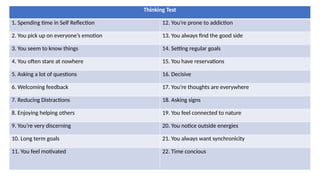
Thinking Test
1. Spending time in Self Reflection 12. You’re prone to addiction
2. You pick up on everyone’s emotion 13. You always find the good side
3. You seem to know things 14. Setting regular goals
4. You often stare at nowhere 15. You have reservations
5. Asking a lot of questions 16. Decisive
6. Welcoming feedback 17. You’re thoughts are everywhere
7. Reducing Distractions 18. Asking signs
8. Enjoying helping others 19. You feel connected to nature
9. You’re very discerning 20. You notice outside energies
10. Long term goals 21. You always want synchronicity
11. You feel motivated 22. Time concious
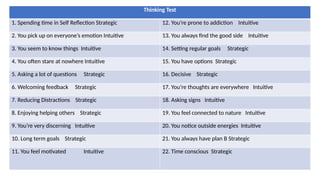
Thinking Test
1. Spending time in Self Reflection Strategic 12. You’re prone to addiction Intuitive
2. You pick up on everyone’s emotion Intuitive 13. You always find the good side Intuitive
3. You seem to know things Intuitive 14. Setting regular goals Strategic
4. You often stare at nowhere Intuitive 15. You have options Strategic
5. Asking a lot of questions Strategic 16. Decisive Strategic
6. Welcoming feedback Strategic 17. You’re thoughts are everywhere Intuitive
7. Reducing Distractions Strategic 18. Asking signs Intuitive
8. Enjoying helping others Strategic 19. You feel connected to nature Intuitive
9. You’re very discerning Intuitive 20. You notice outside energies Intuitive
10. Long term goals Strategic 21. You always have plan B Strategic
11. You feel motivated Intuitive 22. Time conscious Strategic
Strategic Thinking
Thinking that
enable you to use
critical thinking to
solve complex
problems and
plan for the
future.
Strategic
foresight
Strategic thinkers have the
ability to think ahead and
anticipate potential
problems. They know
having a backup plan (or
several) can help them pivot
quickly when things don’t go
as planned.
An
Inquisitive
mind:
•Strategic thinkers
aren’t afraid to
question or challenge
conventional thinking.
They know asking the
right question is as
important as finding
the right solution.
A
flexible
attitude
:
•Good strategists have the
ability to pivot when a
course of action isn’t
providing the intended
results. They’re also flexible
when it comes to
reassessing their own ideas
and assumptions as new
information comes to light
An
ability to
connect
the dots:
•Strategists have a knack
for identifying patterns
and making meaning out
of overarching trends.
An ability to
contextualize
information
•Thinking strategically
requires seeing
information through the
lens of the past, present,
and future to address
both short-term and long-
term goals.
4 Tips for Developing
Strategic Thinking Skills
You don’t have to be born
with a strategic mindset to
develop effective problem-
solving, decision-making,
and brainstorming skills.
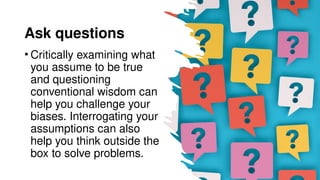
Ask questions
• Critically examining what
you assume to be true
and questioning
conventional wisdom can
help you challenge your
biases. Interrogating your
assumptions can also
help you think outside the
box to solve problems.
Take time to listen
• A skilled strategic
thinker listens before
making a move. When
working with a team,
consider everyone’s
point of view and
digest many
perspectives in order
to take a more
nuanced approach to
problem-solving.
Learn to prioritize
• Whether your goals are
personal or
professional, ranking
action items from most
to least important can
help you stay focused
on a course of action.
Reflect on what
worked and what
didn’t
• After you’ve executed
your plan, take time to
assess successes and
failures. What part of
the process worked
well that you’d like to
repeat next time? What
could be improved
upon?
Intuitive
Thinking
• Is basically the kind of
thinking that helps you
understand reality in the
moment, without logic or
analysis. There’s no
language involved in it,
either. It’s entirely about
signs and sensations.
Most of the time, it goes
against whatever we
might think of as
“rational”.
•According to science, intuitive thinking
happens in a region of our brain close to the
pineal gland. In other words, it lines up with
the middle of your forehead, between your
eyebrows. You can’t use intuitive thinking
whenever you want, though. It only shows up
in “moments of inspiration”. Plus, it really
works. It’s what some people call doctors’
“clinical eye” or being a “visionary”.
Emotional
intuitive
thinking
•Emotional intuitive
thinking. This has to
do with your ability to
immediately pick up on
other people’s
personality traits or
emotional states. You
can see who they are,
or how they are,
without them having to
say anything.
Mental
intuitive
thinking
•This is about finding
an immediate answer
to a problem, without
analyzing it. It’s very
common in people
with jobs that require
quick decisions, like
firefighters or bomb
technicians.
Psychic
intuitive
thinking
•This means having the
ability to choose the
best path to overcome
a personal difficulty,
without putting much
mental effort into it. It
also means being able
to pick up on social
and work-related
dynamics.
Spiritual
intuitive
thinking
•This has to do with
states of
“enlightenment” or
“revelations”.
They’re more of an
experience than a
fact. Buddhists talk
about this kind of
intuition more than
anyone else, which
has given it a
mystical quality.
Is it possible to improve your intuition?
It’s hard for a lot of us in the Western world to listen to our intuition.
We’re all blinded by rationality.
Not trusting yourself will also block your ability to think intuitively.
Let it flow more freely. One good strategy is taking note of the first thing
that comes to mind in any situation.
Afterward, you can look over your notes and see if your initial impression
was valid

Strategic and Intuitive Thinking TNCT.pptx

  • 1.
  • 3.
    Thinking Test 1. Spendingtime in Self Reflection 12. You’re prone to addiction 2. You pick up on everyone’s emotion 13. You always find the good side 3. You seem to know things 14. Setting regular goals 4. You often stare at nowhere 15. You have reservations 5. Asking a lot of questions 16. Decisive 6. Welcoming feedback 17. You’re thoughts are everywhere 7. Reducing Distractions 18. Asking signs 8. Enjoying helping others 19. You feel connected to nature 9. You’re very discerning 20. You notice outside energies 10. Long term goals 21. You always want synchronicity 11. You feel motivated 22. Time concious
  • 4.
    Thinking Test 1. Spendingtime in Self Reflection Strategic 12. You’re prone to addiction Intuitive 2. You pick up on everyone’s emotion Intuitive 13. You always find the good side Intuitive 3. You seem to know things Intuitive 14. Setting regular goals Strategic 4. You often stare at nowhere Intuitive 15. You have options Strategic 5. Asking a lot of questions Strategic 16. Decisive Strategic 6. Welcoming feedback Strategic 17. You’re thoughts are everywhere Intuitive 7. Reducing Distractions Strategic 18. Asking signs Intuitive 8. Enjoying helping others Strategic 19. You feel connected to nature Intuitive 9. You’re very discerning Intuitive 20. You notice outside energies Intuitive 10. Long term goals Strategic 21. You always have plan B Strategic 11. You feel motivated Intuitive 22. Time conscious Strategic
  • 5.
    Strategic Thinking Thinking that enableyou to use critical thinking to solve complex problems and plan for the future.
  • 7.
    Strategic foresight Strategic thinkers havethe ability to think ahead and anticipate potential problems. They know having a backup plan (or several) can help them pivot quickly when things don’t go as planned.
  • 8.
    An Inquisitive mind: •Strategic thinkers aren’t afraidto question or challenge conventional thinking. They know asking the right question is as important as finding the right solution.
  • 9.
    A flexible attitude : •Good strategists havethe ability to pivot when a course of action isn’t providing the intended results. They’re also flexible when it comes to reassessing their own ideas and assumptions as new information comes to light
  • 10.
    An ability to connect the dots: •Strategistshave a knack for identifying patterns and making meaning out of overarching trends.
  • 11.
    An ability to contextualize information •Thinkingstrategically requires seeing information through the lens of the past, present, and future to address both short-term and long- term goals.
  • 12.
    4 Tips forDeveloping Strategic Thinking Skills You don’t have to be born with a strategic mindset to develop effective problem- solving, decision-making, and brainstorming skills.
  • 13.
    Ask questions • Criticallyexamining what you assume to be true and questioning conventional wisdom can help you challenge your biases. Interrogating your assumptions can also help you think outside the box to solve problems.
  • 14.
    Take time tolisten • A skilled strategic thinker listens before making a move. When working with a team, consider everyone’s point of view and digest many perspectives in order to take a more nuanced approach to problem-solving.
  • 15.
    Learn to prioritize •Whether your goals are personal or professional, ranking action items from most to least important can help you stay focused on a course of action.
  • 16.
    Reflect on what workedand what didn’t • After you’ve executed your plan, take time to assess successes and failures. What part of the process worked well that you’d like to repeat next time? What could be improved upon?
  • 17.
    Intuitive Thinking • Is basicallythe kind of thinking that helps you understand reality in the moment, without logic or analysis. There’s no language involved in it, either. It’s entirely about signs and sensations. Most of the time, it goes against whatever we might think of as “rational”.
  • 19.
    •According to science,intuitive thinking happens in a region of our brain close to the pineal gland. In other words, it lines up with the middle of your forehead, between your eyebrows. You can’t use intuitive thinking whenever you want, though. It only shows up in “moments of inspiration”. Plus, it really works. It’s what some people call doctors’ “clinical eye” or being a “visionary”.
  • 20.
    Emotional intuitive thinking •Emotional intuitive thinking. Thishas to do with your ability to immediately pick up on other people’s personality traits or emotional states. You can see who they are, or how they are, without them having to say anything.
  • 21.
    Mental intuitive thinking •This is aboutfinding an immediate answer to a problem, without analyzing it. It’s very common in people with jobs that require quick decisions, like firefighters or bomb technicians.
  • 22.
    Psychic intuitive thinking •This means havingthe ability to choose the best path to overcome a personal difficulty, without putting much mental effort into it. It also means being able to pick up on social and work-related dynamics.
  • 23.
    Spiritual intuitive thinking •This has todo with states of “enlightenment” or “revelations”. They’re more of an experience than a fact. Buddhists talk about this kind of intuition more than anyone else, which has given it a mystical quality.
  • 24.
    Is it possibleto improve your intuition? It’s hard for a lot of us in the Western world to listen to our intuition. We’re all blinded by rationality. Not trusting yourself will also block your ability to think intuitively. Let it flow more freely. One good strategy is taking note of the first thing that comes to mind in any situation. Afterward, you can look over your notes and see if your initial impression was valid