Given Enough Monkeys
Some Thoughts on Randomness
Jesse Anderson |   CLOUDERA, INSTRUCTOR
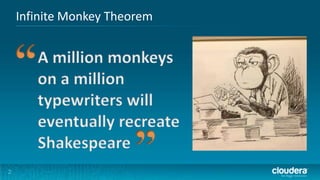
Infinite Monkey Theorem


2
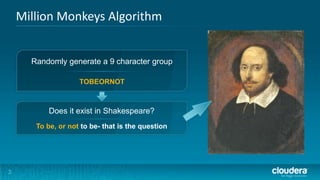
Million Monkeys Algorithm


      Randomly generate a 9 character group

                    TOBEORNOT


          Does it exist in Shakespeare?
       To be, or not to be- that is the question


3
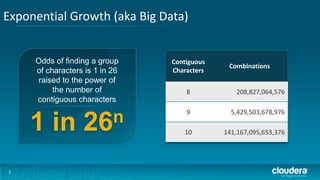
Exponential Growth (aka Big Data)


     Odds of finding a group    Contiguous
                                              Combinations
     of characters is 1 in 26   Characters
     raised to the power of
          the number of             8           208,827,064,576
     contiguous characters
                                    9          5,429,503,678,976

                                   10        141,167,095,653,376


4
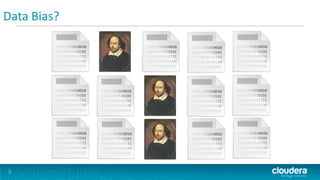
Data Bias?


5
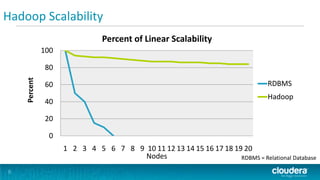
Hadoop Scalability
                               Percent of Linear Scalability
              100

              80
    Percent


              60                                                               RDBMS
                                                                               Hadoop
              40

              20

                0
                    1 2 3 4 5 6 7 8 9 10 11 12 13 14 15 16 17 18 19 20
                                      Nodes                        RDBMS = Relational Database

6
Business Value of Scalability


        Scaling does not require    Adding more computers
         massive re-engineering         to cluster gets a
        and complete rewrites of     predictable increase in
                  code             computational power and
                                             storage

         SAVE                        SAVE


7
Going Viral (and taking over the world)


      Covered internationally        26,000 unique
      in BBC, Wall Street            visits from 119
      Journal, Wired and             countries in
      Slashdot                       one day


8
@jessetanderson

Strata 2012 Million Monkeys

  • 1.
    Given Enough Monkeys SomeThoughts on Randomness Jesse Anderson | CLOUDERA, INSTRUCTOR
  • 2.
  • 3.
    Million Monkeys Algorithm Randomly generate a 9 character group TOBEORNOT Does it exist in Shakespeare? To be, or not to be- that is the question 3
  • 4.
    Exponential Growth (akaBig Data) Odds of finding a group Contiguous Combinations of characters is 1 in 26 Characters raised to the power of the number of 8 208,827,064,576 contiguous characters 9 5,429,503,678,976 10 141,167,095,653,376 4
  • 5.
  • 6.
    Hadoop Scalability Percent of Linear Scalability 100 80 Percent 60 RDBMS Hadoop 40 20 0 1 2 3 4 5 6 7 8 9 10 11 12 13 14 15 16 17 18 19 20 Nodes RDBMS = Relational Database 6
  • 7.
    Business Value ofScalability Scaling does not require Adding more computers massive re-engineering to cluster gets a and complete rewrites of predictable increase in code computational power and storage SAVE SAVE 7
  • 8.
    Going Viral (andtaking over the world) Covered internationally 26,000 unique in BBC, Wall Street visits from 119 Journal, Wired and countries in Slashdot one day 8
  • 9.

Editor's Notes

  • #3 Interesting statistical question. Thought about since Aristotle.Randomness+Resouces+Time=AnythingPossibleNo real monkeys – need virtual monkeys
  • #4 Lucky monkeyThe monkey wears a lot of hats. He generates and then compares.Every work of Shakespeare created. First was A Lover’s Complaint and last was Taming of the ShrewVisualization to find your favorite line from Shakespeare
  • #5 Shakespeare lazy. Heavily influenced English Literature.Big Data isn’t always a huge file. It can be high computation.
  • #6 Creating Shakespeare not a business. Don’t have Shakespeare in your data.If you look hard enough you will find itHumans are not randomYou want to be looking for what’s actually there. Check your assumptionsOperate with scientific method. Form a hypothesis. Test hypothesis against data.Offer what customers are looking for. Not what you think or favorite or new product. Only what your data shows.
  • #7 This is not a map of MT and ID1 to 20 node testingKeep efficiency up RDBMS efficiency in gutter
  • #8 Engineers not spending time coding to scale. Busy adding new features.No code changes for scaling. Took 1.5 months on one computer and 3.5 days on 20 nodesSpending on new computers gives a consistent, linear increase. Compare spending on RDBMS and Hadoop.
  • #10 We like to ask bigger questions.I asked if Shakespeare could be randomly recreated by a bunch of virtual monkeys? The answer is yes.