Introduction
to Big Data
Introduction to Big
Data
Topics
3
Scope: Big Data &
Analytics
• Foundation of Data Analytics and
Data Mining
• Hadoop/Map-Reduce Programming
and Data Processing &
BigTable/Hbase/Cassandra
• Graph Database and Graph
Analytics
Topics:
What’s Big Data?
No single definition;
here is from
Wikipedia:
Big data is the term
for a collection of
data sets so large and
complex that it
becomes difficult to
process using on-hand
database
management tools or
traditional data
processing
applications.
The challenges
include capture,
curation, storage,
search, sharing,
transfer, analysis, and
visualization.
The trend to larger
data sets is due to the
additional information
derivable from
analysis of a single
large set of related
data, as compared to
separate smaller sets
with the same total
amount of data,
allowing correlations
to be found to "spot
business trends,
determine quality of
research, prevent
diseases, link legal
citations, combat
crime, and determine
real-time roadway
traffic conditions.”
4
Big Data: 3V’s
5
6
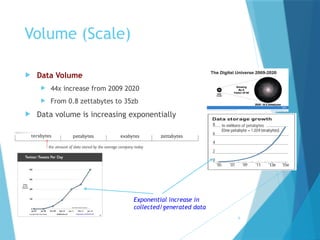
Volume (Scale)
 Data Volume
 44x increase from 2009 2020
 From 0.8 zettabytes to 35zb
 Data volume is increasing exponentially
Exponential increase in
collected/generated data
7
Volume (Scale)
 Data Volume
 44x increase from 2009 2020
 From 0.8 zettabytes to 35zb
 Data volume is increasing exponentially
Exponential increase in
collected/generated data
12+ TBs
of tweet data
every day
25+ TBs of
log data
every day
?
TBs
of
data
every
day
2+
billion
people on
the Web
by end
2011
30 billion RFID
tags today
(1.3B in 2005)
4.6
billion
camera
phones
world
wide
100s of
millions
of GPS
enabled
devices
sold
annually
76 million smart
meters in 2009…
200M by 2014
Maximilien Brice, © CERN
CERN’s Large Hydron Collider (LHC) generates 15 PB a year
The Earthscope
• The Earthscope is the world's largest science
project. Designed to track North America's
geological evolution, this observatory records
data over 3.8 million square miles, amassing 67
terabytes of data. It analyzes seismic slips in the
San Andreas fault, sure, but also the plume of
magma underneath Yellowstone and much, much
more.
(http://www.msnbc.msn.com/id/44363598/ns/t
echnology_and_science-future_of_technology/
#.TmetOdQ--uI)
11
Variety (Complexity)
 Relational Data (Tables/Transaction/Legacy Data)
 Text Data (Web)
 Semi-structured Data (XML)
 Graph Data
 Social Network, Semantic Web (RDF), …
 Streaming Data
 You can only scan the data once
 A single application can be generating/collecting many
types of data
 Big Public Data (online, weather, finance, etc)
To extract knowledge all these types
of data need to linked together
A Single View to the Customer
Customer
Social
Media
Gamin
g
Entertai
n
Bankin
g
Financ
e
Our
Known
History
Purchas
e
13
Velocity (Speed)
 Data is begin generated fast and need to be processed fast
 Online Data Analytics
 Late decisions  missing opportunities
 Examples
 E-Promotions: Based on your current location, your purchase
history, what you like  send promotions right now for store next
to you
 Healthcare monitoring: sensors monitoring your activities and
body  any abnormal measurements require immediate reaction
14
Real-time/Fast Data
 The progress and innovation is no longer hindered by the ability to collect data
 But, by the ability to manage, analyze, summarize, visualize, and discover knowledge
from the collected data in a timely manner and in a scalable fashion
Social media and networks
(all of us are generating data)
Scientific instruments
(collecting all sorts of data)
Mobile devices
(tracking all objects all the time)
Sensor technology and
networks
(measuring all kinds of data)
Real-Time Analytics/Decision Requirement
Customer
Influence
Behavior
Product
Recommendations
that are Relevant
& Compelling
Friend Invitations
to join a
Game or Activity
that expands
business
Preventing Fraud
as it is Occurring
& preventing more
proactively
Learning why Customers
Switch to competitors
and their offers; in
time to Counter
Improving the
Marketing
Effectiveness of a
Promotion while it
is still in Play
16
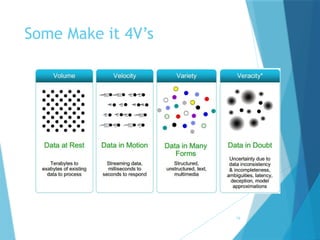
Some Make it 4V’s
17
Harnessing Big Data
 OLTP: Online Transaction Processing (DBMSs)
 OLAP: Online Analytical Processing (Data Warehousing)
 RTAP: Real-Time Analytics Processing (Big Data Architecture & technology)
18
The Model Has Changed…
 The Model of Generating/Consuming Data has Changed
Old Model: Few companies are generating data, all others are consuming data
New Model: all of us are generating data, and all of us are consuming
data
19
What’s driving Big Data
- Ad-hoc querying and reporting
- Data mining techniques
- Structured data, typical sources
- Small to mid-size datasets
- Optimizations and predictive analytics
- Complex statistical analysis
- All types of data, and many sources
- Very large datasets
- More of a real-time
Big Data:
Batch Processing &
Distributed Data
Store
Hadoop/Spark;
HBase/Cassandra
BI Reporting
OLAP &
Dataware house
Business Objects, SAS,
Informatica, Cognos other
SQL Reporting Tools
Interactive
Business
Intelligence &
In-memory RDBMS
QliqView, Tableau, HANA
Big Data:
Real Time &
Single View
Graph Databases
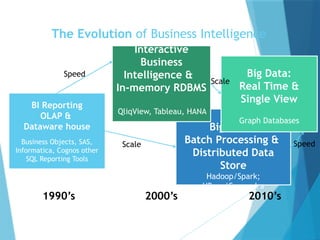
The Evolution of Business Intelligence
1990’s 2000’s 2010’s
Speed
Scale
Scale
Speed
21
Big Data Analytics
 Big data is more real-time in
nature than traditional DW
applications
 Traditional DW architectures
(e.g. Exadata, Teradata) are not
well-suited for big data apps
 Shared nothing, massively
parallel processing, scale out
architectures are well-suited for
big data apps
23
Big Data Technology
Cloud Computing
 IT resources provided as a service
 Compute, storage, databases, queues
 Clouds leverage economies of scale of commodity
hardware
 Cheap storage, high bandwidth networks & multicore
processors
 Geographically distributed data centers
 Offerings from Microsoft, Amazon, Google, …
wikipedia:Cloud Computing
Benefits
 Cost & management
 Economies of scale, “out-sourced” resource management
 Reduced Time to deployment
 Ease of assembly, works “out of the box”
 Scaling
 On demand provisioning, co-locate data and compute
 Reliability
 Massive, redundant, shared resources
 Sustainability
 Hardware not owned
Types of Cloud Computing
 Public Cloud: Computing infrastructure is hosted at the
vendor’s premises.
 Private Cloud: Computing architecture is dedicated to
the customer and is not shared with other organisations.
 Hybrid Cloud: Organisations host some critical, secure
applications in private clouds. The not so critical
applications are hosted in the public cloud
 Cloud bursting: the organisation uses its own infrastructure for
normal usage, but cloud is used for peak loads.
 Community Cloud
Classification of Cloud Computing
based on Service Provided
 Infrastructure as a service (IaaS)
 Offering hardware related services using the principles of cloud computing. These could include storage services (database or disk
storage) or virtual servers.
 Amazon EC2, Amazon S3, Rackspace Cloud Servers and Flexiscale.
 Platform as a Service (PaaS)
 Offering a development platform on the cloud.
 Google’s Application Engine, Microsofts Azure, Salesforce.com’s
force.com .
 Software as a service (SaaS)
 Including a complete software offering on the cloud. Users can
access a software application hosted by the cloud vendor on pay-
per-use basis. This is a well-established sector.
 Salesforce.coms’ offering in the online Customer Relationship
Management (CRM) space, Googles gmail and Microsofts hotmail,
Google docs.
Infrastructure as a Service
(IaaS)
More Refined Categorization
 Storage-as-a-service
 Database-as-a-service
 Information-as-a-service
 Process-as-a-service
 Application-as-a-service
 Platform-as-a-service
 Integration-as-a-service
 Security-as-a-service
 Management/
Governance-as-a-service
 Testing-as-a-service
 Infrastructure-as-a-service
InfoWorld Cloud Computing Deep Dive
Key Ingredients in Cloud
Computing
 Service-Oriented Architecture (SOA)
 Utility Computing (on demand)
 Virtualization (P2P Network)
 SAAS (Software As A Service)
 PAAS (Platform AS A Service)
 IAAS (Infrastructure AS A Servie)
 Web Services in Cloud
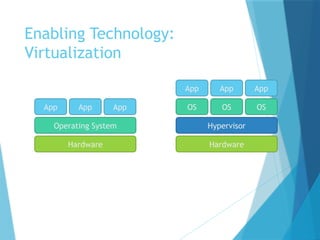
Enabling Technology:
Virtualization
Hardware
Operating System
App App App
Traditional Stack
Hardware
OS
App App App
Hypervisor
OS OS
Virtualized Stack
Everything as a Service
 Utility computing = Infrastructure as a Service (IaaS)
 Why buy machines when you can rent cycles?
 Examples: Amazon’s EC2, Rackspace
 Platform as a Service (PaaS)
 Give me nice API and take care of the maintenance, upgrades, …
 Example: Google App Engine
 Software as a Service (SaaS)
 Just run it for me!
 Example: Gmail, Salesforce
Cloud versus cloud
 Amazon Elastic Compute Cloud
 Google App Engine
 Microsoft Azure
 GoGrid
 AppNexus
The Obligatory Timeline Slide
(Mike Culver @ AWS)
COBOL,
Edsel
1959
1969
1982
1996
Amazon.com
2004
2006
Darkness
Web as a
Platform
Web Services,
Resources Eliminated
Web
Awareness
Internet
ARPANET
Dot-Com Bubble Web 2.0 Web Scale
Computing
2001
1997
AWS
 Elastic Compute Cloud – EC2 (IaaS)
 Simple Storage Service – S3 (IaaS)
 Elastic Block Storage – EBS (IaaS)
 SimpleDB (SDB) (PaaS)
 Simple Queue Service – SQS (PaaS)
 CloudFront (S3 based Content Delivery Network – PaaS)
 Consistent AWS Web Services API
What does Azure platform offer to developers?
Service
Bus
Access
Control
Workflow
…
Database
Reporting
Analytics
…
Compute Storage Manage
Identity
Devices
Contacts
…
…
…
Your Applications
Google’s AppEngine vs Amazon’s EC2
AppEngine:
 Higher-level functionality
(e.g., automatic scaling)
 More restrictive
(e.g., respond to URL only)
 Proprietary lock-in
EC2/S3:
 Lower-level functionality
 More flexible
 Coarser billing model
June 3, 2008
Google AppEngine vs. Amazon EC2/S3 Slide 38
VMs - Flat File Storage
Python
BigTable
Other API’s
Topics
Overview
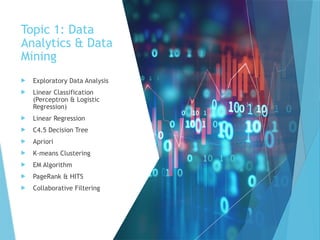
Topic 1: Data
Analytics & Data
Mining
 Exploratory Data Analysis
 Linear Classification
(Perceptron & Logistic
Regression)
 Linear Regression
 C4.5 Decision Tree
 Apriori
 K-means Clustering
 EM Algorithm
 PageRank & HITS
 Collaborative Filtering
Topic 2: Hadoop/MapReduce
Programming & Data Processing
ARCHITECTURE OF
HADOOP
, HDFS, AND
YARN
PROGRAMMING ON
HADOOP
BASIC DATA
PROCESSING: SORT
AND JOIN
INFORMATION
RETRIEVAL USING
HADOOP
DATA MINING USING
HADOOP
(KMEANS+HISTOGRAMS
)
MACHINE LEARNING
ON HADOOP (EM)
HIVE/PIG HBASE AND
CASSANDRA
Topic 3: Graph Database and
Graph Analytics
 Graph Database (http://en.wikipedia.org/wiki/Graph_database)
 Native Graph Database (Neo4j)
 Pregel/Giraph (Distributed Graph Processing Engine)
 Neo4j/Titan/GraphLab/GraphSQL
Textbooks
• No Official Textbooks
• References:
• Hadoop: The Definitive Guide, Tom White, O’Reilly
• Hadoop In Action, Chuck Lam, Manning
• Data-Intensive Text Processing with MapReduce, Jimmy Lin and Chris Dyer (
www.umiacs.umd.edu/~jimmylin/MapReduce-book-final.pdf)
• Data Mining: Concepts and Techniques, Third Edition, by Jiawei Han et al.
 Many Online Tutorials and Papers
43
Cloud Resources
 Hadoop on your local machine
 Hadoop in a virtual machine on your local machine
(Pseudo-Distributed on Ubuntu)
 Hadoop in the clouds with Amazon EC2

Big Data Analytics PPT - S1 working .pptx

  • 1.
  • 2.
  • 3.
    Topics 3 Scope: Big Data& Analytics • Foundation of Data Analytics and Data Mining • Hadoop/Map-Reduce Programming and Data Processing & BigTable/Hbase/Cassandra • Graph Database and Graph Analytics Topics:
  • 4.
    What’s Big Data? Nosingle definition; here is from Wikipedia: Big data is the term for a collection of data sets so large and complex that it becomes difficult to process using on-hand database management tools or traditional data processing applications. The challenges include capture, curation, storage, search, sharing, transfer, analysis, and visualization. The trend to larger data sets is due to the additional information derivable from analysis of a single large set of related data, as compared to separate smaller sets with the same total amount of data, allowing correlations to be found to "spot business trends, determine quality of research, prevent diseases, link legal citations, combat crime, and determine real-time roadway traffic conditions.” 4
  • 5.
  • 6.
    6 Volume (Scale)  DataVolume  44x increase from 2009 2020  From 0.8 zettabytes to 35zb  Data volume is increasing exponentially Exponential increase in collected/generated data
  • 7.
    7 Volume (Scale)  DataVolume  44x increase from 2009 2020  From 0.8 zettabytes to 35zb  Data volume is increasing exponentially Exponential increase in collected/generated data
  • 8.
    12+ TBs of tweetdata every day 25+ TBs of log data every day ? TBs of data every day 2+ billion people on the Web by end 2011 30 billion RFID tags today (1.3B in 2005) 4.6 billion camera phones world wide 100s of millions of GPS enabled devices sold annually 76 million smart meters in 2009… 200M by 2014
  • 9.
    Maximilien Brice, ©CERN CERN’s Large Hydron Collider (LHC) generates 15 PB a year
  • 10.
    The Earthscope • TheEarthscope is the world's largest science project. Designed to track North America's geological evolution, this observatory records data over 3.8 million square miles, amassing 67 terabytes of data. It analyzes seismic slips in the San Andreas fault, sure, but also the plume of magma underneath Yellowstone and much, much more. (http://www.msnbc.msn.com/id/44363598/ns/t echnology_and_science-future_of_technology/ #.TmetOdQ--uI)
  • 11.
    11 Variety (Complexity)  RelationalData (Tables/Transaction/Legacy Data)  Text Data (Web)  Semi-structured Data (XML)  Graph Data  Social Network, Semantic Web (RDF), …  Streaming Data  You can only scan the data once  A single application can be generating/collecting many types of data  Big Public Data (online, weather, finance, etc) To extract knowledge all these types of data need to linked together
  • 12.
    A Single Viewto the Customer Customer Social Media Gamin g Entertai n Bankin g Financ e Our Known History Purchas e
  • 13.
    13 Velocity (Speed)  Datais begin generated fast and need to be processed fast  Online Data Analytics  Late decisions  missing opportunities  Examples  E-Promotions: Based on your current location, your purchase history, what you like  send promotions right now for store next to you  Healthcare monitoring: sensors monitoring your activities and body  any abnormal measurements require immediate reaction
  • 14.
    14 Real-time/Fast Data  Theprogress and innovation is no longer hindered by the ability to collect data  But, by the ability to manage, analyze, summarize, visualize, and discover knowledge from the collected data in a timely manner and in a scalable fashion Social media and networks (all of us are generating data) Scientific instruments (collecting all sorts of data) Mobile devices (tracking all objects all the time) Sensor technology and networks (measuring all kinds of data)
  • 15.
    Real-Time Analytics/Decision Requirement Customer Influence Behavior Product Recommendations thatare Relevant & Compelling Friend Invitations to join a Game or Activity that expands business Preventing Fraud as it is Occurring & preventing more proactively Learning why Customers Switch to competitors and their offers; in time to Counter Improving the Marketing Effectiveness of a Promotion while it is still in Play
  • 16.
  • 17.
    17 Harnessing Big Data OLTP: Online Transaction Processing (DBMSs)  OLAP: Online Analytical Processing (Data Warehousing)  RTAP: Real-Time Analytics Processing (Big Data Architecture & technology)
  • 18.
    18 The Model HasChanged…  The Model of Generating/Consuming Data has Changed Old Model: Few companies are generating data, all others are consuming data New Model: all of us are generating data, and all of us are consuming data
  • 19.
    19 What’s driving BigData - Ad-hoc querying and reporting - Data mining techniques - Structured data, typical sources - Small to mid-size datasets - Optimizations and predictive analytics - Complex statistical analysis - All types of data, and many sources - Very large datasets - More of a real-time
  • 20.
    Big Data: Batch Processing& Distributed Data Store Hadoop/Spark; HBase/Cassandra BI Reporting OLAP & Dataware house Business Objects, SAS, Informatica, Cognos other SQL Reporting Tools Interactive Business Intelligence & In-memory RDBMS QliqView, Tableau, HANA Big Data: Real Time & Single View Graph Databases The Evolution of Business Intelligence 1990’s 2000’s 2010’s Speed Scale Scale Speed
  • 21.
    21 Big Data Analytics Big data is more real-time in nature than traditional DW applications  Traditional DW architectures (e.g. Exadata, Teradata) are not well-suited for big data apps  Shared nothing, massively parallel processing, scale out architectures are well-suited for big data apps
  • 23.
  • 24.
    Cloud Computing  ITresources provided as a service  Compute, storage, databases, queues  Clouds leverage economies of scale of commodity hardware  Cheap storage, high bandwidth networks & multicore processors  Geographically distributed data centers  Offerings from Microsoft, Amazon, Google, …
  • 25.
  • 26.
    Benefits  Cost &management  Economies of scale, “out-sourced” resource management  Reduced Time to deployment  Ease of assembly, works “out of the box”  Scaling  On demand provisioning, co-locate data and compute  Reliability  Massive, redundant, shared resources  Sustainability  Hardware not owned
  • 27.
    Types of CloudComputing  Public Cloud: Computing infrastructure is hosted at the vendor’s premises.  Private Cloud: Computing architecture is dedicated to the customer and is not shared with other organisations.  Hybrid Cloud: Organisations host some critical, secure applications in private clouds. The not so critical applications are hosted in the public cloud  Cloud bursting: the organisation uses its own infrastructure for normal usage, but cloud is used for peak loads.  Community Cloud
  • 28.
    Classification of CloudComputing based on Service Provided  Infrastructure as a service (IaaS)  Offering hardware related services using the principles of cloud computing. These could include storage services (database or disk storage) or virtual servers.  Amazon EC2, Amazon S3, Rackspace Cloud Servers and Flexiscale.  Platform as a Service (PaaS)  Offering a development platform on the cloud.  Google’s Application Engine, Microsofts Azure, Salesforce.com’s force.com .  Software as a service (SaaS)  Including a complete software offering on the cloud. Users can access a software application hosted by the cloud vendor on pay- per-use basis. This is a well-established sector.  Salesforce.coms’ offering in the online Customer Relationship Management (CRM) space, Googles gmail and Microsofts hotmail, Google docs.
  • 29.
    Infrastructure as aService (IaaS)
  • 30.
    More Refined Categorization Storage-as-a-service  Database-as-a-service  Information-as-a-service  Process-as-a-service  Application-as-a-service  Platform-as-a-service  Integration-as-a-service  Security-as-a-service  Management/ Governance-as-a-service  Testing-as-a-service  Infrastructure-as-a-service InfoWorld Cloud Computing Deep Dive
  • 31.
    Key Ingredients inCloud Computing  Service-Oriented Architecture (SOA)  Utility Computing (on demand)  Virtualization (P2P Network)  SAAS (Software As A Service)  PAAS (Platform AS A Service)  IAAS (Infrastructure AS A Servie)  Web Services in Cloud
  • 32.
    Enabling Technology: Virtualization Hardware Operating System AppApp App Traditional Stack Hardware OS App App App Hypervisor OS OS Virtualized Stack
  • 33.
    Everything as aService  Utility computing = Infrastructure as a Service (IaaS)  Why buy machines when you can rent cycles?  Examples: Amazon’s EC2, Rackspace  Platform as a Service (PaaS)  Give me nice API and take care of the maintenance, upgrades, …  Example: Google App Engine  Software as a Service (SaaS)  Just run it for me!  Example: Gmail, Salesforce
  • 34.
    Cloud versus cloud Amazon Elastic Compute Cloud  Google App Engine  Microsoft Azure  GoGrid  AppNexus
  • 35.
    The Obligatory TimelineSlide (Mike Culver @ AWS) COBOL, Edsel 1959 1969 1982 1996 Amazon.com 2004 2006 Darkness Web as a Platform Web Services, Resources Eliminated Web Awareness Internet ARPANET Dot-Com Bubble Web 2.0 Web Scale Computing 2001 1997
  • 36.
    AWS  Elastic ComputeCloud – EC2 (IaaS)  Simple Storage Service – S3 (IaaS)  Elastic Block Storage – EBS (IaaS)  SimpleDB (SDB) (PaaS)  Simple Queue Service – SQS (PaaS)  CloudFront (S3 based Content Delivery Network – PaaS)  Consistent AWS Web Services API
  • 37.
    What does Azureplatform offer to developers? Service Bus Access Control Workflow … Database Reporting Analytics … Compute Storage Manage Identity Devices Contacts … … … Your Applications
  • 38.
    Google’s AppEngine vsAmazon’s EC2 AppEngine:  Higher-level functionality (e.g., automatic scaling)  More restrictive (e.g., respond to URL only)  Proprietary lock-in EC2/S3:  Lower-level functionality  More flexible  Coarser billing model June 3, 2008 Google AppEngine vs. Amazon EC2/S3 Slide 38 VMs - Flat File Storage Python BigTable Other API’s
  • 39.
  • 40.
    Topic 1: Data Analytics& Data Mining  Exploratory Data Analysis  Linear Classification (Perceptron & Logistic Regression)  Linear Regression  C4.5 Decision Tree  Apriori  K-means Clustering  EM Algorithm  PageRank & HITS  Collaborative Filtering
  • 41.
    Topic 2: Hadoop/MapReduce Programming& Data Processing ARCHITECTURE OF HADOOP , HDFS, AND YARN PROGRAMMING ON HADOOP BASIC DATA PROCESSING: SORT AND JOIN INFORMATION RETRIEVAL USING HADOOP DATA MINING USING HADOOP (KMEANS+HISTOGRAMS ) MACHINE LEARNING ON HADOOP (EM) HIVE/PIG HBASE AND CASSANDRA
  • 42.
    Topic 3: GraphDatabase and Graph Analytics  Graph Database (http://en.wikipedia.org/wiki/Graph_database)  Native Graph Database (Neo4j)  Pregel/Giraph (Distributed Graph Processing Engine)  Neo4j/Titan/GraphLab/GraphSQL
  • 43.
    Textbooks • No OfficialTextbooks • References: • Hadoop: The Definitive Guide, Tom White, O’Reilly • Hadoop In Action, Chuck Lam, Manning • Data-Intensive Text Processing with MapReduce, Jimmy Lin and Chris Dyer ( www.umiacs.umd.edu/~jimmylin/MapReduce-book-final.pdf) • Data Mining: Concepts and Techniques, Third Edition, by Jiawei Han et al.  Many Online Tutorials and Papers 43
  • 44.
    Cloud Resources  Hadoopon your local machine  Hadoop in a virtual machine on your local machine (Pseudo-Distributed on Ubuntu)  Hadoop in the clouds with Amazon EC2