STOP PLACEMENT
INDEX
1. Stop Placement
2. Inexperienced Traders
3. Trading Plan
4. Risk Tolerance
5. Fundamental Trades
STOP PLACEMENT
 Stops are a crucial, very important tool in trading.
 They allow us as traders to control the amount we
risk on a given trade and often prevent a loss from
spiraling out of control.
 It is such an important discipline when trading that I
can’t imagine placing a trade without a stop.
 Given, that my style is to assess risk before even
placing a trade, entering a stop is just completely
an automatic discipline.
INEXPERIENCED TRADERS
 Inexperienced traders will often trade without stops.
 When you try to find out their reasons, it is difficult
to understand other than there is fear that if they
place a stop and are “STOPPED OUT” it is an
admission of being wrong.
 Traders are wrong all the time. You simply cannot
operate at a 100% profitable trades rate.
 New traders learn to place stops after a few big
losses so this initial approach is soon rectified.
TRADING PLAN
 When placing a stop (I have written about this in
several TRADER TOPIC sections of the PREMIUM
SERVICE blog over the past few weeks) it is vital
that it is done on the basis that the stop level and
the risk tolerance involved is within your TRADING
PLAN guidelines.
 I have started to talk about MICRO versus MINI
versus STANDARD when it comes to lot sizes and
will add more on this subject in the coming weeks
when I write about brokers and how many to use
and for what reasons.
 Basically the stop is based on one or more of the
following parameters:
1. Previous High or Low
2. Round Numbers
3. Average True Range (ATR)
4. Pivot points
5. Fibonacci level.
 Each currency pair trades at a different volume and
therefore it is not a standard amount of pips for
each stop.
 Research is required and risk is assessed before
the trade is placed.
 So you will know before placing a trade.
RISK TOLERANCE
1. The Pair you are going to trade.
2. Examine the RISK TOLERANCE you have via your
TRADING PLAN
3. Check where the entry and exit levels should be.
(Fibonacci Level, Pivot Point, Trend Line Support or
Resistance) I always add a few pips +10/+20 depending
upon the pair to cover stop loss runs to the levels
chosen.
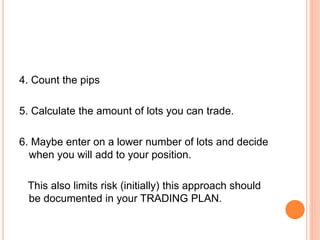
4. Count the pips
5. Calculate the amount of lots you can trade.
6. Maybe enter on a lower number of lots and decide
when you will add to your position.
This also limits risk (initially) this approach should
be documented in your TRADING PLAN.
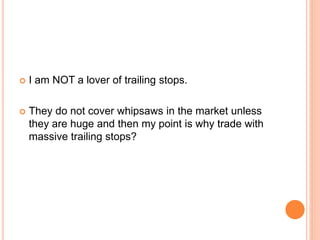
 I am NOT a lover of trailing stops.
 They do not cover whipsaws in the market unless
they are huge and then my point is why trade with
massive trailing stops?
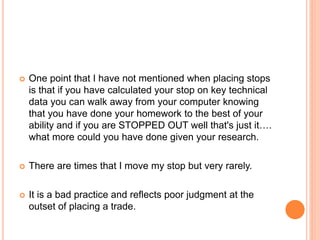
 One point that I have not mentioned when placing stops
is that if you have calculated your stop on key technical
data you can walk away from your computer knowing
that you have done your homework to the best of your
ability and if you are STOPPED OUT well that's just it….
what more could you have done given your research.
 There are times that I move my stop but very rarely.
 It is a bad practice and reflects poor judgment at the
outset of placing a trade.
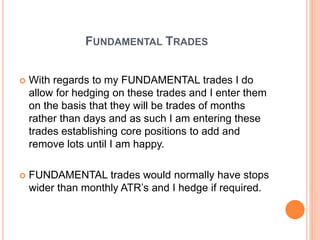
FUNDAMENTAL TRADES
 With regards to my FUNDAMENTAL trades I do
allow for hedging on these trades and I enter them
on the basis that they will be trades of months
rather than days and as such I am entering these
trades establishing core positions to add and
remove lots until I am happy.
 FUNDAMENTAL trades would normally have stops
wider than monthly ATR’s and I hedge if required.
 When I place the vast majority of my stops, I will
primarily use Fibonacci levels and/or Pivot points.
 Some other thoughts weigh in (depending upon the
currency pair) such as significant highs/lows and
trend lines.
 Trend lines are great and chart patterns around
trend lines.
 More often than not Fibonacci levels offer great
placing of stops levels, but not all the time.
 The thing to do is not to get too subjective when
placing stops.
 Being objective is more important
 Setting stops is not always easy, and being honest
it is the most subjective aspect of our trading
methodology.
 I hope that this short piece shed some light on what
I look for when placing stops.
THANK YOU

Stop Placement

  • 1.
  • 2.
    INDEX 1. Stop Placement 2.Inexperienced Traders 3. Trading Plan 4. Risk Tolerance 5. Fundamental Trades
  • 4.
    STOP PLACEMENT  Stopsare a crucial, very important tool in trading.  They allow us as traders to control the amount we risk on a given trade and often prevent a loss from spiraling out of control.
  • 5.
     It issuch an important discipline when trading that I can’t imagine placing a trade without a stop.  Given, that my style is to assess risk before even placing a trade, entering a stop is just completely an automatic discipline.
  • 6.
    INEXPERIENCED TRADERS  Inexperiencedtraders will often trade without stops.  When you try to find out their reasons, it is difficult to understand other than there is fear that if they place a stop and are “STOPPED OUT” it is an admission of being wrong.
  • 7.
     Traders arewrong all the time. You simply cannot operate at a 100% profitable trades rate.  New traders learn to place stops after a few big losses so this initial approach is soon rectified.
  • 8.
    TRADING PLAN  Whenplacing a stop (I have written about this in several TRADER TOPIC sections of the PREMIUM SERVICE blog over the past few weeks) it is vital that it is done on the basis that the stop level and the risk tolerance involved is within your TRADING PLAN guidelines.  I have started to talk about MICRO versus MINI versus STANDARD when it comes to lot sizes and will add more on this subject in the coming weeks when I write about brokers and how many to use and for what reasons.
  • 9.
     Basically thestop is based on one or more of the following parameters: 1. Previous High or Low 2. Round Numbers 3. Average True Range (ATR) 4. Pivot points 5. Fibonacci level.
  • 10.
     Each currencypair trades at a different volume and therefore it is not a standard amount of pips for each stop.  Research is required and risk is assessed before the trade is placed.  So you will know before placing a trade.
  • 11.
    RISK TOLERANCE 1. ThePair you are going to trade. 2. Examine the RISK TOLERANCE you have via your TRADING PLAN 3. Check where the entry and exit levels should be. (Fibonacci Level, Pivot Point, Trend Line Support or Resistance) I always add a few pips +10/+20 depending upon the pair to cover stop loss runs to the levels chosen.
  • 12.
    4. Count thepips 5. Calculate the amount of lots you can trade. 6. Maybe enter on a lower number of lots and decide when you will add to your position. This also limits risk (initially) this approach should be documented in your TRADING PLAN.
  • 13.
     I amNOT a lover of trailing stops.  They do not cover whipsaws in the market unless they are huge and then my point is why trade with massive trailing stops?
  • 14.
     One pointthat I have not mentioned when placing stops is that if you have calculated your stop on key technical data you can walk away from your computer knowing that you have done your homework to the best of your ability and if you are STOPPED OUT well that's just it…. what more could you have done given your research.  There are times that I move my stop but very rarely.  It is a bad practice and reflects poor judgment at the outset of placing a trade.
  • 15.
    FUNDAMENTAL TRADES  Withregards to my FUNDAMENTAL trades I do allow for hedging on these trades and I enter them on the basis that they will be trades of months rather than days and as such I am entering these trades establishing core positions to add and remove lots until I am happy.  FUNDAMENTAL trades would normally have stops wider than monthly ATR’s and I hedge if required.
  • 16.
     When Iplace the vast majority of my stops, I will primarily use Fibonacci levels and/or Pivot points.  Some other thoughts weigh in (depending upon the currency pair) such as significant highs/lows and trend lines.  Trend lines are great and chart patterns around trend lines.
  • 17.
     More oftenthan not Fibonacci levels offer great placing of stops levels, but not all the time.  The thing to do is not to get too subjective when placing stops.  Being objective is more important
  • 18.
     Setting stopsis not always easy, and being honest it is the most subjective aspect of our trading methodology.  I hope that this short piece shed some light on what I look for when placing stops.
  • 19.