Stereotypes
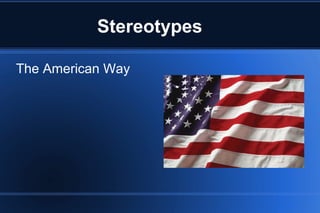
The American Way
How do Americans perceive
other Ethnic Groups?
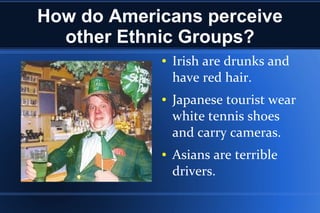
● Irish are drunks and
have red hair.
● Japanese tourist wear
white tennis shoes
and carry cameras.
● Asians are terrible
drivers.
How do Americans perceive
other Ethnic Groups?
● Jewish are misers
and greedy.
● Mexicans are lazy
and illegal
● British are dull and
boring.
How do Americans perceive
other Ethnic Groups?
● Middle Easterners
are muslims and
violent.
Why do we stereotype?
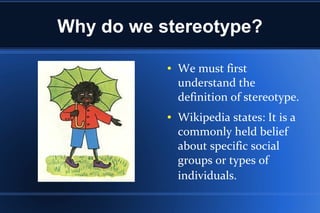
● We must first
understand the
definition of stereotype.
● Wikipedia states: It is a
commonly held belief
about specific social
groups or types of
individuals.
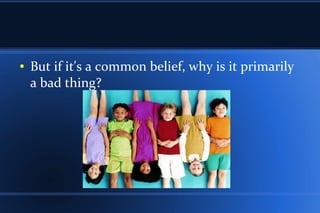
● But if it's a common belief, why is it primarily
a bad thing?
How are Americans Perceived?
● Let's turn the tables for a moment and think
about how Americans are perceived?
● Americans are rich, have no family values nor
morals. Americans are hypocritical and all
their women are promiscuous.
Perception of Americans
●
Is that an accurateIs that an accurate
depiction, or yet anotherdepiction, or yet another
stereotypical analysis ofstereotypical analysis of
a culture?a culture?
●
Are you offended?Are you offended?
●
How do you think otherHow do you think other
ethnic groups feel whenethnic groups feel when
we stereotype them?we stereotype them?
● We as humans have a need to
categorize things. It helps us to
understand our world.
● To help us understand people,
whether from our own society
or different ethnic or cultural
groups, we focus on similarities
whether it's real or imagined.
This provides an explanation
whether accurate or inaccurate
for behavior.
Fundamental Attribution Error
Fundamental Attribution
Error is a form of reasoning
that is common around the
world
● Can possibly occur when either
we or someone else has done
something that needs to be
explained.
● Particularly strong when an
action is seen as negative or
strange.
● We expect and look for
certain things when
something is reinforced in
our minds causing us to
stereotype.
● Stereotypes are not learned
just from personal
experience but also from
family, friends, mass media
and co-workers.
Points of Variance
● When speaking of
stereotypes there are
five major
dimensions:
● Direction
● Intensity
● Specificity
● Consensus
● Accuracy
Direction
● Pretty
● Hardworking
● Intelligent
● Stupid
● Lazy
● Slow
● Whether the
stereotype is
Positive or Negative
Intensity
● The intensity of a stereotype is
based on how strong the belief
and the strength of various
experiences.
One person wrote:
● 99.9% of Americans assume every
Arkansan looks like this
● I don't know how many times I've been
asked by people online if I wear shoes, or
wanted to marry my cousin, and I wasn't
even born in this state. The stereotype
gets so old.
Specificity
● Relates to the nature of the
stereotype, whether vague or
specific.
● An example might be a very
loud group.
● Or policeman who visit donut
shops.
Consensus
● Within a community,
consensus is how
well a stereotype is
known or accepted.
Accuracy
● How accurate the stereotype is when describing the other group.
● There are always exceptions to the rules and can be open to
inaccuracies and misunderstandings.
● From a statistical standpoint, sociotype, which is a specific type of
stereotyping is quite accurate.
Stereotyping-The American Way
● Everyone stereotypes, it's the way we make sense of our world.
We tend to group things together and categorize them, and those
turn into stereotypes.
● What we need to remember then is that we need to remain open,
manage stereotypes in productive ways by:
● Making them more accurate
● Keeping them open to refinement
● Allowing for individual differences.
● Stereotyping is our way of understanding and making sense of
differences that are perceived in others.
Stereotypes

Stereotypes

  • 1.
  • 2.
    How do Americansperceive other Ethnic Groups? ● Irish are drunks and have red hair. ● Japanese tourist wear white tennis shoes and carry cameras. ● Asians are terrible drivers.
  • 3.
    How do Americansperceive other Ethnic Groups? ● Jewish are misers and greedy. ● Mexicans are lazy and illegal ● British are dull and boring.
  • 4.
    How do Americansperceive other Ethnic Groups? ● Middle Easterners are muslims and violent.
  • 5.
    Why do westereotype? ● We must first understand the definition of stereotype. ● Wikipedia states: It is a commonly held belief about specific social groups or types of individuals.
  • 6.
    ● But ifit's a common belief, why is it primarily a bad thing?
  • 7.
    How are AmericansPerceived? ● Let's turn the tables for a moment and think about how Americans are perceived? ● Americans are rich, have no family values nor morals. Americans are hypocritical and all their women are promiscuous.
  • 8.
    Perception of Americans ● Isthat an accurateIs that an accurate depiction, or yet anotherdepiction, or yet another stereotypical analysis ofstereotypical analysis of a culture?a culture? ● Are you offended?Are you offended? ● How do you think otherHow do you think other ethnic groups feel whenethnic groups feel when we stereotype them?we stereotype them?
  • 9.
    ● We ashumans have a need to categorize things. It helps us to understand our world. ● To help us understand people, whether from our own society or different ethnic or cultural groups, we focus on similarities whether it's real or imagined. This provides an explanation whether accurate or inaccurate for behavior.
  • 10.
    Fundamental Attribution Error FundamentalAttribution Error is a form of reasoning that is common around the world ● Can possibly occur when either we or someone else has done something that needs to be explained. ● Particularly strong when an action is seen as negative or strange. ● We expect and look for certain things when something is reinforced in our minds causing us to stereotype. ● Stereotypes are not learned just from personal experience but also from family, friends, mass media and co-workers.
  • 11.
    Points of Variance ●When speaking of stereotypes there are five major dimensions: ● Direction ● Intensity ● Specificity ● Consensus ● Accuracy
  • 12.
    Direction ● Pretty ● Hardworking ●Intelligent ● Stupid ● Lazy ● Slow ● Whether the stereotype is Positive or Negative
  • 13.
    Intensity ● The intensityof a stereotype is based on how strong the belief and the strength of various experiences. One person wrote: ● 99.9% of Americans assume every Arkansan looks like this ● I don't know how many times I've been asked by people online if I wear shoes, or wanted to marry my cousin, and I wasn't even born in this state. The stereotype gets so old.
  • 14.
    Specificity ● Relates tothe nature of the stereotype, whether vague or specific. ● An example might be a very loud group. ● Or policeman who visit donut shops.
  • 15.
    Consensus ● Within acommunity, consensus is how well a stereotype is known or accepted.
  • 16.
    Accuracy ● How accuratethe stereotype is when describing the other group. ● There are always exceptions to the rules and can be open to inaccuracies and misunderstandings. ● From a statistical standpoint, sociotype, which is a specific type of stereotyping is quite accurate.
  • 17.
    Stereotyping-The American Way ●Everyone stereotypes, it's the way we make sense of our world. We tend to group things together and categorize them, and those turn into stereotypes. ● What we need to remember then is that we need to remain open, manage stereotypes in productive ways by: ● Making them more accurate ● Keeping them open to refinement ● Allowing for individual differences. ● Stereotyping is our way of understanding and making sense of differences that are perceived in others.