%
%
%
to a
Segments To Emphasize Physical activity and nutrition Steps
Healthy Teen
NATIONAL 4-H CURRICULUM
Product Number 08391
FACILITATOR’s Guide
Authors
Laura Anderson, MS RD, Extension Educator, Michigan State University
Dawn Earnesty, MS RD, Extension Educator, Michigan State University
Deborah Grischke, MS CFCS, Extension Specialist, Michigan State University
Sheilah Hebert, MS RD, Extension Educator, Michigan State University
Lynn Krahn, MSW, Extension Educator, Michigan State University
Cynthia B. Mark, PhD, Extension Program Leader Emeritus, Michigan State University
B’Onko Sadler, MS, Extension Associate, Michigan State University
Mary Yeomans, MA, Volunteer, Michigan State University
Project Directors
Cynthia Mark, Ph.D., Program Leader Emeritus,
Michigan State University
Tara D. M. Wheeler, MPA
National 4-H Council
Editor
Anita C. Stuever MA, Communication Works
Layout and Design
TM Design, Inc., (301) 831-1114, www.tmdesigninc.com
This curriculum is a project of:
For ordering information contact National 4-H Council Supply Service at:
(301) 961-2934 or www.4-Hmall.org.
Copyright © 2013 National 4-H Council. All rights reserved.
The 4-H Name & Emblem is protected under 18 USC 707.
Activity1:OnTheRightTrack
1
Overview	 STEPS to a Healthy Teen curriculum...........................................................2
Activity 1.	 On the Right Track!........................................................................................3
Activity 2.	 Getting a Handle on Nutrition.......................................................................9
Activity 3.	 The Balancing Act........................................................................................23
Activity 4.	 Label Lingo...................................................................................................29
Activity 5.	 The Importance of Hydration: Avoiding Energy Drinks............................35
Activity 6.	 Physical Fitness Options.............................................................................43
Activity 7.	 Healthy Body Image....................................................................................51
Activity 8.	 Building a Physical Activity Plan or Fitness Plan......................................59
Activity 9.	 Building a Nutrition Plan.............................................................................65
Activity 10.	 In the Zone With YOUth...............................................................................71
Culture & Food...................................................................................................................79
Combined Glossary...........................................................................................................81
Table of
Contents
TOC
Copyright © 2013 National 4-H Council. All rights reserved.
Activity9:BuildingaNutritionPlan
65
building a
nutrition
plan
activity9
Skill Level
•	 Intermediate
Learner Outcomes
•	 Youth will understand the concept of
SMART goals.
•	 Youth will develop SMART goals to help
achieve their nutrition goals.
National Health Education Standards
•	 Standard 3: Students will demonstrate
the ability to access valid health infor-
mation and health-promoting products
and services.
•	 Standard 6: Students will demonstrate
the ability to use goal-setting and de-
cision-making skills to enhance health.
(Joint Committee on National Health
Education Standards, 1997)
Success Indicators
Youth will be able to:
•	 Create a nutrition plan that is appro-
priate for one’s age and meets USDA
recommendations for caloric intake and
food group recommendations.
Life Skills
•	 Healthy lifestyle choices
•	 Perseverance
•	 Self-confidence/self-esteem
•	 Decision making
•	 Critical thinking
Time Needed
•	 45 minutes
Materials List
•	 How to Set and Achieve SMART Goals:
Nutrition on page 50 in the Youth
Notebook
•	 Recipe: Whole-Wheat Fettuccini With
Fresh Red Sauce on page 51 in the
Youth Notebook
•	 Computers with Internet access
•	 Pens or pencils
•	 Newsprint or flip charts and markers
•	 Ingredients for whole-wheat fettuccini
with fresh red sauce (see recipe). Plan
to make enough for all participants to
taste a sample
•	 Hot, soapy water and paper towels
•	 Bowls, spoons, paper plates, and forks
•	 Food processor or blender
•	 Electric cooking plate
Space Needed
•	 Tables and chairs
Suggested Group Size
•	 10–30 youth
introduction
Each individual has personal nutrition recommendations,
identified in Activity 1, On the Right Track! to help them
become or remain healthy. It is important to understand
individual needs in order to meet the body’s requirements
for growth, development, and maintenance. Personal
nutrition needs depend on height, weight, and other
factors. In this activity, discussion will include individual
calorie needs and how those needs can be met through a
personal nutrition plan.
Understanding personal nutrition needs and the benefits
of making healthy food choices are the first steps toward
making behavioral changes. Equally important is learning
how to set goals for nutrition to sustain health. During this
activity, youth will develop SMART goals to help achieve
their nutrition goals. A SMART goal is one that is Specific,
Measurable, Attainable, Realistic, and Time-bound.
Setting SMART goals can help people work toward their
objectives in many areas. In Activity 8, Building a Physical
Activity Plan or Fitness Plan, participants used SMART
goals to build a physical activity plan. Activity 9 uses
the same principles to build a nutrition plan. Teens who
completed Activity 8 will be familiar with the SMART goal-
setting tool and will need only a quick review of how to
develop goals.
To show teens one way to reach a goal to increase
consumption of vegetables and whole grains, the facilitator
will demonstrate how to make whole-wheat fettuccini with
fresh red sauce.
Copyright © 2013 National 4-H Council. All rights reserved.
STEPStoaHeatlhyTeen:SegmentstoEmphasizePhysicalactivityandnutritionSteps
66
Procedure
1.	 Ask the Opening Questions. Allow enough time for youth to answer the questions and gain a
general understanding of what the session is about.
2.	 Facilitate discussion using the worksheet, How to Set and Achieve SMART Goals: Nutrition.
a.	 Ask participants whether barriers prevent teens from eating healthy food choices each day. If
yes, what are the barriers? List their responses on newsprint or a flip chart.
b.	Help participants use computers to navigate to and review the SuperTracker website.
Remind teens to save their login name and password so they can build on the data they
entered during a previous session. Remind youth to save their personal recommendations
and familiarize themselves with them if they haven’t already done so. All of the tools in the
SuperTracker can be saved as Adobe PDF files, printed, and emailed.
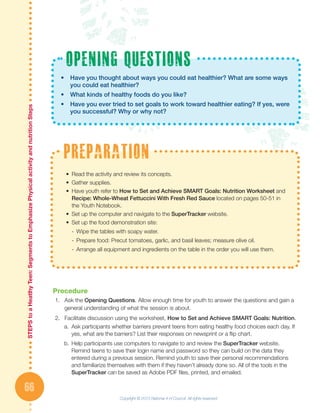
•	 Have you thought about ways you could eat healthier? What are some ways 	
	 you could eat healthier?
•	 What kinds of healthy foods do you like?
•	 Have you ever tried to set goals to work toward healthier eating? If yes, were 	
	 you successful? Why or why not?
opening questions
•	 Read the activity and review its concepts.
•	 Gather supplies.
•	 Have youth refer to How to Set and Achieve SMART Goals: Nutrition Worksheet and
Recipe: Whole-Wheat Fettuccini With Fresh Red Sauce located on pages 50-51 in
the Youth Notebook.
•	 Set up the computer and navigate to the SuperTracker website.
•	 Set up the food demonstration site:
-- Wipe the tables with soapy water.
-- Prepare food: Precut tomatoes, garlic, and basil leaves; measure olive oil.
-- Arrange all equipment and ingredients on the table in the order you will use them.
preparation
Copyright © 2013 National 4-H Council. All rights reserved.
67
Activity9:BuildingaNutritionPlan
c.	 Discuss the importance of choosing foods in portion sizes that meet calorie recommendations.
d.	Discuss the importance of incorporating foods from all food groups into a healthy eating plan.
One way to accomplish that is to set SMART goals. SMART goals are Specific, Measurable,
Attainable, Realistic, and Time-bound. Review each letter in the acronym SMART:
Specific: The goal is clearly defined and answers who, what, when, where, and how much.
Measurable: Includes language that helps you determine whether you have met your goal.
Attainable: The goal is something you really want to do.
Realistic: The goal is something you are willing and able to do.
Time-bound: Includes language that establishes a deadline to achieve the goal.
e.	 Distribute the worksheet to all participants. Discuss the example SMART goals. Have
participants develop their own SMART goal and write it on their How to Set and Achieve
SMART Goals: Nutrition Worksheet.
f.	 Once participants have developed their SMART goals, have them exchange with a partner to
critique the makeup of their goals, specifically concentrating on what each letter of the SMART
acronym means. Allow time for youth to revise the SMART goal if needed.
3.	 Demonstrate how to make the whole-wheat fettuccini with fresh red sauce recipe in Activity 9.
a.	 Begin by discussing safety considerations such as these:
- Heat water with pot handles turned 	
	 in so a child cannot grab the handle 	
	 and spill hot water.
- To avoid cross-contamination, use
	 one cutting board for fresh produce 	
	 and bread and a separate one for 		
	 raw meat, poultry, and seafood –
	 or sanitize the cutting board 		
	 between cutting meat and cutting 		
	 other foods.
b.	 Show participants how to cut garlic
and seed tomatoes. If needed, go to
www.YouTube.com and search “how to
cut garlic” or “how to seed tomatoes.”
It is not necessary to peel tomatoes
before cutting.
c.	 Follow recipe directions. Once pasta and
sauce are done, plate enough for each
participant to taste.
d.	Discuss the benefits of eating whole-
wheat fettuccini, sauce without sugar,
and limited amounts of salt.
e.	 Have participants share their thoughts of
the pasta – whether they like or dislike it.
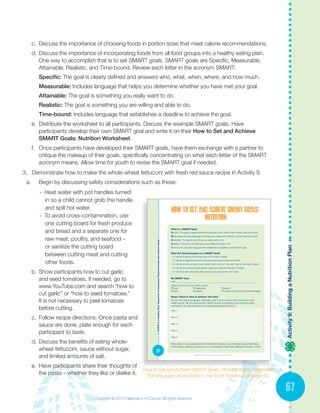
How to Set and Achieve SMART Goals: Physical Activity Worksheet
Full size page can be found in the Youth Notebook on page 50.
STEPStoaHeatlhyTeen:SegmentstoEmphasizePhysicalactivityandnutritionSteps
50
What is a SMART Goal?
Specific: The goal is clearly defined and answers who, what, when, where, and how much.
Measurable: Includes language that helps you determine whether you have met your goal.
Attainable: The goal is something you really want to do.
Realistic: The goal is something you are willing and able to do.
Time bound: Includes language that establishes a deadline to achieve the goal.
What Are Good Examples of a SMART Goal?
•	 I will eat 2 pieces of fruit every day for the next 2 weeks.
•	 I will eat a vegetable at lunch and dinner each day for the next month.
•	 I will reduce the amount of soft drinks I drink to only 1 can each day for the next 3 weeks.
•	 I will eat 3 ounces of whole grains 3 days per week for the next 2 months.
•	 I will drink skim chocolate milk at lunch every day for the next week.
My SMART Goal
I will ________________________________________________________________________
Check the focus of your nutrition goal:
❒ fruits ❒ vegetables ❒ grains
❒ dairy ❒ protein ❒ nutrient-Limited Foods and Beverages
Steps I Need to Take to Achieve This Goal
List as many steps as needed. Examples: pack fruit as a snack, ask my parents to buy
healthy foods, visit my local farmer’s market, record my progress, avoid snacking while
watching TV, sit with a friend at lunch, help prepare dinner at home.
Step 1:
Step 2:
Step 3:
Step 4:
Step 5:
Build a plan to be physically active for at least 60 minutes a day. Examples include bike riding,
in-line skating, walking, jumping rope, or a combination of activities totaling 60 minutes or more.
Copyright © 2013 National 4-H Council. All rights reserved.
STEPStoaHeatlhyTeen:SegmentstoEmphasizePhysicalactivityandnutritionSteps
68
4.	 While participants finish eating pasta, facilitate discussion of the Talk It Over questions.
5.	 Assign the Teen Research (TR) Challenge.
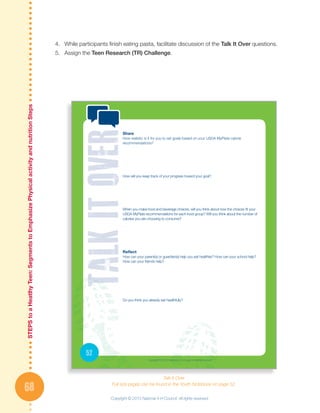
Talk It Over
Full size pages can be found in the Youth Notebook on page 52.
52
Share
How realistic is it for you to set goals based on your USDA MyPlate calorie
recommendations?
How will you keep track of your progress toward your goal?
When you make food and beverage choices, will you think about how the choices fit your
USDA MyPlate recommendations for each food group? Will you think about the number of
calories you are choosing to consume?
Reflect
How can your parent(s) or guardian(s) help you eat healthier? How can your school help?
How can your friends help?
Do you think you already eat healthfully?
Copyright © 2013 National 4-H Council. All rights reserved.
69
Activity9:BuildingaNutritionPlan
resources
Learn more at
www.4-H.org/curriculum/
STEPSforHealth
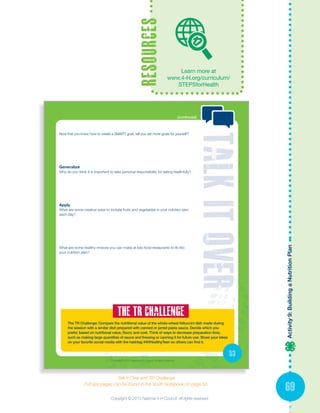
Talk It Over and TR Challenge
Full size pages can be found in the Youth Notebook on page 53.
Now that you know how to create a SMART goal, will you set more goals for yourself?
Generalize
Why do you think it is important to take personal responsibility for eating healthfully?
Apply
What are some creative ways to include fruits and vegetables in your nutrition plan
each day?
What are some healthy choices you can make at fast-food restaurants to fit into
your nutrition plan?
The TR Challenge: Compare the nutritional value of the whole-wheat fettuccini dish made during
the session with a similar dish prepared with canned or jarred pasta sauce. Decide which you
prefer, based on nutritional value, flavor, and cost. Think of ways to decrease preparation time,
such as making large quantities of sauce and freezing or canning it for future use. Share your ideas
on your favorite social media with the hashtag #4HHealthyTeen so others can find it.
53
(continued)
Copyright © 2013 National 4-H Council. All rights reserved.
“I Pledge my Head to clearer thinking,
my Heart to greater loyalty,
my Hands to larger service,
and my Health to better living,
for my club, my community, my country,
and my world.”

STEPS_to_a_HealthyTeen-FacilitatorGuidePreview

  • 1.
    % % % to a Segments ToEmphasize Physical activity and nutrition Steps Healthy Teen NATIONAL 4-H CURRICULUM Product Number 08391 FACILITATOR’s Guide
  • 2.
    Authors Laura Anderson, MSRD, Extension Educator, Michigan State University Dawn Earnesty, MS RD, Extension Educator, Michigan State University Deborah Grischke, MS CFCS, Extension Specialist, Michigan State University Sheilah Hebert, MS RD, Extension Educator, Michigan State University Lynn Krahn, MSW, Extension Educator, Michigan State University Cynthia B. Mark, PhD, Extension Program Leader Emeritus, Michigan State University B’Onko Sadler, MS, Extension Associate, Michigan State University Mary Yeomans, MA, Volunteer, Michigan State University Project Directors Cynthia Mark, Ph.D., Program Leader Emeritus, Michigan State University Tara D. M. Wheeler, MPA National 4-H Council Editor Anita C. Stuever MA, Communication Works Layout and Design TM Design, Inc., (301) 831-1114, www.tmdesigninc.com This curriculum is a project of: For ordering information contact National 4-H Council Supply Service at: (301) 961-2934 or www.4-Hmall.org. Copyright © 2013 National 4-H Council. All rights reserved. The 4-H Name & Emblem is protected under 18 USC 707.
  • 3.
    Activity1:OnTheRightTrack 1 Overview STEPS toa Healthy Teen curriculum...........................................................2 Activity 1. On the Right Track!........................................................................................3 Activity 2. Getting a Handle on Nutrition.......................................................................9 Activity 3. The Balancing Act........................................................................................23 Activity 4. Label Lingo...................................................................................................29 Activity 5. The Importance of Hydration: Avoiding Energy Drinks............................35 Activity 6. Physical Fitness Options.............................................................................43 Activity 7. Healthy Body Image....................................................................................51 Activity 8. Building a Physical Activity Plan or Fitness Plan......................................59 Activity 9. Building a Nutrition Plan.............................................................................65 Activity 10. In the Zone With YOUth...............................................................................71 Culture & Food...................................................................................................................79 Combined Glossary...........................................................................................................81 Table of Contents TOC Copyright © 2013 National 4-H Council. All rights reserved.
  • 4.
    Activity9:BuildingaNutritionPlan 65 building a nutrition plan activity9 Skill Level • Intermediate Learner Outcomes • Youth will understand the concept of SMART goals. • Youth will develop SMART goals to help achieve their nutrition goals. National Health Education Standards • Standard 3: Students will demonstrate the ability to access valid health infor- mation and health-promoting products and services. • Standard 6: Students will demonstrate the ability to use goal-setting and de- cision-making skills to enhance health. (Joint Committee on National Health Education Standards, 1997) Success Indicators Youth will be able to: • Create a nutrition plan that is appro- priate for one’s age and meets USDA recommendations for caloric intake and food group recommendations. Life Skills • Healthy lifestyle choices • Perseverance • Self-confidence/self-esteem • Decision making • Critical thinking Time Needed • 45 minutes Materials List • How to Set and Achieve SMART Goals: Nutrition on page 50 in the Youth Notebook • Recipe: Whole-Wheat Fettuccini With Fresh Red Sauce on page 51 in the Youth Notebook • Computers with Internet access • Pens or pencils • Newsprint or flip charts and markers • Ingredients for whole-wheat fettuccini with fresh red sauce (see recipe). Plan to make enough for all participants to taste a sample • Hot, soapy water and paper towels • Bowls, spoons, paper plates, and forks • Food processor or blender • Electric cooking plate Space Needed • Tables and chairs Suggested Group Size • 10–30 youth introduction Each individual has personal nutrition recommendations, identified in Activity 1, On the Right Track! to help them become or remain healthy. It is important to understand individual needs in order to meet the body’s requirements for growth, development, and maintenance. Personal nutrition needs depend on height, weight, and other factors. In this activity, discussion will include individual calorie needs and how those needs can be met through a personal nutrition plan. Understanding personal nutrition needs and the benefits of making healthy food choices are the first steps toward making behavioral changes. Equally important is learning how to set goals for nutrition to sustain health. During this activity, youth will develop SMART goals to help achieve their nutrition goals. A SMART goal is one that is Specific, Measurable, Attainable, Realistic, and Time-bound. Setting SMART goals can help people work toward their objectives in many areas. In Activity 8, Building a Physical Activity Plan or Fitness Plan, participants used SMART goals to build a physical activity plan. Activity 9 uses the same principles to build a nutrition plan. Teens who completed Activity 8 will be familiar with the SMART goal- setting tool and will need only a quick review of how to develop goals. To show teens one way to reach a goal to increase consumption of vegetables and whole grains, the facilitator will demonstrate how to make whole-wheat fettuccini with fresh red sauce. Copyright © 2013 National 4-H Council. All rights reserved.
  • 5.
    STEPStoaHeatlhyTeen:SegmentstoEmphasizePhysicalactivityandnutritionSteps 66 Procedure 1. Ask theOpening Questions. Allow enough time for youth to answer the questions and gain a general understanding of what the session is about. 2. Facilitate discussion using the worksheet, How to Set and Achieve SMART Goals: Nutrition. a. Ask participants whether barriers prevent teens from eating healthy food choices each day. If yes, what are the barriers? List their responses on newsprint or a flip chart. b. Help participants use computers to navigate to and review the SuperTracker website. Remind teens to save their login name and password so they can build on the data they entered during a previous session. Remind youth to save their personal recommendations and familiarize themselves with them if they haven’t already done so. All of the tools in the SuperTracker can be saved as Adobe PDF files, printed, and emailed. • Have you thought about ways you could eat healthier? What are some ways you could eat healthier? • What kinds of healthy foods do you like? • Have you ever tried to set goals to work toward healthier eating? If yes, were you successful? Why or why not? opening questions • Read the activity and review its concepts. • Gather supplies. • Have youth refer to How to Set and Achieve SMART Goals: Nutrition Worksheet and Recipe: Whole-Wheat Fettuccini With Fresh Red Sauce located on pages 50-51 in the Youth Notebook. • Set up the computer and navigate to the SuperTracker website. • Set up the food demonstration site: -- Wipe the tables with soapy water. -- Prepare food: Precut tomatoes, garlic, and basil leaves; measure olive oil. -- Arrange all equipment and ingredients on the table in the order you will use them. preparation Copyright © 2013 National 4-H Council. All rights reserved.
  • 6.
    67 Activity9:BuildingaNutritionPlan c. Discuss theimportance of choosing foods in portion sizes that meet calorie recommendations. d. Discuss the importance of incorporating foods from all food groups into a healthy eating plan. One way to accomplish that is to set SMART goals. SMART goals are Specific, Measurable, Attainable, Realistic, and Time-bound. Review each letter in the acronym SMART: Specific: The goal is clearly defined and answers who, what, when, where, and how much. Measurable: Includes language that helps you determine whether you have met your goal. Attainable: The goal is something you really want to do. Realistic: The goal is something you are willing and able to do. Time-bound: Includes language that establishes a deadline to achieve the goal. e. Distribute the worksheet to all participants. Discuss the example SMART goals. Have participants develop their own SMART goal and write it on their How to Set and Achieve SMART Goals: Nutrition Worksheet. f. Once participants have developed their SMART goals, have them exchange with a partner to critique the makeup of their goals, specifically concentrating on what each letter of the SMART acronym means. Allow time for youth to revise the SMART goal if needed. 3. Demonstrate how to make the whole-wheat fettuccini with fresh red sauce recipe in Activity 9. a. Begin by discussing safety considerations such as these: - Heat water with pot handles turned in so a child cannot grab the handle and spill hot water. - To avoid cross-contamination, use one cutting board for fresh produce and bread and a separate one for raw meat, poultry, and seafood – or sanitize the cutting board between cutting meat and cutting other foods. b. Show participants how to cut garlic and seed tomatoes. If needed, go to www.YouTube.com and search “how to cut garlic” or “how to seed tomatoes.” It is not necessary to peel tomatoes before cutting. c. Follow recipe directions. Once pasta and sauce are done, plate enough for each participant to taste. d. Discuss the benefits of eating whole- wheat fettuccini, sauce without sugar, and limited amounts of salt. e. Have participants share their thoughts of the pasta – whether they like or dislike it. How to Set and Achieve SMART Goals: Physical Activity Worksheet Full size page can be found in the Youth Notebook on page 50. STEPStoaHeatlhyTeen:SegmentstoEmphasizePhysicalactivityandnutritionSteps 50 What is a SMART Goal? Specific: The goal is clearly defined and answers who, what, when, where, and how much. Measurable: Includes language that helps you determine whether you have met your goal. Attainable: The goal is something you really want to do. Realistic: The goal is something you are willing and able to do. Time bound: Includes language that establishes a deadline to achieve the goal. What Are Good Examples of a SMART Goal? • I will eat 2 pieces of fruit every day for the next 2 weeks. • I will eat a vegetable at lunch and dinner each day for the next month. • I will reduce the amount of soft drinks I drink to only 1 can each day for the next 3 weeks. • I will eat 3 ounces of whole grains 3 days per week for the next 2 months. • I will drink skim chocolate milk at lunch every day for the next week. My SMART Goal I will ________________________________________________________________________ Check the focus of your nutrition goal: ❒ fruits ❒ vegetables ❒ grains ❒ dairy ❒ protein ❒ nutrient-Limited Foods and Beverages Steps I Need to Take to Achieve This Goal List as many steps as needed. Examples: pack fruit as a snack, ask my parents to buy healthy foods, visit my local farmer’s market, record my progress, avoid snacking while watching TV, sit with a friend at lunch, help prepare dinner at home. Step 1: Step 2: Step 3: Step 4: Step 5: Build a plan to be physically active for at least 60 minutes a day. Examples include bike riding, in-line skating, walking, jumping rope, or a combination of activities totaling 60 minutes or more. Copyright © 2013 National 4-H Council. All rights reserved. Copyright © 2013 National 4-H Council. All rights reserved.
  • 7.
    STEPStoaHeatlhyTeen:SegmentstoEmphasizePhysicalactivityandnutritionSteps 68 4. While participantsfinish eating pasta, facilitate discussion of the Talk It Over questions. 5. Assign the Teen Research (TR) Challenge. Talk It Over Full size pages can be found in the Youth Notebook on page 52. 52 Share How realistic is it for you to set goals based on your USDA MyPlate calorie recommendations? How will you keep track of your progress toward your goal? When you make food and beverage choices, will you think about how the choices fit your USDA MyPlate recommendations for each food group? Will you think about the number of calories you are choosing to consume? Reflect How can your parent(s) or guardian(s) help you eat healthier? How can your school help? How can your friends help? Do you think you already eat healthfully? Copyright © 2013 National 4-H Council. All rights reserved. Copyright © 2013 National 4-H Council. All rights reserved.
  • 8.
    69 Activity9:BuildingaNutritionPlan resources Learn more at www.4-H.org/curriculum/ STEPSforHealth TalkIt Over and TR Challenge Full size pages can be found in the Youth Notebook on page 53. Now that you know how to create a SMART goal, will you set more goals for yourself? Generalize Why do you think it is important to take personal responsibility for eating healthfully? Apply What are some creative ways to include fruits and vegetables in your nutrition plan each day? What are some healthy choices you can make at fast-food restaurants to fit into your nutrition plan? The TR Challenge: Compare the nutritional value of the whole-wheat fettuccini dish made during the session with a similar dish prepared with canned or jarred pasta sauce. Decide which you prefer, based on nutritional value, flavor, and cost. Think of ways to decrease preparation time, such as making large quantities of sauce and freezing or canning it for future use. Share your ideas on your favorite social media with the hashtag #4HHealthyTeen so others can find it. 53 (continued) Copyright © 2013 National 4-H Council. All rights reserved. Copyright © 2013 National 4-H Council. All rights reserved.
  • 9.
    “I Pledge myHead to clearer thinking, my Heart to greater loyalty, my Hands to larger service, and my Health to better living, for my club, my community, my country, and my world.”