ROTARY.ORG & MY ROTARY
STATUS AND UPDATES
Tom Wolf, RI Web Development Lead
June 25, 2018
•User Experience Design
•Rotary.org
•My Rotary
•Questions & Feedback
TOPICS
WHAT WE WILL COVER TODAY
User Experience Design
(UXD)
“User experience design is
the process of creating
products [and services] that
provide meaningful and
relevant experiences to
users.”
- Interaction Design
Foundation
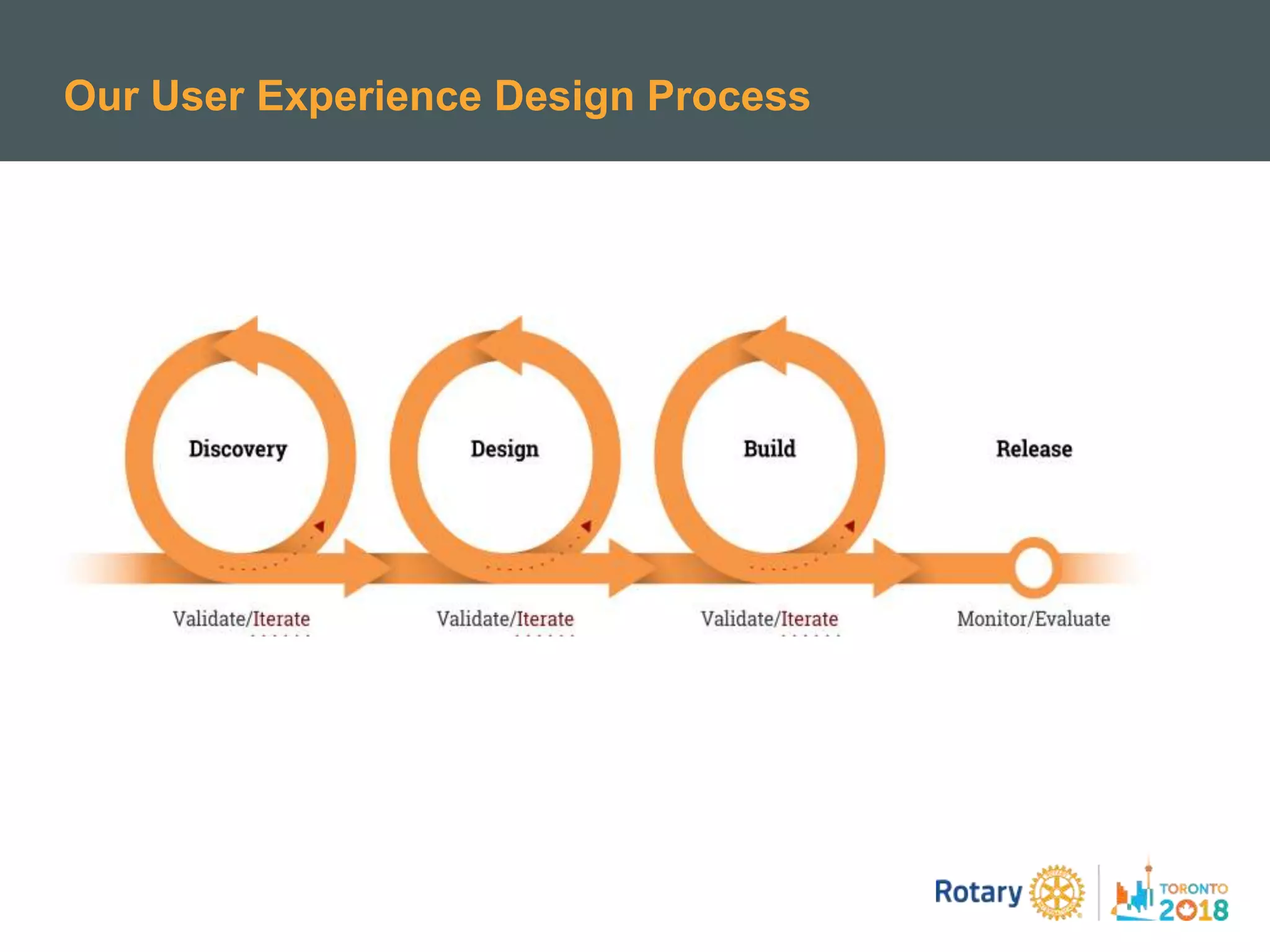
Our User Experience Design Process
Rotary.org
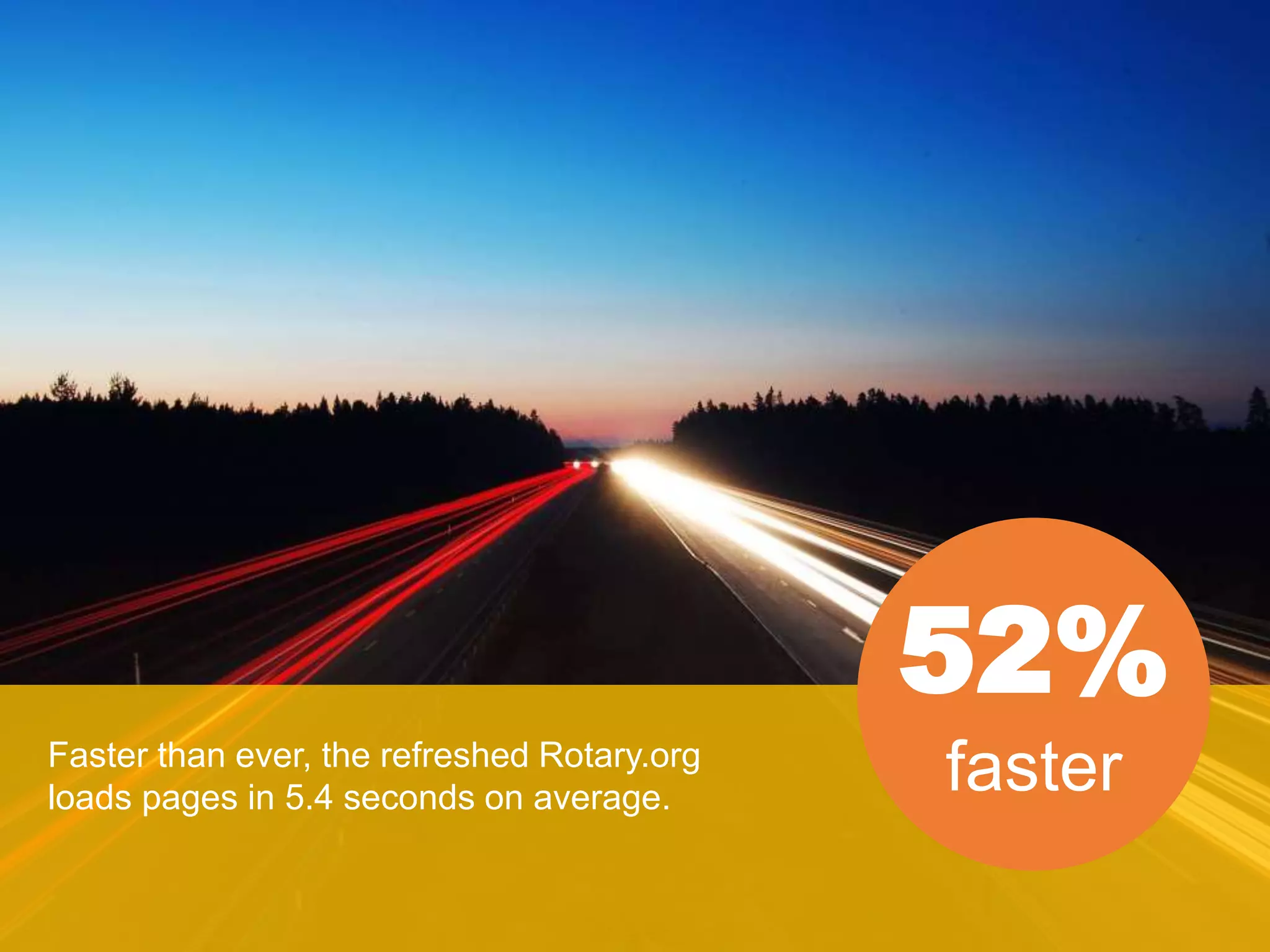
Faster than ever, the refreshed Rotary.org
loads pages in 5.4 seconds on average.
52%
faster
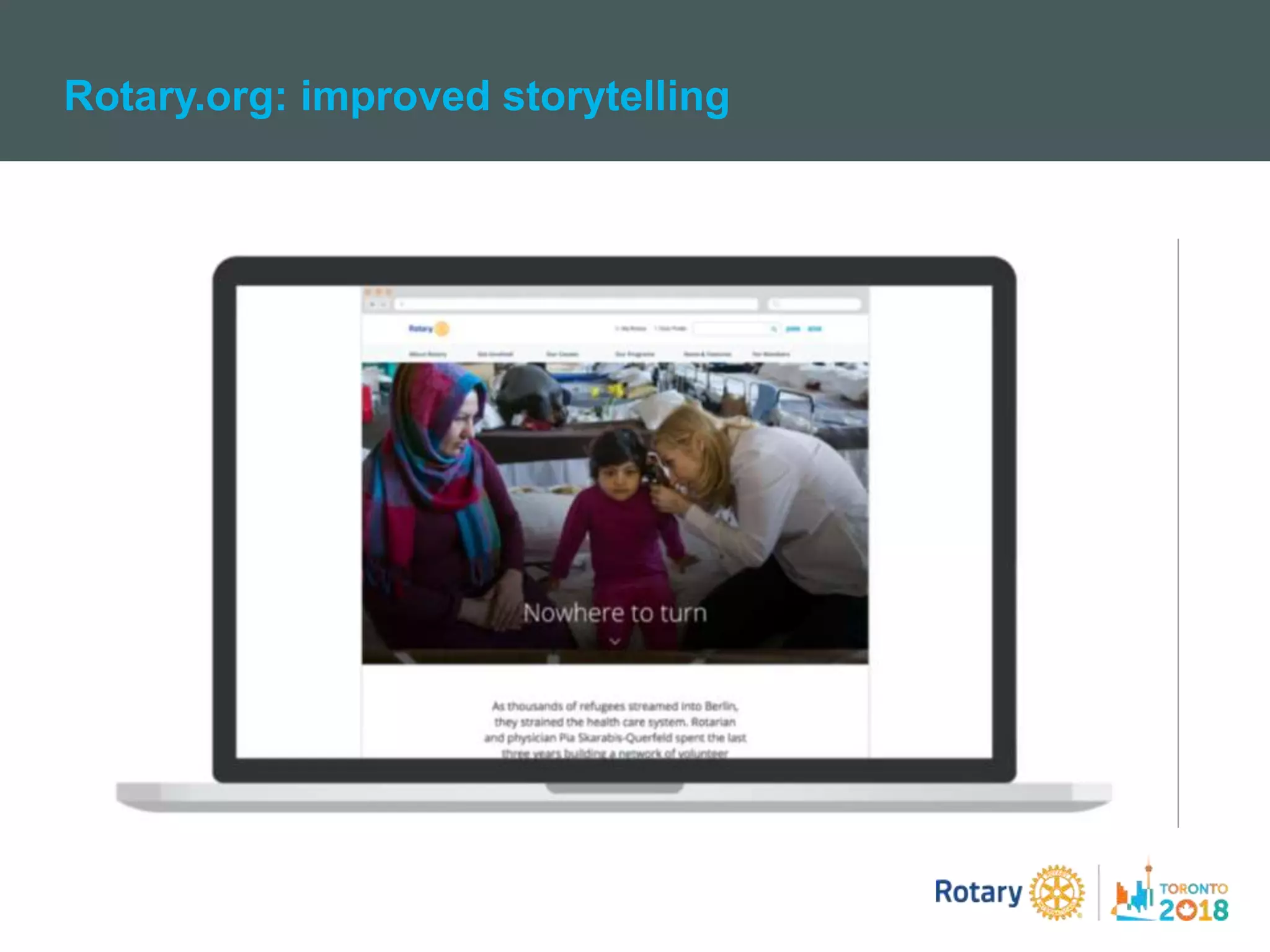
Rotary.org: improved storytelling
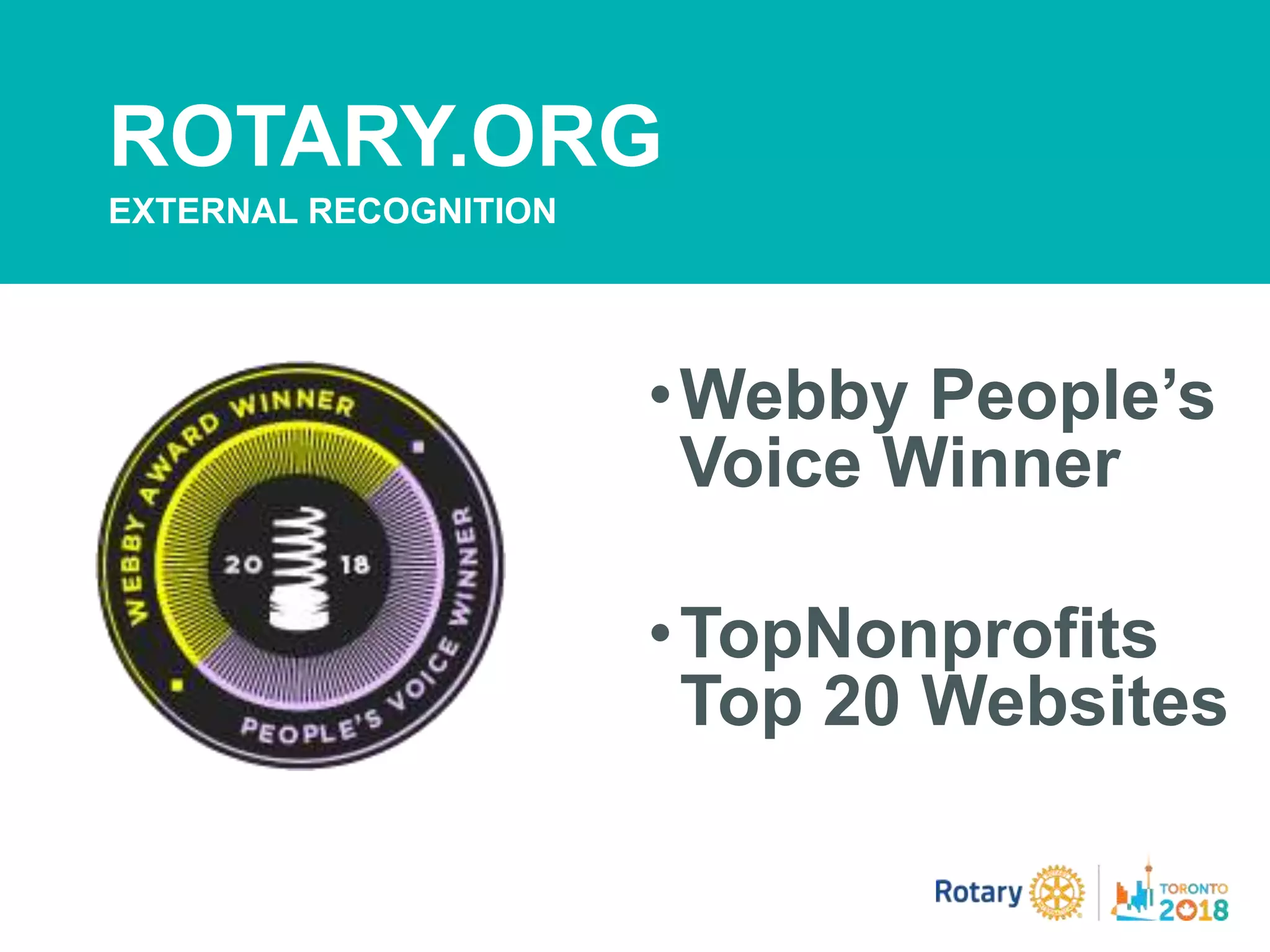
•Webby People’s
Voice Winner
•TopNonprofits
Top 20 Websites
ROTARY.ORG
EXTERNAL RECOGNITION
A PAGE FOR BIG BOLDBULLET ITEMS
● Weave storytelling throughout
● Clarify roles of Rotary.org & My Rotary
● Transition between sites with a purpose
ROTARY.ORG
BETTER INTEGRATION
My Rotary
•Online donations
•Rotary Club Central
•Grants
SO FAR, SO GOOD
CURRENT IMPROVEMENTS WITHIN MY ROTARY
•80,425 members contacted
•Four methodologies
•3,453 participants
MY ROTARY
RESEARCH, RESEARCH, RESEARCH
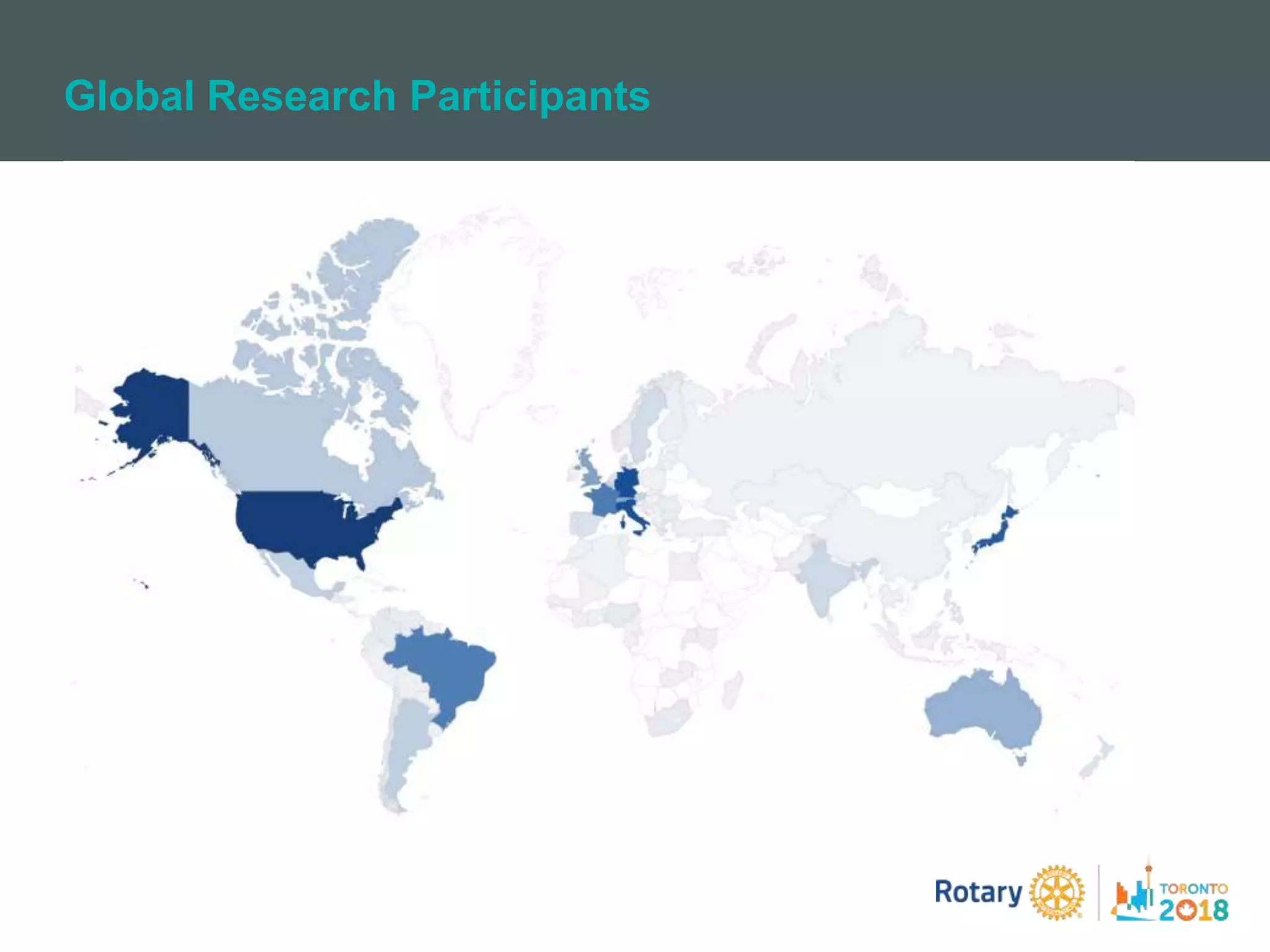
Global Research Participants
•Basic tasks are overcomplicated
•Finding the right resource is hard
•Users seek support and
inspiration
MY ROTARY
KEY RESEARCH FINDINGS
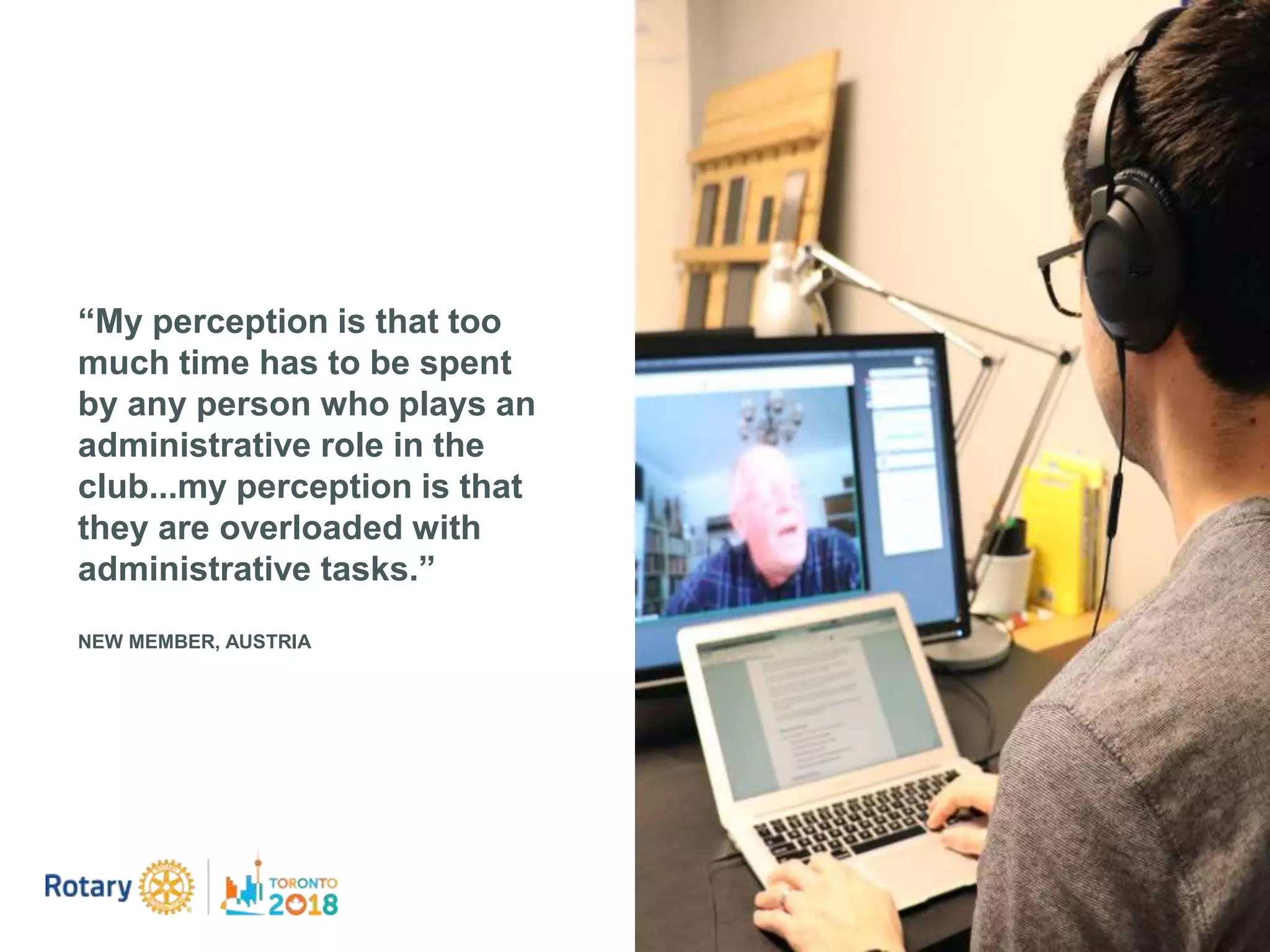
“My perception is that too
much time has to be spent
by any person who plays an
administrative role in the
club...my perception is that
they are overloaded with
administrative tasks.”
NEW MEMBER, AUSTRIA
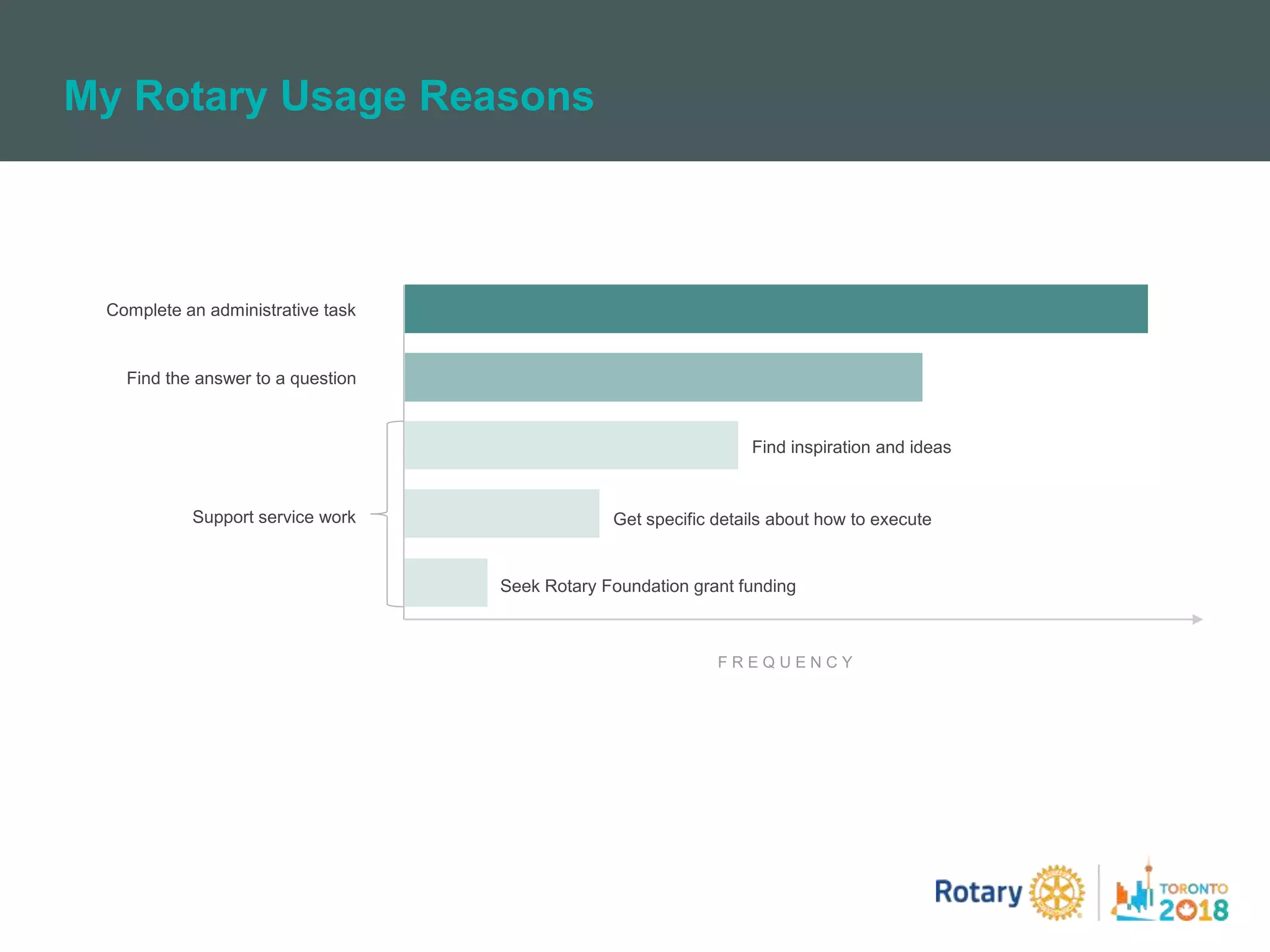
My Rotary Usage Reasons
Complete an administrative task
Find the answer to a question
Find inspiration and ideas
Get specific details about how to execute
Seek Rotary Foundation grant funding
F R E Q U E N C Y
Support service work
Design & Build
•Be inclusive
•Serve core audience first
MY ROTARY
DESIGN PRINCIPLES
•Minimize user impact
•Validate early and often
•Think long-term, work
incrementally
MY ROTARY
BUILD APPROACH
Questions & Feedback
Tom.Wolf@Rotary.org
This presentation and others
from throughout the convention
are available through the
convention mobile app and on
SlideShare at
www.SlideShare.net/Rotary_International.
Rate this session in the Rotary
Events app, available in your
Apple or Android app store.

Status Report on Website Updates

Editor's Notes

  • #2 Welcome everyone, and thank you for joining us for this session! My name is Tom Wolf, and I am the Software Development Lead in the Web Department of The Secretariat.
  • #3 Here, you can see what we will be talking about today. Before turning to our main websites, Rotary.org & My Rotary, I would like to spend some time discussing User Experience Design. And don’t worry; I’m also reserving some time at the end of this session for questions, feedback, and discussion.
  • #4 The reason I wanted to spend some time discussing User Experience Design is twofold: UX design is a relatively unknown discipline and it has become the way primary we organize our efforts within the Secretariat Web Department. For both the refresh of Rotary.org last year and the ongoing improvements for My Rotary, User Experience Design is shaping our approach.
  • #5 So what do we mean by “User Experience Design”? The Interactive Design Foundation describes it as “..the process of creating products [and services] that provide meaningful and relevant experiences to users.” That last bit is what is most important: meaningful and relevant to our users. In practice, this means that not only do we need to think about what we are building from the perspective of our users, we need to talk to them. From the perspective of Rotary International, our users include both the public as well as members, program participants, donors, and the broader Rotary community.
  • #6 Here is a very high-level overview of our UX process. During the discovery phase, we work to define our goals, declare our assumptions, and understand what will best meet our users’ needs and expectations. In the design phase, we take what was learned during discovery and explore various possible solutions. Once we have validated the design with our users, we identify what to build. Functional requirements are finalized, wireframes are turned into full designs, and actually build the product. Then, what we have built is released. Our process does not stop there, though: we monitor and evaluate what has been built against our goals and work to understand the way our users using the new system. We identify any potential improvements to be made, start the process over. You’ll notice that each of the phases has “Validate/iterate” underneath it. Throughout each part of the process, we employ various user research methods: interviews, usability studies, mental modeling, and tree testing. This allows us to validate our work with our users.
  • #7 With all that as context, let’s turn briefly to Rotary.org. Nearly 18 months ago now, we refreshed our flagship Rotary.org site. I just want to highlight a few of the improvements we’ve made and where we’re headed next.
  • #8 An obvious (we hope) improvement to Rotary.org is the speed: we were able to improve the performance significantly and the average page load time for Rotary.org is down to 5.4 seconds. This is a 52% improvement over the old site.
  • #9 Another major focus of the refresh was to improve the way we tell Rotary’s story. Here is an example from Rotary.org today: we put the visuals front-and-center, creating an evocative hook to draw the reader in. We have a flexible layout that we use to pull the user down the page and we let the layout follow the focus of the story rather than being a fixed template. All of this combines to tell Rotary’s story in a compelling way rather than merely informing the user.
  • #10 Our work with Rotary.org has paid off. Last year, our new Rotary.org was named as a top 20 website by TopNonprofits. This year, Rotary.org won the People’s Voice award in the Association category of the Webby Awards. Not only do these accolades represent external recognition of the improvements that we’ve made to Rotary.org, they are one more way that we are Rotary’s visibility in the media.
  • #11 So rather than rest on our laurels, we’re still working to improve Rotary.org. I mentioned the shift to storytelling with the refresh last year and we want to continue to improve on that approach. As with our People of Action campaign, we are working to better use the stories of work from around the Rotary world to show who Rotary is all across the site. We are also working on improving the way that users move between Rotary.org and My Rotary. While Rotary.org is our public face to the online world, we also recognize that it is a resource which our Members use regularly, so it is important that we make it clear why a user is moving from one site to the other for a particular resource or action.
  • #12 Now, we turn to My Rotary. Here, there are obvious avenues of improvement: as with Rotary.org, we can improve performance, reduce the complexity of our navigation, and generally modernize the site. Beyond that, though, we are currently applying our User Experience Design process to improve My Rotary as a whole. My Rotary has a lot of parts and pieces and we’re currently working on an effort to really understand the right way to organize it all from the perspective of our users.
  • #13 Rotary Club Central has gotten faster and easier to use, the online Grants application has been revised to make the process easier to navigate and most recently, we launched a revision to the process for accepting and managing donations online.
  • #14 In parallel to those improvements, we have been conducting research around My Rotary as a whole. We are looking at the big picture here, trying to best understand how the entirety of My Rotary can better meet the needs of our Members. Some of you might even have been involved in these research efforts! We employed both quantitative techniques such as surveys and tree testing as well as soliciting qualitative feedback through user interviews and usability studies. We also did not want to limit our focus to what is present today. We worked to understand both how to improve the current offering as well as what our users expect but are not finding. This is more than just a visual overhaul, we are working to ensure My Rotary is a truly useful tool for our Membership.
  • #15 It may be a little hard to see here, but this map is showing where we gathered responses. The Rotary world is large and diverse and we worked to ensure that we had representation from all the various regions and languages, but also across roles and time in Rotary.
  • #16 So after talking with so many people, we have a lot of data to wade through. I do want to highlight a few specific findings, however.
  • #17 The administrative burden came through clearly in our research, even from new members. One such member in Austria observed, “My perception is that too much time has to be spent by any person who plays an administrative role in the club...my perception is that they are overloaded with administrative tasks.” This clearly presents us with an opportunity to improve the way that personal, club, & district data is managed and reported on within My Rotary. We want to reduce that burden as much as possible.
  • #18 Let’s have a look at this summary of why users currently visit or would think about visiting My Rotary. Obviously, this is not all the responses, but these were the most frequent. In addition to the basic administrative tasks we just mentioned, users indicated they were frequently visiting to find the answer to a specific question or to find some inspiration for work that they might do in their club. An Egyptian Club President said, “I mostly use My Rotary to get ideas from other clubs...I wanted to think of a new project that was innovative that I could do, so I was looking for ideas for my year.”
  • #19 So now that we’ve concluded the initial Discovery phase of our process, we’re working to design and build revisions to My Rotary.
  • #20 We have a few key principles that we are keeping in mind throughout this process. I realize that these two statements might seem to be at odds, but let me explain. Inclusivity, here means that we are designing solutions which will work regardless of bandwidth, device, location, language, or ability. At the same time, we are also focusing My Rotary to ensure that we serve the core audience first. We want to deliver what our membership needs and wants from My Rotary and use that as a foundation before looking further afield.
  • #21 Finally, when it comes to building, these three elements make up the core of our approach. Obviously, My Rotary is quite large and if we waited until we had revisited absolutely everything, we would be delaying getting improvements in front of all of you. So instead, we are focusing on making incremental improvements within the frame of big-picture thinking. As we complete functionality, we will release it. We’ll work to do so in a way that stays out of the way of our users. That means we’ll launch features in chunks that make sense logically. I do want to emphasize that what I’ve shared here is the core of an ongoing process. We are working to get the first increments launched by the end of 2018, but as I mentioned way back at the beginning, this is an iterative approach and so you’ll be seeing improvements rolling out on an ongoing basis.
  • #22 As I outlined during the User Experience Design portion, hearing from you is incredibly important to our process! If you are interested in volunteering to be part of our UX research efforts, please send me an email. At this point, I’m happy to answer questions or hear general feedback and suggestions for improvement. I would ask, however, that if you have a very specific “tech support” question that you wait until after this session when I’ll be happy to help you out!
  • #23 [Keep this slide at the end]
  • #24 [Keep this slide at the end, and read this suggested text] Your feedback is valuable so remember to complete the brief session evaluation in the convention mobile app. To download the app, search for “Rotary Events” in your Apple or Android app store.