Reporter:Michael Montano
PRAYE
R
ATTENDAN
CE
TIME TO
REVIEW
++++++++++++++++++++++++++++++++++++++++++++++++++++++++++++++++++++++++++++++
++++++++++++++++++++++++++++++++++++++++++++++++++++++
CRUMPLED PAPER
"The facilitator will pass around a crumpled
paper containing questions while there is
music playing, and when the music stops,
the student holding the crumpled paper last
needs to answer the question."
++++++++++++++++++++++++++++++++++++++++++++++++++++++++++++++++++++++++++++++
++++++++++++++++++++++++++++++++++++++++++++++++++++++
OBJECTIVES
1.Differentiate the types of variables
2.Develop a Venn diagram about types
of variables.
3.Recognize the importance of
different types of variables
++++++++++++++++++++++++++++++++++++++++++++++++++++++++++++++++++++++++++++++
++++++++++++++++++++++++++++++++++++++++++++++++++++++
UNLOCKING OF TERMS OF TERM
1.Integer: In mathematics, an integer is a whole number that can be positive,
negative, or zero, but does not include fractions or decimals. Examples of
integers are -3, 0, 7, and 42.
2.Inherently: This adverb describes something that is an inseparable or
intrinsic part of something else. It suggests that a characteristic or quality is
inherent, or naturally existing, within a particular thing or situation. For
example, "Risk is inherently part of entrepreneurship" means that risk is a
fundamental aspect of entrepreneurship and cannot be separated from it.
3 Nominal: This term has several meanings depending on the context
Knowingly / unknowingly, we all tend to use
mathematics and numbers in our day-to-day life
for decision-making. We can live with basic
mathematics skills for our routine grocery
shopping. However, if you are an aspiring data
scientist then it is essential to have a very good
understanding of statistical concepts. Even
before we dive into statistics, one should have
an understanding of the types of variables. So,
let us begin our discussion on numbers by
looking at them as variables (e.g. Age,
Occupation, Income, etc) and variable types.
++++++++++++++++++++++++++++++++++++++++++++++++++++++++++++++++++++++++++++++
++++++++++++++++++++++++++++++++++++++++++++++++++++++
Categorical Variable
• The Categorical variable is also known as a
Qualitative variable. It represents the
characteristics of the data object.
• Sometimes categorical variables take
numerical values, but having numerical values
doesn’t mean it has any mathematical meaning.
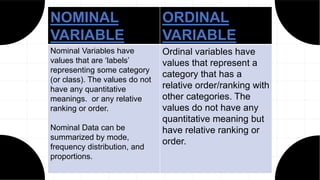
NOMINAL
VARIABLE
ORDINAL
VARIABLE
Nominal Variables have
values that are ‘labels’
representing some category
(or class). The values do not
have any quantitative
meanings. or any relative
ranking or order.
Nominal Data can be
summarized by mode,
frequency distribution, and
proportions.
Ordinal variables have
values that represent a
category that has a
relative order/ranking with
other categories. The
values do not have any
quantitative meaning but
have relative ranking or
order.
++++++++++++++++++++++++++++++++++++++++++++++++++++++++++++++++++++++++++++++
++++++++++++++++++++++++++++++++++++++++++++++++++++++
Numerical Variable
• Numerical Variable is also called a
Quantitative Variable.
• Numerical data is either an integer
or a real value.
• It has a mathematical meaning.
Discrete
Variable
Continuous
Variable
A Discrete Variable
can only take certain
distinct and separate
values. But, it cannot
take any intermediate
value between them.
A continuous
variable can
only take any
continuous
value.
INTERVAL
VARIABLE
RATIO
VARIABLE
• The quantitative variables
where the ratio of its values
do not have any meaning
and it does not have an
inherently defined zero
value are Interval Variables
• The difference between the
two values of the interval
variable is meaningful,
however, the ratio does not
make any sense.
• The quantitative variables
which are measured on a
scale such that the ratio of
its values are meaningful
and they have an
inherently defined zero
value are called Ratio
Variables
• The difference or ratio
between two values for
ratio variables are both
meaningful
GENERALIZATION
EVALUATION
1: What distinguishes a categorical variable from a numerical
variable in statistics?
A) Categorical variables are qualitative, while numerical variables
are quantitative.
B) Categorical variables have numerical values, whereas
numerical variables have label representations.
C) Categorical variables can only be summarized by mode, while
numerical variables can be summarized by mean, median, and
mode.
D) Categorical variables have an inherently defined zero value,
whereas numerical variables do not.
E) Categorical variables represent continuous values, while
numerical variables represent discrete values.
2: Which of the following best describes nominal
variables?
A) Nominal variables have values representing a category
with relative order/ranking.
B) Nominal variables have values that are labels without
any quantitative meaning or order.
C) Nominal variables have values that are continuous and
can take any value.
D) Nominal variables have an inherently defined zero
value.
E) Nominal variables have values representing a category
with meaningful ratios.
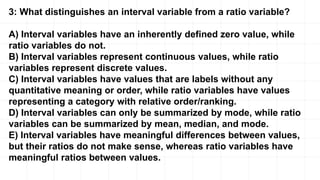
3: What distinguishes an interval variable from a ratio variable?
A) Interval variables have an inherently defined zero value, while
ratio variables do not.
B) Interval variables represent continuous values, while ratio
variables represent discrete values.
C) Interval variables have values that are labels without any
quantitative meaning or order, while ratio variables have values
representing a category with relative order/ranking.
D) Interval variables can only be summarized by mode, while ratio
variables can be summarized by mean, median, and mode.
E) Interval variables have meaningful differences between values,
but their ratios do not make sense, whereas ratio variables have
meaningful ratios between values.
4: Which of the following statements about interval
variables is true?
A) Interval variables can take any continuous value.
B) The difference between two values of an interval
variable is not meaningful.
C) Interval variables have values representing a category
with relative order/ranking.
D) Interval variables have an inherently defined zero
value.
E) The ratio between two values of an interval variable is
always meaningful.
5: What type of variable is temperature measured
in Celsius or Fahrenheit?
A) Discrete variable
B) Continuous variable
C) Nominal variable
D) Ratio variable
E) Ordinal variable
KEY TO CORRECTION
1.A
2.B
3.E
4.B
5.B
++++++++++++++++++++++++++++++++++++++++++++++++++++++++++++++++++++++++++++++
++++++++++++++++++++++++++++++++++++++++++++++++++++++
ACTIVITY
CREATE A VENN DIAGRAM
ABOUT THE TWO TYPES OF
VARIABLES
THANK
YOU

STATS DIFFERENT TYPES OF VARIABLE.......