Building Statistical Models In Python 1st Edition Anonymous
Building Statistical Models In Python 1st Edition Anonymous
Building Statistical Models In Python 1st Edition Anonymous
Building Statistical Models In Python 1st Edition Anonymous
Building Statistical Models In Python 1st Edition Anonymous
1.
Building Statistical ModelsIn Python 1st
Edition Anonymous download
https://ebookbell.com/product/building-statistical-models-in-
python-1st-edition-anonymous-55316492
Explore and download more ebooks at ebookbell.com
2.
Here are somerecommended products that we believe you will be
interested in. You can click the link to download.
Building Statistical Models In Python Develop Useful Models For
Regression Classification Time Series And Survival Analysis Converted
Huy Hoang Nguyen
https://ebookbell.com/product/building-statistical-models-in-python-
develop-useful-models-for-regression-classification-time-series-and-
survival-analysis-converted-huy-hoang-nguyen-53149124
Empirical Model Building Data Models And Reality Second Edition Wiley
Series In Probability And Statistics 2nd James R Thompson
https://ebookbell.com/product/empirical-model-building-data-models-
and-reality-second-edition-wiley-series-in-probability-and-
statistics-2nd-james-r-thompson-2512014
Essentials Of Monte Carlo Simulation Statistical Methods For Building
Simulation Models 1st Edition Nick T Thomopoulos Auth
https://ebookbell.com/product/essentials-of-monte-carlo-simulation-
statistical-methods-for-building-simulation-models-1st-edition-nick-t-
thomopoulos-auth-4272306
Business Statistics For Competitive Advantage With Excel 2010 Basics
Model Building And Cases 2nd Edition Cynthia Fraser Auth
https://ebookbell.com/product/business-statistics-for-competitive-
advantage-with-excel-2010-basics-model-building-and-cases-2nd-edition-
cynthia-fraser-auth-4098324
3.
Business Statistics ForCompetitive Advantage With Excel 2007 Basics
Model Building And Cases Cynthia Fraser Auth
https://ebookbell.com/product/business-statistics-for-competitive-
advantage-with-excel-2007-basics-model-building-and-cases-cynthia-
fraser-auth-4112536
Business Statistics For Competitive Advantage With Excel 2013 Basics
Model Building Simulation And Cases 3rd Edition Cynthia Fraser Auth
https://ebookbell.com/product/business-statistics-for-competitive-
advantage-with-excel-2013-basics-model-building-simulation-and-
cases-3rd-edition-cynthia-fraser-auth-4269624
Business Statistics For Competitive Advantage With Excel 2016 Basics
Model Building Simulation And Cases 1st Edition Cynthia Fraser Auth
https://ebookbell.com/product/business-statistics-for-competitive-
advantage-with-excel-2016-basics-model-building-simulation-and-
cases-1st-edition-cynthia-fraser-auth-5605696
Business Statistics For Competitive Advantage With Excel 2019 And Jmp
Basics Model Building Simulation And Cases 1st Ed 2019 Cynthia Fraser
https://ebookbell.com/product/business-statistics-for-competitive-
advantage-with-excel-2019-and-jmp-basics-model-building-simulation-
and-cases-1st-ed-2019-cynthia-fraser-10797178
Business Statistics For Competitive Advantage With Excel 2007 Basics
Model Building And Cases 1st Edition Cynthia Fraser Auth
https://ebookbell.com/product/business-statistics-for-competitive-
advantage-with-excel-2007-basics-model-building-and-cases-1st-edition-
cynthia-fraser-auth-1229072
6.
Building Statistical Models
inPython
Develop useful models for regression, classification,
time series, and survival analysis
Huy Hoang Nguyen
Paul N Adams
Stuart J Miller
BIRMINGHAM—MUMBAI
To my parents,Thieu and Tang, for their enormous support and faith in me.
To my wife, Tam, for her endless love, dedication, and courage.
- Huy Hoang Nguyen
To my daughter, Lydie, for demonstrating how work and dedication regenerate inspiration and
creativity. To my wife, Helene, for her love and support.
– Paul Adams
To my partner, Kate, who has always supported my endeavors.
– Stuart Miller
9.
Contributors
About the authors
HuyHoang Nguyen is a mathematician and data scientist with extensive experience in advanced
mathematics, strategic leadership, and applied machine learning research. He holds a PhD in
Mathematics, as well as two Master’s degrees in Applied Mathematics and Data Science. His previous
work focused on Partial Differential Equations, Functional Analysis, and their applications in Fluid
Mechanics. After transitioning from academia to the healthcare industry, he has undertaken a variety
of data science projects, ranging from traditional machine learning to deep learning.
Paul Adams is a Data Scientist with a background primarily in the healthcare industry. Paul applies
statistics and machine learning in multiple areas of industry, focusing on projects in process engineering,
process improvement, metrics and business rules development, anomaly detection, forecasting,
clustering, and classification. Paul holds an MSc in Data Science from Southern Methodist University.
Stuart Miller is a Machine Learning Engineer with a wide range of experience. Stuart has applied
machine learning methods to various projects in industries ranging from insurance to semiconductor
manufacturing. Stuart holds degrees in data science, electrical engineering, and physics.
10.
About the reviewers
KrishnanRaghavan is an IT Professional with over 20+ years of experience in software development
and delivery excellence across multiple domains and technology ranging from C++ to Java, Python,
Data Warehousing, and Big Data tools and technologies.
When not working, Krishnan likes to spend time with his wife and daughter, reading fiction and
nonfiction as well as technical books. Krishnan tries to give back to the community by being part of
the GDG Pune Volunteer Group, helping the team organize events. Currently, he is unsuccessfully
trying to learn how to play the guitar.
You can connect with Krishnan at mailtokrishnan@gmail.com or via
LinkedIn: www.linkedin.com/in/krishnan-raghavan.
I would like to thank my wife Anita and daughter Ananya for giving me the time and space to review
this book.
Karthik Dulam is a Principal Data Scientist at EDB. He is passionate about all things data with a
particular focus on data engineering, statistical modeling, and machine learning. He has a diverse
background delivering machine learning solutions for the healthcare, IT, automotive, telecom, tax,
and advisory industries. He actively engages with students as a guest speaker at esteemed universities
delivering insightful talks on machine learning use cases.
I would like to thank my wife, Sruthi Anem, for her unwavering support and patience. I also want to
thank my family, friends, and colleagues who have played an instrumental role in shaping the person I
am today. Their unwavering support, encouragement, and belief in me have been a constant source of
inspiration.
12.
Preface xiii
Part 1:Introductionto Statistics
1
Sampling and Generalization 3
Software and environment setup 3
Population versus sample 6
Population inference from samples 8
Randomized experiments 8
Observational study 9
Sampling strategies – random,
systematic, stratified, and clustering 11
Probability sampling 11
Non-probability sampling 16
Summary 17
2
Distributions of Data 19
Technical requirements 19
Understanding data types 20
Nominal data 20
Ordinal data 21
Interval data 21
Ratio data 22
Visualizing data types 22
Measuring and describing
distributions 26
Measuring central tendency 26
Measuring variability 33
Measuring shape 38
The normal distribution and central
limit theorem 42
The Central Limit Theorem 45
Bootstrapping 45
Confidence intervals 46
Standard error 51
Correlation coefficients (Pearson’s correlation) 51
Permutations 52
Permutations and combinations 52
Permutation testing 55
Table of Contents
13.
Table of Contents
viii
Transformations57
Summary 59
References 59
3
Hypothesis Testing 61
The goal of hypothesis testing 61
Overview of a hypothesis test for the mean 62
Scope of inference 62
Hypothesis test steps 63
Type I and Type II errors 63
Type I errors 63
Type II errors 64
Basics of the z-test – the z-score,
z-statistic, critical values, and p-values 65
The z-score and z-statistic 65
A z-test for means 72
z-test for proportions 78
Power analysis for a two-population pooled
z-test 82
Summary 85
4
Parametric Tests 87
Assumptions of parametric tests 87
Normally distributed population data 88
Equal population variance 99
T-test – a parametric hypothesis test 102
T-test for means 103
Two-sample t-test – pooled t-test 108
Two-sample t-test – Welch’s t-test 111
Paired t-test 112
Tests with more than two groups and
ANOVA 114
Multiple tests for significance 114
ANOVA 117
Pearson’s correlation coefficient 118
Power analysis examples 123
Summary 124
References 124
5
Non-Parametric Tests 125
When parametric test assumptions
are violated 125
Permutation tests 126
The Rank-Sum test 128
The test statistic procedure 128
Normal approximation 129
Rank-Sum example 129
The Signed-Rank test 130
14.
Table of Contentsix
The Kruskal-Wallis test 132
Chi-square distribution 133
Chi-square goodness-of-fit 135
Chi-square test of independence 136
Chi-square goodness-of-fit test
power analysis 138
Spearman’s rank correlation
coefficient 139
Summary 141
Part 2: Regression Models
6
Simple Linear Regression 145
Simple linear regression using OLS 145
Coefficients of correlation and
determination 148
Coefficients of correlation 148
Coefficients of determination 151
Required model assumptions 152
A linear relationship between the variables 152
Normality of the residuals 153
Homoscedasticity of the residuals 154
Sample independence 155
Testing for significance and
validating models 155
Model validation 169
Summary 171
7
Multiple Linear Regression 173
Multiple linear regression 173
Adding categorical variables 175
Evaluating model fit 176
Interpreting the results 181
Feature selection 184
Statistical methods for feature selection 184
Performance-based methods for feature
selection 186
Recursive feature elimination 187
Shrinkage methods 188
Ridge regression 189
LASSO regression 192
Elastic Net 194
Dimension reduction 196
PCA – a hands-on introduction 196
PCR – a hands-on salary prediction study 199
Summary 202
15.
Table of Contents
x
Part3: Classification Models
8
Discrete Models 205
Probit and logit models 205
Multinomial logit model 210
Poisson model 213
The Poisson distribution 213
Modeling count data 215
The negative binomial regression
model 217
Negative binomial distribution 217
Summary 224
9
Discriminant Analysis 225
Bayes’ theorem 225
Probability 225
Conditional probability 227
Discussing Bayes’ Theorem 228
Linear Discriminant Analysis 229
Supervised dimension reduction 236
Quadratic Discriminant Analysis 238
Summary 244
Part 4: Time Series Models
10
Introduction to Time Series 247
What is a time series? 248
Goals of time series analysis 249
Statistical measurements 249
Mean 249
Variance 251
Autocorrelation 253
Cross-correlation 257
The white-noise model 263
Stationarity 265
Summary 270
References 270
16.
Table of Contentsxi
11
ARIMA Models 271
Technical requirements 271
Models for stationary time series 272
Autoregressive (AR) models 272
Moving average (MA) models 283
Autoregressive moving average (ARMA)
models 287
Models for non-stationary
time series 295
ARIMA models 296
Seasonal ARIMA models 304
More on model evaluation 311
Summary 318
References 319
12
Multivariate Time Series 321
Multivariate time series 321
Time-series cross-correlation 322
ARIMAX 326
Preprocessing the exogenous variables 328
Fitting the model 329
Assessing model performance 333
VAR modeling 335
Step 1 – visual inspection 338
Step 2 – selecting the order of AR(p) 339
Step 3 – assessing cross-correlation 340
Step 4 – building the VAR(p,q) model 344
Step 5 – testing the forecast 346
Step 6 – building the forecast 347
Summary 349
References 349
Part 5: Survival Analysis
13
Time-to-Event Variables – An Introduction 353
What is censoring? 354
Left censoring 354
Right censoring 354
Interval censoring 355
Type I and Type II censoring 355
Survival data 356
Survival Function, Hazard and
Hazard Ratio 357
Summary 360
17.
Table of Contents
xii
14
SurvivalModels 361
Technical requirements 361
Kaplan-Meier model 362
Model definition 362
Model example 364
Exponential model 368
Model example 370
Cox Proportional Hazards
regression model 372
Step 1 374
Step 2 375
Step 3 379
Step 4 380
Step 5 383
Summary 384
Index 385
Other Books You May Enjoy 396
18.
Preface
Statistics is adiscipline of study used for applying analytical methods to answer questions and solve
problems using data, in both academic and industry settings. Many methods have been around for
centuries, while others are much more recent. Statistical analysis and results are fairly straightforward
for presenting to both technical and non-technical audiences. Furthermore, producing results with
statistical analysis does not necessarily require large amounts of data or compute resources and can be
done fairly quickly, especially when using programming languages such as Python, which is moderately
easy to work with and implement.
While artificial intelligence (AI) and advanced machine learning (ML) tools have become more
prominent and popular over recent years with the increase of accessibility in compute power, performing
statistical analysis as a precursor to developing larger-scale projects using AI and ML can enable a
practitioner to assess feasibility and practicality before using larger compute resources and project
architecture development for those types of projects.
This book provides a wide variety of tools that are commonly used to test hypotheses and provide
basic predictive capabilities to analysts and data scientists alike. The reader will walk through the
basic concepts and terminology required for understanding the statistical tools in this book prior to
exploring the different tests and conditions under which they are applicable. Further, the reader will
gain knowledge for assessing the performance of the tests. Throughout, examples will be provided
in the Python programming language to get readers started understanding their data using the tools
presented, which will be applicable to some of the most common questions faced in the data analytics
industry. The topics we will walk through include:
• An introduction to statistics
• Regression models
• Classification models
• Time series models
• Survival analysis
Understanding the tools provided in these sections will provide the reader with a firm foundation
from which further independent growth in the statistics domain can more easily be achieved.
19.
Preface
xiv
Who this bookis for
Professionals in most industries can benefit from the tools in this book. The tools provided are useful
primarily at a higher level of inferential analysis, but can be applied to deeper levels depending on
the industry in which the practitioner wishes to apply them. The target audiences of this book are:
• Industry professionals with limited statistical or programming knowledge who would like to
learn to use data for testing hypotheses they have in their business domain
• Data analysts and scientists who wish to broaden their statistical knowledge and find a set of
tools and their implementations for performing various data-oriented tasks
The ground-up approach of this book seeks to provide entry into the knowledge base for a wide
audience and therefore should neither discourage novice-level practitioners nor exclude advanced-
level practitioners from the benefits of the materials presented.
What this book covers
Chapter 1, Sampling and Generalization, describes the concepts of sampling and generalization. The
discussion of sampling covers several common methods for sampling data from a population and
discusses the implications for generalization. This chapter also discusses how to setup the software
required for this book.
Chapter 2, Distributions of Data, provides a detailed introduction to types of data, common distributions
used to describe data, and statistical measures. This chapter also covers common transformations
used to change distributions.
Chapter 3, Hypothesis Testing, introduces the concept of statistical tests as a method for answering
questions of interest. This chapter covers the steps to perform a test, the types of errors encountered
in testing, and how to select power using the Z-test.
Chapter 4, Parametric Tests, further discusses statistical tests, providing detailed descriptions of
common parametric statistical tests, the assumptions of parametric tests, and how to assess the validity
of parametric tests. This chapter also introduces the concept of multiple tests and provides details on
corrections for multiple tests.
Chapter 5, Non-parametric Tests, discuss how to perform statistical tests when the assumptions of
parametric tests are violated with class of tests without assumptions called non-parametric tests.
Chapter 6, Simple Linear Regression, introduces the concept of a statistical model with the simple
linear regression model. This chapter begins by discussing the theoretical foundations of simple
linear regression and then discusses how to interpret the results of the model and assess the validity
of the model.
20.
Preface xv
Chapter 7,Multiple Linear Regression, builds on the previous chapter by extending the simple linear
regression model into additional dimensions. This chapter also discusses issues that occur when
modeling with multiple explanatory variables, including multicollinearity, feature selection, and
dimension reduction.
Chapter 8, Discrete Models, introduces the concept of classification and develops a model for classifying
variables into discrete levels of a categorical response variable. This chapter starts by developing the
model binary classification and then extends the model to multivariate classification. Finally, the
Poisson model and negative binomial models are covered.
Chapter 9, Discriminant Analysis, discusses several additional models for classification, including linear
discriminant analysis and quadratic discriminant analysis. This chapter also introduces Bayes’ Theorem.
Chapter 10, Introduction to Time Series, introduces time series data, discussing the time series concept
of autocorrelation and the statistical measures for time series. This chapter also introduces the white
noise model and stationarity.
Chapter 11, ARIMA Models, discusses models for univariate models. This chapter starts by discussing
models for stationary time series and then extends the discussion to non-stationary time series. Finally,
this chapter provides a detailed discussion on model evaluation.
Chapter 12, Multivariate Time Series, builds on the previous two chapters by introducing the concept of
a multivariate time series and extends ARIMA models to multiple explanatory variables. This chapter
also discusses time series cross-correlation.
Chapter 13, Survival Analysis, introduces survival data, also called time-to-event data. This chapter
discusses the concept of censoring and the impact of censoring survival data. Finally, the chapter
discusses the survival function, hazard, and hazard ratio.
Chapter 14, Survival Models, building on the previous chapter, provides an overview of several models
for survival data, including the Kaplan-Meier model, the Exponential model, and the Cox Proportional
Hazards model.
21.
Preface
xvi
To get themost out of this book
You will need access to download and install open-source code packages implemented in the Python
programming language and accessible through PyPi.org or the Anaconda Python distribution. While a
background in statistics is helpful, but not necessary, this book assumes you have a decent background in
basic algebra. Each unit of this book is independent of the other units, but the chapters within each unit
build upon each other. Thus, we advise you to begin each unit with that unit’s first chapter to understand
the content.
Software/hardware covered in the book Operating system requirements
Python version ≥ 3.8 Windows, macOS, or Linux
Statsmodels 0.13.2
SciPy 1.8.1
lifelines 0.27.4
scikit-learn 1.1.1
pmdarima 2.02
Sktime 0.15.0
Pandas 1.4.3
Matplotlib 3.5.2
Numpy 1.23.0
If you are using the digital version of this book, we advise you to type the code yourself or access
the code from the book’s GitHub repository (a link is available in the next section). Doing so will
help you avoid any potential errors related to the copying and pasting of code.
Download the example code files
You can download the example code files for this book from GitHub at https://github.com/
PacktPublishing/Building-Statistical-Models-in-Python. If there’s an update
to the code, it will be updated in the GitHub repository.
We also have other code bundles from our rich catalog of books and videos available at https://
github.com/PacktPublishing/. Check them out!
Conventions used
There are a number of text conventions used throughout this book.
Code in text: Indicates code words in text, database table names, folder names, filenames, file
extensions, pathnames, dummy URLs, user input, and Twitter handles. Here is an example: “Mount
the downloaded WebStorm-10*.dmg disk image file as another disk in your system.”
22.
Preface xvii
A blockof code is set as follows:
A = [3,5,4]
B = [43,41,56,78,54]
permutation_testing(A,B,n_iter=10000)
Any command-line input or output is written as follows:
pip install SomePackage
Bold: Indicates a new term, an important word, or words that you see onscreen. For instance,
words in menus or dialog boxes appear in bold. Here is an example: “Select System info from the
Administration panel.”
Tips or important notes
Appear like this.
Get in touch
Feedback from our readers is always welcome.
General feedback: If you have questions about any aspect of this book, email us at customercare@
packtpub.com and mention the book title in the subject of your message.
Errata: Although we have taken every care to ensure the accuracy of our content, mistakes do happen.
If you have found a mistake in this book, we would be grateful if you would report this to us. Please
visit www.packtpub.com/support/errata and fill in the form.
23.
Preface
xviii
Piracy: If youcome across any illegal copies of our works in any form on the internet, we would
be grateful if you would provide us with the location address or website name. Please contact us at
copyright@packtpub.com with a link to the material.
If you are interested in becoming an author: If there is a topic that you have expertise in and you
are interested in either writing or contributing to a book, please visit authors.packtpub.com.
Share Your Thoughts
Once you’ve read Building Statistical Models in Python, we’d love to hear your thoughts! Please click
here to go straight to the Amazon review page for this book and share your feedback.
Your review is important to us and the tech community and will help us make sure we’re delivering
excellent quality content.
24.
Preface xix
Download afree PDF copy of this book
Thanks for purchasing this book!
Do you like to read on the go but are unable to carry your print books everywhere?
Is your eBook purchase not compatible with the device of your choice?
Don’t worry, now with every Packt book you get a DRM-free PDF version of that book at no cost.
Read anywhere, any place, on any device. Search, copy, and paste code from your favorite technical
books directly into your application.
The perks don’t stop there, you can get exclusive access to discounts, newsletters, and great free content
in your inbox daily
Follow these simple steps to get the benefits:
1. Scan the QR code or visit the link below
https://packt.link/free-ebook/978-1-80461-428-0
2. Submit your proof of purchase
3. That’s it! We’ll send your free PDF and other benefits to your email directly
26.
Part 1:
Introduction toStatistics
This part will cover the statistical concepts that are foundational to statistical modeling.
It includes the following chapters:
• Chapter 1, Sampling and Generalization
• Chapter 2, Distributions of Data
• Chapter 3, Hypothesis Testing
• Chapter 4, Parametric Tests
• Chapter 5, Non-Parametric Tests
28.
1
Sampling and Generalization
Inthis chapter, we will describe the concept of populations and sampling from populations, including
some common strategies for sampling. The discussion of sampling will lead to a section that will describe
generalization. Generalization will be discussed as it relates to using samples to make conclusions
about their respective populations. When modeling for statistical inference, it is necessary to ensure
that samples can be generalized to populations. We will provide an in-depth overview of this bridge
through the subjects in this chapter.
We will cover the following main topics:
• Software and environment setup
• Population versus sample
• Population inference from samples
• Sampling strategies – random, systematic, and stratified
Software and environment setup
Python is one of the most popular programming languages for data science and machine learning thanks
to the large open source community that has driven the development of these libraries. Python’s ease
of use and flexible nature made it a prime candidate in the data science world, where experimentation
and iteration are key features of the development cycle. While there are new languages in development
for data science applications, such as Julia, Python currently remains the key language for data science
due to its wide breadth of open source projects, supporting applications from statistical modeling
to deep learning. We have chosen to use Python in this book due to its positioning as an important
language for data science and its demand in the job market.
Python is available for all major operating systems: Microsoft Windows, macOS, and Linux. Additionally,
the installer and documentation can be found at the official website: https://www.python.org/.
29.
Sampling and Generalization
4
Thisbook is written for Python version 3.8 (or higher). It is recommended that you use whatever recent
version of Python that is available. It is not likely that the code found in this book will be compatible
with Python 2.7, and most active libraries have already started dropping support for Python 2.7 since
official support ended in 2020.
The libraries used in this book can be installed with the Python package manager, pip, which is part
of the standard Python library in contemporary versions of Python. More information about pip can
be found here: https://docs.python.org/3/installing/index.html. After pip is
installed, packages can be installed using pip on the command line. Here is basic usage at a glance:
Install a new package using the latest version:
pip install SomePackage
Install the package with a specific version, version 2.1 in this example:
pip install SomePackage==2.1
A package that is already installed can be upgraded with the --upgrade flag:
pip install SomePackage –upgrade
In general, it is recommended to use Python virtual environments between projects and to keep
project dependencies separate from system directories. Python provides a virtual environment utility,
venv, which, like pip, is part of the standard library in contemporary versions of Python. Virtual
environments allow you to create individual binaries of Python, where each binary of Python has its
own set of installed dependencies. Using virtual environments can prevent package version issues
and conflict when working on multiple Python projects. Details on setting up and using virtual
environments can be found here: https://docs.python.org/3/library/venv.html.
While we recommend the use of Python and Python’s virtual environments for environment setups, a
highly recommended alternative is Anaconda. Anaconda is a free (enterprise-ready) analytics-focused
distribution of Python by Anaconda Inc. (previously Continuum Analytics). Anaconda distributions
come with many of the core data science packages, common IDEs (such as Jupyter and Visual Studio
Code), and a graphical user interface for managing environments. Anaconda can be installed using
the installer found at the Anaconda website here: https://www.anaconda.com/products/
distribution.
Anaconda comes with its own package manager, conda, which can be used to install new packages
similarly to pip.
Install a new package using the latest version:
conda install SomePackage
30.
Software and environmentsetup 5
Upgrade a package that is already installed:
conda upgrade SomePackage
Throughout this book, we will make use of several core libraries in the Python data science ecosystem,
such as NumPy for array manipulations, pandas for higher-level data manipulations, and matplotlib
for data visualization. The package versions used for this book are contained in the following list. Please
ensure that the versions installed in your environment are equal to or greater than the versions listed.
This will help ensure that the code examples run correctly:
• statsmodels 0.13.2
• Matplotlib 3.5.2
• NumPy 1.23.0
• SciPy 1.8.1
• scikit-learn 1.1.1
• pandas 1.4.3
The packages used for the code in this book are shown here in Figure 1.1. The __version__ method
can be used to print the package version in code.
Figure 1.1 – Package versions used in this book
31.
Sampling and Generalization
6
Havingset up the technical environment for the book, let’s get into the statistics. In the next sections,
we will discuss the concepts of population and sampling. We will demonstrate sampling strategies
with code implementations.
Population versus sample
In general, the goal of statistical modeling is to answer a question about a group by making an inference
about that group. The group we are making an inference on could be machines in a production factory,
people voting in an election, or plants on different plots of land. The entire group, every individual item
or entity, is referred to as the population. In most cases, the population of interest is so large that it is
not practical or even possible to collect data on every entity in the population. For instance, using the
voting example, it would probably not be possible to poll every person that voted in an election. Even
if it was possible to reach all the voters for the election of interest, many voters may not consent to
polling, which would prevent collection on the entire population. An additional consideration would
be the expense of polling such a large group. These factors make it practically impossible to collect
population statistics in our example of vote polling. These types of prohibitive factors exist in many
cases where we may want to assess a population-level attribute. Fortunately, we do not need to collect
data on the entire population of interest. Inferences about a population can be made using a subset
of the population. This subset of the population is called a sample. This is the main idea of statistical
modeling. A model will be created using a sample and inferences will be made about the population.
In order to make valid inferences about the population of interest using a sample, the sample must
be representative of the population of interest, meaning that the sample should contain the variation
found in the population. For example, if we were interested in making an inference about plants in a
field, it is unlikely that samples from one corner of the field would be sufficient for inferences about
the larger population. There would likely be variations in plant characteristics over the entire field.
We could think of various reasons why there might be variation. For this example, we will consider
some examples from Figure 1.2.
32.
Population versus sample7
Figure 1.2 – Field of plants
The figure shows that Sample A is near a forest. This sample area may be affected by the presence of
the forest; for example, some of the plants in that sample may receive less sunlight than plants in the
other sample. Sample B is shown to be in between the main irrigation lines. It’s conceivable that this
sample receives more water on average than the other two samples, which may have an effect on the
plants in this sample. The final Sample C is near a road. This sample may see other effects that are
not seen in Sample A or B.
If samples were only taken from one of those sections, the inferences from those samples would be
biased and would not provide valid references about the population. Thus, samples would need to
be taken from across the entire field to create a sample that is more likely to be representative of the
population of plants. When taking samples from populations, it is critical to ensure the sampling
method is robust to possible issues, such as the influence of irrigation and shade in the previous
example. Whenever taking a sample from a population, it’s important to identify and mitigate possible
influences of bias because biases in data will affect your model and skew your conclusions.
33.
Sampling and Generalization
8
Inthe next section, various methods for sampling from a dataset will be discussed. An additional
consideration is the sample size. The sample size impacts the type of statistical tools we can use, the
distributional assumptions that can be made about the sample, and the confidence of inferences and
predictions. The impact of sample size will be explored in depth in Chapter 2, Distributions of Data
and Chapter 3, Hypothesis Testing.
Population inference from samples
When using a statistical model to make inferential conclusions about a population from a sample subset
of that population, the study design must account for similar degrees of uncertainty in its variables as
those in the population. This is the variation mentioned earlier in this chapter. To appropriately draw
inferential conclusions about a population, any statistical model must be structured around a chance
mechanism. Studies structured around these chance mechanisms are called randomized experiments
and provide an understanding of both correlation and causation.
Randomized experiments
There are two primary characteristics of a randomized experiment:
• Random sampling, colloquially referred to as random selection
• Random assignment of treatments, which is the nature of the study
Random sampling
Random sampling (also called random selection) is designed with the intent of creating a sample
representative of the overall population so that statistical models generalize the population well enough
to assign cause-and-effect outcomes. In order for random sampling to be successful, the population
of interest must be well defined. All samples taken from the population must have a chance of being
selected. In considering the example of polling voters, all voters must be willing to be polled. Once all
voters are entered into a lottery, random sampling can be used to subset voters for modeling. Sampling
from only voters who are willing to be polled introduces sampling bias into statistical modeling, which
can lead to skewed results. The sampling method in the scenario where only some voters are willing
to participate is called self-selection. Any information obtained and modeled from self-selected
samples – or any non-random samples – cannot be used for inference.
Random assignment of treatments
The random assignment of treatments refers to two motivators:
• The first motivator is to gain an understanding of specific input variables and their influence
on the response – for example, understanding whether assigning treatment A to a specific
individual may produce more favorable outcomes than a placebo.
34.
Population inference fromsamples 9
• The second motivator is to remove the impact of external variables on the outcomes of a study.
These external variables, called confounding variables (or confounders), are important to
remove as they often prove difficult to control. They may have unpredictable values or even be
unknown to the researcher. The consequence of including confounders is that the outcomes of
a study may not be replicable, which can be costly. While confounders can influence outcomes,
they can also influence input variables, as well as the relationships between those variables.
Referring back to the example in the earlier section, Population versus sample, consider a farmer who
decides to start using pesticides on his crops and wants to test two different brands. The farmer knows
there are three distinct areas of the land; plot A, plot B, and plot C. To determine the success of the
pesticides and prevent damage to the crops, the farmer randomly chooses 60 plants from each plot
(this is called stratified random sampling where random sampling is stratified across each plot) for
testing. This selection is representative of the population of plants. From this selection, the farmer
labels his plants (labeling doesn’t need to be random). For each plot, the farmer shuffles the labels into
a bag, to randomize them, and begins selecting 30 plants. The first 30 plants get one of two treatments
and the other 30 are given the other treatment. This is a random assignment of treatment. Assuming
the three separate plots represent a distinct set of confounding variables on crop yield, the farmer
will have enough information to obtain an inference about the crop yield for each pesticide brand.
Observational study
The other type of statistical study often performed is an observational study, in which the researcher
seeks to learn through observing data that already exists. An observational study can aid in the
understanding of input variables and their relationships to both the target and each other, but cannot
provide cause-and-effect understanding as a randomized experiment can. An observational study may
have one of the two components of a randomized experiment – either random sampling or random
assignment of treatment – but without both components, will not directly yield inference. There are
many reasons why an observational study may be performed versus a randomized experiment, such
as the following:
• A randomized experiment being too costly
• Ethical constraints for an experiment (for example, an experiment to determine the rate of
birth defects caused by smoking while pregnant)
• Using data from prior randomized experiments, which thus removes the need for
another experiment
One method for deriving some causality from an observational study is to perform random sampling
and repeated analysis. Repeated random sampling and analysis can help minimize the impact of
confounding variables over time. This concept plays a huge role in the usefulness of big data and machine
learning, which has gained a lot of importance in many industries within this century. While almost
any tool that can be used for observational analysis can also be used for a randomized experiment, this
book focuses primarily on tools for observational analysis, as this is more common in most industries.
35.
Sampling and Generalization
10
Itcan be said that statistics is a science for helping make the best decisions when there are quantifiable
uncertainties. All statistical tests contain a null hypothesis and an alternative hypothesis. That is to say,
an assumption that there is no statistically significant difference between data (the null hypothesis)
or that there is a statistically significant difference between data (the alternative hypothesis). The
term statistically significant difference implies the existence of a benchmark – or threshold – beyond
which a measure takes place and indicates significance. This benchmark is called the critical value.
The measure that is applied against this critical value is called the test statistic. The critical value is a
static value quantified based on behavior in the data, such as the average and variation, and is based
on the hypothesis. If there are two possible routes by which a null hypothesis may be rejected – for
example, we believe some output is either less than or more than the average – there will be two
critical values (this test is called a two-tailed hypothesis test), but if there is only one argument against
the null hypothesis, there will be only one critical value (this is called a one-tailed hypothesis test).
Regardless of the number of critical values, there will always only be one test statistic measurement
for each group within a given hypothesis test. If the test statistic exceeds the critical value, there is
a statistically significant reason to support rejecting the null hypothesis and concluding there is a
statistically significant difference in the data.
It is useful to understand that a hypothesis test can test the following:
• One variable against another (such as in a t-test)
• Multiple variables against one variable (for example, linear regression)
• Multiple variables against multiple variables (for example, MANOVA)
In the following figure, we can see visually the relationship between the test statistic and critical values
in a two-tailed hypothesis test.
Figure 1.3 – Critical values versus a test statistic in a two-tailed hypothesis test
Based on the figure, we now have a visual idea of how a test statistic exceeding the critical value
suggests rejecting the null hypothesis.
36.
Sampling strategies –random, systematic, stratified, and clustering 11
One concern with using only the approach of measuring test statistics against critical values in the
hypothesis, however, is that test statistics can be impractically large. This is likely to occur when there
may be a wide range of results that are not considered to fall within the bounds of a treatment effect. It
is uncertain whether a result as extreme as or more extreme than the test statistic is possible. To prevent
misleadingly rejecting the null hypothesis, a p-value is used. The p-value represents the probability
that chance alone resulted in a value as extreme as the one observed (the one that suggests rejecting
the null hypothesis). If a p-value is low, relative to the level of significance, the null hypothesis can be
rejected. Common levels of significance are 0.01, 0.05, and 0.10. It is beneficial to confirm prior to
making a decision on a hypothesis to assess both the critical value’s relationship to the test statistic
and the p-value. More will be discussed in Chapter 3, Hypothesis Testing, when we begin discussing
hypothesis testing.
Sampling strategies – random, systematic, stratified, and
clustering
In this section, we will discuss the different sampling methods used in research. Broadly speaking,
in the real world, it is not easy or possible to get the whole population data for many reasons. For
instance, the costs of gathering data are expensive in terms of money and time. Collecting all the data
is impractical in many cases and ethical issues are also considered. Taking samples from the population
can help us overcome these problems and is a more efficient way to collect data. By collecting an
appropriate sample for a study, we can draw statistical conclusions or statistical inferences about the
population properties. Inferential statistical analysis is a fundamental aspect of statistical thinking.
Different sampling methods from probability strategies to non-probability strategies used in research
and industry will be discussed in this section.
There are essentially two types of sampling methods:
• Probability sampling
• Non-probability sampling
Probability sampling
In probability sampling, a sample is chosen from a population based on the theory of probability, or
it is chosen randomly using random selection. In random selection, the chance of each member in a
population being selected is equal. For example, consider a game with 10 similar pieces of paper. We
write numbers 1 through 10, with a separate piece of paper for each number. The numbers are then
shuffled in a box. The game requires picking three of these ten pieces of paper randomly. Because the
pieces of paper have been prepared using the same process, the chance of any piece of paper being
selected (or the numbers one through ten) is equal for each piece. Collectively, the 10 pieces of paper are
considered a population and the 3 selected pieces of paper constitute a random sample. This example
is one approach to the probability sampling methods we will discuss in this chapter.
37.
Sampling and Generalization
12
Figure1.4 – A random sampling example
We can implement the sampling method described before (and shown in Figure 1.4) with numpy.
We will use the choice method to select three samples from the given population. Notice that
replace==False is used in the choice. This means that once a sample is chosen, it will not be
considered again. Note that the random generator is used in the following code for reproducibility:
import numpy as np
# setup generator for reproducibility
random_generator = np.random.default_rng(2020)
population = np.arange(1, 10 + 1)
sample = random_generator.choice(
population, #sample from population
size=3, #number of samples to take
replace=False #only allow to sample individuals once
)
print(sample)
# array([1, 8, 5])
The purpose of random selection is to avoid a biased result when some units of a population have a
lower or higher probability of being chosen in a sample than others. Nowadays, a random selection
process can be done by using computer randomization programs.
Four main types of the probability sampling methods that will be discussed here are as follows:
• Simple random sampling
• Systematic sampling
38.
Sampling strategies –random, systematic, stratified, and clustering 13
• Stratified sampling
• Cluster sampling
Let’s look at each one of them.
Simple random sampling
First, simple random sampling is a method to select a sample randomly from a population. Every
member of the subset (or the sample) has an equal chance of being chosen through an unbiased
selection method. This method is used when all members of a population have similar properties
related to important variables (important features) and it is the most direct approach to probability
sampling. The advantages of this method are to minimize bias and maximize representativeness.
However, while this method helps limit a biased approach, there is a risk of errors with simple random
sampling. This method also has some limitations. For instance, when the population is very large,
there can be high costs and a lot of time required. Sampling errors need to be considered when a
sample is not representative of the population and the study needs to perform this sampling process
again. In addition, not every member of a population is willing to participate in the study voluntarily,
which makes it a big challenge to obtain good information representative of a large population. The
previous example of choosing 3 pieces of paper from 10 pieces of paper is a simple random sample.
Systematic sampling
Here, members of a population are selected at a random starting point with a fixed sampling interval.
We first choose a fixed sampling interval by dividing the number of members in a population by the
number of members in a sample that the study conducts. Then, a random starting point between
the number one and the number of members in the sampling interval is selected. Finally, we choose
subsequent members by repeating this sampling process until enough samples have been collected.
This method is faster and preferable than simple random sampling when cost and time are the main
factors to be considered in the study. On the other hand, while in simple random sampling, each
member of a population has an equal chance of being selected, in systematic sampling, a sampling
interval rule is used to choose a member from a population in a sample for a study. It can be said that
systematic sampling is less random than simple random sampling. Similarly, as in simple random
sampling, member properties of a population are similarly related to important variables/features.
Let us discuss how we perform systematic sampling through the following example. In a class at one
high school in Dallas, there are 50 students but only 10 books to give to these students. The sampling
interval is fixed by dividing the number of students in the class by the number of books (50/10 =
5). We also need to generate a random number between one and 50 as a random starting point. For
example, take the number 18. Hence, the 10 students selected to get the books will be as follows:
18, 23, 28, 33, 38, 43, 48, 3, 8, 13
39.
Sampling and Generalization
14
Thenatural question arises as to whether the interval sampling is a fraction. For example, if we have
13 books, then the sampling interval will be 50/13 ~ 3.846. However, we cannot choose this fractional
number as a sampling interval that represents the number of students. In this situation, we could
choose number 3 or 4, alternatively, as the sampling intervals (we could also choose either 3 or 4
as the sampling interval). Let us assume that a random starting point generated is 17. Then, the 13
selected students are these:
17, 20, 24, 27, 31, 34, 38, 41, 45, 48, 2, 5, 9
Observing the preceding series of numbers, after reaching the number 48, since adding 4 will produce
a number greater than the count of students (50 students), the sequence restarts at 2 (48 + 4 = 52, but
since 50 is the maximum, we restart at 2). Therefore, the last three numbers in the sequence are 2, 5,
and 9, with the sampling intervals 4, 3, and 4, respectively (passing the number 50 and back to the
number 1 until we have 13 selected students for the systematic sample).
With systematic sampling, there is a biased risk when the list of members of a population is organized
to match the sampling interval. For example, going back to the case of 50 students, researchers want to
know how students feel about mathematics classes. However, if the best students in math correspond
to numbers 2, 12, 22, 32, and 42, then the survey could be biased if conducted when the random
starting point is 2 and the sampling interval is 10.
Stratified sampling
It is a probability sampling method based on dividing a population into homogeneous subpopulations
called strata. Each stratum splits based on distinctly different properties, such as gender, age, color,
and so on. These subpopulations must be distinct so that every member in each stratum has an equal
chance of being selected by using simple random sampling. Figure 1.5 illustrates how stratified sampling
is performed to select samples from two subpopulations (a set of numbers and a set of letters):
Figure 1.5 – A stratified sample example
40.
Sampling strategies –random, systematic, stratified, and clustering 15
The following code sample shows how to implement stratified sampling with numpy using the example
shown in Figure 1.5. First, the instances are split into the respective strata: numbers and letters. Then,
we use numpy to take random samples from each stratum. Like in the previous code example, we
utilize the choice method to take the random sample, but the sample size for each stratum is based
on the total number of instances in each stratum rather than the total number of instances in the
entire population; for example, sampling 50% of the numbers and 50% of the letters:
import numpy as np
# setup generator for reproducibility
random_generator = np.random.default_rng(2020)
population = [
1, A, 3, 4,
5, 2, D, 8,
C, 7, 6, B
]
# group strata
strata = {
'number' : [],
'string' : [],
}
for item in population:
if isinstance(item, int):
strata['number'].append(item)
else:
strata['string'].append(item)
# fraction of population to sample
sample_fraction = 0.5
# random sample from stata
sampled_strata = {}
for group in strata:
sample_size = int(
sample_fraction * len(strata[group])
)
sampled_strata[group] = random_generator.choice(
strata[group],
size=sample_size,
replace=False
)
41.
Sampling and Generalization
16
print(sampled_strata)
#{'number':array([2, 8, 5, 1]), 'string': array(['D', 'C'],
dtype='U1')}
The main advantage of this method is that key population characteristics in a sample better represent
the population that is studied and are also proportional to the overall population. This method helps
to reduce sample selection bias. On the other hand, when classifying each member of a population
into distinct subpopulations is not obvious, this method becomes unusable.
Cluster sampling
Here, a population is divided into different subgroups called clusters. Each cluster has homogeneous
characteristics. Instead of randomly selecting individual members in each cluster, entire clusters are
randomly chosen and each of these clusters has an equal chance of being selected as part of a sample.
If clusters are large, then we can conduct a multistage sampling by using one of the previous sampling
methods to select individual members within each cluster. A cluster sampling example is discussed
now. A local pizzeria plans to expand its business in the neighborhood. The owner wants to know
how many people order pizzas from his pizzeria and what the preferred pizzas are. He then splits the
neighborhood into different areas and selects clients randomly to form cluster samples. A survey is sent
to the selected clients for his business study. Another example is related to multistage cluster sampling.
A retail chain store conducts a study to see the performance of each store in the chain. The stores are
divided into subgroups based on location, then samples are randomly selected to form clusters, and
the sample cluster is used as a performance study of his stores. This method is easy and convenient.
However, the sample clusters are not guaranteed to be representative of the whole population.
Non-probability sampling
The other type of sampling method is non-probability sampling, where some or all members of a
population do not have an equal chance of being selected as a sample to participate in the study. This
method is used when random probability sampling is impossible to conduct and it is faster and easier
to obtain data compared to the probability sampling method. One of the reasons to use this method
is due to cost and time considerations. It allows us to collect data easily by using a non-random
selection based on convenience or certain criteria. This method can lead to a higher-biased risk than
the probability sampling method. The method is often used in exploratory and qualitative research. For
example, if a group of researchers wants to understand clients’ opinions of a company related to one of
its products, they send a survey to the clients who bought and used the product. It is a convenient way
to get opinions, but these opinions are only from clients who already used the product. Therefore, the
sample data is only representative of one group of clients and cannot be generalized as the opinions
of all the clients of the company.
42.
Summary 17
Figure 1.6– A survey study example
The previous example is one of two types of non-probability sampling methods that we want to discuss
here. This method is convenience sampling. In convenience sampling, researchers choose members
the most accessible to the researchers from a population to form a sample. This method is easy and
inexpensive but generalizing the results obtained to the whole population is questionable.
Quota sampling is another type of non-probability sampling where a sample group is selected to
be representative of a larger population in a non-random way. For example, recruiters with limited
time can use the quota sampling method to search for potential candidates from professional social
networks (LinkedIn, Indeed.com, etc.) and interview them. This method is cost-effective and saves
time but presents bias during the selection process.
In this section, we provided an overview of probability and non-probability sampling. Each strategy
has advantages and disadvantages, but they help us to minimize risks, such as bias. A well-planned
sampling strategy will also help reduce errors in predictive modeling.
Summary
In this chapter, we discussed installing and setting up the Python environment to run the Statsmodels
API and other requisite open-source packages. We also discussed populations versus samples and the
requirements to gain inference from samples. Finally, we explained several different common sampling
methods used in statistical and machine learning models.
In the next chapter, we will begin a discussion on statistical distributions and their implications for
building statistical models. In Chapter 3, Hypothesis Testing, we will begin discussing hypothesis testing
in depth, expanding on the concepts discussed in the Observational study section of this chapter.
We will also discuss power analysis, which is a useful tool for determining the sample size based on
existing sample data parameters and the desired levels of statistical significance.
44.
2
Distributions of Data
Inthis chapter, we will cover the essential aspects of data and distributions. We will start by covering
the types of data and distributions of data. Having covered the essential measurements of distributions,
we will describe the normal distribution and its important properties, including the central limit
theorem. Finally, we will cover resampling methods such as permutations and transformation
methods such as log transformations. This chapter covers the foundational knowledge necessary to
begin statistical modeling.
In this chapter, we’re going to cover the following main topics:
• Understanding data types
• Measuring and describing distributions
• The normal distribution and the central limit theorem
• Bootstrapping
• Permutations
• Transformations
Technical requirements
This chapter will make use of Python 3.8.
The code for this chapter can be found here – https://github.com/PacktPublishing/
Building-Statistical-Models-in-Python – in the ch2 folder.
Please set up a virtual environment or Anaconda environment with the following packages installed:
• numpy==1.23.0
• scipy==1.8.1
• matplotlib==3.5.2
45.
Distributions of Data
20
•pandas==1.4.2
• statsmodels==0.13.2
Understanding data types
Before discussing data distributions, it would be useful to understand the types of data. Understanding
data types is critical because the type of data determines what kind of analysis can be used since the
type of data determines what operations can be used with the data (this will become clearer through
the examples in this chapter). There are four distinct types of data:
• Nominal data
• Ordinal data
• Interval data
• Ratio data
These types of data can also be grouped into two sets. The first two types of data (nominal and ordinal)
are qualitative data, generally non-numeric categories. The last two types of data (interval and ratio)
are quantitative data, generally numeric values.
Let’s start with nominal data.
Nominal data
Nominal data is data labeled with distinct groupings. As an example, take machines in a sign factory. It
is common for factories to source machines from different suppliers, which would also have different
model numbers. For example, the example factory may have 3 of Model A and 5 of Model B (see
Figure 2.1). The machines would make up a set of nominal data where Model A and Model B are the
distinct group labels. With nominal data, there is only one operation that can be performed: equality.
Each member of a group is equal while members from different groups are unequal. In our factory
example, a Model A machine would be equal to another Model A machine while a Model B machine
would be unequal to a Model A machine.
46.
Understanding data types21
Figure 2.1 – Two groups of machines in a factory
As we can see, with this type of data, we can only group items together under labels. With the next
type of data, we will introduce a new feature: order.
Ordinal data
The next type of data is like nominal data but exhibits an order. The data can be labeled into distinct
groups and the groups can be ordered. We call this type of data ordinal data. Continuing with the
factory example, let’s suppose that there is a Model C machine, and Model C is supplied by the same
vendor as Model B. However, Model C is the high-performance version, which generates higher output.
In this case, Model B and Model C are ordinal data because Model B is a lower-output machine,
and Model C is a higher-output machine, which creates a natural order. For instance, we can put the
model labels in ascending order of performance: Model B, Model C. University education levels are
another example of ordinal data with the levels BS, MS, and PhD. As mentioned, the new operation
for this type of data is ordering, meaning the data can be sorted. Thus, ordinal data supports order
and equality. While this type of data can be ordered in ascending or descending order, we cannot add
or subtract the data, meaning Model B + Model C is not a meaningful statement. The next type of
data we will discuss will support addition and subtraction.
Interval data
The next type of data, interval data, is used to describe data that exists on an interval scale but
does not have a clear definition of zero. This means the difference between two data points is
meaningful. Take the Celsius temperature scale, for example. The data points are numeric, and the
data points are evenly spaced at an interval (for example, 20 and 40 are both 10 degrees away from 30).
47.
Distributions of Data
22
Inthis example of the temperature scale, the definition of 0 is arbitrary. For Celsius, 0 happens to be
set at water’s freezing point, but this is an arbitrary choice made by the designers of the scale. So, the
interval data type supports equality, ordering, and addition/subtraction.
Ratio data
The final data type is ratio data. Like interval data, ratio data is ordered numeric data, but unlike
interval data, ratio data has an absolute 0. Absolute 0 means that if the value of a ratio-type variable
is zero, none of that variable exists or is present. For example, consider wait times for rides at an
amusement park. If no one is in line for the ride, the wait time is 0; new guests can ride the amusement
ride immediately. There is no meaningful negative measurement for wait times. A wait time of 0 is
the absolute minimum value. Ratio data also supports meaningful multiplication/division, making
ratio data the type of data with the most supported operations.
Visualizing data types
Data visualization is a critical step for understanding distributions and identifying properties of data.
In this chapter (and throughout this book), we will utilize matplotlib for visualizing data. While
other Python libraries can be used for visualizing data, matplotlib is the de facto standard plotting
library for Python. In this section, we will begin using matplotlib to visualize the four types of
data discussed previously.
Plotting qualitative data types
Since the first two types of data are categorical, we will use a bar chart to visualize these distributions
of data. Example bar charts are shown in Figure 2.2.
Figure 2.2 – Nominal data in a bar chart (left) and ordinal data in a bar chart (right)
48.
Understanding data types23
The left bar chart in Figure 2.2 shows the distribution of the Model A machines and Model B machines
given in the factory example. The right bar chart shows an example distribution of the education levels
of a team of engineers. Note that in the education level bar chart, the x-axis labels are ordered from
the lowest level of education to the highest level of education.
The code used to generate Figure 2.2 is shown next.
The code has three main parts.
• The library imports:
In this case, we are only importing pyplot from matplotlib, which is canonically imported
as plt.
• The code for data creation:
After the import statement, there are a few statements to create the data we will plot. The
data for the first plot is stored in two Python lists: label and counts, which contain the
machine labels and the number of machines, respectively. It’s worth noting that each of these
two lists contains the same number of elements (two elements). The education data is stored
similarly. While in this example, we are using simple example data, in later chapters, we will
have additional steps for retrieving and formatting data.
• The code for plotting the data:
The final step is plotting the data. Since we are plotting two sets of data in this example, we use the
subplots method, which will create a grid of plots. The first two arguments to subplots are
the number of rows and the number of columns for the grid of figures. In our case, the number
of rows is 1 and the number of columns is 2. The subplots method returns two objects; the
figure, fig, and the axes, ax. The first returned object, fig, has high-level controls over the
figure, such as saving the figure, showing the figure in a new window, and many others. The
second object, ax, will either be an individual axis object or an array of axis objects. In our case,
ax is an array of axes objects – since our grid has two plots, indexing into ax gives us the axes
object. We use the bar method of an axes object to create a bar chart. The bar method has
two required arguments. The first required argument is the list of labels. The second argument
is the bar heights that correspond to each label, which is why the two lists must have the same
length. The other three methods, set_title, set_ylabel, and set_xlabel, set the
values for the corresponding plot attributes: title, ylabel, and x-label.
Finally, the figure is created using fig.show():
import matplotlib.pyplot as plt
label = ['model A', 'model B']
counts = [3, 5]
edu_label = ['BS', 'MS', 'PhD']
edu_counts = [10, 5, 2]
fig, ax = plt.subplots(1, 2, figsize=(12, 5))
49.
Distributions of Data
24
ax[0].bar(label,counts)
ax[0].set_title('Counts of Machine Models')
ax[0].set_ylabel('Count')
ax[0].set_xlabel('Machine Model')
ax[1].bar(edu_label, edu_counts)
ax[1].set_title('Counts of Education Level')
ax[1].set_ylabel('Count')
ax[1].set_xlabel('Education Level')
fig.show()
Now let’s look at how to plot data from the other two data types.
Plotting quantitative data types
Since the last two data types are numeric, we will use a histogram to visualize the distributions. Two
example histograms are shown in Figure 2.3.
Figure 2.3 – Nominal data in a bar chart (left) and ordinal data in a bar chart (right)
The left histogram is synthetic wait time data (ratio data) that might represent wait times at an
amusement park. The right histogram is temperature data (interval data) for the Dallas-Fort Worth
area during April and May of 2022 (pulled from https://www.iweathernet.com/texas-
dfw-weather-records).
The code used to generate Figure 2.3 is shown next. Again, the code has three main parts, the library
imports, the code for data creation, and the code for plotting the data.
50.
Understanding data types25
Like in the previous example, matplotlib is imported as plt. In this example, we also import a
function from scipy; however, this function is only used for generating sample data to work with
and we will not discuss it at length here. For our purposes, just think of skewnorm as producing an
array of numbers. This code block is very similar to the previous code block.
The main difference is the method used for plotting the data, hist, which creates a histogram. The
hist method has one required argument, which is the sequence of numbers to plot in the histogram.
The second argument used in this example is bins, which effectively controls the granularity of the
histogram – granularity increases with more bins. The bin count of a histogram can be adjusted for
the desired visual effect and is generally set experimentally for the data plotted:
from scipy.stats import skewnorm
import matplotlib.pyplot as plt
a = 4
x = skewnorm.rvs(a, size=3000) + 0.5
x = x[x 0]
dfw_highs = [
85, 87, 75, 88, 80, 86, 90, 94, 93, 92, 90, 92, 94,
93, 97, 90, 95, 96, 96, 95, 92, 70, 79, 73, 88, 92,
94, 93, 95, 76, 78, 86, 81, 95, 77, 71, 69, 88, 86,
89, 84, 82, 77, 84, 81, 79, 75, 75, 91, 86, 86, 84,
82, 68, 75, 78, 82, 83, 85]
fig, ax = plt.subplots(1,2, figsize=(12, 5))
ax[0].hist(x, bins=30)
ax[0].set_xlabel('Wait Time (hr)')
ax[0].set_ylabel('Frequency')
ax[0].set_title('Wait Times');
ax[1].hist(dfw_highs, bins=7)
ax[1].set_title('High Temperatures for DFW (4/2022-5/2022)')
ax[1].set_ylabel('Frequency')
ax[1].set_xlabel('Temperature (F)')
fig.show()
In this section, we had a glimpse into how varied data and distributions can appear. Since distributions
of data appear in many shapes and sizes in the wild, it is useful to have methods for describing
distributions. In the next section, we will discuss the measurements available for distributions, how
those measurements are performed, and the types of data that can be measured.
51.
Distributions of Data
26
Measuringand describing distributions
The distributions of data found in the wild come in many shapes and sizes. This section will discuss
how distributions are measured and which measurements apply to the four types of data. These
measurements will provide methods to compare and contrast different distributions. The measurements
discussed in this section can be broken into the following categories:
• Central tendency
• Variability
• Shape
These measurements are called descriptive statistics. The descriptive statistics discussed in this section
are commonly used in statistical summaries of data.
Measuring central tendency
There are three types of measurement of central tendency:
• Mode
• Median
• Mean
Let’s discuss each one of them.
Mode
The first measurement of central tendency we will discuss is the mode. The mode of a dataset is
simply the most commonly occurring instance. Using the machines in the factory as an example (see
Figure 2.1), the mode of the dataset would be model B. In the example, there are 3 of model A and 5
of model B, therefore, making model B the most common – the mode.
A dataset can be one of the following:
• Unimodal – having one mode
• Multimodal – having more than one mode
In the preceding example, the data is unimodal.
Using the factory example again, let’s imagine that there are 3 of Model A, 5 of Model B, and 5 of
Model D (a new model). Then, the dataset will have two modes: Model B and Model D, as shown
in Figure 2.4.
52.
Measuring and describingdistributions 27
Figure 2.4 – Multimodel distribution of machines in a factory
Therefore, this dataset is multimodal.
Mode and Data Types
These examples of modes have used nominal data, but all four types of data support the mode
because all four data types support the equality operation.
While the mode refers to the most common instance, in multimodal cases of continuous data, the term
mode is often used in a less strict sense. For example, the distribution in Figure 2.5 would commonly
be referred to as multimodal even though the peaks of the distribution are not the same magnitude.
However, with nominal and ordinal data, it is more common to use the stricter definition of most
common when referring to the modality of a distribution.
53.
Distributions of Data
28
Figure2.5 – A multimodal distribution of data
Now, we will look at how to calculate the mode with code using scipy. The scipy library contains
functions for calculating descriptive statistics in the stats module. In this example, we import
mode from scipy.stats and calculate the mode of the following numbers, 1, 2, 3, 4, 4,
4, 5, 5:
from scipy.stats import mode
m = mode([1,2,3,4,4,4,5,5])
print(
fThe mode is {m.mode[0]} with a count of
f {m.count[0]} instances
)
# The mode is 4 with a count of 3 instances
The mode function returns a mode object containing mode and count members. Unsurprisingly,
the mode and count members contain the modes of the dataset and the number of times the modes
appear, respectively. Note that mode and count members are indexable (like lists) because a dataset
can contain multiple modes.
54.
Measuring and describingdistributions 29
Median
The next measure of the center is the median. The median is the middle value occurring when the
values are arranged in an order.
Median and Data Types
This measure can be performed on ordinal data, interval data, and ratio data, but not on
nominal data.
We will discuss two cases here.
Finding the median when the number of instances is odd
Finding the median of some numeric data is shown in Figure 2.6. The data is sorted, then the median
is identified.
Figure 2.6 – Identifying the median with an odd number of instances
In the preceding example, the instances are odd in number (7 instances), which have a center value.
However, if the number of instances had been even, it would not have been possible to just take the
middle number after sorting the values.
Finding the median when the number of instances is even
When there are an even number of instances, the average of the two middle-most values is taken.
Unlike the mode, there is no concept of multiple medians for the same series of data. An example
with an even number of instances (8 instances) is shown in Figure 2.7.
And in thiswise for many and many a day,
The Rose and Nightingale held festival,
Until the furious cruelty of fate
Turned all their love to abject misery.
The Rose became the prey of every wind,
The Nightingale fell headlong in the dust,
The course of fate ordained for them to drink
The cup of desolation to the dregs.
Those upon whom companion’s smile is turned,
Are never infinitely destitute,
And this too treacherous world betrays us all,
With craft and the sharp edge of trickery.
And when the dish gives honey to our lips,
A deadly poison lurks within the bowl.
And if we trust one moment to a cup
It kills us till the blood in torrents flows.
When did two days award an equal calm
But that distress did not the next ensue?
When was it that the highest bliss was given,
But that at last there followed misery?
The treasure is a snake, the gold but dross,
Their grace a fading leaf, their balm is blight,
And pain is but the sequel of delight,
Their life to nothing but a vapor turns.
Darius, Alexander, where are they,
Who once were conquerors of every land?
For both of them at last exchanged for grief,
For grief of death, the glory of their life.
Where is the sovereign Solomon, whose throne
From peak to peak of Caucasus was set,
He whose high throne was sport to every wind,
To waft it as it wished to every pole?
At last the wind bore off the lofty throne,
And Solomon to-day is but a name.
Where is Schamshid, through whose profound design
The world was moulded into living form?
But even his genius vanished in the wind
57.
But even hisgenius vanished in the wind,
And suddenly he mouldered into dust.
Where now is he, the Lord of all the world,
The lord of lords, illustrious Feridun?
He also to the spoiler yields his power,
Flung to the ground to mingle with the dust.
Still in this house there lingers only one,
The everlasting, everliving God.
This world has but two portals, which indeed
Are separated from each other far,
For by one door man enters to the house,
And by the other he an exit makes.
Who in this house forever gladly stays,
From which the very Prophet took his flight?
And since he never lingered in this house,
How canst thou think eternal there thy lot?
What is the world, O Fasli, but an inn
Where caravans halt only for night?
Put not thy trust, then, in its permanence,
For ambush ever lies in wait for it.
Distrust it, then, for it can ne’er endure,
Despise it, for it has no help for thee.
LIX
Declaration of the Hidden Meaning Which for the Mystic Lies in
This True History and Mournful Narrative
58.
Thou who haston these pages fixed thine eyes,
If there is any knowledge in thy mind,
Look not on these events as idle tales,
For in the words a meaning there abides.
And what from idle tales can come of good,
Unless some meaning there be hid in them?
Some doctrine from a fable often comes,
So idle tales are often profitless.
And hence the hidden sense of history
Declares the sequel both to me and thee.
For now when to an end the story comes,
Thou needs must learn the lesson of the tale.
The Shah, the radiant monarch of the Spring,
Is intellect that bides for evermore.
The Rose, which is the daughter of the Shah,
Is genius, offspring of the intellect.
The city which is named the rose garden
Is life when spent on beds of luxury.
The Nightingale upon the rose parterre
The human heart, which after genius longs.
The heart by genius is perfected,
And therefore is of genius amorous.
The East Wind is the breath of suffering,
Which ever blows between the heart and soul,
And the clear vision which in life abides
Is the narcissus in the rose parterre.
The tulip, in a circle bends its cup,—
’Tis friendship with its tender-heartedness.
The cypress, I would fain expound to you,
Is the free symbol of integrity.
The rivulet is purity of soul,
Wherein the well-beloved is mirrored clear.
And in the dew which serves the flowers for wine
Is seen the shining tenderness of God.
What is the lily else but bravery?
The violet is loveliness of heart,
The hyacinth is bitter jealousy
59.
The hyacinth isbitter jealousy,
The thorn is anger which estranges all.
And that which Summer I and Winter call,
Must also have a double sense to thee.
For one brings many blessings to thy life,
The other desolates this world of ours;
And on the character of each of these
All of the year’s vicissitudes depend.
The one is strong as anger in its day,
And with it carries off the strength of man;
For man when fiery ardor rules the sky
Finds all his life with flames of heat consumed.
And this is August burning like a brand,
Which desolates the city of the soul.
Thus will be clear to thee how any fire
Destroys the happiness of monarch Spring.
So soon as suffering seizes on the life
It overcomes the soul and intellect.
For intellect its office fails to fill,
So anger has with all things laid it waste.
The other source of strength is love of kind,
Which always brings a blessing in its train.
Its action is to deepen graciousness,
And give new color to the sense of life.
And so I name it Autumn: well is known
Its character as separate and distinct—
Since rage and passion then are satisfied,
And life into a mellow twilight comes.
While all the time nature in calm decay
Is like the chill of man’s declining day.
And thus the king of winter seems at last
The human life and spirit to usurp.
The king who does the rose garden restore
Is but the light and health that clears man’s soul.
Anger and passion both give way to him,
And God’s own light at last pours blessing down.
This king brings help to heart and intellect,
And takes possession of the whole domain.
H f h i i f h h f
60.
He frees thespirit from the charge of sense,
And widens out the prospect of the soul;
Then heart and spirit in a kiss unite,
The bridal of the Rose and Nightingale.
LX
The Close of the Book
61.
Thank God, thesepages, numbered to the full,
Are pleasant as the petals of a Rose;
Where genius is as the Nightingale,
And plucks them ardently from off the flower.
’Tis genius blent the sweets of Gulistan,
Tinting narcissus’ cheeks with fresher hue.
Each verse is like a gayly-painted rose,
And Bulbul is the guardian of the grove.
The letters like to cedars stand in line,
The lines run o’er the page like rivulets.
The words like rank and file their order take,
The sense is as the diamond in the mine.
And thus the poet has prepared for you
A feast of tenderness, a dainty feast,
A bosom book of the sublimest lore,
Which all the world will welcome with delight.
The book towers up like some tall monument,
And every verse of it is Eden’s door.
And I have put a meaning under it,
Which is the Gulistan of its fair words.
It sprang from out the well of my pure wit,
My genius is enthroned on its renown,
’Tis I who clothed the legend in these words,
The language and the meaning both are mine,
And in this legend there is naught of guile,
My taper’s light no ignis fatuus,
And he who sees the symbol will esteem,
The book from title-page to colophon.
I borrowed no man’s phrases and I trod
No path that had been trodden hitherto.
Forth from the portal of my intellect
There streamed the words of evil and of good.
And many a lovely lay have I composed
From the sad music of the Nightingale.
So that this book, so fascinating fair,
Will by the fair ever be beloved.
I hope that God the volume will protect
62.
I hope thatGod the volume will protect,
And keep it safe from misadventures twain.
First from a critic ignorant and dull,
Who like a mule the poet tramples down,
A critic without intellect and sense,
Who cannot see the meaning of the words,
But twists the sense of every graceful line,
And does not hear the music in the verse.
One point he dwells on, to another blind,
And mixes up the poetry and prose.
Presumes himself to boast poetic fire,
And to set right a hundred lines of mine.
Then from the writer who, like one bewitched,
Does naught but blot each blemish in the book.
He scores the book with blots as with a cloak,
And all its beauties in concealment keeps.
He sticks his mark where is no need of it,
And blunders every time he would correct;
His criticism should be criticised,
And his misuse of language makes me smile,
Even misspelling he is guilty of.
His very letters does he scarcely know,
His very pen itself cannot run straight,
His knotted fingers scarce can hold the pen.
Now, Fasli, comes at length thy poem’s end.
Thank God for all the beauty of thy lays.
Leave poetry and turn thy mind to God,
And thank him thou hast reached the colophon.
Thy book is one of happiness and bliss,
In lovers’ bosoms it will oft be borne.
And now the numbered verses thus conclude
The story of the Rose and Nightingale.
63.
I
HISTORY OF THEFORTY VEZIRS
INTRODUCTION
T is related that the wife of a great king unjustly accused his son, by
another mother, of an act of treachery against his father; and that that king
was wroth, and for forty mornings caused his son to be led forth to be
slain; and that that king had many vezirs, all of whom were peerless in the
sea of understanding, and in thoughtfulness and sagacity, and full of plans
and devices; and that when the king each morning caused his son to be led
forth for execution, these vezirs gave the king counsel, and each morning a
vezir, telling a story, calmed the king’s heart and turned away his wrath, and
saved the prince from his hand; and again, that each night that crafty lady,
letting not the king rest, ever incited him to the slaughter of the prince, and
with enticing and beguiling words, repeated each night a story to the king,
and made his understanding forsake him; and that through the words of that
crafty lady, every morning for forty days he caused his son to be led into his
presence to be slain; and that the vezirs by telling a story delivered him.
After forty days the innocence of the prince was manifested and the
falsehood and calumny of the crafty lady disclosed; and she received her
due, and the prince was greatly loved and esteemed before his father when
the truth of his affair was known. The adventures of the king, and the lady
and the prince, and his governor and the vezirs, and what befell between
them, will be related; and sixteen of the stories told by the vezirs in the
forty days, and by the lady in the forty nights will be set forth and narrated.
“With God is grace: how excellent a friend is he!”
They tell in history books, that there was in Persia a great king, whose
name was Khānqīn, and in the grasp of whose possession were the Seven
Climes. As he was gracious and able and sagacious, kingliness and the
bases of empire were present in him. God most high had give him a fair
son, by whose beauty the people of the world were bewildered. Whosoever
looked upon his loveliness would say, “Is it magic, this?”[3] and he who
beheld his tall figure would exclaim, “This is no mortal!”[4] Fair was his
beauty and charming was his self, and desired of lovers. Moreover, his were
accomplishments and perfections; he had no rival in the reading of science,
64.
or in penmanship,or in archery, or in horsemanship; and his fair character
was talked of and celebrated among high and low. The king, too, whenever
he saw him, experienced a hundred thousand pleasures, and looked upon
him as the source of his life. The mother of this youth was of the lovely
ones of China.[5] One day she fell ill, and at length, no remedy availing, she
was received into Mercy. Thereupon, after some time had passed, his father
married the daughter of a great king and brought her to his palace.
After a while this lady fell in love with the prince. For a long time she
hid her love in her heart, and, saying in herself, “He is my step-son, what
help for it!” she disclosed it not. But when, day after day, she looked upon
his beauty, she was no longer able to bear with patience the fire of love,
and, bringing into the field the wallet of craft, she was busy night and day
with stratagems. Now the king had given the prince to a governor to be
taught the sciences of astronomy and astrology, and the boy was night and
day occupied acquiring them. One day the governor looked at the youth’s
horoscope, and perceived there was a space of forty days in most sinister
aspect. Did he say a word about this, he would be pointing out a great
calamity; so he was exceeding grieved, and his heart was contracted. But he
said to the prince, “I have this day looked at thy horoscope and seen a most
sinister aspect; such is it, my life,[6] that thou must obey the command and
decree of God most high, and observe my injunction, else thou shalt die.”
The prince heard these words of his governor and his color changed, and
he said to his teacher, “Order what thou wilt: command is thine.” Quoth the
teacher, “O son, the way of averting this calamity is thus stated in the book:
for the space of forty days thou shalt not speak one word though a naked
sword be above thy head.” Then he bade the prince bear in mind certain of
the holy names and blessed litanies, and sent him to his father. The
governor thereupon hid in a vault and concealed himself.[7] When the
prince came to his father, the latter said to him, “My son, what hast thou
read and written this day?” but the prince gave no answer to his father.
Again quoth the king, “O my life, what does thy master?” again he gave no
answer. Again his father said, “O life of my life, what has befallen thee?
Why dost thou not speak?” Again he gave no answer. Then said the king to
his son’s guardian, “The boy is sad to-day, take him to his mother, maybe
that his heart will expand.” Then the guardian took the youth to the lady and
said, “Lady, this youth is sad, he has not uttered one syllable to his father
65.
this day, thereforehas he sent him to thee, that peradventure he may speak
beside his mother.” The lady was glad and said, “Clear the house, go, be
off; that I may learn somewhat of the prince, and banish his sadness and
grief.”
When she was alone with the youth the lady threw her arm round his
neck, and said, “O my life, ah, my lord, what has befallen thee that thy heart
is thus sad, and that thou art disconsolate and mournful? Whatever thy
father possesses is in my hand; if thou wilt make thy heart one with mine,
and act according to my words, I will turn away thy sadness.” To her too the
prince gave no answer. Again said the lady, “Thou art a grown-up youth, I
too am a young lady; thy father is a decrepit old man, with neither thought
nor discernment; if thou wilt assure me, and swear to me, and accept me as
thy legal wife, I will make shift to kill thy father and make thee king in his
stead. First, I swear by God, and for God, and in God, that I speak these
words from the bottom of my heart and from my very soul, and that I will
not falsify these words; do thou likewise assure me, and swear to me that I
may act accordingly.” The prince answered not a word.
Quoth the lady, “O dearer than my life, should thou ask how I will kill
thy father; lo, in the treasury are many kinds of poisons, of one of which if a
person eat, he turns ill and after three months dies. The people will not
know the cause of his death, and will not suspect that he has eaten poison.
They will say he but took ill, and will doubtless make thee king. Should
thou say I am thy step-mother and wonder how thou art to marry me, the
way is this: send me off to my own country, and while yet on the road, send
someone after me who shall come in the guise of a robber and pounce upon
us by night and seize me; so it will be said that robbers have seized me.
Then buy me as a slave girl from that man, and make me thy wife; so none
will know.” But the prince answered her not at all, and spake not. Then the
lady grew desperate at his not speaking, and her patience was exhausted,
and she said, “O my soul, O my gliding angel, why wilt thou not speak to
me?” And she put her arm round his neck and drew him to her and made to
kiss him. And the prince was wroth, and he smote the lady’s mouth with the
back of his hand, so that her mouth filled with blood.
When she saw this conduct the fire of anger blazed up in the hearth of
her breast, and the sparks from the fumes of her pride gained her heart, and
she cried, “Out on thee! fool! boy! I sought to raise thee to the throne and
make thee king, and thou didst strike me thus; now will I speak to thy father
66.
that he shallhew thee in pieces, small even as thine ear.” And she
dishevelled her hair and smeared the four sides of her robe with the blood
of her mouth and sat down, sad and tearful, feeble and wailing. Then the
youth went to his private apartments. After a time the king came to the
harem, thinking to inquire of the lady concerning the affair of the prince,
and he saw her seated besmeared with red blood. And the king marvelled at
this sight, and said to the lady, “What is this matter? explain to me.” She
said, “O king, that degenerate son of thine! God forbid that he be son of
thine!” “What is the matter?” said the king.
The lady replied, “I saw that degenerate youth that he was sad, and I
cleared the palace that I might banish his sadness, and I said to him, ‘My
son, why art thou sad?’ Then he stretched forth his hand and made to do me
wrong, but I prevented him. Then he said to me, ‘Why dost thou flee me? if
thou wilt be my mistress and make thy heart one with mine, and assure me
thereof, it is my intention to kill my father and make thee my wife; and the
riches, and the country, and the throne, and the kingdom will be ours,’ But I
consented not, and he desired to kill me that I might not make known this
matter to the king. And I cried out for the saving of my life, and he left me
in this plight and went away. Now, O king, know of a surety that he
purposes evil against thee, and see to the saving of thine own life, else
crown and throne will go from thy hands; so ere he kill thee do thou kill
him that thou be secure from his wickedness.” When the king heard these
words from the lady he was wroth, and that night sleep came not to his
eyes.
In the early morning he went forth and sat upon his throne, and caused
the prince to be brought before him, that he might order the executioner to
smite off his head. The courtiers who were beside him got the executioner
to delay, and at once sent word to the vezirs. As soon as they knew what
was happening, the vezirs came with all speed to the presence of the king,
and said, “O king, how has the prince this day thus merited the anger of the
king?”
The king related to the vezirs the events that had taken place, whereupon
the grand vezir said, “Slay not thy son, trusting on the woman’s word; do
not a deed beyond the ordinance of God and the law of the Messenger:[8]
and there is no permission in the law for one to act on a woman’s word. If
there were witnesses that the prince had done this thing to the lady, then
67.
were command theking’s; but spill not blood unjustly, that afterward thou
suffer not regret and remorse. They have said that whatsoever oppression
there be in a country it is incumbent on him who is king to banish it; where
then were room for kings to do deeds beyond the law and spill blood
unjustly? If they be negligent in the matter of banishing oppression, God
most high will visit and afflict them with four sorts of troubles: firstly, he
will make their life short; secondly, he will let the enemy prevail against
them; thirdly, he will give the enemy aid and victory; and fourthly, on the
resurrection day he will be wroth with them and consign them to the
torment of hell.
“He then is wise who will not for a five-days’ life lose the hereafter, and
is not needless. And, moreover, the holy Messenger (peace on him!) when
going to perform the ablution would first of all perform it with sand; the
companions asked, ‘O Apostle of God, is it lawful to perform the sand
ablution when there is water?’ The most noble beloved of God replied, ‘I
fear lest death let me not reach the water.’ Now, O king, be not
presumptuous through worldly fortune and kingship, and consent not to a
deed contrary to the law, and ruin not thy hereafter, trusting in the woman’s
word. For by reason of the craft of woman has many a head been cut off;
and the blessed Messenger hath said, ‘Whatsoever misfortunes befall my
people will befall them through women.’ And wise is he who looks at the
beginning and end of an affair, like that king who took counsel with his
sons and his vezirs and the elders of the country, and was prospered alike in
the world and the hereafter. And that story is a fair story; if the king grant
leave I will relate it.” The king said, “Tell on.” Quoth the vezir:
Trial of the Three Sons
“There was of old time in the palace of the world a great king, such that
the world was under his rule. He had lived enjoying sovereignty for a
hundred and twenty years in the palace of the world, and was grown old and
knew that in the near future he would be given to drink of the potion of
death. And the king had three moon-faced[9] sons and likewise three able
and skilful vezirs. One day quoth the king to his vezirs, ‘The end of this my
life draws nigh; the natural life of man is a hundred and twenty years, after
that not an old man remains. Now I have reached that state and the affair is
thus, I wish to appoint one of my sons to my place, and, leaning my back
68.
against the wallof abdication, take rest. Which of my sons do ye deem
worthy of the throne?’ The vezirs said, ‘O king, long be thy life; a person’s
good and bad are not known till he have been proved; for two things are the
touchstone of a man; the first is wine, the second, office; in these two things
is a person’s manfulness apparent and manifest. This were best, for nine
days let these thy three sons enjoy the throne and sovereignty, and with this
touchstone let the king prove them; whatever be the character of each of
them, it will appear; for the rest, let the king order accordingly,’
“When the king heard these words from the vezirs they seemed right
good to his heart, and he commanded that each son should sit for three days
on the throne and exercise sovereignty, and declared that he would allow
whatever they should annul or appoint, and whatever they should grant
from the treasury, and whatever justice or oppression they might show, and
that no one should say aught. Then the eldest son of the king sat upon the
throne and directed the government, and he practised justice and equity on
such wise as cannot be described. He loved the doctors and turned from the
foolish, and gave the high offices to the learned, and withdrew from
listening to things forbidden and what was vain, and strove much in well-
doing.
“Then the king, to prove the judgment of his son, sent him three persons
from prison, one was a murderer, and one a thief, and one an adulterer; and
with them he sent the complainants. When they came before the prince the
complainants stated their case and the witnesses bore witness that these
three persons were indeed guilty, and that these words were no calumny
against them, but true. When the prince knew how the case was, he said,
‘On a man’s coming into the world he is the blood of his father’s and
mother’s hearts; and, after bearing these many troubles and afflictions, a
man in forty years becomes mature; so it is not well to slay him in a minute,
as God most high will in the hereafter surely punish him in hell.’ And he
made them vow that henceforward they would do no such deeds, and set all
three at liberty. And for the whole three days he ruled with justice.
“On the fourth day the turn came to the middle son, and he likewise sat
upon the throne and directed the government. He abased the learned and
promoted the foolish; and adopted as habit wine and music, and as
profession avarice and meanness. Brief, he was the opposite of his elder
brother. According to the custom, they sent to him too three criminals.
When the prince heard how the case was he said, ‘Men like these are the
69.
thorns of thecountry;’ and he ordered that the three of them perished. When
he too had ruled for three days, the turn came to the youngest prince, and he
likewise sat upon the throne and directed the government. He gave to the
doctors the post suitable to the doctors, and to the learned the high offices,
and to the strong and impetuous young heroes, military fiefs, and to the
champions, feudal domains; and he registered their pay. He honored each of
them according to his position, and abased the unmannerly. Brief, he put
each one in his proper place, like a string of pearls; and he left not his gate
unlocked lest the foe should triumph over him.
“The king again sent three culprits from the prison that he might try his
judgment. When they were present the servants informed him, and he said,
‘Bring them one by one,’ Then when the witnesses had borne witness that
the man had indeed committed murder, the prince said, ‘Murder is of two
kinds, the one intentional, the other accidental; and the intentional is also of
two kinds, the first when a person strikes another with an iron instrument
and kills him, him it is needful to put to death in retaliation; and they have
written in the Book of Dues that if one person strike another with a stick
and kill him, or if he throw him into a fire, then the fine for blood and the
expiation alike become necessary. And the other too is accidental, when the
expiation is incumbent, and he is culpable, but the fine for blood does not
become necessary. And that is accidental when a person shoots an arrow at
a deer, and it glances and hits a man and kills him; as God most high hath
said, “Then whoso killeth a believer by mischance, then (the expiation is)
the freeing of a believer from bondage ... but if he find not (the means of
doing so), then a fast for two consecutive months.”’[10]
“Then the prince asked and learned that he had murdered intentionally;
so they executed him. After that they brought the thief; and the prince said,
‘If anyone, sane and of age, steal ten minted dirhems of silver, his hand
must be cut off, as also if he steal one dīnār of gold, even as saith the
Apostle (peace on him!), “No cutting save for a dīnār or ten dirhems.”
When one thus commits theft his right hand must be cut off at the wrist; if
he commit theft again, his left hand must be cut off; if he commit it a third
time, his right foot must be cut off; and if he commit it yet again, he must
be put in prison till he repent.’ Then the prince caused the man to receive
the due of his crime. After that they brought him who had committed
adultery, his case also they exposed, and they gave him the due of his sin
conformably to the law.
70.
“The nine dayswere completed, and the king assembled his vezirs and
said, ‘Lo, ye have seen the rule of my three sons, which of them is worthy
the throne?’ Quoth the first vezir, ‘O king, thy eldest son is worthy,’ Quoth
the second vezir, ‘Thy middle son is worthy,’ Quoth the third vezir, ‘Thy
youngest son is worthy,’ When the king heard these words of the vezirs his
doubts were not removed; and he said, ‘O vezirs, the words of the three of
ye are contrary each to other.’ And forthwith he commanded the people of
the country that on the morrow they should all come out to the plain. The
next day the whole of the folk were assembled on the plain; then the king
rose on his feet and said, ‘O people, do not to-morrow on the resurrection
day seize hold of my collar and say, “Thou hast oppressed us,” and so wrest
from me my meritorious acts and render me confounded and ashamed. Now
be ye kind and look not at my kingship and know that before God most high
there is none meaner or more abject than myself.’ And he wept full bitterly.
And the rich and poor assembled there wept all of them together.
“Then turning again, the king said, ‘O friends, lo, my time is at hand; do
ye absolve me for the hereafter. I have three sons, whichever of them ye
wish, him will I seat upon the throne. If he be just, ye will enjoy rest and
bless me, and I shall be at rest in the place where I lie; but if he be cruel, ye
will not have rest neither shall I have rest.’ The people said, ‘May the king’s
life endure full many a year! may God most high be well pleased with our
king! We are well pleased with our king; whatever we may have against our
king, let him be absolved. We are pleased with whichever son he see worthy
the throne; but since the king has given the choice into our hands, let him
seat his youngest son upon the throne. He is wise as well as learned and
skilled in the affairs of the world; if the king see fit, the wise is worthy the
seat of honor, as this has come down in the traditions, “A wise youth taketh
precedence of a foolish elder.” For the rest, the king knows.’
“Then the king went to the palace and ordered that they adorned the
throne, and the grandees of the state came, and all were present. Then he
took his youngest son by the hand and made to seat him on the throne,
when his brothers came forward and said, ‘O father, all the folk say that he
is accomplished and wise and that he knows well the law and the
government; now we have some questions to ask of him, which if he
answer, we also will contentedly resign to him the throne and stand in his
presence with folded hands;[11] but if not, the crown and throne indeed
become him not.’
71.
“The king saidto his youngest son, ‘What sayest thou?’ He replied,
‘Whatsoever their questions be, let them ask them.’ They said, ‘What is
meant by Sultan?’ He answered, ‘By Sultan is meant one who has
certificate and warrant, that we obey the command and ordinance of God
most high: the Sultan is the shadow of God on the earth.’ And they asked,
‘To whom is it worthy to be king by birth?’ He answered, ‘First the king’s
lineage must be manifest, then his descent must be perfect, then he must
observe the habits of the just monarchs. They said, ‘Who is just?’ He
answered, ‘The just is he who transgresses not the law.’ They said, ‘Who is
unjust?’ He replied, ‘He who rather than obey the law, brings in innovations
of his own, so that it may be easy to amass wealth with oppression.’ They
said, ‘What manner of persons should kings appoint vezirs?’
“He answered, ‘They should appoint those persons in whom are two
characteristics, the first of which is that they be endowed with prudence and
resource, and the second that they be wise and accomplished; for learning in
a man is a second understanding.’ They said, ‘How many sorts of people are
needful to kings?’ He answered, ‘Four kinds of people; the first, skilful
vezirs; the second, valiant warriors; the third, an accomplished scribe who
is perfect in Arabic and Persian and the science of writing; and the fourth, a
clever physician who is most able in the science of philosophy.’ They said,
‘How many different things ought always to be in the thoughts of a king?’
He answered, ‘Four different things; the first, to do justice to the people; the
second, to use aright the money that is in the treasury; the third, to distribute
offices properly; and the fourth, to be not negligent concerning enemies.’
They said, ‘How many different traits should the king adopt as his wont?’
He answered, ‘Four; the first is a smiling face; the second, a sweet speech;
the third, generosity; and the fourth, mercy to the poor.’ They said, ‘How
many kinds of courtiers are needful to the king?’ He answered, ‘Four
classes are requisite; first, the wise; second, the learned; third, the valiant
champions; and fourth, musicians: from the wise he will learn the law, from
the learned he will acquire the sciences, from the valiant champions he will
acquire chivalry, and by the musicians will his heart be expanded.’
“They said, ‘Of which class should the king consider himself one?’ He
answered, ‘Let him consider himself of the great sheykhs who have reached
God, for it will cause him to be just.’ Then he turned to his brothers and
said, ‘O my brothers, ye have put these many questions to me and I have
answered the whole of them to the best of my power: I too have a question.’
72.
So they saidto him, ‘Ask on.’ Quoth he, ‘What do the kings of the world
resemble, and what do their agents resemble, and what do the people
resemble, and what do the king’s enemies resemble, and what do the
sheykhs resemble?’ Then they both bent their heads and pondered. After a
time the prince again said, ‘This is no time for pondering; lo, there the
question; lo, there the throne.’ Quoth they, ‘We are unequal to this
question.’ Then the king took his youngest son by the hand and seated him
on the throne and said, ‘O son, may God ever aid thee and may thy foes be
overthrown!’ Then all the nobles of the state and the people came and said,
‘May the throne be blessed!’And they made him king over them.
“Then the king said, ‘O son, do thou answer the question thou puttest to
thy brethren, that we may hear.’ Quoth the prince, ‘O my father, this world
resembles a pasture, and these people resemble the sheep that wander in
that pasture, and the king resembles their shepherd, and the owner of the
sheep is God most high, and the nobles resemble that shepherd’s dogs, and
the enemy resembles the wolf, and the sheykhs and the wise resemble the
guardians appointed by God most high over the shepherd, who forbid the
shepherd by the order of God most high whenever he would do evil to the
sheep. O father, in very truth I am a feeble shepherd, I see the sheep, and I
perceive that even while we say, “Let not them come and hurt the sheep,”
we become ourselves partners with the wolf. Should the Owner of the sheep
ask us about his lambs, woe, woe to us!’ And he wept full bitterly. The
princes acknowledged the sovereignty of their younger brother.
“Then the King took up a handful of dust and put it on his eye and said,
‘O eye, how long a time is it I have been king, and how great wealth have I
amassed and brought before thee by this much oppression and justice, and
thou wast never satisfied! And with how many beauties have I made merry
and enjoyed the best of what they had till thou hast lost all pleasure in
taking it! And how many delicacies have I eaten and how many sherbets
have I drunk, and thou art not content! Why then didst thou not look to
these affairs and see not? True is it what they say, “Naught fills the eye save
a handful of dust.” Woe, woe, to us!’ And he wept. And all the nobles
assembled there were moved to pity and they wept together. Then the king
arose and went to his oratory and gave himself up to devotion.
“After some time the king laid his head upon the pillow of death and felt
that his life had touched its end, and he said, ‘Do now before my eyes that
which ye should do when I am dead, that I may see it.’ Then they laid the
73.
king upon histhrone in the palace. And they scattered sifted dust below the
castle and cut up strips of damask and strewed them with dust. And all the
slave girls put on black and dishevelled their hair and scattered dust upon
their heads and began to weep together, crying, ‘Alas! woe! alas!’ so that
hearts were rent. Then came the vezirs, who likewise fell to weeping
together and exclaiming, ‘Shall a king so just as this be found?’ After that
they ordered that they brought a coffin with great reverence; then the three
princes, when they saw the coffin, wept blood in place of tears and cried,
‘This is the horse our father rideth now!’ And they adorned it with jewels
and placed upon it a jewel-set crown and held over it the royal parasol.
“Then four great lords came and took hold of the frame of the coffin and
bare it away. And before the coffin went the sheykhs singing chants and
hymns. And the devotees held copies of the sacred volume before them; and
great nobles and nobles’ sons marched in front. Before them were a hundred
sweet-voiced dirge singers who wept and cried, ‘Ah! woe! alas!’ And from
one side they scattered gold and silver and jewels on the coffin; and there
were some 10,000 horsemen with golden saddles and broken stirrups and
snapped bows. And behind these was an array of slave girls, all clad in
black, whose wails and cries rose to the heavens.
“When the king saw those things he sighed and ordered that they took
him down from the throne; and he turned and said, ‘While yet alive I have
seen my death.’And he took a handful of earth and threw it on his head and
said, ‘Earth, though this long sovereignty has been mine, I have done no
righteous deed which will endure.’ And again, ‘O vezirs, I would that ye
endow for me.’ Thereupon the vezirs wrote what amounted to 10,000 aspres
a day; and they founded free kitchens and colleges, and they settled the
revenues of certain towns and villages on the free kitchens. When the
business of the endowments was finished, they brought the sections of the
Koran, and to each section reader they gave five sequins; and to each of the
devotees and dervishes they gave 500 sequins.[12] Then they brought the
food, and all the plates were of gold or silver; and to all before whom they
placed a dish they said, ‘Thine be food and plate.’ When the banquet too
was finished they freed all the male and female slaves; and three days later
the king departed for the Abiding Home.
“Now, O king, I have told this story for that the king may, like that
sovereign, inquire, and act conformably to the words of the vezirs and the
74.
people, and incompliance with the command of the law, that he be not a
prey in the world to remorse and in the hereafter to torment.” And he kissed
the ground and made intercession for the prince. When the king heard of
these wondrous events from the vezir, he perceived how the world had no
stability and he sighed and sent the youth to the prison and went himself to
the chase.
When it was evening he returned and came to the palace, and went in to
the lady who rose to greet him, and they sat down. After the repast the lady
began to speak about the youth and asked concerning him. Quoth the king,
“I have again sent him to the prison.” The lady said, “This matter which has
happened is no light matter, but thou art negligent and wouldst act upon
everyone’s word; and they have said that the negligent person is not exempt
from one of three conditions; either he is a fool, or he is ignorant, or fortune
has turned its face from him. O king, the negligent does no perfect deed; be
not negligent, for to be negligent in this affair is madness. O king, this thy
story resembles that of another king, upon whom five times fell the enemy
by reason of his negligence; but mayhap my king has not heard that story.”
The king said, “Tell on, let us hear.” Quoth the lady:
Stratagem Greater Than Strength
“There was of old time a king, and he had an enemy greater than
himself. One day that hostile king assembled a mighty host and came
against that weak king. The latter, having no other resource, assembled all
his army and went forth to meet him. Although he much besought that
strong king and said, ‘War is not a good thing, come, consent not to this
calamity, make not thyself guilty of the blood of so many Moslems;’ and
mentioned how the holy Apostle hath said, ‘If two Moslems fight against
each other with swords or other implements of war, and one kill the other,
both the killer and the killed shall enter hell;’ and made many and many an
excuse, it was in vain.
“When the king saw that all his entreaty was of no avail with the enemy,
he perceived that it was necessary to find some plan to avert this evil. Now
the king had three skilful vezirs, these he summoned to give counsel. He
said, ‘O my vezirs, what is your advice in this matter?’ The chief vezir came
forward and said, ‘My king, in the present circumstances the military might
of our enemy is great; most assuredly are we unable to oppose him. Now
75.
the best waywere this, that we put off the battle and return to our country;
he will certainly come after us, but we will enter into a strong castle and
rest there till that time when fortune will surely turn toward us likewise;
thus are the affairs of the world, now gladness, now woe.’ He likewise
asked the second vezir, ‘What is thy advice, let us see?’ So he said, ‘O my
king, all that the first vezir has said is wise; but it is never allowable to
show weakness before the enemy, for inasmuch as thou displayest weakness
will he become strong; so if now thou shun battle and flee, thou wilt be
giving him opportunity. Wise is he who, although the enemy appear
overwhelming, fears not death and gives the foe no answer but the sword.’
“Then, said the king to the third vezir, ‘What is thine advice in this
matter?’ The vezir answered, ‘O king, manliness is of ten parts, nine of
which are stratagem and one of which is strength; and by stratagem is the
affair of enemies ever finished, for they have said that the affair which one
stratagem finishes 100,000 soldiers cannot finish. If the king will be guided
by this humble one, to-night of a sudden we will attack the enemy and fall
upon his camp, and, if it please God most high, we will cut off the heads of
many of them.’ The king approved this stratagem of the vezir, so when it
was midnight and the enemy was negligent they fell upon his camp from
every side, and slaughtered the foes till morning, and their king fled to his
own country.
“So was this weak king victorious, and he returned to his own land. But
that fugitive king went to his country and assembled an army, and again
marched against this king. Then the weak king, having no other resource,
went forth to meet him, and they pitched opposite each other.
“The weak king said to his vezirs, ‘What is your advice this time, let us
see?’ Then quoth the third vezir, ‘O king, we shall again finish our affair by
stratagem.’ Said the king, ‘What stratagem shall we use? they will be very
watchful this night.’ The vezir replied, ‘Stratagem is not one; let them keep
watch till morning, we shall this time employ another stratagem.’ Quoth the
king, ‘Speak on, let us see.’ The vezir said, ‘We will hide in ambush 2,000
strong impetuous youths; and as soon as it is morning we will go out
against the enemy and fight a little, then we will appear to flee, and they
shall follow after, thinking to fall upon us; and when the foremost of the
host reaches us we will turn and fight with them and cut them down.
Thereupon our soldiers who are in ambush will rush into the field and take
the hostile army in the centre; and, if it please God most high, we will strike
76.
hard with ourswords and seize their leaders, and take their flags, and tear in
pieces their ensigns; and in this way will we overcome the foe.’ The king
liked this plan of the vezir, and by this stratagem they sabred the foe and
were again victorious. And the king returned smiling to his country.
“The other strong king in the greatness of his wrath cried out, ‘What
means this that thus weak a king routs my army and puts me to flight on
this wise! God most high gives victory to whom he will!’ Then he
assembled an army of which he, himself, knew not the number, and went
against that poor weak king. They gave the king word, and he, having no
other resource, went forth again, and they pitched opposite each other.
Again the weak king questioned his vezirs. Then the third vezir said, ‘O my
king, our affair is finished by stratagem.’ Quoth the king, ‘What stratagem
shall we employ?’ The vezir said, ‘O king, let us send an adroit headsman,
who will go and by some stratagem kill him; and when the head goes the
foot is not steady.’
“The king approved the vezir’s words, and sent a headsman with a
dagger, who went and somehow made shift to smite that strong king that he
well-nigh slew him, and then took flight. But while he was fleeing they
caught him and hewed him in pieces. When they saw their king that he had
reached the bounds of death, they said, ‘There is no fighting in such plight;’
and they fled, bearing their king. They came to their country and appointed
a physician, and after some days the wound got better. And that king again
assembled a host and came against the poor weak king. The latter, having
no other resource, went forth to meet him and again sought counsel of his
vezirs. The third vezir said, ‘O my king, our affair is finished by stratagem.’
The king asked, ‘What stratagem wilt thou employ this time?’ The vezir
said, ‘This time let us send an ambassador and offer some money and some
slave girls and say, “We submit to thee.” And we will give poison to one of
the slave girls we send, and tell her to give it to the king to eat when she
finds an opportunity; and in this way will we gain the victory over him.’
“The king deemed the vezir’s words good, and by that stratagem they
poisoned that king. And this king mounted and attacked his army, and, as
when the head goes the foot is not steady, it was beaten. They took their
king, and, after a thousand stratagems, conveyed him to a castle and tended
him, and at length he recovered. Again he assembled an army, and again
they went against that weak king. So the latter, having no other resource,
again went forth to meet him. He summoned his vezirs and asked advice.
77.
Again the thirdvezir said, ‘O king, our affair is finished by stratagem.’
Quoth the king, ‘Give advice.’ The vezir said. ‘O king, this time he comes
with great caution, and has posted men on the roads and at the stations who
seize on everyone who passes. If the king deem good, we will write a letter
and address it to his vezirs and great nobles, and it shall be on this wise:
“ ’ “After greeting: Be it not concealed that your letter has come and all
that you say is understood. Long life and health to you! We indeed hoped it
from you. Now let me see you. Display manliness and valor. Seize him on
the road and bring him to me, and that country shall be yours; such and
such a place to so and so, and such and such a district to so and so.” Then
we will seal it, and split a staff and put it therein, and give it to a man and
send him to them. They will find the staff and take it to the king, who will
undoubtedly read it, and look upon those vezirs and nobles as traitors, and
murmurings will arise among them and they will split into parties. And by
this stratagem we will again find relief.’
“The king did so. And in that way they brought the letter to that king,
and as soon as he had read it, fear for his life fell upon him. Then he turned
back and went to his country and seized those vezirs and nobles and slew
them. At length all the nobles turned from him and wrote a letter and sent it
to this king, and it was thus: ‘For the love of God come against this tyrant,
and we will aid thee.’ When the king had read the letter he assembled an
army and went to that country, and on the battle day all the nobles came and
submitted to him, and they seized the other king and surrendered him. So he
took that country through stratagem; and because that strong king was
negligent he lost his country and his head, for they slew him.
“Now, O king, I have told this story for that my king may know and not
be negligent, and lose not life and kingdom through the stratagem of that
unworthy youth.” When the king heard this story from the lady he was
wroth, and said, “To-morrow will I slay him.”
When it was morning and the sun showed his face from behind the castle
of Qāf,[13] and illumined the world with light, the king came and sat upon
his throne, and commanded the executioner that he bring the youth and he
gave the word, “Smite off his head.” Then the fourth vezir came forward
and said, “O my king, it is not seemly in kings to hasten in all things with
precipitancy; above all the spilling of blood unjustly is deemed by the wise
most blameworthy and hateful. They have declared that the trials of a king
78.
are four: oneis haste; another, trusting to wrong; another, considering not
the end of matters; and another, negligence. Haste is that which disappoints
those who seek good and profit for themselves; wrong is that which brings
about wars and uses armies unjustly and does evil things; considering not
the end of matters is that which employs hurry instead of deliberation; and
negligence is that which inclines to music, and lust, and taking counsel of
women. And they have said, ‘Let one take counsel of a woman and do the
opposite of what she says;’ even as spake the holy Apostle (peace on him!)
‘Consult them and do clear contrary.’[14]
“In compliance with this tradition the king must not obey the woman’s
word; and through the words of women have many men suffered remorse
and fallen under the wrath of God. And the story of Balaam, the son of
Beor,[15] is a strange story; if the king grant leave, I will relate it.” The king
said, “Tell on, let us hear.” Quoth the vezir:
The Wiles of Woman
“One day Moses (peace on him!) went against a tribe, and they were of
the people of ‘Ad, and they called their chief Og, the son of Anak.[16] One
day Moses (peace on him!) by command of God summoned these to the
faith, and resolved to fight and war with them if they were not obedient. So
Moses (peace on him!) assembled four hundred and four-score thousand
men and proceeded against the ‘Adīs. When they were come near the ‘Adīs,
he sent twelve men as ambassadors to that tribe. Now Og had gone out to
look about, and he saw the twelve men coming, so he put the whole of them
into his sack and slung it over his shoulder and turned back and went away.
He brought them to his tribe the ‘Adīs and said, ‘See the host of the
Messenger Moses which is come seeking to make war with us;’ and he held
the mouth of the sack downward and the twelve men rolled out.
“And that tribe saw them that they were small of stature, for their own
stature was twice that of these. And they all made mock of them and
laughed at them; but they killed them not, but sent them back. They
returned and told these things to Saint Moses, and fear fell upon all the host.
Then Saint Moses (peace on him!) took his rod in his hand and went against
that tribe of ‘Ad. Og the son of Anak saw that Moses (peace on him!) was
himself coming, and straightway he went and pulled up a rock like a
mountain and put it on his head, and went that he might cast it upon the host
79.
of Moses (peaceon him!). But God most high commanded an angel that he
went in the likeness of a bird and smote that rock with his beak and clave it,
and thereupon it passed like a circle of cursers down before the face of Og.
And straightway Saint Moses came up, and his stature grew to forty cubits,
and his rod to forty cubits, and he leaped up forty cubits, and smote Og on
the heel with his rod; and God most high slew Og.
“Then Saint Moses (peace on him!) returned to his people and gave them
tidings of Og being slain; and they were all glad. Then Saint Moses passed
thence and made for the country of Sheykh Balaam, the son of Beor. When
he was come nigh, they brought word to the sheykh that Saint Moses was
coming against him with many warriors. Whereupon the sheykh’s disciples
said, ‘O sheykh, if that host come into our land, it will lay waste all our
land; thou must find some help for this.’ Then were they silent. The sheykh
said, ‘What should we do?’ They answered, ‘Curse him.’ The sheykh said,
‘He is a Messenger; I cannot curse him.’ And howsoever much they urged
the sheykh, it was in vain. Now the sheykh had a cunning brawling wife;
her they besought, saying, ‘Speak to the sheykh, and we will give thee
much money,’ The woman answered, ‘I will manage it.’ When the sheykh
came to his house he desired to take counsel of his wife; she said, ‘Curse
him.’ The sheykh replied, ‘He is a Messenger; how can I curse him?’
“The woman persisted so that the sheykh was constrained to lift up his
hands and curse him. His curse was heard; and Saint Moses, who was
fourteen leagues distant, remained for forty years in the wilderness; even as
God most high saith in his Word, ‘For forty years shall they wander about
in the earth,’[17] Then Saint Moses knew that there was some reason for
this, and he prayed and humbled himself before God most high, and said,
‘My God, send him who is the cause of our thus wandering, from the world
to the hereafter without the faith.’ His prayer was accepted at the court of
God, and that sheykh went from the world to the hereafter without the faith
by reason of a woman; even as God most high hath said, ‘And his likeness
was as the likeness of a dog.’[18]
“Now, O King, I have told this story for that these many men have been
cast forth from the court of God for following the words of women. Then is
it incumbent on the king that he judge accordingly, so that he become not a
prey to remorse; for too late repentance profits not. Beware and beware,
slay not the prince on the woman’s word.” And he kissed the ground and
80.
made intercession forthe prince for that day. When the king heard this story
from the vezir, he sent the prince to the prison and went himself to the
chase.
When it was evening the king came to the palace, and the lady rose to
greet him, and they sat down. After the repast the lady again began to speak
about the youth, and the king said, “This day too my vezirs would not let
me be, so I have sent him to the prison.” Quoth the lady, “I know all the
plot of those vezirs, day by day each of them plans some trick or wile; they
purpose to discredit me with thee, so they say that women are lacking in
understanding, and that by reason thereof they are plotters and liars. These
words of theirs are false, do not assail the truth; for these see me, that my
trust in my king is strong. Yet I am aware of their case and their hurtful
deeds; and for that I would defend my king from their craft and malice, are
they enemies to me. An thou desire, my king, I shall say no more; and they
may do whatsoever they will. But all these are of single tongue and single
aim, and I fear they will bring some calamity upon thee and some evil upon
me; and afterward thou shalt repent, but it will avail not.
“My king, thou hast assembled some men of low birth and made them
vezirs and confided all thy affairs to them, and thou thinkest them honest;
Heaven forefend they should be honest when some of them are the sons of
cooks, and some of bakers, and some of butchers; it is even as when
Khizr[19] (peace on him!) showed another king the origin of his vezirs, but
mayhap my king has not heard that story.” The king said, “Tell on, let us
hear.” Quoth the lady:
The Search for Khizr
“There was in the palace of the world a king who was very desirous of
seeing Khizr (peace on him!); and he would ever say, ‘If there be anyone
who will show me Khizr, I will give him whatsoever he may wish.’ Now
there was at that time a man poor of estate; and from the greatness of his
poverty he said in himself, ‘Let me go and bespeak the king that if he
provide for me during three years I will show him Khizr; by three years
either I shall be dead or the king will be dead, or he will forgive me my
fault, or I shall on somewise win to escape: and in this way shall I make
merry for a time.’ So he went to the king and spake those words to him. The
81.
king said, ‘Anthou show him not then, I will kill thee;’ and that poor man
consented.
“Then the king let give him much wealth and money, and the poor man
took that wealth and money and went to his house. Three years he spent in
merriment and delight, and he rested at ease till the term was accomplished.
At the end of the time he fled and hid himself in a trackless place, and he
began to quake for fear. Of a sudden he saw a personage with white raiment
and shining face who saluted him. The poor man returned the salutation,
and the radiant being asked, ‘Why art thou thus sad?’ but he gave no
answer. Again the radiant being asked him and sware to him, saying, ‘Do
indeed tell to me thy plight that I may find thee some remedy.’ So that
hapless one narrated his story from its beginning to its end; and the radiant
being said, ‘Come, I will go with thee to the king and I will answer for
thee;’ so they arose.
“Now the king wanted that hapless one; and, while they were going,
some of the king’s officers who were seeking met them, and they
straightway seized the poor man and brought him to the king. Quoth the
king, ‘Lo, the three years are accomplished; come now show me Khizr.’
That poor man said, ‘My king, grace and bounty are the work of kings;
forgive my sin.’ Quoth the king, ‘I made a pact; till I have killed thee I shall
not have fulfilled it!’ And he looked to his chief vezir and said, ‘How
should this be done?’ Quoth the vezir, ‘This man should be hewn in many
pieces, and these hung up on butcher’s hooks, that others may see and lie
not before the king.’ Said that radiant being, ‘True spake the vezir; all things
return to their origin.’ Then the king looked to the second vezir and said,
‘What sayest thou?’ He replied, ‘This man should be boiled in a caldron.’
Said that radiant being, ‘True spake the vezir; all things return to their
origin.’ The king looked to the third vezir and said, ‘What sayest thou?’ The
vezir replied, ‘This man should be hewn in small pieces and baked in an
oven.’ Again said that elder, ‘True spake the vezir; all things return to their
origin.’
“Then quoth the king to the fourth vezir, ‘Let us see, what sayest thou?’
The vezir replied, ‘O king, the wealth thou gavest this poor creature was for
the love of Khizr (peace on him!). He, thinking to find him, accepted it;
now that he has not found him he seeks pardon; this were befitting, that
thou set free this poor creature for the love of Khizr.’ Said that elder, ‘True
spake the vezir; all things return to their origin.’ Then the king said to the
82.
elder, ‘O elder,all my vezirs have said different things, contrary the one to
the other, and thou hast said concerning each of them, “True spake the
vezir; all things return to their origin.’ What is the reason thereof?’ That
elder replied, ‘O king, thy first vezir is a butcher’s son, therefore did he
draw to his origin; thy second vezir is a cook’s son, he likewise proposed a
punishment as became his origin; thy third vezir is a baker’s son, he
likewise proposed a punishment as became his origin; but thy fourth vezir is
of gentle birth, compassion therefore becomes his origin; so he had
compassion on that hapless one and sought to do good and counselled
liberation. O king, all things draw to their origin.’[20]
“And he gave the king much counsel and at last said, ‘Lo, I am Khizr!’
and vanished. Then the king went forth from his palace, but could see no
sign or trace of that radiant elder; and he said, ‘I much longed to see Khizr
(peace on him!); praise be to God, I have attained thereto, and he has told
me the origin of my vezirs.’ And he commanded that they gave that poor
man much wealth.
“Now, O king, I have told this story for that thou mayst know that thy
vezirs are of low origin, and that fidelity will not proceed from them. In this
matter too their words tally with their origin; lose not the opportunity, for to
spare an enemy is great folly.” The king heard this story from the lady, and
said, “To-morrow will I roll up the scroll of his life.”
When it was morning and the world, like to him who had won to Khizr,
was illumined with light, the king sat upon his throne and commanded the
executioner that he bring the youth, and he gave the word, “Smite off his
head.” Thereupon the fifth vezir came forward and said, “O king of the
world, slay not the prince thus hastily, and cast not to the winds the
counsels of these many vezirs; for as they take pearls from the sea and
string them, so do these string their words; they are speakers such that
Mercury in the sky could not match their suggestions. O king, the reason of
that which thy vezirs have said to thee is this, that the Apostle (peace on
him!) hath said that whoso seeth his king do an act contrary to the law, and
hindereth him not therefrom, hath departed from the Canon. Now, O king,
deem not the words of thy vezirs mistaken; it is even as they have said, ‘Let
him who would see Khizr in the flesh, look upon a wise, accomplished and
learned vezir.’ And again, ‘If one seek to do a righteous deed, let him
arrange the affair of some poor creature with a king.’ Mayhap the king has
83.
not heard thestory of Khizr and a vezir.” The king said, “Tell on, let us
hear.” Quoth the vezir:
The Vezir and Khizr
“There was, of old time, a king who had an experienced vezir; and Khizr
(peace on him!) would ever come to that vezir. One day the vezir looked
upon the affairs of the world, how they abode not with anyone; and he
withdrew from the vezirship, and chose the corner of retirement, and gave
himself up to worship. A long time passed, and Khizr (peace on him!) never
once came to him. The vezir marvelled and said, ‘Why does not Khizr
(peace on him!) come to me? Now ought he to come every day.’ Then he
said, ‘There must indeed be some reason for this.’ Thereupon he saw that
Khizr had appeared, and he said, ‘O Khizr, while I was vezir thou didst ever
come to me, is it for that I have withdrawn from the world that thou comest
not now?’ Khizr (peace on him!) replied, ‘O vezir, outwardly thou didst
perform the duties of vezir, inwardly I did; therefore was there a bond
between us; now thou hast withdrawn therefrom, and that bond is gone
from between us, so I come not to thee.’ When the vezir heard these words
from Khizr, he went and asked back the vezirship, and he received it, and
Khizr (peace on him!) came to him as before and ceased not.
“O king, I have told this story for that the king may hearken to the
vezir’s words and follow them, and pass his life in happiness. Beware, O
king, be not overhasty in this affair, that afterward thou suffer not remorse.”
When the king heard this story from the vezir, he sent the prince to the
prison and went himself to the chase, and that day he took much game.
In the evening he came to the palace, and the lady rose to greet him, and
they sat down. After the repast the lady asked about the youth; the king
said, “This day again such an one of my vezirs made intercession for him,
and I sent him to the prison.” Quoth the lady, “O my king, how good were
it, could he be reformed by such conduct; but this youth is incapable of
reform; for he resembles that snake which first stings his mother as she
bears him and kills her, and then stings his father and kills him. God most
high will take vengeance on him; and his eyes will be blinded as though he
had looked upon an emerald.[21] If a drop of an April shower fall upon a
snake it becomes poison, but if it fall into an oyster it becomes a pearl;[22]
and if the Koran, great of glory, fall upon a believer’s heart, it is faith and
84.
knowledge. And itis notorious that whoever nurses a snake falls at last a
prey to its poison. A certain man formed a friendship with a snake and used
every day to bring it a portion of food. He went to the snake’s hole and laid
it there, and the snake would put its head out of its hole and eat that food,
and when it was satisfied it would frolic about, and that man would play
with it. One day he came and saw that the snake was out of its place and
quite stiff from cold; ‘O poor thing,’ he said, and took and put it in his
bosom. When the snake got warm it at once raised its head and stung that
unhappy man, and killed him, and fled and entered its hole. And thus have
they said, that if one foster a swine, that brute will not leave off till in the
end it hurt him. It is even as the story of that sherbet-seller and the Moor.”
Said the king, “Tell on, let us hear.” Quoth the lady:
The Sherbet-seller and the Moor
“There was of old time in a great city a sherbet-seller, and he had a son,
a loveling of the age, who was so fair that he seemed a second Joseph;[23]
and he used to sell sherbet in the shop. The folk would come to gaze upon
this youth’s beauty, and they would give a sequin for each cup of sherbet,
and drain it; and whenever they drank a cup they would say it was the water
of life. Now one day a swarthy Moor came to that country; and as soon as
he saw the youth, the hapless Moor’s power of speech left him, and he
could not stir one step from where he stood, but leaned against the opposite
wall bewildered. After a time he recovered his understanding, and, rising
and falling like one drunk, he came up as best he could to the youth, and
gave a sequin and drank a cup of sherbet, and went away. For a time he
came every day and drank cups of sherbet at a sequin each, and looked on
the beauty of the youth.
“One day the youth told this thing to his father, and his father perceived
that the Moor was ravished with the boy, and said, ‘O my son, bring that
Moor to the house to-morrow, and let us see what manner of man he is.’ The
next day when the Moor came to the youth, he invited him to his house, and
took him and went to his father. After they had eaten, the father of the boy
asked of the Moor’s case and dwelling. The Moor saw what his intention
was, and answered, ‘I have no dwelling, I am a stranger.’ The boy’s father
said, ‘Thou art a stranger; we will give thee a dwelling, stay with us.’ The
Moor was glad and counted it a boon to his soul; even as they have said,
85.
‘The loved one’sward is paradise.’ So they showed the Moor a dwelling.
He abode for some days, and gradually his love for the boy increased; and
one day he showed him a precious stone, and said, ‘An thou let me take one
kiss of thee, I will give thee this stone.’ With a thousand graces the boy
consented, and the Moor gave him the stone and kissed him, and said, ‘My
life, my master, I love thee from heart and soul, flee me not; I know a
talisman which will open before thee; if thou wilt come with me I will open
it, and give thee so much gold that thou shalt never again know poverty.’
“The youth told this thing to his father, and his father gave him leave; so
the Moor took him, and they went without the city; and he brought him to a
ruin. Now there was a well there, full to the mouth with water; and the
Moor wrote on a piece of paper and laid it on the well, and thereupon all the
water vanished from the well. The Moor and the boy descended to the
bottom of the well, and saw a locked door. The Moor wrote a charm and
fastened it on the lock, and it opened forthwith. They went in and saw a
negro holding in one hand a great stone to throw upon anyone who entered.
The Moor repeated a charm and blew upon the negro, and the negro laid the
stone that was in his hand upon the ground, and let them pass. They went on
and saw a dome of crystal, and at the door of the domed building were two
dragons, who stood facing one the other with open mouths like caverns.
When they came near, these flew at them, but the Moor repeated a charm
and blew on them, and they vanished.
“Then the door of the domed building opened and they went in, and they
saw that in one corner thereof was gold, in another corner silver, in another
corner all manner of jewels, and in another corner was raised a throne upon
black earth, and on that throne was a coffin, and in that coffin lay a
renowned man dead. Upon his breast was a gold tablet, and on that tablet
was written: ‘I was a king, and I ruled the whole earth, and whithersoever I
went in this world I conquered. I had many many champions and great
wealth and treasure. Some little of the wealth I owned I gathered here. Me
too death spared not; but made me even as though I had not come into the
world. Now, O thou who seest me in this plight, take warning by me, and
remember my soul in prayer, and be not presumptuous through the wealth
of this world for a few days’ life.’ And that was all. Then the Moor and the
youth took as much as they desired of the gold and silver and precious
stones and black earth, which was the philosopher’s stone, and went out.
The Moor repeated a charm and blew upon the well, and it was again all
86.
full of water;and he went back with the boy to their house, and they gave
themselves up to mirth and merriment. Day and night they ceased not
therefrom an instant.
“One day the boy asked the Moor to teach him the charms he had
repeated in the talisman. The Moor consented, and instructed him for many
days and taught him. One day, of a sudden, the boy said to his father, ‘O
father, I have learned the whole of the charms for the talisman, so we have
no longer any need of the Moor; let us poison him.’ But his father consented
not, and said, ‘Let us turn him away; let him go elsewhither.’ Quoth the
youth, ‘The turning away of him would not do; he is a great master, he
might do us an injury, so let us poison him ere he play us some trick; and I
will take as much gold and silver as is needful from that buried treasure.’
The Moor heard him and knew that fairness purposed foulness, and he
straightway disappeared from there.
“Now, O king, I have told this story for that the king may know that no
good has ever happened to anyone from youths. Yea, O king, be not
negligent, kill the youth, else the affair will end in evil.” When the king
heard this story from the lady he was wroth and said, “On the morrow will I
slay him.”
When it was morning the king sat upon his throne and caused the youth
to be brought, and commanded the executioner, “Smite off his head.” The
sixth vezir came forward and said, “O king of the world, beware, act not on
anyone’s word till the crime be proved against the prince; for the
resurrection is at hand, and lying and cunning and craft abound. The wise
man is he who turns off sin and evil that he may not afterward begin to bite
upon the finger with regret and remorse and be repentant, and who takes the
woful by the hand and gives happiness to the unhappy, and who repulses
not him who comes to his door, but sees his needs and provides for him,
and who never lets himself be deceived by a woman’s word; for these laugh
in one’s face. Mayhap my king has not heard the story of the tailor youth
and the woman.” The king said, “Tell on, let us hear.” Quoth the vezir:
The Tailor and the Woman
“Thus relate they: In the time of Saint Jesus (peace on him!) there was a
tailor youth who had a fair wife, and they greatly loved one another. One
day they made a pact that if the woman died first, her husband should take
87.
no other wife,but throw his arms round her tombstone, and weep till
morning; and if the youth died first, the woman should do likewise. By the
decree of God the woman died. After the tailor had wept and lamented he
buried her, and fulfilled his pact, and threw his arms round his wife’s
tombstone and wept. And he constantly kept watch over the grave. One day
Jesus (peace on him!) when passing by that place, saw a youth weeping and
embracing a tombstone, and he went up to him and asked why he wept. The
youth related all.
“Then Jesus (peace on him!) prayed, and the woman became alive, and
came forth from the grave in her shroud. And Jesus (peace on him!)
proceeded on his way. The youth said, ‘One cannot go thus in a shroud;
wait thou here a moment till I go and fetch clothes from the house; then
thou shalt put on these clothes, and we will go together.’ And he went
quickly to the house, leaving the woman there. Suddenly the son of the king
of that country passed that spot, and saw a fair woman sitting wrapped in a
shroud. As soon as the prince saw that woman he fell in love with her from
heart and soul, and he said to her, ‘Who art thou?’ She answered, ‘I am a
stranger; a robber has stripped me.’ Thereupon the prince ordered his
servants to take the woman to the palace, and clothe her in clean garments.
“When the youth returned with the clothes he found not the woman
there, and he cried and asked of the passers-by. No one had seen her. The
poor man, asking and asking, met the prince’s servants. These asked the
tailor why he wept. He replied, ‘For a time my wife was dead; but now,
praise be to God, she is become alive through the prayer of the messenger
Jesus; I went to fetch her clothes, but she has disappeared: therefore do I
weep.’ They answered, ‘The prince sent that lady to the palace this day.’
Thereupon the tailor went before the prince and complained, saying, ‘The
woman thou hast taken is my wife.’ The prince asked the lady, she denied
and said, ‘This is the robber who stripped me of my clothes and made off;
praise be to God, if thou kill him now, thou shalt gain great reward.’ The
prince commanded that they bound both the tailor’s hands behind his back.
Although the poor tailor cried aloud, it was no avail; they put a rope round
his neck and led him to the gallows.
“Then they perceived Saint Jesus on the road, and they waited. When he
came near he asked of their case, and they told him. Then he bade them stop
and went himself to the prince; they called the woman, and he said, ‘This
woman is the wife of yonder youth; I prayed and she became alive.’ When
88.
Welcome to ourwebsite – the perfect destination for book lovers and
knowledge seekers. We believe that every book holds a new world,
offering opportunities for learning, discovery, and personal growth.
That’s why we are dedicated to bringing you a diverse collection of
books, ranging from classic literature and specialized publications to
self-development guides and children's books.
More than just a book-buying platform, we strive to be a bridge
connecting you with timeless cultural and intellectual values. With an
elegant, user-friendly interface and a smart search system, you can
quickly find the books that best suit your interests. Additionally,
our special promotions and home delivery services help you save time
and fully enjoy the joy of reading.
Join us on a journey of knowledge exploration, passion nurturing, and
personal growth every day!
ebookbell.com



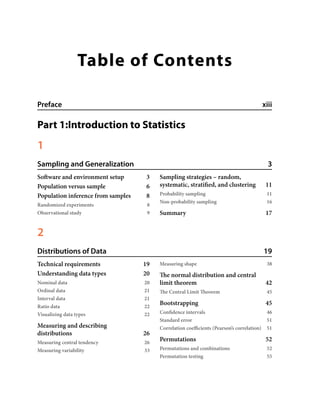
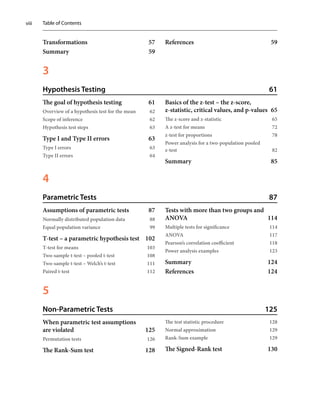
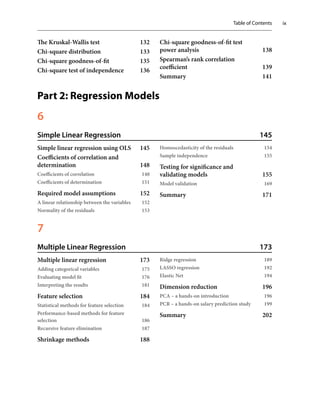
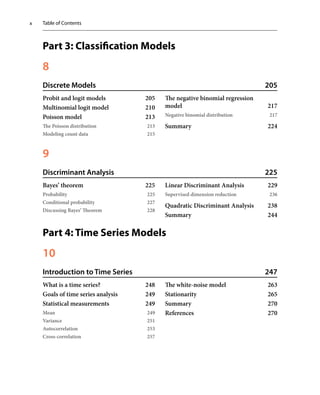
![Preface xvii
A block of code is set as follows:
A = [3,5,4]
B = [43,41,56,78,54]
permutation_testing(A,B,n_iter=10000)
Any command-line input or output is written as follows:
pip install SomePackage
Bold: Indicates a new term, an important word, or words that you see onscreen. For instance,
words in menus or dialog boxes appear in bold. Here is an example: “Select System info from the
Administration panel.”
Tips or important notes
Appear like this.
Get in touch
Feedback from our readers is always welcome.
General feedback: If you have questions about any aspect of this book, email us at customercare@
packtpub.com and mention the book title in the subject of your message.
Errata: Although we have taken every care to ensure the accuracy of our content, mistakes do happen.
If you have found a mistake in this book, we would be grateful if you would report this to us. Please
visit www.packtpub.com/support/errata and fill in the form.](https://image.slidesharecdn.com/27658246-250518023126-866d28ba/85/Building-Statistical-Models-In-Python-1st-Edition-Anonymous-22-320.jpg)



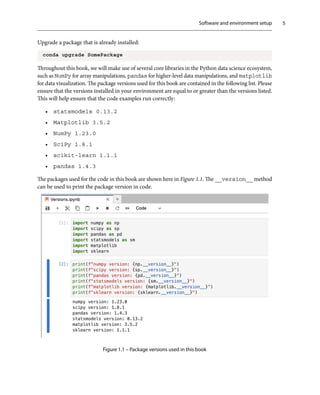
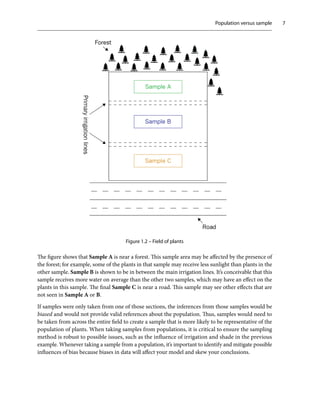
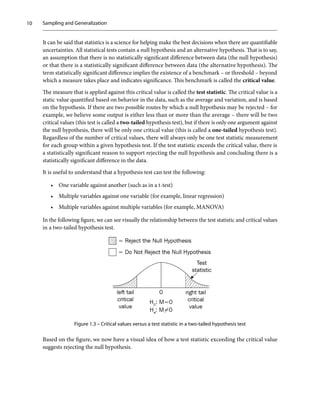
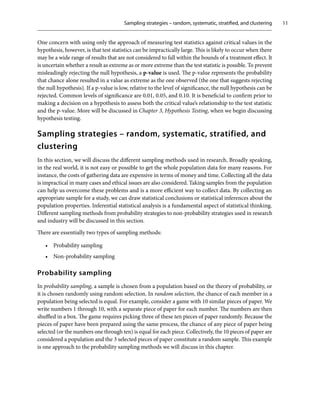
![Sampling and Generalization
12
Figure 1.4 – A random sampling example
We can implement the sampling method described before (and shown in Figure 1.4) with numpy.
We will use the choice method to select three samples from the given population. Notice that
replace==False is used in the choice. This means that once a sample is chosen, it will not be
considered again. Note that the random generator is used in the following code for reproducibility:
import numpy as np
# setup generator for reproducibility
random_generator = np.random.default_rng(2020)
population = np.arange(1, 10 + 1)
sample = random_generator.choice(
population, #sample from population
size=3, #number of samples to take
replace=False #only allow to sample individuals once
)
print(sample)
# array([1, 8, 5])
The purpose of random selection is to avoid a biased result when some units of a population have a
lower or higher probability of being chosen in a sample than others. Nowadays, a random selection
process can be done by using computer randomization programs.
Four main types of the probability sampling methods that will be discussed here are as follows:
• Simple random sampling
• Systematic sampling](https://image.slidesharecdn.com/27658246-250518023126-866d28ba/85/Building-Statistical-Models-In-Python-1st-Edition-Anonymous-37-320.jpg)
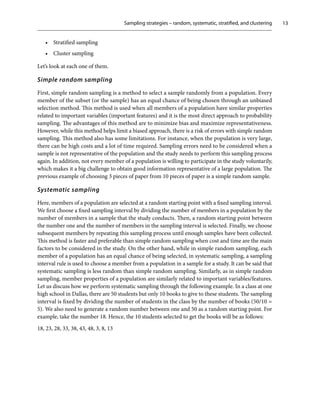
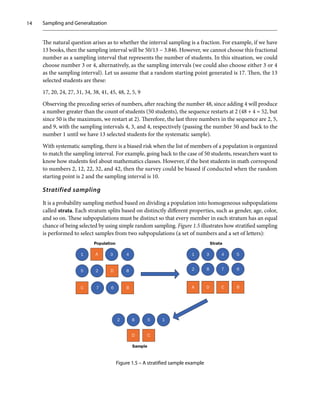
![Sampling strategies – random, systematic, stratified, and clustering 15
The following code sample shows how to implement stratified sampling with numpy using the example
shown in Figure 1.5. First, the instances are split into the respective strata: numbers and letters. Then,
we use numpy to take random samples from each stratum. Like in the previous code example, we
utilize the choice method to take the random sample, but the sample size for each stratum is based
on the total number of instances in each stratum rather than the total number of instances in the
entire population; for example, sampling 50% of the numbers and 50% of the letters:
import numpy as np
# setup generator for reproducibility
random_generator = np.random.default_rng(2020)
population = [
1, A, 3, 4,
5, 2, D, 8,
C, 7, 6, B
]
# group strata
strata = {
'number' : [],
'string' : [],
}
for item in population:
if isinstance(item, int):
strata['number'].append(item)
else:
strata['string'].append(item)
# fraction of population to sample
sample_fraction = 0.5
# random sample from stata
sampled_strata = {}
for group in strata:
sample_size = int(
sample_fraction * len(strata[group])
)
sampled_strata[group] = random_generator.choice(
strata[group],
size=sample_size,
replace=False
)](https://image.slidesharecdn.com/27658246-250518023126-866d28ba/85/Building-Statistical-Models-In-Python-1st-Edition-Anonymous-40-320.jpg)
![Sampling and Generalization
16
print(sampled_strata)
#{'number': array([2, 8, 5, 1]), 'string': array(['D', 'C'],
dtype='U1')}
The main advantage of this method is that key population characteristics in a sample better represent
the population that is studied and are also proportional to the overall population. This method helps
to reduce sample selection bias. On the other hand, when classifying each member of a population
into distinct subpopulations is not obvious, this method becomes unusable.
Cluster sampling
Here, a population is divided into different subgroups called clusters. Each cluster has homogeneous
characteristics. Instead of randomly selecting individual members in each cluster, entire clusters are
randomly chosen and each of these clusters has an equal chance of being selected as part of a sample.
If clusters are large, then we can conduct a multistage sampling by using one of the previous sampling
methods to select individual members within each cluster. A cluster sampling example is discussed
now. A local pizzeria plans to expand its business in the neighborhood. The owner wants to know
how many people order pizzas from his pizzeria and what the preferred pizzas are. He then splits the
neighborhood into different areas and selects clients randomly to form cluster samples. A survey is sent
to the selected clients for his business study. Another example is related to multistage cluster sampling.
A retail chain store conducts a study to see the performance of each store in the chain. The stores are
divided into subgroups based on location, then samples are randomly selected to form clusters, and
the sample cluster is used as a performance study of his stores. This method is easy and convenient.
However, the sample clusters are not guaranteed to be representative of the whole population.
Non-probability sampling
The other type of sampling method is non-probability sampling, where some or all members of a
population do not have an equal chance of being selected as a sample to participate in the study. This
method is used when random probability sampling is impossible to conduct and it is faster and easier
to obtain data compared to the probability sampling method. One of the reasons to use this method
is due to cost and time considerations. It allows us to collect data easily by using a non-random
selection based on convenience or certain criteria. This method can lead to a higher-biased risk than
the probability sampling method. The method is often used in exploratory and qualitative research. For
example, if a group of researchers wants to understand clients’ opinions of a company related to one of
its products, they send a survey to the clients who bought and used the product. It is a convenient way
to get opinions, but these opinions are only from clients who already used the product. Therefore, the
sample data is only representative of one group of clients and cannot be generalized as the opinions
of all the clients of the company.](https://image.slidesharecdn.com/27658246-250518023126-866d28ba/85/Building-Statistical-Models-In-Python-1st-Edition-Anonymous-41-320.jpg)
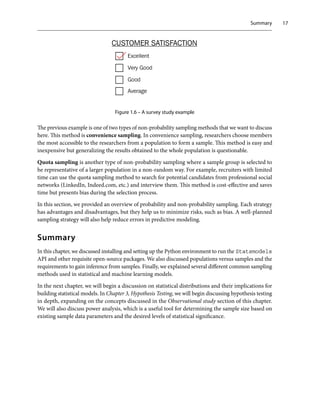

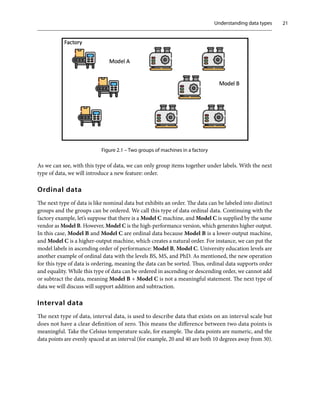
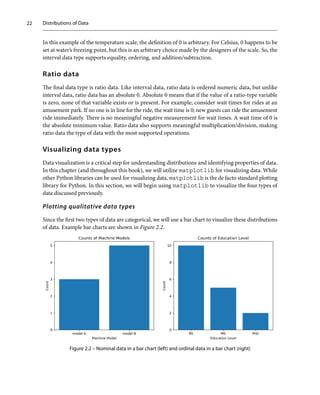
![Understanding data types 23
The left bar chart in Figure 2.2 shows the distribution of the Model A machines and Model B machines
given in the factory example. The right bar chart shows an example distribution of the education levels
of a team of engineers. Note that in the education level bar chart, the x-axis labels are ordered from
the lowest level of education to the highest level of education.
The code used to generate Figure 2.2 is shown next.
The code has three main parts.
• The library imports:
In this case, we are only importing pyplot from matplotlib, which is canonically imported
as plt.
• The code for data creation:
After the import statement, there are a few statements to create the data we will plot. The
data for the first plot is stored in two Python lists: label and counts, which contain the
machine labels and the number of machines, respectively. It’s worth noting that each of these
two lists contains the same number of elements (two elements). The education data is stored
similarly. While in this example, we are using simple example data, in later chapters, we will
have additional steps for retrieving and formatting data.
• The code for plotting the data:
The final step is plotting the data. Since we are plotting two sets of data in this example, we use the
subplots method, which will create a grid of plots. The first two arguments to subplots are
the number of rows and the number of columns for the grid of figures. In our case, the number
of rows is 1 and the number of columns is 2. The subplots method returns two objects; the
figure, fig, and the axes, ax. The first returned object, fig, has high-level controls over the
figure, such as saving the figure, showing the figure in a new window, and many others. The
second object, ax, will either be an individual axis object or an array of axis objects. In our case,
ax is an array of axes objects – since our grid has two plots, indexing into ax gives us the axes
object. We use the bar method of an axes object to create a bar chart. The bar method has
two required arguments. The first required argument is the list of labels. The second argument
is the bar heights that correspond to each label, which is why the two lists must have the same
length. The other three methods, set_title, set_ylabel, and set_xlabel, set the
values for the corresponding plot attributes: title, ylabel, and x-label.
Finally, the figure is created using fig.show():
import matplotlib.pyplot as plt
label = ['model A', 'model B']
counts = [3, 5]
edu_label = ['BS', 'MS', 'PhD']
edu_counts = [10, 5, 2]
fig, ax = plt.subplots(1, 2, figsize=(12, 5))](https://image.slidesharecdn.com/27658246-250518023126-866d28ba/85/Building-Statistical-Models-In-Python-1st-Edition-Anonymous-48-320.jpg)
![Distributions of Data
24
ax[0].bar(label, counts)
ax[0].set_title('Counts of Machine Models')
ax[0].set_ylabel('Count')
ax[0].set_xlabel('Machine Model')
ax[1].bar(edu_label, edu_counts)
ax[1].set_title('Counts of Education Level')
ax[1].set_ylabel('Count')
ax[1].set_xlabel('Education Level')
fig.show()
Now let’s look at how to plot data from the other two data types.
Plotting quantitative data types
Since the last two data types are numeric, we will use a histogram to visualize the distributions. Two
example histograms are shown in Figure 2.3.
Figure 2.3 – Nominal data in a bar chart (left) and ordinal data in a bar chart (right)
The left histogram is synthetic wait time data (ratio data) that might represent wait times at an
amusement park. The right histogram is temperature data (interval data) for the Dallas-Fort Worth
area during April and May of 2022 (pulled from https://www.iweathernet.com/texas-
dfw-weather-records).
The code used to generate Figure 2.3 is shown next. Again, the code has three main parts, the library
imports, the code for data creation, and the code for plotting the data.](https://image.slidesharecdn.com/27658246-250518023126-866d28ba/85/Building-Statistical-Models-In-Python-1st-Edition-Anonymous-49-320.jpg)
![Understanding data types 25
Like in the previous example, matplotlib is imported as plt. In this example, we also import a
function from scipy; however, this function is only used for generating sample data to work with
and we will not discuss it at length here. For our purposes, just think of skewnorm as producing an
array of numbers. This code block is very similar to the previous code block.
The main difference is the method used for plotting the data, hist, which creates a histogram. The
hist method has one required argument, which is the sequence of numbers to plot in the histogram.
The second argument used in this example is bins, which effectively controls the granularity of the
histogram – granularity increases with more bins. The bin count of a histogram can be adjusted for
the desired visual effect and is generally set experimentally for the data plotted:
from scipy.stats import skewnorm
import matplotlib.pyplot as plt
a = 4
x = skewnorm.rvs(a, size=3000) + 0.5
x = x[x 0]
dfw_highs = [
85, 87, 75, 88, 80, 86, 90, 94, 93, 92, 90, 92, 94,
93, 97, 90, 95, 96, 96, 95, 92, 70, 79, 73, 88, 92,
94, 93, 95, 76, 78, 86, 81, 95, 77, 71, 69, 88, 86,
89, 84, 82, 77, 84, 81, 79, 75, 75, 91, 86, 86, 84,
82, 68, 75, 78, 82, 83, 85]
fig, ax = plt.subplots(1,2, figsize=(12, 5))
ax[0].hist(x, bins=30)
ax[0].set_xlabel('Wait Time (hr)')
ax[0].set_ylabel('Frequency')
ax[0].set_title('Wait Times');
ax[1].hist(dfw_highs, bins=7)
ax[1].set_title('High Temperatures for DFW (4/2022-5/2022)')
ax[1].set_ylabel('Frequency')
ax[1].set_xlabel('Temperature (F)')
fig.show()
In this section, we had a glimpse into how varied data and distributions can appear. Since distributions
of data appear in many shapes and sizes in the wild, it is useful to have methods for describing
distributions. In the next section, we will discuss the measurements available for distributions, how
those measurements are performed, and the types of data that can be measured.](https://image.slidesharecdn.com/27658246-250518023126-866d28ba/85/Building-Statistical-Models-In-Python-1st-Edition-Anonymous-50-320.jpg)
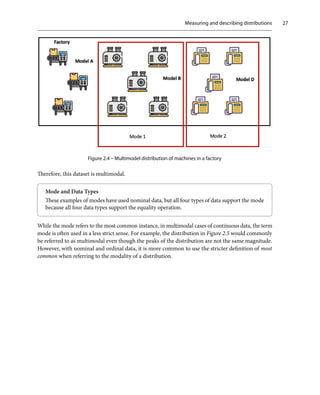
![Distributions of Data
28
Figure 2.5 – A multimodal distribution of data
Now, we will look at how to calculate the mode with code using scipy. The scipy library contains
functions for calculating descriptive statistics in the stats module. In this example, we import
mode from scipy.stats and calculate the mode of the following numbers, 1, 2, 3, 4, 4,
4, 5, 5:
from scipy.stats import mode
m = mode([1,2,3,4,4,4,5,5])
print(
fThe mode is {m.mode[0]} with a count of
f {m.count[0]} instances
)
# The mode is 4 with a count of 3 instances
The mode function returns a mode object containing mode and count members. Unsurprisingly,
the mode and count members contain the modes of the dataset and the number of times the modes
appear, respectively. Note that mode and count members are indexable (like lists) because a dataset
can contain multiple modes.](https://image.slidesharecdn.com/27658246-250518023126-866d28ba/85/Building-Statistical-Models-In-Python-1st-Edition-Anonymous-53-320.jpg)
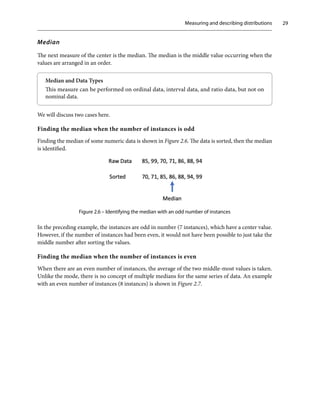


![I
HISTORY OF THE FORTY VEZIRS
INTRODUCTION
T is related that the wife of a great king unjustly accused his son, by
another mother, of an act of treachery against his father; and that that king
was wroth, and for forty mornings caused his son to be led forth to be
slain; and that that king had many vezirs, all of whom were peerless in the
sea of understanding, and in thoughtfulness and sagacity, and full of plans
and devices; and that when the king each morning caused his son to be led
forth for execution, these vezirs gave the king counsel, and each morning a
vezir, telling a story, calmed the king’s heart and turned away his wrath, and
saved the prince from his hand; and again, that each night that crafty lady,
letting not the king rest, ever incited him to the slaughter of the prince, and
with enticing and beguiling words, repeated each night a story to the king,
and made his understanding forsake him; and that through the words of that
crafty lady, every morning for forty days he caused his son to be led into his
presence to be slain; and that the vezirs by telling a story delivered him.
After forty days the innocence of the prince was manifested and the
falsehood and calumny of the crafty lady disclosed; and she received her
due, and the prince was greatly loved and esteemed before his father when
the truth of his affair was known. The adventures of the king, and the lady
and the prince, and his governor and the vezirs, and what befell between
them, will be related; and sixteen of the stories told by the vezirs in the
forty days, and by the lady in the forty nights will be set forth and narrated.
“With God is grace: how excellent a friend is he!”
They tell in history books, that there was in Persia a great king, whose
name was Khānqīn, and in the grasp of whose possession were the Seven
Climes. As he was gracious and able and sagacious, kingliness and the
bases of empire were present in him. God most high had give him a fair
son, by whose beauty the people of the world were bewildered. Whosoever
looked upon his loveliness would say, “Is it magic, this?”[3] and he who
beheld his tall figure would exclaim, “This is no mortal!”[4] Fair was his
beauty and charming was his self, and desired of lovers. Moreover, his were
accomplishments and perfections; he had no rival in the reading of science,](https://image.slidesharecdn.com/27658246-250518023126-866d28ba/85/Building-Statistical-Models-In-Python-1st-Edition-Anonymous-63-320.jpg)
![or in penmanship, or in archery, or in horsemanship; and his fair character
was talked of and celebrated among high and low. The king, too, whenever
he saw him, experienced a hundred thousand pleasures, and looked upon
him as the source of his life. The mother of this youth was of the lovely
ones of China.[5] One day she fell ill, and at length, no remedy availing, she
was received into Mercy. Thereupon, after some time had passed, his father
married the daughter of a great king and brought her to his palace.
After a while this lady fell in love with the prince. For a long time she
hid her love in her heart, and, saying in herself, “He is my step-son, what
help for it!” she disclosed it not. But when, day after day, she looked upon
his beauty, she was no longer able to bear with patience the fire of love,
and, bringing into the field the wallet of craft, she was busy night and day
with stratagems. Now the king had given the prince to a governor to be
taught the sciences of astronomy and astrology, and the boy was night and
day occupied acquiring them. One day the governor looked at the youth’s
horoscope, and perceived there was a space of forty days in most sinister
aspect. Did he say a word about this, he would be pointing out a great
calamity; so he was exceeding grieved, and his heart was contracted. But he
said to the prince, “I have this day looked at thy horoscope and seen a most
sinister aspect; such is it, my life,[6] that thou must obey the command and
decree of God most high, and observe my injunction, else thou shalt die.”
The prince heard these words of his governor and his color changed, and
he said to his teacher, “Order what thou wilt: command is thine.” Quoth the
teacher, “O son, the way of averting this calamity is thus stated in the book:
for the space of forty days thou shalt not speak one word though a naked
sword be above thy head.” Then he bade the prince bear in mind certain of
the holy names and blessed litanies, and sent him to his father. The
governor thereupon hid in a vault and concealed himself.[7] When the
prince came to his father, the latter said to him, “My son, what hast thou
read and written this day?” but the prince gave no answer to his father.
Again quoth the king, “O my life, what does thy master?” again he gave no
answer. Again his father said, “O life of my life, what has befallen thee?
Why dost thou not speak?” Again he gave no answer. Then said the king to
his son’s guardian, “The boy is sad to-day, take him to his mother, maybe
that his heart will expand.” Then the guardian took the youth to the lady and
said, “Lady, this youth is sad, he has not uttered one syllable to his father](https://image.slidesharecdn.com/27658246-250518023126-866d28ba/85/Building-Statistical-Models-In-Python-1st-Edition-Anonymous-64-320.jpg)
![that he shall hew thee in pieces, small even as thine ear.” And she
dishevelled her hair and smeared the four sides of her robe with the blood
of her mouth and sat down, sad and tearful, feeble and wailing. Then the
youth went to his private apartments. After a time the king came to the
harem, thinking to inquire of the lady concerning the affair of the prince,
and he saw her seated besmeared with red blood. And the king marvelled at
this sight, and said to the lady, “What is this matter? explain to me.” She
said, “O king, that degenerate son of thine! God forbid that he be son of
thine!” “What is the matter?” said the king.
The lady replied, “I saw that degenerate youth that he was sad, and I
cleared the palace that I might banish his sadness, and I said to him, ‘My
son, why art thou sad?’ Then he stretched forth his hand and made to do me
wrong, but I prevented him. Then he said to me, ‘Why dost thou flee me? if
thou wilt be my mistress and make thy heart one with mine, and assure me
thereof, it is my intention to kill my father and make thee my wife; and the
riches, and the country, and the throne, and the kingdom will be ours,’ But I
consented not, and he desired to kill me that I might not make known this
matter to the king. And I cried out for the saving of my life, and he left me
in this plight and went away. Now, O king, know of a surety that he
purposes evil against thee, and see to the saving of thine own life, else
crown and throne will go from thy hands; so ere he kill thee do thou kill
him that thou be secure from his wickedness.” When the king heard these
words from the lady he was wroth, and that night sleep came not to his
eyes.
In the early morning he went forth and sat upon his throne, and caused
the prince to be brought before him, that he might order the executioner to
smite off his head. The courtiers who were beside him got the executioner
to delay, and at once sent word to the vezirs. As soon as they knew what
was happening, the vezirs came with all speed to the presence of the king,
and said, “O king, how has the prince this day thus merited the anger of the
king?”
The king related to the vezirs the events that had taken place, whereupon
the grand vezir said, “Slay not thy son, trusting on the woman’s word; do
not a deed beyond the ordinance of God and the law of the Messenger:[8]
and there is no permission in the law for one to act on a woman’s word. If
there were witnesses that the prince had done this thing to the lady, then](https://image.slidesharecdn.com/27658246-250518023126-866d28ba/85/Building-Statistical-Models-In-Python-1st-Edition-Anonymous-66-320.jpg)
![were command the king’s; but spill not blood unjustly, that afterward thou
suffer not regret and remorse. They have said that whatsoever oppression
there be in a country it is incumbent on him who is king to banish it; where
then were room for kings to do deeds beyond the law and spill blood
unjustly? If they be negligent in the matter of banishing oppression, God
most high will visit and afflict them with four sorts of troubles: firstly, he
will make their life short; secondly, he will let the enemy prevail against
them; thirdly, he will give the enemy aid and victory; and fourthly, on the
resurrection day he will be wroth with them and consign them to the
torment of hell.
“He then is wise who will not for a five-days’ life lose the hereafter, and
is not needless. And, moreover, the holy Messenger (peace on him!) when
going to perform the ablution would first of all perform it with sand; the
companions asked, ‘O Apostle of God, is it lawful to perform the sand
ablution when there is water?’ The most noble beloved of God replied, ‘I
fear lest death let me not reach the water.’ Now, O king, be not
presumptuous through worldly fortune and kingship, and consent not to a
deed contrary to the law, and ruin not thy hereafter, trusting in the woman’s
word. For by reason of the craft of woman has many a head been cut off;
and the blessed Messenger hath said, ‘Whatsoever misfortunes befall my
people will befall them through women.’ And wise is he who looks at the
beginning and end of an affair, like that king who took counsel with his
sons and his vezirs and the elders of the country, and was prospered alike in
the world and the hereafter. And that story is a fair story; if the king grant
leave I will relate it.” The king said, “Tell on.” Quoth the vezir:
Trial of the Three Sons
“There was of old time in the palace of the world a great king, such that
the world was under his rule. He had lived enjoying sovereignty for a
hundred and twenty years in the palace of the world, and was grown old and
knew that in the near future he would be given to drink of the potion of
death. And the king had three moon-faced[9] sons and likewise three able
and skilful vezirs. One day quoth the king to his vezirs, ‘The end of this my
life draws nigh; the natural life of man is a hundred and twenty years, after
that not an old man remains. Now I have reached that state and the affair is
thus, I wish to appoint one of my sons to my place, and, leaning my back](https://image.slidesharecdn.com/27658246-250518023126-866d28ba/85/Building-Statistical-Models-In-Python-1st-Edition-Anonymous-67-320.jpg)
![thorns of the country;’ and he ordered that the three of them perished. When
he too had ruled for three days, the turn came to the youngest prince, and he
likewise sat upon the throne and directed the government. He gave to the
doctors the post suitable to the doctors, and to the learned the high offices,
and to the strong and impetuous young heroes, military fiefs, and to the
champions, feudal domains; and he registered their pay. He honored each of
them according to his position, and abased the unmannerly. Brief, he put
each one in his proper place, like a string of pearls; and he left not his gate
unlocked lest the foe should triumph over him.
“The king again sent three culprits from the prison that he might try his
judgment. When they were present the servants informed him, and he said,
‘Bring them one by one,’ Then when the witnesses had borne witness that
the man had indeed committed murder, the prince said, ‘Murder is of two
kinds, the one intentional, the other accidental; and the intentional is also of
two kinds, the first when a person strikes another with an iron instrument
and kills him, him it is needful to put to death in retaliation; and they have
written in the Book of Dues that if one person strike another with a stick
and kill him, or if he throw him into a fire, then the fine for blood and the
expiation alike become necessary. And the other too is accidental, when the
expiation is incumbent, and he is culpable, but the fine for blood does not
become necessary. And that is accidental when a person shoots an arrow at
a deer, and it glances and hits a man and kills him; as God most high hath
said, “Then whoso killeth a believer by mischance, then (the expiation is)
the freeing of a believer from bondage ... but if he find not (the means of
doing so), then a fast for two consecutive months.”’[10]
“Then the prince asked and learned that he had murdered intentionally;
so they executed him. After that they brought the thief; and the prince said,
‘If anyone, sane and of age, steal ten minted dirhems of silver, his hand
must be cut off, as also if he steal one dīnār of gold, even as saith the
Apostle (peace on him!), “No cutting save for a dīnār or ten dirhems.”
When one thus commits theft his right hand must be cut off at the wrist; if
he commit theft again, his left hand must be cut off; if he commit it a third
time, his right foot must be cut off; and if he commit it yet again, he must
be put in prison till he repent.’ Then the prince caused the man to receive
the due of his crime. After that they brought him who had committed
adultery, his case also they exposed, and they gave him the due of his sin
conformably to the law.](https://image.slidesharecdn.com/27658246-250518023126-866d28ba/85/Building-Statistical-Models-In-Python-1st-Edition-Anonymous-69-320.jpg)
![“The nine days were completed, and the king assembled his vezirs and
said, ‘Lo, ye have seen the rule of my three sons, which of them is worthy
the throne?’ Quoth the first vezir, ‘O king, thy eldest son is worthy,’ Quoth
the second vezir, ‘Thy middle son is worthy,’ Quoth the third vezir, ‘Thy
youngest son is worthy,’ When the king heard these words of the vezirs his
doubts were not removed; and he said, ‘O vezirs, the words of the three of
ye are contrary each to other.’ And forthwith he commanded the people of
the country that on the morrow they should all come out to the plain. The
next day the whole of the folk were assembled on the plain; then the king
rose on his feet and said, ‘O people, do not to-morrow on the resurrection
day seize hold of my collar and say, “Thou hast oppressed us,” and so wrest
from me my meritorious acts and render me confounded and ashamed. Now
be ye kind and look not at my kingship and know that before God most high
there is none meaner or more abject than myself.’ And he wept full bitterly.
And the rich and poor assembled there wept all of them together.
“Then turning again, the king said, ‘O friends, lo, my time is at hand; do
ye absolve me for the hereafter. I have three sons, whichever of them ye
wish, him will I seat upon the throne. If he be just, ye will enjoy rest and
bless me, and I shall be at rest in the place where I lie; but if he be cruel, ye
will not have rest neither shall I have rest.’ The people said, ‘May the king’s
life endure full many a year! may God most high be well pleased with our
king! We are well pleased with our king; whatever we may have against our
king, let him be absolved. We are pleased with whichever son he see worthy
the throne; but since the king has given the choice into our hands, let him
seat his youngest son upon the throne. He is wise as well as learned and
skilled in the affairs of the world; if the king see fit, the wise is worthy the
seat of honor, as this has come down in the traditions, “A wise youth taketh
precedence of a foolish elder.” For the rest, the king knows.’
“Then the king went to the palace and ordered that they adorned the
throne, and the grandees of the state came, and all were present. Then he
took his youngest son by the hand and made to seat him on the throne,
when his brothers came forward and said, ‘O father, all the folk say that he
is accomplished and wise and that he knows well the law and the
government; now we have some questions to ask of him, which if he
answer, we also will contentedly resign to him the throne and stand in his
presence with folded hands;[11] but if not, the crown and throne indeed
become him not.’](https://image.slidesharecdn.com/27658246-250518023126-866d28ba/85/Building-Statistical-Models-In-Python-1st-Edition-Anonymous-70-320.jpg)
![king upon his throne in the palace. And they scattered sifted dust below the
castle and cut up strips of damask and strewed them with dust. And all the
slave girls put on black and dishevelled their hair and scattered dust upon
their heads and began to weep together, crying, ‘Alas! woe! alas!’ so that
hearts were rent. Then came the vezirs, who likewise fell to weeping
together and exclaiming, ‘Shall a king so just as this be found?’ After that
they ordered that they brought a coffin with great reverence; then the three
princes, when they saw the coffin, wept blood in place of tears and cried,
‘This is the horse our father rideth now!’ And they adorned it with jewels
and placed upon it a jewel-set crown and held over it the royal parasol.
“Then four great lords came and took hold of the frame of the coffin and
bare it away. And before the coffin went the sheykhs singing chants and
hymns. And the devotees held copies of the sacred volume before them; and
great nobles and nobles’ sons marched in front. Before them were a hundred
sweet-voiced dirge singers who wept and cried, ‘Ah! woe! alas!’ And from
one side they scattered gold and silver and jewels on the coffin; and there
were some 10,000 horsemen with golden saddles and broken stirrups and
snapped bows. And behind these was an array of slave girls, all clad in
black, whose wails and cries rose to the heavens.
“When the king saw those things he sighed and ordered that they took
him down from the throne; and he turned and said, ‘While yet alive I have
seen my death.’And he took a handful of earth and threw it on his head and
said, ‘Earth, though this long sovereignty has been mine, I have done no
righteous deed which will endure.’ And again, ‘O vezirs, I would that ye
endow for me.’ Thereupon the vezirs wrote what amounted to 10,000 aspres
a day; and they founded free kitchens and colleges, and they settled the
revenues of certain towns and villages on the free kitchens. When the
business of the endowments was finished, they brought the sections of the
Koran, and to each section reader they gave five sequins; and to each of the
devotees and dervishes they gave 500 sequins.[12] Then they brought the
food, and all the plates were of gold or silver; and to all before whom they
placed a dish they said, ‘Thine be food and plate.’ When the banquet too
was finished they freed all the male and female slaves; and three days later
the king departed for the Abiding Home.
“Now, O king, I have told this story for that the king may, like that
sovereign, inquire, and act conformably to the words of the vezirs and the](https://image.slidesharecdn.com/27658246-250518023126-866d28ba/85/Building-Statistical-Models-In-Python-1st-Edition-Anonymous-73-320.jpg)
![Again the third vezir said, ‘O king, our affair is finished by stratagem.’
Quoth the king, ‘Give advice.’ The vezir said. ‘O king, this time he comes
with great caution, and has posted men on the roads and at the stations who
seize on everyone who passes. If the king deem good, we will write a letter
and address it to his vezirs and great nobles, and it shall be on this wise:
“ ’ “After greeting: Be it not concealed that your letter has come and all
that you say is understood. Long life and health to you! We indeed hoped it
from you. Now let me see you. Display manliness and valor. Seize him on
the road and bring him to me, and that country shall be yours; such and
such a place to so and so, and such and such a district to so and so.” Then
we will seal it, and split a staff and put it therein, and give it to a man and
send him to them. They will find the staff and take it to the king, who will
undoubtedly read it, and look upon those vezirs and nobles as traitors, and
murmurings will arise among them and they will split into parties. And by
this stratagem we will again find relief.’
“The king did so. And in that way they brought the letter to that king,
and as soon as he had read it, fear for his life fell upon him. Then he turned
back and went to his country and seized those vezirs and nobles and slew
them. At length all the nobles turned from him and wrote a letter and sent it
to this king, and it was thus: ‘For the love of God come against this tyrant,
and we will aid thee.’ When the king had read the letter he assembled an
army and went to that country, and on the battle day all the nobles came and
submitted to him, and they seized the other king and surrendered him. So he
took that country through stratagem; and because that strong king was
negligent he lost his country and his head, for they slew him.
“Now, O king, I have told this story for that my king may know and not
be negligent, and lose not life and kingdom through the stratagem of that
unworthy youth.” When the king heard this story from the lady he was
wroth, and said, “To-morrow will I slay him.”
When it was morning and the sun showed his face from behind the castle
of Qāf,[13] and illumined the world with light, the king came and sat upon
his throne, and commanded the executioner that he bring the youth and he
gave the word, “Smite off his head.” Then the fourth vezir came forward
and said, “O my king, it is not seemly in kings to hasten in all things with
precipitancy; above all the spilling of blood unjustly is deemed by the wise
most blameworthy and hateful. They have declared that the trials of a king](https://image.slidesharecdn.com/27658246-250518023126-866d28ba/85/Building-Statistical-Models-In-Python-1st-Edition-Anonymous-77-320.jpg)
![are four: one is haste; another, trusting to wrong; another, considering not
the end of matters; and another, negligence. Haste is that which disappoints
those who seek good and profit for themselves; wrong is that which brings
about wars and uses armies unjustly and does evil things; considering not
the end of matters is that which employs hurry instead of deliberation; and
negligence is that which inclines to music, and lust, and taking counsel of
women. And they have said, ‘Let one take counsel of a woman and do the
opposite of what she says;’ even as spake the holy Apostle (peace on him!)
‘Consult them and do clear contrary.’[14]
“In compliance with this tradition the king must not obey the woman’s
word; and through the words of women have many men suffered remorse
and fallen under the wrath of God. And the story of Balaam, the son of
Beor,[15] is a strange story; if the king grant leave, I will relate it.” The king
said, “Tell on, let us hear.” Quoth the vezir:
The Wiles of Woman
“One day Moses (peace on him!) went against a tribe, and they were of
the people of ‘Ad, and they called their chief Og, the son of Anak.[16] One
day Moses (peace on him!) by command of God summoned these to the
faith, and resolved to fight and war with them if they were not obedient. So
Moses (peace on him!) assembled four hundred and four-score thousand
men and proceeded against the ‘Adīs. When they were come near the ‘Adīs,
he sent twelve men as ambassadors to that tribe. Now Og had gone out to
look about, and he saw the twelve men coming, so he put the whole of them
into his sack and slung it over his shoulder and turned back and went away.
He brought them to his tribe the ‘Adīs and said, ‘See the host of the
Messenger Moses which is come seeking to make war with us;’ and he held
the mouth of the sack downward and the twelve men rolled out.
“And that tribe saw them that they were small of stature, for their own
stature was twice that of these. And they all made mock of them and
laughed at them; but they killed them not, but sent them back. They
returned and told these things to Saint Moses, and fear fell upon all the host.
Then Saint Moses (peace on him!) took his rod in his hand and went against
that tribe of ‘Ad. Og the son of Anak saw that Moses (peace on him!) was
himself coming, and straightway he went and pulled up a rock like a
mountain and put it on his head, and went that he might cast it upon the host](https://image.slidesharecdn.com/27658246-250518023126-866d28ba/85/Building-Statistical-Models-In-Python-1st-Edition-Anonymous-78-320.jpg)
![of Moses (peace on him!). But God most high commanded an angel that he
went in the likeness of a bird and smote that rock with his beak and clave it,
and thereupon it passed like a circle of cursers down before the face of Og.
And straightway Saint Moses came up, and his stature grew to forty cubits,
and his rod to forty cubits, and he leaped up forty cubits, and smote Og on
the heel with his rod; and God most high slew Og.
“Then Saint Moses (peace on him!) returned to his people and gave them
tidings of Og being slain; and they were all glad. Then Saint Moses passed
thence and made for the country of Sheykh Balaam, the son of Beor. When
he was come nigh, they brought word to the sheykh that Saint Moses was
coming against him with many warriors. Whereupon the sheykh’s disciples
said, ‘O sheykh, if that host come into our land, it will lay waste all our
land; thou must find some help for this.’ Then were they silent. The sheykh
said, ‘What should we do?’ They answered, ‘Curse him.’ The sheykh said,
‘He is a Messenger; I cannot curse him.’ And howsoever much they urged
the sheykh, it was in vain. Now the sheykh had a cunning brawling wife;
her they besought, saying, ‘Speak to the sheykh, and we will give thee
much money,’ The woman answered, ‘I will manage it.’ When the sheykh
came to his house he desired to take counsel of his wife; she said, ‘Curse
him.’ The sheykh replied, ‘He is a Messenger; how can I curse him?’
“The woman persisted so that the sheykh was constrained to lift up his
hands and curse him. His curse was heard; and Saint Moses, who was
fourteen leagues distant, remained for forty years in the wilderness; even as
God most high saith in his Word, ‘For forty years shall they wander about
in the earth,’[17] Then Saint Moses knew that there was some reason for
this, and he prayed and humbled himself before God most high, and said,
‘My God, send him who is the cause of our thus wandering, from the world
to the hereafter without the faith.’ His prayer was accepted at the court of
God, and that sheykh went from the world to the hereafter without the faith
by reason of a woman; even as God most high hath said, ‘And his likeness
was as the likeness of a dog.’[18]
“Now, O King, I have told this story for that these many men have been
cast forth from the court of God for following the words of women. Then is
it incumbent on the king that he judge accordingly, so that he become not a
prey to remorse; for too late repentance profits not. Beware and beware,
slay not the prince on the woman’s word.” And he kissed the ground and](https://image.slidesharecdn.com/27658246-250518023126-866d28ba/85/Building-Statistical-Models-In-Python-1st-Edition-Anonymous-79-320.jpg)
![made intercession for the prince for that day. When the king heard this story
from the vezir, he sent the prince to the prison and went himself to the
chase.
When it was evening the king came to the palace, and the lady rose to
greet him, and they sat down. After the repast the lady again began to speak
about the youth, and the king said, “This day too my vezirs would not let
me be, so I have sent him to the prison.” Quoth the lady, “I know all the
plot of those vezirs, day by day each of them plans some trick or wile; they
purpose to discredit me with thee, so they say that women are lacking in
understanding, and that by reason thereof they are plotters and liars. These
words of theirs are false, do not assail the truth; for these see me, that my
trust in my king is strong. Yet I am aware of their case and their hurtful
deeds; and for that I would defend my king from their craft and malice, are
they enemies to me. An thou desire, my king, I shall say no more; and they
may do whatsoever they will. But all these are of single tongue and single
aim, and I fear they will bring some calamity upon thee and some evil upon
me; and afterward thou shalt repent, but it will avail not.
“My king, thou hast assembled some men of low birth and made them
vezirs and confided all thy affairs to them, and thou thinkest them honest;
Heaven forefend they should be honest when some of them are the sons of
cooks, and some of bakers, and some of butchers; it is even as when
Khizr[19] (peace on him!) showed another king the origin of his vezirs, but
mayhap my king has not heard that story.” The king said, “Tell on, let us
hear.” Quoth the lady:
The Search for Khizr
“There was in the palace of the world a king who was very desirous of
seeing Khizr (peace on him!); and he would ever say, ‘If there be anyone
who will show me Khizr, I will give him whatsoever he may wish.’ Now
there was at that time a man poor of estate; and from the greatness of his
poverty he said in himself, ‘Let me go and bespeak the king that if he
provide for me during three years I will show him Khizr; by three years
either I shall be dead or the king will be dead, or he will forgive me my
fault, or I shall on somewise win to escape: and in this way shall I make
merry for a time.’ So he went to the king and spake those words to him. The](https://image.slidesharecdn.com/27658246-250518023126-866d28ba/85/Building-Statistical-Models-In-Python-1st-Edition-Anonymous-80-320.jpg)
![elder, ‘O elder, all my vezirs have said different things, contrary the one to
the other, and thou hast said concerning each of them, “True spake the
vezir; all things return to their origin.’ What is the reason thereof?’ That
elder replied, ‘O king, thy first vezir is a butcher’s son, therefore did he
draw to his origin; thy second vezir is a cook’s son, he likewise proposed a
punishment as became his origin; thy third vezir is a baker’s son, he
likewise proposed a punishment as became his origin; but thy fourth vezir is
of gentle birth, compassion therefore becomes his origin; so he had
compassion on that hapless one and sought to do good and counselled
liberation. O king, all things draw to their origin.’[20]
“And he gave the king much counsel and at last said, ‘Lo, I am Khizr!’
and vanished. Then the king went forth from his palace, but could see no
sign or trace of that radiant elder; and he said, ‘I much longed to see Khizr
(peace on him!); praise be to God, I have attained thereto, and he has told
me the origin of my vezirs.’ And he commanded that they gave that poor
man much wealth.
“Now, O king, I have told this story for that thou mayst know that thy
vezirs are of low origin, and that fidelity will not proceed from them. In this
matter too their words tally with their origin; lose not the opportunity, for to
spare an enemy is great folly.” The king heard this story from the lady, and
said, “To-morrow will I roll up the scroll of his life.”
When it was morning and the world, like to him who had won to Khizr,
was illumined with light, the king sat upon his throne and commanded the
executioner that he bring the youth, and he gave the word, “Smite off his
head.” Thereupon the fifth vezir came forward and said, “O king of the
world, slay not the prince thus hastily, and cast not to the winds the
counsels of these many vezirs; for as they take pearls from the sea and
string them, so do these string their words; they are speakers such that
Mercury in the sky could not match their suggestions. O king, the reason of
that which thy vezirs have said to thee is this, that the Apostle (peace on
him!) hath said that whoso seeth his king do an act contrary to the law, and
hindereth him not therefrom, hath departed from the Canon. Now, O king,
deem not the words of thy vezirs mistaken; it is even as they have said, ‘Let
him who would see Khizr in the flesh, look upon a wise, accomplished and
learned vezir.’ And again, ‘If one seek to do a righteous deed, let him
arrange the affair of some poor creature with a king.’ Mayhap the king has](https://image.slidesharecdn.com/27658246-250518023126-866d28ba/85/Building-Statistical-Models-In-Python-1st-Edition-Anonymous-82-320.jpg)
![not heard the story of Khizr and a vezir.” The king said, “Tell on, let us
hear.” Quoth the vezir:
The Vezir and Khizr
“There was, of old time, a king who had an experienced vezir; and Khizr
(peace on him!) would ever come to that vezir. One day the vezir looked
upon the affairs of the world, how they abode not with anyone; and he
withdrew from the vezirship, and chose the corner of retirement, and gave
himself up to worship. A long time passed, and Khizr (peace on him!) never
once came to him. The vezir marvelled and said, ‘Why does not Khizr
(peace on him!) come to me? Now ought he to come every day.’ Then he
said, ‘There must indeed be some reason for this.’ Thereupon he saw that
Khizr had appeared, and he said, ‘O Khizr, while I was vezir thou didst ever
come to me, is it for that I have withdrawn from the world that thou comest
not now?’ Khizr (peace on him!) replied, ‘O vezir, outwardly thou didst
perform the duties of vezir, inwardly I did; therefore was there a bond
between us; now thou hast withdrawn therefrom, and that bond is gone
from between us, so I come not to thee.’ When the vezir heard these words
from Khizr, he went and asked back the vezirship, and he received it, and
Khizr (peace on him!) came to him as before and ceased not.
“O king, I have told this story for that the king may hearken to the
vezir’s words and follow them, and pass his life in happiness. Beware, O
king, be not overhasty in this affair, that afterward thou suffer not remorse.”
When the king heard this story from the vezir, he sent the prince to the
prison and went himself to the chase, and that day he took much game.
In the evening he came to the palace, and the lady rose to greet him, and
they sat down. After the repast the lady asked about the youth; the king
said, “This day again such an one of my vezirs made intercession for him,
and I sent him to the prison.” Quoth the lady, “O my king, how good were
it, could he be reformed by such conduct; but this youth is incapable of
reform; for he resembles that snake which first stings his mother as she
bears him and kills her, and then stings his father and kills him. God most
high will take vengeance on him; and his eyes will be blinded as though he
had looked upon an emerald.[21] If a drop of an April shower fall upon a
snake it becomes poison, but if it fall into an oyster it becomes a pearl;[22]
and if the Koran, great of glory, fall upon a believer’s heart, it is faith and](https://image.slidesharecdn.com/27658246-250518023126-866d28ba/85/Building-Statistical-Models-In-Python-1st-Edition-Anonymous-83-320.jpg)
![knowledge. And it is notorious that whoever nurses a snake falls at last a
prey to its poison. A certain man formed a friendship with a snake and used
every day to bring it a portion of food. He went to the snake’s hole and laid
it there, and the snake would put its head out of its hole and eat that food,
and when it was satisfied it would frolic about, and that man would play
with it. One day he came and saw that the snake was out of its place and
quite stiff from cold; ‘O poor thing,’ he said, and took and put it in his
bosom. When the snake got warm it at once raised its head and stung that
unhappy man, and killed him, and fled and entered its hole. And thus have
they said, that if one foster a swine, that brute will not leave off till in the
end it hurt him. It is even as the story of that sherbet-seller and the Moor.”
Said the king, “Tell on, let us hear.” Quoth the lady:
The Sherbet-seller and the Moor
“There was of old time in a great city a sherbet-seller, and he had a son,
a loveling of the age, who was so fair that he seemed a second Joseph;[23]
and he used to sell sherbet in the shop. The folk would come to gaze upon
this youth’s beauty, and they would give a sequin for each cup of sherbet,
and drain it; and whenever they drank a cup they would say it was the water
of life. Now one day a swarthy Moor came to that country; and as soon as
he saw the youth, the hapless Moor’s power of speech left him, and he
could not stir one step from where he stood, but leaned against the opposite
wall bewildered. After a time he recovered his understanding, and, rising
and falling like one drunk, he came up as best he could to the youth, and
gave a sequin and drank a cup of sherbet, and went away. For a time he
came every day and drank cups of sherbet at a sequin each, and looked on
the beauty of the youth.
“One day the youth told this thing to his father, and his father perceived
that the Moor was ravished with the boy, and said, ‘O my son, bring that
Moor to the house to-morrow, and let us see what manner of man he is.’ The
next day when the Moor came to the youth, he invited him to his house, and
took him and went to his father. After they had eaten, the father of the boy
asked of the Moor’s case and dwelling. The Moor saw what his intention
was, and answered, ‘I have no dwelling, I am a stranger.’ The boy’s father
said, ‘Thou art a stranger; we will give thee a dwelling, stay with us.’ The
Moor was glad and counted it a boon to his soul; even as they have said,](https://image.slidesharecdn.com/27658246-250518023126-866d28ba/85/Building-Statistical-Models-In-Python-1st-Edition-Anonymous-84-320.jpg)