Chapter 2 Title and Outline
1
2 Probability
2-1 Sample Spaces & Events
2-1.1 Random Experiments
2-1.2 Sample Spaces
2-1.3 Events
2-1.4 Count Techniques
2-2 Interpretations & Axioms of
Probability
2-3 Addition Rules
2-4 Conditional Probability
2-5 Multiplication & Total
Probability Rules
2-6 Independence
2-7 Bayes’ Theorem
2-8 Random Variables
CHAPTER OUTLINE
2
Chapter 2 Learning Objectives
© John Wiley & Sons, Inc. Applied Statistics and Probability for Engineers, by Montgomery and Runger.
Learning Objectives for Chapter 2
After careful study of this chapter, you should be able to do the
following:
1. Understand and describe sample spaces and events for random
experiments with graphs, tables, lists, or tree diagrams.
2. Interpret probabilities and use probabilities of outcomes to calculate
probabilities of events in discrete sample spaces.
3. Use permutation and combinations to count the number of outcomes in
both an event and the sample space .
4. Calculate the probabilities of joint events such as unions and
intersections from the probabilities of individuals events.
5. Interpret and calculate conditional probabilities of events.
6. Determine the independence of events and use independence to
calculate probabilities.
7. Use Bayes’ theorem to calculate conditional probabilities .
8. Understand random variables.
© John Wiley & Sons, Inc. Applied Statistics and Probability for Engineers, by Montgomery and Runger.
Random Experiments
3
Sec 2-1.1 Random Experiments
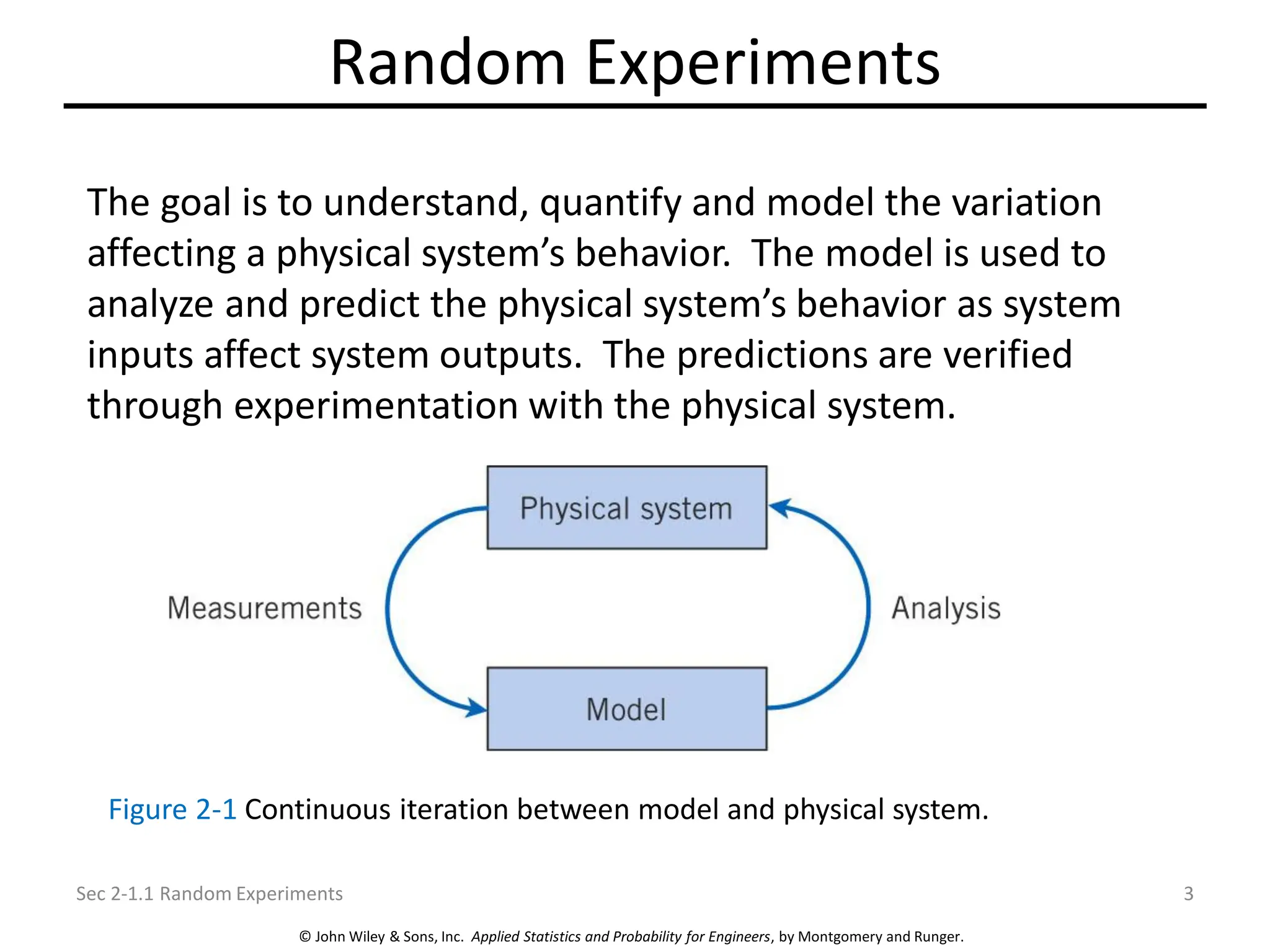
Figure 2-1 Continuous iteration between model and physical system.
The goal is to understand, quantify and model the variation
affecting a physical system’s behavior. The model is used to
analyze and predict the physical system’s behavior as system
inputs affect system outputs. The predictions are verified
through experimentation with the physical system.
© John Wiley & Sons, Inc. Applied Statistics and Probability for Engineers, by Montgomery and Runger.
Noise Produces Output Variation
Sec 2-1.1 Random Experiments 4
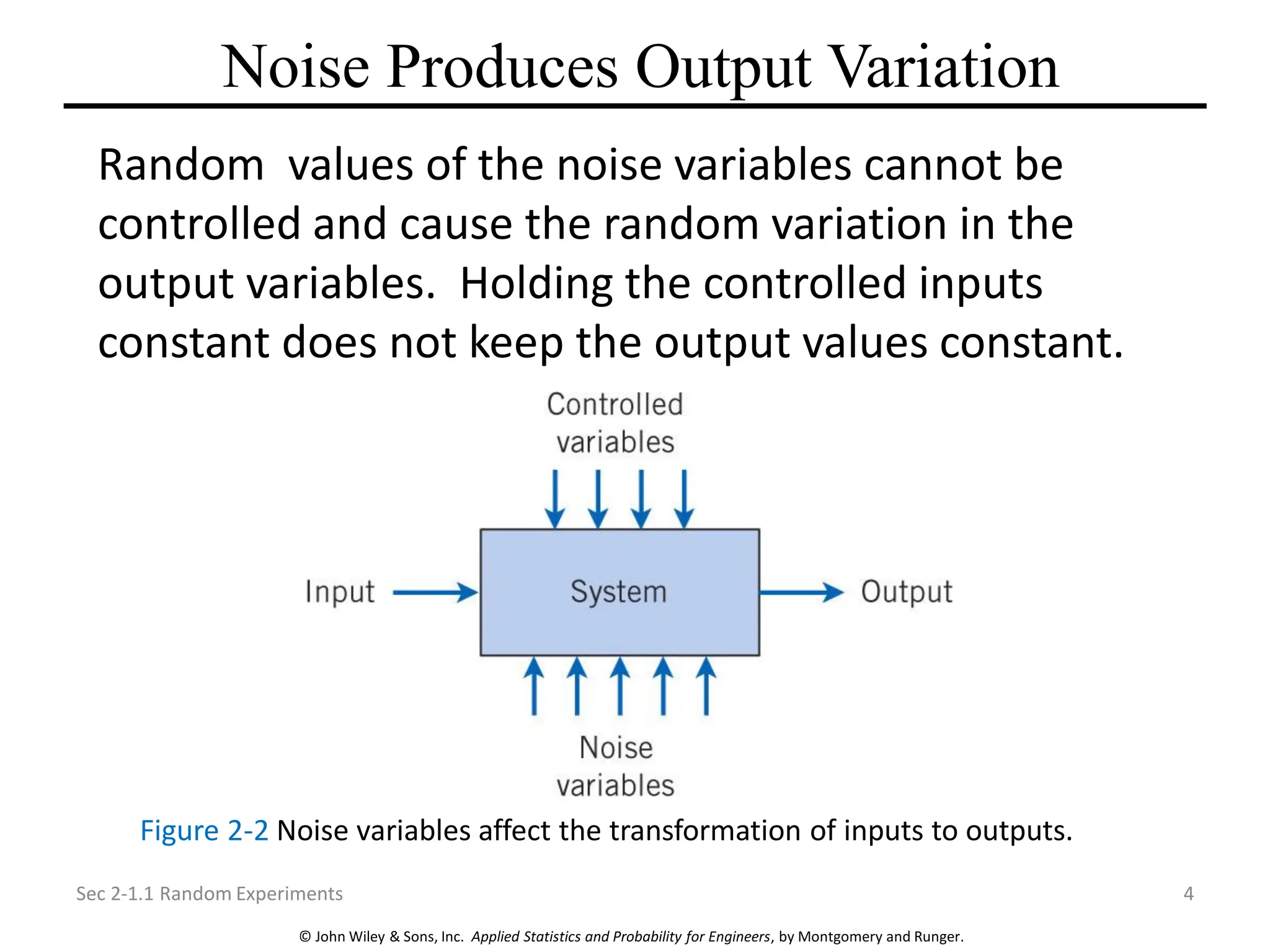
Figure 2-2 Noise variables affect the transformation of inputs to outputs.
Random values of the noise variables cannot be
controlled and cause the random variation in the
output variables. Holding the controlled inputs
constant does not keep the output values constant.
© John Wiley & Sons, Inc. Applied Statistics and Probability for Engineers, by Montgomery and Runger.
Random Experiment
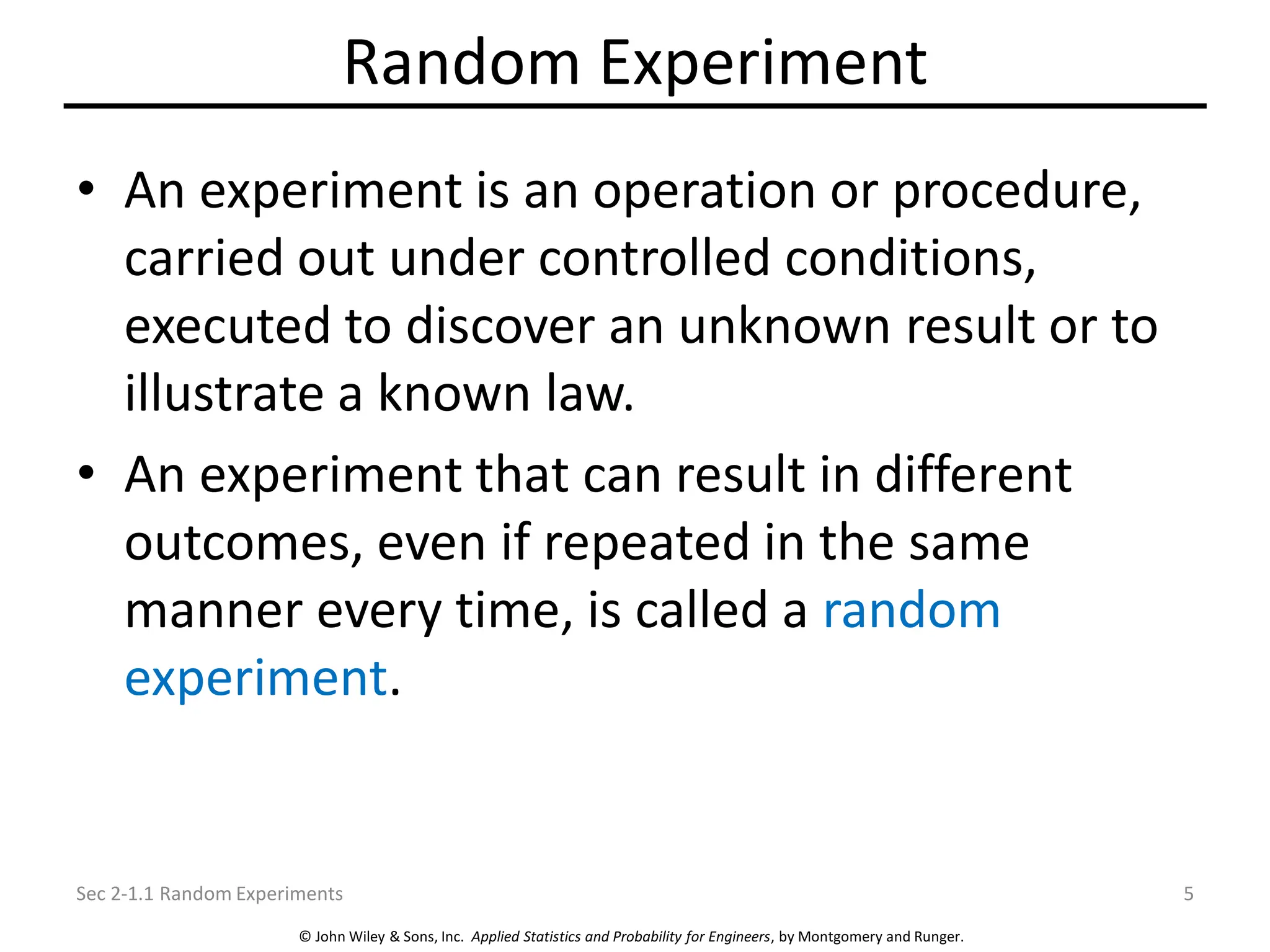
• An experiment is an operation or procedure,
carried out under controlled conditions,
executed to discover an unknown result or to
illustrate a known law.
• An experiment that can result in different
outcomes, even if repeated in the same
manner every time, is called a random
experiment.
Sec 2-1.1 Random Experiments 5
© John Wiley & Sons, Inc. Applied Statistics and Probability for Engineers, by Montgomery and Runger.
Randomness Affects Natural Law
Sec 2-1.1 Random Experiments 6
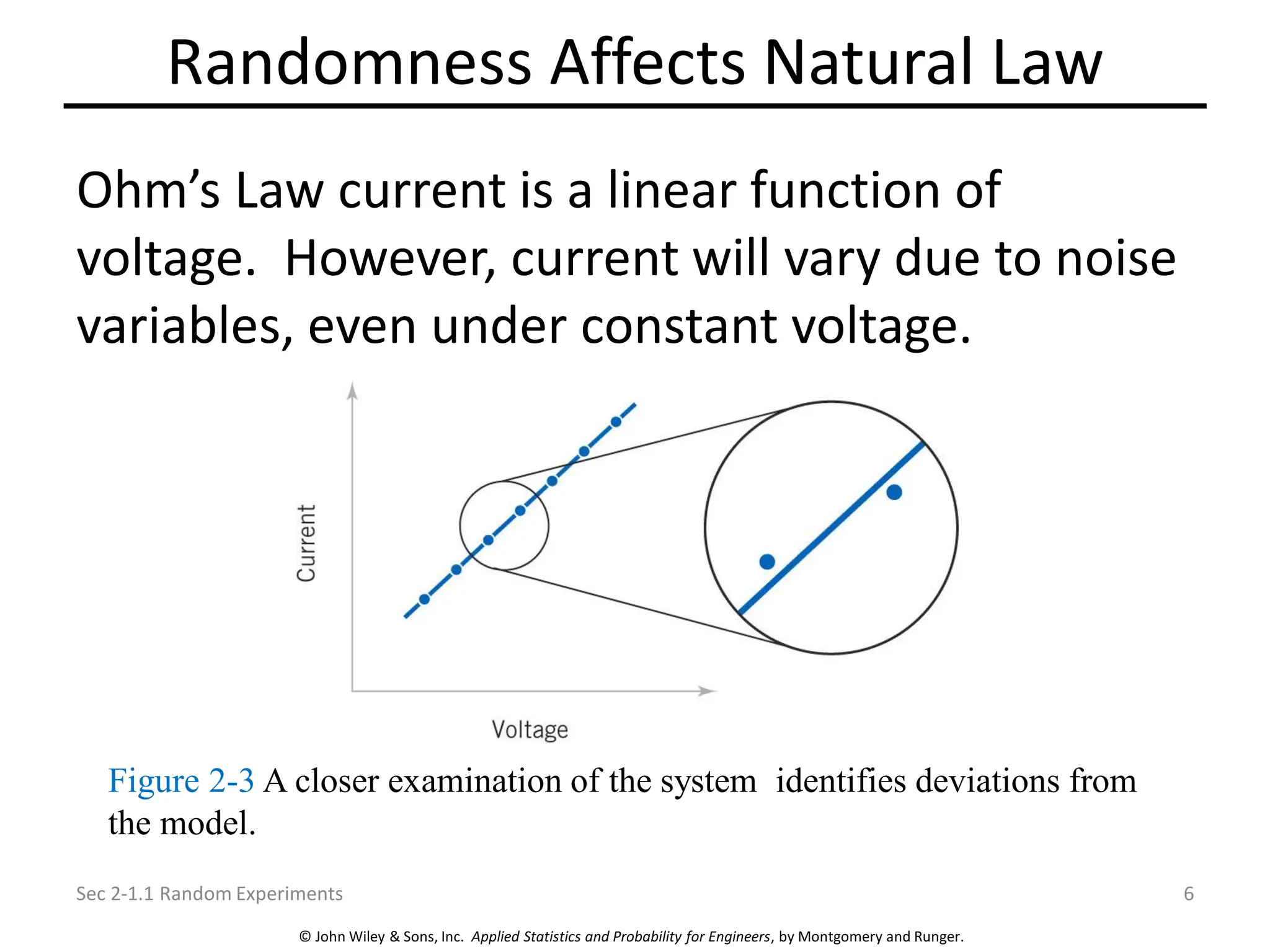
Figure 2-3 A closer examination of the system identifies deviations from
the model.
Ohm’s Law current is a linear function of
voltage. However, current will vary due to noise
variables, even under constant voltage.
© John Wiley & Sons, Inc. Applied Statistics and Probability for Engineers, by Montgomery and Runger.
Randomness Can Disrupt a System
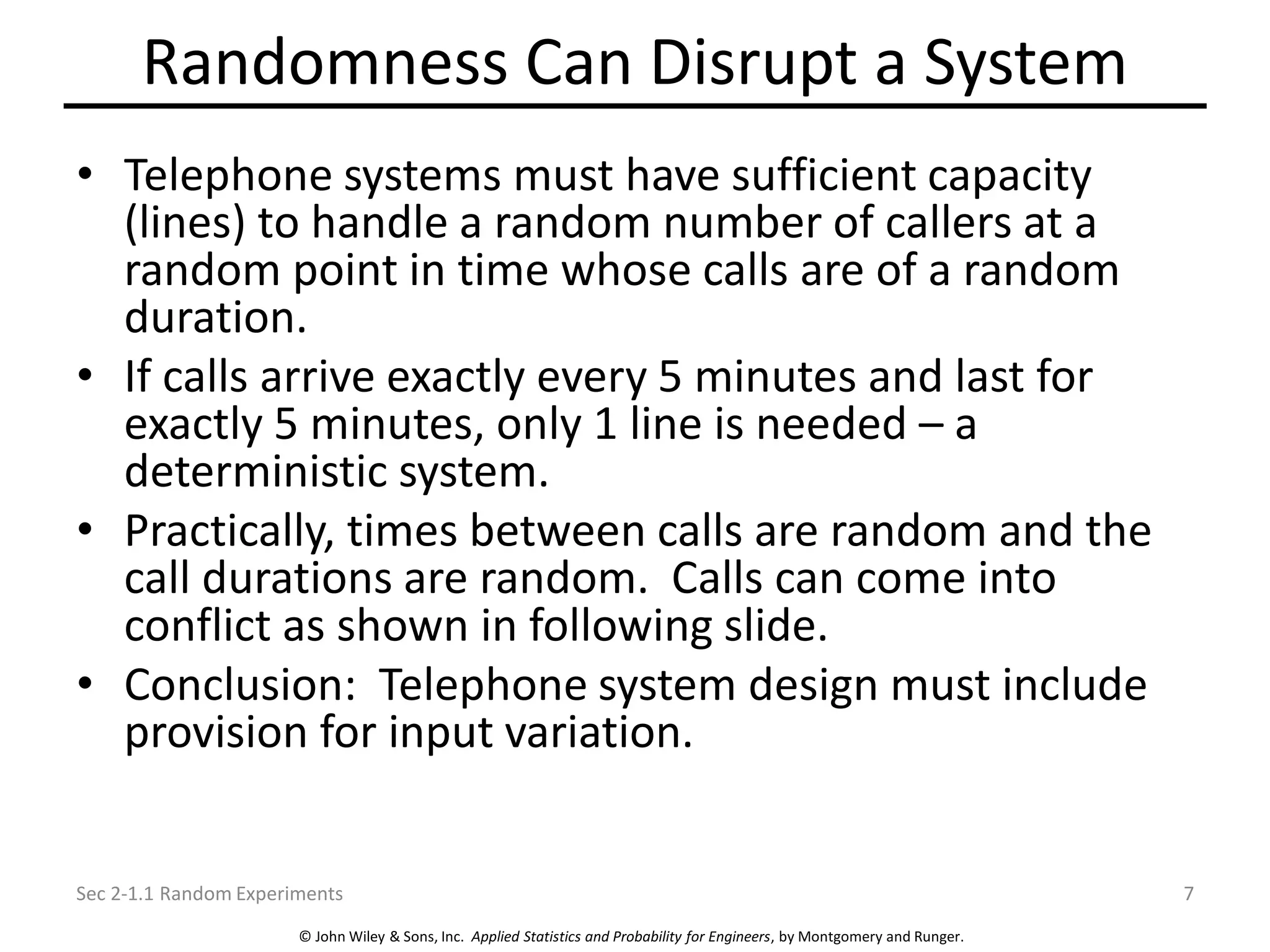
• Telephone systems must have sufficient capacity
(lines) to handle a random number of callers at a
random point in time whose calls are of a random
duration.
• If calls arrive exactly every 5 minutes and last for
exactly 5 minutes, only 1 line is needed – a
deterministic system.
• Practically, times between calls are random and the
call durations are random. Calls can come into
conflict as shown in following slide.
• Conclusion: Telephone system design must include
provision for input variation.
Sec 2-1.1 Random Experiments 7
© John Wiley & Sons, Inc. Applied Statistics and Probability for Engineers, by Montgomery and Runger.
Deterministic & Random Call Behavior
Sec 2-1.1 Random Experiments 8
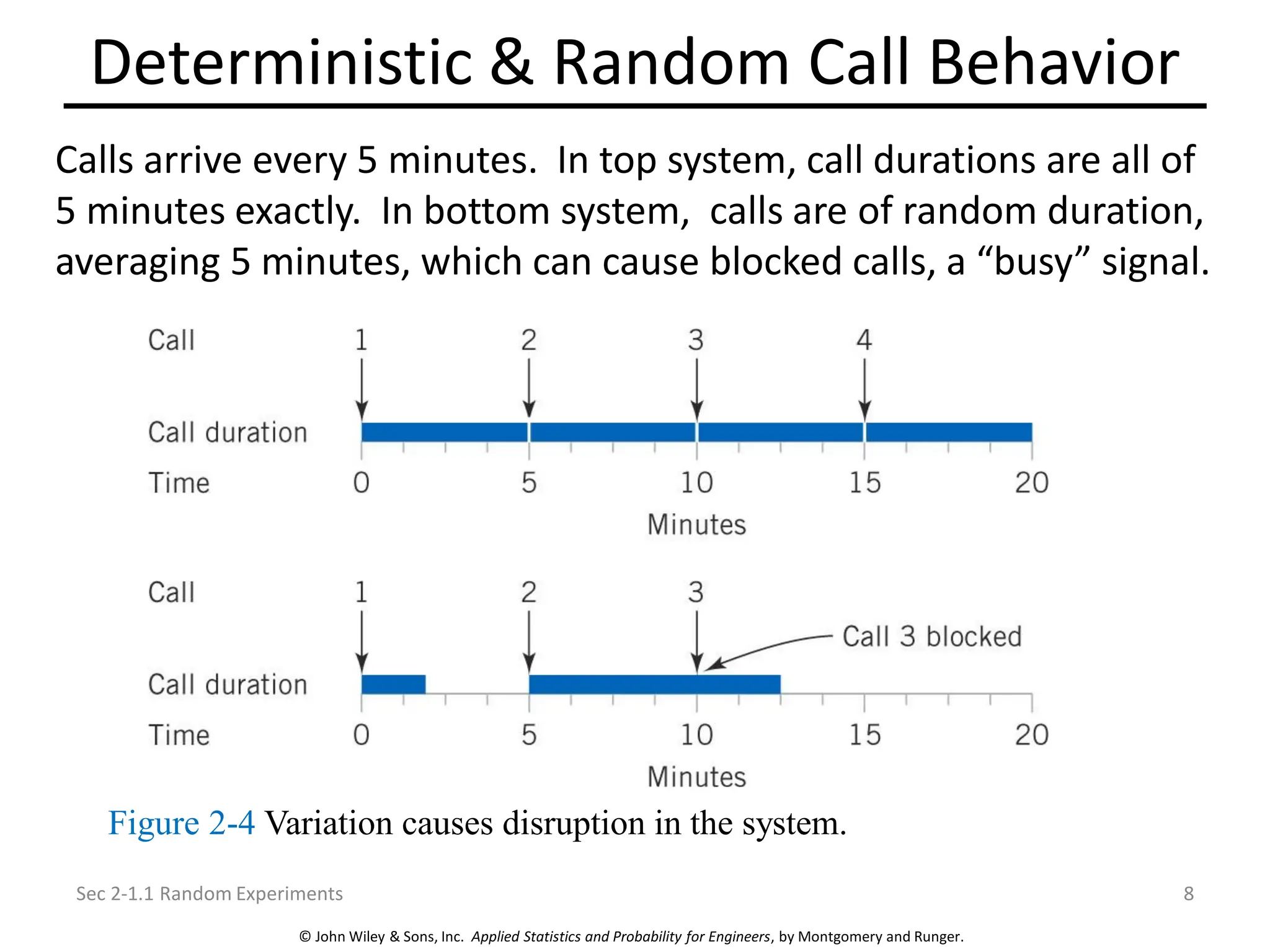
Figure 2-4 Variation causes disruption in the system.
Calls arrive every 5 minutes. In top system, call durations are all of
5 minutes exactly. In bottom system, calls are of random duration,
averaging 5 minutes, which can cause blocked calls, a “busy” signal.
© John Wiley & Sons, Inc. Applied Statistics and Probability for Engineers, by Montgomery and Runger.
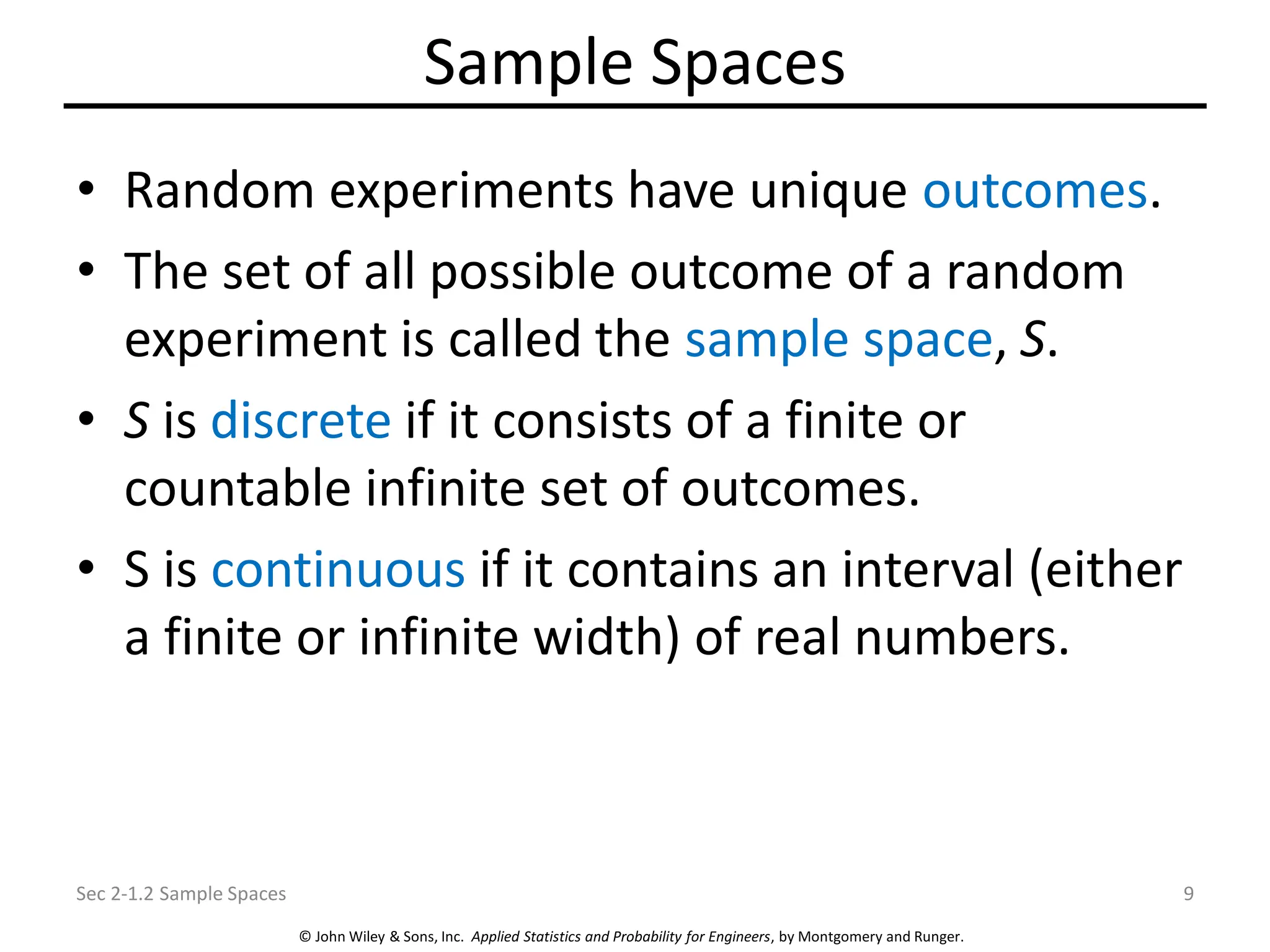
Sample Spaces
• Random experiments have unique outcomes.
• The set of all possible outcome of a random
experiment is called the sample space, S.
• S is discrete if it consists of a finite or
countable infinite set of outcomes.
• S is continuous if it contains an interval (either
a finite or infinite width) of real numbers.
Sec 2-1.2 Sample Spaces 9
© John Wiley & Sons, Inc. Applied Statistics and Probability for Engineers, by Montgomery and Runger.
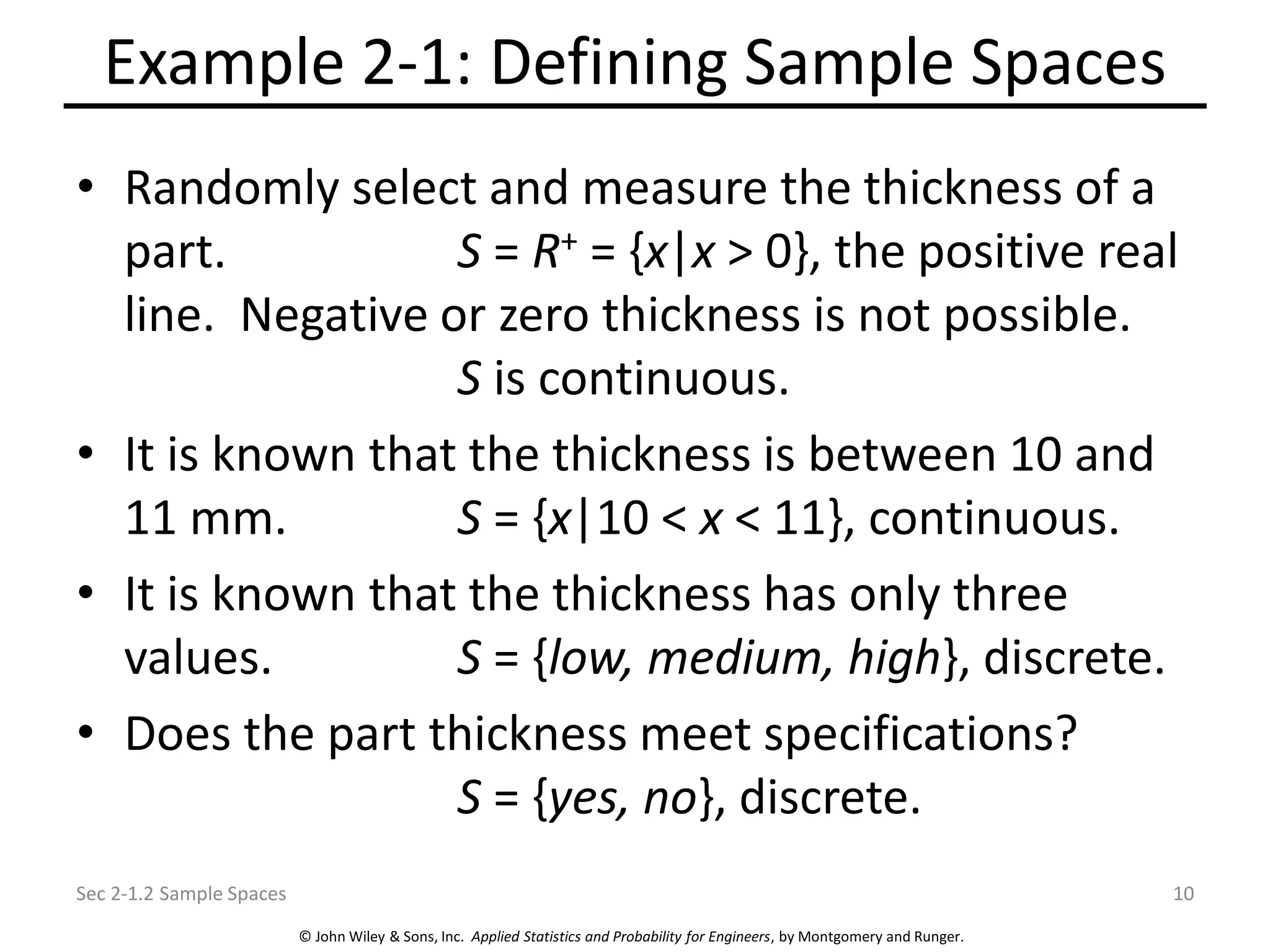
Example 2-1: Defining Sample Spaces
• Randomly select and measure the thickness of a
part. S = R+ = {x|x > 0}, the positive real
line. Negative or zero thickness is not possible.
S is continuous.
• It is known that the thickness is between 10 and
11 mm. S = {x|10 < x < 11}, continuous.
• It is known that the thickness has only three
values. S = {low, medium, high}, discrete.
• Does the part thickness meet specifications?
S = {yes, no}, discrete.
Sec 2-1.2 Sample Spaces 10
© John Wiley & Sons, Inc. Applied Statistics and Probability for Engineers, by Montgomery and Runger.
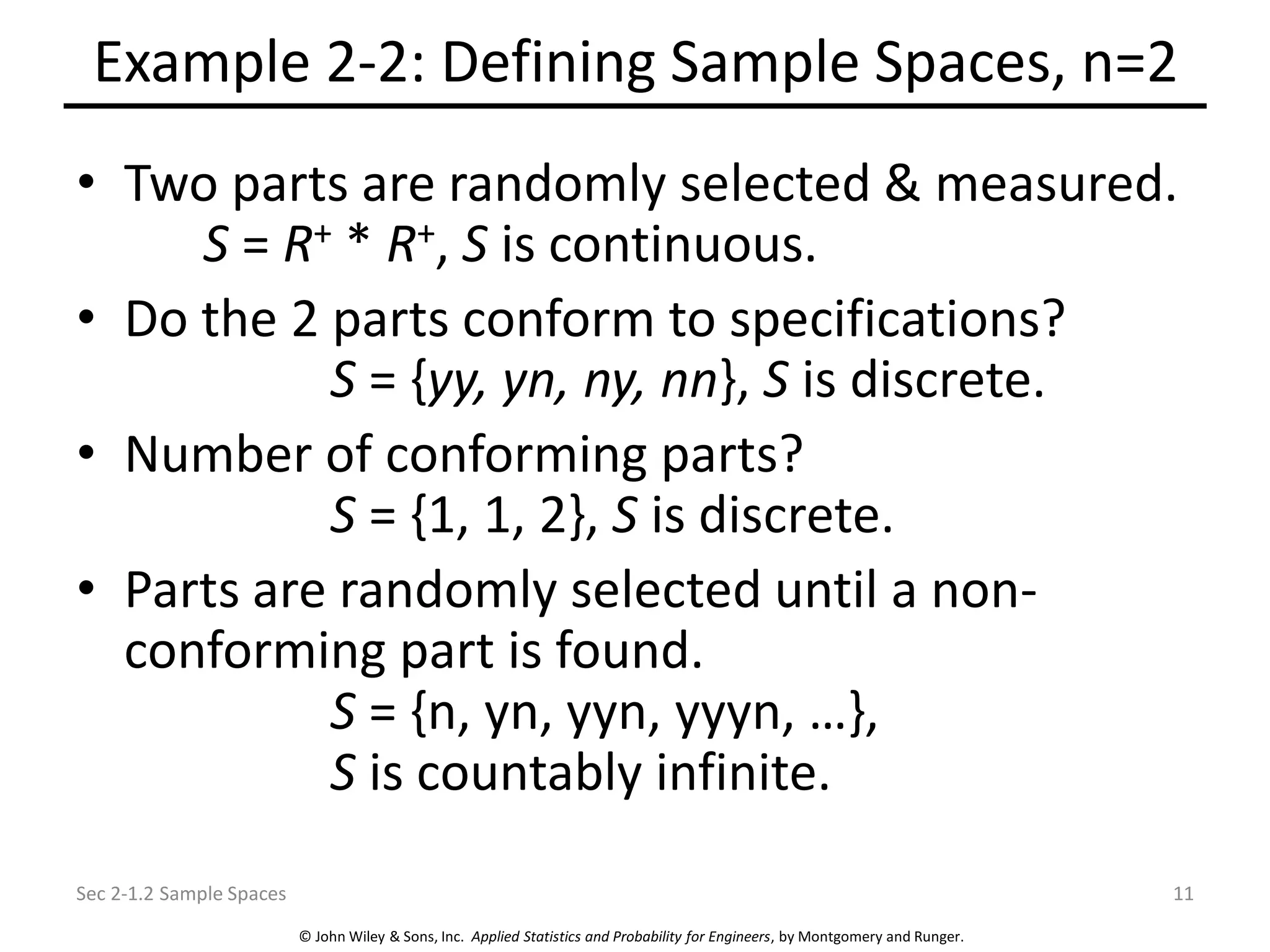
Example 2-2: Defining Sample Spaces, n=2
• Two parts are randomly selected & measured.
S = R+ * R+, S is continuous.
• Do the 2 parts conform to specifications?
S = {yy, yn, ny, nn}, S is discrete.
• Number of conforming parts?
S = {1, 1, 2}, S is discrete.
• Parts are randomly selected until a non-
conforming part is found.
S = {n, yn, yyn, yyyn, …},
S is countably infinite.
Sec 2-1.2 Sample Spaces 11
© John Wiley & Sons, Inc. Applied Statistics and Probability for Engineers, by Montgomery and Runger.
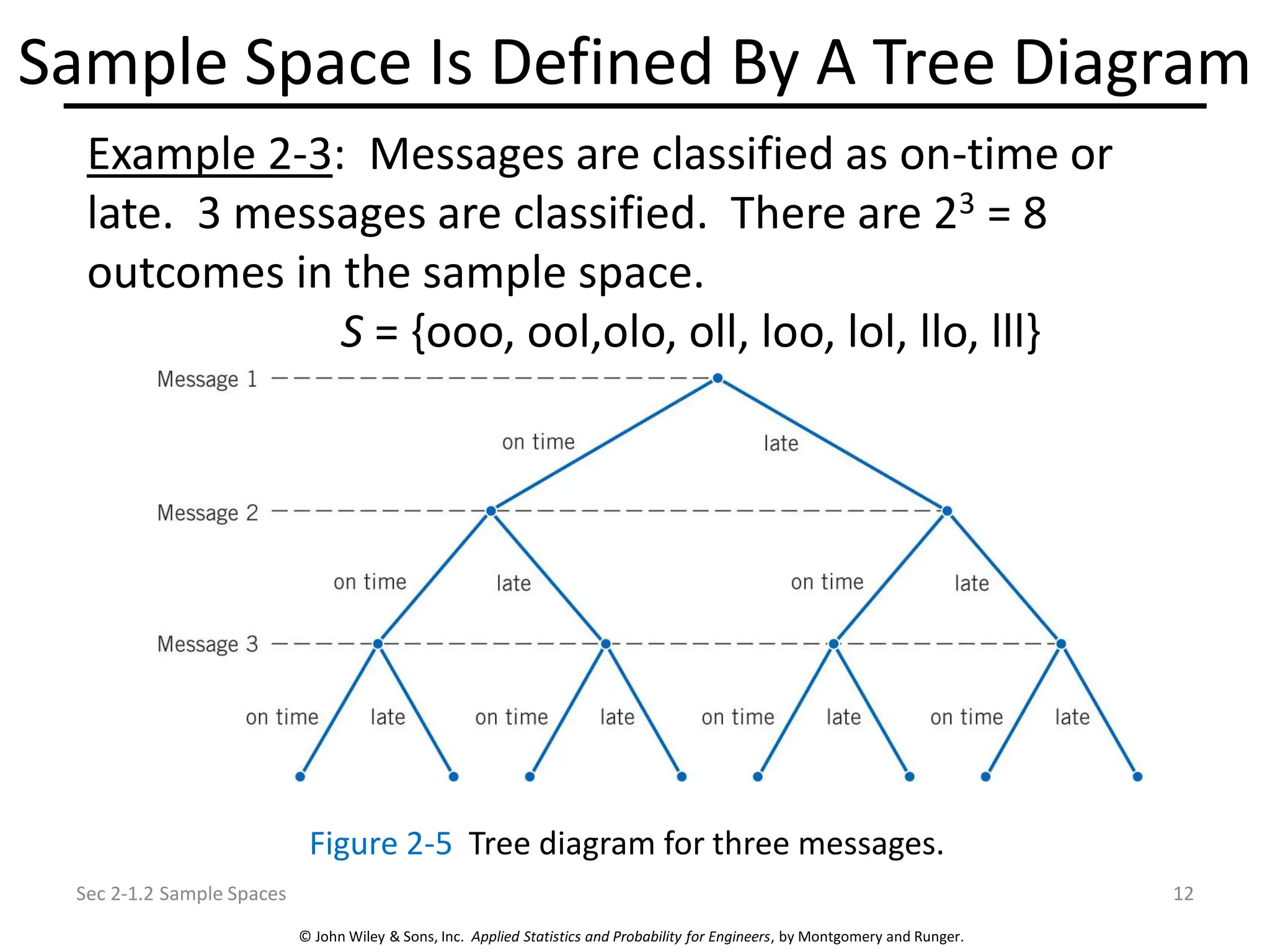
Sample Space Is Defined By A Tree Diagram
Sec 2-1.2 Sample Spaces 12
Example 2-3: Messages are classified as on-time or
late. 3 messages are classified. There are 23 = 8
outcomes in the sample space.
S = {ooo, ool,olo, oll, loo, lol, llo, lll}
Figure 2-5 Tree diagram for three messages.
© John Wiley & Sons, Inc. Applied Statistics and Probability for Engineers, by Montgomery and Runger.
Tree Diagrams Can Fit The Situation
Sec 2-1.2 Sample Spaces 13
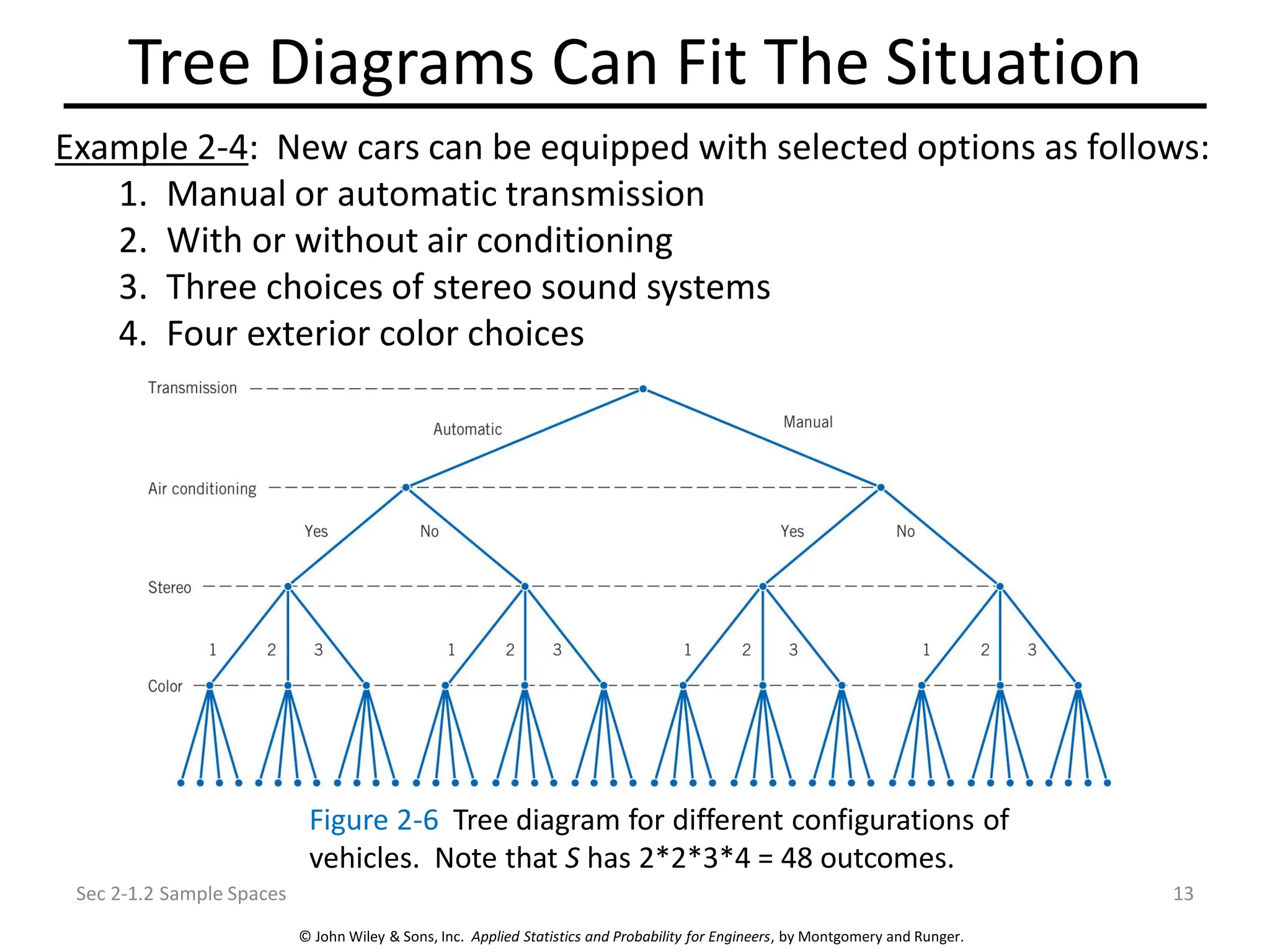
Example 2-4: New cars can be equipped with selected options as follows:
1. Manual or automatic transmission
2. With or without air conditioning
3. Three choices of stereo sound systems
4. Four exterior color choices
Figure 2-6 Tree diagram for different configurations of
vehicles. Note that S has 2*2*3*4 = 48 outcomes.
© John Wiley & Sons, Inc. Applied Statistics and Probability for Engineers, by Montgomery and Runger.
Tree Diagrams Help Count Outcomes
Sec 2-1.2 Sample Spaces, Figure 2-7. 14
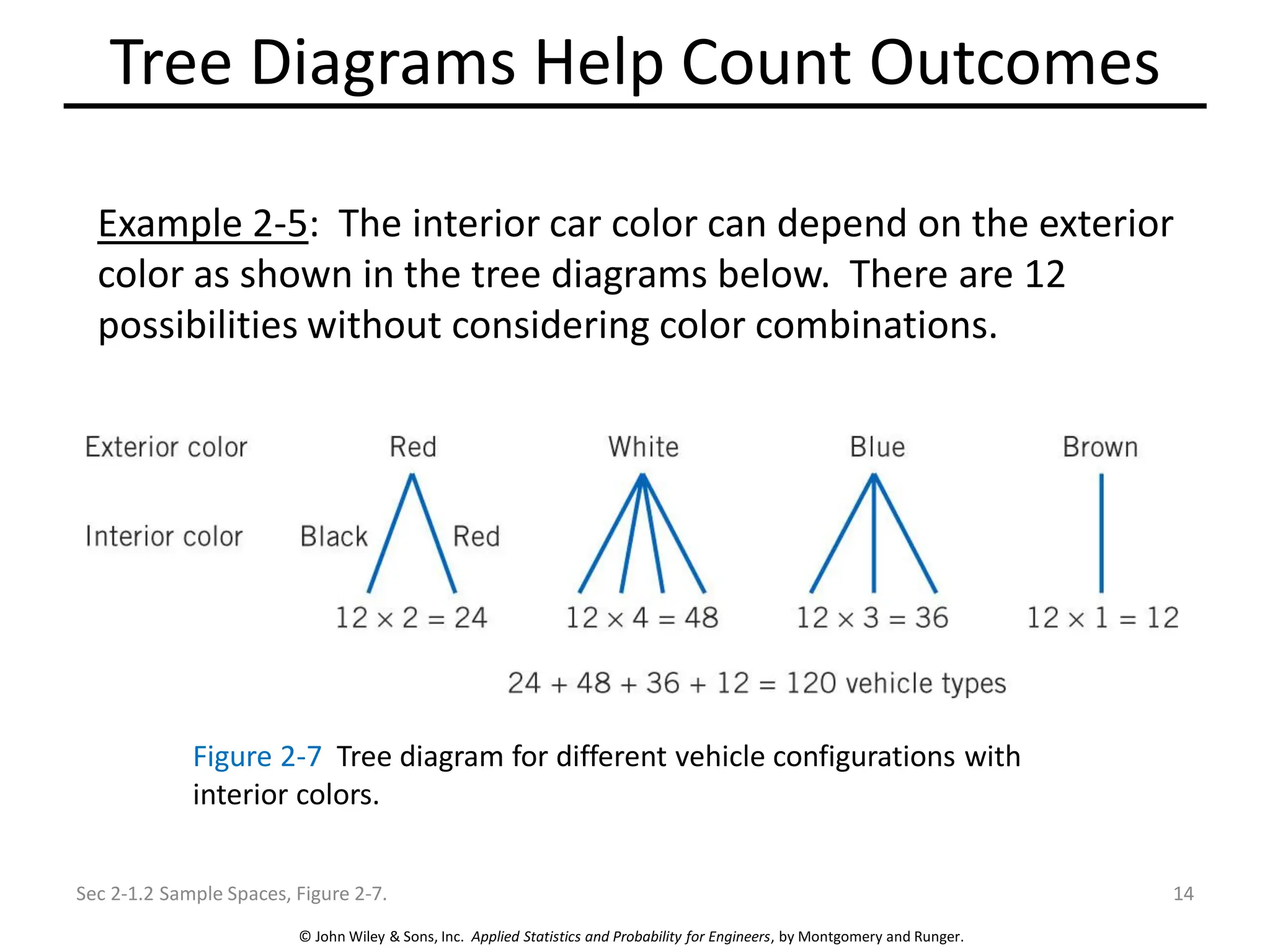
Example 2-5: The interior car color can depend on the exterior
color as shown in the tree diagrams below. There are 12
possibilities without considering color combinations.
Figure 2-7 Tree diagram for different vehicle configurations with
interior colors.
© John Wiley & Sons, Inc. Applied Statistics and Probability for Engineers, by Montgomery and Runger.
Events Are Sets of Outcomes
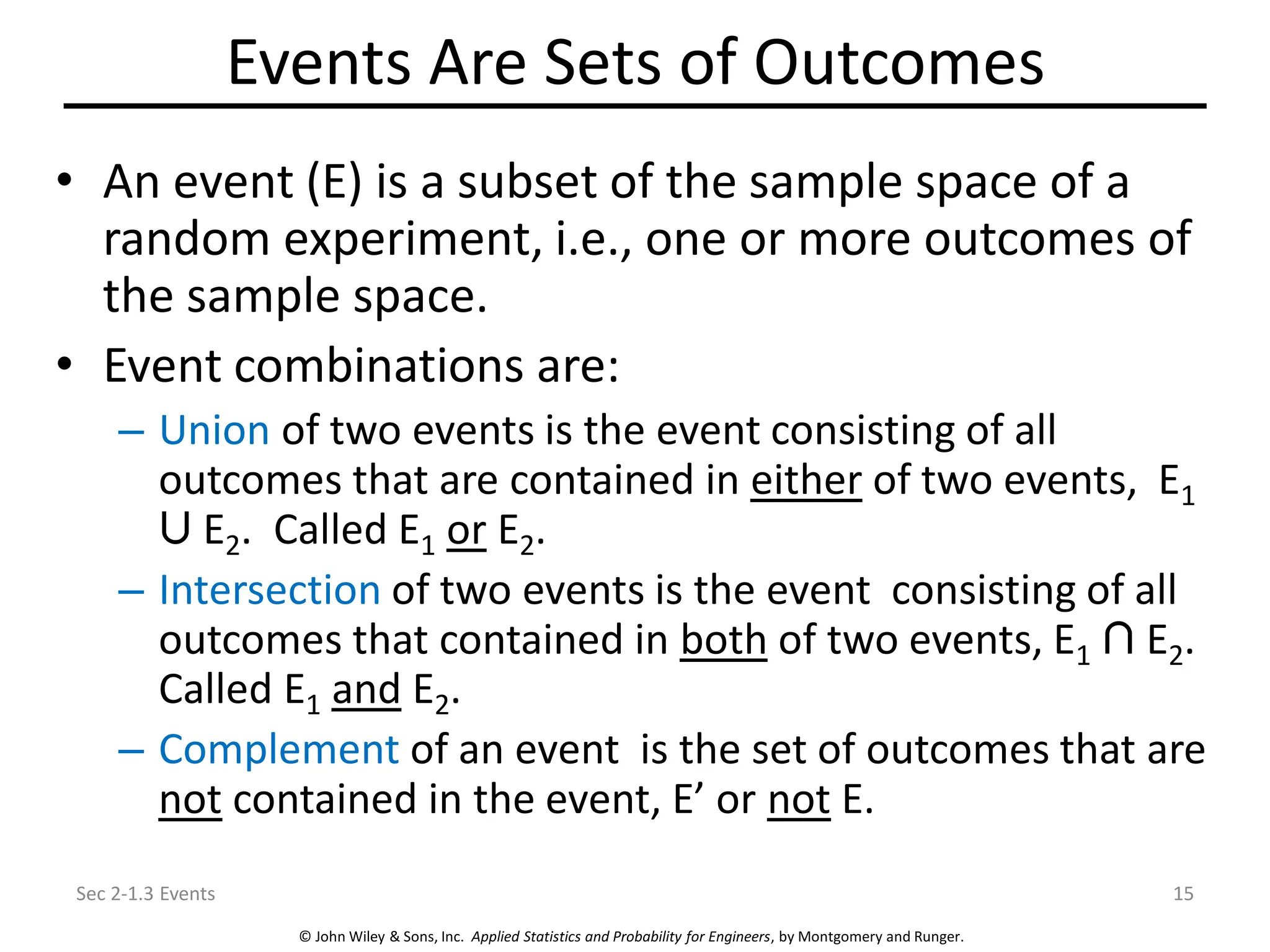
• An event (E) is a subset of the sample space of a
random experiment, i.e., one or more outcomes of
the sample space.
• Event combinations are:
– Union of two events is the event consisting of all
outcomes that are contained in either of two events, E1
E2. Called E1 or E2.
– Intersection of two events is the event consisting of all
outcomes that contained in both of two events, E1 E2.
Called E1 and E2.
– Complement of an event is the set of outcomes that are
not contained in the event, E’ or not E.
Sec 2-1.3 Events 15
© John Wiley & Sons, Inc. Applied Statistics and Probability for Engineers, by Montgomery and Runger.
Example 2-6, Discrete Event Algebra
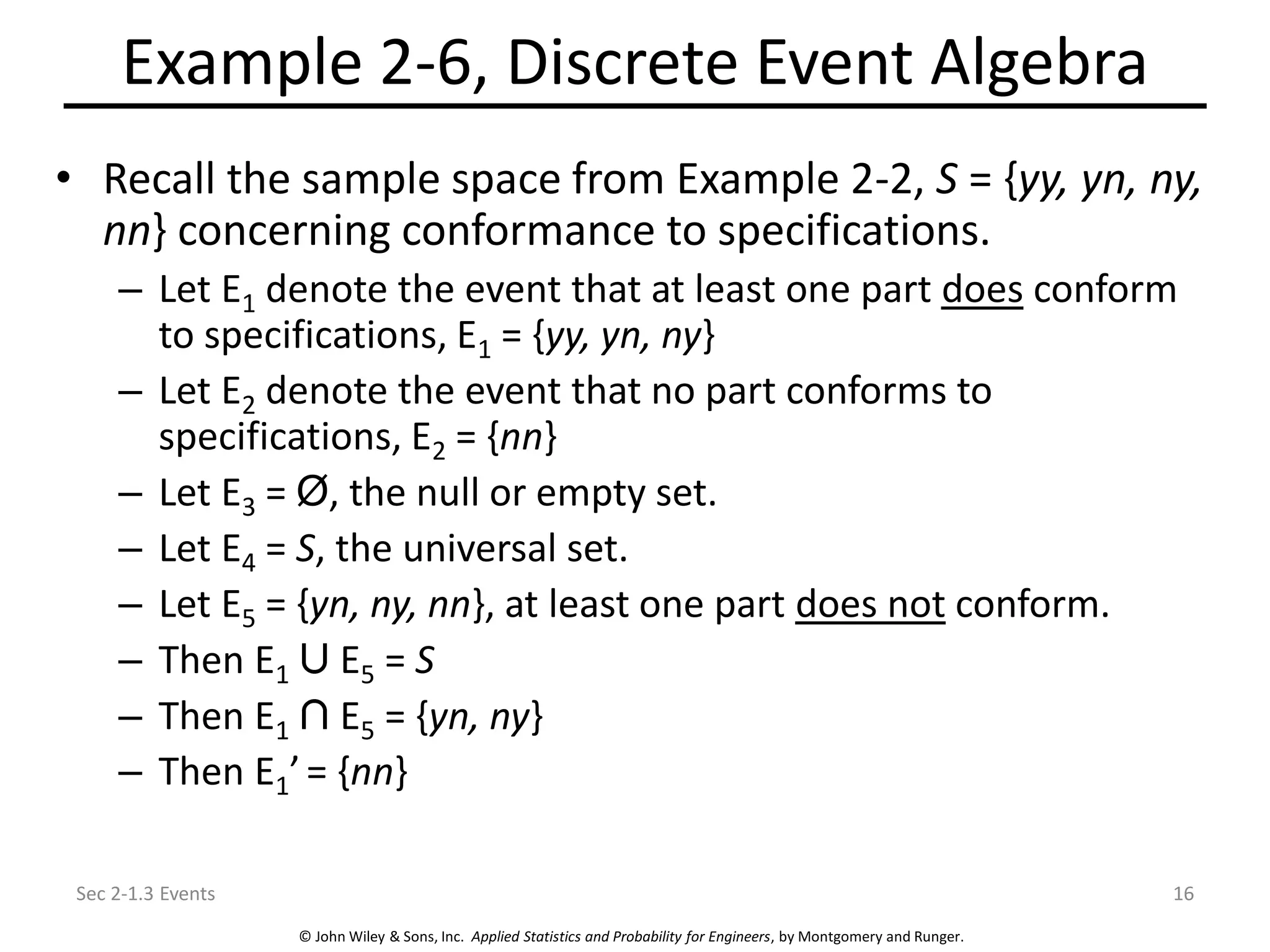
• Recall the sample space from Example 2-2, S = {yy, yn, ny,
nn} concerning conformance to specifications.
– Let E1 denote the event that at least one part does conform
to specifications, E1 = {yy, yn, ny}
– Let E2 denote the event that no part conforms to
specifications, E2 = {nn}
– Let E3 = Ø, the null or empty set.
– Let E4 = S, the universal set.
– Let E5 = {yn, ny, nn}, at least one part does not conform.
– Then E1 E5 = S
– Then E1 E5 = {yn, ny}
– Then E1’= {nn}
Sec 2-1.3 Events 16
© John Wiley & Sons, Inc. Applied Statistics and Probability for Engineers, by Montgomery and Runger.
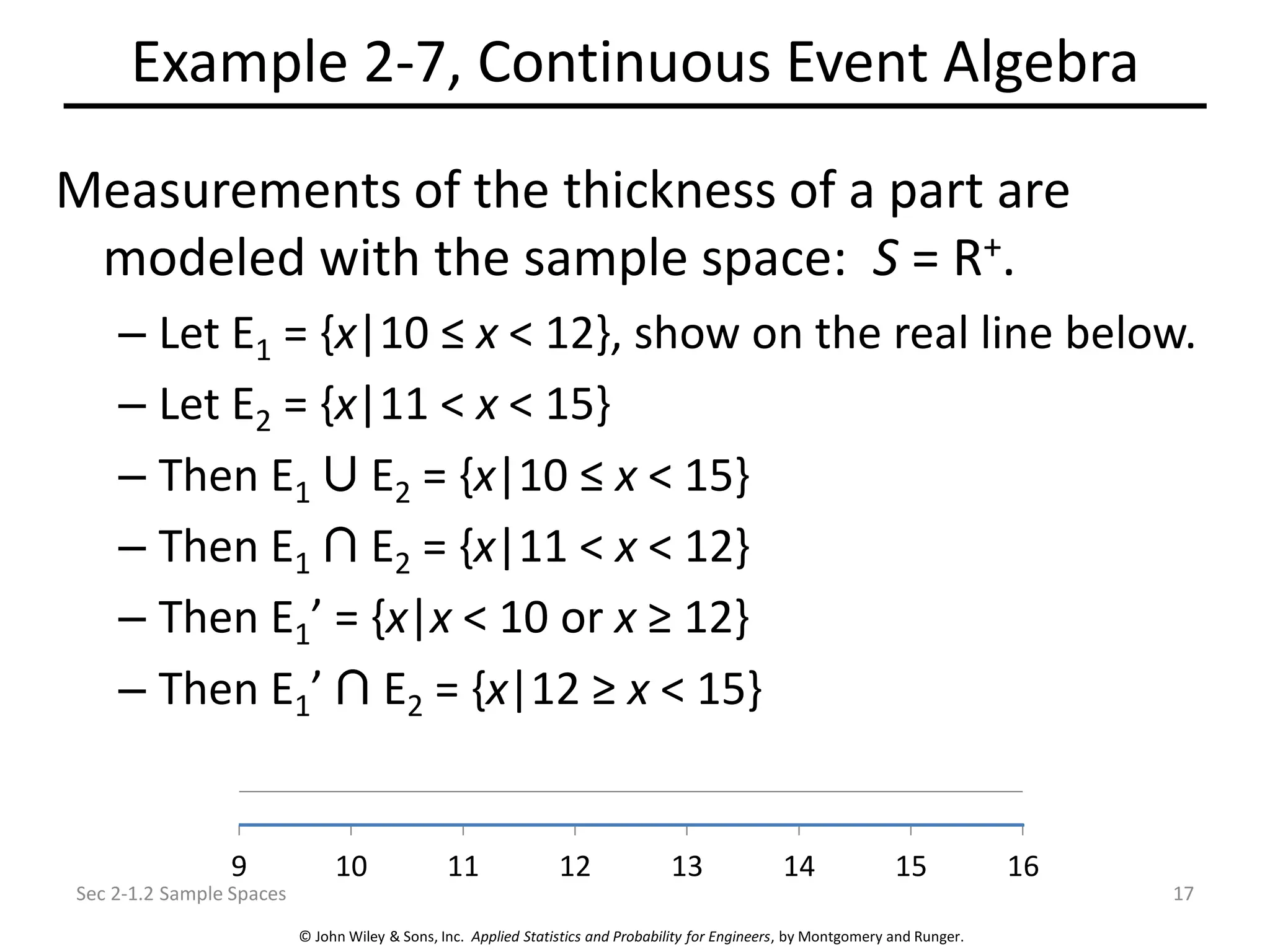
Example 2-7, Continuous Event Algebra
Measurements of the thickness of a part are
modeled with the sample space: S = R+.
– Let E1 = {x|10 ≤ x < 12}, show on the real line below.
– Let E2 = {x|11 < x < 15}
– Then E1 E2 = {x|10 ≤ x < 15}
– Then E1 E2 = {x|11 < x < 12}
– Then E1’ = {x|x < 10 or x ≥ 12}
– Then E1’ E2 = {x|12 ≥ x < 15}
Sec 2-1.2 Sample Spaces 17
9 10 11 12 13 14 15 16
© John Wiley & Sons, Inc. Applied Statistics and Probability for Engineers, by Montgomery and Runger.
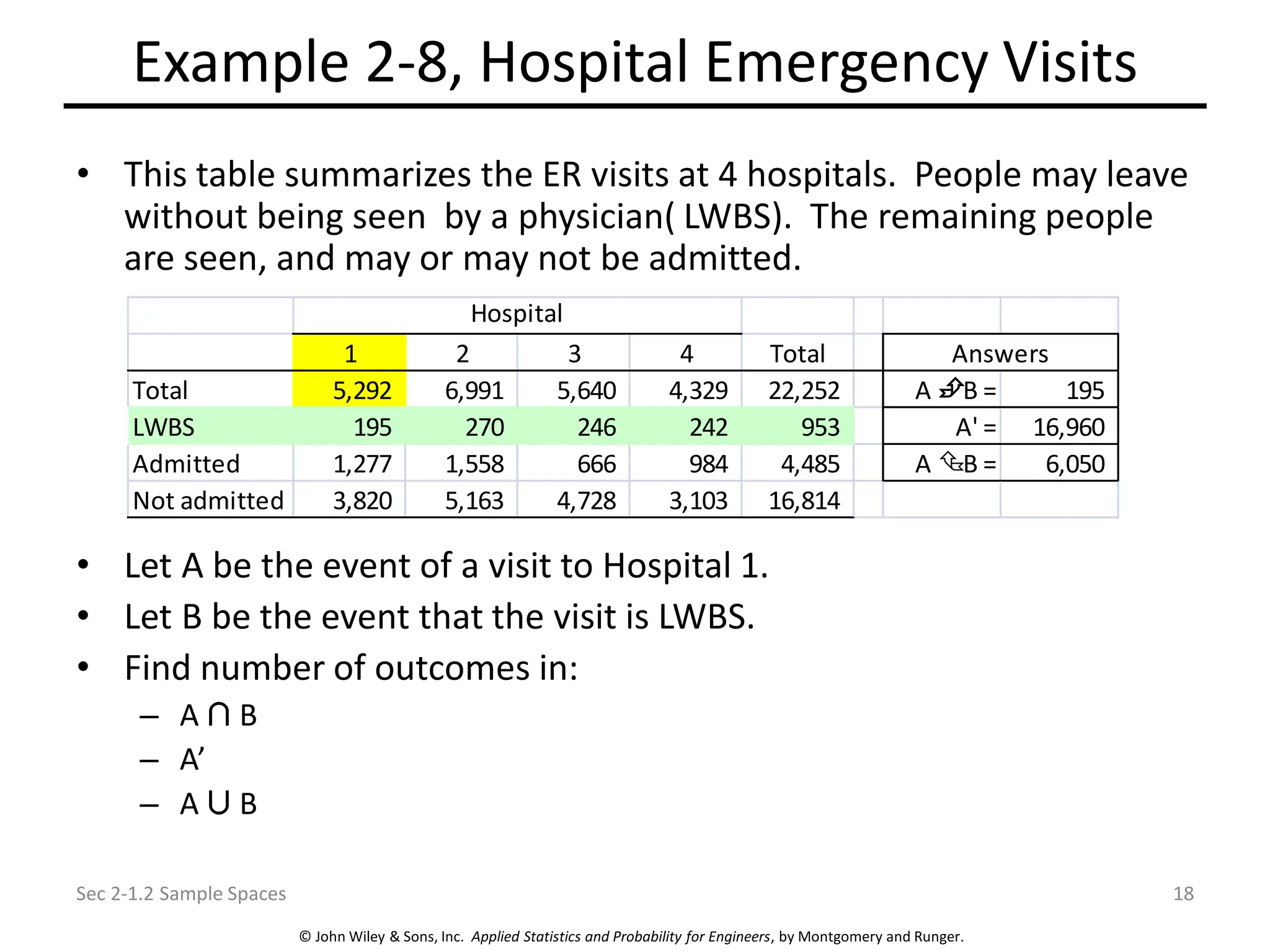
Example 2-8, Hospital Emergency Visits
• This table summarizes the ER visits at 4 hospitals. People may leave
without being seen by a physician( LWBS). The remaining people
are seen, and may or may not be admitted.
• Let A be the event of a visit to Hospital 1.
• Let B be the event that the visit is LWBS.
• Find number of outcomes in:
– A B
– A’
– A B
Sec 2-1.2 Sample Spaces 18
1 2 3 4 Total
Total 5,292 6,991 5,640 4,329 22,252 A B = 195
LWBS 195 270 246 242 953 A' = 16,960
Admitted 1,277 1,558 666 984 4,485 A B = 6,050
Not admitted 3,820 5,163 4,728 3,103 16,814
Hospital
Answers
© John Wiley & Sons, Inc. Applied Statistics and Probability for Engineers, by Montgomery and Runger.
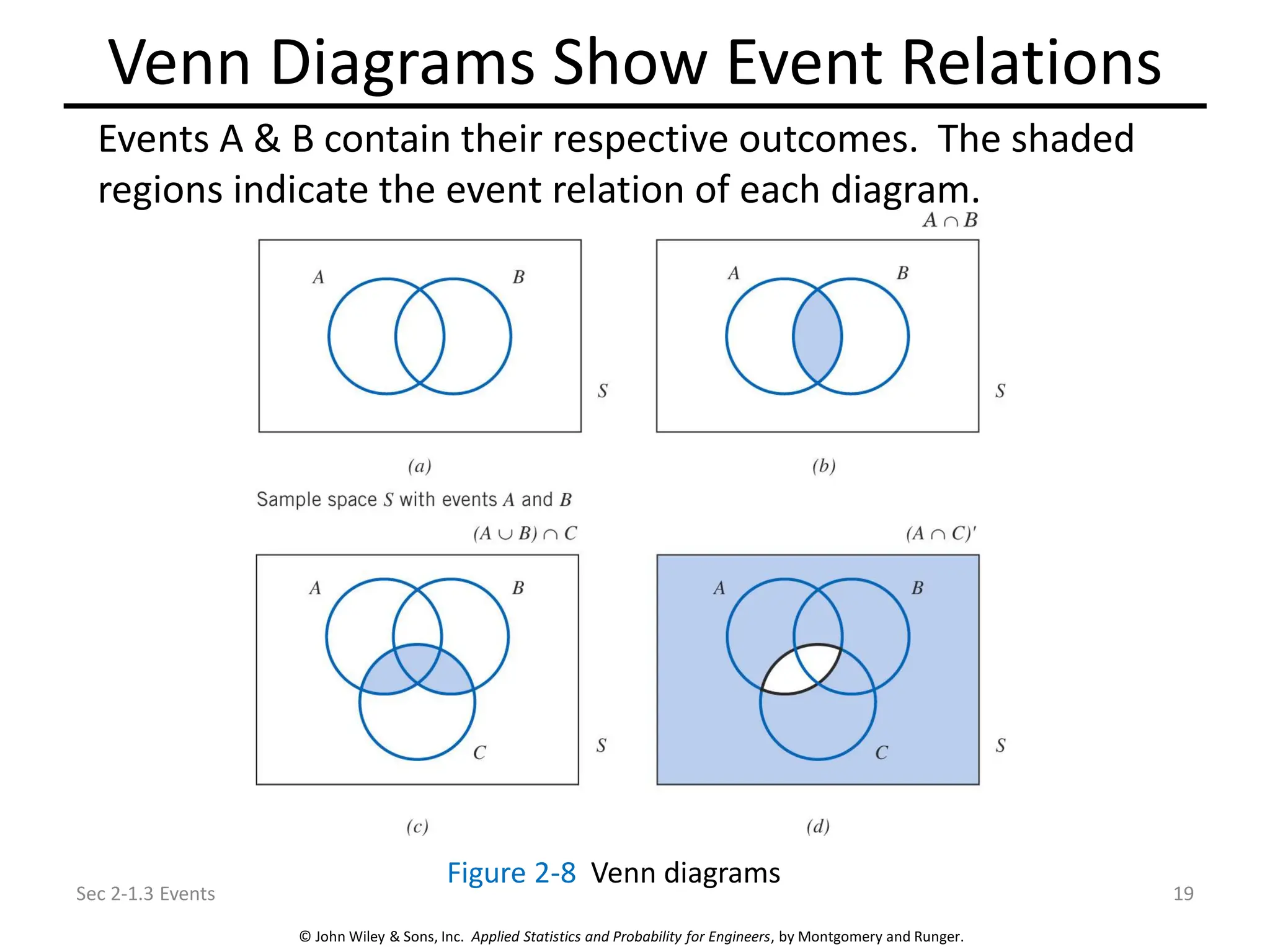
Venn Diagrams Show Event Relations
Sec 2-1.3 Events 19
Events A & B contain their respective outcomes. The shaded
regions indicate the event relation of each diagram.
Figure 2-8 Venn diagrams
© John Wiley & Sons, Inc. Applied Statistics and Probability for Engineers, by Montgomery and Runger.
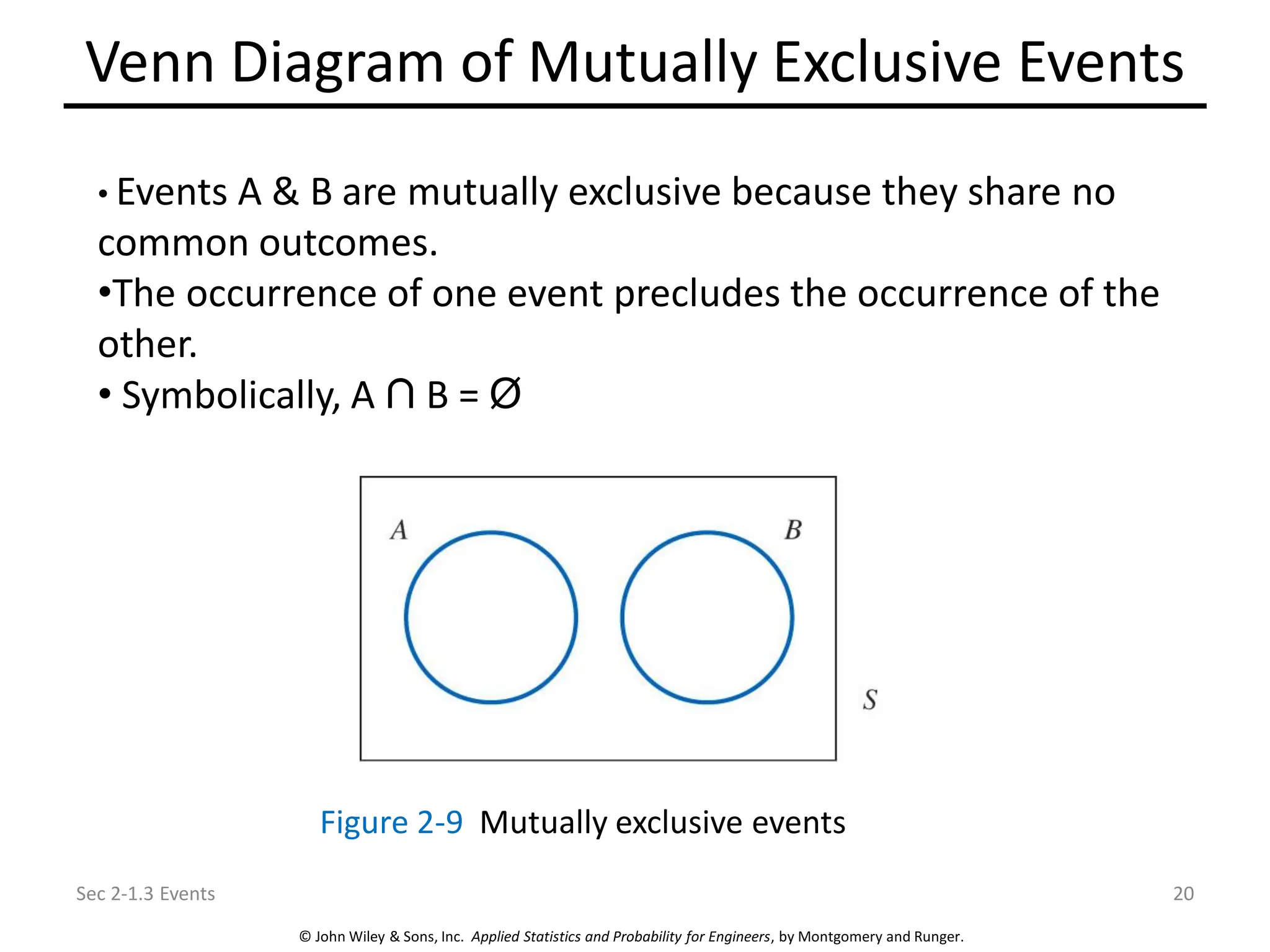
Venn Diagram of Mutually Exclusive Events
Sec 2-1.3 Events 20
• Events A & B are mutually exclusive because they share no
common outcomes.
•The occurrence of one event precludes the occurrence of the
other.
• Symbolically, A B = Ø
Figure 2-9 Mutually exclusive events
© John Wiley & Sons, Inc. Applied Statistics and Probability for Engineers, by Montgomery and Runger.
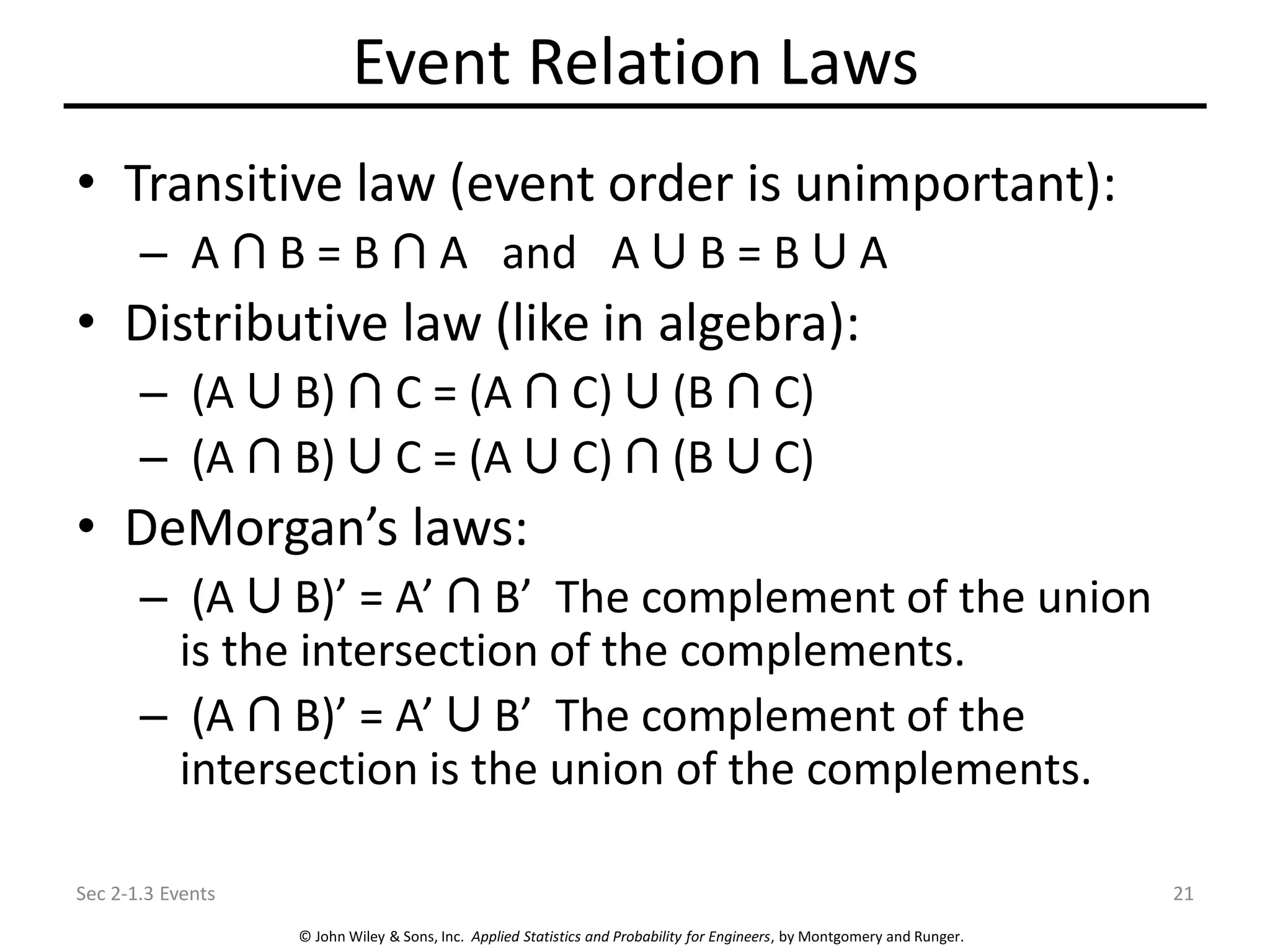
Event Relation Laws
• Transitive law (event order is unimportant):
– A B = B A and A B = B A
• Distributive law (like in algebra):
– (A B) C = (A C) (B C)
• DeMorgan’s laws:
– (A B)’ = A’ B’ The complement of the union
is the intersection of the complements.
– (A B)’ = A’ B’ The complement of the
intersection is the union of the complements.
Sec 2-1.3 Events 21
© John Wiley & Sons, Inc. Applied Statistics and Probability for Engineers, by Montgomery and Runger.
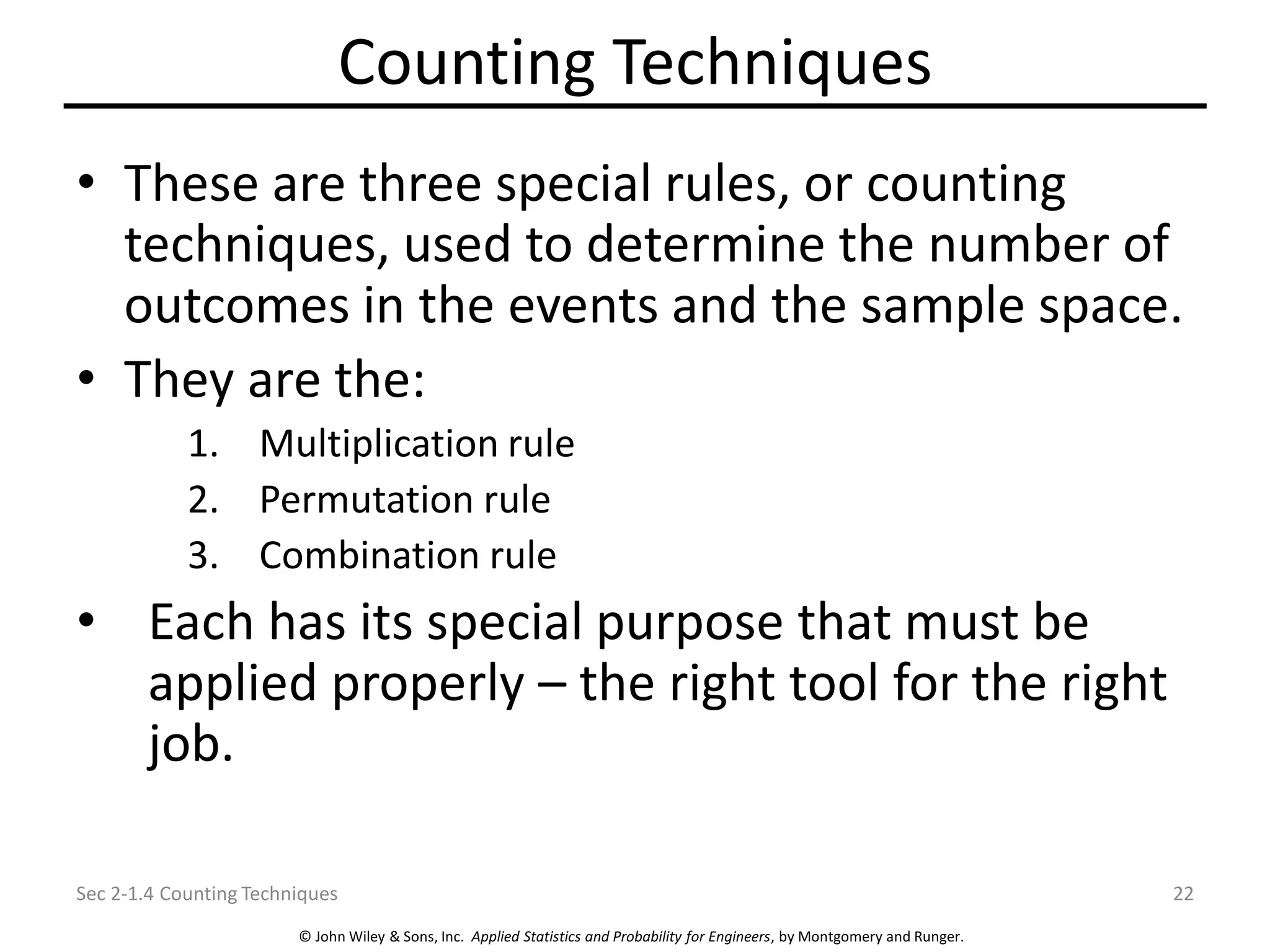
Counting Techniques
• These are three special rules, or counting
techniques, used to determine the number of
outcomes in the events and the sample space.
• They are the:
1. Multiplication rule
2. Permutation rule
3. Combination rule
• Each has its special purpose that must be
applied properly – the right tool for the right
job.
Sec 2-1.4 Counting Techniques 22
© John Wiley & Sons, Inc. Applied Statistics and Probability for Engineers, by Montgomery and Runger.
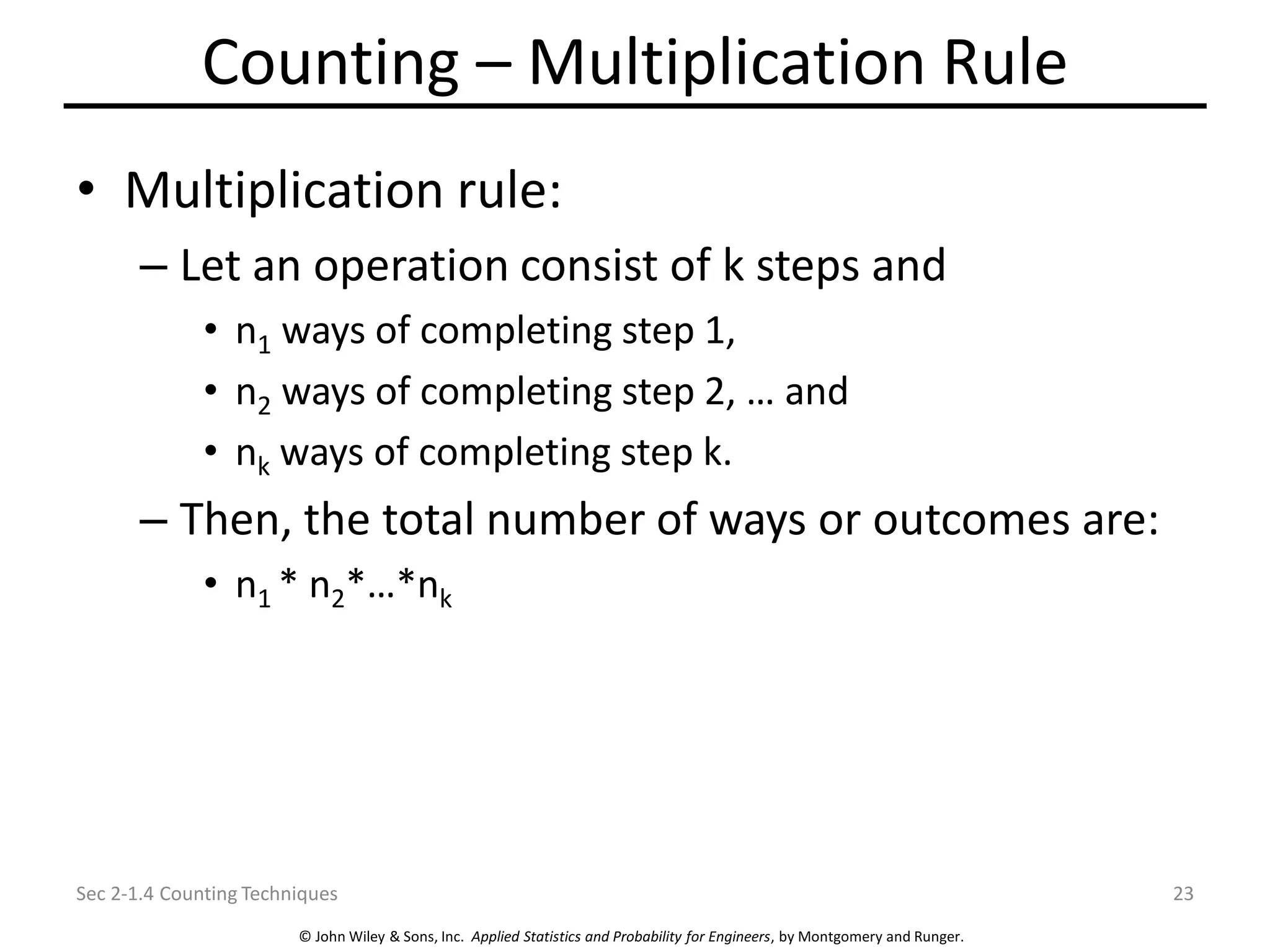
Counting – Multiplication Rule
• Multiplication rule:
– Let an operation consist of k steps and
• n1 ways of completing step 1,
• n2 ways of completing step 2, … and
• nk ways of completing step k.
– Then, the total number of ways or outcomes are:
• n1 * n2*…*nk
Sec 2-1.4 Counting Techniques 23
© John Wiley & Sons, Inc. Applied Statistics and Probability for Engineers, by Montgomery and Runger.
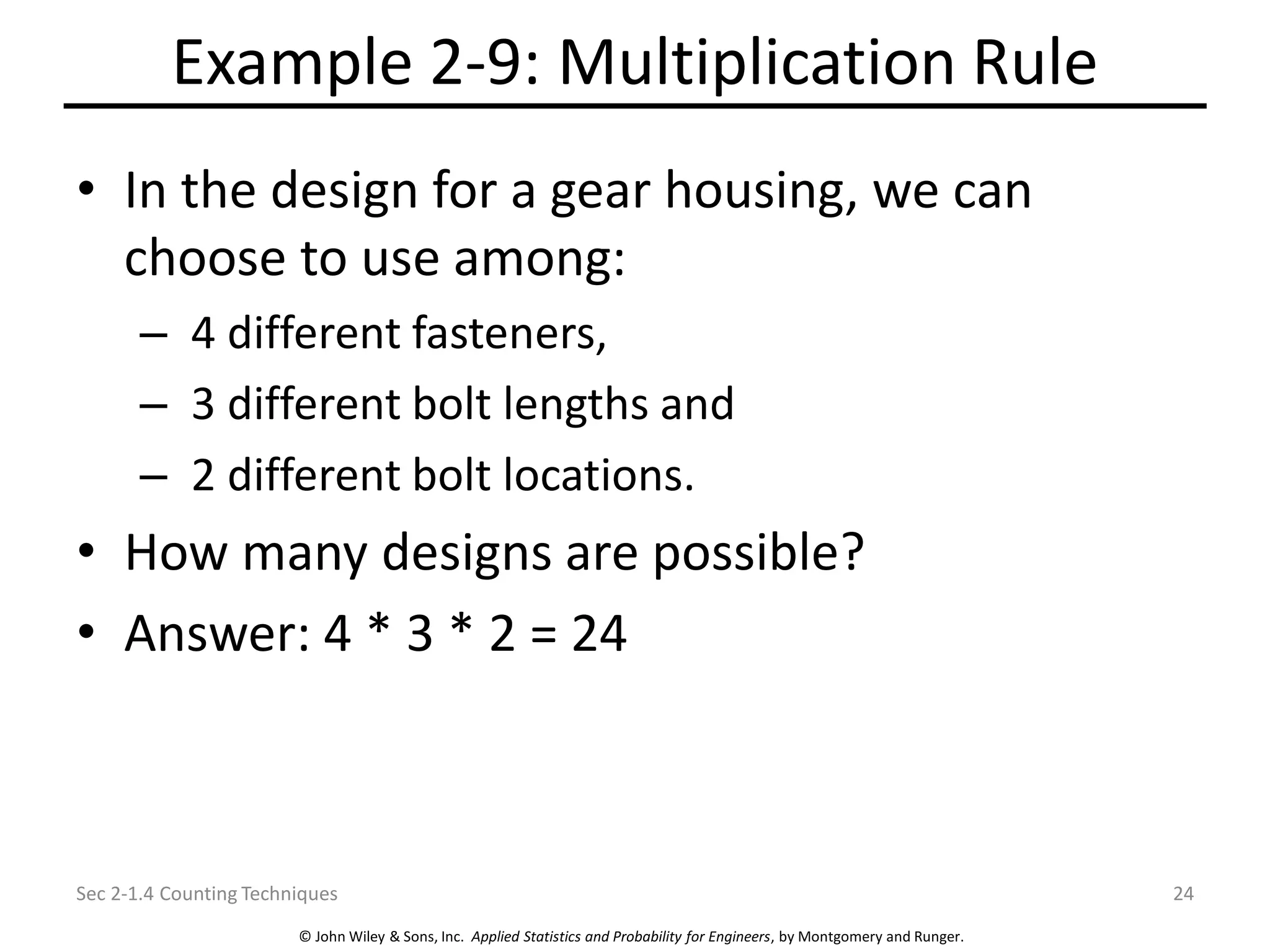
Example 2-9: Multiplication Rule
• In the design for a gear housing, we can
choose to use among:
– 4 different fasteners,
– 3 different bolt lengths and
– 2 different bolt locations.
• How many designs are possible?
• Answer: 4 * 3 * 2 = 24
Sec 2-1.4 Counting Techniques 24
© John Wiley & Sons, Inc. Applied Statistics and Probability for Engineers, by Montgomery and Runger.
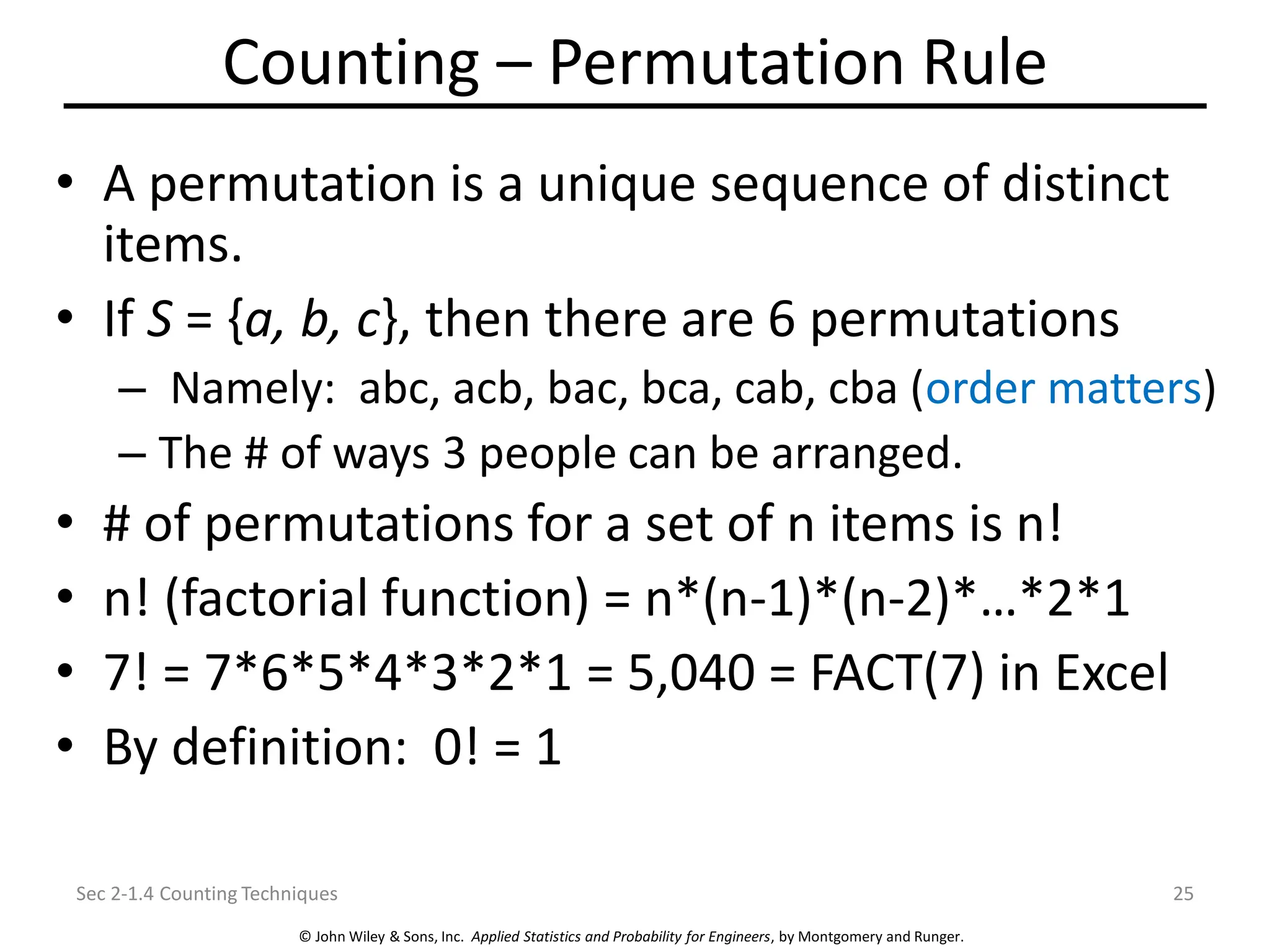
Counting – Permutation Rule
• A permutation is a unique sequence of distinct
items.
• If S = {a, b, c}, then there are 6 permutations
– Namely: abc, acb, bac, bca, cab, cba (order matters)
– The # of ways 3 people can be arranged.
• # of permutations for a set of n items is n!
• n! (factorial function) = n*(n-1)*(n-2)*…*2*1
• 7! = 7*6*5*4*3*2*1 = 5,040 = FACT(7) in Excel
• By definition: 0! = 1
Sec 2-1.4 Counting Techniques 25
© John Wiley & Sons, Inc. Applied Statistics and Probability for Engineers, by Montgomery and Runger.
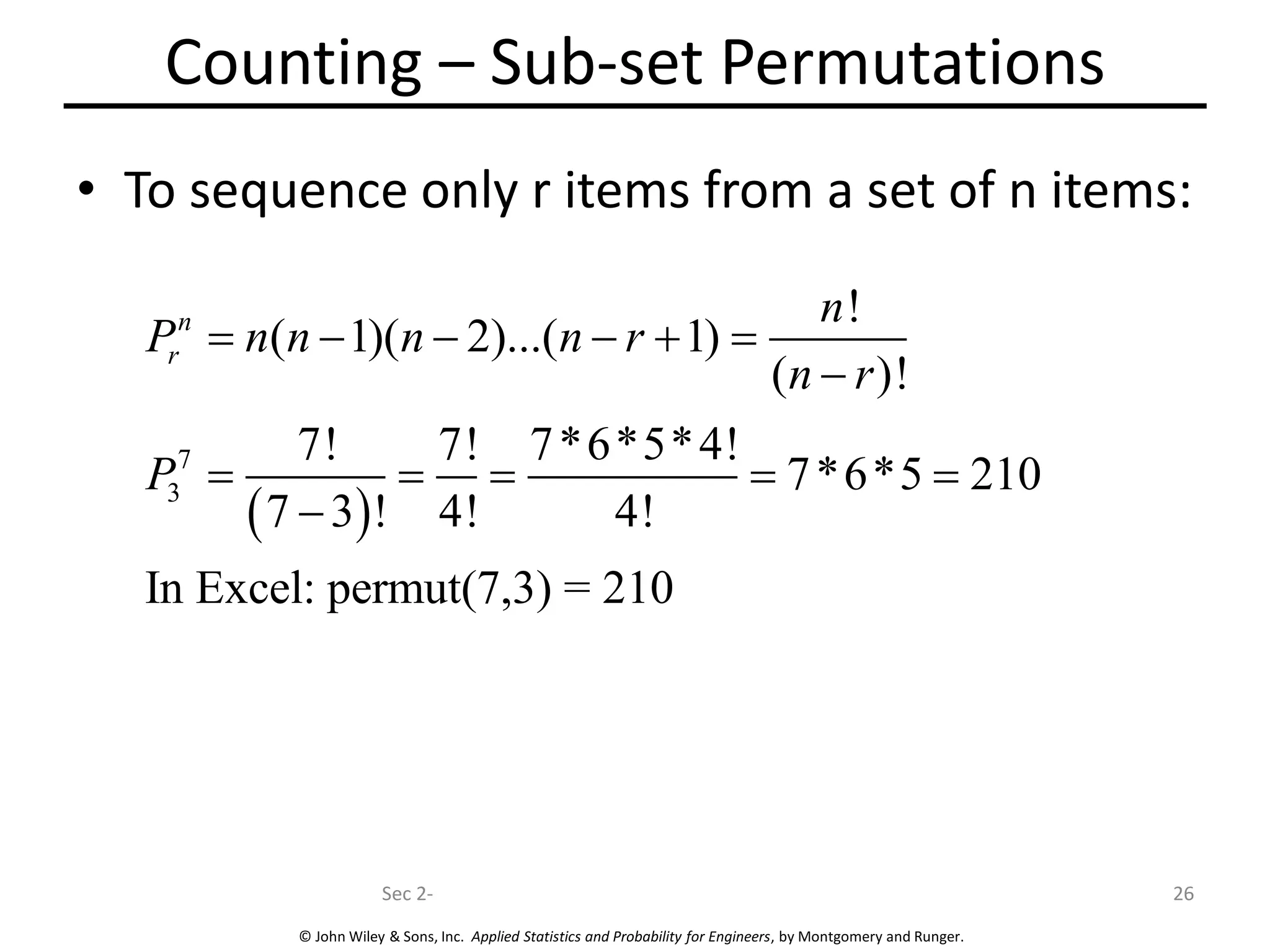
Counting – Sub-set Permutations
• To sequence only r items from a set of n items:
Sec 2- 26
( )
7
3
!
( 1)( 2)...( 1)
( )!
7! 7! 7*6*5*4!
7*6*5 210
7 3 ! 4! 4!
In Excel: permut(7,3) = 210
n
r
n
P n n n n r
n r
P
= − − − + =
−
= = = = =
−
© John Wiley & Sons, Inc. Applied Statistics and Probability for Engineers, by Montgomery and Runger.
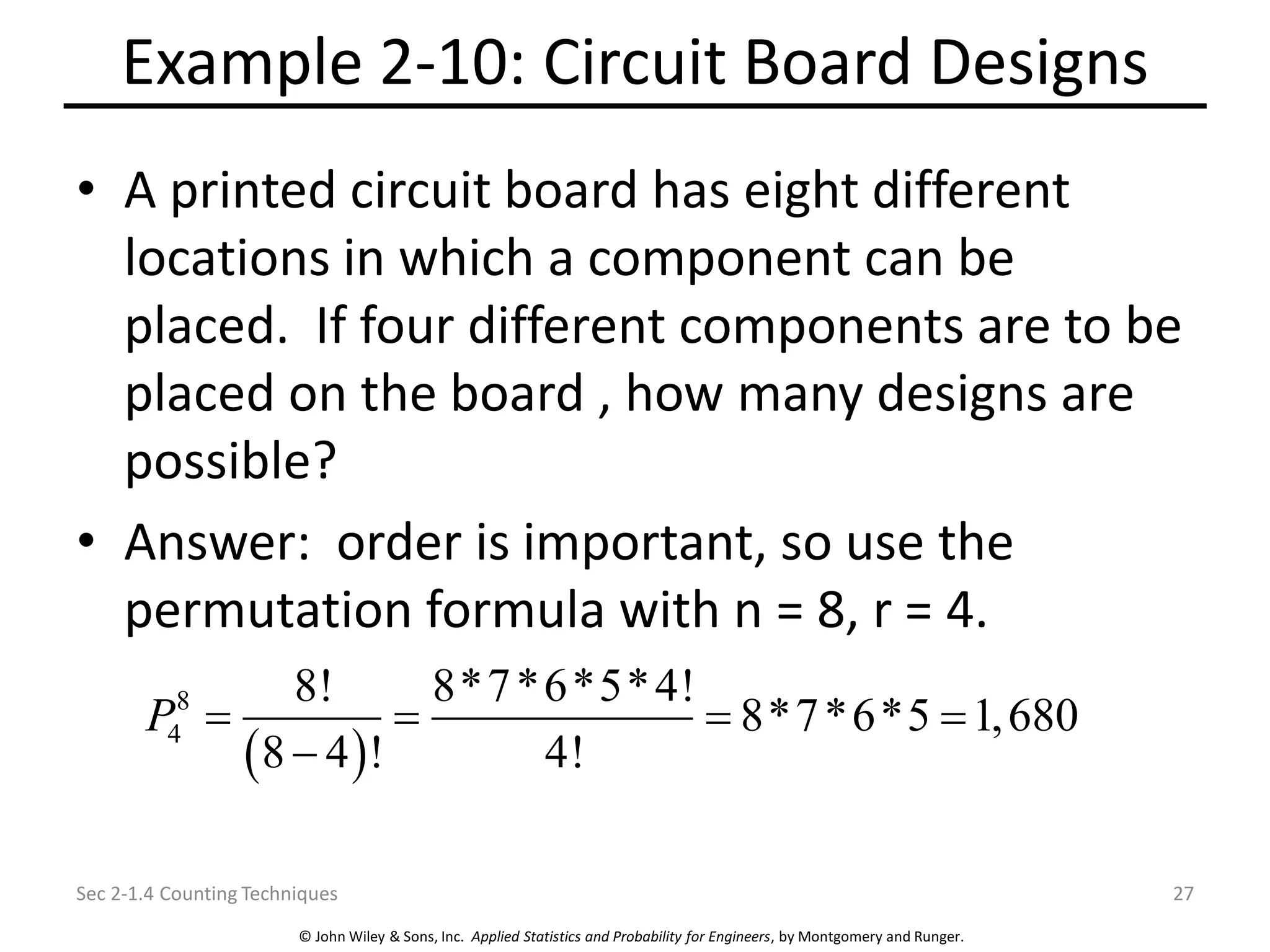
Example 2-10: Circuit Board Designs
• A printed circuit board has eight different
locations in which a component can be
placed. If four different components are to be
placed on the board , how many designs are
possible?
• Answer: order is important, so use the
permutation formula with n = 8, r = 4.
Sec 2-1.4 Counting Techniques 27
( )
8
4
8! 8*7*6*5*4!
8*7*6*5 1,680
8 4 ! 4!
P = = = =
−
© John Wiley & Sons, Inc. Applied Statistics and Probability for Engineers, by Montgomery and Runger.
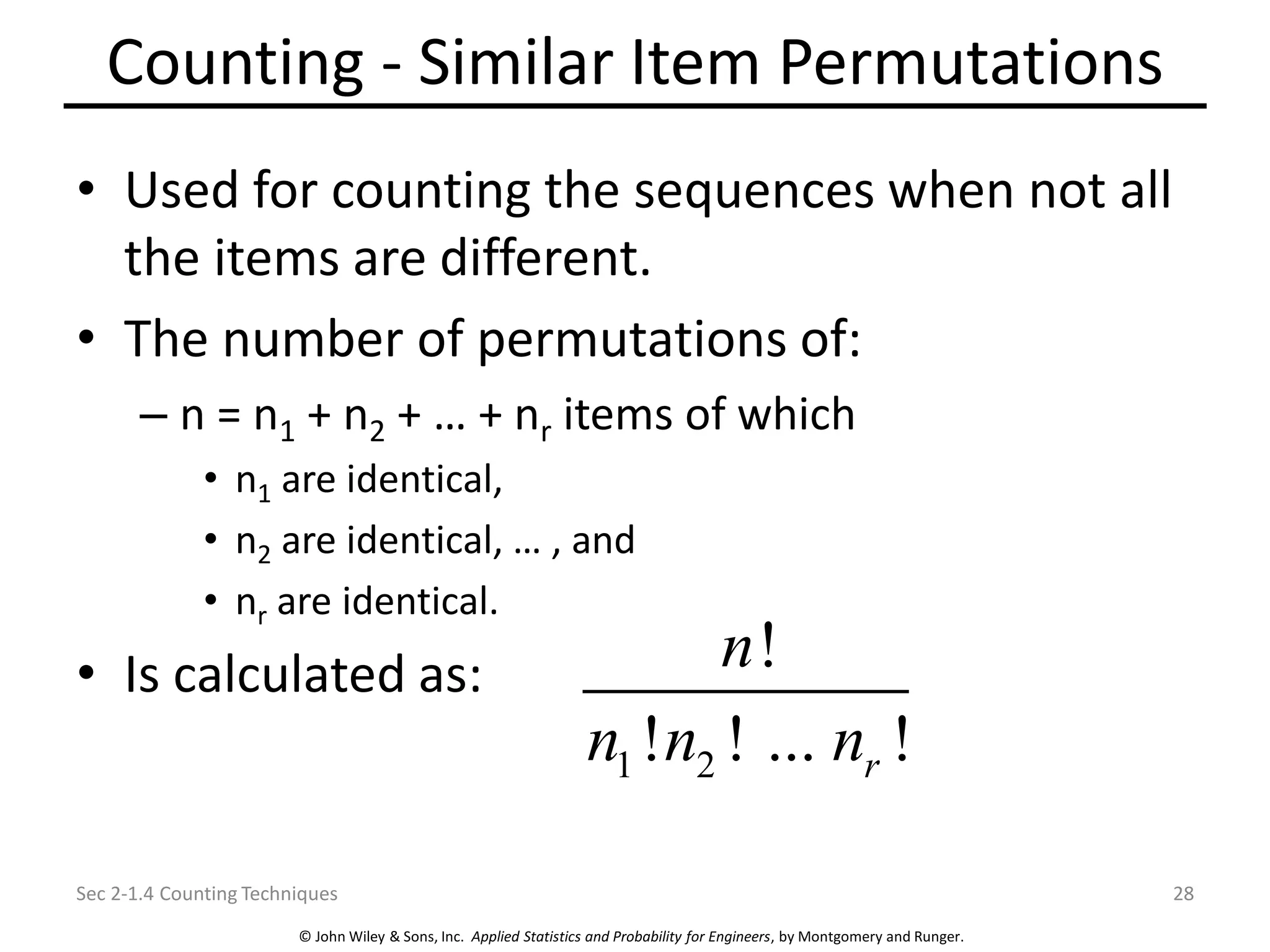
Counting - Similar Item Permutations
• Used for counting the sequences when not all
the items are different.
• The number of permutations of:
– n = n1 + n2 + … + nr items of which
• n1 are identical,
• n2 are identical, … , and
• nr are identical.
• Is calculated as:
Sec 2-1.4 Counting Techniques 28
1 2
!
! ! ... !
r
n
n n n
© John Wiley & Sons, Inc. Applied Statistics and Probability for Engineers, by Montgomery and Runger.
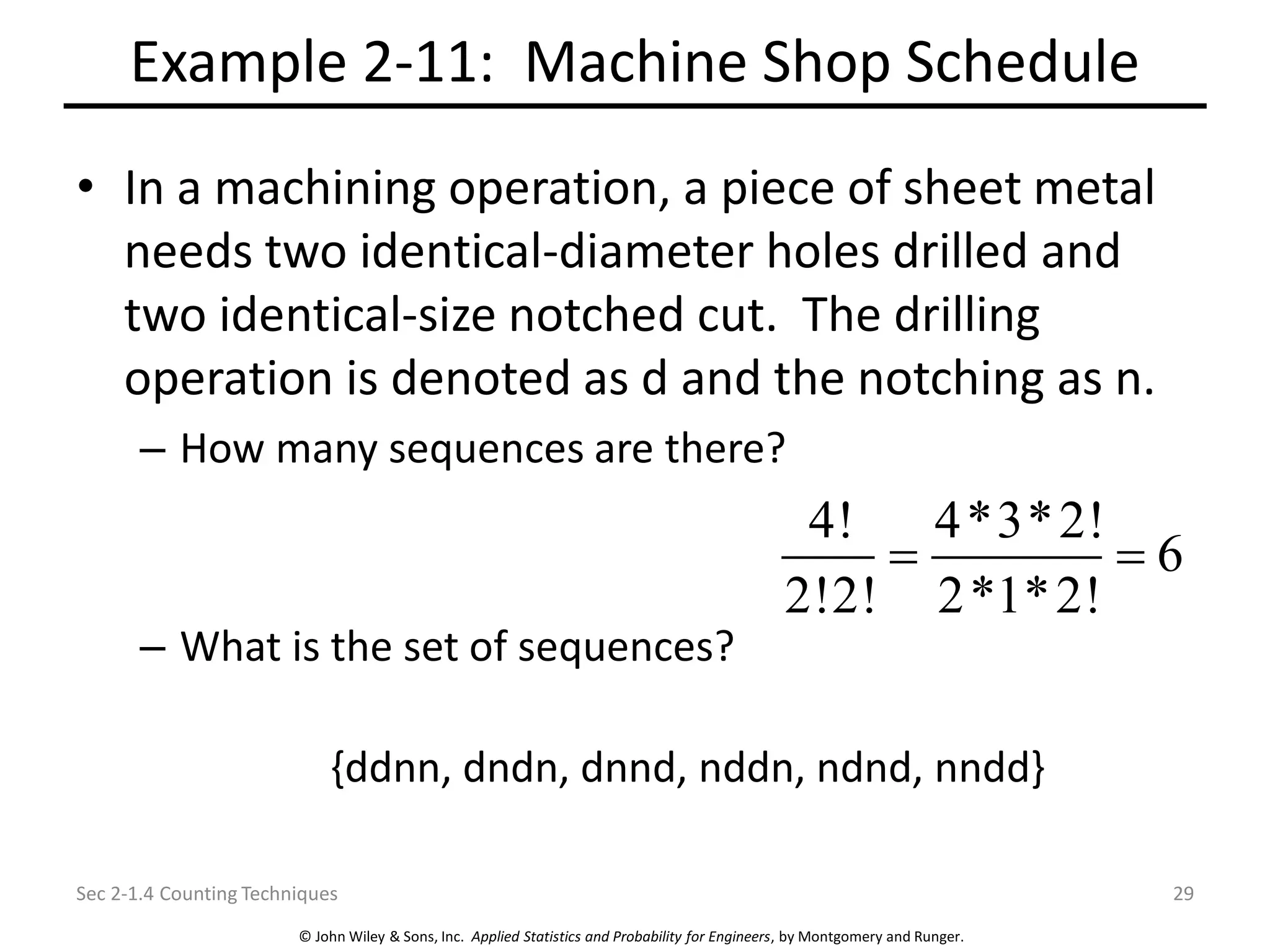
Example 2-11: Machine Shop Schedule
• In a machining operation, a piece of sheet metal
needs two identical-diameter holes drilled and
two identical-size notched cut. The drilling
operation is denoted as d and the notching as n.
– How many sequences are there?
– What is the set of sequences?
{ddnn, dndn, dnnd, nddn, ndnd, nndd}
Sec 2-1.4 Counting Techniques 29
4! 4*3*2!
6
2!2! 2*1*2!
= =
© John Wiley & Sons, Inc. Applied Statistics and Probability for Engineers, by Montgomery and Runger.
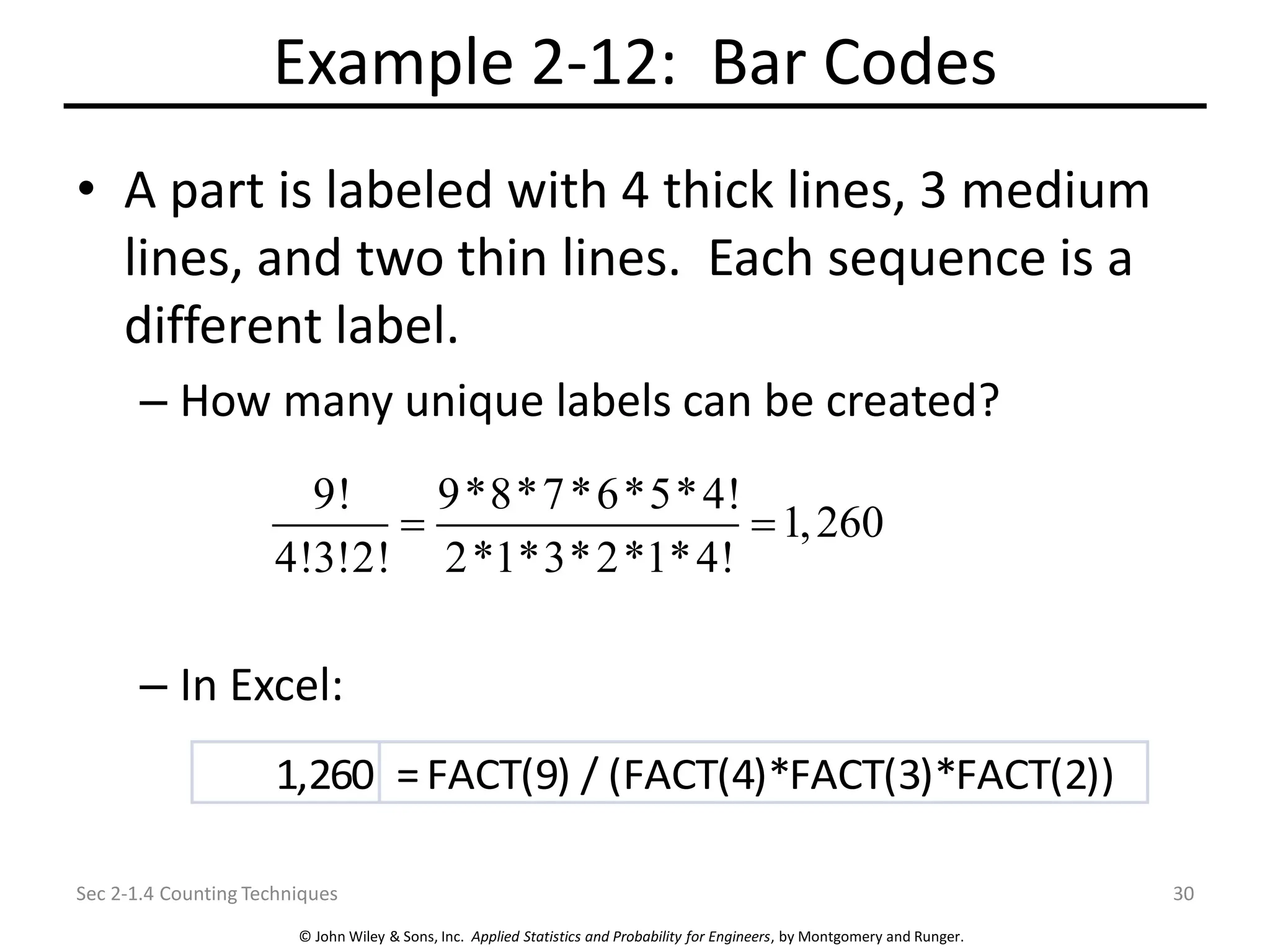
Example 2-12: Bar Codes
• A part is labeled with 4 thick lines, 3 medium
lines, and two thin lines. Each sequence is a
different label.
– How many unique labels can be created?
– In Excel:
Sec 2-1.4 Counting Techniques 30
9! 9*8*7*6*5*4!
1,260
4!3!2! 2*1*3*2*1*4!
= =
1,260 =FACT(9) / (FACT(4)*FACT(3)*FACT(2))
© John Wiley & Sons, Inc. Applied Statistics and Probability for Engineers, by Montgomery and Runger.
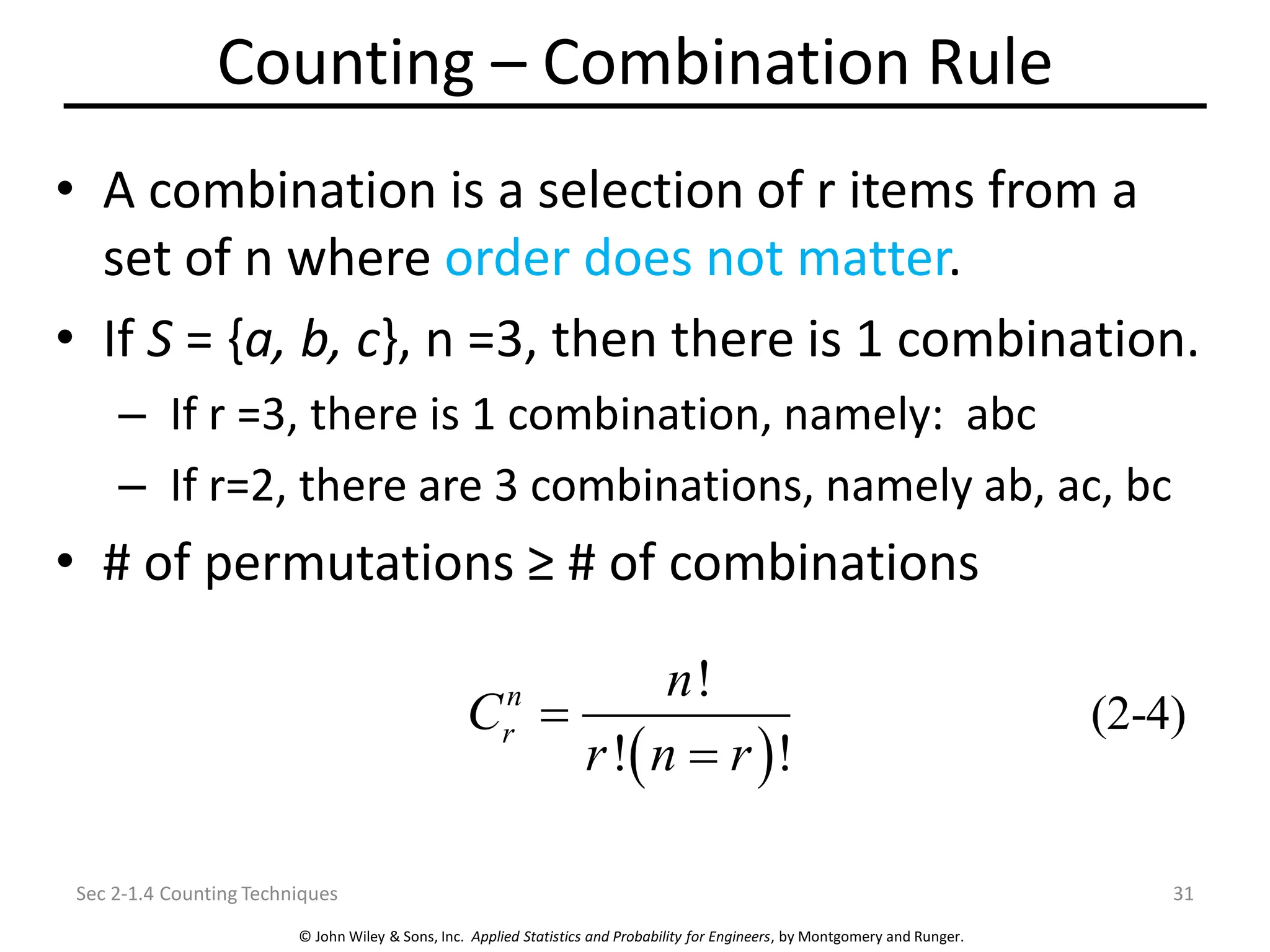
Counting – Combination Rule
• A combination is a selection of r items from a
set of n where order does not matter.
• If S = {a, b, c}, n =3, then there is 1 combination.
– If r =3, there is 1 combination, namely: abc
– If r=2, there are 3 combinations, namely ab, ac, bc
• # of permutations ≥ # of combinations
Sec 2-1.4 Counting Techniques 31
( )
(2-4)
!
! !
n
r
n
C
r n r
=
=
© John Wiley & Sons, Inc. Applied Statistics and Probability for Engineers, by Montgomery and Runger.
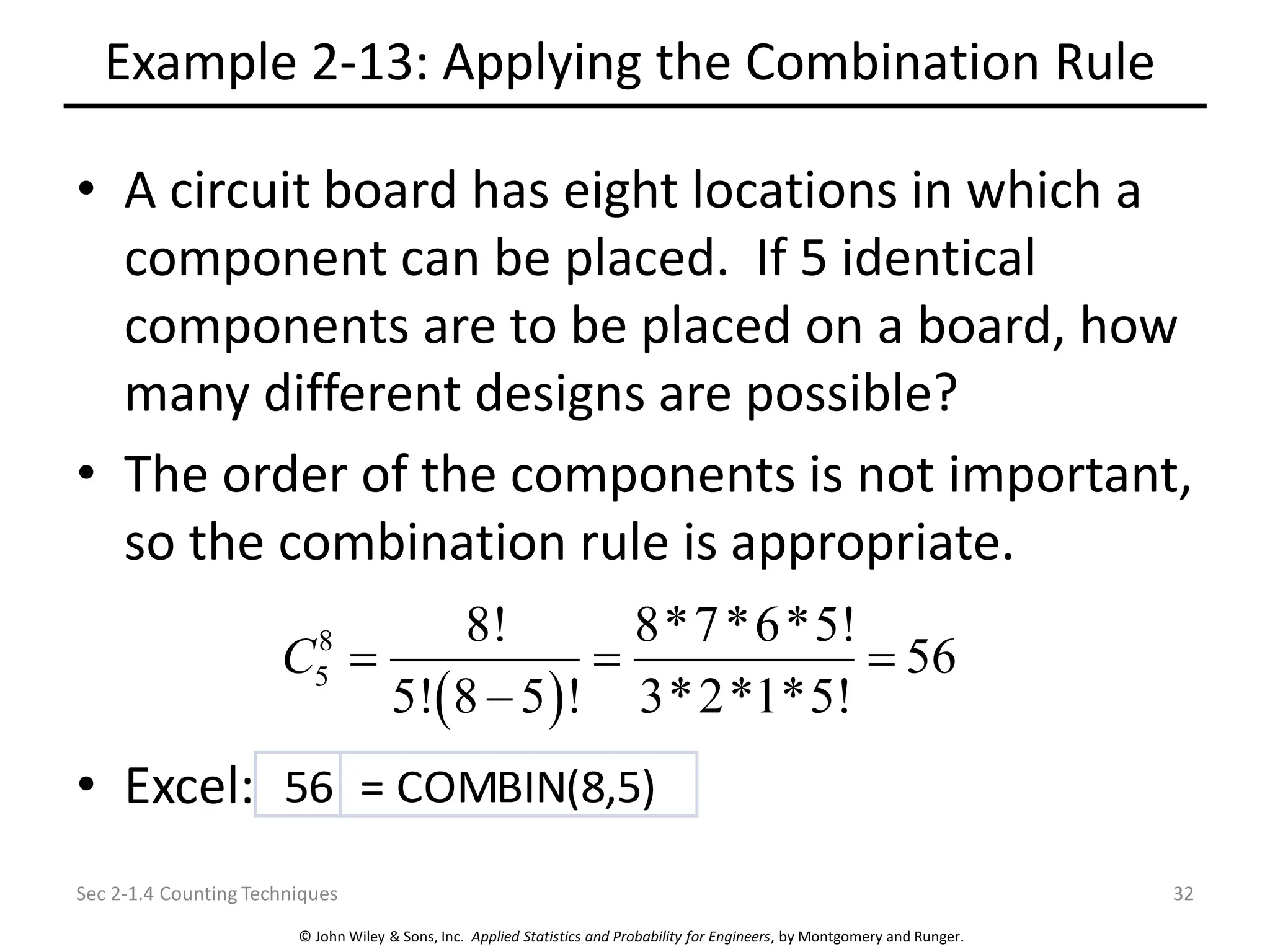
Example 2-13: Applying the Combination Rule
• A circuit board has eight locations in which a
component can be placed. If 5 identical
components are to be placed on a board, how
many different designs are possible?
• The order of the components is not important,
so the combination rule is appropriate.
• Excel:
Sec 2-1.4 Counting Techniques 32
( )
8
5
8! 8*7*6*5!
56
5! 8 5 ! 3*2*1*5!
C = = =
−
56 = COMBIN(8,5)
© John Wiley & Sons, Inc. Applied Statistics and Probability for Engineers, by Montgomery and Runger.
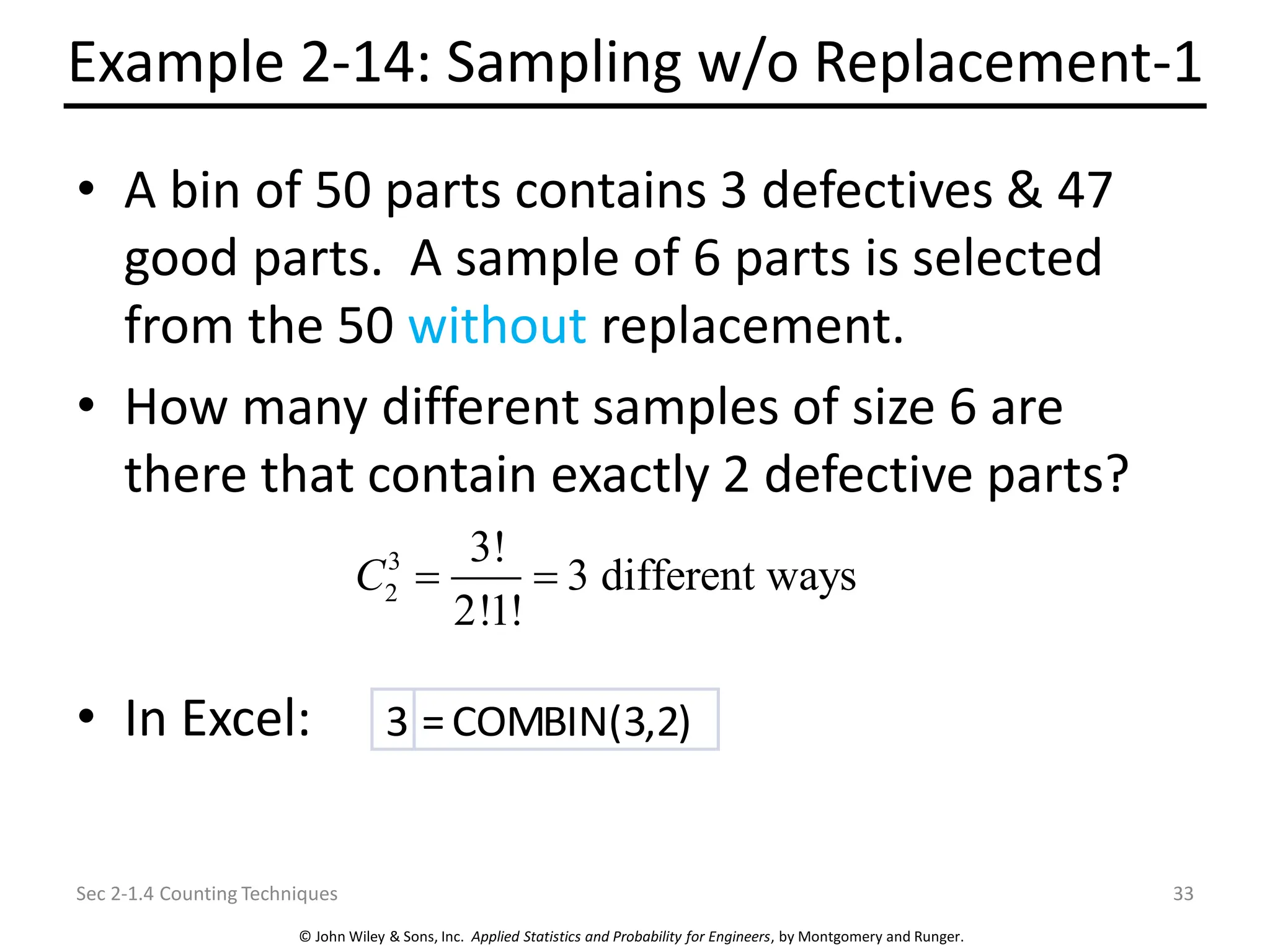
Example 2-14: Sampling w/o Replacement-1
• A bin of 50 parts contains 3 defectives & 47
good parts. A sample of 6 parts is selected
from the 50 without replacement.
• How many different samples of size 6 are
there that contain exactly 2 defective parts?
• In Excel:
Sec 2-1.4 Counting Techniques 33
3
2
3!
3 different ways
2!1!
C = =
3 =COMBIN(3,2)
© John Wiley & Sons, Inc. Applied Statistics and Probability for Engineers, by Montgomery and Runger.
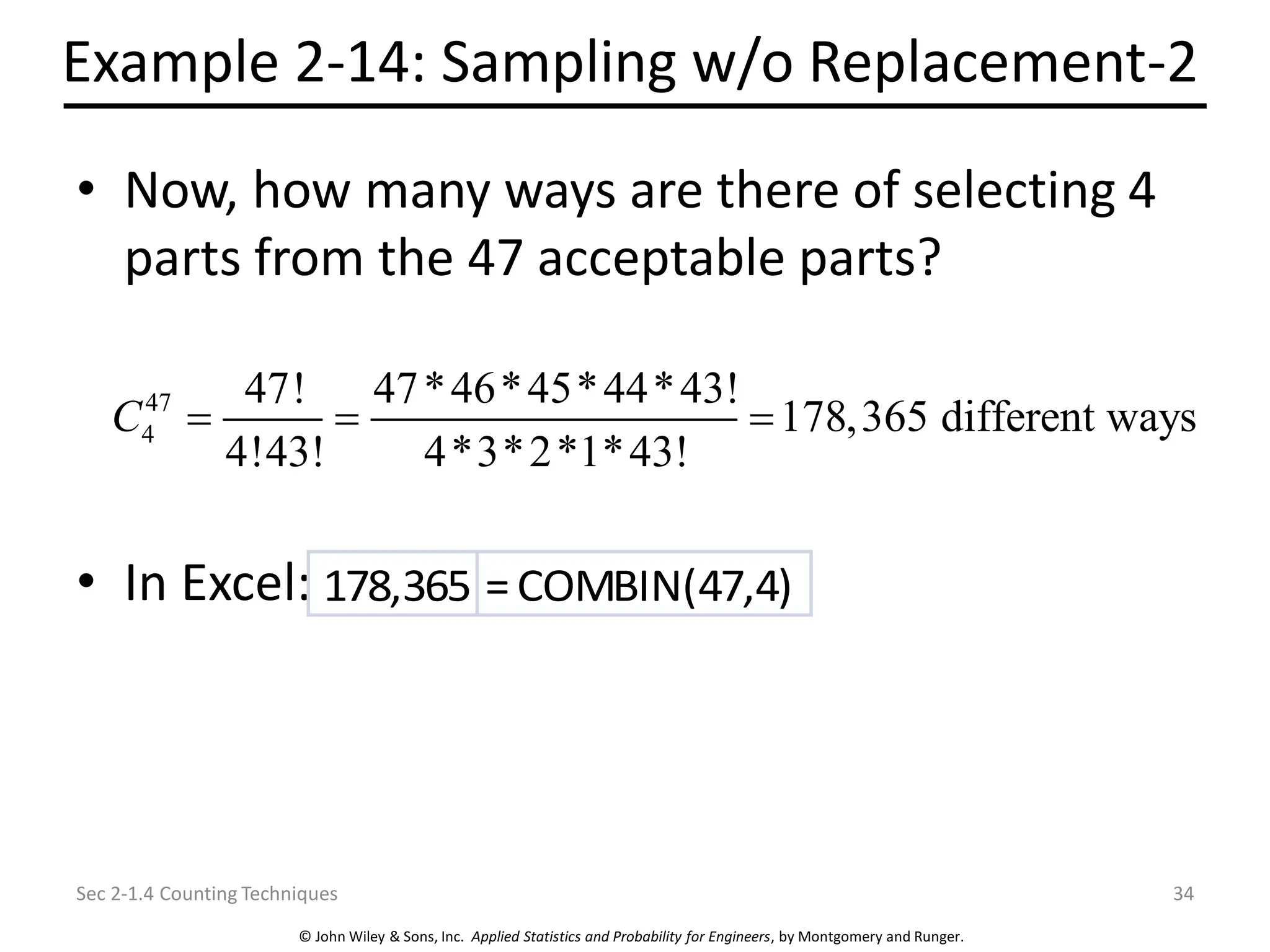
Example 2-14: Sampling w/o Replacement-2
• Now, how many ways are there of selecting 4
parts from the 47 acceptable parts?
• In Excel:
Sec 2-1.4 Counting Techniques 34
47
4
47! 47*46*45*44*43!
178,365 different ways
4!43! 4*3*2*1*43!
C = = =
178,365 =COMBIN(47,4)
© John Wiley & Sons, Inc. Applied Statistics and Probability for Engineers, by Montgomery and Runger.
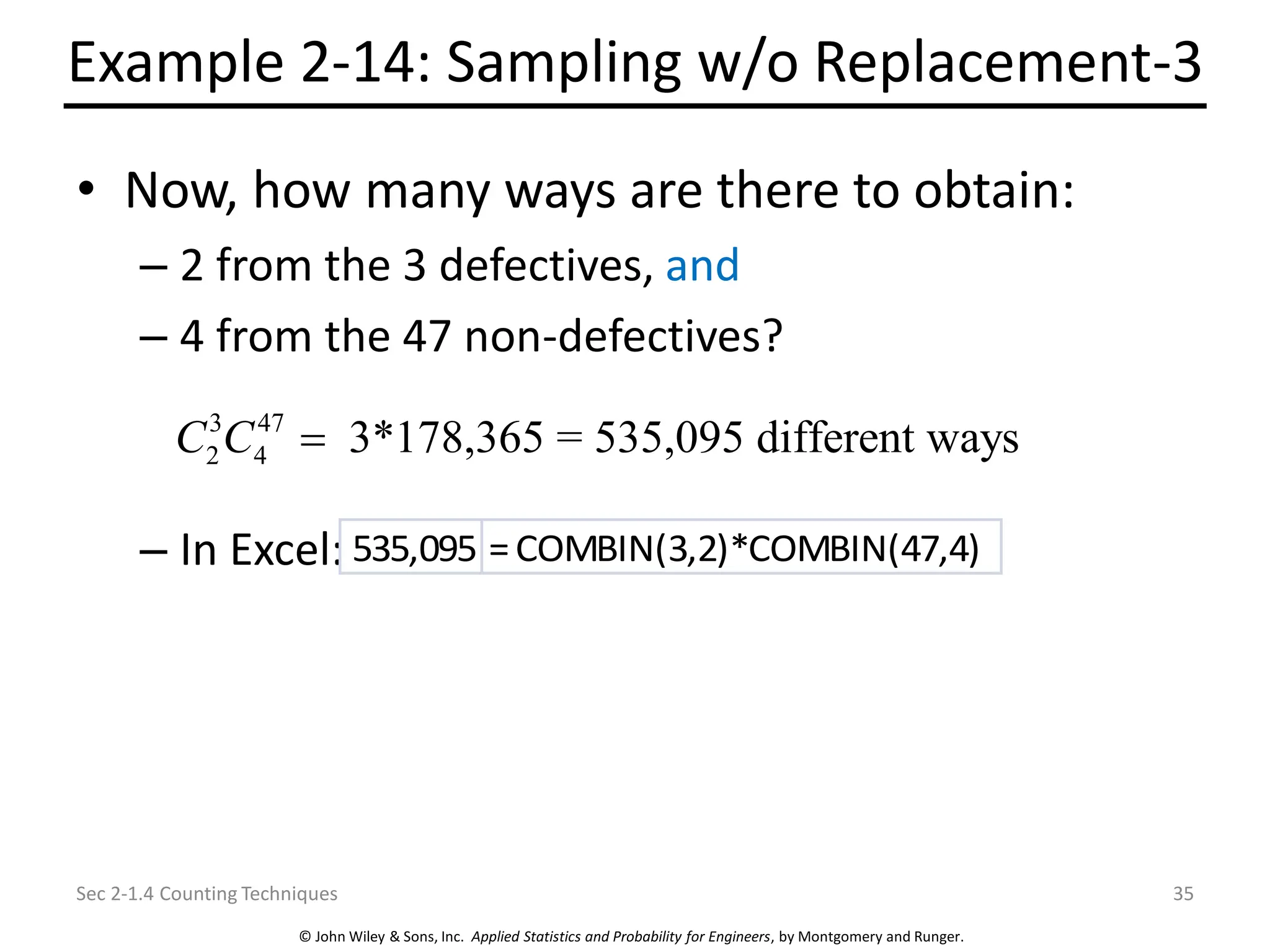
Example 2-14: Sampling w/o Replacement-3
• Now, how many ways are there to obtain:
– 2 from the 3 defectives, and
– 4 from the 47 non-defectives?
– In Excel:
Sec 2-1.4 Counting Techniques 35
3 47
2 4 3*178,365 = 535,095 different ways
C C =
535,095 =COMBIN(3,2)*COMBIN(47,4)
© John Wiley & Sons, Inc. Applied Statistics and Probability for Engineers, by Montgomery and Runger.
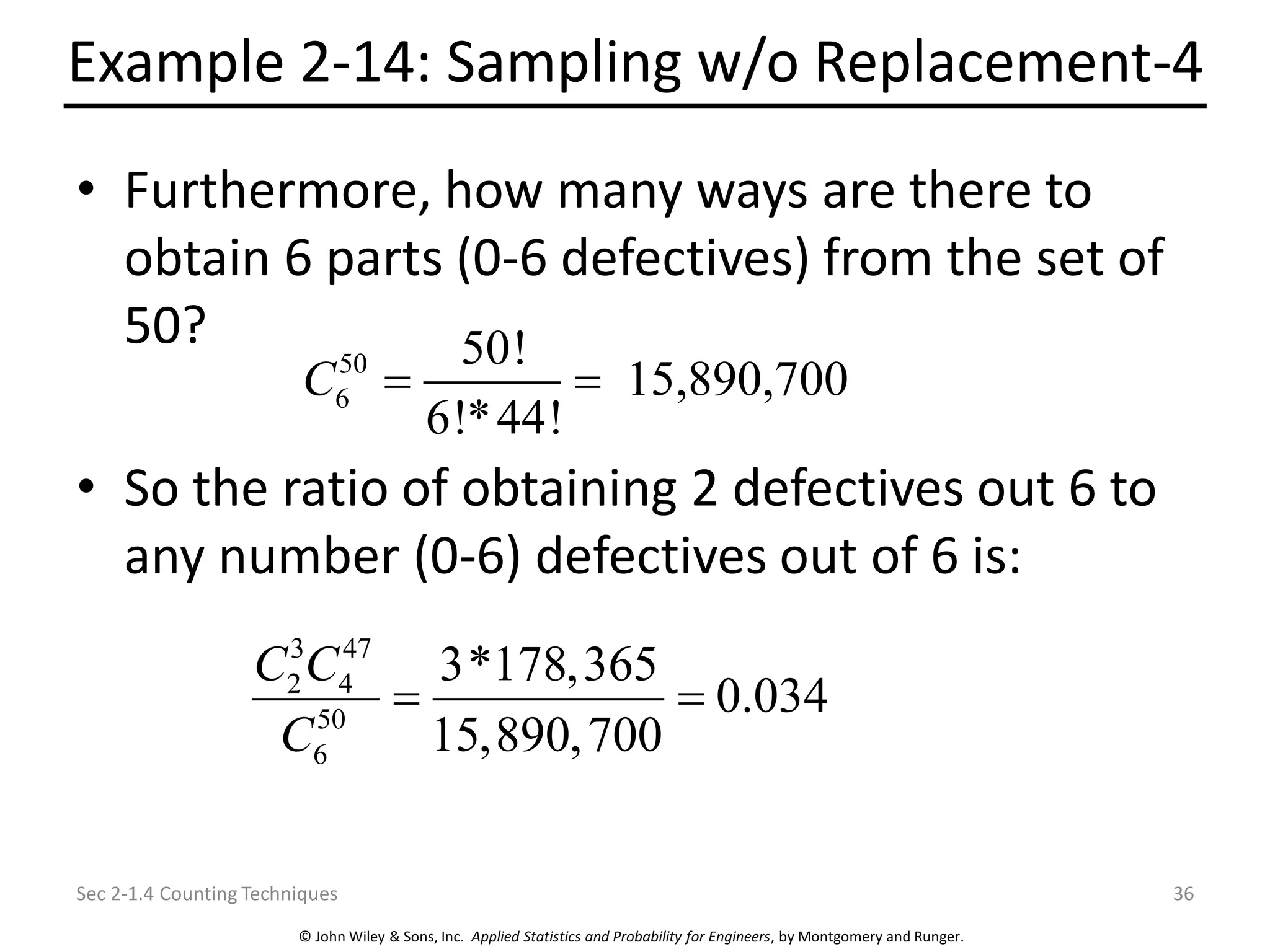
Example 2-14: Sampling w/o Replacement-4
• Furthermore, how many ways are there to
obtain 6 parts (0-6 defectives) from the set of
50?
• So the ratio of obtaining 2 defectives out 6 to
any number (0-6) defectives out of 6 is:
Sec 2-1.4 Counting Techniques 36
50
6
50!
15,890,700
6!*44!
C = =
3 47
2 4
50
6
3*178,365
0.034
15,890,700
C C
C
= =
© John Wiley & Sons, Inc. Applied Statistics and Probability for Engineers, by Montgomery and Runger.
What Is Probability?
• Probability is the likelihood or chance that a particular
outcome or event from a random experiment will occur.
• Here, only finite sample spaces ideas apply.
• Probability is a number in the [0,1] interval.
• May be expressed as a:
– proportion (0.15)
– percent (15%)
– fraction (3/20)
• A probability of:
– 1 means certainty
– 0 means impossibility
Sec 2-2 Interpretations & Axioms of Probability 37
© John Wiley & Sons, Inc. Applied Statistics and Probability for Engineers, by Montgomery and Runger.
Types of Probability
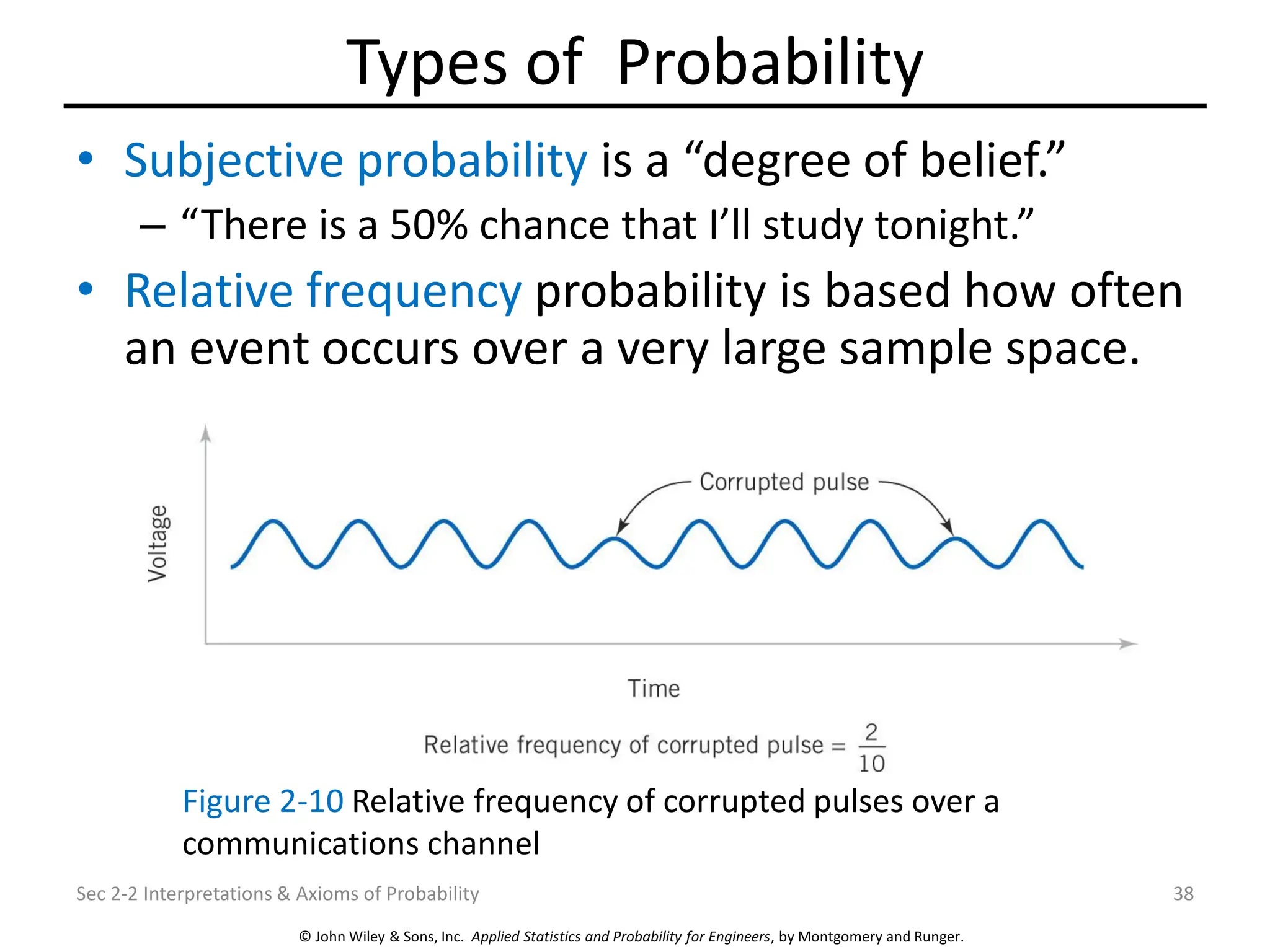
• Subjective probability is a “degree of belief.”
– “There is a 50% chance that I’ll study tonight.”
• Relative frequency probability is based how often
an event occurs over a very large sample space.
Sec 2-2 Interpretations & Axioms of Probability 38
Figure 2-10 Relative frequency of corrupted pulses over a
communications channel
© John Wiley & Sons, Inc. Applied Statistics and Probability for Engineers, by Montgomery and Runger.
Probability Based on Equally-Likely Outcomes
• Whenever a sample space consists of N
possible outcomes that are equally likely, the
probability of each outcome is 1/N.
• Example: In a batch of 100 diodes, 1 is
colored red. A diode is randomly selected
from the batch. Random means each diode
has an equal chance of being selected. The
probability of choosing the red diode is 1/100
or 0.01, because each outcome in the sample
space is equally likely.
Sec 2-2 Interpretations & Axioms of Probabilities 39
© John Wiley & Sons, Inc. Applied Statistics and Probability for Engineers, by Montgomery and Runger.
Example 2-15: Laser Diodes
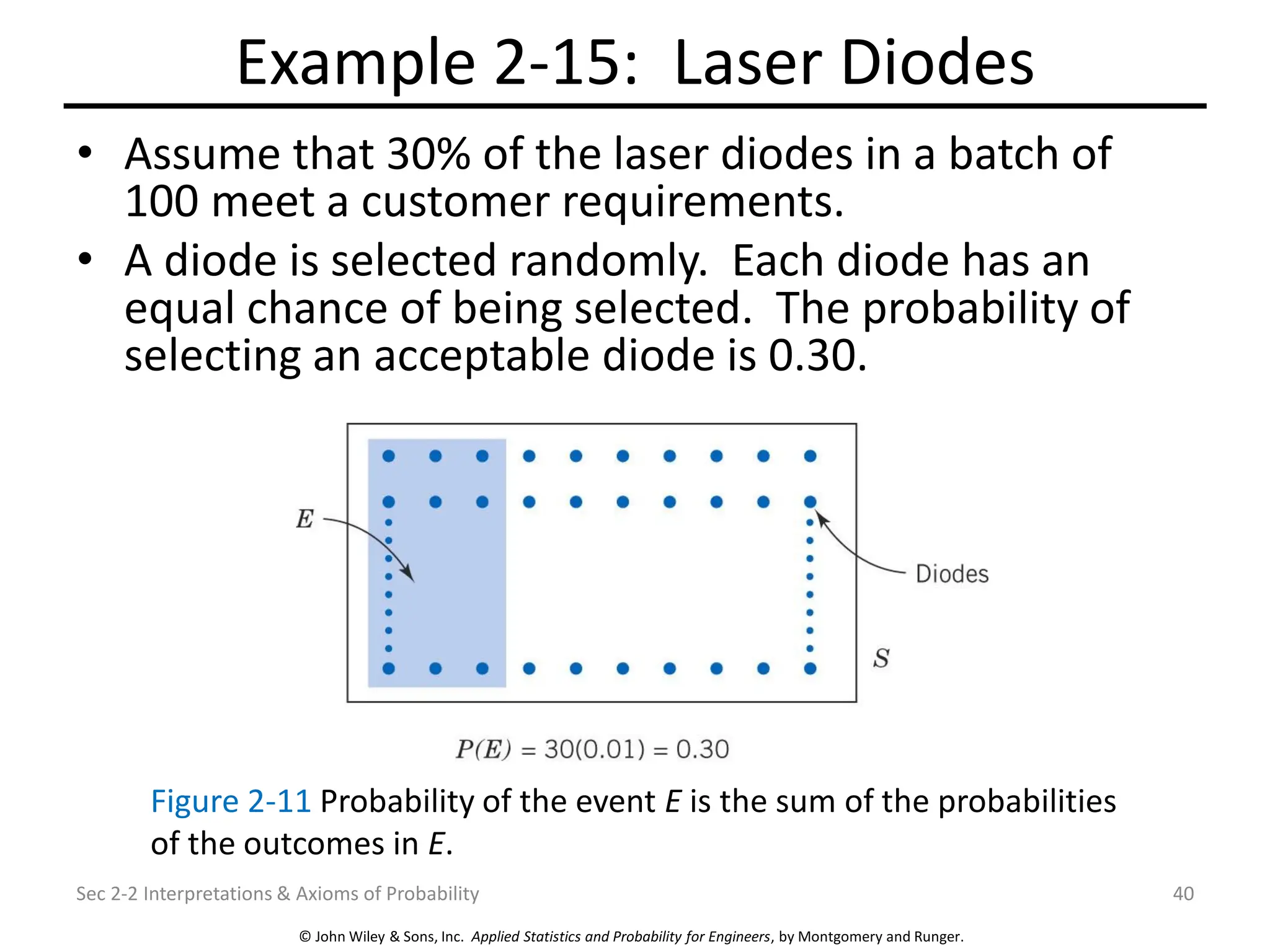
• Assume that 30% of the laser diodes in a batch of
100 meet a customer requirements.
• A diode is selected randomly. Each diode has an
equal chance of being selected. The probability of
selecting an acceptable diode is 0.30.
Sec 2-2 Interpretations & Axioms of Probability 40
Figure 2-11 Probability of the event E is the sum of the probabilities
of the outcomes in E.
© John Wiley & Sons, Inc. Applied Statistics and Probability for Engineers, by Montgomery and Runger.
Probability of an Event
• For a discrete sample space, the probability of
an event E, denoted by P(E), equals the sum of
the probabilities of the outcomes in E.
• The discrete sample space may be:
– A finite set of outcomes
– A countably infinite set of outcomes.
• Further explanation is necessary to describe
probability with respect to continuous sample
spaces.
Sec 2-2 Interpretations & Axioms of Probability 41
© John Wiley & Sons, Inc. Applied Statistics and Probability for Engineers, by Montgomery and Runger.
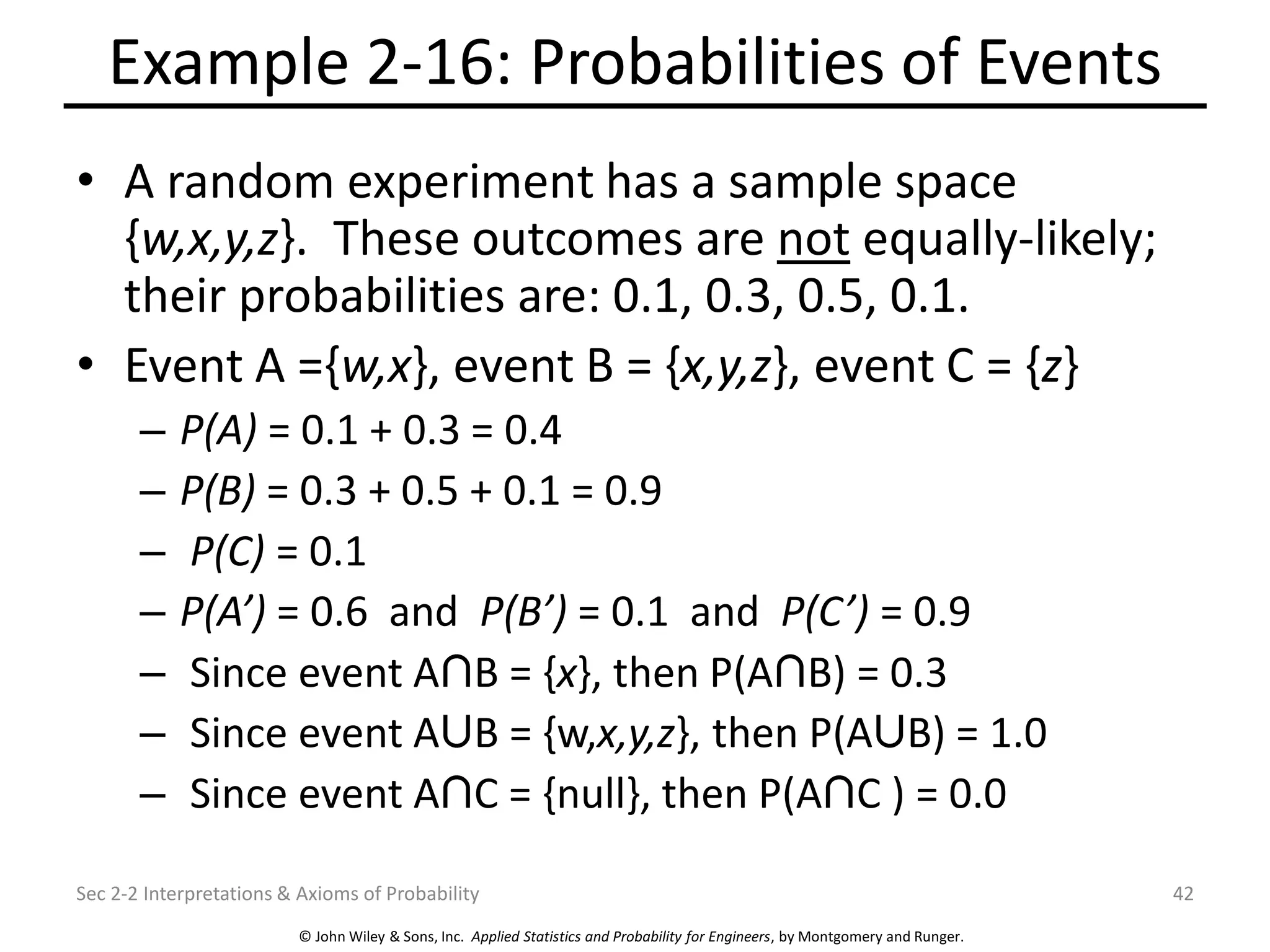
Example 2-16: Probabilities of Events
• A random experiment has a sample space
{w,x,y,z}. These outcomes are not equally-likely;
their probabilities are: 0.1, 0.3, 0.5, 0.1.
• Event A ={w,x}, event B = {x,y,z}, event C = {z}
– P(A) = 0.1 + 0.3 = 0.4
– P(B) = 0.3 + 0.5 + 0.1 = 0.9
– P(C) = 0.1
– P(A’) = 0.6 and P(B’) = 0.1 and P(C’) = 0.9
– Since event A B = {x}, then P(A B) = 0.3
– Since event A B = {w,x,y,z}, then P(A B) = 1.0
– Since event A C = {null}, then P(A C ) = 0.0
Sec 2-2 Interpretations & Axioms of Probability 42
© John Wiley & Sons, Inc. Applied Statistics and Probability for Engineers, by Montgomery and Runger.
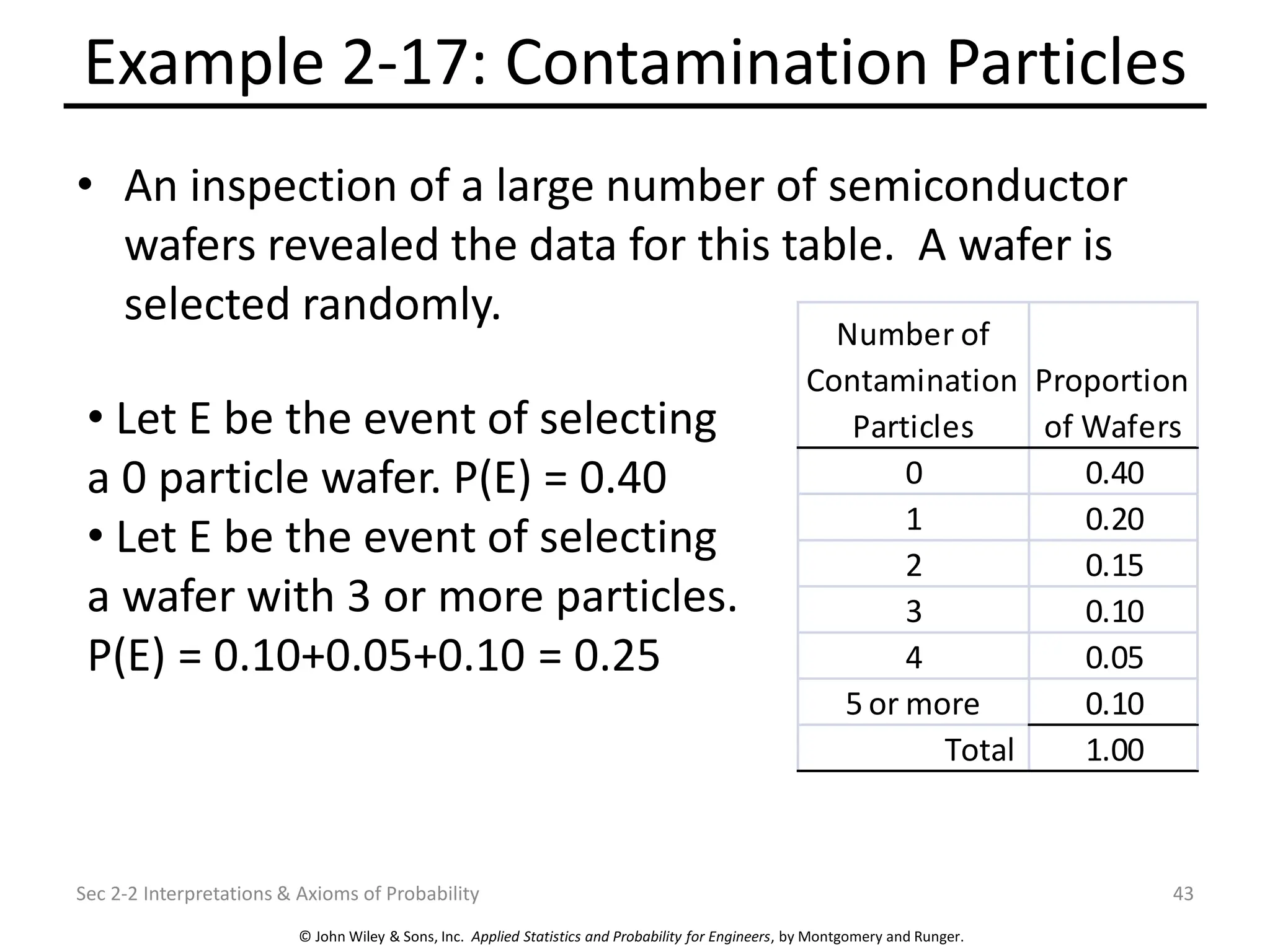
Example 2-17: Contamination Particles
• An inspection of a large number of semiconductor
wafers revealed the data for this table. A wafer is
selected randomly.
Sec 2-2 Interpretations & Axioms of Probability 43
Number of
Contamination
Particles
Proportion
of Wafers
0 0.40
1 0.20
2 0.15
3 0.10
4 0.05
5 or more 0.10
Total 1.00
• Let E be the event of selecting
a 0 particle wafer. P(E) = 0.40
• Let E be the event of selecting
a wafer with 3 or more particles.
P(E) = 0.10+0.05+0.10 = 0.25
© John Wiley & Sons, Inc. Applied Statistics and Probability for Engineers, by Montgomery and Runger.
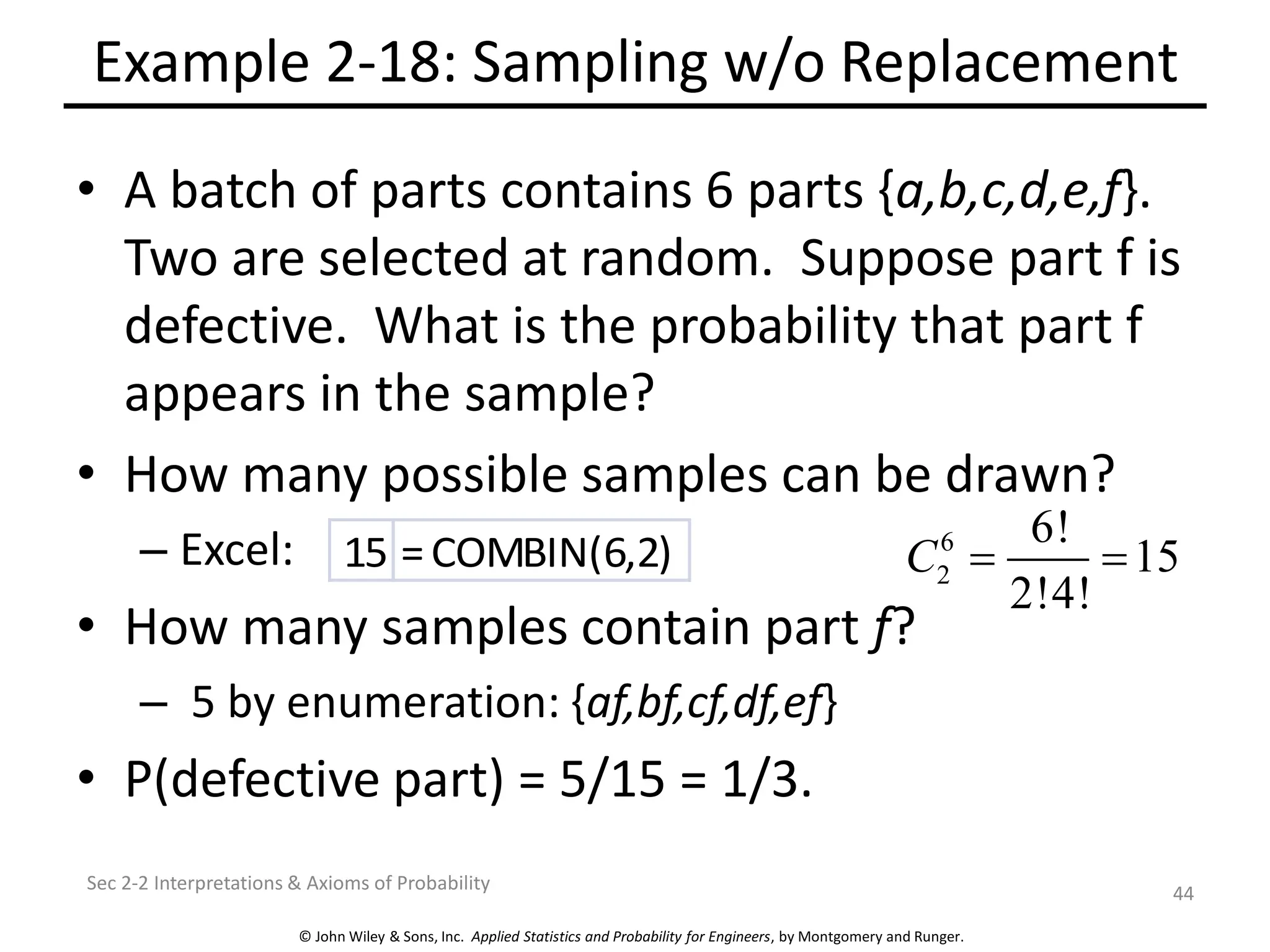
Example 2-18: Sampling w/o Replacement
• A batch of parts contains 6 parts {a,b,c,d,e,f}.
Two are selected at random. Suppose part f is
defective. What is the probability that part f
appears in the sample?
• How many possible samples can be drawn?
– Excel:
• How many samples contain part f?
– 5 by enumeration: {af,bf,cf,df,ef}
• P(defective part) = 5/15 = 1/3.
Sec 2-2 Interpretations & Axioms of Probability
44
6
2
6!
15
2!4!
C = =
15 =COMBIN(6,2)
© John Wiley & Sons, Inc. Applied Statistics and Probability for Engineers, by Montgomery and Runger.
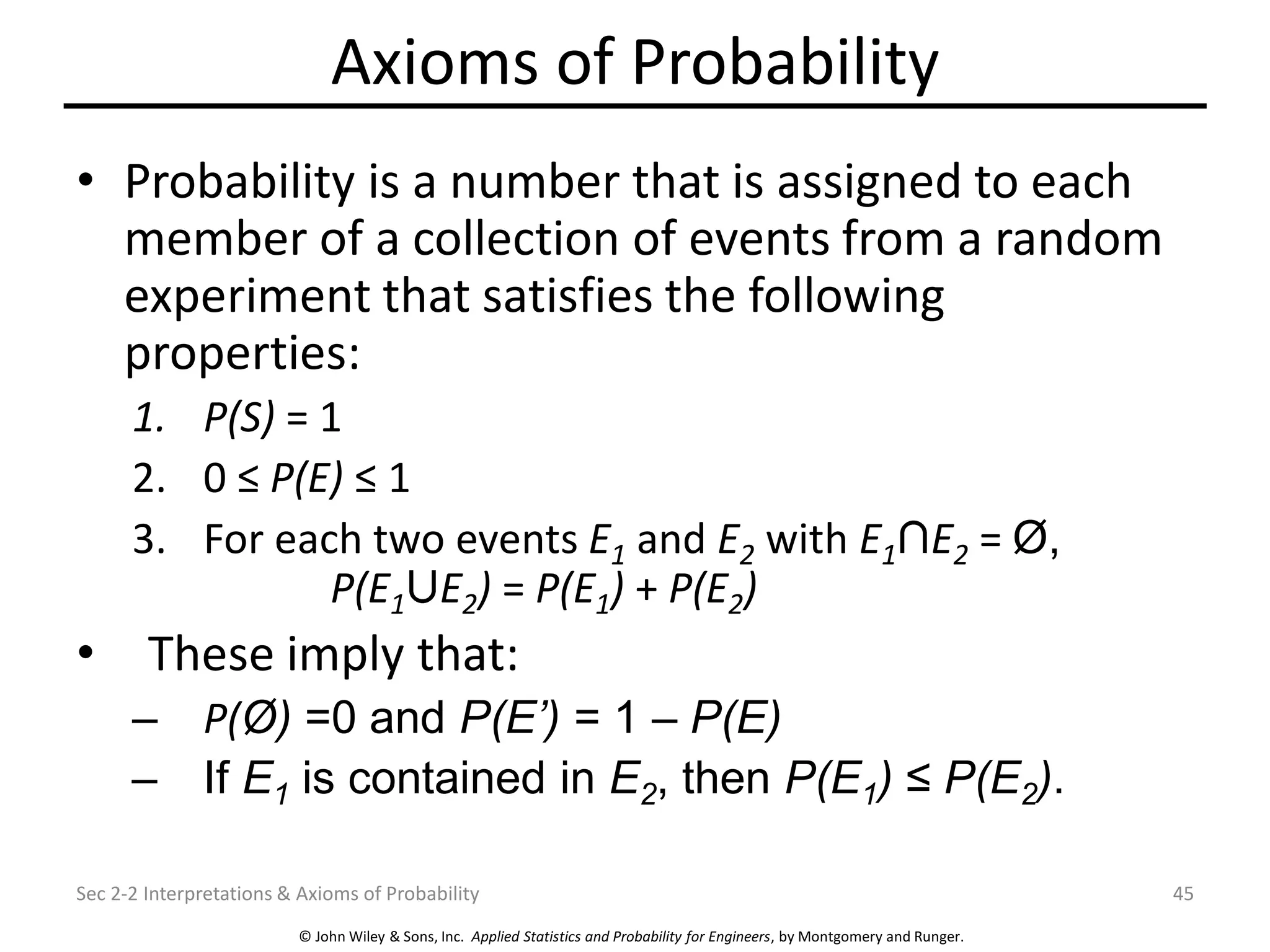
Axioms of Probability
• Probability is a number that is assigned to each
member of a collection of events from a random
experiment that satisfies the following
properties:
1. P(S) = 1
2. 0 ≤ P(E) ≤ 1
3. For each two events E1 and E2 with E1 E2 = Ø,
P(E1 E2) = P(E1) + P(E2)
• These imply that:
– P(Ø) =0 and P(E’) = 1 – P(E)
– If E1 is contained in E2, then P(E1) ≤ P(E2).
Sec 2-2 Interpretations & Axioms of Probability 45
© John Wiley & Sons, Inc. Applied Statistics and Probability for Engineers, by Montgomery and Runger.
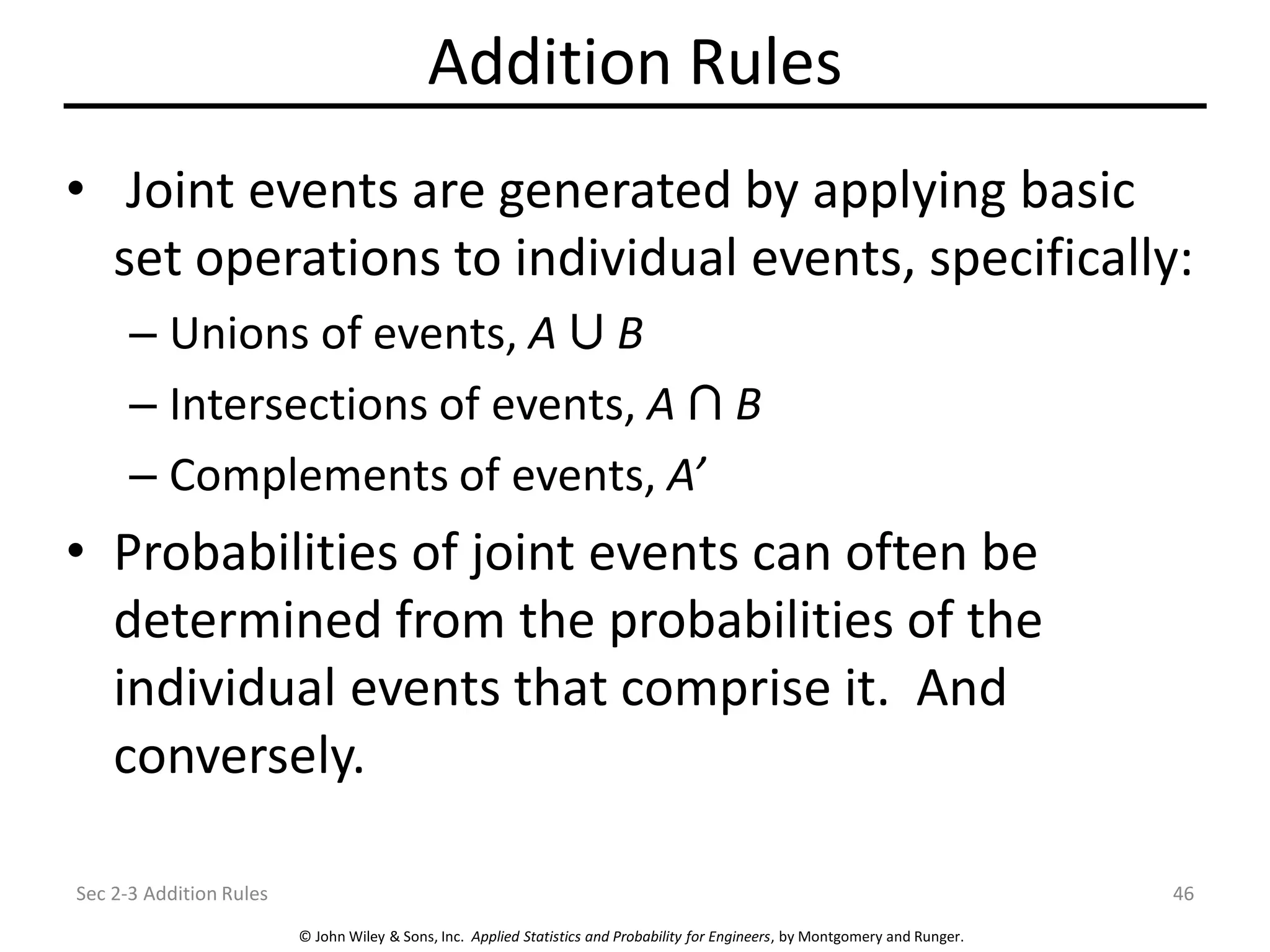
Addition Rules
• Joint events are generated by applying basic
set operations to individual events, specifically:
– Unions of events, A B
– Intersections of events, A B
– Complements of events, A’
• Probabilities of joint events can often be
determined from the probabilities of the
individual events that comprise it. And
conversely.
Sec 2-3 Addition Rules 46
© John Wiley & Sons, Inc. Applied Statistics and Probability for Engineers, by Montgomery and Runger.
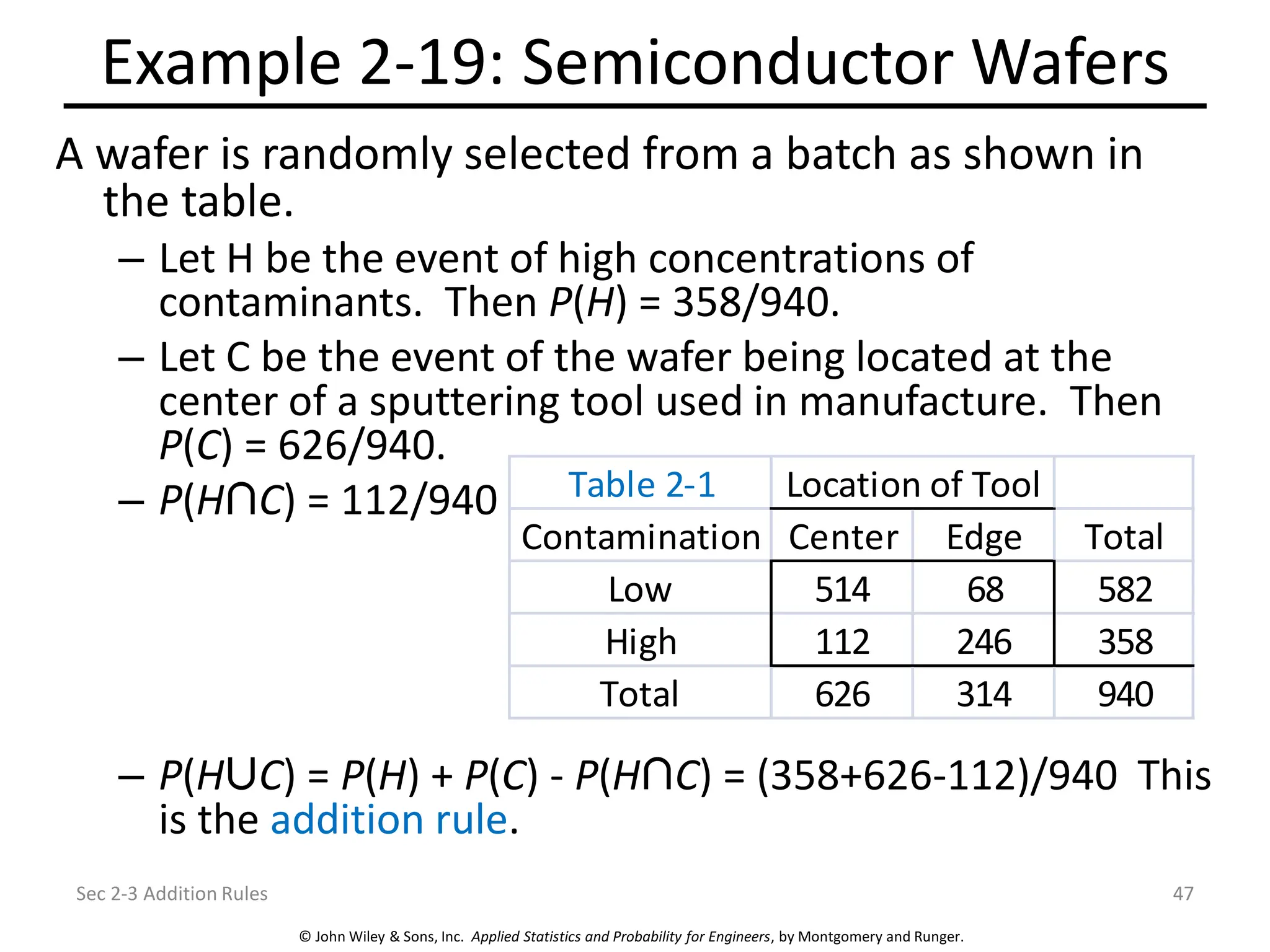
Example 2-19: Semiconductor Wafers
A wafer is randomly selected from a batch as shown in
the table.
– Let H be the event of high concentrations of
contaminants. Then P(H) = 358/940.
– Let C be the event of the wafer being located at the
center of a sputtering tool used in manufacture. Then
P(C) = 626/940.
– P(H C) = 112/940
– P(H C) = P(H) + P(C) - P(H C) = (358+626-112)/940 This
is the addition rule.
Sec 2-3 Addition Rules 47
Table 2-1
Contamination Center Edge Total
Low 514 68 582
High 112 246 358
Total 626 314 940
Location of Tool
© John Wiley & Sons, Inc. Applied Statistics and Probability for Engineers, by Montgomery and Runger.
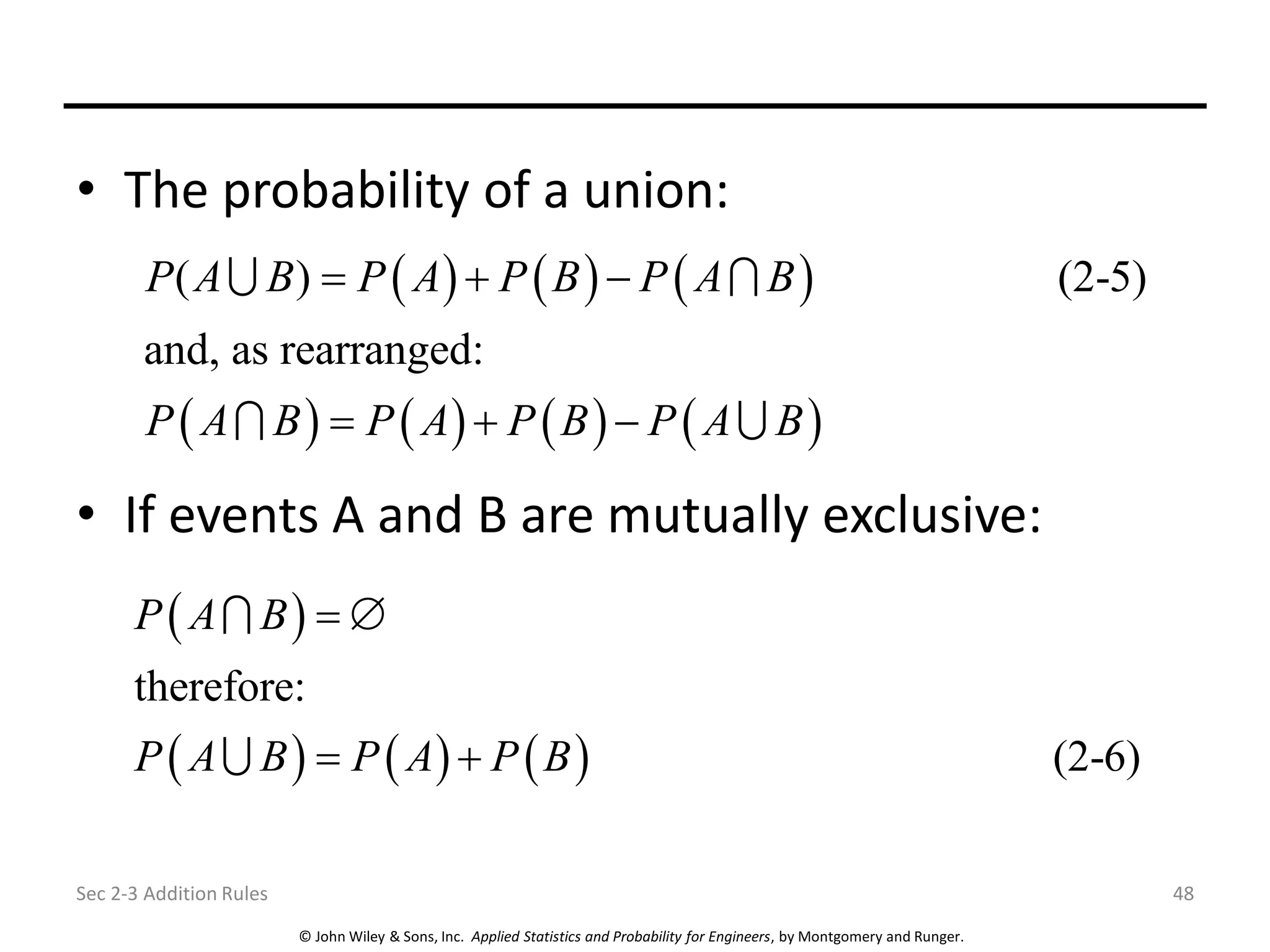
• The probability of a union:
• If events A and B are mutually exclusive:
Sec 2-3 Addition Rules 48
( ) ( ) ( )
( ) ( ) ( ) ( )
( ) (2-5)
and, as rearranged:
P A B P A P B P A B
P A B P A P B P A B
= + −
= + −
( )
( ) ( ) ( )
therefore:
(2-6)
P A B
P A B P A P B
= 
= +
© John Wiley & Sons, Inc. Applied Statistics and Probability for Engineers, by Montgomery and Runger.
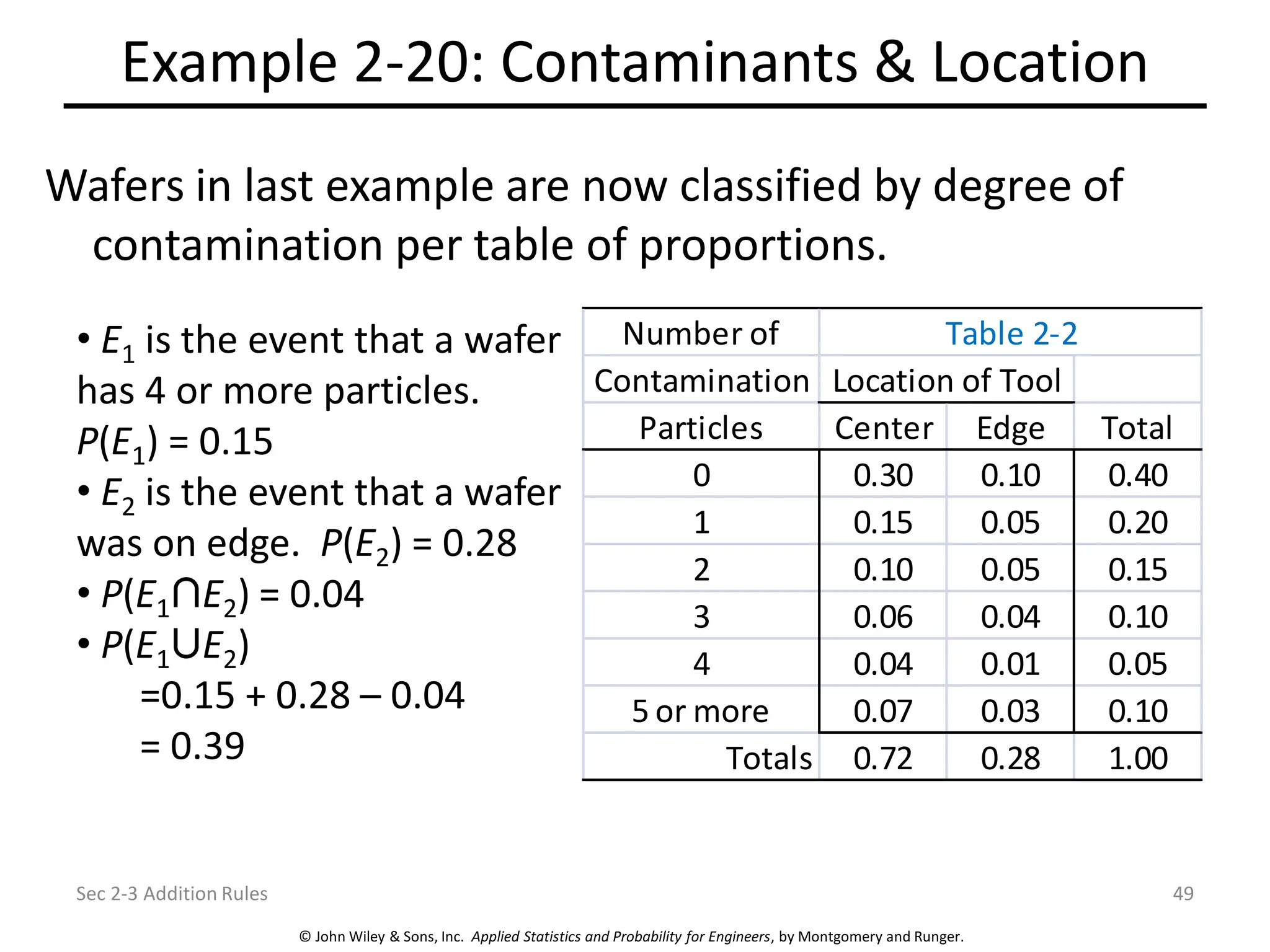
Example 2-20: Contaminants & Location
Wafers in last example are now classified by degree of
contamination per table of proportions.
Sec 2-3 Addition Rules 49
Number of
Contamination
Particles Center Edge Total
0 0.30 0.10 0.40
1 0.15 0.05 0.20
2 0.10 0.05 0.15
3 0.06 0.04 0.10
4 0.04 0.01 0.05
5 or more 0.07 0.03 0.10
Totals 0.72 0.28 1.00
Location of Tool
Table 2-2
• E1 is the event that a wafer
has 4 or more particles.
P(E1) = 0.15
• E2 is the event that a wafer
was on edge. P(E2) = 0.28
• P(E1 E2) = 0.04
• P(E1 E2)
=0.15 + 0.28 – 0.04
= 0.39
© John Wiley & Sons, Inc. Applied Statistics and Probability for Engineers, by Montgomery and Runger.
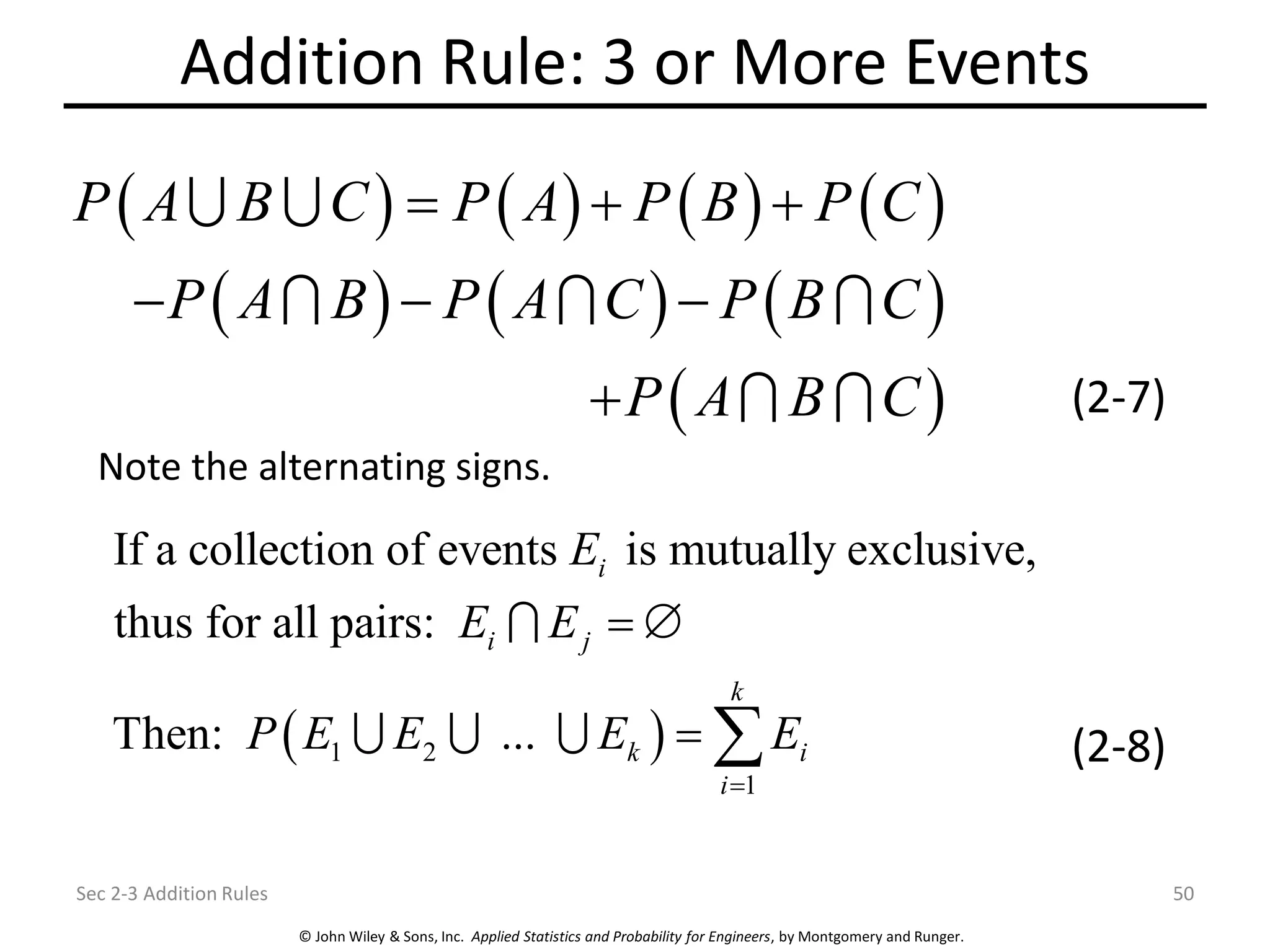
Addition Rule: 3 or More Events
Sec 2-3 Addition Rules 50
( ) ( ) ( ) ( )
( ) ( ) ( )
( )
P A B C P A P B P C
P A B P A C P B C
P A B C
= + +
− − −
+ (2-7)
Note the alternating signs.
( )
1 2
1
If a collection of events is mutually exclusive,
thus for all pairs:
Then: ...
i
i j
k
k i
i
E
E E
P E E E E
=
= 
=  (2-8)
© John Wiley & Sons, Inc. Applied Statistics and Probability for Engineers, by Montgomery and Runger.
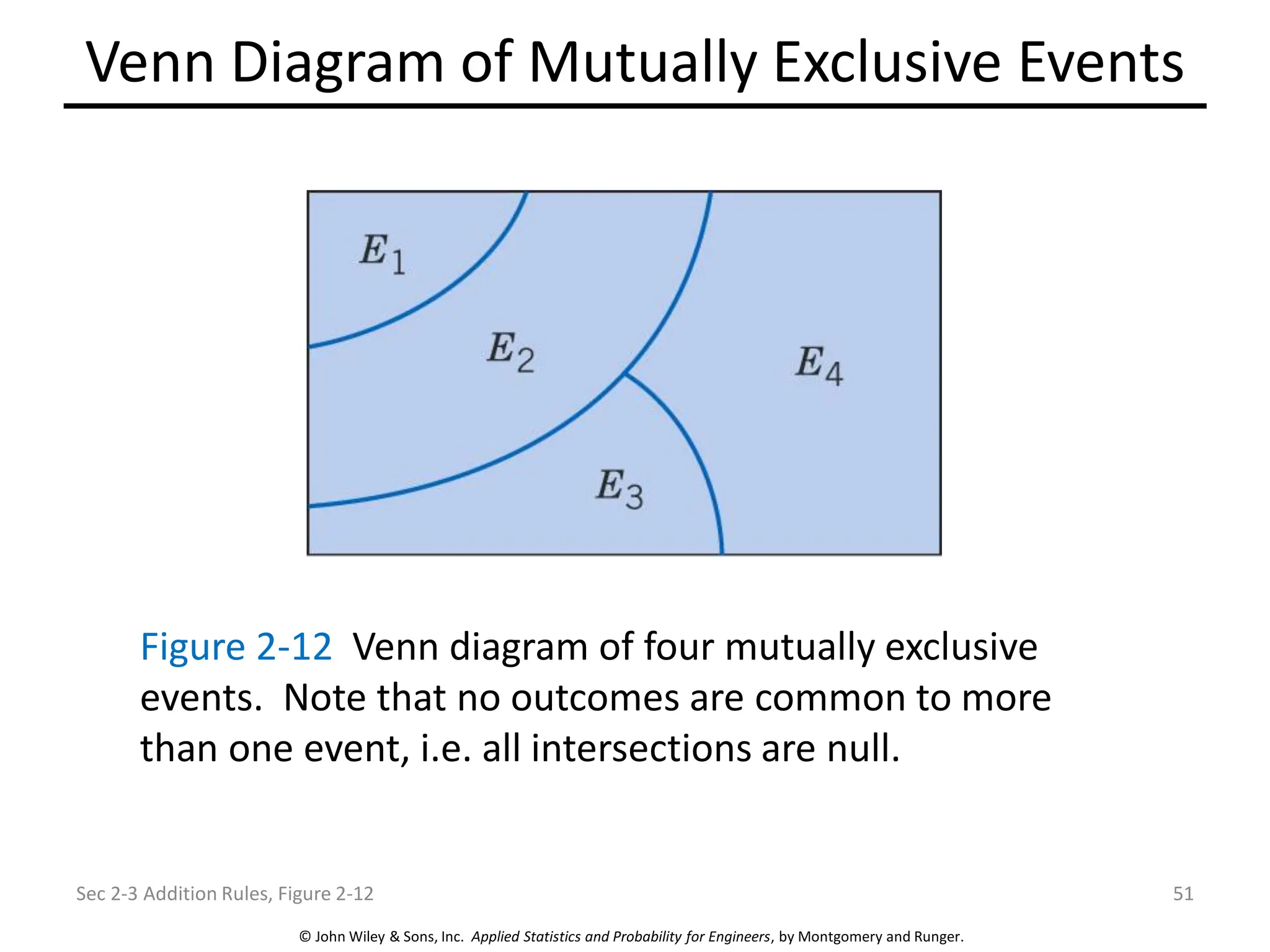
Venn Diagram of Mutually Exclusive Events
Sec 2-3 Addition Rules, Figure 2-12 51
Figure 2-12 Venn diagram of four mutually exclusive
events. Note that no outcomes are common to more
than one event, i.e. all intersections are null.
© John Wiley & Sons, Inc. Applied Statistics and Probability for Engineers, by Montgomery and Runger.
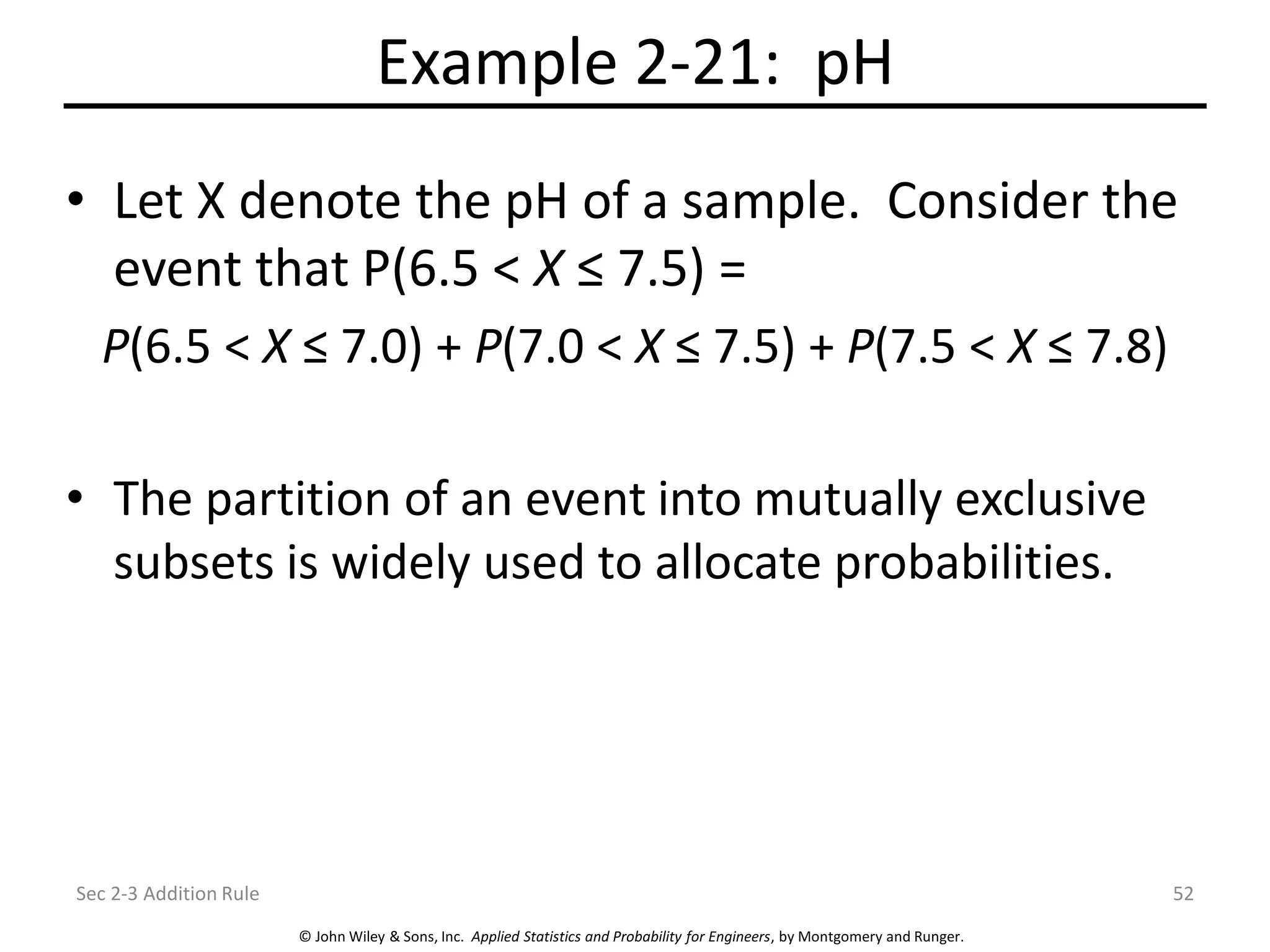
Example 2-21: pH
• Let X denote the pH of a sample. Consider the
event that P(6.5 < X ≤ 7.5) =
P(6.5 < X ≤ 7.0) + P(7.0 < X ≤ 7.5) + P(7.5 < X ≤ 7.8)
• The partition of an event into mutually exclusive
subsets is widely used to allocate probabilities.
Sec 2-3 Addition Rule 52
© John Wiley & Sons, Inc. Applied Statistics and Probability for Engineers, by Montgomery and Runger.
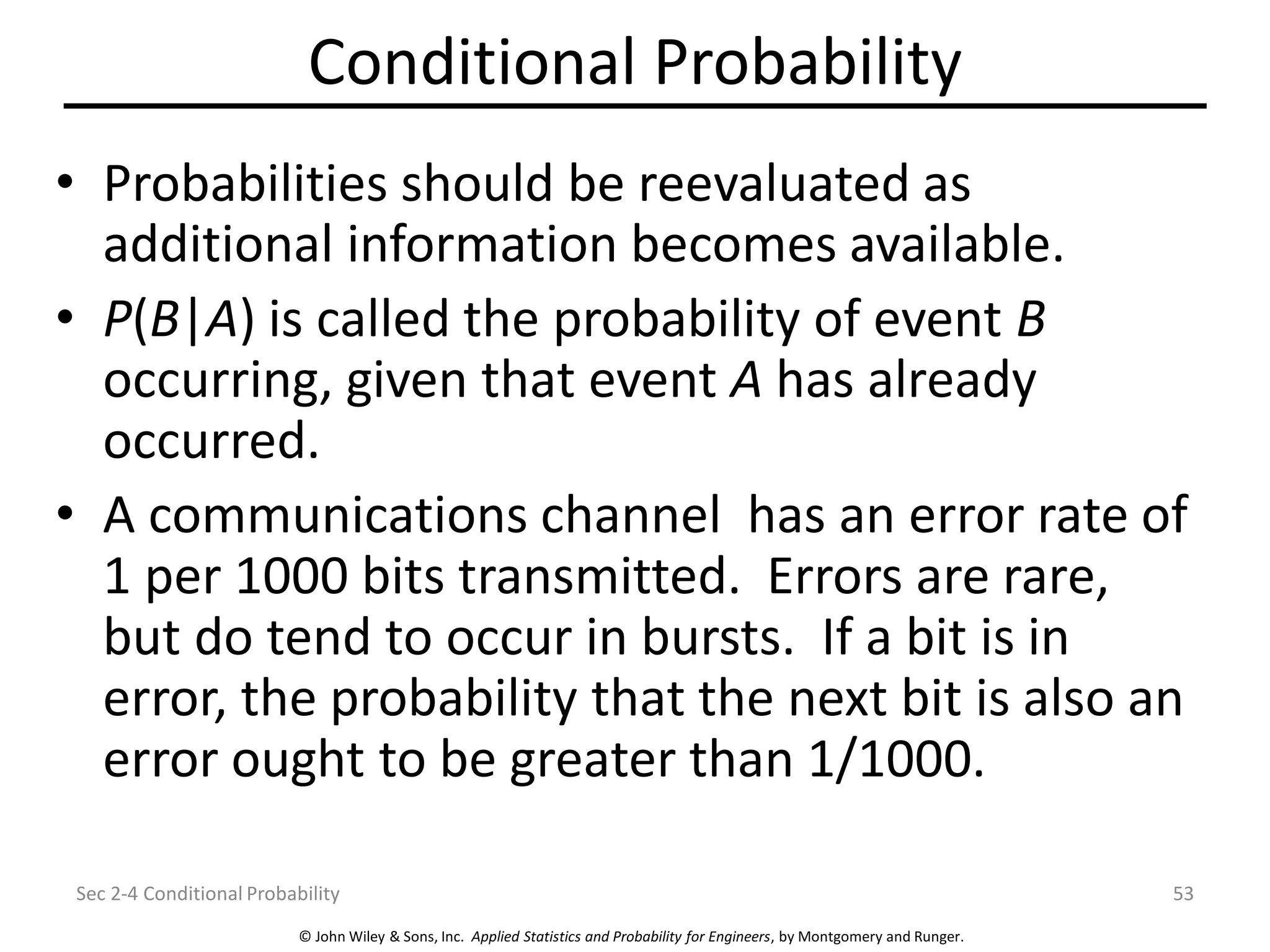
Conditional Probability
• Probabilities should be reevaluated as
additional information becomes available.
• P(B|A) is called the probability of event B
occurring, given that event A has already
occurred.
• A communications channel has an error rate of
1 per 1000 bits transmitted. Errors are rare,
but do tend to occur in bursts. If a bit is in
error, the probability that the next bit is also an
error ought to be greater than 1/1000.
Sec 2-4 Conditional Probability 53
© John Wiley & Sons, Inc. Applied Statistics and Probability for Engineers, by Montgomery and Runger.
An Example of Conditional Probability
• In a thin film manufacturing process, the
proportion of parts that are not acceptable is
2%. However the process is sensitive to
contamination that can increase the rate of
parts rejection.
• If we know that the plant is having filtration
problems that increase film contamination, we
would presume that the rejection rate has
increased.
Sec 2-4 Conditional Probability 54
© John Wiley & Sons, Inc. Applied Statistics and Probability for Engineers, by Montgomery and Runger.
Another Example of Conditional Probability
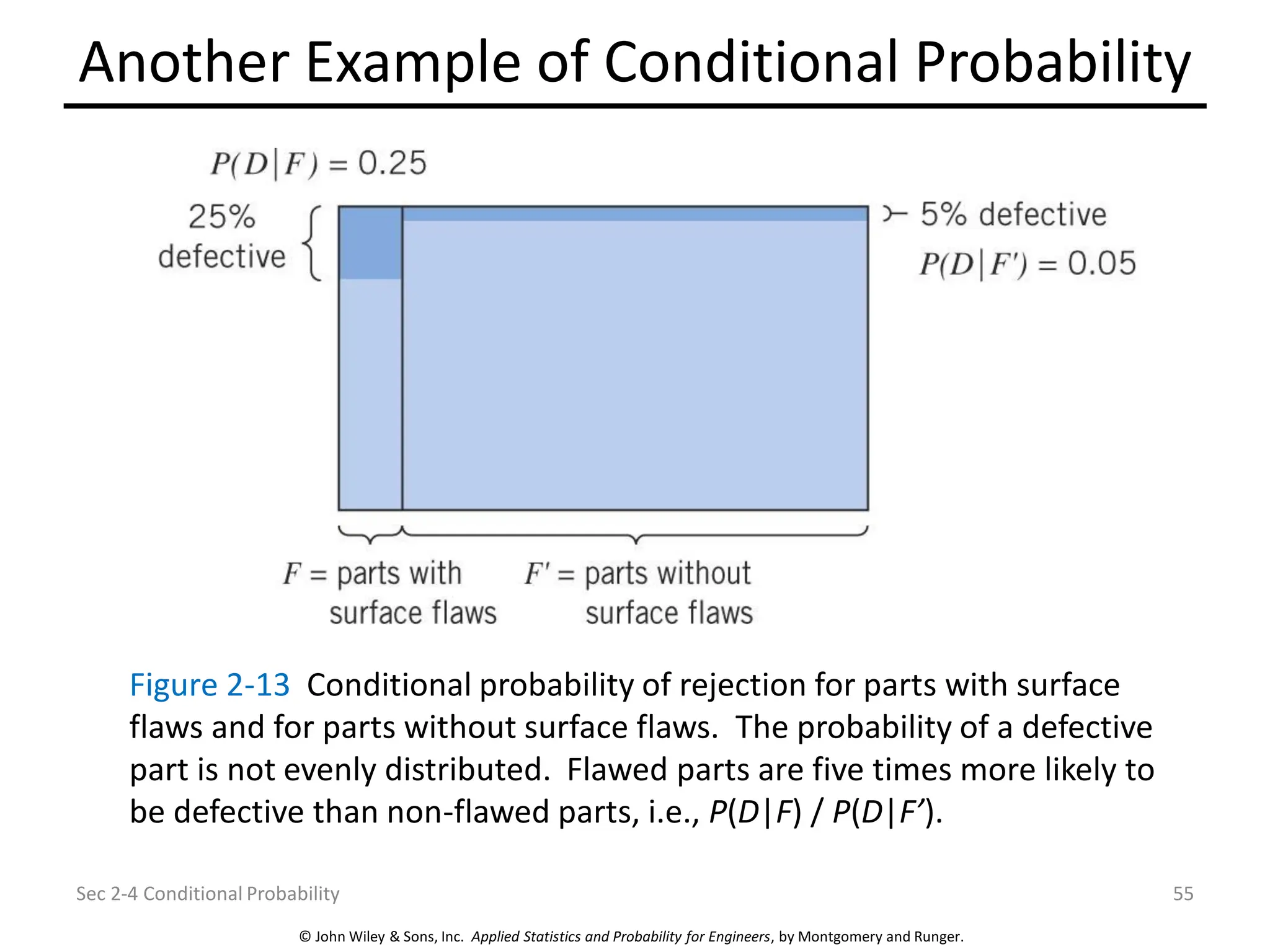
Sec 2-4 Conditional Probability 55
Figure 2-13 Conditional probability of rejection for parts with surface
flaws and for parts without surface flaws. The probability of a defective
part is not evenly distributed. Flawed parts are five times more likely to
be defective than non-flawed parts, i.e., P(D|F) / P(D|F’).
© John Wiley & Sons, Inc. Applied Statistics and Probability for Engineers, by Montgomery and Runger.
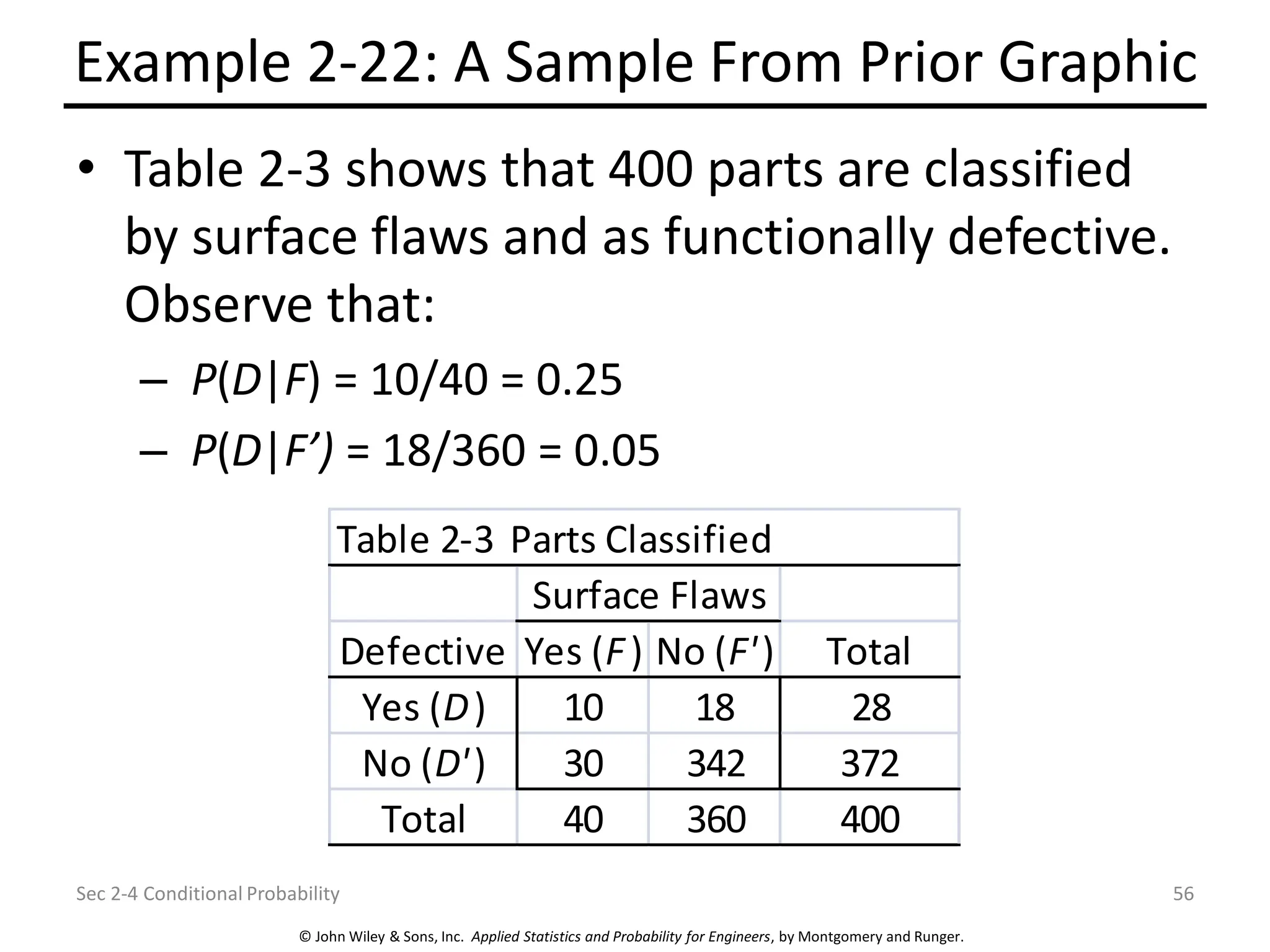
Example 2-22: A Sample From Prior Graphic
• Table 2-3 shows that 400 parts are classified
by surface flaws and as functionally defective.
Observe that:
– P(D|F) = 10/40 = 0.25
– P(D|F’) = 18/360 = 0.05
Sec 2-4 Conditional Probability 56
Defective Yes (F) No (F') Total
Yes (D) 10 18 28
No (D') 30 342 372
Total 40 360 400
Surface Flaws
Table 2-3 Parts Classified
© John Wiley & Sons, Inc. Applied Statistics and Probability for Engineers, by Montgomery and Runger.
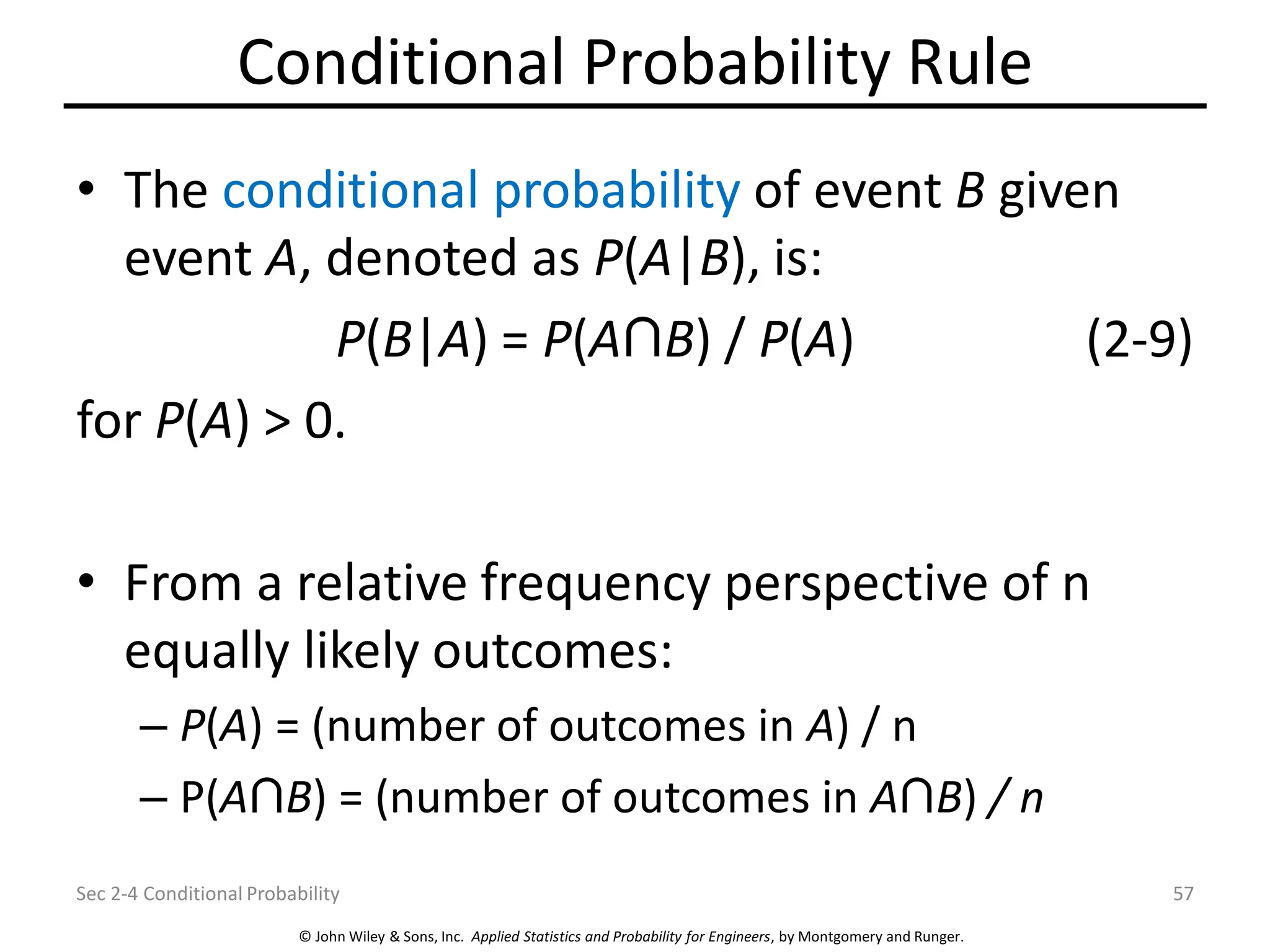
Conditional Probability Rule
• The conditional probability of event B given
event A, denoted as P(A|B), is:
P(B|A) = P(A B) / P(A) (2-9)
for P(A) > 0.
• From a relative frequency perspective of n
equally likely outcomes:
– P(A) = (number of outcomes in A) / n
– P(A B) = (number of outcomes in A B) / n
Sec 2-4 Conditional Probability 57
© John Wiley & Sons, Inc. Applied Statistics and Probability for Engineers, by Montgomery and Runger.
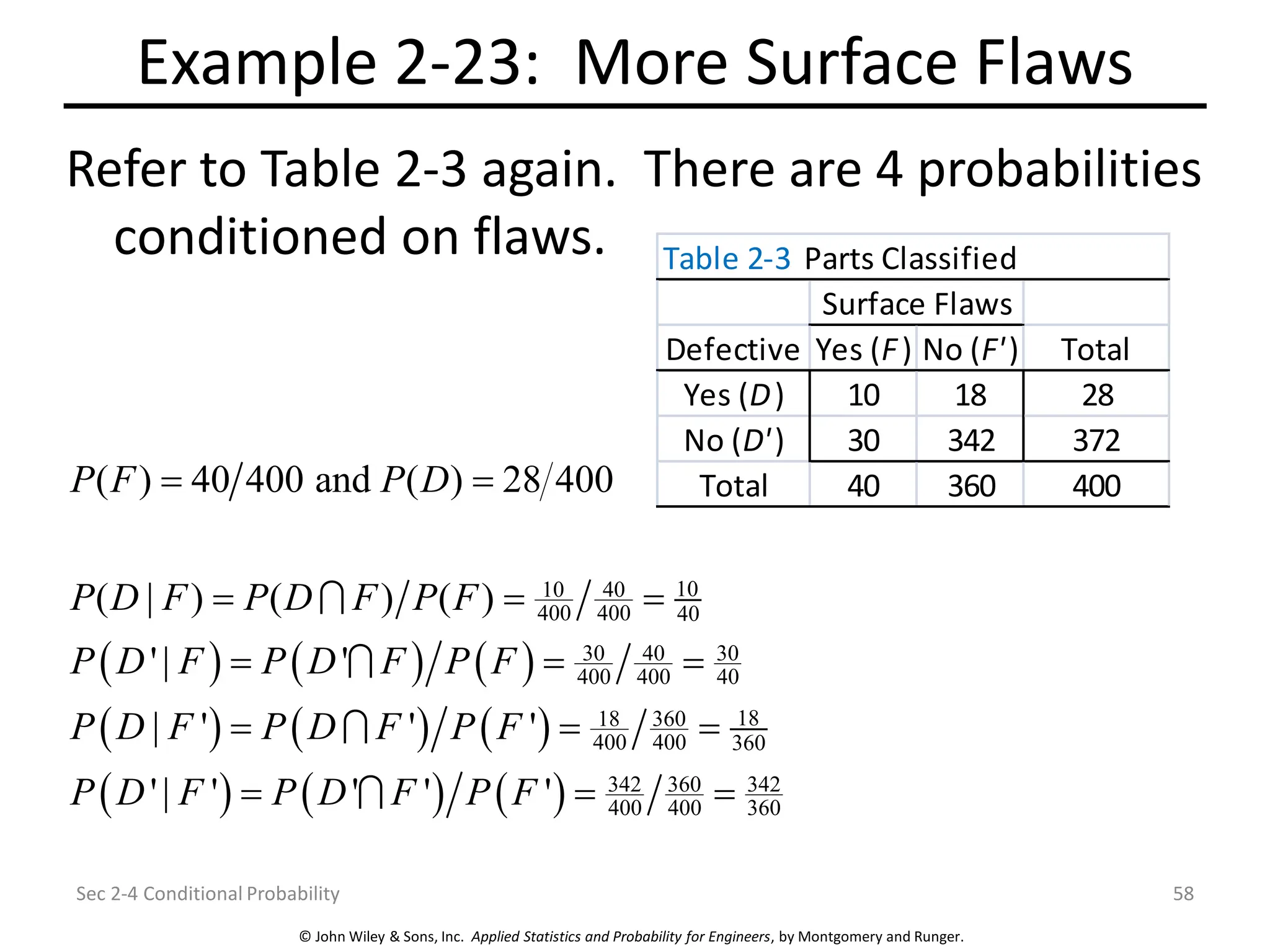
Example 2-23: More Surface Flaws
Refer to Table 2-3 again. There are 4 probabilities
conditioned on flaws.
Sec 2-4 Conditional Probability 58
( ) ( ) ( )
( ) ( ) ( )
( ) ( ) ( )
10
10 40
400 400 40
30 40 30
400 400 40
18
18 360
400 400 360
342 360 342
400 400 360
( ) 40 400 and ( ) 28 400
( | ) ( ) ( )
'| '
| ' ' '
'| ' ' ' '
P F P D
P D F P D F P F
P D F P D F P F
P D F P D F P F
P D F P D F P F
= =
= = =
= = =
= = =
= = =
Defective Yes (F) No (F') Total
Yes (D) 10 18 28
No (D') 30 342 372
Total 40 360 400
Surface Flaws
Table 2-3 Parts Classified
© John Wiley & Sons, Inc. Applied Statistics and Probability for Engineers, by Montgomery and Runger.
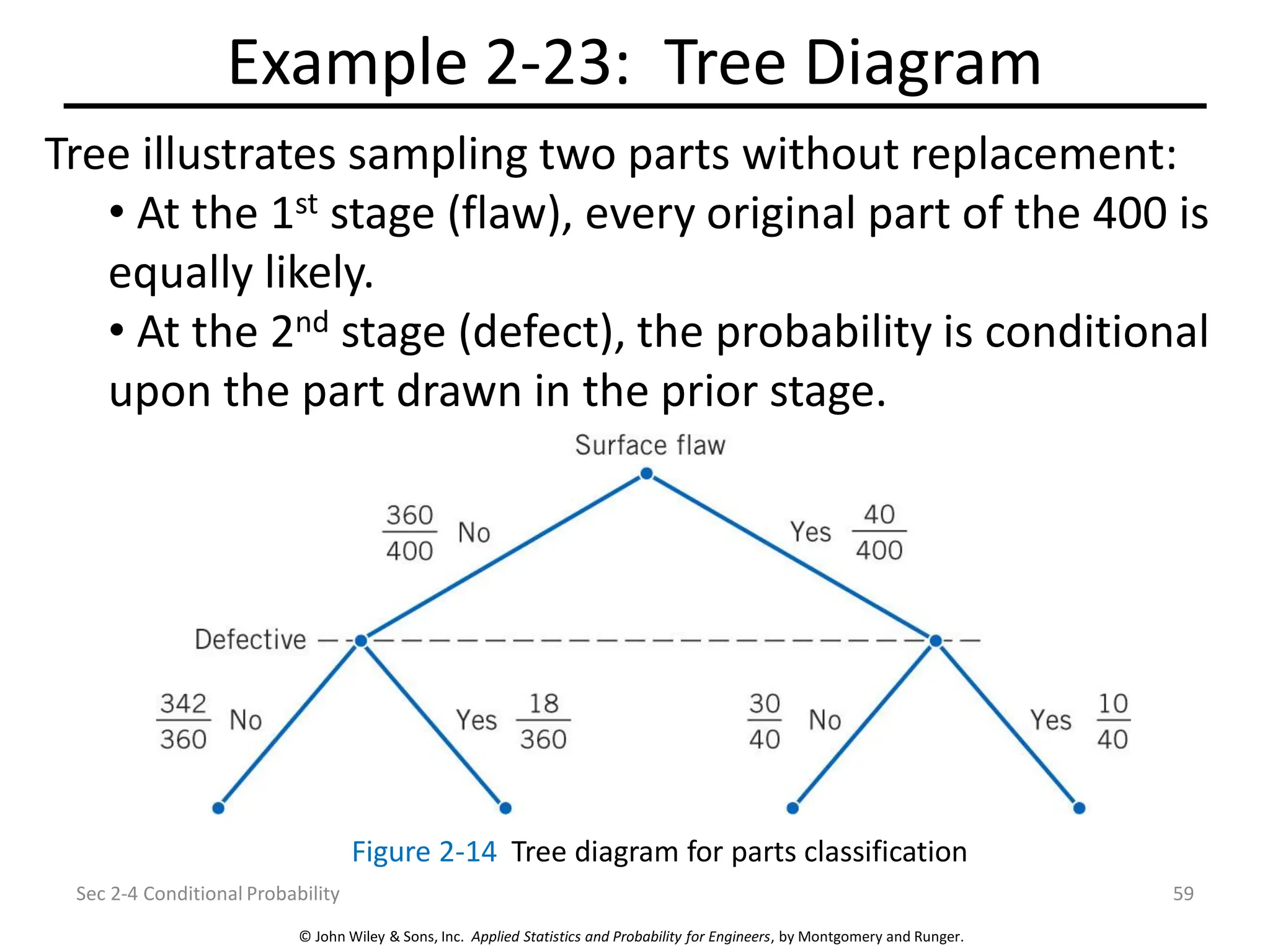
Example 2-23: Tree Diagram
Sec 2-4 Conditional Probability 59
Figure 2-14 Tree diagram for parts classification
Tree illustrates sampling two parts without replacement:
• At the 1st stage (flaw), every original part of the 400 is
equally likely.
• At the 2nd stage (defect), the probability is conditional
upon the part drawn in the prior stage.
© John Wiley & Sons, Inc. Applied Statistics and Probability for Engineers, by Montgomery and Runger.
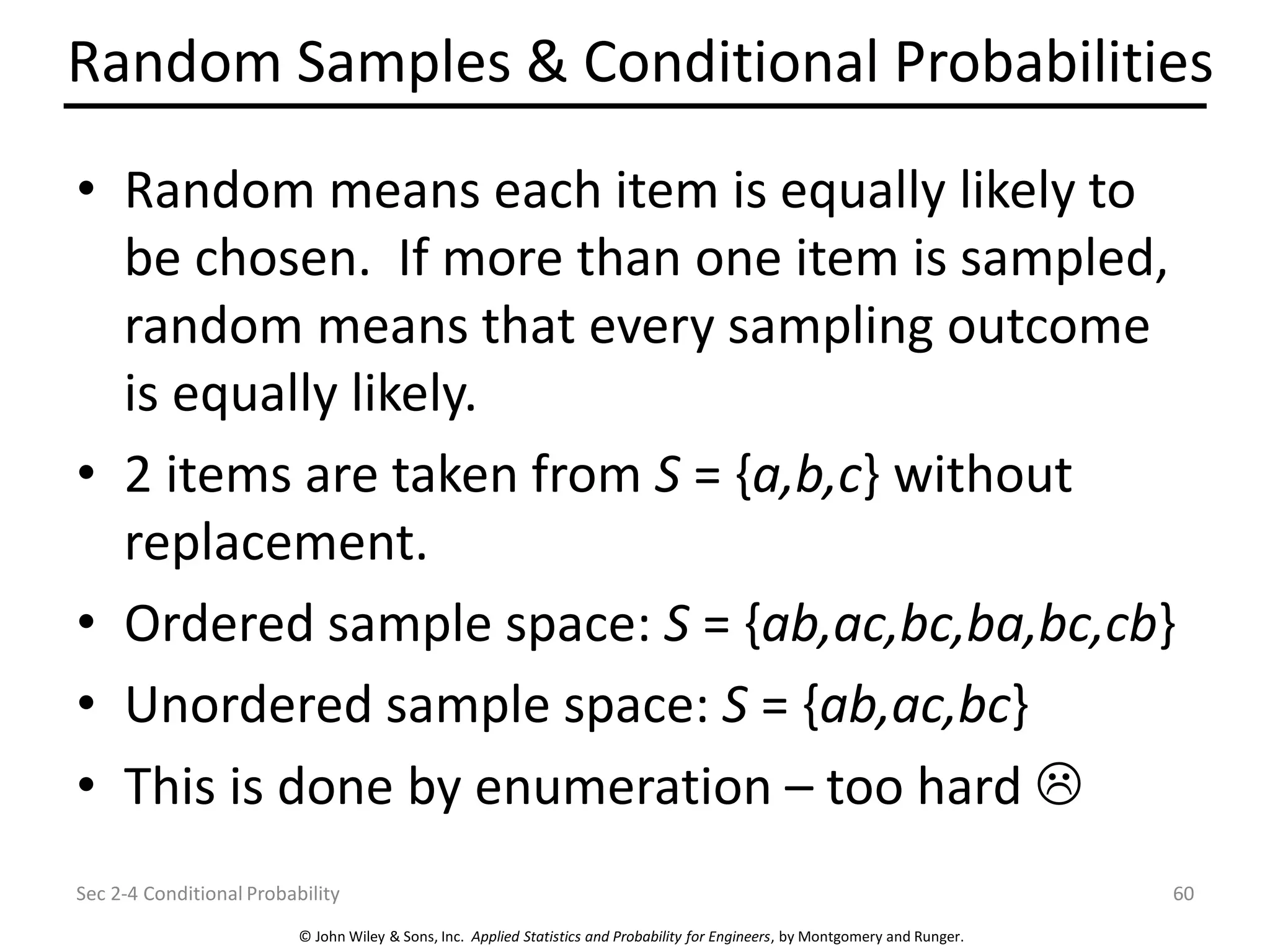
Random Samples & Conditional Probabilities
• Random means each item is equally likely to
be chosen. If more than one item is sampled,
random means that every sampling outcome
is equally likely.
• 2 items are taken from S = {a,b,c} without
replacement.
• Ordered sample space: S = {ab,ac,bc,ba,bc,cb}
• Unordered sample space: S = {ab,ac,bc}
• This is done by enumeration – too hard 
Sec 2-4 Conditional Probability 60
© John Wiley & Sons, Inc. Applied Statistics and Probability for Engineers, by Montgomery and Runger.
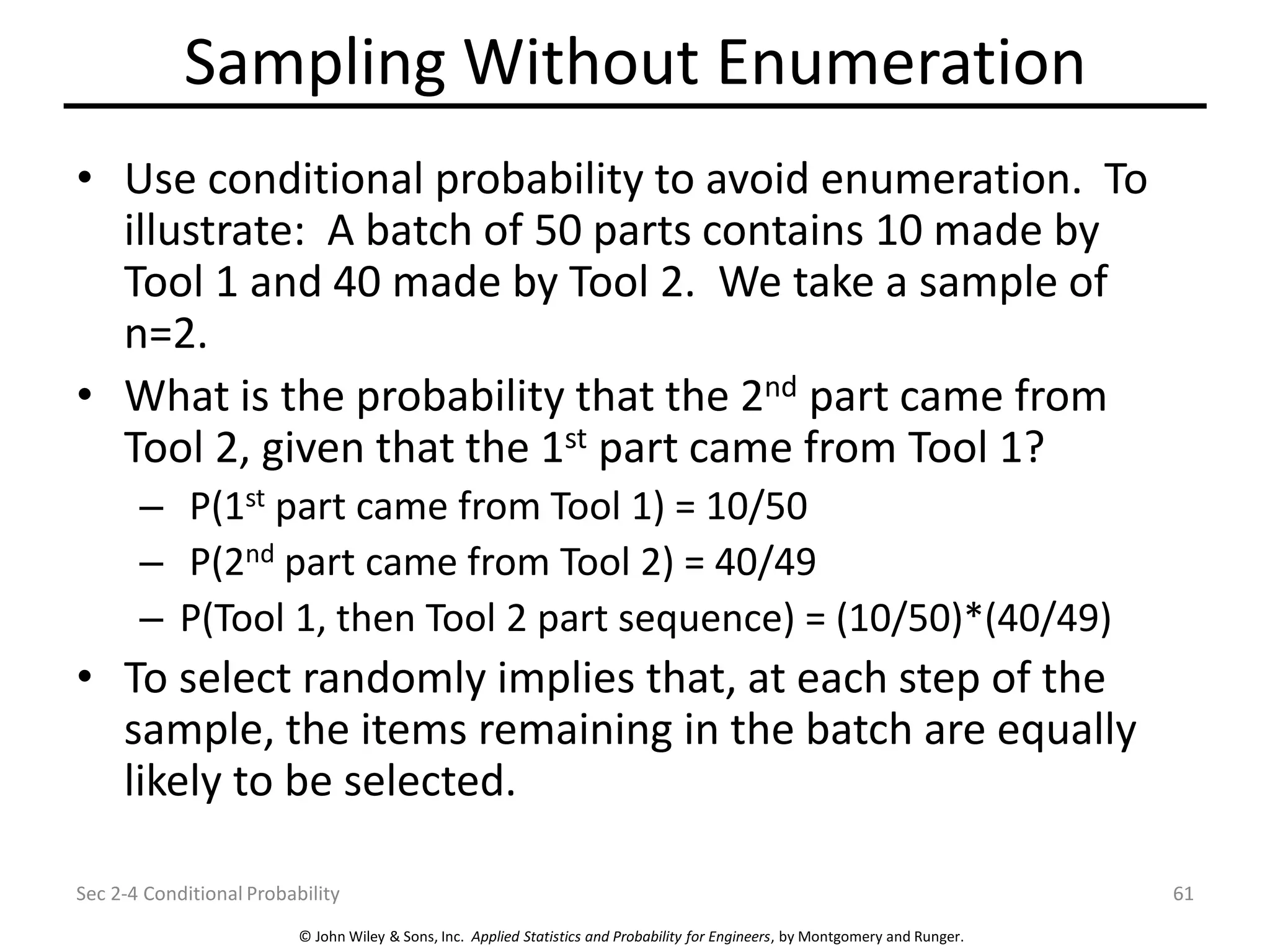
Sampling Without Enumeration
• Use conditional probability to avoid enumeration. To
illustrate: A batch of 50 parts contains 10 made by
Tool 1 and 40 made by Tool 2. We take a sample of
n=2.
• What is the probability that the 2nd part came from
Tool 2, given that the 1st part came from Tool 1?
– P(1st part came from Tool 1) = 10/50
– P(2nd part came from Tool 2) = 40/49
– P(Tool 1, then Tool 2 part sequence) = (10/50)*(40/49)
• To select randomly implies that, at each step of the
sample, the items remaining in the batch are equally
likely to be selected.
Sec 2-4 Conditional Probability 61
© John Wiley & Sons, Inc. Applied Statistics and Probability for Engineers, by Montgomery and Runger.
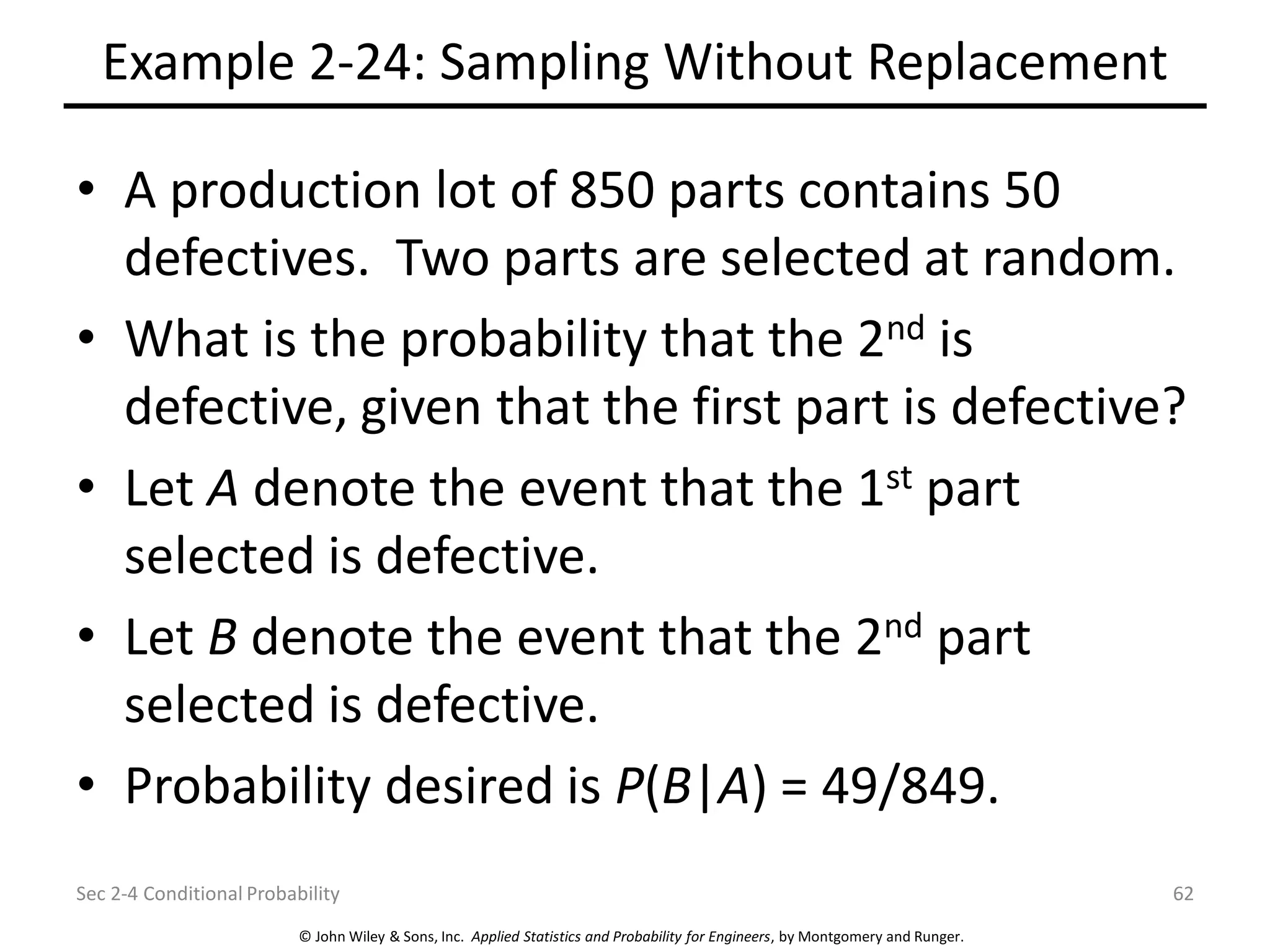
Example 2-24: Sampling Without Replacement
• A production lot of 850 parts contains 50
defectives. Two parts are selected at random.
• What is the probability that the 2nd is
defective, given that the first part is defective?
• Let A denote the event that the 1st part
selected is defective.
• Let B denote the event that the 2nd part
selected is defective.
• Probability desired is P(B|A) = 49/849.
Sec 2-4 Conditional Probability 62
© John Wiley & Sons, Inc. Applied Statistics and Probability for Engineers, by Montgomery and Runger.
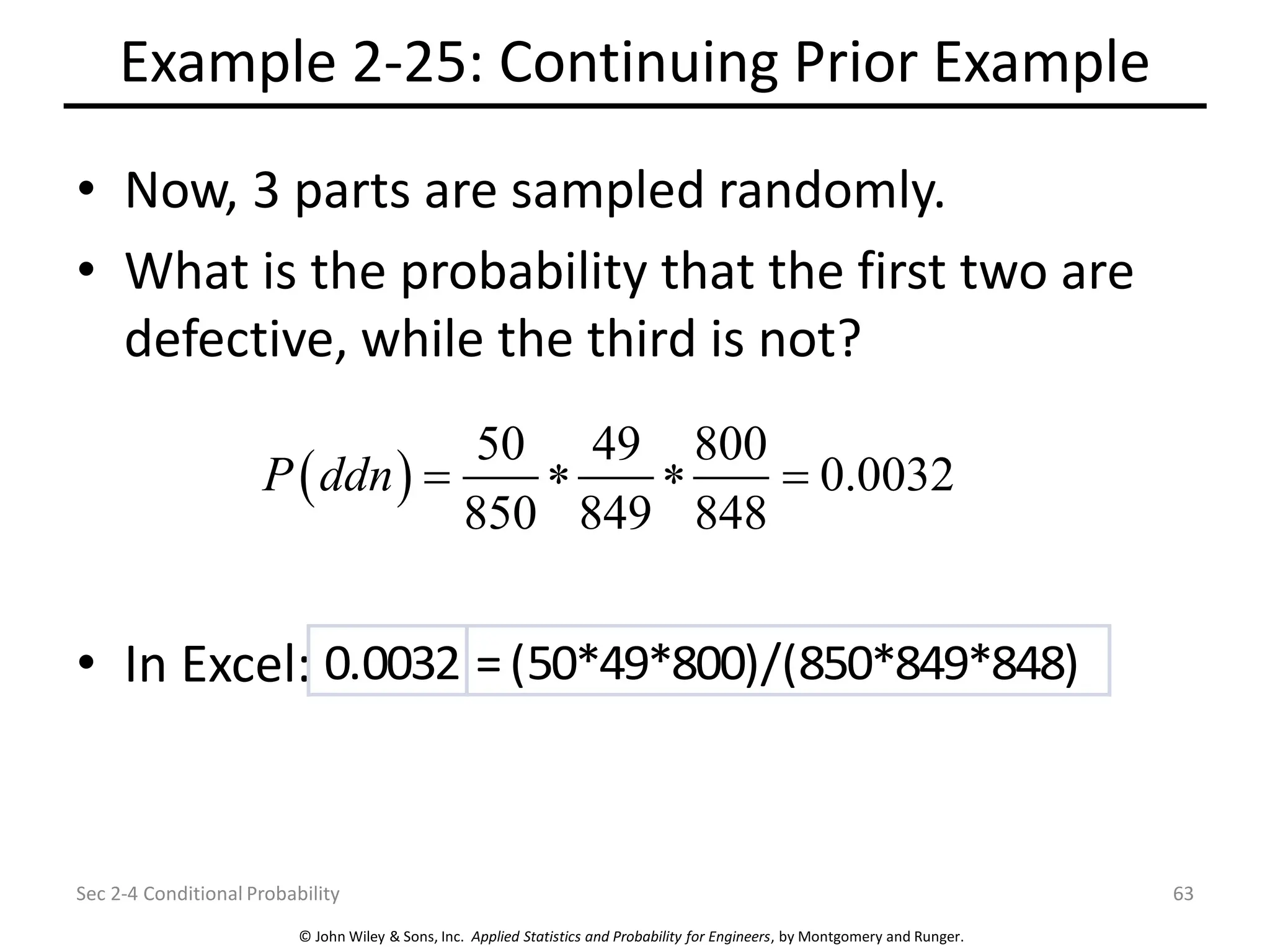
Example 2-25: Continuing Prior Example
• Now, 3 parts are sampled randomly.
• What is the probability that the first two are
defective, while the third is not?
• In Excel:
Sec 2-4 Conditional Probability 63
( )
50 49 800
0.0032
850 849 848
P ddn =   =
0.0032 =(50*49*800)/(850*849*848)
© John Wiley & Sons, Inc. Applied Statistics and Probability for Engineers, by Montgomery and Runger.
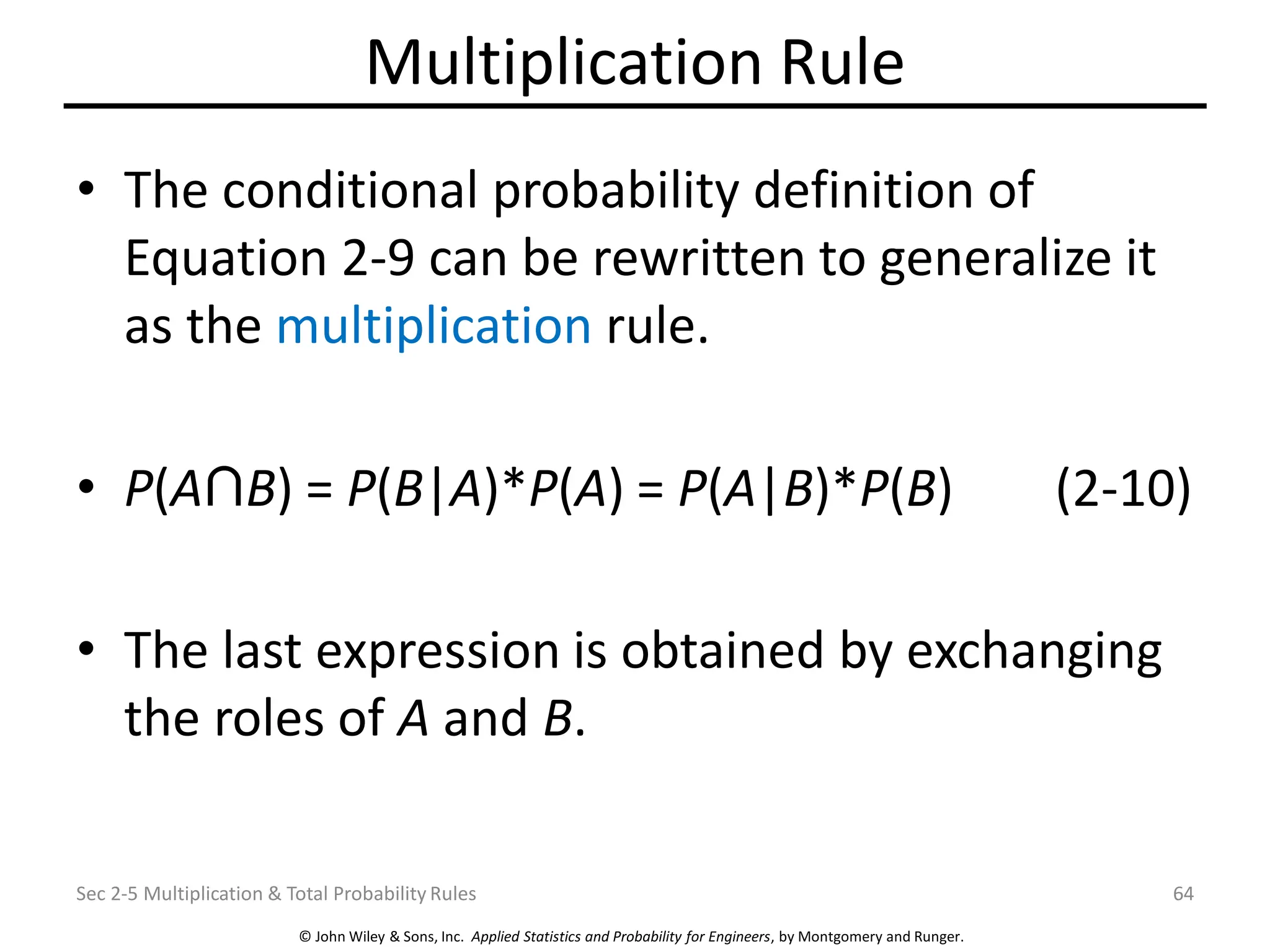
Multiplication Rule
• The conditional probability definition of
Equation 2-9 can be rewritten to generalize it
as the multiplication rule.
• P(A B) = P(B|A)*P(A) = P(A|B)*P(B) (2-10)
• The last expression is obtained by exchanging
the roles of A and B.
Sec 2-5 Multiplication & Total Probability Rules 64
© John Wiley & Sons, Inc. Applied Statistics and Probability for Engineers, by Montgomery and Runger.
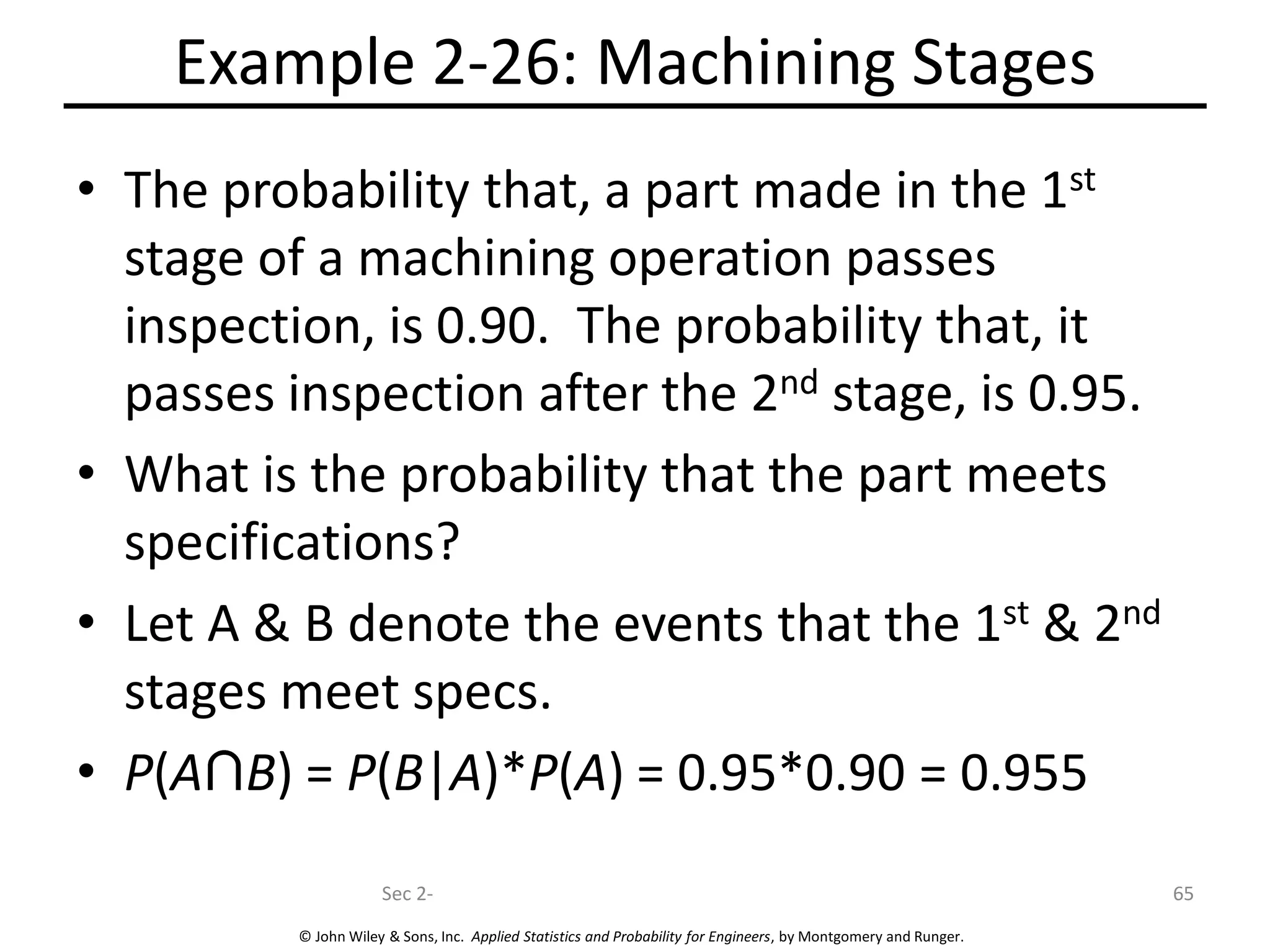
Example 2-26: Machining Stages
• The probability that, a part made in the 1st
stage of a machining operation passes
inspection, is 0.90. The probability that, it
passes inspection after the 2nd stage, is 0.95.
• What is the probability that the part meets
specifications?
• Let A & B denote the events that the 1st & 2nd
stages meet specs.
• P(A B) = P(B|A)*P(A) = 0.95*0.90 = 0.955
Sec 2- 65
© John Wiley & Sons, Inc. Applied Statistics and Probability for Engineers, by Montgomery and Runger.
Two Mutually Exclusive Subsets
Sec 2-5 Multiplication & Total Probability Rules 66
Figure 2-15 Partitioning an event into two mutually exclusive subsets.
• A & A’ are mutually exclusive.
• A B and A’ B are mutually exclusive
• B = (A B) (A B)
© John Wiley & Sons, Inc. Applied Statistics and Probability for Engineers, by Montgomery and Runger.
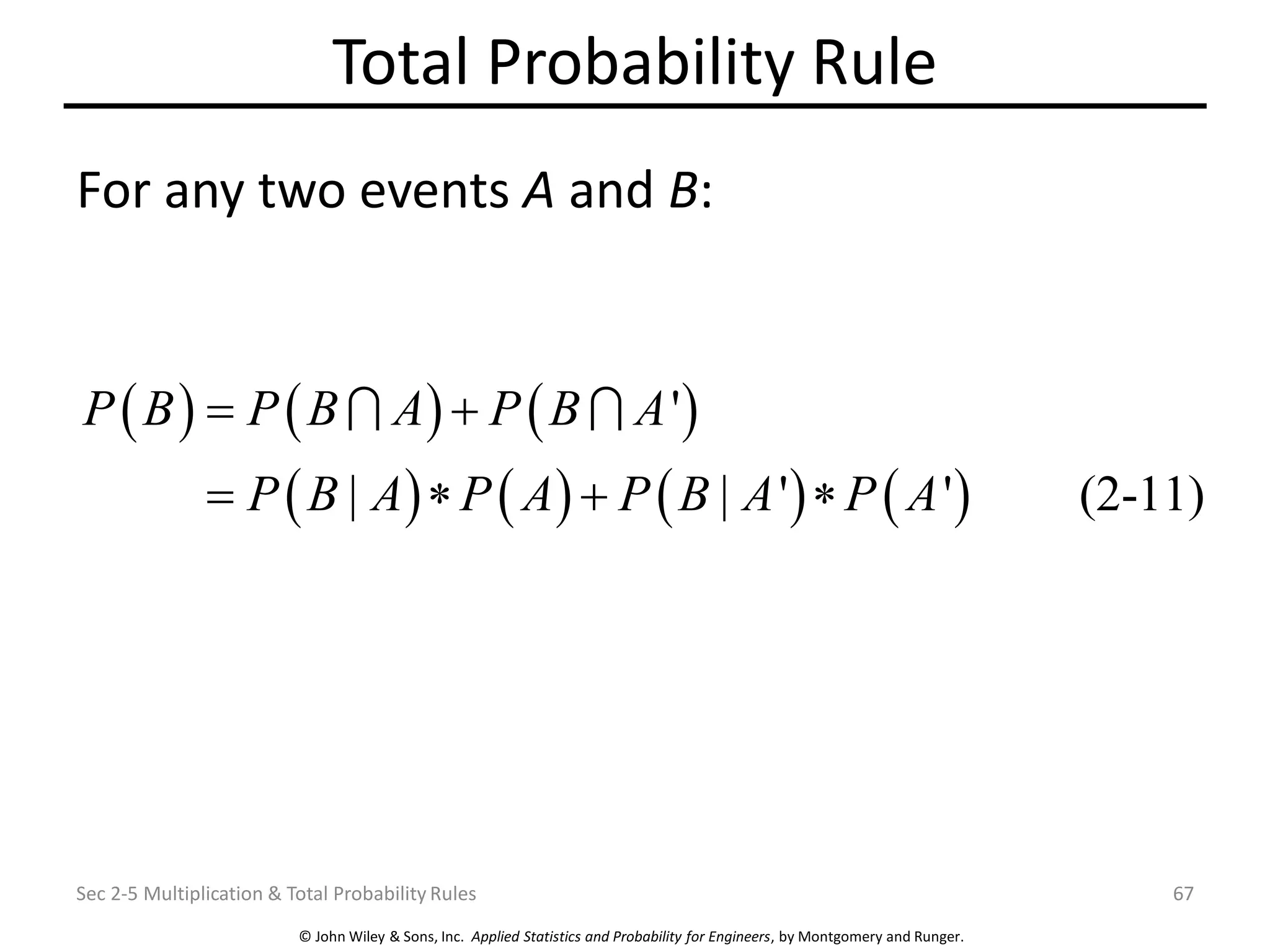
Total Probability Rule
For any two events A and B:
Sec 2-5 Multiplication & Total Probability Rules 67
( ) ( ) ( )
( ) ( ) ( ) ( )
'
| | ' ' (2-11)
P B P B A P B A
P B A P A P B A P A
= +
=  + 
© John Wiley & Sons, Inc. Applied Statistics and Probability for Engineers, by Montgomery and Runger.
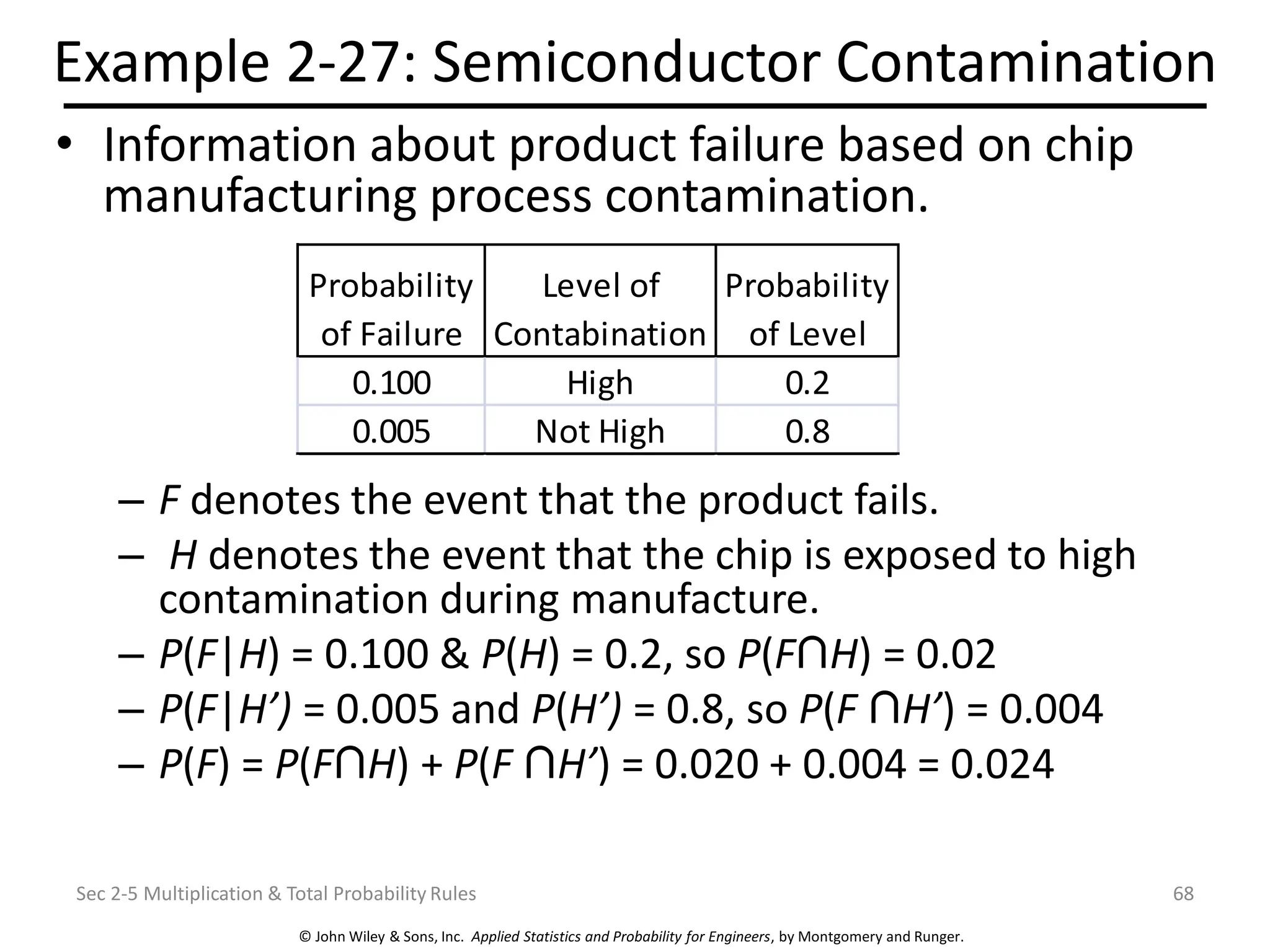
Example 2-27: Semiconductor Contamination
• Information about product failure based on chip
manufacturing process contamination.
– F denotes the event that the product fails.
– H denotes the event that the chip is exposed to high
contamination during manufacture.
– P(F|H) = 0.100 & P(H) = 0.2, so P(F H) = 0.02
– P(F|H’) = 0.005 and P(H’) = 0.8, so P(F H’) = 0.004
– P(F) = P(F H) + P(F H’) = 0.020 + 0.004 = 0.024
Sec 2-5 Multiplication & Total Probability Rules 68
Probability
of Failure
Level of
Contabination
Probability
of Level
0.100 High 0.2
0.005 Not High 0.8
© John Wiley & Sons, Inc. Applied Statistics and Probability for Engineers, by Montgomery and Runger.
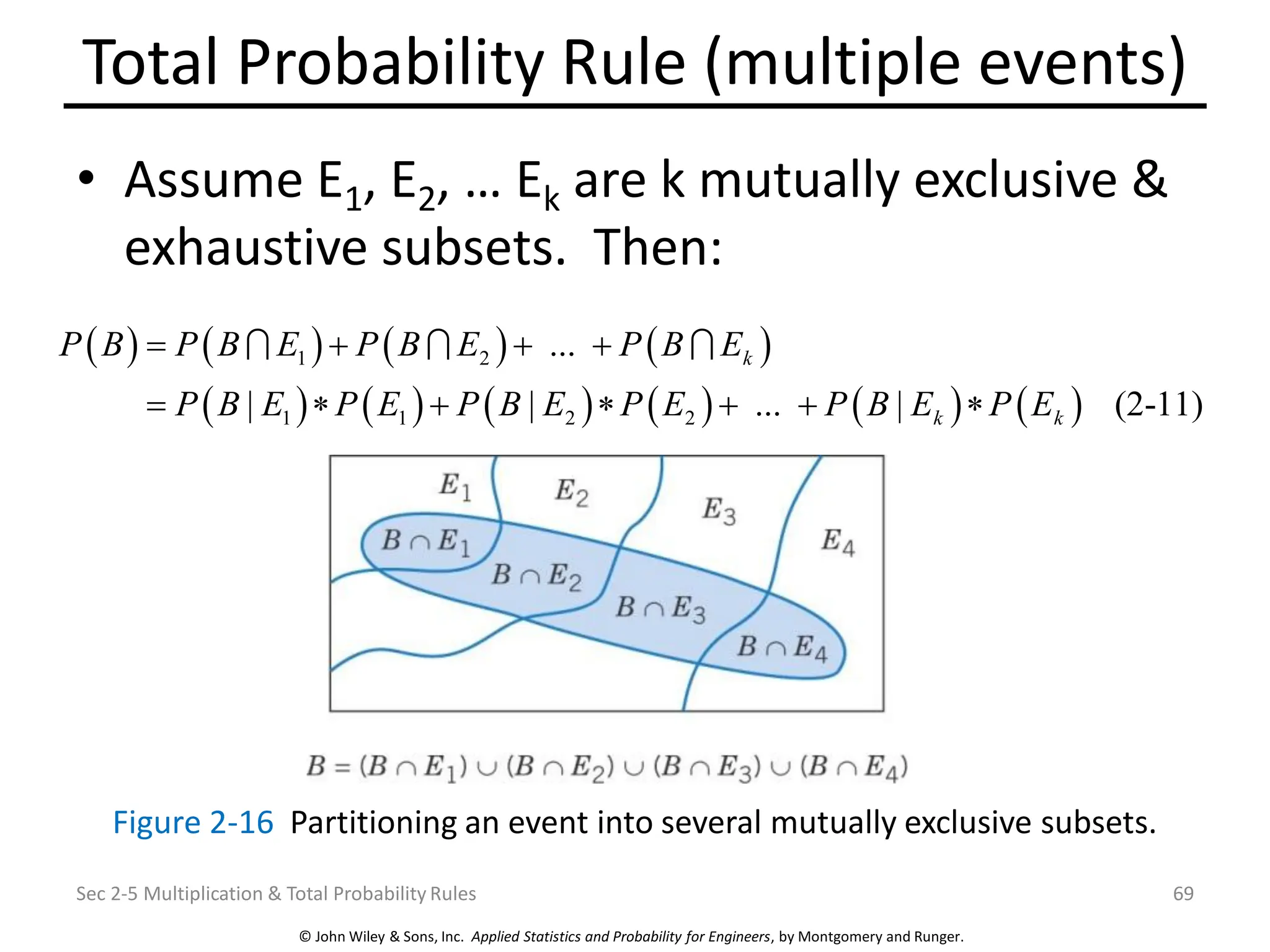
Total Probability Rule (multiple events)
• Assume E1, E2, … Ek are k mutually exclusive &
exhaustive subsets. Then:
Sec 2-5 Multiplication & Total Probability Rules 69
( ) ( ) ( ) ( )
( ) ( ) ( ) ( ) ( ) ( )
1 2
1 1 2 2
...
| | ... | (2-11)
k
k k
P B P B E P B E P B E
P B E P E P B E P E P B E P E
= + + +
=  +  + + 
Figure 2-16 Partitioning an event into several mutually exclusive subsets.
© John Wiley & Sons, Inc. Applied Statistics and Probability for Engineers, by Montgomery and Runger.
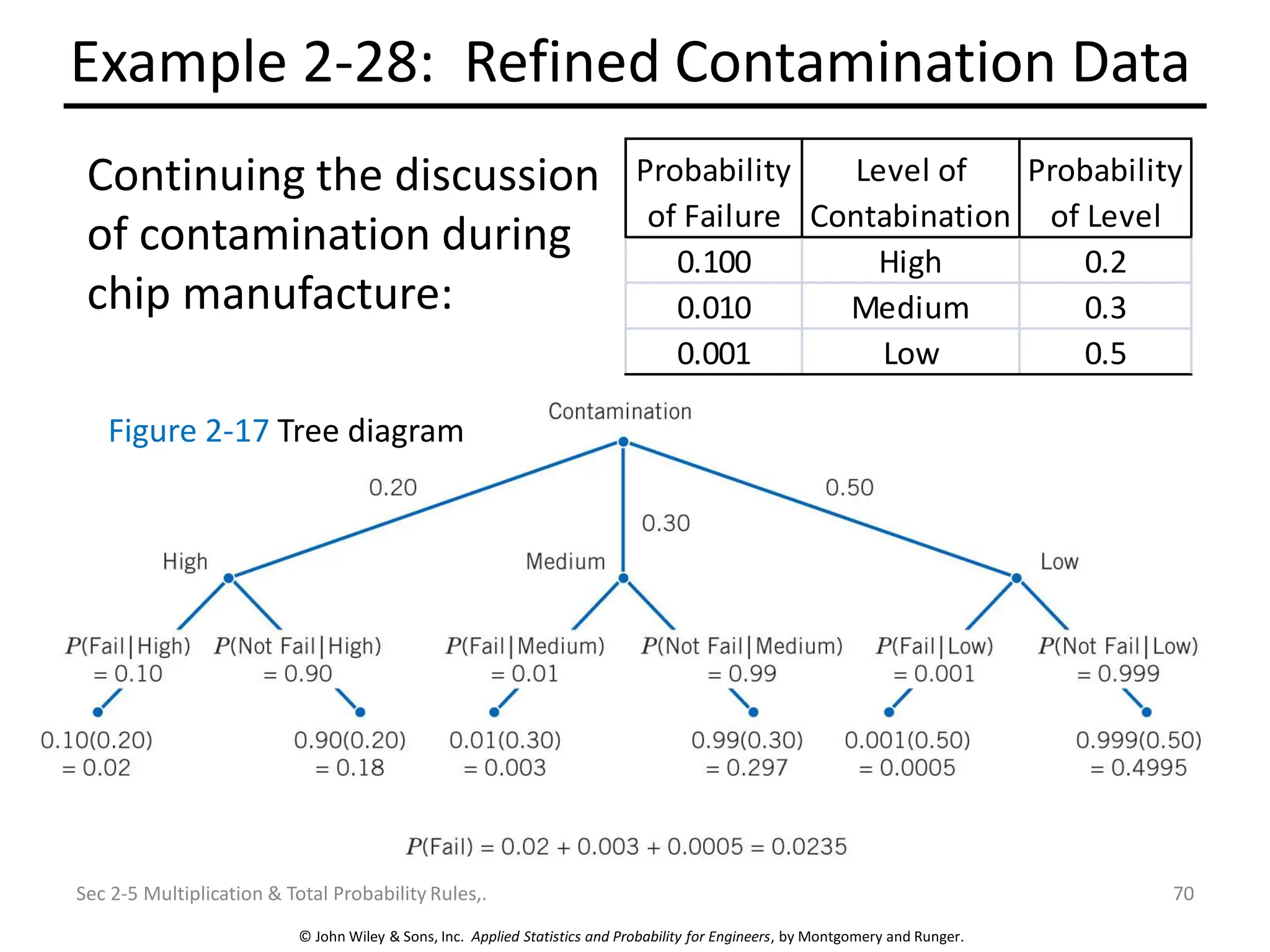
Example 2-28: Refined Contamination Data
Sec 2-5 Multiplication & Total Probability Rules,. 70
Probability
of Failure
Level of
Contabination
Probability
of Level
0.100 High 0.2
0.010 Medium 0.3
0.001 Low 0.5
Continuing the discussion
of contamination during
chip manufacture:
Figure 2-17 Tree diagram
© John Wiley & Sons, Inc. Applied Statistics and Probability for Engineers, by Montgomery and Runger.
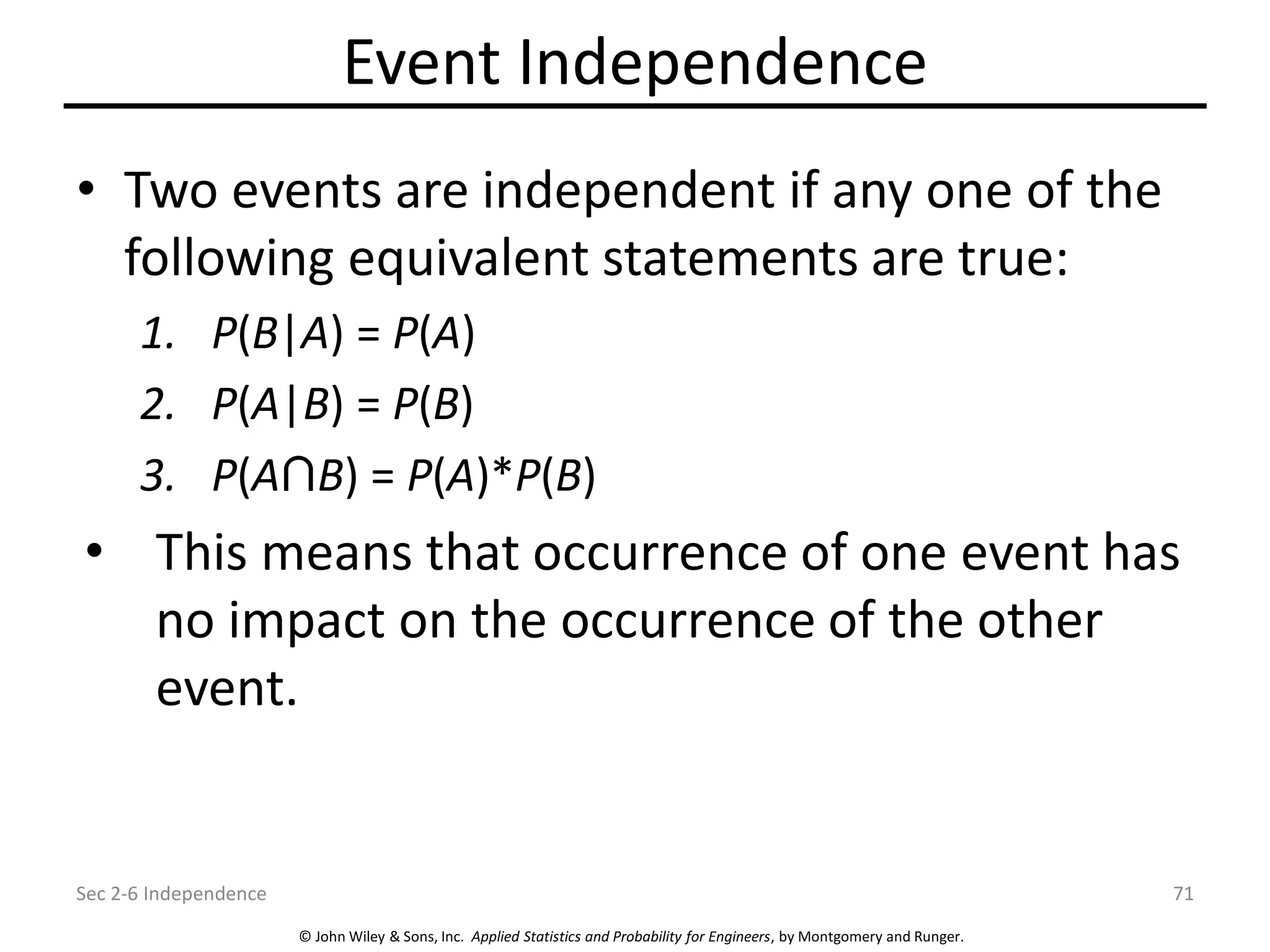
Event Independence
• Two events are independent if any one of the
following equivalent statements are true:
1. P(B|A) = P(A)
2. P(A|B) = P(B)
3. P(A B) = P(A)*P(B)
• This means that occurrence of one event has
no impact on the occurrence of the other
event.
Sec 2-6 Independence 71
© John Wiley & Sons, Inc. Applied Statistics and Probability for Engineers, by Montgomery and Runger.
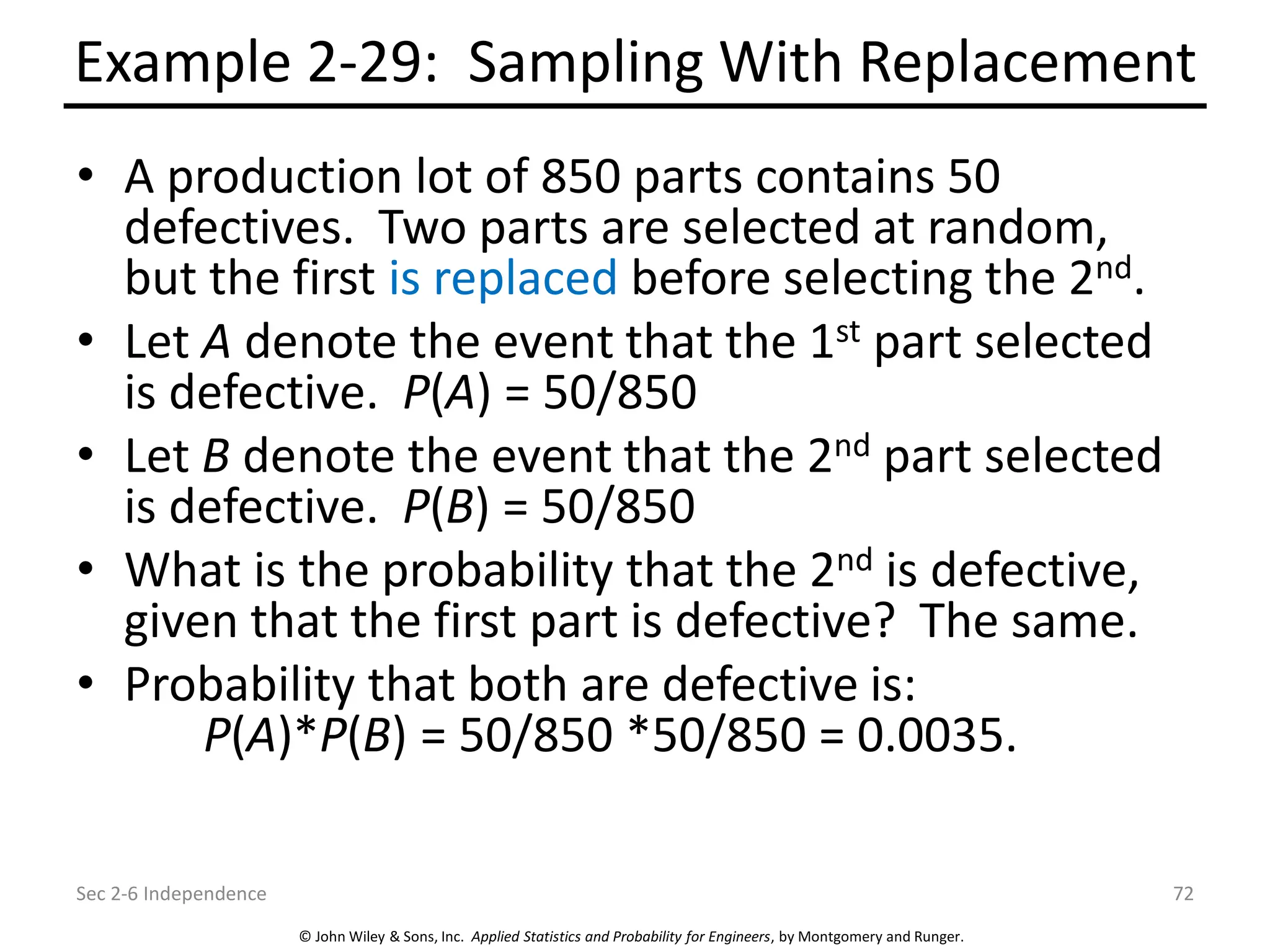
Example 2-29: Sampling With Replacement
• A production lot of 850 parts contains 50
defectives. Two parts are selected at random,
but the first is replaced before selecting the 2nd.
• Let A denote the event that the 1st part selected
is defective. P(A) = 50/850
• Let B denote the event that the 2nd part selected
is defective. P(B) = 50/850
• What is the probability that the 2nd is defective,
given that the first part is defective? The same.
• Probability that both are defective is:
P(A)*P(B) = 50/850 *50/850 = 0.0035.
Sec 2-6 Independence 72
© John Wiley & Sons, Inc. Applied Statistics and Probability for Engineers, by Montgomery and Runger.
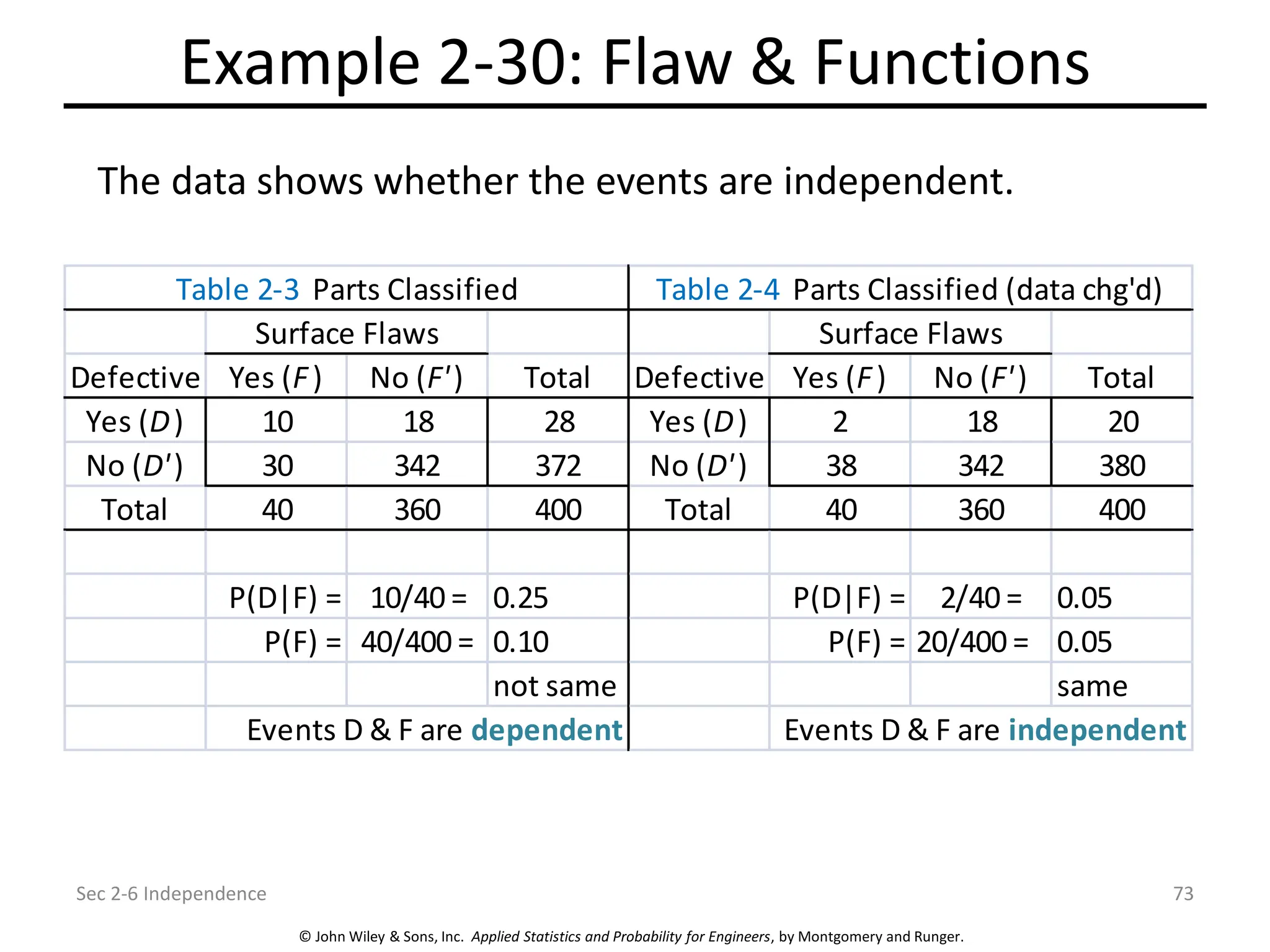
Example 2-30: Flaw & Functions
Sec 2-6 Independence 73
Defective Yes (F) No (F') Total Defective Yes (F) No (F') Total
Yes (D) 10 18 28 Yes (D) 2 18 20
No (D') 30 342 372 No (D') 38 342 380
Total 40 360 400 Total 40 360 400
P(D|F) = 10/40 = 0.25 P(D|F) = 2/40 = 0.05
P(F) = 40/400 = 0.10 P(F) = 20/400 = 0.05
not same same
Events D & F are dependent Events D & F are independent
Surface Flaws
Table 2-3 Parts Classified Table 2-4 Parts Classified (data chg'd)
Surface Flaws
The data shows whether the events are independent.
© John Wiley & Sons, Inc. Applied Statistics and Probability for Engineers, by Montgomery and Runger.
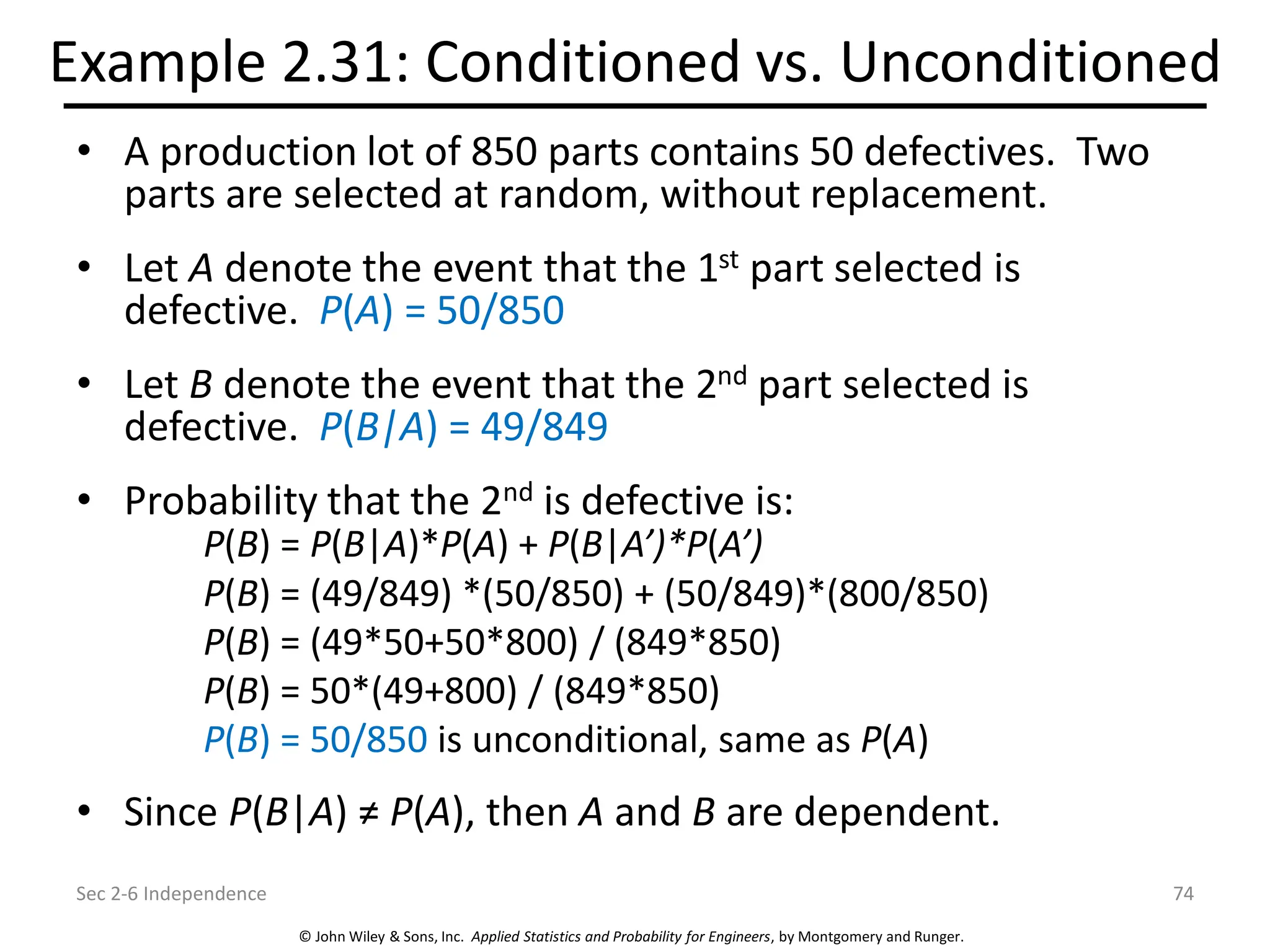
Example 2.31: Conditioned vs. Unconditioned
• A production lot of 850 parts contains 50 defectives. Two
parts are selected at random, without replacement.
• Let A denote the event that the 1st part selected is
defective. P(A) = 50/850
• Let B denote the event that the 2nd part selected is
defective. P(B|A) = 49/849
• Probability that the 2nd is defective is:
P(B) = P(B|A)*P(A) + P(B|A’)*P(A’)
P(B) = (49/849) *(50/850) + (50/849)*(800/850)
P(B) = (49*50+50*800) / (849*850)
P(B) = 50*(49+800) / (849*850)
P(B) = 50/850 is unconditional, same as P(A)
• Since P(B|A) ≠ P(A), then A and B are dependent.
Sec 2-6 Independence 74
© John Wiley & Sons, Inc. Applied Statistics and Probability for Engineers, by Montgomery and Runger.
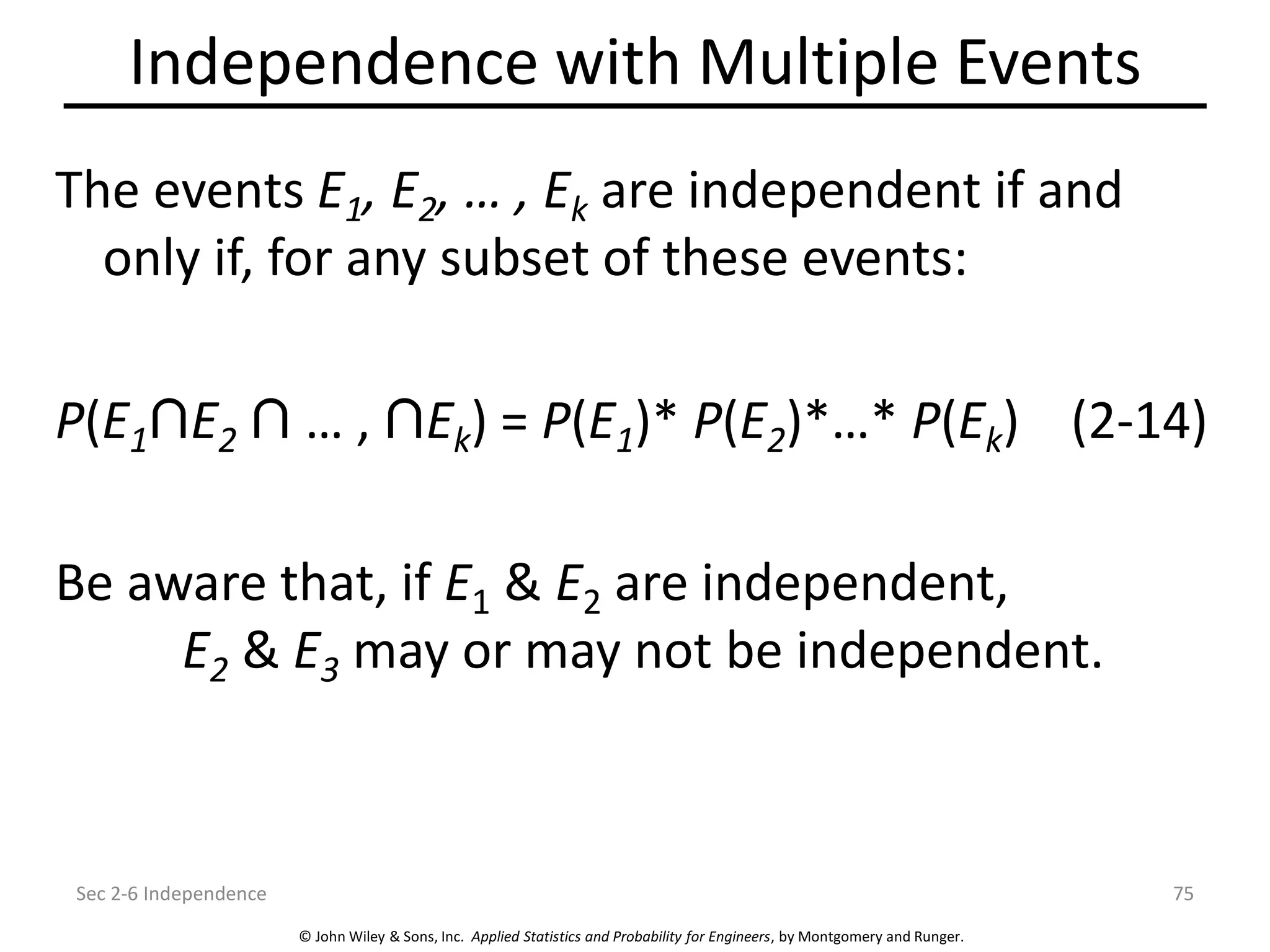
Independence with Multiple Events
The events E1, E2, … , Ek are independent if and
only if, for any subset of these events:
P(E1 E2 … , Ek) = P(E1)* P(E2)*…* P(Ek) (2-14)
Be aware that, if E1 & E2 are independent,
E2 & E3 may or may not be independent.
Sec 2-6 Independence 75
© John Wiley & Sons, Inc. Applied Statistics and Probability for Engineers, by Montgomery and Runger.
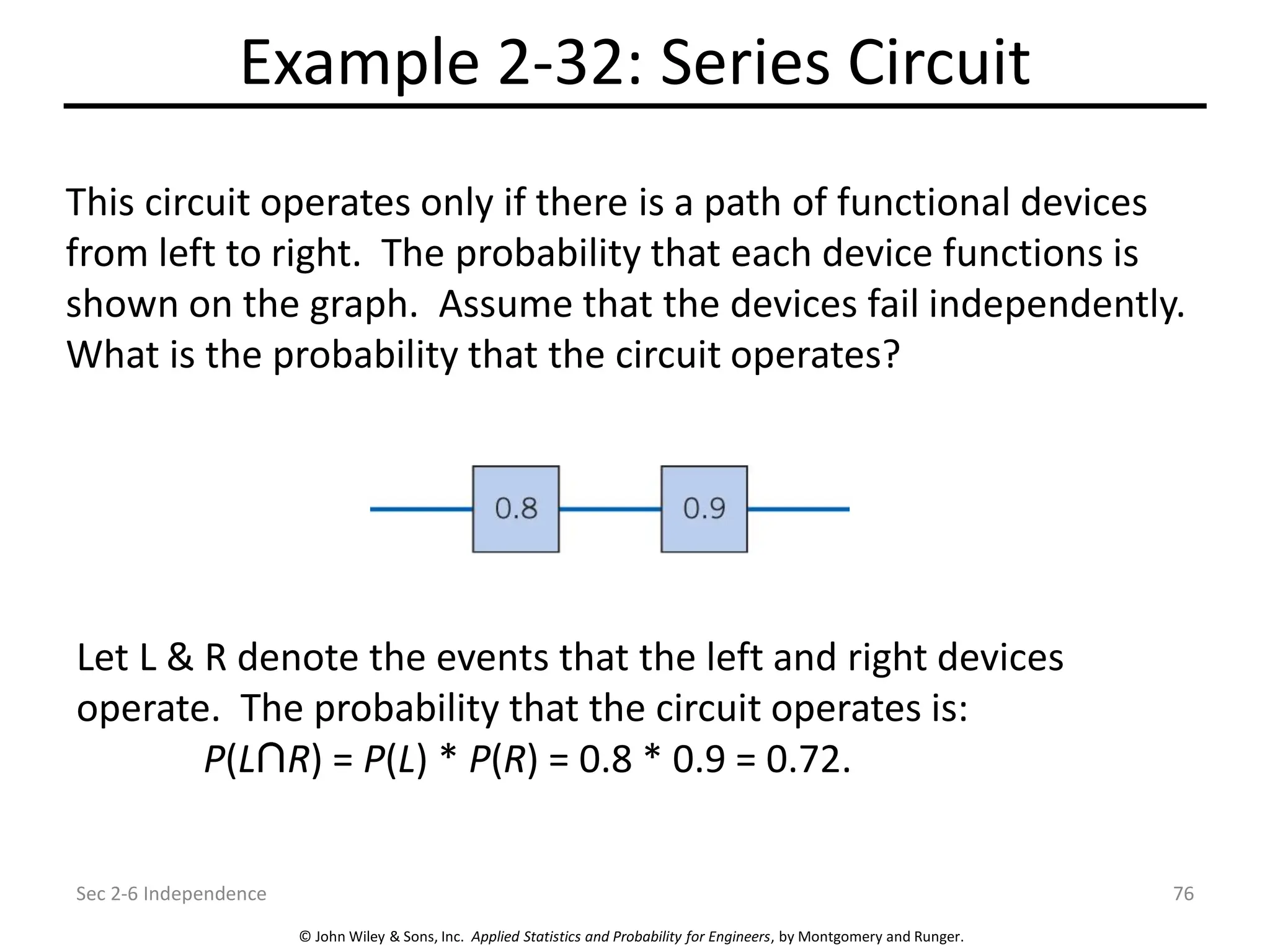
Example 2-32: Series Circuit
Sec 2-6 Independence 76
This circuit operates only if there is a path of functional devices
from left to right. The probability that each device functions is
shown on the graph. Assume that the devices fail independently.
What is the probability that the circuit operates?
Let L & R denote the events that the left and right devices
operate. The probability that the circuit operates is:
P(L R) = P(L) * P(R) = 0.8 * 0.9 = 0.72.
© John Wiley & Sons, Inc. Applied Statistics and Probability for Engineers, by Montgomery and Runger.
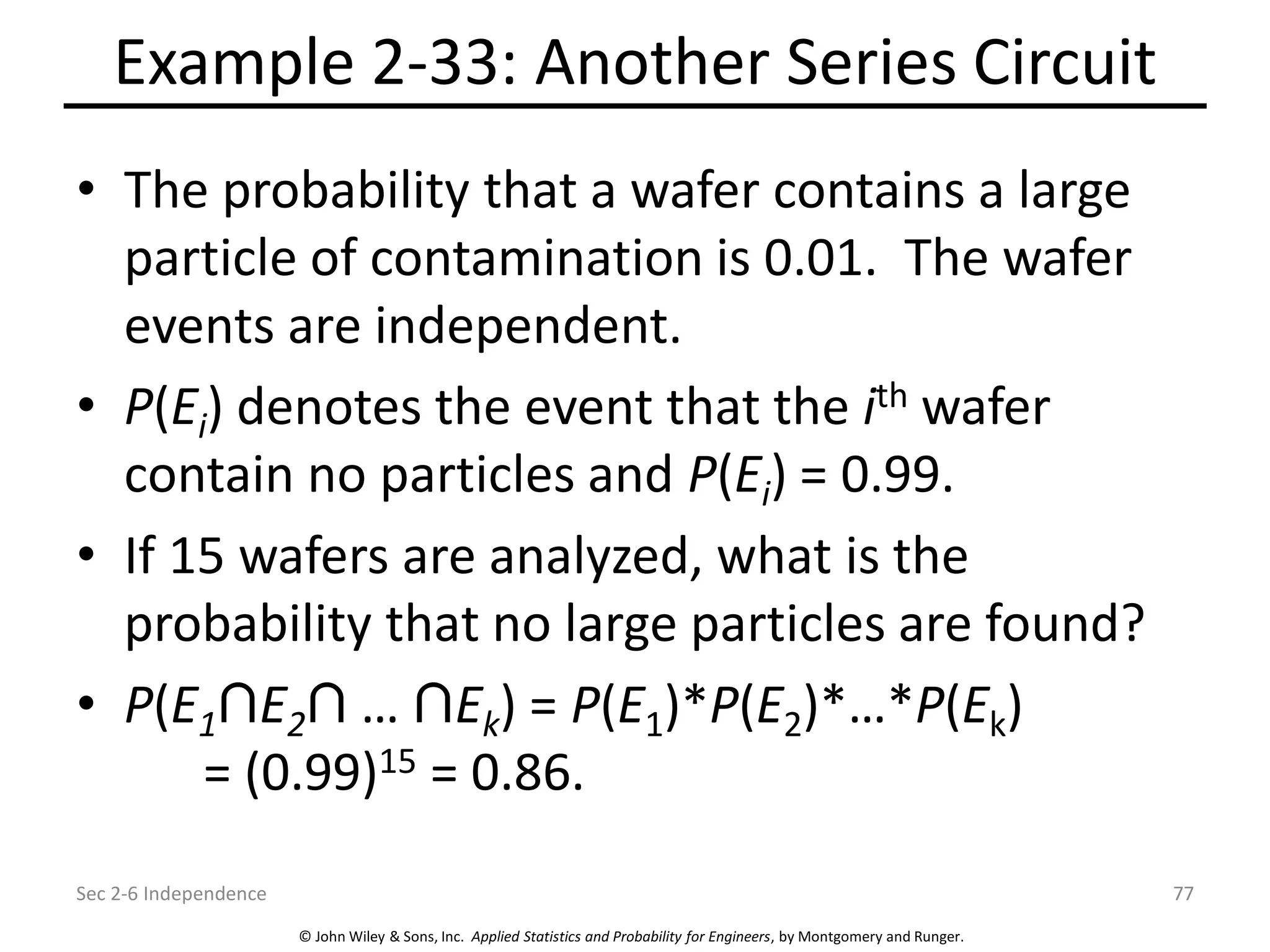
Example 2-33: Another Series Circuit
• The probability that a wafer contains a large
particle of contamination is 0.01. The wafer
events are independent.
• P(Ei) denotes the event that the ith wafer
contain no particles and P(Ei) = 0.99.
• If 15 wafers are analyzed, what is the
probability that no large particles are found?
• P(E1 E2 … Ek) = P(E1)*P(E2)*…*P(Ek)
= (0.99)15 = 0.86.
Sec 2-6 Independence 77
© John Wiley & Sons, Inc. Applied Statistics and Probability for Engineers, by Montgomery and Runger.
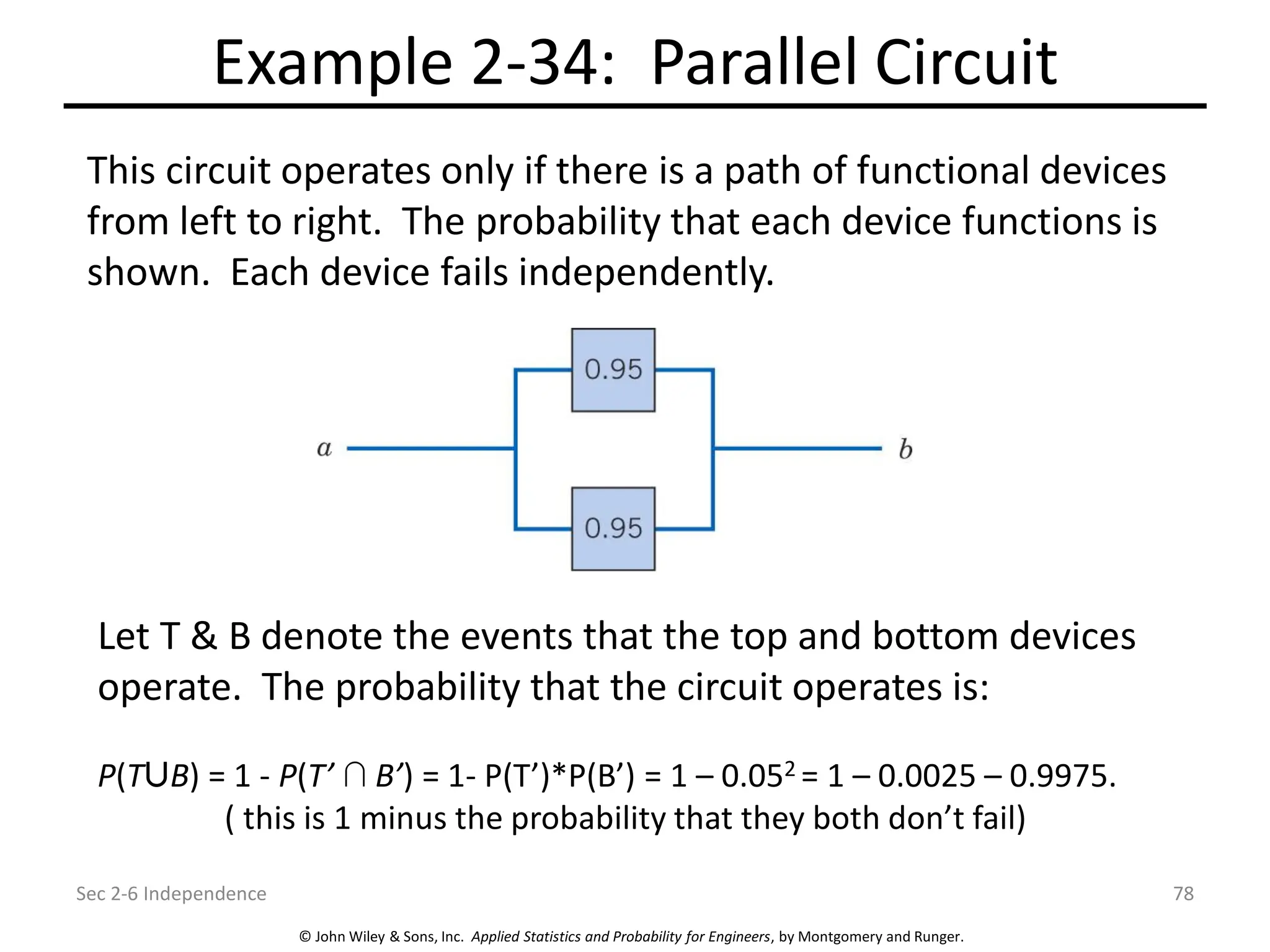
Example 2-34: Parallel Circuit
Sec 2-6 Independence 78
This circuit operates only if there is a path of functional devices
from left to right. The probability that each device functions is
shown. Each device fails independently.
Let T & B denote the events that the top and bottom devices
operate. The probability that the circuit operates is:
P(T B) = 1 - P(T’ B’) = 1- P(T’)*P(B’) = 1 – 0.052 = 1 – 0.0025 – 0.9975.
( this is 1 minus the probability that they both don’t fail)
© John Wiley & Sons, Inc. Applied Statistics and Probability for Engineers, by Montgomery and Runger.
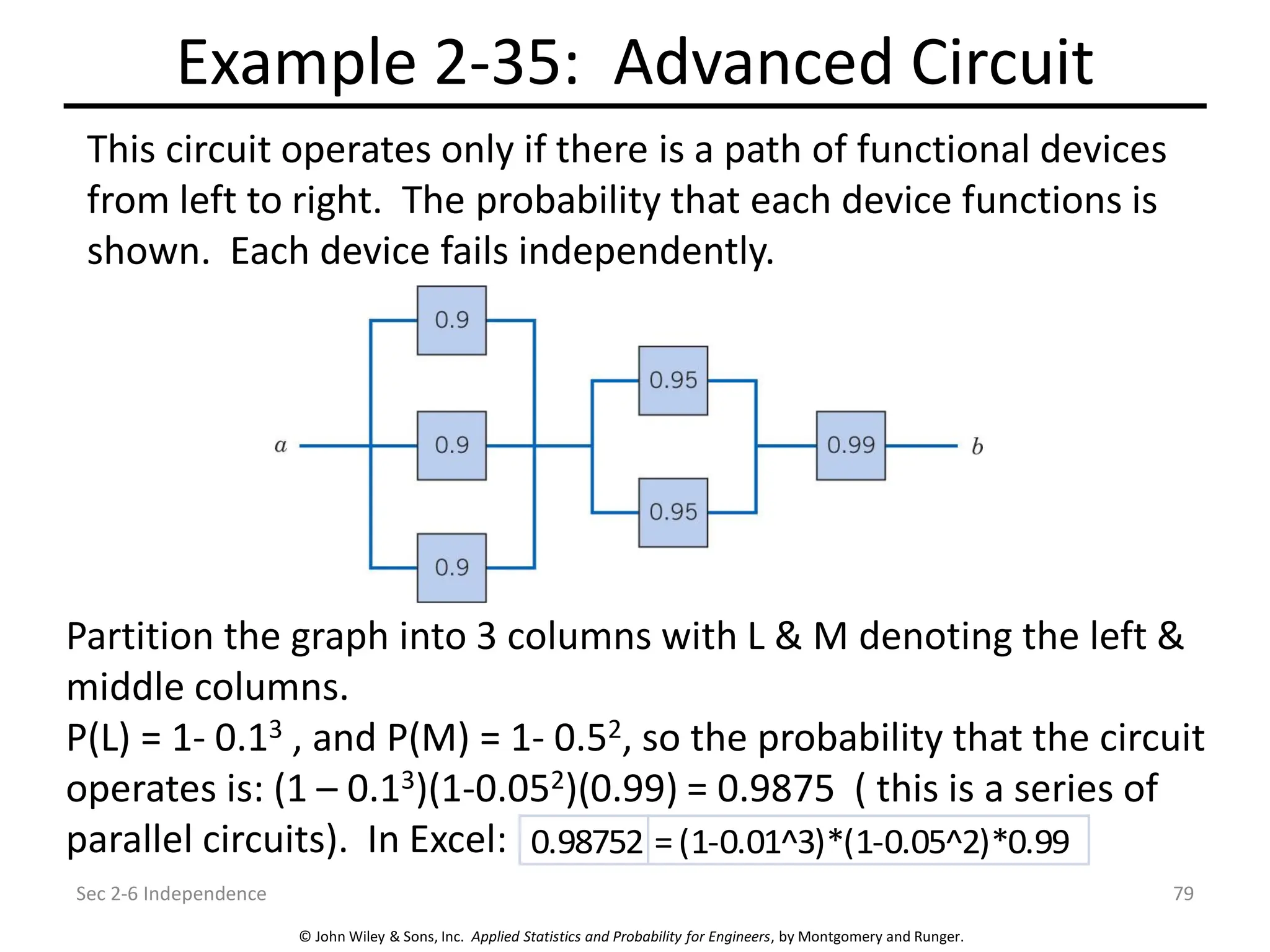
Example 2-35: Advanced Circuit
Sec 2-6 Independence 79
This circuit operates only if there is a path of functional devices
from left to right. The probability that each device functions is
shown. Each device fails independently.
Partition the graph into 3 columns with L & M denoting the left &
middle columns.
P(L) = 1- 0.13 , and P(M) = 1- 0.52, so the probability that the circuit
operates is: (1 – 0.13)(1-0.052)(0.99) = 0.9875 ( this is a series of
parallel circuits). In Excel: 0.98752 =(1-0.01^3)*(1-0.05^2)*0.99
© John Wiley & Sons, Inc. Applied Statistics and Probability for Engineers, by Montgomery and Runger.
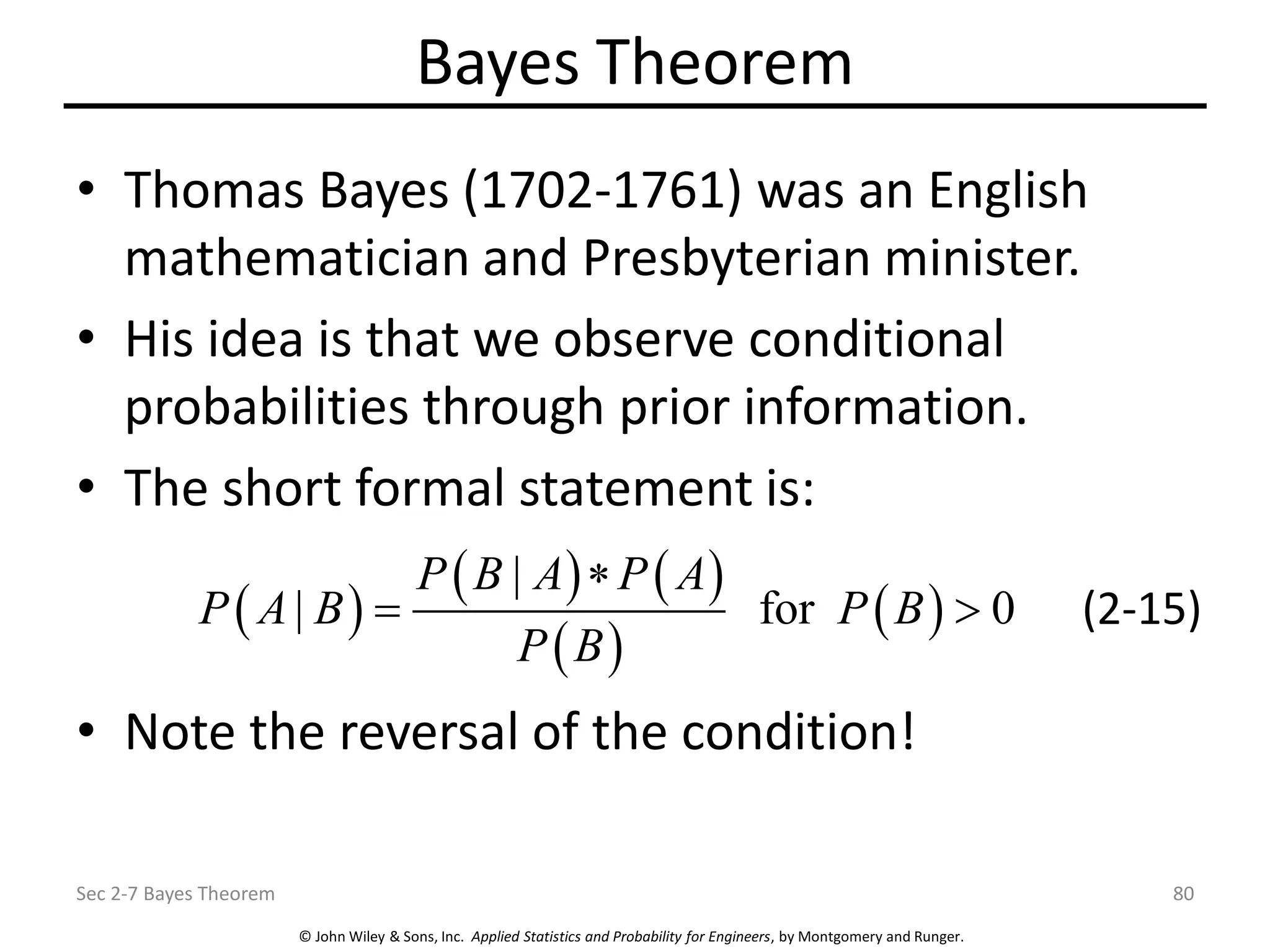
Bayes Theorem
• Thomas Bayes (1702-1761) was an English
mathematician and Presbyterian minister.
• His idea is that we observe conditional
probabilities through prior information.
• The short formal statement is:
• Note the reversal of the condition!
Sec 2-7 Bayes Theorem 80
( )
( ) ( )
( )
( )
|
| for 0
P B A P A
P A B P B
P B

=  (2-15)
© John Wiley & Sons, Inc. Applied Statistics and Probability for Engineers, by Montgomery and Runger.
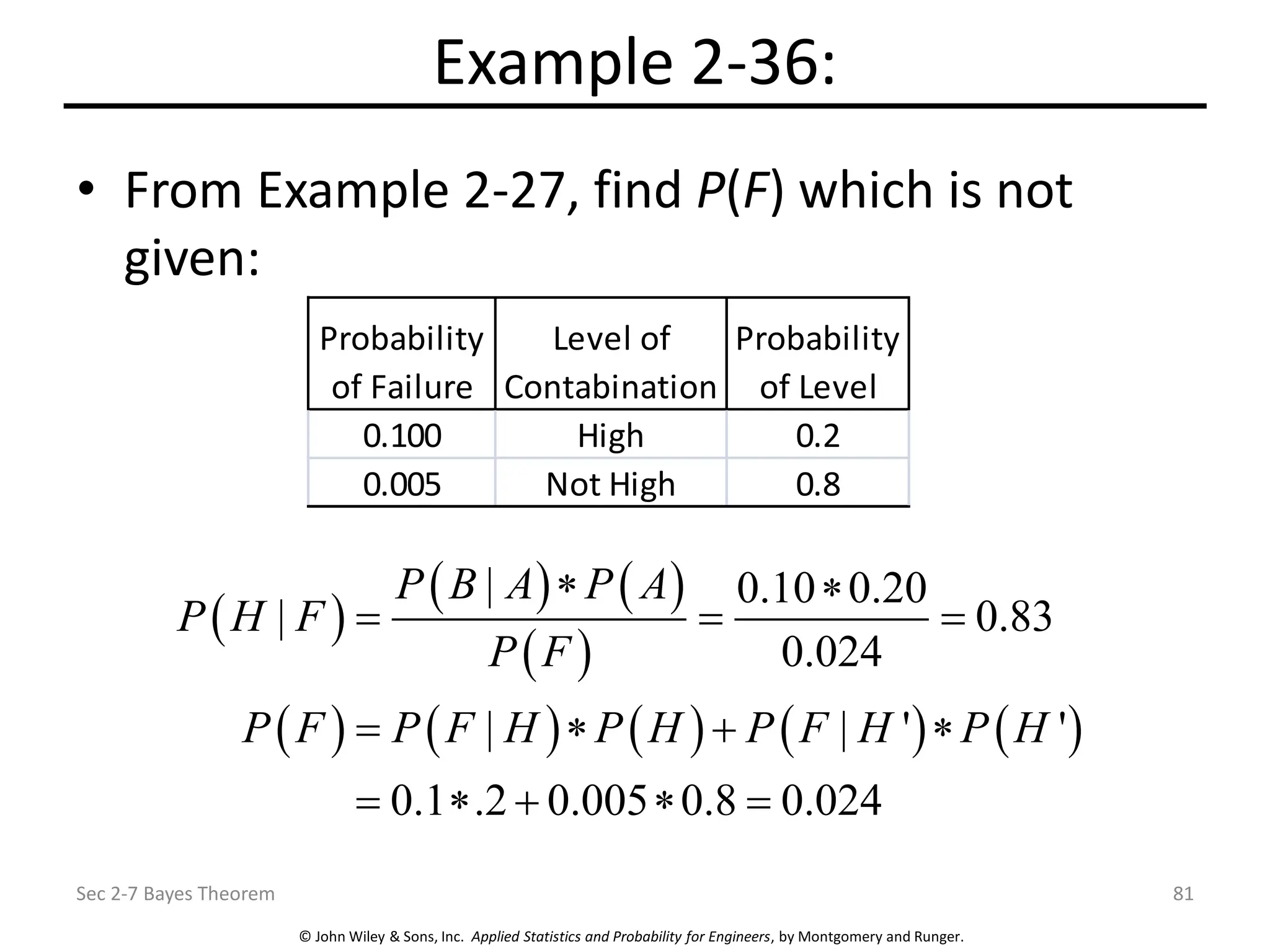
Example 2-36:
• From Example 2-27, find P(F) which is not
given:
Sec 2-7 Bayes Theorem 81
Probability
of Failure
Level of
Contabination
Probability
of Level
0.100 High 0.2
0.005 Not High 0.8
( )
( ) ( )
( )
( ) ( ) ( ) ( ) ( )
| 0.10 0.20
| 0.83
0.024
| | ' '
0.1 .2 0.005 0.8 0.024
P B A P A
P H F
P F
P F P F H P H P F H P H
 
= = =
=  + 
=  +  =
© John Wiley & Sons, Inc. Applied Statistics and Probability for Engineers, by Montgomery and Runger.
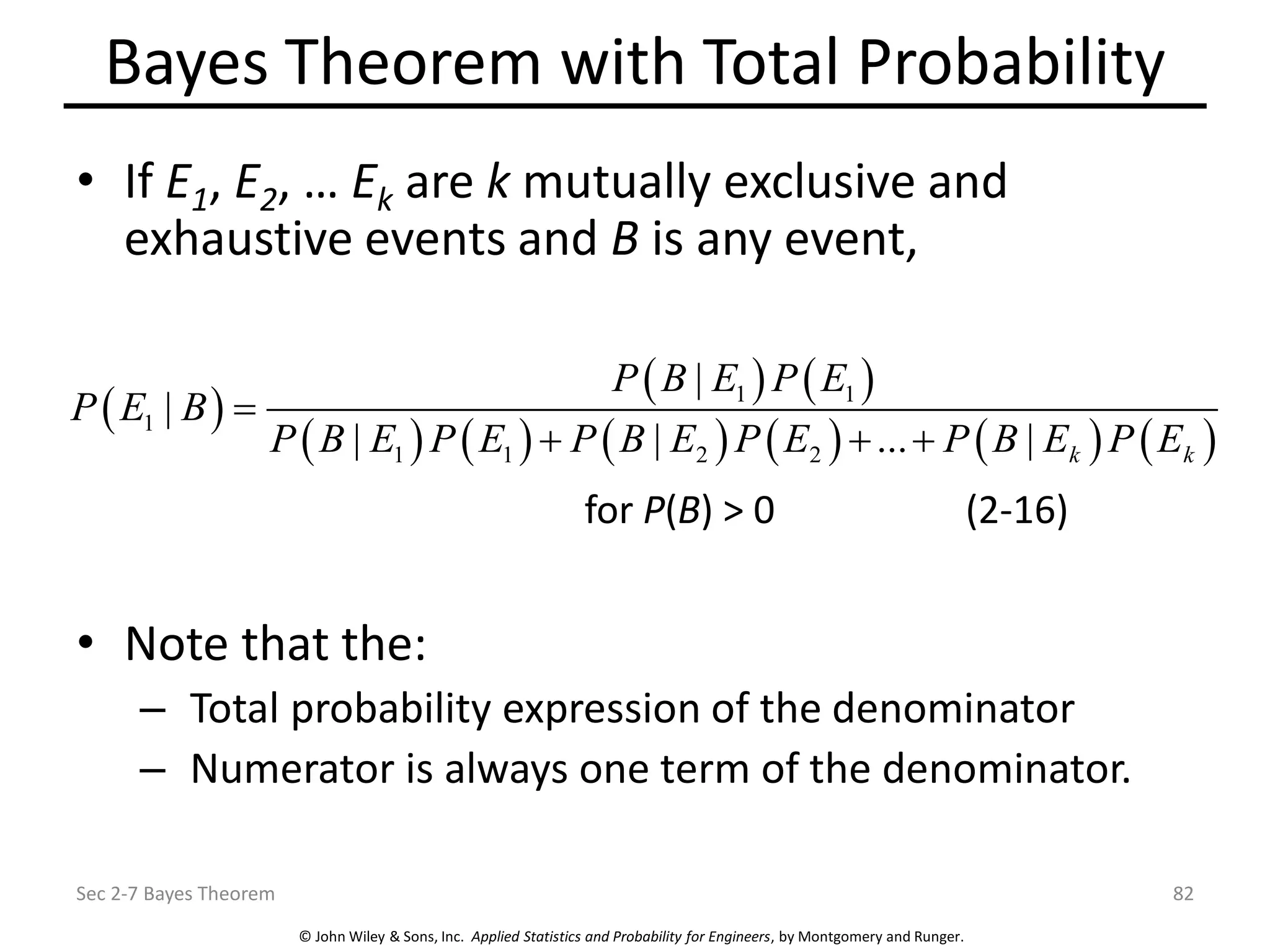
Bayes Theorem with Total Probability
• If E1, E2, … Ek are k mutually exclusive and
exhaustive events and B is any event,
for P(B) > 0 (2-16)
• Note that the:
– Total probability expression of the denominator
– Numerator is always one term of the denominator.
Sec 2-7 Bayes Theorem 82
( )
( ) ( )
( ) ( ) ( ) ( ) ( ) ( )
1 1
1
1 1 2 2
|
|
| | ... | k k
P B E P E
P E B
P B E P E P B E P E P B E P E
=
+ + +
© John Wiley & Sons, Inc. Applied Statistics and Probability for Engineers, by Montgomery and Runger.
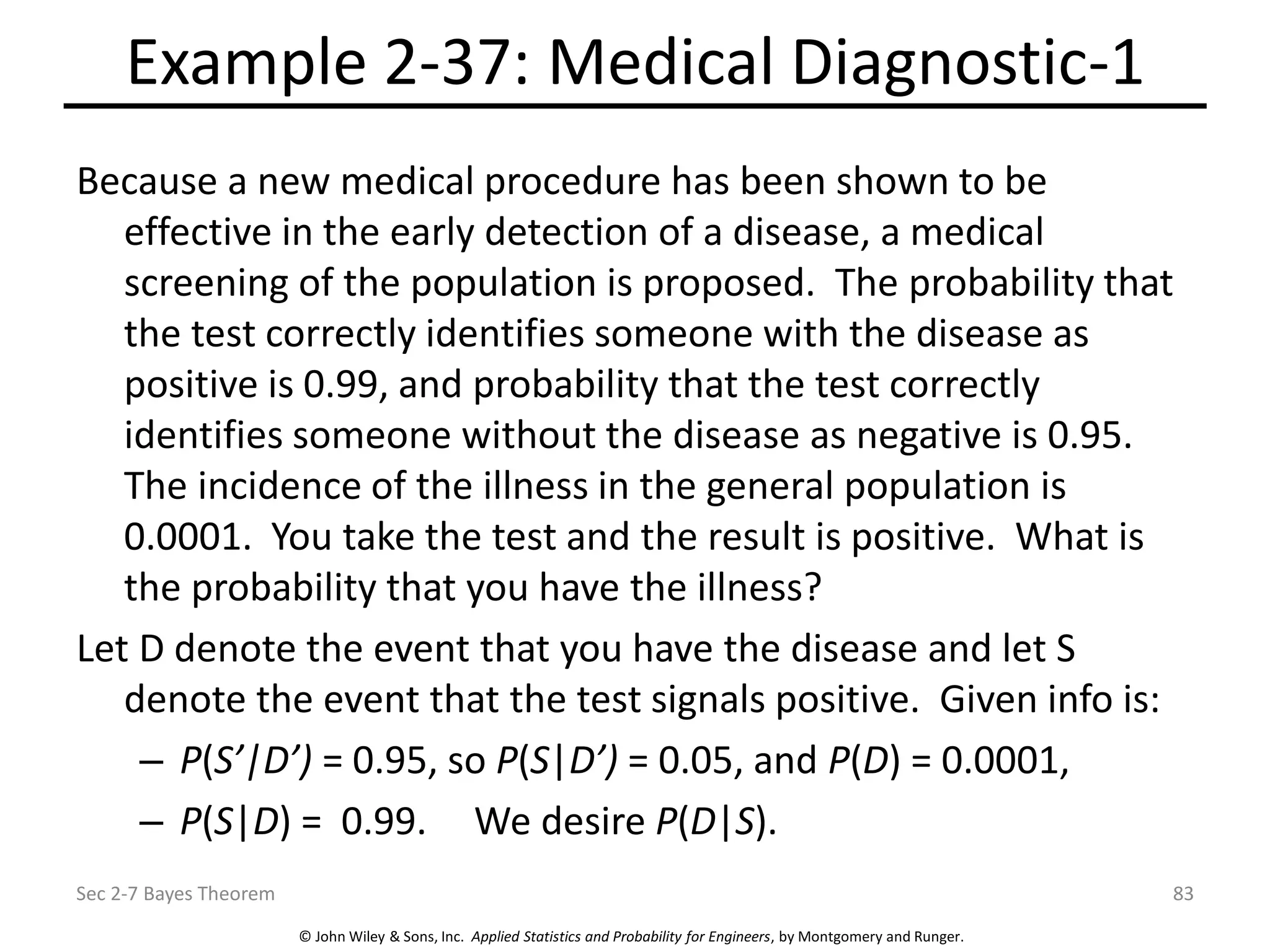
Example 2-37: Medical Diagnostic-1
Because a new medical procedure has been shown to be
effective in the early detection of a disease, a medical
screening of the population is proposed. The probability that
the test correctly identifies someone with the disease as
positive is 0.99, and probability that the test correctly
identifies someone without the disease as negative is 0.95.
The incidence of the illness in the general population is
0.0001. You take the test and the result is positive. What is
the probability that you have the illness?
Let D denote the event that you have the disease and let S
denote the event that the test signals positive. Given info is:
– P(S’|D’) = 0.95, so P(S|D’) = 0.05, and P(D) = 0.0001,
– P(S|D) = 0.99. We desire P(D|S).
Sec 2-7 Bayes Theorem 83
© John Wiley & Sons, Inc. Applied Statistics and Probability for Engineers, by Montgomery and Runger.
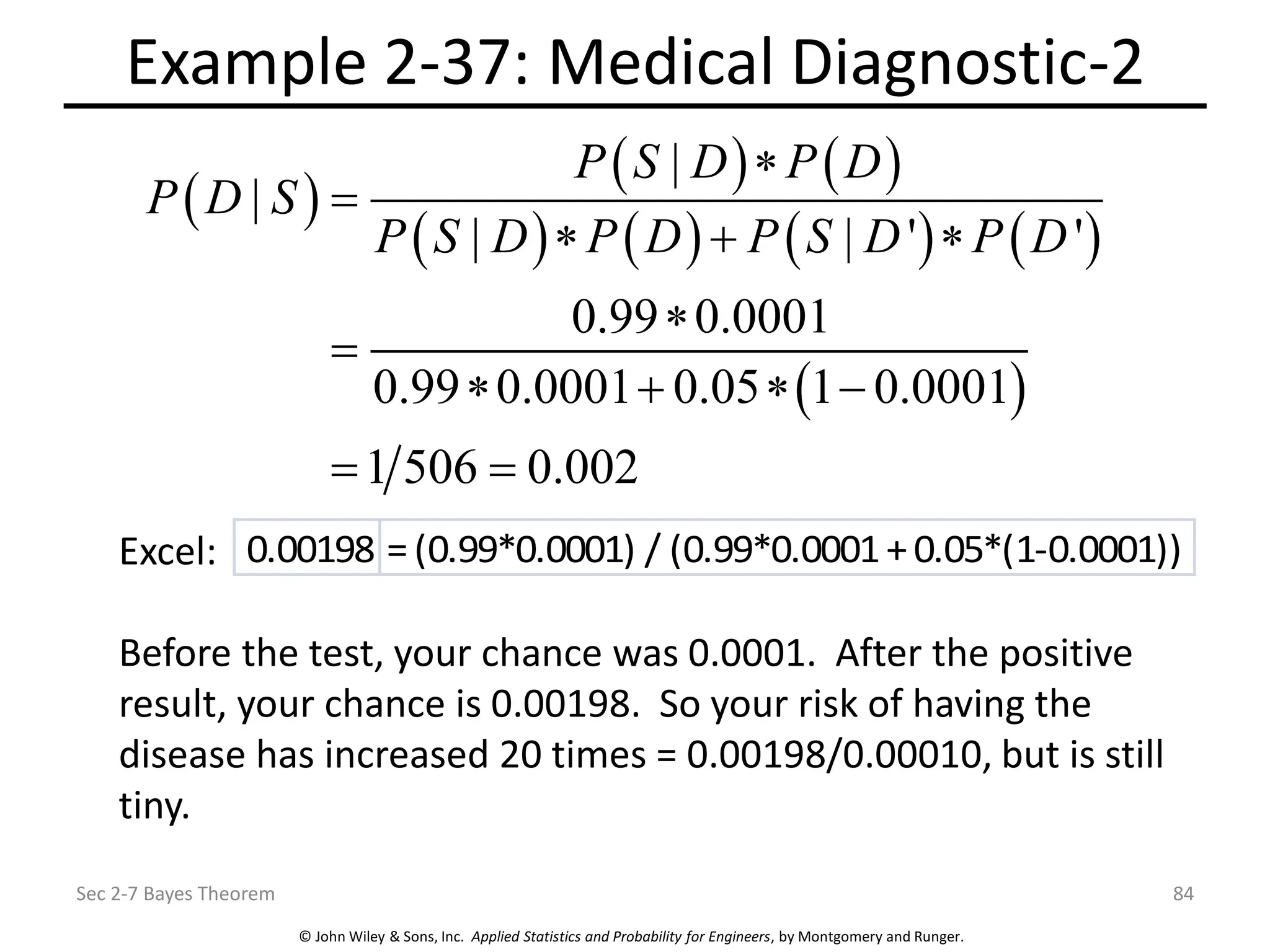
Example 2-37: Medical Diagnostic-2
Sec 2-7 Bayes Theorem 84
( )
( ) ( )
( ) ( ) ( ) ( )
( )
|
|
| | ' '
0.99 0.0001
0.99 0.0001 0.05 1 0.0001
1 506 0.002
P S D P D
P D S
P S D P D P S D P D

=
 + 

=
 +  −
= =
0.00198 =(0.99*0.0001) / (0.99*0.0001+0.05*(1-0.0001))
Excel:
Before the test, your chance was 0.0001. After the positive
result, your chance is 0.00198. So your risk of having the
disease has increased 20 times = 0.00198/0.00010, but is still
tiny.
© John Wiley & Sons, Inc. Applied Statistics and Probability for Engineers, by Montgomery and Runger.
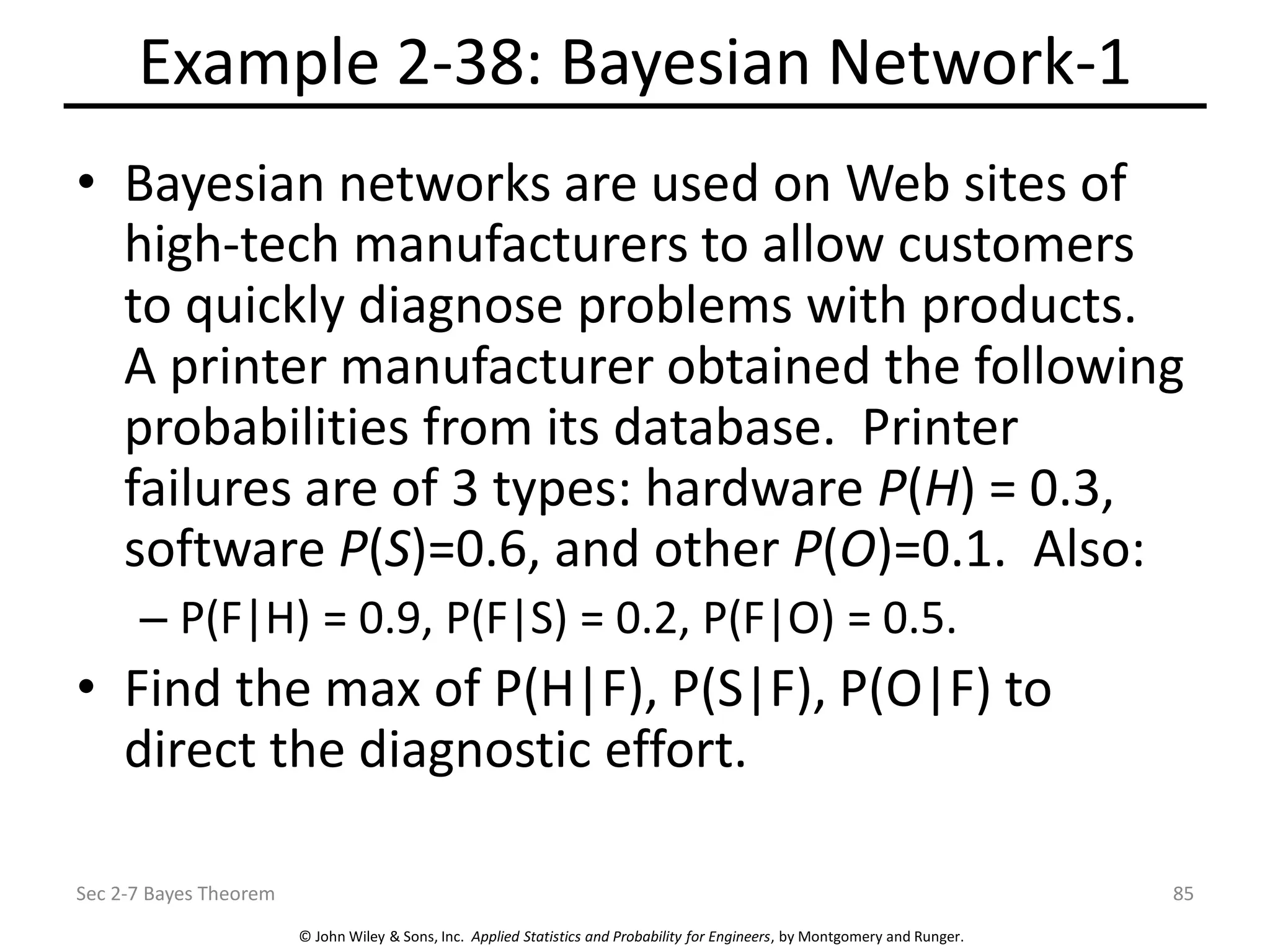
Example 2-38: Bayesian Network-1
• Bayesian networks are used on Web sites of
high-tech manufacturers to allow customers
to quickly diagnose problems with products.
A printer manufacturer obtained the following
probabilities from its database. Printer
failures are of 3 types: hardware P(H) = 0.3,
software P(S)=0.6, and other P(O)=0.1. Also:
– P(F|H) = 0.9, P(F|S) = 0.2, P(F|O) = 0.5.
• Find the max of P(H|F), P(S|F), P(O|F) to
direct the diagnostic effort.
Sec 2-7 Bayes Theorem 85
© John Wiley & Sons, Inc. Applied Statistics and Probability for Engineers, by Montgomery and Runger.
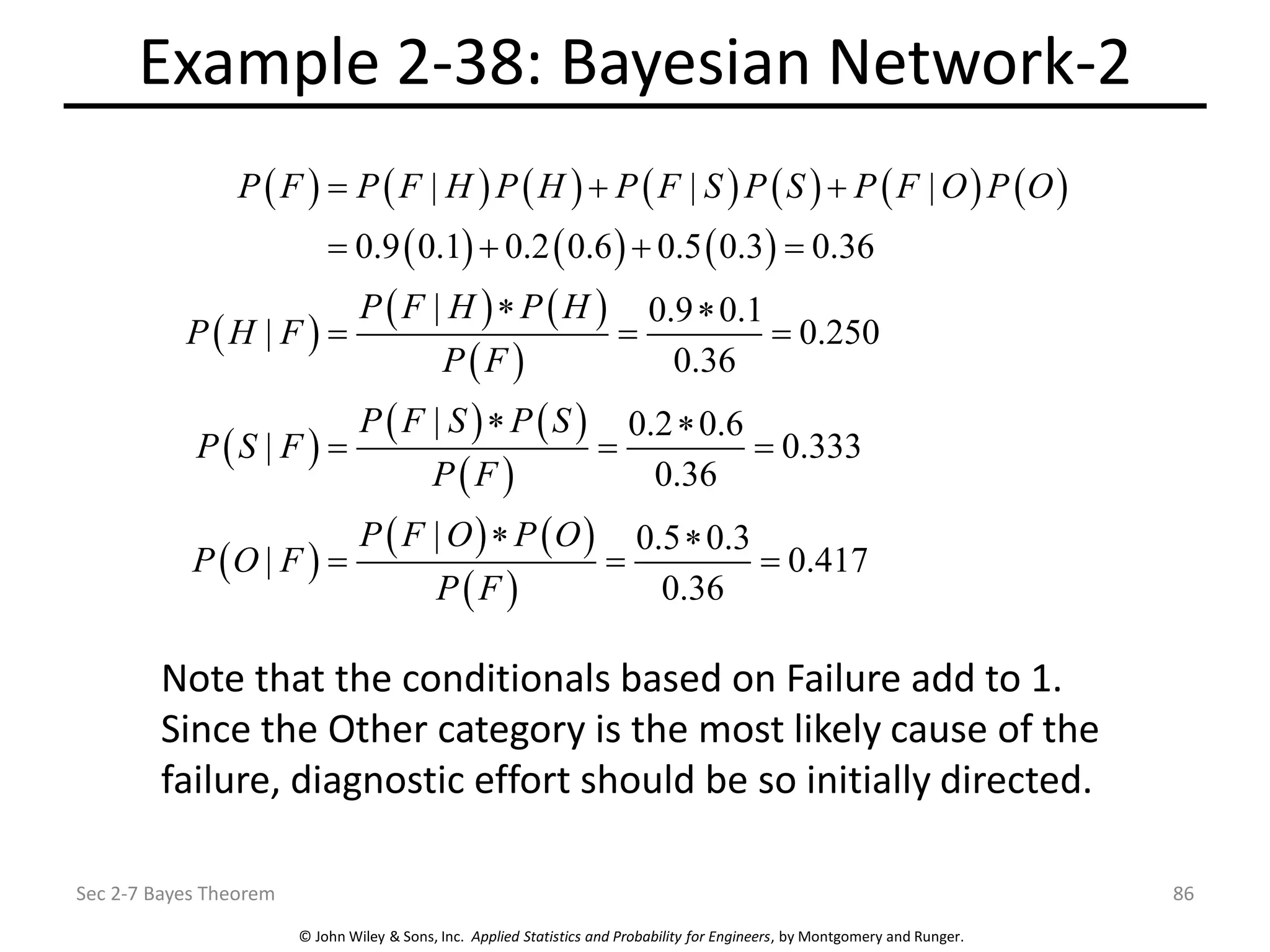
Example 2-38: Bayesian Network-2
Sec 2-7 Bayes Theorem 86
( ) ( ) ( ) ( ) ( ) ( ) ( )
( ) ( ) ( )
( )
( ) ( )
( )
( )
( ) ( )
( )
( )
( ) ( )
( )
| | |
0.9 0.1 0.2 0.6 0.5 0.3 0.36
| 0.9 0.1
| 0.250
0.36
| 0.2 0.6
| 0.333
0.36
| 0.5 0.3
| 0.417
0.36
P F P F H P H P F S P S P F O P O
P F H P H
P H F
P F
P F S P S
P S F
P F
P F O P O
P O F
P F
= + +
= + + =
 
= = =
 
= = =
 
= = =
Note that the conditionals based on Failure add to 1.
Since the Other category is the most likely cause of the
failure, diagnostic effort should be so initially directed.
© John Wiley & Sons, Inc. Applied Statistics and Probability for Engineers, by Montgomery and Runger.
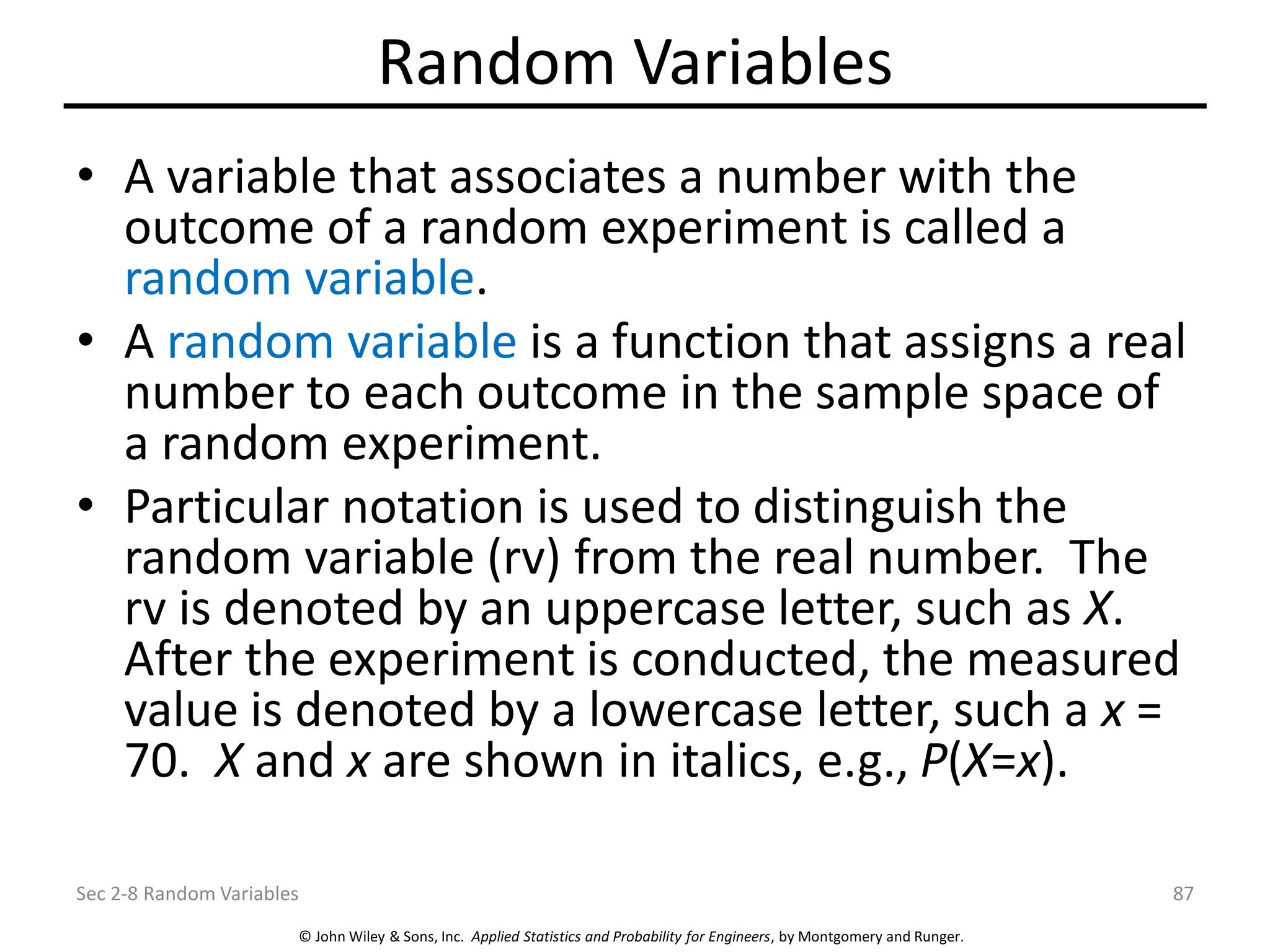
Random Variables
• A variable that associates a number with the
outcome of a random experiment is called a
random variable.
• A random variable is a function that assigns a real
number to each outcome in the sample space of
a random experiment.
• Particular notation is used to distinguish the
random variable (rv) from the real number. The
rv is denoted by an uppercase letter, such as X.
After the experiment is conducted, the measured
value is denoted by a lowercase letter, such a x =
70. X and x are shown in italics, e.g., P(X=x).
Sec 2-8 Random Variables 87
© John Wiley & Sons, Inc. Applied Statistics and Probability for Engineers, by Montgomery and Runger.
Continuous & Discrete Random Variables
• A discrete random variable is a rv with a finite
(or countably infinite) range. They are usually
integer counts, e.g., number of errors or
number of bit errors per 100,000 transmitted
(rate). The ends of the range of rv values may
be finite (0 ≤ x ≤ 5) or infinite (x ≥ 0).
• A continuous random variable is a rv with an
interval (either finite or infinite) of real
numbers for its range. Its precision depends
on the measuring instrument.
Sec 2-8 Random Variables 88
© John Wiley & Sons, Inc. Applied Statistics and Probability for Engineers, by Montgomery and Runger.
Examples of Discrete & Continuous RVs
• Discrete rv’s:
– Number of scratches on a surface.
– Proportion of defective parts among 100 tested.
– Number of transmitted bits received in error.
– Number of common stock shares traded per day.
• Continuous rv’s:
– Electrical current and voltage.
– Physical measurements, e.g., length, weight, time,
temperature, pressure.
Sec 2-8 Random Variables 89
© John Wiley & Sons, Inc. Applied Statistics and Probability for Engineers, by Montgomery and Runger.
Important Terms & Concepts of Chapter 2
Addition rule
Axioms of probability
Bayes’ theorem
Combination
Conditional probability
Equally likely outcomes
Event
Independence
Multiplication rule
Mutually exclusive events
Outcome
Permutation
Probability
Random experiment
Random variable
– Discrete
– Continuous
Sample space
– Discrete
– Continuous
Total probability rule
Tree diagram
Venn diagram
With replacement
Without replacement
Chapter 2 Summary 90

Statistical analysis design and analysis of experiemnts

  • 1.
    Chapter 2 Titleand Outline 1 2 Probability 2-1 Sample Spaces & Events 2-1.1 Random Experiments 2-1.2 Sample Spaces 2-1.3 Events 2-1.4 Count Techniques 2-2 Interpretations & Axioms of Probability 2-3 Addition Rules 2-4 Conditional Probability 2-5 Multiplication & Total Probability Rules 2-6 Independence 2-7 Bayes’ Theorem 2-8 Random Variables CHAPTER OUTLINE
  • 2.
    2 Chapter 2 LearningObjectives © John Wiley & Sons, Inc. Applied Statistics and Probability for Engineers, by Montgomery and Runger. Learning Objectives for Chapter 2 After careful study of this chapter, you should be able to do the following: 1. Understand and describe sample spaces and events for random experiments with graphs, tables, lists, or tree diagrams. 2. Interpret probabilities and use probabilities of outcomes to calculate probabilities of events in discrete sample spaces. 3. Use permutation and combinations to count the number of outcomes in both an event and the sample space . 4. Calculate the probabilities of joint events such as unions and intersections from the probabilities of individuals events. 5. Interpret and calculate conditional probabilities of events. 6. Determine the independence of events and use independence to calculate probabilities. 7. Use Bayes’ theorem to calculate conditional probabilities . 8. Understand random variables.
  • 3.
    © John Wiley& Sons, Inc. Applied Statistics and Probability for Engineers, by Montgomery and Runger. Random Experiments 3 Sec 2-1.1 Random Experiments Figure 2-1 Continuous iteration between model and physical system. The goal is to understand, quantify and model the variation affecting a physical system’s behavior. The model is used to analyze and predict the physical system’s behavior as system inputs affect system outputs. The predictions are verified through experimentation with the physical system.
  • 4.
    © John Wiley& Sons, Inc. Applied Statistics and Probability for Engineers, by Montgomery and Runger. Noise Produces Output Variation Sec 2-1.1 Random Experiments 4 Figure 2-2 Noise variables affect the transformation of inputs to outputs. Random values of the noise variables cannot be controlled and cause the random variation in the output variables. Holding the controlled inputs constant does not keep the output values constant.
  • 5.
    © John Wiley& Sons, Inc. Applied Statistics and Probability for Engineers, by Montgomery and Runger. Random Experiment • An experiment is an operation or procedure, carried out under controlled conditions, executed to discover an unknown result or to illustrate a known law. • An experiment that can result in different outcomes, even if repeated in the same manner every time, is called a random experiment. Sec 2-1.1 Random Experiments 5
  • 6.
    © John Wiley& Sons, Inc. Applied Statistics and Probability for Engineers, by Montgomery and Runger. Randomness Affects Natural Law Sec 2-1.1 Random Experiments 6 Figure 2-3 A closer examination of the system identifies deviations from the model. Ohm’s Law current is a linear function of voltage. However, current will vary due to noise variables, even under constant voltage.
  • 7.
    © John Wiley& Sons, Inc. Applied Statistics and Probability for Engineers, by Montgomery and Runger. Randomness Can Disrupt a System • Telephone systems must have sufficient capacity (lines) to handle a random number of callers at a random point in time whose calls are of a random duration. • If calls arrive exactly every 5 minutes and last for exactly 5 minutes, only 1 line is needed – a deterministic system. • Practically, times between calls are random and the call durations are random. Calls can come into conflict as shown in following slide. • Conclusion: Telephone system design must include provision for input variation. Sec 2-1.1 Random Experiments 7
  • 8.
    © John Wiley& Sons, Inc. Applied Statistics and Probability for Engineers, by Montgomery and Runger. Deterministic & Random Call Behavior Sec 2-1.1 Random Experiments 8 Figure 2-4 Variation causes disruption in the system. Calls arrive every 5 minutes. In top system, call durations are all of 5 minutes exactly. In bottom system, calls are of random duration, averaging 5 minutes, which can cause blocked calls, a “busy” signal.
  • 9.
    © John Wiley& Sons, Inc. Applied Statistics and Probability for Engineers, by Montgomery and Runger. Sample Spaces • Random experiments have unique outcomes. • The set of all possible outcome of a random experiment is called the sample space, S. • S is discrete if it consists of a finite or countable infinite set of outcomes. • S is continuous if it contains an interval (either a finite or infinite width) of real numbers. Sec 2-1.2 Sample Spaces 9
  • 10.
    © John Wiley& Sons, Inc. Applied Statistics and Probability for Engineers, by Montgomery and Runger. Example 2-1: Defining Sample Spaces • Randomly select and measure the thickness of a part. S = R+ = {x|x > 0}, the positive real line. Negative or zero thickness is not possible. S is continuous. • It is known that the thickness is between 10 and 11 mm. S = {x|10 < x < 11}, continuous. • It is known that the thickness has only three values. S = {low, medium, high}, discrete. • Does the part thickness meet specifications? S = {yes, no}, discrete. Sec 2-1.2 Sample Spaces 10
  • 11.
    © John Wiley& Sons, Inc. Applied Statistics and Probability for Engineers, by Montgomery and Runger. Example 2-2: Defining Sample Spaces, n=2 • Two parts are randomly selected & measured. S = R+ * R+, S is continuous. • Do the 2 parts conform to specifications? S = {yy, yn, ny, nn}, S is discrete. • Number of conforming parts? S = {1, 1, 2}, S is discrete. • Parts are randomly selected until a non- conforming part is found. S = {n, yn, yyn, yyyn, …}, S is countably infinite. Sec 2-1.2 Sample Spaces 11
  • 12.
    © John Wiley& Sons, Inc. Applied Statistics and Probability for Engineers, by Montgomery and Runger. Sample Space Is Defined By A Tree Diagram Sec 2-1.2 Sample Spaces 12 Example 2-3: Messages are classified as on-time or late. 3 messages are classified. There are 23 = 8 outcomes in the sample space. S = {ooo, ool,olo, oll, loo, lol, llo, lll} Figure 2-5 Tree diagram for three messages.
  • 13.
    © John Wiley& Sons, Inc. Applied Statistics and Probability for Engineers, by Montgomery and Runger. Tree Diagrams Can Fit The Situation Sec 2-1.2 Sample Spaces 13 Example 2-4: New cars can be equipped with selected options as follows: 1. Manual or automatic transmission 2. With or without air conditioning 3. Three choices of stereo sound systems 4. Four exterior color choices Figure 2-6 Tree diagram for different configurations of vehicles. Note that S has 2*2*3*4 = 48 outcomes.
  • 14.
    © John Wiley& Sons, Inc. Applied Statistics and Probability for Engineers, by Montgomery and Runger. Tree Diagrams Help Count Outcomes Sec 2-1.2 Sample Spaces, Figure 2-7. 14 Example 2-5: The interior car color can depend on the exterior color as shown in the tree diagrams below. There are 12 possibilities without considering color combinations. Figure 2-7 Tree diagram for different vehicle configurations with interior colors.
  • 15.
    © John Wiley& Sons, Inc. Applied Statistics and Probability for Engineers, by Montgomery and Runger. Events Are Sets of Outcomes • An event (E) is a subset of the sample space of a random experiment, i.e., one or more outcomes of the sample space. • Event combinations are: – Union of two events is the event consisting of all outcomes that are contained in either of two events, E1 E2. Called E1 or E2. – Intersection of two events is the event consisting of all outcomes that contained in both of two events, E1 E2. Called E1 and E2. – Complement of an event is the set of outcomes that are not contained in the event, E’ or not E. Sec 2-1.3 Events 15
  • 16.
    © John Wiley& Sons, Inc. Applied Statistics and Probability for Engineers, by Montgomery and Runger. Example 2-6, Discrete Event Algebra • Recall the sample space from Example 2-2, S = {yy, yn, ny, nn} concerning conformance to specifications. – Let E1 denote the event that at least one part does conform to specifications, E1 = {yy, yn, ny} – Let E2 denote the event that no part conforms to specifications, E2 = {nn} – Let E3 = Ø, the null or empty set. – Let E4 = S, the universal set. – Let E5 = {yn, ny, nn}, at least one part does not conform. – Then E1 E5 = S – Then E1 E5 = {yn, ny} – Then E1’= {nn} Sec 2-1.3 Events 16
  • 17.
    © John Wiley& Sons, Inc. Applied Statistics and Probability for Engineers, by Montgomery and Runger. Example 2-7, Continuous Event Algebra Measurements of the thickness of a part are modeled with the sample space: S = R+. – Let E1 = {x|10 ≤ x < 12}, show on the real line below. – Let E2 = {x|11 < x < 15} – Then E1 E2 = {x|10 ≤ x < 15} – Then E1 E2 = {x|11 < x < 12} – Then E1’ = {x|x < 10 or x ≥ 12} – Then E1’ E2 = {x|12 ≥ x < 15} Sec 2-1.2 Sample Spaces 17 9 10 11 12 13 14 15 16
  • 18.
    © John Wiley& Sons, Inc. Applied Statistics and Probability for Engineers, by Montgomery and Runger. Example 2-8, Hospital Emergency Visits • This table summarizes the ER visits at 4 hospitals. People may leave without being seen by a physician( LWBS). The remaining people are seen, and may or may not be admitted. • Let A be the event of a visit to Hospital 1. • Let B be the event that the visit is LWBS. • Find number of outcomes in: – A B – A’ – A B Sec 2-1.2 Sample Spaces 18 1 2 3 4 Total Total 5,292 6,991 5,640 4,329 22,252 A B = 195 LWBS 195 270 246 242 953 A' = 16,960 Admitted 1,277 1,558 666 984 4,485 A B = 6,050 Not admitted 3,820 5,163 4,728 3,103 16,814 Hospital Answers
  • 19.
    © John Wiley& Sons, Inc. Applied Statistics and Probability for Engineers, by Montgomery and Runger. Venn Diagrams Show Event Relations Sec 2-1.3 Events 19 Events A & B contain their respective outcomes. The shaded regions indicate the event relation of each diagram. Figure 2-8 Venn diagrams
  • 20.
    © John Wiley& Sons, Inc. Applied Statistics and Probability for Engineers, by Montgomery and Runger. Venn Diagram of Mutually Exclusive Events Sec 2-1.3 Events 20 • Events A & B are mutually exclusive because they share no common outcomes. •The occurrence of one event precludes the occurrence of the other. • Symbolically, A B = Ø Figure 2-9 Mutually exclusive events
  • 21.
    © John Wiley& Sons, Inc. Applied Statistics and Probability for Engineers, by Montgomery and Runger. Event Relation Laws • Transitive law (event order is unimportant): – A B = B A and A B = B A • Distributive law (like in algebra): – (A B) C = (A C) (B C) – (A B) C = (A C) (B C) • DeMorgan’s laws: – (A B)’ = A’ B’ The complement of the union is the intersection of the complements. – (A B)’ = A’ B’ The complement of the intersection is the union of the complements. Sec 2-1.3 Events 21
  • 22.
    © John Wiley& Sons, Inc. Applied Statistics and Probability for Engineers, by Montgomery and Runger. Counting Techniques • These are three special rules, or counting techniques, used to determine the number of outcomes in the events and the sample space. • They are the: 1. Multiplication rule 2. Permutation rule 3. Combination rule • Each has its special purpose that must be applied properly – the right tool for the right job. Sec 2-1.4 Counting Techniques 22
  • 23.
    © John Wiley& Sons, Inc. Applied Statistics and Probability for Engineers, by Montgomery and Runger. Counting – Multiplication Rule • Multiplication rule: – Let an operation consist of k steps and • n1 ways of completing step 1, • n2 ways of completing step 2, … and • nk ways of completing step k. – Then, the total number of ways or outcomes are: • n1 * n2*…*nk Sec 2-1.4 Counting Techniques 23
  • 24.
    © John Wiley& Sons, Inc. Applied Statistics and Probability for Engineers, by Montgomery and Runger. Example 2-9: Multiplication Rule • In the design for a gear housing, we can choose to use among: – 4 different fasteners, – 3 different bolt lengths and – 2 different bolt locations. • How many designs are possible? • Answer: 4 * 3 * 2 = 24 Sec 2-1.4 Counting Techniques 24
  • 25.
    © John Wiley& Sons, Inc. Applied Statistics and Probability for Engineers, by Montgomery and Runger. Counting – Permutation Rule • A permutation is a unique sequence of distinct items. • If S = {a, b, c}, then there are 6 permutations – Namely: abc, acb, bac, bca, cab, cba (order matters) – The # of ways 3 people can be arranged. • # of permutations for a set of n items is n! • n! (factorial function) = n*(n-1)*(n-2)*…*2*1 • 7! = 7*6*5*4*3*2*1 = 5,040 = FACT(7) in Excel • By definition: 0! = 1 Sec 2-1.4 Counting Techniques 25
  • 26.
    © John Wiley& Sons, Inc. Applied Statistics and Probability for Engineers, by Montgomery and Runger. Counting – Sub-set Permutations • To sequence only r items from a set of n items: Sec 2- 26 ( ) 7 3 ! ( 1)( 2)...( 1) ( )! 7! 7! 7*6*5*4! 7*6*5 210 7 3 ! 4! 4! In Excel: permut(7,3) = 210 n r n P n n n n r n r P = − − − + = − = = = = = −
  • 27.
    © John Wiley& Sons, Inc. Applied Statistics and Probability for Engineers, by Montgomery and Runger. Example 2-10: Circuit Board Designs • A printed circuit board has eight different locations in which a component can be placed. If four different components are to be placed on the board , how many designs are possible? • Answer: order is important, so use the permutation formula with n = 8, r = 4. Sec 2-1.4 Counting Techniques 27 ( ) 8 4 8! 8*7*6*5*4! 8*7*6*5 1,680 8 4 ! 4! P = = = = −
  • 28.
    © John Wiley& Sons, Inc. Applied Statistics and Probability for Engineers, by Montgomery and Runger. Counting - Similar Item Permutations • Used for counting the sequences when not all the items are different. • The number of permutations of: – n = n1 + n2 + … + nr items of which • n1 are identical, • n2 are identical, … , and • nr are identical. • Is calculated as: Sec 2-1.4 Counting Techniques 28 1 2 ! ! ! ... ! r n n n n
  • 29.
    © John Wiley& Sons, Inc. Applied Statistics and Probability for Engineers, by Montgomery and Runger. Example 2-11: Machine Shop Schedule • In a machining operation, a piece of sheet metal needs two identical-diameter holes drilled and two identical-size notched cut. The drilling operation is denoted as d and the notching as n. – How many sequences are there? – What is the set of sequences? {ddnn, dndn, dnnd, nddn, ndnd, nndd} Sec 2-1.4 Counting Techniques 29 4! 4*3*2! 6 2!2! 2*1*2! = =
  • 30.
    © John Wiley& Sons, Inc. Applied Statistics and Probability for Engineers, by Montgomery and Runger. Example 2-12: Bar Codes • A part is labeled with 4 thick lines, 3 medium lines, and two thin lines. Each sequence is a different label. – How many unique labels can be created? – In Excel: Sec 2-1.4 Counting Techniques 30 9! 9*8*7*6*5*4! 1,260 4!3!2! 2*1*3*2*1*4! = = 1,260 =FACT(9) / (FACT(4)*FACT(3)*FACT(2))
  • 31.
    © John Wiley& Sons, Inc. Applied Statistics and Probability for Engineers, by Montgomery and Runger. Counting – Combination Rule • A combination is a selection of r items from a set of n where order does not matter. • If S = {a, b, c}, n =3, then there is 1 combination. – If r =3, there is 1 combination, namely: abc – If r=2, there are 3 combinations, namely ab, ac, bc • # of permutations ≥ # of combinations Sec 2-1.4 Counting Techniques 31 ( ) (2-4) ! ! ! n r n C r n r = =
  • 32.
    © John Wiley& Sons, Inc. Applied Statistics and Probability for Engineers, by Montgomery and Runger. Example 2-13: Applying the Combination Rule • A circuit board has eight locations in which a component can be placed. If 5 identical components are to be placed on a board, how many different designs are possible? • The order of the components is not important, so the combination rule is appropriate. • Excel: Sec 2-1.4 Counting Techniques 32 ( ) 8 5 8! 8*7*6*5! 56 5! 8 5 ! 3*2*1*5! C = = = − 56 = COMBIN(8,5)
  • 33.
    © John Wiley& Sons, Inc. Applied Statistics and Probability for Engineers, by Montgomery and Runger. Example 2-14: Sampling w/o Replacement-1 • A bin of 50 parts contains 3 defectives & 47 good parts. A sample of 6 parts is selected from the 50 without replacement. • How many different samples of size 6 are there that contain exactly 2 defective parts? • In Excel: Sec 2-1.4 Counting Techniques 33 3 2 3! 3 different ways 2!1! C = = 3 =COMBIN(3,2)
  • 34.
    © John Wiley& Sons, Inc. Applied Statistics and Probability for Engineers, by Montgomery and Runger. Example 2-14: Sampling w/o Replacement-2 • Now, how many ways are there of selecting 4 parts from the 47 acceptable parts? • In Excel: Sec 2-1.4 Counting Techniques 34 47 4 47! 47*46*45*44*43! 178,365 different ways 4!43! 4*3*2*1*43! C = = = 178,365 =COMBIN(47,4)
  • 35.
    © John Wiley& Sons, Inc. Applied Statistics and Probability for Engineers, by Montgomery and Runger. Example 2-14: Sampling w/o Replacement-3 • Now, how many ways are there to obtain: – 2 from the 3 defectives, and – 4 from the 47 non-defectives? – In Excel: Sec 2-1.4 Counting Techniques 35 3 47 2 4 3*178,365 = 535,095 different ways C C = 535,095 =COMBIN(3,2)*COMBIN(47,4)
  • 36.
    © John Wiley& Sons, Inc. Applied Statistics and Probability for Engineers, by Montgomery and Runger. Example 2-14: Sampling w/o Replacement-4 • Furthermore, how many ways are there to obtain 6 parts (0-6 defectives) from the set of 50? • So the ratio of obtaining 2 defectives out 6 to any number (0-6) defectives out of 6 is: Sec 2-1.4 Counting Techniques 36 50 6 50! 15,890,700 6!*44! C = = 3 47 2 4 50 6 3*178,365 0.034 15,890,700 C C C = =
  • 37.
    © John Wiley& Sons, Inc. Applied Statistics and Probability for Engineers, by Montgomery and Runger. What Is Probability? • Probability is the likelihood or chance that a particular outcome or event from a random experiment will occur. • Here, only finite sample spaces ideas apply. • Probability is a number in the [0,1] interval. • May be expressed as a: – proportion (0.15) – percent (15%) – fraction (3/20) • A probability of: – 1 means certainty – 0 means impossibility Sec 2-2 Interpretations & Axioms of Probability 37
  • 38.
    © John Wiley& Sons, Inc. Applied Statistics and Probability for Engineers, by Montgomery and Runger. Types of Probability • Subjective probability is a “degree of belief.” – “There is a 50% chance that I’ll study tonight.” • Relative frequency probability is based how often an event occurs over a very large sample space. Sec 2-2 Interpretations & Axioms of Probability 38 Figure 2-10 Relative frequency of corrupted pulses over a communications channel
  • 39.
    © John Wiley& Sons, Inc. Applied Statistics and Probability for Engineers, by Montgomery and Runger. Probability Based on Equally-Likely Outcomes • Whenever a sample space consists of N possible outcomes that are equally likely, the probability of each outcome is 1/N. • Example: In a batch of 100 diodes, 1 is colored red. A diode is randomly selected from the batch. Random means each diode has an equal chance of being selected. The probability of choosing the red diode is 1/100 or 0.01, because each outcome in the sample space is equally likely. Sec 2-2 Interpretations & Axioms of Probabilities 39
  • 40.
    © John Wiley& Sons, Inc. Applied Statistics and Probability for Engineers, by Montgomery and Runger. Example 2-15: Laser Diodes • Assume that 30% of the laser diodes in a batch of 100 meet a customer requirements. • A diode is selected randomly. Each diode has an equal chance of being selected. The probability of selecting an acceptable diode is 0.30. Sec 2-2 Interpretations & Axioms of Probability 40 Figure 2-11 Probability of the event E is the sum of the probabilities of the outcomes in E.
  • 41.
    © John Wiley& Sons, Inc. Applied Statistics and Probability for Engineers, by Montgomery and Runger. Probability of an Event • For a discrete sample space, the probability of an event E, denoted by P(E), equals the sum of the probabilities of the outcomes in E. • The discrete sample space may be: – A finite set of outcomes – A countably infinite set of outcomes. • Further explanation is necessary to describe probability with respect to continuous sample spaces. Sec 2-2 Interpretations & Axioms of Probability 41
  • 42.
    © John Wiley& Sons, Inc. Applied Statistics and Probability for Engineers, by Montgomery and Runger. Example 2-16: Probabilities of Events • A random experiment has a sample space {w,x,y,z}. These outcomes are not equally-likely; their probabilities are: 0.1, 0.3, 0.5, 0.1. • Event A ={w,x}, event B = {x,y,z}, event C = {z} – P(A) = 0.1 + 0.3 = 0.4 – P(B) = 0.3 + 0.5 + 0.1 = 0.9 – P(C) = 0.1 – P(A’) = 0.6 and P(B’) = 0.1 and P(C’) = 0.9 – Since event A B = {x}, then P(A B) = 0.3 – Since event A B = {w,x,y,z}, then P(A B) = 1.0 – Since event A C = {null}, then P(A C ) = 0.0 Sec 2-2 Interpretations & Axioms of Probability 42
  • 43.
    © John Wiley& Sons, Inc. Applied Statistics and Probability for Engineers, by Montgomery and Runger. Example 2-17: Contamination Particles • An inspection of a large number of semiconductor wafers revealed the data for this table. A wafer is selected randomly. Sec 2-2 Interpretations & Axioms of Probability 43 Number of Contamination Particles Proportion of Wafers 0 0.40 1 0.20 2 0.15 3 0.10 4 0.05 5 or more 0.10 Total 1.00 • Let E be the event of selecting a 0 particle wafer. P(E) = 0.40 • Let E be the event of selecting a wafer with 3 or more particles. P(E) = 0.10+0.05+0.10 = 0.25
  • 44.
    © John Wiley& Sons, Inc. Applied Statistics and Probability for Engineers, by Montgomery and Runger. Example 2-18: Sampling w/o Replacement • A batch of parts contains 6 parts {a,b,c,d,e,f}. Two are selected at random. Suppose part f is defective. What is the probability that part f appears in the sample? • How many possible samples can be drawn? – Excel: • How many samples contain part f? – 5 by enumeration: {af,bf,cf,df,ef} • P(defective part) = 5/15 = 1/3. Sec 2-2 Interpretations & Axioms of Probability 44 6 2 6! 15 2!4! C = = 15 =COMBIN(6,2)
  • 45.
    © John Wiley& Sons, Inc. Applied Statistics and Probability for Engineers, by Montgomery and Runger. Axioms of Probability • Probability is a number that is assigned to each member of a collection of events from a random experiment that satisfies the following properties: 1. P(S) = 1 2. 0 ≤ P(E) ≤ 1 3. For each two events E1 and E2 with E1 E2 = Ø, P(E1 E2) = P(E1) + P(E2) • These imply that: – P(Ø) =0 and P(E’) = 1 – P(E) – If E1 is contained in E2, then P(E1) ≤ P(E2). Sec 2-2 Interpretations & Axioms of Probability 45
  • 46.
    © John Wiley& Sons, Inc. Applied Statistics and Probability for Engineers, by Montgomery and Runger. Addition Rules • Joint events are generated by applying basic set operations to individual events, specifically: – Unions of events, A B – Intersections of events, A B – Complements of events, A’ • Probabilities of joint events can often be determined from the probabilities of the individual events that comprise it. And conversely. Sec 2-3 Addition Rules 46
  • 47.
    © John Wiley& Sons, Inc. Applied Statistics and Probability for Engineers, by Montgomery and Runger. Example 2-19: Semiconductor Wafers A wafer is randomly selected from a batch as shown in the table. – Let H be the event of high concentrations of contaminants. Then P(H) = 358/940. – Let C be the event of the wafer being located at the center of a sputtering tool used in manufacture. Then P(C) = 626/940. – P(H C) = 112/940 – P(H C) = P(H) + P(C) - P(H C) = (358+626-112)/940 This is the addition rule. Sec 2-3 Addition Rules 47 Table 2-1 Contamination Center Edge Total Low 514 68 582 High 112 246 358 Total 626 314 940 Location of Tool
  • 48.
    © John Wiley& Sons, Inc. Applied Statistics and Probability for Engineers, by Montgomery and Runger. • The probability of a union: • If events A and B are mutually exclusive: Sec 2-3 Addition Rules 48 ( ) ( ) ( ) ( ) ( ) ( ) ( ) ( ) (2-5) and, as rearranged: P A B P A P B P A B P A B P A P B P A B = + − = + − ( ) ( ) ( ) ( ) therefore: (2-6) P A B P A B P A P B =  = +
  • 49.
    © John Wiley& Sons, Inc. Applied Statistics and Probability for Engineers, by Montgomery and Runger. Example 2-20: Contaminants & Location Wafers in last example are now classified by degree of contamination per table of proportions. Sec 2-3 Addition Rules 49 Number of Contamination Particles Center Edge Total 0 0.30 0.10 0.40 1 0.15 0.05 0.20 2 0.10 0.05 0.15 3 0.06 0.04 0.10 4 0.04 0.01 0.05 5 or more 0.07 0.03 0.10 Totals 0.72 0.28 1.00 Location of Tool Table 2-2 • E1 is the event that a wafer has 4 or more particles. P(E1) = 0.15 • E2 is the event that a wafer was on edge. P(E2) = 0.28 • P(E1 E2) = 0.04 • P(E1 E2) =0.15 + 0.28 – 0.04 = 0.39
  • 50.
    © John Wiley& Sons, Inc. Applied Statistics and Probability for Engineers, by Montgomery and Runger. Addition Rule: 3 or More Events Sec 2-3 Addition Rules 50 ( ) ( ) ( ) ( ) ( ) ( ) ( ) ( ) P A B C P A P B P C P A B P A C P B C P A B C = + + − − − + (2-7) Note the alternating signs. ( ) 1 2 1 If a collection of events is mutually exclusive, thus for all pairs: Then: ... i i j k k i i E E E P E E E E = =  =  (2-8)
  • 51.
    © John Wiley& Sons, Inc. Applied Statistics and Probability for Engineers, by Montgomery and Runger. Venn Diagram of Mutually Exclusive Events Sec 2-3 Addition Rules, Figure 2-12 51 Figure 2-12 Venn diagram of four mutually exclusive events. Note that no outcomes are common to more than one event, i.e. all intersections are null.
  • 52.
    © John Wiley& Sons, Inc. Applied Statistics and Probability for Engineers, by Montgomery and Runger. Example 2-21: pH • Let X denote the pH of a sample. Consider the event that P(6.5 < X ≤ 7.5) = P(6.5 < X ≤ 7.0) + P(7.0 < X ≤ 7.5) + P(7.5 < X ≤ 7.8) • The partition of an event into mutually exclusive subsets is widely used to allocate probabilities. Sec 2-3 Addition Rule 52
  • 53.
    © John Wiley& Sons, Inc. Applied Statistics and Probability for Engineers, by Montgomery and Runger. Conditional Probability • Probabilities should be reevaluated as additional information becomes available. • P(B|A) is called the probability of event B occurring, given that event A has already occurred. • A communications channel has an error rate of 1 per 1000 bits transmitted. Errors are rare, but do tend to occur in bursts. If a bit is in error, the probability that the next bit is also an error ought to be greater than 1/1000. Sec 2-4 Conditional Probability 53
  • 54.
    © John Wiley& Sons, Inc. Applied Statistics and Probability for Engineers, by Montgomery and Runger. An Example of Conditional Probability • In a thin film manufacturing process, the proportion of parts that are not acceptable is 2%. However the process is sensitive to contamination that can increase the rate of parts rejection. • If we know that the plant is having filtration problems that increase film contamination, we would presume that the rejection rate has increased. Sec 2-4 Conditional Probability 54
  • 55.
    © John Wiley& Sons, Inc. Applied Statistics and Probability for Engineers, by Montgomery and Runger. Another Example of Conditional Probability Sec 2-4 Conditional Probability 55 Figure 2-13 Conditional probability of rejection for parts with surface flaws and for parts without surface flaws. The probability of a defective part is not evenly distributed. Flawed parts are five times more likely to be defective than non-flawed parts, i.e., P(D|F) / P(D|F’).
  • 56.
    © John Wiley& Sons, Inc. Applied Statistics and Probability for Engineers, by Montgomery and Runger. Example 2-22: A Sample From Prior Graphic • Table 2-3 shows that 400 parts are classified by surface flaws and as functionally defective. Observe that: – P(D|F) = 10/40 = 0.25 – P(D|F’) = 18/360 = 0.05 Sec 2-4 Conditional Probability 56 Defective Yes (F) No (F') Total Yes (D) 10 18 28 No (D') 30 342 372 Total 40 360 400 Surface Flaws Table 2-3 Parts Classified
  • 57.
    © John Wiley& Sons, Inc. Applied Statistics and Probability for Engineers, by Montgomery and Runger. Conditional Probability Rule • The conditional probability of event B given event A, denoted as P(A|B), is: P(B|A) = P(A B) / P(A) (2-9) for P(A) > 0. • From a relative frequency perspective of n equally likely outcomes: – P(A) = (number of outcomes in A) / n – P(A B) = (number of outcomes in A B) / n Sec 2-4 Conditional Probability 57
  • 58.
    © John Wiley& Sons, Inc. Applied Statistics and Probability for Engineers, by Montgomery and Runger. Example 2-23: More Surface Flaws Refer to Table 2-3 again. There are 4 probabilities conditioned on flaws. Sec 2-4 Conditional Probability 58 ( ) ( ) ( ) ( ) ( ) ( ) ( ) ( ) ( ) 10 10 40 400 400 40 30 40 30 400 400 40 18 18 360 400 400 360 342 360 342 400 400 360 ( ) 40 400 and ( ) 28 400 ( | ) ( ) ( ) '| ' | ' ' ' '| ' ' ' ' P F P D P D F P D F P F P D F P D F P F P D F P D F P F P D F P D F P F = = = = = = = = = = = = = = Defective Yes (F) No (F') Total Yes (D) 10 18 28 No (D') 30 342 372 Total 40 360 400 Surface Flaws Table 2-3 Parts Classified
  • 59.
    © John Wiley& Sons, Inc. Applied Statistics and Probability for Engineers, by Montgomery and Runger. Example 2-23: Tree Diagram Sec 2-4 Conditional Probability 59 Figure 2-14 Tree diagram for parts classification Tree illustrates sampling two parts without replacement: • At the 1st stage (flaw), every original part of the 400 is equally likely. • At the 2nd stage (defect), the probability is conditional upon the part drawn in the prior stage.
  • 60.
    © John Wiley& Sons, Inc. Applied Statistics and Probability for Engineers, by Montgomery and Runger. Random Samples & Conditional Probabilities • Random means each item is equally likely to be chosen. If more than one item is sampled, random means that every sampling outcome is equally likely. • 2 items are taken from S = {a,b,c} without replacement. • Ordered sample space: S = {ab,ac,bc,ba,bc,cb} • Unordered sample space: S = {ab,ac,bc} • This is done by enumeration – too hard  Sec 2-4 Conditional Probability 60
  • 61.
    © John Wiley& Sons, Inc. Applied Statistics and Probability for Engineers, by Montgomery and Runger. Sampling Without Enumeration • Use conditional probability to avoid enumeration. To illustrate: A batch of 50 parts contains 10 made by Tool 1 and 40 made by Tool 2. We take a sample of n=2. • What is the probability that the 2nd part came from Tool 2, given that the 1st part came from Tool 1? – P(1st part came from Tool 1) = 10/50 – P(2nd part came from Tool 2) = 40/49 – P(Tool 1, then Tool 2 part sequence) = (10/50)*(40/49) • To select randomly implies that, at each step of the sample, the items remaining in the batch are equally likely to be selected. Sec 2-4 Conditional Probability 61
  • 62.
    © John Wiley& Sons, Inc. Applied Statistics and Probability for Engineers, by Montgomery and Runger. Example 2-24: Sampling Without Replacement • A production lot of 850 parts contains 50 defectives. Two parts are selected at random. • What is the probability that the 2nd is defective, given that the first part is defective? • Let A denote the event that the 1st part selected is defective. • Let B denote the event that the 2nd part selected is defective. • Probability desired is P(B|A) = 49/849. Sec 2-4 Conditional Probability 62
  • 63.
    © John Wiley& Sons, Inc. Applied Statistics and Probability for Engineers, by Montgomery and Runger. Example 2-25: Continuing Prior Example • Now, 3 parts are sampled randomly. • What is the probability that the first two are defective, while the third is not? • In Excel: Sec 2-4 Conditional Probability 63 ( ) 50 49 800 0.0032 850 849 848 P ddn =   = 0.0032 =(50*49*800)/(850*849*848)
  • 64.
    © John Wiley& Sons, Inc. Applied Statistics and Probability for Engineers, by Montgomery and Runger. Multiplication Rule • The conditional probability definition of Equation 2-9 can be rewritten to generalize it as the multiplication rule. • P(A B) = P(B|A)*P(A) = P(A|B)*P(B) (2-10) • The last expression is obtained by exchanging the roles of A and B. Sec 2-5 Multiplication & Total Probability Rules 64
  • 65.
    © John Wiley& Sons, Inc. Applied Statistics and Probability for Engineers, by Montgomery and Runger. Example 2-26: Machining Stages • The probability that, a part made in the 1st stage of a machining operation passes inspection, is 0.90. The probability that, it passes inspection after the 2nd stage, is 0.95. • What is the probability that the part meets specifications? • Let A & B denote the events that the 1st & 2nd stages meet specs. • P(A B) = P(B|A)*P(A) = 0.95*0.90 = 0.955 Sec 2- 65
  • 66.
    © John Wiley& Sons, Inc. Applied Statistics and Probability for Engineers, by Montgomery and Runger. Two Mutually Exclusive Subsets Sec 2-5 Multiplication & Total Probability Rules 66 Figure 2-15 Partitioning an event into two mutually exclusive subsets. • A & A’ are mutually exclusive. • A B and A’ B are mutually exclusive • B = (A B) (A B)
  • 67.
    © John Wiley& Sons, Inc. Applied Statistics and Probability for Engineers, by Montgomery and Runger. Total Probability Rule For any two events A and B: Sec 2-5 Multiplication & Total Probability Rules 67 ( ) ( ) ( ) ( ) ( ) ( ) ( ) ' | | ' ' (2-11) P B P B A P B A P B A P A P B A P A = + =  + 
  • 68.
    © John Wiley& Sons, Inc. Applied Statistics and Probability for Engineers, by Montgomery and Runger. Example 2-27: Semiconductor Contamination • Information about product failure based on chip manufacturing process contamination. – F denotes the event that the product fails. – H denotes the event that the chip is exposed to high contamination during manufacture. – P(F|H) = 0.100 & P(H) = 0.2, so P(F H) = 0.02 – P(F|H’) = 0.005 and P(H’) = 0.8, so P(F H’) = 0.004 – P(F) = P(F H) + P(F H’) = 0.020 + 0.004 = 0.024 Sec 2-5 Multiplication & Total Probability Rules 68 Probability of Failure Level of Contabination Probability of Level 0.100 High 0.2 0.005 Not High 0.8
  • 69.
    © John Wiley& Sons, Inc. Applied Statistics and Probability for Engineers, by Montgomery and Runger. Total Probability Rule (multiple events) • Assume E1, E2, … Ek are k mutually exclusive & exhaustive subsets. Then: Sec 2-5 Multiplication & Total Probability Rules 69 ( ) ( ) ( ) ( ) ( ) ( ) ( ) ( ) ( ) ( ) 1 2 1 1 2 2 ... | | ... | (2-11) k k k P B P B E P B E P B E P B E P E P B E P E P B E P E = + + + =  +  + +  Figure 2-16 Partitioning an event into several mutually exclusive subsets.
  • 70.
    © John Wiley& Sons, Inc. Applied Statistics and Probability for Engineers, by Montgomery and Runger. Example 2-28: Refined Contamination Data Sec 2-5 Multiplication & Total Probability Rules,. 70 Probability of Failure Level of Contabination Probability of Level 0.100 High 0.2 0.010 Medium 0.3 0.001 Low 0.5 Continuing the discussion of contamination during chip manufacture: Figure 2-17 Tree diagram
  • 71.
    © John Wiley& Sons, Inc. Applied Statistics and Probability for Engineers, by Montgomery and Runger. Event Independence • Two events are independent if any one of the following equivalent statements are true: 1. P(B|A) = P(A) 2. P(A|B) = P(B) 3. P(A B) = P(A)*P(B) • This means that occurrence of one event has no impact on the occurrence of the other event. Sec 2-6 Independence 71
  • 72.
    © John Wiley& Sons, Inc. Applied Statistics and Probability for Engineers, by Montgomery and Runger. Example 2-29: Sampling With Replacement • A production lot of 850 parts contains 50 defectives. Two parts are selected at random, but the first is replaced before selecting the 2nd. • Let A denote the event that the 1st part selected is defective. P(A) = 50/850 • Let B denote the event that the 2nd part selected is defective. P(B) = 50/850 • What is the probability that the 2nd is defective, given that the first part is defective? The same. • Probability that both are defective is: P(A)*P(B) = 50/850 *50/850 = 0.0035. Sec 2-6 Independence 72
  • 73.
    © John Wiley& Sons, Inc. Applied Statistics and Probability for Engineers, by Montgomery and Runger. Example 2-30: Flaw & Functions Sec 2-6 Independence 73 Defective Yes (F) No (F') Total Defective Yes (F) No (F') Total Yes (D) 10 18 28 Yes (D) 2 18 20 No (D') 30 342 372 No (D') 38 342 380 Total 40 360 400 Total 40 360 400 P(D|F) = 10/40 = 0.25 P(D|F) = 2/40 = 0.05 P(F) = 40/400 = 0.10 P(F) = 20/400 = 0.05 not same same Events D & F are dependent Events D & F are independent Surface Flaws Table 2-3 Parts Classified Table 2-4 Parts Classified (data chg'd) Surface Flaws The data shows whether the events are independent.
  • 74.
    © John Wiley& Sons, Inc. Applied Statistics and Probability for Engineers, by Montgomery and Runger. Example 2.31: Conditioned vs. Unconditioned • A production lot of 850 parts contains 50 defectives. Two parts are selected at random, without replacement. • Let A denote the event that the 1st part selected is defective. P(A) = 50/850 • Let B denote the event that the 2nd part selected is defective. P(B|A) = 49/849 • Probability that the 2nd is defective is: P(B) = P(B|A)*P(A) + P(B|A’)*P(A’) P(B) = (49/849) *(50/850) + (50/849)*(800/850) P(B) = (49*50+50*800) / (849*850) P(B) = 50*(49+800) / (849*850) P(B) = 50/850 is unconditional, same as P(A) • Since P(B|A) ≠ P(A), then A and B are dependent. Sec 2-6 Independence 74
  • 75.
    © John Wiley& Sons, Inc. Applied Statistics and Probability for Engineers, by Montgomery and Runger. Independence with Multiple Events The events E1, E2, … , Ek are independent if and only if, for any subset of these events: P(E1 E2 … , Ek) = P(E1)* P(E2)*…* P(Ek) (2-14) Be aware that, if E1 & E2 are independent, E2 & E3 may or may not be independent. Sec 2-6 Independence 75
  • 76.
    © John Wiley& Sons, Inc. Applied Statistics and Probability for Engineers, by Montgomery and Runger. Example 2-32: Series Circuit Sec 2-6 Independence 76 This circuit operates only if there is a path of functional devices from left to right. The probability that each device functions is shown on the graph. Assume that the devices fail independently. What is the probability that the circuit operates? Let L & R denote the events that the left and right devices operate. The probability that the circuit operates is: P(L R) = P(L) * P(R) = 0.8 * 0.9 = 0.72.
  • 77.
    © John Wiley& Sons, Inc. Applied Statistics and Probability for Engineers, by Montgomery and Runger. Example 2-33: Another Series Circuit • The probability that a wafer contains a large particle of contamination is 0.01. The wafer events are independent. • P(Ei) denotes the event that the ith wafer contain no particles and P(Ei) = 0.99. • If 15 wafers are analyzed, what is the probability that no large particles are found? • P(E1 E2 … Ek) = P(E1)*P(E2)*…*P(Ek) = (0.99)15 = 0.86. Sec 2-6 Independence 77
  • 78.
    © John Wiley& Sons, Inc. Applied Statistics and Probability for Engineers, by Montgomery and Runger. Example 2-34: Parallel Circuit Sec 2-6 Independence 78 This circuit operates only if there is a path of functional devices from left to right. The probability that each device functions is shown. Each device fails independently. Let T & B denote the events that the top and bottom devices operate. The probability that the circuit operates is: P(T B) = 1 - P(T’ B’) = 1- P(T’)*P(B’) = 1 – 0.052 = 1 – 0.0025 – 0.9975. ( this is 1 minus the probability that they both don’t fail)
  • 79.
    © John Wiley& Sons, Inc. Applied Statistics and Probability for Engineers, by Montgomery and Runger. Example 2-35: Advanced Circuit Sec 2-6 Independence 79 This circuit operates only if there is a path of functional devices from left to right. The probability that each device functions is shown. Each device fails independently. Partition the graph into 3 columns with L & M denoting the left & middle columns. P(L) = 1- 0.13 , and P(M) = 1- 0.52, so the probability that the circuit operates is: (1 – 0.13)(1-0.052)(0.99) = 0.9875 ( this is a series of parallel circuits). In Excel: 0.98752 =(1-0.01^3)*(1-0.05^2)*0.99
  • 80.
    © John Wiley& Sons, Inc. Applied Statistics and Probability for Engineers, by Montgomery and Runger. Bayes Theorem • Thomas Bayes (1702-1761) was an English mathematician and Presbyterian minister. • His idea is that we observe conditional probabilities through prior information. • The short formal statement is: • Note the reversal of the condition! Sec 2-7 Bayes Theorem 80 ( ) ( ) ( ) ( ) ( ) | | for 0 P B A P A P A B P B P B  =  (2-15)
  • 81.
    © John Wiley& Sons, Inc. Applied Statistics and Probability for Engineers, by Montgomery and Runger. Example 2-36: • From Example 2-27, find P(F) which is not given: Sec 2-7 Bayes Theorem 81 Probability of Failure Level of Contabination Probability of Level 0.100 High 0.2 0.005 Not High 0.8 ( ) ( ) ( ) ( ) ( ) ( ) ( ) ( ) ( ) | 0.10 0.20 | 0.83 0.024 | | ' ' 0.1 .2 0.005 0.8 0.024 P B A P A P H F P F P F P F H P H P F H P H   = = = =  +  =  +  =
  • 82.
    © John Wiley& Sons, Inc. Applied Statistics and Probability for Engineers, by Montgomery and Runger. Bayes Theorem with Total Probability • If E1, E2, … Ek are k mutually exclusive and exhaustive events and B is any event, for P(B) > 0 (2-16) • Note that the: – Total probability expression of the denominator – Numerator is always one term of the denominator. Sec 2-7 Bayes Theorem 82 ( ) ( ) ( ) ( ) ( ) ( ) ( ) ( ) ( ) 1 1 1 1 1 2 2 | | | | ... | k k P B E P E P E B P B E P E P B E P E P B E P E = + + +
  • 83.
    © John Wiley& Sons, Inc. Applied Statistics and Probability for Engineers, by Montgomery and Runger. Example 2-37: Medical Diagnostic-1 Because a new medical procedure has been shown to be effective in the early detection of a disease, a medical screening of the population is proposed. The probability that the test correctly identifies someone with the disease as positive is 0.99, and probability that the test correctly identifies someone without the disease as negative is 0.95. The incidence of the illness in the general population is 0.0001. You take the test and the result is positive. What is the probability that you have the illness? Let D denote the event that you have the disease and let S denote the event that the test signals positive. Given info is: – P(S’|D’) = 0.95, so P(S|D’) = 0.05, and P(D) = 0.0001, – P(S|D) = 0.99. We desire P(D|S). Sec 2-7 Bayes Theorem 83
  • 84.
    © John Wiley& Sons, Inc. Applied Statistics and Probability for Engineers, by Montgomery and Runger. Example 2-37: Medical Diagnostic-2 Sec 2-7 Bayes Theorem 84 ( ) ( ) ( ) ( ) ( ) ( ) ( ) ( ) | | | | ' ' 0.99 0.0001 0.99 0.0001 0.05 1 0.0001 1 506 0.002 P S D P D P D S P S D P D P S D P D  =  +   =  +  − = = 0.00198 =(0.99*0.0001) / (0.99*0.0001+0.05*(1-0.0001)) Excel: Before the test, your chance was 0.0001. After the positive result, your chance is 0.00198. So your risk of having the disease has increased 20 times = 0.00198/0.00010, but is still tiny.
  • 85.
    © John Wiley& Sons, Inc. Applied Statistics and Probability for Engineers, by Montgomery and Runger. Example 2-38: Bayesian Network-1 • Bayesian networks are used on Web sites of high-tech manufacturers to allow customers to quickly diagnose problems with products. A printer manufacturer obtained the following probabilities from its database. Printer failures are of 3 types: hardware P(H) = 0.3, software P(S)=0.6, and other P(O)=0.1. Also: – P(F|H) = 0.9, P(F|S) = 0.2, P(F|O) = 0.5. • Find the max of P(H|F), P(S|F), P(O|F) to direct the diagnostic effort. Sec 2-7 Bayes Theorem 85
  • 86.
    © John Wiley& Sons, Inc. Applied Statistics and Probability for Engineers, by Montgomery and Runger. Example 2-38: Bayesian Network-2 Sec 2-7 Bayes Theorem 86 ( ) ( ) ( ) ( ) ( ) ( ) ( ) ( ) ( ) ( ) ( ) ( ) ( ) ( ) ( ) ( ) ( ) ( ) ( ) ( ) ( ) ( ) | | | 0.9 0.1 0.2 0.6 0.5 0.3 0.36 | 0.9 0.1 | 0.250 0.36 | 0.2 0.6 | 0.333 0.36 | 0.5 0.3 | 0.417 0.36 P F P F H P H P F S P S P F O P O P F H P H P H F P F P F S P S P S F P F P F O P O P O F P F = + + = + + =   = = =   = = =   = = = Note that the conditionals based on Failure add to 1. Since the Other category is the most likely cause of the failure, diagnostic effort should be so initially directed.
  • 87.
    © John Wiley& Sons, Inc. Applied Statistics and Probability for Engineers, by Montgomery and Runger. Random Variables • A variable that associates a number with the outcome of a random experiment is called a random variable. • A random variable is a function that assigns a real number to each outcome in the sample space of a random experiment. • Particular notation is used to distinguish the random variable (rv) from the real number. The rv is denoted by an uppercase letter, such as X. After the experiment is conducted, the measured value is denoted by a lowercase letter, such a x = 70. X and x are shown in italics, e.g., P(X=x). Sec 2-8 Random Variables 87
  • 88.
    © John Wiley& Sons, Inc. Applied Statistics and Probability for Engineers, by Montgomery and Runger. Continuous & Discrete Random Variables • A discrete random variable is a rv with a finite (or countably infinite) range. They are usually integer counts, e.g., number of errors or number of bit errors per 100,000 transmitted (rate). The ends of the range of rv values may be finite (0 ≤ x ≤ 5) or infinite (x ≥ 0). • A continuous random variable is a rv with an interval (either finite or infinite) of real numbers for its range. Its precision depends on the measuring instrument. Sec 2-8 Random Variables 88
  • 89.
    © John Wiley& Sons, Inc. Applied Statistics and Probability for Engineers, by Montgomery and Runger. Examples of Discrete & Continuous RVs • Discrete rv’s: – Number of scratches on a surface. – Proportion of defective parts among 100 tested. – Number of transmitted bits received in error. – Number of common stock shares traded per day. • Continuous rv’s: – Electrical current and voltage. – Physical measurements, e.g., length, weight, time, temperature, pressure. Sec 2-8 Random Variables 89
  • 90.
    © John Wiley& Sons, Inc. Applied Statistics and Probability for Engineers, by Montgomery and Runger. Important Terms & Concepts of Chapter 2 Addition rule Axioms of probability Bayes’ theorem Combination Conditional probability Equally likely outcomes Event Independence Multiplication rule Mutually exclusive events Outcome Permutation Probability Random experiment Random variable – Discrete – Continuous Sample space – Discrete – Continuous Total probability rule Tree diagram Venn diagram With replacement Without replacement Chapter 2 Summary 90