www.sakshieducation.com
S
A
K
S
H
I
Statements and Conclusions
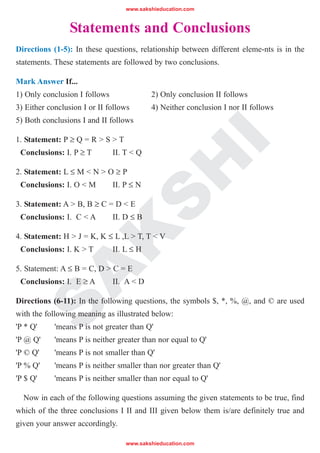
Directions (1-5): In these questions, relationship between different eleme-nts is in the
statements. These statements are followed by two conclusions.
Mark Answer If...
1) Only conclusion I follows 2) Only conclusion II follows
3) Either conclusion I or II follows 4) Neither conclusion I nor II follows
5) Both conclusions I and II follows
1. Statement: P ≥ Q = R > S > T
Conclusions: I. P ≥ T II. T < Q
2. Statement: L ≤ M < N > O ≥ P
Conclusions: I. O < M II. P ≤ N
3. Statement: A > B, B ≥ C = D < E
Conclusions: I. C < A II. D ≤ B
4. Statement: H > J = K, K ≤ L ,L > T, T < V
Conclusions: I. K > T II. L ≤ H
5. Statement: A ≤ B = C, D > C = E
Conclusions: I. E ≥ A II. A < D
Directions (6-11): In the following questions, the symbols $, *, %, @, and © are used
with the following meaning as illustrated below:
'P * Q' 'means P is not greater than Q'
'P @ Q' 'means P is neither greater than nor equal to Q'
'P © Q' 'means P is not smaller than Q'
'P % Q' 'means P is neither smaller than nor greater than Q'
'P $ Q' 'means P is neither smaller than nor equal to Q'
Now in each of the following questions assuming the given statements to be true, find
which of the three conclusions I II and III given below them is/are definitely true and
given your answer accordingly.
S
A
K
S
H
I
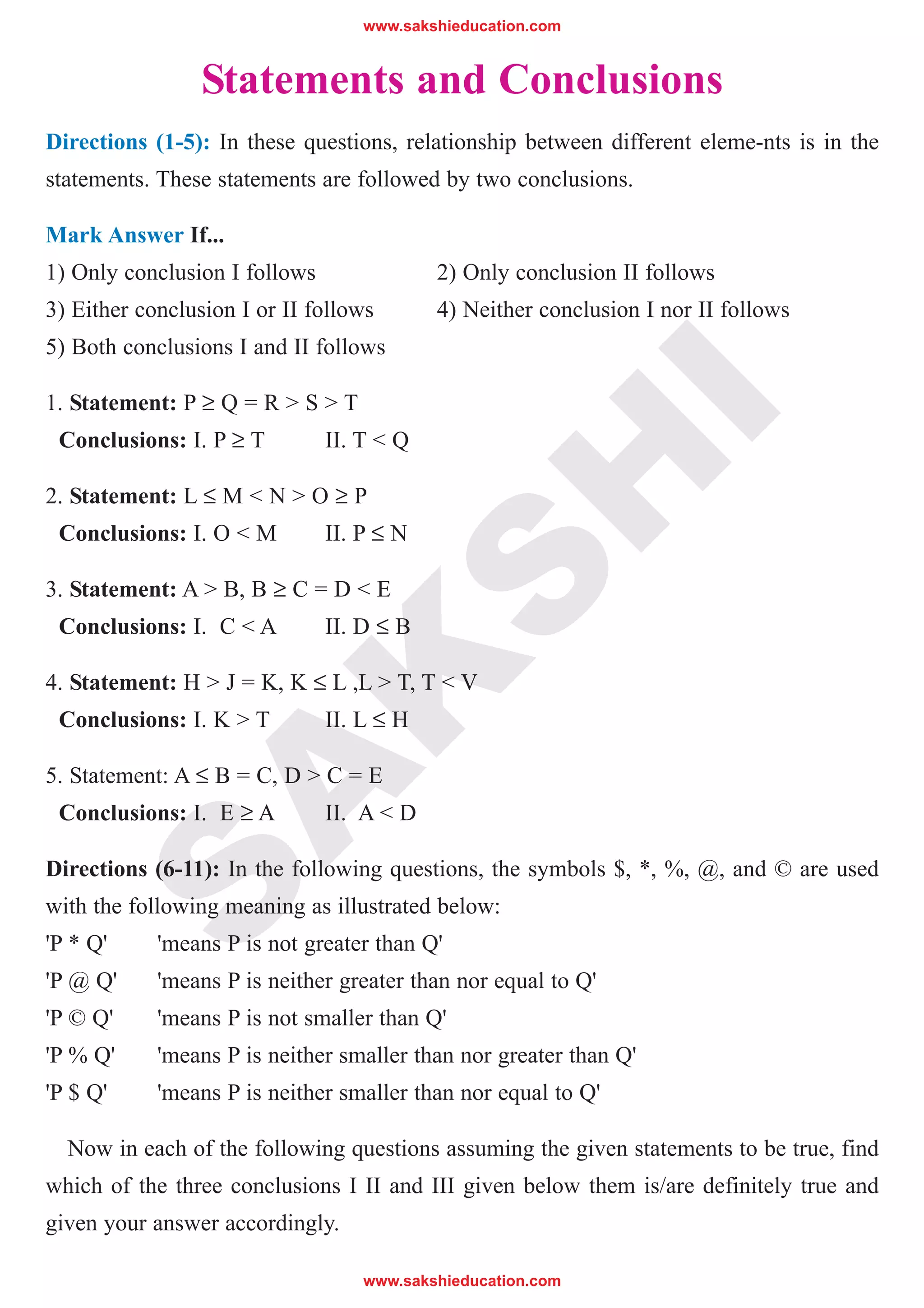
6. Statements: R© K, K $ M, M * J
Conclusions: I. J $ K II. M @ R III. M % R
1) None is true 2) only I is true 3) only II is true
4) only either I or III is true 5) only III is true
7. Statements: D @ K, K % F, F © B
Conclusions: I. F $ D II. B @ K III. B % K
1) Only I is true 2) only II is true 3) only III is true
4) only either II or III is true 5) only either II or III & I is true
8. Statements: H * W, W @ N, N % R
Conclusions: I. R $ W II. N $ W III. H @ R
1) Only I and II are true 2) only II and III are true 3) only I and III are true
4) All I, II and III are True 5) None of these
9. Statements: Z % M, M * F, F $ D
Conclusions: I. F % Z II. F $ Z III. D @ Z
1) Only I is true 2) only either I or II is true 3) only II is true
4) only III is true 5) None of these
10. Statements: R $ B, B © N, N @ T
Conclusions: I. N @ R II. T $ B III. T $ R
1) None is true 2) only I is true 3) only II is true
4) only III is true 5) only I and II are true
11. Statements: W ©K, K $ R, R % N
Conclusions: I.N @ K II.R @ W III.W $ N
1) Only I and II are true 2) only either II or III is true
3) only II and III are true 4) only I and III are true
5) All I, II and III are true
Directions (12-18): In the following questions, the symbols $, %, @, ©, and * are used
with the following meaning as illustrated below:
'P % Q' 'means P is neither greater than nor smaller than Q'
'P $ Q' 'means P is neither smaller than nor equal to Q'
www.sakshieducation.com
S
A
K
S
H
I
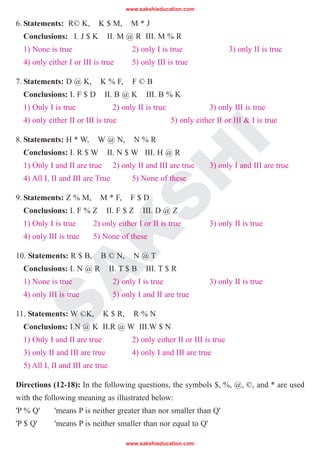
'P © Q' 'means P is neither greater than nor equal to Q'
'P * Q' 'means P is not greater than Q'
'P @ Q' 'means P is not smaller than Q'
Now in each of the following questions assuming the given statements to be true, find
which of the three conclusions I II and III given below them is/are definitely true and
given your answer accordingly.
12. Statements: V © K, K @ B, B $ M
Conclusions: I. V © K II. M © K III. M © V
1) None is true 2) only I is true 3) only II is true
4) only III is true 5) only I and III are true
13. Statements:D * R, R % F, F $ T
Conclusions:I. F % D II. F $ D III. T © R
1) Only I is true 2) only II is true 3) only III is true
4) only either I or II is true 5) only either I or II & III are true
14. Statements: N @ D, D * K, K $ A
Conclusions: I. K @ N II. A © D III. N $ A
1) None is true 2) only I is true 3) only II is true
4) only III is true 5) only II and III is true
15. Statements: K @ T, T $ N, N © R
Conclusions: I. R $ Z II. N * K III. K $ N
1) None is true 2) only I is true 3) only II is true
4) only III is true 5) only II and III are true
16. Statements: W % K, K © F, D $ F
Conclusions: I. D $ K II. D $ W III. F @ W
1) only I and III are true 2) only I and II true 3) only II and III is true
4) All I, II and III are true 5) None of these
17. Statements: B * K, K © F, F % R
Conclusions: I. R $ K II. R $ B III. F $ B
1) Only I and II are true 2) only I and III are true
3) only II and III are true 4) All I, II and III are true 5) only I and II are true
www.sakshieducation.com
S
A
K
S
H
I
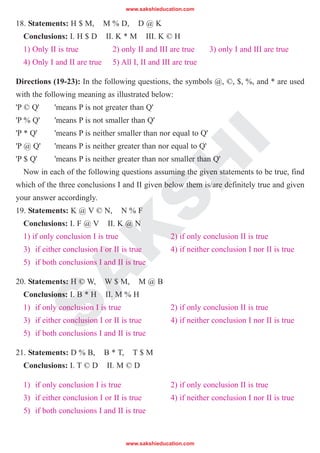
18. Statements: H $ M, M % D, D @ K
Conclusions: I. H $ D II. K * M III. K © H
1) Only II is true 2) only II and III are true 3) only I and III are true
4) Only I and II are true 5) All I, II and III are true
Directions (19-23): In the following questions, the symbols @, ©, $, %, and * are used
with the following meaning as illustrated below:
'P © Q' 'means P is not greater than Q'
'P % Q' 'means P is not smaller than Q'
'P * Q' 'means P is neither smaller than nor equal to Q'
'P @ Q' 'means P is neither greater than nor equal to Q'
'P $ Q' 'means P is neither greater than nor smaller than Q'
Now in each of the following questions assuming the given statements to be true, find
which of the three conclusions I and II given below them is/are definitely true and given
your answer accordingly.
19. Statements: K @ V © N, N % F
Conclusions: I. F @ V II. K @ N
1) if only conclusion I is true 2) if only conclusion II is true
3) if either conclusion I or II is true 4) if neither conclusion I nor II is true
5) if both conclusions I and II is true
20. Statements: H © W, W $ M, M @ B
Conclusions: I. B * H II. M % H
1) if only conclusion I is true 2) if only conclusion II is true
3) if either conclusion I or II is true 4) if neither conclusion I nor II is true
5) if both conclusions I and II is true
21. Statements: D % B, B * T, T $ M
Conclusions: I. T © D II. M © D
1) if only conclusion I is true 2) if only conclusion II is true
3) if either conclusion I or II is true 4) if neither conclusion I nor II is true
5) if both conclusions I and II is true
www.sakshieducation.com
S
A
K
S
H
I
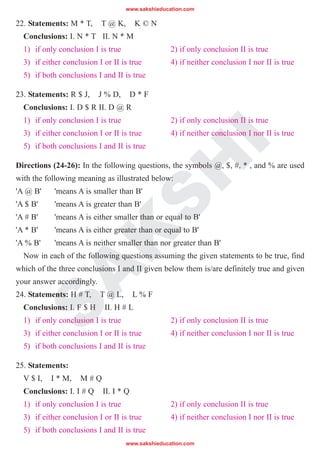
22. Statements: M * T, T @ K, K © N
Conclusions: I. N * T II. N * M
1) if only conclusion I is true 2) if only conclusion II is true
3) if either conclusion I or II is true 4) if neither conclusion I nor II is true
5) if both conclusions I and II is true
23. Statements: R $ J, J % D, D * F
Conclusions: I. D $ R II. D @ R
1) if only conclusion I is true 2) if only conclusion II is true
3) if either conclusion I or II is true 4) if neither conclusion I nor II is true
5) if both conclusions I and II is true
Directions (24-26): In the following questions, the symbols @, $, #, * , and % are used
with the following meaning as illustrated below:
'A @ B' 'means A is smaller than B'
'A $ B' 'means A is greater than B'
'A # B' 'means A is either smaller than or equal to B'
'A * B' 'means A is either greater than or equal to B'
'A % B' 'means A is neither smaller than nor greater than B'
Now in each of the following questions assuming the given statements to be true, find
which of the three conclusions I and II given below them is/are definitely true and given
your answer accordingly.
24. Statements: H # T, T @ L, L % F
Conclusions: I. F $ H II. H # L
1) if only conclusion I is true 2) if only conclusion II is true
3) if either conclusion I or II is true 4) if neither conclusion I nor II is true
5) if both conclusions I and II is true
25. Statements:
V $ I, I * M, M # Q
Conclusions: I. I # Q II. I * Q
1) if only conclusion I is true 2) if only conclusion II is true
3) if either conclusion I or II is true 4) if neither conclusion I nor II is true
5) if both conclusions I and II is true
www.sakshieducation.com
S
A
K
S
H
I
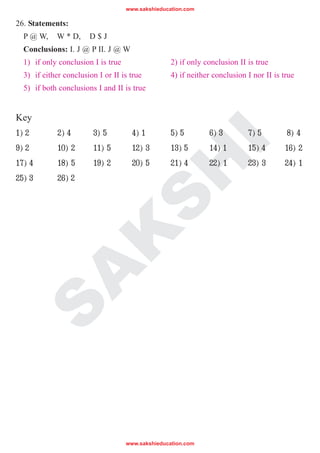
26. Statements:
P @ W, W * D, D $ J
Conclusions: I. J @ P II. J @ W
1) if only conclusion I is true 2) if only conclusion II is true
3) if either conclusion I or II is true 4) if neither conclusion I nor II is true
5) if both conclusions I and II is true
Key
1) 2 2) 4 3) 5 4) 1 5) 5 6) 3 7) 5 8) 4
9) 2 10) 2 11) 5 12) 3 13) 5 14) 1 15) 4 16) 2
17) 4 18) 5 19) 2 20) 5 21) 4 22) 1 23) 3 24) 1
25) 3 26) 2
www.sakshieducation.com

Statements conclusions

  • 1.
    www.sakshieducation.com www.sakshieducation.com S A K S H I Statements and Conclusions Directions(1-5): In these questions, relationship between different eleme-nts is in the statements. These statements are followed by two conclusions. Mark Answer If... 1) Only conclusion I follows 2) Only conclusion II follows 3) Either conclusion I or II follows 4) Neither conclusion I nor II follows 5) Both conclusions I and II follows 1. Statement: P ≥ Q = R > S > T Conclusions: I. P ≥ T II. T < Q 2. Statement: L ≤ M < N > O ≥ P Conclusions: I. O < M II. P ≤ N 3. Statement: A > B, B ≥ C = D < E Conclusions: I. C < A II. D ≤ B 4. Statement: H > J = K, K ≤ L ,L > T, T < V Conclusions: I. K > T II. L ≤ H 5. Statement: A ≤ B = C, D > C = E Conclusions: I. E ≥ A II. A < D Directions (6-11): In the following questions, the symbols $, *, %, @, and © are used with the following meaning as illustrated below: 'P * Q' 'means P is not greater than Q' 'P @ Q' 'means P is neither greater than nor equal to Q' 'P © Q' 'means P is not smaller than Q' 'P % Q' 'means P is neither smaller than nor greater than Q' 'P $ Q' 'means P is neither smaller than nor equal to Q' Now in each of the following questions assuming the given statements to be true, find which of the three conclusions I II and III given below them is/are definitely true and given your answer accordingly.
  • 2.
    S A K S H I 6. Statements: R©K, K $ M, M * J Conclusions: I. J $ K II. M @ R III. M % R 1) None is true 2) only I is true 3) only II is true 4) only either I or III is true 5) only III is true 7. Statements: D @ K, K % F, F © B Conclusions: I. F $ D II. B @ K III. B % K 1) Only I is true 2) only II is true 3) only III is true 4) only either II or III is true 5) only either II or III & I is true 8. Statements: H * W, W @ N, N % R Conclusions: I. R $ W II. N $ W III. H @ R 1) Only I and II are true 2) only II and III are true 3) only I and III are true 4) All I, II and III are True 5) None of these 9. Statements: Z % M, M * F, F $ D Conclusions: I. F % Z II. F $ Z III. D @ Z 1) Only I is true 2) only either I or II is true 3) only II is true 4) only III is true 5) None of these 10. Statements: R $ B, B © N, N @ T Conclusions: I. N @ R II. T $ B III. T $ R 1) None is true 2) only I is true 3) only II is true 4) only III is true 5) only I and II are true 11. Statements: W ©K, K $ R, R % N Conclusions: I.N @ K II.R @ W III.W $ N 1) Only I and II are true 2) only either II or III is true 3) only II and III are true 4) only I and III are true 5) All I, II and III are true Directions (12-18): In the following questions, the symbols $, %, @, ©, and * are used with the following meaning as illustrated below: 'P % Q' 'means P is neither greater than nor smaller than Q' 'P $ Q' 'means P is neither smaller than nor equal to Q' www.sakshieducation.com www.sakshieducation.com
  • 3.
    S A K S H I 'P © Q''means P is neither greater than nor equal to Q' 'P * Q' 'means P is not greater than Q' 'P @ Q' 'means P is not smaller than Q' Now in each of the following questions assuming the given statements to be true, find which of the three conclusions I II and III given below them is/are definitely true and given your answer accordingly. 12. Statements: V © K, K @ B, B $ M Conclusions: I. V © K II. M © K III. M © V 1) None is true 2) only I is true 3) only II is true 4) only III is true 5) only I and III are true 13. Statements:D * R, R % F, F $ T Conclusions:I. F % D II. F $ D III. T © R 1) Only I is true 2) only II is true 3) only III is true 4) only either I or II is true 5) only either I or II & III are true 14. Statements: N @ D, D * K, K $ A Conclusions: I. K @ N II. A © D III. N $ A 1) None is true 2) only I is true 3) only II is true 4) only III is true 5) only II and III is true 15. Statements: K @ T, T $ N, N © R Conclusions: I. R $ Z II. N * K III. K $ N 1) None is true 2) only I is true 3) only II is true 4) only III is true 5) only II and III are true 16. Statements: W % K, K © F, D $ F Conclusions: I. D $ K II. D $ W III. F @ W 1) only I and III are true 2) only I and II true 3) only II and III is true 4) All I, II and III are true 5) None of these 17. Statements: B * K, K © F, F % R Conclusions: I. R $ K II. R $ B III. F $ B 1) Only I and II are true 2) only I and III are true 3) only II and III are true 4) All I, II and III are true 5) only I and II are true www.sakshieducation.com www.sakshieducation.com
  • 4.
    S A K S H I 18. Statements: H$ M, M % D, D @ K Conclusions: I. H $ D II. K * M III. K © H 1) Only II is true 2) only II and III are true 3) only I and III are true 4) Only I and II are true 5) All I, II and III are true Directions (19-23): In the following questions, the symbols @, ©, $, %, and * are used with the following meaning as illustrated below: 'P © Q' 'means P is not greater than Q' 'P % Q' 'means P is not smaller than Q' 'P * Q' 'means P is neither smaller than nor equal to Q' 'P @ Q' 'means P is neither greater than nor equal to Q' 'P $ Q' 'means P is neither greater than nor smaller than Q' Now in each of the following questions assuming the given statements to be true, find which of the three conclusions I and II given below them is/are definitely true and given your answer accordingly. 19. Statements: K @ V © N, N % F Conclusions: I. F @ V II. K @ N 1) if only conclusion I is true 2) if only conclusion II is true 3) if either conclusion I or II is true 4) if neither conclusion I nor II is true 5) if both conclusions I and II is true 20. Statements: H © W, W $ M, M @ B Conclusions: I. B * H II. M % H 1) if only conclusion I is true 2) if only conclusion II is true 3) if either conclusion I or II is true 4) if neither conclusion I nor II is true 5) if both conclusions I and II is true 21. Statements: D % B, B * T, T $ M Conclusions: I. T © D II. M © D 1) if only conclusion I is true 2) if only conclusion II is true 3) if either conclusion I or II is true 4) if neither conclusion I nor II is true 5) if both conclusions I and II is true www.sakshieducation.com www.sakshieducation.com
  • 5.
    S A K S H I 22. Statements: M* T, T @ K, K © N Conclusions: I. N * T II. N * M 1) if only conclusion I is true 2) if only conclusion II is true 3) if either conclusion I or II is true 4) if neither conclusion I nor II is true 5) if both conclusions I and II is true 23. Statements: R $ J, J % D, D * F Conclusions: I. D $ R II. D @ R 1) if only conclusion I is true 2) if only conclusion II is true 3) if either conclusion I or II is true 4) if neither conclusion I nor II is true 5) if both conclusions I and II is true Directions (24-26): In the following questions, the symbols @, $, #, * , and % are used with the following meaning as illustrated below: 'A @ B' 'means A is smaller than B' 'A $ B' 'means A is greater than B' 'A # B' 'means A is either smaller than or equal to B' 'A * B' 'means A is either greater than or equal to B' 'A % B' 'means A is neither smaller than nor greater than B' Now in each of the following questions assuming the given statements to be true, find which of the three conclusions I and II given below them is/are definitely true and given your answer accordingly. 24. Statements: H # T, T @ L, L % F Conclusions: I. F $ H II. H # L 1) if only conclusion I is true 2) if only conclusion II is true 3) if either conclusion I or II is true 4) if neither conclusion I nor II is true 5) if both conclusions I and II is true 25. Statements: V $ I, I * M, M # Q Conclusions: I. I # Q II. I * Q 1) if only conclusion I is true 2) if only conclusion II is true 3) if either conclusion I or II is true 4) if neither conclusion I nor II is true 5) if both conclusions I and II is true www.sakshieducation.com www.sakshieducation.com
  • 6.
    S A K S H I 26. Statements: P @W, W * D, D $ J Conclusions: I. J @ P II. J @ W 1) if only conclusion I is true 2) if only conclusion II is true 3) if either conclusion I or II is true 4) if neither conclusion I nor II is true 5) if both conclusions I and II is true Key 1) 2 2) 4 3) 5 4) 1 5) 5 6) 3 7) 5 8) 4 9) 2 10) 2 11) 5 12) 3 13) 5 14) 1 15) 4 16) 2 17) 4 18) 5 19) 2 20) 5 21) 4 22) 1 23) 3 24) 1 25) 3 26) 2 www.sakshieducation.com www.sakshieducation.com