What’s your State of Place™ ?


  A  streamlined  decision-­‐‑making  tool  that  makes  it  easier  and  more  
cost  efficient  for  cities  to  enhance  walkability  and  maximize  the  triple  
           bo;om  line  in  a  transparent  and  accountable  way	

                                                      Mariela Alfonzo, Ph.D.
                                                     Founder, State of Place
                                                    President, Urban Imprint
                                Research Fellow/Adjunct Professor, NYU-Poly
                                        www.urbanimprint.com/state-of-place
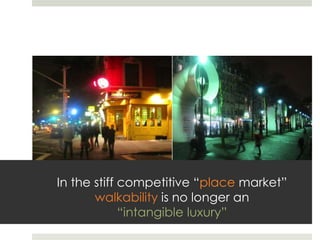
In the stiff competitive “place market”
       walkability is no longer an
             “intangible luxury”
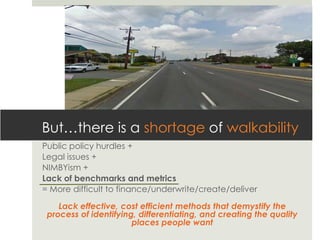
But…there is a shortage of walkability
Public policy hurdles +
Legal issues +
NIMBYism +
Lack of benchmarks and metrics
= More difficult to finance/underwrite/create/deliver

    Lack effective, cost efficient methods that demystify the
 process of identifying, differentiating, and creating the quality
                       places people want
Enter, State of Place™ ?

¤  Art  à  Science:  Quantifying  walkability	
¤  Comprehensive,  Objective,  Reliable	
¤  Captures  “Micro-­‐‑scale”  &  “Sensory”  features	
¤  Diagnostic,  Empirically-­‐‑Based	
¤  Ties  Place  Quality,  Economic  Impact	
¤  Facilitates  Evidence-­‐‑based  decision  making,  Accountability	
¤  Provides  empirically-­‐‑based  ROI  predictions,  Customizable
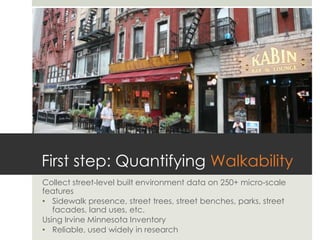
First step: Quantifying Walkability
Collect street-level built environment data on 250+ micro-scale
features
•  Sidewalk presence, street trees, street benches, parks, street
   facades, land uses, etc.
Using Irvine Minnesota Inventory
•  Reliable, used widely in research
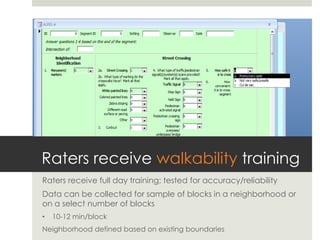
Raters receive walkability training
Raters receive full day training; tested for accuracy/reliability
Data can be collected for sample of blocks in a neighborhood or
on a select number of blocks
•  10-12 min/block
Neighborhood defined based on existing boundaries
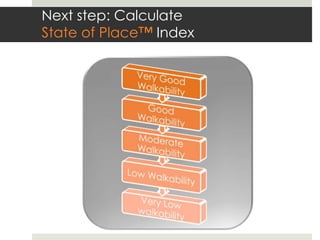
Next step: Calculate
State of Place™ Index
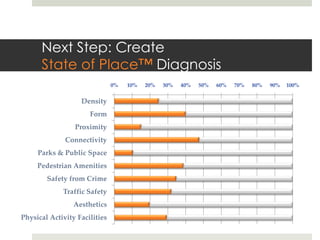
Next Step: Create
       State of Place™ Diagnosis
                               0%	
 10%	
 20%	
 30%	
 40%	
 50%	
 60%	
 70%	
 80%	
 90%	
 100%	

                     Density	
                        Form	
                  Proximity	
               Connectivity	
     Parks  &  Public  Space	
     Pedestrian  Amenities	
         Safety  from  Crime	
               Traffic  Safety	
                  Aesthetics	
Physical  Activity  Facilities
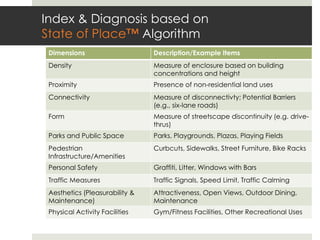
Index & Diagnosis based on
State of Place™ Algorithm
 Dimensions                     Description/Example Items
 Density                        Measure of enclosure based on building
                                concentrations and height
 Proximity                      Presence of non-residential land uses
 Connectivity                   Measure of disconnectivty; Potential Barriers
                                (e.g., six-lane roads)
 Form                           Measure of streetscape discontinuity (e.g. drive-
                                thrus)
 Parks and Public Space         Parks, Playgrounds, Plazas, Playing Fields
 Pedestrian Infrastructure/     Curbcuts, Sidewalks, Street Furniture, Bike Racks
 Amenities
 Personal Safety                Graffiti, Litter, Windows with Bars
 Traffic Measures               Traffic Signals, Speed Limit, Traffic Calming
 Aesthetics (Pleasurability &   Attractiveness, Open Views, Outdoor Dining,
 Maintenance)                   Maintenance
 Physical Activity Facilities   Gym/Fitness Facilities, Other Recreational Uses
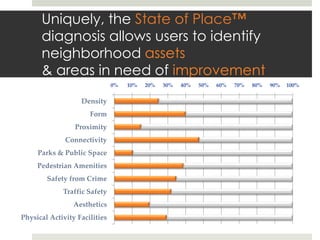
Uniquely, the State of Place™
       diagnosis allows users to identify
       neighborhood assets
       & areas in need of improvement
                               0%	
 10%	
 20%	
 30%	
 40%	
 50%	
 60%	
 70%	
 80%	
 90%	
 100%	

                     Density	
                        Form	
                  Proximity	
               Connectivity	
     Parks  &  Public  Space	
     Pedestrian  Amenities	
         Safety  from  Crime	
               Traffic  Safety	
                  Aesthetics	
Physical  Activity  Facilities
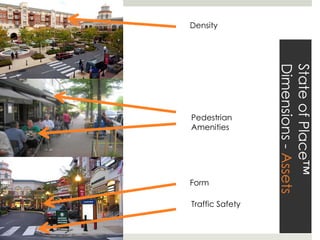
Density


                 Dimensions - Assets
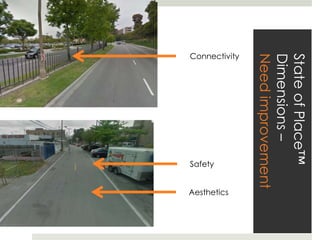
                 State of Place™
Pedestrian
Amenities


Form

Traffic Safety
State of Place™
  Dimensions –
  Need improvement
Connectivity


                        Aesthetics
               Safety
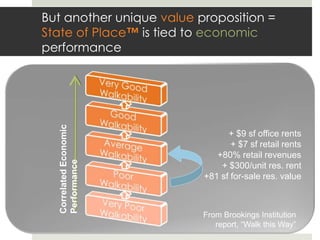
But another key value proposition =
State of Place™ is tied to economic
performance
   Correlated Economic Performance


                                          + $9 sf office rents
                                          + $7 sf retail rents
                                        +80% retail revenues
                                       + $300/unit res. rent
                                     +81 sf for-sale res. value


                                     From Brookings Institution
                                        report, “Walk this Way”
State of Place™ is a powerful
decision-making tool
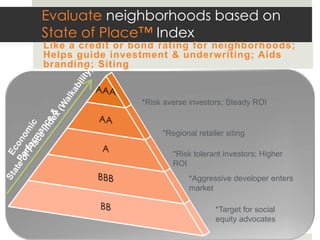
Evaluate neighborhoods based on
State of Place™ Index
Like a credit or bond rating for neighborhoods; Helps
guide investment & underwriting; Aids branding; Siting


                     *Risk averse investors; Steady ROI


                           *Regional retailer siting

                              *Risk tolerant investors; Higher ROI


                                   *Aggressive developer enters market


                                            *Target for social
                                            equity advocates
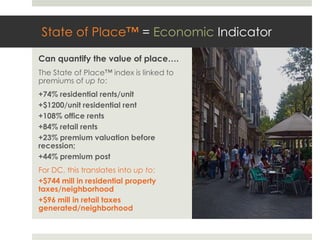
State of Place™ = Economic Indicator

Can quantify the value of place….
The State of Place™ index is linked to
premiums of up to:
+74% residential rents/unit
+$1200/unit residential rent
+108% office rents
+84% retail rents
+23% premium valuation before
recession;
+44% premium post
For DC, this translates into up to:
+$744 mill in residential property taxes/
neighborhood
+$96 mill in retail taxes generated/
neighborhood
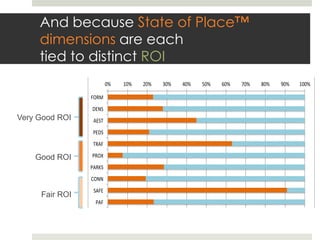
And because State of Place™
     dimensions are each
     tied to distinct ROI
                                                    !"#"$%&'(%)*'
                         !"#   $!"#   %!"#   &!"#   '!"#   (!"#     )!"#   *!"#   +!"#   ,!"#   $!!"#

                -./0#
                1234#
Very Good ROI    5246#
                 7214#
                 6/5-#

    Good ROI    7/.8#
                75/94#
                :.33#
                 45-2#
     Fair ROI
                  75-#
!"#"$%&'(%)*'
                    !"#   $!"#   %!"#   &!"#   '!"#   (!"#     )!"#   *!"#   +!"#   ,!"#   $!!"#

           -./0#
 Very
Good        1234#

 ROI        5246#
            7214#
            6/5-#
Good
            7/.8#
 ROI
           75/94#
            :.33#
 Fair       45-2#
 ROI         75-#


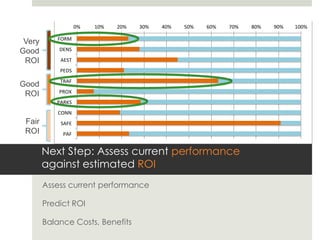
        Next Step: Assess current performance
        against estimated ROI
        Assess current performance

        Predict ROI

        Balance Costs, Benefits
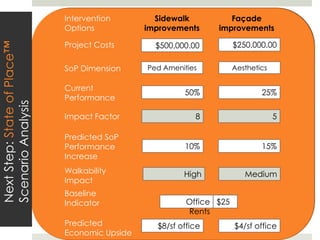
Intervention             Sidewalk               Façade
Scenario Analysis - EXAMPLE    Options              improvement           improvement

                               Project Costs         $500,000.00          $250,000.00

                               SoP Dimension       Ped. Amenities         Aesthetics

                               Current
                                                             50%                  25%
                               Performance
State of Place™


                              ROI Impact Factor                 6                      7

                              Predicted SoP
                              Performance                    10%                  15%
                              Increase
                              Walkability Impact                7                      4


                              Baseline Indicator       Office Rents $25

                              Predicted                  $3.13/sf             $1.89/sf
                              Economic Upside
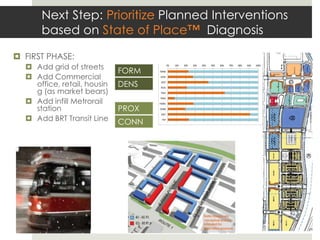
Next Step: Prioritize Planned Interventions
       based on State of Place™ Diagnosis

¤  FIRST PHASE:                                                         !"#"$%&'(%)*'

   ¤  Add grid of streets                    !"#   $!"#   %!"#   &!"#   '!"#   (!"#     )!"#   *!"#   +!"#   ,!"#   $!!"#

                              FORM   -./0#

   ¤  Add Commercial                1234#


       office, retail,        DENS    5246#
                                      7214#

       housing (as market             6/5-#

       bears)                        7/.8#
                                     75/94#

   ¤  Add infill Metrorail   PROX   :.33#


       station                        45-2#


                              CONN
                                       75-#

   ¤  Add BRT Transit Line
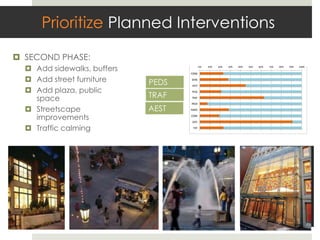
Prioritize Planned Interventions
¤  SECOND PHASE:                                                         !"#"$%&'(%)*'

  ¤  Add sidewalks, buffers          -./0#
                                               !"#   $!"#   %!"#   &!"#   '!"#   (!"#     )!"#   *!"#   +!"#   ,!"#   $!!"#


  ¤  Add street furniture     PEDS
                                      1234#
                                       5246#
  ¤  Add plaza, public                7214#

      space                    TRAF    6/5-#
                                      7/.8#

  ¤  Streetscape              AEST   75/94#

      improvements                    :.33#
                                       45-2#

  ¤  Traffic calming                   75-#
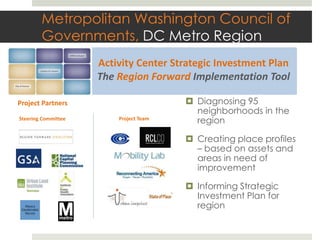
Metropolitan Washington Council of
        Governments, DC Metro Region
                     !"#$%$#& '()#(* +#*,#(-$" .)%(/#0()# 12,)
                     !"# $#%&'( )'*+,*- ./01#/#(2,2&'( !''1

!"#$%&' !("')%"*                        ¤  Diagnosing 95
                                            neighborhoods in the
+'%%",)- .#//,''%%   !"#$%&' ()&*#++ ,%%')-.
                         !"#$%&' 0%(/
                                            region
                       /%5'%60%"7
                       / ' 0 12 3412
                                        ¤  Creating place profiles
                                            – based on assets and
                                            areas in need of
                                            improvement

                                        ¤  Informing Strategic
                                            Investment Plan for
                                            region
Conservation Law Foundation
Ventures, Boston, MA

¤  CLFV à Creating Healthy Neighborhood Equity Fund

¤  Piloting State of Place™ as project & neighborhood
    screening tool

¤  Creating estimated State of Place™ scores based on
    proposed projects
  ¤  Calculating potential upside
State of Place™ current & future “imprint”…

¤  Applicable across urban, suburban, & rural communities
   ¤  IMI data has been collected in California, Minneapolis, Houston, Iowa, North
       Carolina RT, Denver, Salt Lake City, Kansas, Arkansas, Michigan, Illinois…

¤  Rolling out State of Place in other metros
   ¤  San Francisco/Bay area – Spring 2013
   ¤  Houston, Phoenix, Seattle, Los Angeles

¤  Incorporating a broader set of economic indicators
   ¤  Job creation, retention, firm recruitment
   ¤  Health Metrics

¤  App – available soon!

¤  Partnering with universities

¤  Working with underprivileged community
   ¤    Brownsville + NYU-Poly

¤  China – in progress!
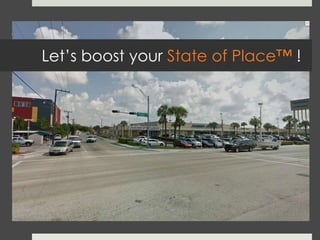
Let’s boost your State of Place™ !
What’s your State of Place™ ?


     www.urbanimprint.com/state-of-place

What's your State of Place™ ? A decision-making tool for walkability interventions, investments, and policy that maximize the triple bottom line

  • 1.
    What’s your Stateof Place™ ? A  streamlined  decision-­‐‑making  tool  that  makes  it  easier  and  more   cost  efficient  for  cities  to  enhance  walkability  and  maximize  the  triple   bo;om  line  in  a  transparent  and  accountable  way Mariela Alfonzo, Ph.D. Founder, State of Place President, Urban Imprint Research Fellow/Adjunct Professor, NYU-Poly www.urbanimprint.com/state-of-place
  • 2.
    In the stiffcompetitive “place market” walkability is no longer an “intangible luxury”
  • 3.
    But…there is ashortage of walkability Public policy hurdles + Legal issues + NIMBYism + Lack of benchmarks and metrics = More difficult to finance/underwrite/create/deliver Lack effective, cost efficient methods that demystify the process of identifying, differentiating, and creating the quality places people want
  • 4.
    Enter, State ofPlace™ ? ¤  Art  à  Science:  Quantifying  walkability ¤  Comprehensive,  Objective,  Reliable ¤  Captures  “Micro-­‐‑scale”  &  “Sensory”  features ¤  Diagnostic,  Empirically-­‐‑Based ¤  Ties  Place  Quality,  Economic  Impact ¤  Facilitates  Evidence-­‐‑based  decision  making,  Accountability ¤  Provides  empirically-­‐‑based  ROI  predictions,  Customizable
  • 5.
    First step: QuantifyingWalkability Collect street-level built environment data on 250+ micro-scale features •  Sidewalk presence, street trees, street benches, parks, street facades, land uses, etc. Using Irvine Minnesota Inventory •  Reliable, used widely in research
  • 6.
    Raters receive walkabilitytraining Raters receive full day training; tested for accuracy/reliability Data can be collected for sample of blocks in a neighborhood or on a select number of blocks •  10-12 min/block Neighborhood defined based on existing boundaries
  • 7.
    Next step: Calculate Stateof Place™ Index
  • 8.
    Next Step: Create State of Place™ Diagnosis 0% 10% 20% 30% 40% 50% 60% 70% 80% 90% 100% Density Form Proximity Connectivity Parks  &  Public  Space Pedestrian  Amenities Safety  from  Crime Traffic  Safety Aesthetics Physical  Activity  Facilities
  • 9.
    Index & Diagnosisbased on State of Place™ Algorithm Dimensions Description/Example Items Density Measure of enclosure based on building concentrations and height Proximity Presence of non-residential land uses Connectivity Measure of disconnectivty; Potential Barriers (e.g., six-lane roads) Form Measure of streetscape discontinuity (e.g. drive- thrus) Parks and Public Space Parks, Playgrounds, Plazas, Playing Fields Pedestrian Infrastructure/ Curbcuts, Sidewalks, Street Furniture, Bike Racks Amenities Personal Safety Graffiti, Litter, Windows with Bars Traffic Measures Traffic Signals, Speed Limit, Traffic Calming Aesthetics (Pleasurability & Attractiveness, Open Views, Outdoor Dining, Maintenance) Maintenance Physical Activity Facilities Gym/Fitness Facilities, Other Recreational Uses
  • 10.
    Uniquely, the Stateof Place™ diagnosis allows users to identify neighborhood assets & areas in need of improvement 0% 10% 20% 30% 40% 50% 60% 70% 80% 90% 100% Density Form Proximity Connectivity Parks  &  Public  Space Pedestrian  Amenities Safety  from  Crime Traffic  Safety Aesthetics Physical  Activity  Facilities
  • 11.
    Density Dimensions - Assets State of Place™ Pedestrian Amenities Form Traffic Safety
  • 12.
    State of Place™ Dimensions – Need improvement Connectivity Aesthetics Safety
  • 13.
    But another keyvalue proposition = State of Place™ is tied to economic performance Correlated Economic Performance + $9 sf office rents + $7 sf retail rents +80% retail revenues + $300/unit res. rent +81 sf for-sale res. value From Brookings Institution report, “Walk this Way”
  • 14.
    State of Place™is a powerful decision-making tool
  • 15.
    Evaluate neighborhoods basedon State of Place™ Index Like a credit or bond rating for neighborhoods; Helps guide investment & underwriting; Aids branding; Siting *Risk averse investors; Steady ROI *Regional retailer siting *Risk tolerant investors; Higher ROI *Aggressive developer enters market *Target for social equity advocates
  • 16.
    State of Place™= Economic Indicator Can quantify the value of place…. The State of Place™ index is linked to premiums of up to: +74% residential rents/unit +$1200/unit residential rent +108% office rents +84% retail rents +23% premium valuation before recession; +44% premium post For DC, this translates into up to: +$744 mill in residential property taxes/ neighborhood +$96 mill in retail taxes generated/ neighborhood
  • 17.
    And because Stateof Place™ dimensions are each tied to distinct ROI !"#"$%&'(%)*' !"# $!"# %!"# &!"# '!"# (!"# )!"# *!"# +!"# ,!"# $!!"# -./0# 1234# Very Good ROI 5246# 7214# 6/5-# Good ROI 7/.8# 75/94# :.33# 45-2# Fair ROI 75-#
  • 18.
    !"#"$%&'(%)*' !"# $!"# %!"# &!"# '!"# (!"# )!"# *!"# +!"# ,!"# $!!"# -./0# Very Good 1234# ROI 5246# 7214# 6/5-# Good 7/.8# ROI 75/94# :.33# Fair 45-2# ROI 75-# Next Step: Assess current performance against estimated ROI Assess current performance Predict ROI Balance Costs, Benefits
  • 19.
    Intervention Sidewalk Façade Scenario Analysis - EXAMPLE Options improvement improvement Project Costs $500,000.00 $250,000.00 SoP Dimension Ped. Amenities Aesthetics Current 50% 25% Performance State of Place™ ROI Impact Factor 6 7 Predicted SoP Performance 10% 15% Increase Walkability Impact 7 4 Baseline Indicator Office Rents $25 Predicted $3.13/sf $1.89/sf Economic Upside
  • 20.
    Next Step: PrioritizePlanned Interventions based on State of Place™ Diagnosis ¤  FIRST PHASE: !"#"$%&'(%)*' ¤  Add grid of streets !"# $!"# %!"# &!"# '!"# (!"# )!"# *!"# +!"# ,!"# $!!"# FORM -./0# ¤  Add Commercial 1234# office, retail, DENS 5246# 7214# housing (as market 6/5-# bears) 7/.8# 75/94# ¤  Add infill Metrorail PROX :.33# station 45-2# CONN 75-# ¤  Add BRT Transit Line
  • 21.
    Prioritize Planned Interventions ¤ SECOND PHASE: !"#"$%&'(%)*' ¤  Add sidewalks, buffers -./0# !"# $!"# %!"# &!"# '!"# (!"# )!"# *!"# +!"# ,!"# $!!"# ¤  Add street furniture PEDS 1234# 5246# ¤  Add plaza, public 7214# space TRAF 6/5-# 7/.8# ¤  Streetscape AEST 75/94# improvements :.33# 45-2# ¤  Traffic calming 75-#
  • 22.
    Metropolitan Washington Councilof Governments, DC Metro Region !"#$%$#& '()#(* +#*,#(-$" .)%(/#0()# 12,) !"# $#%&'( )'*+,*- ./01#/#(2,2&'( !''1 !"#$%&' !("')%"* ¤  Diagnosing 95 neighborhoods in the +'%%",)- .#//,''%% !"#$%&' ()&*#++ ,%%')-. !"#$%&' 0%(/ region /%5'%60%"7 / ' 0 12 3412 ¤  Creating place profiles – based on assets and areas in need of improvement ¤  Informing Strategic Investment Plan for region
  • 23.
    Conservation Law Foundation Ventures,Boston, MA ¤  CLFV à Creating Healthy Neighborhood Equity Fund ¤  Piloting State of Place™ as project & neighborhood screening tool ¤  Creating estimated State of Place™ scores based on proposed projects ¤  Calculating potential upside
  • 24.
    State of Place™current & future “imprint”… ¤  Applicable across urban, suburban, & rural communities ¤  IMI data has been collected in California, Minneapolis, Houston, Iowa, North Carolina RT, Denver, Salt Lake City, Kansas, Arkansas, Michigan, Illinois… ¤  Rolling out State of Place in other metros ¤  San Francisco/Bay area – Spring 2013 ¤  Houston, Phoenix, Seattle, Los Angeles ¤  Incorporating a broader set of economic indicators ¤  Job creation, retention, firm recruitment ¤  Health Metrics ¤  App – available soon! ¤  Partnering with universities ¤  Working with underprivileged community ¤  Brownsville + NYU-Poly ¤  China – in progress!
  • 25.
    Let’s boost yourState of Place™ !
  • 26.
    What’s your Stateof Place™ ? www.urbanimprint.com/state-of-place

Editor's Notes

  • #2 Introduction
  • #3 In light of the competitive “place” marketplace, “walkability” is no longer an “intangible luxury.” Walkability contributes to quality of place – and it is increasingly in demand. Many Americans are choosing which place to “consume” based on the physical features of the neighborhood that allow them to walk and not have to rely on an automobile. Many planners, developers, investors, and city officials have begun to realize that addressing the demand for walkability is a critical factor in ensuring the economic growth and prosperity of places.
  • #4 Cities want for a tool that facilitates cost-efficient, transparent, and accountable decision-making regarding how best to deliver sustainable, walkable places.
  • #5 In the past, designing the built environment was generally considered to be more of an “art” than a “science.” But State of Place™™ has now not only quantified walkability – a critical component of what customers are increasingly demanding of places — but also its economic impact. Providing both a rating and a diagnosis, State of Place™™ is an empirically-based tool that makes it easier and more cost effective to identify quality places and make them better – from a triple bottom line (people, planet, and profit) perspective.
  • #8 So state of place puts these researchprinciples into practiceAs a rating system:Guide investment decisionsUnderwrite debt/equityBusinesses/Developers choose locationsAdvocates/social equity agencies (like HUD) identify places that need investment/helpFor example, a lender may choose to fund a new development in a AAA neighborhood over an A because it’s less risky; OR on the flip side, an investor may choose to develop in a level A over a level AAA because he or she sees more potential for up-side.
  • #14 Found 5 levels of walkability – attached to econ perf
  • #16 So state of place puts these researchprinciples into practiceAs a rating system:Guide investment decisionsUnderwrite debt/equityBusinesses/Developers choose locationsAdvocates/social equity agencies (like HUD) identify places that need investment/helpFor example, a lender may choose to fund a new development in a AAA neighborhood over an A because it’s less risky; OR on the flip side, an investor may choose to develop in a level A over a level AAA because he or she sees more potential for up-side.
  • #17 Translates into econ dev $$
  • #18 Will update this to reflect our conversation yesterday
  • #19 Will update this to reflect our conversation yesterday
  • #20 Will update this to reflect our conversation yesterday
  • #26 Aim = improve places like this!