Active Learning Lecture Slides  For use with Classroom Response Systems Elementary Statistics   Eleventh Edition  and the Triola Statistics Series  by Mario F. Triola Chapter 1:  Introduction to Statistics
The population is A collection of observations. A collection of methods for planning studies and experiments. The complete collection of all elements. D. A subcollection of members drawn from a larger group.
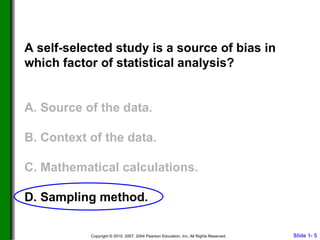
A self-selected study is a source of bias in which factor of statistical analysis? A. Source of the data. B. Context of the data. C. Mathematical calculations. D. Sampling method.
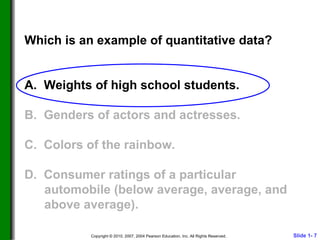
Which is an example of quantitative data? A.  Weights of high school students. B.  Genders of actors and actresses. C.  Colors of the rainbow. D.  Consumer ratings of a particular automobile (below average, average, and above average).
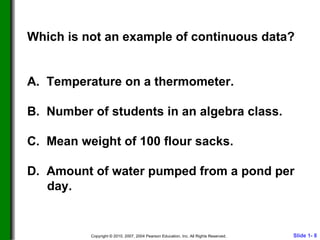
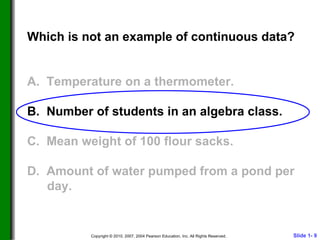
Which is not an example of continuous data? A.  Temperature on a thermometer. B.  Number of students in an algebra class. C.  Mean weight of 100 flour sacks. D.  Amount of water pumped from a pond per day.
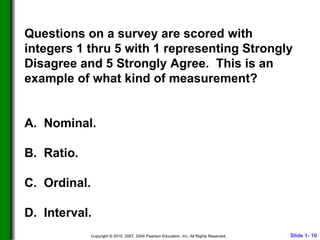
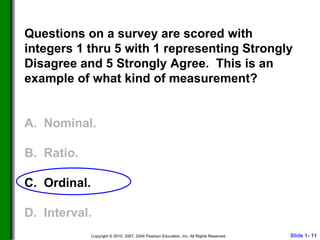
Questions on a survey are scored with integers 1 thru 5 with 1 representing Strongly Disagree and 5 Strongly Agree.  This is an example of what kind of measurement? A.  Nominal. B.  Ratio. C.  Ordinal. D.  Interval.
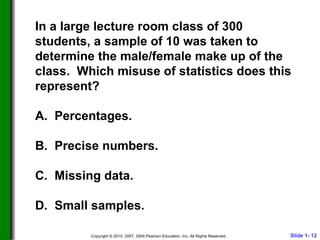
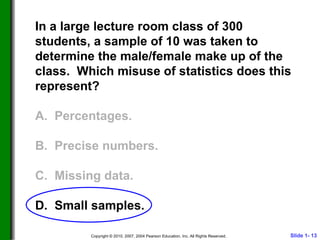
In a large lecture room class of 300 students, a sample of 10 was taken to determine the male/female make up of the class.  Which misuse of statistics does this represent? A.  Percentages. B.  Precise numbers. C.  Missing data. D.  Small samples.
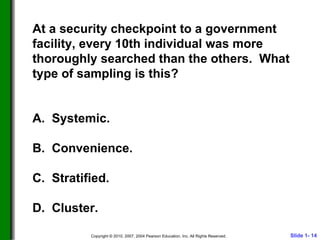
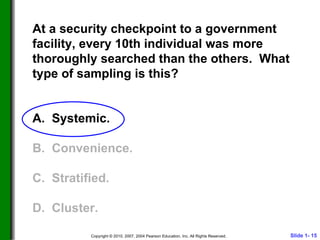
At a security checkpoint to a government facility, every 10th individual was more thoroughly searched than the others.  What type of sampling is this? A.  Systemic. B.  Convenience. C.  Stratified. D.  Cluster.
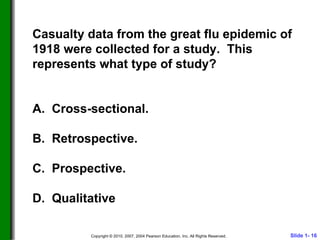
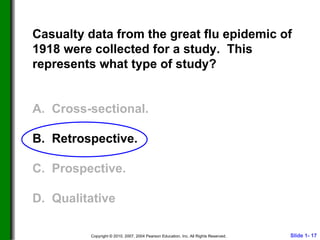
Casualty data from the great flu epidemic of 1918 were collected for a study.  This represents what type of study? A.  Cross-sectional. B.  Retrospective. C.  Prospective. D.  Qualitative

Stat11t alq chapter01

  • 1.
    Active Learning LectureSlides For use with Classroom Response Systems Elementary Statistics Eleventh Edition and the Triola Statistics Series by Mario F. Triola Chapter 1: Introduction to Statistics
  • 2.
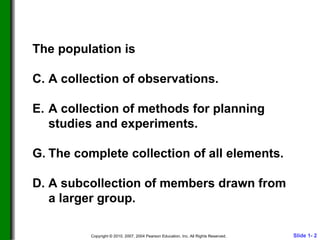
    The population isA collection of observations. A collection of methods for planning studies and experiments. The complete collection of all elements. D. A subcollection of members drawn from a larger group.
  • 3.
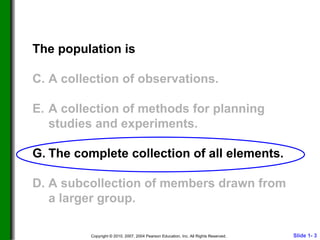
    The population isA collection of observations. A collection of methods for planning studies and experiments. The complete collection of all elements. D. A subcollection of members drawn from a larger group.
  • 4.
    A self-selected studyis a source of bias in which factor of statistical analysis? A. Source of the data. B. Context of the data. C. Mathematical calculations. D. Sampling method.
  • 5.
    A self-selected studyis a source of bias in which factor of statistical analysis? A. Source of the data. B. Context of the data. C. Mathematical calculations. D. Sampling method.
  • 6.
    Which is anexample of quantitative data? A. Weights of high school students. B. Genders of actors and actresses. C. Colors of the rainbow. D. Consumer ratings of a particular automobile (below average, average, and above average).
  • 7.
    Which is anexample of quantitative data? A. Weights of high school students. B. Genders of actors and actresses. C. Colors of the rainbow. D. Consumer ratings of a particular automobile (below average, average, and above average).
  • 8.
    Which is notan example of continuous data? A. Temperature on a thermometer. B. Number of students in an algebra class. C. Mean weight of 100 flour sacks. D. Amount of water pumped from a pond per day.
  • 9.
    Which is notan example of continuous data? A. Temperature on a thermometer. B. Number of students in an algebra class. C. Mean weight of 100 flour sacks. D. Amount of water pumped from a pond per day.
  • 10.
    Questions on asurvey are scored with integers 1 thru 5 with 1 representing Strongly Disagree and 5 Strongly Agree. This is an example of what kind of measurement? A. Nominal. B. Ratio. C. Ordinal. D. Interval.
  • 11.
    Questions on asurvey are scored with integers 1 thru 5 with 1 representing Strongly Disagree and 5 Strongly Agree. This is an example of what kind of measurement? A. Nominal. B. Ratio. C. Ordinal. D. Interval.
  • 12.
    In a largelecture room class of 300 students, a sample of 10 was taken to determine the male/female make up of the class. Which misuse of statistics does this represent? A. Percentages. B. Precise numbers. C. Missing data. D. Small samples.
  • 13.
    In a largelecture room class of 300 students, a sample of 10 was taken to determine the male/female make up of the class. Which misuse of statistics does this represent? A. Percentages. B. Precise numbers. C. Missing data. D. Small samples.
  • 14.
    At a securitycheckpoint to a government facility, every 10th individual was more thoroughly searched than the others. What type of sampling is this? A. Systemic. B. Convenience. C. Stratified. D. Cluster.
  • 15.
    At a securitycheckpoint to a government facility, every 10th individual was more thoroughly searched than the others. What type of sampling is this? A. Systemic. B. Convenience. C. Stratified. D. Cluster.
  • 16.
    Casualty data fromthe great flu epidemic of 1918 were collected for a study. This represents what type of study? A. Cross-sectional. B. Retrospective. C. Prospective. D. Qualitative
  • 17.
    Casualty data fromthe great flu epidemic of 1918 were collected for a study. This represents what type of study? A. Cross-sectional. B. Retrospective. C. Prospective. D. Qualitative