The Ultimate Guide to
Startup
Marketing
presents
Friday, December 20, 13
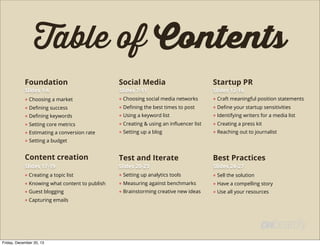
Table of Contents
Foundation Social Media Startup PR
● Choosing a market
● Defining success
● Defining keywords
● Setting core metrics
● Estimating a conversion rate
● Setting a budget
● Choosing social media networks
● Defining the best times to post
● Using a keyword list
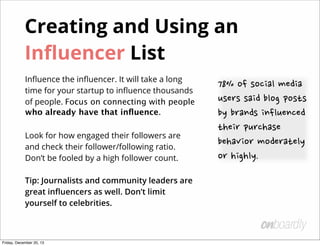
● Creating & using an influencer list
● Setting up a blog
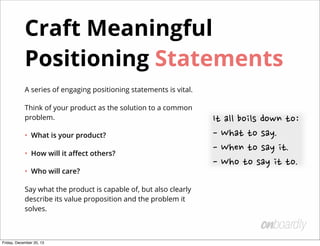
● Craft meaningful position statements
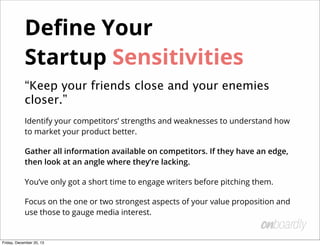
● Define your startup sensitivities
● Identifying writers for a media list
● Creating a press kit
● Reaching out to journalist
Content creation Test and Iterate Best Practices
● Creating a topic list
● Knowing what content to publish
● Guest blogging
● Capturing emails
● Setting up analytics tools
● Measuring against benchmarks
● Brainstorming creative new ideas
● Sell the solution
● Have a compelling story
● Use all your resources
Slides 1-6 Slides 7-11 Slides 12-16
Slides 17-19 Slides 20-23 Slides 24-27
Friday, December 20, 13
Startup Marketing
is a Whole
Different Science
“Build it and they will come” doesn’t work
Those overnight success stories are often the result of years of hard work.
Startup marketing is challenging because of limited resources (Time,
money, or talent.)
Every effort, no matter how small, must be flawlessly executed.
Traditional strategies don’t always work.
The secret is combining the right channels: Content marketing and PR.
Friday, December 20, 13
Foundation
Before you start laying bricks you need a solid
foundation. Learn how to choose a market, define
keywords, define success and set a budget.
Friday, December 20, 13
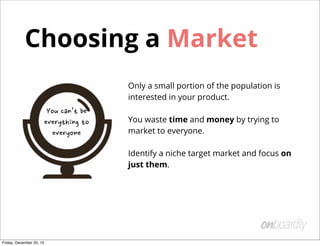
Choosing a Market
Only a small portion of the population is
interested in your product.
You waste time and money by trying to
market to everyone.
Identify a niche target market and focus on
just them.
You
 can’t
 be
 
everything
 to
 
everyone
Friday, December 20, 13
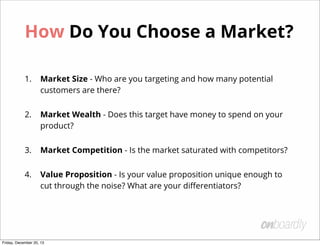
How Do You Choose a Market?
1. Market Size - Who are you targeting and how many potential
customers are there?
2. Market Wealth - Does this target have money to spend on your
product?
3. Market Competition - Is the market saturated with competitors?
4. Value Proposition - Is your value proposition unique enough to
cut through the noise? What are your differentiators?
Friday, December 20, 13
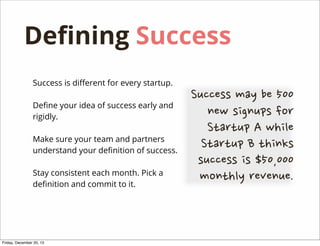
Defining Success
Success
 may
 be
 500
 
new
 signups
 for
 
Startup
 A
 while
 
Startup
 B
 thinks
 
success
 is
 $50,000
 
monthly
 revenue.
Success is different for every startup.
Define your idea of success early and
rigidly.
Make sure your team and partners
understand your definition of success.
Stay consistent each month. Pick a
definition and commit to it.
Friday, December 20, 13
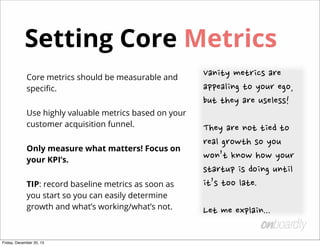
Setting Core Metrics
Core metrics should be measurable and
specific.
Use highly valuable metrics based on your
customer acquisition funnel.
Only measure what matters! Focus on
your KPI’s.
TIP: record baseline metrics as soon as
you start so you can easily determine
growth and what’s working/what’s not.
Vanity
 metrics
 are
 
appealing
 to
 your
 ego,
 
but
 they
 are
 useless!
They
 are
 not
 tied
 to
 
real
 growth

Startupmarketing onboardlyforslideshare-131220114602-phpapp01

  • 1.
    The Ultimate Guideto Startup Marketing presents Friday, December 20, 13
  • 2.
    Table of Contents FoundationSocial Media Startup PR ● Choosing a market ● Defining success ● Defining keywords ● Setting core metrics ● Estimating a conversion rate ● Setting a budget ● Choosing social media networks ● Defining the best times to post ● Using a keyword list ● Creating & using an influencer list ● Setting up a blog ● Craft meaningful position statements ● Define your startup sensitivities ● Identifying writers for a media list ● Creating a press kit ● Reaching out to journalist Content creation Test and Iterate Best Practices ● Creating a topic list ● Knowing what content to publish ● Guest blogging ● Capturing emails ● Setting up analytics tools ● Measuring against benchmarks ● Brainstorming creative new ideas ● Sell the solution ● Have a compelling story ● Use all your resources Slides 1-6 Slides 7-11 Slides 12-16 Slides 17-19 Slides 20-23 Slides 24-27 Friday, December 20, 13
  • 3.
    Startup Marketing is aWhole Different Science “Build it and they will come” doesn’t work Those overnight success stories are often the result of years of hard work. Startup marketing is challenging because of limited resources (Time, money, or talent.) Every effort, no matter how small, must be flawlessly executed. Traditional strategies don’t always work. The secret is combining the right channels: Content marketing and PR. Friday, December 20, 13
  • 4.
    Foundation Before you startlaying bricks you need a solid foundation. Learn how to choose a market, define keywords, define success and set a budget. Friday, December 20, 13
  • 5.
    Choosing a Market Onlya small portion of the population is interested in your product. You waste time and money by trying to market to everyone. Identify a niche target market and focus on just them. You
  • 6.
  • 7.
  • 8.
  • 9.
  • 10.
  • 11.
    How Do YouChoose a Market? 1. Market Size - Who are you targeting and how many potential customers are there? 2. Market Wealth - Does this target have money to spend on your product? 3. Market Competition - Is the market saturated with competitors? 4. Value Proposition - Is your value proposition unique enough to cut through the noise? What are your differentiators? Friday, December 20, 13
  • 12.
  • 13.
  • 14.
  • 15.
  • 16.
  • 17.
  • 18.
  • 19.
  • 20.
  • 21.
  • 22.
  • 23.
  • 24.
  • 25.
  • 26.
  • 27.
  • 28.
  • 29.
     revenue. Success is differentfor every startup. Define your idea of success early and rigidly. Make sure your team and partners understand your definition of success. Stay consistent each month. Pick a definition and commit to it. Friday, December 20, 13
  • 30.
    Setting Core Metrics Coremetrics should be measurable and specific. Use highly valuable metrics based on your customer acquisition funnel. Only measure what matters! Focus on your KPI’s. TIP: record baseline metrics as soon as you start so you can easily determine growth and what’s working/what’s not. Vanity
  • 31.
  • 32.
  • 33.
  • 34.
  • 35.
  • 36.
  • 37.
  • 38.
  • 39.
  • 40.
  • 41.
  • 42.
  • 43.
  • 44.
  • 45.
  • 46.