Starting a Hedge Fund in 2009 Bart Mallon, Esq. www. hedgefundlawblog .com For 40 minute voice presentation with this  presentation, please visit website.
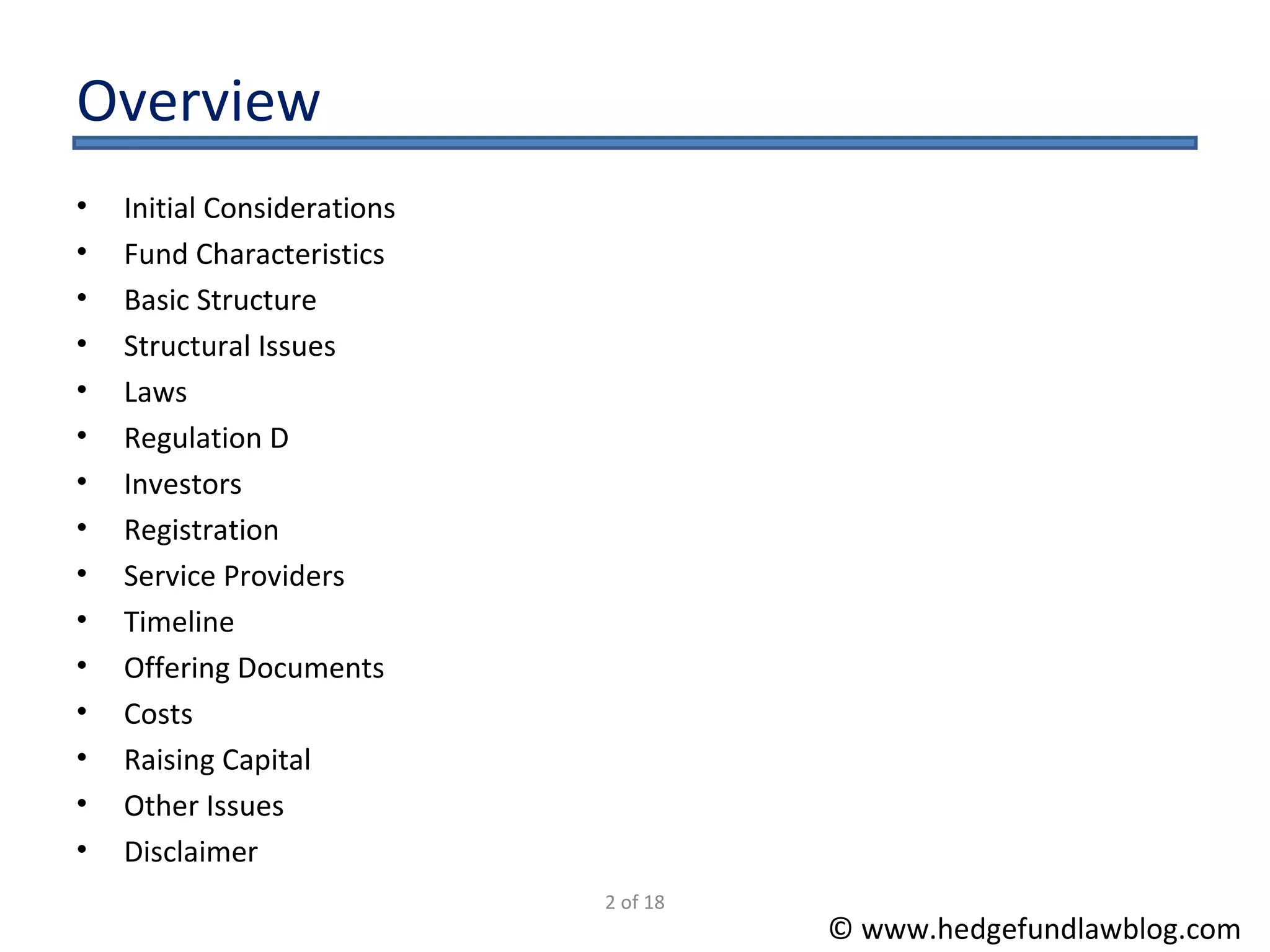
Overview Initial Considerations Fund Characteristics Basic Structure Structural Issues Laws Regulation D Investors Registration Service Providers Timeline Offering Documents Costs Raising Capital Other Issues Disclaimer © www.hedgefundlawblog.com 2 of 18
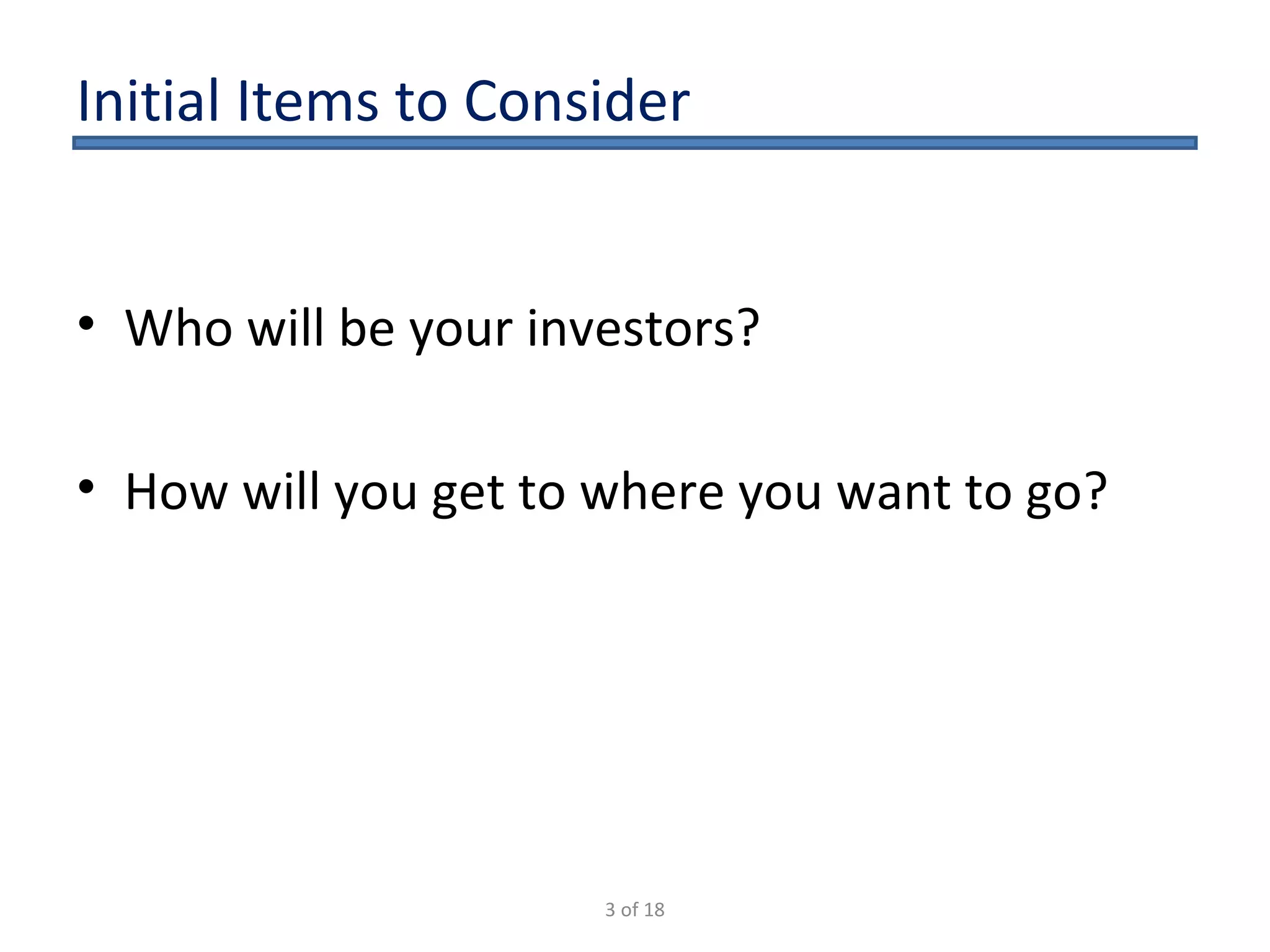
Who will be your investors? How will you get to where you want to go? Initial Items to Consider 3 of 18
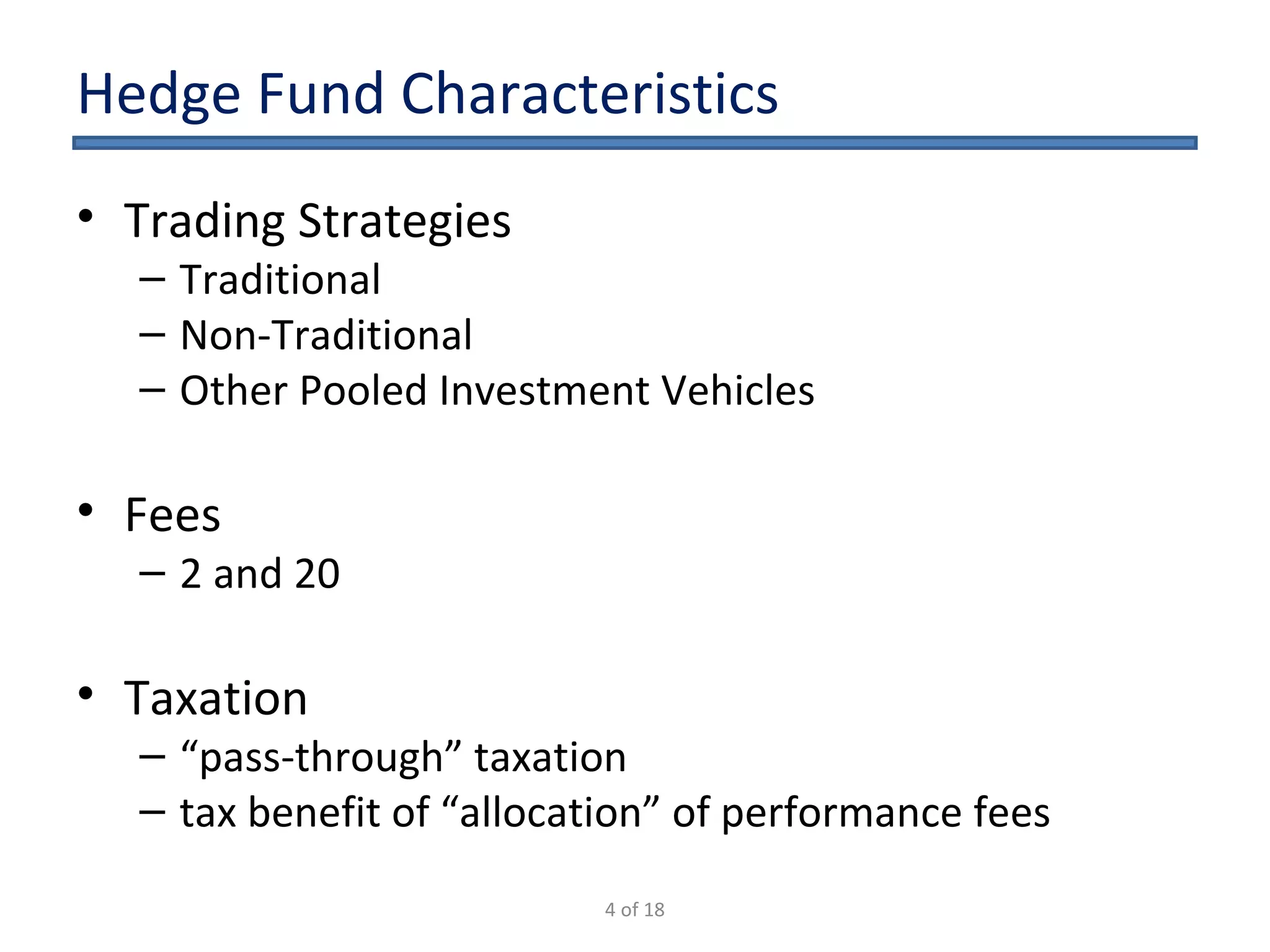
Hedge Fund Characteristics Trading Strategies Traditional Non-Traditional Other Pooled Investment Vehicles Fees 2 and 20 Taxation “ pass-through” taxation tax benefit of “allocation” of performance fees 4 of 18
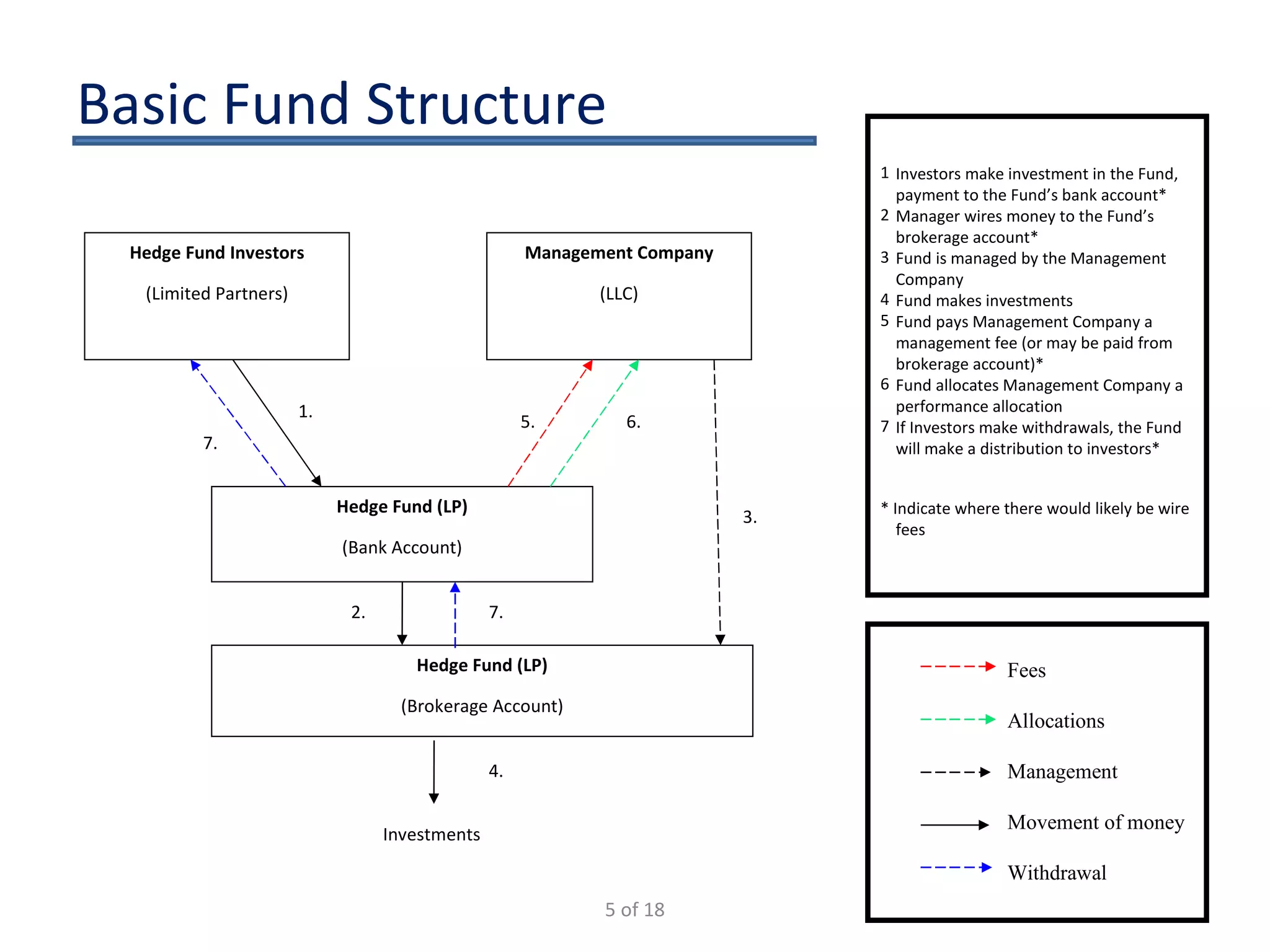
Basic Fund Structure Hedge Fund (LP) (Bank Account) Hedge Fund Investors (Limited Partners) Management Company (LLC) Hedge Fund (LP) (Brokerage Account) Investors make investment in the Fund, payment to the Fund’s bank account* Manager wires money to the Fund’s brokerage account* Fund is managed by the Management Company Fund makes investments Fund pays Management Company a management fee (or may be paid from brokerage account)* Fund allocates Management Company a performance allocation  If Investors make withdrawals, the Fund will make a distribution to investors* * Indicate where there would likely be wire fees Investments Fees Allocations Management Movement of money Withdrawal  1. 7. 5. 6. 3. 2. 7. 4. 5 of 18
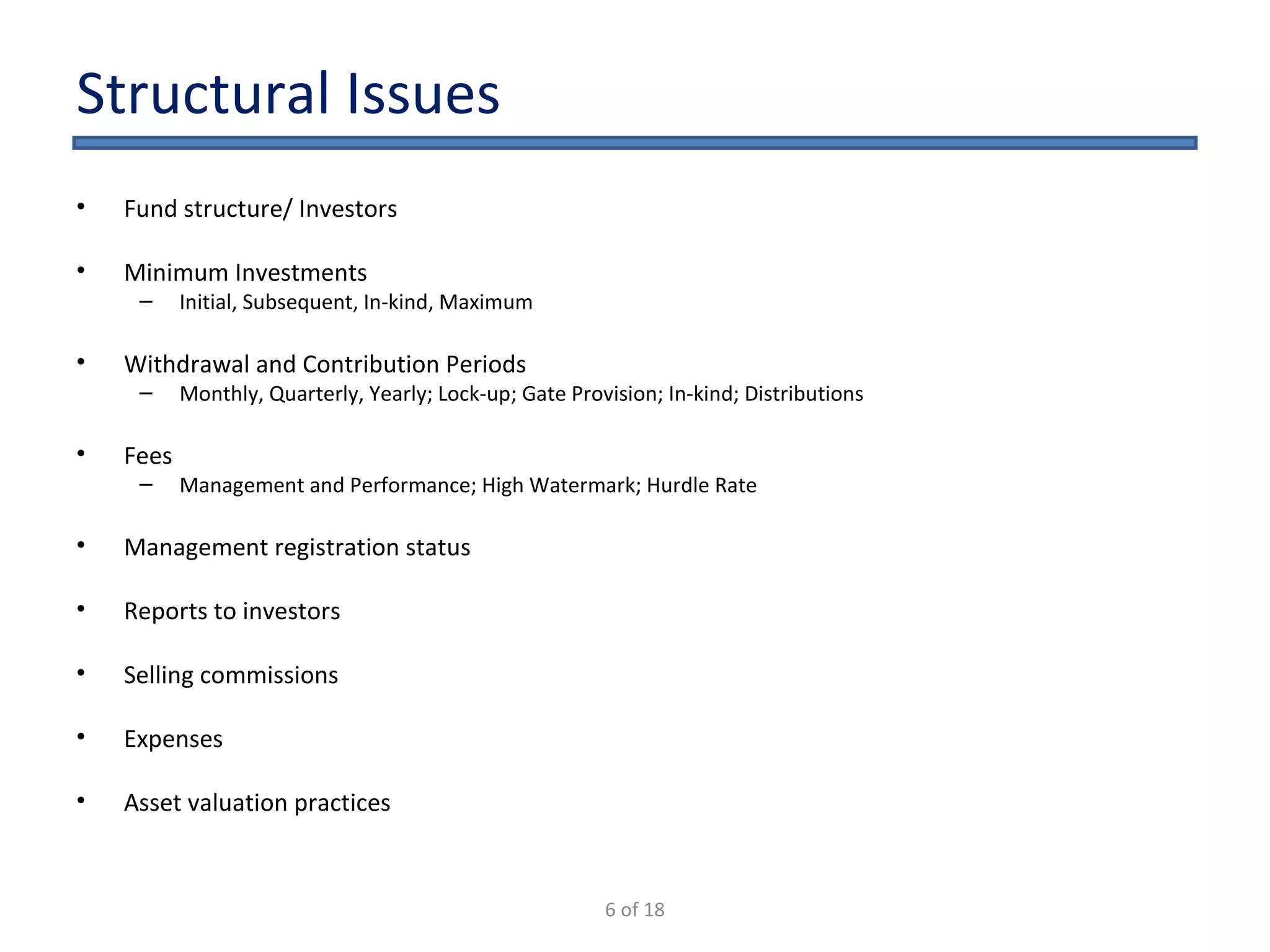
Structural Issues Fund structure/ Investors Minimum Investments Initial, Subsequent, In-kind, Maximum Withdrawal and Contribution Periods Monthly, Quarterly, Yearly; Lock-up; Gate Provision; In-kind; Distributions Fees  Management and Performance; High Watermark; Hurdle Rate Management registration status Reports to investors Selling commissions Expenses Asset valuation practices 6 of 18
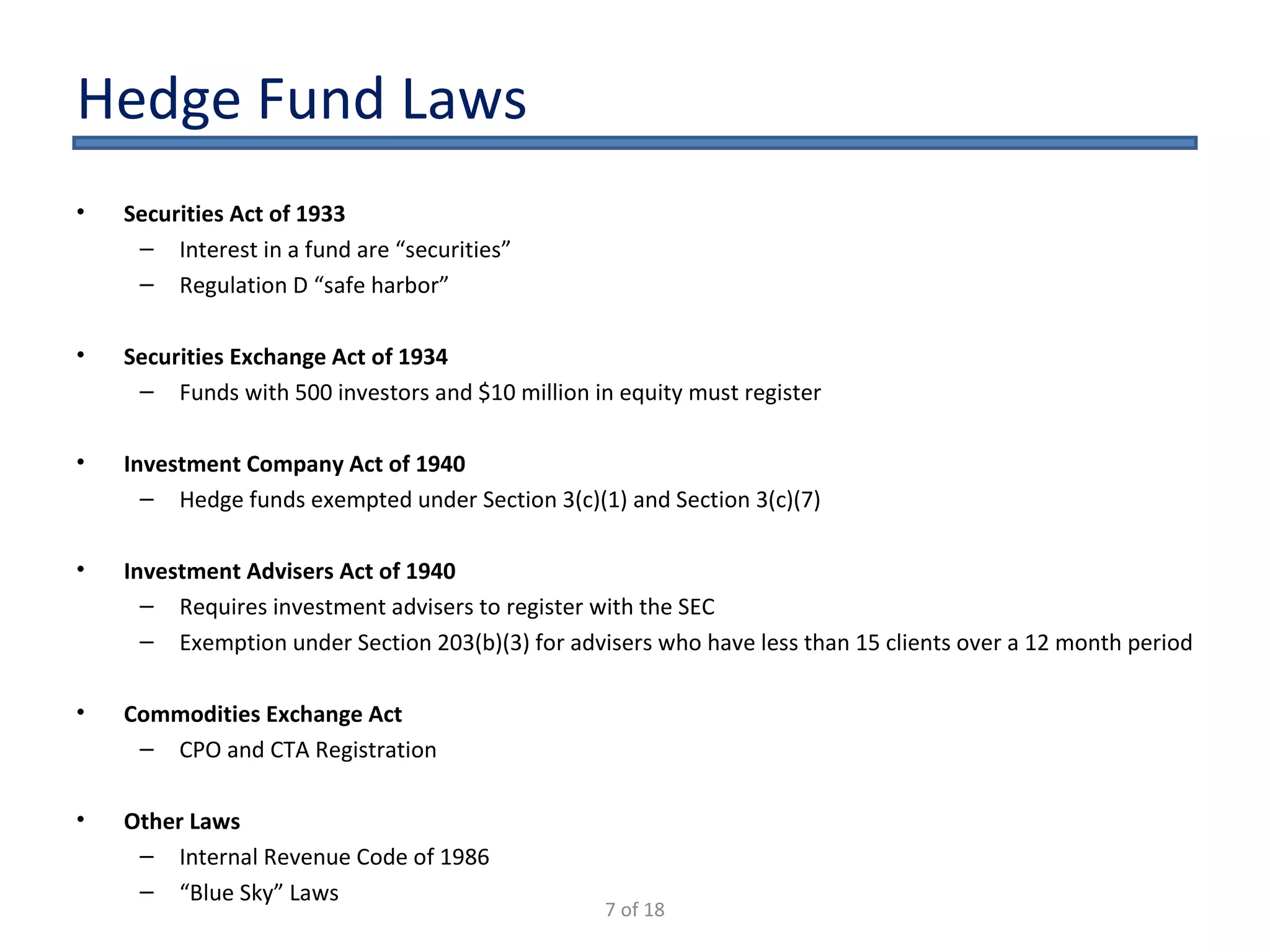
Hedge Fund Laws Securities Act of 1933 Interest in a fund are “securities” Regulation D “safe harbor” Securities Exchange Act of 1934 Funds with 500 investors and $10 million in equity must register Investment Company Act of 1940 Hedge funds exempted under Section 3(c)(1) and Section 3(c)(7) Investment Advisers Act of 1940 Requires investment advisers to register with the SEC Exemption under Section 203(b)(3) for advisers who have less than 15 clients over a 12 month period Commodities Exchange Act CPO and CTA Registration Other Laws Internal Revenue Code of 1986 “ Blue Sky” Laws 7 of 18
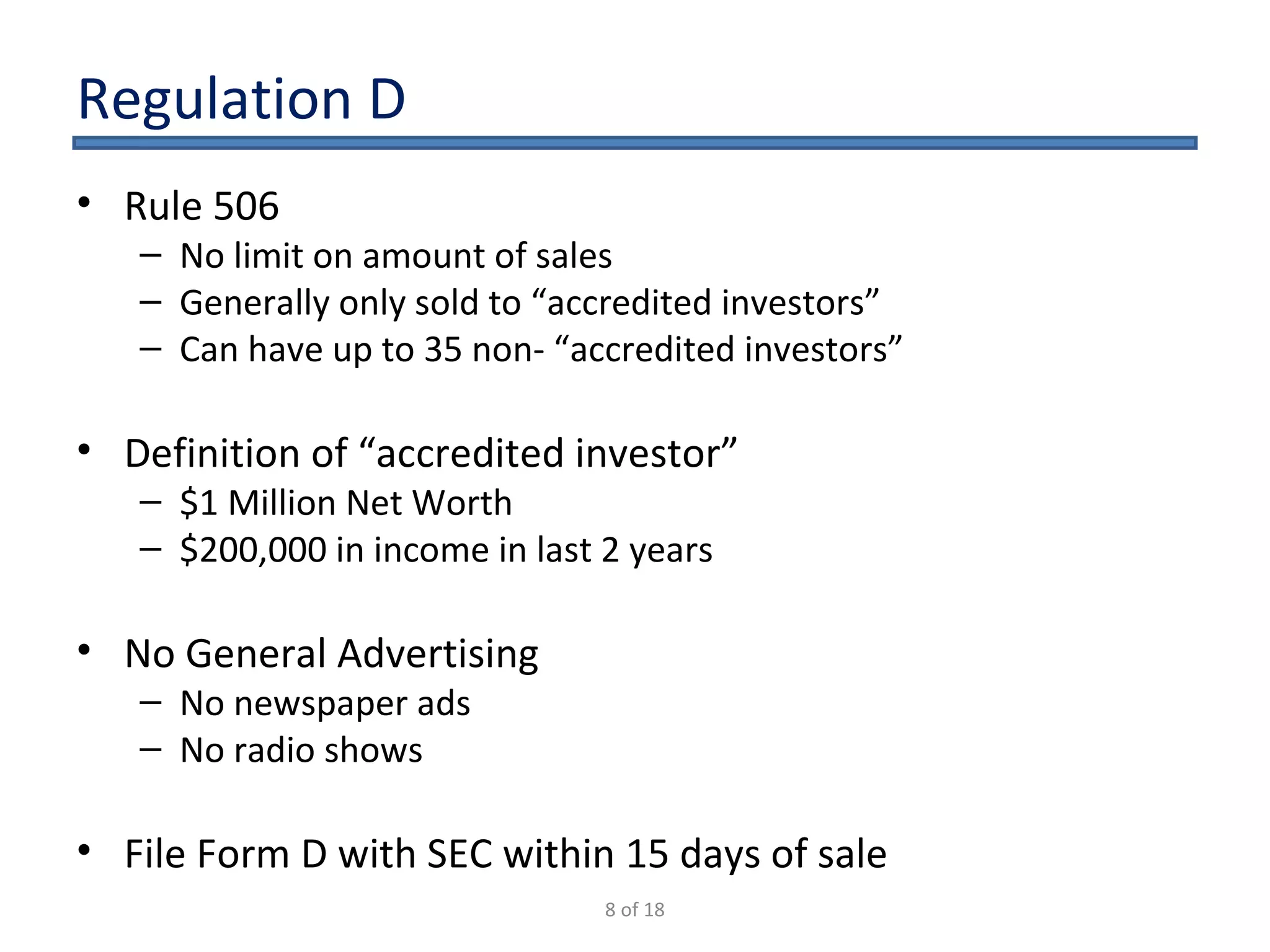
Regulation D Rule 506 No limit on amount of sales Generally only sold to “accredited investors” Can have up to 35 non- “accredited investors” Definition of “accredited investor” $1 Million Net Worth $200,000 in income in last 2 years No General Advertising No newspaper ads No radio shows File Form D with SEC within 15 days of sale 8 of 18
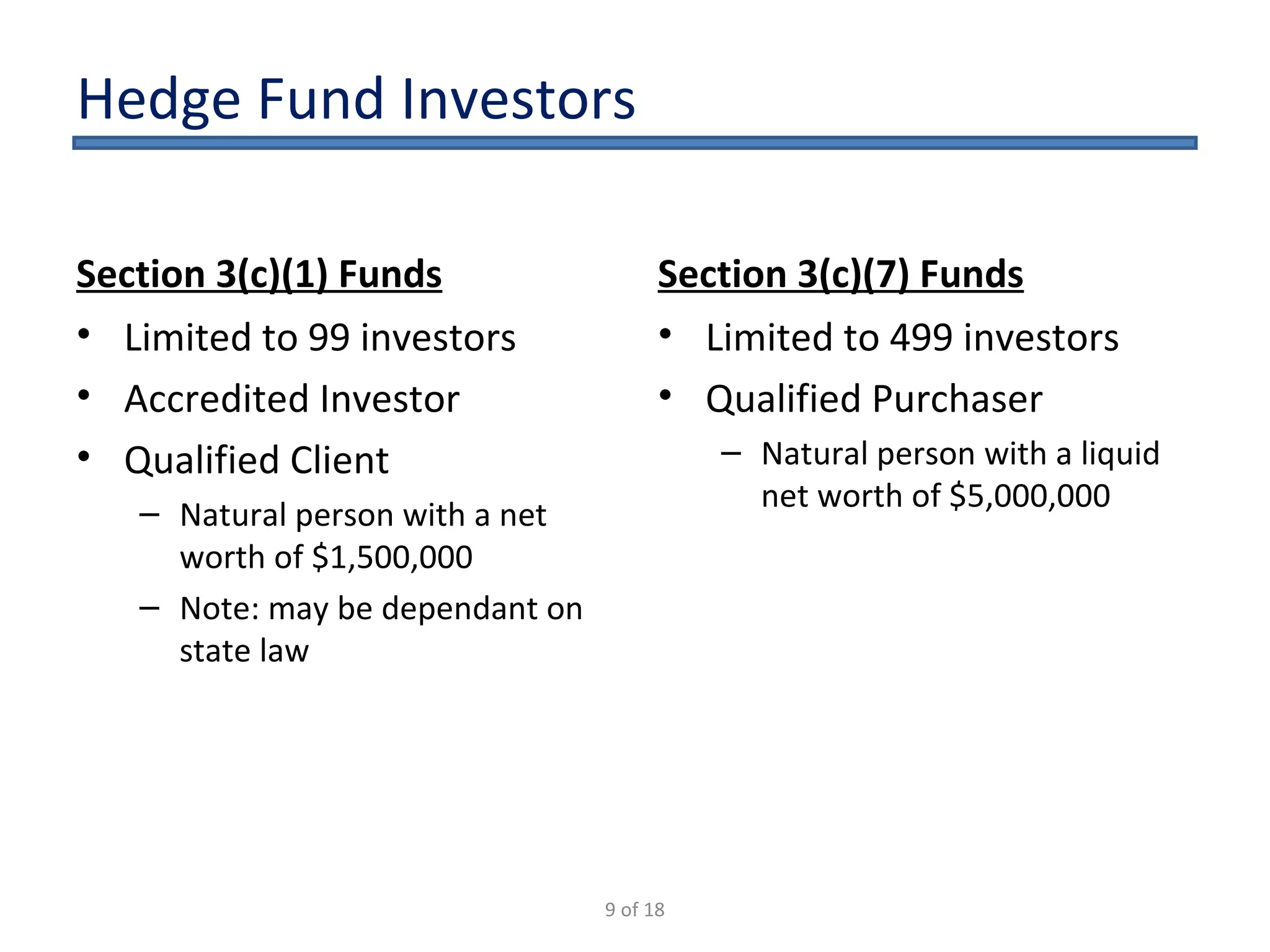
Hedge Fund Investors Section 3(c)(1) Funds Limited to 99 investors Accredited Investor Qualified Client Natural person with a net worth of $1,500,000 Note: may be dependant on state law Section 3(c)(7) Funds Limited to 499 investors  Qualified Purchaser Natural person with a liquid net worth of $5,000,000 9 of 18
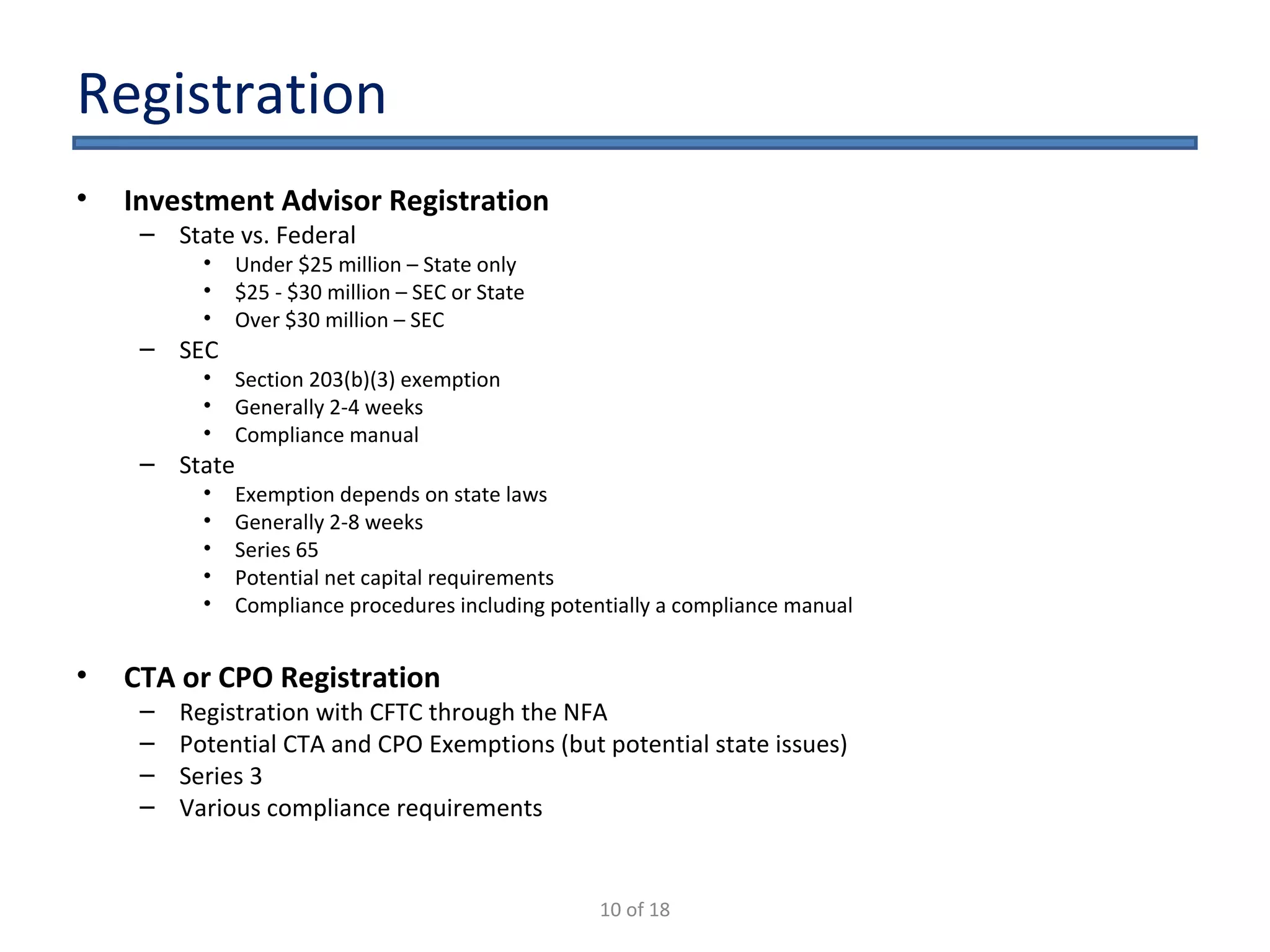
Registration Investment Advisor Registration State vs. Federal Under $25 million – State only $25 - $30 million – SEC or State Over $30 million – SEC  SEC Section 203(b)(3) exemption Generally 2-4 weeks Compliance manual State Exemption depends on state laws Generally 2-8 weeks Series 65 Potential net capital requirements Compliance procedures including potentially a compliance manual CTA or CPO Registration Registration with CFTC through the NFA Potential CTA and CPO Exemptions (but potential state issues) Series 3  Various compliance requirements 10 of 18
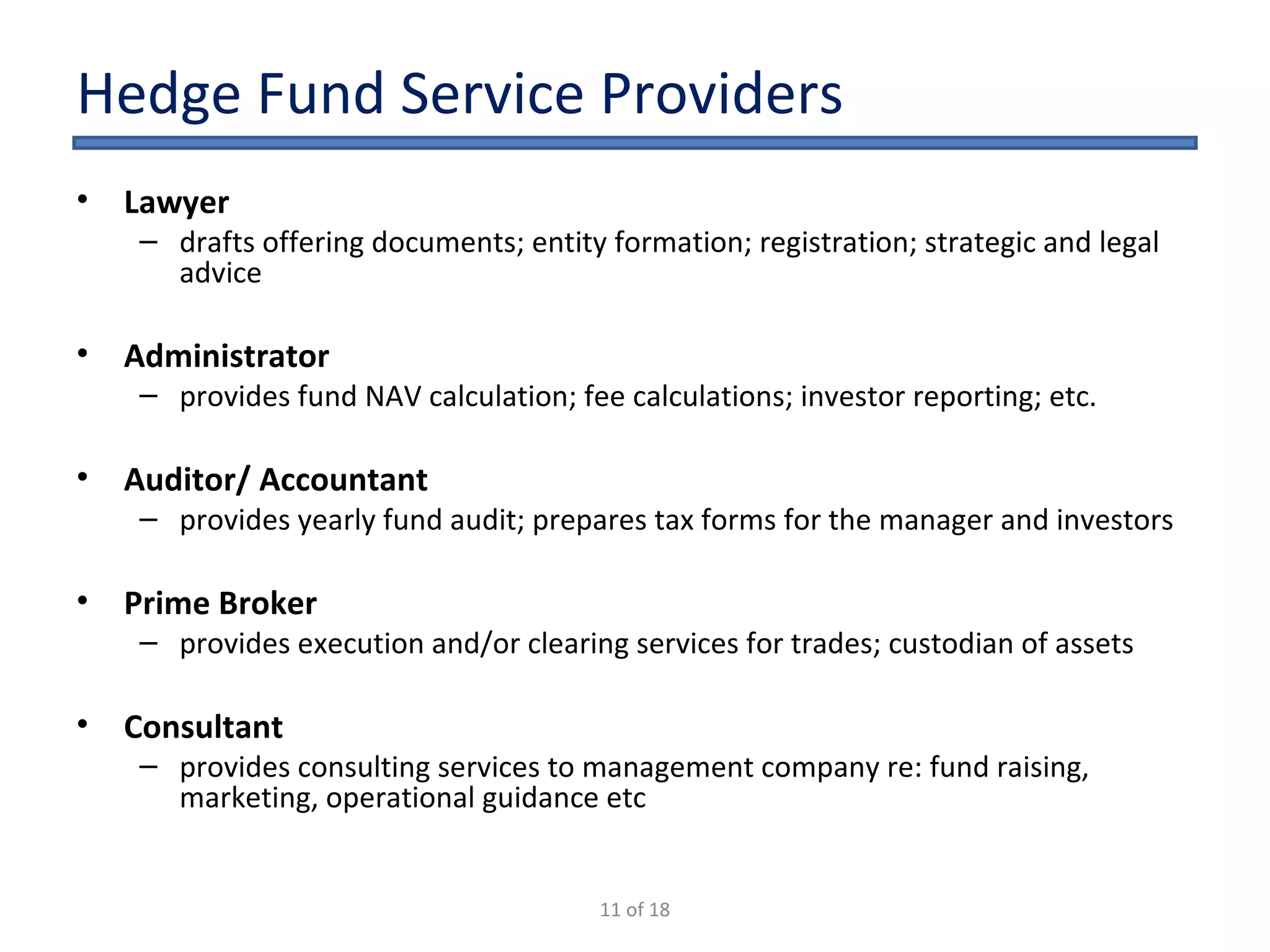
Hedge Fund Service Providers Lawyer  drafts offering documents; entity formation; registration; strategic and legal advice Administrator   provides fund NAV calculation; fee calculations; investor reporting; etc. Auditor/ Accountant  provides yearly fund audit; prepares tax forms for the manager and investors Prime Broker   provides execution and/or clearing services for trades; custodian of assets Consultant   provides consulting services to management company re: fund raising, marketing, operational guidance etc 11 of 18
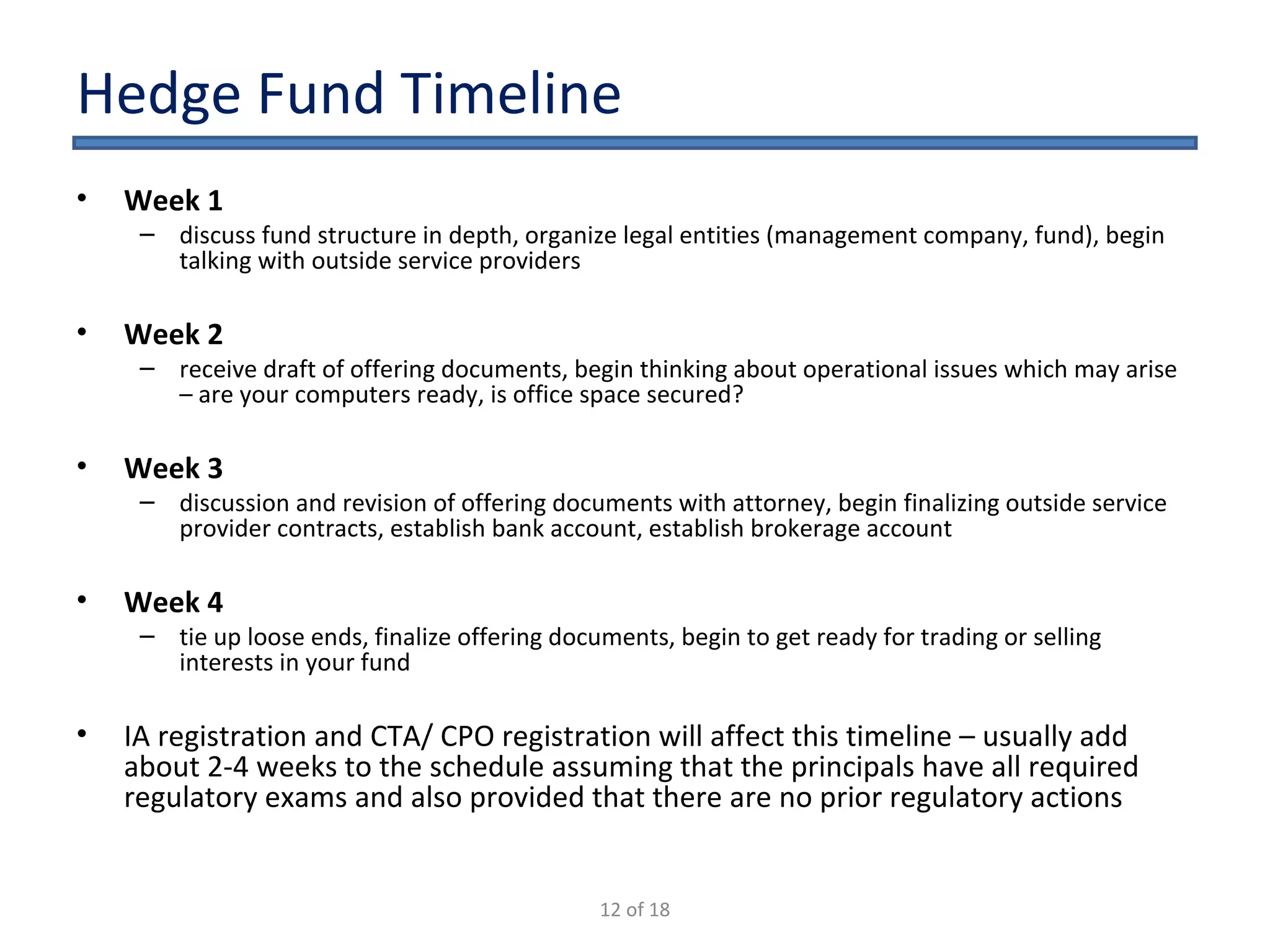
Hedge Fund Timeline Week 1  discuss fund structure in depth, organize legal entities (management company, fund), begin talking with outside service providers Week 2  receive draft of offering documents, begin thinking about operational issues which may arise – are your computers ready, is office space secured? Week 3  discussion and revision of offering documents with attorney, begin finalizing outside service provider contracts, establish bank account, establish brokerage account Week 4  tie up loose ends, finalize offering documents, begin to get ready for trading or selling interests in your fund IA registration and CTA/ CPO registration will affect this timeline – usually add about 2-4 weeks to the schedule assuming that the principals have all required regulatory exams and also provided that there are no prior regulatory actions 12 of 18
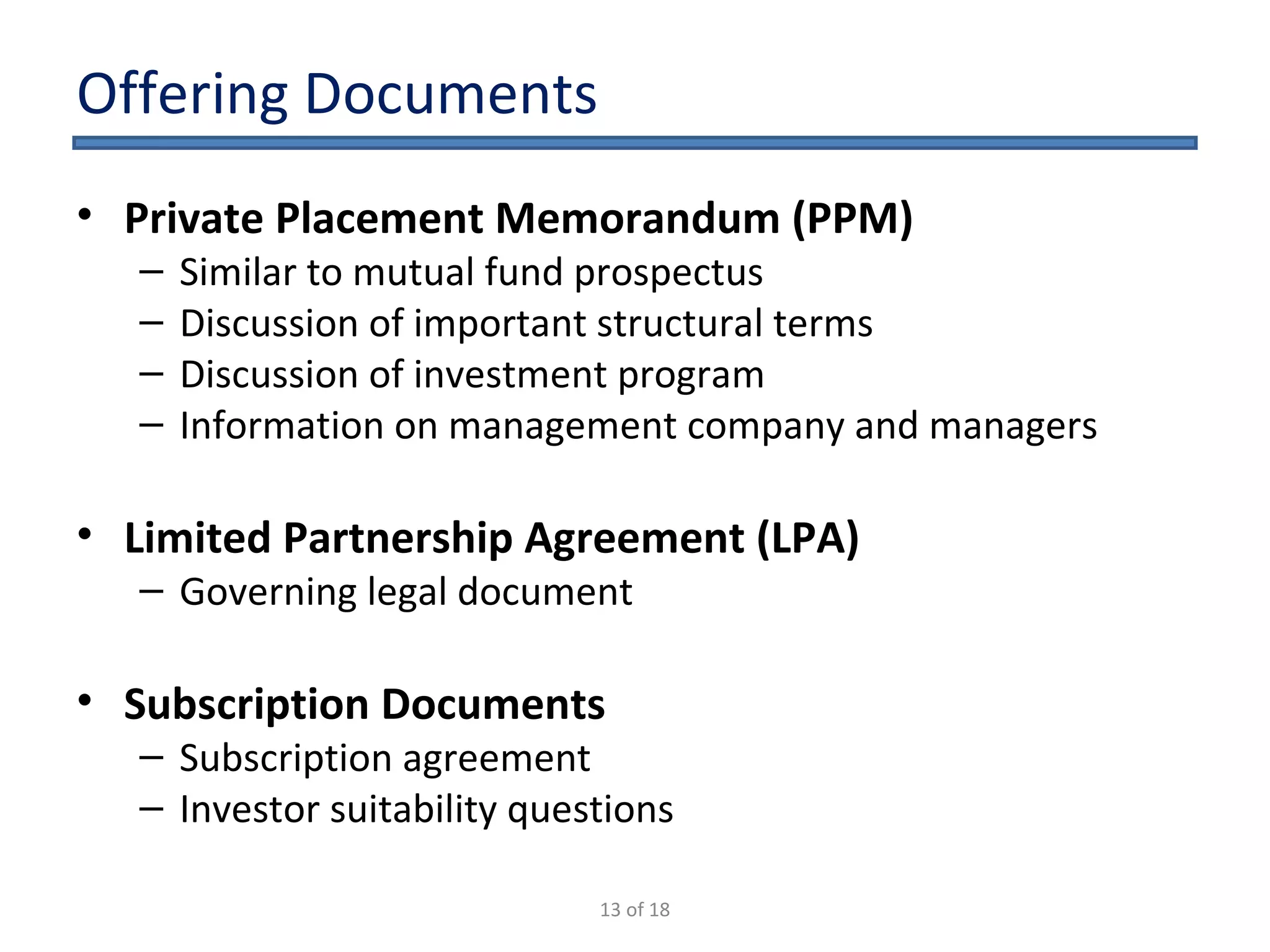
Offering Documents Private Placement Memorandum (PPM) Similar to mutual fund prospectus Discussion of important structural terms Discussion of investment program Information on management company and managers Limited Partnership Agreement (LPA) Governing legal document Subscription Documents Subscription agreement Investor suitability questions 13 of 18
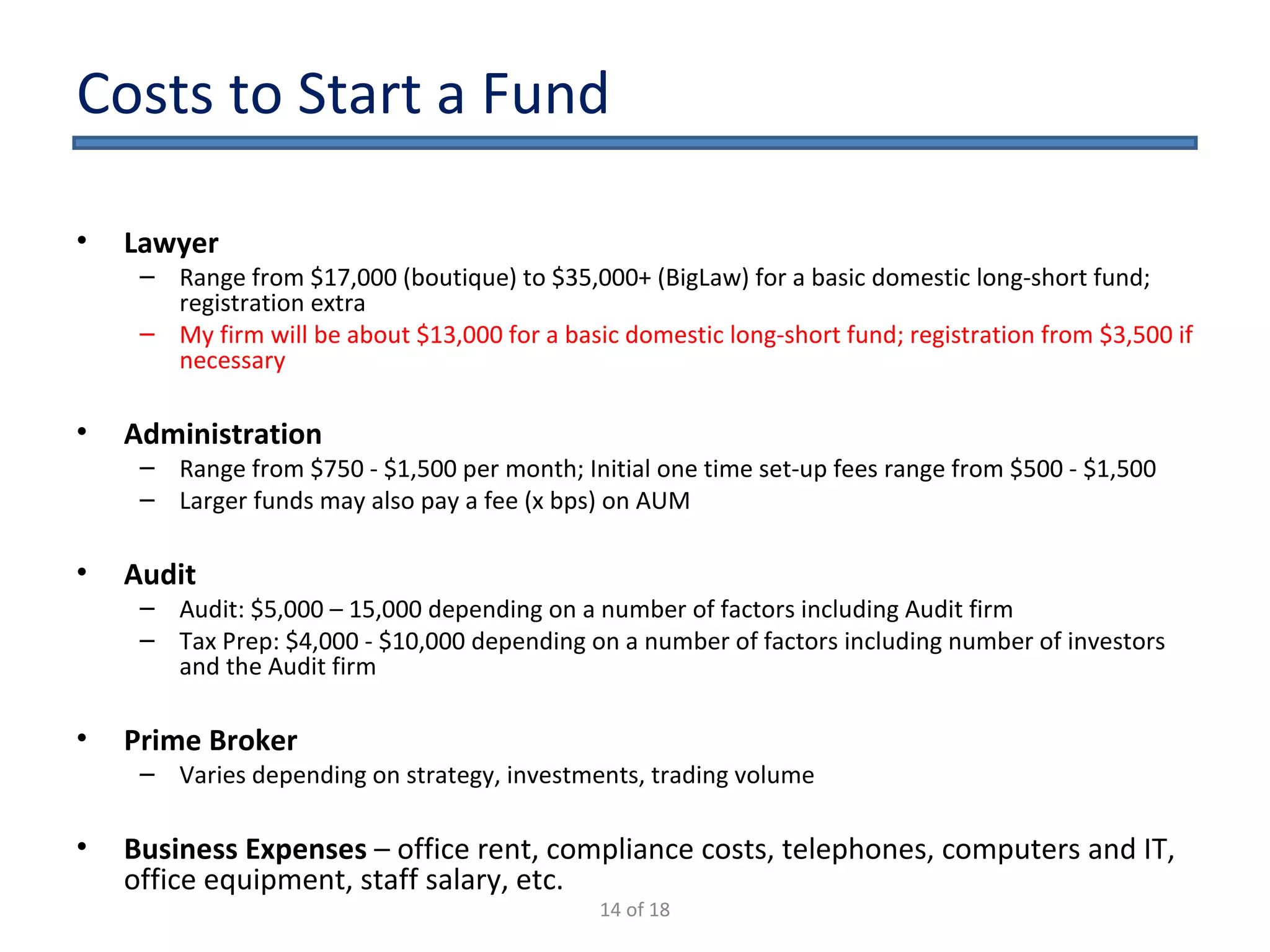
Costs to Start a Fund Lawyer Range from $15,000 (boutique) to $30,000 (BigLaw) for a basic domestic long-short fund; registration extra My firm will be about $10,000 for a basic domestic long-short fund; registration from $2,000 if necessary Administration Range from $750 - $1,500 per month; Initial one time set-up fees range from $500 - $1,500 Larger funds may also pay a fee (x bps) on AUM Audit Audit: $5,000 – 15,000 depending on a number of factors including Audit firm Tax Prep: $4,000 - $10,000 depending on a number of factors including number of investors and the Audit firm Prime Broker Varies depending on strategy, investments, trading volume Business Expenses  – office rent, compliance costs, telephones, computers and IT, office equipment, staff salary, etc. 14 of 18
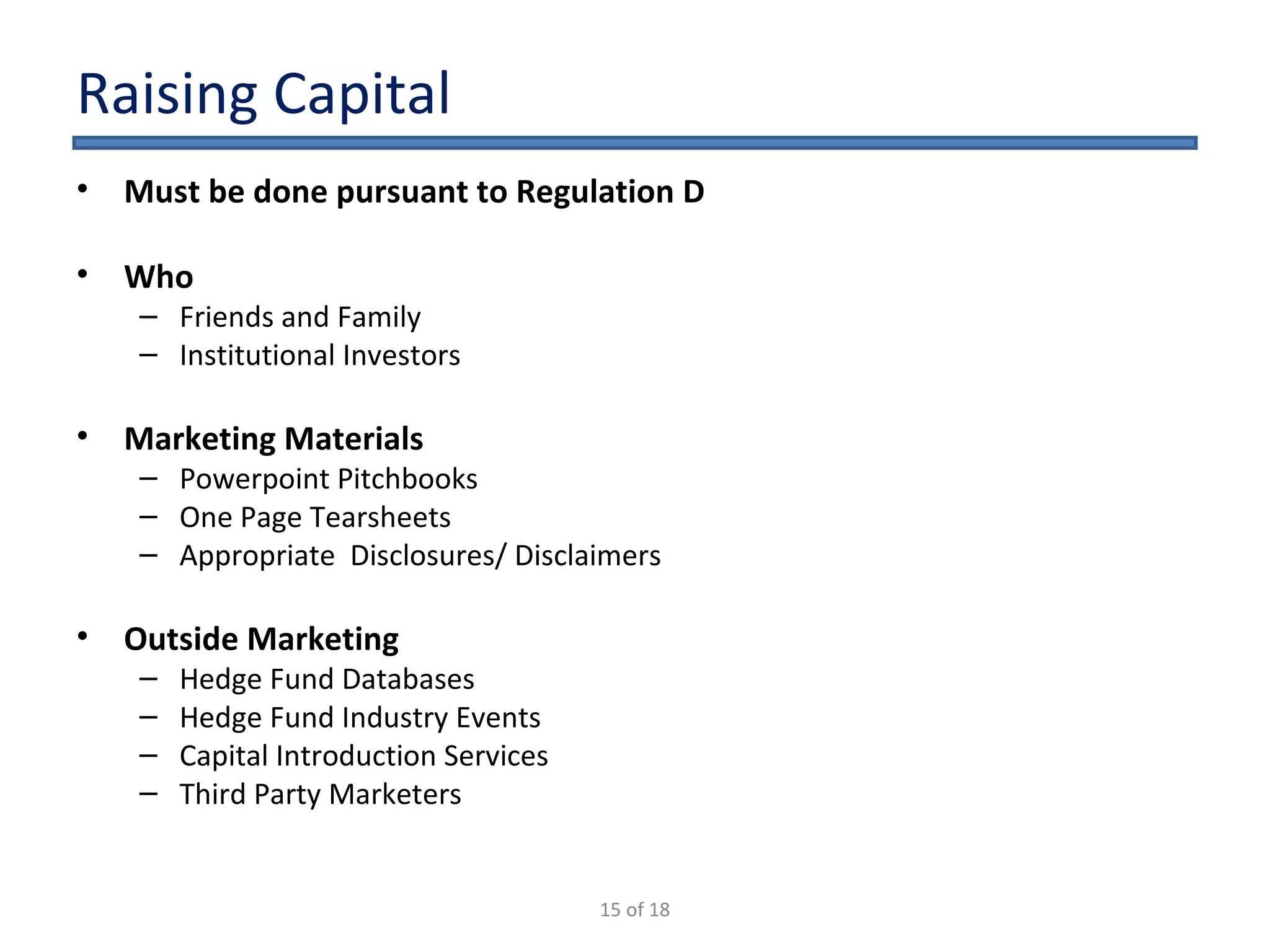
Raising Capital Must be done pursuant to Regulation D Who Friends and Family Institutional Investors Marketing Materials Powerpoint Pitchbooks One Page Tearsheets Appropriate  Disclosures/ Disclaimers Outside Marketing Hedge Fund Databases Hedge Fund Industry Events Capital Introduction Services Third Party Marketers 15 of 18
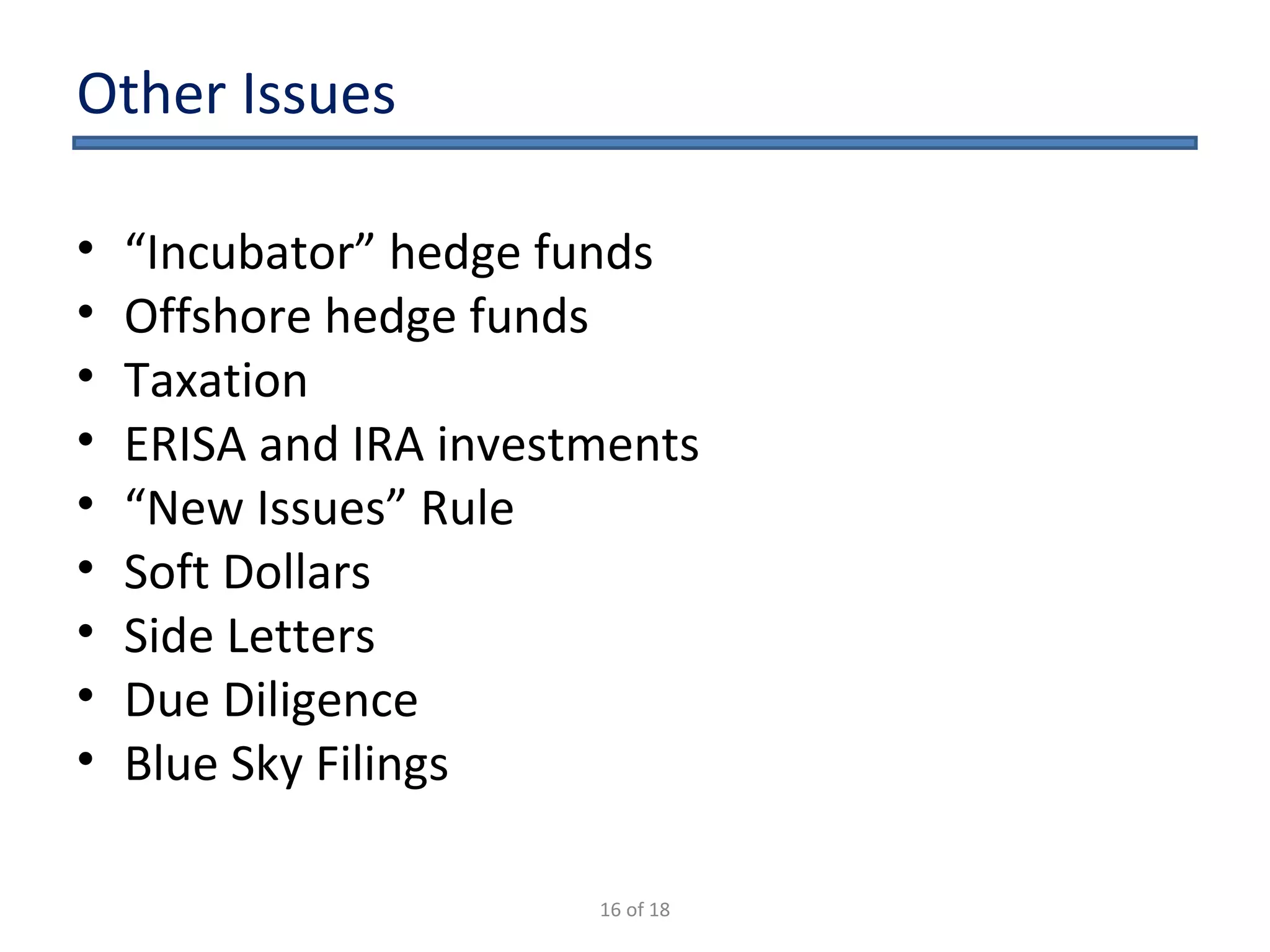
Other Issues “ Incubator” hedge funds Offshore hedge funds Taxation ERISA and IRA investments “ New Issues” Rule Soft Dollars Side Letters Due Diligence Blue Sky Filings 16 of 18
Disclaimer This presentation was made for informational purposes only. I am not providing legal advice to any user.  I am not providing tax advice.  Presentation is subject to the Circular 230 Notice on the disclaimer portion of my blog. This presentation does not establish an attorney-client relationship between myself and the user.  Any discussion herein is not a substitute for seeking actual legal advice from a licensed attorney with knowledge of the rules and regulations governing the industry.  I make no representations, guarantees, or warranties as to the accuracy, completeness, currency, or suitability of the information provided via this presentation.  This may be considered to be “attorney advertising” in some jurisdictions.  17 of 18
For Voice Presentation, please see: www. hedgefundlawblog .com Please send questions, comments or suggestions to  Bart Mallon at  bartmallon@gmail.com © www.hedgefundlawblog.com

Starting A Hedge Fund In 2009

  • 1.
    Starting a HedgeFund in 2009 Bart Mallon, Esq. www. hedgefundlawblog .com For 40 minute voice presentation with this presentation, please visit website.
  • 2.
    Overview Initial ConsiderationsFund Characteristics Basic Structure Structural Issues Laws Regulation D Investors Registration Service Providers Timeline Offering Documents Costs Raising Capital Other Issues Disclaimer © www.hedgefundlawblog.com 2 of 18
  • 3.
    Who will beyour investors? How will you get to where you want to go? Initial Items to Consider 3 of 18
  • 4.
    Hedge Fund CharacteristicsTrading Strategies Traditional Non-Traditional Other Pooled Investment Vehicles Fees 2 and 20 Taxation “ pass-through” taxation tax benefit of “allocation” of performance fees 4 of 18
  • 5.
    Basic Fund StructureHedge Fund (LP) (Bank Account) Hedge Fund Investors (Limited Partners) Management Company (LLC) Hedge Fund (LP) (Brokerage Account) Investors make investment in the Fund, payment to the Fund’s bank account* Manager wires money to the Fund’s brokerage account* Fund is managed by the Management Company Fund makes investments Fund pays Management Company a management fee (or may be paid from brokerage account)* Fund allocates Management Company a performance allocation If Investors make withdrawals, the Fund will make a distribution to investors* * Indicate where there would likely be wire fees Investments Fees Allocations Management Movement of money Withdrawal 1. 7. 5. 6. 3. 2. 7. 4. 5 of 18
  • 6.
    Structural Issues Fundstructure/ Investors Minimum Investments Initial, Subsequent, In-kind, Maximum Withdrawal and Contribution Periods Monthly, Quarterly, Yearly; Lock-up; Gate Provision; In-kind; Distributions Fees Management and Performance; High Watermark; Hurdle Rate Management registration status Reports to investors Selling commissions Expenses Asset valuation practices 6 of 18
  • 7.
    Hedge Fund LawsSecurities Act of 1933 Interest in a fund are “securities” Regulation D “safe harbor” Securities Exchange Act of 1934 Funds with 500 investors and $10 million in equity must register Investment Company Act of 1940 Hedge funds exempted under Section 3(c)(1) and Section 3(c)(7) Investment Advisers Act of 1940 Requires investment advisers to register with the SEC Exemption under Section 203(b)(3) for advisers who have less than 15 clients over a 12 month period Commodities Exchange Act CPO and CTA Registration Other Laws Internal Revenue Code of 1986 “ Blue Sky” Laws 7 of 18
  • 8.
    Regulation D Rule506 No limit on amount of sales Generally only sold to “accredited investors” Can have up to 35 non- “accredited investors” Definition of “accredited investor” $1 Million Net Worth $200,000 in income in last 2 years No General Advertising No newspaper ads No radio shows File Form D with SEC within 15 days of sale 8 of 18
  • 9.
    Hedge Fund InvestorsSection 3(c)(1) Funds Limited to 99 investors Accredited Investor Qualified Client Natural person with a net worth of $1,500,000 Note: may be dependant on state law Section 3(c)(7) Funds Limited to 499 investors Qualified Purchaser Natural person with a liquid net worth of $5,000,000 9 of 18
  • 10.
    Registration Investment AdvisorRegistration State vs. Federal Under $25 million – State only $25 - $30 million – SEC or State Over $30 million – SEC SEC Section 203(b)(3) exemption Generally 2-4 weeks Compliance manual State Exemption depends on state laws Generally 2-8 weeks Series 65 Potential net capital requirements Compliance procedures including potentially a compliance manual CTA or CPO Registration Registration with CFTC through the NFA Potential CTA and CPO Exemptions (but potential state issues) Series 3 Various compliance requirements 10 of 18
  • 11.
    Hedge Fund ServiceProviders Lawyer drafts offering documents; entity formation; registration; strategic and legal advice Administrator provides fund NAV calculation; fee calculations; investor reporting; etc. Auditor/ Accountant provides yearly fund audit; prepares tax forms for the manager and investors Prime Broker provides execution and/or clearing services for trades; custodian of assets Consultant provides consulting services to management company re: fund raising, marketing, operational guidance etc 11 of 18
  • 12.
    Hedge Fund TimelineWeek 1 discuss fund structure in depth, organize legal entities (management company, fund), begin talking with outside service providers Week 2 receive draft of offering documents, begin thinking about operational issues which may arise – are your computers ready, is office space secured? Week 3 discussion and revision of offering documents with attorney, begin finalizing outside service provider contracts, establish bank account, establish brokerage account Week 4 tie up loose ends, finalize offering documents, begin to get ready for trading or selling interests in your fund IA registration and CTA/ CPO registration will affect this timeline – usually add about 2-4 weeks to the schedule assuming that the principals have all required regulatory exams and also provided that there are no prior regulatory actions 12 of 18
  • 13.
    Offering Documents PrivatePlacement Memorandum (PPM) Similar to mutual fund prospectus Discussion of important structural terms Discussion of investment program Information on management company and managers Limited Partnership Agreement (LPA) Governing legal document Subscription Documents Subscription agreement Investor suitability questions 13 of 18
  • 14.
    Costs to Starta Fund Lawyer Range from $15,000 (boutique) to $30,000 (BigLaw) for a basic domestic long-short fund; registration extra My firm will be about $10,000 for a basic domestic long-short fund; registration from $2,000 if necessary Administration Range from $750 - $1,500 per month; Initial one time set-up fees range from $500 - $1,500 Larger funds may also pay a fee (x bps) on AUM Audit Audit: $5,000 – 15,000 depending on a number of factors including Audit firm Tax Prep: $4,000 - $10,000 depending on a number of factors including number of investors and the Audit firm Prime Broker Varies depending on strategy, investments, trading volume Business Expenses – office rent, compliance costs, telephones, computers and IT, office equipment, staff salary, etc. 14 of 18
  • 15.
    Raising Capital Mustbe done pursuant to Regulation D Who Friends and Family Institutional Investors Marketing Materials Powerpoint Pitchbooks One Page Tearsheets Appropriate Disclosures/ Disclaimers Outside Marketing Hedge Fund Databases Hedge Fund Industry Events Capital Introduction Services Third Party Marketers 15 of 18
  • 16.
    Other Issues “Incubator” hedge funds Offshore hedge funds Taxation ERISA and IRA investments “ New Issues” Rule Soft Dollars Side Letters Due Diligence Blue Sky Filings 16 of 18
  • 17.
    Disclaimer This presentationwas made for informational purposes only. I am not providing legal advice to any user. I am not providing tax advice. Presentation is subject to the Circular 230 Notice on the disclaimer portion of my blog. This presentation does not establish an attorney-client relationship between myself and the user. Any discussion herein is not a substitute for seeking actual legal advice from a licensed attorney with knowledge of the rules and regulations governing the industry. I make no representations, guarantees, or warranties as to the accuracy, completeness, currency, or suitability of the information provided via this presentation. This may be considered to be “attorney advertising” in some jurisdictions. 17 of 18
  • 18.
    For Voice Presentation,please see: www. hedgefundlawblog .com Please send questions, comments or suggestions to Bart Mallon at bartmallon@gmail.com © www.hedgefundlawblog.com