Start Writing!
EDUC 293
15 Jan 2008
THE INTRODUCTION of the REVIEW
OF RELATED LITERATURE
 Aim
1. Introduces and makes a brief pitch for the topic
2. Introduces key concepts and terms
3. Describes the scope and organization of the
review
 A Good way to end it is by laying out the
scope of the rest of the chapter: the topics
covered; the sequence; criteria for
inclusion; benchmarks for
ideas/conclusions by era
 Acts as an advanced organizer
 Covers about 2-3 pages
Mind map based on a 2 day lecture
Mind map of possibilities
A mind map for mind mapping
Idea
(Author, Year)
(Author, Year)
Idea
(Author, Year)
(Author, Year)
Idea
(Author, Year)
(Author, Year)
Idea
(Author, Year)
(Author, Year)
Idea
(Author, Year)
(Author, Year)
Idea
(Author, Year)
(Author, Year)
I STILL PREFER IT THIS WAY!
The Subsections of the Lit Review:
Style #1
 Make an introduction for the subsection
(see the previous guidelines)
 Describe relevant studies ONE BY ONE
 Cluster related studies together
 Provide comparable information for each study
 Pull the material together with a summary
and an overall critique at the end of the
subsection
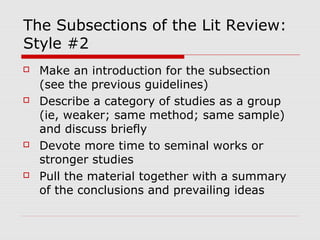
The Subsections of the Lit Review:
Style #2
 Make an introduction for the subsection
(see the previous guidelines)
 Describe a category of studies as a group
(ie, weaker; same method; same sample)
and discuss briefly
 Devote more time to seminal works or
stronger studies
 Pull the material together with a summary
of the conclusions and prevailing ideas
The Subsections of the Lit Review:
Style #3
 Make an introduction for the subsection
(see the previous guidelines)
 Organize according to findings
 Use the studies reviewed to support the
logical series of points being developed by
the review (which is organized by findings)
 You need to be a two pronged funnel to do
this
 Pull the material together with a summary
and highlight which finding has the greatest
evidence
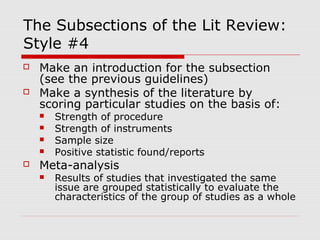
The Subsections of the Lit Review:
Style #4
 Make an introduction for the subsection
(see the previous guidelines)
 Make a synthesis of the literature by
scoring particular studies on the basis of:
 Strength of procedure
 Strength of instruments
 Sample size
 Positive statistic found/reports
 Meta-analysis
 Results of studies that investigated the same
issue are grouped statistically to evaluate the
characteristics of the group of studies as a whole
Expect these difficulties:
 Writer’s Block
 Breaking free from the notion that
you have to start writing from the
beginning
 Too much detail – the chatty one
Some things to remember
1. Get your outline.
2. Write the individual sections of the
outline
3. JUST WRITE. Forget the errors or the
fears. JUST WRITE.
4. Express/Articulate PRODUCT GOALS.
5. Reward yourself for accomplishing the
small goals.
6. Find patterns in the literature.
Synthesize.
Ways to Synthesize
Use integrative
transition
sentences and
phrases to help
readers see
patterns as they
read the
document
Although most studies
previously described used
correlational designs,
Padilla and Preclaro
(2007) explored the issue
of mentoring novice
teachers using the
experimental design.
Their findings were
similar to the previous
studies.
Ways to Synthesize
Use comparative
and evlauative
phrases. Use
this when you
describe a study.
Padilla and Preclaro
(2007) could not
replicate the findings
reported by Hermosa
(2006). Unfortunately,
the small sample size in
their comparative groups
may have limited the
power of their
experiment to detect
significant differences.
Some things to remember
7. Are findings consistent over
a series of studies?
8. Consider how the findings
may be have become
different.
9. Which studies are good?
Strong? Poorly done? Why?
Some things to remember
10. At the end of the literature review, you
should have clearly shown the patterns of
findings and methods that are prevailing in
your area.
11. Use a professional tone – you may be
criticizing your teacher’s work
12. Do not be emotional – there is no such
thing as perfect research
13. At the end of the review of literature, the
rationale for what you propose and why
you propose to do it in a specific way
SHOULD BE OBVIOUS.

Start writing your thesis proposal

  • 1.
  • 2.
    THE INTRODUCTION ofthe REVIEW OF RELATED LITERATURE  Aim 1. Introduces and makes a brief pitch for the topic 2. Introduces key concepts and terms 3. Describes the scope and organization of the review  A Good way to end it is by laying out the scope of the rest of the chapter: the topics covered; the sequence; criteria for inclusion; benchmarks for ideas/conclusions by era  Acts as an advanced organizer  Covers about 2-3 pages
  • 3.
    Mind map basedon a 2 day lecture
  • 4.
    Mind map ofpossibilities
  • 5.
    A mind mapfor mind mapping
  • 6.
    Idea (Author, Year) (Author, Year) Idea (Author,Year) (Author, Year) Idea (Author, Year) (Author, Year) Idea (Author, Year) (Author, Year) Idea (Author, Year) (Author, Year) Idea (Author, Year) (Author, Year) I STILL PREFER IT THIS WAY!
  • 7.
    The Subsections ofthe Lit Review: Style #1  Make an introduction for the subsection (see the previous guidelines)  Describe relevant studies ONE BY ONE  Cluster related studies together  Provide comparable information for each study  Pull the material together with a summary and an overall critique at the end of the subsection
  • 8.
    The Subsections ofthe Lit Review: Style #2  Make an introduction for the subsection (see the previous guidelines)  Describe a category of studies as a group (ie, weaker; same method; same sample) and discuss briefly  Devote more time to seminal works or stronger studies  Pull the material together with a summary of the conclusions and prevailing ideas
  • 9.
    The Subsections ofthe Lit Review: Style #3  Make an introduction for the subsection (see the previous guidelines)  Organize according to findings  Use the studies reviewed to support the logical series of points being developed by the review (which is organized by findings)  You need to be a two pronged funnel to do this  Pull the material together with a summary and highlight which finding has the greatest evidence
  • 10.
    The Subsections ofthe Lit Review: Style #4  Make an introduction for the subsection (see the previous guidelines)  Make a synthesis of the literature by scoring particular studies on the basis of:  Strength of procedure  Strength of instruments  Sample size  Positive statistic found/reports  Meta-analysis  Results of studies that investigated the same issue are grouped statistically to evaluate the characteristics of the group of studies as a whole
  • 11.
    Expect these difficulties: Writer’s Block  Breaking free from the notion that you have to start writing from the beginning  Too much detail – the chatty one
  • 12.
    Some things toremember 1. Get your outline. 2. Write the individual sections of the outline 3. JUST WRITE. Forget the errors or the fears. JUST WRITE. 4. Express/Articulate PRODUCT GOALS. 5. Reward yourself for accomplishing the small goals. 6. Find patterns in the literature. Synthesize.
  • 13.
    Ways to Synthesize Useintegrative transition sentences and phrases to help readers see patterns as they read the document Although most studies previously described used correlational designs, Padilla and Preclaro (2007) explored the issue of mentoring novice teachers using the experimental design. Their findings were similar to the previous studies.
  • 14.
    Ways to Synthesize Usecomparative and evlauative phrases. Use this when you describe a study. Padilla and Preclaro (2007) could not replicate the findings reported by Hermosa (2006). Unfortunately, the small sample size in their comparative groups may have limited the power of their experiment to detect significant differences.
  • 15.
    Some things toremember 7. Are findings consistent over a series of studies? 8. Consider how the findings may be have become different. 9. Which studies are good? Strong? Poorly done? Why?
  • 16.
    Some things toremember 10. At the end of the literature review, you should have clearly shown the patterns of findings and methods that are prevailing in your area. 11. Use a professional tone – you may be criticizing your teacher’s work 12. Do not be emotional – there is no such thing as perfect research 13. At the end of the review of literature, the rationale for what you propose and why you propose to do it in a specific way SHOULD BE OBVIOUS.