https://www.fulimachinery.com/newslist-419113-1
Starch gelatinization temperature influence cardboard quality
Mar 25, 2019
Effect of starch gelatinization temperature on the quality of corrugated
board
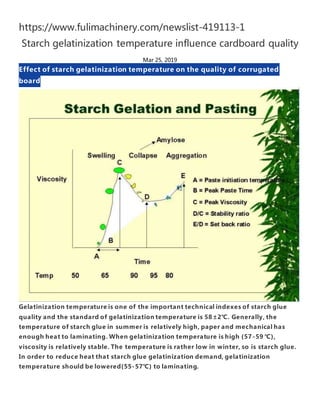
Gelatinization temperature is one of the important technical indexes of starch glue
quality and the standard of gelatinization temperature is 58±2℃. Generally, the
temperature of starch glue in summer is relatively high, paper and mechanical has
enough heat to laminating. When gelatinization temperature is high (57-59 ℃),
viscosity is relatively stable. The temperature is rather low in winter, so is starch glue.
In order to reduce heat that starch glue gelatinization demand, gelatinization
temperature should be lowered(55-57℃) to laminating.
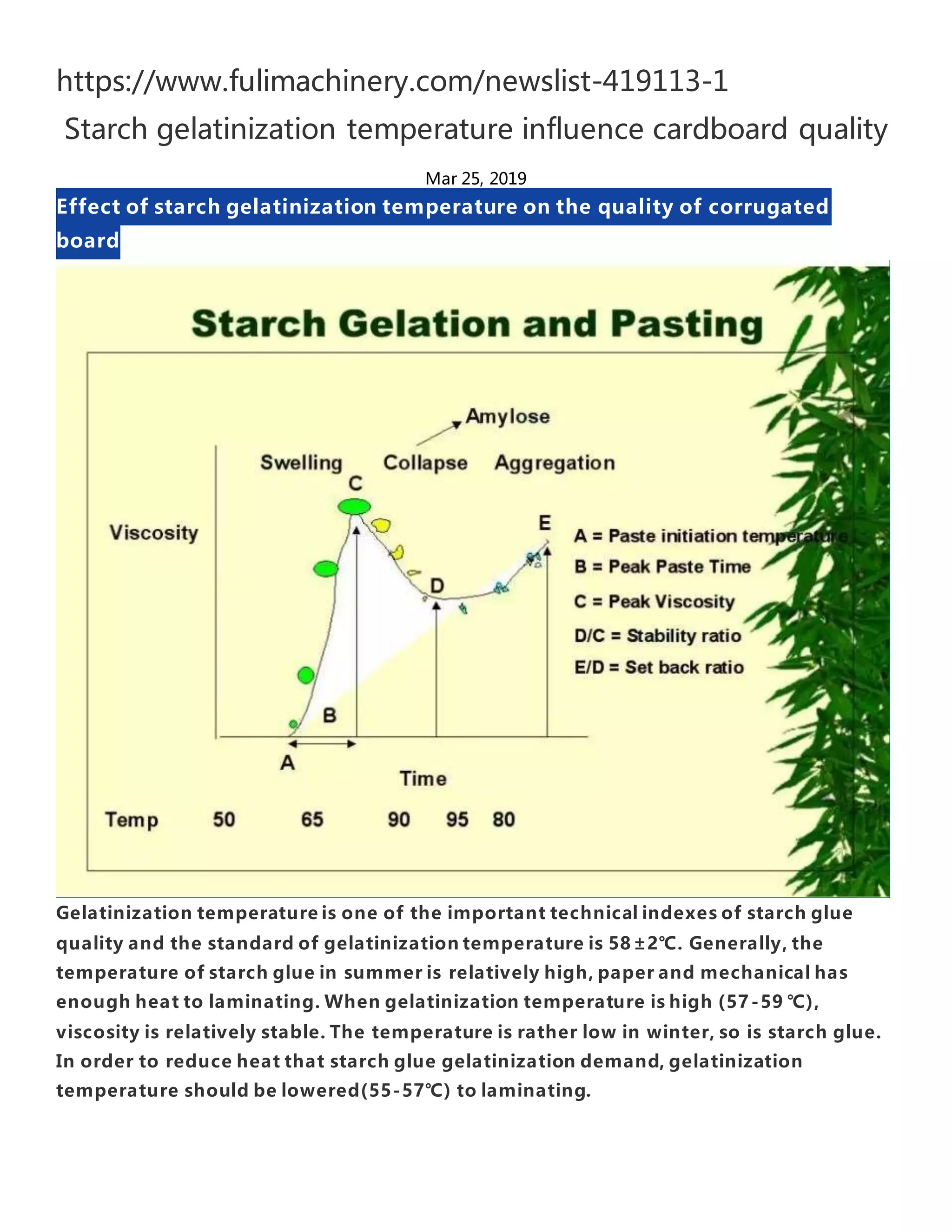
Starch particles were stirred fully under the action of a certain temperature of water,
and expanded gradually under the action of the gelatinizer to reach the gelatinization
temperature. As the temperature rises, starch particles begin to collapse and gradually
disperse into small pieces. When soaked to the inside of linerboard and corrugated
medium, they start to bond which require a certain initial viscosity (mainly due to
NaOH solution and borax solution). As the temperature rises, the moisture content of
starch particles will evaporate, and some of them will be absorbed by linerboard and
corrugated medium, so that the initial adhesion will be carried out rapidly. The starch
glue will connect inner liner, corrugated medium, flute and linerboard into a whole, so
as to achieve the purpose of adhesion.
When starch glue starts to thicken and the gelatinization temperature is that showing the
bonding property due to raw starch gradually g elatinizing among all the starch glue raw
materials.There are many factors affecting the gelatinization temperature, mainly in the
following aspects.
2.1 The dosage of the gelatinizer NaOH
①The effect of the gelatinizer
Starch particles itself has a strong cohesive force, water molecules are not easy to infiltrate,
so water molecules must be brought into starch particles with the help of gelatinizer, which
can weaken the interaction between starch macromolecules and reduc e the gelatinization
temperature. Secondly, when gelatinizer dissolves in starch solution, it will give out certain
heat, making starch particles expand, producing viscosity, and also make starch glue having
better fluidity, and not moldy easily.
In the carton industry, sodium hydroxide (NaOH) is generally selected as the gelatinizer. The
dosage is usually controlled below 1% of the quality of starch glue. It is appropriate to add
the oxidized starch solution and stir the starch solution into a translucen t paste for 20min.
②The amount of NaOH has a great influence on the gelatinization
temperature of starch glue
The higher the amount of NaOH, the lower the gelatinization temperature with a better
infiltration. However, if the weather is too hot, the temperature of starch glue will rise, and
the activity of NaOH will increase as well, which will easily cause viscosity rising. Therefore,
the amount of NaOH should be slightly adjusted to reach the appropriate gelatinization
temperature. Generally, the amount of NaOH should be adjusted with the second amount of
NaOH.
Large amount of NaOH will cause swelling and gelatinization of starch molecules, resulting
in thickening and increase of viscosity (higher than that of 80s). It is not conducive to the
diffusion of oxidants, and it is not easy to glue or glue vague.The dosage of NaOH should
be reduced according to the situation, and measures should be taken to dilute.If the amount
of NaOH is too large, which exceeds all the required amount in the gelatinization pr ocess,
the glue solution is in high fluidity, which will reduce the viscosity of starch glue and increase
the pH value, resulting in yellowing corrugated box and the ink color shifted on the surface
of corrugated box.
The dosage of NaOH is relatively small., it is white or milky paste 20min after being added,
opaque and non-sticky, which under this circumstances is not conducive to the oxidation of
starch. The gelatinization is not complete. Glue solution is turbid with a poor fluidity and
difficult to storage. If the dosage is too small, characterized by the amount of heat released
is less, the gelatinization effect is not sufficient, the viscosity is too low (viscosity is below
20s), and the adhesion force is poor, then the amount of NaOH should be added
appropriately according to the situation (the net amount of NaOH used should be clarified).
When adding NaOH, fill a certain amount of NaOH with 5 -10 times cold water, slowly add it
to the container, and continue to stir.
In addition, the concentration of NaOH cannot be too high, if so, the gelatinization reaction
will be too strong, easy to saccharifying, resulting in glue thrown, and vague glue will be
generated on the framed corrugated peak. It will cause debonding and destroy paper fiber
and is difficult to dry. when air humidity is large, easy to absorb moisture and yellowing,
which generally should be controlled in 10%-13% .
The dosage of NaOH should be depended on the actual use, generally about 12% of starch
is appropriate.
2.2 The type and quality of starch
Starch is the main adhesive, insoluble in water, expands and gelatinizes with the increase of
water temperature. When it acts with NaOH solution, it expands sufficiently and its viscosity
increases.
The commonly used starch mainly includes co rn starch, wheat starch, tapioca starch and
potato starch. The variation of gelatinization temperature is due to different producing areas,
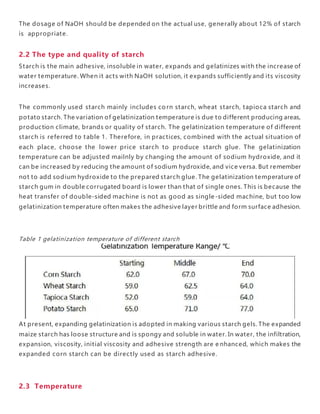
production climate, brands or quality of starch. The gelatinization temperature of different
starch is referred to table 1. Therefore, in practices, combined with the actual situation of
each place, choose the lower price starch to produce starch glue. The gelatinization
temperature can be adjusted mailnly by changing the amount of sodium hydroxide, and it
can be increased by reducing the amount of sodium hydroxide, and vice versa. But remember
not to add sodium hydroxide to the prepared starch glue. The gelatinization temperature of
starch gum in double corrugated board is lower than that of single ones. This is because the
heat transfer of double-sided machine is not as good as single -sided machine, but too low
gelatinization temperature often makes the adhesive layer brittle and form surface adhesion.
Table 1 gelatinization temperature of different starch
At present, expanding gelatinization is adopted in making various starch gels. The expanded
maize starch has loose structure and is spongy and soluble in water. In water, the infiltration,
expansion, viscosity, initial viscosity and adhesive strength are e nhanced, which makes the
expanded corn starch can be directly used as starch adhesive.
2.3 Temperature
The higher the water temperature, the stronger the activity of NaOH, the faster the starch
glue viscosity increases, and therefore the lower the gelat inization temperature is. In this
case, the amount of secondary NaOH must be reduced to achieve a stable gelatinization
temperature, while the lower the water temperature is, the opposite is true.
2.4 The process of configuration craft
After the first addition of NaOH, it should be stirred for 25 ±5min to have sufficient time to
evenly expand and get the correct gelatinization temperature. If the gelatinization
temperature is too low, some starch particles will overexpand, while some are not yet
expanded, and the viscosity changes greatly, in this case, the amount of NaOH must be
reduced. If the gelatinization temperature is too high, the viscosity will be decreased in the
text of shear cut during the use, and the amount of NaOH needs to b e increased.
The biggest defect of starch glue is that it is easy to corrupt and deteriorate, the storage
period is short, the service performance is not stable, and the reason why is related to
gelatinization temperature.
When gelatinization temperature is low, it is easy to cause insufficient gelatinization reaction.
The more complete the gelatinization reaction, the longer the storage time of the glue. If
starch glue deteriorates during storage from 3 days to 6 months, the reason for the
insufficient gelatinization reaction is that ungelatinized starch molecules are more
susceptible to bacterial erosion than gelatinized starch molecules.
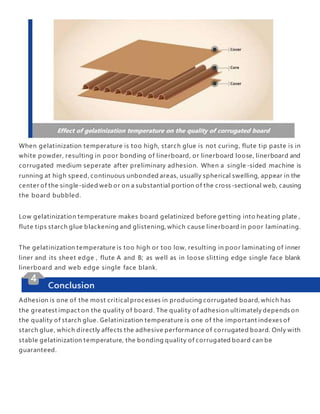
When gelatinization temperature is too high, starch glue is not curing, flute tip paste is in
white powder, resulting in poor bonding of linerboard, or linerboard loose, linerboard and
corrugated medium seperate after preliminary adhesion. When a single -sided machine is
running at high speed, continuous unbonded areas, usually spherical swelling, appear in the
center of the single-sided web or on a substantial portion of the cross-sectional web, causing
the board bubbled.
Low gelatinization temperature makes board gelatinized before getting into heating plate ,
flute tips starch glue blackening and glistening, which cause linerboard in poor laminating.
The gelatinization temperature is too high or too low, resulting in poor laminating of inner
liner and its sheet edge , flute A and B; as well as in loose slitting edge single face blank
linerboard and web edge single face blank.
Adhesion is one of the most critical processes in producing corrugated board, which has
the greatest impact on the quality of board. The quality of adhesion ultimately depends on
the quality of starch glue. Gelatinization temperature is one of the important indexes of
starch glue, which directly affects the adhesive performance of corrugated board. Only with
stable gelatinization temperature, the bonding quality of corrugated board can be
guaranteed.

Starch gelatinization temperature influence cardboard quality

  • 1.
    https://www.fulimachinery.com/newslist-419113-1 Starch gelatinization temperatureinfluence cardboard quality Mar 25, 2019 Effect of starch gelatinization temperature on the quality of corrugated board Gelatinization temperature is one of the important technical indexes of starch glue quality and the standard of gelatinization temperature is 58±2℃. Generally, the temperature of starch glue in summer is relatively high, paper and mechanical has enough heat to laminating. When gelatinization temperature is high (57-59 ℃), viscosity is relatively stable. The temperature is rather low in winter, so is starch glue. In order to reduce heat that starch glue gelatinization demand, gelatinization temperature should be lowered(55-57℃) to laminating.
  • 2.
    Starch particles werestirred fully under the action of a certain temperature of water, and expanded gradually under the action of the gelatinizer to reach the gelatinization temperature. As the temperature rises, starch particles begin to collapse and gradually disperse into small pieces. When soaked to the inside of linerboard and corrugated medium, they start to bond which require a certain initial viscosity (mainly due to NaOH solution and borax solution). As the temperature rises, the moisture content of starch particles will evaporate, and some of them will be absorbed by linerboard and corrugated medium, so that the initial adhesion will be carried out rapidly. The starch glue will connect inner liner, corrugated medium, flute and linerboard into a whole, so as to achieve the purpose of adhesion. When starch glue starts to thicken and the gelatinization temperature is that showing the bonding property due to raw starch gradually g elatinizing among all the starch glue raw materials.There are many factors affecting the gelatinization temperature, mainly in the following aspects.
  • 3.
    2.1 The dosageof the gelatinizer NaOH ①The effect of the gelatinizer Starch particles itself has a strong cohesive force, water molecules are not easy to infiltrate, so water molecules must be brought into starch particles with the help of gelatinizer, which can weaken the interaction between starch macromolecules and reduc e the gelatinization temperature. Secondly, when gelatinizer dissolves in starch solution, it will give out certain heat, making starch particles expand, producing viscosity, and also make starch glue having better fluidity, and not moldy easily. In the carton industry, sodium hydroxide (NaOH) is generally selected as the gelatinizer. The dosage is usually controlled below 1% of the quality of starch glue. It is appropriate to add the oxidized starch solution and stir the starch solution into a translucen t paste for 20min.
  • 4.
    ②The amount ofNaOH has a great influence on the gelatinization temperature of starch glue The higher the amount of NaOH, the lower the gelatinization temperature with a better infiltration. However, if the weather is too hot, the temperature of starch glue will rise, and the activity of NaOH will increase as well, which will easily cause viscosity rising. Therefore, the amount of NaOH should be slightly adjusted to reach the appropriate gelatinization temperature. Generally, the amount of NaOH should be adjusted with the second amount of NaOH. Large amount of NaOH will cause swelling and gelatinization of starch molecules, resulting in thickening and increase of viscosity (higher than that of 80s). It is not conducive to the diffusion of oxidants, and it is not easy to glue or glue vague.The dosage of NaOH should be reduced according to the situation, and measures should be taken to dilute.If the amount of NaOH is too large, which exceeds all the required amount in the gelatinization pr ocess, the glue solution is in high fluidity, which will reduce the viscosity of starch glue and increase the pH value, resulting in yellowing corrugated box and the ink color shifted on the surface of corrugated box. The dosage of NaOH is relatively small., it is white or milky paste 20min after being added, opaque and non-sticky, which under this circumstances is not conducive to the oxidation of starch. The gelatinization is not complete. Glue solution is turbid with a poor fluidity and difficult to storage. If the dosage is too small, characterized by the amount of heat released is less, the gelatinization effect is not sufficient, the viscosity is too low (viscosity is below 20s), and the adhesion force is poor, then the amount of NaOH should be added appropriately according to the situation (the net amount of NaOH used should be clarified). When adding NaOH, fill a certain amount of NaOH with 5 -10 times cold water, slowly add it to the container, and continue to stir. In addition, the concentration of NaOH cannot be too high, if so, the gelatinization reaction will be too strong, easy to saccharifying, resulting in glue thrown, and vague glue will be generated on the framed corrugated peak. It will cause debonding and destroy paper fiber and is difficult to dry. when air humidity is large, easy to absorb moisture and yellowing, which generally should be controlled in 10%-13% .
  • 5.
    The dosage ofNaOH should be depended on the actual use, generally about 12% of starch is appropriate. 2.2 The type and quality of starch Starch is the main adhesive, insoluble in water, expands and gelatinizes with the increase of water temperature. When it acts with NaOH solution, it expands sufficiently and its viscosity increases. The commonly used starch mainly includes co rn starch, wheat starch, tapioca starch and potato starch. The variation of gelatinization temperature is due to different producing areas, production climate, brands or quality of starch. The gelatinization temperature of different starch is referred to table 1. Therefore, in practices, combined with the actual situation of each place, choose the lower price starch to produce starch glue. The gelatinization temperature can be adjusted mailnly by changing the amount of sodium hydroxide, and it can be increased by reducing the amount of sodium hydroxide, and vice versa. But remember not to add sodium hydroxide to the prepared starch glue. The gelatinization temperature of starch gum in double corrugated board is lower than that of single ones. This is because the heat transfer of double-sided machine is not as good as single -sided machine, but too low gelatinization temperature often makes the adhesive layer brittle and form surface adhesion. Table 1 gelatinization temperature of different starch At present, expanding gelatinization is adopted in making various starch gels. The expanded maize starch has loose structure and is spongy and soluble in water. In water, the infiltration, expansion, viscosity, initial viscosity and adhesive strength are e nhanced, which makes the expanded corn starch can be directly used as starch adhesive. 2.3 Temperature
  • 6.
    The higher thewater temperature, the stronger the activity of NaOH, the faster the starch glue viscosity increases, and therefore the lower the gelat inization temperature is. In this case, the amount of secondary NaOH must be reduced to achieve a stable gelatinization temperature, while the lower the water temperature is, the opposite is true. 2.4 The process of configuration craft After the first addition of NaOH, it should be stirred for 25 ±5min to have sufficient time to evenly expand and get the correct gelatinization temperature. If the gelatinization temperature is too low, some starch particles will overexpand, while some are not yet expanded, and the viscosity changes greatly, in this case, the amount of NaOH must be reduced. If the gelatinization temperature is too high, the viscosity will be decreased in the text of shear cut during the use, and the amount of NaOH needs to b e increased. The biggest defect of starch glue is that it is easy to corrupt and deteriorate, the storage period is short, the service performance is not stable, and the reason why is related to gelatinization temperature. When gelatinization temperature is low, it is easy to cause insufficient gelatinization reaction. The more complete the gelatinization reaction, the longer the storage time of the glue. If starch glue deteriorates during storage from 3 days to 6 months, the reason for the insufficient gelatinization reaction is that ungelatinized starch molecules are more susceptible to bacterial erosion than gelatinized starch molecules.
  • 7.
    When gelatinization temperatureis too high, starch glue is not curing, flute tip paste is in white powder, resulting in poor bonding of linerboard, or linerboard loose, linerboard and corrugated medium seperate after preliminary adhesion. When a single -sided machine is running at high speed, continuous unbonded areas, usually spherical swelling, appear in the center of the single-sided web or on a substantial portion of the cross-sectional web, causing the board bubbled. Low gelatinization temperature makes board gelatinized before getting into heating plate , flute tips starch glue blackening and glistening, which cause linerboard in poor laminating. The gelatinization temperature is too high or too low, resulting in poor laminating of inner liner and its sheet edge , flute A and B; as well as in loose slitting edge single face blank linerboard and web edge single face blank. Adhesion is one of the most critical processes in producing corrugated board, which has the greatest impact on the quality of board. The quality of adhesion ultimately depends on the quality of starch glue. Gelatinization temperature is one of the important indexes of starch glue, which directly affects the adhesive performance of corrugated board. Only with stable gelatinization temperature, the bonding quality of corrugated board can be guaranteed.