Standardised Tests for
Measuring Interest: A
Comprehensive Guide
The Why: Understanding the Value of Interest
Measurement
Standardised interest tests offer profound insights into an
individual's inclinations, preferences, and potential career
paths. They are vital tools for career counselling, educational
planning, and personal development, helping individuals
align their passions with purposeful pursuits.
By objectively assessing interests, these tests can:
Guide career choices.
Enhance job satisfaction.
Facilitate educational pathways.
Promote self-discovery.
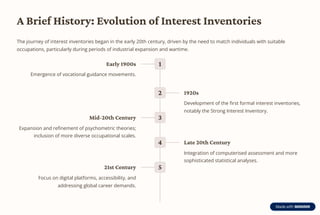
A Brief History: Evolution of Interest Inventories
The journey of interest inventories began in the early 20th century, driven by the need to match individuals with suitable
occupations, particularly during periods of industrial expansion and wartime.
1
Early 1900s
Emergence of vocational guidance movements.
2 1920s
Development of the first formal interest inventories,
notably the Strong Interest Inventory.
3
Mid-20th Century
Expansion and refinement of psychometric theories;
inclusion of more diverse occupational scales.
4 Late 20th Century
Integration of computerised assessment and more
sophisticated statistical analyses.
5
21st Century
Focus on digital platforms, accessibility, and
addressing global career demands.
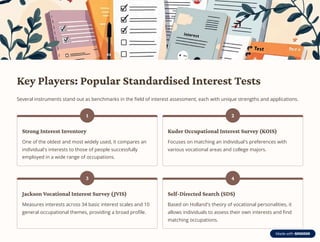
Key Players: Popular Standardised Interest Tests
Several instruments stand out as benchmarks in the field of interest assessment, each with unique strengths and applications.
1
Strong Interest Inventory
One of the oldest and most widely used, it compares an
individual's interests to those of people successfully
employed in a wide range of occupations.
2
Kuder Occupational Interest Survey (KOIS)
Focuses on matching an individual's preferences with
various vocational areas and college majors.
3
Jackson Vocational Interest Survey (JVIS)
Measures interests across 34 basic interest scales and 10
general occupational themes, providing a broad profile.
4
Self-Directed Search (SDS)
Based on Holland's theory of vocational personalities, it
allows individuals to assess their own interests and find
matching occupations.
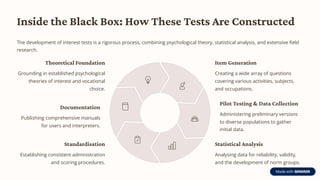
Inside the Black Box: How These Tests Are Constructed
The development of interest tests is a rigorous process, combining psychological theory, statistical analysis, and extensive field
research.
Theoretical Foundation
Grounding in established psychological
theories of interest and vocational
choice.
Item Generation
Creating a wide array of questions
covering various activities, subjects,
and occupations.
Pilot Testing & Data Collection
Administering preliminary versions
to diverse populations to gather
initial data.
Statistical Analysis
Analysing data for reliability, validity,
and the development of norm groups.
Standardisation
Establishing consistent administration
and scoring procedures.
Documentation
Publishing comprehensive manuals
for users and interpreters.
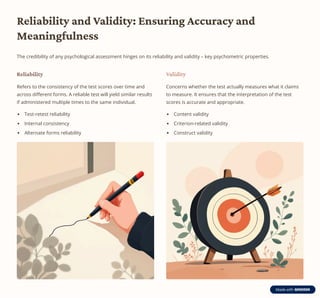
Reliability and Validity: Ensuring Accuracy and
Meaningfulness
The credibility of any psychological assessment hinges on its reliability and validity 3 key psychometric properties.
Reliability
Refers to the consistency of the test scores over time and
across different forms. A reliable test will yield similar results
if administered multiple times to the same individual.
Test-retest reliability
Internal consistency
Alternate forms reliability
Validity
Concerns whether the test actually measures what it claims
to measure. It ensures that the interpretation of the test
scores is accurate and appropriate.
Content validity
Criterion-related validity
Construct validity
Beyond the Score: Interpreting Results and Providing
Guidance
Raw scores alone hold little meaning. The true value of interest tests lies in expert interpretation and thoughtful counselling,
translating data into actionable insights for personal and professional growth.
Contextualisation
Placing results within the individual's unique life
experiences, education, and aspirations.
Exploration
Facilitating discussions about potential careers,
educational programmes, and further training
opportunities suggested by the results.
Action Planning
Collaborating with the individual to develop concrete
steps towards exploring or pursuing identified interests.
Ongoing Support
Providing resources and follow-up to ensure continuous
development and adjustment as interests evolve.
Case Studies: Real-World Applications and Success
Stories
From guiding students to selecting majors to assisting professionals in career transitions, interest tests have a proven track
record.
A university student discovered a passion for environmental science after an interest inventory highlighted related fields,
leading to a fulfilling career.
A mid-career professional used test results to pivot from finance to educational technology, experiencing renewed job
satisfaction.
A high school leaver, uncertain about their future, found clarity through an interest test, choosing a vocational path that
leveraged their innate creative abilities.
Ethical Considerations: Bias,
Access, and Responsible Use
While powerful, interest tests must be applied with a strong ethical
compass to ensure fairness, equity, and privacy.
Addressing Bias
Ensuring tests are culturally sensitive and do not inadvertently favour
specific demographics or socio-economic backgrounds.
Ensuring Accessibility
Making tests available and interpretable for individuals with diverse
needs, including those with disabilities.
Responsible Interpretation
Emphasising that test results are guidance, not definitive
pronouncements, and should empower, not limit, individuals.
Data Privacy
Strict adherence to confidentiality and data protection regulations
when collecting and storing sensitive personal information.
Future Horizons: Innovations
and Emerging Trends in Interest
Assessment
The landscape of interest assessment is continually evolving, driven by
technological advancements and deeper understandings of human
psychology.
AI & Machine Learning
Leveraging algorithms for more nuanced pattern recognition
and personalised recommendations.
Gamification & VR
Creating immersive, interactive experiences to assess
interests in more engaging and realistic scenarios.
Globalisation of Careers
Developing tests that reflect an increasingly interconnected
world and diverse global career opportunities.
Continuous Assessment
Moving towards dynamic, ongoing assessments that adapt as
individuals' interests and the job market evolve.
Standardised-Tests-for-Measuring-Interest-A-Comprehensive-Guide.pdf

  • 1.
    Standardised Tests for MeasuringInterest: A Comprehensive Guide
  • 2.
    The Why: Understandingthe Value of Interest Measurement Standardised interest tests offer profound insights into an individual's inclinations, preferences, and potential career paths. They are vital tools for career counselling, educational planning, and personal development, helping individuals align their passions with purposeful pursuits. By objectively assessing interests, these tests can: Guide career choices. Enhance job satisfaction. Facilitate educational pathways. Promote self-discovery.
  • 3.
    A Brief History:Evolution of Interest Inventories The journey of interest inventories began in the early 20th century, driven by the need to match individuals with suitable occupations, particularly during periods of industrial expansion and wartime. 1 Early 1900s Emergence of vocational guidance movements. 2 1920s Development of the first formal interest inventories, notably the Strong Interest Inventory. 3 Mid-20th Century Expansion and refinement of psychometric theories; inclusion of more diverse occupational scales. 4 Late 20th Century Integration of computerised assessment and more sophisticated statistical analyses. 5 21st Century Focus on digital platforms, accessibility, and addressing global career demands.
  • 4.
    Key Players: PopularStandardised Interest Tests Several instruments stand out as benchmarks in the field of interest assessment, each with unique strengths and applications. 1 Strong Interest Inventory One of the oldest and most widely used, it compares an individual's interests to those of people successfully employed in a wide range of occupations. 2 Kuder Occupational Interest Survey (KOIS) Focuses on matching an individual's preferences with various vocational areas and college majors. 3 Jackson Vocational Interest Survey (JVIS) Measures interests across 34 basic interest scales and 10 general occupational themes, providing a broad profile. 4 Self-Directed Search (SDS) Based on Holland's theory of vocational personalities, it allows individuals to assess their own interests and find matching occupations.
  • 5.
    Inside the BlackBox: How These Tests Are Constructed The development of interest tests is a rigorous process, combining psychological theory, statistical analysis, and extensive field research. Theoretical Foundation Grounding in established psychological theories of interest and vocational choice. Item Generation Creating a wide array of questions covering various activities, subjects, and occupations. Pilot Testing & Data Collection Administering preliminary versions to diverse populations to gather initial data. Statistical Analysis Analysing data for reliability, validity, and the development of norm groups. Standardisation Establishing consistent administration and scoring procedures. Documentation Publishing comprehensive manuals for users and interpreters.
  • 6.
    Reliability and Validity:Ensuring Accuracy and Meaningfulness The credibility of any psychological assessment hinges on its reliability and validity 3 key psychometric properties. Reliability Refers to the consistency of the test scores over time and across different forms. A reliable test will yield similar results if administered multiple times to the same individual. Test-retest reliability Internal consistency Alternate forms reliability Validity Concerns whether the test actually measures what it claims to measure. It ensures that the interpretation of the test scores is accurate and appropriate. Content validity Criterion-related validity Construct validity
  • 7.
    Beyond the Score:Interpreting Results and Providing Guidance Raw scores alone hold little meaning. The true value of interest tests lies in expert interpretation and thoughtful counselling, translating data into actionable insights for personal and professional growth. Contextualisation Placing results within the individual's unique life experiences, education, and aspirations. Exploration Facilitating discussions about potential careers, educational programmes, and further training opportunities suggested by the results. Action Planning Collaborating with the individual to develop concrete steps towards exploring or pursuing identified interests. Ongoing Support Providing resources and follow-up to ensure continuous development and adjustment as interests evolve.
  • 8.
    Case Studies: Real-WorldApplications and Success Stories From guiding students to selecting majors to assisting professionals in career transitions, interest tests have a proven track record. A university student discovered a passion for environmental science after an interest inventory highlighted related fields, leading to a fulfilling career. A mid-career professional used test results to pivot from finance to educational technology, experiencing renewed job satisfaction. A high school leaver, uncertain about their future, found clarity through an interest test, choosing a vocational path that leveraged their innate creative abilities.
  • 9.
    Ethical Considerations: Bias, Access,and Responsible Use While powerful, interest tests must be applied with a strong ethical compass to ensure fairness, equity, and privacy. Addressing Bias Ensuring tests are culturally sensitive and do not inadvertently favour specific demographics or socio-economic backgrounds. Ensuring Accessibility Making tests available and interpretable for individuals with diverse needs, including those with disabilities. Responsible Interpretation Emphasising that test results are guidance, not definitive pronouncements, and should empower, not limit, individuals. Data Privacy Strict adherence to confidentiality and data protection regulations when collecting and storing sensitive personal information.
  • 10.
    Future Horizons: Innovations andEmerging Trends in Interest Assessment The landscape of interest assessment is continually evolving, driven by technological advancements and deeper understandings of human psychology. AI & Machine Learning Leveraging algorithms for more nuanced pattern recognition and personalised recommendations. Gamification & VR Creating immersive, interactive experiences to assess interests in more engaging and realistic scenarios. Globalisation of Careers Developing tests that reflect an increasingly interconnected world and diverse global career opportunities. Continuous Assessment Moving towards dynamic, ongoing assessments that adapt as individuals' interests and the job market evolve.