Radu Stancut
CS6313
Information Visualization, Spring 2015
Visual Data Exploration and Presentation with Tableau - Parole Data
The New York state parole data provides several features to work with, both that allow for direct
visualization and the creation of additional information that further helps visualize what the table
consists of. As a means to better understand what we are dealing with I provide some perfunctory
data, images, and descriptions of the 24,000+ records. Using one of the few categorical fields
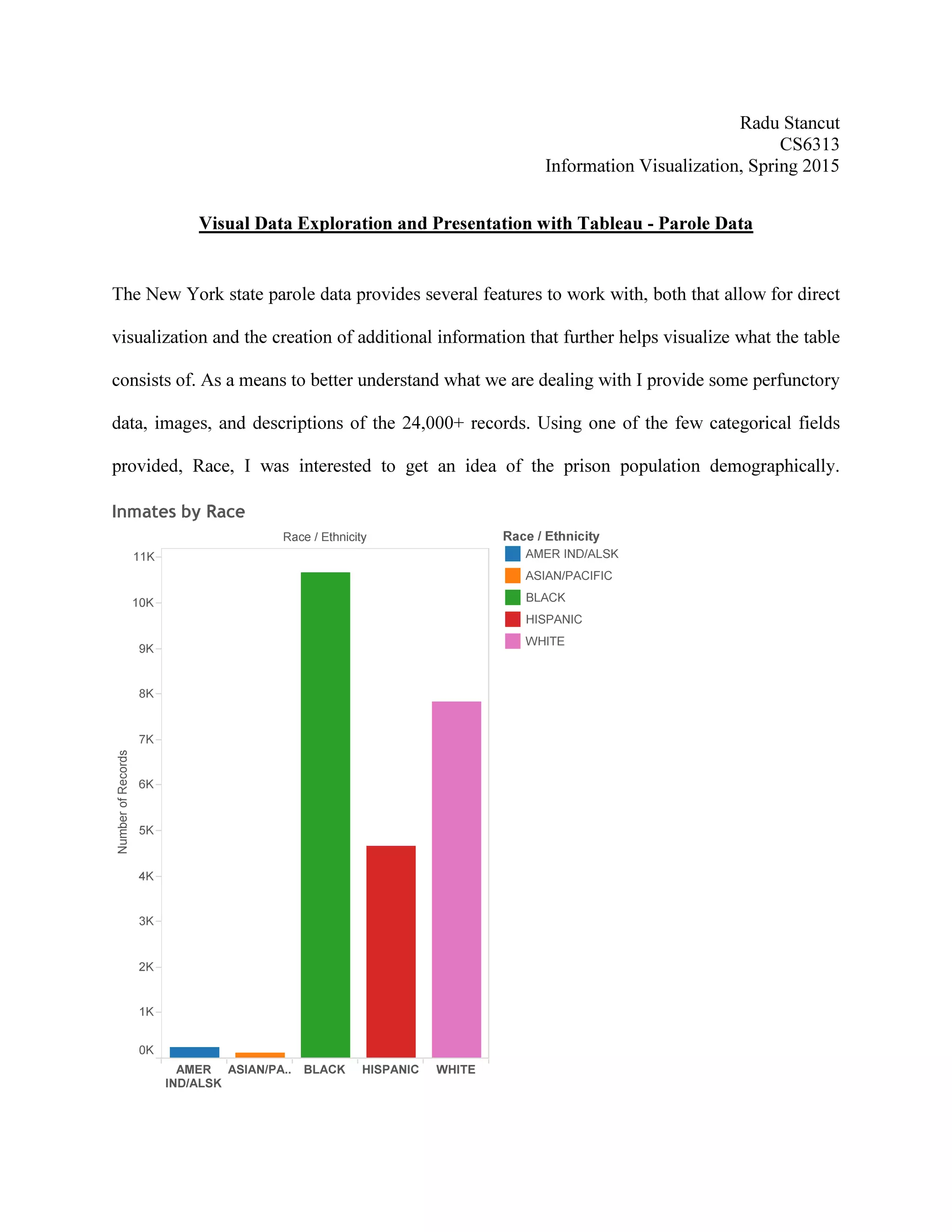
provided, Race, I was interested to get an idea of the prison population demographically.
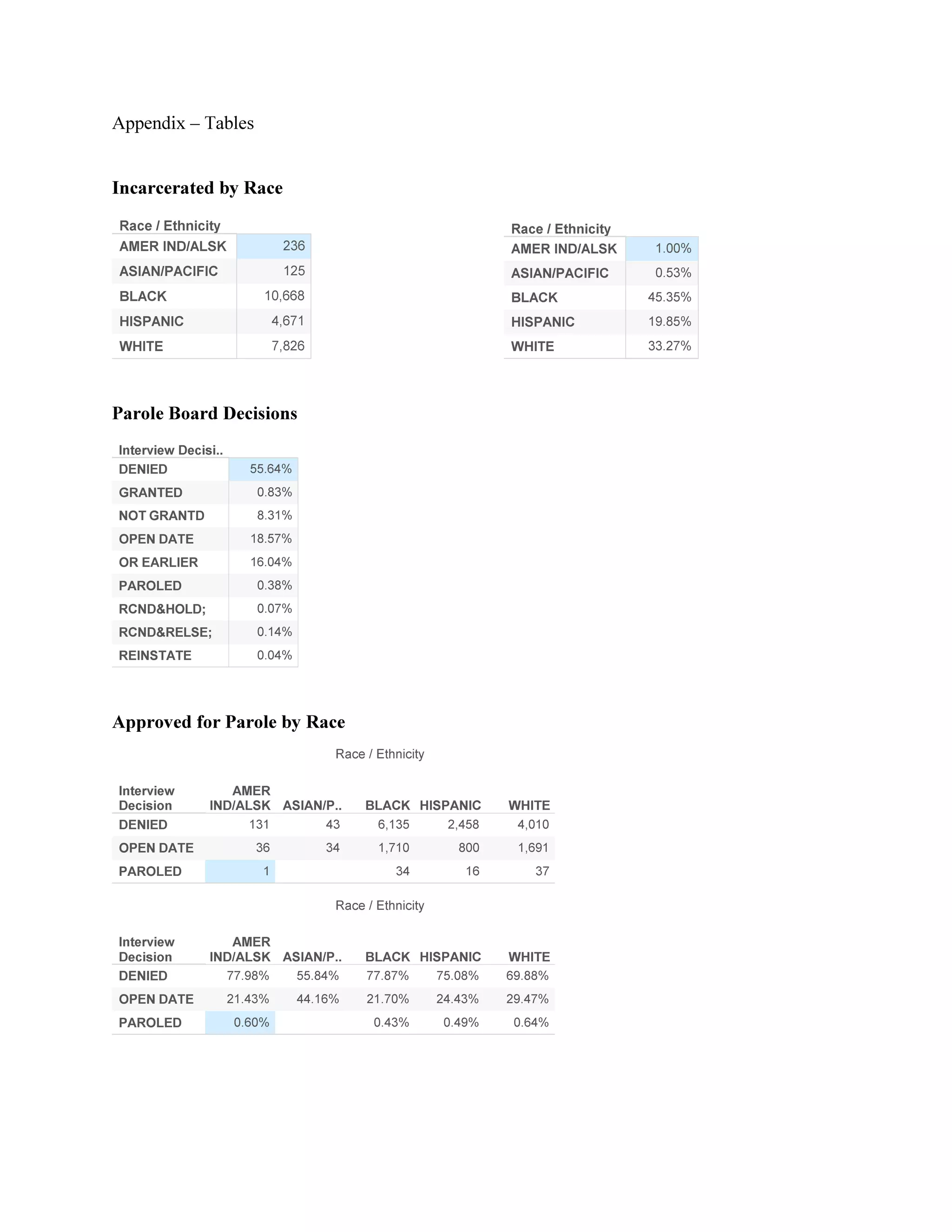
The first figure above does just that and shows all identified races, with columns displaying the
count for each race; the top three races, in descending order of inmates are Black, White, and
Hispanic. Corresponding tables for this and other figures, as well as numbers not directly taken
from the visualizations, may be found at the end of the paper in the Appendix.
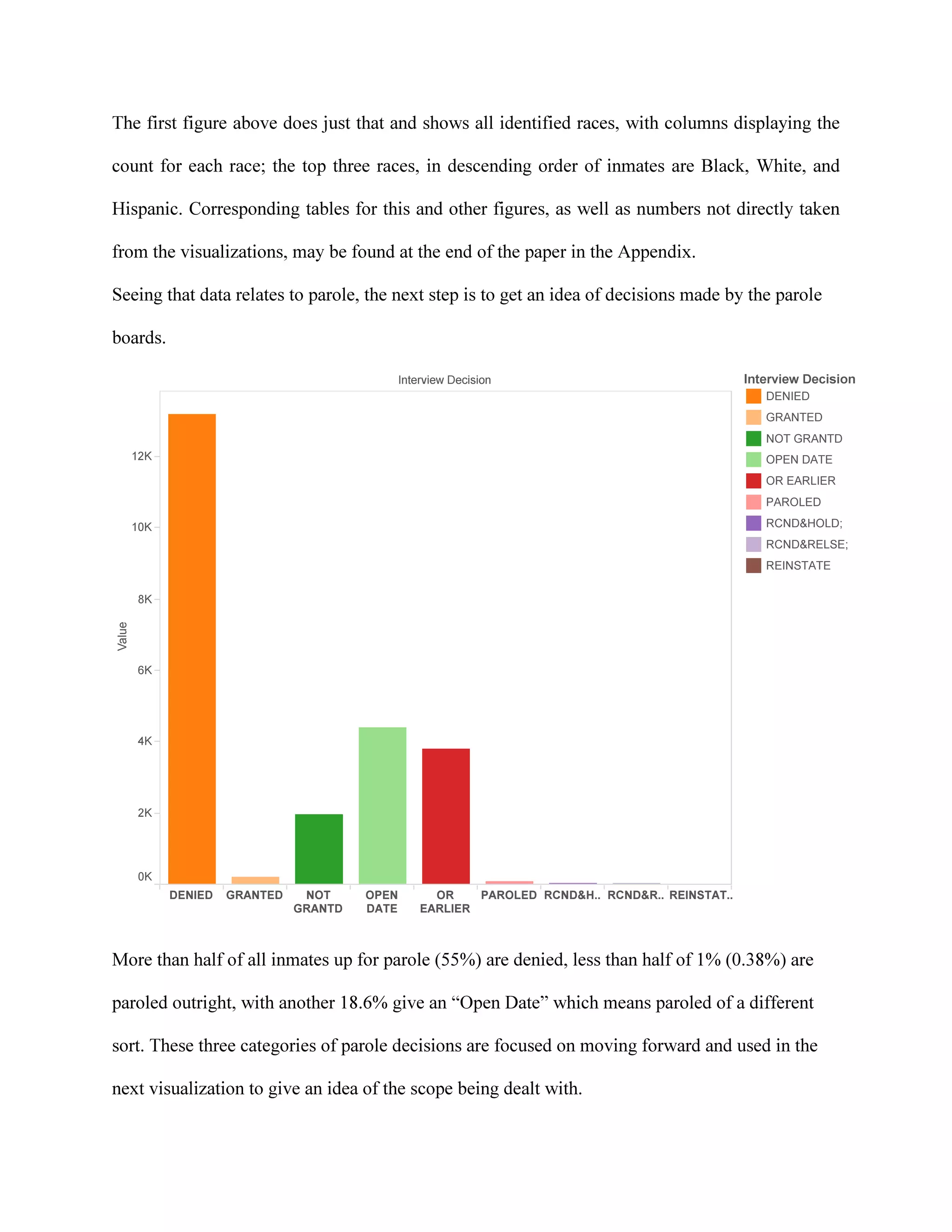
Seeing that data relates to parole, the next step is to get an idea of decisions made by the parole
boards.
More than half of all inmates up for parole (55%) are denied, less than half of 1% (0.38%) are
paroled outright, with another 18.6% give an “Open Date” which means paroled of a different
sort. These three categories of parole decisions are focused on moving forward and used in the
next visualization to give an idea of the scope being dealt with.
Interview Decision
DENIED GRANTED NOT
GRANTD
OPEN
DATE
OR
EARLIER
PAROLED RCND&H.. RCND&R.. REINSTAT..
0K
2K
4K
6K
8K
10K
12K
Interview Decision
DENIED
GRANTED
NOT GRANTD
OPEN DATE
OR EARLIER
PAROLED
RCND&HOLD;
RCND&RELSE;
REINSTATE
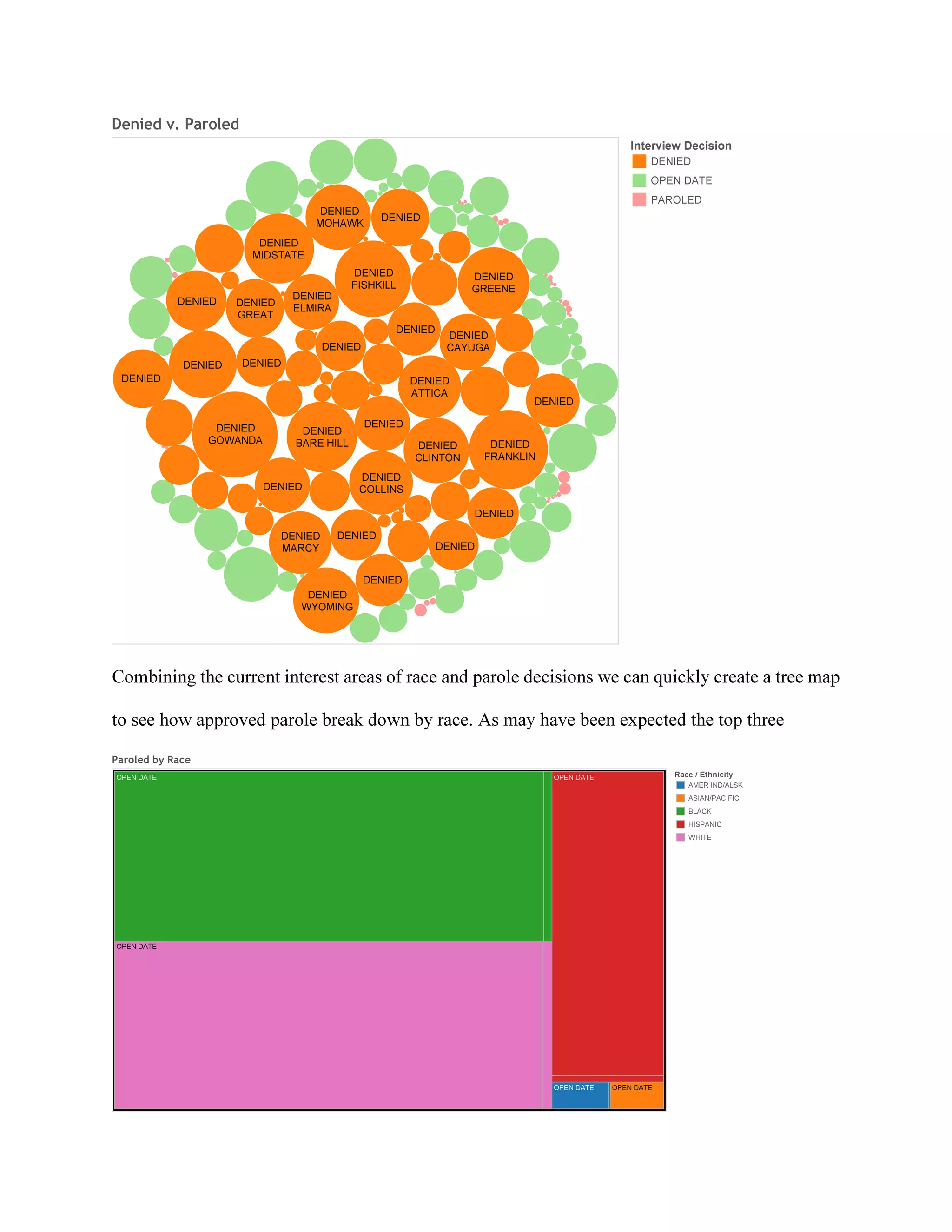
Combining the current interest areas of race and parole decisions we can quickly create a tree map
to see how approved parole break down by race. As may have been expected the top three
OPEN DATE
OPEN DATEOPEN DATE
OPEN DATEOPEN DATE
Paroled by Race
Race / Ethnicity
AMER IND/ALSK
ASIAN/PACIFIC
BLACK
HISPANIC
WHITE
incarcerated races are also the top three paroled groups. Nothing too dramatic but you may have
noticed that Blacks and Whites have a similar number of parolees (~1,700) despite having a
different number of inmates, resulting in different percentages favoring White parolees (22% v.
30%). Now we have two potential indications of bias, a higher ratio of Blacks incarcerated than
their general population would indicate1
and their being granted parole at a lower rate than White
counterparts.
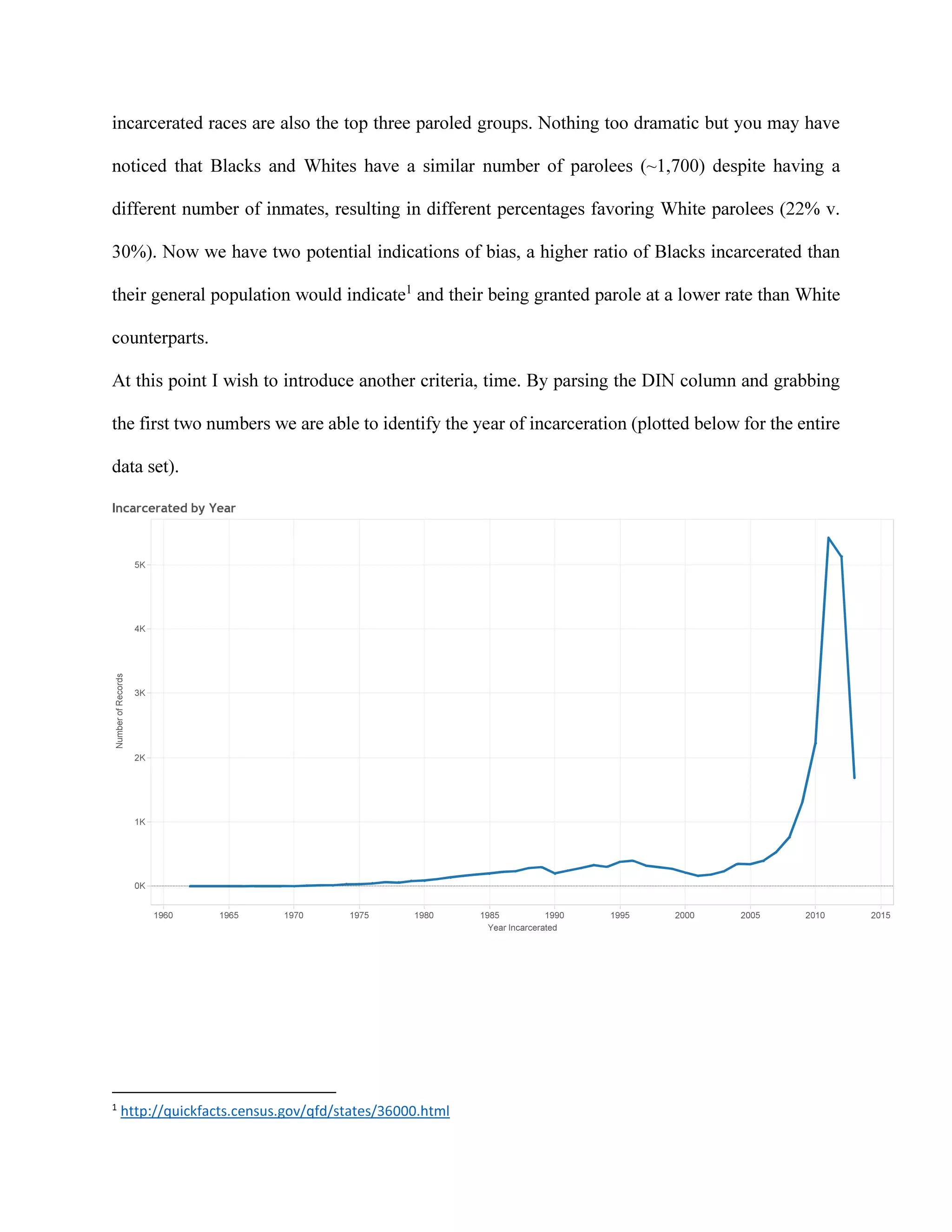
At this point I wish to introduce another criteria, time. By parsing the DIN column and grabbing
the first two numbers we are able to identify the year of incarceration (plotted below for the entire
data set).
1
http://quickfacts.census.gov/qfd/states/36000.html
1960 1965 1970 1975 1980 1985 1990 1995 2000 2005 2010 2015
Year Incarcerated
0K
1K
2K
3K
4K
5K
Incarcerated by Year
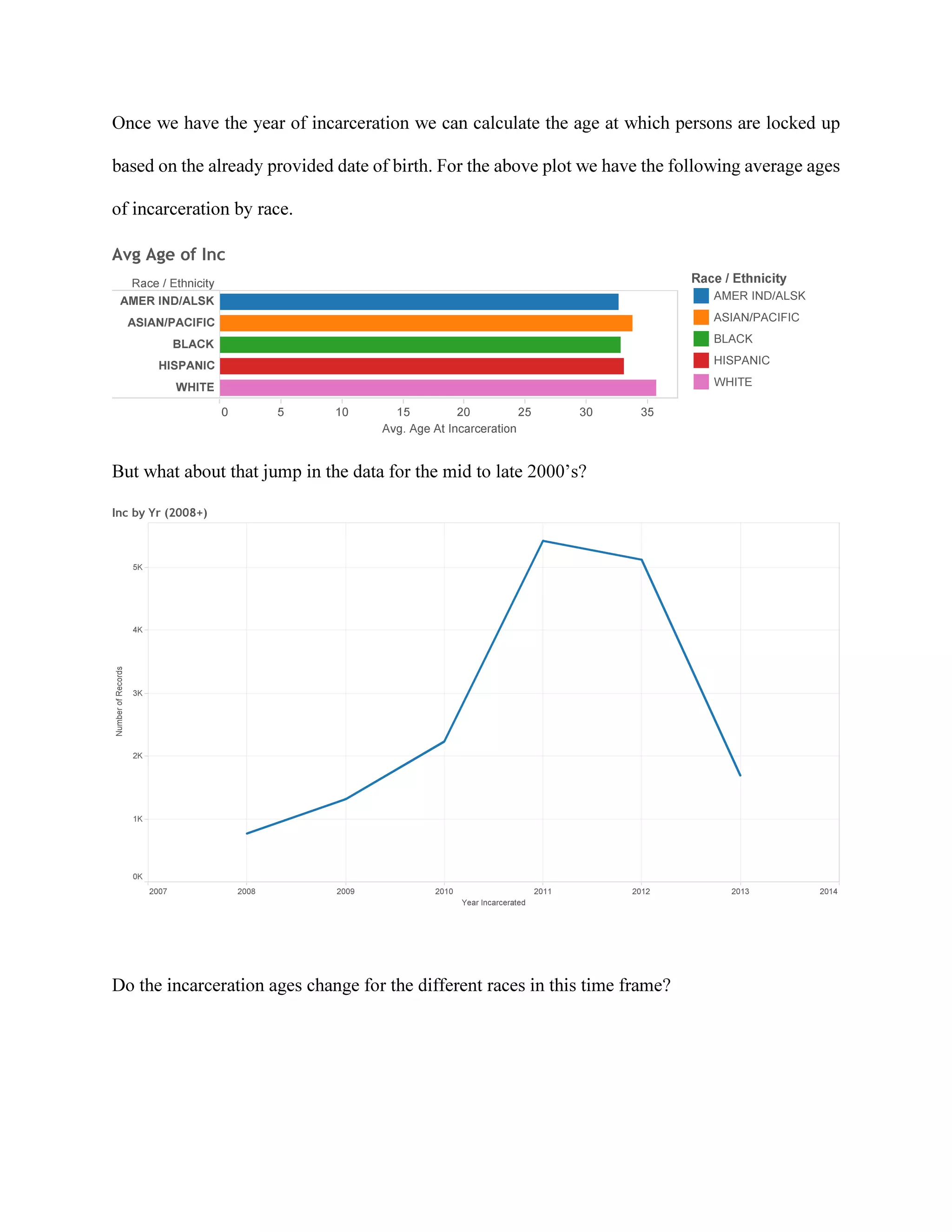
Once we have the year of incarceration we can calculate the age at which persons are locked up
based on the already provided date of birth. For the above plot we have the following average ages
of incarceration by race.
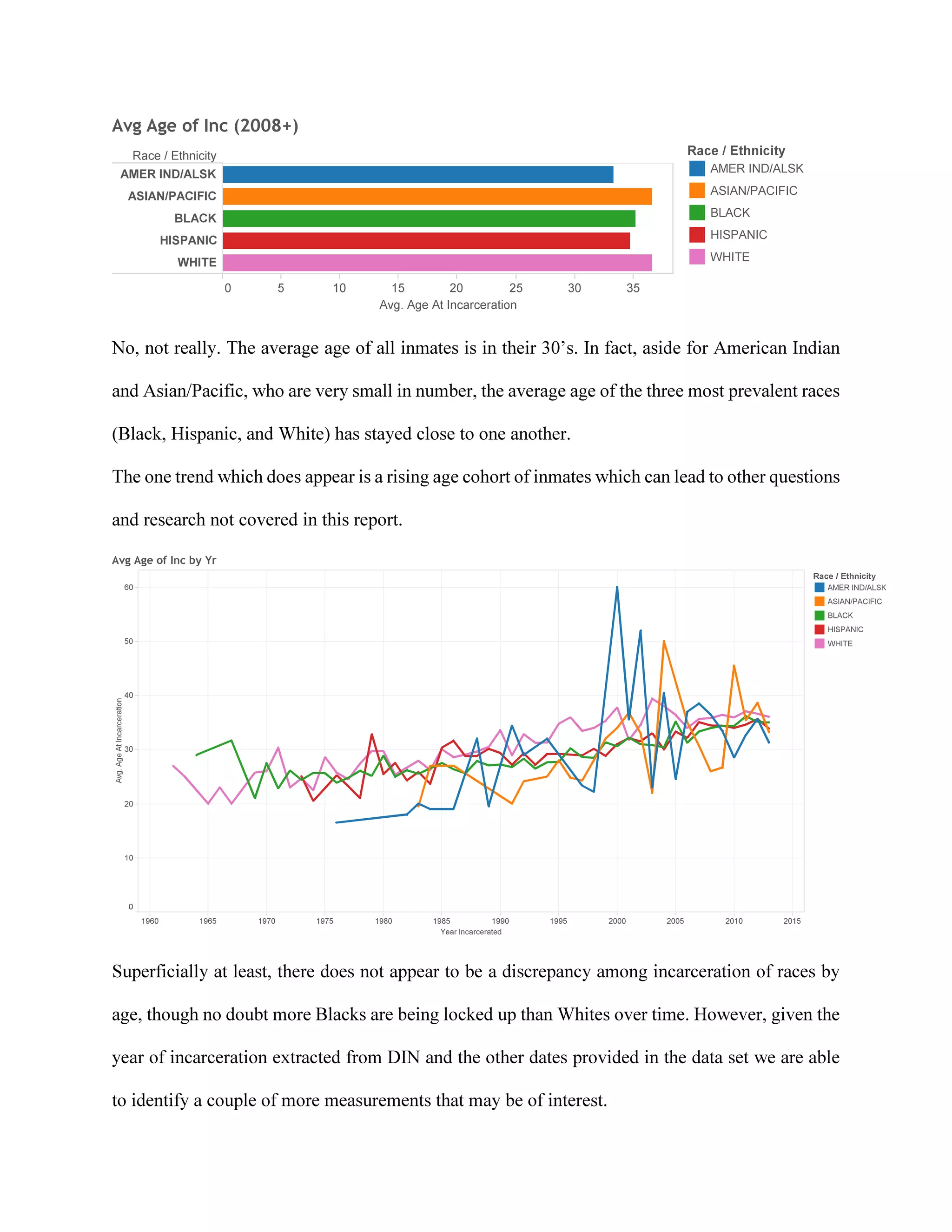
But what about that jump in the data for the mid to late 2000’s?
Do the incarceration ages change for the different races in this time frame?
2007 2008 2009 2010 2011 2012 2013 2014
Year Incarcerated
0K
1K
2K
3K
4K
5K
Inc by Yr (2008+)
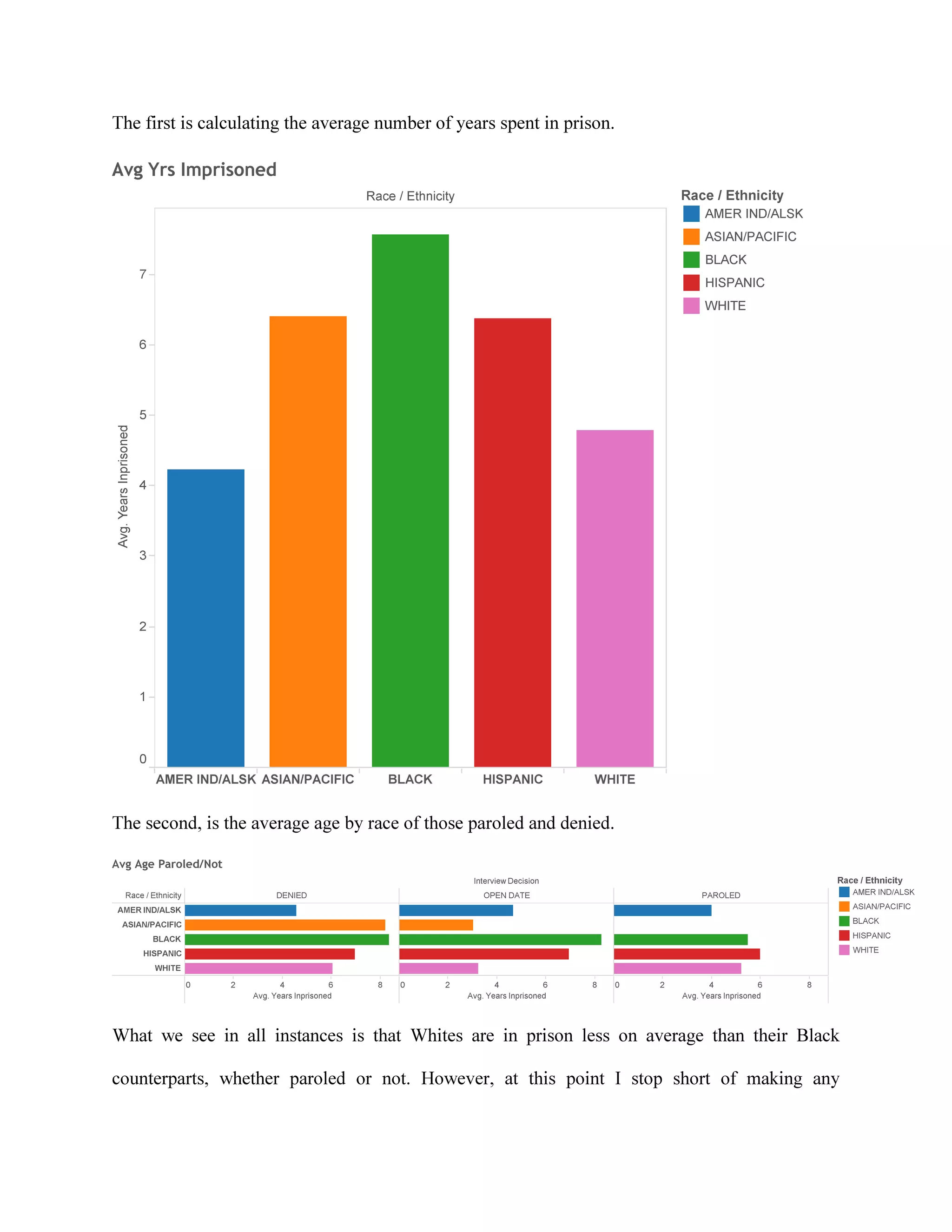
No, not really. The average age of all inmates is in their 30’s. In fact, aside for American Indian
and Asian/Pacific, who are very small in number, the average age of the three most prevalent races
(Black, Hispanic, and White) has stayed close to one another.
The one trend which does appear is a rising age cohort of inmates which can lead to other questions
and research not covered in this report.
Superficially at least, there does not appear to be a discrepancy among incarceration of races by
age, though no doubt more Blacks are being locked up than Whites over time. However, given the
year of incarceration extracted from DIN and the other dates provided in the data set we are able
to identify a couple of more measurements that may be of interest.
Race / Ethnicity
0 5 10 15 20 25 30 35
Avg. Age At Incarceration
AMER IND/ALSK
ASIAN/PACIFIC
BLACK
HISPANIC
WHITE
Avg Age of Inc (2008+)
Race / Ethnicity
AMER IND/ALSK
ASIAN/PACIFIC
BLACK
HISPANIC
WHITE
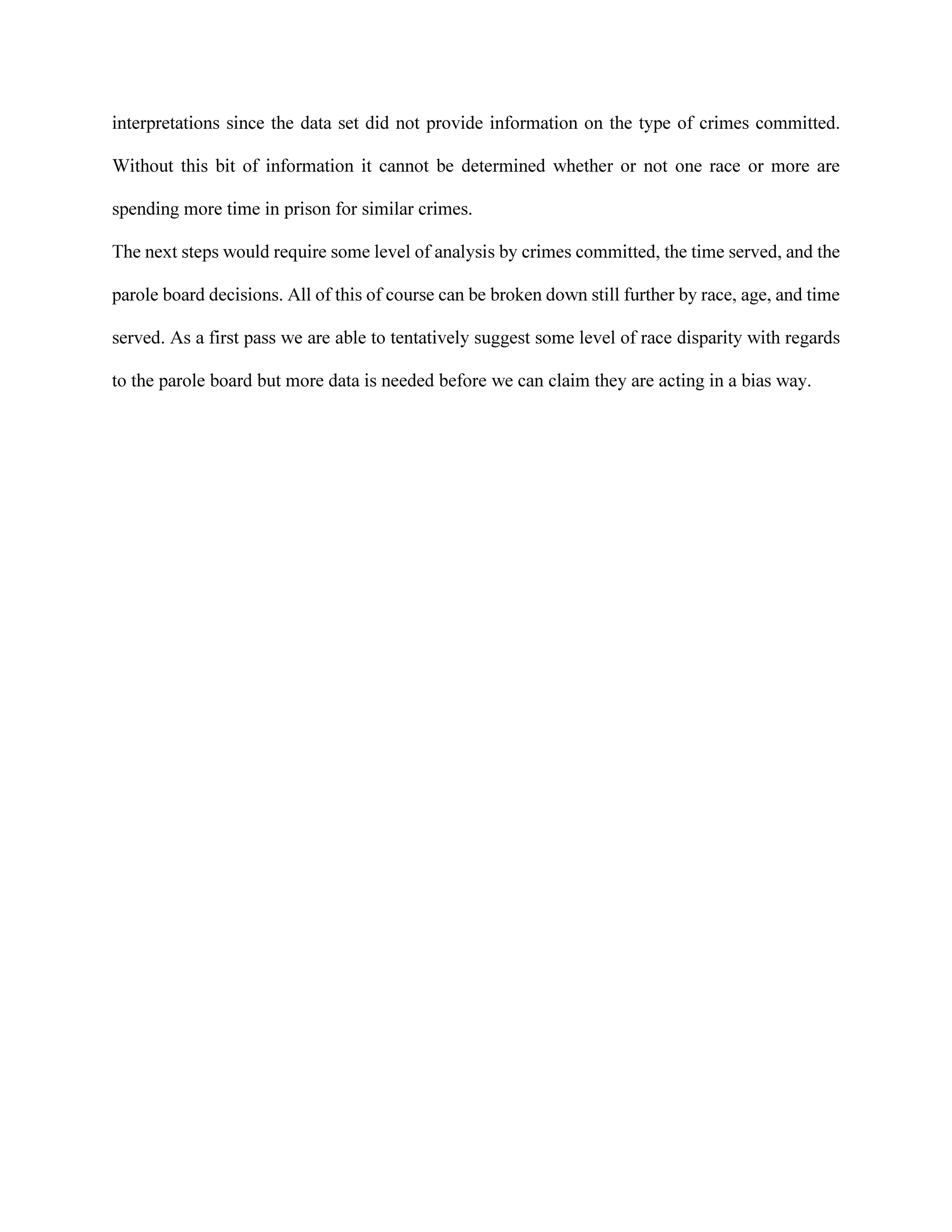
The first is calculating the average number of years spent in prison.
The second, is the average age by race of those paroled and denied.
What we see in all instances is that Whites are in prison less on average than their Black
counterparts, whether paroled or not. However, at this point I stop short of making any
interpretations since the data set did not provide information on the type of crimes committed.
Without this bit of information it cannot be determined whether or not one race or more are
spending more time in prison for similar crimes.
The next steps would require some level of analysis by crimes committed, the time served, and the
parole board decisions. All of this of course can be broken down still further by race, age, and time
served. As a first pass we are able to tentatively suggest some level of race disparity with regards
to the parole board but more data is needed before we can claim they are acting in a bias way.
Appendix – Tables
Incarcerated by Race
Parole Board Decisions
Approved for Parole by Race

Visual Data Exploration of Parole Data with Tableau

  • 1.
    Radu Stancut CS6313 Information Visualization,Spring 2015 Visual Data Exploration and Presentation with Tableau - Parole Data The New York state parole data provides several features to work with, both that allow for direct visualization and the creation of additional information that further helps visualize what the table consists of. As a means to better understand what we are dealing with I provide some perfunctory data, images, and descriptions of the 24,000+ records. Using one of the few categorical fields provided, Race, I was interested to get an idea of the prison population demographically.
  • 2.
    The first figureabove does just that and shows all identified races, with columns displaying the count for each race; the top three races, in descending order of inmates are Black, White, and Hispanic. Corresponding tables for this and other figures, as well as numbers not directly taken from the visualizations, may be found at the end of the paper in the Appendix. Seeing that data relates to parole, the next step is to get an idea of decisions made by the parole boards. More than half of all inmates up for parole (55%) are denied, less than half of 1% (0.38%) are paroled outright, with another 18.6% give an “Open Date” which means paroled of a different sort. These three categories of parole decisions are focused on moving forward and used in the next visualization to give an idea of the scope being dealt with. Interview Decision DENIED GRANTED NOT GRANTD OPEN DATE OR EARLIER PAROLED RCND&H.. RCND&R.. REINSTAT.. 0K 2K 4K 6K 8K 10K 12K Interview Decision DENIED GRANTED NOT GRANTD OPEN DATE OR EARLIER PAROLED RCND&HOLD; RCND&RELSE; REINSTATE
  • 3.
    Combining the currentinterest areas of race and parole decisions we can quickly create a tree map to see how approved parole break down by race. As may have been expected the top three OPEN DATE OPEN DATEOPEN DATE OPEN DATEOPEN DATE Paroled by Race Race / Ethnicity AMER IND/ALSK ASIAN/PACIFIC BLACK HISPANIC WHITE
  • 4.
    incarcerated races arealso the top three paroled groups. Nothing too dramatic but you may have noticed that Blacks and Whites have a similar number of parolees (~1,700) despite having a different number of inmates, resulting in different percentages favoring White parolees (22% v. 30%). Now we have two potential indications of bias, a higher ratio of Blacks incarcerated than their general population would indicate1 and their being granted parole at a lower rate than White counterparts. At this point I wish to introduce another criteria, time. By parsing the DIN column and grabbing the first two numbers we are able to identify the year of incarceration (plotted below for the entire data set). 1 http://quickfacts.census.gov/qfd/states/36000.html 1960 1965 1970 1975 1980 1985 1990 1995 2000 2005 2010 2015 Year Incarcerated 0K 1K 2K 3K 4K 5K Incarcerated by Year
  • 5.
    Once we havethe year of incarceration we can calculate the age at which persons are locked up based on the already provided date of birth. For the above plot we have the following average ages of incarceration by race. But what about that jump in the data for the mid to late 2000’s? Do the incarceration ages change for the different races in this time frame? 2007 2008 2009 2010 2011 2012 2013 2014 Year Incarcerated 0K 1K 2K 3K 4K 5K Inc by Yr (2008+)
  • 6.
    No, not really.The average age of all inmates is in their 30’s. In fact, aside for American Indian and Asian/Pacific, who are very small in number, the average age of the three most prevalent races (Black, Hispanic, and White) has stayed close to one another. The one trend which does appear is a rising age cohort of inmates which can lead to other questions and research not covered in this report. Superficially at least, there does not appear to be a discrepancy among incarceration of races by age, though no doubt more Blacks are being locked up than Whites over time. However, given the year of incarceration extracted from DIN and the other dates provided in the data set we are able to identify a couple of more measurements that may be of interest. Race / Ethnicity 0 5 10 15 20 25 30 35 Avg. Age At Incarceration AMER IND/ALSK ASIAN/PACIFIC BLACK HISPANIC WHITE Avg Age of Inc (2008+) Race / Ethnicity AMER IND/ALSK ASIAN/PACIFIC BLACK HISPANIC WHITE
  • 7.
    The first iscalculating the average number of years spent in prison. The second, is the average age by race of those paroled and denied. What we see in all instances is that Whites are in prison less on average than their Black counterparts, whether paroled or not. However, at this point I stop short of making any
  • 8.
    interpretations since thedata set did not provide information on the type of crimes committed. Without this bit of information it cannot be determined whether or not one race or more are spending more time in prison for similar crimes. The next steps would require some level of analysis by crimes committed, the time served, and the parole board decisions. All of this of course can be broken down still further by race, age, and time served. As a first pass we are able to tentatively suggest some level of race disparity with regards to the parole board but more data is needed before we can claim they are acting in a bias way.
  • 9.
    Appendix – Tables Incarceratedby Race Parole Board Decisions Approved for Parole by Race