www.stampertech.com
   www.gomastering.com
www.facebook.com/stampertech
   The magic of mastering?
   Startup Considerations
   Need for Feedback (closed loop systems)
       Equipment
       Process
       People
   Process optimization
   Mastering is a science
   What’s next
Not if you know the tricks…
But it doesn’t mean that it’s easy.
Pre-Mastering
                                                           Stamper


                                                                          Replication
                                  laser

                                                           Molding
                                  Acousto Opto
                                  modulator      1,000’s
                Glass Recording                            Plastic disc
                (film exposure)
Mastering


                Developing

                Galvanics                                  CD/DVD Player
                (nickel plate)
                Separation
   Business Plan and Model
   Types and quality of equipment
   Quality and experience of staff
        Core technical competency
   Unit Mfg Cost
   Media handling
   Utilities/Facilities
   Health, Safety, and Environmental
   Administrative
   Operations
   Revenues
        Target market
        Size of market
        Capacity based on yields and efficiencies
        Pricing strategy
   Costs
        Leaseholds and equipment capitals
        Staffing
        Consumables, Maintenance, Utilities, Facilities
        Rent and insurance
        Sales and marketing
        Yields and efficiencies
        Licensing
        Administrative and IT infrastructure
   Pre-Mastering
        Media, logical, and content testing; Network data transfers of DDP files (security and content
         integrity)
   Mastering
        Glass cleaner, photoresist coater, laser beam recorder, developer, metallizer, inspection systems, PR
         measurement/scanner, diffraction order measurement, optical densitometer.
   Galvanics
        Cleaning/passivation, plating cells, thickness measurement, protective coating.
   Utilities
        RO water, DI water, compressed air, chilled water, backup UPS, waste water treatment, exhaust.
   Post Production
        Stamper Testers, Inspection systems, microscopes, AFM, optical comparators, bit to bit verification,
         digital and dynamic testing.
   Customer Service
   Operations                                        President                       Front Office
                                                                                        Support


    Technical Support
                                                                                       Facilities
                         Customer                                         Sales &
                                                                                       Support
                                     Engineering      Production
                           Service                                        Marketing
                                                                                      IT Support

   Administrative                    Technician
                                      0.6 per shift
                                                       Premastering Op)
                                                       1 per shift
                                                                                         Legal
                                                       Mastering Op

   Management                                         1 per shift
                                                       Galvanics Op
                                                       1 per shift
                                                       QA Op

   Sales and Marketing
                                                       1 per shift


   IT Support
   Legal Support
   Equipment capability and stability studies
   Process Development
   Training based on detailed operating procedures
        Operator Training
        Technical Training
   Documentation
        Users manuals
        Schematics
        Components Test Results
        Process procedures
   Spare parts and maintenance schedule
   Glass substrates (Cost/# of cycles)
   Laser (Cost/# of parts)
   Consumables
        Nickel pellets, acids, solvents, photoresists, alkalines, nickel targets, galvanics filters.
   Facilities
        Power, waste treatment, DI water production
   Cleanroom supplies
        Gloves, tacky mats, protective personal equipment, cleanroom notebooks and papers,
         glass cases, face masks, cleaning solvents.
   Stamper Cases (Selected for best shipping ruggedness)
   Content rights
        Music
        Software
        Video
   Media quality
        CD’s, DVD’s, DLT’s, 8mm, Network.
   Format compliance
        DDP compatible, DVD spec, Philips Book specs.
   RO Water
   DI Water (resistivity, total organic content)
   Compressed Air (moisture and oil free)
   Electricity (total loads, transformers, UPS)
   Chilled Water (regulated temperature)
   Temp and Humidity Control
   Exhaust and flow control for balance
   Waste Water Treatment (complies to local reg)
   Plant monitoring system
   Osha compliance
       MSDS and rights to know
       Chemical labeling
       Harzardous communication
       Fire safety (evacuation plan)
   Environmental wastes
   Sewage permit
   Emissions permit
   Chemical handling/storage
   Ventilation
   Customer Service
   Credit Checks
   Accounts Payable
   Accounts Receivable
   Payroll/Benefits
   Human Resources
   Information Technology
   Sales and Marketing
   Scheduling
   Inventory
   Reporting
       Yields
       Failure Paretos
       Efficiency
   Product Tracking
   Quality Control (Statistical)
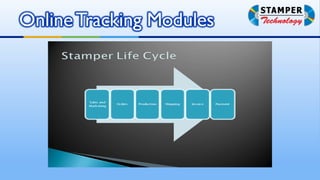
   Receive PO or Storefront Order
   Send confirm order to customer
   Create a workorder for each job with live 24/7 online status for customer
    to monitor
   Receive physical media or FTP upload
   Check PO against Master
   Calculate due date based on turn time
   Automated production scheduling
   Verify WO against Source for ID info
   Verify content ownership
   Load source image into Image Server
   Check for virus
   Check for content compliance
   Check for logical structure integrity
   Enter playtime and any CDText into WO
   Create workorder sheet and send job to Mastering
   Program ID band into Laser Recorder
   Expose data onto photoresist glass
   Develop glass master with inline laser monitor
   Check exposure of each part with diffraction order offline to verify inline
    developer
   Metallize glass master
   Inspect for defects
   Check HubID band on glass against work order
   Update online workorder status
   Program amp hours to make correct thickness for each
    customer and make father from the glass
   Make mother and stamper if necessary
   Measure thickness of each part
   Inspect for defects
   Put protective coating on part
   Verify part needs to be finished
   Verify HubID band information
   Back sand each part
   Verify punch size on work order
   Punch part with matching punch size
   Inspect for defects and for burrs
   Update workorder online status
   Separate parts for CD’s and DVD’s
   Test using proper players
   Verify test results against specs
   Compare program time on work order against test results to
    confirm correct content
   Inspect stamper for defects
   Update workorder online status
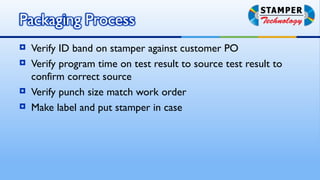
   Verify ID band on stamper against customer PO
   Verify program time on test result to source test result to
    confirm correct source
   Verify punch size match work order
   Make label and put stamper in case
   Ship workorder in system and send paper work to A/R to
    invoice
   Prepare packing slip for each customer
   Coordinate shipping carriers
   Send shipping information to customers
Metallized
                                           Mastering System                             Glass with
    Glass
                                                                                         Content
      X                +                         H(X)                        Y              Z


                                          Process Control System
                                                H(Y)

X    +      H(X)   Y       Z
                           X   +   H(X)      Y   XZ   +   H(X)   Y   Z
                                                                     X   +       H(X)    Y   Z


            H(Y)                   H(Y)                   H(Y)                   H(Y)
Dev Flow
      Dev Time
               Laser Power
      Laser Focus
               Num Aperture
            DI Temp
PR Sensitivity
    PR Thickness


               ce
       lean


                    ur f a
      ss C


                s sS
     Gla


                     Gla
Dev Flow
             Laser Power    Dev Time
        DI Temp    Num Aperture Laser Focus
Glass Clean Glass Surface PR Thickness PR Sensitivity
   Process Feedback
       Glass cleaning, photoresist coating, laser recording, developing,
        metallizing, quality control, yield.
   Equipment Feedback
       Glass cleaner, photoresist coater, LBR, developer, metallizer, cycle time,
        equipment efficiency.
   Human Resources Feedback
       Training, human error tracking, production efficiency.
   Glass Inspection
   PR profile and surface defects
   Laser profile and Intensity
   Diffraction Measurement
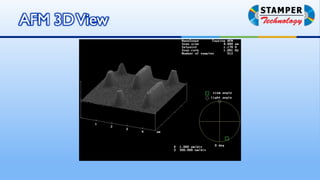
   AFM
   Dynamic Testing
   Logical Testing
   Glass Cleaner
        Chemical concentration, chemical level detectors, alarms.
   Photoresist Coater
        Chemical concentration, DI temperature, air temperature, humidity, airflow,
         dispensing volume, rotational speed.
   Laser Beam Recorder
        Translational error, rotational error, focus error, beam direction error, effective
         laser energy, laser mode, laser temp, beam shape.
   Developer
        Chemical concentration, DI temperature, air temperature, humidity, airflow,
         dispensing volume, rotational speed, diffraction order.
   Glass preparation
        Surface defects, surface tension, residual grating, film.
   Photoresist coating
        Solvent cleaning, adhesion promotion, photoresist application, baking profile.
   Laser beam recording
        Laser power stability, laser quality, modulation transfer function (bandwidth),
         focusing response, translation accuracy, rotational noise, vibration isolation,
         optical path efficiency.
   Developing
        Development curve over time
   Metallizing
        Power ramp versus metallization density and quality
   More Cycle = Cheaper unit mfg cost
   Caustic solution to remove PR
   Acid to remove metals
   Neutralizer for surface tension
   Rinsing and drying
   Monitor quality with focus error and correlate to number of
    usage
   Fine Cleaning
   Solvent Rinse
   Primer
   PhotoResist Coating
   Coating Curve
   Baking (40nm solvent reduction @ 130nm)
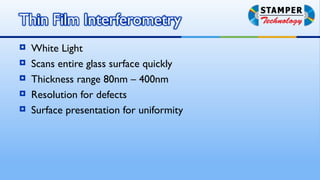
   White Light
   Scans entire glass surface quickly
   Thickness range 80nm – 400nm
   Resolution for defects
   Surface presentation for uniformity
PR Thickness Curve

                           600
           PR Thick (nm)


                           500

                           400                                             20% PR Avg Thickness

                           300

                           200

                           100            10% PR Avg Thickness

                             0
                              200   300        400      500      600         700      800        900    1000   1100   1200   1300   1400   1500
                                                                                      Rotation (RPM )


PR TTV Curve

                           9.0
                           8.0
                           7.0
TTV (nm)


                           6.0                                20% PR TTV
                           5.0
                           4.0
                           3.0
                           2.0        10% PR TTV
                           1.0
                           0.0
                              200   300        400     500       600         700     800        900     1000   1100   1200   1300   1400   1500
                                                                                    Rotation (RPM )
Modulator Curve Nonlinearity

                0.8
Output Power%


                0.7

                0.6

                0.5

                0.4

                0.3

                0.2

                0.1

                 0
                      0   0.5        1         1.5       2   2.5
                                    Input Voltage
Intensity
                                          Laser                        control
      Controller

                                          Modulation Driver
                                                                            AOM


                     EFM1
     EFM/Atip                EFM2                 Modulation Driver
     Encoder                                                                EOM
                     ATIP1
                     ATIP2


     Source
(Media or Network)
                                    Glass plate
0th Order


                              1st Order

                                          2nd Order


240 mm Glass Substrate
Developing
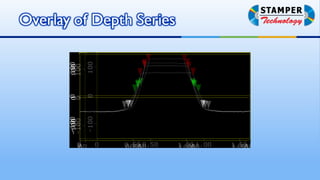
   Cantilever that deflect laser light to monitor surface
    deflections
   73 deg max at 90 deg scan direction
   Nanometric resolution
Photodiodes

                                Laserbeam


                          Tip

Substrate
   Photoresist thickness as variable (X)
   Fix photoresist concentration
   Fix laser power
   Fix developing I1/I0
   Output parameters measurement (Y)
       Physical pits
       Dynamic test signals (I3/Itop, I11/Itop, Symmetry, PP)
AFM vs Interferom etry Com parison                                           D/W vs I2/I1

                           190                                                                0.45                  y = 1.0602x + 0.0257
                                                   y = 1.0239x - 8.2325
Interferometer Thickness


                           180                          R2 = 0.9961                                                      R2 = 0.9932
                                                                                               0.4
                           170


                                                                                I2/I1 Ratio
                                                                                              0.35
                           160
                                                                                               0.3
                           150
                                                                                              0.25
                           140

                           130                                                                 0.2
                              130     140    150   160    170     180     190                        0.2   0.25       0.3       0.35       0.4

                                              AFM Pit Depth                                                       D/W Ratio
AFM Depth/Width vs Dynamic Signals

            1                                                             0.1


                                                                                  Symmetry/PP
           0.8                                                            0.05
Contrast


                                                               PP
                       I11                                                0
           0.6
                                                                          -0.05
           0.4          I3
                                                                          -0.1
                                           Sym m etry
           0.2                                                            -0.15
            0                                                             -0.2
                 0.2         0.25            0.3        0.35        0.4
                                    AFM Depth/Width Ratio
I2/I1 vs Signals

           0.9                                                     0.1
           0.8                                                     0.05
                                                              PP


                                                                           Symmetry/PP
           0.7                                                     0
                    I11
Contrast

           0.6                                     Symmetry
                                                                   -0.05
           0.5
           0.4       I3                                            -0.1

           0.3                                                     -0.15
           0.2                                                     -0.2
             0.25         0.3        0.35           0.4        0.45
                                     I2/I1
   Definitely a science not magic!
   Understand the science (theoretical models).
   Characterize the process.
   Develop empirical models.
   Statistically control the process as feedback loop using the models to
    predict.
   Last but most important feedback is that from the voice of the customer
    and correlate your mastering process to the customer’s process.
   Use existing well characterized processes for
    application in new industries
       Diffractive Holography
            Authentication, Decorative
       Diffractive Optics
       Computer Generated Diffractive Optical Elements
       Microchannels, microfluidics
www.stampertech.com
   www.gomastering.com
www.facebook.com/stampertech

Stamper Technology 2012 04-06

  • 1.
    www.stampertech.com www.gomastering.com www.facebook.com/stampertech
  • 2.
    The magic of mastering?  Startup Considerations  Need for Feedback (closed loop systems)  Equipment  Process  People  Process optimization  Mastering is a science  What’s next
  • 3.
    Not if youknow the tricks… But it doesn’t mean that it’s easy.
  • 4.
    Pre-Mastering Stamper Replication laser Molding Acousto Opto modulator 1,000’s Glass Recording Plastic disc (film exposure) Mastering Developing Galvanics CD/DVD Player (nickel plate) Separation
  • 5.
    Business Plan and Model  Types and quality of equipment  Quality and experience of staff  Core technical competency  Unit Mfg Cost  Media handling  Utilities/Facilities  Health, Safety, and Environmental  Administrative  Operations
  • 6.
    Revenues  Target market  Size of market  Capacity based on yields and efficiencies  Pricing strategy  Costs  Leaseholds and equipment capitals  Staffing  Consumables, Maintenance, Utilities, Facilities  Rent and insurance  Sales and marketing  Yields and efficiencies  Licensing  Administrative and IT infrastructure
  • 7.
    Pre-Mastering  Media, logical, and content testing; Network data transfers of DDP files (security and content integrity)  Mastering  Glass cleaner, photoresist coater, laser beam recorder, developer, metallizer, inspection systems, PR measurement/scanner, diffraction order measurement, optical densitometer.  Galvanics  Cleaning/passivation, plating cells, thickness measurement, protective coating.  Utilities  RO water, DI water, compressed air, chilled water, backup UPS, waste water treatment, exhaust.  Post Production  Stamper Testers, Inspection systems, microscopes, AFM, optical comparators, bit to bit verification, digital and dynamic testing.
  • 8.
    Customer Service  Operations President Front Office Support Technical Support Facilities  Customer Sales & Support Engineering Production Service Marketing IT Support  Administrative Technician 0.6 per shift Premastering Op) 1 per shift Legal Mastering Op  Management 1 per shift Galvanics Op 1 per shift QA Op  Sales and Marketing 1 per shift  IT Support  Legal Support
  • 9.
    Equipment capability and stability studies  Process Development  Training based on detailed operating procedures  Operator Training  Technical Training  Documentation  Users manuals  Schematics  Components Test Results  Process procedures  Spare parts and maintenance schedule
  • 10.
    Glass substrates (Cost/# of cycles)  Laser (Cost/# of parts)  Consumables  Nickel pellets, acids, solvents, photoresists, alkalines, nickel targets, galvanics filters.  Facilities  Power, waste treatment, DI water production  Cleanroom supplies  Gloves, tacky mats, protective personal equipment, cleanroom notebooks and papers, glass cases, face masks, cleaning solvents.  Stamper Cases (Selected for best shipping ruggedness)
  • 11.
    Content rights  Music  Software  Video  Media quality  CD’s, DVD’s, DLT’s, 8mm, Network.  Format compliance  DDP compatible, DVD spec, Philips Book specs.
  • 12.
    RO Water  DI Water (resistivity, total organic content)  Compressed Air (moisture and oil free)  Electricity (total loads, transformers, UPS)  Chilled Water (regulated temperature)  Temp and Humidity Control  Exhaust and flow control for balance  Waste Water Treatment (complies to local reg)  Plant monitoring system
  • 13.
    Osha compliance  MSDS and rights to know  Chemical labeling  Harzardous communication  Fire safety (evacuation plan)  Environmental wastes  Sewage permit  Emissions permit  Chemical handling/storage  Ventilation
  • 14.
    Customer Service  Credit Checks  Accounts Payable  Accounts Receivable  Payroll/Benefits  Human Resources  Information Technology  Sales and Marketing
  • 15.
    Scheduling  Inventory  Reporting  Yields  Failure Paretos  Efficiency  Product Tracking  Quality Control (Statistical)
  • 23.
    Receive PO or Storefront Order  Send confirm order to customer  Create a workorder for each job with live 24/7 online status for customer to monitor  Receive physical media or FTP upload  Check PO against Master  Calculate due date based on turn time  Automated production scheduling
  • 24.
    Verify WO against Source for ID info  Verify content ownership  Load source image into Image Server  Check for virus  Check for content compliance  Check for logical structure integrity  Enter playtime and any CDText into WO  Create workorder sheet and send job to Mastering
  • 25.
    Program ID band into Laser Recorder  Expose data onto photoresist glass  Develop glass master with inline laser monitor  Check exposure of each part with diffraction order offline to verify inline developer  Metallize glass master  Inspect for defects  Check HubID band on glass against work order  Update online workorder status
  • 26.
    Program amp hours to make correct thickness for each customer and make father from the glass  Make mother and stamper if necessary  Measure thickness of each part  Inspect for defects  Put protective coating on part
  • 27.
    Verify part needs to be finished  Verify HubID band information  Back sand each part  Verify punch size on work order  Punch part with matching punch size  Inspect for defects and for burrs  Update workorder online status
  • 28.
    Separate parts for CD’s and DVD’s  Test using proper players  Verify test results against specs  Compare program time on work order against test results to confirm correct content  Inspect stamper for defects  Update workorder online status
  • 29.
    Verify ID band on stamper against customer PO  Verify program time on test result to source test result to confirm correct source  Verify punch size match work order  Make label and put stamper in case
  • 30.
    Ship workorder in system and send paper work to A/R to invoice  Prepare packing slip for each customer  Coordinate shipping carriers  Send shipping information to customers
  • 34.
    Metallized Mastering System Glass with Glass Content X + H(X) Y Z Process Control System H(Y) X + H(X) Y Z X + H(X) Y XZ + H(X) Y Z X + H(X) Y Z H(Y) H(Y) H(Y) H(Y)
  • 35.
    Dev Flow Dev Time Laser Power Laser Focus Num Aperture DI Temp PR Sensitivity PR Thickness ce lean ur f a ss C s sS Gla Gla
  • 36.
    Dev Flow Laser Power Dev Time DI Temp Num Aperture Laser Focus Glass Clean Glass Surface PR Thickness PR Sensitivity
  • 37.
    Process Feedback  Glass cleaning, photoresist coating, laser recording, developing, metallizing, quality control, yield.  Equipment Feedback  Glass cleaner, photoresist coater, LBR, developer, metallizer, cycle time, equipment efficiency.  Human Resources Feedback  Training, human error tracking, production efficiency.
  • 38.
    Glass Inspection  PR profile and surface defects  Laser profile and Intensity  Diffraction Measurement  AFM  Dynamic Testing  Logical Testing
  • 40.
    Glass Cleaner  Chemical concentration, chemical level detectors, alarms.  Photoresist Coater  Chemical concentration, DI temperature, air temperature, humidity, airflow, dispensing volume, rotational speed.  Laser Beam Recorder  Translational error, rotational error, focus error, beam direction error, effective laser energy, laser mode, laser temp, beam shape.  Developer  Chemical concentration, DI temperature, air temperature, humidity, airflow, dispensing volume, rotational speed, diffraction order.
  • 41.
    Glass preparation  Surface defects, surface tension, residual grating, film.  Photoresist coating  Solvent cleaning, adhesion promotion, photoresist application, baking profile.  Laser beam recording  Laser power stability, laser quality, modulation transfer function (bandwidth), focusing response, translation accuracy, rotational noise, vibration isolation, optical path efficiency.  Developing  Development curve over time  Metallizing  Power ramp versus metallization density and quality
  • 42.
    More Cycle = Cheaper unit mfg cost  Caustic solution to remove PR  Acid to remove metals  Neutralizer for surface tension  Rinsing and drying  Monitor quality with focus error and correlate to number of usage
  • 43.
    Fine Cleaning  Solvent Rinse  Primer  PhotoResist Coating  Coating Curve  Baking (40nm solvent reduction @ 130nm)
  • 44.
    White Light  Scans entire glass surface quickly  Thickness range 80nm – 400nm  Resolution for defects  Surface presentation for uniformity
  • 45.
    PR Thickness Curve 600 PR Thick (nm) 500 400 20% PR Avg Thickness 300 200 100 10% PR Avg Thickness 0 200 300 400 500 600 700 800 900 1000 1100 1200 1300 1400 1500 Rotation (RPM ) PR TTV Curve 9.0 8.0 7.0 TTV (nm) 6.0 20% PR TTV 5.0 4.0 3.0 2.0 10% PR TTV 1.0 0.0 200 300 400 500 600 700 800 900 1000 1100 1200 1300 1400 1500 Rotation (RPM )
  • 48.
    Modulator Curve Nonlinearity 0.8 Output Power% 0.7 0.6 0.5 0.4 0.3 0.2 0.1 0 0 0.5 1 1.5 2 2.5 Input Voltage
  • 50.
    Intensity Laser control Controller Modulation Driver AOM EFM1 EFM/Atip EFM2 Modulation Driver Encoder EOM ATIP1 ATIP2 Source (Media or Network) Glass plate
  • 52.
    0th Order 1st Order 2nd Order 240 mm Glass Substrate
  • 54.
  • 55.
    Cantilever that deflect laser light to monitor surface deflections  73 deg max at 90 deg scan direction  Nanometric resolution
  • 56.
    Photodiodes Laserbeam Tip Substrate
  • 59.
    Photoresist thickness as variable (X)  Fix photoresist concentration  Fix laser power  Fix developing I1/I0  Output parameters measurement (Y)  Physical pits  Dynamic test signals (I3/Itop, I11/Itop, Symmetry, PP)
  • 61.
    AFM vs Interferometry Com parison D/W vs I2/I1 190 0.45 y = 1.0602x + 0.0257 y = 1.0239x - 8.2325 Interferometer Thickness 180 R2 = 0.9961 R2 = 0.9932 0.4 170 I2/I1 Ratio 0.35 160 0.3 150 0.25 140 130 0.2 130 140 150 160 170 180 190 0.2 0.25 0.3 0.35 0.4 AFM Pit Depth D/W Ratio
  • 64.
    AFM Depth/Width vsDynamic Signals 1 0.1 Symmetry/PP 0.8 0.05 Contrast PP I11 0 0.6 -0.05 0.4 I3 -0.1 Sym m etry 0.2 -0.15 0 -0.2 0.2 0.25 0.3 0.35 0.4 AFM Depth/Width Ratio
  • 65.
    I2/I1 vs Signals 0.9 0.1 0.8 0.05 PP Symmetry/PP 0.7 0 I11 Contrast 0.6 Symmetry -0.05 0.5 0.4 I3 -0.1 0.3 -0.15 0.2 -0.2 0.25 0.3 0.35 0.4 0.45 I2/I1
  • 66.
    Definitely a science not magic!  Understand the science (theoretical models).  Characterize the process.  Develop empirical models.  Statistically control the process as feedback loop using the models to predict.  Last but most important feedback is that from the voice of the customer and correlate your mastering process to the customer’s process.
  • 67.
    Use existing well characterized processes for application in new industries  Diffractive Holography  Authentication, Decorative  Diffractive Optics  Computer Generated Diffractive Optical Elements  Microchannels, microfluidics
  • 71.
    www.stampertech.com www.gomastering.com www.facebook.com/stampertech