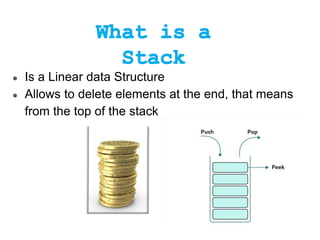
● Is a Linear data Structure
● Allows to delete elements at the end, that means
from the top of the stack
Stack Operations
● Primary Operations
● Secondary Operations
● Primary Operations
1) push(data) : Insert data on to the stack
● Primary Operations (Cont.)
2) pop(data) : Delete last inserted element from
the stack
● Secondary Operations
1) top() : Return last Inserted element without
removing it.
● Secondary Operations (Cont.)
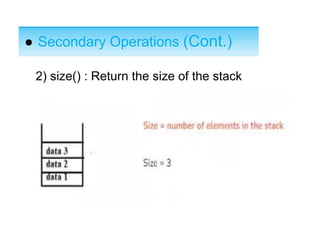
2) size() : Return the size of the stack
● Secondary Operations (Cont.)
3) is Empty() : Returns TRUE if the stack is
empty. Else return false.
● Secondary Operations (Cont.)
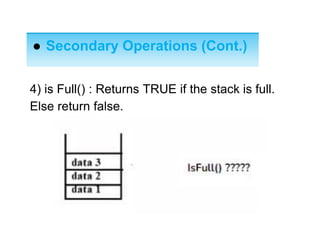
4) is Full() : Returns TRUE if the stack is full.
Else return false.
Implementation of
Stack
Array Implementation
Link-List Implementation
Linked List Implementation
 Why?
• When the size is unknown
• No limitations for the number of nodes
 Why should we refer the beginning
of the linked
list as the top of the stack?
• Time complexity
stac
k
top
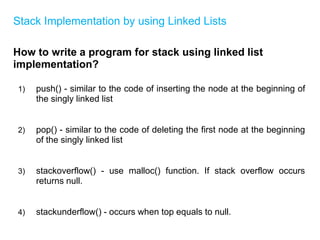
Stack Implementation by using Linked Lists
How to write a program for stack using linked list
implementation?
1) push() - similar to the code of inserting the node at the beginning of
the singly linked list
2) pop() - similar to the code of deleting the first node at the beginning
of the singly linked list
3) stackoverflow() - use malloc() function. If stack overflow occurs
returns null.
4) stackunderflow() - occurs when top equals to null.
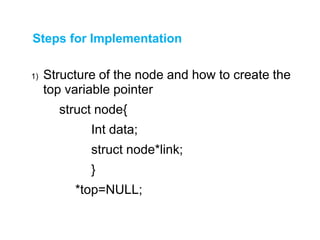
Steps for Implementation
1) Structure of the node and how to create the
top variable pointer
struct node{
Int data;
struct node*link;
}
*top=NULL;
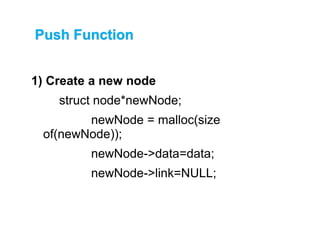
1) Create a new node
struct node*newNode;
newNode = malloc(size
of(newNode));
newNode->data=data;
newNode->link=NULL;
Push Function
Push Function (Cont.)
2) Put the address of the first node of the linked
list to the link part of the new node
newNode->link=top;
3) Update the top pointer and make it point to the
new node of the linked list
top=newNode;
Pop Function
1) Create a temporary pointer for the purpose of deletion
struct node*temp;
2) Update the temporary pointer. So that it can be point to
the first node of the linked list
Temp = top;
3)Store the value of the first node (pop returns)
int val=temp->data;
Pop Function (Cont.)
4) Update the top pointer. So that it can be point to the
next node of the linked list
top = top->link;
5) Delete the node pointed by the temporary pointer.
free(temp);
temp=NULL;
6)Return the value of the first node
return val;
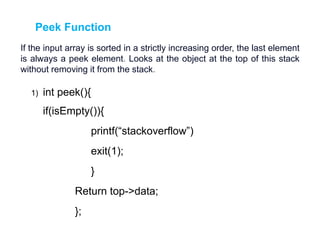
Peek Function
1) int peek(){
if(isEmpty()){
printf(“stackoverflow”)
exit(1);
}
Return top->data;
};
If the input array is sorted in a strictly increasing order, the last element
is always a peek element. Looks at the object at the top of this stack
without removing it from the stack.
Stack - PPT Slides.pptx-data sturutures and algorithanms

Stack - PPT Slides.pptx-data sturutures and algorithanms

  • 2.
    ● Is aLinear data Structure ● Allows to delete elements at the end, that means from the top of the stack
  • 3.
    Stack Operations ● PrimaryOperations ● Secondary Operations
  • 4.
    ● Primary Operations 1)push(data) : Insert data on to the stack
  • 5.
    ● Primary Operations(Cont.) 2) pop(data) : Delete last inserted element from the stack
  • 6.
    ● Secondary Operations 1)top() : Return last Inserted element without removing it.
  • 7.
    ● Secondary Operations(Cont.) 2) size() : Return the size of the stack
  • 8.
    ● Secondary Operations(Cont.) 3) is Empty() : Returns TRUE if the stack is empty. Else return false.
  • 9.
    ● Secondary Operations(Cont.) 4) is Full() : Returns TRUE if the stack is full. Else return false.
  • 10.
  • 11.
    Linked List Implementation Why? • When the size is unknown • No limitations for the number of nodes  Why should we refer the beginning of the linked list as the top of the stack? • Time complexity stac k top
  • 12.
    Stack Implementation byusing Linked Lists How to write a program for stack using linked list implementation? 1) push() - similar to the code of inserting the node at the beginning of the singly linked list 2) pop() - similar to the code of deleting the first node at the beginning of the singly linked list 3) stackoverflow() - use malloc() function. If stack overflow occurs returns null. 4) stackunderflow() - occurs when top equals to null.
  • 13.
    Steps for Implementation 1)Structure of the node and how to create the top variable pointer struct node{ Int data; struct node*link; } *top=NULL;
  • 14.
    1) Create anew node struct node*newNode; newNode = malloc(size of(newNode)); newNode->data=data; newNode->link=NULL; Push Function
  • 15.
    Push Function (Cont.) 2)Put the address of the first node of the linked list to the link part of the new node newNode->link=top; 3) Update the top pointer and make it point to the new node of the linked list top=newNode;
  • 16.
    Pop Function 1) Createa temporary pointer for the purpose of deletion struct node*temp; 2) Update the temporary pointer. So that it can be point to the first node of the linked list Temp = top; 3)Store the value of the first node (pop returns) int val=temp->data;
  • 17.
    Pop Function (Cont.) 4)Update the top pointer. So that it can be point to the next node of the linked list top = top->link; 5) Delete the node pointed by the temporary pointer. free(temp); temp=NULL; 6)Return the value of the first node return val;
  • 18.
    Peek Function 1) intpeek(){ if(isEmpty()){ printf(“stackoverflow”) exit(1); } Return top->data; }; If the input array is sorted in a strictly increasing order, the last element is always a peek element. Looks at the object at the top of this stack without removing it from the stack.