What I Said and What I Meant:
Cross Cultural Communication
          St. Andrew’s School
           Rosetta Eun Ryong Lee
            Seattle Girls’ School

    Rosetta Eun Ryong Lee (http://tiny.cc/rosettalee)
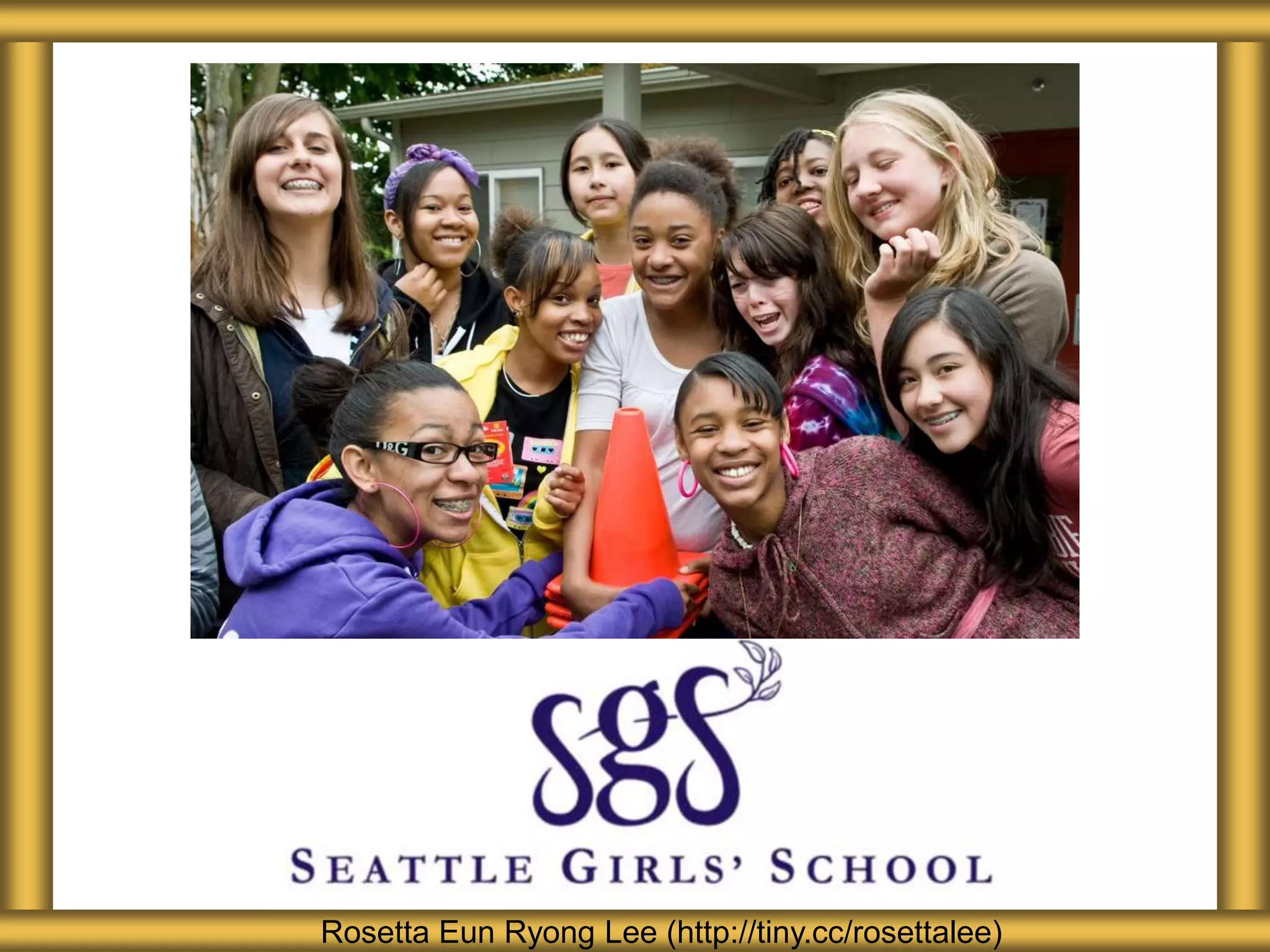
About Seattle Girls’ School


        Rosetta Eun Ryong Lee (http://tiny.cc/rosettalee)
Agenda

    Cross Cultural Communication
    Cultural Values, Norms of Behavior,
     and Communication
    Activity: Nonverbal Violations
    Cultural Identifiers, Power, and
     Communication
    Discussion: Conflict Re-understood
    So What? Now What?


    Rosetta Eun Ryong Lee (http://tiny.cc/rosettalee)
Rosetta Eun Ryong Lee (http://tiny.cc/rosettalee)
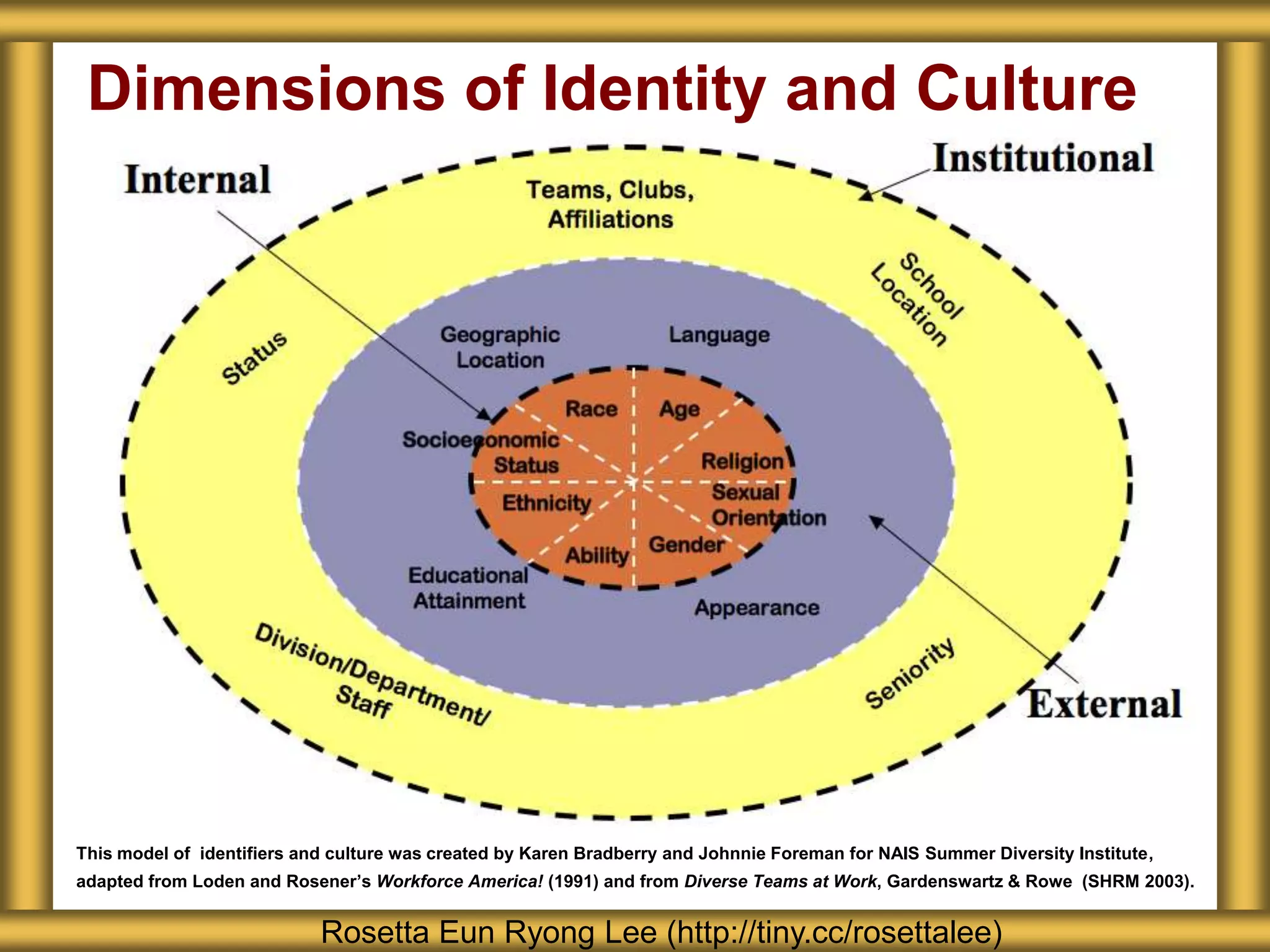
Dimensions of Identity and Culture


This model of identifiers and culture was created by Karen Bradberry and Johnnie Foreman for NAIS Summer Diversity Institute,
adapted from Loden and Rosener’s Workforce America! (1991) and from Diverse Teams at Work, Gardenswartz & Rowe (SHRM 2003).


                            Rosetta Eun Ryong Lee (http://tiny.cc/rosettalee)
Cross Cultural Communication
    What is it?
    How is it Different from Intercultural
     Communication?
    CCC Theories
    –   Face-Negotiation Theory
    –   Conversational Constraints Theory
    –   Expectancy Violation Theory
    –   Anxiety/Uncertainty Management Theory
    –   Communication Accommodation Theory

          Rosetta Eun Ryong Lee (http://tiny.cc/rosettalee)
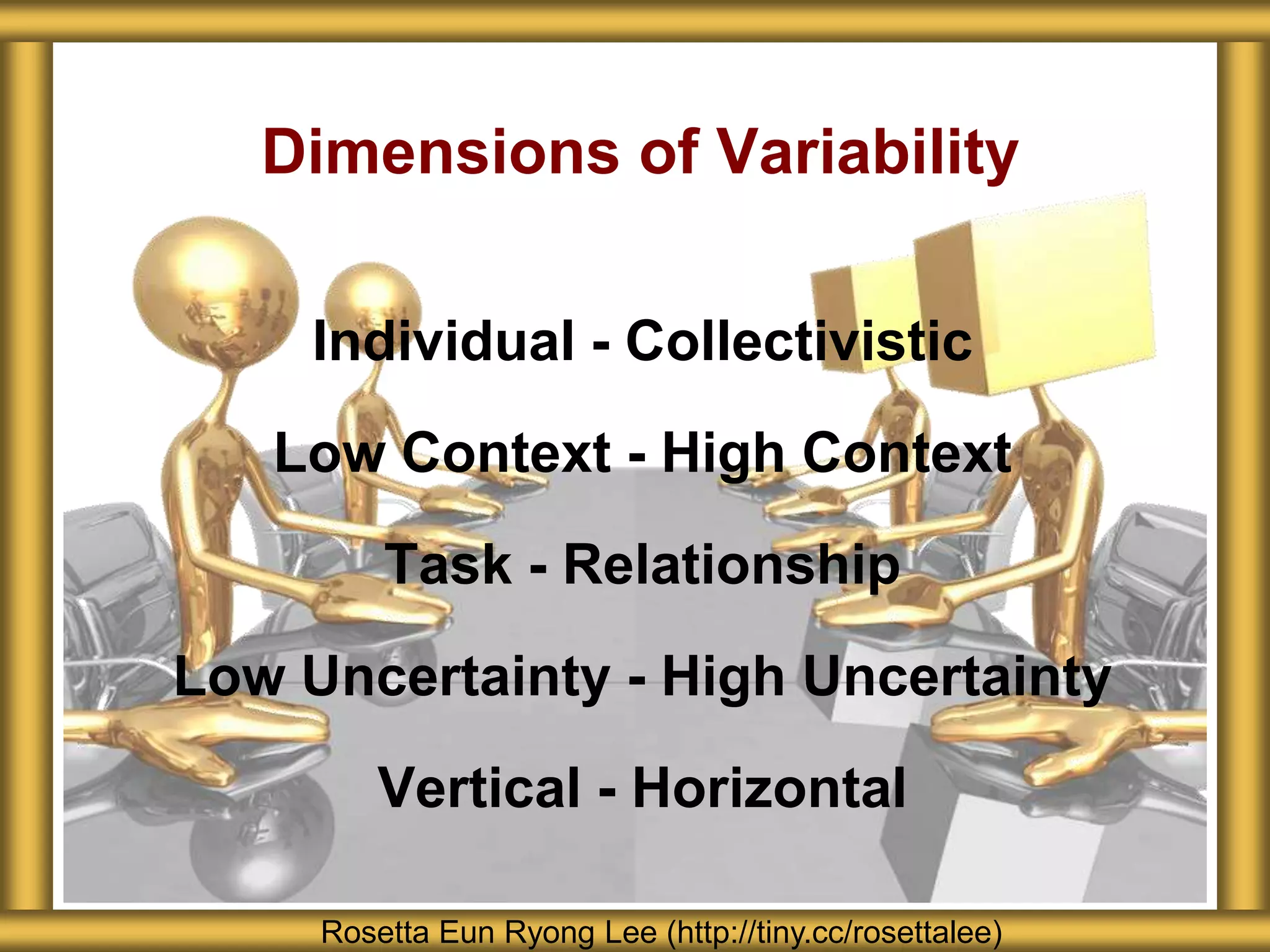
Dimensions of Variability

     Individual - Collectivistic
   Low Context - High Context
         Task - Relationship
Low Uncertainty - High Uncertainty
         Vertical - Horizontal

     Rosetta Eun Ryong Lee (http://tiny.cc/rosettalee)
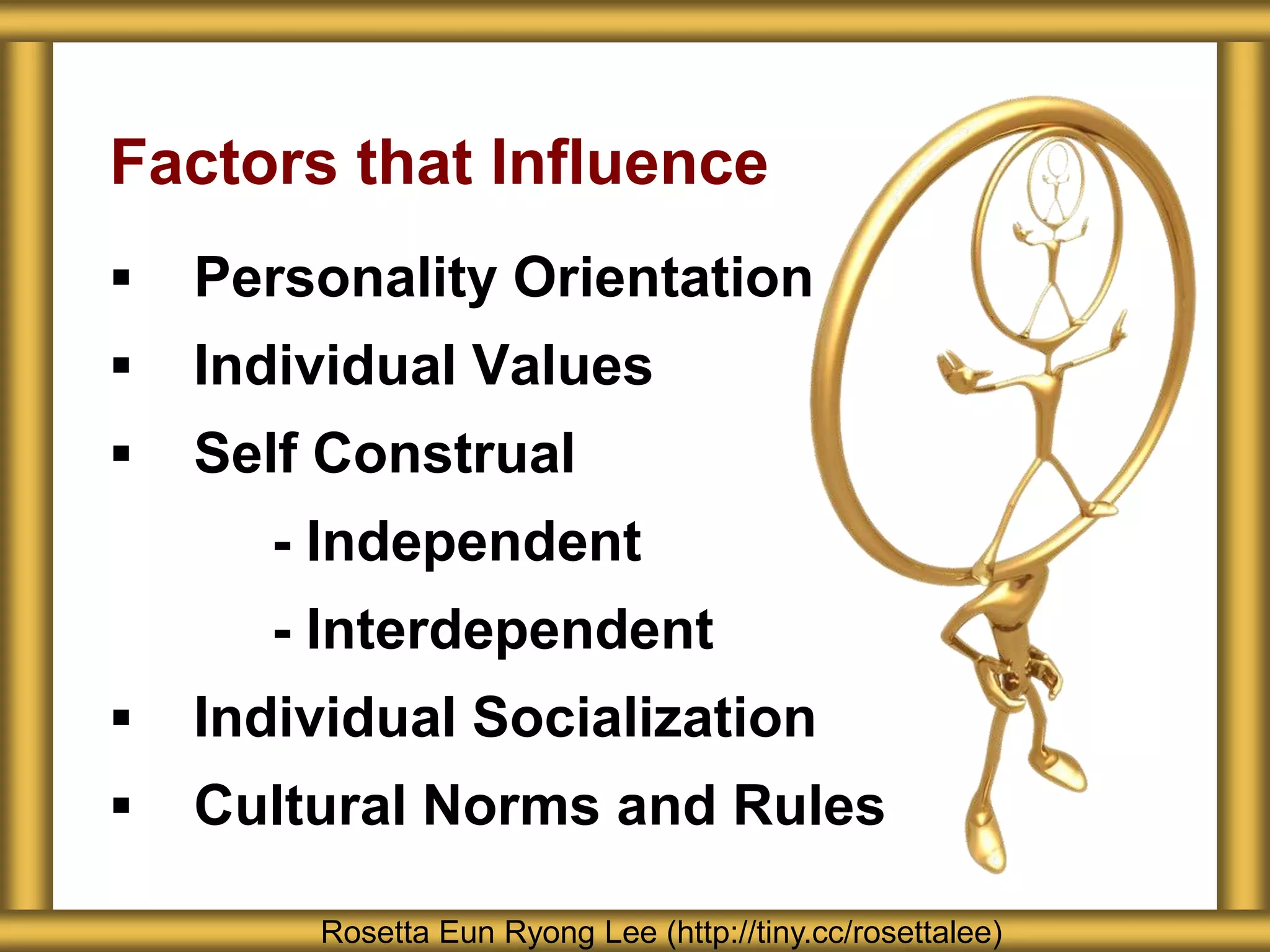
Factors that Influence
   Personality Orientation
   Individual Values
   Self Construal
       - Independent
       - Interdependent
   Individual Socialization
   Cultural Norms and Rules

        Rosetta Eun Ryong Lee (http://tiny.cc/rosettalee)
Discussion: My Style
                 In hearing about
                 communication
                 differences, what would
                 you describe as your
                 cultural communication
                 style? Have you noticed
                 stark differences
                 compared to others?


Rosetta Eun Ryong Lee (http://tiny.cc/rosettalee)
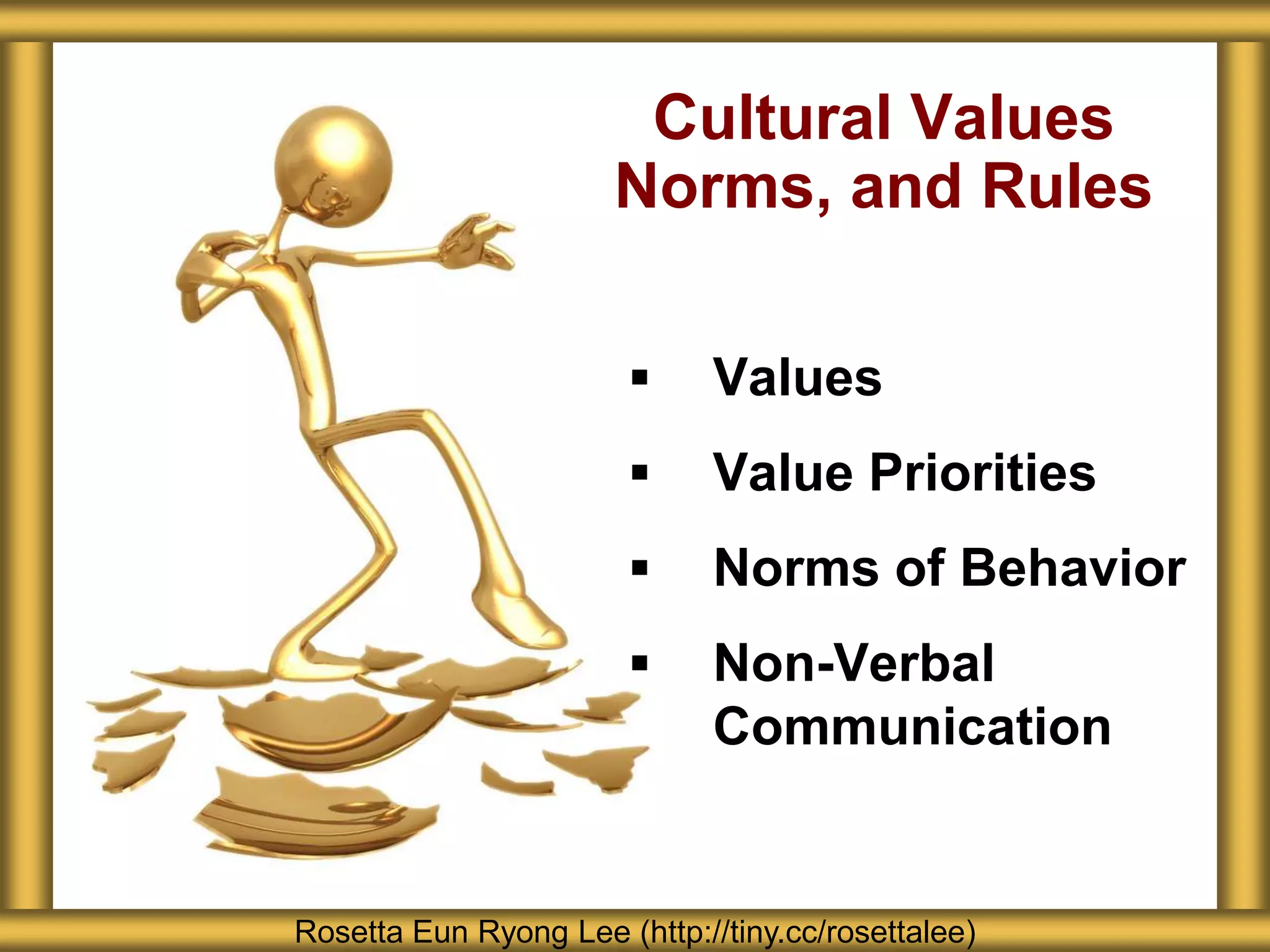
Cultural Values
                      Norms, and Rules

                             Values
                             Value Priorities
                             Norms of Behavior
                             Non-Verbal
                              Communication


Rosetta Eun Ryong Lee (http://tiny.cc/rosettalee)
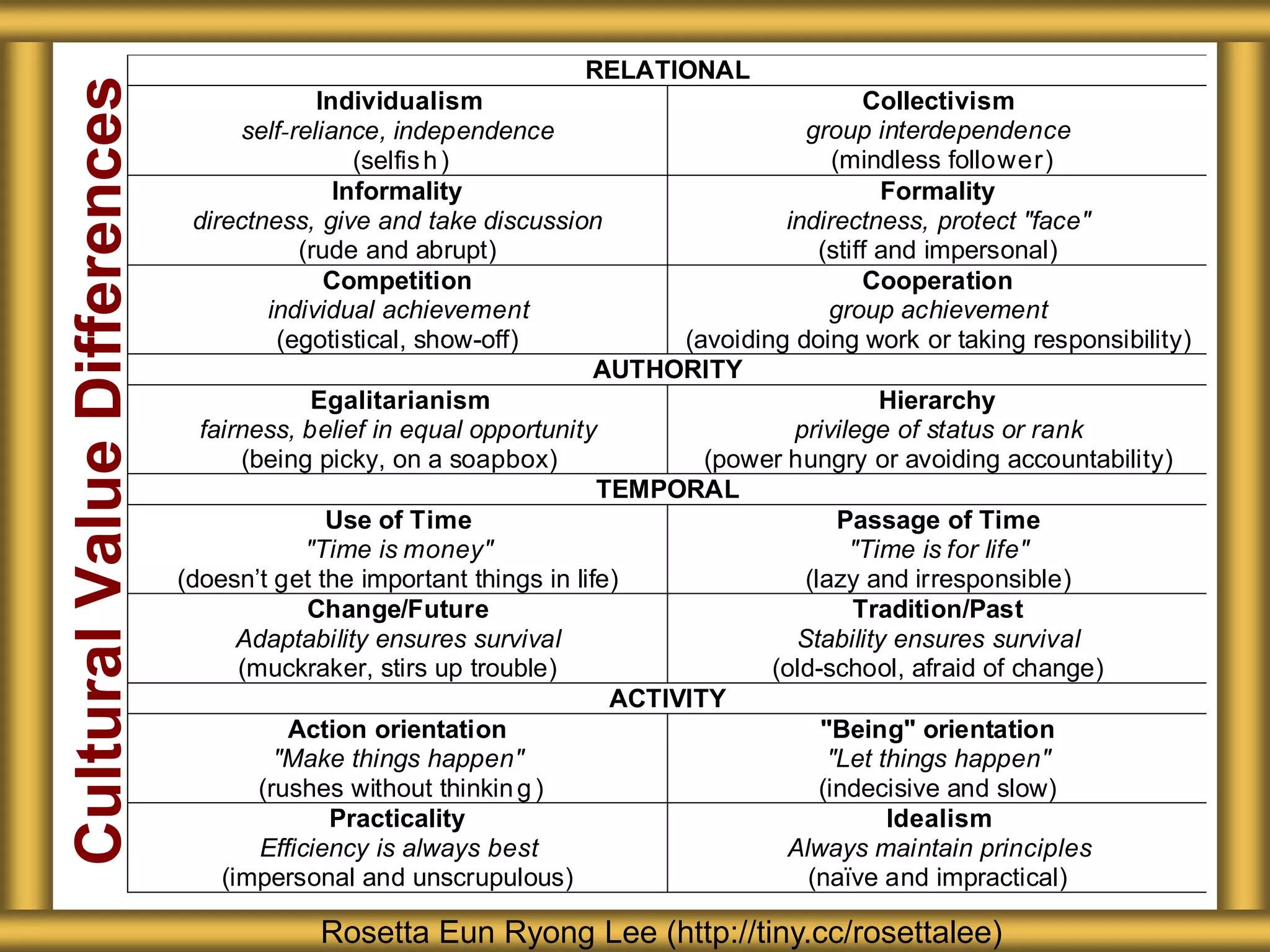
RELATIONAL
Cultural Value Differences                 Individualism
                                   self-reliance, independence
                                                                                              Collectivism
                                                                                       group interdependence
                                               (selfis h )                                 (mindless follower)
                                             Informality                                        Formality
                              directness, give and take discussion                  indirectness, protect "face"
                                         (rude and abrupt)                               (stiff and impersonal)
                                            Competition                                       Cooperation
                                      individual achievement                              group achievement
                                       (egotistical, show-off)             (avoiding doing work or taking responsibility)
                                                                     AUTHORITY
                                           Egalitarianism                                       Hierarchy
                               fairness, belief in equal opportunity                 privilege of status or rank
                                   (being picky, on a soapbox)               (power hungry or avoiding accountability)
                                                                     TEMPORAL
                                            Use of Time                                     Passage of Time
                                          "Time is money"                                    "Time is for life"
                             (doesn’t get the important things in life)                (lazy and irresponsible)
                                          Change/Future                                      Tradition/Past
                                   Adaptability ensures survival                      Stability ensures survival
                                   (muckraker, stirs up trouble)                   (old-school, afraid of change)
                                                                      ACTIVITY
                                        Action orientation                               "Being" orientation
                                       "Make things happen"                               "Let things happen"
                                     (rushes without thinkin g )                         (indecisive and slow)
                                            Practicality                                         Idealism
                                     Efficiency is always best                       Always maintain principles
                                 (impersonal and unscrupulous)                         (naïve and impractical)

                                          Rosetta Eun Ryong Lee (http://tiny.cc/rosettalee)
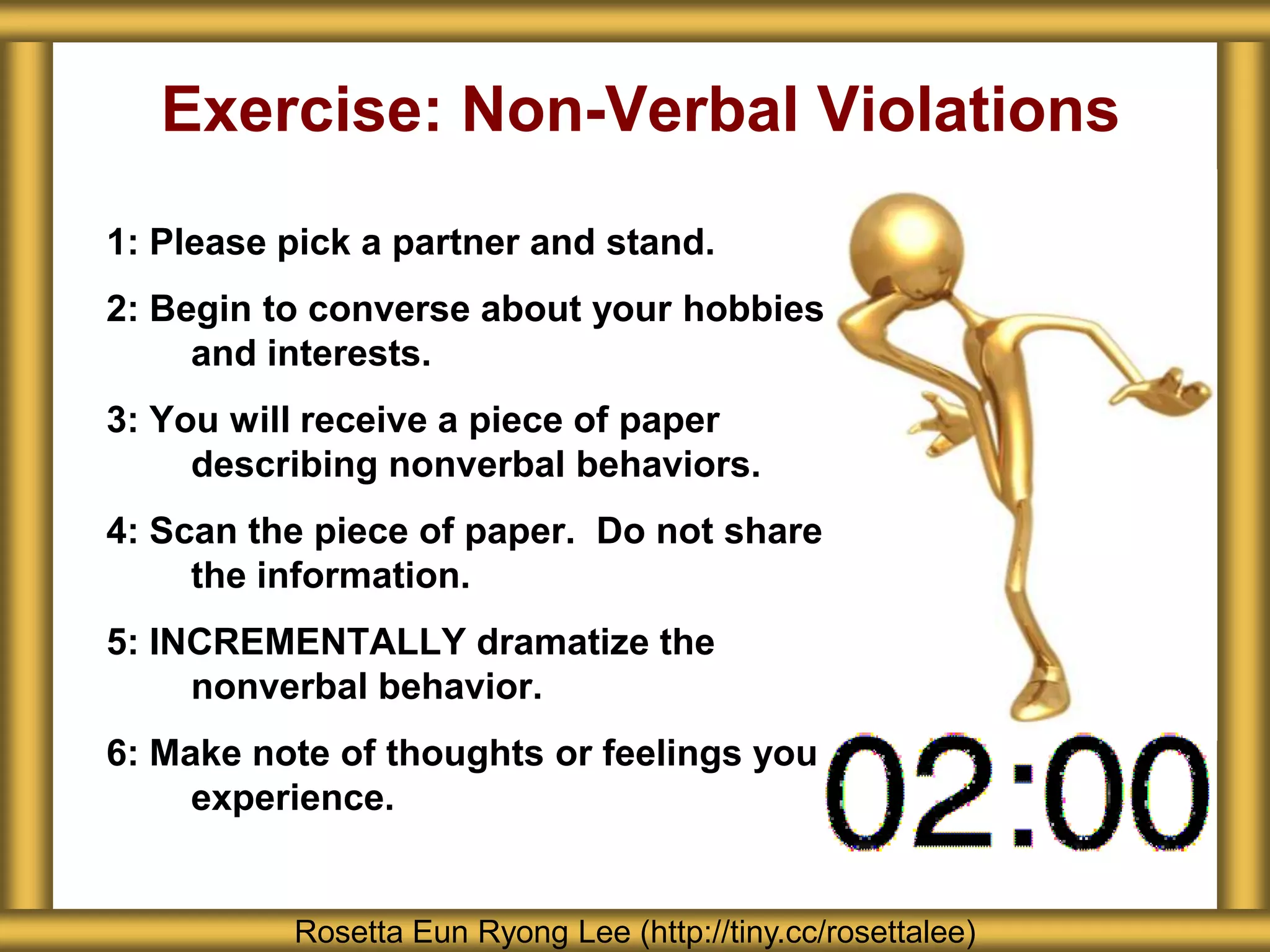
Exercise: Non-Verbal Violations
1: Please pick a partner and stand.
2: Begin to converse about your hobbies
     and interests.
3: You will receive a piece of paper
     describing nonverbal behaviors.
4: Scan the piece of paper. Do not share
     the information.
5: INCREMENTALLY dramatize the
     nonverbal behavior.
6: Make note of thoughts or feelings you
     experience.


          Rosetta Eun Ryong Lee (http://tiny.cc/rosettalee)
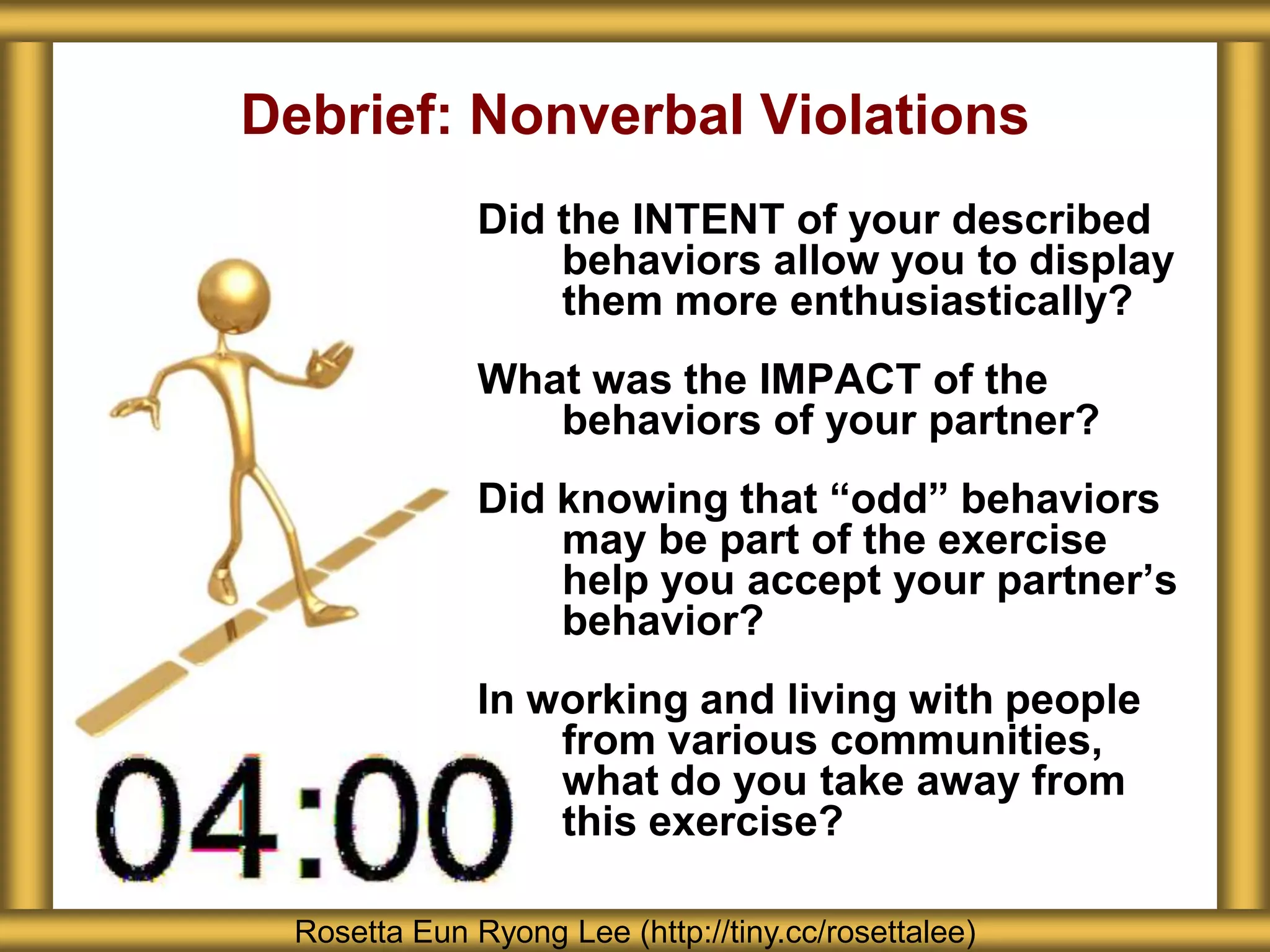
Debrief: Nonverbal Violations
              Did the INTENT of your described
                  behaviors allow you to display
                  them more enthusiastically?
              What was the IMPACT of the
                 behaviors of your partner?
              Did knowing that “odd” behaviors
                  may be part of the exercise
                  help you accept your partner’s
                  behavior?
              In working and living with people
                  from various communities,
                  what do you take away from
                  this exercise?

 Rosetta Eun Ryong Lee (http://tiny.cc/rosettalee)
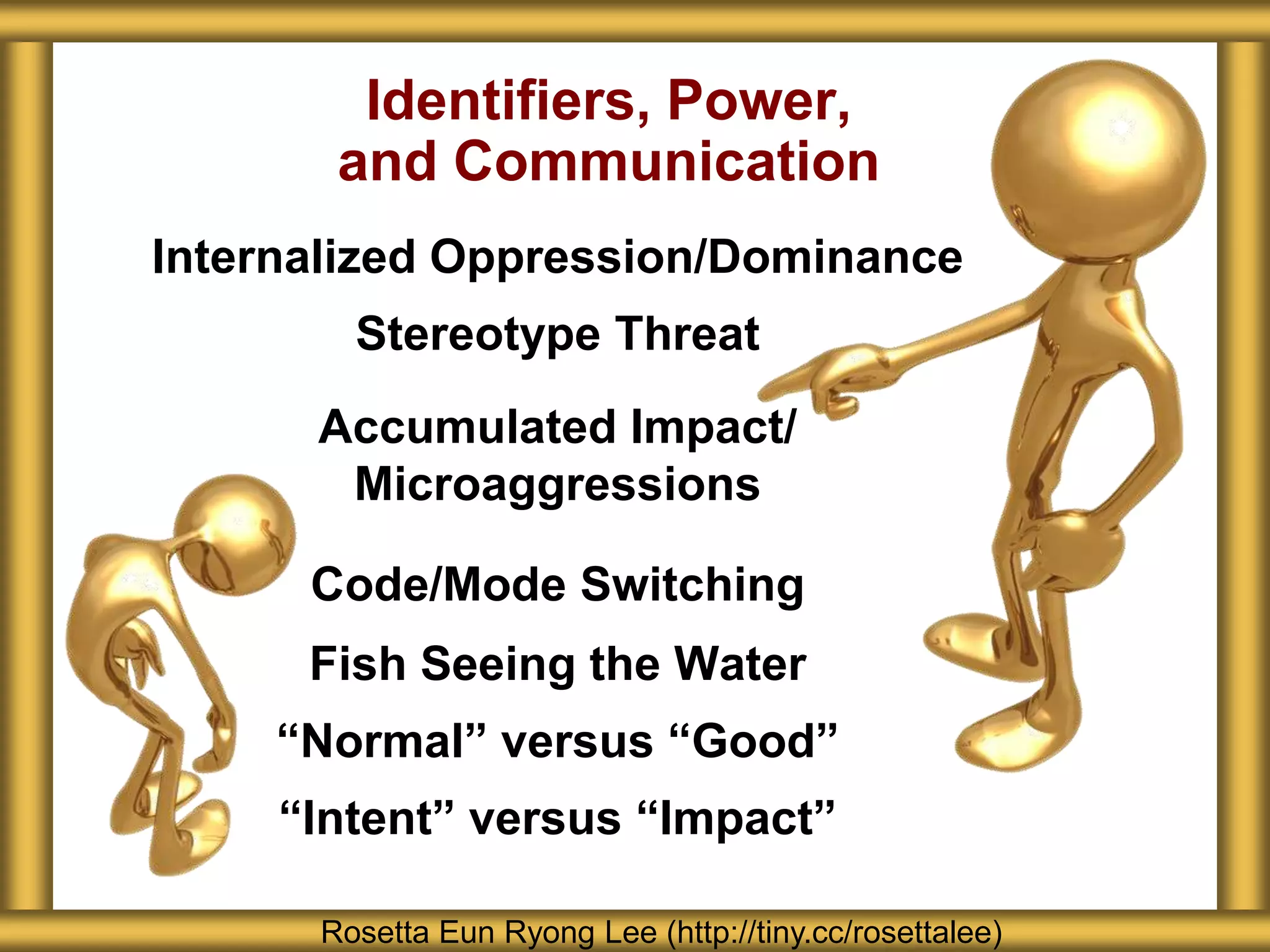
Identifiers, Power,
       and Communication
Internalized Oppression/Dominance
        Stereotype Threat
      Accumulated Impact/
       Microaggressions

      Code/Mode Switching
      Fish Seeing the Water
     “Normal” versus “Good”
     “Intent” versus “Impact”

      Rosetta Eun Ryong Lee (http://tiny.cc/rosettalee)
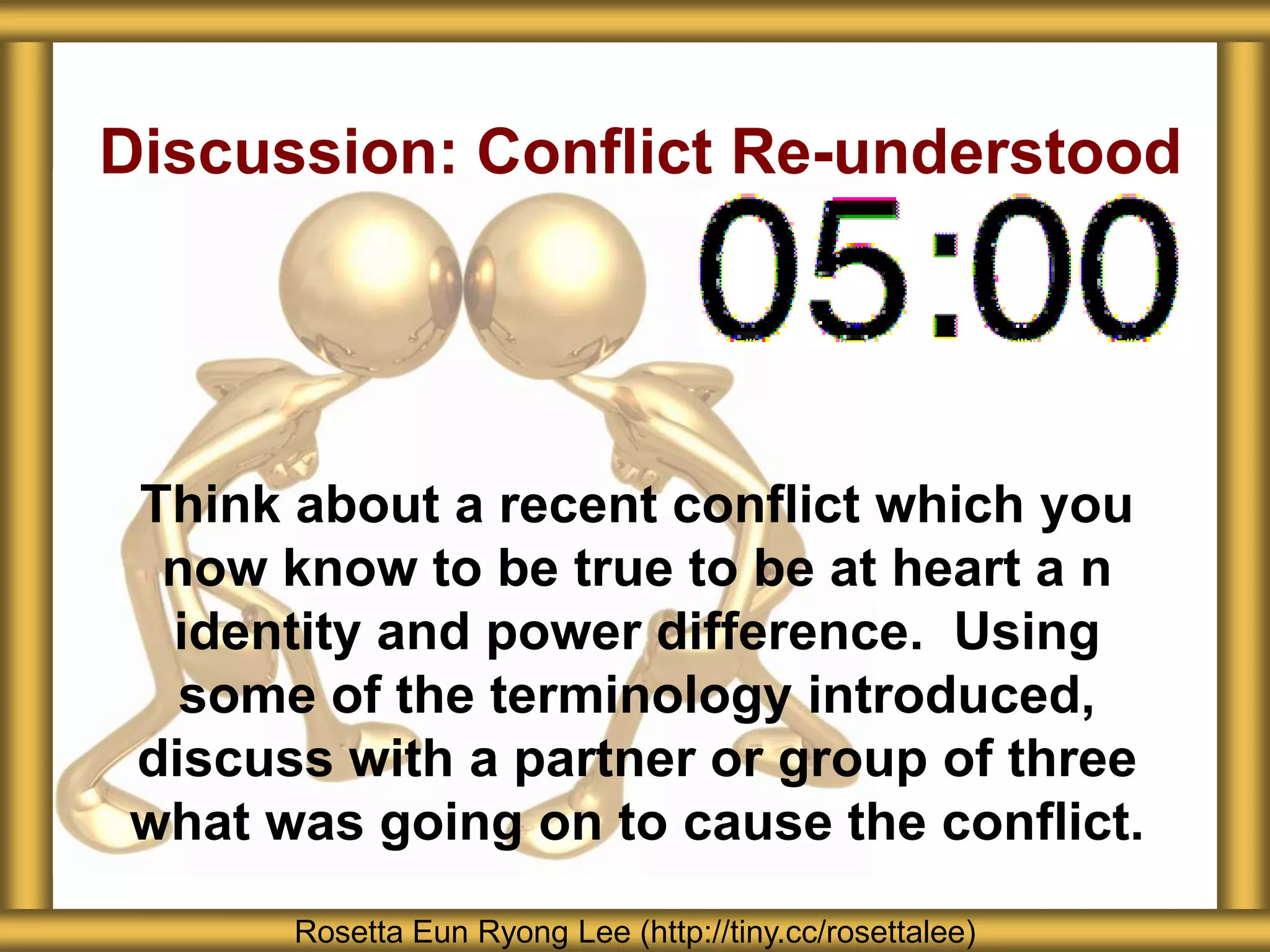
Discussion: Conflict Re-understood


Think about a recent conflict which you
 now know to be true to be at heart a n
 identity and power difference. Using
  some of the terminology introduced,
discuss with a partner or group of three
what was going on to cause the conflict.
      Rosetta Eun Ryong Lee (http://tiny.cc/rosettalee)
So What? Now What?


Rosetta Eun Ryong Lee (http://tiny.cc/rosettalee)
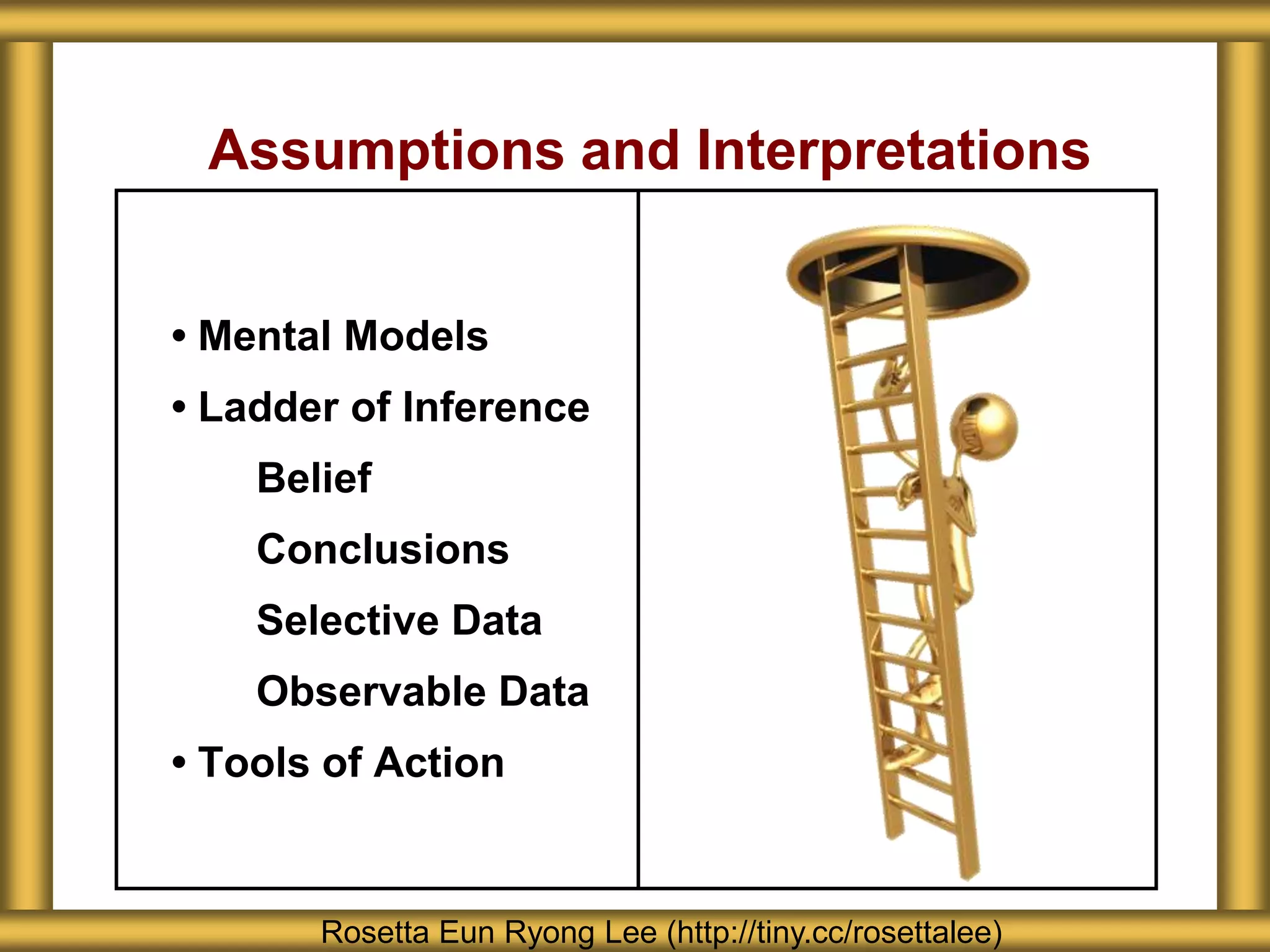
Assumptions and Interpretations


• Mental Models
• Ladder of Inference
    Belief
    Conclusions
    Selective Data
    Observable Data
• Tools of Action


       Rosetta Eun Ryong Lee (http://tiny.cc/rosettalee)
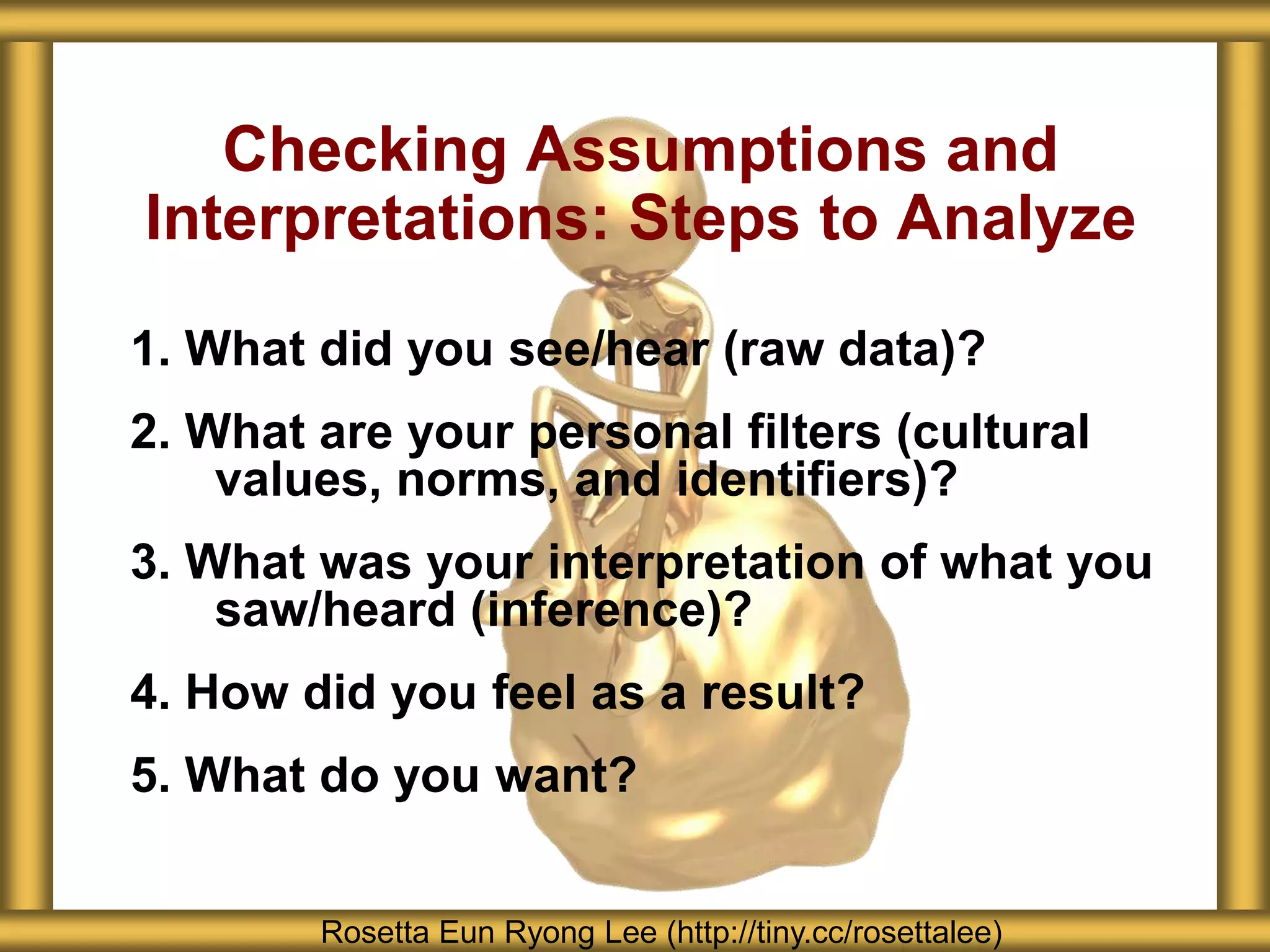
Checking Assumptions and
Interpretations: Steps to Analyze
1. What did you see/hear (raw data)?
2. What are your personal filters (cultural
    values, norms, and identifiers)?
3. What was your interpretation of what you
    saw/heard (inference)?
4. How did you feel as a result?
5. What do you want?


        Rosetta Eun Ryong Lee (http://tiny.cc/rosettalee)
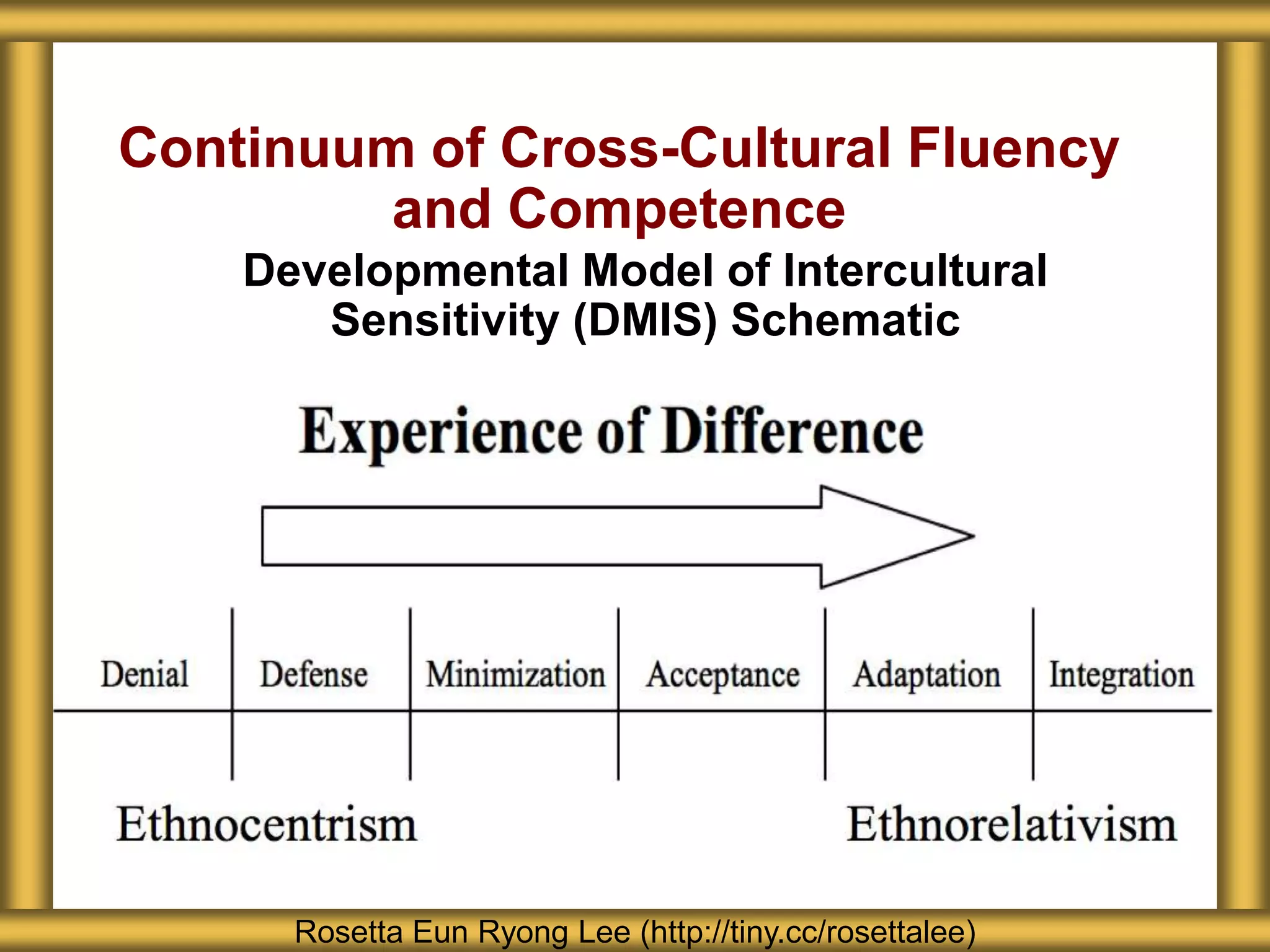
Continuum of Cross-Cultural Fluency
         and Competence
    Developmental Model of Intercultural
       Sensitivity (DMIS) Schematic


      Rosetta Eun Ryong Lee (http://tiny.cc/rosettalee)
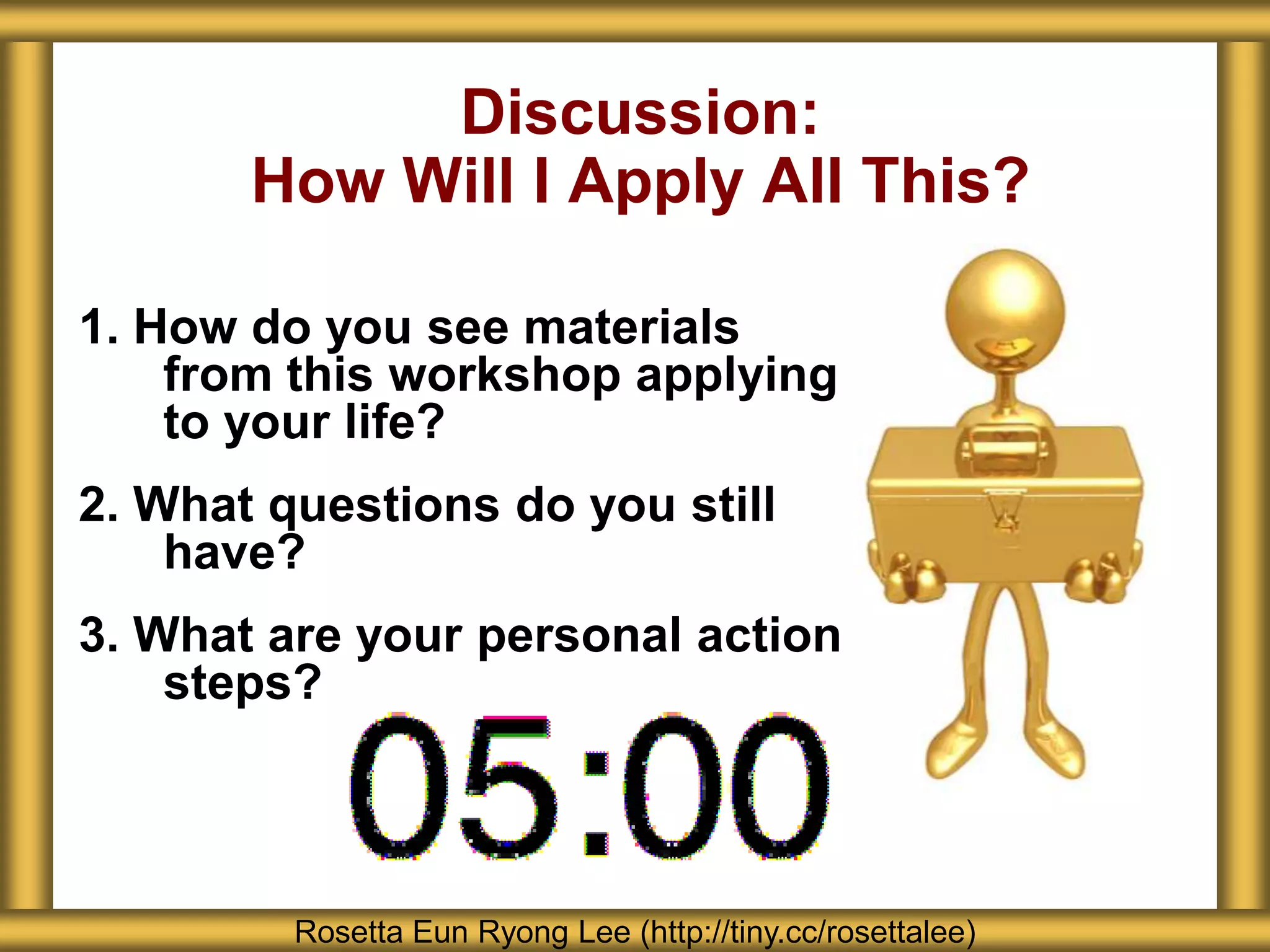
Discussion:
       How Will I Apply All This?

1. How do you see materials
    from this workshop applying
    to your life?
2. What questions do you still
    have?
3. What are your personal action
    steps?


         Rosetta Eun Ryong Lee (http://tiny.cc/rosettalee)
Cultural Effectiveness

  “To be culturally effective doesn’t
  mean you are an authority in the
 values and beliefs of every culture.
   What it means is that you hold a
deep respect for cultural differences
and are eager to learn, and willing to
accept, that there are many ways of
          viewing the world”
                  Okokon O. Udo
      Rosetta Eun Ryong Lee (http://tiny.cc/rosettalee)
Final Questions or Comments?


   Rosetta Eun Ryong Lee (http://tiny.cc/rosettalee)
Resources
• “Stereotype Threat” by Joshua Aronson
• David K. Berlo, The Process of Communication (New York: Holt,
      Rinehart, and Winston, 1960)
• Brenda J. Allen, Difference Matters: Communicating Social Identity
• William Gudykunst, Cross-Cultural and Intercultural Comunication
• Milton Bennett, PhD, Intercultural Communication Institute
      www.intercultural.org
• National Coalition Building Institute
• “Non-Verbal Communication Across Cultures” by Erica Hagen,
      Intercultural Communication Resources
• Thiagi.com
• Thrive! Team Dynamics
• Nonverbal Violations 
by Stella Ting-Toomey
• http://www.analytictech.com/mb021/action_science_ history.htm

            Rosetta Eun Ryong Lee (http://tiny.cc/rosettalee)
Presenter Information
                Rosetta Eun Ryong Lee
                6th Faculty and
                Professional Outreach
                Seattle Girls’ School
                2706 S Jackson Street
                Seattle WA 98144
                (206) 805-6562
                rlee@seattlegirlsschool.org

                http://tiny.cc/rosettalee

    Rosetta Eun Ryong Lee (http://tiny.cc/rosettalee)

St. Andrew's School CCC

  • 1.
    What I Saidand What I Meant: Cross Cultural Communication St. Andrew’s School Rosetta Eun Ryong Lee Seattle Girls’ School Rosetta Eun Ryong Lee (http://tiny.cc/rosettalee)
  • 2.
    About Seattle Girls’School Rosetta Eun Ryong Lee (http://tiny.cc/rosettalee)
  • 3.
    Agenda  Cross Cultural Communication  Cultural Values, Norms of Behavior, and Communication  Activity: Nonverbal Violations  Cultural Identifiers, Power, and Communication  Discussion: Conflict Re-understood  So What? Now What? Rosetta Eun Ryong Lee (http://tiny.cc/rosettalee)
  • 4.
    Rosetta Eun RyongLee (http://tiny.cc/rosettalee)
  • 5.
    Dimensions of Identityand Culture This model of identifiers and culture was created by Karen Bradberry and Johnnie Foreman for NAIS Summer Diversity Institute, adapted from Loden and Rosener’s Workforce America! (1991) and from Diverse Teams at Work, Gardenswartz & Rowe (SHRM 2003). Rosetta Eun Ryong Lee (http://tiny.cc/rosettalee)
  • 6.
    Cross Cultural Communication  What is it?  How is it Different from Intercultural Communication?  CCC Theories – Face-Negotiation Theory – Conversational Constraints Theory – Expectancy Violation Theory – Anxiety/Uncertainty Management Theory – Communication Accommodation Theory Rosetta Eun Ryong Lee (http://tiny.cc/rosettalee)
  • 7.
    Dimensions of Variability Individual - Collectivistic Low Context - High Context Task - Relationship Low Uncertainty - High Uncertainty Vertical - Horizontal Rosetta Eun Ryong Lee (http://tiny.cc/rosettalee)
  • 8.
    Factors that Influence  Personality Orientation  Individual Values  Self Construal - Independent - Interdependent  Individual Socialization  Cultural Norms and Rules Rosetta Eun Ryong Lee (http://tiny.cc/rosettalee)
  • 9.
    Discussion: My Style In hearing about communication differences, what would you describe as your cultural communication style? Have you noticed stark differences compared to others? Rosetta Eun Ryong Lee (http://tiny.cc/rosettalee)
  • 10.
    Cultural Values Norms, and Rules  Values  Value Priorities  Norms of Behavior  Non-Verbal Communication Rosetta Eun Ryong Lee (http://tiny.cc/rosettalee)
  • 11.
    RELATIONAL Cultural Value Differences Individualism self-reliance, independence Collectivism group interdependence (selfis h ) (mindless follower) Informality Formality directness, give and take discussion indirectness, protect "face" (rude and abrupt) (stiff and impersonal) Competition Cooperation individual achievement group achievement (egotistical, show-off) (avoiding doing work or taking responsibility) AUTHORITY Egalitarianism Hierarchy fairness, belief in equal opportunity privilege of status or rank (being picky, on a soapbox) (power hungry or avoiding accountability) TEMPORAL Use of Time Passage of Time "Time is money" "Time is for life" (doesn’t get the important things in life) (lazy and irresponsible) Change/Future Tradition/Past Adaptability ensures survival Stability ensures survival (muckraker, stirs up trouble) (old-school, afraid of change) ACTIVITY Action orientation "Being" orientation "Make things happen" "Let things happen" (rushes without thinkin g ) (indecisive and slow) Practicality Idealism Efficiency is always best Always maintain principles (impersonal and unscrupulous) (naïve and impractical) Rosetta Eun Ryong Lee (http://tiny.cc/rosettalee)
  • 12.
    Exercise: Non-Verbal Violations 1:Please pick a partner and stand. 2: Begin to converse about your hobbies and interests. 3: You will receive a piece of paper describing nonverbal behaviors. 4: Scan the piece of paper. Do not share the information. 5: INCREMENTALLY dramatize the nonverbal behavior. 6: Make note of thoughts or feelings you experience. Rosetta Eun Ryong Lee (http://tiny.cc/rosettalee)
  • 13.
    Debrief: Nonverbal Violations Did the INTENT of your described behaviors allow you to display them more enthusiastically? What was the IMPACT of the behaviors of your partner? Did knowing that “odd” behaviors may be part of the exercise help you accept your partner’s behavior? In working and living with people from various communities, what do you take away from this exercise? Rosetta Eun Ryong Lee (http://tiny.cc/rosettalee)
  • 14.
    Identifiers, Power, and Communication Internalized Oppression/Dominance Stereotype Threat Accumulated Impact/ Microaggressions Code/Mode Switching Fish Seeing the Water “Normal” versus “Good” “Intent” versus “Impact” Rosetta Eun Ryong Lee (http://tiny.cc/rosettalee)
  • 15.
    Discussion: Conflict Re-understood Thinkabout a recent conflict which you now know to be true to be at heart a n identity and power difference. Using some of the terminology introduced, discuss with a partner or group of three what was going on to cause the conflict. Rosetta Eun Ryong Lee (http://tiny.cc/rosettalee)
  • 16.
    So What? NowWhat? Rosetta Eun Ryong Lee (http://tiny.cc/rosettalee)
  • 17.
    Assumptions and Interpretations •Mental Models • Ladder of Inference Belief Conclusions Selective Data Observable Data • Tools of Action Rosetta Eun Ryong Lee (http://tiny.cc/rosettalee)
  • 18.
    Checking Assumptions and Interpretations:Steps to Analyze 1. What did you see/hear (raw data)? 2. What are your personal filters (cultural values, norms, and identifiers)? 3. What was your interpretation of what you saw/heard (inference)? 4. How did you feel as a result? 5. What do you want? Rosetta Eun Ryong Lee (http://tiny.cc/rosettalee)
  • 19.
    Continuum of Cross-CulturalFluency and Competence Developmental Model of Intercultural Sensitivity (DMIS) Schematic Rosetta Eun Ryong Lee (http://tiny.cc/rosettalee)
  • 20.
    Discussion: How Will I Apply All This? 1. How do you see materials from this workshop applying to your life? 2. What questions do you still have? 3. What are your personal action steps? Rosetta Eun Ryong Lee (http://tiny.cc/rosettalee)
  • 21.
    Cultural Effectiveness “To be culturally effective doesn’t mean you are an authority in the values and beliefs of every culture. What it means is that you hold a deep respect for cultural differences and are eager to learn, and willing to accept, that there are many ways of viewing the world” Okokon O. Udo Rosetta Eun Ryong Lee (http://tiny.cc/rosettalee)
  • 22.
    Final Questions orComments? Rosetta Eun Ryong Lee (http://tiny.cc/rosettalee)
  • 23.
    Resources • “Stereotype Threat”by Joshua Aronson • David K. Berlo, The Process of Communication (New York: Holt, Rinehart, and Winston, 1960) • Brenda J. Allen, Difference Matters: Communicating Social Identity • William Gudykunst, Cross-Cultural and Intercultural Comunication • Milton Bennett, PhD, Intercultural Communication Institute www.intercultural.org • National Coalition Building Institute • “Non-Verbal Communication Across Cultures” by Erica Hagen, Intercultural Communication Resources • Thiagi.com • Thrive! Team Dynamics • Nonverbal Violations 
by Stella Ting-Toomey • http://www.analytictech.com/mb021/action_science_ history.htm Rosetta Eun Ryong Lee (http://tiny.cc/rosettalee)
  • 24.
    Presenter Information Rosetta Eun Ryong Lee 6th Faculty and Professional Outreach Seattle Girls’ School 2706 S Jackson Street Seattle WA 98144 (206) 805-6562 rlee@seattlegirlsschool.org http://tiny.cc/rosettalee Rosetta Eun Ryong Lee (http://tiny.cc/rosettalee)