WORLD TRADE ORGANISATION
NAME – AKHILESH VERMA
CLASS – X
ROLL NO – 1002
SUBJECT –SOCIAL SCIENCE
WHAT IS WORLD TRADE ORGANISATION?
• The World Trade Organization (WTO) is a
large international organization to regulate trade
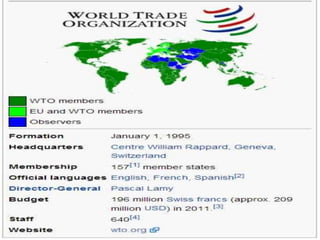
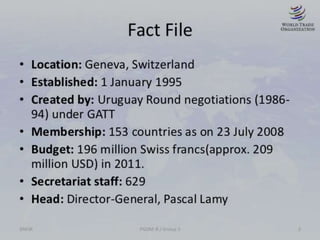
that was established in 1995. As of 15 December,
2005, there were 153 member countries. In the
WTO, agreements are made on trade between
countries. The General Agreement on Tariffs and
Trade (GATT) means that countries have to lower
barriers to international trade, such as tariff on
goods crossing borders. This lets businesses
operate in many different countries.
• The World Trade Organization (WTO) is
an organization that intends to supervise
and liberalize international trade. The organization
officially commenced on 1 January 1995 under
the Marrakech Agreement, signed by 123 nations on 15
April 1994, replacing the General Agreement on Tariffs
and Trade (GATT), which commenced in 1948.[The
organization deals with regulation of trade between
participating countries by providing a framework for
negotiating and formalizing trade agreements and a
dispute resolution process aimed at enforcing participan
adherence to WTO agreements, which are signed by
representatives of member and ratified by their
parliaments. Most of the issues that the WTO focuses o
derive from previous trade negotiations, especially from
the Uruguay Round (1986–1994).
• WTO's current Director-General
is Roberto Azevêdo, who leads a staff
of over 600 people
in Geneva, Switzerland trade
facilitation agreement known as
the Bali Package was reached by all
members on 7 December 2013, the
first comprehensive agreement in
the organization's history.
• The organization is attempting to complete
negotiations on the Doha Development Round, which
was launched in 2001 with an explicit focus on
addressing the needs of developing countries. As of
June 2012, the future of the Doha Round remained
uncertain: the work programme lists 21 subjects in
which the original deadline of 1 January 2005 was
missed, and the round is still incomplete.[The conflict
between free trade on industrial goods and services
but retention of protectionism onfarm subsidies to
domestic agricultural sector (requested by developed
countries) and the substantiation of the international
liberalization of fair trade on agricultural products
(requested by developing countries) remain the major
obstacles.
• These points of contention have
hindered any progress to launch new
WTO negotiations beyond the Doha
Development Round. As a result of this
impasse, there has been an increasing
number of bilateral free trade
agreements signed.[ As of July 2012,
there were various negotiation groups in
the WTO system for the current
agricultural trade negotiation which is in
the condition of stalemate
HISTORY OF WORLD TRADE
ORGANISATION
• The WTO's predecessor, the General Agreement on Tariffs
and Trade (GATT), was established after World War II in the
wake of other new multilateral institutions dedicated to
international economic cooperation – notably the Bretton
Woods institutions known as the World Bank and
the International Monetary Fund. A comparable
international institution for trade, named the International
Trade Organization was successfully negotiated. The ITO
was to be a United Nations specialized agency and would
address not only trade barriers but other issues indirectly
related to trade, including employment, investment,
restrictive business practices, and commodity agreements.
But the ITO treaty was not approved by the U.S. and a few
other signatories and never went into effect
•In the absence of an
international organization
for trade, the GATT would
over the years "transform
itself" into a de
facto international
organization
FUNCTIONS OF
WORLD TRADE
ORGANISATION
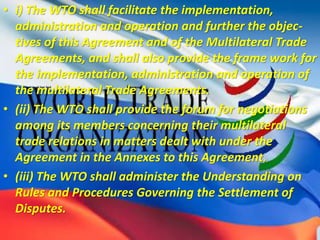
• i) The WTO shall facilitate the implementation,
administration and operation and further the objec-
tives of this Agreement and of the Multilateral Trade
Agreements, and shall also provide the frame work for
the implementation, administration and operation of
the multilateral Trade Agreements.
• (ii) The WTO shall provide the forum for negotiations
among its members concerning their multilateral
trade relations in matters dealt with under the
Agreement in the Annexes to this Agreement.
• (iii) The WTO shall administer the Understanding on
Rules and Procedures Governing the Settlement of
Disputes.
• (iv) The WTO shall administer Trade
Policy Review Mechanism.
• (v) With a view to achieving greater
coherence in global economic policy
making, the WTO shall cooperate, as
appropriate, with the international
Monetary Fund (IMF) and with the
International Bank for Reconstruction
and Development (IBRD) and its
affiliated agencies
PRINCIPLES OF THE TRADING SYSTEM
• Non-discrimination. It has two major components: the most
favoured nation (MFN) rule, and the national treatmentpolicy.
Both are embedded in the main WTO rules on goods,
services, and intellectual property, but their precise scope and
nature differ across these areas. The MFN rule requires that a
WTO member must apply the same conditions on all trade
with other WTO members, i.e. a WTO member has to grant
the most favorable conditions under which it allows trade in a
certain product type to all other WTO members.[45] "Grant
someone a special favour and you have to do the same for all
other WTO members."[29] National treatment means that
imported goods should be treated no less favorably than
domestically produced goods (at least after the foreign goods
have entered the market) and was introduced to tackle non-
tariff barriers to trade (e.g. technical standards, security
standards et al. discriminating against imported goods)
• Reciprocity. It reflects both a desire to limit the
scope of free-riding that may arise because of the
MFN rule, and a desire to obtain better access to
foreign markets. A related point is that for a nation
to negotiate, it is necessary that the gain from doing
so be greater than the gain available
from unilateral liberalization; reciprocal concessions
intend to ensure t
• Safety valves. In specific circumstances,
governments are able to restrict trade. The WTO's
agreements permit members to take measures to
protect not only the environment but also public
health, animal health and plant health at such gains
will materialise
S.s.t
S.s.t
S.s.t
S.s.t
S.s.t
S.s.t

S.s.t

  • 1.
    WORLD TRADE ORGANISATION NAME– AKHILESH VERMA CLASS – X ROLL NO – 1002 SUBJECT –SOCIAL SCIENCE
  • 2.
    WHAT IS WORLDTRADE ORGANISATION? • The World Trade Organization (WTO) is a large international organization to regulate trade that was established in 1995. As of 15 December, 2005, there were 153 member countries. In the WTO, agreements are made on trade between countries. The General Agreement on Tariffs and Trade (GATT) means that countries have to lower barriers to international trade, such as tariff on goods crossing borders. This lets businesses operate in many different countries.
  • 3.
    • The WorldTrade Organization (WTO) is an organization that intends to supervise and liberalize international trade. The organization officially commenced on 1 January 1995 under the Marrakech Agreement, signed by 123 nations on 15 April 1994, replacing the General Agreement on Tariffs and Trade (GATT), which commenced in 1948.[The organization deals with regulation of trade between participating countries by providing a framework for negotiating and formalizing trade agreements and a dispute resolution process aimed at enforcing participan adherence to WTO agreements, which are signed by representatives of member and ratified by their parliaments. Most of the issues that the WTO focuses o derive from previous trade negotiations, especially from the Uruguay Round (1986–1994).
  • 5.
    • WTO's currentDirector-General is Roberto Azevêdo, who leads a staff of over 600 people in Geneva, Switzerland trade facilitation agreement known as the Bali Package was reached by all members on 7 December 2013, the first comprehensive agreement in the organization's history.
  • 6.
    • The organizationis attempting to complete negotiations on the Doha Development Round, which was launched in 2001 with an explicit focus on addressing the needs of developing countries. As of June 2012, the future of the Doha Round remained uncertain: the work programme lists 21 subjects in which the original deadline of 1 January 2005 was missed, and the round is still incomplete.[The conflict between free trade on industrial goods and services but retention of protectionism onfarm subsidies to domestic agricultural sector (requested by developed countries) and the substantiation of the international liberalization of fair trade on agricultural products (requested by developing countries) remain the major obstacles.
  • 7.
    • These pointsof contention have hindered any progress to launch new WTO negotiations beyond the Doha Development Round. As a result of this impasse, there has been an increasing number of bilateral free trade agreements signed.[ As of July 2012, there were various negotiation groups in the WTO system for the current agricultural trade negotiation which is in the condition of stalemate
  • 8.
    HISTORY OF WORLDTRADE ORGANISATION • The WTO's predecessor, the General Agreement on Tariffs and Trade (GATT), was established after World War II in the wake of other new multilateral institutions dedicated to international economic cooperation – notably the Bretton Woods institutions known as the World Bank and the International Monetary Fund. A comparable international institution for trade, named the International Trade Organization was successfully negotiated. The ITO was to be a United Nations specialized agency and would address not only trade barriers but other issues indirectly related to trade, including employment, investment, restrictive business practices, and commodity agreements. But the ITO treaty was not approved by the U.S. and a few other signatories and never went into effect
  • 9.
    •In the absenceof an international organization for trade, the GATT would over the years "transform itself" into a de facto international organization
  • 12.
  • 13.
    • i) TheWTO shall facilitate the implementation, administration and operation and further the objec- tives of this Agreement and of the Multilateral Trade Agreements, and shall also provide the frame work for the implementation, administration and operation of the multilateral Trade Agreements. • (ii) The WTO shall provide the forum for negotiations among its members concerning their multilateral trade relations in matters dealt with under the Agreement in the Annexes to this Agreement. • (iii) The WTO shall administer the Understanding on Rules and Procedures Governing the Settlement of Disputes.
  • 14.
    • (iv) TheWTO shall administer Trade Policy Review Mechanism. • (v) With a view to achieving greater coherence in global economic policy making, the WTO shall cooperate, as appropriate, with the international Monetary Fund (IMF) and with the International Bank for Reconstruction and Development (IBRD) and its affiliated agencies
  • 18.
    PRINCIPLES OF THETRADING SYSTEM • Non-discrimination. It has two major components: the most favoured nation (MFN) rule, and the national treatmentpolicy. Both are embedded in the main WTO rules on goods, services, and intellectual property, but their precise scope and nature differ across these areas. The MFN rule requires that a WTO member must apply the same conditions on all trade with other WTO members, i.e. a WTO member has to grant the most favorable conditions under which it allows trade in a certain product type to all other WTO members.[45] "Grant someone a special favour and you have to do the same for all other WTO members."[29] National treatment means that imported goods should be treated no less favorably than domestically produced goods (at least after the foreign goods have entered the market) and was introduced to tackle non- tariff barriers to trade (e.g. technical standards, security standards et al. discriminating against imported goods)
  • 19.
    • Reciprocity. Itreflects both a desire to limit the scope of free-riding that may arise because of the MFN rule, and a desire to obtain better access to foreign markets. A related point is that for a nation to negotiate, it is necessary that the gain from doing so be greater than the gain available from unilateral liberalization; reciprocal concessions intend to ensure t • Safety valves. In specific circumstances, governments are able to restrict trade. The WTO's agreements permit members to take measures to protect not only the environment but also public health, animal health and plant health at such gains will materialise