An online training module

Sponsored

Student Organizations:
Faculty Advisor Guide
Sponsored Student Organizations: Faculty Advising


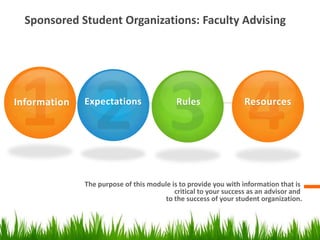
Information   Expectations                 Rules                 Resources


              The purpose of this module is to provide you with information that is
                                          critical to your success as an advisor and
                                       to the success of your student organization.
Information
   Oregon State University recognizes that sponsored student organizations are inherently linked to
   the University because of their role in enhancing education, representing OSU, and/or presenting
   events that are considered an integral part of the institution. In order to best support the learning
    of student leaders in our community, we have adopted a philosophical approach of partnership
       and collaboration with individual students and student organizations as “facilitators” in the
involvement experience. As “facilitators,” faculty advisors work with administrators, faculty, and staff to
     support student organization members and leaders in making intelligent, fair, and reasonable
  choices within the boundaries established by state, federal, and local laws, university rules/policies,
  and the mission of the sponsoring unit. At Oregon State University, the Faculty Advisor is defined as
     “faculty, staff, or personnel responsible for maintaining relationship with a sponsored student
organization that allows for education and development as well as administration of data collection and
                       University policies, procedures, and guidelines” and serves as
                       the primary “facilitator” to Sponsored Student Organizations.
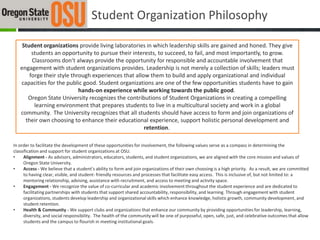
Student Organization Philosophy

    Student organizations provide living laboratories in which leadership skills are gained and honed. They give
        students an opportunity to pursue their interests, to succeed, to fail, and most importantly, to grow.
        Classrooms don’t always provide the opportunity for responsible and accountable involvement that
   engagement with student organizations provides. Leadership is not merely a collection of skills; leaders must
       forge their style through experiences that allow them to build and apply organizational and individual
   capacities for the public good. Student organizations are one of the few opportunities students have to gain
                            hands-on experience while working towards the public good.
      Oregon State University recognizes the contributions of Student Organizations in creating a compelling
         learning environment that prepares students to live in a multicultural society and work in a global
   community. The University recognizes that all students should have access to form and join organizations of
     their own choosing to enhance their educational experience, support holistic personal development and
                                                      retention.

In order to facilitate the development of these opportunities for involvement, the following values serve as a compass in determining the
classification and support for student organizations at OSU.
•     Alignment - As advisors, administrators, educators, students, and student organizations, we are aligned with the core mission and values of
      Oregon State University.
•     Access - We believe that a student’s ability to form and join organizations of their own choosing is a high priority. As a result, we are committed
      to having clear, visible, and student- friendly resources and processes that facilitate easy access. This is inclusive of, but not limited to: a
      mentoring relationship, advising, assistance with recruitment, and access to meeting and activity space.
•     Engagement - We recognize the value of co-curricular and academic involvement throughout the student experience and are dedicated to
      facilitating partnerships with students that support shared accountability, responsibility, and learning. Through engagement with student
      organizations, students develop leadership and organizational skills which enhance knowledge, holistic growth, community development, and
      student retention.
•     Health & Community - We support clubs and organizations that enhance our community by providing opportunities for leadership, learning,
      diversity, and social responsibility. The health of the community will be one of purposeful, open, safe, just, and celebrative outcomes that allow
      students and the campus to flourish in meeting institutional goals.
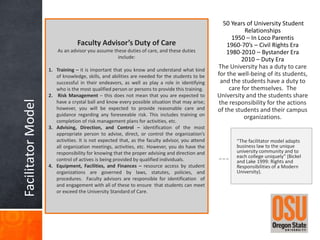
50 Years of University Student
                                                                                                            Relationships
                                                                                                       1950 – In Loco Parentis
                                 Faculty Advisor’s Duty of Care                                      1960-70’s – Civil Rights Era
                        As an advisor you assume these duties of care, and these duties              1980-2010 – Bystander Era
                                                   include:
                                                                                                           2010 – Duty Era
                    1. Training – it is important that you know and understand what kind
                                                                                                 The University has a duty to care
                       of knowledge, skills, and abilities are needed for the students to be     for the well-being of its students,
                       successful in their endeavors, as well as play a role in identifying       and the students have a duty to
                       who is the most qualified person or persons to provide this training.          care for themselves. The
                    2. Risk Management – this does not mean that you are expected to             University and the students share
Facilitator Model


                       have a crystal ball and know every possible situation that may arise;      the responsibility for the actions
                       however, you will be expected to provide reasonable care and              of the students and their campus
                       guidance regarding any foreseeable risk. This includes training on
                                                                                                            organizations.
                       completion of risk management plans for activities, etc.
                    3. Advising, Direction, and Control – identification of the most
                       appropriate person to advise, direct, or control the organization’s
                       activities. It is not expected that, as the faculty advisor, you attend          “The facilitator model adapts
                       all organization meetings, activities, etc. However, you do have the             business law to the unique
                       responsibility for knowing that the proper advising and direction and            university community and to
                                                                                                        each college uniquely” (Bickel
                       control of actives is being provided by qualified individuals.                   and Lake 1999: Rights and
                    4. Equipment, Facilities, and Finances – resource access by student                 Responsibilities of a Modern
                       organizations are governed by laws, statutes, policies, and                      University).
                       procedures. Faculty advisors are responsible for identification of
                       and engagement with all of these to ensure that students can meet
                       or exceed the University Standard of Care.
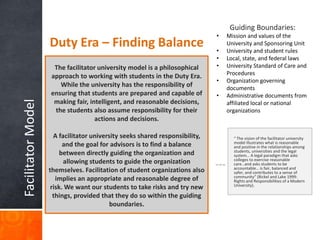
Guiding Boundaries:
                                                                              •   Mission and values of the
                    Duty Era – Finding Balance                                •
                                                                                  University and Sponsoring Unit
                                                                                  University and student rules
                                                                              •   Local, state, and federal laws
                     The facilitator university model is a philosophical      •   University Standard of Care and
                                                                                  Procedures
                    approach to working with students in the Duty Era.
                                                                              •   Organization governing
                       While the university has the responsibility of             documents
                    ensuring that students are prepared and capable of        •   Administrative documents from
                     making fair, intelligent, and reasonable decisions,
Facilitator Model


                                                                                  affiliated local or national
                     the students also assume responsibility for their            organizations
                                    actions and decisions.

                      A facilitator university seeks shared responsibility,         “ The vision of the facilitator university
                                                                                    model illustrates what is reasonable
                          and the goal for advisors is to find a balance            and positive in the relationships among
                                                                                    students, universities and the legal
                         between directly guiding the organization and              system… A legal paradigm that asks
                                                                                    colleges to exercise reasonable
                          allowing students to guide the organization               care…and asks students to be
                                                                                    accountable… is fair, balanced and
                    themselves. Facilitation of student organizations also          safer, and contributes to a sense of
                                                                                    community” (Bickel and Lake 1999:
                       implies an appropriate and reasonable degree of              Rights and Responsibilities of a Modern
                                                                                    University).
                     risk. We want our students to take risks and try new
                      things, provided that they do so within the guiding
                                           boundaries.

SSO Faculty Advisor Guide - Information

  • 1.
    An online trainingmodule Sponsored Student Organizations: Faculty Advisor Guide
  • 2.
    Sponsored Student Organizations:Faculty Advising Information Expectations Rules Resources The purpose of this module is to provide you with information that is critical to your success as an advisor and to the success of your student organization.
  • 3.
    Information Oregon State University recognizes that sponsored student organizations are inherently linked to the University because of their role in enhancing education, representing OSU, and/or presenting events that are considered an integral part of the institution. In order to best support the learning of student leaders in our community, we have adopted a philosophical approach of partnership and collaboration with individual students and student organizations as “facilitators” in the involvement experience. As “facilitators,” faculty advisors work with administrators, faculty, and staff to support student organization members and leaders in making intelligent, fair, and reasonable choices within the boundaries established by state, federal, and local laws, university rules/policies, and the mission of the sponsoring unit. At Oregon State University, the Faculty Advisor is defined as “faculty, staff, or personnel responsible for maintaining relationship with a sponsored student organization that allows for education and development as well as administration of data collection and University policies, procedures, and guidelines” and serves as the primary “facilitator” to Sponsored Student Organizations.
  • 4.
    Student Organization Philosophy Student organizations provide living laboratories in which leadership skills are gained and honed. They give students an opportunity to pursue their interests, to succeed, to fail, and most importantly, to grow. Classrooms don’t always provide the opportunity for responsible and accountable involvement that engagement with student organizations provides. Leadership is not merely a collection of skills; leaders must forge their style through experiences that allow them to build and apply organizational and individual capacities for the public good. Student organizations are one of the few opportunities students have to gain hands-on experience while working towards the public good. Oregon State University recognizes the contributions of Student Organizations in creating a compelling learning environment that prepares students to live in a multicultural society and work in a global community. The University recognizes that all students should have access to form and join organizations of their own choosing to enhance their educational experience, support holistic personal development and retention. In order to facilitate the development of these opportunities for involvement, the following values serve as a compass in determining the classification and support for student organizations at OSU. • Alignment - As advisors, administrators, educators, students, and student organizations, we are aligned with the core mission and values of Oregon State University. • Access - We believe that a student’s ability to form and join organizations of their own choosing is a high priority. As a result, we are committed to having clear, visible, and student- friendly resources and processes that facilitate easy access. This is inclusive of, but not limited to: a mentoring relationship, advising, assistance with recruitment, and access to meeting and activity space. • Engagement - We recognize the value of co-curricular and academic involvement throughout the student experience and are dedicated to facilitating partnerships with students that support shared accountability, responsibility, and learning. Through engagement with student organizations, students develop leadership and organizational skills which enhance knowledge, holistic growth, community development, and student retention. • Health & Community - We support clubs and organizations that enhance our community by providing opportunities for leadership, learning, diversity, and social responsibility. The health of the community will be one of purposeful, open, safe, just, and celebrative outcomes that allow students and the campus to flourish in meeting institutional goals.
  • 5.
    50 Years ofUniversity Student Relationships 1950 – In Loco Parentis Faculty Advisor’s Duty of Care 1960-70’s – Civil Rights Era As an advisor you assume these duties of care, and these duties 1980-2010 – Bystander Era include: 2010 – Duty Era 1. Training – it is important that you know and understand what kind The University has a duty to care of knowledge, skills, and abilities are needed for the students to be for the well-being of its students, successful in their endeavors, as well as play a role in identifying and the students have a duty to who is the most qualified person or persons to provide this training. care for themselves. The 2. Risk Management – this does not mean that you are expected to University and the students share Facilitator Model have a crystal ball and know every possible situation that may arise; the responsibility for the actions however, you will be expected to provide reasonable care and of the students and their campus guidance regarding any foreseeable risk. This includes training on organizations. completion of risk management plans for activities, etc. 3. Advising, Direction, and Control – identification of the most appropriate person to advise, direct, or control the organization’s activities. It is not expected that, as the faculty advisor, you attend “The facilitator model adapts all organization meetings, activities, etc. However, you do have the business law to the unique responsibility for knowing that the proper advising and direction and university community and to each college uniquely” (Bickel control of actives is being provided by qualified individuals. and Lake 1999: Rights and 4. Equipment, Facilities, and Finances – resource access by student Responsibilities of a Modern organizations are governed by laws, statutes, policies, and University). procedures. Faculty advisors are responsible for identification of and engagement with all of these to ensure that students can meet or exceed the University Standard of Care.
  • 6.
    Guiding Boundaries: • Mission and values of the Duty Era – Finding Balance • University and Sponsoring Unit University and student rules • Local, state, and federal laws The facilitator university model is a philosophical • University Standard of Care and Procedures approach to working with students in the Duty Era. • Organization governing While the university has the responsibility of documents ensuring that students are prepared and capable of • Administrative documents from making fair, intelligent, and reasonable decisions, Facilitator Model affiliated local or national the students also assume responsibility for their organizations actions and decisions. A facilitator university seeks shared responsibility, “ The vision of the facilitator university model illustrates what is reasonable and the goal for advisors is to find a balance and positive in the relationships among students, universities and the legal between directly guiding the organization and system… A legal paradigm that asks colleges to exercise reasonable allowing students to guide the organization care…and asks students to be accountable… is fair, balanced and themselves. Facilitation of student organizations also safer, and contributes to a sense of community” (Bickel and Lake 1999: implies an appropriate and reasonable degree of Rights and Responsibilities of a Modern University). risk. We want our students to take risks and try new things, provided that they do so within the guiding boundaries.