Contemporary Issues Conference –


School Leadership in Mauritius:
                Leading for Learning


                                                By
                                          Fizza Bheekhoo
Education Reform in Mauritius
   Education Reform began in 2006

   “The Rector has the overall responsibility for the smooth and
    effective running of the school and, as such, she is the empowered
    authority within the institution. However, this also makes the Rector
    accountable to the higher authorities as well as to the community.”

   “Inclusive education being an on-going process, the Rector and the
    Educators must work actively and purposefully to reach the
    school‟s vision and goals.”
     “The students are central to the mission of the school
                and all the activities of the institution are geared
                towards promoting their interest. In this respect, it is
                important to highlight that the student community
                legitimately needs to understand the decisions taken
                and even to take part in their making. Thus, the
                Rector should, as often as required, consult them and
                enlist their participation for the effective running of the
                school.”
                                                                                  (School Management Manual, 2009, p. 4)


Ministry of Education, Culture, & Human Resources (2009). School Management Manual For Rectors of State Secondary Schools: Policies, Procedures
& Guidelines on School Management Issues. Retrieved from http://www.gov.mu/portal/goc/educationsite/file/School%20Management%20Manual.pdf.
“The Manual is based on existing policies and
circulars. However, it does not claim to be an
 exhaustive document on “do‟s” and “don‟ts”
since each school has its own specificities and
    may require a different approach when
  dealing with a particular problem.” (p. iii )
Organisational Chart: Zone Directorates and Schools


                                                Students    Parents

                                                School Community


Source: School Management Manual (2009, p. 5)
Leadership for Learningmodel
                   Leadership for Learning – an integrative (LfL)
                         (Swaffield, S. and MacBeath, J. (2009) ‘Researching Leadership for Learning across International and
                         Methodological Boundaries’, Paper presented at the Annual Meeting of the AERA, San Diego, 13-17 April, p16)
                         (See also MacBeath, J. and Dempster, N. (Eds) Connecting Leadership and Learning, Routledge: London)


Source: Swaffield, S. & MacBeath, J. (2009). „Researching Leadership for Learning across International and Methodological Boundaries‟. Paper
presented at the Annual Meeting of the AERA, San Diego, 13-17 April, p. 16.
Focus on Learning
   student learning

   professional learning

   organisational learning

   system learning
Learning Leaders – Learning Staff

                        Leadership Dimension                                                            Effect Size
           Establishing goals & expectations                                                                       0.42
           Strategic Resourcing                                                                                    0.31
           Planning, coordinating & evaluating teaching
                                                                                                                   0.42
           and curriculum
           Promoting and taking part in teacher
                                                                                                                   0.84
           professional learning, formal & informal
           Ensuring an orderly & supportive environment                                                            0.27
                                                         Source: Robinson et al. (2008, p. 657)


                     FOR MORE INFO...
Robinson, V., Lloyd, C., & Rowe, K. (2008). The impact of leadership on student outcomes: an analysis of the differential effects of leadership
types. Educational Administration Quarterly, 44(5), 635-674.
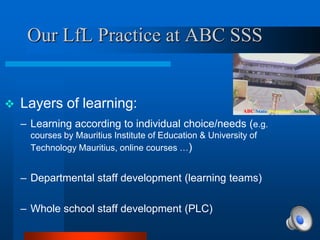
Our LfL Practice at ABC SSS


   Layers of learning:                                      ABC State Secondary School

    – Learning according to individual choice/needs (e.g.
      courses by Mauritius Institute of Education & University of
      Technology Mauritius, online courses …)


    – Departmental staff development (learning teams)

    – Whole school staff development (PLC)
Our LfL Practice at ABC SSS
 Informal   Leadership (few examples):
  – Leadership Team for whole school professional
    development planning

  – Educators deliver professional development
    sessions (mentoring, peer observations,
    assessment strategies, „deans‟ evaluating & using
    students‟ data …)

  – Preparing/sharing lessons with other colleagues or
    educators of (some) other schools …
Focus on Learning (contd.)
    Everyone1 is a learner;

    Learning relies on effective interplay of social, emotional and cognitive
     processes;

    Efficacy of learning is highly sensitive to context and to differing ways in
     which people learn;

    Capacity for leadership arises out of powerful learning experiences; and

    Opportunities to exercise leadership enhance learning.
                                                                                                            (Swaffield & MacBeath, 2009, p. 16)
1 „Everyone‟ includes students, educators, rectors, the school as an organisation.

Swaffield, S. & MacBeath, J. (2009). „Researching Leadership for Learning across International and Methodological Boundaries‟. Paper presented
at the Annual Meeting of the AERA, San Diego, 13-17 April.
Conditions Favourable to Learning
                                                                 OUR VISION STATEMENT
                                                                  To enable each individual
                                                                    student develop all her
                                                                   potentials through quality
                                                                 education in order to become
   Cultures nurture the learning of everyone;                   responsible citizens who can
                                                                  take their rightful place in
                                                                             society


   Everyone has opportunities to reflect on nature, skills and processes of
    learning;

   Physical & social spaces stimulate and celebrate learning;

   Safe & secure environments enable everyone to take risks, cope with
    failure and respond positively to challenges; and

   Tools & strategies used to enhance thinking about learning and practice
    of teaching.
                                                           (Swaffield & MacBeath, 2009, p. 16)
Dialogue
   Leadership for learning practice is made explicit, discussable and flexible;

   Active collegial inquiry focusing on link between learning and leadership;

   Consistency achieved through sharing of values, understanding and
    practices;

   Factors which impede and promote learning and leadership examined
    and addressed; and

   Different perspectives explored through networking with researchers and
    practitioners across national / cultural boundaries.
                                                             (Swaffield & MacBeath, 2009, p. 16)
OUR MISSION STATEMENT
                                                                          Prepare our students to face adult
                                                                            life by providing them quality
                                                                          education so that they can aim at
                                                                           excellence in their undertakings


       Shared/Distributed Leadership
   Structures support participation in developing the school as a learning community;


   Shared leadership is symbolised in the day-to-day flow of activities of the school;


   Everyone is encouraged to take the lead as appropriate to task and context;


   Experience and expertise of staff, students and parents are drawn upon as
    resources; and


   Collaborative patterns of work and activity across boundaries of subject, role and
    status are valued and promoted.
                                                                  (Swaffield & MacBeath, 2009, p. 16)
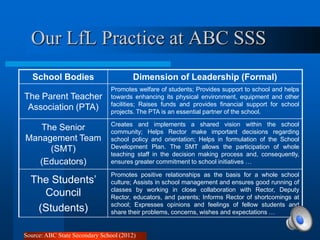
Our LfL Practice at ABC SSS
   School Bodies                        Dimension of Leadership (Formal)
                               Promotes welfare of students; Provides support to school and helps
The Parent Teacher             towards enhancing its physical environment, equipment and other
                               facilities; Raises funds and provides financial support for school
 Association (PTA)             projects. The PTA is an essential partner of the school.

                               Creates and implements a shared vision within the school
   The Senior                  community; Helps Rector make important decisions regarding
Management Team                school policy and orientation; Helps in formulation of the School
     (SMT)                     Development Plan. The SMT allows the participation of whole
                               teaching staff in the decision making process and, consequently,
   (Educators)                 ensures greater commitment to school initiatives …

                               Promotes positive relationships as the basis for a whole school
  The Students‟                culture; Assists in school management and ensures good running of
                               classes by working in close collaboration with Rector, Deputy
    Council                    Rector, educators, and parents; Informs Rector of shortcomings at
                               school; Expresses opinions and feelings of fellow students and
   (Students)                  share their problems, concerns, wishes and expectations …


Source: ABC State Secondary School (2012)
Our LfL Practice at ABC SSS

  School Bodies                        Dimension of Leadership (Formal)
                               Helps Rector and Educators in maintaining discipline among the
  The Student                  student community; Works in close collaboration with Rector,
 Prefects‟ Body                Deputy Rector, Educators, Usher, Student Council and Class
                               Captains.
                               Creates opportunities for misbehaving students, through guidance,
 The Pastoral                  support, skill building, to return to grace and to experience success
                               in their behaviour; Monitors student‟s behaviour progress and liaise
Care Committee                 with parents and with outside agencies if the Committee feels such
                               involvement is necessary.
  (Educators)
                               Collect feedback on learner performance on a monthly basis as per
The Pedagogical                a pro-forma; Analyses end-of-term and end-of-year assessment and
                               examination results for identification of strengths and weaknesses;
   Committee                   Sets up targets and objectives for the different levels; Devises and
                               monitors strategies for improving teaching and learning, in general,
  (Educators)                  and for students with learning difficulties in particular.


Source: ABC State Secondary School (2012)
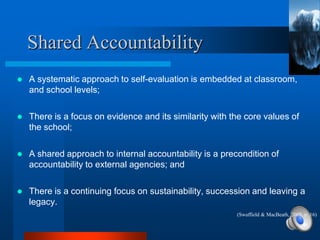
Shared Accountability
   A systematic approach to self-evaluation is embedded at classroom,
    and school levels;

   There is a focus on evidence and its similarity with the core values of
    the school;

   A shared approach to internal accountability is a precondition of
    accountability to external agencies; and

   There is a continuing focus on sustainability, succession and leaving a
    legacy.
                                                          (Swaffield & MacBeath, 2009, p. 16)
“Food for Thought”
How is leadership for learning put into practice at your
 school/workplace?


What are the challenges being faced (or could be faced) at your
 school/workplace while leading for learning?


Can you share your point of view about the leadership for learning
 practice in the conference?

EDU8719 presentation

  • 1.
    Contemporary Issues Conference– School Leadership in Mauritius: Leading for Learning By Fizza Bheekhoo
  • 2.
    Education Reform inMauritius  Education Reform began in 2006  “The Rector has the overall responsibility for the smooth and effective running of the school and, as such, she is the empowered authority within the institution. However, this also makes the Rector accountable to the higher authorities as well as to the community.”  “Inclusive education being an on-going process, the Rector and the Educators must work actively and purposefully to reach the school‟s vision and goals.”
  • 3.
    “The students are central to the mission of the school and all the activities of the institution are geared towards promoting their interest. In this respect, it is important to highlight that the student community legitimately needs to understand the decisions taken and even to take part in their making. Thus, the Rector should, as often as required, consult them and enlist their participation for the effective running of the school.” (School Management Manual, 2009, p. 4) Ministry of Education, Culture, & Human Resources (2009). School Management Manual For Rectors of State Secondary Schools: Policies, Procedures & Guidelines on School Management Issues. Retrieved from http://www.gov.mu/portal/goc/educationsite/file/School%20Management%20Manual.pdf.
  • 4.
    “The Manual isbased on existing policies and circulars. However, it does not claim to be an exhaustive document on “do‟s” and “don‟ts” since each school has its own specificities and may require a different approach when dealing with a particular problem.” (p. iii )
  • 5.
    Organisational Chart: ZoneDirectorates and Schools Students Parents School Community Source: School Management Manual (2009, p. 5)
  • 6.
    Leadership for Learningmodel Leadership for Learning – an integrative (LfL) (Swaffield, S. and MacBeath, J. (2009) ‘Researching Leadership for Learning across International and Methodological Boundaries’, Paper presented at the Annual Meeting of the AERA, San Diego, 13-17 April, p16) (See also MacBeath, J. and Dempster, N. (Eds) Connecting Leadership and Learning, Routledge: London) Source: Swaffield, S. & MacBeath, J. (2009). „Researching Leadership for Learning across International and Methodological Boundaries‟. Paper presented at the Annual Meeting of the AERA, San Diego, 13-17 April, p. 16.
  • 7.
    Focus on Learning  student learning  professional learning  organisational learning  system learning
  • 8.
    Learning Leaders –Learning Staff Leadership Dimension Effect Size Establishing goals & expectations 0.42 Strategic Resourcing 0.31 Planning, coordinating & evaluating teaching 0.42 and curriculum Promoting and taking part in teacher 0.84 professional learning, formal & informal Ensuring an orderly & supportive environment 0.27 Source: Robinson et al. (2008, p. 657) FOR MORE INFO... Robinson, V., Lloyd, C., & Rowe, K. (2008). The impact of leadership on student outcomes: an analysis of the differential effects of leadership types. Educational Administration Quarterly, 44(5), 635-674.
  • 9.
    Our LfL Practiceat ABC SSS  Layers of learning: ABC State Secondary School – Learning according to individual choice/needs (e.g. courses by Mauritius Institute of Education & University of Technology Mauritius, online courses …) – Departmental staff development (learning teams) – Whole school staff development (PLC)
  • 10.
    Our LfL Practiceat ABC SSS  Informal Leadership (few examples): – Leadership Team for whole school professional development planning – Educators deliver professional development sessions (mentoring, peer observations, assessment strategies, „deans‟ evaluating & using students‟ data …) – Preparing/sharing lessons with other colleagues or educators of (some) other schools …
  • 12.
    Focus on Learning(contd.)  Everyone1 is a learner;  Learning relies on effective interplay of social, emotional and cognitive processes;  Efficacy of learning is highly sensitive to context and to differing ways in which people learn;  Capacity for leadership arises out of powerful learning experiences; and  Opportunities to exercise leadership enhance learning. (Swaffield & MacBeath, 2009, p. 16) 1 „Everyone‟ includes students, educators, rectors, the school as an organisation. Swaffield, S. & MacBeath, J. (2009). „Researching Leadership for Learning across International and Methodological Boundaries‟. Paper presented at the Annual Meeting of the AERA, San Diego, 13-17 April.
  • 13.
    Conditions Favourable toLearning OUR VISION STATEMENT To enable each individual student develop all her potentials through quality education in order to become  Cultures nurture the learning of everyone; responsible citizens who can take their rightful place in society  Everyone has opportunities to reflect on nature, skills and processes of learning;  Physical & social spaces stimulate and celebrate learning;  Safe & secure environments enable everyone to take risks, cope with failure and respond positively to challenges; and  Tools & strategies used to enhance thinking about learning and practice of teaching. (Swaffield & MacBeath, 2009, p. 16)
  • 14.
    Dialogue  Leadership for learning practice is made explicit, discussable and flexible;  Active collegial inquiry focusing on link between learning and leadership;  Consistency achieved through sharing of values, understanding and practices;  Factors which impede and promote learning and leadership examined and addressed; and  Different perspectives explored through networking with researchers and practitioners across national / cultural boundaries. (Swaffield & MacBeath, 2009, p. 16)
  • 15.
    OUR MISSION STATEMENT Prepare our students to face adult life by providing them quality education so that they can aim at excellence in their undertakings Shared/Distributed Leadership  Structures support participation in developing the school as a learning community;  Shared leadership is symbolised in the day-to-day flow of activities of the school;  Everyone is encouraged to take the lead as appropriate to task and context;  Experience and expertise of staff, students and parents are drawn upon as resources; and  Collaborative patterns of work and activity across boundaries of subject, role and status are valued and promoted. (Swaffield & MacBeath, 2009, p. 16)
  • 16.
    Our LfL Practiceat ABC SSS School Bodies Dimension of Leadership (Formal) Promotes welfare of students; Provides support to school and helps The Parent Teacher towards enhancing its physical environment, equipment and other facilities; Raises funds and provides financial support for school Association (PTA) projects. The PTA is an essential partner of the school. Creates and implements a shared vision within the school The Senior community; Helps Rector make important decisions regarding Management Team school policy and orientation; Helps in formulation of the School (SMT) Development Plan. The SMT allows the participation of whole teaching staff in the decision making process and, consequently, (Educators) ensures greater commitment to school initiatives … Promotes positive relationships as the basis for a whole school The Students‟ culture; Assists in school management and ensures good running of classes by working in close collaboration with Rector, Deputy Council Rector, educators, and parents; Informs Rector of shortcomings at school; Expresses opinions and feelings of fellow students and (Students) share their problems, concerns, wishes and expectations … Source: ABC State Secondary School (2012)
  • 17.
    Our LfL Practiceat ABC SSS School Bodies Dimension of Leadership (Formal) Helps Rector and Educators in maintaining discipline among the The Student student community; Works in close collaboration with Rector, Prefects‟ Body Deputy Rector, Educators, Usher, Student Council and Class Captains. Creates opportunities for misbehaving students, through guidance, The Pastoral support, skill building, to return to grace and to experience success in their behaviour; Monitors student‟s behaviour progress and liaise Care Committee with parents and with outside agencies if the Committee feels such involvement is necessary. (Educators) Collect feedback on learner performance on a monthly basis as per The Pedagogical a pro-forma; Analyses end-of-term and end-of-year assessment and examination results for identification of strengths and weaknesses; Committee Sets up targets and objectives for the different levels; Devises and monitors strategies for improving teaching and learning, in general, (Educators) and for students with learning difficulties in particular. Source: ABC State Secondary School (2012)
  • 18.
    Shared Accountability  A systematic approach to self-evaluation is embedded at classroom, and school levels;  There is a focus on evidence and its similarity with the core values of the school;  A shared approach to internal accountability is a precondition of accountability to external agencies; and  There is a continuing focus on sustainability, succession and leaving a legacy. (Swaffield & MacBeath, 2009, p. 16)
  • 19.
    “Food for Thought” Howis leadership for learning put into practice at your school/workplace? What are the challenges being faced (or could be faced) at your school/workplace while leading for learning? Can you share your point of view about the leadership for learning practice in the conference?