GreeceGreece
andand
22ndnd
Vocational High School of GiannitsaVocational High School of Giannitsa
presents:presents:
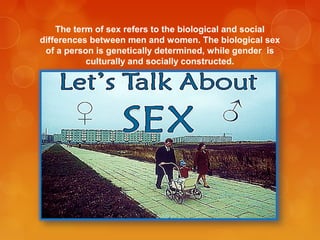
The term of sex refers to the biological and social
differences between men and women. The biological sex
of a person is genetically determined, while gender is
culturally and socially constructed.
From the beginning of the world:From the beginning of the world:
“Another creature was Adam & other Eve …”“Another creature was Adam & other Eve …”
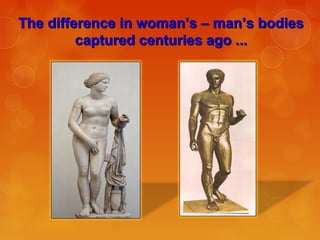
The difference in woman’s – man’s bodiesThe difference in woman’s – man’s bodies
captured centuries ago ...captured centuries ago ...
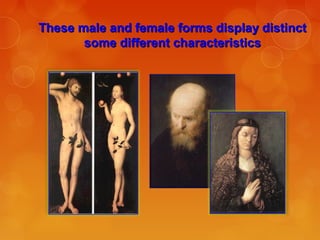
These male and female forms display distinctThese male and female forms display distinct
some different characteristicssome different characteristics
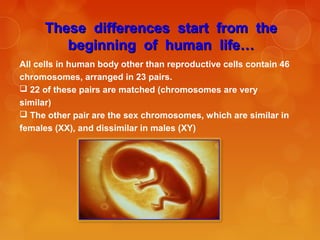
These differences start from theThese differences start from the
beginning of human life…beginning of human life…
All cells in human body other than reproductive cells contain 46
chromosomes, arranged in 23 pairs.
 22 of these pairs are matched (chromosomes are very
similar)
 The other pair are the sex chromosomes, which are similar in
females (XX), and dissimilar in males (XY)
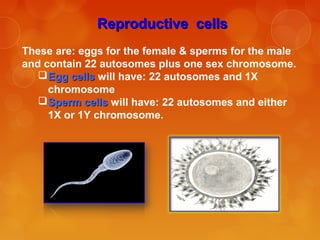
Reproductive cellsReproductive cells
These are: eggs for the female & sperms for the male
and contain 22 autosomes plus one sex chromosome.
Egg cellsEgg cells will have: 22 autosomes and 1X
chromosome
Sperm cellsSperm cells will have: 22 autosomes and either
1X or 1Y chromosome.
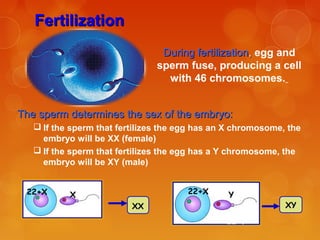
FertilizationFertilization
During fertilizationDuring fertilization,, egg and
sperm fuse, producing a cell
with 46 chromosomes.
The sperm determines the sex of the embryo:The sperm determines the sex of the embryo:
 If the sperm that fertilizes the egg has an X chromosome, the
embryo will be XX (female)
 If the sperm that fertilizes the egg has a Y chromosome, the
embryo will be XY (male)
22+X
22+X
XXXX
22+X
22+Y
XYXY
XX YY
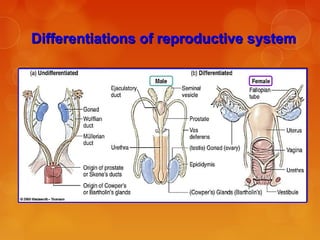
Differentiations of reproductive systemDifferentiations of reproductive system
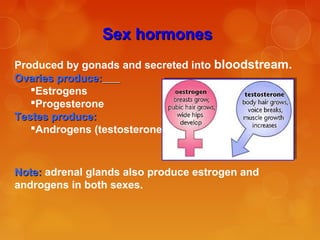
Sex hormonesSex hormones
Produced by gonads and secreted into bloodstream.
Ovaries produce:Ovaries produce:
Estrogens
Progesterone
Testes produce:Testes produce:
Androgens (testosterone)
Note:Note: adrenal glands also produce estrogen and
androgens in both sexes.
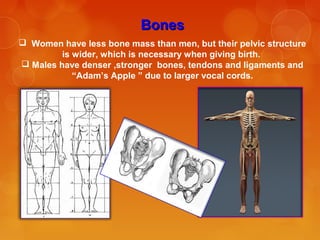
BonesBones
 Women have less bone mass than men, but their pelvic structure
is wider, which is necessary when giving birth.
 Males have denser ,stronger bones, tendons and ligaments and
“Adam’s Apple ” due to larger vocal cords.
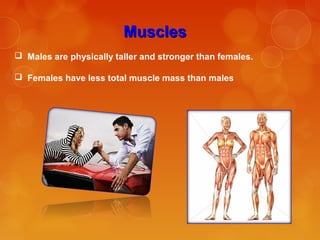
MusclesMuscles
 Males are physically taller and stronger than females.
 Females have less total muscle mass than males
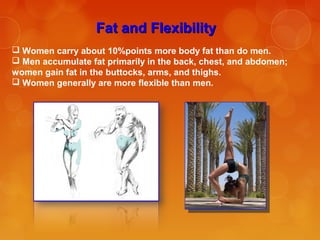
Fat and FlexibilityFat and Flexibility
 Women carry about 10%points more body fat than do men.
 Men accumulate fat primarily in the back, chest, and abdomen;
women gain fat in the buttocks, arms, and thighs.
 Women generally are more flexible than men.
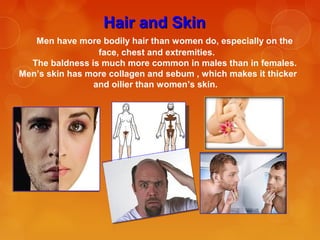
Hair and SkinHair and Skin
Men have more bodily hair than women do, especially on the
face, chest and extremities.
The baldness is much more common in males than in females.
Men’s skin has more collagen and sebum , which makes it thicker
and oilier than women’s skin.
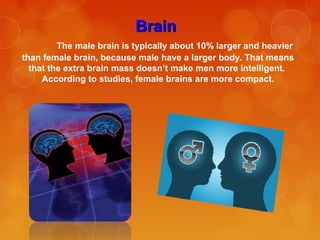
BrainBrain
The male brain is typically about 10% larger and heavier
than female brain, because male have a larger body. That means
that the extra brain mass doesn’t make men more intelligent.
According to studies, female brains are more compact.
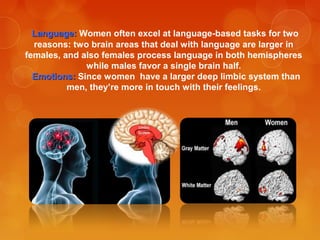
Language:Language: Women often excel at language-based tasks for two
reasons: two brain areas that deal with language are larger in
females, and also females process language in both hemispheres
while males favor a single brain half.
Emotions:Emotions: Since women have a larger deep limbic system than
men, they’re more in touch with their feelings.
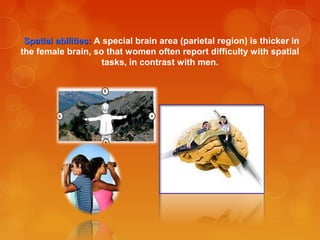
Spatial abilities:Spatial abilities: A special brain area (parietal region) is thicker in
the female brain, so that women often report difficulty with spatial
tasks, in contrast with men.
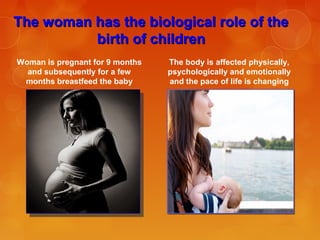
The woman has the biological role of theThe woman has the biological role of the
birth of childrenbirth of children
Woman is pregnant for 9 months
and subsequently for a few
months breastfeed the baby
The body is affected physically,
psychologically and emotionally
and the pace of life is changing
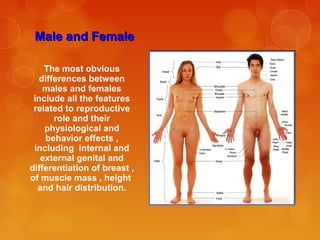
Male and FemaleMale and Female
The most obvious
differences between
males and females
include all the features
related to reproductive
role and their
physiological and
behavior effects ,
including internal and
external genital and
differentiation of breast ,
of muscle mass , height
and hair distribution.
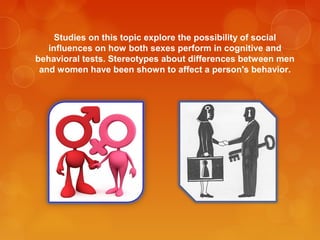
Studies on this topic explore the possibility of social
influences on how both sexes perform in cognitive and
behavioral tests. Stereotypes about differences between men
and women have been shown to affect a person's behavior.
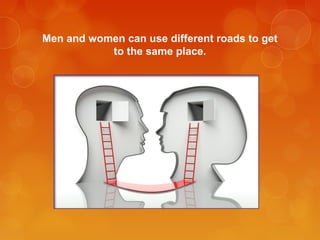
Men and women can use different roads to get
to the same place.
Supervisors:Supervisors:
Goula Athina
Nikou Evangelia
Students participated in this project:Students participated in this project:
Karakatsani Anthi
Thomaidou Maria
Vairamidou Evmorfia
Vardikidou Aggeliki
Kamtsi Konstantina
Kiriakidou Despina
Latsari Elsa
Lina Panagiota
Melikidou Alexandra
Baxevani Petroula
Daule Joanna
Panagiotidou Emanuella
Raskaki Antigoni
Rode Kisian
Tzahalaki Christina
Tsehou Vaso
Hatsaturova Anna
BIBLIOGRAPHYBIBLIOGRAPHY
Birke , Lydia. The Gender and Science Reader ed. Muriel Lederman and
Ingrid Bartsch . New York, Routledge , 2001. (306-322)
Miller, AE; MacDougall, JD; Tarnopolsky, MA; Sale, DG (1993). "Gender
differences in strength and muscle fiber characteristics". European journal
of applied physiology and occupational physiology 66 (3): (254–62).
Arnold, A. P. (2004). "Sex chromosomes and brain gender". Nature Rev.
Neurosci 5 (9): (701–708).
Haier , R.J.; Jung, R.E.; Yeo , R.A.; Head, K.; Alkire , M.T. (September
2004). "Structural brain variation and general intelligence" (PDF).
Neuroimage 23 (1): (425–33).
Frost, P. (2007). Sex linkage of human skin, hair, and eye color
Fausto -Sterling, Anne “Of Gender and Genitals” from Sexing the
body: gender politics and the construction of sexuality New York, NY:
Basic Books, 2000, [Chapter 3, pp. 44-77]
Reproductive Anatomy and Physiology, Technical Issues In
Reproductive Health, Columbia Mailman School of Public Health
Glucksman , A. (1981) Sexual Dimorphism in Human and Mammalian
Biology and Pathology (Academic Press, 1981), (pp. 66-75)
Gustafsson A & Lindenfors P (2004). "Human size evolution: no
allometric relationship between male and female stature". Journal of
Human Evolution 47 (4): (253–266)

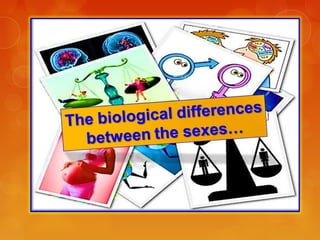
Biological differences between the sexes - Βιολογικές διαφορές των φύλων

  • 1.
    GreeceGreece andand 22ndnd Vocational High Schoolof GiannitsaVocational High School of Giannitsa presents:presents:
  • 3.
    The term ofsex refers to the biological and social differences between men and women. The biological sex of a person is genetically determined, while gender is culturally and socially constructed.
  • 4.
    From the beginningof the world:From the beginning of the world: “Another creature was Adam & other Eve …”“Another creature was Adam & other Eve …”
  • 5.
    The difference inwoman’s – man’s bodiesThe difference in woman’s – man’s bodies captured centuries ago ...captured centuries ago ...
  • 6.
    These male andfemale forms display distinctThese male and female forms display distinct some different characteristicssome different characteristics
  • 7.
    These differences startfrom theThese differences start from the beginning of human life…beginning of human life… All cells in human body other than reproductive cells contain 46 chromosomes, arranged in 23 pairs.  22 of these pairs are matched (chromosomes are very similar)  The other pair are the sex chromosomes, which are similar in females (XX), and dissimilar in males (XY)
  • 8.
    Reproductive cellsReproductive cells Theseare: eggs for the female & sperms for the male and contain 22 autosomes plus one sex chromosome. Egg cellsEgg cells will have: 22 autosomes and 1X chromosome Sperm cellsSperm cells will have: 22 autosomes and either 1X or 1Y chromosome.
  • 9.
    FertilizationFertilization During fertilizationDuring fertilization,,egg and sperm fuse, producing a cell with 46 chromosomes. The sperm determines the sex of the embryo:The sperm determines the sex of the embryo:  If the sperm that fertilizes the egg has an X chromosome, the embryo will be XX (female)  If the sperm that fertilizes the egg has a Y chromosome, the embryo will be XY (male) 22+X 22+X XXXX 22+X 22+Y XYXY XX YY
  • 10.
    Differentiations of reproductivesystemDifferentiations of reproductive system
  • 11.
    Sex hormonesSex hormones Producedby gonads and secreted into bloodstream. Ovaries produce:Ovaries produce: Estrogens Progesterone Testes produce:Testes produce: Androgens (testosterone) Note:Note: adrenal glands also produce estrogen and androgens in both sexes.
  • 12.
    BonesBones  Women haveless bone mass than men, but their pelvic structure is wider, which is necessary when giving birth.  Males have denser ,stronger bones, tendons and ligaments and “Adam’s Apple ” due to larger vocal cords.
  • 13.
    MusclesMuscles  Males arephysically taller and stronger than females.  Females have less total muscle mass than males
  • 14.
    Fat and FlexibilityFatand Flexibility  Women carry about 10%points more body fat than do men.  Men accumulate fat primarily in the back, chest, and abdomen; women gain fat in the buttocks, arms, and thighs.  Women generally are more flexible than men.
  • 15.
    Hair and SkinHairand Skin Men have more bodily hair than women do, especially on the face, chest and extremities. The baldness is much more common in males than in females. Men’s skin has more collagen and sebum , which makes it thicker and oilier than women’s skin.
  • 16.
    BrainBrain The male brainis typically about 10% larger and heavier than female brain, because male have a larger body. That means that the extra brain mass doesn’t make men more intelligent. According to studies, female brains are more compact.
  • 17.
    Language:Language: Women oftenexcel at language-based tasks for two reasons: two brain areas that deal with language are larger in females, and also females process language in both hemispheres while males favor a single brain half. Emotions:Emotions: Since women have a larger deep limbic system than men, they’re more in touch with their feelings.
  • 18.
    Spatial abilities:Spatial abilities:A special brain area (parietal region) is thicker in the female brain, so that women often report difficulty with spatial tasks, in contrast with men.
  • 19.
    The woman hasthe biological role of theThe woman has the biological role of the birth of childrenbirth of children Woman is pregnant for 9 months and subsequently for a few months breastfeed the baby The body is affected physically, psychologically and emotionally and the pace of life is changing
  • 20.
    Male and FemaleMaleand Female The most obvious differences between males and females include all the features related to reproductive role and their physiological and behavior effects , including internal and external genital and differentiation of breast , of muscle mass , height and hair distribution.
  • 21.
    Studies on thistopic explore the possibility of social influences on how both sexes perform in cognitive and behavioral tests. Stereotypes about differences between men and women have been shown to affect a person's behavior.
  • 22.
    Men and womencan use different roads to get to the same place.
  • 24.
    Supervisors:Supervisors: Goula Athina Nikou Evangelia Studentsparticipated in this project:Students participated in this project: Karakatsani Anthi Thomaidou Maria
  • 25.
    Vairamidou Evmorfia Vardikidou Aggeliki KamtsiKonstantina Kiriakidou Despina Latsari Elsa Lina Panagiota Melikidou Alexandra Baxevani Petroula Daule Joanna Panagiotidou Emanuella Raskaki Antigoni Rode Kisian Tzahalaki Christina Tsehou Vaso Hatsaturova Anna
  • 26.
    BIBLIOGRAPHYBIBLIOGRAPHY Birke , Lydia.The Gender and Science Reader ed. Muriel Lederman and Ingrid Bartsch . New York, Routledge , 2001. (306-322) Miller, AE; MacDougall, JD; Tarnopolsky, MA; Sale, DG (1993). "Gender differences in strength and muscle fiber characteristics". European journal of applied physiology and occupational physiology 66 (3): (254–62). Arnold, A. P. (2004). "Sex chromosomes and brain gender". Nature Rev. Neurosci 5 (9): (701–708). Haier , R.J.; Jung, R.E.; Yeo , R.A.; Head, K.; Alkire , M.T. (September 2004). "Structural brain variation and general intelligence" (PDF). Neuroimage 23 (1): (425–33). Frost, P. (2007). Sex linkage of human skin, hair, and eye color
  • 27.
    Fausto -Sterling, Anne“Of Gender and Genitals” from Sexing the body: gender politics and the construction of sexuality New York, NY: Basic Books, 2000, [Chapter 3, pp. 44-77] Reproductive Anatomy and Physiology, Technical Issues In Reproductive Health, Columbia Mailman School of Public Health Glucksman , A. (1981) Sexual Dimorphism in Human and Mammalian Biology and Pathology (Academic Press, 1981), (pp. 66-75) Gustafsson A & Lindenfors P (2004). "Human size evolution: no allometric relationship between male and female stature". Journal of Human Evolution 47 (4): (253–266)