


群眾外包應用於藥物服用知識系統之研究
A Study of Medication Knowledge System with Crowdsourcing
國立成功大學工程科學系
指導教授:侯廷偉 教授
研究生:林彥成
2013.7
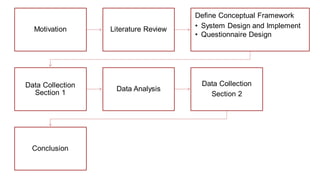
Motivation Literature Review
Define Conceptual Framework
• System Design and Implement
• Questionnaire Design
Data Collection
Section 1
Data Analysis
Data Collection
Section 2
Conclusion
Design a system and survey
the user’s intention to this
system.
Why?
Medication Knowledge
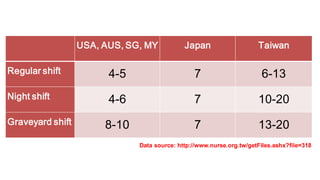
USA, AUS, SG, MY Japan Taiwan
Regular shift 4-5 7 6-13
Night shift 4-6 7 10-20
Graveyard shift 8-10 7 13-20
Data source: http://www.nurse.org.tw/getFiles.ashx?file=318
40 hours/ a week
Danielle M. Olds and Sean P. Clarke (2010)
indicated that errors in health care were
significantly related to working more than 40
hours in the average week [1].
Prescribing Errors
42%
Typing Errors
24%
Dispensing Errors
1%
Do not Conform to
the Rules of National
Health Insurance
33%
PERCENTAGE OF MEDICATION ERRORS [2]
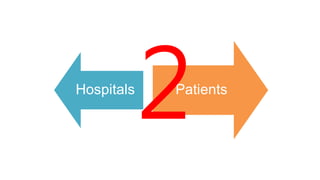
Hospitals Patients
Error Rate Reduce 81%
Bates (1999) indicated that the computerized POE can
reduce 81% of non-missed-dose medication error rate
[3].
Using the barcode technology can also reduce the
error rate in the health care facilities [4].
1/2
Medication Education
Gryfe-Becker, Segal and Einarson (1989) have
indicated that the auxiliary labels is a useful [5].
A general medication education should be provided to
patients in order to improve the overall medication
knowledge and medication-related behavior [6].
2/2
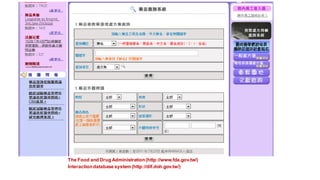
The Food and Drug Administration(http://www.fda.gov.tw/)
Interactiondatabase system (http://dif.doh.gov.tw/)
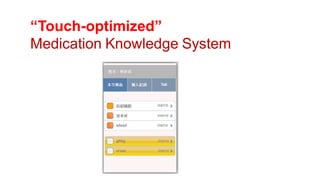
“Touch-optimized”
Medication Knowledge System
Innovation
Why?
Crowdsourcing!
Why?
Crowdsourcing?
June, 2006 [7]
Jeff Howe
The crucial prerequisite is the: use of an open
call format, and the wide network of potential
laborers.
2. Pull task1. Submit task
3. Complete task4. Proof
5. Remuneration
Crowdsourcing Platform
Crowdsourcing Model [8]
Q1
Q2
Q3
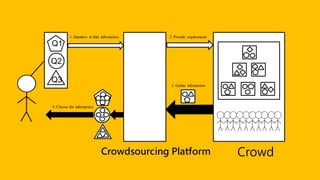
Crowdsourcing Platform Crowd
1. Intention to find information
3. Gather information
2. Provide requirements
4. Choose the information
1/2
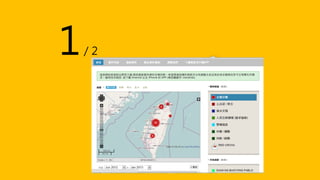
About Taiwan
2/2
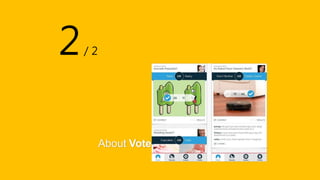
About Vote
About This Study
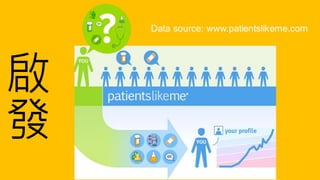
Data source: www.patientslikeme.com
啟
發
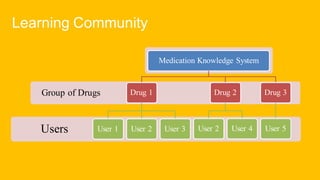
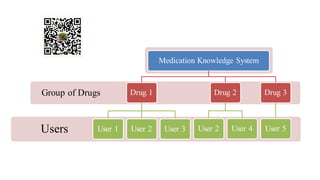
Users
Group of Drugs
Medication Knowledge System
Drug 1
User 1 User 2 User 3
Drug 2
User 2 User 4
Drug 3
User 5
Learning Community
Peer Discussion
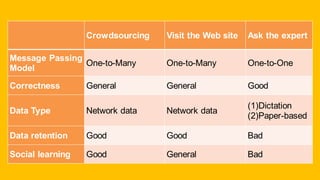
Crowdsourcing Visit the Web site Ask the expert
Message Passing
Model
One-to-Many One-to-Many One-to-One
Correctness General General Good
Data Type Network data Network data
(1)Dictation
(2)Paper-based
Data retention Good Good Bad
Social learning Good General Bad
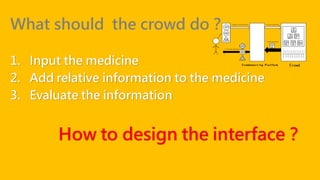
What should the crowd do?
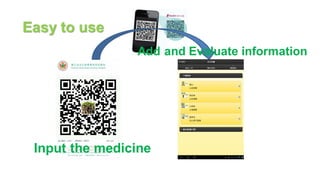
1. Input the medicine
2. Add relative information to the medicine
3. Evaluate the information
How to design the interface?
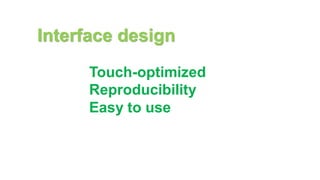
Interface design
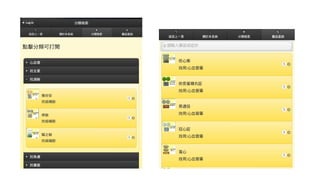
Touch-optimized
Reproducibility
Easy to use
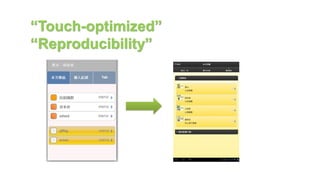
jQuery mobile is a touch-optimized web
framework developed by jQuery project team.
Reproducibility
“Touch-optimized”
“Reproducibility”
Input the medicine
Add and Evaluate information
Easy to use
Users
Group of Drugs
Medication Knowledge System
Drug 1
User 1 User 2 User 3
Drug 2
User 2 User 4
Drug 3
User 5
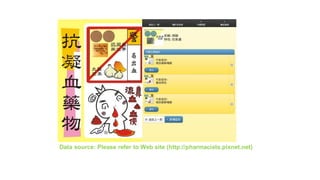
Data source: Please refer to Web site (http://pharmacists.pixnet.net)
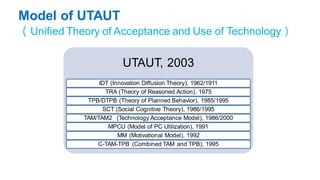
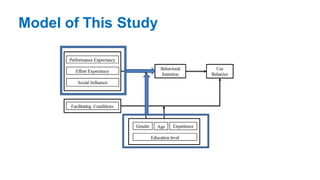
Model of UTAUT
(Unified Theory of Acceptance and Use of Technology)
UTAUT, 2003
IDT (Innovation Diffusion Theory), 1962/1911
TRA (Theory of Reasoned Action), 1975
TPB/DTPB (Theory of Planned Behavior), 1985/1995
SCT (Social Cognitive Theory), 1986/1995
TAM/TAM2 (Technology Acceptance Model), 1986/2000
MPCU (Model of PC Utilization), 1991
MM (Motivational Model), 1992
C-TAM-TPB (Combined TAM and TPB), 1995
Model of UTAUT cont.
Data source: Reference [9]
70%
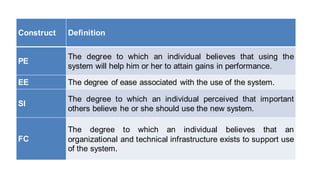
Construct Definition
PE
The degree to which an individual believes that using the
system will help him or her to attain gains in performance.
EE The degree of ease associated with the use of the system.
SI
The degree to which an individual perceived that important
others believe he or she should use the new system.
FC
The degree to which an individual believes that an
organizational and technical infrastructure exists to support use
of the system.
Model of This Study
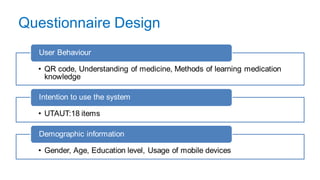
Questionnaire Design
• QR code, Understanding of medicine, Methods of learning medication
knowledge
User Behaviour
• UTAUT:18 items
Intention to use the system
• Gender, Age, Education level, Usage of mobile devices
Demographic information
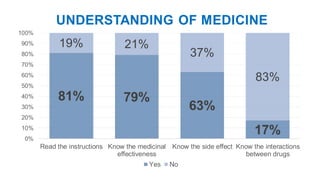
User Behaviour
81% 79%
63%
17%
19% 21%
37%
83%
0%
10%
20%
30%
40%
50%
60%
70%
80%
90%
100%
Read the instructions Know the medicinal
effectiveness
Know the side effect Know the interactions
between drugs
UNDERSTANDING OF MEDICINE
Yes No
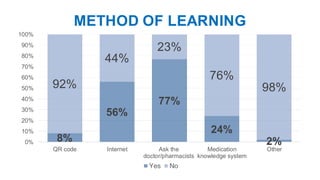
8%
56%
77%
24%
2%
92%
44%
23%
76%
98%
0%
10%
20%
30%
40%
50%
60%
70%
80%
90%
100%
QR code Internet Ask the
doctor/pharmacists
Medication
knowledge system
Other
METHOD OF LEARNING
Yes No
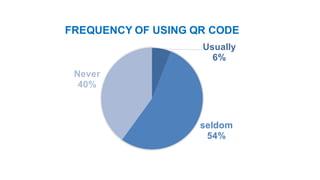
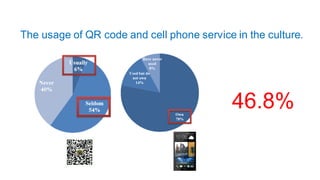
Usually
6%
seldom
54%
Never
40%
FREQUENCY OF USING QR CODE
UTAUT
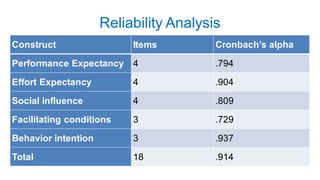
Reliability Analysis
Construct Items Cronbach’s alpha
Performance Expectancy 4 .794
Effort Expectancy 4 .904
Social influence 4 .809
Facilitating conditions 3 .729
Behavior intention 3 .937
Total 18 .914
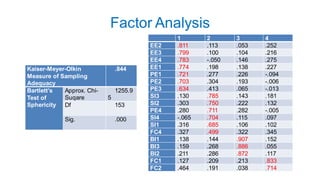
Factor Analysis
Kaiser-Meyer-Olkin
Measure of Sampling
Adequacy
.844
Bartlett’s
Test of
Sphericity
Approx. Chi-
Suqare
1255.9
5
Df 153
Sig. .000
1 2 3 4
EE2 .811 .113 .053 .252
EE3 .799 .100 .104 .216
EE4 .783 -.050 .146 .275
EE1 .774 .198 .138 .227
PE1 .721 .277 .226 -.094
PE2 .703 .304 .193 -.006
PE3 .634 .413 .065 -.013
SI3 .130 .785 .143 .181
SI2 .303 .750 .222 .132
PE4 .280 .711 .282 -.005
SI4 -.065 .704 .115 .097
SI1 .316 .685 .106 .102
FC4 .327 .499 .322 .345
BI1 .138 .144 .907 .152
BI3 .159 .268 .886 .055
BI2 .211 .286 .872 .117
FC1 .127 .209 .213 .833
FC2 .464 .191 .038 .714
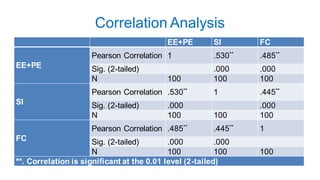
Correlation Analysis
EE+PE SI FC
EE+PE
Pearson Correlation 1 .530** .485**
Sig. (2-tailed) .000 .000
N 100 100 100
SI
Pearson Correlation .530** 1 .445**
Sig. (2-tailed) .000 .000
N 100 100 100
FC
Pearson Correlation .485** .445** 1
Sig. (2-tailed) .000 .000
N 100 100 100
**. Correlation is significant at the 0.01 level (2-tailed)
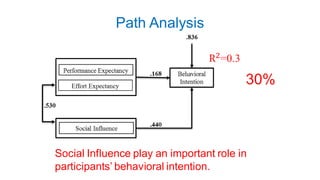
Path Analysis
30%
Social Influence play an important role in
participants’ behavioral intention.
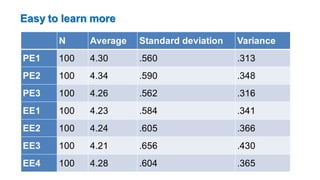
N Average Standard deviation Variance
PE1 100 4.30 .560 .313
PE2 100 4.34 .590 .348
PE3 100 4.26 .562 .316
EE1 100 4.23 .584 .341
EE2 100 4.24 .605 .366
EE3 100 4.21 .656 .430
EE4 100 4.28 .604 .365
Easy to learn more
The usage of QR code and cell phone service in the culture.
46.8%
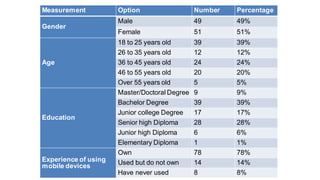
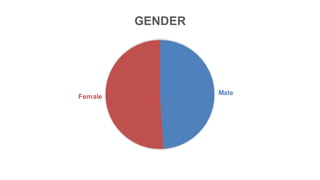
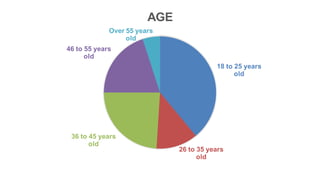
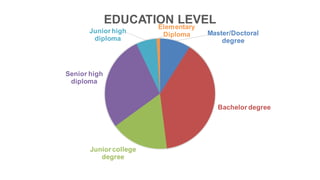
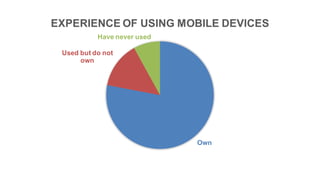
Demographic Information
Measurement Option Number Percentage
Gender
Male 49 49%
Female 51 51%
Age
18 to 25 years old 39 39%
26 to 35 years old 12 12%
36 to 45 years old 24 24%
46 to 55 years old 20 20%
Over 55 years old 5 5%
Education
Master/Doctoral Degree 9 9%
Bachelor Degree 39 39%
Junior college Degree 17 17%
Senior high Diploma 28 28%
Junior high Diploma 6 6%
Elementary Diploma 1 1%
Experience of using
mobile devices
Own 78 78%
Used but do not own 14 14%
Have never used 8 8%
Male
Female
GENDER
18 to 25 years
old
26 to 35 years
old
36 to 45 years
old
46 to 55 years
old
Over 55 years
old
AGE
Master/Doctoral
degree
Bachelor degree
Junior college
degree
Senior high
diploma
Junior high
diploma
Elementary
Diploma
EDUCATION LEVEL
Own
Used but do not
own
Have never used
EXPERIENCE OF USING MOBILE DEVICES
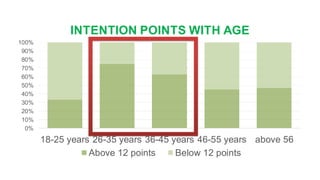
0%
10%
20%
30%
40%
50%
60%
70%
80%
90%
100%
18-25 years 26-35 years 36-45 years 46-55 years above 56
INTENTION POINTS WITH AGE
Above 12 points Below 12 points
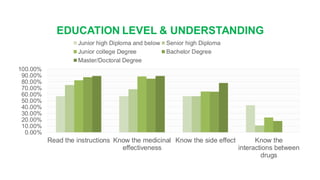
0.00%
10.00%
20.00%
30.00%
40.00%
50.00%
60.00%
70.00%
80.00%
90.00%
100.00%
Read the instructions Know the medicinal
effectiveness
Know the side effect Know the
interactions between
drugs
EDUCATION LEVEL & UNDERSTANDING
Junior high Diploma and below Senior high Diploma
Junior college Degree Bachelor Degree
Master/Doctoral Degree
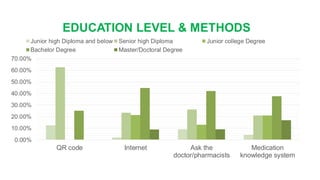
0.00%
10.00%
20.00%
30.00%
40.00%
50.00%
60.00%
70.00%
QR code Internet Ask the
doctor/pharmacists
Medication
knowledge system
EDUCATION LEVEL & METHODS
Junior high Diploma and below Senior high Diploma Junior college Degree
Bachelor Degree Master/Doctoral Degree
Restrictions & Assumptions
我有老花眼睛不太好。
我們這一輩都沒有用智慧型手機。
我連電腦都不會用。
我沒用過這個掃描。
給辦公室小姐用就好了。
民眾回饋(限制):
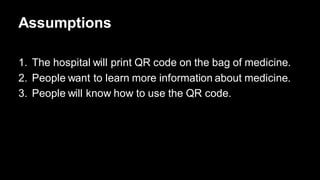
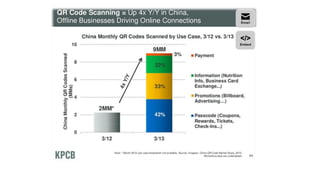
Assumptions
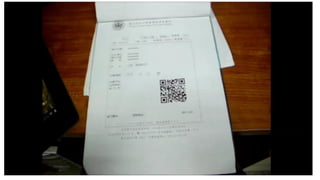
1. The hospital will print QR code on the bag of medicine.
2. People want to learn more information about medicine.
3. People will know how to use the QR code.
Conclusion and Contribution
1. The empirical data reveal that social influence play an
important role in participants’ behavioral intention.
2. A major finding is that most of people in the hospital are
not familiar with the QR code.
3. Implications for decision makers and suggestions for
further research are also considered in this study.
Design
✓Touch-optimized
✓Reproducibility
✓Easy to use
Future work
1. Making the function more completely.
2. Recommend NHI QR code’s information
should consists of regular data and a URL.
Reference
[1] E. Estellés-Arolas, and F. González-Ladrón-de-Guevara, “Towards an integrated
crowdsourcing definition,” Journal of Information Science, vol. 38, no. 2, pp. 189-
200, April 1, 2012.
[2] Mei-Hua Chuang, Chin-Lon Lin, Yuh-Feng Wang et al., “Medication Errors in
Health Care Institutions,” Tzu Chi Med, vol. 15, no 4, pp. 247-258, 2003. (Written in
Chinese)
[3] Bates DW, MD, MSc et al., “The Impact of Computerized Physician Order
Entry on Medication Error Prevention” Journal of American Medical Informatics
Association, vol. 6, no 4, pp. 313-321, 1999.
[4] E. G. Poon, C. A. Keohane, C. S. Yoon et al., “Effect of Bar-Code Technology on
the Safety of MedicationAdministration,” New England Journal of Medicine, vol.
362, no. 18, pp. 1698-1707, 2010.
Reference cont.
[5] Gryfe-Becker BM, Segal HJ, Einarson TR, “Effect of auxiliary prescription labels
on the elderly ambulatory patient's drug knowledge,” The Annals of
Pharmacotherapy vol. 23 no. 4, pp. 324-329, 1989.
[6] Lian-Hua Huang, “Effectiveness of Medication Education Strategies for the
Elderly in the Community,” The Journal of Nursing Research, vol. 4, no 2, pp. 104-
114, 1996. (Written in Chinese)
[7] J. Howe, “The Rise of Crowdsourcing”, Wired Magazine, no.14.06, 2006
[8] M. Hirth, T. Hoßfeld, and P. Tran-Gia, “Analyzing costs and accuracy of
validation mechanisms for crowdsourcing platforms,” Mathematical and Computer
Modelling, vol. 57, no. 11–12, pp. 2918-2932, 2013.
[9] V. Venkatesh, M. G. Morris, B. D. Gordon et al., “User Acceptance of Information
Technology: Toward a Unified View,” MIS Quarterly, vol. 27, no. 3, pp. 425-478,
2003.
群眾外包應用於藥物服用知識系統之研究

群眾外包應用於藥物服用知識系統之研究