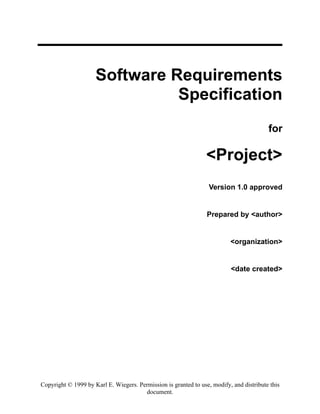
Software Requirements
                               Specification
                                                                                         for

                                                                 <Project>
                                                                  Version 1.0 approved


                                                                 Prepared by <author>


                                                                          <organization>


                                                                          <date created>


Copyright © 1999 by Karl E. Wiegers. Permission is granted to use, modify, and distribute this
                                       document.
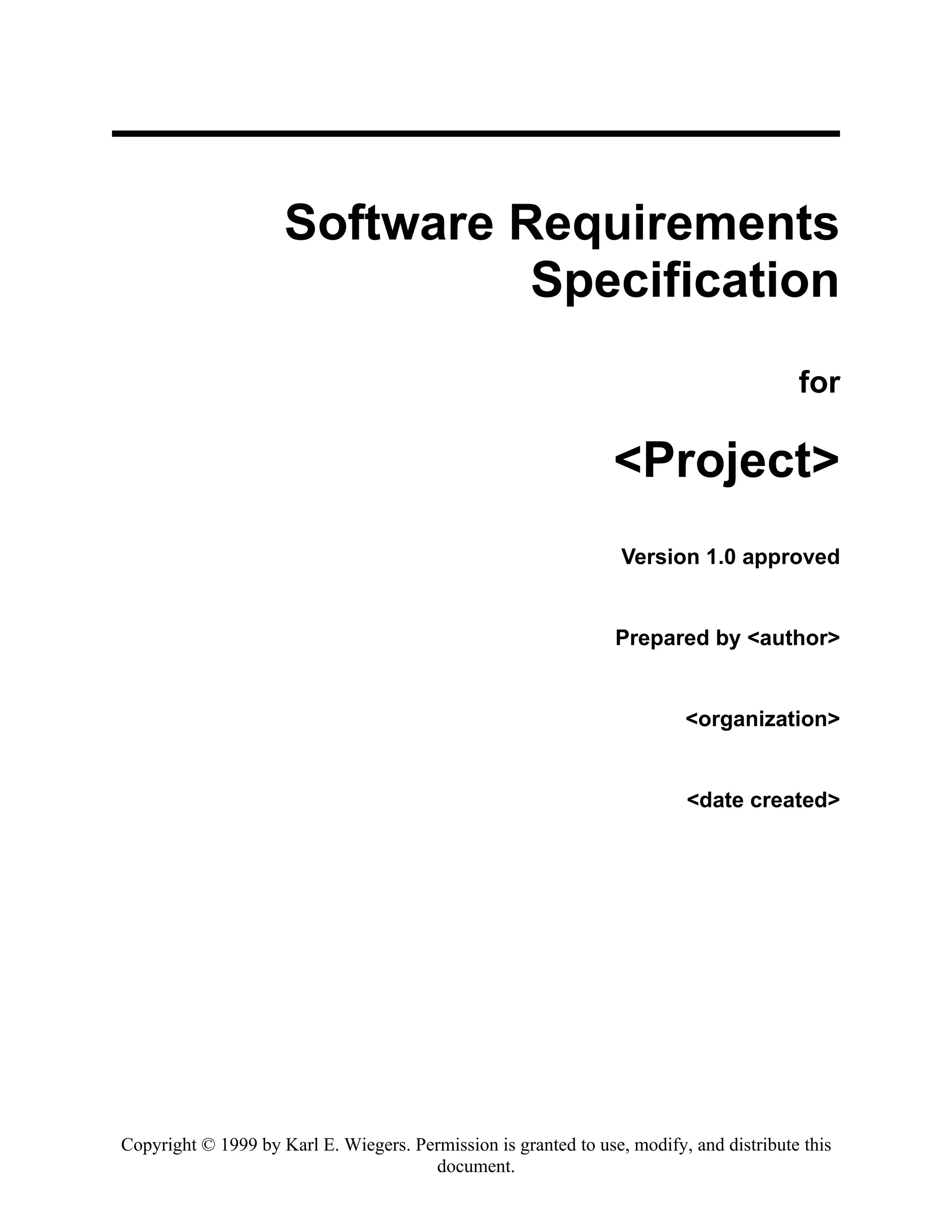
Software Requirements Specification for <Project>                                                   Page ii


Table of Contents
1. Introduction................................................................................................................................3
    1.1 Purpose ...............................................................................................................................................   3
    1.2 Document Conventions.......................................................................................................................               3
    1.3 Intended Audience and Reading Suggestions.....................................................................................                            3
    1.4 Product Scope......................................................................................................................................       3
    1.5 References...........................................................................................................................................     3
2. Overall Description....................................................................................................................4
    2.1 Product Perspective.............................................................................................................................          4
    2.2 Product Functions................................................................................................................................         4
    2.3 User Classes and Characteristics.........................................................................................................                 4
    2.4 Operating Environment.......................................................................................................................              4
    2.5 Design and Implementation Constraints.............................................................................................                        4
    2.6 User Documentation............................................................................................................................            5
    2.7 Assumptions and Dependencies..........................................................................................................                    5
3. External Interface Requirements............................................................................................. 5
    3.1 User Interfaces....................................................................................................................................       5
    3.2 Hardware Interfaces............................................................................................................................           5
    3.3 Software Interfaces..............................................................................................................................         6
    3.4 Communications Interfaces.................................................................................................................                6
4. System Features......................................................................................................................... 6
    4.1 System Feature 1................................................................................................................................. 6
    4.2 System Feature 2 (and so on).............................................................................................................. 7
5. Other Nonfunctional Requirements.........................................................................................7
    5.1 Performance Requirements.................................................................................................................                 7
    5.2 Safety Requirements...........................................................................................................................            7
    5.3 Security Requirements........................................................................................................................             7
    5.4 Software Quality Attributes................................................................................................................               8
    5.5 Business Rules....................................................................................................................................        8
6. Other Requirements.................................................................................................................. 8


Revision History
Name                                Date                 Reason For Changes                                                                    Version
1.Introduction
1.1Purpose
<Identify the product whose software requirements are specified in this document, including
the revision or release number. Describe the scope of the product that is covered by this
SRS, particularly if this SRS describes only part of the system or a single subsystem.>

1.2Document Conventions
<Describe any standards or typographical conventions that were followed when writing this
SRS, such as fonts or highlighting that have special significance. For example, state whether
priorities for higher-level requirements are assumed to be inherited by detailed
requirements, or whether every requirement statement is to have its own priority.>

1.3Intended Audience and Reading Suggestions
<Describe the different types of reader that the document is intended for, such as
developers, project managers, marketing staff, users, testers, and documentation writers.
Describe what the rest of this SRS contains and how it is organized. Suggest a sequence for
reading the document, beginning with the overview sections and proceeding through the
sections that are most pertinent to each reader type.>

1.4Product Scope
<Provide a short description of the software being specified and its purpose, including
relevant benefits, objectives, and goals. Relate the software to corporate goals or business
strategies. If a separate vision and scope document is available, refer to it rather than
duplicating its contents here.>

1.5References
<List any other documents or Web addresses to which this SRS refers. These may include
user interface style guides, contracts, standards, system requirements specifications, use
case documents, or a vision and scope document. Provide enough information so that the
reader could access a copy of each reference, including title, author, version number, date,
and source or location.>


                           Ambit lick Solutions
             Mail Id : Ambitlick@gmail.com , Ambitlicksolutions@gmail.Com
2.Overall Description
2.1Product Perspective
<Describe the context and origin of the product being specified in this SRS. For example,
state whether this product is a follow-on member of a product family, a replacement for
certain existing systems, or a new, self-contained product. If the SRS defines a component of
a larger system, relate the requirements of the larger system to the functionality of this
software and identify interfaces between the two. A simple diagram that shows the major
components of the overall system, subsystem interconnections, and external interfaces can
be helpful.>

2.2Product Functions
<Summarize the major functions the product must perform or must let the user perform.
Details will be provided in Section 3, so only a high level summary (such as a bullet list) is
needed here. Organize the functions to make them understandable to any reader of the
SRS. A picture of the major groups of related requirements and how they relate, such as a
top level data flow diagram or object class diagram, is often effective.>

2.3User Classes and Characteristics
<Identify the various user classes that you anticipate will use this product. User classes may
be differentiated based on frequency of use, subset of product functions used, technical
expertise, security or privilege levels, educational level, or experience. Describe the pertinent
characteristics of each user class. Certain requirements may pertain only to certain user
classes. Distinguish the most important user classes for this product from those who are less
important to satisfy.>

2.4Operating Environment
<Describe the environment in which the software will operate, including the hardware
platform, operating system and versions, and any other software components or applications
with which it must peacefully coexist.>

2.5Design and Implementation Constraints
<Describe any items or issues that will limit the options available to the developers. These
might include: corporate or regulatory policies; hardware limitations (timing requirements,
memory requirements); interfaces to other applications; specific technologies, tools, and
databases to be used; parallel operations; language requirements; communications
protocols; security considerations; design conventions or programming standards (for

                           Ambit lick Solutions
              Mail Id : Ambitlick@gmail.com , Ambitlicksolutions@gmail.Com
example, if the customer’s organization will be responsible for maintaining the delivered
software).>

2.6User Documentation
<List the user documentation components (such as user manuals, on-line help, and tutorials)
that will be delivered along with the software. Identify any known user documentation delivery
formats or standards.>

2.7Assumptions and Dependencies
<List any assumed factors (as opposed to known facts) that could affect the requirements
stated in the SRS. These could include third-party or commercial components that you plan
to use, issues around the development or operating environment, or constraints. The project
could be affected if these assumptions are incorrect, are not shared, or change. Also identify
any dependencies the project has on external factors, such as software components that you
intend to reuse from another project, unless they are already documented elsewhere (for
example, in the vision and scope document or the project plan).>


3.External Interface Requirements
3.1User Interfaces
<Describe the logical characteristics of each interface between the software product and the
users. This may include sample screen images, any GUI standards or product family style
guides that are to be followed, screen layout constraints, standard buttons and functions
(e.g., help) that will appear on every screen, keyboard shortcuts, error message display
standards, and so on. Define the software components for which a user interface is needed.
Details of the user interface design should be documented in a separate user interface
specification.>

3.2Hardware Interfaces
<Describe the logical and physical characteristics of each interface between the software
product and the hardware components of the system. This may include the supported device
types, the nature of the data and control interactions between the software and the hardware,
and communication protocols to be used.>


                           Ambit lick Solutions
             Mail Id : Ambitlick@gmail.com , Ambitlicksolutions@gmail.Com
3.3Software Interfaces
<Describe the connections between this product and other specific software components
(name and version), including databases, operating systems, tools, libraries, and integrated
commercial components. Identify the data items or messages coming into the system and
going out and describe the purpose of each. Describe the services needed and the nature of
communications. Refer to documents that describe detailed application programming
interface protocols. Identify data that will be shared across software components. If the data
sharing mechanism must be implemented in a specific way (for example, use of a global data
area in a multitasking operating system), specify this as an implementation constraint.>

3.4Communications Interfaces
<Describe the requirements associated with any communications functions required by this
product, including e-mail, web browser, network server communications protocols, electronic
forms, and so on. Define any pertinent message formatting. Identify any communication
standards that will be used, such as FTP or HTTP. Specify any communication security or
encryption issues, data transfer rates, and synchronization mechanisms.>


4.System Features
<This template illustrates organizing the functional requirements for the product by system
features, the major services provided by the product. You may prefer to organize this section
by use case, mode of operation, user class, object class, functional hierarchy, or
combinations of these, whatever makes the most logical sense for your product.>

4.1System Feature 1
<Don’t really say “System Feature 1.” State the feature name in just a few words.>
      4.1.1   Description and Priority
              <Provide a short description of the feature and indicate whether it is of High,
              Medium, or Low priority. You could also include specific priority component
              ratings, such as benefit, penalty, cost, and risk (each rated on a relative scale
              from a low of 1 to a high of 9).>
      4.1.2   Stimulus/Response Sequences
              <List the sequences of user actions and system responses that stimulate the
              behavior defined for this feature. These will correspond to the dialog elements
              associated with use cases.>
      4.1.3   Functional Requirements


                           Ambit lick Solutions
              Mail Id : Ambitlick@gmail.com , Ambitlicksolutions@gmail.Com
<Itemize the detailed functional requirements associated with this feature.
              These are the software capabilities that must be present in order for the user to
              carry out the services provided by the feature, or to execute the use case.
              Include how the product should respond to anticipated error conditions or
              invalid inputs. Requirements should be concise, complete, unambiguous,
              verifiable, and necessary. Use “TBD” as a placeholder to indicate when
              necessary information is not yet available.>

              <Each requirement should be uniquely identified with a sequence number or a
              meaningful tag of some kind.>

              REQ-1:
              REQ-2:

4.2System Feature 2 (and so on)


5.Other Nonfunctional Requirements
5.1Performance Requirements
<If there are performance requirements for the product under various circumstances, state
them here and explain their rationale, to help the developers understand the intent and make
suitable design choices. Specify the timing relationships for real time systems. Make such
requirements as specific as possible. You may need to state performance requirements for
individual functional requirements or features.>

5.2Safety Requirements
<Specify those requirements that are concerned with possible loss, damage, or harm that
could result from the use of the product. Define any safeguards or actions that must be
taken, as well as actions that must be prevented. Refer to any external policies or regulations
that state safety issues that affect the product’s design or use. Define any safety
certifications that must be satisfied.>

5.3Security Requirements
<Specify any requirements regarding security or privacy issues surrounding use of the
product or protection of the data used or created by the product. Define any user identity
authentication requirements. Refer to any external policies or regulations containing security
issues that affect the product. Define any security or privacy certifications that must be
satisfied.>


                           Ambit lick Solutions
             Mail Id : Ambitlick@gmail.com , Ambitlicksolutions@gmail.Com
5.4Software Quality Attributes
<Specify any additional quality characteristics for the product that will be important to either
the customers or the developers. Some to consider are: adaptability, availability, correctness,
flexibility, interoperability, maintainability, portability, reliability, reusability, robustness,
testability, and usability. Write these to be specific, quantitative, and verifiable when possible.
At the least, clarify the relative preferences for various attributes, such as ease of use over
ease of learning.>

5.5Business Rules
<List any operating principles about the product, such as which individuals or roles can
perform which functions under specific circumstances. These are not functional requirements
in themselves, but they may imply certain functional requirements to enforce the rules.>


6.Other Requirements
<Define any other requirements not covered elsewhere in the SRS. This might include
database requirements, internationalization requirements, legal requirements, reuse
objectives for the project, and so on. Add any new sections that are pertinent to the project.>

Appendix A: Glossary
<Define all the terms necessary to properly interpret the SRS, including acronyms and
abbreviations. You may wish to build a separate glossary that spans multiple projects or the
entire organization, and just include terms specific to a single project in each SRS.>

Appendix B: Analysis Models
<Optionally, include any pertinent analysis models, such as data flow diagrams, class
diagrams, state-transition diagrams, or entity-relationship diagrams.>

Appendix C: To Be Determined List
<Collect a numbered list of the TBD (to be determined) references that remain in the SRS so
they can be tracked to closure.>


                            Ambit lick Solutions
              Mail Id : Ambitlick@gmail.com , Ambitlicksolutions@gmail.Com

Srs template

  • 1.
    Software Requirements Specification for <Project> Version 1.0 approved Prepared by <author> <organization> <date created> Copyright © 1999 by Karl E. Wiegers. Permission is granted to use, modify, and distribute this document.
  • 2.
    Software Requirements Specificationfor <Project> Page ii Table of Contents 1. Introduction................................................................................................................................3 1.1 Purpose ............................................................................................................................................... 3 1.2 Document Conventions....................................................................................................................... 3 1.3 Intended Audience and Reading Suggestions..................................................................................... 3 1.4 Product Scope...................................................................................................................................... 3 1.5 References........................................................................................................................................... 3 2. Overall Description....................................................................................................................4 2.1 Product Perspective............................................................................................................................. 4 2.2 Product Functions................................................................................................................................ 4 2.3 User Classes and Characteristics......................................................................................................... 4 2.4 Operating Environment....................................................................................................................... 4 2.5 Design and Implementation Constraints............................................................................................. 4 2.6 User Documentation............................................................................................................................ 5 2.7 Assumptions and Dependencies.......................................................................................................... 5 3. External Interface Requirements............................................................................................. 5 3.1 User Interfaces.................................................................................................................................... 5 3.2 Hardware Interfaces............................................................................................................................ 5 3.3 Software Interfaces.............................................................................................................................. 6 3.4 Communications Interfaces................................................................................................................. 6 4. System Features......................................................................................................................... 6 4.1 System Feature 1................................................................................................................................. 6 4.2 System Feature 2 (and so on).............................................................................................................. 7 5. Other Nonfunctional Requirements.........................................................................................7 5.1 Performance Requirements................................................................................................................. 7 5.2 Safety Requirements........................................................................................................................... 7 5.3 Security Requirements........................................................................................................................ 7 5.4 Software Quality Attributes................................................................................................................ 8 5.5 Business Rules.................................................................................................................................... 8 6. Other Requirements.................................................................................................................. 8 Revision History Name Date Reason For Changes Version
  • 3.
    1.Introduction 1.1Purpose <Identify the productwhose software requirements are specified in this document, including the revision or release number. Describe the scope of the product that is covered by this SRS, particularly if this SRS describes only part of the system or a single subsystem.> 1.2Document Conventions <Describe any standards or typographical conventions that were followed when writing this SRS, such as fonts or highlighting that have special significance. For example, state whether priorities for higher-level requirements are assumed to be inherited by detailed requirements, or whether every requirement statement is to have its own priority.> 1.3Intended Audience and Reading Suggestions <Describe the different types of reader that the document is intended for, such as developers, project managers, marketing staff, users, testers, and documentation writers. Describe what the rest of this SRS contains and how it is organized. Suggest a sequence for reading the document, beginning with the overview sections and proceeding through the sections that are most pertinent to each reader type.> 1.4Product Scope <Provide a short description of the software being specified and its purpose, including relevant benefits, objectives, and goals. Relate the software to corporate goals or business strategies. If a separate vision and scope document is available, refer to it rather than duplicating its contents here.> 1.5References <List any other documents or Web addresses to which this SRS refers. These may include user interface style guides, contracts, standards, system requirements specifications, use case documents, or a vision and scope document. Provide enough information so that the reader could access a copy of each reference, including title, author, version number, date, and source or location.> Ambit lick Solutions Mail Id : Ambitlick@gmail.com , Ambitlicksolutions@gmail.Com
  • 4.
    2.Overall Description 2.1Product Perspective <Describethe context and origin of the product being specified in this SRS. For example, state whether this product is a follow-on member of a product family, a replacement for certain existing systems, or a new, self-contained product. If the SRS defines a component of a larger system, relate the requirements of the larger system to the functionality of this software and identify interfaces between the two. A simple diagram that shows the major components of the overall system, subsystem interconnections, and external interfaces can be helpful.> 2.2Product Functions <Summarize the major functions the product must perform or must let the user perform. Details will be provided in Section 3, so only a high level summary (such as a bullet list) is needed here. Organize the functions to make them understandable to any reader of the SRS. A picture of the major groups of related requirements and how they relate, such as a top level data flow diagram or object class diagram, is often effective.> 2.3User Classes and Characteristics <Identify the various user classes that you anticipate will use this product. User classes may be differentiated based on frequency of use, subset of product functions used, technical expertise, security or privilege levels, educational level, or experience. Describe the pertinent characteristics of each user class. Certain requirements may pertain only to certain user classes. Distinguish the most important user classes for this product from those who are less important to satisfy.> 2.4Operating Environment <Describe the environment in which the software will operate, including the hardware platform, operating system and versions, and any other software components or applications with which it must peacefully coexist.> 2.5Design and Implementation Constraints <Describe any items or issues that will limit the options available to the developers. These might include: corporate or regulatory policies; hardware limitations (timing requirements, memory requirements); interfaces to other applications; specific technologies, tools, and databases to be used; parallel operations; language requirements; communications protocols; security considerations; design conventions or programming standards (for Ambit lick Solutions Mail Id : Ambitlick@gmail.com , Ambitlicksolutions@gmail.Com
  • 5.
    example, if thecustomer’s organization will be responsible for maintaining the delivered software).> 2.6User Documentation <List the user documentation components (such as user manuals, on-line help, and tutorials) that will be delivered along with the software. Identify any known user documentation delivery formats or standards.> 2.7Assumptions and Dependencies <List any assumed factors (as opposed to known facts) that could affect the requirements stated in the SRS. These could include third-party or commercial components that you plan to use, issues around the development or operating environment, or constraints. The project could be affected if these assumptions are incorrect, are not shared, or change. Also identify any dependencies the project has on external factors, such as software components that you intend to reuse from another project, unless they are already documented elsewhere (for example, in the vision and scope document or the project plan).> 3.External Interface Requirements 3.1User Interfaces <Describe the logical characteristics of each interface between the software product and the users. This may include sample screen images, any GUI standards or product family style guides that are to be followed, screen layout constraints, standard buttons and functions (e.g., help) that will appear on every screen, keyboard shortcuts, error message display standards, and so on. Define the software components for which a user interface is needed. Details of the user interface design should be documented in a separate user interface specification.> 3.2Hardware Interfaces <Describe the logical and physical characteristics of each interface between the software product and the hardware components of the system. This may include the supported device types, the nature of the data and control interactions between the software and the hardware, and communication protocols to be used.> Ambit lick Solutions Mail Id : Ambitlick@gmail.com , Ambitlicksolutions@gmail.Com
  • 6.
    3.3Software Interfaces <Describe theconnections between this product and other specific software components (name and version), including databases, operating systems, tools, libraries, and integrated commercial components. Identify the data items or messages coming into the system and going out and describe the purpose of each. Describe the services needed and the nature of communications. Refer to documents that describe detailed application programming interface protocols. Identify data that will be shared across software components. If the data sharing mechanism must be implemented in a specific way (for example, use of a global data area in a multitasking operating system), specify this as an implementation constraint.> 3.4Communications Interfaces <Describe the requirements associated with any communications functions required by this product, including e-mail, web browser, network server communications protocols, electronic forms, and so on. Define any pertinent message formatting. Identify any communication standards that will be used, such as FTP or HTTP. Specify any communication security or encryption issues, data transfer rates, and synchronization mechanisms.> 4.System Features <This template illustrates organizing the functional requirements for the product by system features, the major services provided by the product. You may prefer to organize this section by use case, mode of operation, user class, object class, functional hierarchy, or combinations of these, whatever makes the most logical sense for your product.> 4.1System Feature 1 <Don’t really say “System Feature 1.” State the feature name in just a few words.> 4.1.1 Description and Priority <Provide a short description of the feature and indicate whether it is of High, Medium, or Low priority. You could also include specific priority component ratings, such as benefit, penalty, cost, and risk (each rated on a relative scale from a low of 1 to a high of 9).> 4.1.2 Stimulus/Response Sequences <List the sequences of user actions and system responses that stimulate the behavior defined for this feature. These will correspond to the dialog elements associated with use cases.> 4.1.3 Functional Requirements Ambit lick Solutions Mail Id : Ambitlick@gmail.com , Ambitlicksolutions@gmail.Com
  • 7.
    <Itemize the detailedfunctional requirements associated with this feature. These are the software capabilities that must be present in order for the user to carry out the services provided by the feature, or to execute the use case. Include how the product should respond to anticipated error conditions or invalid inputs. Requirements should be concise, complete, unambiguous, verifiable, and necessary. Use “TBD” as a placeholder to indicate when necessary information is not yet available.> <Each requirement should be uniquely identified with a sequence number or a meaningful tag of some kind.> REQ-1: REQ-2: 4.2System Feature 2 (and so on) 5.Other Nonfunctional Requirements 5.1Performance Requirements <If there are performance requirements for the product under various circumstances, state them here and explain their rationale, to help the developers understand the intent and make suitable design choices. Specify the timing relationships for real time systems. Make such requirements as specific as possible. You may need to state performance requirements for individual functional requirements or features.> 5.2Safety Requirements <Specify those requirements that are concerned with possible loss, damage, or harm that could result from the use of the product. Define any safeguards or actions that must be taken, as well as actions that must be prevented. Refer to any external policies or regulations that state safety issues that affect the product’s design or use. Define any safety certifications that must be satisfied.> 5.3Security Requirements <Specify any requirements regarding security or privacy issues surrounding use of the product or protection of the data used or created by the product. Define any user identity authentication requirements. Refer to any external policies or regulations containing security issues that affect the product. Define any security or privacy certifications that must be satisfied.> Ambit lick Solutions Mail Id : Ambitlick@gmail.com , Ambitlicksolutions@gmail.Com
  • 8.
    5.4Software Quality Attributes <Specifyany additional quality characteristics for the product that will be important to either the customers or the developers. Some to consider are: adaptability, availability, correctness, flexibility, interoperability, maintainability, portability, reliability, reusability, robustness, testability, and usability. Write these to be specific, quantitative, and verifiable when possible. At the least, clarify the relative preferences for various attributes, such as ease of use over ease of learning.> 5.5Business Rules <List any operating principles about the product, such as which individuals or roles can perform which functions under specific circumstances. These are not functional requirements in themselves, but they may imply certain functional requirements to enforce the rules.> 6.Other Requirements <Define any other requirements not covered elsewhere in the SRS. This might include database requirements, internationalization requirements, legal requirements, reuse objectives for the project, and so on. Add any new sections that are pertinent to the project.> Appendix A: Glossary <Define all the terms necessary to properly interpret the SRS, including acronyms and abbreviations. You may wish to build a separate glossary that spans multiple projects or the entire organization, and just include terms specific to a single project in each SRS.> Appendix B: Analysis Models <Optionally, include any pertinent analysis models, such as data flow diagrams, class diagrams, state-transition diagrams, or entity-relationship diagrams.> Appendix C: To Be Determined List <Collect a numbered list of the TBD (to be determined) references that remain in the SRS so they can be tracked to closure.> Ambit lick Solutions Mail Id : Ambitlick@gmail.com , Ambitlicksolutions@gmail.Com