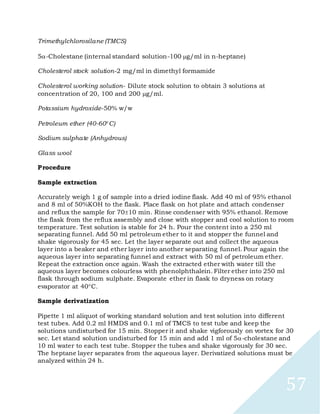
TECHNIQUES
USED IN
CHEMICAL
ANALYSIS OF
FOOD
SUMMER INTERNSHIP REPORT
SUBMITTED BY :- SANYA VASHISTH
Btech Food Technology,
Lady Irwin College,
Delhi University.
2
PREFACE
This report document the worl done during the summer internship at SHRIRAM
INSTITUTE FOR INDUSTRIAL RESEARCH (NEW DELHI).
The report first shall give an overview of the tasks completed during th e period of
internship with technical details
I have tried my best to keep report simple and technically correct. I hope I have
succeeded in my attempt
SANYA VASHISTH
3
TO WHOSOEVER IT MAY CONCERN
This is to certify that Miss Sanya Vashisth, 2nd year, Btech Food Technology at
Lady Irwin College, Delhi University has successfully completed her 15 days
internship from 1st june 2015 to 15th june 2015 at SHRIRAM INSTITUTE FOR
INDUSTRIAL RESEARCH (NEW DELHI ).
During the period of her internship program with us, we found her sincere, hard
working, technically sound and result oriented. She worked well as part of team
during her tenure.
We have given her the golden opportunity for her better future.
Dr. S.K. Nayak Dr. M.L. Aggarwal
Sr. Scientist Dy. Director
4
CONTENTS
I. Acknowledgement
II. Shriram Institute- At a Glance
III. Introduction
IV. Determination Of Moisture In Mustard Oil By Hot Air Oven Drying Method
V. Determination of moisture in cumin seeds by Dean And Stark method
VI. Determination of protein content by Kjeldahl method
VII. Determination of crude fat in animal feed by soxhlet extraction method
VIII. Determination of crude fibre in animal feed
IX. Determination of total ash content in animal feed
X. Determination of acid insoluble ash in animal feed
XI. Determination of volatile oil in spices
XII. Determination of free fatty acid and acid value in mustard oil
XIII. Determination of colour in mustard oil by Lovibond Tintometer
XIV. Determination of iodine value in mustard oil
XV. Determination of saponification value in mustard oil
XVI. Determination of unsaponificable matter in mustard oil
XVII. Determination of allyl isothiocyanate in mustard oil
XVIII. Determination of peroxide value in mustard oil
XIX. Determination of specific gravity of mustard oil
XX. Determination of copper, zinc, lead and cadmium in food products by Atomic
Absorption Spectroscopy
XXI. Determination of cholesterol content in ghee by GC
5
ACKNOWLEDGEMENT
I am thankful to Lady Irwin College, Delhi University for providing me an
opportunity and an open platform for learning
I would like to thank Dr. K.M. Chacko, Director, Shriram Institute for
Industrial Research, New Delhi, for providing me this valuable opportunity to
undergo this training programme.
I express my heartfelt gratitude to Dr. M.L. Aggarwal, Deputy Director
(ASD/BIO) and Col. C.S. Ghosh, Deputy Director (Admin), SRI ,Delhi, for
providing me an opportunity to undertake this training in Food And Farm Lab of
SRI, Delhi.
I am deeply indebted to Dr. S.K. Nayak, Sr. Scientist, SRI ,Delhi, who guided
me time to time in learning the skills for testing and analytical studies in the field
of Food Science.
I would like to express my heartfelt gratitude to Dr. Sarabjeet kaur, Radhika
Sharma, Neha Gupta, Dr. Anita Gaur , Dr. Veena Balyan , Pankaj And Shyam
Singh Mehra, scientists of Food and Farm Lab, SRI, Delhi, for their valuable
guidance and encouragement during the course of training programme.
I am thankful to all the staff members of SRI, Delhi for their help and
knowledge they have instilled in me.
I would like to express my heartfelt thanks to my beloved parents for their
blessings, love and support.
6
Shriram Institute – At a Glance
Profile
Shriram Institute for Industrial Research (SRI) is an independent, self
sustaining, not-for-profit multidisciplinary contract research institute
conducting research and development in the areas of special
significance to industry, government agencies and other organizations.
SRI is committed to develop, innovate, analyse and apply technology
for products and processes.
SRI also brings its innovations to the marketplace by licensing its technologies and
helps in establishing production units for the interested clients.
SRI founded in 1947 by an illustrious founder Lala Shriram, started functioning in
1950. Lala Shriram believed that if India was to catch up with the rest of the world,
it was necessary to understand existing technology and innovate it through
research.
SRI's strengths have been its staff , a knowledgeable, expert and experienced
Governing Board and an innovative management.
SRI is operational from Delhi and Bangalore.
SRI's thrust areas are Materials Science, Analytical Science, Life Science,
Irradiation of Medical and Surgical products and Quality Assurance.
Recent thrust areas in material science includes Blood bags, Cactus Latex based
products, Biomaterials, Materials for Aero Space Applications, Polymers for
Electronics, Hightech Adhesives, Polymers, Composites, Specialty Chemicals,
Renewable resources, Radiation based Technologies, Herbal Products, Waste
Utilization, Technical Consultancy etc.
The Analytical Sciences Division provides prompt, precise and dependable
analytical services in the fields of metal and minerals, rubber and plastics, building
materials, paper, leather and textiles, chemicals and agro chemicals, food and
pharmaceuticals, petroleum products, home appliances and Microbiological
studies. The Division standardises develop and validate new methods for analysis .
It provides assistance to customers to ensure the quality of products laid down by
various certifying agencies and statutory bodies. It also provides Calibration
services.
SRI's Life Sciences Division conducts research on various aspects of Environment
including Biological Impact Studies, Rapid Environmental Impact Studies and
Comprehensive Environmental Impact Studies. The Division undertakes
7
toxicological studies to establish safety levels of chemicals, agrochemicals and
herbal products
Shriram Applied Radiation Centre, SARC, established with the technical assistance
of BARC, conducts research in polymer modifications and undertakes irradiation of
life saving medical and surgical products and spices.
SRI's uncompromising commitment to excellence in research is underscored by its
own Quality Assurance Division which ensures that the Institute itself adheres to
the highest standards of scientific investigation and service.
Research & Development
Since its inception, SRI has been maintaining its status as an independent, self-
supporting contract research organization. It has been recognized as a pioneer
contributor to Indian industry through its efforts with technologically innovative
applied research approach.
Over the years, the R&D activities of SRI have been expanded covering different
areas of materials. The present activities of research involve:
 Identification of new product, application, process and technology
 Development of product, process and technology
 Improvements in the existing product and process
 Scale up studies to take up development work from lab scale to commercial
scale
 Cost effective measures either by suggesting alternative route or process of
manufacturing of a particular product
 Rendering technical help in preparation of product, application and safety
data sheet for capturing market
 Providing opinion report on the existing product as well as process
 Product differentiation etc.
The areas in which R&D is being actively pursued are quite varied from polymers,
health care, waste utilization to food, agricultural and herbal products
8
About Food and Farm Laboratory
Thrust areas
» Quality evaluation of various raw and processed food products
» Quality evaluation of food additives and food packaging materials
» Method development and validation of analytical techniques
» Studies on product differentiation
» Shelf life / stability studies of products at both ambient and accelerated
conditions
» Inspection and certification of product quality
» Certification of packaging materials for food products
» Certification of materials used for serving food products
» Certification of organic food
» Evaluation of contaminants in foods
» Development of food products for special purpose
9
INTRODUCTION
Food is any substance which, when consumed orally by humans is utilized by the
body in its normal metabolic activities. Food contains various nutrients such as
proteins, carbohydrates, fats, minerals, vitamins etc., essential for the growth and
healthcare of our body. All the nutrients get digested in our body and as a result
they contribute to the wellbeing of our body. In addition, food may contain several
indigestible materials which aid in peristalsis. Water present in food serves as a
vehicle for transporting food and its constituents throughout the process of
digestion into different organs of the human body.
Water is the carrier for substances getting out of the food into the human blood,
besides being the medium in which digestion process takes place. Further, water
also carries the remaining of the digestion process i.e. waste materials from body
and assists in the regulation of body temperature and other components such as
flavouring agent, condiment, colour, etc., which aid in food acceptability. By the
way, remember that the humans consume a significant amount of water for
survival and since the water is also consumed orally, water is a food product. Food
either raw or processed can be categorized into different groups:
(a) Agricultural products (Cereals, pulses, fruits and vegetables),
(b) Milk and dairy products,
(c) Vegetable oils and fats,
(d) Meat, fish and egg products,
(e) Spices and condiments,
(f) Sugar and confectionery
(g) Alcoholic and non-alcoholic beverages.
It is often desired to analyze a given food product any of the purposes as stated
below:
(i) Nutritional labelling or proximate analysis which involves the determination of
moisture, protein, fat, carbohydrates, fibre, etc.
(ii) Determination of purity of a food products, and
(iii) Estimation of impurities present in the raw or the processed food product.
In case of proximate analysis of foods, the methods may vary for different
categories of food products. Therefore, the analytical methods need to be validated
each time they are being used for different categories of food products. Analysis of
food plays an important role not only for the assessment but also for the
maintenance of food quality and safety, both for the industry manufacturing food
products and for enforcement authorities engaged in ensuring the food safety and
quality at the national and international levels. During earlier times, the food
analysis was concerned more with the food adulteration but now-a-days there is an
increasing tendency to examine food from a more positive view point. As a result,
10
processed foods are produced within the limits of prescribed manufacturing
formulations, set also to comply with legal or other requirements. In many food
laboratories, most of the routine works is confined to proximate analysis and the
analysis of additives and contaminants, which is required at different stages of
food processing right from farm to the final
product. While most of the proximate analysis can be undertaken using wet
chemical analysis, the analysis of additives and contaminants at very low level has
necessitated the development of instrumental techniques, which are suitable for
rapid assessment and control. The instrumental techniques are also required for
the purpose of evaluating the food products from the point of view of contaminants
and toxicants All sorts of analytical techniques are necessary in the development of
food products and also in controlling the quality of food products. Knowledge of
chemical composition of food products is important again not just for the purpose
of the health and well being but also from the point of view of the health and safety
of the consumers. Knowledge of the physico -
chemical properties of foods is thus, important to ensure the health and health
safety of the consumers. Besides this, the physico-chemical properties of food
products are useful to manufacturers in understanding the importance of various
nutritional constituents so that these may be maintained or improved during
processing. The knowledge of principles of different food analysis techniques is
useful to food analysts during select ion of appropriate techniques for analyzing a
particular food. The compilation of physical and chemical techniques in this unit
would be helpful to the graduate level students for understanding the basic
principles of food analysis for the various physico –chemical parameters.
11
Determination Of Moisture In Mustard Oil
By Hot Air Oven Drying Method
Water, the simplest of all constituents of foods, is one of greatest concern to
producer, manufacturer, processor, consumer and a food analyst. In cereals,
pulses and flour, the moisture content usually ranges from 10 to 15%. In fruits
and vegetables, the water content may be as high as 95%, and in starchy
vegetables viz. potato and beans, it is normally 70 to 80%. Milk contains an
average of 87% whereas lean meat and fish muscles contain about 50 to 70%
moisture. Such a wide variation in moisture content may not a concern from the
point of view of health safety of the raw and fresh food but it certainly is a matter of
concern when one undertakes the processing of food products for value addition
and for enhancement of the shelf-life. Understanding the variation of the moisture
content with time during the period when the product is on the shelf, one can
assess the quality and determine the shelf-life of the product. The accurate
determination of moisture poses many challenges. One of the major problems is
extracting the complete quantity of water from the food sample, thereby resulting
in error in reporting the moisture content; lower than the actual moisture content.
On the other hand, harsher conditions if applied to the food products although
may result in removing all the moisture but simultaneously it would cause
decomposition
of the food product thereby resulting into total weight loss and thus again may give
inaccurate results.
Most of the methods for the estimation of water in foods depend on the loss in
weight on heating. This method is not suitable for the determination of moisture in
foods like milk products or mineral mixture.
Principle
Determination of the loss in mass on drying of a given material under specified
condition gives a measure of moisture present in oil.
Requirements
Apparatus
Moisture Dish - made of porcelain, silica, glass or aluminium.
Oven - maintained at 105°C.
Desiccator
Procedure
12
Weigh accurately about 5 g of the prepared sample in the moisture dish, previously
air dried in the oven and weighed. Place the dish in the oven maintained at
1051°C for 4 hours. Cool in the desiccator and weigh. Repeat the process of
drying, cooling and weighing at 30 min intervals until the difference between the
two consecutive weighing is less than 1 mg. Record the lowest weight.
Calculation
Moisture, % by mass = -100 (W1-W2)
----------------
W1-W
Where,
W1 = weight, in g, of the dish with the material before drying,
W2 = weight, in g, of the dish with the material after drying, and
W = weight, in g, of the empty dish.
Observation
Empty weight Dish + sample Dish + dried sample Moisture
W W1 W2 %
70.7271 82.3912 82.3662 0.2142
73.9614 83.402 83.3782 0.2521
Result
The moisture content of mustard oil came out to be 0.23 %
Precautions

Use a calibrated analytical balance capable of weighing to an accuracy of
0.001g.

Use Grinding mill that is (a) made of material which does not absorb moisture;
(b) easy to clean with as little dead space as possible; (c) able to grind rapidly and
uniformly, without appreciable development of heat and, as far as possible, without
contact with the outside air.

Use dish having an effective surface area enabling the test portion to be
distributed so as to give a mass per unit area of not more than 0.3 g/cm2.
13
Determination of moisture of cumin seeds
by Dean & Stark method
The loss in weight on heating is not entirely due to the moisture content but may
also result due to the loss of volatile substances which are present in most of the
foods. Most of the spices contain notable quantities of volatile oil which pass off
with the water. The moisture content of spices and oils/fats containing 2% or more
of water may be determined by Dean & Stark distillation method using xylene,
toluene or heptane.
Principle
This method is based on the principle that during heating, water and any
immiscible solvent (toluene or xylene) distil off together at a constant ratio
(azeotropic property) at a temperature lower than the boiling point of either
component. As water is denser than toluene/xylene, the water is collected in the
receiver measuring tube where it separates from the extracting solvent.
Requirements
Apparatus
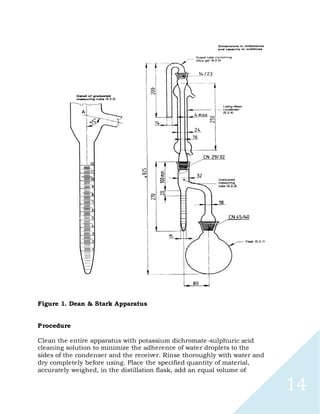
Dean & Stark apparatus
Heat source- an electric heater provided with a sliding rheostat or other means of
heat control.
Copper wire: long enough to extend through the condenser, with one end twisted
into a spiral. The diameter of the spiral should be such that it fits within the
graduated portion of the receiver and yet may be moved up and down.
Reagents
Potassium dichromate- sulphuric acid cleaning solution (Chromic acid solution)
Xylene or toluene
14
Figure 1. Dean & Stark Apparatus
Procedure
Clean the entire apparatus with potassium dichromate-sulphuric acid
cleaning solution to minimize the adherence of water droplets to the
sides of the condenser and the receiver. Rinse thoroughly with water and
dry completely before using. Place the specified quantity of material,
accurately weighed, in the distillation flask, add an equal volume of
15
xylene or toluene, as desired, or at least 100 ml if less than 100 g of the material is
used, and swirl to mix. Assemble the apparatus and fill the receiver with the
solvent by pouring it through the condenser until it begins to overflow into the
distillation flask. Insert a loose cotton plug in the top of the condenser to prevent
condensation of atmospheric moisture within the tube. In order that the refluxing
may be under control, wrap the flask and the tube leading to the receiver with
asbestos cloth. Heat the flask so that the distillation rate is about 100 drops per
minute. Purge the reflux condenser occasionally during the distillation with 5 ml
portions of xylene or toluene to wash down any moisture adhering to the walls of
the condenser. The water in the receiver may be made to separate from the xylene
or toluene by moving the spiral copper wire up and down in the condenser and
receiver occasionally, thus causing the water to settle at the bottom of the receiver.
Reflux until the water-level in the receiver remains unchanged for 30 minutes and
then shut off the source of heat. Flush the condenser with either xylene or toluene
or cyclohexane, as required, making use of the spiral copper wire to discharge any
moisture droplets. Immerse the receiver in water at about 27°C for at least 15
minutes or until the xylene or toluene or cyclohexane layer is clear, and then read
the volume of water.
Calculation
V 100
Moisture, % (v/m) = -----------
W
Where,
V = volume, in ml, of water collected, and
W = weight, in g, of the test sample taken.
Observation
Water collected weight of sample taken moisture
V (ml) W (g) %
0.5 10 4.9943
Results & Inference
The moisture content in cumin seeds was 4.99%
Precautions

Sample should be properly ground and passed through sieve.

Calibrated dean and stark apparatus should be used.

16
Correction factor for volume in calculation should be used while reporting the
results.

The apparatus should be properly cleaned and dried before use.

Use calibrated receiver tube for collection of water
17
Determination of protein content by
Kjeldahl method
The Kjeldahl method has a wide acceptance for the determination of protein in food
products. The protein content of foods is usually calculated from total nitrogen by
multiplying with a suitable conversion factor that is based upon the nitrogen %
present in a particular protein.
Principle
The sample is oxidized in the presence of sulphuric acid and nitrogenous
compounds are converted into ammonium sulphate. Mercury is added to the
digestion mixture as a catalyst and alkali sulphate as a boiling point elevator.
Ammonia is liberated by adding an excess of alkali and is quantitatively distilled
into a measured volume of standard hydrochloric or sulphuric acid. The acid not
neutralized by ammonia is back-titrated with standard alkali to give a measure of
the nitrogen content in the sample.
Equations
Carbohydrate + Protein + Fat (NH4)2SO4 + CO2+ SO2 + H2O
(NH4)2SO4 + 2NaOH 2NH4OH + Na2SO4
2NH4OH + H2SO4 (NH4)2SO4 + 2H2O
Requirements
Apparatus
For Digestion
Kjeldahl flasks (500 to 800 ml capacity)
A heating device (heater/burner)
For Distillation
(A) Round bottom flask (1 litre capacity)
(B) Splash head
Neutralization
(C) Condenser (Allihn type)
(D) Trap
(E) Beaker (500 ml capacity)
18
(F) Receiving funnel
Reagents
Concentrated Sulphuric Acid, AR Grade
Potassium Sulphate or Anhydrous Sodium Sulphate, AR Grade
Sodium Hydroxide Solution - Dissolve about 450 g solid sodium hydroxide
in distilled water, cool, and dilute for 1 litre. The specific gravity should
be at least 1.36 at 20°C.
Hydrochloric or Sulphuric Acid, Standard Solution: (0.1N or 0.5N).
Prepare the standard solution as discussed in experiment No.1 (part-B).
Standardize against sodium hydroxide standard solution.
Sodium Hydroxide Standard Solution - 0.1 N. Standardize against primary
standard and against standard acid solution.
Methyl Red Indicator - Dissolve 1 g methyl red in 200 ml alcohol.
19
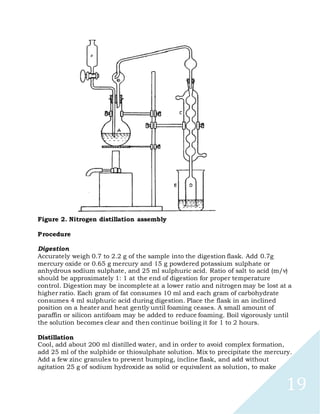
Figure 2. Nitrogen distillation assembly
Procedure
Digestion
Accurately weigh 0.7 to 2.2 g of the sample into the digestion flask. Add 0.7g
mercury oxide or 0.65 g mercury and 15 g powdered potassium sulphate or
anhydrous sodium sulphate, and 25 ml sulphuric acid. Ratio of salt to acid (m/v)
should be approximately 1: 1 at the end of digestion for proper temperature
control. Digestion may be incomplete at a lower ratio and nitrogen may be lost at a
higher ratio. Each gram of fat consumes 10 ml and each gram of carbohydrate
consumes 4 ml sulphuric acid during digestion. Place the flask in an inclined
position on a heater and heat gently until foaming ceases. A small amount of
paraffin or silicon antifoam may be added to reduce foaming. Boil vigorously until
the solution becomes clear and then continue boiling it for 1 to 2 hours.
Distillation
Cool, add about 200 ml distilled water, and in order to avoid complex formation,
add 25 ml of the sulphide or thiosulphate solution. Mix to precipitate the mercury.
Add a few zinc granules to prevent bumping, incline flask, and add without
agitation 25 g of sodium hydroxide as solid or equivalent as solution, to make
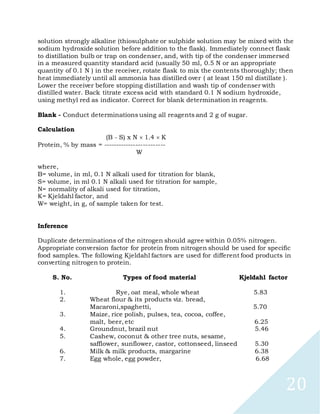
20
solution strongly alkaline (thiosulphate or sulphide solution may be mixed with the
sodium hydroxide solution before addition to the flask). Immediately connect flask
to distillation bulb or trap on condenser, and, with tip of the condenser immersed
in a measured quantity standard acid (usually 50 ml, 0.5 N or an appropriate
quantity of 0.1 N ) in the receiver, rotate flask to mix the contents thoroughly; then
heat immediately until all ammonia has distilled over ( at least 150 ml distillate ).
Lower the receiver before stopping distillation and wash tip of condenser with
distilled water. Back titrate excess acid with standard 0.1 N sodium hydroxide,
using methyl red as indicator. Correct for blank determination in reagents.
Blank - Conduct determinations using all reagents and 2 g of sugar.
Calculation
(B - S) x N 1.4 K
Protein, % by mass = -------------------------
W
where,
B= volume, in ml, 0.1 N alkali used for titration for blank,
S= volume, in ml 0.1 N alkali used for titration for sample,
N= normality of alkali used for titration,
K= Kjeldahl factor, and
W= weight, in g, of sample taken for test.
Inference
Duplicate determinations of the nitrogen should agree within 0.05% nitrogen.
Appropriate conversion factor for protein from nitrogen should be used for specific
food samples. The following Kjeldahl factors are used for different food products in
converting nitrogen to protein.
S. No. Types of food material Kjeldahl factor
1. Rye, oat meal, whole wheat 5.83
2. Wheat flour & its products viz. bread,
Macaroni,spaghetti, 5.70
3. Maize, rice polish, pulses, tea, cocoa, coffee,
malt, beer, etc 6.25
4. Groundnut, brazil nut 5.46
5. Cashew, coconut & other tree nuts, sesame,
safflower, sunflower, castor, cottonseed, linseed 5.30
6. Milk & milk products, margarine 6.38
7. Egg whole, egg powder, 6.68
21
Precautions

Sample to be analyzed should be homogeneous.

Determine the strength of NaOH before use.

Sample should be checked for complete digestion through colour and there
should not be any presence of carbon particles adhering to the neck of Kjeldahl
flask.
22
Determination of crude fat in Animal feed
by Soxhlet extraction method
The crude fat content can be conveniently determined in foods by extracting the
dried and ground material with petroleum ether or diethyl ether in Soxhlet
extraction apparatus.
Principle
Extraction of the crude fat is carried out either with petroleum ether or diethyl
ether in a Soxhlet unit followed by volatilization of the solvent after extraction and
determination of the mass of the residue.
Requirements
Apparatus
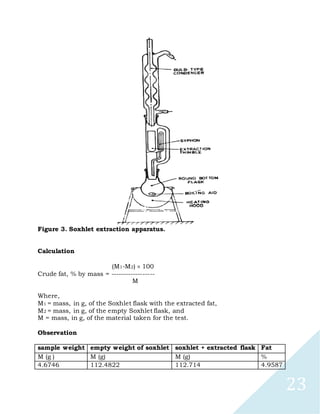
Soxhlet apparatus
Reagent
Diethyl Ether — anhydrous or Petroleum ether (bp. 60-80C)
Procedure
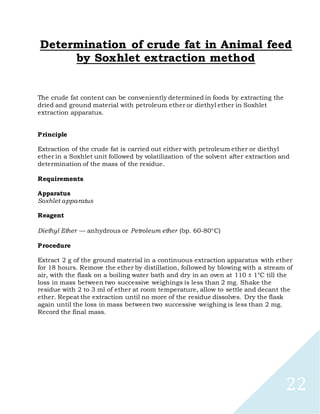
Extract 2 g of the ground material in a continuous extraction apparatus with ether
for 18 hours. Remove the ether by distillation, followed by blowing with a stream of
air, with the flask on a boiling water bath and dry in an oven at 110 ± 1°C till the
loss in mass between two successive weighings is less than 2 mg. Shake the
residue with 2 to 3 ml of ether at room temperature, allow to settle and decant the
ether. Repeat the extraction until no more of the residue dissolves. Dry the flask
again until the loss in mass between two successive weighing is less than 2 mg.
Record the final mass.
23
Figure 3. Soxhlet extraction apparatus.
Calculation
(M1-M2) 100
Crude fat, % by mass = ------------------
M
Where,
M1 = mass, in g, of the Soxhlet flask with the extracted fat,
M2 = mass, in g, of the empty Soxhlet flask, and
M = mass, in g, of the material taken for the test.
Observation
sample weight empty weight of soxhlet soxhlet + extracted flask Fat
M (g ) M (g) M (g) %
4.6746 112.4822 112.714 4.9587
24
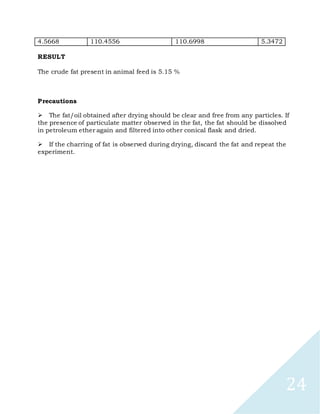
4.5668 110.4556 110.6998 5.3472
RESULT
The crude fat present in animal feed is 5.15 %
Precautions

The fat/oil obtained after drying should be clear and free from any particles. If
the presence of particulate matter observed in the fat, the fat should be dissolved
in petroleum ether again and filtered into other conical flask and dried.

If the charring of fat is observed during drying, discard the fat and repeat the
experiment.
25
Determination of crude fibre in animal
feed
The seed coat of oilseeds, nuts and pulses, peels of fruits and vegetables, and bran
of cereals contain considerably more fibre than the softer edible inner tissues. So,
the fibre content can be employed for assessing the proportion of outer coating of
plant materials. The digestibility of food varies inversely with the crude fibre
content.
Principles
The crude fibre represents the cell wall material left after boiling with dilute acid
and alkali. It contains a mixture of cellulose, lignin and pentosans, together with
sand, silica and other mineral matter locked in the tissues and a little nitrogenous
matter.
Requirements
Reagents
Sulphuric Acid — 0.255 N [1.25 percent ( m/v )], accurately prepared.
Sodium Hydroxide Solution — 0.313 N [1.25 percent ( m/v )], accurately prepared.
Procedure
Weigh accurately about 2 g of the dried material and extract the fat for about 8
hours with petroleum ether or hexane, food grade, using a Soxhlet or other
suitable extractor or use the residue from the crude fat determination. Transfer the
fat-free dry residue to a one-litre conical flask. Take 200 ml of dilute sulphuric acid
in a beaker and bring to the boil. Transfer the whole of the boiling acid to the flask
containing the fat free material and immediately connect the flask with a reflux
water condenser and heat, so that the contents of the flask begin to boil within one
minute. Rotate the flask frequently, taking care to keep the material from
remaining on the sides of the flask out of contact with the acid. Continue boiling
for exactly 30 minutes. Remove the flask and filter through fine linen (about 18
threads to the centimeter) held in a funnel, and wash with boiling water until the
washings are no longer acid to litmus. Bring to the boil some quantity of sodium
hydroxide solution under a reflux condenser. Wash the residue on the linen into
the flask with 200 ml of the boiling sodium hydroxide solution. Immediately
connect the flask with the reflux condenser and boil for exactly 30 minutes.
Remove the flask and immediately filter through the filtering cloth. Thoroughly
wash the residue with boiling water and transfer to a Gooch crucible prepared with
26
a thin but compact layer of ignited asbestos. Wash the residue thoroughly first
with hot water and then with about 15 ml of 95 percent (by volume) ethyl alcohol.
Dry the Gooch crucible and contents at 105 ± 1°C in the air-oven to constant
mass. Cool and weigh. Incinerate the contents of the Gooch crucible at 600 ± 20ºC
in a muffle furnace until all the carbonaceous matter is burnt. Cool the Gooch
crucible containing the ash in a desiccator and weigh.
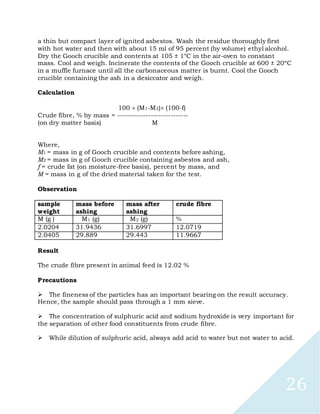
Calculation
100 (M1-M2)(100-f)
Crude fibre, % by mass = -----------------------------
(on dry matter basis) M
Where,
M1 = mass in g of Gooch crucible and contents before ashing,
M2 = mass in g of Gooch crucible containing asbestos and ash,
f = crude fat (on moisture-free basis), percent by mass, and
M = mass in g of the dried material taken for the test.
Observation
sample
weight
mass before
ashing
mass after
ashing
crude fibre
M (g ) M1 (g) M2 (g) %
2.0204 31.9436 31.6997 12.0719
2.0405 29.889 29.443 11.9667
Result
The crude fibre present in animal feed is 12.02 %
Precautions

The fineness of the particles has an important bearing on the result accuracy.
Hence, the sample should pass through a 1 mm sieve.

The concentration of sulphuric acid and sodium hydroxide is very important for
the separation of other food constituents from crude fibre.

While dilution of sulphuric acid, always add acid to water but not water to acid.
27
Determination of total ash contents In
animal feed
Total ash refers to the inorganic residue remaining after total incineration of
organic matter present in food. Because of its non variable nature, the ash content
can be used for assessing the quality of food product with respect to the presence
of inorganic substance in it.
Principle
Ash refers to the inorganic residue remaining after total incineration of organic
matter. The ash content is determined from the loss of weight, which occurs from
complete oxidation of sample at a high temperature 500 to 600°C through
combustion and volatilization of organic materials.
Requirements
Apparatus
Flat-Bottom Dish - of stainless steel, porcelain, silica or platinum.
Muffle Furnace maintained at 55010°C.
Desiccator
Procedure
Weigh accurately about 3 g of the material in the dish, previously dried in an air-
oven and weighed. Heat the dish gently on a flame at first and then strongly in a
muffle furnace at 55010°C till grey ash results. Cool the dish in a desiccator and
weigh. Heat the dish again at 55010°C for 30 minutes. Cool the dish in a
desiccator and weigh. Repeat this process of heating for 30 minutes, cooling and
weighing until the difference between two successive weighing is less than 1 mg.
Record the lowest weight.
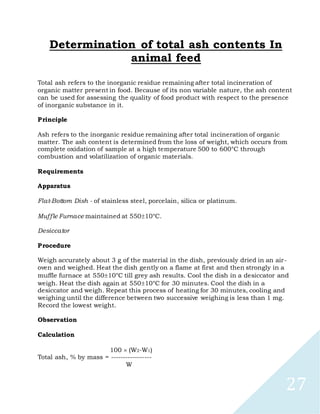
Observation
Calculation
100 (W2-W1)
Total ash, % by mass = -----------------
W
28
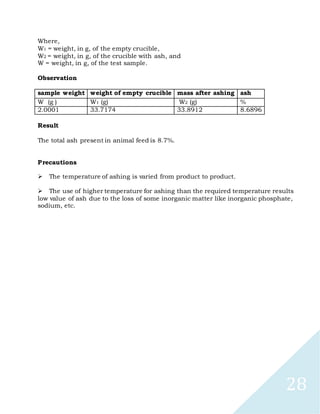
Where,
W1 = weight, in g, of the empty crucible,
W2 = weight, in g, of the crucible with ash, and
W = weight, in g, of the test sample.
Observation
sample weight weight of empty crucible mass after ashing ash
W (g ) W1 (g) W2 (g) %
2.0001 33.7174 33.8912 8.6896
Result
The total ash present in animal feed is 8.7%.
Precautions

The temperature of ashing is varied from product to product.

The use of higher temperature for ashing than the required temperature results
low value of ash due to the loss of some inorganic matter like inorganic phosphate,
sodium, etc.
29
Determination of acid insoluble ash in
animal feed
The acid insoluble ash is a measure of the sandy matter and plant body parts
including calyx, leaves, etc, which contain higher content of noncombustible acid
insoluble matter.
Principle
Acid insoluble ash is determined by dissolving ash in dilute hydrochloric acid (10%
m/m), the liquid filtered through an ashless filter paper and thoroughly washed
with hot water. The filter paper is then ignited in the original dish, cooled and
weighed.
Requirements
Apparatus
Flat-Bottom Dish - of stainless steel, porcelain, silica or platinum.
MuffeFurnace - maintained at 55010°C.
Desiccator
Reagent
Dilute Hydrochloric Acid (5N)
Procedure
To the ash contained in the dish, add 25 ml of dilute hydrochloric acid, cover with
a watch-glass and heat on a water-bath for 10 minutes. Allow to cool and filter the
contents of the dish through a Whatman filter paper No. 42 or its equivalent. Wash
the filter paper with water until the washings are free from the acid and return
them to the dish. Keep it in an oven maintained at 100 f 2°C for about 3 hours.
Ignite in a muffle furnace at 550 f 10°C for one hour. Cool the dish in a desiccator
and weigh. Heat the dish again at 55010°C for 30 minutes, cool in a desiccator
and weigh. Repeat this process of heating for 30 minutes, cooling and weighing
until the difference between two successive weighing is less than 1 mg. Record the
lowest weight.
30
Calculation
100 (W2-W1)
Acid insoluble ash, % by mass = -----------------
W
Where,
W1 = weight, in g, of the empty dish,
W2 = weight, in g, of the dish with acid insoluble ash, and
W = weight, in g, of the sample.
Observation
sample
weight
weight of empty
crucible
weight with acid insoluble ash ash
W (g ) W(g) W (g) %
2.0001 33.7174 33.7352 0.89
Result
The percentage amount of acid insoluble ash present is 0.89% .
Precautions

Ashing should be proper.

Ashless filter paper should be used for the filtration.
31
Determination of volatile oil in spices
Volatile oil content is a measure of aroma strength of spices and condiments. The
volatile oil content in different spices ranges from 1 to 12%. The volatile oil content
varies with source, variety and seasons.
Principle
The method involves distilling the volatile oil over with boiling water, condensing
and collecting the oil in a measured volume of xylene in a graduated tube, after
cooling, direct reading from the volume of volatile oil separated from the distillate.
Requirements
Apparatus
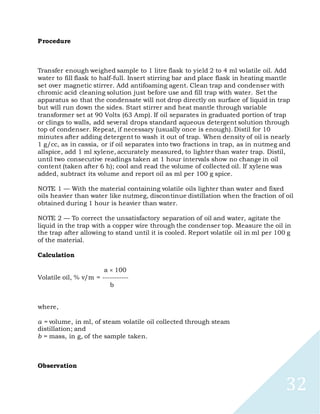
Volatile Oil Traps — Clevenger-type with joints.
Flask with Magnetic Stirrer — 1 litre capacity round bottom and shortneck with
standard joint and having egg-shaped magnetic stirrer bar.
Reagent
Xylene (A.R. grade)
Figure 5. Apparatus for determination of volatile oil
32
Procedure
Transfer enough weighed sample to 1 litre flask to yield 2 to 4 ml volatile oil. Add
water to fill flask to half-full. Insert stirring bar and place flask in heating mantle
set over magnetic stirrer. Add antifoaming agent. Clean trap and condenser with
chromic acid cleaning solution just before use and fill trap with water. Set the
apparatus so that the condensate will not drop directly on surface of liquid in trap
but will run down the sides. Start stirrer and heat mantle through variable
transformer set at 90 Volts (63 Amp). If oil separates in graduated portion of trap
or clings to walls, add several drops standard aqueous detergent solution through
top of condenser. Repeat, if necessary (usually once is enough). Distil for 10
minutes after adding detergent to wash it out of trap. When density of oil is nearly
1 g/cc, as in cassia, or if oil separates into two fractions in trap, as in nutmeg and
allspice, add 1 ml xylene, accurately measured, to lighter than water trap. Distil,
until two consecutive readings taken at 1 hour intervals show no change in oil
content (taken after 6 h); cool and read the volume of collected oil. If xylene was
added, subtract its volume and report oil as ml per 100 g spice.
NOTE 1 — With the material containing volatile oils lighter than water and fixed
oils heavier than water like nutmeg, discontinue distillation when the fraction of oil
obtained during 1 hour is heavier than water.
NOTE 2 — To correct the unsatisfactory separation of oil and water, agitate the
liquid in the trap with a copper wire through the condenser top. Measure the oil in
the trap after allowing to stand until it is cooled. Report volatile oil in ml per 100 g
of the material.
Calculation
a 100
Volatile oil, % v/m = -----------
b
where,
a = volume, in ml, of steam volatile oil collected through steam
distillation; and
b = mass, in g, of the sample taken.
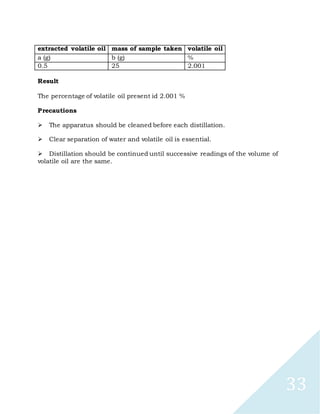
Observation
33
extracted volatile oil mass of sample taken volatile oil
a (g) b (g) %
0.5 25 2.001
Result
The percentage of volatile oil present id 2.001 %
Precautions

The apparatus should be cleaned before each distillation.

Clear separation of water and volatile oil is essential.

Distillation should be continued until successive readings of the volume of
volatile oil are the same.
34
Determination of free fatty acids and acid
value in mustard oil
The Acid value has wide implication in the oil refining industry. It conveys not only
the quality of oil but also total quantity of alkali needed to neutralize the acidity in
a particular batch for making it suitable for the purpose of hydrogenation or
marketing of refined oil or fat of very low acidity. Acid value is a measure of the
hydrolytic rancidity present in the sample.
Principle
The acid value is determined by directly titrating the material in an alcoholic
medium with aqueous sodium or potassium hydroxide solution.
Acid value is the number of mg of KOH required to neutralize the free fatty acids
present in 1 g of the oil or fat. Free fatty acid is calculated as oleic, lauric, ricinoleic
or palmitic acids.
Requirements
Reagents
Ethyl Alcohol — 95%v/v, neutral to phenolphthalein indicator.
Phenolphthalein Indicator Solution — Dissolve 1 g of phenolphthalein in 100 ml of
ethyl alcohol.
NOTE — When testing oils or fats which give dark coloured soap solution, the
observation of the end point of the titration may be facilitated either (a) by using
thymolphthalein or alkali blue 6B in place of phenolphthalein, or (b) by adding 1
ml of a 0.1%, w/v solution of methylene blue in water to each 100 ml of
phenolphthalein indicator solution before the titration.
Standard Aqueous Potassium Hydroxide or Sodium Hydroxide Solutions —
0.1 N or 0.5 N.
Procedure
Mix the oil or melted fat thoroughly before weighing. Weigh accurately a suitable
quantity of the cooled oil or fat in a 200-ml conical flask. The weight of the oil or fat
taken for the test and the strength of the alkali used for the titration shall be such
that the volume of alkali required for the titration does not exceed 10 ml. Add 50 to
100 ml of freshly neutralized hot ethyl alcohol, and about 1 ml of phenolphthalein
indicator solution. Boil the mixture for about five minutes and titrate while as hot
35
as possible with standard aqueous alkali solution, shaking vigorously during
titration.
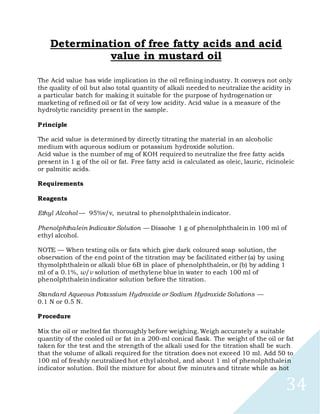
Calculation
56.1 N V
Acid value = -----------------
W
Where,
V = volume in ml of standard KOH/NaOH solution used,
N = normality of standard KOH/NaOH solution, and
W = weight in g of the material taken for the test.
Observation
sample weight sample titration normality ACID VALUE
W (g) V (ml ) N
10.0554 1.9 0.01053 0.1116
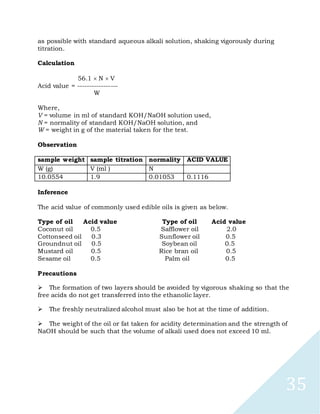
Inference
The acid value of commonly used edible oils is given as below.
Type of oil Acid value Type of oil Acid value
Coconut oil 0.5 Safflower oil 2.0
Cottonseed oil 0.3 Sunflower oil 0.5
Groundnut oil 0.5 Soybean oil 0.5
Mustard oil 0.5 Rice bran oil 0.5
Sesame oil 0.5 Palm oil 0.5
Precautions

The formation of two layers should be avoided by vigorous shaking so that the
free acids do not get transferred into the ethanolic layer.

The freshly neutralized alcohol must also be hot at the time of addition.

The weight of the oil or fat taken for acidity determination and the strength of
NaOH should be such that the volume of alkali used does not exceed 10 ml.
36
Determination of colour of Mustard oil by
Lovibond Tintometer
Colour measurement on Lovibond scale is useful for determining the quality of oils
and in the refining processes. Measurement of colour serves to check the bleaching
processes also.
Principles
This method determines the colour of oils by comparison with Lovibond glasses of
known colour characteristics. The colour is expressed as the sum total of the
yellow and red slides used to match the colour of the oil in a cell of the specified
size in the Lovibond tintometer.
Requirements
Apparatus
Lovibond Tintometer or Colorimeter
Glass Cells —The Lovibond cell designations namely, ¼”, ½”, 1” and 5¼” are
recommended.
Filter Paper
Procedure
Melt the sample, if it is not already liquid, and filter through a filter paper to
remove any impurities and the last traces of moisture. Make sure that the sample
is absolutely clear and free from turbidity. Clean the glass cell of the desired size
with carbon tetrachloride and allow it to dry. Fill it with the clear filtered sample
and place the cell in position in the tintometer. Place along side of it such red,
yellow, blue or neutral Lovibond glass slides or any combinations of these as are
necessary to match the colour shade of the oil, observing the colours of the oil and
of the combination of the glass slides through an eyepiece.
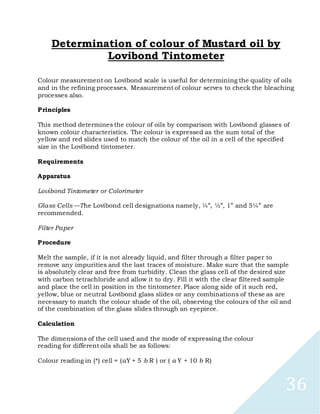
Calculation
The dimensions of the cell used and the mode of expressing the colour
reading for different oils shall be as follows:
Colour reading in (*) cell = (aY + 5 b R ) or ( a Y + 10 b R)
37
*Size designation of the cell used,
where,
a = the sum total of the various yellow (Y) slides used, and
b = the sum total of the various red (R) slides used.
Observation
colour result
1/4 inch cell Y+5R
3R+11Y 26
Inference
The maximum colour intensity of commonly used edible refined oils in Lovibond
scale is given as below.
Type of oil Y+5R units Type of oil Y+5R units
Coconut oil 2 Safflower oil 15
Cottonseed oil 10 Sunflower oil 5
Groundnut oil 3 Soybean oil 20
Mustard oil 15 Rice bran oil 20
Sesame oil 2 Palm oil 50
Precautions

Fat should be melted and any oil or fat that is cloudy should be filtered at a
temperature not more than 60C.

Colour readings need to be taken within a comparatively

Lamp should not be used continuously for long time.

During matching, the sample should be at room temperature for oils or not
more than 10C above the melting point.

Do not strain your eyes for long time, allow to relax from time to time.
38
Determination of iodine value in Mustard oil
The glycerides of the unsaturated fatty acids unite with a definite amount of iodine
and the iodine value is therefore a measure of the degree of unsaturation.
Principle
The material is treated, in carbon tetrachloride medium, with a known excess of
iodine monochloride solution in glacial acetic acid (Wijs solution). The excess of
iodine monochloride is treated with potassium iodide and the liberated iodine
estimated by titration with sodium thiosulphate solution.
Requirements
Reagents
Potassium Dichromate.
Concentrated Hydrochloric Acid.
Potassium Iodide Solution — Prepare a fresh solution by dissolving 10 g of KI free
from potassium iodate, in 90 ml of water.
Starch Solution — Triturate 5 g of starch and 0.01 g of mercuric iodide with 30 ml
of cold water and slowly pour it with stirring into one litre of boiling water. Boil for
three minutes. Allow to cool and decant off the supernatant clear liquid.
Standard Sodium Thiosulphate Solution (0.1N).
Glacial acetic Acid.
Iodine Monochloride (ICl) — 98 %.
Wijs Iodine Monochloride Solution
Dissolve 10 ml of iodine monochloride in about 1800 ml of glacial acetic acid
(chemically pure) and shake vigorously. Pipette 5 ml of this, add 10 ml of KI
solution and titrate with 0.1 N standard Na2S2O3 solution, using starch solution as
indicator. Adjust the volume of the solution till it is approximately 0.2 N.
Carbon Tetrachloride or Chloroform — inert to Wijs solution.
39
Procedure
Melt the sample if it is not already completely liquid, and filter through a filter
paper to remove any impurities and the last traces of moisture. Make sure that the
sample as well as the glass apparatus used is absolutely clean and dry. Weigh
accurately, by difference, an appropriate quantity of the oil or fat, into a clean dry
500-ml iodine flask or well ground glass-stoppered bottle to which 25 ml of carbon
Wijs solution and replace the glass stopper after wetting with KI solution; swirl for
intimate mixing, and allow to stand in the dark for 30 min in the case of nondrying
and semi-drying oils and 1 h in the case of drying oils. Carry out a blank test
simultaneously under similar experimental conditions. After standing, add 15 ml of
KI solution and 100 ml of water, rinsing in the stopper also, and titrate the
liberated iodine with standard Na2S2O3 solution, swirling the contents of the bottle
continuously to avoid any local excess until the colour of the solution is straw
yellow. Add 1 ml of the starch solution and continue the titration until the blue
colour formed disappears after thorough shaking with the stopper on.
Calculation
12.69 (B-S) N
Iodine value = --------------------
W
Where,
B = Volume, in ml, of Na2S2O3 solution required for the blank,
S = volume, in ml, of Na2S2O3 solution required for the sample,
N = normality of Na2S2O3 solution, and
W = weight, in g, of the material taken for the test.
Observation
sample
weight
volume required for
blank
volume required for
sample
N of
na2s2o3
iodine
value
W (g) B (ml) S (ml) N
0.2743 46.8 23.5 0.1007 108.5478
Result
The iodine value is 108.54.
Inference
The range of iodine value for animal fats (30-70), non-drying oils ((80-110)), semi-
drying oils (80-140) and drying oils (125- 200) and very small value for waxes. The
iodine value of commonly used edible oils is given as below.
40
Type of oil Iodine value Type of oil Iodine value
Coconut oil 7.5-10.5 Safflower oil 138-146
Cottonseed oil 98-115 Sunflower oil 100-140
Groundnut oil 87-98 Soybean oil 125-140
Mustard oil 98-110 Rice bran oil 90-105
Sesame oil 103-115 Palm oil 44-58
Precautions

As soon as Wij’s solution is added stopper the flask immediately.

Exactly for 30 minutes the flask should be kept in dark.

Exact and accurate weighing should be done according to the iodine value
expected in the sample.

If B-S is greater than B/2, the test must be repeated using a lesser quantity of
the sample.
41
Determination of saponification value in
Mustard oil
The number of milligrams of potassium hydroxide required to saponify completely
one gram of oil or fat. When fat is saponified by refluxing with a known excess of
alcoholic potassium hydroxide solution, the triglycerides hydrolyze, glycerol and
soap are formed. The alkali consumed for this hydrolysis is a measure of the
saponification value, which is determined by titrating the excess alkali with
standard hydrochloric acid.
Principle
The material is saponified by refluxing with a known excess of alcoholic potassium
hydroxide solution. The alkali consumed for saponification is determined by
titrating the excess alkali with standard hydrochloric acid.
Requirements
Apparatus
Conical Flasks — 250 to 300 ml capacity.
Reflux Condenser —at least 65 cm long.
Water-Bath or Electric Hot-Plate with Rheostat Control
Reagents
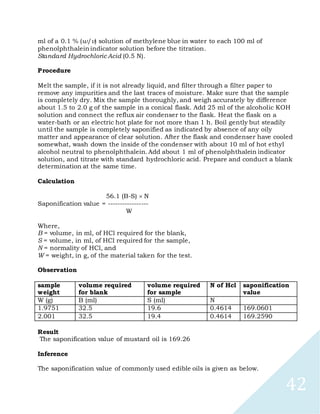
Alcoholic Potassium Hydroxide Solution — Dissolve 35 to 40 g of KOH in 20 ml of
distilled water, and add sufficient aldehyde-free rectified spirit to make up to 1000
ml. Allow to stand overnight, decant the clear liquid and keep in a bottle closed
tight with a cork or rubber stopper.
Aldehyde-Free Rectified Spirit Reflux 1.2 litres of rectified spirit for 30 min in a
round-bottom flask with 10 g of KOH and 6 g of granulated aluminium (or
aluminium foil). Distil and collect one litre after discarding the first 50 ml.
Phenolphthalein Indicator Solution — Dissolve 1.0 g of phenolphthalein in 100 ml of
rectified spirit.
NOTE - When testing oils or fats which give dark-coloured soap solutions, the
observation of the end point of the titration may be facilitated either (a) by using
thymolphthalein, or alkali blue 6B in place of phenolphthalein or (b) by adding 1
42
ml of a 0.1 % (w/v) solution of methylene blue in water to each 100 ml of
phenolphthalein indicator solution before the titration.
Standard Hydrochloric Acid (0.5 N).
Procedure
Melt the sample, if it is not already liquid, and filter through a filter paper to
remove any impurities and the last traces of moisture. Make sure that the sample
is completely dry. Mix the sample thoroughly, and weigh accurately by difference
about 1.5 to 2.0 g of the sample in a conical flask. Add 25 ml of the alcoholic KOH
solution and connect the reflux air condenser to the flask. Heat the flask on a
water-bath or an electric hot plate for not more than 1 h. Boil gently but steadily
until the sample is completely saponified as indicated by absence of any oily
matter and appearance of clear solution. After the flask and condenser have cooled
somewhat, wash down the inside of the condenser with about 10 ml of hot ethyl
alcohol neutral to phenolphthalein. Add about 1 ml of phenolphthalein indicator
solution, and titrate with standard hydrochloric acid. Prepare and conduct a blank
determination at the same time.
Calculation
56.1 (B-S) N
Saponification value = -----------------
W
Where,
B = volume, in ml, of HCl required for the blank,
S = volume, in ml, of HCl required for the sample,
N = normality of HCl, and
W = weight, in g, of the material taken for the test.
Observation
sample
weight
volume required
for blank
volume required
for sample
N of Hcl saponification
value
W (g) B (ml) S (ml) N
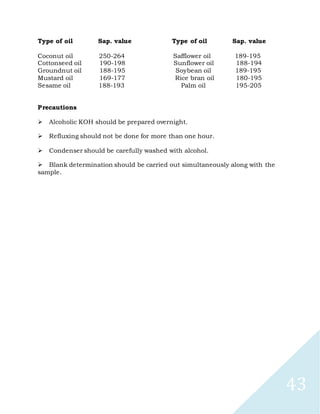
1.9751 32.5 19.6 0.4614 169.0601
2.001 32.5 19.4 0.4614 169.2590
Result
The saponification value of mustard oil is 169.26
Inference
The saponification value of commonly used edible oils is given as below.
43
Type of oil Sap. value Type of oil Sap. value
Coconut oil 250-264 Safflower oil 189-195
Cottonseed oil 190-198 Sunflower oil 188-194
Groundnut oil 188-195 Soybean oil 189-195
Mustard oil 169-177 Rice bran oil 180-195
Sesame oil 188-193 Palm oil 195-205
Precautions

Alcoholic KOH should be prepared overnight.

Refluxing should not be done for more than one hour.

Condenser should be carefully washed with alcohol.

Blank determination should be carried out simultaneously along with the
sample.
44
Determination of unsaponifiable matter in
mustard oil
The unsaponifiable matter is that fraction of oil and fat, which is not saponified
with caustic alkali but is soluble in non-polar solvents. The unsaponifiable matter
in oil or fat consists of hydrocarbons, higher alcohols, oil-soluble vitamins and
sterols, which are not soluble in water after esterification. Most oils and fats of
normal purity contain less than 2% unsaponifiable matter. Higher value indicates
the possibility of adulteration with mineral oil. Adulteration of oils and fats with
paraffin hydrocarbons will appear in the unsaponifiable matter.
Principle
The material is completely saponified with alcoholic potassium hydroxide solution
and extracted with petroleum ether. The petroleum ether extract is washed with
aqueous alcohol and then again with water. The washed ether extract is evaporated
and the residue weighed. Unsaponifiable matter is this residue minus the fatty acid
present in it, which is determined by titration with sodium hydroxide solution in
alcoholic medium.
Requirements
Apparatus
Flat-Bottomed or Conical Flask — 250 to 300 ml capacity. An ordinary round, flat-
bottomed flask, fitted with a long glass tube which acts as a condenser, may also
be used.
Separating Funnels — 500-ml capacity.
Reagents
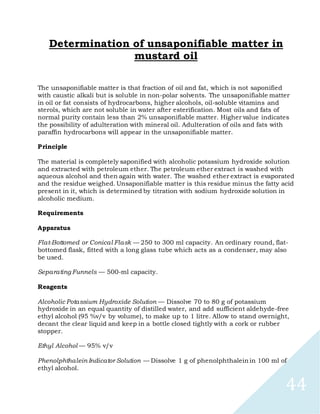
Alcoholic Potassium Hydroxide Solution — Dissolve 70 to 80 g of potassium
hydroxide in an equal quantity of distilled water, and add sufficient aldehyde-free
ethyl alcohol (95 %v/v by volume), to make up to 1 litre. Allow to stand overnight,
decant the clear liquid and keep in a bottle closed tightly with a cork or rubber
stopper.
Ethyl Alcohol — 95% v/v
Phenolphthalein Indicator Solution — Dissolve 1 g of phenolphthalein in 100 ml of
ethyl alcohol.
45
Petroleum Ether —60-80C.
Aqueous Alcohol — containing 10 % v/v of ethyl alcohol.
Standard Sodium Hydroxide Solution — approximately 0.02 N.
Acetone — free from evaporation residue.
Procedure
Weigh accurately about 5 g of the well-mixed sample into the flask. Add 50 ml of
alcoholic potassium hydroxide solution. Boil gently but steadily under a reflux
condenser for one hour or until the saponification is complete. Wash the condenser
with about 10 ml of ethyl alcohol. Cool the mixture and transfer it to a separating
funnel. Complete the transfer by washing the flask first with some ethyl alcohol
and then with cold water. Altogether, add 50 ml of water to the separating funnel
followed by an addition of 50 ml of petroleum ether. Insert the stopper and shake
vigorously for at least one minute and allow to settle until both the layers are clear.
Transfer the lower layer containing the soap solution to another separating funnel,
and repeat the ether extraction at least six times more using 50 ml of petroleum
ether for each extraction. If any emulsion is formed, add a small quantity of ethyl
alcohol or alcoholic potassium hydroxide solution.
Collect all the ether extracts in a separating funnel. Wash the combined extracts in
the funnel three times with 25-ml portions of aqueous alcohol shaking vigorously
and drawing off the alcohol-water layer after each washing. Again wash the ether
layer successively with 20-ml portions of water until the wash-water no longer
turns pink on addition of a few drops of phenolphthalein indicator solution. Do not
remove any of the ether layers. Transfer the ether layer to a tared flask containing
a few pieces of pumice stone, and evaporate to dryness on a water-bath under a
gentle stream of clean dry air. To remove the last traces of ether, place the flask in
an air-oven at 80 to 90°C for about 1 h. To remove the last traces of moisture, add
a few ml of acetone and pass a gentle stream of clean dry air over the surface of the
material or evacuate using a water vacuum pump at about 50°C for about 15 min.
Cool in a desiccator and weigh. Repeat the evacuating, cooling and weighing until a
constant weight is obtained.
After weighing, take up the residue in 50 ml of warm neutral ethyl alcohol,
containing a few drops of phenolphthalein indicator solution and titrate with
standard sodium hydroxide solution.
Calculation
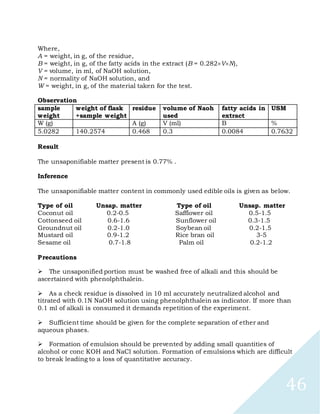
(A-B) 100
Unsaponifiable matter, % by mass = -----------------
W
46
Where,
A = weight, in g, of the residue,
B = weight, in g, of the fatty acids in the extract (B = 0.282VN),
V = volume, in ml, of NaOH solution,
N = normality of NaOH solution, and
W = weight, in g, of the material taken for the test.
Observation
sample
weight
weight of flask
+sample weight
residue volume of Naoh
used
fatty acids in
extract
USM
W (g) A (g) V (ml) B %
5.0282 140.2574 0.468 0.3 0.0084 0.7632
Result
The unsaponifiable matter present is 0.77% .
Inference
The unsaponifiable matter content in commonly used edible oils is given as below.
Type of oil Unsap. matter Type of oil Unsap. matter
Coconut oil 0.2-0.5 Safflower oil 0.5-1.5
Cottonseed oil 0.6-1.6 Sunflower oil 0.3-1.5
Groundnut oil 0.2-1.0 Soybean oil 0.2-1.5
Mustard oil 0.9-1.2 Rice bran oil 3-5
Sesame oil 0.7-1.8 Palm oil 0.2-1.2
Precautions

The unsaponified portion must be washed free of alkali and this should be
ascertained with phenolphthalein.

As a check residue is dissolved in 10 ml accurately neutralized alcohol and
titrated with 0.1N NaOH solution using phenolphthalein as indicator. If more than
0.1 ml of alkali is consumed it demands repetition of the experiment.

Sufficient time should be given for the complete separation of ether and
aqueous phases.

Formation of emulsion should be prevented by adding small quantities of
alcohol or conc KOH and NaCl solution. Formation of emulsions which are difficult
to break leading to a loss of quantitative accuracy.
47
Determination of allyl isothiocyanate in
mustard oil
The oil obtained from mustard seeds and rape seeds contains sinigrin and myrosin
(glucosinolates), which are sources of goitrogens. As such they are relatively non-
toxic but their hydrolysis products include allyl isothiocyanates and
oxazolidinethiones, which are powerful goitrogens, producing varying
manifestations of toxicity in non-ruminants.
Principle
The allyl isothiocyanate in the oil is steam distilled into a known excess of silver
nitrate solution, and the excess of silver nitrate solution is determined by titration
with standard ammonium thiocyanate solution.
Requirements
Apparatus
Distillation Flask — 500 ml round-bottomed flask.
Any EfficientReflux Condenser (~ 90 cm long).
Measuring Flask — 200 ml capacity.
Water-Bath
Reagents
Ethyl Alcohol — 95%, v/v neutral to phenolphthalein.
Silver Nitrate Solution —0.1 N.
Ammonium Hydroxide Solution — 10 % (w/v).
Conc. HNO3
Ferric ammonium sulphate Indicator — 0.1 % solution in water.
Standard Ammonium Thiocyanate (NH4SCN) Solution —0.1 N.
Procedure
48
Weigh accurately about 5 g of the material into a 500-ml distillation flask and add
to it 25 ml of ethyl alcohol, 250 ml of water and a few pieces of pumice stone. Distil
the mixture in steam and collect the distillate in a 200-ml measuring flask
containing exactly 25 ml of silver nitrate solution and 10 ml of ammonium
hydroxide solution. Collect as rapidly as possible about 150 ml of the distillate.
Attach the reflux air condenser to the measuring flask and heat the mixture for
about one hour on a boiling water-bath. Cool to room temperature, add water to
make up to 200 ml and filter the contents after shaking. Take 100 ml of the filtrate,
add 6 ml of HNO3 and a few drops of ferric ammonium sulphate indicator, and
titrate with standard ammonium thiocyanate solution until a permanent red colour
is obtained. Carry out a blank test simultaneously along with the sample.
Calculation
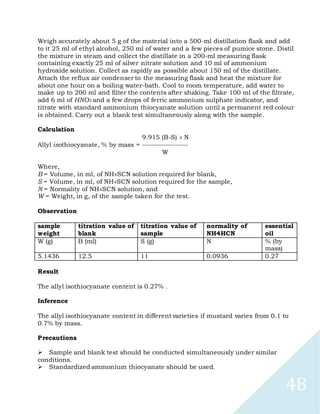
9.915 (B-S) N
Allyl isothiocyanate, % by mass = -------------------
W
Where,
B = Volume, in ml, of NH4SCN solution required for blank,
S = Volume, in ml, of NH4SCN solution required for the sample,
N = Normality of NH4SCN solution, and
W = Weight, in g, of the sample taken for the test.
Observation
sample
weight
titration value of
blank
titration value of
sample
normality of
NH4HCN
essential
oil
W (g) B (ml) S (g) N % (by
mass)
5.1436 12.5 11 0.0936 0.27
Result
The allyl isothiocyanate content is 0.27% .
Inference
The allyl isothiocyanate content in different varieties if mustard varies from 0.1 to
0.7% by mass.
Precautions

Sample and blank test should be conducted simultaneously under similar
conditions.
Standardized ammonium thiocyanate should be used.
49
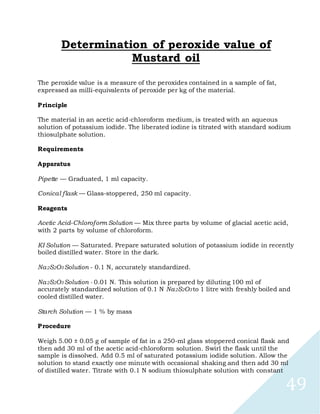
Determination of peroxide value of
Mustard oil
The peroxide value is a measure of the peroxides contained in a sample of fat,
expressed as milli-equivalents of peroxide per kg of the material.
Principle
The material in an acetic acid-chloroform medium, is treated with an aqueous
solution of potassium iodide. The liberated iodine is titrated with standard sodium
thiosulphate solution.
Requirements
Apparatus
Pipette — Graduated, 1 ml capacity.
Conical flask — Glass-stoppered, 250 ml capacity.
Reagents
Acetic Acid-Chloroform Solution — Mix three parts by volume of glacial acetic acid,
with 2 parts by volume of chloroform.
KI Solution — Saturated. Prepare saturated solution of potassium iodide in recently
boiled distilled water. Store in the dark.
Na2S2O3 Solution - 0.1 N, accurately standardized.
Na2S2O3 Solution - 0.01 N. This solution is prepared by diluting 100 ml of
accurately standardized solution of 0.1 N Na2S2O3 to 1 litre with freshly boiled and
cooled distilled water.
Starch Solution — 1 % by mass
Procedure
Weigh 5.00 ± 0.05 g of sample of fat in a 250-ml glass stoppered conical flask and
then add 30 ml of the acetic acid-chloroform solution. Swirl the flask until the
sample is dissolved. Add 0.5 ml of saturated potassium iodide solution. Allow the
solution to stand exactly one minute with occasional shaking and then add 30 ml
of distilled water. Titrate with 0.1 N sodium thiosulphate solution with constant
50
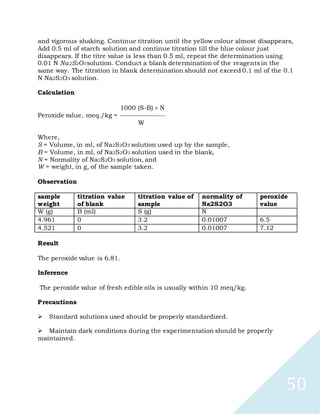
and vigorous shaking. Continue titration until the yellow colour almost disappears,
Add 0.5 ml of starch solution and continue titration till the blue colour just
disappears. If the titre value is less than 0.5 ml, repeat the determination using
0.01 N Na2S2O3 solution. Conduct a blank determination of the reagents in the
same way. The titration in blank determination should not exceed 0.1 ml of the 0.1
N Na2S2O3 solution.
Calculation
1000 (S-B) N
Peroxide value, meq./kg = -------------------
W
Where,
S = Volume, in ml, of Na2S2O3 solution used up by the sample,
B = Volume, in ml, of Na2S2O3 solution used in the blank,
N = Normality of Na2S2O3 solution, and
W = weight, in g, of the sample taken.
Observation
sample
weight
titration value
of blank
titration value of
sample
normality of
Na2S2O3
peroxide
value
W (g) B (ml) S (g) N
4.961 0 3.2 0.01007 6.5
4.521 0 3.2 0.01007 7.12
Result
The peroxide value is 6.81.
Inference
The peroxide value of fresh edible oils is usually within 10 meq/kg.
Precautions

Standard solutions used should be properly standardized.

Maintain dark conditions during the experimentation should be properly
maintained.
51
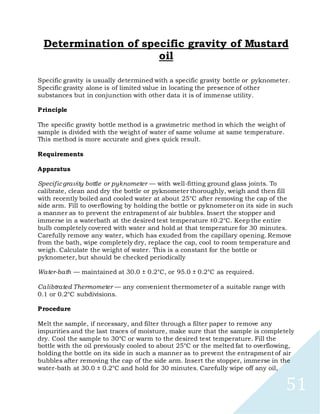
Determination of specific gravity of Mustard
oil
Specific gravity is usually determined with a specific gravity bottle or pyknometer.
Specific gravity alone is of limited value in locating the presence of other
substances but in conjunction with other data it is of immense utility.
Principle
The specific gravity bottle method is a gravimetric method in which the weight of
sample is divided with the weight of water of same volume at same temperature.
This method is more accurate and gives quick result.
Requirements
Apparatus
Specificgravity bottle or pyknometer — with well-fitting ground glass joints. To
calibrate, clean and dry the bottle or pyknometer thoroughly, weigh and then fill
with recently boiled and cooled water at about 25°C after removing the cap of the
side arm. Fill to overflowing by holding the bottle or pyknometer on its side in such
a manner as to prevent the entrapment of air bubbles. Insert the stopper and
immerse in a waterbath at the desired test temperature ±0.2°C. Keep the entire
bulb completely covered with water and hold at that temperature for 30 minutes.
Carefully remove any water, which has exuded from the capillary opening. Remove
from the bath, wipe completely dry, replace the cap, cool to room temperature and
weigh. Calculate the weight of water. This is a constant for the bottle or
pyknometer, but should be checked periodically
Water-bath — maintained at 30.0 ± 0.2°C, or 95.0 ± 0.2°C as required.
Calibtrated Thermometer — any convenient thermometer of a suitable range with
0.1 or 0.2°C subdivisions.
Procedure
Melt the sample, if necessary, and filter through a filter paper to remove any
impurities and the last traces of moisture, make sure that the sample is completely
dry. Cool the sample to 30°C or warm to the desired test temperature. Fill the
bottle with the oil previously cooled to about 25°C or the melted fat to overflowing,
holding the bottle on its side in such a manner as to prevent the entrapment of air
bubbles after removing the cap of the side arm. Insert the stopper, immerse in the
water-bath at 30.0 ± 0.2°C and hold for 30 minutes. Carefully wipe off any oil,
52
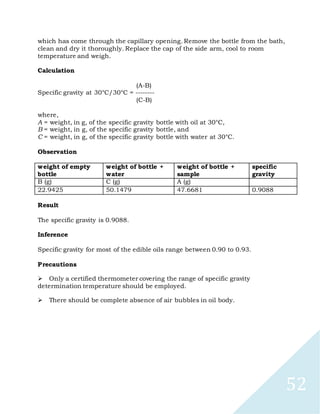
which has come through the capillary opening. Remove the bottle from the bath,
clean and dry it thoroughly. Replace the cap of the side arm, cool to room
temperature and weigh.
Calculation
(A-B)
Specific gravity at 30°C/30°C = --------
(C-B)
where,
A = weight, in g, of the specific gravity bottle with oil at 30°C,
B = weight, in g, of the specific gravity bottle, and
C = weight, in g, of the specific gravity bottle with water at 30°C.
Observation
weight of empty
bottle
weight of bottle +
water
weight of bottle +
sample
specific
gravity
B (g) C (g) A (g)
22.9425 50.1479 47.6681 0.9088
Result
The specific gravity is 0.9088.
Inference
Specific gravity for most of the edible oils range between 0.90 to 0.93.
Precautions

Only a certified thermometer covering the range of specific gravity
determination temperature should be employed.

There should be complete absence of air bubbles in oil body.
53
Determination of copper, zinc, lead and
cadmium in food products by Atomic
Absorption Spectroscopy
Food products contain substantial quantity of organic matter which must be
destroyed prior to the estimation of minerals. Dry ashing or wet digestion is
generally used for the destruction of organic matter. The wet digestion method is
more preferable to dry ashing method because some of minerals may loss during
dry ashing at high temperature. Atomic absorption spectroscopy is an important
analytical technique used for the detection and determination of metals in foods.
Atomic absorption spectrophotometer consists of hollow cathode lamp or
electrodeless discharge lamp, chopper, atomizer, monochromator, detector and
electronics. AAS technique offers specificity and more accuracy as compared to the
chemical methods.
Principle
The organic matter is removed by dry ashing or wet digestion. The residue is
dissolved in dilute acid and sprayed into the flame of an atomic absorption
spectrophotometer (AAS). The absorption or emission of the metal to be analysed is
measured at a specific wavelength. AAS determines a wide range of elements based
upon the principle of absorption of atoms. The liquid sample is aspirated and
atomized in the flame where it converts into atomic vapour in their ground state.
Atoms of metal of interest absorb the intensity of light from hollow cathode lamp.
The amount of light absorbed in flame is proportional concentration of metal in
solution.
Requirements
Apparatus
Silica crucible
Muffle furnace
Desiccator
Hot plate
AAS : Any instrument operating in absorption mode may be used providing it has
facilities for the selection of required oxidant/fuel combination from a choice of air,
nitrous oxide and acetylene and has wavelength ranges from 180 to 600 nm.
54
Light source : Hollow cathode or electrodeless discharge lamps
Reagents
Nitric acid (sp gr 1.42)
Sulphuric acid-98%
Hydrochloric acid-sp gr 1.16 to 1.18)
Standard solutions
Copper (100 ppm): Dissolve 3.928 g of pure copper/copper sulphate (CuSO4.5H2O)
in water, dilute to 1000 ml at 20C with water in a volumetric flask. Dilute 10 ml to
100 ml with water in a volumetric flask. One ml of solution contains 100 g Cu.
Zinc (100 ppm): Dissolve 1.000 g of pure zinc powder in 10 ml water, 5 ml of HCl
and dilute to 1000 ml at 20C with water in a volumetric flask. Dilute 10 ml to 100
ml with water in a volumetric flask. One ml of solution contains 100 g Zn.
Lead (100 ppm): Dissolve 1.000g of pure lead in 10 ml HNO3 in 1 litre volumetric
flask, dilute to 1000 ml at 20C with water in a volumetric flask. Dilute 10 ml to
100 ml with water in a volumetric flask. One ml of solution contains 100 g Pb.
Cadmium (100 ppm): Dissolve 2.282 g of CdSO4.8H2O in distilled water, dilute to
1000 ml at 20C with water in a volumetric flask. Dilute 10 ml to 100 ml with
water in a volumetric flask. One ml of solution contains 100 g Cd.
Procedure
Sample preparation
By dry ashing : Accurately weigh 5-10 g of sample into a dried, tared crucible. Heat
the dish on hot plate until fume cease and place the crucible in furnace
maintained at 55010C till white ash results. To the ash, add 5-10 ml of 6N HCl,
and heat to dryness at low temperature on a hot plate. Add 15 ml of 3N HCl and
heat on a hot plate until the solution just boils. Cool and filter through ashless
filter paper (Whatman 42) into 100 ml volumetric flask. Make up the volume with
distilled water. Prepare a reagent blank along with sample.
By Wet digestion : In case of dried products, take 2 g of the sample. If the sample
contains more moisture (>10%), take 5 g or more and transfer to a 500 ml Kjeldahl
flask. Add 10 ml of conc sulphuric acid and shake vigorously. Ensure that there
are no dry lumps. Add 5 ml of conc nitric acid and mix. Heat gently in a fume
cupboard until the initial vigorous reaction has subsided. Thereafter, heat
55
vigorously until most of the nitrous fume has ceased to evolve. Add nitric acid
dropwise and continue heating until all the organic matter is destroyed and white
fumes of sulphuric acid evolve. Cool the digest, add water again cool transfer to a
volumetric flask and make up the volume with water. Carry out a blank through
the operation using the same amount of reagents as in the case of sample.
Instrument conditions
Select the wavelength and gases to be used for the particular element
under consideration from table below:
Element Wavelength (nm) Gases
Zinc 213.9 Air/Acetylene
Copper 324.8 Air/Acetylene
Lead 217.0 Air/Acetylene
Cadmium 228.8 Air/Acetylene
The recommended settings for the various instrumental parameters vary from
model to model and certain parameters require optimization at the time of use to
obtain the best results. Instrument should therefore be adjusted as described in
the manufacturer’s instructions using the type of flame and wavelength settings
specified above. Set the AAS to appropriate condition. Measure the absorbance of
the standards. Instrument automatically will plot a graph showing net absorbance
against the concentration of element in standard solution.
Now read the blank and the sample solutions.
Calculation
Conc of element (g/ml) Dilution
Element in sample, mg/kg = ------------------------------------------
Weight of sample (g)
Precautions

Make sure that the sample is free from organic matter before reading in the
AAS.

Digest sample always in fuming cupboard.

Use hand gloves, mask and guggles for protection from acid fumes while
digesting the sample.

Thoroughly washed glassware should be used

Prepare standard solutions accurately
56
Determination of cholesterol content in ghee
by GC
Cholesterol is the most widely distributed sterol. It is found in animal body fat,
eggs, milk fat and even in some vegetable oils. Due to the relationship between
plasma cholesterol levels and the risk of coronary disease, the labeling of
cholesterol in packaged food products is become mandatory as per new integrated
food law.
Principle
The ghee sample is saponified using ethanolic KOH and the unsaponifiable matter
is extracted with petroleum ether. The cholesterol is then derivatized to
trimethylsilyl ether and quantified by GC. The separation of cholesterol from other
sterols on GC is based on the distribution of species between two non-miscible
phase in which the mobile phase is a carrier gas moving through or passing the
stationary phase contained in a column. It is applicable to substances or their
derivatives which are volatilized under the temperature employed.
Requirements
Apparatus
Gas chromatograph- Varian CP 3800 or any other model
Hot plate
Micropipette (20-200 l)
Vortex shaker
Weighing balance
Water bath
Rotary evaporator
Reagents
Dimethyl formamide (DMF)
Hexamethyl disilane (HMDS)
57
Trimethylchlorosilane (TMCS)
5-Cholestane (internal standard solution-100 g/ml in n-heptane)
Cholesterol stock solution-2 mg/ml in dimethyl formamide
Cholesterol working solution- Dilute stock solution to obtain 3 solutions at
concentration of 20, 100 and 200 g/ml.
Potassium hydroxide-50% w/w
Petroleum ether (40-60C)
Sodium sulphate (Anhydrous)
Glass wool
Procedure
Sample extraction
Accurately weigh 1 g of sample into a dried iodine flask. Add 40 ml of 95% ethanol
and 8 ml of 50%KOH to the flask. Place flask on hot plate and attach condenser
and reflux the sample for 7010 min. Rinse condenser with 95% ethanol. Remove
the flask from the reflux assembly and close with stopper and cool solution to room
temperature. Test solution is stable for 24 h. Pour the content into a 250 ml
separating funnel. Add 50 ml petroleum ether to it and stopper the funnel and
shake vigorously for 45 sec. Let the layer separate out and collect the aqueous
layer into a beaker and ether layer into another separating funnel. Pour again the
aqueous layer into separating funnel and extract with 50 ml of petroleum ether.
Repeat the extraction once again. Wash the extracted ether with water till the
aqueous layer becomes colourless with phenolphthalein. Filter ether into 250 ml
flask through sodium sulphate. Evaporate ether in flask to dryness on rotary
evaporator at 40C.
Sample derivatization
Pipette 1 ml aliquot of working standard solution and test solution into different
test tubes. Add 0.2 ml HMDS and 0.1 ml of TMCS to test tube and keep the
solutions undisturbed for 15 min. Stopper it and shake vigforously on vortex for 30
sec. Let stand solution undisturbed for 15 min and add 1 ml of 5-cholestane and
10 ml water to each test tube. Stopper the tubes and shake vigorously for 30 sec.
The heptane layer separates from the aqueous layer. Derivatized solutions must be
analyzed within 24 h.
58
Instrument conditions
Capillary column – HP-5 (30 m 320 m 0.25 m)
Detector- Hydrogen flame ionization detector (FID)/Temperature (300C)
Injector - 280C/ Split mode (Split ratio-1:2)
Oven - 270C hold 10 min, Increase 10C/min to 300C hold 5 min.
Flow rate – Helium column about 2 ml/min
Split vent about 30 ml/min
Purge vent about 3 ml/min
Auxillary make up gas about 20 ml/min
Hydrogen about 35 ml/min
Air about 280 ml/min
Calculation
Area of sample conc of std Dilutionpurity
Cholesterol, mg/kg = -------------------------------------------------------
Area of std sample weight (g)
Inference
The cholesterol content in some fat-riched food products are given in below.
Food products Total sterols, mg/kg Cholesterol, % sterols
Butter 2843-2746 98.3
Cod liver oil 4099 98.3
Beef 1350 98.4
Lard 1161 97.0
Coconut oil 1550-7797 0.6-3.0
Cottonseed oil 2690-6430 0.7-2.3
Palm oil 376-4000 2.6-7.0
Groundnut oil 901-2854 Trace-3.8
Precautions

Transfer the liquid during extraction carefully

Use dry glassware during derivatization.

For saponification, rinse the flask with ethanol after KOH addition in order to
prevent joint of flask with condenser from freezing together.

Prepare standard solutions accurately.

sri report work

  • 1.
    TECHNIQUES USED IN CHEMICAL ANALYSIS OF FOOD SUMMERINTERNSHIP REPORT SUBMITTED BY :- SANYA VASHISTH Btech Food Technology, Lady Irwin College, Delhi University.
  • 2.
    2 PREFACE This report documentthe worl done during the summer internship at SHRIRAM INSTITUTE FOR INDUSTRIAL RESEARCH (NEW DELHI). The report first shall give an overview of the tasks completed during th e period of internship with technical details I have tried my best to keep report simple and technically correct. I hope I have succeeded in my attempt SANYA VASHISTH
  • 3.
    3 TO WHOSOEVER ITMAY CONCERN This is to certify that Miss Sanya Vashisth, 2nd year, Btech Food Technology at Lady Irwin College, Delhi University has successfully completed her 15 days internship from 1st june 2015 to 15th june 2015 at SHRIRAM INSTITUTE FOR INDUSTRIAL RESEARCH (NEW DELHI ). During the period of her internship program with us, we found her sincere, hard working, technically sound and result oriented. She worked well as part of team during her tenure. We have given her the golden opportunity for her better future. Dr. S.K. Nayak Dr. M.L. Aggarwal Sr. Scientist Dy. Director
  • 4.
    4 CONTENTS I. Acknowledgement II. ShriramInstitute- At a Glance III. Introduction IV. Determination Of Moisture In Mustard Oil By Hot Air Oven Drying Method V. Determination of moisture in cumin seeds by Dean And Stark method VI. Determination of protein content by Kjeldahl method VII. Determination of crude fat in animal feed by soxhlet extraction method VIII. Determination of crude fibre in animal feed IX. Determination of total ash content in animal feed X. Determination of acid insoluble ash in animal feed XI. Determination of volatile oil in spices XII. Determination of free fatty acid and acid value in mustard oil XIII. Determination of colour in mustard oil by Lovibond Tintometer XIV. Determination of iodine value in mustard oil XV. Determination of saponification value in mustard oil XVI. Determination of unsaponificable matter in mustard oil XVII. Determination of allyl isothiocyanate in mustard oil XVIII. Determination of peroxide value in mustard oil XIX. Determination of specific gravity of mustard oil XX. Determination of copper, zinc, lead and cadmium in food products by Atomic Absorption Spectroscopy XXI. Determination of cholesterol content in ghee by GC
  • 5.
    5 ACKNOWLEDGEMENT I am thankfulto Lady Irwin College, Delhi University for providing me an opportunity and an open platform for learning I would like to thank Dr. K.M. Chacko, Director, Shriram Institute for Industrial Research, New Delhi, for providing me this valuable opportunity to undergo this training programme. I express my heartfelt gratitude to Dr. M.L. Aggarwal, Deputy Director (ASD/BIO) and Col. C.S. Ghosh, Deputy Director (Admin), SRI ,Delhi, for providing me an opportunity to undertake this training in Food And Farm Lab of SRI, Delhi. I am deeply indebted to Dr. S.K. Nayak, Sr. Scientist, SRI ,Delhi, who guided me time to time in learning the skills for testing and analytical studies in the field of Food Science. I would like to express my heartfelt gratitude to Dr. Sarabjeet kaur, Radhika Sharma, Neha Gupta, Dr. Anita Gaur , Dr. Veena Balyan , Pankaj And Shyam Singh Mehra, scientists of Food and Farm Lab, SRI, Delhi, for their valuable guidance and encouragement during the course of training programme. I am thankful to all the staff members of SRI, Delhi for their help and knowledge they have instilled in me. I would like to express my heartfelt thanks to my beloved parents for their blessings, love and support.
  • 6.
    6 Shriram Institute –At a Glance Profile Shriram Institute for Industrial Research (SRI) is an independent, self sustaining, not-for-profit multidisciplinary contract research institute conducting research and development in the areas of special significance to industry, government agencies and other organizations. SRI is committed to develop, innovate, analyse and apply technology for products and processes. SRI also brings its innovations to the marketplace by licensing its technologies and helps in establishing production units for the interested clients. SRI founded in 1947 by an illustrious founder Lala Shriram, started functioning in 1950. Lala Shriram believed that if India was to catch up with the rest of the world, it was necessary to understand existing technology and innovate it through research. SRI's strengths have been its staff , a knowledgeable, expert and experienced Governing Board and an innovative management. SRI is operational from Delhi and Bangalore. SRI's thrust areas are Materials Science, Analytical Science, Life Science, Irradiation of Medical and Surgical products and Quality Assurance. Recent thrust areas in material science includes Blood bags, Cactus Latex based products, Biomaterials, Materials for Aero Space Applications, Polymers for Electronics, Hightech Adhesives, Polymers, Composites, Specialty Chemicals, Renewable resources, Radiation based Technologies, Herbal Products, Waste Utilization, Technical Consultancy etc. The Analytical Sciences Division provides prompt, precise and dependable analytical services in the fields of metal and minerals, rubber and plastics, building materials, paper, leather and textiles, chemicals and agro chemicals, food and pharmaceuticals, petroleum products, home appliances and Microbiological studies. The Division standardises develop and validate new methods for analysis . It provides assistance to customers to ensure the quality of products laid down by various certifying agencies and statutory bodies. It also provides Calibration services. SRI's Life Sciences Division conducts research on various aspects of Environment including Biological Impact Studies, Rapid Environmental Impact Studies and Comprehensive Environmental Impact Studies. The Division undertakes
  • 7.
    7 toxicological studies toestablish safety levels of chemicals, agrochemicals and herbal products Shriram Applied Radiation Centre, SARC, established with the technical assistance of BARC, conducts research in polymer modifications and undertakes irradiation of life saving medical and surgical products and spices. SRI's uncompromising commitment to excellence in research is underscored by its own Quality Assurance Division which ensures that the Institute itself adheres to the highest standards of scientific investigation and service. Research & Development Since its inception, SRI has been maintaining its status as an independent, self- supporting contract research organization. It has been recognized as a pioneer contributor to Indian industry through its efforts with technologically innovative applied research approach. Over the years, the R&D activities of SRI have been expanded covering different areas of materials. The present activities of research involve:  Identification of new product, application, process and technology  Development of product, process and technology  Improvements in the existing product and process  Scale up studies to take up development work from lab scale to commercial scale  Cost effective measures either by suggesting alternative route or process of manufacturing of a particular product  Rendering technical help in preparation of product, application and safety data sheet for capturing market  Providing opinion report on the existing product as well as process  Product differentiation etc. The areas in which R&D is being actively pursued are quite varied from polymers, health care, waste utilization to food, agricultural and herbal products
  • 8.
    8 About Food andFarm Laboratory Thrust areas » Quality evaluation of various raw and processed food products » Quality evaluation of food additives and food packaging materials » Method development and validation of analytical techniques » Studies on product differentiation » Shelf life / stability studies of products at both ambient and accelerated conditions » Inspection and certification of product quality » Certification of packaging materials for food products » Certification of materials used for serving food products » Certification of organic food » Evaluation of contaminants in foods » Development of food products for special purpose
  • 9.
    9 INTRODUCTION Food is anysubstance which, when consumed orally by humans is utilized by the body in its normal metabolic activities. Food contains various nutrients such as proteins, carbohydrates, fats, minerals, vitamins etc., essential for the growth and healthcare of our body. All the nutrients get digested in our body and as a result they contribute to the wellbeing of our body. In addition, food may contain several indigestible materials which aid in peristalsis. Water present in food serves as a vehicle for transporting food and its constituents throughout the process of digestion into different organs of the human body. Water is the carrier for substances getting out of the food into the human blood, besides being the medium in which digestion process takes place. Further, water also carries the remaining of the digestion process i.e. waste materials from body and assists in the regulation of body temperature and other components such as flavouring agent, condiment, colour, etc., which aid in food acceptability. By the way, remember that the humans consume a significant amount of water for survival and since the water is also consumed orally, water is a food product. Food either raw or processed can be categorized into different groups: (a) Agricultural products (Cereals, pulses, fruits and vegetables), (b) Milk and dairy products, (c) Vegetable oils and fats, (d) Meat, fish and egg products, (e) Spices and condiments, (f) Sugar and confectionery (g) Alcoholic and non-alcoholic beverages. It is often desired to analyze a given food product any of the purposes as stated below: (i) Nutritional labelling or proximate analysis which involves the determination of moisture, protein, fat, carbohydrates, fibre, etc. (ii) Determination of purity of a food products, and (iii) Estimation of impurities present in the raw or the processed food product. In case of proximate analysis of foods, the methods may vary for different categories of food products. Therefore, the analytical methods need to be validated each time they are being used for different categories of food products. Analysis of food plays an important role not only for the assessment but also for the maintenance of food quality and safety, both for the industry manufacturing food products and for enforcement authorities engaged in ensuring the food safety and quality at the national and international levels. During earlier times, the food analysis was concerned more with the food adulteration but now-a-days there is an increasing tendency to examine food from a more positive view point. As a result,
  • 10.
    10 processed foods areproduced within the limits of prescribed manufacturing formulations, set also to comply with legal or other requirements. In many food laboratories, most of the routine works is confined to proximate analysis and the analysis of additives and contaminants, which is required at different stages of food processing right from farm to the final product. While most of the proximate analysis can be undertaken using wet chemical analysis, the analysis of additives and contaminants at very low level has necessitated the development of instrumental techniques, which are suitable for rapid assessment and control. The instrumental techniques are also required for the purpose of evaluating the food products from the point of view of contaminants and toxicants All sorts of analytical techniques are necessary in the development of food products and also in controlling the quality of food products. Knowledge of chemical composition of food products is important again not just for the purpose of the health and well being but also from the point of view of the health and safety of the consumers. Knowledge of the physico - chemical properties of foods is thus, important to ensure the health and health safety of the consumers. Besides this, the physico-chemical properties of food products are useful to manufacturers in understanding the importance of various nutritional constituents so that these may be maintained or improved during processing. The knowledge of principles of different food analysis techniques is useful to food analysts during select ion of appropriate techniques for analyzing a particular food. The compilation of physical and chemical techniques in this unit would be helpful to the graduate level students for understanding the basic principles of food analysis for the various physico –chemical parameters.
  • 11.
    11 Determination Of MoistureIn Mustard Oil By Hot Air Oven Drying Method Water, the simplest of all constituents of foods, is one of greatest concern to producer, manufacturer, processor, consumer and a food analyst. In cereals, pulses and flour, the moisture content usually ranges from 10 to 15%. In fruits and vegetables, the water content may be as high as 95%, and in starchy vegetables viz. potato and beans, it is normally 70 to 80%. Milk contains an average of 87% whereas lean meat and fish muscles contain about 50 to 70% moisture. Such a wide variation in moisture content may not a concern from the point of view of health safety of the raw and fresh food but it certainly is a matter of concern when one undertakes the processing of food products for value addition and for enhancement of the shelf-life. Understanding the variation of the moisture content with time during the period when the product is on the shelf, one can assess the quality and determine the shelf-life of the product. The accurate determination of moisture poses many challenges. One of the major problems is extracting the complete quantity of water from the food sample, thereby resulting in error in reporting the moisture content; lower than the actual moisture content. On the other hand, harsher conditions if applied to the food products although may result in removing all the moisture but simultaneously it would cause decomposition of the food product thereby resulting into total weight loss and thus again may give inaccurate results. Most of the methods for the estimation of water in foods depend on the loss in weight on heating. This method is not suitable for the determination of moisture in foods like milk products or mineral mixture. Principle Determination of the loss in mass on drying of a given material under specified condition gives a measure of moisture present in oil. Requirements Apparatus Moisture Dish - made of porcelain, silica, glass or aluminium. Oven - maintained at 105°C. Desiccator Procedure
  • 12.
    12 Weigh accurately about5 g of the prepared sample in the moisture dish, previously air dried in the oven and weighed. Place the dish in the oven maintained at 1051°C for 4 hours. Cool in the desiccator and weigh. Repeat the process of drying, cooling and weighing at 30 min intervals until the difference between the two consecutive weighing is less than 1 mg. Record the lowest weight. Calculation Moisture, % by mass = -100 (W1-W2) ---------------- W1-W Where, W1 = weight, in g, of the dish with the material before drying, W2 = weight, in g, of the dish with the material after drying, and W = weight, in g, of the empty dish. Observation Empty weight Dish + sample Dish + dried sample Moisture W W1 W2 % 70.7271 82.3912 82.3662 0.2142 73.9614 83.402 83.3782 0.2521 Result The moisture content of mustard oil came out to be 0.23 % Precautions  Use a calibrated analytical balance capable of weighing to an accuracy of 0.001g.  Use Grinding mill that is (a) made of material which does not absorb moisture; (b) easy to clean with as little dead space as possible; (c) able to grind rapidly and uniformly, without appreciable development of heat and, as far as possible, without contact with the outside air.  Use dish having an effective surface area enabling the test portion to be distributed so as to give a mass per unit area of not more than 0.3 g/cm2.
  • 13.
    13 Determination of moistureof cumin seeds by Dean & Stark method The loss in weight on heating is not entirely due to the moisture content but may also result due to the loss of volatile substances which are present in most of the foods. Most of the spices contain notable quantities of volatile oil which pass off with the water. The moisture content of spices and oils/fats containing 2% or more of water may be determined by Dean & Stark distillation method using xylene, toluene or heptane. Principle This method is based on the principle that during heating, water and any immiscible solvent (toluene or xylene) distil off together at a constant ratio (azeotropic property) at a temperature lower than the boiling point of either component. As water is denser than toluene/xylene, the water is collected in the receiver measuring tube where it separates from the extracting solvent. Requirements Apparatus Dean & Stark apparatus Heat source- an electric heater provided with a sliding rheostat or other means of heat control. Copper wire: long enough to extend through the condenser, with one end twisted into a spiral. The diameter of the spiral should be such that it fits within the graduated portion of the receiver and yet may be moved up and down. Reagents Potassium dichromate- sulphuric acid cleaning solution (Chromic acid solution) Xylene or toluene
  • 14.
    14 Figure 1. Dean& Stark Apparatus Procedure Clean the entire apparatus with potassium dichromate-sulphuric acid cleaning solution to minimize the adherence of water droplets to the sides of the condenser and the receiver. Rinse thoroughly with water and dry completely before using. Place the specified quantity of material, accurately weighed, in the distillation flask, add an equal volume of
  • 15.
    15 xylene or toluene,as desired, or at least 100 ml if less than 100 g of the material is used, and swirl to mix. Assemble the apparatus and fill the receiver with the solvent by pouring it through the condenser until it begins to overflow into the distillation flask. Insert a loose cotton plug in the top of the condenser to prevent condensation of atmospheric moisture within the tube. In order that the refluxing may be under control, wrap the flask and the tube leading to the receiver with asbestos cloth. Heat the flask so that the distillation rate is about 100 drops per minute. Purge the reflux condenser occasionally during the distillation with 5 ml portions of xylene or toluene to wash down any moisture adhering to the walls of the condenser. The water in the receiver may be made to separate from the xylene or toluene by moving the spiral copper wire up and down in the condenser and receiver occasionally, thus causing the water to settle at the bottom of the receiver. Reflux until the water-level in the receiver remains unchanged for 30 minutes and then shut off the source of heat. Flush the condenser with either xylene or toluene or cyclohexane, as required, making use of the spiral copper wire to discharge any moisture droplets. Immerse the receiver in water at about 27°C for at least 15 minutes or until the xylene or toluene or cyclohexane layer is clear, and then read the volume of water. Calculation V 100 Moisture, % (v/m) = ----------- W Where, V = volume, in ml, of water collected, and W = weight, in g, of the test sample taken. Observation Water collected weight of sample taken moisture V (ml) W (g) % 0.5 10 4.9943 Results & Inference The moisture content in cumin seeds was 4.99% Precautions  Sample should be properly ground and passed through sieve.  Calibrated dean and stark apparatus should be used. 
  • 16.
    16 Correction factor forvolume in calculation should be used while reporting the results.  The apparatus should be properly cleaned and dried before use.  Use calibrated receiver tube for collection of water
  • 17.
    17 Determination of proteincontent by Kjeldahl method The Kjeldahl method has a wide acceptance for the determination of protein in food products. The protein content of foods is usually calculated from total nitrogen by multiplying with a suitable conversion factor that is based upon the nitrogen % present in a particular protein. Principle The sample is oxidized in the presence of sulphuric acid and nitrogenous compounds are converted into ammonium sulphate. Mercury is added to the digestion mixture as a catalyst and alkali sulphate as a boiling point elevator. Ammonia is liberated by adding an excess of alkali and is quantitatively distilled into a measured volume of standard hydrochloric or sulphuric acid. The acid not neutralized by ammonia is back-titrated with standard alkali to give a measure of the nitrogen content in the sample. Equations Carbohydrate + Protein + Fat (NH4)2SO4 + CO2+ SO2 + H2O (NH4)2SO4 + 2NaOH 2NH4OH + Na2SO4 2NH4OH + H2SO4 (NH4)2SO4 + 2H2O Requirements Apparatus For Digestion Kjeldahl flasks (500 to 800 ml capacity) A heating device (heater/burner) For Distillation (A) Round bottom flask (1 litre capacity) (B) Splash head Neutralization (C) Condenser (Allihn type) (D) Trap (E) Beaker (500 ml capacity)
  • 18.
    18 (F) Receiving funnel Reagents ConcentratedSulphuric Acid, AR Grade Potassium Sulphate or Anhydrous Sodium Sulphate, AR Grade Sodium Hydroxide Solution - Dissolve about 450 g solid sodium hydroxide in distilled water, cool, and dilute for 1 litre. The specific gravity should be at least 1.36 at 20°C. Hydrochloric or Sulphuric Acid, Standard Solution: (0.1N or 0.5N). Prepare the standard solution as discussed in experiment No.1 (part-B). Standardize against sodium hydroxide standard solution. Sodium Hydroxide Standard Solution - 0.1 N. Standardize against primary standard and against standard acid solution. Methyl Red Indicator - Dissolve 1 g methyl red in 200 ml alcohol.
  • 19.
    19 Figure 2. Nitrogendistillation assembly Procedure Digestion Accurately weigh 0.7 to 2.2 g of the sample into the digestion flask. Add 0.7g mercury oxide or 0.65 g mercury and 15 g powdered potassium sulphate or anhydrous sodium sulphate, and 25 ml sulphuric acid. Ratio of salt to acid (m/v) should be approximately 1: 1 at the end of digestion for proper temperature control. Digestion may be incomplete at a lower ratio and nitrogen may be lost at a higher ratio. Each gram of fat consumes 10 ml and each gram of carbohydrate consumes 4 ml sulphuric acid during digestion. Place the flask in an inclined position on a heater and heat gently until foaming ceases. A small amount of paraffin or silicon antifoam may be added to reduce foaming. Boil vigorously until the solution becomes clear and then continue boiling it for 1 to 2 hours. Distillation Cool, add about 200 ml distilled water, and in order to avoid complex formation, add 25 ml of the sulphide or thiosulphate solution. Mix to precipitate the mercury. Add a few zinc granules to prevent bumping, incline flask, and add without agitation 25 g of sodium hydroxide as solid or equivalent as solution, to make
  • 20.
    20 solution strongly alkaline(thiosulphate or sulphide solution may be mixed with the sodium hydroxide solution before addition to the flask). Immediately connect flask to distillation bulb or trap on condenser, and, with tip of the condenser immersed in a measured quantity standard acid (usually 50 ml, 0.5 N or an appropriate quantity of 0.1 N ) in the receiver, rotate flask to mix the contents thoroughly; then heat immediately until all ammonia has distilled over ( at least 150 ml distillate ). Lower the receiver before stopping distillation and wash tip of condenser with distilled water. Back titrate excess acid with standard 0.1 N sodium hydroxide, using methyl red as indicator. Correct for blank determination in reagents. Blank - Conduct determinations using all reagents and 2 g of sugar. Calculation (B - S) x N 1.4 K Protein, % by mass = ------------------------- W where, B= volume, in ml, 0.1 N alkali used for titration for blank, S= volume, in ml 0.1 N alkali used for titration for sample, N= normality of alkali used for titration, K= Kjeldahl factor, and W= weight, in g, of sample taken for test. Inference Duplicate determinations of the nitrogen should agree within 0.05% nitrogen. Appropriate conversion factor for protein from nitrogen should be used for specific food samples. The following Kjeldahl factors are used for different food products in converting nitrogen to protein. S. No. Types of food material Kjeldahl factor 1. Rye, oat meal, whole wheat 5.83 2. Wheat flour & its products viz. bread, Macaroni,spaghetti, 5.70 3. Maize, rice polish, pulses, tea, cocoa, coffee, malt, beer, etc 6.25 4. Groundnut, brazil nut 5.46 5. Cashew, coconut & other tree nuts, sesame, safflower, sunflower, castor, cottonseed, linseed 5.30 6. Milk & milk products, margarine 6.38 7. Egg whole, egg powder, 6.68
  • 21.
    21 Precautions  Sample to beanalyzed should be homogeneous.  Determine the strength of NaOH before use.  Sample should be checked for complete digestion through colour and there should not be any presence of carbon particles adhering to the neck of Kjeldahl flask.
  • 22.
    22 Determination of crudefat in Animal feed by Soxhlet extraction method The crude fat content can be conveniently determined in foods by extracting the dried and ground material with petroleum ether or diethyl ether in Soxhlet extraction apparatus. Principle Extraction of the crude fat is carried out either with petroleum ether or diethyl ether in a Soxhlet unit followed by volatilization of the solvent after extraction and determination of the mass of the residue. Requirements Apparatus Soxhlet apparatus Reagent Diethyl Ether — anhydrous or Petroleum ether (bp. 60-80C) Procedure Extract 2 g of the ground material in a continuous extraction apparatus with ether for 18 hours. Remove the ether by distillation, followed by blowing with a stream of air, with the flask on a boiling water bath and dry in an oven at 110 ± 1°C till the loss in mass between two successive weighings is less than 2 mg. Shake the residue with 2 to 3 ml of ether at room temperature, allow to settle and decant the ether. Repeat the extraction until no more of the residue dissolves. Dry the flask again until the loss in mass between two successive weighing is less than 2 mg. Record the final mass.
  • 23.
    23 Figure 3. Soxhletextraction apparatus. Calculation (M1-M2) 100 Crude fat, % by mass = ------------------ M Where, M1 = mass, in g, of the Soxhlet flask with the extracted fat, M2 = mass, in g, of the empty Soxhlet flask, and M = mass, in g, of the material taken for the test. Observation sample weight empty weight of soxhlet soxhlet + extracted flask Fat M (g ) M (g) M (g) % 4.6746 112.4822 112.714 4.9587
  • 24.
    24 4.5668 110.4556 110.69985.3472 RESULT The crude fat present in animal feed is 5.15 % Precautions  The fat/oil obtained after drying should be clear and free from any particles. If the presence of particulate matter observed in the fat, the fat should be dissolved in petroleum ether again and filtered into other conical flask and dried.  If the charring of fat is observed during drying, discard the fat and repeat the experiment.
  • 25.
    25 Determination of crudefibre in animal feed The seed coat of oilseeds, nuts and pulses, peels of fruits and vegetables, and bran of cereals contain considerably more fibre than the softer edible inner tissues. So, the fibre content can be employed for assessing the proportion of outer coating of plant materials. The digestibility of food varies inversely with the crude fibre content. Principles The crude fibre represents the cell wall material left after boiling with dilute acid and alkali. It contains a mixture of cellulose, lignin and pentosans, together with sand, silica and other mineral matter locked in the tissues and a little nitrogenous matter. Requirements Reagents Sulphuric Acid — 0.255 N [1.25 percent ( m/v )], accurately prepared. Sodium Hydroxide Solution — 0.313 N [1.25 percent ( m/v )], accurately prepared. Procedure Weigh accurately about 2 g of the dried material and extract the fat for about 8 hours with petroleum ether or hexane, food grade, using a Soxhlet or other suitable extractor or use the residue from the crude fat determination. Transfer the fat-free dry residue to a one-litre conical flask. Take 200 ml of dilute sulphuric acid in a beaker and bring to the boil. Transfer the whole of the boiling acid to the flask containing the fat free material and immediately connect the flask with a reflux water condenser and heat, so that the contents of the flask begin to boil within one minute. Rotate the flask frequently, taking care to keep the material from remaining on the sides of the flask out of contact with the acid. Continue boiling for exactly 30 minutes. Remove the flask and filter through fine linen (about 18 threads to the centimeter) held in a funnel, and wash with boiling water until the washings are no longer acid to litmus. Bring to the boil some quantity of sodium hydroxide solution under a reflux condenser. Wash the residue on the linen into the flask with 200 ml of the boiling sodium hydroxide solution. Immediately connect the flask with the reflux condenser and boil for exactly 30 minutes. Remove the flask and immediately filter through the filtering cloth. Thoroughly wash the residue with boiling water and transfer to a Gooch crucible prepared with
  • 26.
    26 a thin butcompact layer of ignited asbestos. Wash the residue thoroughly first with hot water and then with about 15 ml of 95 percent (by volume) ethyl alcohol. Dry the Gooch crucible and contents at 105 ± 1°C in the air-oven to constant mass. Cool and weigh. Incinerate the contents of the Gooch crucible at 600 ± 20ºC in a muffle furnace until all the carbonaceous matter is burnt. Cool the Gooch crucible containing the ash in a desiccator and weigh. Calculation 100 (M1-M2)(100-f) Crude fibre, % by mass = ----------------------------- (on dry matter basis) M Where, M1 = mass in g of Gooch crucible and contents before ashing, M2 = mass in g of Gooch crucible containing asbestos and ash, f = crude fat (on moisture-free basis), percent by mass, and M = mass in g of the dried material taken for the test. Observation sample weight mass before ashing mass after ashing crude fibre M (g ) M1 (g) M2 (g) % 2.0204 31.9436 31.6997 12.0719 2.0405 29.889 29.443 11.9667 Result The crude fibre present in animal feed is 12.02 % Precautions  The fineness of the particles has an important bearing on the result accuracy. Hence, the sample should pass through a 1 mm sieve.  The concentration of sulphuric acid and sodium hydroxide is very important for the separation of other food constituents from crude fibre.  While dilution of sulphuric acid, always add acid to water but not water to acid.
  • 27.
    27 Determination of totalash contents In animal feed Total ash refers to the inorganic residue remaining after total incineration of organic matter present in food. Because of its non variable nature, the ash content can be used for assessing the quality of food product with respect to the presence of inorganic substance in it. Principle Ash refers to the inorganic residue remaining after total incineration of organic matter. The ash content is determined from the loss of weight, which occurs from complete oxidation of sample at a high temperature 500 to 600°C through combustion and volatilization of organic materials. Requirements Apparatus Flat-Bottom Dish - of stainless steel, porcelain, silica or platinum. Muffle Furnace maintained at 55010°C. Desiccator Procedure Weigh accurately about 3 g of the material in the dish, previously dried in an air- oven and weighed. Heat the dish gently on a flame at first and then strongly in a muffle furnace at 55010°C till grey ash results. Cool the dish in a desiccator and weigh. Heat the dish again at 55010°C for 30 minutes. Cool the dish in a desiccator and weigh. Repeat this process of heating for 30 minutes, cooling and weighing until the difference between two successive weighing is less than 1 mg. Record the lowest weight. Observation Calculation 100 (W2-W1) Total ash, % by mass = ----------------- W
  • 28.
    28 Where, W1 = weight,in g, of the empty crucible, W2 = weight, in g, of the crucible with ash, and W = weight, in g, of the test sample. Observation sample weight weight of empty crucible mass after ashing ash W (g ) W1 (g) W2 (g) % 2.0001 33.7174 33.8912 8.6896 Result The total ash present in animal feed is 8.7%. Precautions  The temperature of ashing is varied from product to product.  The use of higher temperature for ashing than the required temperature results low value of ash due to the loss of some inorganic matter like inorganic phosphate, sodium, etc.
  • 29.
    29 Determination of acidinsoluble ash in animal feed The acid insoluble ash is a measure of the sandy matter and plant body parts including calyx, leaves, etc, which contain higher content of noncombustible acid insoluble matter. Principle Acid insoluble ash is determined by dissolving ash in dilute hydrochloric acid (10% m/m), the liquid filtered through an ashless filter paper and thoroughly washed with hot water. The filter paper is then ignited in the original dish, cooled and weighed. Requirements Apparatus Flat-Bottom Dish - of stainless steel, porcelain, silica or platinum. MuffeFurnace - maintained at 55010°C. Desiccator Reagent Dilute Hydrochloric Acid (5N) Procedure To the ash contained in the dish, add 25 ml of dilute hydrochloric acid, cover with a watch-glass and heat on a water-bath for 10 minutes. Allow to cool and filter the contents of the dish through a Whatman filter paper No. 42 or its equivalent. Wash the filter paper with water until the washings are free from the acid and return them to the dish. Keep it in an oven maintained at 100 f 2°C for about 3 hours. Ignite in a muffle furnace at 550 f 10°C for one hour. Cool the dish in a desiccator and weigh. Heat the dish again at 55010°C for 30 minutes, cool in a desiccator and weigh. Repeat this process of heating for 30 minutes, cooling and weighing until the difference between two successive weighing is less than 1 mg. Record the lowest weight.
  • 30.
    30 Calculation 100 (W2-W1) Acid insolubleash, % by mass = ----------------- W Where, W1 = weight, in g, of the empty dish, W2 = weight, in g, of the dish with acid insoluble ash, and W = weight, in g, of the sample. Observation sample weight weight of empty crucible weight with acid insoluble ash ash W (g ) W(g) W (g) % 2.0001 33.7174 33.7352 0.89 Result The percentage amount of acid insoluble ash present is 0.89% . Precautions  Ashing should be proper.  Ashless filter paper should be used for the filtration.
  • 31.
    31 Determination of volatileoil in spices Volatile oil content is a measure of aroma strength of spices and condiments. The volatile oil content in different spices ranges from 1 to 12%. The volatile oil content varies with source, variety and seasons. Principle The method involves distilling the volatile oil over with boiling water, condensing and collecting the oil in a measured volume of xylene in a graduated tube, after cooling, direct reading from the volume of volatile oil separated from the distillate. Requirements Apparatus Volatile Oil Traps — Clevenger-type with joints. Flask with Magnetic Stirrer — 1 litre capacity round bottom and shortneck with standard joint and having egg-shaped magnetic stirrer bar. Reagent Xylene (A.R. grade) Figure 5. Apparatus for determination of volatile oil
  • 32.
    32 Procedure Transfer enough weighedsample to 1 litre flask to yield 2 to 4 ml volatile oil. Add water to fill flask to half-full. Insert stirring bar and place flask in heating mantle set over magnetic stirrer. Add antifoaming agent. Clean trap and condenser with chromic acid cleaning solution just before use and fill trap with water. Set the apparatus so that the condensate will not drop directly on surface of liquid in trap but will run down the sides. Start stirrer and heat mantle through variable transformer set at 90 Volts (63 Amp). If oil separates in graduated portion of trap or clings to walls, add several drops standard aqueous detergent solution through top of condenser. Repeat, if necessary (usually once is enough). Distil for 10 minutes after adding detergent to wash it out of trap. When density of oil is nearly 1 g/cc, as in cassia, or if oil separates into two fractions in trap, as in nutmeg and allspice, add 1 ml xylene, accurately measured, to lighter than water trap. Distil, until two consecutive readings taken at 1 hour intervals show no change in oil content (taken after 6 h); cool and read the volume of collected oil. If xylene was added, subtract its volume and report oil as ml per 100 g spice. NOTE 1 — With the material containing volatile oils lighter than water and fixed oils heavier than water like nutmeg, discontinue distillation when the fraction of oil obtained during 1 hour is heavier than water. NOTE 2 — To correct the unsatisfactory separation of oil and water, agitate the liquid in the trap with a copper wire through the condenser top. Measure the oil in the trap after allowing to stand until it is cooled. Report volatile oil in ml per 100 g of the material. Calculation a 100 Volatile oil, % v/m = ----------- b where, a = volume, in ml, of steam volatile oil collected through steam distillation; and b = mass, in g, of the sample taken. Observation
  • 33.
    33 extracted volatile oilmass of sample taken volatile oil a (g) b (g) % 0.5 25 2.001 Result The percentage of volatile oil present id 2.001 % Precautions  The apparatus should be cleaned before each distillation.  Clear separation of water and volatile oil is essential.  Distillation should be continued until successive readings of the volume of volatile oil are the same.
  • 34.
    34 Determination of freefatty acids and acid value in mustard oil The Acid value has wide implication in the oil refining industry. It conveys not only the quality of oil but also total quantity of alkali needed to neutralize the acidity in a particular batch for making it suitable for the purpose of hydrogenation or marketing of refined oil or fat of very low acidity. Acid value is a measure of the hydrolytic rancidity present in the sample. Principle The acid value is determined by directly titrating the material in an alcoholic medium with aqueous sodium or potassium hydroxide solution. Acid value is the number of mg of KOH required to neutralize the free fatty acids present in 1 g of the oil or fat. Free fatty acid is calculated as oleic, lauric, ricinoleic or palmitic acids. Requirements Reagents Ethyl Alcohol — 95%v/v, neutral to phenolphthalein indicator. Phenolphthalein Indicator Solution — Dissolve 1 g of phenolphthalein in 100 ml of ethyl alcohol. NOTE — When testing oils or fats which give dark coloured soap solution, the observation of the end point of the titration may be facilitated either (a) by using thymolphthalein or alkali blue 6B in place of phenolphthalein, or (b) by adding 1 ml of a 0.1%, w/v solution of methylene blue in water to each 100 ml of phenolphthalein indicator solution before the titration. Standard Aqueous Potassium Hydroxide or Sodium Hydroxide Solutions — 0.1 N or 0.5 N. Procedure Mix the oil or melted fat thoroughly before weighing. Weigh accurately a suitable quantity of the cooled oil or fat in a 200-ml conical flask. The weight of the oil or fat taken for the test and the strength of the alkali used for the titration shall be such that the volume of alkali required for the titration does not exceed 10 ml. Add 50 to 100 ml of freshly neutralized hot ethyl alcohol, and about 1 ml of phenolphthalein indicator solution. Boil the mixture for about five minutes and titrate while as hot
  • 35.
    35 as possible withstandard aqueous alkali solution, shaking vigorously during titration. Calculation 56.1 N V Acid value = ----------------- W Where, V = volume in ml of standard KOH/NaOH solution used, N = normality of standard KOH/NaOH solution, and W = weight in g of the material taken for the test. Observation sample weight sample titration normality ACID VALUE W (g) V (ml ) N 10.0554 1.9 0.01053 0.1116 Inference The acid value of commonly used edible oils is given as below. Type of oil Acid value Type of oil Acid value Coconut oil 0.5 Safflower oil 2.0 Cottonseed oil 0.3 Sunflower oil 0.5 Groundnut oil 0.5 Soybean oil 0.5 Mustard oil 0.5 Rice bran oil 0.5 Sesame oil 0.5 Palm oil 0.5 Precautions  The formation of two layers should be avoided by vigorous shaking so that the free acids do not get transferred into the ethanolic layer.  The freshly neutralized alcohol must also be hot at the time of addition.  The weight of the oil or fat taken for acidity determination and the strength of NaOH should be such that the volume of alkali used does not exceed 10 ml.
  • 36.
    36 Determination of colourof Mustard oil by Lovibond Tintometer Colour measurement on Lovibond scale is useful for determining the quality of oils and in the refining processes. Measurement of colour serves to check the bleaching processes also. Principles This method determines the colour of oils by comparison with Lovibond glasses of known colour characteristics. The colour is expressed as the sum total of the yellow and red slides used to match the colour of the oil in a cell of the specified size in the Lovibond tintometer. Requirements Apparatus Lovibond Tintometer or Colorimeter Glass Cells —The Lovibond cell designations namely, ¼”, ½”, 1” and 5¼” are recommended. Filter Paper Procedure Melt the sample, if it is not already liquid, and filter through a filter paper to remove any impurities and the last traces of moisture. Make sure that the sample is absolutely clear and free from turbidity. Clean the glass cell of the desired size with carbon tetrachloride and allow it to dry. Fill it with the clear filtered sample and place the cell in position in the tintometer. Place along side of it such red, yellow, blue or neutral Lovibond glass slides or any combinations of these as are necessary to match the colour shade of the oil, observing the colours of the oil and of the combination of the glass slides through an eyepiece. Calculation The dimensions of the cell used and the mode of expressing the colour reading for different oils shall be as follows: Colour reading in (*) cell = (aY + 5 b R ) or ( a Y + 10 b R)
  • 37.
    37 *Size designation ofthe cell used, where, a = the sum total of the various yellow (Y) slides used, and b = the sum total of the various red (R) slides used. Observation colour result 1/4 inch cell Y+5R 3R+11Y 26 Inference The maximum colour intensity of commonly used edible refined oils in Lovibond scale is given as below. Type of oil Y+5R units Type of oil Y+5R units Coconut oil 2 Safflower oil 15 Cottonseed oil 10 Sunflower oil 5 Groundnut oil 3 Soybean oil 20 Mustard oil 15 Rice bran oil 20 Sesame oil 2 Palm oil 50 Precautions  Fat should be melted and any oil or fat that is cloudy should be filtered at a temperature not more than 60C.  Colour readings need to be taken within a comparatively  Lamp should not be used continuously for long time.  During matching, the sample should be at room temperature for oils or not more than 10C above the melting point.  Do not strain your eyes for long time, allow to relax from time to time.
  • 38.
    38 Determination of iodinevalue in Mustard oil The glycerides of the unsaturated fatty acids unite with a definite amount of iodine and the iodine value is therefore a measure of the degree of unsaturation. Principle The material is treated, in carbon tetrachloride medium, with a known excess of iodine monochloride solution in glacial acetic acid (Wijs solution). The excess of iodine monochloride is treated with potassium iodide and the liberated iodine estimated by titration with sodium thiosulphate solution. Requirements Reagents Potassium Dichromate. Concentrated Hydrochloric Acid. Potassium Iodide Solution — Prepare a fresh solution by dissolving 10 g of KI free from potassium iodate, in 90 ml of water. Starch Solution — Triturate 5 g of starch and 0.01 g of mercuric iodide with 30 ml of cold water and slowly pour it with stirring into one litre of boiling water. Boil for three minutes. Allow to cool and decant off the supernatant clear liquid. Standard Sodium Thiosulphate Solution (0.1N). Glacial acetic Acid. Iodine Monochloride (ICl) — 98 %. Wijs Iodine Monochloride Solution Dissolve 10 ml of iodine monochloride in about 1800 ml of glacial acetic acid (chemically pure) and shake vigorously. Pipette 5 ml of this, add 10 ml of KI solution and titrate with 0.1 N standard Na2S2O3 solution, using starch solution as indicator. Adjust the volume of the solution till it is approximately 0.2 N. Carbon Tetrachloride or Chloroform — inert to Wijs solution.
  • 39.
    39 Procedure Melt the sampleif it is not already completely liquid, and filter through a filter paper to remove any impurities and the last traces of moisture. Make sure that the sample as well as the glass apparatus used is absolutely clean and dry. Weigh accurately, by difference, an appropriate quantity of the oil or fat, into a clean dry 500-ml iodine flask or well ground glass-stoppered bottle to which 25 ml of carbon Wijs solution and replace the glass stopper after wetting with KI solution; swirl for intimate mixing, and allow to stand in the dark for 30 min in the case of nondrying and semi-drying oils and 1 h in the case of drying oils. Carry out a blank test simultaneously under similar experimental conditions. After standing, add 15 ml of KI solution and 100 ml of water, rinsing in the stopper also, and titrate the liberated iodine with standard Na2S2O3 solution, swirling the contents of the bottle continuously to avoid any local excess until the colour of the solution is straw yellow. Add 1 ml of the starch solution and continue the titration until the blue colour formed disappears after thorough shaking with the stopper on. Calculation 12.69 (B-S) N Iodine value = -------------------- W Where, B = Volume, in ml, of Na2S2O3 solution required for the blank, S = volume, in ml, of Na2S2O3 solution required for the sample, N = normality of Na2S2O3 solution, and W = weight, in g, of the material taken for the test. Observation sample weight volume required for blank volume required for sample N of na2s2o3 iodine value W (g) B (ml) S (ml) N 0.2743 46.8 23.5 0.1007 108.5478 Result The iodine value is 108.54. Inference The range of iodine value for animal fats (30-70), non-drying oils ((80-110)), semi- drying oils (80-140) and drying oils (125- 200) and very small value for waxes. The iodine value of commonly used edible oils is given as below.
  • 40.
    40 Type of oilIodine value Type of oil Iodine value Coconut oil 7.5-10.5 Safflower oil 138-146 Cottonseed oil 98-115 Sunflower oil 100-140 Groundnut oil 87-98 Soybean oil 125-140 Mustard oil 98-110 Rice bran oil 90-105 Sesame oil 103-115 Palm oil 44-58 Precautions  As soon as Wij’s solution is added stopper the flask immediately.  Exactly for 30 minutes the flask should be kept in dark.  Exact and accurate weighing should be done according to the iodine value expected in the sample.  If B-S is greater than B/2, the test must be repeated using a lesser quantity of the sample.
  • 41.
    41 Determination of saponificationvalue in Mustard oil The number of milligrams of potassium hydroxide required to saponify completely one gram of oil or fat. When fat is saponified by refluxing with a known excess of alcoholic potassium hydroxide solution, the triglycerides hydrolyze, glycerol and soap are formed. The alkali consumed for this hydrolysis is a measure of the saponification value, which is determined by titrating the excess alkali with standard hydrochloric acid. Principle The material is saponified by refluxing with a known excess of alcoholic potassium hydroxide solution. The alkali consumed for saponification is determined by titrating the excess alkali with standard hydrochloric acid. Requirements Apparatus Conical Flasks — 250 to 300 ml capacity. Reflux Condenser —at least 65 cm long. Water-Bath or Electric Hot-Plate with Rheostat Control Reagents Alcoholic Potassium Hydroxide Solution — Dissolve 35 to 40 g of KOH in 20 ml of distilled water, and add sufficient aldehyde-free rectified spirit to make up to 1000 ml. Allow to stand overnight, decant the clear liquid and keep in a bottle closed tight with a cork or rubber stopper. Aldehyde-Free Rectified Spirit Reflux 1.2 litres of rectified spirit for 30 min in a round-bottom flask with 10 g of KOH and 6 g of granulated aluminium (or aluminium foil). Distil and collect one litre after discarding the first 50 ml. Phenolphthalein Indicator Solution — Dissolve 1.0 g of phenolphthalein in 100 ml of rectified spirit. NOTE - When testing oils or fats which give dark-coloured soap solutions, the observation of the end point of the titration may be facilitated either (a) by using thymolphthalein, or alkali blue 6B in place of phenolphthalein or (b) by adding 1
  • 42.
    42 ml of a0.1 % (w/v) solution of methylene blue in water to each 100 ml of phenolphthalein indicator solution before the titration. Standard Hydrochloric Acid (0.5 N). Procedure Melt the sample, if it is not already liquid, and filter through a filter paper to remove any impurities and the last traces of moisture. Make sure that the sample is completely dry. Mix the sample thoroughly, and weigh accurately by difference about 1.5 to 2.0 g of the sample in a conical flask. Add 25 ml of the alcoholic KOH solution and connect the reflux air condenser to the flask. Heat the flask on a water-bath or an electric hot plate for not more than 1 h. Boil gently but steadily until the sample is completely saponified as indicated by absence of any oily matter and appearance of clear solution. After the flask and condenser have cooled somewhat, wash down the inside of the condenser with about 10 ml of hot ethyl alcohol neutral to phenolphthalein. Add about 1 ml of phenolphthalein indicator solution, and titrate with standard hydrochloric acid. Prepare and conduct a blank determination at the same time. Calculation 56.1 (B-S) N Saponification value = ----------------- W Where, B = volume, in ml, of HCl required for the blank, S = volume, in ml, of HCl required for the sample, N = normality of HCl, and W = weight, in g, of the material taken for the test. Observation sample weight volume required for blank volume required for sample N of Hcl saponification value W (g) B (ml) S (ml) N 1.9751 32.5 19.6 0.4614 169.0601 2.001 32.5 19.4 0.4614 169.2590 Result The saponification value of mustard oil is 169.26 Inference The saponification value of commonly used edible oils is given as below.
  • 43.
    43 Type of oilSap. value Type of oil Sap. value Coconut oil 250-264 Safflower oil 189-195 Cottonseed oil 190-198 Sunflower oil 188-194 Groundnut oil 188-195 Soybean oil 189-195 Mustard oil 169-177 Rice bran oil 180-195 Sesame oil 188-193 Palm oil 195-205 Precautions  Alcoholic KOH should be prepared overnight.  Refluxing should not be done for more than one hour.  Condenser should be carefully washed with alcohol.  Blank determination should be carried out simultaneously along with the sample.
  • 44.
    44 Determination of unsaponifiablematter in mustard oil The unsaponifiable matter is that fraction of oil and fat, which is not saponified with caustic alkali but is soluble in non-polar solvents. The unsaponifiable matter in oil or fat consists of hydrocarbons, higher alcohols, oil-soluble vitamins and sterols, which are not soluble in water after esterification. Most oils and fats of normal purity contain less than 2% unsaponifiable matter. Higher value indicates the possibility of adulteration with mineral oil. Adulteration of oils and fats with paraffin hydrocarbons will appear in the unsaponifiable matter. Principle The material is completely saponified with alcoholic potassium hydroxide solution and extracted with petroleum ether. The petroleum ether extract is washed with aqueous alcohol and then again with water. The washed ether extract is evaporated and the residue weighed. Unsaponifiable matter is this residue minus the fatty acid present in it, which is determined by titration with sodium hydroxide solution in alcoholic medium. Requirements Apparatus Flat-Bottomed or Conical Flask — 250 to 300 ml capacity. An ordinary round, flat- bottomed flask, fitted with a long glass tube which acts as a condenser, may also be used. Separating Funnels — 500-ml capacity. Reagents Alcoholic Potassium Hydroxide Solution — Dissolve 70 to 80 g of potassium hydroxide in an equal quantity of distilled water, and add sufficient aldehyde-free ethyl alcohol (95 %v/v by volume), to make up to 1 litre. Allow to stand overnight, decant the clear liquid and keep in a bottle closed tightly with a cork or rubber stopper. Ethyl Alcohol — 95% v/v Phenolphthalein Indicator Solution — Dissolve 1 g of phenolphthalein in 100 ml of ethyl alcohol.
  • 45.
    45 Petroleum Ether —60-80C. AqueousAlcohol — containing 10 % v/v of ethyl alcohol. Standard Sodium Hydroxide Solution — approximately 0.02 N. Acetone — free from evaporation residue. Procedure Weigh accurately about 5 g of the well-mixed sample into the flask. Add 50 ml of alcoholic potassium hydroxide solution. Boil gently but steadily under a reflux condenser for one hour or until the saponification is complete. Wash the condenser with about 10 ml of ethyl alcohol. Cool the mixture and transfer it to a separating funnel. Complete the transfer by washing the flask first with some ethyl alcohol and then with cold water. Altogether, add 50 ml of water to the separating funnel followed by an addition of 50 ml of petroleum ether. Insert the stopper and shake vigorously for at least one minute and allow to settle until both the layers are clear. Transfer the lower layer containing the soap solution to another separating funnel, and repeat the ether extraction at least six times more using 50 ml of petroleum ether for each extraction. If any emulsion is formed, add a small quantity of ethyl alcohol or alcoholic potassium hydroxide solution. Collect all the ether extracts in a separating funnel. Wash the combined extracts in the funnel three times with 25-ml portions of aqueous alcohol shaking vigorously and drawing off the alcohol-water layer after each washing. Again wash the ether layer successively with 20-ml portions of water until the wash-water no longer turns pink on addition of a few drops of phenolphthalein indicator solution. Do not remove any of the ether layers. Transfer the ether layer to a tared flask containing a few pieces of pumice stone, and evaporate to dryness on a water-bath under a gentle stream of clean dry air. To remove the last traces of ether, place the flask in an air-oven at 80 to 90°C for about 1 h. To remove the last traces of moisture, add a few ml of acetone and pass a gentle stream of clean dry air over the surface of the material or evacuate using a water vacuum pump at about 50°C for about 15 min. Cool in a desiccator and weigh. Repeat the evacuating, cooling and weighing until a constant weight is obtained. After weighing, take up the residue in 50 ml of warm neutral ethyl alcohol, containing a few drops of phenolphthalein indicator solution and titrate with standard sodium hydroxide solution. Calculation (A-B) 100 Unsaponifiable matter, % by mass = ----------------- W
  • 46.
    46 Where, A = weight,in g, of the residue, B = weight, in g, of the fatty acids in the extract (B = 0.282VN), V = volume, in ml, of NaOH solution, N = normality of NaOH solution, and W = weight, in g, of the material taken for the test. Observation sample weight weight of flask +sample weight residue volume of Naoh used fatty acids in extract USM W (g) A (g) V (ml) B % 5.0282 140.2574 0.468 0.3 0.0084 0.7632 Result The unsaponifiable matter present is 0.77% . Inference The unsaponifiable matter content in commonly used edible oils is given as below. Type of oil Unsap. matter Type of oil Unsap. matter Coconut oil 0.2-0.5 Safflower oil 0.5-1.5 Cottonseed oil 0.6-1.6 Sunflower oil 0.3-1.5 Groundnut oil 0.2-1.0 Soybean oil 0.2-1.5 Mustard oil 0.9-1.2 Rice bran oil 3-5 Sesame oil 0.7-1.8 Palm oil 0.2-1.2 Precautions  The unsaponified portion must be washed free of alkali and this should be ascertained with phenolphthalein.  As a check residue is dissolved in 10 ml accurately neutralized alcohol and titrated with 0.1N NaOH solution using phenolphthalein as indicator. If more than 0.1 ml of alkali is consumed it demands repetition of the experiment.  Sufficient time should be given for the complete separation of ether and aqueous phases.  Formation of emulsion should be prevented by adding small quantities of alcohol or conc KOH and NaCl solution. Formation of emulsions which are difficult to break leading to a loss of quantitative accuracy.
  • 47.
    47 Determination of allylisothiocyanate in mustard oil The oil obtained from mustard seeds and rape seeds contains sinigrin and myrosin (glucosinolates), which are sources of goitrogens. As such they are relatively non- toxic but their hydrolysis products include allyl isothiocyanates and oxazolidinethiones, which are powerful goitrogens, producing varying manifestations of toxicity in non-ruminants. Principle The allyl isothiocyanate in the oil is steam distilled into a known excess of silver nitrate solution, and the excess of silver nitrate solution is determined by titration with standard ammonium thiocyanate solution. Requirements Apparatus Distillation Flask — 500 ml round-bottomed flask. Any EfficientReflux Condenser (~ 90 cm long). Measuring Flask — 200 ml capacity. Water-Bath Reagents Ethyl Alcohol — 95%, v/v neutral to phenolphthalein. Silver Nitrate Solution —0.1 N. Ammonium Hydroxide Solution — 10 % (w/v). Conc. HNO3 Ferric ammonium sulphate Indicator — 0.1 % solution in water. Standard Ammonium Thiocyanate (NH4SCN) Solution —0.1 N. Procedure
  • 48.
    48 Weigh accurately about5 g of the material into a 500-ml distillation flask and add to it 25 ml of ethyl alcohol, 250 ml of water and a few pieces of pumice stone. Distil the mixture in steam and collect the distillate in a 200-ml measuring flask containing exactly 25 ml of silver nitrate solution and 10 ml of ammonium hydroxide solution. Collect as rapidly as possible about 150 ml of the distillate. Attach the reflux air condenser to the measuring flask and heat the mixture for about one hour on a boiling water-bath. Cool to room temperature, add water to make up to 200 ml and filter the contents after shaking. Take 100 ml of the filtrate, add 6 ml of HNO3 and a few drops of ferric ammonium sulphate indicator, and titrate with standard ammonium thiocyanate solution until a permanent red colour is obtained. Carry out a blank test simultaneously along with the sample. Calculation 9.915 (B-S) N Allyl isothiocyanate, % by mass = ------------------- W Where, B = Volume, in ml, of NH4SCN solution required for blank, S = Volume, in ml, of NH4SCN solution required for the sample, N = Normality of NH4SCN solution, and W = Weight, in g, of the sample taken for the test. Observation sample weight titration value of blank titration value of sample normality of NH4HCN essential oil W (g) B (ml) S (g) N % (by mass) 5.1436 12.5 11 0.0936 0.27 Result The allyl isothiocyanate content is 0.27% . Inference The allyl isothiocyanate content in different varieties if mustard varies from 0.1 to 0.7% by mass. Precautions  Sample and blank test should be conducted simultaneously under similar conditions. Standardized ammonium thiocyanate should be used.
  • 49.
    49 Determination of peroxidevalue of Mustard oil The peroxide value is a measure of the peroxides contained in a sample of fat, expressed as milli-equivalents of peroxide per kg of the material. Principle The material in an acetic acid-chloroform medium, is treated with an aqueous solution of potassium iodide. The liberated iodine is titrated with standard sodium thiosulphate solution. Requirements Apparatus Pipette — Graduated, 1 ml capacity. Conical flask — Glass-stoppered, 250 ml capacity. Reagents Acetic Acid-Chloroform Solution — Mix three parts by volume of glacial acetic acid, with 2 parts by volume of chloroform. KI Solution — Saturated. Prepare saturated solution of potassium iodide in recently boiled distilled water. Store in the dark. Na2S2O3 Solution - 0.1 N, accurately standardized. Na2S2O3 Solution - 0.01 N. This solution is prepared by diluting 100 ml of accurately standardized solution of 0.1 N Na2S2O3 to 1 litre with freshly boiled and cooled distilled water. Starch Solution — 1 % by mass Procedure Weigh 5.00 ± 0.05 g of sample of fat in a 250-ml glass stoppered conical flask and then add 30 ml of the acetic acid-chloroform solution. Swirl the flask until the sample is dissolved. Add 0.5 ml of saturated potassium iodide solution. Allow the solution to stand exactly one minute with occasional shaking and then add 30 ml of distilled water. Titrate with 0.1 N sodium thiosulphate solution with constant
  • 50.
    50 and vigorous shaking.Continue titration until the yellow colour almost disappears, Add 0.5 ml of starch solution and continue titration till the blue colour just disappears. If the titre value is less than 0.5 ml, repeat the determination using 0.01 N Na2S2O3 solution. Conduct a blank determination of the reagents in the same way. The titration in blank determination should not exceed 0.1 ml of the 0.1 N Na2S2O3 solution. Calculation 1000 (S-B) N Peroxide value, meq./kg = ------------------- W Where, S = Volume, in ml, of Na2S2O3 solution used up by the sample, B = Volume, in ml, of Na2S2O3 solution used in the blank, N = Normality of Na2S2O3 solution, and W = weight, in g, of the sample taken. Observation sample weight titration value of blank titration value of sample normality of Na2S2O3 peroxide value W (g) B (ml) S (g) N 4.961 0 3.2 0.01007 6.5 4.521 0 3.2 0.01007 7.12 Result The peroxide value is 6.81. Inference The peroxide value of fresh edible oils is usually within 10 meq/kg. Precautions  Standard solutions used should be properly standardized.  Maintain dark conditions during the experimentation should be properly maintained.
  • 51.
    51 Determination of specificgravity of Mustard oil Specific gravity is usually determined with a specific gravity bottle or pyknometer. Specific gravity alone is of limited value in locating the presence of other substances but in conjunction with other data it is of immense utility. Principle The specific gravity bottle method is a gravimetric method in which the weight of sample is divided with the weight of water of same volume at same temperature. This method is more accurate and gives quick result. Requirements Apparatus Specificgravity bottle or pyknometer — with well-fitting ground glass joints. To calibrate, clean and dry the bottle or pyknometer thoroughly, weigh and then fill with recently boiled and cooled water at about 25°C after removing the cap of the side arm. Fill to overflowing by holding the bottle or pyknometer on its side in such a manner as to prevent the entrapment of air bubbles. Insert the stopper and immerse in a waterbath at the desired test temperature ±0.2°C. Keep the entire bulb completely covered with water and hold at that temperature for 30 minutes. Carefully remove any water, which has exuded from the capillary opening. Remove from the bath, wipe completely dry, replace the cap, cool to room temperature and weigh. Calculate the weight of water. This is a constant for the bottle or pyknometer, but should be checked periodically Water-bath — maintained at 30.0 ± 0.2°C, or 95.0 ± 0.2°C as required. Calibtrated Thermometer — any convenient thermometer of a suitable range with 0.1 or 0.2°C subdivisions. Procedure Melt the sample, if necessary, and filter through a filter paper to remove any impurities and the last traces of moisture, make sure that the sample is completely dry. Cool the sample to 30°C or warm to the desired test temperature. Fill the bottle with the oil previously cooled to about 25°C or the melted fat to overflowing, holding the bottle on its side in such a manner as to prevent the entrapment of air bubbles after removing the cap of the side arm. Insert the stopper, immerse in the water-bath at 30.0 ± 0.2°C and hold for 30 minutes. Carefully wipe off any oil,
  • 52.
    52 which has comethrough the capillary opening. Remove the bottle from the bath, clean and dry it thoroughly. Replace the cap of the side arm, cool to room temperature and weigh. Calculation (A-B) Specific gravity at 30°C/30°C = -------- (C-B) where, A = weight, in g, of the specific gravity bottle with oil at 30°C, B = weight, in g, of the specific gravity bottle, and C = weight, in g, of the specific gravity bottle with water at 30°C. Observation weight of empty bottle weight of bottle + water weight of bottle + sample specific gravity B (g) C (g) A (g) 22.9425 50.1479 47.6681 0.9088 Result The specific gravity is 0.9088. Inference Specific gravity for most of the edible oils range between 0.90 to 0.93. Precautions  Only a certified thermometer covering the range of specific gravity determination temperature should be employed.  There should be complete absence of air bubbles in oil body.
  • 53.
    53 Determination of copper,zinc, lead and cadmium in food products by Atomic Absorption Spectroscopy Food products contain substantial quantity of organic matter which must be destroyed prior to the estimation of minerals. Dry ashing or wet digestion is generally used for the destruction of organic matter. The wet digestion method is more preferable to dry ashing method because some of minerals may loss during dry ashing at high temperature. Atomic absorption spectroscopy is an important analytical technique used for the detection and determination of metals in foods. Atomic absorption spectrophotometer consists of hollow cathode lamp or electrodeless discharge lamp, chopper, atomizer, monochromator, detector and electronics. AAS technique offers specificity and more accuracy as compared to the chemical methods. Principle The organic matter is removed by dry ashing or wet digestion. The residue is dissolved in dilute acid and sprayed into the flame of an atomic absorption spectrophotometer (AAS). The absorption or emission of the metal to be analysed is measured at a specific wavelength. AAS determines a wide range of elements based upon the principle of absorption of atoms. The liquid sample is aspirated and atomized in the flame where it converts into atomic vapour in their ground state. Atoms of metal of interest absorb the intensity of light from hollow cathode lamp. The amount of light absorbed in flame is proportional concentration of metal in solution. Requirements Apparatus Silica crucible Muffle furnace Desiccator Hot plate AAS : Any instrument operating in absorption mode may be used providing it has facilities for the selection of required oxidant/fuel combination from a choice of air, nitrous oxide and acetylene and has wavelength ranges from 180 to 600 nm.
  • 54.
    54 Light source :Hollow cathode or electrodeless discharge lamps Reagents Nitric acid (sp gr 1.42) Sulphuric acid-98% Hydrochloric acid-sp gr 1.16 to 1.18) Standard solutions Copper (100 ppm): Dissolve 3.928 g of pure copper/copper sulphate (CuSO4.5H2O) in water, dilute to 1000 ml at 20C with water in a volumetric flask. Dilute 10 ml to 100 ml with water in a volumetric flask. One ml of solution contains 100 g Cu. Zinc (100 ppm): Dissolve 1.000 g of pure zinc powder in 10 ml water, 5 ml of HCl and dilute to 1000 ml at 20C with water in a volumetric flask. Dilute 10 ml to 100 ml with water in a volumetric flask. One ml of solution contains 100 g Zn. Lead (100 ppm): Dissolve 1.000g of pure lead in 10 ml HNO3 in 1 litre volumetric flask, dilute to 1000 ml at 20C with water in a volumetric flask. Dilute 10 ml to 100 ml with water in a volumetric flask. One ml of solution contains 100 g Pb. Cadmium (100 ppm): Dissolve 2.282 g of CdSO4.8H2O in distilled water, dilute to 1000 ml at 20C with water in a volumetric flask. Dilute 10 ml to 100 ml with water in a volumetric flask. One ml of solution contains 100 g Cd. Procedure Sample preparation By dry ashing : Accurately weigh 5-10 g of sample into a dried, tared crucible. Heat the dish on hot plate until fume cease and place the crucible in furnace maintained at 55010C till white ash results. To the ash, add 5-10 ml of 6N HCl, and heat to dryness at low temperature on a hot plate. Add 15 ml of 3N HCl and heat on a hot plate until the solution just boils. Cool and filter through ashless filter paper (Whatman 42) into 100 ml volumetric flask. Make up the volume with distilled water. Prepare a reagent blank along with sample. By Wet digestion : In case of dried products, take 2 g of the sample. If the sample contains more moisture (>10%), take 5 g or more and transfer to a 500 ml Kjeldahl flask. Add 10 ml of conc sulphuric acid and shake vigorously. Ensure that there are no dry lumps. Add 5 ml of conc nitric acid and mix. Heat gently in a fume cupboard until the initial vigorous reaction has subsided. Thereafter, heat
  • 55.
    55 vigorously until mostof the nitrous fume has ceased to evolve. Add nitric acid dropwise and continue heating until all the organic matter is destroyed and white fumes of sulphuric acid evolve. Cool the digest, add water again cool transfer to a volumetric flask and make up the volume with water. Carry out a blank through the operation using the same amount of reagents as in the case of sample. Instrument conditions Select the wavelength and gases to be used for the particular element under consideration from table below: Element Wavelength (nm) Gases Zinc 213.9 Air/Acetylene Copper 324.8 Air/Acetylene Lead 217.0 Air/Acetylene Cadmium 228.8 Air/Acetylene The recommended settings for the various instrumental parameters vary from model to model and certain parameters require optimization at the time of use to obtain the best results. Instrument should therefore be adjusted as described in the manufacturer’s instructions using the type of flame and wavelength settings specified above. Set the AAS to appropriate condition. Measure the absorbance of the standards. Instrument automatically will plot a graph showing net absorbance against the concentration of element in standard solution. Now read the blank and the sample solutions. Calculation Conc of element (g/ml) Dilution Element in sample, mg/kg = ------------------------------------------ Weight of sample (g) Precautions  Make sure that the sample is free from organic matter before reading in the AAS.  Digest sample always in fuming cupboard.  Use hand gloves, mask and guggles for protection from acid fumes while digesting the sample.  Thoroughly washed glassware should be used  Prepare standard solutions accurately
  • 56.
    56 Determination of cholesterolcontent in ghee by GC Cholesterol is the most widely distributed sterol. It is found in animal body fat, eggs, milk fat and even in some vegetable oils. Due to the relationship between plasma cholesterol levels and the risk of coronary disease, the labeling of cholesterol in packaged food products is become mandatory as per new integrated food law. Principle The ghee sample is saponified using ethanolic KOH and the unsaponifiable matter is extracted with petroleum ether. The cholesterol is then derivatized to trimethylsilyl ether and quantified by GC. The separation of cholesterol from other sterols on GC is based on the distribution of species between two non-miscible phase in which the mobile phase is a carrier gas moving through or passing the stationary phase contained in a column. It is applicable to substances or their derivatives which are volatilized under the temperature employed. Requirements Apparatus Gas chromatograph- Varian CP 3800 or any other model Hot plate Micropipette (20-200 l) Vortex shaker Weighing balance Water bath Rotary evaporator Reagents Dimethyl formamide (DMF) Hexamethyl disilane (HMDS)
  • 57.
    57 Trimethylchlorosilane (TMCS) 5-Cholestane (internalstandard solution-100 g/ml in n-heptane) Cholesterol stock solution-2 mg/ml in dimethyl formamide Cholesterol working solution- Dilute stock solution to obtain 3 solutions at concentration of 20, 100 and 200 g/ml. Potassium hydroxide-50% w/w Petroleum ether (40-60C) Sodium sulphate (Anhydrous) Glass wool Procedure Sample extraction Accurately weigh 1 g of sample into a dried iodine flask. Add 40 ml of 95% ethanol and 8 ml of 50%KOH to the flask. Place flask on hot plate and attach condenser and reflux the sample for 7010 min. Rinse condenser with 95% ethanol. Remove the flask from the reflux assembly and close with stopper and cool solution to room temperature. Test solution is stable for 24 h. Pour the content into a 250 ml separating funnel. Add 50 ml petroleum ether to it and stopper the funnel and shake vigorously for 45 sec. Let the layer separate out and collect the aqueous layer into a beaker and ether layer into another separating funnel. Pour again the aqueous layer into separating funnel and extract with 50 ml of petroleum ether. Repeat the extraction once again. Wash the extracted ether with water till the aqueous layer becomes colourless with phenolphthalein. Filter ether into 250 ml flask through sodium sulphate. Evaporate ether in flask to dryness on rotary evaporator at 40C. Sample derivatization Pipette 1 ml aliquot of working standard solution and test solution into different test tubes. Add 0.2 ml HMDS and 0.1 ml of TMCS to test tube and keep the solutions undisturbed for 15 min. Stopper it and shake vigforously on vortex for 30 sec. Let stand solution undisturbed for 15 min and add 1 ml of 5-cholestane and 10 ml water to each test tube. Stopper the tubes and shake vigorously for 30 sec. The heptane layer separates from the aqueous layer. Derivatized solutions must be analyzed within 24 h.
  • 58.
    58 Instrument conditions Capillary column– HP-5 (30 m 320 m 0.25 m) Detector- Hydrogen flame ionization detector (FID)/Temperature (300C) Injector - 280C/ Split mode (Split ratio-1:2) Oven - 270C hold 10 min, Increase 10C/min to 300C hold 5 min. Flow rate – Helium column about 2 ml/min Split vent about 30 ml/min Purge vent about 3 ml/min Auxillary make up gas about 20 ml/min Hydrogen about 35 ml/min Air about 280 ml/min Calculation Area of sample conc of std Dilutionpurity Cholesterol, mg/kg = ------------------------------------------------------- Area of std sample weight (g) Inference The cholesterol content in some fat-riched food products are given in below. Food products Total sterols, mg/kg Cholesterol, % sterols Butter 2843-2746 98.3 Cod liver oil 4099 98.3 Beef 1350 98.4 Lard 1161 97.0 Coconut oil 1550-7797 0.6-3.0 Cottonseed oil 2690-6430 0.7-2.3 Palm oil 376-4000 2.6-7.0 Groundnut oil 901-2854 Trace-3.8 Precautions  Transfer the liquid during extraction carefully  Use dry glassware during derivatization.  For saponification, rinse the flask with ethanol after KOH addition in order to prevent joint of flask with condenser from freezing together.  Prepare standard solutions accurately.