INDUSTRIALTRAININGAT
SRI LANKA RAILWAYS (SLR)
26th January 2015 - 24th April 2015
Lakshitha M.A.R
EG/2012/1980
Department of Mechanical and Manufacturing
Faculty of Engineering
University of Ruhuna
Presentation Outline
 Introduction to Sri Lanka Railways
 Introduction to the training establishment
 Chief Mechanical Engineer’s workshops
 Safety management
 Training experience
 Suggestions
1 of 14
Introduction to Sri Lanka Railways
History
Introduced in Sri Lanka in 1864 to transport coffee by the British colonial government. Till 1953,
Ceylon's railways operated steam locomotives. In the golden era, it enhanced its service by changing to
diesel locomotives, under the leadership of most respected chief mechanical engineer B.D Rampala.
Services
Operates both intercity and express services, connecting major population centres, and commuter rail,
serving Colombo commuter traffic. The railways also transport freight.
Sri Lanka Railway department is Sri Lanka's railway owner and primary operator. Presently the Sri
Lankan Railway network consists of 1,508 kilometers.
2 of 14
Introduction to the Training Establishment
Vision
To provide technical training conforming to international standard in order to produce
competent and skilled man power required to maintain timely operated efficient
steady and reliable passenger and good train series.
Mission
To become the training institute with the highest level of acceptance in Sri Lanka in
order to produce skilled craftsman having national vocational skill level who are
capable to go forward with a new technical developments to railway and Sri Lanka.
Sri Lanka German Railway technical training center is the key organization which
provides railway technicians to the nation.
3 of 14
Chief Mechanical Engineer’s workshops
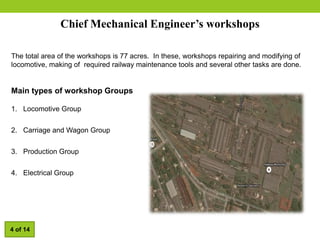
The total area of the workshops is 77 acres. In these, workshops repairing and modifying of
locomotive, making of required railway maintenance tools and several other tasks are done.
Main types of workshop Groups
1. Locomotive Group
2. Carriage and Wagon Group
3. Production Group
4. Electrical Group
4 of 14
Diesel Electric Locomotive
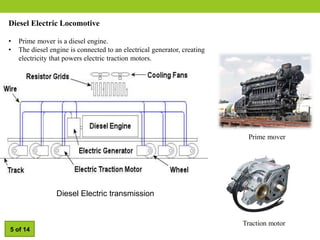
• Prime mover is a diesel engine.
• The diesel engine is connected to an electrical generator, creating
electricity that powers electric traction motors.
Diesel Electric transmission
Prime mover
Traction motor
5 of 14
Diesel Engine Auxiliaries
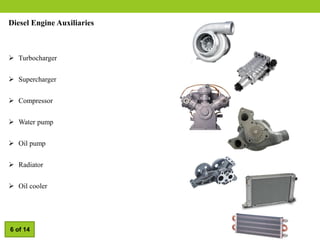
 Turbocharger
 Supercharger
 Compressor
 Water pump
 Oil pump
 Radiator
 Oil cooler
6 of 14
Fuel Injection
Atomizing fuel through a small nozzle under high pressure,
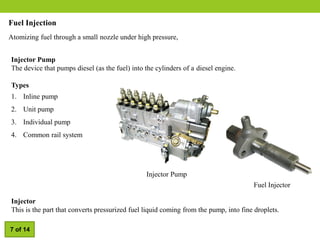
Injector Pump
The device that pumps diesel (as the fuel) into the cylinders of a diesel engine.
Types
1. Inline pump
2. Unit pump
3. Individual pump
4. Common rail system
Injector
This is the part that converts pressurized fuel liquid coming from the pump, into fine droplets.
Fuel Injector
Injector Pump
7 of 14
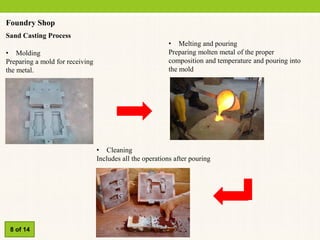
Foundry Shop
Sand Casting Process
• Molding
Preparing a mold for receiving
the metal.
• Melting and pouring
Preparing molten metal of the proper
composition and temperature and pouring into
the mold
• Cleaning
Includes all the operations after pouring
8 of 14
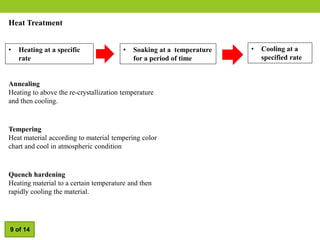
Heat Treatment
• Heating at a specific
rate
• Soaking at a temperature
for a period of time
• Cooling at a
specified rate
Annealing
Heating to above the re-crystallization temperature
and then cooling.
Tempering
Heat material according to material tempering color
chart and cool in atmospheric condition
Quench hardening
Heating material to a certain temperature and then
rapidly cooling the material.
9 of 14
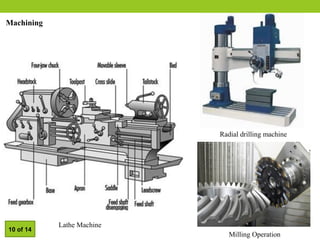
Machining
Lathe Machine
Radial drilling machine
Milling Operation
10 of 14
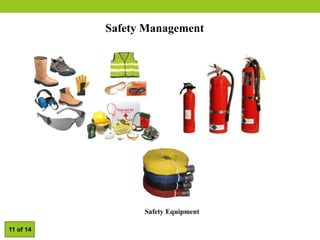
Safety Management
Safety Equipment
11 of 14
Training Experience
I could gain practical experience about
 Assembling and dissembling of machinery
 Welding
 Production
 How to work in a real working environment
 How to work with different types of people
12 of 14
Suggestions
 Use new technologies.
 Stop political placements.
 Make practically success regulations and rules.
 Give the instructions about the employees’ safety and advise them to
follow the safety instructions.
 Make good travelling system within the workshops.
13 of 14
14 of 14

Sri Lanka Railways

  • 1.
    INDUSTRIALTRAININGAT SRI LANKA RAILWAYS(SLR) 26th January 2015 - 24th April 2015 Lakshitha M.A.R EG/2012/1980 Department of Mechanical and Manufacturing Faculty of Engineering University of Ruhuna
  • 2.
    Presentation Outline  Introductionto Sri Lanka Railways  Introduction to the training establishment  Chief Mechanical Engineer’s workshops  Safety management  Training experience  Suggestions 1 of 14
  • 3.
    Introduction to SriLanka Railways History Introduced in Sri Lanka in 1864 to transport coffee by the British colonial government. Till 1953, Ceylon's railways operated steam locomotives. In the golden era, it enhanced its service by changing to diesel locomotives, under the leadership of most respected chief mechanical engineer B.D Rampala. Services Operates both intercity and express services, connecting major population centres, and commuter rail, serving Colombo commuter traffic. The railways also transport freight. Sri Lanka Railway department is Sri Lanka's railway owner and primary operator. Presently the Sri Lankan Railway network consists of 1,508 kilometers. 2 of 14
  • 4.
    Introduction to theTraining Establishment Vision To provide technical training conforming to international standard in order to produce competent and skilled man power required to maintain timely operated efficient steady and reliable passenger and good train series. Mission To become the training institute with the highest level of acceptance in Sri Lanka in order to produce skilled craftsman having national vocational skill level who are capable to go forward with a new technical developments to railway and Sri Lanka. Sri Lanka German Railway technical training center is the key organization which provides railway technicians to the nation. 3 of 14
  • 5.
    Chief Mechanical Engineer’sworkshops The total area of the workshops is 77 acres. In these, workshops repairing and modifying of locomotive, making of required railway maintenance tools and several other tasks are done. Main types of workshop Groups 1. Locomotive Group 2. Carriage and Wagon Group 3. Production Group 4. Electrical Group 4 of 14
  • 6.
    Diesel Electric Locomotive •Prime mover is a diesel engine. • The diesel engine is connected to an electrical generator, creating electricity that powers electric traction motors. Diesel Electric transmission Prime mover Traction motor 5 of 14
  • 7.
    Diesel Engine Auxiliaries Turbocharger  Supercharger  Compressor  Water pump  Oil pump  Radiator  Oil cooler 6 of 14
  • 8.
    Fuel Injection Atomizing fuelthrough a small nozzle under high pressure, Injector Pump The device that pumps diesel (as the fuel) into the cylinders of a diesel engine. Types 1. Inline pump 2. Unit pump 3. Individual pump 4. Common rail system Injector This is the part that converts pressurized fuel liquid coming from the pump, into fine droplets. Fuel Injector Injector Pump 7 of 14
  • 9.
    Foundry Shop Sand CastingProcess • Molding Preparing a mold for receiving the metal. • Melting and pouring Preparing molten metal of the proper composition and temperature and pouring into the mold • Cleaning Includes all the operations after pouring 8 of 14
  • 10.
    Heat Treatment • Heatingat a specific rate • Soaking at a temperature for a period of time • Cooling at a specified rate Annealing Heating to above the re-crystallization temperature and then cooling. Tempering Heat material according to material tempering color chart and cool in atmospheric condition Quench hardening Heating material to a certain temperature and then rapidly cooling the material. 9 of 14
  • 11.
    Machining Lathe Machine Radial drillingmachine Milling Operation 10 of 14
  • 12.
  • 13.
    Training Experience I couldgain practical experience about  Assembling and dissembling of machinery  Welding  Production  How to work in a real working environment  How to work with different types of people 12 of 14
  • 14.
    Suggestions  Use newtechnologies.  Stop political placements.  Make practically success regulations and rules.  Give the instructions about the employees’ safety and advise them to follow the safety instructions.  Make good travelling system within the workshops. 13 of 14
  • 15.