Canadian Anti-Spam Legislation
“CASL”
SQUASH ONTARIO
Canadian Anti-Spam Legislation
 Canada’s new anti-spam law was passed in December, 2010, and will
come into force July 1, 2014.
 Enacted to protect Canadians from unwanted SPAM and to provide
guidelines for businesses and organizations regarding how commercial
electronic messages (CEMs) should be handled.
 CASL does not apply to non-commercial messages.
APPLICABILITY
Who needs to know about this law?
Anyone who makes use of commercial electronic
messages needs to be aware of this law.
What is a commercial electronic message (CEM)?
Messages sent electronically where one of its purposes is
to encourage participation in a commercial activity,
regardless of whether there is an expectation of profit:
 Purchase or sell a product, goods or service
 Advertises or promotes anything referring to a product,
good or service
Requirements for Sending
Commercial Messages
You cannot send a commercial electronic message (CEM)
unless:
 The recipient has consented to receive it;
 The message clearly identifies the sender and provides
sufficient contact information to allow a response; and
 The message sets out an “unsubscribe” mechanism.
EXPRESS CONSENT
 Express Consent – When an individual gives you
permission to send them any type of message, including
CEMs.
 Signing up on your website to receive messages
 Checking a box on a paper form (membership application)
 Providing an email address, after it has been made clear you
intend to send CEMs
 Oral or written requests to receive messages
 Express Consent does not expire unless it is withdrawn by
the individual.
IMPLIED CONSENT
 Implied Consent – Consent can be implied in most cases where there
has been some type of business transaction or personal interaction in
the 2 years prior to sending the message.
"existing business relationship”
 Communications between organizations (NSO/PSO/Clubs/Leagues) are
exempt as there is an expectation to receive communications relevant to
the commercial or business side of the sport”
"existing non-business relationship”
 Communications to individuals who have volunteered or been a member of
your organization within the last 2 years, or who have purchased
goods and services from you in the last 2 years.
ENFORCEMENT
Maximum penalties
 The maximum penalty for a violation is $1,000,000 in the case of an individual, and
$10,000,000 in the case of any other person.
 Directors and Officers may also be liable for breaches by their employers or
volunteers.
 There is a reverse onus meaning you are presumed guilty unless you can show
otherwise through representations that you are entitled to make to the CRTC.
HOW TO COMPLY
Obtain express consent prior to July 1, 2014!
Include “Opt-In” box on any online registration or paper
application forms.
Ensure all communications clearly identify the sender and
provide sufficient contact information.
Include an “unsubscribe” mechanism on all email
communications that have a commercial message.
Maintain proper records to keep track of those who
“unsubscribe” and ensure you comply with those requests.
Maintain proper records to verify a non-business
relationship with members/volunteers in last 2 yrs.
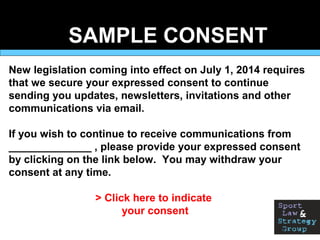
New legislation coming into effect on July 1, 2014 requires
that we secure your expressed consent to continue
sending you updates, newsletters, invitations and other
communications via email.
If you wish to continue to receive communications from
______________ , please provide your expressed consent
by clicking on the link below. You may withdraw your
consent at any time.
> Click here to indicate
your consent
SAMPLE CONSENT
Check out our Website!
LeeAnn Cupidio
(416) 315-3524
llc@sportlaw.ca
www.sportlaw.ca

Squash Ontario AGM - Anti Spam Presentation

  • 1.
  • 2.
    Canadian Anti-Spam Legislation Canada’s new anti-spam law was passed in December, 2010, and will come into force July 1, 2014.  Enacted to protect Canadians from unwanted SPAM and to provide guidelines for businesses and organizations regarding how commercial electronic messages (CEMs) should be handled.  CASL does not apply to non-commercial messages.
  • 3.
    APPLICABILITY Who needs toknow about this law? Anyone who makes use of commercial electronic messages needs to be aware of this law. What is a commercial electronic message (CEM)? Messages sent electronically where one of its purposes is to encourage participation in a commercial activity, regardless of whether there is an expectation of profit:  Purchase or sell a product, goods or service  Advertises or promotes anything referring to a product, good or service
  • 4.
    Requirements for Sending CommercialMessages You cannot send a commercial electronic message (CEM) unless:  The recipient has consented to receive it;  The message clearly identifies the sender and provides sufficient contact information to allow a response; and  The message sets out an “unsubscribe” mechanism.
  • 5.
    EXPRESS CONSENT  ExpressConsent – When an individual gives you permission to send them any type of message, including CEMs.  Signing up on your website to receive messages  Checking a box on a paper form (membership application)  Providing an email address, after it has been made clear you intend to send CEMs  Oral or written requests to receive messages  Express Consent does not expire unless it is withdrawn by the individual.
  • 6.
    IMPLIED CONSENT  ImpliedConsent – Consent can be implied in most cases where there has been some type of business transaction or personal interaction in the 2 years prior to sending the message. "existing business relationship”  Communications between organizations (NSO/PSO/Clubs/Leagues) are exempt as there is an expectation to receive communications relevant to the commercial or business side of the sport” "existing non-business relationship”  Communications to individuals who have volunteered or been a member of your organization within the last 2 years, or who have purchased goods and services from you in the last 2 years.
  • 7.
    ENFORCEMENT Maximum penalties  Themaximum penalty for a violation is $1,000,000 in the case of an individual, and $10,000,000 in the case of any other person.  Directors and Officers may also be liable for breaches by their employers or volunteers.  There is a reverse onus meaning you are presumed guilty unless you can show otherwise through representations that you are entitled to make to the CRTC.
  • 8.
    HOW TO COMPLY Obtainexpress consent prior to July 1, 2014! Include “Opt-In” box on any online registration or paper application forms. Ensure all communications clearly identify the sender and provide sufficient contact information. Include an “unsubscribe” mechanism on all email communications that have a commercial message. Maintain proper records to keep track of those who “unsubscribe” and ensure you comply with those requests. Maintain proper records to verify a non-business relationship with members/volunteers in last 2 yrs.
  • 9.
    New legislation cominginto effect on July 1, 2014 requires that we secure your expressed consent to continue sending you updates, newsletters, invitations and other communications via email. If you wish to continue to receive communications from ______________ , please provide your expressed consent by clicking on the link below. You may withdraw your consent at any time. > Click here to indicate your consent SAMPLE CONSENT
  • 10.
    Check out ourWebsite! LeeAnn Cupidio (416) 315-3524 llc@sportlaw.ca www.sportlaw.ca