What is SQL?
SQL stands for “structured query language”. It is a language used to query,
analyze, and manipulate data from databases. Today, SQL is one of the most
widely used tools in data. 

SQL Basics Cheat Sheet
SQL for Data Science
Learn SQL online at www.DataCamp.com
> The different dialects of SQL
Although SQL languages all share a basic structure, some of the specific
commands and styles can differ slightly. Popular dialects include MySQL,
SQLite, SQL Server, Oracle SQL, and more. PostgreSQL is a good place to start
—since it’s close to standard SQL syntax and is easily adapted to other
dialects. 

> Sample Data
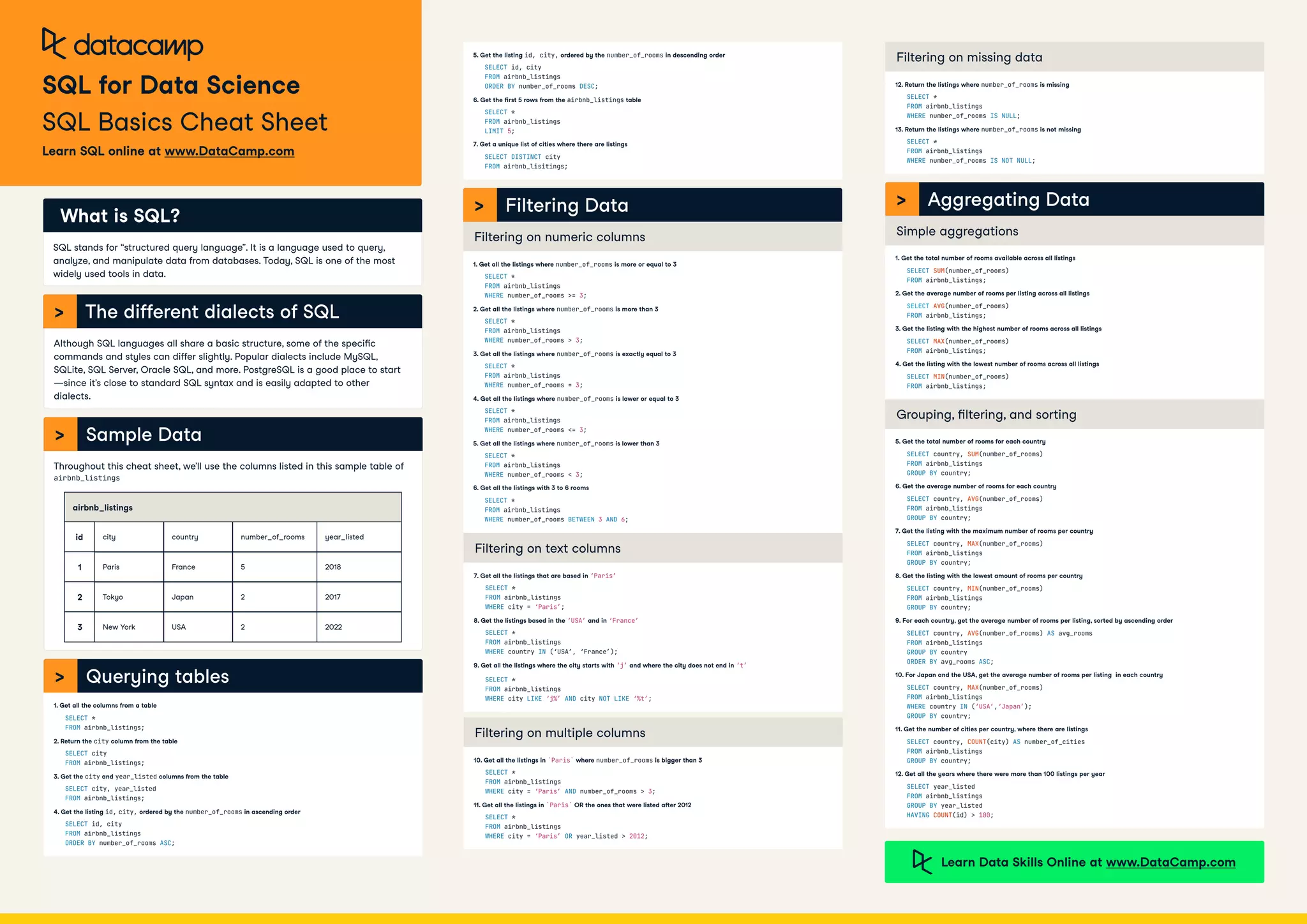
Throughout this cheat sheet, we’ll use the columns listed in this sample table of
airbnb_listings
airbnb_listings
id city country number_of_rooms year_listed
1 Paris France 5 2018
2 Tokyo Japan 2 2017
3 New York USA 2 2022
> Filtering Data
Filtering on numeric columns
* 

airbnb_listings 

number_of_rooms >= ;
SELECT
FROM
WHERE 3
1. Get all the listings where number_of_rooms is more or equal to 3
*

airbnb_listings 

number_of_rooms > ;
SELECT
FROM
WHERE 3
2. Get all the listings where number_of_rooms is more than 3
*

airbnb_listings 

number_of_rooms = ;
SELECT
FROM
WHERE 3
3. Get all the listings where number_of_rooms is exactly equal to 3
*

airbnb_listings 

number_of_rooms <= ;
SELECT
FROM
WHERE 3
4. Get all the listings where number_of_rooms is lower or equal to 3
*

airbnb_listings 

number_of_rooms < ;
SELECT
FROM
WHERE 3
5. Get all the listings where number_of_rooms is lower than 3
*

airbnb_listings 

number_of_rooms ;
SELECT
FROM
WHERE BETWEEN AND
3 6
6. Get all the listings with 3 to 6 rooms
> Querying tables
* 

airbnb_listings;
SELECT
FROM
1. Get all the columns from a table
city

airbnb_listings;
SELECT
FROM
2. Return the city column from the table
city, year_listed

airbnb_listings;
SELECT
FROM
3. Get the city and year_listed columns from the table
id, city 

airbnb_listings 

number_of_rooms ;
SELECT
FROM
ORDER BY ASC
4. Get the listing id, city, ordered by the number_of_rooms in ascending order
id, city

airbnb_listings 

number_of_rooms ;
SELECT
FROM
ORDER BY DESC
5. Get the listing id, city, ordered by the number_of_rooms in descending order
* 

airbnb_listings

;
SELECT
FROM
LIMIT 5
6. Get the first 5 rows from the airbnb_listings table
city 

airbnb_lisitings;
SELECT DISTINCT
FROM
7. Get a unique list of cities where there are listings
Filtering on text columns
*

airbnb_listings 

city = ;
SELECT
FROM
WHERE ‘Paris’
7. Get all the listings that are based in ‘Paris’
*

airbnb_listings 

country (‘USA’, ‘France’);
SELECT
FROM
WHERE IN
8. Get the listings based in the and in
‘USA’ ‘France’
*

airbnb_listings 

city city ;
SELECT
FROM
WHERE LIKE AND NOT LIKE
‘j%’ ‘%t’
9. Get all the listings where the city starts with and where the city does not end in
‘j’ ‘t’
Filtering on multiple columns
*

airbnb_listings 

city = number_of_rooms > ;
SELECT
FROM
WHERE AND
‘Paris’ 3
10. Get all the listings in where number_of_rooms is bigger than 3
`Paris`
*

airbnb_listings 

city = year_listed > ;
SELECT
FROM
WHERE OR
‘Paris’ 2012
11. Get all the listings in OR the ones that were listed after 2012
`Paris`
Filtering on missing data
*

airbnb_listings 

number_of_rooms ;
SELECT
FROM
WHERE IS NULL
12. Return the listings where number_of_rooms is missing
*

airbnb_listings 

number_of_rooms ;
SELECT
FROM
WHERE IS NOT NULL
13. Return the listings where number_of_rooms is not missing
> Aggregating Data
Simple aggregations
(number_of_rooms)

airbnb_listings;
SELECT
FROM
SUM
1. Get the total number of rooms available across all listings
(number_of_rooms)

airbnb_listings;
SELECT AVG
FROM
2. Get the average number of rooms per listing across all listings
(number_of_rooms)

airbnb_listings;
SELECT
FROM
MAX
3. Get the listing with the highest number of rooms across all listings
(number_of_rooms)

airbnb_listings;
SELECT
FROM
MIN
4. Get the listing with the lowest number of rooms across all listings
Grouping, filtering, and sorting
country, (number_of_rooms)

airbnb_listings

country;
SELECT
FROM
GROUP BY
SUM
5. Get the total number of rooms for each country
country, (number_of_rooms)

airbnb_listings

country;
SELECT
FROM
GROUP BY
AVG
6. Get the average number of rooms for each country
country, (number_of_rooms)

airbnb_listings

country;
SELECT
FROM
GROUP BY
MAX
7. Get the listing with the maximum number of rooms per country
country, (number_of_rooms)

airbnb_listings

country;
SELECT
FROM
GROUP BY
MIN
8. Get the listing with the lowest amount of rooms per country
country, (number_of_rooms) avg_rooms

airbnb_listings

country

avg_rooms ;
SELECT AS
FROM
GROUP BY
ORDER BY ASC
AVG
9. For each country, get the average number of rooms per listing, sorted by ascending order
country, (number_of_rooms)

airbnb_listings

country ( , );

country;
SELECT
FROM
WHERE IN
GROUP BY
MAX
‘USA’ ‘Japan’
10. For Japan and the USA, get the average number of rooms per listing in each country
country, (city) number_of_cities

airbnb_listings

country;
SELECT AS
FROM
GROUP BY
COUNT
11. Get the number of cities per country, where there are listings
year_listed

airbnb_listings

year_listed

(id) > ;
SELECT
FROM
GROUP BY
HAVING COUNT 100
12. Get all the years where there were more than 100 listings per year
Learn Data Skills Online at www.DataCamp.com

SQL+for+Data+Science.pdf

  • 1.
    What is SQL? SQLstands for “structured query language”. It is a language used to query, analyze, and manipulate data from databases. Today, SQL is one of the most widely used tools in data. SQL Basics Cheat Sheet SQL for Data Science Learn SQL online at www.DataCamp.com > The different dialects of SQL Although SQL languages all share a basic structure, some of the specific commands and styles can differ slightly. Popular dialects include MySQL, SQLite, SQL Server, Oracle SQL, and more. PostgreSQL is a good place to start —since it’s close to standard SQL syntax and is easily adapted to other dialects. > Sample Data Throughout this cheat sheet, we’ll use the columns listed in this sample table of airbnb_listings airbnb_listings id city country number_of_rooms year_listed 1 Paris France 5 2018 2 Tokyo Japan 2 2017 3 New York USA 2 2022 > Filtering Data Filtering on numeric columns * airbnb_listings number_of_rooms >= ; SELECT FROM WHERE 3 1. Get all the listings where number_of_rooms is more or equal to 3 * airbnb_listings number_of_rooms > ; SELECT FROM WHERE 3 2. Get all the listings where number_of_rooms is more than 3 * airbnb_listings number_of_rooms = ; SELECT FROM WHERE 3 3. Get all the listings where number_of_rooms is exactly equal to 3 * airbnb_listings number_of_rooms <= ; SELECT FROM WHERE 3 4. Get all the listings where number_of_rooms is lower or equal to 3 * airbnb_listings number_of_rooms < ; SELECT FROM WHERE 3 5. Get all the listings where number_of_rooms is lower than 3 * airbnb_listings number_of_rooms ; SELECT FROM WHERE BETWEEN AND 3 6 6. Get all the listings with 3 to 6 rooms > Querying tables * airbnb_listings; SELECT FROM 1. Get all the columns from a table city airbnb_listings; SELECT FROM 2. Return the city column from the table city, year_listed airbnb_listings; SELECT FROM 3. Get the city and year_listed columns from the table id, city airbnb_listings number_of_rooms ; SELECT FROM ORDER BY ASC 4. Get the listing id, city, ordered by the number_of_rooms in ascending order id, city airbnb_listings number_of_rooms ; SELECT FROM ORDER BY DESC 5. Get the listing id, city, ordered by the number_of_rooms in descending order * airbnb_listings ; SELECT FROM LIMIT 5 6. Get the first 5 rows from the airbnb_listings table city airbnb_lisitings; SELECT DISTINCT FROM 7. Get a unique list of cities where there are listings Filtering on text columns * airbnb_listings city = ; SELECT FROM WHERE ‘Paris’ 7. Get all the listings that are based in ‘Paris’ * airbnb_listings country (‘USA’, ‘France’); SELECT FROM WHERE IN 8. Get the listings based in the and in ‘USA’ ‘France’ * airbnb_listings city city ; SELECT FROM WHERE LIKE AND NOT LIKE ‘j%’ ‘%t’ 9. Get all the listings where the city starts with and where the city does not end in ‘j’ ‘t’ Filtering on multiple columns * airbnb_listings city = number_of_rooms > ; SELECT FROM WHERE AND ‘Paris’ 3 10. Get all the listings in where number_of_rooms is bigger than 3 `Paris` * airbnb_listings city = year_listed > ; SELECT FROM WHERE OR ‘Paris’ 2012 11. Get all the listings in OR the ones that were listed after 2012 `Paris` Filtering on missing data * airbnb_listings number_of_rooms ; SELECT FROM WHERE IS NULL 12. Return the listings where number_of_rooms is missing * airbnb_listings number_of_rooms ; SELECT FROM WHERE IS NOT NULL 13. Return the listings where number_of_rooms is not missing > Aggregating Data Simple aggregations (number_of_rooms) airbnb_listings; SELECT FROM SUM 1. Get the total number of rooms available across all listings (number_of_rooms) airbnb_listings; SELECT AVG FROM 2. Get the average number of rooms per listing across all listings (number_of_rooms) airbnb_listings; SELECT FROM MAX 3. Get the listing with the highest number of rooms across all listings (number_of_rooms) airbnb_listings; SELECT FROM MIN 4. Get the listing with the lowest number of rooms across all listings Grouping, filtering, and sorting country, (number_of_rooms) airbnb_listings country; SELECT FROM GROUP BY SUM 5. Get the total number of rooms for each country country, (number_of_rooms) airbnb_listings country; SELECT FROM GROUP BY AVG 6. Get the average number of rooms for each country country, (number_of_rooms) airbnb_listings country; SELECT FROM GROUP BY MAX 7. Get the listing with the maximum number of rooms per country country, (number_of_rooms) airbnb_listings country; SELECT FROM GROUP BY MIN 8. Get the listing with the lowest amount of rooms per country country, (number_of_rooms) avg_rooms airbnb_listings country avg_rooms ; SELECT AS FROM GROUP BY ORDER BY ASC AVG 9. For each country, get the average number of rooms per listing, sorted by ascending order country, (number_of_rooms) airbnb_listings country ( , ); country; SELECT FROM WHERE IN GROUP BY MAX ‘USA’ ‘Japan’ 10. For Japan and the USA, get the average number of rooms per listing in each country country, (city) number_of_cities airbnb_listings country; SELECT AS FROM GROUP BY COUNT 11. Get the number of cities per country, where there are listings year_listed airbnb_listings year_listed (id) > ; SELECT FROM GROUP BY HAVING COUNT 100 12. Get all the years where there were more than 100 listings per year Learn Data Skills Online at www.DataCamp.com