SQL Server is Microsoft's enterprise-grade relational database management system (RDBMS), offering robust data
storage, security, and scalability. This presentation highlights its evolution, architecture, and industry applications
with minimal text and maximum visuals.
SQL Server Overview
A flagship RDBMS developed by Microsoft, trusted by enterprises
worldwide for data management.
SQL Server at a Glance
Stores data in structured tables with defined relationships, ensuring
integrity and efficiency.
Enterprise-Grade
Designed for high performance, security, and scalability in mission-
critical environments.
Relational DBMS
Microsoft Product
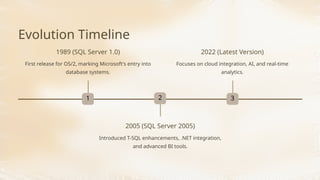
2005 (SQL Server 2005)
First release for OS/2, marking Microsoft's entry into
database systems.
1989 (SQL Server 1.0)
2
Focuses on cloud integration, AI, and real-time
analytics.
2022 (Latest Version)
Introduced T-SQL enhancements, .NET integration,
and advanced BI tools.
3
Evolution Timeline
1
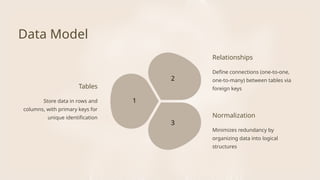
Data Model
Relationships
Store data in rows and
columns, with primary keys for
unique identification
Define connections (one-to-one,
one-to-many) between tables via
foreign keys
Tables
Minimizes redundancy by
organizing data into logical
structures
Normalization
1
3
2
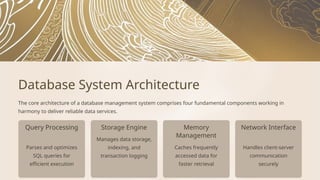
Query Processing Storage Engine
Handles client-server
communication
securely
Memory
Management
Manages data storage,
indexing, and
transaction logging
Parses and optimizes
SQL queries for
efficient execution
Caches frequently
accessed data for
faster retrieval
Network Interface
Database System Architecture
The core architecture of a database management system comprises four fundamental components working in
harmony to deliver reliable data services.
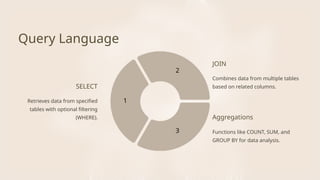
Combines data from multiple tables
based on related columns.
Aggregations
JOIN
SELECT
Retrieves data from specified
tables with optional filtering
(WHERE).
Functions like COUNT, SUM, and
GROUP BY for data analysis.
Query Language
3
1
2
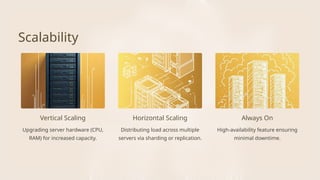
Horizontal Scaling Always On
Scalability
Vertical Scaling
Upgrading server hardware (CPU,
RAM) for increased capacity.
Distributing load across multiple
servers via sharding or replication.
High-availability feature ensuring
minimal downtime.
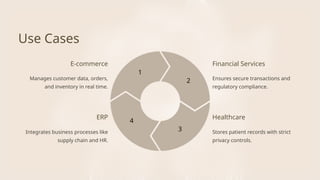
Integrates business processes like
supply chain and HR.
Ensures secure transactions and
regulatory compliance.
Stores patient records with strict
privacy controls.
Healthcare
E-commerce Financial Services
Manages customer data, orders,
and inventory in real time.
ERP
Use Cases
4
1
2
3
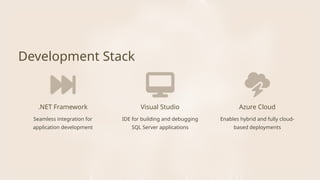
Enables hybrid and fully cloud-
based deployments
Seamless integration for
application development
Visual Studio
Development Stack
Azure Cloud
.NET Framework
IDE for building and debugging
SQL Server applications
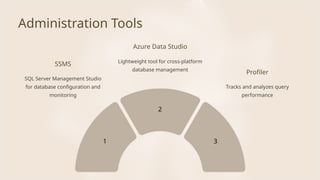
Profiler
SQL Server Management Studio
for database configuration and
monitoring
Tracks and analyzes query
performance
Administration Tools
Lightweight tool for cross-platform
database management
Azure Data Studio
SSMS
3
2
1
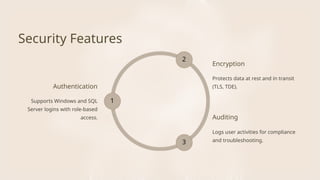
Auditing
Authentication
Logs user activities for compliance
and troubleshooting.
Supports Windows and SQL
Server logins with role-based
access.
Protects data at rest and in transit
(TLS, TDE).
Encryption
Security Features
3
1
2
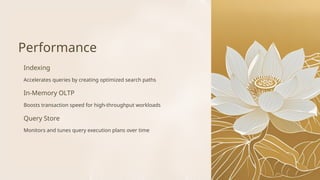
Accelerates queries by creating optimized search paths
Indexing
Query Store
In-Memory OLTP
Monitors and tunes query execution plans over time
Boosts transaction speed for high-throughput workloads
Performance
2
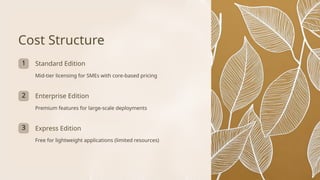
Mid-tier licensing for SMEs with core-based pricing
Premium features for large-scale deployments
Cost Structure
Standard Edition
Free for lightweight applications (limited resources)
Express Edition
1
3
Enterprise Edition
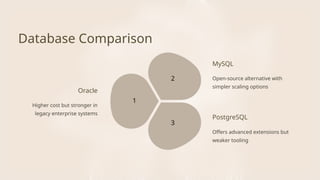
Oracle
PostgreSQL
Higher cost but stronger in
legacy enterprise systems
Database Comparison
MySQL
Offers advanced extensions but
weaker tooling
Open-source alternative with
simpler scaling options
3
2
1
Strengths & Limitations
Strengths
Top-tier security, Azure
integration, and Microsoft
ecosystem.
Licensing costs, Windows-
centric (historically), and
resource-heavy.
Limitations
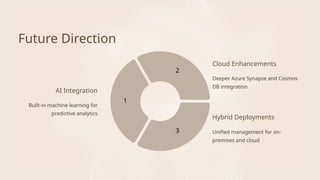
Deeper Azure Synapse and Cosmos
DB integration
Built-in machine learning for
predictive analytics
Unified management for on-
premises and cloud
Hybrid Deployments
Future Direction
AI Integration
Cloud Enhancements
1
2
3
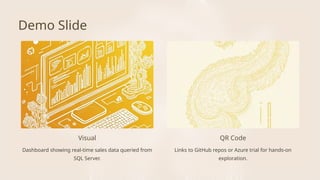
Demo Slide
QR Code
Visual
Dashboard showing real-time sales data queried from
SQL Server.
Links to GitHub repos or Azure trial for hands-on
exploration.
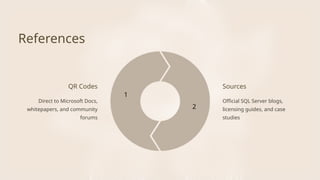
Sources
Official SQL Server blogs,
licensing guides, and case
studies
References
Direct to Microsoft Docs,
whitepapers, and community
forums
QR Codes
1
2
Team Names
Presenters and contributors listed with contact details
Thank You
Visual
SQL Server logo with abstract database motif
SQL Server Overview.pptx ss

  • 1.
    SQL Server isMicrosoft's enterprise-grade relational database management system (RDBMS), offering robust data storage, security, and scalability. This presentation highlights its evolution, architecture, and industry applications with minimal text and maximum visuals. SQL Server Overview
  • 2.
    A flagship RDBMSdeveloped by Microsoft, trusted by enterprises worldwide for data management. SQL Server at a Glance Stores data in structured tables with defined relationships, ensuring integrity and efficiency. Enterprise-Grade Designed for high performance, security, and scalability in mission- critical environments. Relational DBMS Microsoft Product
  • 3.
    2005 (SQL Server2005) First release for OS/2, marking Microsoft's entry into database systems. 1989 (SQL Server 1.0) 2 Focuses on cloud integration, AI, and real-time analytics. 2022 (Latest Version) Introduced T-SQL enhancements, .NET integration, and advanced BI tools. 3 Evolution Timeline 1
  • 4.
    Data Model Relationships Store datain rows and columns, with primary keys for unique identification Define connections (one-to-one, one-to-many) between tables via foreign keys Tables Minimizes redundancy by organizing data into logical structures Normalization 1 3 2
  • 5.
    Query Processing StorageEngine Handles client-server communication securely Memory Management Manages data storage, indexing, and transaction logging Parses and optimizes SQL queries for efficient execution Caches frequently accessed data for faster retrieval Network Interface Database System Architecture The core architecture of a database management system comprises four fundamental components working in harmony to deliver reliable data services.
  • 6.
    Combines data frommultiple tables based on related columns. Aggregations JOIN SELECT Retrieves data from specified tables with optional filtering (WHERE). Functions like COUNT, SUM, and GROUP BY for data analysis. Query Language 3 1 2
  • 7.
    Horizontal Scaling AlwaysOn Scalability Vertical Scaling Upgrading server hardware (CPU, RAM) for increased capacity. Distributing load across multiple servers via sharding or replication. High-availability feature ensuring minimal downtime.
  • 8.
    Integrates business processeslike supply chain and HR. Ensures secure transactions and regulatory compliance. Stores patient records with strict privacy controls. Healthcare E-commerce Financial Services Manages customer data, orders, and inventory in real time. ERP Use Cases 4 1 2 3
  • 9.
    Enables hybrid andfully cloud- based deployments Seamless integration for application development Visual Studio Development Stack Azure Cloud .NET Framework IDE for building and debugging SQL Server applications
  • 10.
    Profiler SQL Server ManagementStudio for database configuration and monitoring Tracks and analyzes query performance Administration Tools Lightweight tool for cross-platform database management Azure Data Studio SSMS 3 2 1
  • 11.
    Auditing Authentication Logs user activitiesfor compliance and troubleshooting. Supports Windows and SQL Server logins with role-based access. Protects data at rest and in transit (TLS, TDE). Encryption Security Features 3 1 2
  • 12.
    Accelerates queries bycreating optimized search paths Indexing Query Store In-Memory OLTP Monitors and tunes query execution plans over time Boosts transaction speed for high-throughput workloads Performance
  • 13.
    2 Mid-tier licensing forSMEs with core-based pricing Premium features for large-scale deployments Cost Structure Standard Edition Free for lightweight applications (limited resources) Express Edition 1 3 Enterprise Edition
  • 14.
    Oracle PostgreSQL Higher cost butstronger in legacy enterprise systems Database Comparison MySQL Offers advanced extensions but weaker tooling Open-source alternative with simpler scaling options 3 2 1
  • 15.
    Strengths & Limitations Strengths Top-tiersecurity, Azure integration, and Microsoft ecosystem. Licensing costs, Windows- centric (historically), and resource-heavy. Limitations
  • 16.
    Deeper Azure Synapseand Cosmos DB integration Built-in machine learning for predictive analytics Unified management for on- premises and cloud Hybrid Deployments Future Direction AI Integration Cloud Enhancements 1 2 3
  • 17.
    Demo Slide QR Code Visual Dashboardshowing real-time sales data queried from SQL Server. Links to GitHub repos or Azure trial for hands-on exploration.
  • 18.
    Sources Official SQL Serverblogs, licensing guides, and case studies References Direct to Microsoft Docs, whitepapers, and community forums QR Codes 1 2
  • 19.
    Team Names Presenters andcontributors listed with contact details Thank You Visual SQL Server logo with abstract database motif