Moamen Hany
MCT & Senior Solutions Architect
www.moamenhany.com
+201143739545
+966564095502
Introduction to
Microsoft SQL
Server
Introduction to SQL Server
SQL Server is a relational database management system, or RDBMS, developed and marketed by
Microsoft.
RDBMS
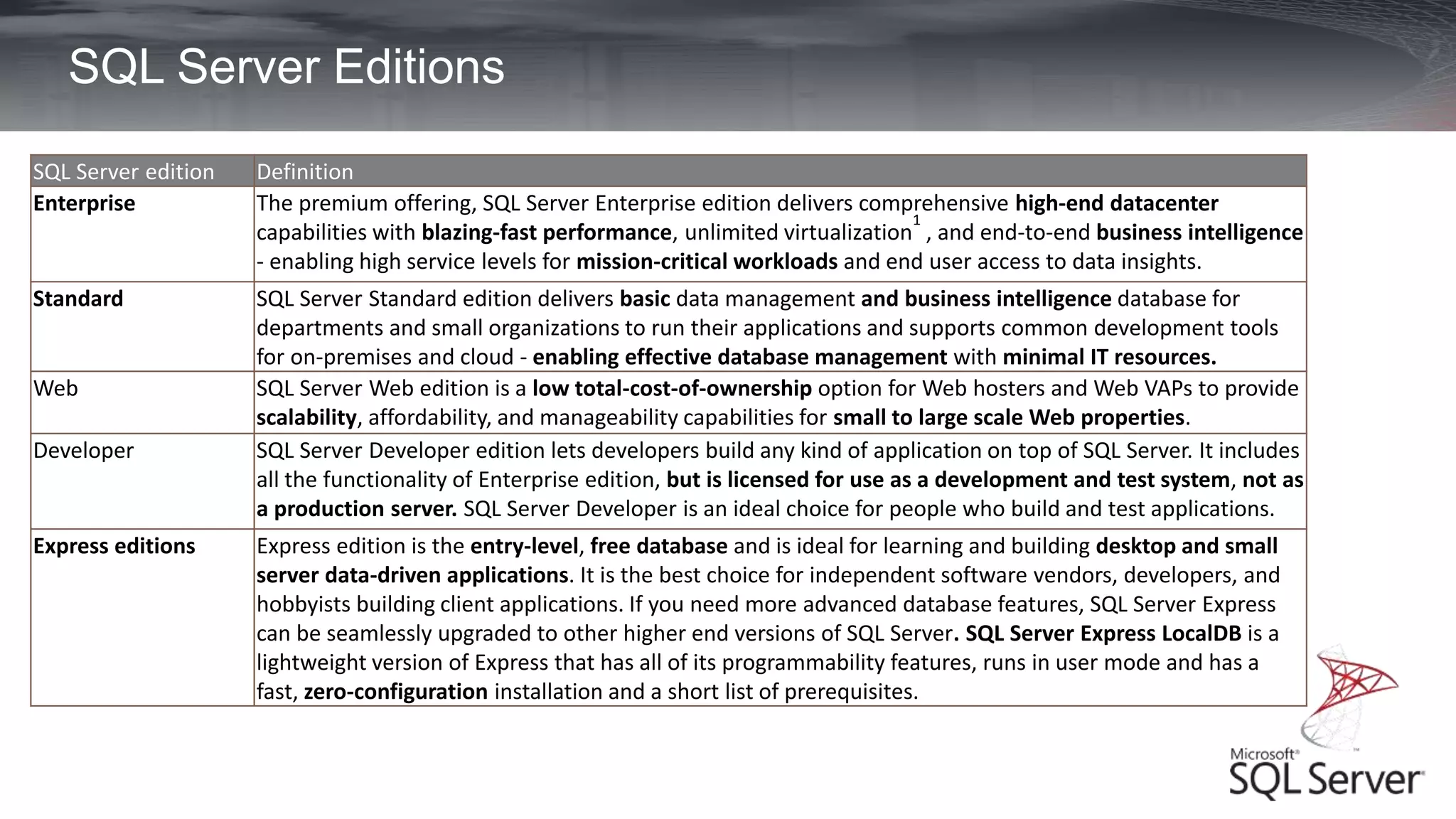
SQL Server Editions
SQL Server edition Definition
Enterprise The premium offering, SQL Server Enterprise edition delivers comprehensive high-end datacenter
capabilities with blazing-fast performance, unlimited virtualization
1
, and end-to-end business intelligence
- enabling high service levels for mission-critical workloads and end user access to data insights.
Standard SQL Server Standard edition delivers basic data management and business intelligence database for
departments and small organizations to run their applications and supports common development tools
for on-premises and cloud - enabling effective database management with minimal IT resources.
Web SQL Server Web edition is a low total-cost-of-ownership option for Web hosters and Web VAPs to provide
scalability, affordability, and manageability capabilities for small to large scale Web properties.
Developer SQL Server Developer edition lets developers build any kind of application on top of SQL Server. It includes
all the functionality of Enterprise edition, but is licensed for use as a development and test system, not as
a production server. SQL Server Developer is an ideal choice for people who build and test applications.
Express editions Express edition is the entry-level, free database and is ideal for learning and building desktop and small
server data-driven applications. It is the best choice for independent software vendors, developers, and
hobbyists building client applications. If you need more advanced database features, SQL Server Express
can be seamlessly upgraded to other higher end versions of SQL Server. SQL Server Express LocalDB is a
lightweight version of Express that has all of its programmability features, runs in user mode and has a
fast, zero-configuration installation and a short list of prerequisites.
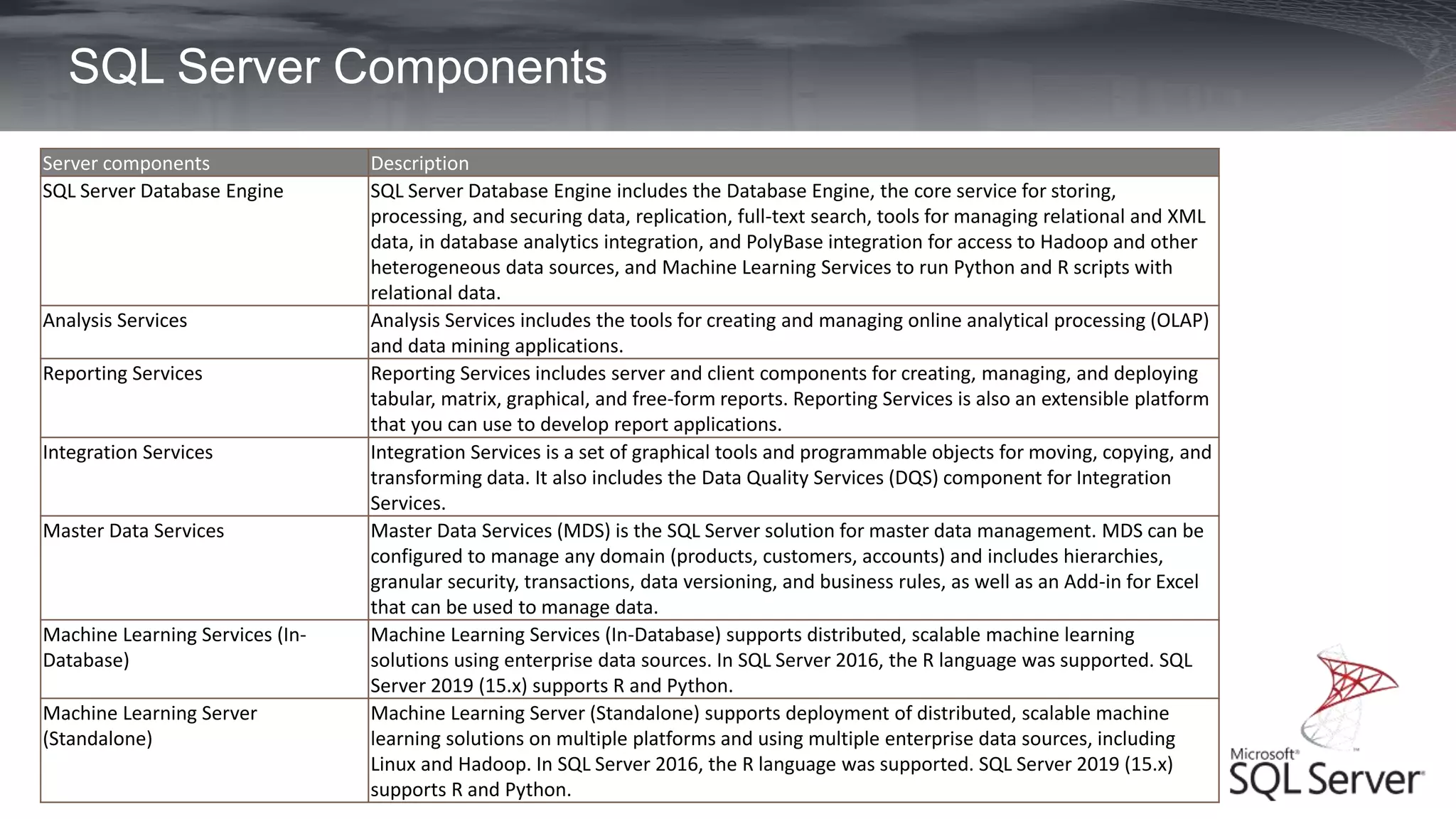
SQL Server Components
Server components Description
SQL Server Database Engine SQL Server Database Engine includes the Database Engine, the core service for storing,
processing, and securing data, replication, full-text search, tools for managing relational and XML
data, in database analytics integration, and PolyBase integration for access to Hadoop and other
heterogeneous data sources, and Machine Learning Services to run Python and R scripts with
relational data.
Analysis Services Analysis Services includes the tools for creating and managing online analytical processing (OLAP)
and data mining applications.
Reporting Services Reporting Services includes server and client components for creating, managing, and deploying
tabular, matrix, graphical, and free-form reports. Reporting Services is also an extensible platform
that you can use to develop report applications.
Integration Services Integration Services is a set of graphical tools and programmable objects for moving, copying, and
transforming data. It also includes the Data Quality Services (DQS) component for Integration
Services.
Master Data Services Master Data Services (MDS) is the SQL Server solution for master data management. MDS can be
configured to manage any domain (products, customers, accounts) and includes hierarchies,
granular security, transactions, data versioning, and business rules, as well as an Add-in for Excel
that can be used to manage data.
Machine Learning Services (In-
Database)
Machine Learning Services (In-Database) supports distributed, scalable machine learning
solutions using enterprise data sources. In SQL Server 2016, the R language was supported. SQL
Server 2019 (15.x) supports R and Python.
Machine Learning Server
(Standalone)
Machine Learning Server (Standalone) supports deployment of distributed, scalable machine
learning solutions on multiple platforms and using multiple enterprise data sources, including
Linux and Hadoop. In SQL Server 2016, the R language was supported. SQL Server 2019 (15.x)
supports R and Python.
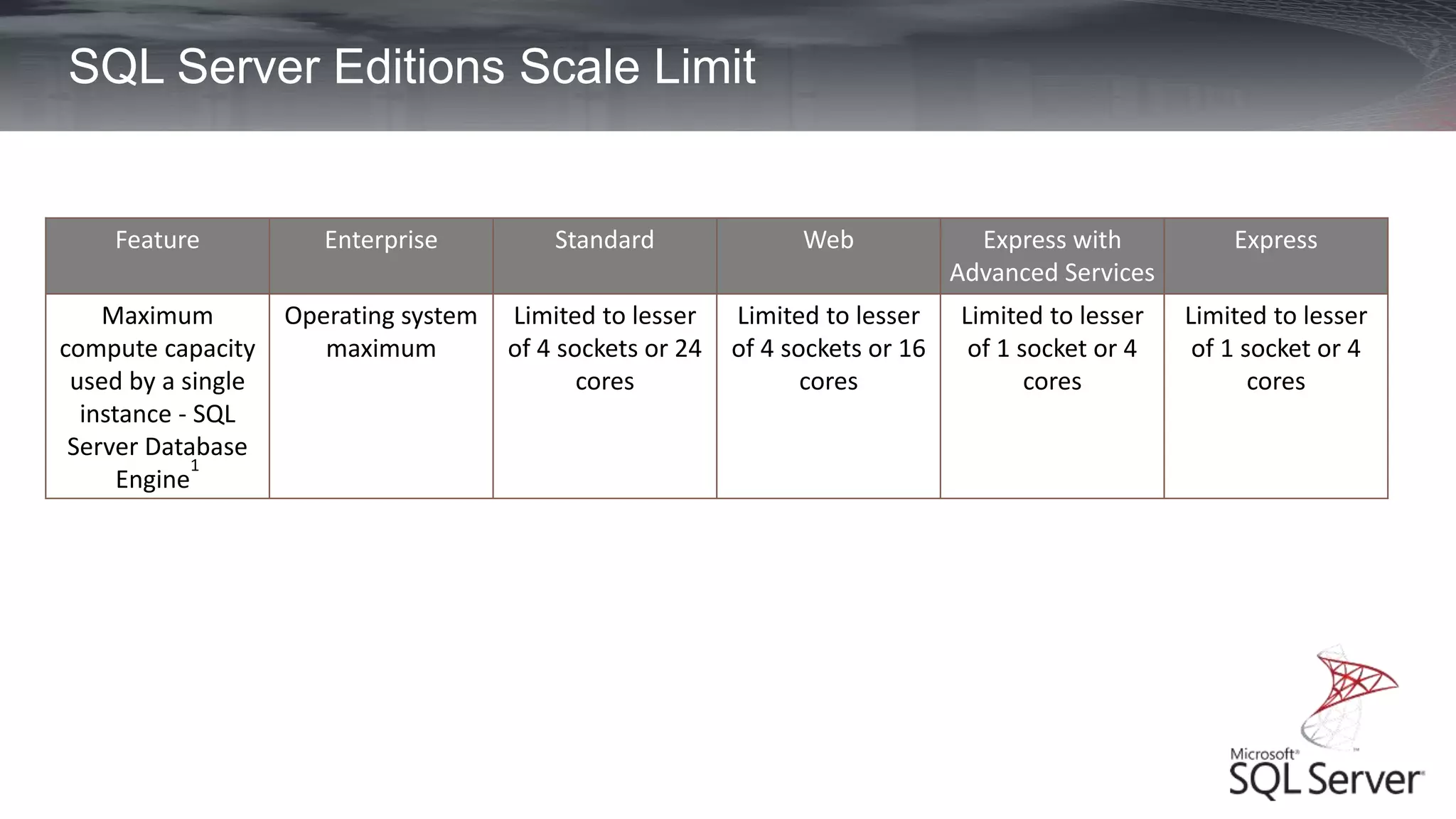
SQL Server Editions Scale Limit
Feature Enterprise Standard Web Express with
Advanced Services
Express
Maximum
compute capacity
used by a single
instance - SQL
Server Database
Engine
1
Operating system
maximum
Limited to lesser
of 4 sockets or 24
cores
Limited to lesser
of 4 sockets or 16
cores
Limited to lesser
of 1 socket or 4
cores
Limited to lesser
of 1 socket or 4
cores
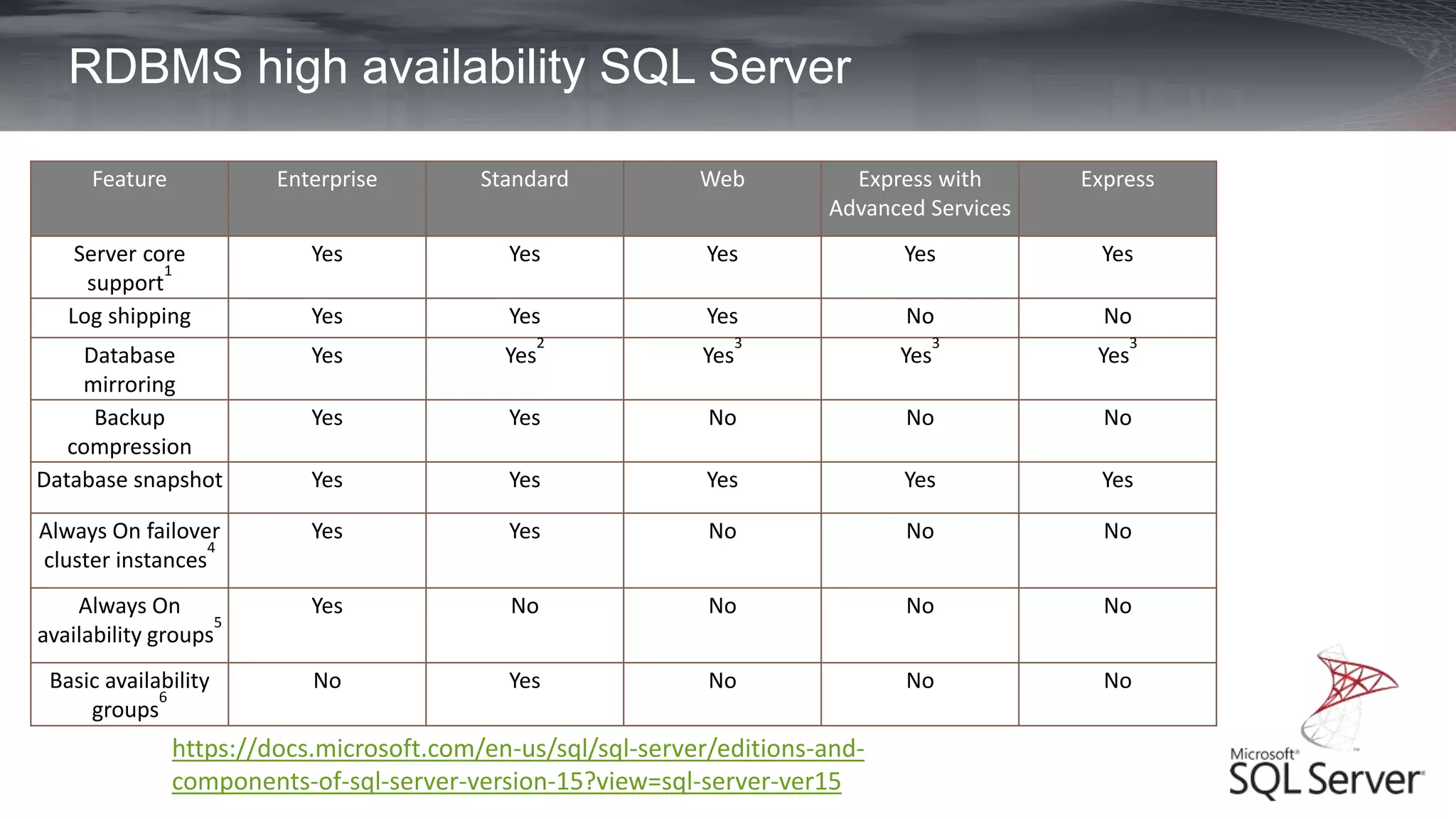
RDBMS high availability SQL Server
Feature Enterprise Standard Web Express with
Advanced Services
Express
Server core
support
1
Yes Yes Yes Yes Yes
Log shipping Yes Yes Yes No No
Database
mirroring
Yes Yes
2
Yes
3
Yes
3
Yes
3
Backup
compression
Yes Yes No No No
Database snapshot Yes Yes Yes Yes Yes
Always On failover
cluster instances
4
Yes Yes No No No
Always On
availability groups
5
Yes No No No No
Basic availability
groups
6
No Yes No No No
https://docs.microsoft.com/en-us/sql/sql-server/editions-and-
components-of-sql-server-version-15?view=sql-server-ver15
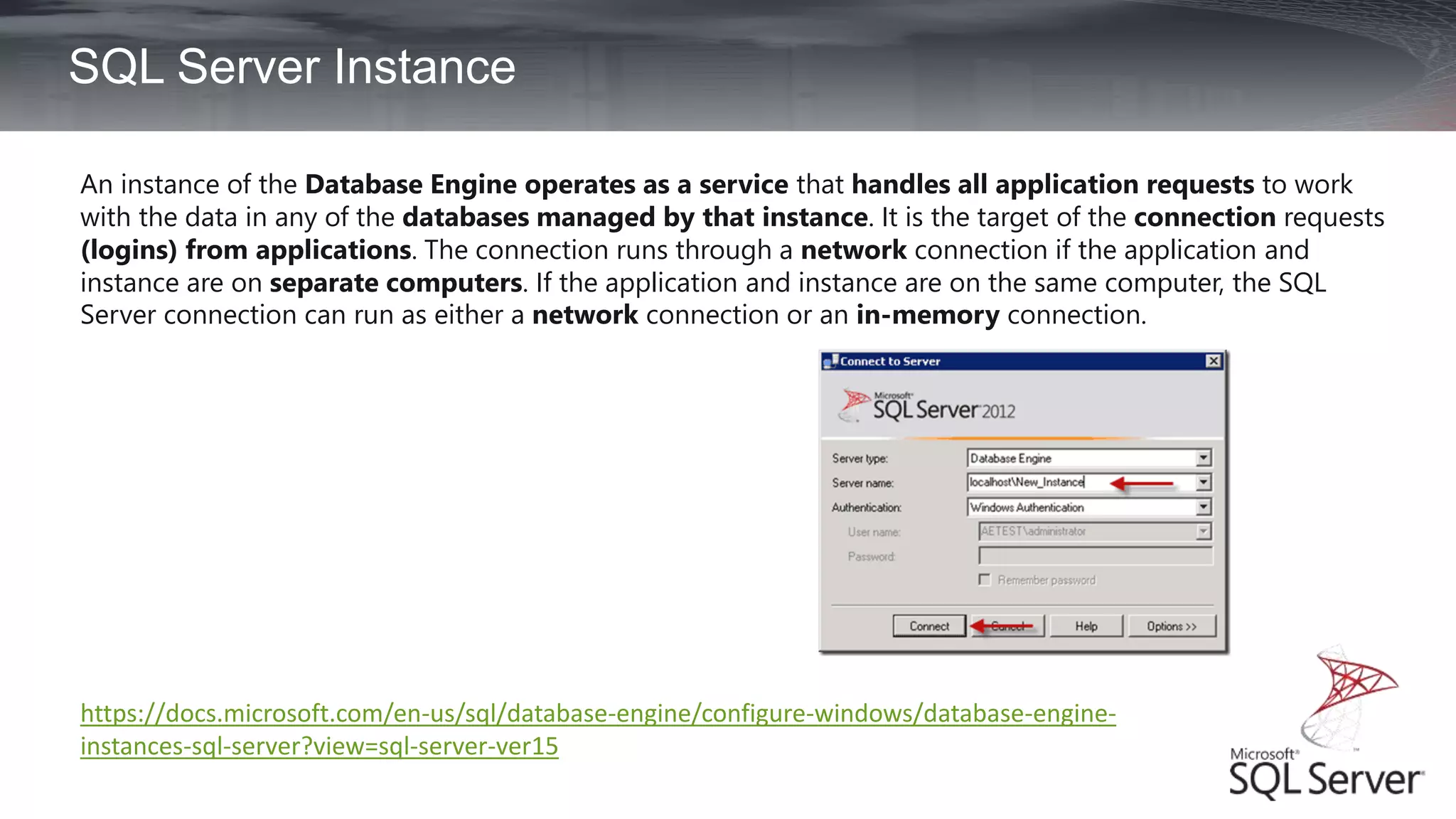
SQL Server Instance
An instance of the Database Engine operates as a service that handles all application requests to work
with the data in any of the databases managed by that instance. It is the target of the connection requests
(logins) from applications. The connection runs through a network connection if the application and
instance are on separate computers. If the application and instance are on the same computer, the SQL
Server connection can run as either a network connection or an in-memory connection.
https://docs.microsoft.com/en-us/sql/database-engine/configure-windows/database-engine-
instances-sql-server?view=sql-server-ver15
Thank you.
© Copyrights www.moamenhany.com. All rights reserved.

introduction to sql server by moamen hany

  • 1.
    Moamen Hany MCT &Senior Solutions Architect www.moamenhany.com +201143739545 +966564095502
  • 2.
  • 3.
    Introduction to SQLServer SQL Server is a relational database management system, or RDBMS, developed and marketed by Microsoft. RDBMS
  • 4.
    SQL Server Editions SQLServer edition Definition Enterprise The premium offering, SQL Server Enterprise edition delivers comprehensive high-end datacenter capabilities with blazing-fast performance, unlimited virtualization 1 , and end-to-end business intelligence - enabling high service levels for mission-critical workloads and end user access to data insights. Standard SQL Server Standard edition delivers basic data management and business intelligence database for departments and small organizations to run their applications and supports common development tools for on-premises and cloud - enabling effective database management with minimal IT resources. Web SQL Server Web edition is a low total-cost-of-ownership option for Web hosters and Web VAPs to provide scalability, affordability, and manageability capabilities for small to large scale Web properties. Developer SQL Server Developer edition lets developers build any kind of application on top of SQL Server. It includes all the functionality of Enterprise edition, but is licensed for use as a development and test system, not as a production server. SQL Server Developer is an ideal choice for people who build and test applications. Express editions Express edition is the entry-level, free database and is ideal for learning and building desktop and small server data-driven applications. It is the best choice for independent software vendors, developers, and hobbyists building client applications. If you need more advanced database features, SQL Server Express can be seamlessly upgraded to other higher end versions of SQL Server. SQL Server Express LocalDB is a lightweight version of Express that has all of its programmability features, runs in user mode and has a fast, zero-configuration installation and a short list of prerequisites.
  • 5.
    SQL Server Components Servercomponents Description SQL Server Database Engine SQL Server Database Engine includes the Database Engine, the core service for storing, processing, and securing data, replication, full-text search, tools for managing relational and XML data, in database analytics integration, and PolyBase integration for access to Hadoop and other heterogeneous data sources, and Machine Learning Services to run Python and R scripts with relational data. Analysis Services Analysis Services includes the tools for creating and managing online analytical processing (OLAP) and data mining applications. Reporting Services Reporting Services includes server and client components for creating, managing, and deploying tabular, matrix, graphical, and free-form reports. Reporting Services is also an extensible platform that you can use to develop report applications. Integration Services Integration Services is a set of graphical tools and programmable objects for moving, copying, and transforming data. It also includes the Data Quality Services (DQS) component for Integration Services. Master Data Services Master Data Services (MDS) is the SQL Server solution for master data management. MDS can be configured to manage any domain (products, customers, accounts) and includes hierarchies, granular security, transactions, data versioning, and business rules, as well as an Add-in for Excel that can be used to manage data. Machine Learning Services (In- Database) Machine Learning Services (In-Database) supports distributed, scalable machine learning solutions using enterprise data sources. In SQL Server 2016, the R language was supported. SQL Server 2019 (15.x) supports R and Python. Machine Learning Server (Standalone) Machine Learning Server (Standalone) supports deployment of distributed, scalable machine learning solutions on multiple platforms and using multiple enterprise data sources, including Linux and Hadoop. In SQL Server 2016, the R language was supported. SQL Server 2019 (15.x) supports R and Python.
  • 6.
    SQL Server EditionsScale Limit Feature Enterprise Standard Web Express with Advanced Services Express Maximum compute capacity used by a single instance - SQL Server Database Engine 1 Operating system maximum Limited to lesser of 4 sockets or 24 cores Limited to lesser of 4 sockets or 16 cores Limited to lesser of 1 socket or 4 cores Limited to lesser of 1 socket or 4 cores
  • 7.
    RDBMS high availabilitySQL Server Feature Enterprise Standard Web Express with Advanced Services Express Server core support 1 Yes Yes Yes Yes Yes Log shipping Yes Yes Yes No No Database mirroring Yes Yes 2 Yes 3 Yes 3 Yes 3 Backup compression Yes Yes No No No Database snapshot Yes Yes Yes Yes Yes Always On failover cluster instances 4 Yes Yes No No No Always On availability groups 5 Yes No No No No Basic availability groups 6 No Yes No No No https://docs.microsoft.com/en-us/sql/sql-server/editions-and- components-of-sql-server-version-15?view=sql-server-ver15
  • 8.
    SQL Server Instance Aninstance of the Database Engine operates as a service that handles all application requests to work with the data in any of the databases managed by that instance. It is the target of the connection requests (logins) from applications. The connection runs through a network connection if the application and instance are on separate computers. If the application and instance are on the same computer, the SQL Server connection can run as either a network connection or an in-memory connection. https://docs.microsoft.com/en-us/sql/database-engine/configure-windows/database-engine- instances-sql-server?view=sql-server-ver15
  • 9.
    Thank you. © Copyrightswww.moamenhany.com. All rights reserved.