Maharashtra Institute of
Technology
Name: Pratik Haridas Khodwe
Database Management System
CSE254
PPT PRESENTATION
•Presentation Topic : SQL Joins
Guided By
Prof. Daivshala Deshmukh Mam
AGENDA
 INTRODUCTION TO THE SQL
 BASIC CONCEPTS OF SQL
 JOINS IN SQL
 TYPES OF JOINS IN SQL
 SOME FAQ’S
WHAT IS SQL ?
• SQL is a database computer language designed for the retrieval and
management of data in a relational database.
• SQL stands for Structured Query Language.
• RDBMS stands for Relational Database Management System.
• All the Relational Database Management Systems (RDMS) like
MySQL, MS Access, Oracle, Sybase, Informix, Postgres and SQL
Server use SQL as their standard database language.
BASIC CONCEPTS OF SQL
The data in an RDBMS is stored in database objects which are called
as tables.
Every table is broken up into smaller entities called fields which are also
known as column.
A record or tuple is also called as a row of data is each individual entry that
exists in a table.
A NULL value in a table is a value in a field that appears to be blank, which
means a field with a NULL value is a field with no value.
JOINS IN SQL
•As the name shows, JOIN means to combine something.
•The SQL Joins clause is used to combine records from two or
more tables in a database.
•The SQL JOIN clause takes records from two or more tables in
a database and combines it together.
WHY JOIN IS USED IN SQL
•If you want to access more than one table through a select
statement.
•If you want to combine two or more table then SQL JOIN
statement is used .
•It combines rows of that tables in one table and one can
retrieve the information by a SELECT statement.
•The joining of two or more tables is based on common field
between them.
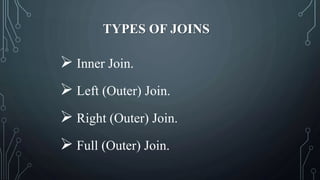
TYPES OF JOINS
 Inner Join.
 Left (Outer) Join.
 Right (Outer) Join.
 Full (Outer) Join.
INNER JOIN
•The most important and frequently used of the joins is
the INNER JOIN.
•They are also referred to as an EQUIJOIN.
•The basic syntax of the INNER JOIN is as follows.
SELECT table1.column1, table2.column2...
FROM table1
INNER JOIN table2
ON table1.common_field =
table2.common_field;
SQL Joins Basic and Fundamentals

SQL Joins Basic and Fundamentals

  • 1.
    Maharashtra Institute of Technology Name:Pratik Haridas Khodwe Database Management System CSE254
  • 2.
    PPT PRESENTATION •Presentation Topic: SQL Joins Guided By Prof. Daivshala Deshmukh Mam
  • 3.
    AGENDA  INTRODUCTION TOTHE SQL  BASIC CONCEPTS OF SQL  JOINS IN SQL  TYPES OF JOINS IN SQL  SOME FAQ’S
  • 4.
    WHAT IS SQL? • SQL is a database computer language designed for the retrieval and management of data in a relational database. • SQL stands for Structured Query Language. • RDBMS stands for Relational Database Management System. • All the Relational Database Management Systems (RDMS) like MySQL, MS Access, Oracle, Sybase, Informix, Postgres and SQL Server use SQL as their standard database language.
  • 5.
    BASIC CONCEPTS OFSQL The data in an RDBMS is stored in database objects which are called as tables. Every table is broken up into smaller entities called fields which are also known as column. A record or tuple is also called as a row of data is each individual entry that exists in a table. A NULL value in a table is a value in a field that appears to be blank, which means a field with a NULL value is a field with no value.
  • 6.
    JOINS IN SQL •Asthe name shows, JOIN means to combine something. •The SQL Joins clause is used to combine records from two or more tables in a database. •The SQL JOIN clause takes records from two or more tables in a database and combines it together.
  • 7.
    WHY JOIN ISUSED IN SQL •If you want to access more than one table through a select statement. •If you want to combine two or more table then SQL JOIN statement is used . •It combines rows of that tables in one table and one can retrieve the information by a SELECT statement. •The joining of two or more tables is based on common field between them.
  • 8.
    TYPES OF JOINS Inner Join.  Left (Outer) Join.  Right (Outer) Join.  Full (Outer) Join.
  • 9.
    INNER JOIN •The mostimportant and frequently used of the joins is the INNER JOIN. •They are also referred to as an EQUIJOIN. •The basic syntax of the INNER JOIN is as follows. SELECT table1.column1, table2.column2... FROM table1 INNER JOIN table2 ON table1.common_field = table2.common_field;